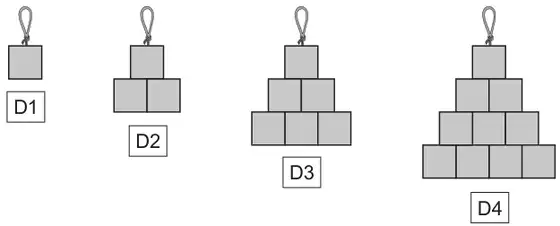
9. Ollie and Josef both have jobs in a workshop that makes decorations.
They make decorations using small squares of stained glass.
(a) Ollie has made the following decorations.
He labels the first decoration D1. He labels the next 3 decorations in order, D2, D3 and D4.
He continues to make decorations and labels following this pattern.
(i) After making decoration D5, Ollie notices he only has 10 small squares of stained glass left. How many more squares of stained glass will Ollie need to make decoration D6? [2]
(ii) Ollie uses a rule to work out how many squares he needs for each decoration. He states that to make decoration D10 he would need 55 squares. Is Ollie correct? You must show your working. [1]
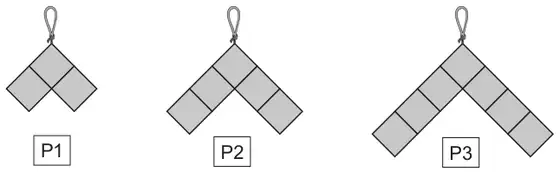
(b) Josef has made the following three decorations using small squares of stained glass.
Josef labels these patterns P1, P2 and P3 in order.
Josef continues to make decorations following the pattern he has started.
(i) How many more squares would he need to make pattern P22 than to make pattern P18? [1]
(ii) Josef has 22 squares.
Josef states,
‘I think I can make one complete decoration using all 22 squares, with none left over.’
Is Josef correct?
Yes ☐ No ☐
Give a reason for your answer. [1]
(iii) Each small square of stained glass measures 0·5 cm by 0·5 cm. The perimeter of one of Josef’s decorations is 10 cm. Complete the label that Josef would use for this decoration. [2]
P ……………
Mark scheme (a)
Scheme
Marks
Comments
(i) (Needs a further) 11 (squares)
B2
B1 for sight of 6+5+4+3+2+1 or 21squares
(ii) States or implies ‘correct’ with sight of, e.g.
10+9+8+7+6+5+4+3+2+1, or
… 21, 28, 36, 45, 55, or
… +7, +8, +9, +10
5 × (10 + 1)
B1
CAO Do not accept any contradictions, e.g. an incorrect answer for the correct sum, i.e. 10+9+8+7+6+5+4+3+2+1 with an answer other than 55
Allow ‘correct’ with D10 diagram drawn in the answer space
Mark scheme (b)
Scheme
Marks
Comments
(i) 8
B1
(ii) States or implies ‘No’ with a reason, e.g. ‘all Josef’s patterns have an odd number of squares’, ‘same number on each branch from the one top square makes it an odd number’, ‘one square left over’, ‘one square short’, ‘one more needed’, ‘the arms would be unequal (in length)’, ’22 is even’, ‘P10 is (made using) 21 (squares), P11 is (made using) 23 (squares)’, ‘he would only be able to make a pattern with 21 squares’
E1
Do not accept ‘No’ with, e.g. ‘too many squares’, ’22 is not part of the pattern’, ‘it is unequal’
(iii) P4
B2
Allow P = 4 B1 for sight of 10÷0.5 or 20 (small square edges) or shows 5 squares on each side (stated or diagram in the answer space for (b)(iii)) B0 for P20 unless sight of 10÷0.5 (which is awarded B1)
We'd like to use Google Analytics cookies to count visits and see which pages help most. They're optional, and the site works exactly the same either way. Privacy policy