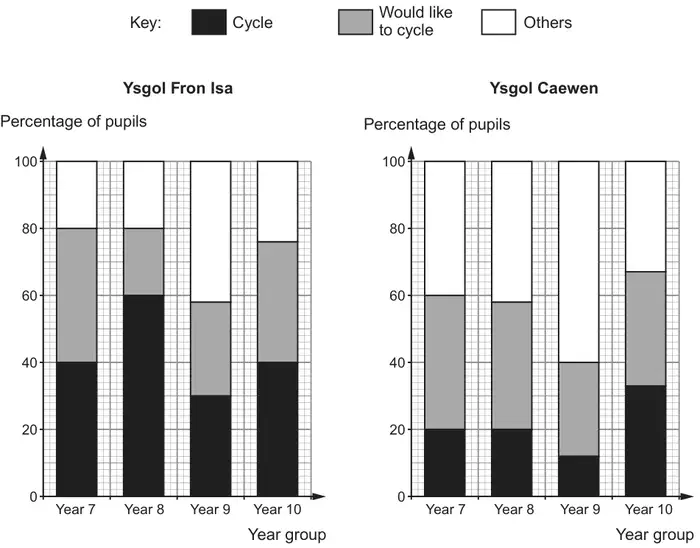
(a) Ysgol Fron Isa and Ysgol Caewen are two very different high schools. One school is large, and in a rural area. The other is a small school in a town. The town in which the small school is situated has many traffic-free cycle routes.
All of the pupils in Years 7 to 10 were surveyed in both of these schools. They were asked the following questions.
Do you cycle to school? Yes ☐ No ☐
If you answered ‘no’, would you like to cycle to school? Yes ☐ No ☐
The results were displayed in graphs, as shown below.
(i) Which school and year group has an approximately equal split between the 3 categories:
pupils who cycle to school,
pupils who would like to cycle to school, and
other pupils? [1]
School: …………… Year Group: ……………
(ii) Circle either TRUE or FALSE for each of the following statements. [3]
There are definitely more pupils in Ysgol Fron Isa who cycle to school than in Ysgol Caewen.
TRUE
FALSE
Both schools have pupils in each year group with no interest in cycling to school.
TRUE
FALSE
The questions asked were biased.
TRUE
FALSE
Approximately 20% of the pupils surveyed in Ysgol Caewen cycle to school.
TRUE
FALSE
It is more likely that it is Ysgol Fron Isa that is the small school situated in a town.
TRUE
FALSE
(b) In January 2011, there were 1200 miles of National Cycle Network (NCN) routes in Wales. In January 2016, there were 1400 miles of NCN routes in Wales.
(i) If the number of miles of NCN routes in Wales were to continue to increase by the same number of miles per year, how many miles of cycle routes would there be in January 2018? [2]
(ii) Why is your answer in (i) unlikely to be an accurate estimate of the number of miles of NCN routes in Wales in January 2018? [1]
Mark scheme (a)
Scheme
Marks
Comments
(i) (Ysgol) Caewen and (Year Group) 10
B1
(ii) FALSE TRUE FALSE TRUE TRUE
B3
All 5 correct
B2 for any 4 correct B1 for any 3 correct
Mark scheme (b)
Scheme
Marks
Comments
(i) 1480 (miles)
B2
B1 for sight of any one of
200 ÷ 5
40 (miles) in 1 year
80 (miles in 2 years)
B0 for an answer for 2018 as 1600 (miles) Ignore statement of incorrect unit, such as km for miles
(ii) Reason suggesting rate of increase not necessarily linear, e.g. ‘unlikely to be a constant rate of increase’, ‘not a uniform pattern each year’, ‘they can vary’, ‘because there can be more one year than another year’, ‘it is a total over 5 years so the number each year can increase or decrease’, ‘not the same miles every time’, ‘there could be more routes in different years’, ‘don’t know what will happen’, ‘because this is just an estimate based on previous data’, ‘cycling becoming more popular, rate may increase because of it’, ‘could have run out of money’
E1
Do not allow if additional incorrect statements are made
Allow, e.g. ‘because it can change’, ‘perhaps they have not built any more since 2016’, ‘cycling becoming more popular’, ‘January 2018 hasn’t happened yet’
We'd like to use Google Analytics cookies to count visits and see which pages help most. They're optional, and the site works exactly the same either way. Privacy policy