25 In London, 2 kg of carrots cost £3.75 In New York, 5 lbs of carrots cost 4.90 US dollars.
£1 = 1.20 US dollars 1 kg = 2.2 lbs
In which city are carrots better value for money, London or New York? You must show how you get your answer. (4)
Mark scheme
Answer
Mark
Mark scheme
New York (supported)
P1
for a conversion between kg and lbs, eg \(2 \times 2.2\ (= 4.4)\) or \(5 \div 2.2\ (= 2.27\ldots)\)
P1
for a conversion between pounds and US dollars, eg \(3.75 \times 1.2(0)\ (= 4.50)\) or \(4.9(0) \div 1.2(0)\ (= 4.08\ldots)\)
P1
for a process to find figures to compare, eg \(3.75 \div \text{``}4.4\text{''}\ (= 0.85\ldots)\) and \(\text{``}4.08\ldots\text{''} \div 5\ (= 0.81(6\ldots))\) or \(\text{``}4.50\text{''} \div 2\ (= 2.25)\) and \(4.9(0) \div \text{``}2.27\ldots\text{''}\ (= 2.15(6\ldots))\) or \(\text{``}4.4\text{''} \div 3.75\ (= 1.17\ldots)\) and \(5 \div \text{``}4.08\text{''}\ (= 1.22\ldots)\) or \(2 \div \text{``}4.5\text{''}\ (= 0.44\ldots)\) and \(\text{``}2.27\text{''} \div 4.9(0)\ (= 0.46\ldots)\)
C1
for New York with correct comparable figures, eg 0.85 and 0.81(6…) OR 2.25 and 2.15(6…)
Additional guidance
See page at end of mark scheme
£ per lb US dollars per kg lbs per £ kg per US dollar
Condone the incorrect assignment of units for all 3 P marks
Final comparable values can be truncated or rounded, they just need to be accurate enough to allow a comparison
Question 25 – Additional information - NOT Exhaustive
Final comparable values can be truncated or rounded and just need to be accurate enough to allow a comparison
Cost per lb in \(\$\): \(2 \times 2.2\ (= 4.4)\) \(3.75 \times 1.2(0)\ (= 4.5)\) \(\text{``}4.5\text{''} \div \text{``}4.4\text{''}\ (= 1.02\ldots)\) and \(4.9(0) \div 5\ (= 0.98)\) New York and 1.02… and 0.98
Cost per lb in £: \(2 \times 2.2\ (= 4.4)\) \(4.9(0) \div 1.2(0)\ (= 4.08\ldots)\) \(3.75 \div \text{``}4.4\text{''}\ (= 0.85\ldots)\) and \(\text{``}4.08\ldots\text{''} \div 5\ (= 0.81(6\ldots))\) New York and 0.85… and 0.81(6…)
Cost per kg in \(\$\): \(5 \div 2.2\ (= 2.27\ldots)\) \(3.75 \times 1.2(0)\ (= 4.5)\) \(\text{``}4.5\text{''} \div 2\ (= 2.25)\) and \(4.9(0) \div \text{``}2.27\ldots\text{''}\ (= 2.15(6))\) New York and 2.25 and 2.15(6)
Cost per kg in £: \(5 \div 2.2\ (= 2.27\ldots)\) \(4.9(0) \div 1.2(0)\ (= 4.08\ldots)\) \(3.75 \div 2\ (= 1.87(5))\) and \(\text{``}4.08\ldots\text{''} \div \text{``}2.27\ldots\text{''}\ (= 1.79(6\ldots))\) New York and 1.87(5) and 1.79(6…)
Number of lbs per \(\$\): \(2 \times 2.2\ (= 4.4)\) \(3.75 \times 1.2(0)\ (= 4.5)\) \(\text{``}4.4\text{''} \div \text{``}4.5\text{''}\ (= 0.97(7\ldots))\) and \(5 \div 4.9(0)\ (= 1.02\ldots)\) New York and 0.97(7…) and 1.02…
Number of lbs per £: \(2 \times 2.2\ (= 4.4)\) \(4.9(0) \div 1.2(0)\ (= 4.08\ldots)\) \(\text{``}4.4\text{''} \div 3.75\ (= 1.17\ldots)\) and \(5 \div \text{``}4.08\ldots\text{''}\ (= 1.22\ldots)\) New York and 1.17… and 1.22…
Number of kg per \(\$\): \(5 \div 2.2\ (= 2.27\ldots)\) \(3.75 \times 1.2(0)\ (= 4.5)\) \(2 \div \text{``}4.5\text{''}\ (= 0.44\ldots)\) and \(\text{``}2.27\ldots\text{''} \div 4.9(0)\ (= 0.46\ldots)\) New York and 0.44… and 0.46…
Number of kg per £: \(5 \div 2.2\ (= 2.27\ldots)\) \(4.9(0) \div 1.2(0)\ (= 4.08\ldots)\) \(2 \div 3.75\ (= 0.53\ldots)\) and \(\text{``}2.27\ldots\text{''} \div \text{``}4.08\ldots\text{''}\ (= 0.55(6\ldots))\) New York and 0.53… and 0.55(6…)
Cost of 5 lb in \(\$\): \(2 \times 2.2\ (= 4.4)\) \(3.75 \times 1.2(0)\ (= 4.5)\) \(\text{``}4.5\text{''} \div \text{``}4.4\text{''} \times 5\ (= 5.11\ldots)\) New York and 5.11…
Cost of 5 lb in £: \(2 \times 2.2\ (= 4.4)\) \(4.9(0) \div 1.2(0)\ (= 4.08\ldots)\) \(3.75 \div \text{``}4.4\text{''} \times 5\ (= 4.26\ldots)\) New York and 4.08… and 4.26…
Cost of 2 kg in \(\$\): \(5 \div 2.2\ (= 2.27\ldots)\) \(3.75 \times 1.2(0)\ (= 4.5)\) \(4.9(0) \div \text{``}2.27\ldots\text{''} \times 2\ (= 4.31\ldots)\) New York and 4.5 and 4.31…
Cost of 2 kg in £: \(5 \div 2.2\ (= 2.27\ldots)\) \(4.9(0) \div 1.2(0)\ (= 4.08\ldots)\) \(\text{``}4.08\ldots\text{''} \div \text{``}2.27\ldots\text{''} \times 2\ (= 3.59\ldots)\) New York and 3.59…
22 There are 280 chocolates in a box. There are only dark chocolates, milk chocolates and white chocolates.
\(\dfrac{1}{7}\) of the 280 chocolates are dark chocolates.
The number of milk chocolates : the number of white chocolates = 1 : 3
The number of white chocolates : the number of dark chocolates = \(n : 1\)
(a) Work out the value of \(n\). You must show all your working. (5)
10 milk chocolates from the box are eaten.
(b) Does this affect your answer to part (a)? Give a reason for your answer. (1)
Mark scheme (a)
Answer
Mark
Mark scheme
4.5
P1
for a process to find the number of dark chocolates, eg \(280 \times \dfrac{1}{7}\) oe (= 40)
P1
for a process to find one part of the ratio for milk chocolates to white chocolates eg \((280 - \text{``}40\text{''}) \div (1 + 3)\ (= 60)\)
P1
for process to find the number of white chocolates, eg \(\text{``}60\text{''} \times 3\ (= 180)\) or \(280 - \text{``}40\text{''} - \text{``}60\text{''}\ (= 180)\)
P1
for a ratio of white chocolates : dark chocolates eg \(\text{``}180\text{''} : \text{``}40\text{''}\) oe or for a process to find the value of \(n\) eg \(\text{``}180\text{''} \div \text{``}40\text{''}\)
A1
(dep P3) for 4.5 oe
Additional guidance
Condone milk, white incorrectly labelled
Labels not required for this mark, but if seen must be correct Must be a 2-part ratio. Allow \(\text{``}40\text{''} : \text{``}180\text{''}\) if labelled as dark chocolate : white chocolate oe
A correct answer with no supportive working gets 0 marks Condone answer of 4.5:1
Mark scheme (b)
Answer
Mark
Mark scheme
No with reason
C1
for No with reason Acceptable examples No, the number of dark chocolates and white chocolates has not changed No, the ratio of \(n\):1 only involved white and dark chocolates No, eating milk chocolates doesn’t change the rest No, the ratio of dark to white chocolates doesn’t change. Not acceptable examples Yes,… No, it doesn’t matter how many milk chocolates are eaten No, the number of white chocolates doesn’t change No, the number of dark chocolates doesn’t change
Additional guidance
Reason must refer to or imply both dark and white chocolates
21 Sid, Tam and Musa share £6900 in the ratio 2 : 3 : 5
Work out how much money each person receives. (3)
Mark scheme
Answer
Mark
Mark scheme
1380 2070 3450
M1
for beginning to work with ratio, eg \(6900 \div (2 + 3 + 5)\ (= 690)\) or \(6900 \div 2\ (= 3450)\) or \(6900 \div 5\ (= 1380)\) or one accurate value correctly assigned
M1
for full method to find the value for two people, eg two of: \(\text{``}690\text{''} \times 2\ (= 1380)\) or \(\text{``}690\text{''} \times 3\ (= 2070)\) or \(\text{``}690\text{''} \times 5\ (= 3450)\) or \((6900 - \text{``}3450\text{''}) \div 5 \times 2\ (= 1380)\) or \((6900 - \text{``}3450\text{''}) \div 5 \times 3\ (= 2070)\) or \((6900 - \text{``}1380\text{''}) \div 8 \times 3\ (= 2070)\) or \((6900 - \text{``}1380\text{''}) \div 8 \times 5\ (= 3450)\) or \(6900 \div 2\ (= 3450)\) and \(6900 \div 5\ (= 1380)\)
A1
for Sid (£) 1380 Tam (£) 2070 Musa (£) 3450
If M1M0, award SCB2 for Sid (£) 3450 Tam (£) 2070 Musa (£) 1380
Additional guidance
Award M0 for a correct value assigned to an incorrect person
Award M0 for a correct value assigned to an incorrect person
Correct values not assigned or assigned to an incorrect person, coming from an incorrect method, eg (Sid =) \(6900 \div 2 = 3450\) and (Tam =) \(6900 \div 3 = 2300\) and (Musa =) \(6900 \div 5 = 1380\) will score no marks
17 Sam wants to use this recipe to make 15 pancakes.
Ingredients for 10 pancakes
100 g flour 200 m\(l\) milk 40 g butter 2 eggs
Sam has 200 g flour 250 m\(l\) milk 70 g butter 5 eggs
Does Sam have enough flour, enough milk, enough butter and enough eggs to make 15 pancakes? You must show all your working. (3)
Mark scheme
Answer
Mark
Mark scheme
No, not enough milk (supported)
Process to find amount needed (starting from recipe quantities)
P1
for a correct process to find amount needed of one ingredient, eg \(100 \div 10 \times 15\) oe (= 150) or \(200 \div 10 \times 15\) oe (= 300) or \(100 \div 2 + 100\ (= 150)\) or \(200 \div 2 + 200\ (= 300)\) or \(40 \div 2 \times 3\) oe (= 60) or \(2 \div 2 \times 3\) oe (= 3) or scale factor of 1.5 seen
P1
for a correct process to find amount needed of all the ingredients, eg \(100 \div 10 \times 15\) oe (= 150) and \(200 \div 10 \times 15\) oe (= 300) and \(40 \div 10 \times 15\) oe (= 60) and \(2 \div 10 \times 15\) oe (= 3)
C1
for statement that there is not enough milk with supporting evidence
OR Process to find quantity of pancakes that can be made (working from the quantities of ingredients available)
P1
for a correct process to find the number of pancakes that can be made with one ingredient, eg \(200 \div 100 \times 10\) oe (= 20) or \(250 \div 200 \times 10\) oe (= 12.5) or \(70 \div 40 \times 10\) oe (= 17.5) or \(5 \div 2 \times 10\) oe (= 25)
P1
for a correct process to find the number of pancakes all ingredients could produce eg \(200 \div 100 \times 10\) oe (= 20) and \(250 \div 200 \times 10\) oe (= 12.5) and \(70 \div 40 \times 10\) oe (= 17.5) and \(5 \div 2 \times 10\) oe (= 25)
C1
for statement that there is not enough milk with supporting evidence
Additional guidance
C1 (both methods): Must have correct figures for all ingredients, but it is not necessary to comment on the other ingredients. Any comment on the other ingredients must be correct.
Second method, first P1: Award this mark for a complete process to find the amount of ingredients for a quantity of pancakes that uses all of one of the ingredients eg process to find amount of ingredients for 20 pancakes (flour).
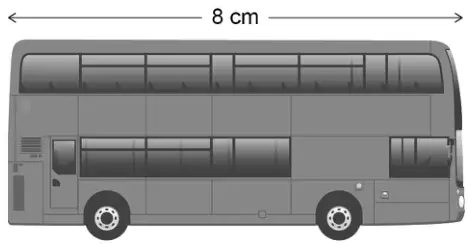
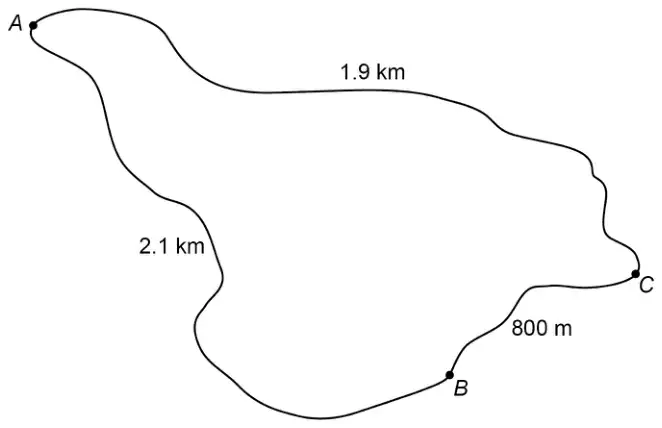
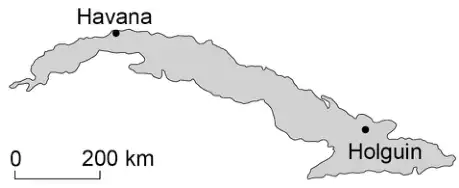
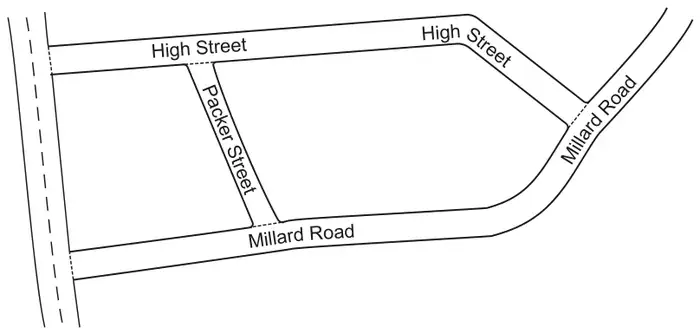
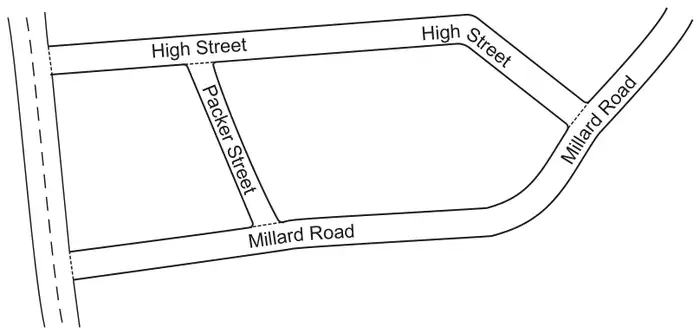
The road is shown on a map with a scale of 1 : 20 000
Work out the length, in centimetres, of this road on the map. (3)
Mark scheme
Answer
Mark
Mark scheme
8
M1
for unit conversion for \(1.6 \times 100\,000\ (= 160\,000\text{ (cm)})\) or \(1.6 \times 1000\ (= 1600\text{ (m)})\) or for \(20\,000 \div 100\,000\ (= 0.2)\) or \(20\,000 \div 100\ (= 200)\) or \(20\,000 \div 1000\ (= 20)\) or \(\text{``}0.00008\text{''} \times 1000\ (= 0.08)\) or \(\text{``}0.00008\text{''} \times 100\,000\ (= 8)\)
M1
for use of scale [distance] \(\div\, 20\,000\) or \(1.6 \div \text{``}0.2\text{''}\) or \(16 \div (\text{``}0.2\text{''} \times 10)\) or \(1.6 \div \text{``}20\text{''}\ (= 0.08)\) or \(\text{``}1600\text{''} \div \text{``}200\text{''}\ (= 8)\) or \(1.6 \div 20\,000\ (= 0.00008)\)
A1
cao
Additional guidance
ie conversions to cm or m Do not award if conversion linked to incorrect unit eg \(1.6 \times 1000 = 1600\) cm Answer of 160 000 centimetres scores M1M0A0
Where [distance] is an attempt at converting km to m or cm, ie figs 16
4 There are 280 chocolates in a box. There are only dark chocolates, milk chocolates and white chocolates.
\(\dfrac{1}{7}\) of the 280 chocolates are dark chocolates.
The number of milk chocolates : the number of white chocolates = 1 : 3
The number of white chocolates : the number of dark chocolates = \(n : 1\)
(a) Work out the value of \(n\). You must show all your working. (5)
10 milk chocolates from the box are eaten.
(b) Does this affect your answer to part (a)? Give a reason for your answer. (1)
Mark scheme (a)
Answer
Mark
Mark scheme
4.5
P1
for a process to find the number of dark chocolates, eg \(280 \times \dfrac{1}{7}\) oe (= 40)
P1
for a process to find one part of the ratio for milk chocolates to white chocolates eg \((280 - \text{``}40\text{''}) \div (1 + 3)\ (= 60)\)
P1
for a process to find the number of white chocolates, eg \(\text{``}60\text{''} \times 3\ (= 180)\) or \(280 - \text{``}40\text{''} - \text{``}60\text{''}\ (= 180)\)
P1
for a ratio of white chocolates : dark chocolates eg \(\text{``}180\text{''} : \text{``}40\text{''}\) oe or for a process to find the value of \(n\) eg \(\text{``}180\text{''} \div \text{``}40\text{''}\)
A1
(dep P3) for 4.5 oe
Additional guidance
Condone milk, white incorrectly labelled
Labels not required for this mark, but if seen must be correct Must be a 2-part ratio Allow \(\text{``}40\text{''} : \text{``}180\text{''}\) if labelled as dark chocolate : white chocolate oe
A correct answer with no supportive working gets 0 marks Condone answer of 4.5 : 1
Mark scheme (b)
Answer
Mark
Mark scheme
No with reason
C1
for No with reason Acceptable examples No, the number of dark chocolates and white chocolates has not changed No, the ratio of \(n\):1 only involved white and dark chocolates No, eating milk chocolates doesn’t change the rest No, the ratio of dark to white chocolates doesn’t change Not acceptable examples Yes,… No, it doesn’t matter how many milk chocolates are eaten No, the number of white chocolates doesn’t change No, the number of dark chocolates doesn’t change
Additional guidance
Reason must refer to or imply both dark and white chocolates
4 In London, 2 kg of carrots cost £3.75 In New York, 5 lbs of carrots cost 4.90 US dollars.
£1 = 1.20 US dollars 1 kg = 2.2 lbs
In which city are carrots better value for money, London or New York? You must show how you get your answer. (4)
Mark scheme
Answer
Mark
Mark scheme
New York (supported)
P1
for a conversion between kg and lbs, eg \(2 \times 2.2\ (= 4.4)\) or \(5 \div 2.2\ (= 2.27\ldots)\)
P1
for a conversion between pounds and US dollars, eg \(3.75 \times 1.2(0)\ (= 4.50)\) or \(4.9(0) \div 1.2(0)\ (= 4.08\ldots)\)
P1
for a process to find figures to compare, eg \(3.75 \div \text{``}4.4\text{''}\ (= 0.85\ldots)\) and \(\text{``}4.08\ldots\text{''} \div 5\ (= 0.81(6\ldots))\) or \(\text{``}4.50\text{''} \div 2\ (= 2.25)\) and \(4.9(0) \div \text{``}2.27\ldots\text{''}\ (= 2.15(6\ldots))\) or \(\text{``}4.4\text{''} \div 3.75\ (= 1.17\ldots)\) and \(5 \div \text{``}4.08\text{''}\ (= 1.22\ldots)\) or \(2 \div \text{``}4.5\text{''}\ (= 0.44\ldots)\) and \(\text{``}2.27\text{''} \div 4.9(0)\ (= 0.46\ldots)\)
C1
for New York with correct comparable figures, eg 0.85… and 0.81(6…) OR 2.25 and 2.15(6…)
Additional guidance
See page at end of mark scheme
£ per lb US dollars per kg lbs per £ kg per US dollar
Condone the incorrect assignment of units for all 3 P marks
Final comparable values can be rounded or truncated, they just need to be accurate enough to allow a comparison.
Question 4 – Additional information NOT Exhaustive
Final comparable values, can be truncated or rounded, they just need to be accurate enough to allow a comparison
Cost per lb in \(\$\): \(2 \times 2.2\ (= 4.4)\) \(3.75 \times 1.2(0)\ (= 4.5)\) \(\text{``}4.5\text{''} \div \text{``}4.4\text{''}\ (= 1.02\ldots)\) and \(4.9(0) \div 5\ (= 0.98)\) New York and 1.02… and 0.98
Cost per lb in £: \(2 \times 2.2\ (= 4.4)\) \(4.9(0) \div 1.2(0)\ (= 4.08\ldots)\) \(3.75 \div \text{``}4.4\text{''}\ (= 0.85\ldots)\) and \(\text{``}4.08\ldots\text{''} \div 5\ (= 0.81(6\ldots))\) New York and 0.85… and 0.81(6…)
Cost per kg in \(\$\): \(5 \div 2.2\ (= 2.27\ldots)\) \(3.75 \times 1.2(0)\ (= 4.5)\) \(\text{``}4.5\text{''} \div 2\ (= 2.25)\) and \(4.9(0) \div \text{``}2.27\ldots\text{''}\ (= 2.15(6))\) New York and 2.25 and 2.15(6)
Cost per kg in £: \(5 \div 2.2\ (= 2.27\ldots)\) \(4.9(0) \div 1.2(0)\ (= 4.08\ldots)\) \(3.75 \div 2\ (= 1.87(5))\) and \(\text{``}4.08\ldots\text{''} \div \text{``}2.27\ldots\text{''}\ (= 1.79(6\ldots))\) New York and 1.87(5) and 1.79(6…)
Number of lbs per \(\$\): \(2 \times 2.2\ (= 4.4)\) \(3.75 \times 1.2(0)\ (= 4.5)\) \(\text{``}4.4\text{''} \div \text{``}4.5\text{''}\ (= 0.97(7\ldots))\) and \(5 \div 4.9(0)\ (= 1.02\ldots)\) New York and 0.97(7…) and 1.02…
Number of lbs per £: \(2 \times 2.2\ (= 4.4)\) \(4.9(0) \div 1.2(0)\ (= 4.08\ldots)\) \(\text{``}4.4\text{''} \div 3.75\ (= 1.17\ldots)\) and \(5 \div \text{``}4.08\ldots\text{''}\ (= 1.22\ldots)\) New York and 1.17… and 1.22…
Number of kg per \(\$\): \(5 \div 2.2\ (= 2.27\ldots)\) \(3.75 \times 1.2(0)\ (= 4.5)\) \(2 \div \text{``}4.5\text{''}\ (= 0.44\ldots)\) and \(\text{``}2.27\ldots\text{''} \div 4.9(0)\ (= 0.46\ldots)\) New York and 0.44… and 0.46…
Number of kg per £: \(5 \div 2.2\ (= 2.27\ldots)\) \(4.9(0) \div 1.2(0)\ (= 4.08\ldots)\) \(2 \div 3.75\ (= 0.53\ldots)\) and \(\text{``}2.27\ldots\text{''} \div \text{``}4.08\ldots\text{''}\ (= 0.55(6\ldots))\) New York and 0.53… and 0.55(6…)
Cost of 5 lb in \(\$\): \(2 \times 2.2\ (= 4.4)\) \(3.75 \times 1.2(0)\ (= 4.5)\) \(\text{``}4.5\text{''} \div \text{``}4.4\text{''} \times 5\ (= 5.11\ldots)\) New York and 5.11…
Cost of 5 lb in £: \(2 \times 2.2\ (= 4.4)\) \(4.9(0) \div 1.2(0)\ (= 4.08\ldots)\) \(3.75 \div \text{``}4.4\text{''} \times 5\ (= 4.26\ldots)\) New York and 4.08… and 4.26…
Cost of 2 kg in \(\$\): \(5 \div 2.2\ (= 2.27\ldots)\) \(3.75 \times 1.2(0)\ (= 4.5)\) \(4.9(0) \div \text{``}2.27\ldots\text{''} \times 2\ (= 4.31\ldots)\) New York and 4.5 and 4.31…
Cost of 2 kg in £: \(5 \div 2.2\ (= 2.27\ldots)\) \(4.9(0) \div 1.2(0)\ (= 4.08\ldots)\) \(\text{``}4.08\ldots\text{''} \div \text{``}2.27\ldots\text{''} \times 2\ (= 3.59\ldots)\) New York and 3.59…
2 Sid, Tam and Musa share £6900 in the ratio 2 : 3 : 5
Work out how much money each person receives. (3)
Mark scheme
Answer
Mark
Mark scheme
1380 2070 3450
M1
for beginning to work with ratio, eg \(6900 \div (2 + 3 + 5)\ (= 690)\) or \(6900 \div 2\ (= 3450)\) or \(6900 \div 5\ (= 1380)\) or one accurate value correctly assigned
M1
for full method to find the value for two people, eg two of: \(\text{``}690\text{''} \times 2\ (= 1380)\) or \(\text{``}690\text{''} \times 3\ (= 2070)\) or \(\text{``}690\text{''} \times 5\ (= 3450)\) or \((6900 - \text{``}3450\text{''}) \div 5 \times 2\ (= 1380)\) or \((6900 - \text{``}3450\text{''}) \div 5 \times 3\ (= 2070)\) or \((6900 - \text{``}1380\text{''}) \div 8 \times 3\ (= 2070)\) or \((6900 - \text{``}1380\text{''}) \div 8 \times 5\ (= 3450)\) or \(6900 \div 2\ (= 3450)\) and \(6900 \div 5\ (= 1380)\)
A1
for Sid (£) 1380 Tam (£) 2070 Musa (£) 3450
If M1M0, award SCB2 for Sid (£) 3450 Tam (£) 2070 Musa (£) 1380
Additional guidance
Award M0 for a correct value assigned to an incorrect person
Award M0 for a correct value assigned to an incorrect person
Correct values not assigned or assigned to an incorrect person, coming from an incorrect method, eg (Sid =) \(6900 \div 2 = 3450\) and (Tam =) \(6900 \div 3 = 2300\) and (Musa =) \(6900 \div 5 = 1380\) will score no marks
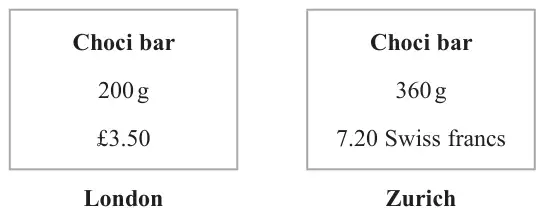
In London, a 200 g Choci bar costs £3.50 In Zurich, a 360 g Choci bar costs 7.20 Swiss francs.
The exchange rate is £1 = 1.25 Swiss francs.
In which city is the Choci bar the better value for money, in London or in Zurich? You must show how you get your answer. (3)
Mark scheme
Answer
Mark
Mark scheme
Zurich (supported)
P1
for one process to compare, eg eg Currency conversion, \(3.5 \times 1.25\ (= 4.375)\) or \(7.20 \div 1.25\ (= 5.76)\) or finds 1g in one place £3.50 \(\div 200\ (= 0.0175)\) or \(7.20 \div 360\ (= 0.02)\) or finds 200g in Zurich, \(7.2 \div 360 \times 200\ (= 4.0)\) or finds 360g in London, \(3.5 \div 200 \times 360\ (= 6.30)\) or finds grams per unit cost, \(200 \div 3.50\ (= 57.1\ldots)\) or \(360 \div 7.20\ (= 50)\)
P1
for a complete process to find comparable figures in the same currency, eg comparing 200g in £ or francs \(3.5 \times 1.25\ (= 4.375)\) and \(7.2 \div 360 \times 200\ (= 4.0)\) or \(\text{``}4.0\text{''} \div 1.25\ (= 3.20)\)
OR comparing 360g in £ or francs \(\text{``}6.30\text{''} \times 1.25\ (= 7.875)\) or \(3.5 \div 200 \times 360\ (= 6.30)\) and \(7.20 \div 1.25\ (= 5.76)\)
OR comparing 1g in £ or francs \(\text{``}0.0175\text{''} \times 1.25\ (= 0.0218\ldots)\) and \(7.20 \div 360\ (= 0.02)\) or £3.50 \(\div 200\ (= 0.0175)\) and \(\text{``}0.02\text{''} \div 1.25\ (= 0.016)\)
OR comparing quantity per unit cost in £ or francs \(200 \div 3.50\ (= 57.1\ldots)\) and \(360 \div \text{``}5.76\text{''}\ (= 62.5)\) or \(200 \div \text{``}4.375\text{''}\ (= 45.7\ldots)\) and \(360 \div 7.20\ (= 50)\)
C1
for Zurich supported by correct comparable values, eg 4.3(75 F) and 4(.0 F) or (£)3.2(0) or 7.8(75 F) or (£)6.3(0) and (£)5.76 or 0.021(8… F) and 0.02 (F) or (£)0.017(5) and (£)0.016 or 57(.1… g/£) and 62(.5 g/£) or 45(.7… g/F) and 50 (g/F)
Additional guidance
Accept figures rounded or truncated to 2sf throughout
Accept working in pence Ignore incorrect units for P marks Award of this mark implies the previous mark
Clear indication that bar is better value for money in Zurich supported by correct values for comparison Units not needed but if stated must be correct. Table with examples at end of mark scheme
21 Robyn buys a total of 240 pens and pencils, where
number of pens : number of pencils = 3 : 5
Robyn pays 9p for each pen. She sells each pen for 11p.
Robyn pays 6p for each pencil. She sells each pencil for 10p.
Robyn sells all of the pens and pencils.
Work out Robyn’s percentage profit. Give your answer correct to 1 decimal place. You must show all your working. (5)
Mark scheme
Answer
Mark
Mark scheme
45.6
P1
for a process to start to work with the ratio, eg \(240 \div (3 + 5)\ (= 30)\) or pens \(= 3n\) and pencils \(= 5n\) where \(n\) is a positive integer
P1
for a complete process to find the number of pens and pencils, eg \(\text{``}30\text{''} \times 3\ (= 90)\) and \(\text{``}30\text{''} \times 5\ (= 150)\) OR for process to find one cost or amount to sell for one item eg \([\text{pens}] \times 9\ (= 810)\) or \([\text{pens}] \times 11\ (= 990)\) or \([\text{pencils}] \times 6\ (= 900)\) or \([\text{pencils}] \times 10\ (= 1500)\) OR for process to find the profit for one pen or one pencil eg \(11 - 9\ (= 2)\) or \(10 - 6\ (= 4)\)
P1
for a process to find the total cost to buy or the total amount to sell for both, eg \([\text{pens}] \times 9 + [\text{pencils}] \times 6\ (= 1710)\) or \([\text{pens}] \times 11 + [\text{pencils}] \times 10\ (= 2490)\) OR process to find the profit for one item eg \([\text{pens}] \times 11 - [\text{pens}] \times 9\ (= 180)\) or \([\text{pens}] \times (11 - 9)\ (= 180)\) or \([\text{pencils}] \times 10 - [\text{pencils}] \times 6\ (= 600)\) or \([\text{pencils}] \times (10 - 6)\ (= 600)\)
P1
for a complete process to find the profit as a percentage or a decimal, eg \(\dfrac{[2490] - [1710]}{[1710]} \times 100\) or \(\dfrac{[2490] - [1710]}{[1710]}\ (= 0.456\ldots)\) or for a process to find the amount to sell as a percentage of the cost eg \(\dfrac{[2490]}{[1710]} \times 100\ (= 145.6\ldots)\)
A1
answer in the range 45.6 to 45.62
Additional guidance
Can work in £ or pence but must be consistent, 90 or 150 imply P1 This mark can be awarded at any stage
[pens] could be \(\text{``}30\text{''} \times 3\) or their number of pens [pencils] could be \(\text{``}30\text{''} \times 5\) or their number of pencils [pens], [pencils] \(\neq 1\)
180 or 600 or 780 implies P3
[2490] is their amount to sell for both pens and pencils [1710] is their cost of pens and pencils [2490] – [1710] may be [180] + [600]
If an answer is given in the range in working and then rounded incorrectly award full marks. A correct answer with no supportive working gets 0 marks
18 Maria wants to find an estimate for the number of frogs in a lake.
On Saturday she catches 40 of the frogs. She puts a tag on each frog and releases them.
On Monday she catches 55 of the frogs. 11 of the frogs have tags.
(a) Work out an estimate for the total number of frogs in the lake. You must show all your working. (3)
(b) State one assumption you have made. (1)
Mark scheme (a)
Answer
Mark
Mark scheme
200
P1
for \(\frac{55}{11}\ (= 5)\) or \(\frac{11}{55}\ (= 0.2)\) or \(\frac{40}{11}\ (= 3.63..)\) or \(\frac{11}{40}\ (= 0.275)\) or for starting to use ratio eg tagged : untagged = 11 : 44 oe
P1
for \(\frac{11}{55} = \frac{40}{n}\) or \(\frac{11}{40} = \frac{55}{n}\) or \(\frac{55 \times 40}{11}\) oe or for process to find the number of untagged frogs eg \(\dfrac{55 - 11}{11} \times 40\ (= 160)\)
A1
cao
Additional guidance
Allow decimal values truncated or rounded to at least 2dp
May be seen in ratio eg 40 : 160
A correct answer with no supportive working gets 0 marks.
Mark scheme (b)
Answer
Mark
Mark scheme
Assumption
C1
for a suitable assumption,
Acceptable examples no frogs have left/arrived at the lake no tags have fallen off / no lost tags sample of frogs taken was a random sample / this is a representative sample tagged frogs are distributed around the lake no baby frogs / no frogs have died There are (still) 4 untagged for every tagged frog. The tagged frogs had time to blend into the population. It is a closed environment There aren’t any more frogs in the lake No other frogs in the lake
Not acceptable examples She has caught all the frogs There are lots of frogs. This is the same lake
17 Gita wants to make 24 litres of green paint. She is going to mix blue paint, yellow paint and white paint in the ratio 4 : 3 : 1
She has 12 litres of blue paint 7 litres of yellow paint 5 litres of white paint.
Does Gita have enough blue paint, yellow paint and white paint to make 24 litres of green paint? You must show how you get your answer. (3)
Mark scheme
Answer
Mark
Mark scheme
No, with correct figures
P1
for start to process to find amount of each paint colour needed eg \(24 \div (4 + 3 + 1)\ (= 3)\) or 8 : 6 : 2
or for start to process to simplify 12 : 7 : 5 to a ratio that can be compared to 4 : 3 : 1 eg \(12 \div 4\ (= 3)\) or \(7 \div 3\ (= 2.3\ldots)\) or \(5 \div 1\ (= 5)\)
P1
for complete process to find amount of each paint colour needed eg \(\text{``}3\text{''} \times 4\ (= 12)\) and \(\text{``}3\text{''} \times 3\ (= 9)\) and \(\text{``}3\text{''} \times 1\ (= 3)\) or 12 : 9 : 3
or for complete process to cancel 12 : 7 : 5 to a ratio that can be compared to 4 : 3 : 1 eg 12 : 7 : 5 as \(4 : \text{``}\tfrac{7}{3}\text{''} : \text{``}\tfrac{5}{3}\text{''}\) or \(4 : \text{``}2.3\ldots\text{''} : \text{``}1.6\ldots\text{''}\) or 12 : 7 : 5 as \(\text{``}5\tfrac{1}{7}\text{''} : 3 : \text{``}2\tfrac{1}{7}\text{''}\) or \(\text{``}5.14\ldots\text{''} : 3 : \text{``}2.14\ldots\text{''}\) or 12 : 7 : 5 as \(\text{``}2\tfrac{2}{5}\text{''} : \text{``}1\tfrac{2}{5}\text{''} : 1\) or \(\text{``}2.4\text{''} : \text{``}1.4\text{''} : 1\)
C1
No, with correct figure(s) for comparison. eg No with 12 : 9 : 3 No, 9 litres of yellow needed No with \(4 : 2.3\ldots : 1.6\ldots\)
15 A map has a scale of 1 : \(25\,000\) On the map, a road has a length of 14 cm.
Work out the real length of the road. Give your answer in kilometres. (3)
Mark scheme
Answer
Mark
Mark scheme
3.5
M1
for a correct first step, eg \(14 \times 25\,000\ (= 350\,000)\) or digits 14 \(\times\) digits 25 or \(25\,000 \div 100\,000\ (= 0.25)\) oe or \(14 \div 100\,000\ (= 0.00014)\) or [distance] \(\div\ 100\,000\)
M1
for a complete method, eg \(\text{``}350\,000\text{''} \div 100\,000\) oe or \(\text{``}0.25\text{''} \times 14\) or \(\text{``}0.00014\text{''} \times 25\,000\)
A1
for 3.5 oe
Additional guidance
[distance] is any calculated value using digits 14 and digits 25
5 Robyn buys a total of 240 pens and pencils, where
number of pens : number of pencils = 3 : 5
Robyn pays 9p for each pen. She sells each pen for 11p.
Robyn pays 6p for each pencil. She sells each pencil for 10p.
Robyn sells all of the pens and pencils.
Work out Robyn’s percentage profit. Give your answer correct to 1 decimal place. You must show all your working. (5)
Mark scheme
Answer
Mark
Mark scheme
45.6
P1
for a process to start to work with the ratio, eg \(240 \div (3 + 5)\ (= 30)\) or pens \(= 3n\) and pencils \(= 5n\) where \(n\) is a positive integer
P1
for a complete process to find the number of pens and pencils, eg \(\text{``}30\text{''} \times 3\ (= 90)\) and \(\text{``}30\text{''} \times 5\ (= 150)\) OR for process to find one cost or amount to sell for one item eg \([\text{pens}] \times 9\ (= 810)\) or \([\text{pens}] \times 11\ (= 990)\) or \([\text{pencils}] \times 6\ (= 900)\) or \([\text{pencils}] \times 10\ (= 1500)\) OR process to find the profit for one pen or one pencil eg \(11 - 9\ (= 2)\) or \(10 - 6\ (= 4)\)
P1
for a process to find the total cost to buy or the total amount to sell for both, eg \([\text{pens}] \times 9 + [\text{pencils}] \times 6\ (= 1710)\) or \([\text{pens}] \times 11 + [\text{pencils}] \times 10\ (= 2490)\) OR process to find the profit for one item eg \([\text{pens}] \times 11 - [\text{pens}] \times 9\ (= 180)\) or \([\text{pens}] \times (11 - 9)\ (= 180)\) or \([\text{pencils}] \times 10 - [\text{pencils}] \times 6\ (= 600)\) or \([\text{pencils}] \times (10 - 6)\ (= 600)\)
P1
for a complete process to find the profit as a percentage or a decimal, eg \(\dfrac{[2490] - [1710]}{[1710]} \times 100\) or \(\dfrac{[2490] - [1710]}{[1710]}\ (= 0.456\ldots)\) or for a process to find the amount to sell as a percentage of the cost eg \(\dfrac{[2490]}{[1710]} \times 100\ (= 145.6\ldots)\)
A1
answer in the range 45.6 to 45.62
Additional guidance
Can work in £ or pence but must be consistent, 90 or 150 imply P1 This mark can be awarded at any stage
[pens] could be \(\text{``}30\text{''} \times 3\) or their number of pens [pencils] could be \(\text{``}30\text{''} \times 5\) or their number of pencils [pens], [pencils] \(\neq 1\)
180 or 600 or 780 implies P3
[2490] is their amount to sell for both pens and pencils [1710] is their cost of pens and pencils [2490] – [1710] may be [180] + [600]
If an answer is given in the range in working and then rounded incorrectly award full marks. A correct answer with no supportive working gets 0 marks
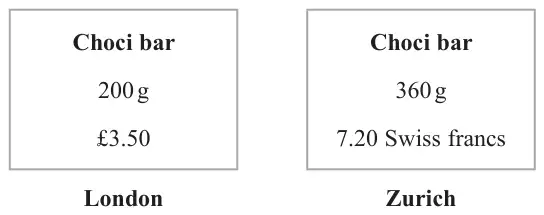
In London, a 200 g Choci bar costs £3.50 In Zurich, a 360 g Choci bar costs 7.20 Swiss francs.
The exchange rate is £1 = 1.25 Swiss francs.
In which city is the Choci bar the better value for money, in London or in Zurich? You must show how you get your answer. (3)
Mark scheme
Answer
Mark
Mark scheme
Zurich (supported)
P1
for one process to compare, eg eg Currency conversion, \(3.5 \times 1.25\ (= 4.375)\) or \(7.20 \div 1.25\ (= 5.76)\) or finds 1g in one place £3.50 \(\div 200\ (= 0.0175)\) or \(7.20 \div 360\ (= 0.02)\) or finds 200g in Zurich, \(7.2 \div 360 \times 200\ (= 4.0)\) or finds 360g in London, \(3.5 \div 200 \times 360\ (= 6.30)\) or finds grams per unit cost, \(200 \div 3.50\ (= 57.1\ldots)\) or \(360 \div 7.20\ (= 50)\)
P1
for a complete process to find comparable figures in the same currency, eg comparing 200g in £ or francs \(3.5 \times 1.25\ (= 4.375)\) and \(7.2 \div 360 \times 200\ (= 4.0)\) or \(\text{``}4.0\text{''} \div 1.25\ (= 3.20)\)
OR comparing 360g in £ or francs \(\text{``}6.30\text{''} \times 1.25\ (= 7.875)\) or \(3.5 \div 200 \times 360\ (= 6.30)\) and \(7.20 \div 1.25\ (= 5.76)\)
OR comparing 1g in £ or francs \(\text{``}0.0175\text{''} \times 1.25\ (= 0.0218\ldots)\) and \(7.20 \div 360\ (= 0.02)\) or £3.50 \(\div 200\ (= 0.0175)\) and \(\text{``}0.02\text{''} \div 1.25\ (= 0.016)\)
OR comparing quantity per unit cost in £ or francs \(200 \div 3.50\ (= 57.1\ldots)\) and \(360 \div \text{``}5.76\text{''}\ (= 62.5)\) or \(200 \div \text{``}4.375\text{''}\ (= 45.7\ldots)\) and \(360 \div 7.20\ (= 50)\)
C1
for Zurich supported by correct comparable values, eg 4.3(75 F) and 4(.0 F) or (£)3.2(0) or 7.8(75 F) or (£)6.3(0) and (£)5.76 or 0.021(8… F) and 0.02 (F) or (£)0.017(5) and (£)0.016 or 57(.1… g/£) and 62(.5 g/£) or 45(.7… g/F) and 50 (g/F)
Additional guidance
Accept figures rounded or truncated to 2sf throughout
Accept working in pence Ignore incorrect units for P marks Award of this mark implies the previous
Clear indication that bar is better value for money in Zurich supported by correct values for comparison Units not needed but if given must be correct Table with examples at end of mark scheme
26 Kasim has some small jars, some medium jars and some large jars. He has a total of 400 jars.
\(\dfrac{3}{8}\) of the 400 jars are empty.
For the empty jars,
\(\qquad\) number of small jars : number of medium jars = 3 : 4 \(\qquad\) number of medium jars : number of large jars = 1 : 2
Work out the percentage of Kasim’s jars that are empty small jars. (5)
Mark scheme
Answer
Mark
Mark scheme
7.5
P1
for process to find the number of empty jars eg \(3 \div 8 \times 400\) oe \((= 150)\)
P1
for start of process to deal with ratios eg 3 : 4 and 4 : 8 or 3 : 4 : 8 oe
P1
for process to find the number of empty small jars eg \(\frac{3}{3+4+8} \times \text{``}150\text{''}\) oe \((= 30)\) or 30 : 40 : 80
P1
for process to find percentage, eg \(\frac{\text{``}30\text{''}}{400} \times 100\) oe or \(\frac{\text{``}7.5\text{''}}{100}\)
A1
for 7.5 or \(7\dfrac{1}{2}\) oe
OR
P1
for start of process to deal with ratios eg 3 : 4 and 4 : 8 or 3 : 4 : 8 oe
P1
for process to find the proportion of the empty jars that are small eg \(\dfrac{3}{3+4+8}\ \left(= \dfrac{1}{5}\right)\)
P1
for process to find the proportion of Kasim’s jars that are empty small jars eg \(\frac{3}{8} \times \text{``}\frac{1}{5}\text{''}\ \left(= \frac{3}{40}\right)\)
P1
for process to find percentage, eg \(\text{``}\frac{3}{40}\text{''} \times 100\) oe or \(\frac{\text{``}7.5\text{''}}{100}\)
25 Andy, Luke and Tina share some sweets in the ratio \(\ 1 : 6 : 14\)
Tina gives \(\dfrac{3}{7}\) of her sweets to Andy.
Tina then gives \(12\dfrac{1}{2}\)% of the rest of her sweets to Luke.
Tina says,
“Now all three of us have the same number of sweets.”
Is Tina correct? You must show how you get your answer. (4)
Mark scheme
Answer
Mark
Mark scheme
Yes, supported by correct figures
P1
for a process to find the number of sweets Tina gives to Andy, eg \(14 \div 7 \times 3\ (= 6)\) or for a process to work with fractions of the total to find fraction given to Andy, eg \(\dfrac{14}{21} \times \dfrac{3}{7} \left(= \dfrac{2}{7}\right)\) or for dividing a given number (eg 441) in the ratio 1 : 6 : 14 (= 21 : 126 : 294)
P1
for a process to find number for Andy and Tina after first exchange, eg \(A = 1 + \text{``}6\text{''}\ (=7)\) and \(T = 14 - \text{``}6\text{''}\ (=8)\) or for a process to find the number of sweets Tina gives to Luke eg \((\text{``}14\text{''} - \text{``}6\text{''}) \times \dfrac{12.5}{100}\ (= 1)\) or for a process to work with fractions of the total to find fraction given to Luke, eg for \(\dfrac{(14 - \text{``}6\text{''})}{21} \times \dfrac{12.5}{100}\) or process to work out the number of sweets given to Andy and Luke for their total, eg \(\text{``}294\text{''} \div 7 \times 3\ (= 126)\) and \((\text{``}294\text{''} - \text{``}126\text{''}) \times \dfrac{12.5}{100}\ (= 21)\)
P1
for a process to find the final amounts or final shares for at least two of Andy, Luke and Tina eg two of \(1 + \text{``}6\text{''}\ (= 7)\), \(6 + \text{``}1\text{''}\ (= 7)\), \(14 - \text{``}6\text{''} - \text{``}1\text{''}\ (= 7)\) or \(\dfrac{1}{21} + \text{``}\dfrac{2}{7}\text{''} \left(= \dfrac{7}{21}\right)\), \(\dfrac{6}{21} + \text{``}\dfrac{1}{21}\text{''} \left(= \dfrac{7}{21}\right)\), \(\dfrac{14}{21} - \text{``}\dfrac{2}{7}\text{''} - \text{``}\dfrac{1}{21}\text{''} \left(= \dfrac{7}{21}\right)\) or \(\text{``}21\text{''} + \text{``}126\text{''}\ (= 147)\), \(\text{``}126\text{''} + \text{``}21\text{''}\ (= 147)\), \(\text{``}294\text{''} - \text{``}126\text{''} - \text{``}21\text{''}\ (= 147)\)
C1
Yes, supported by full working and accurate figures for Andy, Luke and Tina
Additional guidance
May work with an equivalent ratio, eg 21 : 126 : 294 and do \(294 \div 7 \times 3\ (= 126)\) as a first step
May work in multiples of \(x\) for all marks
Accurate figures with no supportive working scores 0
17 Here are the ingredients needed to make 20 shortbread biscuits.
Ingredients for 20 shortbread biscuits
120 g
of butter
200 g
of flour
50 g
of sugar
Heidi wants to make 30 shortbread biscuits.
How much of each ingredient will Heidi need? (3)
Mark scheme
Answer
Mark
Mark scheme
180, 300, 75
M1
for complete method to find amount needed for 30 biscuits for one ingredient, eg \(120 \div 20 \times 30\ (= 180)\) oe eg \(120 + 120 \div 2\ (= 180)\) or for method to find a scale factor, eg \(30 \div 20\ (= 1.5 \text{ oe})\) or for method to find amount needed for 10 biscuits for at least 2 ingredients eg \(120 \div 2\ (= 60)\) or \(200 \div 2\ (= 100)\) or \(50 \div 2\ (= 25)\) or for method to find amount needed for 1 biscuit for at least 2 ingredients eg \(120 \div 20\ (= 6)\) or \(200 \div 20\ (= 10)\) or \(50 \div 20\ (= 2.5)\)
M1
for complete method to find amount needed for 30 biscuits for at least 2 ingredients, eg at least 2 of \(120 \div 20 \times 30\ (= 180)\) or \(200 \div 20 \times 30\ (= 300)\) or \(50 \div 20 \times 30\ (= 75)\) oe or eg at least 2 of \(120 \times \text{``}1.5\text{''}\ (= 180)\) or \(200 \times \text{``}1.5\text{''}\ (= 300)\) or \(50 \times \text{``}1.5\text{''}\ (= 75)\) or eg at least 2 of \(120 + \text{``}60\text{''}\ (= 180)\) or \(200 + \text{``}100\text{''}\ (= 300)\) or \(50 + \text{``}25\text{''}\ (= 75)\) or eg at least 2 of \(30 \times \text{``}6\text{''}\ (= 180)\) or \(30 \times \text{``}10\text{''}\ (= 300)\) or \(30 \times \text{``}2.5\text{''}\ (= 75)\)
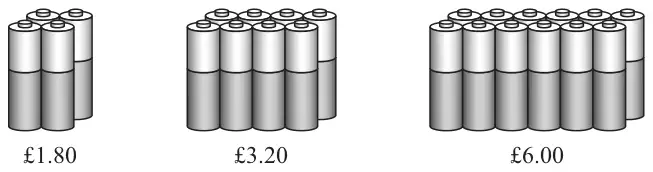
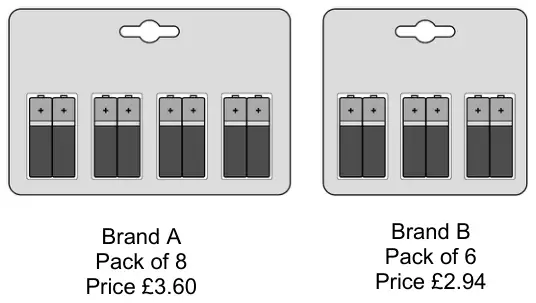
16 Batteries are sold in packs of 4, in packs of 8 and in packs of 12
A pack of 4 batteries costs £1.80 A pack of 8 batteries costs £3.20 A pack of 12 batteries costs £6.00
Which pack gives the best value for money? You must show how you get your answer. (3)
Mark scheme
Answer
Mark
Mark scheme
Pack of 8 (supported)
P1
for a process (for at least 2 packs) of division of price by quantity eg at least 2 of \(180 \div 4\ (= 45)\) or \(320 \div 8\ (= 40)\) or \(600 \div 12\ (= 50)\)
OR any other process that could lead to a comparison of 2 packs eg \(180 \times 2\ (= 360)\) or \(320 \div 8\ (= 40)\) and \(\text{``}40\text{''} \times 12\ (= 480)\)
P1
for a complete process to give values that can be used for comparison of all 3 packs eg \(180 \div 4\ (= 45)\) and \(320 \div 8\ (= 40)\) and \(600 \div 12\ (= 50)\) OR \(3.20 \div 8\ (= 0.40)\) and \(\text{``}0.40\text{''} \times 4\ (= 1.60)\) and \(\text{``}0.40\text{''} \times 12\ (= 4.80)\) OR \(1.80 \times 6\ (= 10.80)\) and \(3.20 \times 3\ (= 9.60)\) and \(6.00 \times 2\ (= 12.00)\)
A1
for ‘pack of 8’ and correct values that can be used to compare all 3 packs
Additional guidance
Calculations could be in pounds or in pence
4 pack
8 pack
12 pack
1
0.45
0.40
0.50
2
0.90
0.80
1.00
4
1.80
1.60
2.00
8
3.60
3.20
4.00
12
5.40
4.80
6.00
16
7.20
6.40
8.00
24
10.80
9.60
12.00
Condone incorrect units.
Pairwise comparison are possible, but check to see that this allows for a decision to be made. Check process. Assuming correct figures found:
Comparisons
Conclusion possible
4 vs 8
8 vs 12
Yes
4 vs 8
4 vs 12
Yes
4 vs 12
8 vs 12
No
Correct answer with no supportive working scores 0 marks.
Do not allow A mark where inconsistent units would prevent comparison e.g. 0.40p and 45p
10 There are only red counters and yellow counters in bag A.
\[\text{number of red counters} : \text{number of yellow counters} = 3 : 5\]
There are only green counters and blue counters in bag B. The number of counters in bag B is half the number of counters in bag A.
Given that there are \(x\) red counters in bag A,
use algebra to show that the total number of counters in bag A and bag B is \(4x\) (3)
Mark scheme
Answer
Mark
Mark scheme
Result shown
M1
for method to find the number of yellow counters in bag A, eg \(x \div 3 \times 5\ \left(= \dfrac{5x}{3}\right)\) or for method to find the total number of counters in bag A eg \(x \div 3 \times 8\ \left(= \dfrac{8x}{3}\right)\) or for starting to work with ratio using algebra eg \(3y\), \(5y\)
M1
(dep) for method to find the total number of counters in bag B, eg \(\left(x + \text{``}\dfrac{5x}{3}\text{''}\right) \div 2\ \left(= \dfrac{4x}{3}\right)\) or \(\text{``}\dfrac{8x}{3}\text{''} \div 2\ \left(= \dfrac{4x}{3}\right)\) or \((3y + 5y) \div 2\ (= 4y)\)
C1
for complete method showing that total number of counters in bag A and bag B is \(4x\), eg \(\dfrac{8x}{3} + \dfrac{4x}{3} = 4x\) or \(3y + 5y + 4y = 12y\) and \(12y \div 3y \times x = 4x\)
Additional guidance
Could use any letter other than \(y\) apart from \(x\)
For the method marks condone decimals that are rounded or truncated to 1dp
For the C mark only accept values that are shown to be recurring and allow \(3.\dot{9}x = 4x\)
7 Kasim has some small jars, some medium jars and some large jars. He has a total of 400 jars.
\(\dfrac{3}{8}\) of the 400 jars are empty.
For the empty jars,
number of small jars : number of medium jars = 3 : 4 number of medium jars : number of large jars = 1 : 2
Work out the percentage of Kasim’s jars that are empty small jars. (5)
Mark scheme
Answer
Mark
Mark scheme
7.5
P1
for process to find the number of empty jars eg \(3 \div 8 \times 400\) oe (= 150)
P1
for start of process to deal with ratios eg 3 : 4 and 4 : 8 or 3 : 4 : 8 oe
P1
for process to find the number of empty small jars eg \(\dfrac{3}{3 + 4 + 8} \times \text{``}150\text{''}\) oe (= 30) or 30 : 40 : 80
P1
for process to find percentage, eg \(\dfrac{\text{``}30\text{''}}{400} \times 100\) oe or \(\dfrac{\text{``}7.5\text{''}}{100}\)
A1
for 7.5 or \(7\dfrac{1}{2}\) oe
OR
P1
for start of process to deal with ratios eg 3 : 4 and 4 : 8 or 3 : 4 : 8 oe
P1
for process to find the proportion of the empty jars that are small eg \(\dfrac{3}{3 + 4 + 8}\ \left(= \dfrac{1}{5}\right)\)
P1
for process to find the proportion of Kasim’s jars that are empty small jars eg \(\dfrac{3}{8} \times \text{``}\dfrac{1}{5}\text{''}\ \left(= \dfrac{3}{40}\right)\)
P1
for process to find percentage, eg \(\text{``}\dfrac{3}{40}\text{''} \times 100\) oe or \(\dfrac{\text{``}7.5\text{''}}{100}\)
6 Andy, Luke and Tina share some sweets in the ratio 1 : 6 : 14
Tina gives \(\dfrac{3}{7}\) of her sweets to Andy.
Tina then gives \(12\dfrac{1}{2}\)% of the rest of her sweets to Luke.
Tina says,
“Now all three of us have the same number of sweets.”
Is Tina correct? You must show how you get your answer. (4)
Mark scheme
Answer
Mark
Mark scheme
Yes, supported by correct figures
P1
for a process to find the number of sweets Tina gives to Andy, eg \(14 \div 7 \times 3\ (= 6)\) or for a process to work with fractions of the total to find fraction given to Andy, eg \(\dfrac{14}{21} \times \dfrac{3}{7}\ \left(= \dfrac{2}{7}\right)\) or for dividing a given number (eg 441) in the ratio 1 : 6 : 14 (= 21 : 126 : 294)
P1
for a process to find number for Andy and Tina after first exchange, eg A = \(1 + \text{``}6\text{''}\ (= 7)\) and T = \(14 - \text{``}6\text{''}\ (= 8)\) or for a process to find the number of sweets Tina gives to Luke eg \((14 - \text{``}6\text{''}) \times \dfrac{12.5}{100}\ (= 1)\) or for a process to work with fractions of the total to find fraction given to Luke, eg for \(\dfrac{(14 - \text{``}6\text{''})}{21} \times \dfrac{12.5}{100}\) or process to work out the number of sweets given to Andy and Luke for their total, eg \(\text{``}294\text{''} \div 7 \times 3\ (= 126)\) and \((\text{``}294\text{''} - \text{``}126\text{''}) \times \dfrac{12.5}{100}\ (= 21)\)
P1
for a process to find the final amounts or final shares for at least two of Andy, Luke and Tina eg two of \(1 + \text{``}6\text{''}\ (= 7)\), \(6 + \text{``}1\text{''}\ (= 7)\), \(14 - \text{``}6\text{''} - \text{``}1\text{''}\ (= 7)\) or \(\dfrac{1}{21} + \dfrac{\text{``}2\text{''}}{7}\ \left(= \dfrac{7}{21}\right)\), \(\dfrac{6}{21} + \text{``}\dfrac{1}{21}\text{''}\ \left(= \dfrac{7}{21}\right)\), \(\dfrac{14}{21} - \text{``}\dfrac{2}{7}\text{''} - \text{``}\dfrac{1}{21}\text{''}\ \left(= \dfrac{7}{21}\right)\) or \(\text{``}21\text{''} + \text{``}126\text{''}\ (= 147)\), \(\text{``}126\text{''} + \text{``}21\text{''}\ (= 147)\), \(\text{``}294\text{''} - \text{``}126\text{''} - \text{``}21\text{''}\ (= 147)\)
C1
Yes, supported by full working and accurate figures for Andy, Luke and Tina
Additional guidance
May work with an equivalent ratio, eg 21 : 126 : 294 and do \(294 \div 7 \times 3\ (= 126)\) as a first step
May work in multiples of \(x\) for all marks
Accurate figures with no supportive working scores 0
Chloe has a large number of hair bands. Each hair band costs 8p.
She buys 100 g of wool for £3
Chloe uses 1 hair band and 5 g of wool to make each scrunchy. She makes as many scrunchies as she can.
Work out the total cost of each scrunchy that she makes. Give your answer in pence. (4)
Mark scheme
Answer
Mark
Mark scheme
23
P1
for finding the number of scrunchies possible eg \(100 \div 5\ (= 20)\) or the cost of 1 g of wool eg \(300 \div 100\ (= 3)\)
P1
for working out the cost of wool per scrunchie eg \(3 \div \text{``}20\text{''}\ (= 0.15)\) or \(300 \div \text{``}20\text{''}\ (= 15)\) or \(\text{``}3\text{''} \times 5\ (= 15)\) or the cost of all hair bands eg \(\text{``}20\text{''} \times 8\ (= 160)\) or \(\text{``}20\text{''} \times 0.08\ (= 1.6(0))\)
P1
for complete process eg \((\text{``}0.15\text{''} + 0.08) \times 100\) or \(\text{``}15\text{''} + 8\) or \((300 + \text{``}160\text{''}) \div \text{``}20\text{''}\) or \((3 + \text{``}1.6(0)\text{''}) \div \text{``}20\text{''} \times 100\)
A1
accept £0.23
Additional guidance
P1 (cost of wool per scrunchie): award of this mark implies the previous mark 460 implies P2
11 The floor plan of a house is drawn using a scale of \(1 : 50\) On the plan, a room in the house has a floor area of 48 cm2
Work out the real area of the floor of this room. Give your answer in m2(3)
Mark scheme
Answer
Mark
Mark scheme
12
P1
for process of working with area scale factor, eg area SF \(= 50^2\ (= 2500)\) or \(0.5 \times 0.5\ (= 0.25)\) or \(48 \times 50 \times 50\ (= 120\,000)\)
or
for process which uses 1 (m2) = 10 000 (cm2), eg \(\dfrac{48}{10\,000}\)
P1
for complete process, eg \(\dfrac{\text{``}120\,000\text{''}}{100 \times 100}\) or \(\text{``}0.25\text{''} \times 48\)
10 Here are the ingredients needed to make 20 peanut butter cookies.
Makes 20 cookies
250 g peanut butter 200 g sugar 2 small eggs
Derek wants to make 60 cookies.
He has 900 g of peanut butter.
Does Derek have enough peanut butter to make 60 cookies? You must show how you get your answer. (3)
Mark scheme
Answer
Mark
Mark scheme
Yes and 750
P1
for beginning to work with proportion eg \(60 \div 20\ (= 3)\) or \(900 - 250\ (= 650)\) or \(250 \div 20\ (= 12.5 \text{ oe})\) or \(900 \div 60\ (= 15)\)
P1
for a complete process to see if there is enough peanut butter eg \(\text{``}3\text{''} \times 250\ (= 750)\) or \(900 \div \text{``}3\text{''}\ (= 300)\) or \(\text{``}650\text{''} - 250 - 250\ (= 150)\) oe or \(\text{``}12.5\text{''} \times 60\ (= 750)\)
or for a complete process to work out how many cookies he can make eg \(900 \div \text{``}12.5\text{''}\ (= 72)\)
or for process to work out how much peanut butter is needed for one cookie and how much peanut butter he can use per cookie eg \(250 \div 20\ (= 12.5 \text{ oe})\) and \(900 \div 60\ (= 15)\)
C1
Yes and accurate figure to compare eg 750 (g needed) or 150 (g over) or 300 (g per batch available)
or 72 (cookies can be made)
or 12.5 (g peanut butter per cookie needed) and 15 (g peanut butter per cookie available)
Additional guidance
Sugar = 600 (g) or Small eggs = 6 (eggs) implies P1
5 Chris, Debbie and Errol share some money in the ratio \(3 : 4 : 2\) Debbie gets £120
Chris then gives some of his share to Debbie and some of his share to Errol. The money that Chris, Debbie and Errol each have is now in the ratio \(2 : 5 : 3\)
How much money did Chris give to Errol? (4)
Mark scheme
Answer
Mark
Mark scheme
21
P1
for process to work correctly with initial ratio, eg \(120 \div 4 \times 9\ (= 270)\) or \(90 + 120 + 60\ (= 270)\)
P1
for process to find the value of 1 part in the new ratio, eg \(\text{``}270\text{''} \div (2 + 5 + 3)\ (= 27)\)
P1
for complete process to find both values for Errol, eg \(\text{``}27\text{''} \times 3\ (= 81)\) and \(120 \div 4 \times 2\ (= 60)\)
A1
cao
Additional guidance
Can be implied by \(90 : 120 : 60\) or by a second ratio that totals 270
25 Last year a family recycled 800 kg of household waste. 57% of this waste was paper and glass.
weight of paper recycled : weight of glass recycled = 12 : 7
Calculate the weight of glass the family recycled. (3)
Mark scheme
Answer
Mark
Mark scheme
168
P1
for a start to the process, eg \(\dfrac{57}{100} \times 800\ (= 456)\) or \(57 \div (12 + 7)\ (= 3)\) or \(800 \div (12 + 7)\ (= 42.1...)\) or \([\text{amount}] \times \dfrac{57}{100}\) or \([\text{amount}] \times \dfrac{7}{12 + 7}\)
P1
for a complete process to find the weight of glass, eg \(\dfrac{57}{100} \times 800 \times \dfrac{7}{12 + 7}\) oe
A1
for an answer in the range 167.9 to 168
SCB2 for an answer of 288
Additional guidance
May be seen as part of other calculations, eg \(\dfrac{7}{12 + 7} \times 57\ (= 21)\) or \(\dfrac{7}{12 + 7} \times 800\ (= 294.7...)\)
[amount] can be any figure considered as being 57% of 800 or 43% calculated incorrectly or a figure calculated from using full or partial ratio incorrectly as a first step
22 There are 48 counters in a bag. There are only red counters and blue counters in the bag.
number of red counters : number of blue counters = 1 : 2
Helen has to work out how many red counters are in the bag.
She says,
“There are 24 red counters in the bag because 1 is half of 2 and 24 is half of 48”
Is Helen correct? You must give a reason for your answer. (1)
Mark scheme
Answer
Mark
Mark scheme
No with reason
C1
for No and valid reason, eg compares \(\dfrac{1}{3}\) with \(\dfrac{1}{2}\) or 16 (with 24)
Acceptable examples No, \(\dfrac{1}{3}\) are red not \(\dfrac{1}{2}\) There are 16 red counters (not 24) No as she has used the ratio 1:1 (not 1:2) Incorrect as it is 16 : 32 No as she should divide by 3 (as \(1 + 2 = 3\)) No as they would both be 24 so it doesn’t fit in the ratio 1 : 2 No because \(24 + 48 = 72\)
Not acceptable examples Yes, … No as the number of red counters would be lower There is 1 red for every 2 blue
18 7 kg of carrots and 5 kg of tomatoes cost a total of 480p
cost of 1 kg of carrots : cost of 1 kg of tomatoes = 5 : 9
Work out the cost of 1 kg of carrots and the cost of 1 kg of tomatoes. (4)
Mark scheme
Answer
Mark
Mark scheme
(\(c\)) 30 (\(t\)) 54
P1
for setting up an equation, eg \(7c + 5t = 480\) or \(c : t = 5 : 9\) or \(\dfrac{c}{t} = \dfrac{5}{9}\) or \(9c = 5t\)
or for starting to work with ratio of total costs,
eg \(7 \times 5\ (= 35)\) and \(5 \times 9\ (= 45)\) or \(7 \times \dfrac{5}{14}\) and \(5 \times \dfrac{9}{14}\) or 35 : 45 or 7 : 9
P1
for a process to eliminate \(c\) or \(t\) from correct equations, eg \(7c + 9c = 480\) or \(7 \times \dfrac{5t}{9} + 5t = 480\) or \(7c + \dfrac{9c}{5} \times 5 = 480\)
or for \(480 \div (\text{``}35\text{''} + \text{``}45\text{''})\ (= 6)\)
or for a process to find total cost of carrots or total cost of tomatoes, eg \(480 \div (\text{``}7\text{''} + \text{``}9\text{''}) \times 7\ (= 210)\) or \(480 \div (\text{``}7\text{''} + \text{``}9\text{''}) \times 9\ (= 270)\)
P1
for a process to isolate \(t\) or \(c\), eg \(16c = 480\) or \(80c = 2400\) oe or \(80t = 4320\) oe
or for one value correct eg \(c = 30\) or \(t = 54\)
or for a process to find cost of 1 kg of carrots or 1 kg of tomatoes, eg \(5 \times \text{``}6\text{''}\ (= 30)\) or \(9 \times \text{``}6\text{''}\ (= 54)\) or \(\text{``}210\text{''} \div 7\ (= 30)\) or \(\text{``}270\text{''} \div 5\ (= 54)\)
for start to method to find a ratio connecting 2 of \(a\), \(b\) and \(c\), eg \(a : c = 3 : 5\) oe or \(b : c = 5 : 3\) oe or for start to method to combine ratios, eg \(14a : 35c\ (= 126 : 525)\) and \(20b : 35c\ (= 500 : 525)\)
M1
for method to find \(a : b : c\), eg 9 : 25 : 15 oe or for method to write \(a + b : b + c\) in terms of one variable eg \(\dfrac{3c}{5} + \dfrac{5c}{3} : \dfrac{5c}{3} + c\)
A1
for \(a + b : b + c = 34 : 40\) oe leading to result
Additional guidance
May be expressed in fractional form Any ratios must be clearly assigned to variables
The cans are sold in packs. There are 12 cans in each pack. Each pack costs £3
(a) Work out the total cost of the cola Asha buys. (3)
Ethan buys a box of 24 cans of lemonade for £7 There are 330 ml of lemonade in each can.
(b) Work out the cost of 100 ml of lemonade. Give your answer correct to the nearest penny. (3)
Mark scheme (a)
Answer
Mark
Mark scheme
45
P1
for a valid start to the process, eg \(180 \div 12\ (= 15)\) or \(3(.00) \div 12\ (= 0.25)\)
P1
for complete process, eg \(\text{``}15\text{''} \times 3(.00)\) or \(180 \times \text{``}0.25\text{''}\)
A1
for 45(.00)
Additional guidance
Calculations can be in £ or p or a combination for both process marks
Mark scheme (b)
Answer
Mark
Mark scheme
9
P1
for a valid start to the process, eg cost of each can, eg \(7(.00) \div 24\ (= 0.2916...)\) or \(700 \div 24\ (= 29.16...)\) or total volume of 24 cans, eg \(330 \times 24\ (= 7920)\) or proportion of ml, eg \(330 \div 100\ (= 3.3)\)
P1
for complete process, eg \(\dfrac{100}{330} \times \text{``}0.2916...\text{''}\ (= 0.08838...)\) or \(\dfrac{100}{330} \times \text{``}29.16...\text{''}\ (= 8.838...)\) or \(\dfrac{100}{\text{``}7920\text{''}} \times 7(.00)\ (= 0.08838...)\) or \(7(.00) \div 24 \div \dfrac{330}{100}\ (= 0.08838...)\) or \(7(.00) \div \dfrac{\text{``}7920\text{''}}{100}\ (= 0.08838...)\)
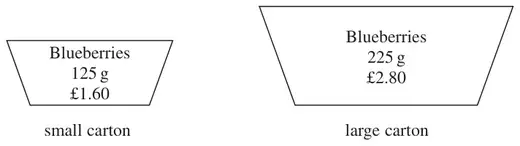
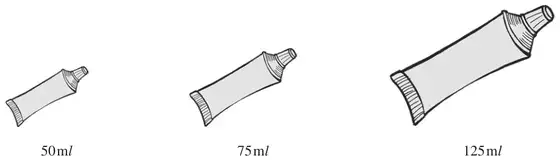
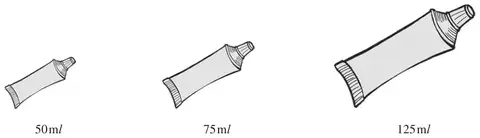
How much cheaper? Give your answer in pence correct to 1 decimal place. (4)
Mark scheme
Answer
Mark
Mark scheme
1.3
M1
for working with boxes or bags eg \(600 \div 120\ (= 5)\) or \(1000 \div 270\ (= 3.7(037..))\) \(6 \div 120\ (=0.05)\) or \(10 \div 270\ (= 0.037(037..))\)
M1
for working with bags and boxes where they are working to the same quantities of boxes and bags eg \(600 \div 120\ (= 5)\) and \(1000 \div 270\ (= 3.7(037..))\) \(6 \div 120\ (=0.05)\) and \(10 \div 270\ (= 0.037(037..))\)
M1
for finding the difference eg \(\text{``}5\text{''} - \text{``}3.7(037..)\text{''}\ (= 1.29.. \text{ to } 1.3)\) or \(\text{``}0.05\text{''} - \text{``}0.037(037..)\text{''}\ (= 0.0129.. \text{ to } 0.013)\)
A1
for answer in the range 1.29 to 1.3
Additional guidance
Cost ÷ quantity For the M marks allow working in £ instead of p.
Other values are possible where they are using alternative quantities of boxes and bags, but these must be the same quantities of each.
Must have consistent units for this mark.
If an answer is given in the range in working and then rounded incorrectly award full marks.
6 Last year a family recycled 800 kg of household waste. 57% of this waste was paper and glass.
weight of paper recycled : weight of glass recycled = 12 : 7
Calculate the weight of glass the family recycled. (3)
Mark scheme
Answer
Mark
Mark scheme
168
P1
for a start to the process, eg \(\dfrac{57}{100} \times 800\ (= 456)\) or \(57 \div (12 + 7)\ (= 3)\) or \(800 \div (12 + 7)\ (= 42.1\ldots)\) or [amount] \(\times \dfrac{57}{100}\) or [amount] \(\times \dfrac{7}{12 + 7}\)
P1
for a complete process to find the weight of glass, eg \(\dfrac{57}{100} \times 800 \times \dfrac{7}{12 + 7}\) oe
A1
for an answer in the range 167.9 to 168 SCB2 for an answer of 288
Additional guidance
May be seen as part of other calculations, eg \(\dfrac{7}{12 + 7} \times 57\ (= 21)\) or \(\dfrac{7}{12 + 7} \times 800\ (= 294.7\ldots)\) [amount] can be any figure considered as being 57% of 800 or 43% of 800 calculated incorrectly or a figure calculated using a full or partial ratio incorrectly as a first step
3 There are 48 counters in a bag. There are only red counters and blue counters in the bag.
number of red counters : number of blue counters = 1 : 2
Helen has to work out how many red counters are in the bag.
She says,
“There are 24 red counters in the bag because 1 is half of 2 and 24 is half of 48”
Is Helen correct? You must give a reason for your answer. (1)
Mark scheme
Answer
Mark
Mark scheme
No with reason
C1
for No and valid reason, eg compares \(\dfrac{1}{3}\) with \(\dfrac{1}{2}\) or 16 (with 24) Acceptable examples No, \(\dfrac{1}{3}\) are red not \(\dfrac{1}{2}\) There are 16 red counters (not 24) No as she has used the ratio 1:1 (not 1:2) Incorrect as it is 16 : 32 No as she should divide by 3 (as \(1 + 2 = 3\)) No as they would both be 24 so it doesn’t fit in the ratio 1 : 2 No because \(24 + 48 = 72\)
Not acceptable examples Yes, … No as the number of red counters would be lower There is 1 red for every 2 blue
22 Rob has been asked to divide 120 in the ratio \(\;3 : 5\)
Here is his working.
\[120 \div 3 = 40 \qquad 120 \div 5 = 24\]
Rob’s working is not correct.
Describe what Rob has done wrong. (1)
Mark scheme
Answer
Mark
Mark scheme
Description
C1
Identifies a mistake in the working
Acceptable examples Rob should divide by 8 He should have added the 3 and 5 first He divided 120 by 3 and 5 instead of 8 He did not do it as \(120 \times \dfrac{3}{8}\) and \(120 \times \dfrac{5}{8}\) He did not add the two ratios first
Not acceptable examples He has done it in two parts but he should do it in one The answer should be 45 : 75 They do not add up to 120 He is supposed to add his numbers 40 + 24 does not equal 120
20 Here is a list of ingredients for making 10 scones.
Ingredients for 10 scones
80 g butter 350 g self-raising flour 30 g sugar 2 eggs
Martin has
100 g butter 1 kg self-raising flour 50 g sugar 4 eggs
Martin wants to make 25 scones. He has not got enough of some of the ingredients.
Work out how much more of each of these ingredients he needs. (4)
Mark scheme
Answer
Mark
Mark scheme
100g butter 25g sugar 1 egg
P1
for process to find the amount needed of one ingredient for 25 scones
P1
for process to find the amount needed for at least three ingredients for 25 scones or for process to find the correct amount more for at least two of butter, sugar, eggs
P1
for complete process to find amount more for each of butter, sugar, eggs
C1
for correct amounts more shown for butter, sugar, eggs
18 There are 240 cans of drink on a shelf. Each can contains cola or lemonade or orange.
the number of cans of cola : the number of cans of lemonade : the number of cans of orange = 5 : 3 : 2
\(\dfrac{1}{2}\) of the cans of lemonade and \(\dfrac{1}{12}\) of the cans of orange are removed from the shelf.
Work out the number of cans of cola as a percentage of the total number of cans of drink remaining on the shelf. (5)
Mark scheme
Answer
Mark
Mark scheme
60
P1
for \(240 \div (5 + 3 + 2)\ (= 24)\)
P1
for complete process to find the number of cans of each drink eg \(5 \times \text{``}24\text{''}\ (= 120)\) and \(3 \times \text{``}24\text{''}\ (= 72)\) and \(2 \times \text{``}24\text{''}\ (= 48)\)
P1
for process to find the number of cans removed eg \(\text{``}72\text{''} \div 2\ (= 36)\) and \(\text{``}48\text{''} \div 12\ (= 4)\)
P1
for process to find percentage eg \(\dfrac{\text{``}120\text{''}}{240 - (\text{``}36\text{''} + \text{``}4\text{''})} \times 100\) or \(\dfrac{\text{``}120\text{''}}{\text{``}120\text{''} + (\text{``}72\text{''} - \text{``}36\text{''}) + (\text{``}48\text{''} - \text{``}4\text{''})} \times 100\)
A1
cao
Alternative
P1
for process to find proportion of lemonade and orange cans removed, eg \(3 \times \dfrac{1}{2}\ (= 1\tfrac{1}{2})\) and \(2 \times \dfrac{1}{12}\ (= \tfrac{1}{6})\)
P1
for process to find proportion of lemonade and orange cans remaining, eg \(3 - \text{``}1\tfrac{1}{2}\text{''} + 2 - \text{``}\tfrac{1}{6}\text{''}\ (= 3\tfrac{1}{3})\)
P1
for \(5 + \text{``}3\tfrac{1}{3}\text{''}\ (= 8\tfrac{1}{3})\)
P1
for process to find percentage eg \((5 \div \text{``}8\tfrac{1}{3}\text{''}) \times 100\)
15 Faiza is studying the population of rabbits in a park.
She wants to estimate the number of rabbits in the park.
On Monday she catches a random sample of 20 rabbits in the park, marks each rabbit with a tag and releases them back into the park.
On Tuesday she catches a random sample of 42 rabbits in the park. 12 of the rabbits are marked with a tag.
(a) Find an estimate for the number of rabbits in the park. (3)
Albie is studying the population of rabbits in a wood.
One day, he catches 55 rabbits and finds that 40 of these rabbits are marked with a tag.
Albie estimates there are 50 rabbits in the wood.
(b) Explain why Albie’s estimate cannot be correct. (1)
Mark scheme (a)
Answer
Mark
Mark scheme
70
P1
for \(\dfrac{20}{12}\ (= 1.66..)\) or \(\dfrac{12}{20}\ (= 0.6)\) or \(\dfrac{12}{42}\ (= 0.2857..)\) or \(\dfrac{42}{12}\ (= 3.5)\)
P1
for \(\dfrac{20}{n} = \dfrac{12}{42}\) or \(\dfrac{12}{20} = \dfrac{42}{n}\) or \(\dfrac{20 \times 42}{12}\)
A1
cao
Additional guidance
Decimal values truncated or rounded to 2 dp or more
Mark scheme (b)
Answer
Mark
Mark scheme
Explanation
C1
for explanation
Acceptable examples the sample size cannot be greater than the population the population is greater than the sample size there are more than 50 rabbits he catches 55 rabbits
Not acceptable examples the sample size is too small some of the tags could fall off he has underestimated
14 Jenny drives from London to Swindon at an average speed of 54 miles per hour. She drives for \(1\dfrac{1}{2}\) hours.
(a) Work out the distance from London to Swindon. (2)
Aleksy is using a map. The map has a scale of \(\;1 : 25\,000\) On the map a road has a length of 6 cm.
(b) Work out the length, in kilometres, of the real road. (3)
Mark scheme (a)
Answer
Mark
Mark scheme
81
M1
for \(54 \times [\text{time}]\) eg \(54 \times 1\dfrac{1}{2}\) oe, or \(54 + 54 \div 2\) oe
A1
cao
Additional guidance
[time] could be \(1\dfrac{1}{2}\) oe or any other time that has been changed from \(1\dfrac{1}{2}\), eg 90 (mins) or 1.30 or 130
Mark scheme (b)
Answer
Mark
Mark scheme
1.5
P1
for use of scale eg \(6 \times 25\,000\ (= 150\,000)\) or for \(25\,000 \div 100\,000\ (= 0.25)\) or \(25\,000 \div 100\ (= 250)\) or \(25\,000 \div 1000\ (= 25)\)
P1
for \(\text{``}150\,000\text{''} \div 100\,000\ (= 1.5)\) or \(\text{``}150\,000\text{''} \div 100\ (= 1500)\) or \(\text{``}150\,000\text{''} \div 1000\ (= 150)\) or for \([0.25] \times 6\ (= 1.5)\)
A1
for 1.5 oe
Additional guidance
[0.25] could be found by dividing 25 000 by 100 (= 250) or dividing 25 000 by 1000 (= 25)
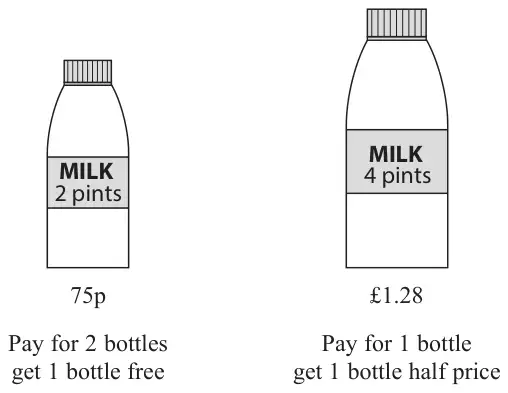
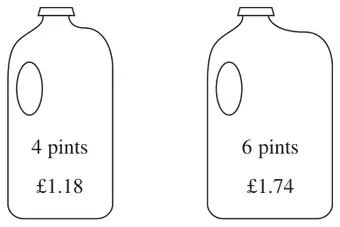
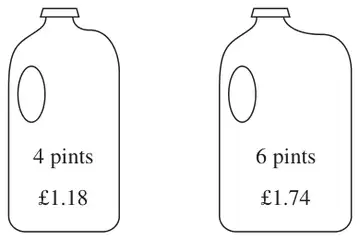
13 A shop has two different special offers on milk.
Which offer gives the better value for money? You must show how you get your answer. (4)
Mark scheme
Answer
Mark
Mark scheme
4 pint with correct figures
P1
for a process to find the price for one deal, eg 6 pints on 1st deal, \(75 \times 2\ (= 150)\) or 8 pints on 2nd deal, \(128 \times 1.5\ (= 192)\) oe
P1
for a process to find the price for both deals, eg 6 pints on 1st deal, \(75 \times 2\ (= 150)\) and 8 pints on 2nd deal, \(128 \times 1.5\ (= 192)\) oe
P1
for a process to find the cost per pint for both deals, eg \(\text{``}150\text{''} \div 6\ (= 25)\) and \(\text{``}192\text{''} \div 8\ (= 24)\) or for prices for a consistent number of pints for both deals eg for 2 pints \(\text{``}1.5\text{''} \div 3\ (=0.5)\) and \(\text{``}1.92\text{''} \div 4\ (= 0.48)\) or a comparison using a unit price eg \(\text{``}150\text{''} \div 6 \times 8\ (= 200)\) and \(128 \times 1.5\ (= 192)\) oe
C1
“4 pint” with two correct comparative costs calculated making full use of both offers
Additional guidance
Accept in mixed units of pence and pounds Might look at a price difference for a consistent number of pints
“4 pint” can be indicated in words or other indication
12 Amol, Gemma and Harry each have a number of sweets.
The number of sweets that Gemma has is 6 times the number of sweets that Amol has. The number of sweets that Harry has is half the number of sweets that Gemma has.
Write down the ratio
the number of sweets that Amol has : the number of sweets that Gemma has : the number of sweets that Harry has
(2)
Mark scheme
Answer
Mark
Mark scheme
1 : 6 : 3
M1
for any two algebraic statements from \(x\), \(6x\), \(6x/2\) oe or any two numbers as a correct ratio eg 1 : 6 or 6 : 3 or 1 : 3 oe or any 3-term ratio using the numbers 1, 6 and 3
6 Rizwan writes down three numbers \(a\), \(b\) and \(c\)
\(a : b = 1 : 3\) \(b : c = 6 : 5\)
(a)
(i) Find \(a : b : c\) (2)
(ii) Express \(a\) as a fraction of the total of the three numbers \(a\), \(b\) and \(c\) (2)
Emma writes down three numbers \(m\), \(n\) and \(p\)
\(n = 2m\) \(p = 5n\)
(b) Find \(m : p\) (2)
Mark scheme (a)
Answer
Mark
Mark scheme
(i) 2 : 6 : 5
P1
for process to compare ratios, eg \(a : b = 2 : 6\) or \(b : c = 3 : 2.5\)
A1
for 2 : 6 : 5 oe
(ii) \(\dfrac{2}{13}\)
M1
for process to find fraction, eg \(\dfrac{[2]}{[2 + 6 + 5]}\) or for \(\dfrac{a}{a + b + c}\)
A1
for \(\dfrac{2}{13}\) oe or ft (a)(i)
Additional guidance
(i) Could use 3 or any common multiple of 3 and 6
Mark scheme (b)
Answer
Mark
Mark scheme
1 : 10
P1
for process to express all numbers in terms of one number, eg \(p = 5 \times 2m\ (= 10m)\) or \(m = \dfrac{n}{2}\) or for \(2m = \dfrac{p}{5}\) or for assigning values in the ratio given, eg \(m = 1\), \(n = 2\), \(p = 10\) or for \(n : m : p = 2 : 1 : 10\) oe or 10 : 1 oe
27 In Spain, Sam pays 27 euros for 18 litres of petrol. In Wales, Leo pays £40.80 for 8 gallons of the same type of petrol.
1 euro
= £0.85
4.5 litres
= 1 gallon
Sam thinks that petrol is cheaper in Spain than in Wales.
Is Sam correct? You must show how you get your answer.(4)
Mark scheme
Answer
Mark
Mark scheme
No (supported)
P1
for a conversion with litres and gallons, eg \(18 \div 4.5\ (= 4)\) or \(8 \times 4.5\ (= 36)\)
P1
for a conversion with £ and euros, eg \(27 \times 0.85\ (= 22.95)\) or \(40.8 \div 0.85\ (= 48)\)
P1
for finding the unit price, eg \(27 \div 18\ (= 1.5)\) OR finding proportionality for fuel eg \((\text{``}36\text{''} \div 18)\ (= 2)\)
C1
for No with comparative figures, eg No with 20.4 and 22.95 or No with 1.275 and 1.133..
Additional guidance
See below (additional information)
May compare cost per gallon or cost in euros May be seen in a calculation or given in a description Accept comparative figures rounded or truncated No is implied by eg Wales is cheaper
Question 27 – Additional information NOT Exhaustive
Cost per litre in £: \(27 \times 0.85\ (=22.95)\) \(\text{``}22.95\text{''} \div 18\ (=1.275)\) \(8 \times 4.5\ (=36)\) No and \(40.8 \div \text{``}36\text{''} = 1.133..\) (cost per litre in £ in Wales) compared to 1.275 (cost per litre in £ in Spain).
Cost per litre in euros: \(27 \div 18\ (=1.5)\) \(8 \times 4.5\ (=36)\) \(40.8 \div 0.85\ (= 48)\) No and \(\text{``}48\text{''} \div \text{``}36\text{''} = 1.333..\) (cost per litre in euros in Wales) compared to 1.5 (cost per litre in euros in Spain).
Cost per gallon in £: \(40.8 \div 8\ (=5.1)\) \(27 \times 0.85\ (=22.95)\) \(18 \div 4.5\ (= 4)\) No and \(\text{``}22.95\text{''} \div \text{``}4\text{''} = 5.7375\) (cost per gallon in £ in Spain) compared to 5.1(0) (cost per gallon in £ in Wales).
Cost per gallon in euros: \(40.8 \div 0.85\ (=48)\) \(\text{``}48\text{''} \div 8\ (= 6)\) \(18 \div 4.5\ (=4)\) No and \(27 \div \text{``}4\text{''} = 6.75\) (cost per gallon in euros in Spain) compared to 6 (cost per gallon in euros in Wales).
Note: “2” comes from \(8 \div \text{``}4\text{''}\) or \(\text{``}36\text{''} \div 18\)
Cost of 8 gallons in £: \(18 \div 4.5\ (= 4)\) \(27 \times 0.85\ (=22.95)\) \(\text{``}22.95\text{''} \times \text{``}2\text{''}\ (=45.90)\) No and 45.90 (total cost in £ in Spain) compared to 40.80 (total cost in £ in Wales given).
Cost of 8 gallons in euros: \(18 \div 4.5\ (=4)\) \(40.8 \div 0.85\ (=48)\) \(27 \times \text{``}2\text{''}\ (= 54)\) No and 54 (cost for 8 gallons in euros in Spain) compared to 48 (cost of 8 gallons in euros in Wales).
Cost of 18 litres in £: \(8 \times 4.5\ (= 36)\) \(40.8 \div \text{``}2\text{''}\ (= 20.4)\) \(27 \times 0.85\ (= 22.95)\) No and 22.95 (cost for 18 litres in £ in Spain) compared to 20.40 (cost of 18 litres in £ in Wales). OR \(18 \div 4.5\ (= 4)\) \(27 \times 0.85\ (= 22.95)\) \(40.8 \div \text{``}2\text{''}\ (= 20.4)\) No and 22.95 (cost for 18 litres in £ in Spain) compared to 20.40 (cost of 18 litres in £ in Wales).
25 The points \(L\), \(M\) and \(N\) are such that \(LMN\) is a straight line.
The coordinates of \(L\) are \((-3, 1)\) The coordinates of \(M\) are \((4, 9)\)
Given that \(LM : MN = 2 : 3\), find the coordinates of \(N\). (4)
Mark scheme
Answer
Mark
Mark scheme
14.5, 21
P1
for process to work with coordinates, eg \(4 - (-3)\ (= 7)\) or \(9 - 1\ (= 8)\)
P1
for process to use ratio, eg \(\text{``}7\text{''} \div 2\ (= 3.5)\) or \(\text{``}8\text{''} \div 2\ (= 4)\) or \(\text{``}7\text{''} \times 3\ (= 21)\) or \(\text{``}8\text{''} \times 3\ (= 24)\)
P1
for complete process to find either the \(x\) or the \(y\) coordinate of \(N\), eg \(\text{``}3.5\text{''} \times 3 + 4\) or \(\text{``}4\text{''} \times 3 + 9\) or \(\text{``}3.5\text{''} \times 5 - 3\) or \(\text{``}4\text{''} \times 5 + 1\) OR to find both the required distances eg \(\text{``}3.5\text{''} \times 3\ (= 10.5)\) and \(\text{``}4\text{''} \times 3\ (= 12)\) or \(\text{``}21\text{''} \div 2\ (= 10.5)\) and \(\text{``}24\text{''} \div 2\ (= 12)\) or \(\text{``}3.5\text{''} \times 5\ (= 17.5)\) and \(\text{``}4\text{''} \times 5\ (= 20)\)
A1
oe
Additional guidance
Accept in reverse order eg \(-3 - 4\ (= -7)\) and negative distances throughout
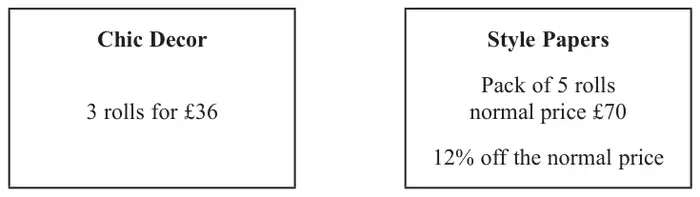
Here is some information about the cost of rolls of wallpaper from each of two shops.
Jo wants to buy the 15 rolls of wallpaper as cheaply as possible.
Should Jo buy the wallpaper from Chic Decor or from Style Papers? You must show how you get your answer. (4)
Mark scheme
Answer
Mark
Mark scheme
Chic Decor (supported)
P1
for process to find cost of 15 rolls from Chic Decor, eg \(\dfrac{15}{3} \times 36\ (= 180)\) or for process to find cost of 15 rolls from Style Papers at normal price, eg \(\dfrac{15}{5} \times 70\ (= 210)\) or for process to find cost of 1 roll from Chic Decor, eg \(36 \div 3\ (= 12)\) or for process to find cost of 1 roll from Style Papers, eg \(70 \div 5\ (= 14)\) or for process to find the cost of 5 rolls from Chic Decor, eg \(\dfrac{36}{3} \times 5\ (= 60)\)
P1
for any first step in using the discount at Style Papers, eg \(0.12 \times \text{``}210\text{''}\ (= 25.2(0))\) or \(0.12 \times \text{``}14\text{''}\ (= 1.68)\) or \(0.12 \times 70\ (= 8.4(0))\) or \(1 - 0.12\ (= 0.88)\)
P1
for full process to find cost from Style Papers, eg \(\text{``}210\text{''} - \text{``}25.2\text{''}\) oe \((= 184.8(0))\) or \(\text{``}0.88\text{''} \times \text{``}210\text{''}\) or for \(\text{``}14\text{''} - \text{``}1.68\text{''}\) oe \((= 12.32)\) or \(\text{``}0.88\text{''} \times \text{``}14\text{''}\) or for \(70 - \text{``}8.4(0)\text{''}\) oe \((= 61.6(0))\) or \(\text{``}0.88\text{''} \times 70\)
C1
for Chic Decor with fully correct figures eg 180 and 184.8(0) or 12 and 12.32 or 60 and 61.6(0)
16 On a scale drawing, a building has length 12.4 cm and width 9.4 cm. The real length of the building is 62 metres.
Work out, in metres, the real width of the building. (3)
Mark scheme
Answer
Mark
Mark scheme
47
P1
for process to find scale factor eg \(62 \div 12.4\ (= 5)\) or \(12.4 \div 62\ (= 0.2)\) or \(9.4 \div 12.4\ (= 0.758...)\) or \(12.4 \div 9.4\ (= 1.31..)\)
P1
for process to use the scale factor eg \(\text{``}5\text{''} \times 9.4\) or \(9.4 \div \text{``}0.2\text{''}\) or \(62 \times \text{``}0.758..\text{''}\) or \(62 \div \text{``}1.31..\text{''}\)
A1
Accept answers in the range 46.5 to 47.7
Additional guidance
Note 1:500 is an acceptable scale factor
Accept working in mixed units or with inconsistent units eg \(620 \div 12.4\ (= 50)\) for process marks only
15 The ratio of Marta’s hourly pay to Khalid’s hourly pay is 6 : 5
Both Marta and Khalid get an increase of £1.50 in their hourly pay.
The ratio of Marta’s hourly pay to Khalid’s hourly pay after this increase is 13 : 11
Work out the hourly pay before the increase for Marta and for Khalid. (4)
Mark scheme
Answer
Mark
Mark scheme
(M) 18, (K) 15
P1
for start of process, eg \((6x + 1.5)\) and \((5x + 1.5)\) or \((6x + 1.5)\) and \((11x + 3)\) or \(a + 1.5\) and \(b + 1.5\) OR starts to work with ratio, eg 6 : 5 = 12 : 10
P1
for setting up an equation, eg \(\dfrac{6x + 1.5}{5x + 1.5} = \dfrac{13}{11}\) or \(66x + 16.5 = 65x + 19.5\) or \(\dfrac{6x + 1.5}{11x + 3} = \dfrac{13}{24}\) or \(144x + 36 = 143x + 39\) or \(\dfrac{a}{b} = \dfrac{6}{5}\) and \(\dfrac{a + 1.5}{b + 1.5} = \dfrac{13}{11}\) or \(5a = 6b\) and \(11a + 16.5 = 13b + 19.5\) oe OR for comparing 12 : 10 to 13 : 11 and deducing 1 part = 1.5
P1
for isolating in terms of \(x\), eg \(66x - 65x = 19.5 - 16.5\) or \(144x - 143x = 39 - 36\) or \(x = 3\) or for eliminating \(a\) or \(b\), eg \(55a = 66b\) and so \(66b = 65b + 15\) OR for process to find values for M and K, eg \(12 \times 1.5\) and \(10 \times 1.5\)
11 Cormac has some sweets in a bag. The sweets are lime flavoured or strawberry flavoured or orange flavoured.
In the bag
number of lime flavoured sweets : number of strawberry flavoured sweets : number of orange flavoured sweets = 9 : 4 : \(x\)
Cormac is going to take at random a sweet from the bag.
The probability that he takes a lime flavoured sweet is \(\dfrac{3}{7}\)
Work out the value of \(x\). (3)
Mark scheme
Answer
Mark
Mark scheme
8
P1
for a start to the process, eg \(\dfrac{9}{9 + 4 + x}\) or \(\left(\dfrac{3}{7} =\right) \dfrac{9}{21}\) or states that the total number of sweets is 21
P1
for forming a correct equation without fractions, eg \(9 \times 7 = 3(9 + 4 + x)\) or \(21 = 9 + 4 + x\) OR for \(21 - 9 - 4\) oe or \(1 - \dfrac{9}{21} - \dfrac{4}{21}\ \left(= \dfrac{8}{21}\right)\)
7 In Spain, Sam pays 27 euros for 18 litres of petrol. In Wales, Leo pays £40.80 for 8 gallons of the same type of petrol.
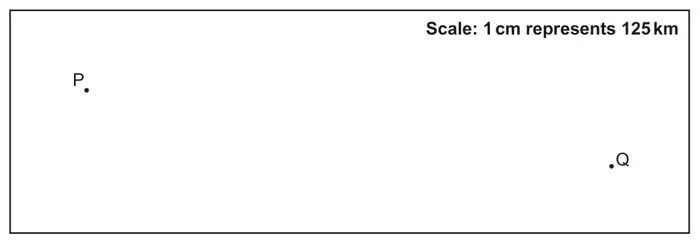
1 euro = £0.85 4.5 litres = 1 gallon
Sam thinks that petrol is cheaper in Spain than in Wales.
Is Sam correct? You must show how you get your answer. (4)
Mark scheme
Answer
Mark
Mark scheme
No (supported)
P1
for a conversion with litres and gallons, eg \(18 \div 4.5\ (= 4)\) or \(8 \times 4.5\ (= 36)\)
P1
for a conversion with £ and euros, eg \(27 \times 0.85\ (= 22.95)\) or \(40.8 \div 0.85\ (= 48)\)
P1
for finding the unit price, eg \(27 \div 18\ (= 1.5)\) OR finding proportionality for fuel eg \((\text{``}36\text{''} \div 18)\ (= 2)\)
C1
for No with comparative figures, eg No with 20.4 and 22.95 OR No with 1.275 and 1.133…
Additional guidance
See additional information below
May compare cost per gallon or cost in euros May be seen in a calculation or given in a description
Accept comparative figures rounded or truncated No is implied by eg Wales is cheaper
Question 7 – Additional information NOT Exhaustive
Cost per litre in £: \(27 \times 0.85\ (= 22.95)\) \(\text{``}22.95\text{''} \div 18\ (= 1.275)\) \(8 \times 4.5\ (= 36)\) No and \(40.8 \div \text{``}36\text{''} = 1.133..\) (cost per litre in £ in Wales) compared to 1.275 (cost per litre in £ in Spain).
Cost per litre in euros: \(27 \div 18\ (= 1.5)\) \(8 \times 4.5\ (= 36)\) \(40.8 \div 0.85\ (= 48)\) No and \(\text{``}48\text{''} \div \text{``}36\text{''} = 1.333..\) (cost per litre in euros in Wales) compared to 1.5 (cost per litre in euros in Spain).
Cost per gallon in £: \(40.8 \div 8\ (= 5.1)\) \(27 \times 0.85\ (= 22.95)\) \(18 \div 4.5\ (= 4)\) No and \(\text{``}22.95\text{''} \div \text{``}4\text{''} = 5.7375\) (cost per gallon in £ in Spain) compared to 5.1(0) (cost per gallon in £ in Wales).
Cost per gallon in euros: \(40.8 \div 0.85\ (= 48)\) \(\text{``}48\text{''} \div 8\ (= 6)\) \(18 \div 4.5\ (= 4)\) No and \(27 \div \text{``}4\text{''} = 6.75\) (cost per gallon in euros in Spain) compared to 6 (cost per gallon in euros in Wales).
Note: “2” comes from \(8 \div \text{``}4\text{''}\) or \(\text{``}36\text{''} \div 18\)
Cost of 8 gallons in £: \(18 \div 4.5\ (= 4)\) \(27 \times 0.85\ (= 22.95)\) \(\text{``}22.95\text{''} \times \text{``}2\text{''}\ (= 45.90)\) No and 45.90 (total cost in £ in Spain) compared to 40.80 (total cost in £ in Wales given).
Cost of 8 gallons in euros: \(18 \div 4.5\ (= 4)\) \(40.8 \div 0.85\ (= 48)\) \(27 \times \text{``}2\text{''}\ (= 54)\) No and 54 (cost for 8 gallons in euros in Spain) compared to 48 (cost of 8 gallons in euros in Wales).
Cost of 18 litres in £: \(8 \times 4.5\ (= 36)\) \(40.8 \div \text{``}2\text{''}\ (= 20.4)\) \(27 \times 0.85\ (= 22.95)\) No and 22.95 (cost for 18 litres in £ in Spain) compared to 20.40 (cost of 18 litres in £ in Wales). OR \(18 \div 4.5\ (= 4)\) \(27 \times 0.85\ (= 22.95)\) \(40.8 \div \text{``}2\text{''}\ (= 20.4)\) No and 22.95 (cost for 18 litres in £ in Spain) compared to 20.40 (cost of 18 litres in £ in Wales).
Cost of 18 litres in euros: \(18 \div 4.5\ (= 4)\) \(40.8 \div 0.85\ (= 48)\) \(\text{``}48\text{''} \div \text{``}2\text{''}\ (= 24)\) No and 24 (cost for 18 litres in euros in Wales) compared to 27 (cost of 18 litres in euros in Spain given). OR \(8 \times 4.5\ (= 36)\) \(40.8 \div \text{``}2\text{''}\ (= 20.4)\) \(\text{``}20.4\text{''} \div 0.85\ (= 24)\) No and 24 (cost for 18 litres in euros in Wales) compared to 27 (cost of 18 litres in euros in Spain given).
5 The points \(L\), \(M\) and \(N\) are such that \(LMN\) is a straight line.
The coordinates of \(L\) are \((-3, 1)\)
The coordinates of \(M\) are \((4, 9)\)
Given that \(LM : MN = 2 : 3\),
find the coordinates of \(N\). (4)
Mark scheme
Answer
Mark
Mark scheme
14.5, 21
P1
for process to work with coordinates, eg \(4 - (-3)\ (= 7)\) or \(9 - 1\ (= 8)\)
P1
for process to use ratio, eg \(\text{``}7\text{''} \div 2\ (= 3.5)\) or \(\text{``}8\text{''} \div 2\ (= 4)\) or \(\text{``}7\text{''} \times 3\ (= 21)\) or \(\text{``}8\text{''} \times 3\ (= 24)\)
P1
for complete process to find \(x\) or \(y\) coordinate of \(N\), eg \(\text{``}3.5\text{''} \times 3 + 4\) or \(\text{``}4\text{''} \times 3 + 9\) or \(\text{``}3.5\text{''} \times 5 - 3\) or \(\text{``}4\text{''} \times 5 + 1\) OR to find both the required distances eg \(\text{``}3.5\text{''} \times 3\ (= 10.5)\) and \(\text{``}4\text{''} \times 3\ (= 12)\) or \(\text{``}21\text{''} \div 2\ (= 10.5)\) and \(\text{``}24\text{''} \div 2\ (= 12)\) or \(\text{``}3.5\text{''} \times 5\ (= 17.5)\) and \(\text{``}4\text{''} \times 5\ (= 20)\)
A1
oe
Additional guidance
Accept in reverse order eg \(-3 - 4\ (= -7)\) and negative distances throughout
Here is some information about the cost of rolls of wallpaper from each of two shops.
Chic Decor
Style Papers
3 rolls for £36
Pack of 5 rolls normal price £70
12% off the normal price
Jo wants to buy the 15 rolls of wallpaper as cheaply as possible.
Should Jo buy the wallpaper from Chic Decor or from Style Papers? You must show how you get your answer. (4)
Mark scheme
Answer
Mark
Mark scheme
Chic Decor with correct supporting evidence
P1
for process to find cost of 15 rolls from Chic Decor, eg \(\dfrac{15}{3} \times 36\ (= 180)\) or for process to find cost of 15 rolls from Style Papers at normal price, eg \(\dfrac{15}{5} \times 70\ (= 210)\) or for process to find cost of 1 roll from Chic Decor, eg \(36 \div 3\ (= 12)\) or for process to find cost of 1 roll from Style Papers, eg \(70 \div 5\ (= 14)\) or for process to find the cost of 5 rolls from Chic Decor, eg \(\dfrac{36}{3} \times 5\ (= 60)\)
P1
for any first step in using the discount at Style Papers, eg \(0.12 \times \text{``}210\text{''}\ (= 25.2(0))\) or \(0.12 \times \text{``}14\text{''}\ (= 1.68)\) or \(0.12 \times 70\ (= 8.4(0))\) or \(1 - 0.12\ (= 0.88)\)
P1
for full process to find cost from Style Papers, eg \(\text{``}210\text{''} - \text{``}25.2\text{''}\) oe \((= 184.8(0))\) or \(\text{``}0.88\text{''} \times \text{``}210\text{''}\)
or for \(\text{``}14\text{''} - \text{``}1.68\text{''}\) oe \((= 12.32)\) or \(\text{``}0.88\text{''} \times \text{``}14\text{''}\)
or for \(70 - \text{``}8.4(0)\text{''}\) oe \((= 61.6(0))\) or \(\text{``}0.88\text{''} \times 70\)
C1
for Chic Decor with fully correct figures eg 180 and 184.8(0) or 12 and 12.32 or 60 and 61.6(0)
3 A delivery company has a total of 160 cars and vans.
the number of cars : the number of vans = 3 : 7
Each car and each van uses electricity or diesel or petrol.
\(\dfrac{1}{8}\) of the cars use electricity. 25% of the cars use diesel. The rest of the cars use petrol.
Work out the number of cars that use petrol. You must show all your working. (5)
Mark scheme
Answer
Mark
Mark scheme
30
P1
for \(160 \div (3+7)\ (= 16)\) or \(\dfrac{3}{3+7}\ \left(= \dfrac{3}{10}\right)\)
P1
for \(\text{``}16\text{''} \times 3\ (= 48)\) or \(\text{``}\dfrac{3}{10}\text{''} \times 160\ (= 48)\)
P1
for a correct step using 48 eg \(\text{``}48\text{''} \div 8\ (= 6)\) or \(\text{``}48\text{''} \times 25 \div 100\ (= 12)\) or (indep) for combining \(\dfrac{1}{8}\) and 25%, eg \(\dfrac{1}{8} + \dfrac{1}{4}\ \left(= \dfrac{3}{8}\right)\) or \(\text{``}0.125\text{''} + \text{``}0.25\text{''}\ (= 0.375)\) or “12.5”(%) + 25(%) (= 37.5(%))
P1
for a complete process to find the number of petrol cars, eg \(\text{``}48\text{''} - \text{``}6\text{''} - \text{``}12\text{''}\) oe or \(\left(1 - \text{``}\dfrac{3}{8}\text{''}\right) \times \text{``}48\text{''}\) oe or \(\text{``}\dfrac{3}{10}\text{''} \times \left(1 - \text{``}\dfrac{3}{8}\text{''}\right) \times 160\) oe
A1
cao
SC B2 for an answer of 100 if P0 scored
Additional guidance
Award no marks for a correct answer with no supportive working
17 Heidi wants to make some biscuits using this recipe.
Makes 12 biscuits
125 g butter 200 g flour 50 g sugar
Heidi thinks that she has,
500 g butter 700 g flour 250 g sugar
Assuming that these weights are correct,
(a) work out the greatest number of biscuits Heidi can make. You must show all your working. (4)
Heidi is wrong. She has more than 250 g of sugar.
(b) Does this affect the greatest number of biscuits Heidi can make? Give a reason for your answer. (1)
Mark scheme (a)
Answer
Mark
Mark scheme
42
P1
for a correct start to the process by finding the number of batches for one ingredient, eg \(500 \div 125\ (= 4)\) or \(700 \div 200\ (= 3.5 \text{ or } 3)\) or \(250 \div 50\ (= 5)\) OR for a correct start to building up number of batches of all ingredients, eg (24 biscuits or 2 batches =) 250 (butter), 400 (flour) and 100 (sugar) OR for a start to the process by finding the amount of one ingredient needed to make 1 biscuit, eg \(125 \div 12\ (= 10\tfrac{5}{12})\) or \(200 \div 12\ (= 16\tfrac{8}{12})\) or \(50 \div 12\ (= 4\tfrac{2}{12})\)
P1
for a correct process to find the number of batches for all 3 ingredients, eg \(500 \div 125\ (= 4)\) and \(700 \div 200\ (= 3.5 \text{ or } 3)\) and \(250 \div 50\ (= 5)\) OR for a build-up process reaching a point where there is not enough of one ingredient, eg (36 biscuits or 3 batches =) 375 (butter), 600 (flour) and 150 (sugar) or (48 biscuits or 4 batches =) 500 (butter), 800 (flour) and 200 (sugar) OR for a correct process to find the amount of each ingredient needed to make 1 biscuit, eg \(125 \div 12\ (= 10\tfrac{5}{12})\) and \(200 \div 12\ (= 16\tfrac{8}{12})\) and \(50 \div 12\ (= 4\tfrac{2}{12})\)
P1
(dep on P2) for a process to find the number of biscuits, eg \(\text{``}4\text{''} \times 12\ (= 48)\) or \(\text{``}3.5\text{''} \times 12\ (= 42)\) or \(\text{``}3\text{''} \times 12\ (= 36)\) or \(\text{``}5\text{''} \times 12\ (= 60)\) OR (dep on P2) for \((700 - 600) \div 200 \times 12\ (= 6)\) or \(\text{``}3\text{''} \times 12\ (= 36)\) OR (dep on P2) for a process to find the number of biscuits, eg \(500 \div \text{``}10\tfrac{5}{12}\text{''}\ (= 48)\) or \(700 \div \text{``}16\tfrac{8}{12}\text{''}\ (= 42)\) or \(250 \div \text{``}4\tfrac{2}{12}\text{''}\ (= 60)\)
A1
cao
Mark scheme (b)
Answer
Mark
Mark scheme
Explanation
C1
(dep on P3) for a correct explanation, ft (a) for the critical ingredient identified Acceptable examples No, since flour is the critical value No, since flour gives you the least number of batches No since she needs more flour to make more biscuits. Not acceptable examples Yes … No (no reason given) No, since we would need more of the other ingredients too
14 Olivia and Jessica have in total half as many sweets as Fran and Gary have in total.
Fran and Gary share their sweets in the ratio \(2 : 3\) Olivia and Jessica share their sweets in the ratio \(9 : 1\)
Fran got \(w\) sweets. Gary got \(x\) sweets. Olivia got \(y\) sweets. Jessica got \(z\) sweets.
Find, in its simplest form, \(w : x : y : z\) (4)
Mark scheme
Answer
Mark
Mark scheme
8 : 12 : 9 : 1
P1
for \(2 + 3\ (= 5)\) and \(9 + 1\ (= 10)\) OR for assigning a total number of sweets for F + G and O + J eg F + G = 100, O + J = 50
P1
for finding correct multiplier for relationship between totals for F + G and O + J eg \(\times 4\) to get from 5, 10 to 20, 10 OR for working out the number of sweets from their totals for F, G eg 40, 60 or for O, J, eg 45, 5
P1
for \(2 \times 4\ (= 8)\) and \(3 \times 4\ (= 12)\) OR for ratio in unsimplified form, eg 40 : 60 : 45 : 5
A1
cao
Additional guidance
May be in algebraic form, eg \(2a + 3a\ (= 5a)\) and \(9a + 1a\ (= 10a)\)
May be in algebraic form, eg F + G = \(5a\), O + J = \(2.5a\)
14 3 kg of carrots cost £1.80 2 kg of carrots and 5 kg of potatoes cost a total of £3.45
Work out the total cost of 4 kg of carrots and 2 kg of potatoes. You must show all your working. (4)
Mark scheme
Answer
Mark
Mark scheme
3.3(0)
P1
for a process to find cost of 1 kg of carrots, eg \(1.80 \div 3\ (= 0.60)\)
P1
for a start to a process to find cost of 1 kg of potatoes, eg \(3.45 - 2 \times \text{``}0.60\text{''}\ (= 2.25)\) or \((1.80 + 3.45) \div 5\ (= 1.05)\) OR for a process to find the cost of 4 kg of carrots, eg \(\text{``}0.60\text{''} \times 4\ (= 2.40)\)
P1
(dep on P2) for a complete process to find the cost of 4 kg of carrots and the cost of 2 kg of potatoes, eg \(\text{``}0.60\text{''} \times 4\ (= 2.40)\) and \((\text{``}2.25\text{''} \div 5) \times 2\ (= 0.90)\) or \(\text{``}0.60\text{''} \times 4\ (= 2.40)\) and \((\text{``}1.05\text{''} - \text{``}0.60\text{''}) \times 2\ (= 0.90)\)
A1
cao
Additional guidance
Could work in £ or p for P marks Condone incorrect money notation
1 kg of potatoes = (£)0.45 or 45p
Award 0 marks for a correct answer with no supportive working.
In the other group, \(\dfrac{3}{7}\) of the students are boys and the rest of the students are girls.
Ann says,
“The ratio of the number of boys to the number of girls is the same for both groups.”
Is Ann correct? You must show how you get your answer. (3)
Mark scheme
Answer
Mark
Mark scheme
Yes, supported by correct working
P1
for \(36 : 48\) oe OR \(\dfrac{36}{84}\) oe or \(\dfrac{48}{84}\) oe (relating to drama group 1)
P1
for \(\dfrac{4}{7}\) or \(3 : 4\) oe (for group 2) OR \(\left(\dfrac{36}{84} = \dfrac{3}{7}\right)\) or \(\left(\dfrac{48}{84} = \dfrac{4}{7}\right)\) or \(84 \times 3 \div 7\) (= 36 boys) or \(84 \times 4 \div 7\) (= 48 girls) or \(N \times 3 \div 7\) and \(N \times 4 \div 7\) (relating to drama group 2)
A1
for Yes with both ratios \(3 : 4\) oe or for a correct pair of fractions and stating they are equivalent.
Additional guidance
\(N\) can be any number (other than 84) of students in the 2nd group
Both equivalent forms of the ratios (fractions) must be the same “Yes” may be implied from working
21 There are 60 people in a choir. Half of the people in the choir are women.
The number of women in the choir is 3 times the number of men in the choir. The rest of the people in the choir are children.
the number of children in the choir : the number of men in the choir = \(n : 1\)
Work out the value of \(n\). You must show how you get your answer. (4)
Mark scheme
Answer
Mark
Mark scheme
2 (supported)
P1
for a process to find the number of men, eg. \((60 \div 2) \div 3\ (= 10)\)
P1
for a process to find the number of children, eg. \(60 - \text{``}30\text{''} - \text{``}10\text{''}\ (= 20)\)
P1
for a start of a process to find the value of \(n\), eg. \((\text{``}20\text{''} : \text{``}10\text{''}) \div 5\) or \(20 : 10 = 10 : 5\) or \(\text{``}20\text{''} \div \text{``}10\text{''}\)
A1
for 2 with supportive working
Additional guidance
\(60 \div 3 = 20\) scores no marks.
Any ratio must come from correct processes to find the number of children and the number of men
Award 0 marks for 2 with no correct supportive working
Award full marks for 2 : 1 given as final answer from correct supportive working
19 Here are the ingredients needed to make 16 biscuits.
Biscuits Ingredients to make 16 biscuits
175 g of butter 75 g of sugar 250 g of flour
Anna has 500 g of butter 300 g of sugar 625 g of flour
Work out the greatest number of biscuits Anna can make. (3)
Mark scheme
Answer
Mark
Mark scheme
40
P1
for a process to find the maximum number of batches for one ingredient, eg \(500 \div 175\ (= 2.85...)\) or \(300 \div 75\ (= 4)\) or \(625 \div 250\ (= 2.5)\)
OR
for a process to find the amount of one ingredient for 1 biscuit, eg \(175 \div 16\ (= 10.9375)\) or \(75 \div 16\ (= 4.6875)\) or \(250 \div 16\ (= 15.625)\)
OR
for multiples of \(175 : 75 : 250\), eg \(175 \times 2\ (= 350)\) and \(75 \times 2\ (= 150)\) and \(250 \times 2\ (= 500)\)
P1
(dep P1) identifies flour as the limiting factor
OR for a process to find the maximum number of biscuits for one ingredient, eg butter: \(\text{``}2.85\text{''} \times 16\) or \(500 \div \text{``}10.9..\text{''}\) oe \((= 45.7...)\) sugar: \(\text{``}4\text{''} \times 16\) or \(300 \div \text{``}4.6..\text{''}\) oe \((= 64)\) flour: \(\text{``}2.5\text{''} \times 16\) or \(625 \div \text{``}15.625\text{''}\) oe \((= 40)\)
14 A group of people went to a restaurant. Each person chose one starter and one main course.
starter
main course
soup
lasagne
prawns
curry
the number of people who chose soup : the number of people who chose prawns = 2 : 3
Of those who chose soup, the number of people who chose lasagne : the number of people who chose curry = 5 : 3
Of those who chose prawns, the number of people who chose lasagne : the number of people who chose curry = 1 : 5
What fraction of the people chose curry? You must show how you get your answer. (4)
Mark scheme
Answer
Mark
Mark scheme
\(\dfrac{13}{20}\)
P1
for finding the fraction who chose either soup \(\left(\dfrac{2}{5}\text{ oe}\right)\) or chose prawns \(\left(\dfrac{3}{5}\text{ oe}\right)\) or for process to share any number in the ratio 2 : 3 eg \(100 \div (2 + 3) \times 2\ (= 40)\)
P1
for a process that could lead to the proportion who chose lasagne or curry for either starter, eg sharing 40% (soup) in the ratio 5 : 3 or sharing 60% (prawns) in the ratio 1 : 5 or \(\dfrac{2}{5} \times \dfrac{5}{8}\) or \(\dfrac{2}{5} \times \dfrac{3}{8}\) or \(\dfrac{3}{5} \times \dfrac{1}{6}\) or \(\dfrac{3}{5} \times \dfrac{5}{6}\) or for continuing the process with their starting number to find the number who chose lasagne or curry for either starter
P1
for a complete process to find the proportion who chose curry for both starters, eg \(\left(\dfrac{2}{5} \times \dfrac{3}{8}\right) + \left(\dfrac{3}{5} \times \dfrac{5}{6}\right)\) or to find the number who chose curry for both starters for their starting number
14 A shop sells compost in 20 litre bags and in 40 litre bags. One day the shop had two special offers for the compost.
Which offer is the better value for money? You must show how you get your answer. (3)
Mark scheme
Answer
Mark
Mark scheme
40 litres (supported)
P1
for finding a cost linked to the correct volume for one offer eg 120 litres \(= 3 \times 3.50\) (= (£)10.5(0)) or 120 litres = (£)9
OR for finding cost per litre or litres per £ for one offer eg \(3.50 \div 40\ (= 0.0875)\) or \(9 \div 120\ (= 0.075)\) or \(40 \div 3.50\ (= 11.4...)\) or \(120 \div 9\ (= 13.3...)\)
OR for working with bags in the ratio \(2 : 1\)
P1
for finding costs linked to the same volume for both offers eg 120 litres \(= 3 \times 3.50\) (= (£)10.5(0)) and 120 litres = (£)9
OR for finding cost per litre or litres per £ for both offers eg \(3.50 \div 40\ (= 0.0875)\) and \(9 \div 120\ (= 0.075)\) or \(40 \div 3.50\ (= 11.4...)\) and \(120 \div 9\ (= 13.3...)\)
OR for a complete process to inform decision
C1
‘40 litre bags’ supported by correct comparable values
Additional guidance
120 \(l\)
£10.50
£9
80 \(l\)
£7
£6
40 \(l\)
£3.50
£3
20 \(l\)
£1.75
£1.50
Clear indication that the 40 litre bags are better value for money supported by correct values for comparison
13 Liquid A and liquid B are mixed together in the ratio 2 : 13 by volume to make liquid C.
Liquid A has density 1.21 g/cm3 Liquid B has density 1.02 g/cm3
A cylindrical container is filled completely with liquid C. The cylinder has radius 3 cm and height 25 cm.
Work out the mass of the liquid in the container. Give your answer correct to 3 significant figures. You must show all your working. (4)
Mark scheme
Answer
Mark
Mark scheme
739
P1
process to find the volume of C, eg \(\pi \times 3^2 \times 25\) (= 706.8583471 or \(225\pi\))
P1
process to find the volume of A or the volume of B, eg \(\text{``}706.8\ldots\text{''} \times \dfrac{2}{2 + 13}\) (= 94.24777961 or \(30\pi\)) or \(\text{``}706.8\ldots\text{''} \times \dfrac{13}{2 + 13}\) (= 612.6105675 or \(195\pi\)) or process to work with density and ratio, eg \((2 \times 1.21 + 13 \times 1.02)\ (= 15.68)\)
P1
process to find the mass of C, eg \(\text{``}30\pi\text{''} \times 1.21\ (= 114.0398133) + \text{``}195\pi\text{''} \times 1.02\ (= 624.8627788)\) or \(\text{``}225\pi\text{''} \times \text{``}15.68\text{''} \div (2 + 13)\)
A1
for an answer in the range 738.5 to 739
Additional guidance
For use of 3.14 Volume of C is 706.5 Volume of A is 94.2 Volume of B is 612.3 Mass of A is 113.982 Mass of B is 624.546
Do not award accuracy mark if the figure is from obvious incorrect working
11 There are \(p\) counters in a bag. 12 of the counters are yellow.
Shafiq takes at random 30 counters from the bag. 5 of these 30 counters are yellow.
Work out an estimate for the value of \(p\). (2)
Mark scheme
Answer
Mark
Mark scheme
72
M1
for \(\dfrac{5}{30} = \dfrac{12}{p}\) oe, eg \(\dfrac{12}{p} \times 30 = 5\) or \(12 \div \dfrac{5}{30}\) or \(5 : 30 = 12 : p\) or 1 in 6 (\(30 \div 5\)) counters are yellow, so \(12 \times \text{``}6\text{''}\) or using equivalent ratios to \(5 : 30\), eg. \(2 : 12\) and \(10 : 60\) and adding to give \(2 + 10 : 12 + 60\)
4 Each person in a fitness club is going to get a free gift. Stan is going to order the gifts.
Stan takes a sample of 50 people in the fitness club. He asks each person to tell him the gift they would like.
The table shows information about his results.
Gift
Number of people
sports bag
17
gym towel
7
headphones
11
voucher
15
There are 700 people in the fitness club.
(i) Work out how many sports bags Stan should order. (2)
(ii) Write down any assumption you made and explain how this could affect your answer. (1)
Mark scheme (i)
Answer
Mark
Mark scheme
238
P1
for working with proportion eg \(\dfrac{17}{50} \times 700\) oe
A1
cao
Mark scheme (ii)
Answer
Mark
Mark scheme
statement
C1
for statement Acceptable Sample is representative (otherwise answer wrong) Random sample (otherwise answer will be different) The 50 people are from the 700 (otherwise not accurate) 17 out of every 50 want a sports bag (otherwise answer will be different / wrong) There is no bias That the other 650 will want the same gifts as the 50 Not acceptable There would be more than 17 people who want the sports bag I rounded my answer 17 out of 50 want a sports bag A repeat of the calculation done in (i) Most of the people would want a sports bag References as what might change in the future (eg a change in membership) That all 700 people wanted a type of gift rather than no gift (otherwise would have changed my answer)
2 There are 60 people in a choir. Half of the people in the choir are women.
The number of women in the choir is 3 times the number of men in the choir. The rest of the people in the choir are children.
the number of children in the choir : the number of men in the choir = \(n : 1\)
Work out the value of \(n\). You must show how you get your answer. (4)
Mark scheme
Answer
Mark
Mark scheme
2 (supported)
P1
for a process to find the number of men, eg. \((60 \div 2) \div 3\ (= 10)\)
P1
for a process to find the number of children, eg. \(60 - \text{``}30\text{''} - \text{``}10\text{''}\ (= 20)\)
P1
for a start of a process to find the value of \(n\), eg. \((\text{``}20\text{''} : \text{``}10\text{''}) \div 5\) or \(20 : 10 = 10 : 5\) or \(\text{``}20\text{''} \div \text{``}10\text{''}\)
A1
for 2 with supportive working
Additional guidance
\(60 \div 3 = 20\) scores no marks
Any ratio must come from correct processes to find the number of children and the number of men
Award 0 marks for 2 with no correct supportive working
Award full marks for 2 : 1 given as a final answer from correct supportive working
27 A shop sells packs of black pens, packs of red pens and packs of green pens.
There are
2 pens in each pack of black pens 5 pens in each pack of red pens 6 pens in each pack of green pens
On Monday,
A total of 212 pens were sold.
Work out the number of green pens sold. (4)
Mark scheme
Answer
Mark
Mark scheme
96
P1
for process to find the ratio of the number of pens of each colour sold, eg \(2 \times 7 : 5 \times 3 : 6 \times 4\ (= 14 : 15 : 24)\)
P1
for process to find the proportion of green pens sold, eg \(\dfrac{212}{\text{``}14\text{''} + \text{``}15\text{''} + \text{``}24\text{''}}\) or \(\dfrac{\text{``}24\text{''}}{\text{``}14\text{''} + \text{``}15\text{''} + \text{``}24\text{''}}\)
P1
for a complete process to find the number of green pens sold, eg \(\dfrac{212}{\text{``}14\text{''} + \text{``}15\text{''} + \text{``}24\text{''}} \times \text{``}24\text{''}\) or \(\dfrac{\text{``}24\text{''}}{\text{``}14\text{''} + \text{``}15\text{''} + \text{``}24\text{''}} \times 212\)
A1
cao
Additional guidance
For the first P1: Does not have to be seen as a ratio but all three needed
For the third P1: P3 can be implied by the values 56, 60 and 96
26 £360 is shared between Abby, Ben, Chloe and Denesh.
The ratio of the amount Abby gets to the amount Ben gets is 2 : 7
Chloe and Denesh each get 1.5 times the amount Abby gets.
Work out the amount of money that Ben gets. (4)
Mark scheme
Answer
Mark
Mark scheme
168
P1
for working with ratio to find the amount for C or D eg. \(1.5 \times 2\ (=3)\) or (A, B, C, D =) 2, 7, 3, 3 oe OR for suitable expressions linking A with C or D, eg. \(A = x\), \(C = 1.5x\)
three times as much flour as sugar two times as much butter as sugar
Deon is going to make 60 biscuits.
(a) Work out the amount of flour she needs. (3)
Deon has to buy all the butter she needs to make 60 biscuits. She buys the butter in 250 g packs.
(b) How many packs of butter does Deon need to buy? (2)
Mark scheme (a)
Answer
Mark
Mark scheme
600
P1
for starting process to calculate amount of flour eg \(60 \div 15\ (= 4)\) or \(3 \times 50\ (= 150)\)
P1
for complete process eg \(\dfrac{60}{15} \times \text{``}150\text{''}\)
A1
cao
Additional guidance
4 implied by 200g of sugar
Mark scheme (b)
Answer
Mark
Mark scheme
2
P1
for process to calculate amount of butter eg \(\dfrac{60}{15} \times 2 \times 50\ (= 400)\) OR for process to calculate the number of packs of butter needed eg \([\text{butter}] \div 250\)
A1
cao
Additional guidance
For the P1: [butter] must be clearly stated or calculated, may be seen in part (a)
For the A1: 2 must not come from incorrect working
Liz wants to change £850 into South African rand. She wants to get as many 200 rand notes as possible.
The exchange rate is £1 \(=\) 18.53 rand.
Work out the greatest number of 200 rand notes that Liz can get for £850 (3)
Mark scheme
Answer
Mark
Mark scheme
78
P1
for process to find the number of rand, eg \(850 \times 18.53\ (= 15750.5)\) OR for process to find number of £, eg \(200 \div 18.53\ (= 10.79\ldots)\)
P1
(dep P1) for process to find the number of rand notes, eg \(\text{``}15750.5\text{''} \div 200\ (= 78.7...)\) OR \(850 \div \text{``}10.79..\text{''}\ (= 78.7...)\)
Machine A makes 6 parts every 10 minutes. Machine B makes 13 parts every 15 minutes.
On Monday machine A makes parts for 12 hours machine B makes parts for 10 hours
Work out the total number of parts made by the two machines on Monday. (4)
Mark scheme
Answer
Mark
Mark scheme
952
P1
for starting to work with parts, eg. \(6 \times 60 \div 10\ (= 36)\) or \(10 \div 6\ (= 1.66..)\) or \(6 \div 10\ (= 0.6)\) or \(13 \times 60 \div 15\ (= 52)\) or \(15 \div 13\ (= 1.15..)\) or \(13 \div 15\ (= 0.866..)\) OR for \(60 \div 10 \times 12\ (= 72)\) or \(10 \times 60 \div 15\ (= 40)\)
P1
for a full process to find the number of parts made by machine A eg \(\text{``}36\text{''} \times 12\ (= 432)\) or \(12 \times 60 \div \text{``}1.66..\text{''}\ (= 432)\) or \(12 \times 60 \times \text{``}0.6\text{''}\ (= 432)\) OR \(\text{``}72\text{''} \times 6\ (= 432)\)
P1
for a full process to find the number of parts made by machine B eg \(\text{``}52\text{''} \times 10\ (= 520)\) or \(10 \times 60 \div \text{``}1.15..\text{''}\ (= 520)\) or \(10 \times 60 \times \text{``}0.866..\text{''}\ (= 520)\) OR \(\text{``}40\text{''} \times 13\ (= 520)\)
17 There are some small cubes and some large cubes in a bag. The cubes are red or the cubes are yellow.
The ratio of the number of small cubes to the number of large cubes is 4 : 7 The ratio of the number of red cubes to the number of yellow cubes is 3 : 5
(a) Explain why the least possible number of cubes in the bag is 88 (1)
All the small cubes are yellow.
(b) Work out the least possible number of large yellow cubes in the bag. (3)
Mark scheme (a)
Answer
Mark
Mark scheme
Explanation
C1
for stating the LCM of (4 + 7) and (5 + 3) is 88 or there is no smaller multiple of 8 and 11 (than 88)
Mark scheme (b)
Answer
Mark
Mark scheme
23
P1
for using a scale factor appropriately eg \(4 \times 8\ (= 32)\) or \(3 \times 11\ (= 33)\) or \(7 \times 8\ (= 56)\) or \(5 \times 11\ (= 55)\) or for writing a pair of suitable fractions, eg \(\dfrac{7}{11}\) and \(\dfrac{3}{8}\), or \(\dfrac{4}{11}\) and \(\dfrac{5}{8}\), or \(\dfrac{3}{8}\) and \(\dfrac{4}{11}\)
P1
for finding the number of large cubes and red cubes, or small and yellow, or small and red eg \(7 \times 8\ (= 56)\) and \(3 \times 11\ (= 33)\), or \(4 \times 8\ (= 32)\) and \(5 \times 11\ (= 55)\), or \(4 \times 8\ (= 32)\) and \(3 \times 11\ (= 33)\) OR for a suitable fractional equation, eg \(\dfrac{7}{11} - x = \dfrac{3}{8}\) or \(\dfrac{5}{8} - x = \dfrac{4}{11}\) or \(x = 1 - \dfrac{3}{8} - \dfrac{4}{11}\) OR for a suitable pair of probabilities with a common denominator, eg \(\dfrac{56}{88}\) and \(\dfrac{33}{88}\), or \(\dfrac{32}{88}\) and \(\dfrac{55}{88}\), or \(\dfrac{33}{88}\) and \(\dfrac{32}{88}\)
A1
cao
Additional guidance
May be seen in a two-way table or probability tree (both P marks)
17 There are 84 calories in 100 g of banana. There are 87 calories in 100 g of yogurt.
Priti has 60 g of banana and 150 g of yogurt for breakfast.
Work out the total number of calories in this breakfast. (4)
Mark scheme
Answer
Mark
Mark scheme
180.9
P1
for starting to work with proportion eg. \(60 \div 100\ (= 0.6)\) or \(150 \div 100\ (= 1.5)\) OR \(100 \div 60\ (= 1.66..)\) or \(100 \div 150\ (= 0.66..)\) OR \(84 \div 100\ (= 0.84)\) or \(87 \div 100\ (= 0.87)\) or \(84 \div 10\ (= 8.4)\) or \(87 \div 10\ (= 8.7)\) or \(84 \div 2\ (= 42)\) or \(87 \div 2\ (= 43.5)\) OR \(100 \div 84\ (= 1.19..)\) or \(100 \div 87\ (= 1.14..)\)
P1
for a complete process to work out the calories in either item eg. \(\text{``}0.6\text{''} \times 84\ (= 50.4)\) or \(\text{``}1.5\text{''} \times 87\ (= 130.5)\) OR \(84 \div \text{``}1.66..\text{''}\ (= 50.4)\) or \(87 \div \text{``}0.66..\text{''}\ (= 130.5)\) OR \(\text{``}0.84\text{''} \times 60\ (= 50.4)\) or \(\text{``}0.87\text{''} \times 150\ (= 130.5)\) or \(\text{``}8.4\text{''} \times 6\ (= 50.4)\) or \(\text{``}8.7\text{''} \times 15\ (= 130.5)\) or \(\text{``}42\text{''} \times 6 \div 5\ (= 50.4)\) or \(\text{``}43.5\text{''} \times 3\ (= 130.5)\) OR \(60 \div \text{``}1.19..\text{''}\ (= 50.4)\) or \(150 \div \text{``}1.14..\text{''}\ (= 130.5)\)
P1
(dep on P2) for a complete process to find total number of calories in the breakfast, eg. \(\text{``}50.4\text{''} + \text{``}130.5\text{''}\)
17 The accurate scale diagram shows a telephone mast and a box.
The box has a real width of 1.5 metres.
Find an estimate for the real height, in metres, of the telephone mast. (2)
Mark scheme
Answer
Mark
Mark scheme
9
M1
for a method to find the scaling factor eg \(\text{``}10.8\text{''} \div \text{``}1.8\text{''}\ (= 6)\) or \(\text{``}1.8\text{''} \div 1.5\ (=1.2)\) or \(1.5 \div \text{``}1.8\text{''}\ (=0.833..)\) or a sf given from 5.5 to 6.5 or from 1.06 to 1.4 or from 0.75 to 0.94 eg used with 1.5
A1
accept an answer in the range 8 to 10
Additional guidance
Could be shown on the diagram by appropriate working eg 6 steps Allow 10.6 to 11.0 and 1.6 to 2.0 for their measured lengths.
7 £360 is shared between Abby, Ben, Chloe and Denesh.
The ratio of the amount Abby gets to the amount Ben gets is 2 : 7 Chloe and Denesh each get 1.5 times the amount Abby gets.
Work out the amount of money that Ben gets. (4)
Mark scheme
Answer
Mark
Mark scheme
168
P1
for working with ratio to find the amount for C or D eg \(1.5 \times 2\ (= 3)\) or (A, B, C, D =) 2, 7, 3, 3 oe OR for suitable expressions linking A with C or D, eg A = \(x\), C = \(1.5x\)
6 A shop sells packs of black pens, packs of red pens and packs of green pens.
There are 2 pens in each pack of black pens 5 pens in each pack of red pens 6 pens in each pack of green pens
On Monday,
number of packs of black pens sold : number of packs of red pens sold : number of packs of green pens sold = 7 : 3 : 4
A total of 212 pens were sold.
Work out the number of green pens sold. (4)
Mark scheme
Answer
Mark
Mark scheme
96
P1
for process to find the ratio of the number of pens of each colour sold, eg \(2 \times 7 : 5 \times 3 : 6 \times 4\ (= 14 : 15 : 24)\)
P1
for process to find the proportion of green pens sold, eg \(\dfrac{212}{\text{``}14\text{''} + \text{``}15\text{''} + \text{``}24\text{''}}\) or \(\dfrac{\text{``}24\text{''}}{\text{``}14\text{''} + \text{``}15\text{''} + \text{``}24\text{''}}\)
P1
for a complete process to find the number of green pens sold, eg \(\dfrac{212}{\text{``}14\text{''} + \text{``}15\text{''} + \text{``}24\text{''}} \times \text{``}24\text{''}\) or \(\dfrac{\text{``}24\text{''}}{\text{``}14\text{''} + \text{``}15\text{''} + \text{``}24\text{''}} \times 212\)
A1
cao
Additional guidance
Does not have to be seen as a ratio but all three needed
3 Hannah is planning a day trip for 195 students. She asks a sample of 30 students where they want to go. Each student chooses one place.
The table shows information about her results.
Place
Number of students
Theme Park
10
Theatre
5
Sports Centre
8
Seaside
7
(i) Work out how many of the 195 students you think will want to go to the Theme Park. (2)
(ii) State any assumption you made and explain how this may affect your answer. (1)
Mark scheme (i)
Answer
Mark
Mark scheme
65
M1
for working with proportion eg \(10 \div 30 \times 195\ (= 65)\)
A1
cao
Additional guidance
Condone use of 200 for 195
Mark scheme (ii)
Answer
Mark
Mark scheme
statement
C1
for statement Acceptable examples sample is representative (otherwise answer wrong) random sample (otherwise answer will be different) the 30 students are from the 195 (otherwise not accurate) 10 out of every 30 want to go to the Theme Park (otherwise answer will be different/wrong) there is no bias Not acceptable examples There would be more than 10 people who want to go to the Theme Park I rounded my answer
She also needs three times as much flour as sugar two times as much butter as sugar
Deon is going to make 60 biscuits.
(a) Work out the amount of flour she needs. (3)
Deon has to buy all the butter she needs to make 60 biscuits. She buys the butter in 250 g packs.
(b) How many packs of butter does Deon need to buy? (2)
Mark scheme (a)
Answer
Mark
Mark scheme
600
P1
for starting process to calculate amount of flour eg \(60 \div 15\ (= 4)\) or \(3 \times 50\ (= 150)\)
P1
for complete process eg \(\dfrac{60}{15} \times \text{``}150\text{''}\)
A1
cao
Additional guidance
4 implied by 200g of sugar
Mark scheme (b)
Answer
Mark
Mark scheme
2
P1
for process to calculate amount of butter eg \(\dfrac{60}{15} \times 2 \times 50\ (= 400)\) OR for process to calculate the number of packs of butter needed eg [butter] ÷ 250
A1
cao
Additional guidance
[butter] must be clearly stated or calculated, may be seen in part (a)
Azmol’s score was four times Ryan’s score. Kim’s score was half of Azmol’s score. Write down the ratio of Azmol’s score to Ryan’s score to Kim’s score. (2)
Mark scheme
Answer
Mark
Mark scheme
4 : 1 : 2
M1
for start to express the statements as a ratio eg 4 : 1, 1 : 4, 1 : 2 or 2 : 1 with clear and correct link to Azmol, Ryan, Kim
OR as algebraic expressions, two of \(4x\), \(x\) and \(2x\) eg \(4x : x\), \(1x : 4x\), \(1x : 2x\) or \(2x : 1x\) with clear and correct link to Azmol, Ryan, Kim
A1
4 : 1 : 2 oe
(SCB1
3 integer numbers in correct ratio but no ratio notation, eg 4, 1, 2 or 20, 5, 10)
Additional guidance
Allow any equivalent ratio, integers only May be seen as part of an incorrect answer.
May be seen as integer multiples of these algebraic expressions. Any letter may be used.
11 Jack and Sadia work for a company that sells boxes of breakfast cereal.
The company wants to have a special offer.
Here is Jack’s idea for the special offer.
Put 25% more cereal into each box and do not change the price.
Here is Sadia’s idea.
Reduce the price and do not change the amount of cereal in each box.
Sadia wants her idea to give the same value for money as Jack’s idea.
By what percentage does she need to reduce the price? (3)
Mark scheme
Answer
Mark
Mark scheme
20
P1
for start of process, eg \(\dfrac{125}{100}\) oe or \(\dfrac{100}{125}\) oe or \(\dfrac{25}{125}\)
P1
for a suitable process to develop a percentage, either 80% or 20% eg. \(\dfrac{100}{125} = \dfrac{x}{100}\) or \(\dfrac{125 - 100}{125} = \dfrac{x}{100}\) or \(\dfrac{p}{1.25m} = \dfrac{xp}{m}\) or \(\dfrac{0.25p}{1.25m} = \dfrac{xp}{m}\)
A1
cao
Additional guidance
Values of amount of cereal and cost may be used, eg. 100g of cereal costing £10 An acceptable start of a process would then be: 125g of cereal costing £10 using Jack’s idea
Ben wants to buy 20 pens and 20 folders. He only has £50
Does Ben have enough money to buy 20 pens and 20 folders? You must show how you get your answer. (4)
Mark scheme
Answer
Mark
Mark scheme
Yes with correct figures
P1
begins to work with proportion eg \(20 \div 2\) (=10) or \(20 \div 5\) (=4) or \(2.38 \div 2\) (=1.19) or \(5.60 \div 5\) (=1.12)
P1
full process to find the cost of 20 pens or 20 folders eg. \(20 \div 2 \times 2.38\) (=23.8) or \(20 \div 5 \times 5.60\) (=22.4) or \(2.38 \div 2 \times 20\) (=23.8) or \(5.60 \div 5 \times 20\) (=22.4)
P1
full process to find total price or amount remaining eg \(\text{``}23.8\text{''} + \text{``}22.4\text{''}\) (=46.2) or \(50 - \text{``}23.8\text{''} - \text{``}22.4\text{''}\) (=3.8)
C1
Yes with correct figures eg 46.2 or 3.8 (left)
Additional guidance
Throughout monetary units not required; trailing zeros not needed. Can work in pence throughout
‘Yes’ might be implied from working eg \(46.2 \lt 50\) or a statement that 3.8 is left, but 46.2 alone must also show an answer such as ‘Yes’ (may be written elsewhere). Working leading to 46.2 must be shown for this mark.
Raya pays a deposit for the van. She then pays the rest of the cost in 12 equal payments of £531.25 each month.
Find the ratio of the deposit Raya pays to the total of the 12 equal payments. Give your answer in its simplest form. (5)
Mark scheme
Answer
Mark
Mark scheme
3 : 5
P1
for process to find 20% or 120% of the cost, eg \(8500 \times 0.2\) (= 1700) oe or \(8500 \times 1.2\) (= 10 200) oe
P1
for process to find total cost of payments, eg \(12 \times 531.25\) (= 6375)
P1
for complete process to find value of deposit, eg \(\text{``}10\,200\text{''} - \text{``}6375\text{''}\) (= 3825) or \(8500 - \text{``}6375\text{''}\) ( =2125) and \(\text{``}2125\text{''} + \text{``}1700\text{''}\) ( =3825) OR the deposit as a proportion of the total cost, eg \(1 - \dfrac{\text{``}6375\text{''}}{\text{``}10200\text{''}} \left(= \dfrac{3}{8}\right)\)
P1
for finding a correct un-simplified ratio, eg “3825” : “6375” oe or 5:3 or \(1.\dot{6} : 1\) or \(\dfrac{5}{3} : 1\)
A1
Accept \(1 : 1.\dot{6}\), \(1 : \dfrac{5}{3}\)
Additional guidance
When partitioning all figures quoted must be correct or a full method shown eg 10% = \(8500 \div 10\) (=850) and 20% = \(\text{``}850\text{''} + \text{``}850\text{''}\) (=1700)
May be seen as a fraction of the total eg \(\dfrac{3825}{10200} \left(= \dfrac{3}{8}\right)\)
Figures at this stage must be expressed as part of a ratio eg 51:85, \(\dfrac{3}{8} : \dfrac{5}{8}\) Ignore consistent units
\(\dfrac{1}{4}\) of the chocolates contain nuts. The rest of the chocolates do not contain nuts.
Write down the ratio of the number of chocolates that contain nuts to the number of chocolates that do not contain nuts. Give your answer in the form \(1 : n\) (2)
Mark scheme
Answer
Mark
Mark scheme
1 : 3
M1
for \(\dfrac{1}{4} : \dfrac{3}{4}\) oe OR for any correct un-simplified ratio, eg 25 : 75
A1
cao SC: B1 for an answer of 3 : 1 or \(1 : \dfrac{1}{3}\) if M0 scored
Additional guidance
Ignore ‘units’ such as 1 nuts : 3 no nuts \(1 : 3n\) gets M1A0
17 Here is the list of ingredients for making 30 biscuits.
Ingredients for 30 biscuits
225 g butter 110 g caster sugar 275 g plain flour 75 g chocolate chips
Lucas has the following ingredients.
900 g butter 1000 g caster sugar 1000 g plain flour 225 g chocolate chips
What is the greatest number of biscuits Lucas can make? You must show your working. (3)
Mark scheme
Answer
Mark
Mark scheme
90
P1
for a process to find the number of batches for at least 2 ingredients, eg \(900 \div 225\ (= 4)\) or \(1000 \div 110\ (= 9.09..)\) or \(1000 \div 275\) (= 3.6.....) or \(225 \div 75\ (= 3)\) OR A full method to find the maximum number of biscuits for 1 ingredient eg \(900 \div 225 \times 30\) OR Amount required for 1 biscuit for at least 2 ingredients eg \(225 \div 30\ (= 7.5)\) or \(110 \div 30\ (= 3.6..)\) or \(275 \div 30\ (= 9.1..)\) or \(75 \div 30\ (= 2.5)\) OR Amount required for 3 batches for at least 2 ingredients eg \(225 \times 3\ (= 675)\) or \(110 \times 3\ (= 330)\) or \(275 \times 3\ (=825)\) or \(75 \times 3\ (= 225)\)
P1
(dep P1) for a complete process to find the maximum number of biscuits after considering at least 3 different ingredients eg \(\text{``}3\text{''} \times 30\)
A1
(dep P2) cao from fully correct working
Additional guidance
They must use their smallest multiplier after considering at least 3 different ingredients
amount of money Alan gets : amount of money Chan gets
Give your answer in the form \(a : b\) where \(a\) and \(b\) are whole numbers. (3)
Mark scheme (a)
Answer
Mark
Mark scheme
10
M1
for a start of method to find Bispah’s share, eg \(2.50 \times 8\ (= 20)\) or \(\dfrac{1}{2} \div \dfrac{1}{8}\ (= 4)\)
A1
cao
Additional guidance
Accept 10.00
Mark scheme (b)
Answer
Mark
Mark scheme
1 : 3
P1
for a process to find Chan’s share, eg \(\text{``}20\text{''} - 2.5 -\) [Bispah’s money] (=7.5) or \(1 - \dfrac{1}{8} - \dfrac{1}{2} \left(= \dfrac{3}{8}\right)\)
P1
for a correct ratio eg 2.5 : “7.5” or \(\dfrac{1}{8} : \text{``}\dfrac{3}{8}\text{''}\) or 3 : 1 oe
A1
for 1 : 3 oe eg 5 : 15
Additional guidance
Accept working in pence, or in £ given as a decimal oe NB: award this mark if the working is seen in part (a)
Accept 3:1 (correct answer in reverse order) which can also be an equivalent ratio to 3:1
Award full marks for 1 : 3 or an equivalent ratio. If an equivalent ratio to 1:3 is shown and then simplified incorrectly award full marks.
12 The diagram shows a scale drawing of a tennis court.
The scale of the drawing is 1 : 200
Work out the perimeter of the real tennis court. Give your answer in metres. (5)
Mark scheme
Answer
Mark
Mark scheme
69.2
B1
for a correct measurement of either length or width, eg 11.5 (cm) or 5.8 (cm)
P1
for process to find actual dimensions, eg [length] \(\times\ 200\ (= 2300)\) or [width] \(\times\ 200\ (= 1160)\)
P1
(indep) for process to convert to metres [length in cm] \(\div\ 100\) eg \(\text{``}2300\text{''} \div 100\ (= 23)\) or \(\text{``}1160\text{''} \div 100\ (= 11.6)\)
P1
(indep) for process to find the perimeter, eg \(\text{``}23\text{''} \times 2 + \text{``}11.6\text{''} \times 2\ (= 69.2)\) or \(\text{``}11.5\text{''} \times 2 + \text{``}5.8\text{''} \times 2\ (= 34.6)\)
A1
for an answer in the range 67.6 to 70.8
Additional guidance
Allow measurements 11.3 to 11.7 cm and 5.6 to 6.0 cm NB: could work in mm
[length] in the range 11.0 to 12.0 [width] in the range 5.0 to 6.5 NB: could work in mm
This mark can be awarded for the conversion of any amount in cm to m (ie not from an area)
calculations could be in cm or in m and could be scaled or unscaled figures
SC: award 3 marks for an answer in the range 67.6 to 70.8 using measurements outside the above ranges
8 The perimeter of a right-angled triangle is 72 cm. The lengths of its sides are in the ratio 3 : 4 : 5
Work out the area of the triangle. (4)
Mark scheme
Answer
Mark
Mark scheme
216
P1
for process to work with ratio eg \(72 \div (3 + 4 + 5)\) (= 6) or \(72 \div 12\) (= 6)
P1
for process to find length of base or height of triangle eg \(3 \times \text{``}6\text{''}\) (= 18) or \(4 \times \text{``}6\text{''}\) (= 24)
OR process to find area scale factor eg \(\text{``}6\text{''} \times \text{``}6\text{''}\) (= 36)
P1
complete process to find the area of the triangle eg \(\frac{1}{2} \times \text{``}18\text{''} \times \text{``}24\text{''}\) or \(\frac{1}{2} \times 3 \times 4 \times \text{``}6\text{''}^2\)
8 Neil buys 30 pens, 30 pencils, 30 rulers and 30 pencil cases.
Price list
pens
6 for 82p
pencils
15 for 45p
rulers
10 for £1.25
pencil cases
37p each
What is the total amount of money Neil spends? (5)
Mark scheme
Answer
Mark
Mark scheme
19.85
P1
for a start to the process eg \(30 \div 6\) (=5) or \(30 \div 15\) (=2) or \(30 \div 10\) (=3) OR \(30 \times 37\) (=1110) OR \(82 \div 6\) (=13.6 to 13.7) or \(45 \div 15\) (=3) or \(1.25 \div 10\) (=0.125)
P1
for process to find cost of 30 pens or 30 pencils or 30 rulers eg \(\text{``}5\text{''} \times 82\ (= 410)\) or \(\text{``}2\text{''} \times 45\ (= 90)\) or \(\text{``}3\text{''} \times 1.25\ (= 3.75)\) OR \(\text{``}13.6..\text{''} \times 30\) (=409.8 to 410) or \(\text{``}3\text{''} \times 30\) (=90) or \(\text{``}0.125\text{''} \times 30\) (=3.75)
P1
for a process to find cost of 2 of 30 pens or 30 pencils or 30 rulers eg any 2 of \(\text{``}5\text{''} \times 82\ (= 410)\), \(\text{``}2\text{''} \times 45\ (= 90)\), \(\text{``}3\text{''} \times 1.25\ (= 3.75)\)
P1
for adding at least 3 different costs (units may not be consistent) eg \(\text{``}410\text{''} + \text{``}90\text{''} + \text{``}3.75\text{''}\) or \(\text{``}410\text{''} + \text{``}90\text{''} + \text{``}11.10\text{''}\)
A1
cao
Additional guidance
Work may be in pence or in pounds
Intention to add not necessary eg 410, 3.75 is sufficient, or working leading to these figures Any two correct methods will imply P1P1P1
Correct working for 3 of pens, pencils, rulers and pencil cases with an intention to add, may be in a mixture of money units
Raya pays a deposit for the van. She then pays the rest of the cost in 12 equal payments of £531.25 each month.
Find the ratio of the deposit Raya pays to the total of the 12 equal payments. Give your answer in its simplest form. (5)
Mark scheme
Answer
Mark
Mark scheme
3 : 5
P1
for process to find 20% or 120% of the cost, eg \(8500 \times 0.2\) (= 1700) oe or \(8500 \times 1.2\) (= 10 200) oe
P1
for process to find total cost of payments, eg \(12 \times 531.25\) (= 6375)
P1
for complete process to find value of deposit, eg \(\text{``}10\,200\text{''} - \text{``}6375\text{''}\) (= 3825) or \(8500 - \text{``}6375\text{''}\) ( =2125) and \(\text{``}2125\text{''} + \text{``}1700\text{''}\) ( =3825) OR the deposit as a proportion of the total cost, eg \(1 - \dfrac{\text{``}6375\text{''}}{\text{``}10200\text{''}} \left(= \dfrac{3}{8}\right)\)
P1
for finding a correct un-simplified ratio, eg “3825” : “6375” oe or 5:3 or \(1.\dot{6} : 1\) or \(\dfrac{5}{3} : 1\)
A1
Accept \(1 : 1.\dot{6}\), \(1 : \dfrac{5}{3}\)
Additional guidance
When partitioning all figures quoted must be correct or a full method shown eg 10% = \(8500 \div 10\) (=850) and 20% = \(\text{``}850\text{''} + \text{``}850\text{''}\) (=1700)
May be seen as a fraction of the total eg \(\dfrac{3825}{10200} \left(= \dfrac{3}{8}\right)\)
Figures at this stage must be expressed as part of a ratio eg 51:85, \(\dfrac{3}{8} : \dfrac{5}{8}\) Ignore consistent units
20 In London, 1 litre of petrol costs 108.9p In New York, 1 US gallon of petrol costs $2.83
1 US gallon = 3.785 litres £1 = $1.46
In which city is petrol better value for money, London or New York? You must show your working. (3)
Mark scheme
Answer
Mark
Notes
New York (supported)
P1
for changing between £ and $, eg \(1.089 \times 1.46\ (= 1.58(9.))\) or \(2.83 \div 1.46\ (= 1.93(8.))\) or between litres and gallons, eg \(1.089 \times 3.785\ (= 4.12(1.))\) or \(2.83 \div 3.785\ (= 0.74(7.))\)
P1
for a complete process to give values that can be used for comparison, eg \(\text{``}1.938...\text{''} \div 3.785\ (= 0.51(2.))\) or \(\text{``}1.589...\text{''} \times 3.785\ (= 6.01(7.))\) or \(1.089 \times 3.785 = (4.12(1.))\) and \(2.83 \div 1.46\ (= 1.93(8.))\)
19 Here is a list of ingredients for making 16 flapjacks.
Ingredients for 16 flapjacks
120 g butter 140 g brown sugar 250 g oats 2 tablespoons syrup
Jenny wants to make 24 flapjacks.
Work out how much of each of the ingredients she needs. (3)
butter ............ g brown sugar ............ g oats ............ g syrup ............ tablespoons
Mark scheme
Answer
Mark
Notes
180, 210, 375, 3
M1
for \(\dfrac{24}{16}\) or 1.5 or \(\dfrac{16}{24}\) oe or 0.5 of any figure in the recipe calculated or amount of any ingredient for 1 flapjack or 3 (tablespoons)
M1
for method to scale at least one ingredient in grams eg \(120 \times 1.5\) or \(140 \times 1.5\) or \(250 \times 1.5\)
15 There are only red buttons, yellow buttons and orange buttons in a jar.
The number of red buttons, the number of yellow buttons and the number of orange buttons are in the ratio 7 : 4 : 9
Work out what percentage of the buttons in the jar are orange. (2)
Mark scheme
Answer
Mark
Notes
45
M1
for a correct first step eg \(\dfrac{9}{7+4+9}\ \left(= \dfrac{9}{20}\right)\) or \(\dfrac{100}{7+4+9}\ (= 5)\) or a full method for one of the other colours
Complete methods \(3.60 \div 2.5 \times 3.5\) or \(3.60 \div 5 \times 7\) or \(3.5 \div (2.5 \div 3.6)\) or \(\dfrac{3.5}{2.5} \times 3.6\) or \(3.6 \div \dfrac{2.5}{3.5}\)
5.04
M1
for a correct first step to find the cost of a unit of weight (eg. 1 kg or 0.5 kg) eg \(3.60 \div 2.5\ (= 1.44)\) or \(3.60 \div 5\ (= 0.72)\) or a complete alternative method
The picture shows a bus next to a building. The bus has a length of 12 m.
The bus and the building are drawn to the same scale.
Work out an estimate for the height, in metres, of the building. (2)
Mark scheme
Answer
Mark
Notes
30
M1
for 12 m = 1.9 to 2 cm or for a scale factor of 2.25 to 2.75 (comparing length of bus with height of the building) or a complete method using the height of the bus to compare with the height of the building.
2 In London, 1 litre of petrol costs 108.9p In New York, 1 US gallon of petrol costs $2.83
1 US gallon = 3.785 litres £1 = $1.46
In which city is petrol better value for money, London or New York? You must show your working. (3)
Mark scheme
Answer
Mark
Notes
New York (supported)
P1
for changing between £ and $, eg \(1.089 \times 1.46\ (= 1.58(9.))\) or \(2.83 \div 1.46\ (= 1.93(8.))\) or between litres and gallons, eg \(1.089 \times 3.785\ (= 4.12(1.))\) or \(2.83 \div 3.785\ (= 0.74(7.))\)
P1
for a complete process to give values that can be used for comparison, eg \(\text{``}1.938...\text{''} \div 3.785\ (= 0.51(2.))\) or \(\text{``}1.589...\text{''} \times 3.785\ (= 6.01(7.))\) or \(1.089 \times 3.785 = (4.12(1.))\) and \(2.83 \div 1.46\ (= 1.93(8.))\)
18 On Saturday, some adults and some children were in a theatre. The ratio of the number of adults to the number of children was 5 : 2
Each person had a seat in the Circle or had a seat in the Stalls.
\(\dfrac{3}{4}\) of the children had seats in the Stalls. 117 children had seats in the Circle.
There are exactly 2600 seats in the theatre.
On this Saturday, were there people on more than 60% of the seats? You must show how you get your answer. (5)
Mark scheme
Answer
Mark
Notes
Yes (supported)
P1
for process to work out the total number of children, e.g. \(117 \times 4\ (= 468)\)
P1
(dep P1) for process to work out total number of adults or the total number of people, e.g. \(\text{``}468\text{''} \times 5 \div 2\ (= 1170)\) or \(\text{``}468\text{''} \times 7 \div 2\ (= 1638)\)
A1
for 1170 or 1638
P1
for process to work out the percentage of theatre full, e.g. \(\dfrac{\text{``}468\text{''} + \text{``}1170\text{''}}{2600} \times 100\ (= 63)\) or for a process to work out 60% of 2600 (= 1560)
C1
for a correct conclusion supported by correct figures e.g. 63% or 1560 and 1638
OR
P1
for a process to work out 60% of 2600, eg. \(\dfrac{60}{100} \times 2600\ (= 1560)\)
P1
(dep P1) for process to work out total number of children, e.g. \(\text{``}1560\text{''} \times 2 \div 7\ (= 445(.7\ldots)\)
A1
for 445(.7...)
P1
for process to work out number of children in the circle, eg. \(\text{``}445(.7\ldots)\text{''} \div 4\ (= 111\) to \(112)\)
C1
for a correct conclusion supported by correct figures e.g. 111 to 112 [Where appropriate, accept rounded or truncated values]
OR
P1
for a process to find the maximum number of children, eg. \(2600 \times 2 \div 7\ (= 742(.8\ldots))\)
P1
for process to work out the total number of children, e.g. \(117 \times 4\ (= 468)\)
A1
for 468 and 742(.8...)
P1
for \(\dfrac{\text{``}468\text{''}}{\text{``}742(.8..)\text{''}} \times 100\ (= 63)\) or process to work out 60% of “742.8..” (= 445(7..))
C1
for a correct conclusion supported by correct figures e.g. 63% or 468 and 445(.7...) [Where appropriate, accept rounded or truncated values]
14 White shapes and black shapes are used in a game.
Some of the shapes are circles. All the other shapes are squares.
The ratio of the number of white shapes to the number of black shapes is 3 : 7 The ratio of the number of white circles to the number of white squares is 4 : 5 The ratio of the number of black circles to the number of black squares is 2 : 5
Work out what fraction of all the shapes are circles. (4)
Mark scheme
Answer
Mark
Notes
\(\dfrac{1}{3}\)
P1
process to solve the problem e.g. \(\dfrac{3}{10} \times \dfrac{4}{9} \left(= \dfrac{12}{90} = \dfrac{2}{15}\right)\) OR finds the number of white circles for their chosen number OR for 9 : 21 (or a multiple of 9 : 21)
P1
second step of the process e.g. \(\dfrac{7}{10} \times \dfrac{2}{7} \left(= \dfrac{14}{70} = \dfrac{2}{10} = \dfrac{1}{5}\right)\) OR finds the number of black circles for their chosen number OR for a multiple of 2 : 5 where the ratio parts sum to “21”
P1
for complete process e.g. \(\text{``}\tfrac{2}{15}\text{''} + \text{``}\tfrac{1}{5}\text{''} \left(= \dfrac{4}{30} + \dfrac{6}{30}\right)\) OR finds the total number of circles for their chosen number OR for 3 ratios that could be used to solve the problem eg 9 : 21 with 4 : 5 with 6 : 15
Andy stayed for 14 nights. His hotel room cost $196 per night.
Andy used wifi for 12 days. Wifi cost $5 per day.
The exchange rate was $1.90 to £1
(a) Work out the total cost of the flights, the hotel room and wifi. Give your answer in pounds. (5)
(b) If there were fewer dollars to £1, what effect would this have on the total cost, in pounds, of Andy’s holiday? (1)
Mark scheme (a)
Answer
Mark
Notes
2975.79
P1
for process to find total room cost eg \(196 \times 14\ (= 2744)\)
P1
for process to find total wifi cost eg \(5 \times 12\ (= 60)\)
P1
for using exchange rate appropriately (could be used earlier in the question), eg \(\text{``}2804\text{''} \div 1.90\) (= (£)1475.789...) or \(1500 \times 1.90\) (= ($)2850)
P1
for process to find the total cost in £, eg \(\text{``}1475.79(..)\text{''} + 1500\) or in $, eg \(\text{``}2850\text{''} + \text{``}2804\text{''}\ (= 5654)\)
A1
2975 to 2976
Working
$
£
5
2.631...
60
31.578...
196
103.157...
2744
1444.21...
2804
1475.789...
Mark scheme (b)
Answer
Mark
Notes
Statement
C1
Statement about the total price rising May comment that flights will not change but the rest will rise
12 The points \(A\), \(B\), \(C\) and \(D\) lie in order on a straight line.
\[\begin{aligned} AB : BD &= 1 : 5 \\ AC : CD &= 7 : 11 \end{aligned}\]
Work out \(AB : BC : CD\) (3)
Mark scheme
Answer
Mark
Notes
3 : 4 : 11
P1
Makes a start e.g. by using multipliers e.g. \(1 + 5 = 6\) and \(7 + 11 = 18\) and \(6 \times 3 = 18\) or \(AB : BD = 3 : 15\) or \(x = 3y\) (appropriate \(x\) and \(y\) shown) or \(\dfrac{1}{6} = \dfrac{3}{18}\)
P1
Complete process to find ratios e.g. \((7 + 11) \div (1 + 5) = 3\) and \(1 \times \text{``}3\text{''} : 7 - (\text{``}3\text{''} \times 1) : 11\)
Here is some information about the cost of envelopes in two shops.
Letters2send Pack of 25 envelopes for £3.49
Stationery World Pack of 10 envelopes for £2.10 Buy 2 packs get 1 pack free
Suha wants to buy the envelopes as cheaply as possible.
Which shop should Suha buy the 150 envelopes from? You must show how you get your answer. (4)
Mark scheme
Answer
Mark
Notes
Letters2send (supported)
P1
for the start of a process to find comparable costs at either shop, e.g. \(150 \div 25\ (= 6)\) or \(150 \div 30\ (= 5)\), \(150 \div 10\ (= 15)\), \(2.10 \div 15 = (=0.14)\)
P1
for process to find cost from Letters2send, e.g. \((150 \div 25) \times 3.49\ (= 20.94)\)
P1
for process to find cost at Stationery World, e.g. \((150 \div 30) \times 2 \times 2.10\ (= 21)\)
C1
for correct conclusion with correct values from each shop (20.94 and 21)
OR
P1
for the start of a process to find comparable costs, eg \(3.49 \div 25\ (= 0.1396)\), \(2.10 \div 10\ (= 0.21)\), \(25 \div 3.49 = (7.1\ldots)\), \(2.10 \div 15 = (= 0.14)\)
P1
for process to take into account the offer at Stationery World, eg buy 30 envelopes pay for 20,
P1
for complete process to find values that can be used for comparison, eg \(30 \times 0.13(96)\) and \(2 \times 2.10\ (= 4.2(0))\)
C1
for correct conclusion with correct values from each shop (4.1(88) and 4.2(0))
2 On Saturday, some adults and some children were in a theatre. The ratio of the number of adults to the number of children was 5 : 2
Each person had a seat in the Circle or had a seat in the Stalls.
\(\dfrac{3}{4}\) of the children had seats in the Stalls. 117 children had seats in the Circle.
There are exactly 2600 seats in the theatre.
On this Saturday, were there people on more than 60% of the seats? You must show how you get your answer. (5)
Mark scheme
Answer
Mark
Notes
Yes (supported)
P1
for process to work out the total number of children, e.g. \(117 \times 4\ (= 468)\)
P1
(dep P1) for process to work out total number of adults or the total number of people, e.g. \(\text{``}468\text{''} \times 5 \div 2\ (= 1170)\) or \(\text{``}468\text{''} \times 7 \div 2\ (= 1638)\)
A1
for 1170 or 1638
P1
for process to work out the percentage of theatre full, e.g. \(\dfrac{\text{``}468\text{''} + \text{``}1170\text{''}}{2600} \times 100\ (= 63)\) or for a process to work out 60% of 2600 (= 1560)
C1
for a correct conclusion supported by correct figures e.g. 63% or 1560 and 1638
OR
P1
for a process to work out 60% of 2600, eg. \(\dfrac{60}{100} \times 2600\ (= 1560)\)
P1
(dep P1) for process to work out this total number of children, e.g. \(\text{``}1560\text{''} \times 2 \div 7\ (= 445(.7\ldots)\)
A1
for 445(.7...)
P1
for process to work out children in the circle, eg. \(\text{``}445(.7\ldots)\text{''} \div 4\ (= 111\) to \(112)\)
C1
for a correct conclusion supported by correct figures e.g. 111 to 112 [Where appropriate, accept rounded or truncated values]
OR
P1
for a process to find the maximum number of children, eg. \(2600 \times 2 \div 7\ (= 742(.8\ldots))\)
P1
for process to work out the total number of children, e.g. \(117 \times 4\ (= 468)\)
A1
for 468 and 742(.8...)
P1
for \(\dfrac{\text{``}468\text{''}}{\text{``}742(.8..)\text{''}} \times 100\ (= 63)\) or process to work out 60% of “742.8..” (= 445(7..))
C1
for a correct conclusion supported by correct figures e.g. 63% or 468 and 445(.7...) [Where appropriate, accept rounded or truncated values]
M1 for method to convert one price to another currency, eg \(189 \div 1.39\) M1 for a complete method leading to 3 prices in the same currency or to figures that can be used to compare the 3 prices A1 for London and correct comparable figures. (accept rounded or truncated to the nearest unit)
22 Babajan makes breakfast cereal. She mixes nuts, raisins and oats in the ratio 3 : 2 : 5 by weight.
On Monday, Babajan uses 60 grams of nuts.
(a) Work out the weight of raisins and the weight of oats she uses to make the breakfast cereal. (3)
On Tuesday, Babajan makes 300 grams of the breakfast cereal. 500 grams of nuts cost £8
(b) Work out the cost of the nuts used to make 300 grams of the breakfast cereal. (3)
Mark scheme (a)
Answer
Mark
Notes
40, 100
3
M1 method to find unit weight e.g. \(60 \div 3\) (= 20) M1 for complete method to find weight of one of the other ingredients e.g. \(\text{``}20\text{''} \times 2\) (= 40) or \(\text{``}20\text{''} \times 5\) (= 100) A1 cao
Mark scheme (b)
Answer
Mark
Notes
1.44
3
M1 for a complete method to work out the weight of nuts needed e.g. \(300 \div (3 + 2 + 5) \times 3\) (= 90) or \(300 \div (60 + \text{``}40\text{''} + \text{``}100\text{''}) \times 60\) (= 90) M1 for a complete method to work out the cost eg \((800 \div 500) \times \text{``}90\text{''}\) (= 144) A1 cao
6 Babajan makes breakfast cereal. She mixes nuts, raisins and oats in the ratio 3 : 2 : 5 by weight.
On Monday, Babajan uses 60 grams of nuts.
(a) Work out the weight of raisins and the weight of oats she uses to make the breakfast cereal. (3)
On Tuesday, Babajan makes 300 grams of the breakfast cereal.
500 grams of nuts cost £8
(b) Work out the cost of the nuts used to make 300 grams of the breakfast cereal. (3)
Mark scheme (a)
Answer
Mark
Notes
40 100
3
M1 for method to find unit weight eg \(60 \div 3\) (= 20) M1 for complete method to find weight of one of the other ingredients eg \(\text{``}20\text{''} \times 2\) (= 40) or \(\text{``}20\text{''} \times 5\) (= 100) A1 cao
Mark scheme (b)
Answer
Mark
Notes
1.44
3
M1 for a complete method to work out the weight of nuts needed eg \(300 \div (3 + 2 + 5) \times 3\) (= 90) or \(300 \div (60 + \text{``}40\text{''} + \text{``}100\text{''}) \times 60\) (= 90) M1 for a complete method to work out the cost eg \((800 \div 500) \times \text{``}90\text{''}\) (= 144) A1 cao
M1 for method to convert one price to another currency, eg \(189 \div 1.39\) M1 for a complete method leading to 3 prices in the same currency or to figures that can be used to compare the 3 prices A1 for London and correct comparable figures (accept rounded or truncated to the nearest unit)
26 There are 165 counters in a bag. Each counter is either black or white. There are twice as many black counters as white counters in the bag.
Martine takes 40% of the black counters from the bag.
Work out the ratio of the number of black counters to the number of white counters now in the bag. Give your ratio in its simplest form. (4)
Mark scheme
Answer
Mark
Notes
6 : 5
4
M1 for \(\frac{2}{3} \times 165\) oe (= 110) [black counters] M1 (dep M1) for \(\frac{40}{100} \times \text{``}110\text{''}\) oe (= 44) [where 110 is their black counters] M1 (dep M2) for \((110 - \text{``}44\text{''}) : 55\) or 66 : 55 or a reversed ratio A1 cao
OR M1 for 2 : 1 M1 for \(2 \times \text{``}1 - 0.4\text{''}\) or 1.2 M1 (dep M2) for “1.2” : 1 A1 cao
OR M1 for correct method to find proportion of black counters left in the bag eg \(\frac{60}{100} \times \frac{2}{3}\ \left(= \frac{120}{300}\right)\) M1 for correct method to find proportion of white counters in the bag ie \(\frac{1}{3}\) oe M1 (dep M2) for correct method to find ratio after eg \(\text{``}\frac{120}{300}\text{''} : \text{``}\frac{1}{3}\text{''}\) A1 cao
*24 Blueberries are sold in small cartons and in large cartons.
There are 125 g of blueberries in a small carton. Each small carton costs £1.60
There are 225 g of blueberries in a large carton. Each large carton costs £2.80
Which size of carton is the better value for money? You must show your working. (3)
Mark scheme
Answer
Mark
Notes
large carton with correct calculations
3
M1 for \(1.60 \div 125\) (= 0.0128) or \(2.8 \div 225\) (= 0.0124(4…)) or \(125 \div 1.60\) (= 78(.125)(g)) or \(225 \div 2.80\) (= 80(.35…)g) or any other calculation that could lead to a comparative figure M1 for \(1.60 \div 125\) (= 0.0128) and \(2.8 \div 225\) (= 0.0124(4…)) or for \(125 \div 1.60\) (= 78(.125)(g)) and \(225 \div 2.80\) (= 80(.35…)g) or for calculations that could lead to comparative figures for the 2 cartons C1 for correct comparative figures for both cartons leading to a correctly stated comparison.
Accept any other method considered equivalent. Figures may be truncated or rounded as long as their method is clear.
20 William is building a planetary path for people to walk along. The planetary path will have a model of the Sun and models of the planets.
William uses two different scales. He uses
1 cm to 1000 km for the diameter of each planet 1 m to 1 000 000 km for the distance from the Sun to each planet
William makes a model of the planet Venus. The model has a diameter of 12.1 cm.
(a) Work out the real diameter of the planet Venus. Give your answer in standard form. (2)
William works out the distance from the model of the Sun to the model of the planet Neptune.
The real distance from the Sun to the planet Neptune is \(4.503 \times 10^9\) km.
(b) Work out the distance from the model of the Sun to the model of the planet Neptune. Give your answer in km, correct to 1 decimal place. (3)
Mark scheme (a)
Answer
Mark
Notes
\(1.21 \times 10^4\)
2
M1 for \(12.1 \times 1000\) (= 12100) oe A1 cao
Mark scheme (b)
Answer
Mark
Notes
4.5
3
M1 for \(4.503 \times 10^9 \div 10^6\) (= 4503) oe or for \(4.503 \times 10^9 \div 10^3\) (= 4503000) oe M1 for \(4.503 \times 10^9 \div 10^6 \div 10^3\) (=4.503 with no other digits) A1 for cao
*10 Blueberries are sold in small cartons and in large cartons.
There are 125 g of blueberries in a small carton. Each small carton costs £1.60
There are 225 g of blueberries in a large carton. Each large carton costs £2.80
Which size of carton is the better value for money? You must show your working. (3)
Mark scheme
Answer
Mark
Notes
large carton with correct calculations
3
M1 for \(1.60 \div 125\) (= 0.0128) or \(2.8 \div 225\) (= 0.0124(4…)) or \(125 \div 1.60\) (= 78(.125(g)) or \(225 \div 2.80\) (= 80(.35…g)) or any other calculation that could lead to a comparative figure
M1 for \(1.60 \div 125\) (= 0.0128) and \(2.8 \div 225\) (= 0.0124(4…)) or for \(125 \div 1.60\) (= 78(.125(g)) and \(225 \div 2.80\) (= 80(.35…g)) or for calculations that could lead to comparative figures for the 2 cartons
C1 for correct comparative figures for both cartons leading to a correctly stated comparison.
Accept any other method considered equivalent. Figures may be truncated or rounded as long as their method is clear.
6 Jack is building a wall. He uses 300 bricks to build part of the wall. This part of the wall is 5 metres long and 1.5 metres high.
The complete wall will be 8 metres long and 1.5 metres high.
How many more bricks does Jack need to complete the wall? (3)
Mark scheme
Answer
Mark
Notes
180
3
M1 for a correct start to the process, eg \(300 \div 5\) (= 60) or \(300 \div (5 \times 1.5)\) (= 40) or \(8 \div 5\) (= 1.6) or \(5 \div 8\) (= 0.625) M1 for a complete method that will lead to the number of bricks needed to build the wall (= 480) or for a complete method that will lead to the number of extra bricks needed to build the wall, eg \(300 \div 5 \times 3\) A1 cao
M1 for a method that would result in at least two values that could be used to compare two packs M1 for a method that would result in values that could be used to compare all three packs A1 for all fully correct figures suitable for comparison C1 ft (dep on M2) for comparison of their values with a correct conclusion from their figures
The photo has a width of 720 pixels. The photo has a height of 540 pixels.
(a) Write down the ratio of the width of the photo to the height of the photo. Give your ratio in its simplest form. (2)
Emma wants the ratio of the width of the photo to the height of the photo to be 3 : 2 She reduces the number of pixels in the height of the photo. The width of the photo is still 720 pixels.
The ratio of the width of the photo to the new height of the photo is 3 : 2
(b) Work out the new height of the photo. (2)
Mark scheme (a)
Answer
Mark
Notes
4 : 3
2
M1 for 720 : 540 oe or for 3 : 4 or 1 : \(\tfrac{4}{3}\) oe or \(\tfrac{3}{4}\) : 1 oe A1 for 4 : 3 or \(\tfrac{4}{3}\) (or 1 .33….) : 1 or 1 : \(\tfrac{3}{4}\) (or 0.75)
Mark scheme (b)
Answer
Mark
Notes
480
2
M1 for \(720 \div 3\) (= 240) or scale factor of \(\dfrac{3}{2}\) or \(\dfrac{2}{3}\) oe or 720 : 480 A1 cao
M1 for a method that would result in at least two values that could be used to compare two packs M1 for a complete method that would result in values that could be used to compare all three packs A1 for all fully correct figures suitable for comparison C1 ft (dep on M2) for comparison of their values with a correct conclusion from their figures
*27 Toothpaste is sold in three different sizes of tube.
A 50 ml tube costs £1.09 A 75 ml tube costs £1.68 A 125 ml tube costs £2.69
Which tube of toothpaste is the best value for money? You must show all your working. (4)
Mark scheme
Answer
Mark
Notes
125 ml
4
M1 for a complete method to find the cost per ml or the number of ml per £1 for one tube or for a method that results in at least two values that can be used to compare two tubes M1 for a complete method to find all three equivalent figures A1 3 correct figures suitable for comparison C1(dep on M2) for stating the correct tube size from their calculations
The picture shows a bus driver standing next to his bus. The bus driver and the bus are drawn to the same scale.
Work out an estimate for the height of the bus. You must clearly show how you get your answer. (3)
Mark scheme
Answer
Mark
Notes
3.2 m – 5 m
3
M1 man’s height seen as 1.6 m – 2 m oe or 5 ft 3 in – 6 ft 7 in oe M1 for 2 to 2.5 × ‘man’s height’ A1 for 3.2 m – 5 m oe or 10 ft 6 in – 16 ft 6 in oe (units needed)
*8 Toothpaste is sold in three different sizes of tube.
A 50 ml tube costs £1.09 A 75 ml tube costs £1.68 A 125 ml tube costs £2.69
Which tube of toothpaste is the best value for money?
You must show all your working.(4)
Mark scheme
Answer
Mark
Notes
125 ml
4
M1 for a complete method to find the cost per ml or the number of ml per £1 for one tube or for a method that results in at least 2 values that can be used to compare 2 tubes M1 for a complete method to find all three equivalent figures A1 3 correct figures suitable for comparison C1 (dep on M2) for stating the correct tube size from their calculations
5 Here are the ingredients needed to make 8 shortbread biscuits.
Shortbread biscuits makes 8 biscuits
120 g butter 60 g caster sugar 180 g flour
Tariq is going to make some shortbread biscuits. He has the following ingredients
330 g butter 200 g caster sugar 450 g flour
Work out the greatest number of shortbread biscuits that Tariq can make with his ingredients.
You must show all your working.(3)
Mark scheme
Answer
Mark
Notes
20
3
M1 for \(330 \div 120\) (=2.75) or \(200 \div 60\) \(\left(= 3\tfrac{1}{3}\right)\) or \(450 \div 180\) (=2.5) M1 for \(450 \div 180\) (=2.5) AND \(8 \times \text{``}2.5\text{''}\) A1 cao
OR M1 for \(120 \div 8\) (=15) or \(60 \div 8\) (=7.5) or \(180 \div 8\) (=22.5) M1 for \(330 \div (120 \div 8)\) [=22] or \(200 \div (60 \div 8)\) [=26.6..] or \(450 \div (180 \div 8)\) A1 cao
OR M1 for multiples of 120:60:180 M1 for multiplication linked to 450 and 8+8+4 A1 cao
21 4.5 kg of oranges and 3 kg of apples cost a total of £3.87 2.5 kg of oranges cost £1.40
Work out the cost of 1 kg of apples. (4)
Mark scheme
Answer
Mark
Notes
45
4
M1 for finding the price of 1 kg or 0.5 kg of oranges M1 for using their value to find the price of 4.5 kg of oranges M1 (dep M2) for a complete method to find the price of 1 kg of apples A1 oe
8 Sandra has a piece of string 153 cm long. She cuts the string into three lengths in the ratio 4 : 2 : 3
Work out the length, in centimetres, of each piece of string. (3)
Mark scheme
Answer
Mark
Notes
68 34 51
3
M1 for \(153 \div (4 + 2 + 3)\) (=17) or for a correct method to scale up to at least 44:22:33 without error M1 (dep M1) for “17” × 4 or “17” × 2 or “17” × 3 or for a complete method to build up to 68:34:51 with at least two of these values correct A1 for 68, 34, 51 in any order (If M0, SC B2 for two correct lengths)
*6 Coffee sachets are sold in three different sizes of box.
A small box has 12 coffee sachets and costs £5.65 A medium box has 20 coffee sachets and costs £9.20 A large box has 35 coffee sachets and costs £15.75
Work out which size of box gives the best value for money.
You must show all your working.(4)
Mark scheme
Answer
Mark
Notes
Large box
4
M1 for a complete method to find the cost per sachet or the number of sachets per £1 for one size of box M1 for a complete method to find all three comparable figures A1 for 0.47(08..), 0.46, 0.45 or 2.12(3...), 2.17(..), 2.22(2..) oe C1 (dep on M2) for a comparison of their answers leading to a correct deduction
OR M1 for 3 multiples of each of 12, 20 and 35 or a common multiple of 12, 20 and 35, eg 420 or multipliers to compare the same number of sachets from each box, eg \(\times \dfrac{35}{12}\) and \(\times \dfrac{35}{20}\) M1 for a complete method to find three comparable costs A1 for three correct costs, eg 197.75 and 193.20 and 189.00 C1 (dep on M2) for a comparison of their answers leading to a correct deduction
22 Margaret is on holiday in France. She buys an English newspaper. The cost of the newspaper is 5 euros. In England, the cost of the same newspaper is £2.50
The exchange rate is £1 = 1.16 euros.
Work out the difference between the cost of the newspaper in France and the cost of the newspaper in England. (3)
Mark scheme
Answer
Mark
Notes
2.10 euros or £1.81
3
M1 for \(2.5 \times 1.16\) (= 2.9) M1 (dep) for \(5 - \text{``}2.9\text{''}\) (= 2.1) A1 for 2.1(0) euros
OR
M1 for \(5 \div 1.16\) (= 4.31...) M1 (dep) for \(\text{``}4.31\text{''} - 2.50\) (= 1.81) A1 for £1.81
21 Suha has a full 600 ml bottle of wallpaper remover. She is going to mix some of the wallpaper remover with water.
Here is the information on the label of the bottle.
Wallpaper remover 600 ml
Mix \(\dfrac{1}{4}\) of the wallpaper remover with 4500 ml of water
Suha is going to use 750 ml of water.
How many millilitres of wallpaper remover should Suha use? You must show your working. (4)
Mark scheme
Answer
Mark
Notes
25
4
M1 for \(600 \div 4\) (= 150) M1 for \(4500 \div \text{``}150\text{''}\) (= 30) M1 for \(750 \div \text{``}30\text{''}\) A1 for 25 with supporting working
OR
M1 for \(4500 \div 750\) (= 6) M1 for \(600 \div 4\) (= 150) or \(600 \div \text{``}6\text{''}\) (= 100) M1 for \(\text{``}150\text{''} \div \text{``}6\text{''}\) or \(\text{``}100\text{''} \div 4\) A1 for 25 with supporting working
OR
M1 for \(4500 \div 750\) (= 6) or \(750 \div 4500\) (= \(\tfrac{1}{6}\)) M1 for \(\text{``}\tfrac{1}{6}\text{''} \times \tfrac{1}{4} = \tfrac{1}{24}\) M1 for \(\text{``}\tfrac{1}{24}\text{''} \times 600\) A1 for 25 with supporting working
A plane flies directly from A to B. The average speed of the plane is 300 km/h.
How long does the plane take to fly from A to B? You must show all your working. (3)
Mark scheme
Answer
Mark
Notes
4
3
B1 for 11.8 – 12.2 (cm) or 1180 – 1220 (km) M1 for \(\text{``}12\text{''} \times 100 \div 300\) oe A1 for 3.9 – 4.1 from correct figures or ft from \(\text{``}12\text{''} \times 100 \div 300\) oe
14 Suha has a full 600 ml bottle of wallpaper remover. She is going to mix some of the wallpaper remover with water.
Here is the information on the label of the bottle.
Wallpaper remover 600 ml
Mix \(\tfrac{1}{4}\) of the wallpaper remover with 4500 ml of water
Suha is going to use 750 ml of water.
How many millilitres of wallpaper remover should Suha use? You must show your working. (4)
Mark scheme
Answer
Mark
Notes
25
4
M1 for \(600 \div 4\) (=150) M1 for \(4500 \div \text{``}150\text{''}\) (=30) M1 for \(750 \div \text{``}30\text{''}\) A1 for 25 with supporting working
OR M1 for \(4500 \div 750\) (=6) or \(750 \div 4500\) \(\left(= \tfrac{1}{6}\right)\) M1 for \(600 \div 4\) (=150) or \(600 \div \text{``}6\text{''}\) (=100) or \(600 \times \text{``}\tfrac{1}{6}\text{''}\) (=100) M1 for \(\text{``}150\text{''} \div \text{``}6\text{''}\) or \(\text{``}100\text{''} \div 4\) or \(150 \times \text{``}\tfrac{1}{6}\text{''}\) A1 for 25 with supporting working
OR M1 for \(4500 \div 750\) (=6) or \(750 \div 4500\) \(\left(= \tfrac{1}{6}\right)\) M1 for \(\tfrac{1}{4} \times \dfrac{1}{\text{``}6\text{''}} \left(= \dfrac{1}{24}\right)\) M1 for \(\text{``}\tfrac{1}{24}\text{''} \times 600\) A1 for 25 with supporting working
M1 for division of price by quantity for both bottles or division of quantity by price for both bottles or a complete method to find the price of the same quantity of milk. A1 for two correct values that could be used for a comparison C1 ft (dep on M1) for comparison of their values with a correct conclusion.
*24 Miss Phillips needs to decide when to have the school sports day.
The table shows the number of students who will be at the sports day on each of 4 days. It also shows the number of teachers who can help on each of the 4 days.
Tuesday
Wednesday
Thursday
Friday
Number of students
179
162
170
143
Number of teachers
15
13
14
12
For every 12 students at the sports day there must be at least 1 teacher to help.
On which of these days will there be enough teachers to help at the sports day?
You must show all your working.(3)
Mark scheme
Answer
Mark
Notes
Tuesday and Friday
3
M1 for 179 ÷ 12 or 162 ÷ 12 or 170 ÷ 12 or 143 ÷ 12 A1 for 14.9(166…) or 15 and 13.5 or 14 and 14.1(66…) or 15 and 11.9(16…) or 12 C1 (dep M1) ft for comparison of their results for all the days with the number of teachers available leading to a correct statement Or M1 for 179 ÷ 15 or 162 ÷ 13 or 170 ÷ 14 or 143 ÷ 12 A1 for 11.9(3…) or 12 and 12.4(6…) or 13 and 12.1(4…) or 13 and 11.9(1…) or 12 C1 (dep M1) ft for comparison of their results for all the days with 12 leading to a correct statement Or M1 for 15 × 12 or 13 × 12 or 14 × 12 or 12 × 12 A1 for 180 and 156 and 168 and 144 C1 (dep M1) ft for comparison of their results for all the days with the number of students taking part leading to a correct statement
The charity put the information shown below on a poster.
Hunger appeal
£3 will buy 5 meals for one person.
£100 will buy lunches for 80 school children for 5 days.
£3 will buy 5 meals for one person.
(a) Work out the cost of one of the meals. Give your answer in pence. (2)
£100 will buy lunches for 80 school children for 5 days.
(b) Work out the cost of buying lunch for one school child for one day. (3)
Mark scheme (a)
Answer
Mark
Notes
60
2
M1 for 300 ÷ 5 or 3 ÷ 5 oe A1 cao
Mark scheme (b)
Answer
Mark
Notes
25p or £0.25
3
M1 for 100 ÷ 5 (= 20) M1 for “20” ÷ 80 or “20” × 100 ÷ 80 A1 for 25p or £0.25 OR M1 for 80 × 5 (= 400) M1 for 100 ÷ “400” or 100 × 100 ÷ “400” A1 for 25p or £0.25 OR M1 for 100 ÷ 80 (= 1.25) M1 for “1.25” ÷ 5 or “1.25” × 100 ÷ 5 A1 for 25p or £0.25 SC B2 for answer of 25 or 0.25
M1 for division of price by quantity for both bottles or division of quantity by price for both bottles or complete method to find price of same quantity of milk A1 for two correct values that could be used for a comparison C1 ft (dep on M1) for comparison of their values with a correct conclusion.
*19 Plants are sold in three different sizes of tray.
A small tray of 30 plants costs £6.50 A medium tray of 40 plants costs £8.95 A large tray of 50 plants costs £10.99
Kaz wants to buy the tray of plants that is the best value for money.
Which size tray of plants should she buy?
You must show all your working.(4)
Mark scheme
Answer
Mark
Notes
Small with correct figures for comparison
4
M1 for one calculation e.g. 6.5 ÷ 30 (=0.216...) or 8.95 ÷ 40 (=0.22375) or 10.99 ÷ 50 (=0.2198) M1 for all three calculations e.g. of 6.5 ÷ 30 (=0.216...) and 8.95 ÷ 40 (=0.22375) and 10.99 ÷ 50 (=0.2198); A1 for 0.216... and 0.22375 and 0.2198... can be rounded or truncated as long as they remain different C1 (dep on M1) for conclusion ft from three comparable figures [could use different figures relating to 30, 40, 50] OR M1 for one calculation e.g 6.5 × 20 (=130) or 8.95 × 15 (=134.25) or 10.99 × 12 (=131.88) M1 for three calculations e.g. 6.5 × 20 (=130) and 8.95 × 15 (=134.25) and 10.99 × 12 (=131.88) A1 for 130 and 134.25 and 131.88 can be rounded or truncated as long as they remain different C1 (dep on M1) for conclusion ft from three comparable figures [or any other calculations leading to comparable figures e.g. cost of 600 plants or comparing small and medium and small and large e.g. 120 plants and 150 plants separately] Or M1 for one calculation e.g 30 ÷ 6.5 (= 4.615…) or 40 ÷ 8.95 (= 4.469…) or 50 ÷ 10.99 (= 4.549…) M1 for three calculations e.g. 30 ÷ 6.5 (= 4.615…) and 40 ÷ 8.95 (= 4.469…) and 50 ÷ 10.99 (= 4.549…) A1 for 4.615… and 4.469… and 4.549… can be rounded or truncated as long as they remain different C1 (dep on M1) for conclusion ft from three comparable figures [or any other calculations leading to comparable figures]
*7 Plants are sold in three different sizes of tray.
A small tray of 30 plants costs £6.50 A medium tray of 40 plants costs £8.95 A large tray of 50 plants costs £10.99
Kaz wants to buy the tray of plants that is the best value for money.
Which size tray of plants should she buy? You must show all your working. (4)
Mark scheme
Answer
Mark
Notes
Small with correct figures for comparison
4
M1 for one calculation eg \(6.5 \div 30\) (=0.216...) or \(8.95 \div 40\) (=0.22375) or \(10.99 \div 50\) (=0.2198) M1 for all three calculations eg \(6.5 \div 30\) (=0.216...) and \(8.95 \div 40\) (=0.22375) and \(10.99 \div 50\) (=0.2198) A1 for 0.216(6...) and 0.223(75) and 0.219(8...); can be rounded or truncated as long as they remain different C1 (dep on M1) for conclusion ft from three comparable figures [could use different figures relating to 30, 40, 50]
OR
M1 for one calculation eg \(6.5 \times 20\) (=130) or \(8.95 \times 15\) (=134.25) or \(10.99 \times 12\) (=131.88) M1 for three calculations eg \(6.5 \times 20\) (=130) and \(8.95 \times 15\) (=134.25) and \(10.99 \times 12\) (=131.88) A1 for 130 and 134(.25) and 131(.88); can be rounded or truncated as long as they remain different C1 (dep on M1) for conclusion ft from three comparable figures eg cost of 600 plants or comparing small and medium and small and large e.g. 120 plants and 150 plants separately]
OR
M1 for one calculation e.g \(30 \div 6.5\) (= 4.615…) or \(40 \div 8.95\) (= 4.469…) or \(50 \div 10.99\) (= 4.549…) M1 for three calculations e.g. \(30 \div 6.5\) (= 4.615…) and \(40 \div 8.95\) (= 4.469…) and \(50 \div 10.99\) (= 4.549…) A1 for 4.6(15…) and 4.4(69…) and 4.5(49…) can be rounded or truncated as long as they remain different C1 (dep on M1) for conclusion ft from three comparable figures [or any other calculations leading to comparable figures]
1 This is a list of ingredients for making chicken soup for 4 people.
Ingredients for 4 people
60 g
butter
300 g
chicken
150 ml
cream
1
onion
640 ml
chicken stock
Bill is going to make chicken soup for 6 people.
Work out the amount of each ingredient he needs. (3)
Mark scheme
Answer
Mark
Notes
90 450 225 1.5 960
3
M1 for \(6 \div 4\) (= 1.5) or \(4 \div 6\) (= 0.66..) or \(\div 4 \times 6\) oe or sight of any one of the correct answers A1 for three correct A1 for all correct
Emma and Dave share the rest of the money in the ratio 3 : 2
What is Dave’s share of the money? (4)
Mark scheme
Answer
Mark
Notes
28% or \(\dfrac{14}{50}\)
4
M1 for 100 − 30 (=70) or \(1 - \dfrac{3}{10}\) (\(= \dfrac{7}{10}\)) M1 for ‘+70’ ÷ (3 + 2) (=14) or ‘\(\dfrac{7}{10}\)’ ÷ (3 + 2) (\(= \dfrac{7}{50}\)) M1 for ‘14’ × 2 or \(\dfrac{7}{50} \times 2\) A1 for 28% or \(\dfrac{14}{50}\) oe OR M1 for a correct method to find (100−30)% of any actual sum of money, eg 0.7×500 M1 for ‘350’ ÷ (3 + 2) (=70) M1 for ‘70’ × 2 (=140) A1 for 28% or \(\dfrac{14}{50}\) oe OR M1 for starting with a two numbers in ratio 3:2, eg 21 and 14 M1 for equating sum of their numbers to 100 – 30 (=70), eg ‘21’ + ‘14’ (=35) M1 for scaling sum of their numbers to 100%, eg ‘35’ ÷ 70 × 100 (=50) A1 for 28% or \(\dfrac{14}{50}\) oe [SC award B3 for oe answers expressed in an incorrect form eg \(\dfrac{2.8}{10}\)]
*22 Here is a list of ingredients for making 18 mince pies.
Ingredients for 18 mince pies
225 g of butter 350 g of flour 100 g of sugar 280 g of mincemeat 1 egg
Elaine wants to make 45 mince pies.
Elaine has
1 kg of butter 1 kg of flour 500 g of sugar 600 g of mincemeat 6 eggs
Does Elaine have enough of each ingredient to make 45 mince pies?
You must show clearly how you got your answer. (4)
Mark scheme
Answer
Mark
Notes
Not enough mincemeat since 600 < 700 OR Only able to make 38 mince pies since insufficient mincemeat
4
M1 for 45 ÷ 18 (= 2.5) M1 for 2.5 used as factor or divisor A1 for 562.5 and 875 and 250 and 700 and 2.5 (accept 2 or 3) OR for availables as 400 and 400 and 200 and 240 and 2.4 (accept 2 or 3) C1 ft (dep on at least M1) for identifying and stating which ingredient is insufficient for the recipe (with some supportive evidence) OR M1 for a correct method to determine the number of pies one ingredient could produce M1 for a correct method to determine the number of pies all ingredient could produce A1 for 80 and 51 and 90 and 38 and 108 C1 ft (dep on at least M1) for identifying and stating which ingredient is insufficient for the recipe (with some supportive evidence)
M1 for use of 1000 g in 1 kg eg. 1000 ÷ 200 (=5); 200 ÷ 1000 (=0.2) oe; 20%; 500g costs £2.80; 100g costs 56p M1(dep) for a fully correct method eg. 5.60 ÷ “5” (= 1.12) or 56 × 2 A1 £1.12 or 112p
17 Robert and his family are going on holiday to France.
A bank gives Robert this chart to help him to change between pounds (£) and euros (€).
pounds (£)
euros (€)
1
=
1.2
2
=
2.4
5
=
6.0
10
=
12.0
20
=
24.0
50
=
60.0
100
=
120.0
Robert changes £600 into euros (€).
(a) How many euros should Robert get? (2)
In France, a laptop costs €540 In England, the same laptop costs £460
(b) Work out the difference between the cost of the laptop in France and the cost of the laptop in England. You must show clearly how you got your answer. (3)
Mark scheme (a)
Answer
Mark
Notes
720
2
M1 for 6 × 120 or 600 × 120 ÷ 100 oe A1 for 720 oe (accept 720.0)
Mark scheme (b)
Answer
Mark
Notes
£10 or €12
3
M1 for 540 ÷ 1.2 (=450) oe, eg 4×100+50 (=450) M1(dep) for 460 – ‘450’ (=10) A1 for £10 oe (accept £10.0) OR M1 for 460 × 1.2 (=552) oe, eg 4×120+60+12 (=552) M1 (dep) for ‘552’ – 540 (=12) A1 for €12 oe (accept €12.0)
Mrs Evans wants to buy 30 pens for the cheapest possible cost.
Which shop should she buy the pens from?
You must show all your working.(4)
Mark scheme
Answer
Mark
Notes
QWC Shop B with working
4
Considering cost of all pens M1 for a correct start eg. 30 ÷ 3 or 10 or 3×10 or 30 ÷ 5 or 5×6 or 6 or list of at least six multiples of 3 or 5 M1 for complete correct method to find total cost for shop A or complete correct method to find total cost for shop B eg. for A : 30÷3×2 or 10×2 or list of multiples of 3 to 30 with (£)20 or 3×10 with (£)20 eg. for B : 30÷5×3 or 6×3 or list of multiples of 5 to 30 with (£)18 or 5×6 with (£)18 A1 for (£)20 and (£)18 C1 (dep on M1) ft for statement giving “Shop B” with two comparable figures [SC : B1 for (£)18 and (£)20 without working] OR Considering cost of one pen (or could be for 15 pens) M1 for correct method to find cost of one pen in shop A or correct method to find cost of one pen in shop B M1 for correct method to find cost of one pen in shop A and correct method to find cost of one pen in shop B A1 for 66.6...p rounded or truncated to at least 2 sig figs eg. 66(p) or 67(p) and 60(p) C1 (dep on M1) ft for statement giving “shop B” with two comparable figures [SC : B1 for 66.6...p rounded or truncated to at least 2 sig figs eg. 66(p) or 67(p) and 60(p) without working]
Emma and Dave share the rest of the money in the ratio 3 : 2
What is Dave’s share of the money? (4)
Mark scheme
Answer
Mark
Notes
28% or \(\dfrac{14}{50}\)
4
M1 for \(100 - 30\) (= 70) or \(1 - \dfrac{3}{10}\) \(\left(= \dfrac{7}{10}\right)\) M1 for “70” \(\div (3 + 2)\) (= 14) or \(\text{``}\dfrac{7}{10}\text{''} \div (3 + 2)\) \(\left(= \dfrac{7}{50}\right)\) M1 for “14” × 2 or \(\dfrac{7}{50} \times 2\) A1 for 28% or \(\dfrac{14}{50}\) oe
OR
M1 for a correct method to find (100-30)% of any actual sum of money M1 for “350” \(\div (3 + 2)\) (= 70) M1 for “70” × 2 A1 for 28% or \(\dfrac{14}{50}\) oe
OR
M1 for starting with two numbers in ratio 3:2, eg 21 and 14 M1 for equating sum of their numbers to 100 – 30 (=70%), eg ‘21’ + ‘14’ (=35) M1 for scaling sum of their numbers to 100%, eg ‘35’÷70×100 (=50) A1 for 28% or \(\dfrac{14}{50}\) oe
SC: award B3 for oe answers expressed in an incorrect form eg \(\dfrac{2.8}{10}\)
*2 Here is a list of ingredients for making 18 mince pies.
Ingredients for 18 mince pies
225 g of butter 350 g of flour 100 g of sugar 280 g of mincemeat 1 egg
Elaine wants to make 45 mince pies.
Elaine has
1 kg of butter 1 kg of flour 500 g of sugar 600 g of mincemeat 6 eggs
Does Elaine have enough of each ingredient to make 45 mince pies? You must show clearly how you got your answer. (4)
Mark scheme
Answer
Mark
Notes
Not enough mincemeat since 600<700 OR Only able to make 38 mince pies since insufficient mincemeat
4
M1 for \(45 \div 18\) (= 2.5) M1 for 2.5 used as factor or divisor A1 for ingredients as 562.5 and 875 and 250 and 700 and 2.5 (accept 2 or 3) OR for availables as 400, 400, 200 240, 2.4 (accept 2 or 3) C1 ft (dep on at least M1) for identifying and stating which ingredient is insufficient for the recipe (with some supportive evidence)
OR
M1 for a correct method to determine the number of pies one ingredient could produce M1 for a correct method to determine the number of pies all ingredient could produce A1 for 80 and 51 and 90 and 38 and 108 C1 ft (dep on at least M1) for identifying and stating which ingredient is insufficient for the recipe. (with some supportive evidence)
One of the schools sent both boys and girls. This school sent 16 boys. The ratio of the number of boys it sent to the number of girls it sent was 1 : 2
The other 4 schools sent only girls.
Each of the 5 schools sent the same number of students.
Work out the total number of students sent to the conference by these 5 schools. (4)
Mark scheme
Answer
Mark
Notes
240
4
M1 for \(16 \times 2\) (= 32 girls) M1 for \(16 + '16 \times 2'\) (= 48) M1 (dep on the previous M1) for \((16 + '32') \times 5\) or \((16 + '32') \times (4 + 1)\) A1 cao OR M1 for 1 : 2 = 3 parts M1 for 5 schools \(\times\) 3 parts (= 15 parts) M1 (dep on the previous M1) for ‘15’ parts \(\times\) 16 A1 cao SC B2 for 176 given on the answer line
Here are the weights of the ingredients needed to make a tank full of yoghurt.
Milk
80 kg
Skimmed milk powder
2 kg
Sugar
3 kg
Stabiliser
1 kg
Fruit
10 kg
The yoghurt from the tank is put into pots. Each 1 kg of the yoghurt is used to fill 8 pots.
Is there enough yoghurt in the tank to fill 750 pots? You must show all your working. (4)
Mark scheme
Answer
Mark
Notes
Yes + supporting work
4
M1 for adding the weights of all the ingredients (= 96) M1 (dep) for \('96' \times 8\) A1 cao for 768 C1 (dep on M2), ft for a correct conclusion (yes or no) from a comparison of 750 (pots) with their ‘768’ pots; units must be quoted [SC: B1 for 768 seen without working if M0M0 scored] OR M1 for adding the weights of all the ingredients (= 96) M1 for \(750 \div 8\) A1 cao for 93.75 C1(dep on M2), ft for a correct conclusion (yes or no) from a comparison of their weight of ingredients in one tank full ‘93.75’ kg with ‘96’ kg; units must be quoted [SC: B1 for 93.75 seen without working if M0M0 scored] OR M1 for adding the weights of all the ingredients (= 96) M1 (dep) for \(750 \div '96'\) A1 cao for 7.8125 C1(dep on M2), ft for a correct conclusion (yes or no) from a comparison of their number of pots, ‘7.8125’ pots with 8 (pots); units must be quoted [SC: B1 for 7.8125 seen without working if M0M0 scored]
One of the schools sent both boys and girls. This school sent 16 boys. The ratio of the number of boys it sent to the number of girls it sent was 1 : 2
The other 4 schools sent only girls.
Each of the 5 schools sent the same number of students.
Work out the total number of students sent to the conference by these 5 schools. (4)
Mark scheme
Answer
Mark
Notes
240
4
M1 for 16 × 2 (= 32 girls) M1 for 16 + ‘16 × 2’ (= 48) M1 (dep on the previous M1) for (16 + ‘32’) × 5 or (16 + ‘32’) × (4 + 1) A1 cao OR M1 for 1 : 2 = 3 parts M1 for 5 schools × 3 parts (= 15 parts) M1 (dep on the previous M1) for ‘15’ parts × 16 A1 cao SC B2 for 176 given on the answer line
Marian wants to make 20 of these cakes. She has 475 grams of flour.
Does Marian have enough flour to make 20 cakes? You must show all your working. (3)
Mark scheme
Answer
Mark
Notes
No + comparison
3
M1 for a correct start to the process eg. \(\frac{225}{9}\) or \(\frac{475}{225}\) or \(\frac{20}{9}\) or \(\frac{475}{20}\) M1 for completion of a fully correct method that will lead to an appropriate comparison C1 (dep on M2) for a correct statement with conclusion with 500 g or 25g more needed or 19 cakes or 25g and 23.75g SC : If no working then B1 for a correct statement with correct figures and units
M1 for \(180 \div (1 + 3 + 5)\) (=20) or 3 multiples of 1 : 3 : 5 M1 for \(1 \times \text{`}20\text{'}\) or \(3 \times \text{`}20\text{'}\) or \(5 \times \text{`}20\text{'}\) or 20 seen or 60 seen or 100 seen A1 for (Cement=) 20, (Sand=) 60, (Gravel=) 100 C1 ft (provided both Ms awarded) for not enough cement oe OR M1 for (\(1 \times 15\) and) \(3 \times 15\) and \(5 \times 15\) or \(9 \times 15\) or sight of the numbers 15, 45, 75 together. M1 for ‘15’ + ‘45’ + ‘75’ A1 for 135 (<180) C1 ft (provided both Ms awarded) for not enough cement oe
M1 for \(\times 24 \div 16\) oe or \(\frac{24}{16}\) or 1.5 seen or \(180 + 90\) (=270) or \(40 + 20\) (=60) or \(110 + 55\) (=165) or \(30 + 15\) (=45) or sight of any one of the correct answers A2 for all 4 correct answers (A1 for 2 or 3 correct answers)
Rob makes a model of the Sun. He also makes a model of the planet Jupiter.
Rob is going to hang the two models in the school hall. Rob wants a distance of 16 m between the two models.
The real distance between the planet Jupiter and the Sun is \(8 \times 10^8\) km.
Work out the scale Rob should use. Give your answer in the form \(1 : n\) (3)
Mark scheme
Working
Answer
Mark
Notes
16 metres : \(8 \times 10^8\) km. 16 : \(8 \times 10^8 \times 1000\) 16 : \(8 \times 10^{11}\) 1 : \(5 \times 10^{10}\) OR 2 m to \(10^8\) km 2m to 100 000 000 000m 1m to 50 000 000 000m
1 : \(5 \times 10^{10}\)
3
M1 (indep) correct method to convert to consistent units M1 \(\dfrac{\text{‘}8 \times 10^8\text{’}}{\text{‘16’}}\) (units may not be consistent) or \(5 \times 10^{10}\) oe or \(5 \times 10^7\) oe A1 1: \(5 \times 10^{10}\) or 1: 50 000 000 000 OR M1 (indep) correct method to convert to consistent units M1 \(\dfrac{\text{‘16’}}{8}\) to ‘\(10^8\)’ A1 1: \(5 \times 10^{10}\) or 1: 50 000 000 000
*16 Ashley wants to buy some tins of paint. He finds out the costs of paint at two shops.
Paint R Us
Deco Mart
Normal price £2.19 a tin
Normal price £1.80 a tin
Special Offer Buy 2 tins at the normal price and get the 3rd tin free
Special Offer 10% off the normal price
Ashley needs 9 tins of paint. Ashley wants to get all the tins of paint from the same shop. He wants to pay the cheapest possible total price.
Which of the two shops should Ashley buy the paint from? (6)
Mark scheme
Working
Answer
Mark
Notes
Paint R Us \(6 \times 2.19\) (= 13.14) Deco Mart \(9 \times 1.80\) (= 16.20) \(16.20 \times 0.9\) (= 14.58)
Paint R Us
6
Paint R Us M1 for \(\text{`}9 - 3\text{'} \times 2.19\) A1 for 13.14 Deco Mart M2 for \(\frac{90}{100} \times \text{`}16.20\text{'}\) oe (M1 for \(\frac{10}{100} \times \text{`}16.20\text{'}\) oe) A1 for 14.58 C1 (dep M1) for comparison of cost of 9 tins at Paint R Us with cost of 9 tins at Deco Mart leading to a correct deduction
He needs to mix cement, sand and gravel in the ratio 1 : 3 : 5 by weight.
Talil wants to make 180 kg of concrete mix.
Talil has 15 kg of cement 85 kg of sand 100 kg of gravel
Does Talil have enough cement, sand and gravel to make the concrete mix? (4)
Mark scheme
Working
Answer
Mark
Notes
180÷9×1 : 180÷9×3 : 180÷9×5 =20:60:100 Not enough cement (but enough sand and enough gravel) OR 1×15:3×15:5×15 =15:45:75 15+45+75=135 (<180) Not enough cement (to make 180kg of concrete)
No + reason
4
M1 for 180 ÷ (1+3+5) ( = 20) or 3 multiples of 1: 3: 5 M1 for 1×”20” or 3×”20” or 5×”20” or 20 seen or 60 seen or 100 seen A1 for (Cement =) 20, (Sand =) 60, (Gravel) = 100 C1 ft (provided both Ms awarded) for not enough cement oe OR M1 for (1×15 and) 3×15 and 5×15 or 9×15 or sight of the numbers 15, 45, 75 together. M1 for ‘15’ + ‘45’ + ‘75’ A1 for 135 (<180) C1 ft (provided both Ms awarded) for not enough cement oe
*10 In the UK, petrol cost £1.24 per litre. In the USA, petrol cost 3.15 dollars per US gallon.
1 US gallon = 3.79 litres £1 = 1.47 dollars
Was petrol cheaper in the UK or in the USA? (4)
Mark scheme
Working
Answer
Mark
Notes
For example
UK
USA
$ per US gal
($)6.90(8412)
[$3.15]
£ per litre
[£1.24]
(£)0.56(53...)
£ per US gal
(£)4.69(96)
(£)2.14(28...)
$ per litre
($)1.82(28)
($)0.83(11...)
Cost in £ per US gal of UK fuel = £1.24 × 3.79 = £4.6996 Cost in $ per US gal of UK fuel = $1.47 × 4.6996 = $6.908412 OR Cost in £ of 1 US gal of US fuel = $3.15 ÷ 1.47 = £2.14 Cost in £ per litre of US fuel = £2.14 ÷ 3.79 = £0.56(5..) OR Cost in UK in £ per US gal = £1.24 × 3.79 (=£4.6996) Cost in USA in £ per US gal = £3.15 ÷ 1.47 (=2.1428) OR Cost in UK is $ per litre = £1.24 × 1.47 (=1.8228) Cost in USA in $ per litre = 3.15 ÷ 3.79 (=0.8311...)
Cheaper in US
4
M1 for 1.24 × 3.79 (= 4.6996) or 1.24 × 1.47 (=1.8228) M1 for 1.47 × ‘4.6996’ or 3.79 × ‘1.8228’ A1 for 6.90(8412) C1 (dep on M2) for $‘6.90(8412)’ or $‘6.91’ and reaching a conclusion consistent with their calculation OR M1 for 3.15 ÷ 1.47 (=2.1428..) or 3.15 ÷ 3.79 (=0.8311) M1 for ‘2.14’ ÷ 3.79 or ‘0.8311’ ÷ 1.47 A1 for 0.56(53…) C1 (dep on M2) for £‘0.56(53...)’ or ‘£0.57’ and reaching a conclusion consistent with their calculation OR M1 1.24 × 3.79 (= 4.6996) M1 3.15 ÷ 1.47 (=2.1428..) A1 4.69(96) and 2.14(28...) C1 (dep on M2) for £‘4.69(96)’ or £‘4.70’ AND £‘2.14(28...)’ and reaching a conclusion consistent with their calculation OR M1 for 1.24 × 1.47 (=1.8228) M1 for 3.15 ÷ 3.79 (=0.8311...) A1 for 1.82(28) and 0.83(11...) C1 (dep on M2) for $‘1.82(28)’ and $‘0.83(11...)’ and reaching a conclusion consistent with their calculation
Notes
NB: Throughout values can be rounded or truncated to 1 or more decimal places. In order to award the communication mark, correct currency must be shown with the calculated value(s) but these can still be rounded or truncated to one or more decimal places as they are being used for comparison.
Work out the weight of 210 cm of the gold wire. (3)
Mark scheme
Working
Answer
Mark
Notes
17.8 ÷ 160 × 210 = 0.11125 × 210 = 23.3625 g OR 210 ÷ 160 × 17.8 = 1.3125 × 17.8 = 23.3625 g OR 210 − 160 (=50) \(\frac{17.8}{160} \times\) ‘50’ (= 5.5625) 17.8 + 5.5625
23.3(625)
3
M1 17.8 ÷ 160 (=0.11125) or 17.8 × 210 (=3738) or 210 ÷ 160 (=1.3125) M1 (dep) ‘0.11125’ × 210 or ‘3738’÷160 or ‘1.3125’× 17.8 A1 for answer in range 23.3 - 23.4 OR M1 for \(\frac{17.8}{160} \times (210 - 160)\) (= 5.5625) M1 (dep) for 17.8 + ‘5.5625’ A1 for answer in range 23.3 - 23.4 OR M1 for correct method to find weight of 2 cm or 5 cm or 10 cm M1 (dep) for complete method A1 for answer in range 23.3 - 23.4
1 Here are the ingredients needed to make 16 gingerbread men.
Ingredients to make 16 gingerbread men
180 g flour 40 g ginger 110 g butter 30 g sugar
Hamish wants to make 24 gingerbread men.
Work out how much of each of the ingredients he needs. (3)
Mark scheme
Working
Answer
Mark
Notes
180×1.5 40×1.5 110×1.5 30×1.5
Flour = 270 Ginger = 60 Butter = 165 Sugar = 45
3
M1 for ×24÷16 oe or 24/16 or 1.5 seen or 180 + 90 (=270) or 40 + 20 (=60) or 110 + 55 (=165) or 30 + 15 (=45) or sight of any one of the correct answers A2 for all 4 correct answers (A1 for 2 or 3 correct answers)
25 Linda is going on holiday to the Czech Republic. She needs to change some money into koruna. She can only change her money into 100 koruna notes.
Linda only wants to change up to £200 into koruna. She wants as many 100 koruna notes as possible.
The exchange rate is £1 = 25.82 koruna.
(a) How many 100 koruna notes should she get? (3)
Linda buys a meal in the Czech Republic. The meal costs 400 koruna.
(b) Work out the cost of the meal in pounds. (3)
Mark scheme (a)
Answer
Mark
Notes
51
3
M1 \(200 \times 25.82\) (= 5164) A1 for 5164 or 5200 or 5100 or 51.64 or 51.6(0) or 5160 or 52 A1 for 51 OR M1 for \(100 \div 25.82\) (3.87…) and \(200 \div\) ‘3.87…’ (=51.64..) A1 for 5164 or 5200 or 5100 or 51.64 or 51.6(0) or 5160 or 52 A1 for 51 cao
Mark scheme (b)
Answer
Mark
Notes
15.49
3
M1 for \(400 \div 25.82\) A1 for 15.4918… A1 for £15.49 or £15.50 OR M1 for \(4 \times\) ‘3.87…’ from (a) A1 15.4918… A1 for £15.49 or £15.50
23 Here are the ingredients needed to make 12 shortcakes.
Shortcakes Makes 12 shortcakes
50 g
of sugar
200 g
of butter
200 g
of flour
10 ml
of milk
Liz makes some shortcakes. She uses 25 ml of milk.
(a) How many shortcakes does Liz make? (2)
Robert has 500 g of sugar 1000 g of butter 1000 g of flour 500 ml of milk
(b) Work out the greatest number of shortcakes Robert can make. (2)
Mark scheme (a)
Answer
Mark
Notes
30
2
M1 for \(25 \div 10\) or 2.5 seen or \(10 \div 25\) or 0.4 seen or \(12 + 12 + 6\) oe or a complete method eg. \(25 \times 12 \div 10\) oe A1 cao
Mark scheme (b)
Working
Answer
Mark
Notes
\(1000 \div 200 \times 12\)
60
2
M1 for \(500 \div 50\) or \(1000 \div 200\) or \(500 \div 10\) or correct scale factor clearly linked with one ingredient eg 10 with sugar or 5 with butter or flour or 50 with milk or an answer of 120 or 600 A1 cao
*23 Potatoes cost £9 for a 12.5 kg bag at a farm shop. The same type of potatoes cost £1.83 for a 2.5 kg bag at a supermarket.
Where are the potatoes the better value, at the farm shop or at the supermarket? You must show your working. (4)
Mark scheme
Answer
Mark
Notes
Farm shop
4
M1 for \(12.5 \div 2.5\) (=5) M1 for ‘5’ \(\times 1.83\) or ‘5’ \(\times 183\) A1 for (£)9.15 or 915(p) C1 for decision ft working shown dep on at least M1 OR M1 for \(12.5 \div 2.5\) (=5) M1 for \(9 \div 5\) or \(900 \div\) ‘5’ A1 for (£)1.8(0) or 180(p) C1 for decision ft working shown dep on at least M1 OR M1 for \(9 \div 12.5\) (=0.72) or \(1.83 \div 2.5\) (=0.732) M1 for \(9 \div 12.5\) (=0.72) and \(1.83 \div 2.5\) (=0.732) A1 for 72(p) and 73.(2)(p) or (£)0.72 and (£)0.73(2) C1 for decision ft working shown dep on at least M1 OR M1 for \(12.5 \div 9\) (= 1.388...) oe M1 for \(2.5 \div 1.83\) ( = 1.366.)oe A1 for 1.38.... and 1.36... truncated or rounded to at least 3SF C1 for decision ft working shown dep on at least M1
22 Pat and Julie share some money in the ratio 2 : 5 Julie gets £45 more than Pat.
How much money did Pat get? (3)
Mark scheme
Working
Answer
Mark
Notes
\(45 \div (5 - 2)\) (=15) ‘15’ \(\times 2\) OR \(45 \times \frac{2}{3}\) OR
P
J
T
D
2
5
7
3
4
10
14
6
6
15
21
9
8
20
28
12
10
25
35
15
12
30
42
18
14
35
49
21
16
40
56
24
18
45
63
27
20
50
70
30
22
55
77
33
24
60
84
36
26
65
91
39
28
70
98
42
30
75
105
45
30
3
M1 for \(45 \div (5 - 2)\) M1 for ‘15’ \(\times 2\) A1 cao for 30 OR M2 for \(45 \times \frac{2}{3}\) oe (M1 for \(45 \times \frac{1}{3}\)) A1 cao for 30 OR M1 for (2, 5); 4, 10; 6, 15; 8, 20 M1 for a completly correct list up to 30, 75 A1 cao (SC If M0 then B1 for 18 given as the answer )
M2 for a fully correct method to enable a conclusion eg \(1.96 \times 2\frac{1}{4}\) OR M1 for \(4.23 \div 9\) or \(423 \div 9\) or 0.47 seen or 47 seen M1 for \(1.96 \div 4\) or \(196 \div 4\) or 0.49 seen or 49 seen OR M1 for \(4.23 \times 4\) or \(423 \times 4\) or 16.92 seen or 1692 seen M1 for \(1.96 \times 9\) or \(196 \times 9\) or 17.64 seen or 1764 seen OR M1 for \(4.23 \div 9\) or \(423 \div 9\) or 0.47 seen or 47 seen M1 for \(0.47 \times 4\) or \(47 \times 4\) or 1.88 seen or 188 seen OR M1 for \(1.96 \div 4\) or \(196 \div 4\) or 0.49 seen or 49 seen M1 for \(0.49 \times 9\) or \(49 \times 9\) or 4.41 seen or 441 seen OR M1 for \(9 \div 4.23\) or 2.12(...) seen or 2.13 seen M1 for \(4 \div 1.96\) or 2.04(...) seen
A1 for Pack of 9 and fully correct calculations NOTE: B0 for an answer of 9 not supported by working.
9 Linda is going on holiday to the Czech Republic. She needs to change some money into koruna. She can only change her money into 100 koruna notes.
Linda only wants to change up to £200 into koruna. She wants as many 100 koruna notes as possible.
The exchange rate is £1 = 25.82 koruna.
How many 100 koruna notes should she get? (3)
Mark scheme
Answer
Mark
Notes
51
3
M1 200 × 25.82 (= 5164) A1 for 5164 or 5160 or 5100 or 5200 or 51.64 or 51.6(0) or 52 A1 for 51 cao OR M1 for 100 ÷ 25.82 (= 3.87…) and 200 ÷ ‘3.87…’ (= 51.64) A1 for 5164 or 5160 or 5100 or 5200 or 51.64 or 51.6(0) or 52 A1 for 51 cao
6 Here are the ingredients needed to make 12 shortcakes.
Shortcakes
Makes 12 shortcakes
50 g of sugar 200 g of butter 200 g of flour 10 m\(l\) of milk
Liz makes some shortcakes. She uses 25 m\(l\) of milk.
(a) How many shortcakes does Liz make? (2)
Robert has 500 g of sugar 1000 g of butter 1000 g of flour 500 m\(l\) of milk
(b) Work out the greatest number of shortcakes Robert can make. (2)
Mark scheme (a)
Answer
Mark
Notes
30
2
M1 for 25 ÷ 10 or 2.5 seen or 10 ÷ 25 or 0.4 seen or 12 + 12 + 6 oe or a complete method eg. 25 × 12 ÷ 10 oe A1 cao
Mark scheme (b)
Working
Answer
Mark
Notes
1000 ÷ 200 × 12
60
2
M1 for 500÷50 or 1000÷200 or 500÷10 OR correct scale factor clearly linked with one ingredient eg. 10 with sugar or 5 with butter or flour or 50 with milk OR answer of 120 or 600 A1 cao
*6 Potatoes cost £9 for a 12.5 kg bag at a farm shop. The same type of potatoes cost £1.83 for a 2.5 kg bag at a supermarket.
Where are the potatoes the better value, at the farm shop or at the supermarket? You must show your working. (4)
Mark scheme
Answer
Mark
Notes
Farm shop
4
M1 for 12.5 ÷ 2.5 (=5) M1 for ‘5’×1.83 or ‘5’ × 183 A1 for (£)9.15 or 915(p) C1 (dep on at least M1) for decision ft working shown OR M1 for 12.5 ÷ 2.5 (=5) M1 for 9 ÷ ‘5’ or 900 ÷ ‘5’ A1 for (£)1.8(0) or 180(p) C1 (dep on at least M1) for decision ft working shown OR M1 for 9 ÷ 12.5 (=0.72) or 1.83 ÷ 2.5 (=0.732) M1 for 9 ÷ 12.5 (=0.72) and 1.83 ÷ 2.5 (=0.732) A1 for 72(p) and 73.(2)(p) or (£)0.72 and (£)0.73(2) C1 (dep on at least M1) for decision ft working shown OR M1 for 12.5 ÷ 9 (= 1.388...) M1 for 2.5 ÷ 1.83 (= 1.366...) A1 for 1.38.... and 1.36... truncated or rounded C1 (dep on at least M1) for decision ft working shown
Alternative method 1: uses values from both A and B
Method to find the cost of any mass for either packet or a correct cost stated or Method to find the number of grams for any cost for either packet or a correct mass stated or Method to find the differences between masses and costs or £1.50 and 300g stated
Fully correct method or values for two comparable/corresponding masses or costs
M1dep
eg \(1.10 \times 5\) and \(2.60 \times 2\) eg \(1.10 \div 2\) and \(2.60 \div 5\)
Packet B with correct comparable values
A1
eg B and 0.55 and 0.52 eg B and 182 and 192
Alternative method 2: scales up from A or down from B
\(\dfrac{2.6}{1.1}\) or 2.36(3…) or 2.364 or \(\dfrac{1.1}{2.6}\) or 0.423(0…) or 0.4231 or \(\dfrac{500}{200}\) or 2.5 or \(\dfrac{200}{500}\) or 0.4
M1
oe
\(\dfrac{2.6}{1.1} \times 200\) or [472, 473] or \(\dfrac{1.1}{2.6} \times 500\) or [211, 212] or \(\dfrac{500}{200} \times 1.1(0)\) or 2.75 or \(\dfrac{200}{500} \times 2.6(0)\) or 1.04
M1dep
oe
Packet B and one correct comparable value stated
A1
eg B and 472 eg B and (£)2.75
Additional guidance
Up to M2 may be awarded for correct work with no answer or incorrect answer, even if this is seen amongst multiple attempts
Working may be in pence
Two correct comparable values found for 100g followed by incorrect units being stated such as 55p \(=\) 1kg and 52p \(=\) 1kg and B
M1M1A1
Alt 1: If comparing, eg cost of 1g of each, there must be enough decimal places to enable a comparison to be made to award the A mark
Alt 1: Just repeating £1.10 and 200g or £2.60 and 500g
M0
Alt 1: Once they have a value from either A or B they may choose to use a value from the difference between the packets for comparison. eg obtains 55p for 100g for packet A £1.50 for 300g (the difference between the two packs) 50p for 100g Packet B
M1
M1 A1
Some examples of commonly seen answers awarded M1M1A1: B and 55 and 52 (cost in p per 100g) B and 0.0055 and 0.0052 (cost in £s per 1g) B and 5.2 and 5.5 (cost of 1kg of each in £) B and 181.8 and 192.3 (mass per £1 for each) B and 2.75 (cost of 500g of bag A)
total value of the numbers in Box A : total value of the numbers in Box B
Give your answer in its simplest form. [3 marks]
(b) One disc is picked at random from Box A.
Write down the probability that the number on the disc is greater than 6 [1 mark]
Mark scheme (a)
Answer
Mark
Comments
\(2 + 2 + 3 + 4 + 9\) or 20 or \(1 + 1 + 1 + 2 + 3 + 4 + 4 + 9\) or 25
M1
oe
20 : 25
A1
oe
4 : 5 or 0.8 : 1 or 1 : 1.25
A1ft
ft their ratio written in its simplest form with M1 awarded if it can be simplified SC2 5 : 4
Additional guidance
SC2 is for correct ratio reversed
Condone any ratio simplified to unitary form, with M1 awarded, for A1ft eg1 20 : 19 answer \(1 : \dfrac{19}{20}\) or \(\dfrac{20}{19} : 1\) eg2 20 : 19
M1A0A1ft M1A0A0ft
20 : 15 simplified to 4 : 3
M1A0A1ft
Mark scheme (b)
Answer
Mark
Comments
\(\dfrac{1}{5}\)
B1
oe fraction, decimal or percentage
Additional guidance
Ignore simplification or conversion attempts after correct probability seen
(a) Write \(\;\)2 weeks\(\;\) as a fraction of \(\;\)8 days.
Give your answer in its simplest form. [1 mark]
(b) Write \(\quad\) 56 centimetres : 2.73 metres \(\quad\) as a ratio in the form \(\;1 : n\) [1 mark]
(c) A : B \(= \dfrac{1}{5} : \dfrac{7}{10}\)
Write A as a fraction of B. [2 marks]
Mark scheme (a)
Answer
Mark
Comments
\(\dfrac{7}{4}\)
B1
Additional guidance
Do not accept \(1\dfrac{3}{4}\) or 1.75
B0
Mark scheme (b)
Answer
Mark
Comments
4.875 or \(\dfrac{39}{8}\) or \(4\dfrac{7}{8}\)
B1
oe decimal, fraction or mixed number eg \(\dfrac{273}{56}\) accept 4.88 or 4.9 if 4.875 seen in working
Additional guidance
\(\dfrac{2.73}{0.56}\)
B0
Units included
B0
Mark scheme (c)
Answer
Mark
Comments
\(\left(\dfrac{1}{5} =\right) \dfrac{2}{10}\) or \(\left(\dfrac{7}{10} =\right) \dfrac{3.5}{5}\) or \(\dfrac{\;\dfrac{1}{5}\;}{\dfrac{7}{10}}\) or \(\dfrac{1}{5} \times \dfrac{10}{7}\) or \(\dfrac{0.2}{0.7}\) or 2 : 7
M1
oe both fractions with a common denominator oe ratio
12 At a music festival, four types of instrument are played.
guitars keyboards drums trumpets
The total number of instruments is 80
Half of the instruments are guitars.
keyboards : drums : trumpets = 3 : 4 : 1
How many keyboards are there? [4 marks]
Mark scheme
Answer
Mark
Comments
Alternative method 1
(guitars =) \(80 \div 2\) or 40
M1
oe
their \(40 \div (3 + 4 + 1)\) or 5
M1dep
oe
\(3 \times\) their 5
M1dep
oe \(\dfrac{3}{3 + 4 + 1} \times 40\) is M3
15
A1
Alternative method 2
\(80 \div (3 + 4 + 1)\) or 10
M1
oe
\(3 \times\) their 10 or 30
M1dep
oe
their \(30 \div 2\)
M1dep
oe
15
A1
Alternative method 3
(guitars =) \(80 \div 2\) or 40
M1
oe
\(x + \dfrac{4}{3}x + \dfrac{1}{3}x =\) their 40
M1dep
oe equation with \(x\) as number of keyboards
\(\dfrac{14}{3}x =\) their 40
M1dep
oe equation in form \(ax = b\)
15
A1
Additional guidance
Up to M2 may be awarded for correct work with no answer or incorrect answer, even if this is seen amongst multiple attempts
Other algebraic approaches are possible eg (guitars =) \(80 \div 2\) or 40 M1 \(3x + 4x + x =\) their 40 but does not score 2nd M1 until \((x =)\) their \(40 \div (3 + 4 + 1)\)
21 People in a stadium are in the North Stand, East Stand, South Stand or West Stand.
Of the people in the stadium,
\(\dfrac{1}{4}\) are in the North Stand
\(\dfrac{3}{10}\) are in the East Stand
number in South Stand : number in West Stand \(= 2 : 7\)
There are 4480 people in the West Stand.
How many people are in the stadium? [4 marks]
Mark scheme
Answer
Mark
Comments
Alternative method 1: uses total and proportion in S with W
\(4480 \times \dfrac{9}{7}\) or 5760
M1
oe total in S with W eg \(640 \times 9\)
\(1 - \dfrac{1}{4} - \dfrac{3}{10}\) or \(\dfrac{9}{20}\)
M1
oe proportion in S with W eg 0.45 or 45%
their 5760 \(\div\) their \(\dfrac{9}{20}\)
M1dep
oe full method dep on M2
12 800
A1
Alternative method 2: uses total in S with W and total in N with E
\(4480 \times \dfrac{9}{7}\) or 5760
M1
oe total in S with W eg \(640 \times 9\)
\(4480 \times \dfrac{11}{7}\) or 7040
M1
oe total in N with E eg \(640 \times 11\)
their 5760 \(+\) their 7040
M1dep
oe full method eg \(640 \times 20\) dep on M2
12 800
A1
Alternative method 3: sets up an equation
\(4480 \times \dfrac{9}{7}\) or 5760
M1
oe total in S with W eg \(640 \times 9\)
\(\dfrac{1}{4}x + \dfrac{3}{10}x +\) their \(5760 = x\)
M1dep
oe equation in any variable eg \(10x + 12x + 230\,400 = 40x\)
their 5760 \(\div \left(1 - \dfrac{1}{4} - \dfrac{3}{10}\right)\)
M1dep
oe full method eg \(230\,400 \div 18\)
12 800
A1
Alternative method 4: works out proportion in W or proportion in S
\(1 - \dfrac{1}{4} - \dfrac{3}{10}\) or \(\dfrac{9}{20}\)
M1
oe proportion in S with W eg 0.45 or 45%
\(\dfrac{7}{9} \times\) their \(\dfrac{9}{20}\) or \(\dfrac{7}{20}\) or \(\dfrac{2}{9} \times\) their \(\dfrac{9}{20}\) or \(\dfrac{2}{20}\)
M1dep
oe proportion in W eg 0.35 or 35% eg \(\dfrac{7}{7 + 2} \times\) their \(\dfrac{9}{20}\) or oe proportion in S eg 0.1 or 10% eg \(\dfrac{2}{7 + 2} \times\) their \(\dfrac{9}{20}\)
\(4480 \div\) their \(\dfrac{7}{20}\) or \(4480 \times \dfrac{2}{7} \div\) their \(\dfrac{2}{20}\)
M1dep
oe full method eg \(640 \times 20\)
12 800
A1
Additional guidance
Up to M2 may be awarded for correct work with no answer or incorrect answer, even if this is seen amongst multiple attempts
Proportions can be percentages but in calculations values must be used eg Alt 1 \(5760 \div 45\%\) is awarded M2 but cannot be awarded the 3rd M1 unless \(\dfrac{9}{20}\) or 0.45 is subsequently used correctly
oe full method eg \(300\,000 \div 100 \div 1000\) or \(0.2 \times 15\) or \(0.00015 \times 20\,000\)
M1 one correct step eg \(15 \times 20\,000\) or 300 000 or \(20\,000 \div 100\) or 200 or \(20\,000 \div 1000\) or 20 or \(15 \div 100\) or 0.15 or \(15 \div 1000\) or 0.015 or \(100 \times 1000\) or 100 000
3
A1
Additional guidance
M1 may be awarded for correct work with no answer or incorrect answer, even if this is seen amongst multiple attempts
M2 will usually be seen in stages eg \(20\,000 \div 100 = 200 \quad 200 \times 15 = 3000 \quad 3000 \div 1000\)
M2
M1 may be seen embedded in more than one step (extra steps could be incorrect) eg \(15 \times 20\,000 \div 100\) or 3000 or \(15 \times 20\,000 \div 1000\) or 300 or \(20\,000 \div 100 \div 1000\) or 0.2 or \(15 \div 100 \div 1000\) or 0.00015
their \(15 \times 0.4(0) + 3 \times 1.35\) or \(6(.00) + 4.05\)
M1dep
oe working in pence their 15 can be a truncated or rounded up decimal
10.05
A1
SC2 6.05
Alternative method 3
\(0.6 \times 3\) or 1.8 or \(1.2 \times 3\) or 3.6 or \(1.3 \times 3\) or 3.9 or \(0.8 \times 3\) or 2.4 or \(1.7 \times 3\) or 5.1
M1
\(0.6 \times 3 \times 0.4\) or 0.72 or \(1.2 \times 3 \times 0.4\) or 1.44 or \(1.3 \times 3 \times 0.4\) or 1.56 or \(0.8 \times 3 \times 0.4\) or 0.96 or \(1.7 \times 3 \times 0.4\) or 2.04
oe working in pence condone one missing or incorrect distance
10.05
A1
SC2 6.05
Additional guidance
Units must be consistent unless recovered
All correct except for missing the return distance from A eg \(0.6 + 1.3 + 0.8 + 1.7\) or 4.4 \(4.4 \times 3 = 13.2\) \(13.2 \times 0.4 + 3 \times 1.35 = 9.33\)
M1M1M1A0
Example using their 15 truncated or rounded up for each mile \(0.6 + 1.3 + 0.8 + 1.7\) or 4.4 \(4.4 \times 3 = 13.2\) \(13 \times 0.4 + 3 \times 1.35 = 9.25\) or \(14 \times 0.4 + 3 \times 1.35 = 9.65\)
M1M1M1A0
\(3.6 + 3.9 + 5.1\) (BC missing)
M1M1
\(3.9 + 2.4 + 5.1\) without further working (TA and AT missing)
19 Andrew and Bruce share some money in the ratio \(\quad\) 5 : 6
Bruce gets £96
Andrew gives \(\dfrac{1}{4}\) of his share to Carl.
Bruce gives \(\dfrac{2}{3}\) of his share to Carl.
How much money does Carl receive? [4 marks]
Mark scheme
Answer
Mark
Comments
\(\dfrac{5}{6} \times 96\) or 80
M1
oe eg \(96 \div 6 \times 5\) implied by 176
\(\dfrac{1}{4} \times\) their 80 or 20
M1dep
oe eg \(80 \div 4\)
\(\dfrac{2}{3} \times 96\) or 64
M1
oe eg \(96 \div 3 \times 2\) accept 0.66 or better for \(\dfrac{2}{3}\)
84(.00)
A1
SC2 100.8(0) or [77.32, 77.34] condone incorrect money notation eg 84.0 or 84.00p
Additional guidance
SC2 for 100.8(0) is from misreading as Andrew gets £96
SC2 for [77.32, 77.34] is from \(\dfrac{2}{3}\) of 80 plus \(\dfrac{1}{4}\) of 96
Do not accept ‘\(\dfrac{5}{6}\) of 96’ or ‘\(\dfrac{1}{4}\) of 80’ or ‘\(\dfrac{2}{3}\) of 96’ for M marks unless accompanied by a correct method or value
12 Kai says that \(\;\) 3 : 2 \(\;\) is an equivalent ratio to \(\;\) 9 : 6
Jo says that \(\;\) 1.5 : 1 \(\;\) is an equivalent ratio to \(\;\) 9 : 6
Who is correct?
Tick one box.
Both of them
Kai only
Jo only
Neither of them
Give reasons for your answer. [2 marks]
Mark scheme
Answer
Mark
Comments
Ticks Both of them and gives valid reason for Kai eg references both values being divided (or multiplied) by 3 and gives valid reason for Jo eg references both values being divided (or multiplied) by 6
B2
oe valid reason eg1 \(9 \div 3 \times 2 = 6\) and \(9 \div 1.5 \times 1 = 6\) or eg2 \(9 \div 6 = 1.5\) and \(3 \div 2 = 1.5\) and \(1.5 \div 1 = 1.5\) B1 ticks Kai only and gives valid reason for Kai or ticks Jo only and gives valid reason for Jo or ticks Both of them and gives valid reason for Jo or Kai
Additional guidance
Ticks Both of them and gives correct reason for Kai or Jo and refs both values being divided (or multiplied) by 2 (to link Jo and Kai)
B2
Accept a build-up method to imply multiplying by 3 or by 6 eg all three of 3 : 2 and 6 : 4 and 9 : 6 or all six of 1.5 : 1 and 3 : 2 and 4.5 : 3 and 6 : 4 and 7.5 : 5 and 9 : 6
Condone eg 3 : 2 \(\times\) 3 = 9 : 6 to imply both values are multiplied by 3
If evaluating \(6 \div 9 = 0.66\) and \(2 \div 3 = 0.66\) and \(1 \div 1.5 = 0.66\), accept 0.66(…) or 0.67
3 is a factor of 9 and 2 is a factor of 6 (with no reference to \(\times\) 3)
B0
9 : 6 = 3 : 2 or \(\dfrac{9}{6} = \dfrac{3}{2}\) (not evaluated to 1.5 or shown \(\div\) 3)
B0
9 : 6 simplifies to 3 : 2 and 1.5 : 1 (with no reference to \(\div\) 3 or \(\div\) 6)
B0
3 : 2 and 1.5 : 1 are both equivalent to 9 : 6 (with no reference to \(\times\) 3 or \(\times\) 6)
6 Andrew and Bruce share some money in the ratio 5 : 6
Bruce gets £96
Andrew gives \(\dfrac{1}{4}\) of his share to Carl.
Bruce gives \(\dfrac{2}{3}\) of his share to Carl.
How much money does Carl receive? [4 marks]
Mark scheme
Answer
Mark
Comments
\(\dfrac{5}{6} \times 96\) or 80
M1
oe eg \(96 \div 6 \times 5\) implied by 176
\(\dfrac{1}{4} \times\) their 80 or 20
M1dep
oe eg \(80 \div 4\)
\(\dfrac{2}{3} \times 96\) or 64
M1
oe eg \(96 \div 3 \times 2\) accept 0.66 or better for \(\dfrac{2}{3}\)
84(.00)
A1
SC2 100.8(0) or [77.32, 77.34] condone incorrect money notation eg 84.0 or 84.00p
Additional guidance
SC2 for 100.8(0) is from misreading as Andrew gets £96
SC2 for [77.32, 77.34] is from \(\dfrac{2}{3}\) of 80 plus \(\dfrac{1}{4}\) of 96
Do not accept ‘\(\dfrac{5}{6}\) of 96’ or ‘\(\dfrac{1}{4}\) of 80’ or ‘\(\dfrac{2}{3}\) of 96’ for M marks unless accompanied by a correct method or value
Work out the greatest number of bottles that can be bought with £5 [2 marks]
(b) Two shops sell bottles of apple juice.
Shop X pack of 4 bottles Was £2.50 Now 10% off
Shop Z pack of 12 bottles £7
At which shop is it cheaper to buy 24 bottles?
Show working to support your answer. [4 marks]
Mark scheme (a)
Answer
Mark
Comments
\(5 \div 0.75\) or \(500 \div 75\) or 6.6(…) or 6.7 or \(75 \times 6\) or 450 or \(0.75 \times 6\) or 4.5 or \(75 \times 7\) or 525 or \(0.75 \times 7\) or 5.25
M1
oe eg build up or build down
6
A1
Additional guidance
Incorrect work seen is A0 eg \(75 \times 6 = 450\) and \(75 \times 7 = 575\) Answer 6
M1A0
Do not allow \(5 \div 75\) or \(500 \div 0.75\) unless recovered
Build up must be fully correct method, no errors, 75, 150, 225, 300, 375, 450, (525)
Build down must be fully correct method, no errors, 425, 350, 275, 200, 125, 50
Mark scheme (b)
Answer
Mark
Comments
Alternative method 1 Comparing the cost of 24 bottles
\(2.5 \times 0.1\) or 0.25 or \(1 - 0.1\) or 0.9
M1
oe eg \(2.5 \div 10\) discount or multiplier for shop X implied by \(2.5 \times 6 \times 0.1\) or 1.5 or 2.25
\((2.5 -\) their \(0.25) \times 6\) or \(2.5 \times\) their \(0.9 \times 6\) or \(2.25 \times 6\) or 13.5
M1dep
oe eg \(15 \times 0.9\) or \(15 - 1.5\) shop X
\(7 \times 2\) or 14
M1
oe shop Z
X with 13.5 and 14 seen
A1
oe
Alternative method 2 Comparing the cost of 1 bottle
\(2.5 \times 0.1\) or 0.25 or \(1 - 0.1\) or 0.9
M1
oe eg \(2.5 \div 10\) discount or multiplier for shop X implied by \(2.5 \div 4 \times 0.1\) or 0.06(25) or 2.25
\((2.5 -\) their \(0.25) \div 4\) or \(2.5 \times\) their \(0.9 \div 4\) or \(2.25 \div 4\) or 0.56(25) or 0.563
M1dep
oe eg \(0.62(5) \times 0.9\) or \(0.62(5) - 0.06(25)\) shop X
\(7 \div 12\) or 0.58(3…)
M1
oe shop Z
X with 0.56(25) or 0.563 and 0.58(3…) seen
A1
oe
Alternative method 3 Comparing the cost of 12 bottles
\(2.5 \times 0.1\) or 0.25 or \(1 - 0.1\) or 0.9
M1
oe eg \(2.5 \div 10\) discount or multiplier for shop X implied by \(2.5 \times 3 \times 0.1\) or 0.75 or 2.25
\((2.5 -\) their \(0.25) \times 3\) or \(2.5 \times\) their \(0.9 \times 3\) or \(2.25 \times 3\)
M1dep
oe eg \(7.5 \times\) their 0.9 or \(7.5 - 0.75\) shop X
X with 6.75 (and 7) seen
A2
A1 6.75 oe
Additional guidance
Up to 3 marks may be awarded for correct work with no answer or incorrect answer, even if this is seen amongst multiple attempts
Use the scheme that favours the student eg 0.56 and 0.58 followed by 13.44 and 13.92 and X (mark by Alt 2)
M3A1
Ignore incorrect money notation eg 13.5 or 14.0
All schemes can be oe in pence and allow work in a mix of pounds or pence for up to 3 marks
Condone eg answer 13.5 with 14 seen
M3A1
For \(0.1 \times 2.5\), accept \(10\% \times 2.5\) but do not accept 10% of 2.5 unless recovered
Allow variations eg Shop X £15, Shop Z £14, Shop X is £1 more but the discount is £1.50 Shop X cheaper
M1 M1M1 A1
Where the student compares eg 2, 3, 4, 6, 48 or 96 bottles apply the principles of Alt 2 – some relevant figures given below (after offer)
The motorbike uses one litre of petrol for every 14 miles.
How many litres of petrol does the motorbike use to go 168 kilometres?
Use 8 kilometres = 5 miles [3 marks]
Mark scheme (a)
Answer
Mark
Comments
\(27 \div 1.2\) or 22.5
M1
oe eg \(27 \times 0.83(3\ldots)\)
22.50
A1
Additional guidance
M1 may be awarded for correct work, with no or incorrect answer, even if this is seen amongst multiple attempts
Condone (£)22.50p
22.50 in working with answer 22.5
M1A1
22.5(0) in working with answer 22 or 23
M1A0
Answer of 22 or 23 with no working
M0A0
\(22.5(0) \times 1.2 = 27\)
M1A0
Build up must be a fully correct method
Mark scheme (b)
Answer
Mark
Comments
7.5
B3
B2 \(168 \div 8 \times 5 \div 14\) oe or \(168 \div 8 \times 5\) oe or 105 or \(168 \times 5 \div 14\) oe or 60 or \(168 \div 8 \div 14\) oe or 1.5 or \(14 \div 5 \times 8\) oe or 22.4 B1 \(168 \div 8\) or 21 or \(168 \times 5\) or 840 or \(168 \div 14\) or 12 or \(14 \div 5\) or 2.8 or \(14 \times 8\) or 112 or \(8 \div 5\) or 1.6 or \(5 \div 8\) or 0.625
Additional guidance
Up to B2 may be awarded for correct work, with no or incorrect answer, even if this is seen amongst multiple attempts
19 On a train, there are between 60 and 70 people.
The ratio of adults to children is \(\;5 : 4\)
Work out the total number of people on the train. [2 marks]
Mark scheme
Answer
Mark
Comments
Alternative method 1
Pair of integers in the ratio \(5 : 4\) between \(20 : 16\) and \(75 : 60\) or list of multiples of 9 with at least 3 correct including 63 or \(63 \div 9 = 7\) or \(63 \div 7 = 9\) or \(9 \times 7 = 63\)
M1
20 and 16 or 25 and 20 or 30 and 24 or 35 and 28 or 40 and 32 or 45 and 36 or 50 and 40 or 55 and 44 or 60 and 48 or 65 and 52 or 70 and 56 or 75 and 60
63
A1
Alternative method 2
An integer \([60, 70]\) divided in the ratio \(5 : 4\) eg \(65 \div 9 \times 5\) and \(65 \div 9 \times 4\)
M1
if no method seen, values must be rounded or truncated to at least 1 dp eg 65 and 36.1 and 28.8 or 28.9
63
A1
Additional guidance
Up to M1 may be awarded for correct work with no answer, or incorrect answer, even if this is seen amongst multiple attempts
M1 pairs of responses may be seen in a ratio
Answer \(35 : 28\)
M1A0
63 seen in list of multiples eg 27, 36, 45, 54, 63, … but not selected as the answer
M1A0
63 from incorrect method with no M1 response seen
M0A0
Alt 2 eg \(65 \div 9 = 7.2\) with 36 and 28.8 implies multiplication by 5 and 4 (because it follows through from their answer to the correct division)
M1A0
Alt 2 eg \(65 \div 9 = 7.2\) with 36.1 and 28.8 or 28.9 implies multiplication by 5 and 4 (may have kept full value on calculator)
M1A0
Alt 2 eg 65 and no working with 36 and 28.8 does not imply the method (because these are not rounded or truncated to at least 1 dp)
The actual length of the bus is 3.8 times the actual length of a car.
Work out the actual length of the car.
Give your answer in metres, to the nearest centimetre. [3 marks]
Mark scheme
Answer
Mark
Comments
Alternative method 1
\(8 \times 1.65\) or 13.2
M1
oe
their \(13.2 \div 3.8\) or [3.47, 3.474] or \([3.47, 3.474] \times 100\) or [347, 347.4]
M1
oe their 13.2 must come from a division or multiplication using 8 and 1.65 only
3.47
A1
SC2 3.4(0) or 3.5(0) SC1 50.16 or 1.27 or 1.28
Alternative method 2
\(8 \div 3.8\) or [2.1, 2.11]
M1
oe
their \([2.1, 2.11] \times 1.65\) or [3.465, 3.4815] or \([3.465, 3.4815] \times 100\) or [346.5, 348.15]
M1
oe their [2.1, 2.11] must come from a division or multiplication using 8 and 3.8 only
3.47
A1
SC2 3.4(0) or 3.5(0) SC1 50.16 or 1.27 or 1.28
Alternative method 3
\(1.65 \div 3.8\) or [0.43, 0.434211]
M1
oe
\(8 \times\) their [0.43, 0.434211] or [3.44, 3.474] or \([3.44, 3.474] \times 100\) or [344, 347.4]
M1dep
oe
3.47
A1
SC2 3.4(0) or 3.5(0) SC1 50.16 or 1.27 or 1.28
Additional guidance
Up to M2 may be awarded for correct work, with no or incorrect answer, even if this is seen amongst multiple attempts
In Alt 1 and Alt 2 the 2nd mark is not dependent In Alt 3 the 2nd mark is dependent
Answer 347 cm or 348 cm with metres crossed out
M1M1A0
Begins by multiplying or dividing by a power of 10 eg1 \(800 \times 1.65 \div 3.8\) oe with answer 3.47 (recovered) eg2 \(8 \times 165 \div 3.8\) oe with answer 347 eg3 \(800 \times 1.65\) oe with answer 1320 eg4 \(0.8 \times 165\) oe
M1M1A1 M1M1A0 M1M0 M1
3.47 in working but a different answer on the answer line, eg 1 3.47 in working but 3 on answer line eg 2 3.47 in working but 347 on answer line
16 Bag A and bag B each contain only red discs and green discs.
Bag A
Contains 28 red discs There are twice as many red discs as green discs
Bag B
Contains 20 green discs There are 3 red discs for every 5 green discs
(a) Work out the total number of discs. [3 marks]
(b) A different bag, C, is empty.
The 28 red discs from A are put into C. The 20 green discs from B are also put into C.
One disc is now picked at random from each bag.
Complete each statement. [3 marks]
The probability of red from A is \(\ldots\ldots\) The probability of red from B is \(\ldots\ldots\) The probability of red from C is \(\ldots\ldots\)
Mark scheme (a)
Answer
Mark
Comments
(green in A =) \(28 \div 2\) or 14 or (red in B =) \(20 \div 5 \times 3\) or 12 or (total in A =) \(28 \times \dfrac{3}{2}\) or (total in B =) \(20 \times \dfrac{8}{5}\)
M1
oe
14 and 12 or (total in A =) 42 or (total in B =) 32 or (total green =) 34 or (total red =) 40
A1
may be implied by final answer
74
A1
SC2 116 (using 56 green discs in A) or 26 (green in A + red in B)
Additional guidance
\(14 + 28 + 15 = 57\) (implied correct interim total for Bag A) \(14 + 28 + 15 + 20 = 77\) (implied correct interim total for Bag A) 14 and 15, with 77 on answer line (implied correct interim total for Bag A)
M1A1A0 M1A1A0 M1A1A0
\(14 + 28 + 15 + 20\), no answer (no implied correct interim total)
M1A0A0
Mark scheme (b)
Answer
Mark
Comments
0
B1
oe fraction decimal or percentage
1
B1
oe fraction decimal or percentage
\(\dfrac{28}{48}\) or \(\dfrac{14}{24}\) or \(\dfrac{7}{12}\) or 0.58(3…)
B1
oe fraction decimal or percentage
Additional guidance
Ignore incorrect simplification after correct answer seen
Do not accept probabilities written as ratios
First B1 \(\dfrac{0}{14}\) (denominator may be any value except 0) First B1 \(\dfrac{0}{0}\)
B1 B0
Second B1 \(\dfrac{12}{12}\)
B1
Do not allow if only words given eg First answer Impossible Second answer Certain
B0B0
Penalise only the first occurrence of “out of” eg 0 out of 48, 48 out of 48, 28 out of 48 eg 0, 1, 28 out of 48
B0B1B1 B1B1B0
Penalise only the first occurrence of an incorrect but consistent denominator eg \(\dfrac{0}{74}\), \(\dfrac{12}{74}\), \(\dfrac{28}{74}\) eg 0, \(\dfrac{12}{116}\), \(\dfrac{28}{74}\)
(a) \(A\), \(B\) and \(C\) are connected by paths.
The length of each path is shown.
Not drawn accurately
Nathan and Sue each walk from \(A\) to \(B\).
Nathan walks along the path \(\quad A \to B\) Sue walks along the paths \(\quad A \to C \to B\)
How much further does Sue walk than Nathan?
Give your answer in kilometres. [3 marks]
(b) A straight path between \(D\) and \(E\) passes through \(P\).
\(DE = 200\) metres \(P\) is 60 metres closer to \(E\) than to \(D\).
Not drawn accurately
Work out the ratio \(\quad DP : PE\)
Give your answer in its simplest form. [3 marks]
Mark scheme (a)
Answer
Mark
Comments
Any correct conversion using values given \(800 \div 1000\) or 0.8 or \(2.1 \times 1000\) or 2100 or \(1.9 \times 1000\) or 1900 or 2.7 (\(\times\) 1000) or 2700 or \(0.2 \times 1000\) or 200
M1
oe eg 0.800 may be seen in 2nd M1 2.7 or 4.8 or 2.9 implies 0.8 4800 implies 2100 and 1900 2900 implies 2100
\(1.9 +\) their \(0.8 - 2.1\) or their \(1900 + 800 -\) their 2100 or their \(0.8 - (2.1 - 1.9)\) or \(800 -\) (their \(2100 -\) their 1900) or 600
M1
oe allow their conversions allow mixed units eg \(1.9 + 800 - 2.1\)
0.6
A1
Additional guidance
Check diagram
600 (implies 2100 and 1900)
M1M1
Accept additional zeroes in the answer eg 0.600 or 00.6
M1M1A1
No correct unit changes or no changes attempted can score M0M1A0 but calculation must be seen eg \(190 + 800 - 210 = 780\)
M0M1A0
Up to M2 may be awarded for correct work, with no or incorrect answer, even if seen amongst multiple attempts
Mark scheme (b)
Answer
Mark
Comments
Alternative method 1
\(\dfrac{200 - 60}{2}\) or \(\dfrac{140}{2}\) or 70
M1
oe eg \(\dfrac{200}{2} - \dfrac{60}{2}\) may be seen or implied in a ratio eg n : 70 or 70 : n
130 : 70
A1
must be in correct order
13 : 7
B1ft
ft a correct and full simplification of any unsimplified ratio condone \(\dfrac{13}{7}\) : 1 or 1 : \(\dfrac{7}{13}\) SC2 7 : 13
Alternative method 2
\(\dfrac{200 + 60}{2}\) or \(\dfrac{260}{2}\) or 130
M1
oe eg \(\dfrac{200}{2} + \dfrac{60}{2}\) may be seen or implied in a ratio eg 130 : n or n : 130
130 : 70
A1
must be in correct order
13 : 7
B1ft
ft a correct and full simplification of any unsimplified ratio condone \(\dfrac{13}{7}\) : 1 or 1 : \(\dfrac{7}{13}\) SC2 7 : 13
Alternative method 3
\(200 + 60\) and \(200 - 60\) or 260 and 140
M1
260 : 140
A1
must be in correct order
13 : 7
B1ft
ft a correct and full simplification of any unsimplified ratio condone \(\dfrac{13}{7}\) : 1 or 1 : \(\dfrac{7}{13}\) SC2 7 : 13
Additional guidance
70 : 130 with answer 7 : 13
M1A0B1ft
Accept 0.53(846…) or 0.54 for \(\dfrac{7}{13}\) or 1.85(714…) or 1.86 for \(\dfrac{13}{7}\)
For the M1 in Alt1, 70 must come from working towards a ratio of 130 : 70 or 70 : 130, not from a simplification of 140 : 60 \(200 - 60 = 140\), 140 : 60, 70 : 30 \(200 - 60 = 140\), 140 : 60, 70 : 30, 7 : 3
M0A0B0ft M0A0B1ft
Ignore any units given in the answer
Algebraic approach may be seen but no marks scored until \(x = \dfrac{200 - 60}{2}\) reached oe
For any ratio, condone correct simplification to 1 : n or n : 1
a basic hourly rate for the first 30 hours worked an overtime hourly rate for any extra hours worked.
The graph shows his pay for working up to 40 hours in a week.
Work out the ratio basic hourly rate : overtime hourly rate
Give your answer in its simplest form. [3 marks]
Mark scheme
Answer
Mark
Comments
Alternative method 1: using different time periods
\(450 \div 30\) or 15 or \(250 \div 10\) or 25
M1
oe for any section of the basic rate or the overtime rate eg \(\dfrac{450 - 150}{30 - 10}\)
15 and 25
A1
implied by any ratio equivalent to 3 : 5 do not allow as a ratio in the wrong order eg 25 : 15
3 : 5 or \(\dfrac{3}{5}\) : 1 or 1 : \(\dfrac{5}{3}\)
B1ft
oe fully simplified ft full simplification of their two values
Alternative method 2: using equal time periods
Four correct readings from equal time periods of at least 5 hours from the two sections of the graph
M1
eg at 5 and 10 hours and at 35 and 40 hours if a reading from 30 is used, there may only be 3 readings a reading of 0 from 0 may be implied
15 and 25 or correct totals for their equal time periods
A1
eg 10 hours = 150 and 10 hours = 250 implied by any ratio equivalent to 3 : 5 must not be seen as a ratio in the wrong order eg 250 : 150
3 : 5 or \(\dfrac{3}{5}\) : 1 or 1 : \(\dfrac{5}{3}\)
B1ft
oe fully simplified ft full simplification of their two values
Additional guidance
In alt 2, only three readings are needed if a reading from 30 hours is included in both time periods or a reading of 0 is used eg readings of 300 from 20, 450 from 30 and 700 from 40
M1
Readings from 10, 20, 30 and 40 should be 150, 300, 450 and 700 For readings from other numbers of hours not giving a multiple of £10 allow the multiple of 10 above or below the reading or any value between, which can then be used to score all three marks eg allow [220, 230] for a reading at 15 hours
eg alt 1 readings of 70 at 5 hours, 380 at 25 hours, 450 at 30 hours and 700 at 40 hours, followed by hourly rates of 15.50 and 25 and an answer of 31 : 50
M1A1B1ft
eg alt 2 readings of 370 at 25 hours, 450 at 30 hours, 580 at 35 hours and 700 at 40 hours, followed by totals of 80 and 120 or hourly rates of 16 and 24 and an answer of 2 : 3
M1A1B1ft
For \(1\dfrac{2}{3}\) allow 1.67 or better with correct rounding
450 : 250 = 45 : 25 does not get the mark for 25, but gets the final mark if simplified to 9 : 5
Ignore units throughout eg answer £3 : £5
M1A1B1
15 : 25
M1A1B0
25 : 15 or 25 : 10 not simplified
M1A0B0
25 : 15 with answer 5 : 3 or 25 : 10 with answer 5 : 2
19 Juice and water are mixed together in the ratio 2 : 7
(a) Draw a straight line graph that shows the amounts of juice and water to mix together.
Your graph must show up to 10 litres of juice. [2 marks]
(b) How much water needs to be mixed with 5 litres of juice? [1 mark]
Mark scheme (a)
Answer
Mark
Comments
Straight line from (0, 0) to (10, 35)
B2
\(\pm \dfrac{1}{2}\) square B1 one correct point \(\pm \dfrac{1}{2}\) square from (2, 7) to (10, 35) seen or plotted or one correct ratio apart from 2 : 7 or one correct pair of amounts apart from 2 juice 7 water
Additional guidance
Mark intention
If no points plotted, a correct point from (2, 7) to (10, 35) can be implied by a straight line with positive gradient
Two points plotted with the same \(x\)-coordinate is choice unless the line is drawn through one of the points
Condone straight line from (2, 7) to (10, 35)
B2
(2, 7) seen with graph not drawn or incorrect
B1
10 : 35 seen with graph not drawn or incorrect
B1
6 juice 21 water with graph not drawn or incorrect
B1
Mark scheme (b)
Answer
Mark
Comments
Alternative method 1 – uses the given ratio
17.5
B1
Alternative method 2 – uses their graph
Correct water reading for 5 litres of juice from their straight line
Valid criticism of method indicating or implying that 30 is incorrect
B1
eg the shop was open for fewer than 30 days
Additional guidance
Valid criticism with non-contradictory statements
B1
Contradictory statements
B0
30 should be 26
B1
The answer is 115 (allow 116 or 115.4 or 115.38…)
B1
30 should be 25
B1
The answer is 120
B1
30 should be 24 (condone)
B1
The answer is 125 (condone)
B1
The answer is more than 100
B1
The shop wasn’t open for 30 days
B1
He didn’t work every day in June
B1
The shop was shut on Sundays
B1
He is open 6 days a week
B1
The shop isn’t open every day
B1
He should divide by 31
B0
He doesn’t work weekends
B0
There aren’t 30 days in June
B0
Not every month has 30 days
B0
30 should be 27
B0
The answer is less than 100
B0
Mark scheme (b)
Answer
Mark
Comments
Alternative method 1
\(3000 \div (9 + 4 + 7)\) or \(3000 \div 20\) or 150
M1
oe implied by 1350 or 600 or 1050 or 358.5(0) or 283.5(0)
\(9 \times 2.39\) or 21.51 or \(4 \times 1.89\) or 7.56 or 29.07
M1
oe may be embedded or implied eg \(9 \times 2.39 \times\) their 150 or \(4 \times 1.89 \times\) their 150 their 150 can be any number 3226.5(0) or 1134 or 4360.5(0) score M1M1
\((6660 - 9 \times 2.39 \times\) their \(150 - 4 \times 1.89 \times\) their \(150) \div (7 \times\) their \(150)\) or \((6660 - 3226.5(0) - 1134) \div 1050\) or \((6660 - 4360.5(0)) \div 1050\) or \(2299.5(0) \div 1050\)
M1dep
oe eg \((6660 - 9 \times 2.39 \times\) their \(150 - 4 \times 1.89 \times\) their \(150) \div (3000 - 9 \times\) their \(150 - 4 \times\) their \(150)\) or \(\dfrac{219}{100}\) dep on M1M1 their 150 must be from 1st M1
2.19
A1
Alternative method 2
\(3000 \div (9 + 4 + 7)\) or \(3000 \div 20\) or 150
M1
oe implied by 1350 or 600 or 1050 or 358.5(0) or 283.5(0)
\(9 \times 2.39\) or 21.51 or \(4 \times 1.89\) or 7.56 or 29.07
M1
oe may be embedded or implied eg \(9 \times 2.39 \times\) their 150 or \(4 \times 1.89 \times\) their 150 their 150 can be any number 3226.5(0) or 1134 or 4360.5(0) score M1M1
an overtime hourly rate for any extra hours worked.
The graph shows his pay for working up to 40 hours in a week.
Work out the ratio basic hourly rate : overtime hourly rate
Give your answer in its simplest form. [3 marks]
Mark scheme
Answer
Mark
Comments
Alternative method 1: using different time periods
\(450 \div 30\) or 15 or \(250 \div 10\) or 25
M1
oe for any section of the basic rate or the overtime rate eg \(\dfrac{450 - 150}{30 - 10}\)
15 and 25
A1
implied by any ratio equivalent to 3 : 5 do not allow as a ratio in the wrong order eg 25 : 15
3 : 5 or \(\dfrac{3}{5} : 1\) or \(1 : \dfrac{5}{3}\)
B1ft
oe fully simplified ft full simplification of their two values
Alternative method 2: using equal time periods
Four correct readings from equal time periods of at least 5 hours from the two sections of the graph
M1
eg at 5 and 10 hours and at 35 and 40 hours if a reading from 30 is used, there may only be 3 readings a reading of 0 from 0 may be implied
15 and 25 or correct totals for their equal time periods
A1
eg 10 hours = 150 and 10 hours = 250 implied by any ratio equivalent to 3 : 5 must not be seen as a ratio in the wrong order eg 250 : 150
3 : 5 or \(\dfrac{3}{5} : 1\) or \(1 : \dfrac{5}{3}\)
B1ft
oe fully simplified ft full simplification of their two values
Additional guidance
In alt 2, only three readings are needed if a reading from 30 hours is included in both time periods or a reading of 0 is used eg readings of 300 from 20, 450 from 30 and 700 from 40
M1
Readings from 10, 20, 30 and 40 should be 150, 300, 450 and 700 For readings from other numbers of hours not giving a multiple of £10 allow the multiple of 10 above or below the reading or any value between, which can then be used to score all three marks eg allow [220, 230] for a reading at 15 hours
eg alt 1 readings of 70 at 5 hours, 380 at 25 hours, 450 at 30 hours and 700 at 40 hours, followed by hourly rates of 15.50 and 25 and an answer of 31 : 50
M1A1B1ft
eg alt 2 readings of 370 at 25 hours, 450 at 30 hours, 580 at 35 hours and 700 at 40 hours, followed by totals of 80 and 120 or hourly rates of 16 and 24 and an answer of 2 : 3
M1A1B1ft
For \(1\dfrac{2}{3}\) allow 1.67 or better with correct rounding
450 : 250 = 45 : 25 does not get the mark for 25, but gets the final mark if simplified to 9 : 5
Ignore units throughout eg answer £3 : £5
M1A1B1
15 : 25
M1A1B0
25 : 15 or 25 : 10 not simplified
M1A0B0
25 : 15 with answer 5 : 3 or 25 : 10 with answer 5 : 2
23 Jeff and Kaz share £270 in the ratio \(\quad\) Jeff : Kaz = 2.6 : 1
How much more than Kaz does Jeff get? [3 marks]
Mark scheme
Answer
Mark
Comments
\(270 \div (2.6 + 1)\) or \(270 \div 3.6\) or 75 or \(\dfrac{2.6}{(2.6 + 1)}\) or \(\dfrac{2.6}{3.6}\) or 0.72(…) or \(2.6 - 1\) or 1.6
M1
oe
their \(75 \times 2.6\) or \(270 -\) their 75 or 195 or \(270 \times\) their 0.72(…) or their \(75 \times (2.6 - 1)\) or their \(75 \times\) their 1.6 or \(\dfrac{\text{their } 1.6}{(2.6 + 1)}\) or 0.44(…)
10 Boxes of chocolates each contain 25 chocolates.
One box costs £3.25
A shop has a special offer.
Two boxes for £5
How much cheaper per chocolate is the special offer? [3 marks]
Mark scheme
Answer
Mark
Comments
Alternative method 1
\(3.25 \div 25\) or 0.13 or \(325 \div 25\) or 13 or \(5 \div (2 \times 25)\) or \(5 \div 50\) or 0.1(0) or \(500 \div (2 \times 25)\) or \(500 \div 50\) or 10
M1
oe cost of a chocolate in a single box
cost of a chocolate from special offer
\(3.25 \div 25 - 5 \div (2 \times 25)\) or their 0.13 \(-\) their 0.1(0) or 0.03 or \(325 \div 25 - 500 \div (2 \times 25)\) or their 13 \(-\) their 10
M1dep
oe their 0.13 and their 0.1(0) must come from correct methods
their 13 and their 10 must come from correct methods
3
A1
condone £0.03 on answer line
Alternative method 2
\(2 \times 3.25 - 5\) or \(6.5(0) - 5\) or 1.5(0) or \(2 \times 325 - 500\) or \(650 - 500\) or 150
M1
difference in cost of two boxes
their \(1.5(0) \div (2 \times 25)\) or 0.03 or their \(150 \div (2 \times 25)\)
M1dep
oe \(1.5(0) \div 50\)
oe \(150 \div 50\)
3
A1
condone £0.03 on answer line
Alternative method 3
\(3.25 - 5 \div 2\) or \(3.25 - 2.5(0)\) or 0.75 or \(325 - 500 \div 2\) or \(325 - 250\) or 75
M1
difference in cost of one box
their \(0.75 \div 25\) or 0.03 or their \(75 \div 25\)
7 Jeff and Kaz share £270 in the ratio \(\quad\) Jeff : Kaz = 2.6 : 1
How much more than Kaz does Jeff get? [3 marks]
Mark scheme
Answer
Mark
Comments
\(270 \div (2.6 + 1)\) or \(270 \div 3.6\) or 75 or \(\dfrac{2.6}{(2.6 + 1)}\) or \(\dfrac{2.6}{3.6}\) or 0.72(…) or \(2.6 - 1\) or 1.6
M1
oe
their \(75 \times 2.6\) or \(270 -\) their 75 or 195 or \(270 \times\) their 0.72(…) or their \(75 \times (2.6 - 1)\) or their \(75 \times\) their 1.6 or \(\dfrac{\text{their } 1.6}{(2.6 + 1)}\) or 0.44(…)
21 Jill puts 440 sweets into small bags, medium bags and large bags.
She uses
30 small bags twice as many medium bags as large bags.
There are no sweets left over.
For the number of bags, work out the ratio small : medium : large [4 marks]
Mark scheme
Answer
Mark
Comments
Alternative method 1
\(30 \times 8\) or 240
M1
\(440 -\) their 240 or 200
M1dep
implied by 10 (medium) and 5 (large) or numbers of sweets in medium and in large totalling 200
\(12m + 16l\) where \(m\) and \(l\) are integers with \(m = 2l\) or \(12 \times 2 + 16\) or 120 (sweets in medium) and 80 (sweets in large) or 10 medium or 5 large
M1
eg \(12 \times 6 + 16 \times 3\) or \(72 + 48\) with 6 (medium) and 3 (large) shown
medium or large may be implied
30 : 10 : 5
A1
oe ratio eg 6 : 2 : 1
Alternative method 2
\(30 \times 8\) or 240
M1
\(440 -\) their 240 or 200
M1dep
implied by 10 (medium) and 5 (large) or numbers of sweets in medium and in large totalling 200
\(12 \times 2x + 16x =\) their 200 or \(x = 5\) or \(12y + 16 \times \dfrac{1}{2}y =\) their 200 or \(y = 10\)
M1dep
oe equation in terms of large bags any letter
oe equation in terms of medium bags any letter
30 : 10 : 5
A1
oe ratio eg 6 : 2 : 1
Additional guidance
Ignore incorrect simplification if 30 : 10 : 5 seen
Answer 240 : 120 : 80
M1M1M1A0
Award up to M3 even if working not subsequently used
oe ratio check diagram for area counting to 20 or 12
5 : 3
B1ft
ft if B0 awarded, a correct and full simplification of any unsimplified ratio condone \(\dfrac{5}{3} : 1\) or \(1.\dot{6} : 1\) or \(1 : \dfrac{3}{5}\) or 1 : 0.6 SC1 3 : 5
Additional guidance
5 : 3 with no working
B2
Ignore any units given with the answer
18 : 16 = 9 : 8 (perimeter)
B0B1ft
Poor unit notation can score a maximum of B1 unless recovered \(20^2\) or \(12^2\) or \(5^2 : 3^2\)
29 Saj makes Rose Pink paint and Cherry Pink paint.
He mixes red paint with white paint as shown.
Rose Pink red : white = 1 : 2
Cherry Pink red : white = 4 : 3
He makes 60 litres of Rose Pink paint.
To this Rose Pink paint he adds
80 litres of red paint and 28 litres of white paint.
Has he now made Cherry Pink paint?
You must show your working. [4 marks]
Mark scheme
Answer
Mark
Comments
Alternative method 1: total amount of each colour (judgement accepted that ratio is not 4 : 3)
\(60 \div (2 + 1)\) or 20 or 40
M1
80 + their 20 or 100
M1dep
\(28 + 2 \times\) their 20 or 68
M1dep
dep on first M1 only
100 and 68 and No
A1
Alternative method 2: total of red and how much white should have been added or how much there should have been originally or how much there should be now
\(60 \div (2 + 1)\) or 20 or 40
M1
80 + their 20 or 100
M1dep
their \(100 \div 4 \times 3\) or 75
M1dep
dep on M2
\((75 - 2 \times 20 =)\) 35 and No or 40 and \((75 - 28 =)\) 47 and No or 75 and 68 and No
A1
comparing 35 to 28
Alternative method 3: total of white and how much red should have been added or how much there should have been originally or how much there should be now
\(60 \div (2 + 1)\) or 20 or 40
M1
\(28 + 2 \times\) their 20 or 68
M1dep
their \(68 \div 3 \times 4\) or \(90\tfrac{2}{3}\) or \(\dfrac{272}{3}\)
M1dep
dep on M2
\((90\tfrac{2}{3} - 20 =)\ 70\tfrac{2}{3}\) and No or 20 and \((90\tfrac{2}{3} - 80 =)\ 10\tfrac{2}{3}\) and No or \(90\tfrac{2}{3}\) and 100 and No
A1
comparing \(70\tfrac{2}{3}\) to 80
Alternative method 4: total of red and what it should be for total amount of paint
\(60 \div (2 + 1)\) or 20 or 40
M1
80 + their 20 or 100
M1dep
\((60 + 80 + 28) \div (4 + 3) \times 4\) or 96
M1
100 and 96 and No
A1
Alternative method 5: total of white and what it should be for total amount of paint
\(60 \div (2 + 1)\) or 20 or 40
M1
\(28 + 2 \times\) their 20 or 68
M1dep
\((60 + 80 + 28) \div (4 + 3) \times 3\) or 72
M1
68 and 72 and No
A1
Additional guidance
20 from \(80 \div 4\) is incorrect
With no incorrect working, ‘He should have added 76 red and 32 white’ implies full marks
M1M1M1A1
‘No’ can be implied, eg on alt 1 accept 100 and 68 and ‘He needs 7 more white’
M1M1M1A1
Condone dubious notation eg 20 : 40 + 80 : 28 = 100 : 68, so No
M1M1M1A1
Ignore further work if 100 and 68 and No are seen
M1M1M1A1
Only works out the amounts of red and white there should be for the total amount of paint, eg, \(168 \div 7 \times 4 = 96\) and \(168 \div 7 \times 3 = 72\)
Beware of 18 coming from wrong working \(90 \div 2 = 45\) \(90 \div 5 = 18\) \(90 \div 7 = \ldots\) However, it is not incorrect to work with \(180 \div 10\)
20 A map of an island is shown on a centimetre grid.
\(A\), \(B\) and \(C\) are houses.
(a) The actual distance between \(A\) and \(B\) is 1500 metres.
Show that the scale on the map is 1 : 30 000 [2 marks]
(b) Work out the actual distance between \(A\) and \(C\).
Give your answer in kilometres. [4 marks]
Mark scheme (a)
Answer
Mark
Comments
Alternative method 1 shown by valid calculation
\(1500 \times 100\) or \(30\,000 \times 5\) or \(1500 \div 5\) or \(30\,000 \div 100\) or \(5 \div 100\) or \(1500 \times 100 \div 5\) or \(30\,000 \times 5 \div 100\) or \(1500 \times 100 \div 30\,000\)
M1
must see one of these calculations but may evaluate incorrectly for M1 do not allow embedded in an invalid calculation eg \(30\,000 \times 5 \div 1000\) is M0
\(\dfrac{1500 \times 100}{5} = 30\,000\) or \(\dfrac{30\,000 \times 5}{100} = 1500\) or \(\dfrac{1500 \times 100}{30\,000} = 5\) and \(AB = 5\) or \(1500 \times 100 = 30\,000 \times 5\) or \(1500 \div 5 = 30\,000 \div 100\)
A1
must show correct use of all four of 1500, 100, 5 and 30 000 may be in two stages eg \(1500 \times 100 = 150\,000\) and \(150\,000 \div 5 = 30\,000\) or \(1500 \div 5 = 300\) and \(30\,000 \div 100 = 300\) if units shown must be correct for A1
Alternative method 2 shown by unit conversion and valid calculation
150 000 cm or 300 m or 0.05 m
M1
correct units must be shown to imply use of 100
150 000 cm and \(30\,000 \times 5 = 150\,000\) or 150 000 cm and \(150\,000 \div 5 = 30\,000\) or 150 000 cm and \(150\,000 \div 30\,000 = 5\) and \(AB = 5\) or 30 000 cm and 300 m and \(1500 \div 5 = 300\) or 30 000 cm and 300 m and \(300 \times 5 = 1500\) or 30 000 cm and 300 m and \(1500 \div 300 = 5\) and \(AB = 5\) or 0.05 m and \(1500 \div 0.05 = 30\,000\) or 0.05 m and \(30\,000 \times 0.05 = 1500\)
A1
correct units must be shown
Additional guidance
\(30\,000 \times 5\) may be seen as a correct build-up ie 30 000, 60 000, 90 000, 120 000, 150 000
Measuring \(AB\) as a value other than 5 will score M1 max
Using \(AC\) or \(BC\) can only score a max of M1 for one of the calculations or conversions that does not use \(AB\)
Allow M1 even if seen among other incorrect work but for A1 their method must be all correct and unambiguous
Must show a calculation from Alt 1 or a value with units from Alt 2 for the M1 ie 150 000 only or 300 only or 0.05 only is M0
Ignore any additional reference to the grid having 100 squares
Mark scheme (b)
Answer
Mark
Comments
Alternative method 1 working in cm
[4.4, 4.6]
B1
may be on diagram
their \([4.4, 4.6] \times 30\,000\) or [132 000, 138 000]
M1
their \(AC\) must be in the range [4, 7] and must not be 5 [132 000, 138 000] implies B1M1 if no measurement for \(AC\) given
their [132 000, 138 000] \(\div 100 \div 1000\)
M1dep
oe must be converting into km
[1.32, 1.38]
A1ft
ft B0M2
Alternative method 2 working in cm
[4.4, 4.6]
B1
may be on diagram
\(\dfrac{\text{their } [4.4, 4.6]}{5} \times 1500\) or their \([4.4, 4.6] \times 300\) or [1320, 1380]
M1
their \(AC\) must be in the range [4, 7] and must not be 5 [1320, 1380] implies B1M1 if no measurement for \(AC\) given
their [1320, 1380] \(\div 1000\)
M1dep
oe must be converting into km
[1.32, 1.38]
A1ft
ft B0M2
Alternative method 3 working in mm
[44, 46]
B1
may be on diagram
their \([44, 46] \times 30\,000\) or [1 320 000, 1 380 000] or \(\dfrac{\text{their } [44, 46]}{50} \times 1500\) or their \([44, 46] \times 30\) or [1320, 1380]
M1
their \(AC\) must be in the range [40, 70] and must not be 50 [1 320 000, 1 380 000] implies B1M1 if no measurement for \(AC\) given [1320, 1380] implies B1M1 if no measurement for \(AC\) given
their [1 320 000, 1 380 000] \(\div 10 \div 100 \div 1000\) or their [1320, 1380] \(\div 1000\)
M1dep
oe must be converting into km
[1.32, 1.38]
A1ft
ft B0M2
Additional guidance
Answer only in range [1.32, 1.38]
B1M1M1A1
Answer must match their \(AC\) if seen
Must be using the scale 1 : 30 000 or 5 : 1500
Their [4.4, 4.6] is often 4 (perhaps counting squares crossed diagonally) or 6 (perhaps 2 down and 4 across)
4 seen and answer 1.2
B0M1M1A1ft
4 seen and 120 000 (by Alt 1) or 4 seen and 1200 (by Alt 2)
B0M1M0A0
Answer 1.2 (without 4 seen)
Zero
6 seen and answer 1.8
B0M1M1A1ft
6 seen and 180 000 (by Alt 1) or 6 seen and 1800 (by Alt 2)
B0M1M0A0
Answer 1.8 (without 6 seen)
Zero
4.7 seen and answer 1.41
B0M1M1A1ft
4.7 seen and 141 000 (by Alt 1) or 4.7 seen and 1410 (by Alt 2)
B0M1M0A0
Answer 1.41 (without 4.7 seen)
Zero
Using Pythagoras gives \(AC = \sqrt{20}\) or \(2\sqrt{5}\) or 4.4(72…) or 4.5
“There are more than three times as many goats as pigs.”
Is she correct?
Tick one box.
Yes
No
Cannot tell
Show working to support your answer. [1 mark]
Mark scheme (a)
Answer
Mark
Comments
Valid reason
B1
eg there might be 20 sheep or the number of sheep could be any multiple of 10 or the ratio may have been simplified or the numbers in the ratio do not have to be the actual numbers
Additional guidance
Ignore irrelevant statements but do not ignore contradictory statements
It doesn’t mean 10 sheep it’s just their ratio
B1
The total number of animals is unknown
B1
Could be 50 sheep
B1
Could be 20 : 6
B1
There are 10 sheep for every 3 cows we just don’t know the exact number (of sheep/cows or total)
B1
Could be 50 sheep and 18 cows (error seen)
B0
Could be 50 : 15 = 10 : 3 = 2 : 1 (error seen)
B0
It’s only a ratio
B0
There are 10 sheep for every 3 cows
B0
There could be more than 10 sheep and more than 3 cows
B0
There might be more than 10 sheep / might be more than 3 cows
B0
Mark scheme (b)
Answer
Mark
Comments
Yes and valid working
B1
eg Yes and \((4 \times 3 =)\) 12 oe or Yes and \(4 \times 3\) is less than 13 oe or Yes and \((13 \div 4 =)\) 3.25 oe or Yes and \(13 \div 4\) is more than 3 oe or Yes and \((13 \div 3 =)\) 4.3… oe or Yes and \(13 \div 3\) is more than 4 oe
Additional guidance
‘No’ or ‘Cannot tell’ ticked
B0
Ignore irrelevant statements but do not ignore contradictory statements
Allow correct reference to remainders or shortfalls in working eg Yes and \(13 \div 4 = 3\) with one (goat) left over eg Yes and \(13 \div 4 = 3\) r1 eg Yes and \(13 \div 4 = 3.1\)
B1 B1 B0
Any evaluation must be fully correct or reference a remainder or shortfall eg Yes and \(13 \div 4 = 3.2\)
B0
Any comparative statement must be true eg Yes and \(13 \div 4\) is less than 3
16 Three teams, A, B and C, play in a competition.
games won by A : games won by B = 2 : 1 games won by B : games won by C = 3 : 1
Team B has won 6 games.
In total, how many games have the three teams won? [3 marks]
Mark scheme
Answer
Mark
Comments
20
B3
B2 (A : B : C =) 12 : 6 : 2 or (A : B =) 12 : 6 and (B : C =) 6 : 2 or A = 12 and C = 2 B1 (A : B : C =) 6 : 3 : 1 oe or (A : B =) 12 : 6 or (B : C =) 6 : 2 or A = 12 or C = 2
10 Saj makes Rose Pink paint and Cherry Pink paint.
He mixes red paint with white paint as shown.
Rose Pink red : white = 1 : 2
Cherry Pink red : white = 4 : 3
He makes 60 litres of Rose Pink paint.
To this Rose Pink paint he adds
80 litres of red paint and 28 litres of white paint.
Has he now made Cherry Pink paint?
You must show your working. [4 marks]
Mark scheme
Answer
Mark
Comments
Alternative method 1: total amount of each colour (judgement accepted that ratio is not 4 : 3)
\(60 \div (2 + 1)\) or 20 or 40
M1
\(80 +\) their 20 or 100
M1dep
\(28 + 2 \times\) their 20 or 68
M1dep
dep on first M1 only
100 and 68 and No
A1
Alternative method 2: total of red and how much white should have been added or how much there should have been originally or how much there should be now
\(60 \div (2 + 1)\) or 20 or 40
M1
\(80 +\) their 20 or 100
M1dep
their \(100 \div 4 \times 3\) or 75
M1dep
dep on M2
\((75 - 2 \times 20 =)\ 35\) and No or 40 and \((75 - 28 =)\ 47\) and No or 75 and 68 and No
A1
comparing 35 to 28
Alternative method 3: total of white and how much red should have been added or how much there should have been originally or how much there should be now
\(60 \div (2 + 1)\) or 20 or 40
M1
\(28 + 2 \times\) their 20 or 68
M1dep
their \(68 \div 3 \times 4\) or \(90\dfrac{2}{3}\) or \(\dfrac{272}{3}\)
M1dep
dep on M2
\(\left(90\dfrac{2}{3} - 20 =\right) 70\dfrac{2}{3}\) and No or 20 and \(\left(90\dfrac{2}{3} - 80 =\right) 10\dfrac{2}{3}\) and No or \(90\dfrac{2}{3}\) and 100 and No
A1
comparing \(70\dfrac{2}{3}\) to 80
Alternative method 4: total of red and what it should be for total amount of paint
\(60 \div (2 + 1)\) or 20 or 40
M1
\(80 +\) their 20 or 100
M1dep
\((60 + 80 + 28) \div (4 + 3) \times 4\) or 96
M1
100 and 96 and No
A1
Alternative method 5: total of white and what it should be for total amount of paint
\(60 \div (2 + 1)\) or 20 or 40
M1
\(28 + 2 \times\) their 20 or 68
M1dep
\((60 + 80 + 28) \div (4 + 3) \times 3\) or 72
M1
68 and 72 and No
A1
Additional guidance
20 from \(80 \div 4\) is incorrect
With no incorrect working, ‘He should have added 76 red and 32 white’ implies full marks
M1M1M1A1
‘No’ can be implied, eg on alt 1 accept 100 and 68 and ‘He needs 7 more white’
M1M1M1A1
Condone dubious notation eg 20 : 40 + 80 : 28 = 100 : 68, so No
M1M1M1A1
Ignore further work if 100 and 68 and No are seen
M1M1M1A1
Only works out the amounts of red and white there should be for the total amount of paint, eg, \(168 \div 7 \times 4 = 96\) and \(168 \div 7 \times 3 = 72\)
10 A line joins \(A\) (1, 1) and \(B\) (6, 1) on a centimetre grid.
\(P\) is a point on the line \(AB\) such that
\(AP : PB = 2 : 3\)
\(C\) is a point such that
angle \(APC\) is 90° and \(PC = 4\) cm
Write down the coordinates of the two possible points for \(C\). [3 marks]
Mark scheme
Answer
Mark
Comments
(3, 1) marked on the grid or stated for \(P\)
B1
implied by (3, 5) or (3, −3)
(3, 5) and (3, −3)
B2ft
ft 4 squares vertically above their (3, 1) and 4 squares vertically below their (3, 1) with \(P\) on the line \(AB\) but not at \(A\) or \(B\) B1ft (3, 5) or (3, −3)
SC2 (3, 5) and (3, −3) correctly marked on grid SC1 (3, 5) or (3, −3) correctly marked on grid
Additional guidance
If more than one point marked on the line \(AB\) then \(P\) must be labelled or used to locate \(C\)
their \(315 \div 50\ (= 6.3(0))\) or their \(112 \div 20\ (= 5.6(0))\)
M1dep
selling price of 1 litre of either colour
their \(315 \div 50\ (= 6.3(0))\) and their \(112 \div 20\ (= 5.6(0))\)
M1dep
selling price of 1 litre of both colours
their \(6.3(0) \times 7 +\) their \(5.6(0) \times 3\) or 60.9(0)
M1dep
oe 44.1(0) + 16.8(0) dep on M3
30.45
A1
Alternative method 4 – making \(n\) litres of paint
\(225 \div 50 \times 0.7n\) or \(3.15n\) or \(80 \div 20 \times 0.3n\) or \(1.2n\)
M1
cost of blue or yellow paint in \(n\) litres of green paint
\(225 \div 50 \times 0.7n\) or \(3.15n\) and \(80 \div 20 \times 0.3n\) or \(1.2n\)
M1
cost of blue and yellow paint in \(n\) litres of green paint
their \(3.15n\) + their \(1.2n\) or \(4.35n\)
M1dep
total cost of \(n\) litres of green paint dep on M2
their \(4.35n \times 1.4\) or \(6.09n\)
M1dep
oe dep on M3
30.45
A1
Additional guidance
If the student attempts more than one method, mark each method and award the highest mark
Alt 4 value of \(n\) must be clear eg 100 litres total or 700:300 (1000 litres implied)
Alt 4 their \(4.35n \div \text{k} \times 1.4\) implies their \(4.35n \times 1.4\) where \(\div\,\text{k}\) is their attempt to scale to the cost of a 5-litre tin
18 In a bag there are blue discs, green discs and white discs.
There are four times as many blue discs as green discs. number of blue discs : number of white discs = 3 : 5
One disc is selected at random.
Work out the probability that the disc is either blue or white. [3 marks]
Mark scheme
Answer
Mark
Comments
(b : g =) 4 : 1 or (b : w =) 6 : 10 or states a number of blue discs that is four times the number of green discs or states a number of blue discs and a number of white discs that are in the ratio 3 : 5 (not 3 and 5) or \(b = 4g\) or \(\dfrac{b}{w} = \dfrac{3}{5}\)
M1
oe ratio or equation eg (b : g =) 3 : 0.75 or 4 blue 1 green or 6 blue 10 white or \(5b = 3w\) do not allow (b : w =) 3 : 5
Three numbers of the form \(12n\), \(3n\) and \(20n\) where \(n > 0\) or unsimplified fraction equivalent to \(\dfrac{32}{35}\)
A1
any order may be seen in a ratio or as numbers of discs eg 12 : 3 : 20 or 100 15 60 or 3 0.75 5 or 4 : 1 : \(\dfrac{20}{3}\) or \(\dfrac{12 + 20}{12 + 3 + 20}\) or \(\dfrac{3 + 5}{3 + 0.75 + 5}\) or \(\dfrac{8}{8.75}\) or \(\dfrac{b + \frac{5}{3}b}{b + \frac{5}{3}b + \frac{1}{4}b}\) or \(\dfrac{\frac{8}{3}b}{\frac{35}{12}b}\)
\(\dfrac{32}{35}\) or 0.91(4…) or 91.(4…)%
A1
oe fraction eg \(\dfrac{64}{70}\)
Additional guidance
Ignore conversion of a correct fraction to a decimal or percentage
Ignore incorrect simplification of a correct fraction
Answer 32 : 35
M1A1A0
Final A1 fraction answers must be \(\dfrac{\text{integer}}{\text{integer}}\)
1 : 4 only scores M1 if indicated as g : b
10 : 6 only scores M1 if indicated as w : b
1st M1 may be embedded eg1 b : g : w = 4 : 1 : 10 eg2 b : g : w = 6 : 3 : 10
M1 M1
Condone 4b : g as an indication of 4 blue and 1 green etc
A has 11 tracks. Each track on A costs the same. The total cost of downloading A is £8.80
Josh also downloads album B. B has 14 tracks.
(a) Work out the total cost of downloading B.
Assume each track costs the same as a track on A. [3 marks]
(b) In fact, compared to the cost of each track on A
the cost of 6 tracks on B is more by 5p each the cost of 8 tracks on B is less by 5p each.
What does this tell you about your answer to part (a)?
Tick one box.
The total cost is less than my answer to part (a)
The total cost is more than my answer to part (a)
The total cost is the same as my answer to part (a)
Give a reason for your decision. [2 marks]
Mark scheme (a)
Answer
Mark
Comments
Alternative method 1
\(8.8(0) \div 11\) or (0).8(0) or \(880 \div 11\) or 80
M1
oe \(8.8(0) \times 14\) or 123.2(0) or \(880 \times 14\) or 12320
their \((0).8(0) \times 3\ (+\ 8.8(0))\) or 2.4(0) (+ 8.8(0)) or their \(80 \times 3\ (+\ 880)\) or 240 (+ 880) or their \((0).8(0) \times 14\) or their \(80 \times 14\) or 11.2 or 1120
M1dep
oe their \(123.2(0) \div 11\) or their \(12320 \div 11\)
11.20
A1
Condone (£)11.20p
Alternative method 2
\(11 \div 8.8(0)\) or 1.25 or \(11 \div 880\) or 0.0125
M1
oe
\(14 \div\) their 1.25 or \(14 \div\) their 0.0125 or 11.2 or 1120
M1dep
oe
11.20
A1
Condone (£)11.20p
Additional guidance
\(8.8(0) \times \dfrac{14}{11}\) or \(8.8(0) \times 1.27(\ldots)\)
M1M1
\(\dfrac{56}{5}\) is oe for 11.2
M1M1
\(\dfrac{4}{5}\) is oe for 0.8, \(\dfrac{5}{4}\) is oe for 1.25, \(\dfrac{1}{80}\) is oe for 0.0125
M1
Mark scheme (b)
Answer
Mark
Comments
Alternative method 1 – answer in (a) correct or answer in (a) not used
Ticks the box The total cost is less than my answer to part (a) and correct reason
B2
correct reasons include more tracks cost less 10(p) (less) (costs) (£)11.1(0)
B1 Ticks the box The total cost is less than my answer to part (a)
Alternative method 2 – answer in (a) incorrect and used for comparison
Ticks the box for the correct decision for comparison with their answer in part (a) and correct reason from comparison with their answer in part (a)
B2ft
B1ft Ticks the box for the correct decision for comparison with their answer in part (a)
Additional guidance
Condone irrelevant statements with a correct reason
Do not accept an incorrect reason with a correct reason
18 Beth and Mia translate documents from Spanish into English.
A set of documents that would take Beth 8 days would take Mia 10 days.
Beth starts to translate the documents.
After 2 days Beth and Mia both work on translating the documents.
How many more days will it take to complete the work?
You must show your working. [4 marks]
Mark scheme
Answer
Mark
Comments
Alternative method 1
\(\dfrac{1}{4}\) (completed) or \(\dfrac{3}{4}\) (left)
M1
oe eg 25% (completed) or 75% (left)
\(\dfrac{1}{8} + \dfrac{1}{10}\) or \(\dfrac{9}{40}\)
M1
oe eg 12.5% + 10% or 22.5%
\(\dfrac{3}{4} \div\) their \(\dfrac{9}{40}\)
M1dep
oe eg 75% \(\div\) their 22.5% dep on M1M1
\(3\dfrac{1}{3}\) or 4 days with correct working seen
A1
oe
Alternative method 2 – assumes a number of pages (eg 80)
\(\dfrac{3}{4} \times\) their 80 or 60
M1
oe
\(\dfrac{1}{8} \times\) their 80 or 10 and \(\dfrac{1}{10} \times\) their 80 or 8
M1
oe
their \(60 \div\) (their 10 + their 8)
M1dep
oe dep on M1M1
\(3\dfrac{1}{3}\) or 4 days with correct working seen
A1
oe
Additional guidance
8 – 2 = 6, 10 – 6 = 4, answer 4
M0M0M0A0
In alt 1, for the third mark allow a build-up method in percentages, fractions or decimals showing that 3 days is not enough (and 4 is enough) eg 47.5%, 70%, 92.5%, (115%), answer 4
the 240 cows produce milk for 10 months each year each cow produces an average of 25 litres of milk per day.
Estimate the total milk production, in litres, of the 240 cows in one year.
You must show your working. [4 marks]
Mark scheme (a)
Answer
Mark
Comments
8
B1
Additional guidance
Ignore mention of bulls or cows eg condone 8 cows
B1
Condone an answer of 8 : 240
B1
8 : 240 followed by 1 : 30
B0
8 : 30
B0
Do not accept 8 from an incorrect method eg \(240 \div 31 = 7.7\ldots\) and answer 8
B0
Mark scheme (b)
Answer
Mark
Comments
Alternative method 1
\([28, 31] \times 10\) or [280, 310]
M1
appropriate days in 10-month year
their \([280, 310] \times 25\) or [7000, 7750] or their \([280, 310] \times 240\) or [67 200, 74 400]
M1dep
litres per year per cow
milkings per year for 240 cows
their \([7000, 7750] \times 240\) or their \([67\,200, 74\,400] \times 25\)
M1dep
[1 680 000, 1 860 000] with correct working
A1
accept to 1 or 2 sf with correct working
SC2 answer of [2 016 000, 2 232 000] with the only error using 12 months and working shown
Alternative method 2
\(25 \times 240\) or 6000
M1
litres per day for 240 cows may be seen embedded in a product eg \(25 \times 10 \times 240\)
their \(6000 \times [28, 31]\) or [168 000, 186 000] or \(25 \times 240\) or 6000 and \([28, 31] \times 10\) or [280, 310]
M1dep
litres per month for 240 cows
litres per day for 240 cows and appropriate days in 10-month year
their \([168\,000, 186\,000] \times 10\) or \(25 \times 240 \times [28, 31] \times 10\) or their \(6000 \times\) their [280, 310]
M1dep
[1 680 000, 1 860 000] with correct working
A1
accept to 1 or 2 sf with correct working
SC2 answer of [2 016 000, 2 232 000] with the only error using 12 months and working shown
Alternative method 3
\([28, 31] \times 25\) or [700, 775]
M1
litres per month per cow
their \([700, 775] \times 10\) or [7000, 7750] or their \([700, 775] \times 240\) or [168 000, 186 000]
M1dep
litres per year per cow
litres per month for 240 cows
their \([7000, 7750] \times 240\) or their \([168\,000, 186\,000] \times 10\)
M1dep
[1 680 000, 1 860 000] with correct working
A1
accept to 1 or 2 sf with correct working
SC2 answer of [2 016 000, 2 232 000] with the only error using 12 months and working shown
Alternative method 4
\([28, 31] \times 240\) or [6720, 7440]
M1
milkings per month for 240 cows
their \([6720, 7440] \times 10\) or [67 200, 74 400] or their \([6720, 7440] \times 25\) or [168 000, 186 000]
M1dep
milkings per year for 240 cows
litres per month for 240 cows
their \([67\,200, 74\,400] \times 25\) or their \([168\,000, 186\,000] \times 10\)
M1dep
[1 680 000, 1 860 000] with correct working
A1
accept to 1 or 2 sf with correct working
SC2 answer of [2 016 000, 2 232 000] with the only error using 12 months and working shown
Additional guidance
Use the scheme that awards the most marks and ignore choice
A value in the range [280, 310] may come from subtracting two months from a year eg uses 303 (may come from 365 – 31 – 31)
M1
The special case allows 2 marks for those using 12 months or using [336, 372] days
Allow consistent use of approximations to 1 sf throughout (this leads to an answer in the given range) ie \(30 \times 10 \times 30 \times 200 = 1\,800\,000\)
M3A1
Mark inconsistent use of approximations to 1sf as the scheme
Their final answer must be in range and correct for their product but may be given to 1 or 2 sf eg 280 days: \(28 \times 10 \times 25 \times 240 = 1\,680\,000\) 300 days: \(30 \times 10 \times 25 \times 240 = 1\,800\,000\) 310 days: \(31 \times 10 \times 25 \times 240 = 1\,860\,000\) 303 days: \(303 \times 25 \times 240 = 1\,818\,000\) 304 days: \(304 \times 25 \times 240 = 1\,824\,000\) 305 days: \(305 \times 25 \times 240 = 1\,830\,000\)
13 \(e : f = 2 : 3 \qquad \text{and} \qquad f : g = 5 : 4\)
Work out \(\quad e : g\)
Give your answer in its simplest form. [3 marks]
Mark scheme
Answer
Mark
Comments
Alternative method 1
\(2 \times 5 : 3 \times 5\) or 10 : 15 and \(5 \times 3 : 4 \times 3\) or 15 : 12
M1
oe common value for \(f\) eg 10 : 15 : 12 or \(\dfrac{2}{3} : 1 : \dfrac{4}{5}\)
10 : 12
M1dep
oe unsimplified ratio condone fractions or decimals
5 : 6
A1
Alternative method 2
\(3e = 2f\) and \(4f = 5g\)
M1
oe equations
\(6e = 5g\)
M1dep
oe equation
5 : 6
A1
Additional guidance
Variables in an otherwise correct answer: the same variable scores 2 marks, eg \(5f : 6f\) different variables do not score, unless earlier marks can be awarded, eg \(5e : 6g\) with no working worth M1 or M1M1
14 Patterns are made using straight lines and arcs.
(a)
More rows are added to Pattern B so that
number of straight lines : number of arcs \(\; = \;\) 10 : 9
How many rows are added? [2 marks]
(b) A different pattern is made using 20 straight lines and 16 arcs.
The straight lines and arcs are made from metal.
20 straight lines cost £12 cost of one straight line : cost of one arc \(\; = \;\) 2 : 3
Work out the total cost of the metal in the pattern. [3 marks]
Mark scheme (a)
Answer
Mark
Comments
At least 3 correct pairs from 15 and 16 20 and 20 25 and 24 30 and 28 35 and 32 40 and 36 or \(9(10 + 5n) = 10(12 + 4n)\) or \(9(5n) = 10(4n + 4)\) or \(9(5 + 5n) = 10(8 + 4n)\) or 7 rows added to A
M1
oe pairs may be seen as ratios
oe equation, where \(n\) is the number of new rows (correct answer is 6) oe equation, where \(n\) is the total number of rows (correct answer is 8) oe equation, where \(n\) is the number of new rows after Pattern A (correct answer is 7) not implied by answer 7
6
A1
Additional guidance
6 with no incorrect working
M1A1
7 or 8 with no working
M0A0
Multiplication of ratio with no working worthy of M1 eg 10 : 9 20 : 18 30 : 27 40 : 36
M0A0
Mark scheme (b)
Answer
Mark
Comments
Alternative method 1
\(12 \div 20\) or 0.6(0)
M1
oe
their \(0.6(0) \times 3 \div 2\) or 0.9(0) or 14.4(0) or 26.4
M1dep
oe
26.40
A1
correct money notation
Alternative method 2
\(12 \times 3 \div 2\) or 18
M1
oe
their \(18 \div 20\) or 0.9(0) or their \(18 \div 5 \times 4\) or 14.4(0) or 26.4
M1dep
oe
26.40
A1
correct money notation
Alternative method 3
\(12 \div 5 \times 4\) or 9.6(0)
M1
oe
their \(9.6(0) \times 3 \div 2\) or 14.4(0) or 26.4
M1dep
oe
26.40
A1
correct money notation
Alternative method 4
\(16 \div 2 \times 3\) or 24 or 44
M1
oe
their \(24 \times 12 \div 20\) or 14.4(0) or their \(44 \times 12 \div 20\) or 26.4
M1dep
oe
26.40
A1
correct money notation
Additional guidance
Condone 26.40p
M1M1A1
\(20 \div 12\) or 1.66… or 1.67 with no working that is worthy of M1
M0M0A0
£18 from using £12 as the cost of one line (may give a total of £528)
12 A takeaway sells 10-inch pizzas and 12-inch pizzas.
Here is some information about the numbers sold in two weeks.
Week 1
10-inch
512
12-inch
231
Total
743
Week 2
(a) In each week a proportion of the pizzas sold were 10-inch.
In which week was this proportion greater?
Show working to support your answer. [2 marks]
(b) The table shows the profit or loss the takeaway makes on each pizza.
Normal price
Offer price
10-inch
£3.74 profit
51p loss
12-inch
£5.29 profit
4p loss
In week 1 the total profit was £1895.55
At the end of week 1 the takeaway spent £175 on adverts.
Was the increase in profit in week 2 more than the cost of the adverts?
You must show your working. [4 marks]
Mark scheme (a)
Answer
Mark
Comments
Alternative method 1
\(512 \div 743\) or 0.6 or 0.68… or 0.69 or \(758 \div 1065\) or 0.7 or 0.71…
M1
oe
0.6 or 0.68… or 0.69 and 0.7 or 0.71… and Week 2
A1
Alternative method 2
\(512 \div 231\) or 2.2 or 2.21… or 2.22 or \(758 \div 307\) or 2.4 or 2.46… or 2.47 or 2.5
M1
oe
2.2 or 2.21… or 2.22 and 2.4 or 2.46… or 2.47 or 2.5 and Week 2
A1
Alternative method 3
\(\dfrac{512}{743}\) or \(\dfrac{758}{1065}\)
M1
\(\dfrac{512}{231}\) or \(\dfrac{758}{307}\)
\(\dfrac{545280}{791295}\) and \(\dfrac{563194}{791295}\) and Week 2
A1
\(\dfrac{157184}{70917}\) and \(\dfrac{175098}{70917}\) and Week 2
Additional guidance
Accept working in percentages
Proportions can be calculated using reciprocals in both Alternative method 1 and Alternative method 2 eg \(231 \div 512\)
60(%) or 68(%) or 69(%) or 70(%) or 71(%)
M1
(10% = 74.3 followed by) \(\dfrac{512}{74.3} \times 10\) or (10% = 106.5 followed by) \(\dfrac{758}{106.5} \times 10\) is oe for Alternative method 1
M1
Mark scheme (b)
Answer
Mark
Comments
\(396 \times 3.74\) or 1481.04 or \(164 \times 5.29\) or 867.56 or \(362 \times 0.51\) or 184.62 or \(143 \times 0.04\) or 5.72
M1
oe Week 2 profit on 10-inch pizzas Week 2 profit on 12-inch pizzas Week 2 loss on 10-inch pizzas Week 2 loss on 12-inch pizzas
their 1481.04 + their 867.56 or 2348.6(0) or their 184.62 + their 5.72 or 190.34 or their \(1481.04 -\) their 184.62 or 1296.42 or their \(867.56 -\) their 5.72 or 861.84
M1dep
oe Week 2 profit for both pizzas Week 2 loss for both pizzas Week 2 profit – loss on 10-inch pizzas Week 2 profit – loss on 12-inch pizzas
their \(2348.6(0) -\) their 190.34 or their 1296.42 + their 861.84 or 2158.26
M1dep
Total week 2 profit from total profit – total loss
(£)87.71 or (£)262.71 and Yes or (£)1983.26 and Yes or (£) 2158.26 and (£)2070.55 and Yes
A1
Total week 2 profit – (total week 1 profit + cost of adverts) Total week 2 profit – total week 1 profit Total week 2 profit – cost of adverts Condone eg £87.71p
Additional guidance
Accept use of inequality sign or words to imply “Yes” in final answer
Accept –184.62 and –5.72 for first M1
Accept working in pence to calculate losses for M1
2070.55 is total week 1 profit + cost of adverts
Answer of (£)87.71 does not require “Yes” to be stated as the advert cost has been subtracted
their \(8 \times 7\) and their \(8 \times 4\) or their \(8 \times 7\) and \(88 -\) their value or their \(8 \times 4\) and \(88 -\) their value or 56 and 32 or their \(8 \times (7 - 4)\) or their \(8 \times 3\)
their \(8 \times 7\) and their \(8 \times 4\) or their \(8 \times 7\) and \(88 -\) their value or their \(8 \times 4\) and \(88 -\) their value or 56 and 32 or their \(8 \times (7 - 4)\) or their \(8 \times 3\)
Ben’s ratio of hits to misses is 5 : 1 Katy’s ratio of hits to misses is 3 : 1
Ben says,
“5 is bigger than 3, so I must have more hits than Katy.”
Give an example to show that this might not be true. [2 marks]
Mark scheme
Answer
Mark
Comments
Alternative method 1 (hits and misses)
A counter example using both ratios or using numbers of hits and misses for both players
B2
eg Katy could be 6 : 2 and Ben hit 5 eg Ben 10 hits and 2 misses and Katy 12 hits and 4 misses
B1 for a correct number of hits and misses (not 3 and 1) or a correct equivalent ratio for Katy
Alternative method 2 (hits and total throws or proportion of hits)
A counter example using total throws and number of hits for both players or using proportion of hits for both players
B2
eg Katy could have hit 6 out of 8, Ben hit 5 eg Katy could have \(\dfrac{18}{24}\) and Ben \(\dfrac{10}{12}\)
B1 for a correct number of total throws and hits (not 3 out of 4) or a correct proportion of hits (not \(\dfrac{3}{4}\)) for Katy
Additional guidance
Must use the given ratios
(Ben) 5 : 1 (Katy) 6 : 2
B2
15 : 3 and 15 : 5 (so the same hits)
B2
(Katy) 6 : 2 or (Katy) 6 hits and 2 misses
B1
List of equivalent ratios for (Ben and) Katy with no counter example chosen
B1
15 : 3 and 9 : 3
B1
Fractions of hits out of total throws oe percentages or decimals or words eg \(\dfrac{5}{6}\) and \(\dfrac{3}{4}\) eg \(\dfrac{20}{24}\) and \(\dfrac{18}{24}\) eg \(\dfrac{5}{6}\) and \(\dfrac{6}{8}\)
B0 B1 B2
Ben had (two) more throws – he had 6 and she had 4
One brand B battery powers the same toy for \(5\dfrac{1}{2}\) hours.
Which brand is better value?
You must show your working. [5 marks]
Mark scheme
Answer
Mark
Comments
Alternative method 1 of 6 – cost per hour
\(3.6(0) \div 8\) or (0).45 or \(2.94 \div 6\) or (0).49
M1
\(360 \div 8\) or 45 or \(294 \div 6\) or 49
their (0).45 \(\div\) 5 or (0).09 or their (0).49 \(\div\) 5.5 or (0).08(9…)
M1dep
their 45 \(\div\) 5 or 9 or their 49 \(\div\) 5.5 or 8.(9…)
their (0).45 \(\div\) 5 and their (0).49 \(\div\) 5.5
M1dep
their 45 \(\div\) 5 and their 49 \(\div\) 5.5
(£)0.09 and (£)0.08(9…)
A1
9(p) and 8.(9…) (p)
brand B
A1ft
ft correct decision for their values with M3 scored
Alternative method 2 of 6 – cost per hour from price of pack
\(8 \times 5\) or 40 or \(6 \times 5.5\) or 33
M1
\(3.6(0) \div\) their 40 or (0).09 or \(2.94 \div\) their 33 or (0).08(9…)
M1dep
\(360 \div\) their 40 or 9 or \(294 \div\) their 33 or 8.(9…)
\(3.6(0) \div\) their 40 and \(2.94 \div\) their 33
M1dep
\(360 \div\) their 40 and \(294 \div\) their 33
(£)0.09 and (£)0.08(9…)
A1
9(p) and 8.(9…) (p)
brand B
A1ft
ft correct decision for their values with M3 scored
Alternative method 3 of 6 – number of hours per unit cost from number of batteries
\(3.6(0) \div 8\) or (0).45 or \(2.94 \div 6\) or (0).49
M1
\(360 \div 8\) or 45 or \(294 \div 6\) or 49
\(5 \div\) their (0).45 or 11.1(…) or \(5.5 \div\) their (0).49 or 11.2(…)
M1dep
\(5 \div\) their 45 or (0).111(…) or \(5.5 \div\) their 49 or (0).112(…)
\(5 \div\) their (0).45 and \(5.5 \div\) their (0).49
M1dep
\(5 \div\) their 45 and \(5.5 \div\) their 49
11.1(…) (hours) and 11.2(…) (hours)
A1
(0).111(…) (hours) and (0).112(…) (hours)
brand B
A1ft
ft correct decision for their values with M3 scored
Alternative method 4 of 6 – common number of batteries
Scaling towards a cost for a common number of batteries (eg 24 batteries) eg \(8 \times 3 \times 5\) or 120 and \(6 \times 4 \times 5.5\) or 132
M1
eg \(3 \times 3.60\) or 10.8(0) and \(4 \times 2.94\) or 11.76
M1
eg \(3 \times 360\) or 1080 and \(4 \times 294\) or 1176
eg their 10.8(0) \(\div\) their 120 or (0).09 and their 11.76 \(\div\) their 132 or (0).08(9…)
M1dep
eg their 1080 \(\div\) their 120 or 9 and their 1176 \(\div\) their 132 or 8.(9…) dependent on M1M1
(£)0.09 and (£)0.08(9…)
A1
9(p) and 8.(9…) (p)
brand B
A1ft
ft correct decision for their values with M3 scored
Alternative method 5 of 6 – number of hours per unit cost from batteries per unit cost
\(8 \div 3.6(0)\) or 2.2(…) or \(6 \div 2.94\) or 2.04(…)
M1
\(8 \div 360\) or 0.022(…) or \(6 \div 294\) or 0.0204(…)
their 2.2(…) \(\times\) 5 or 11.1(…) or their 2.04(…) \(\times\) 5.5 or 11.2(…)
M1dep
their 0.022(…) \(\times\) 5 or 0.111(…) or their 0.0204(…) \(\times\) 5.5 or 0.112(…)
their 2.2(…) \(\times\) 5 and their 2.04(…) \(\times\) 5.5
M1dep
their 0.022(…) \(\times\) 5 and their 0.0204(…) \(\times\) 5.5
11.1(…) (hours) and 11.2(…) (hours)
A1
(0).111(…) (hours) and (0).112(…) (hours)
brand B
A1ft
ft correct decision for their values with M3 scored
Alternative method 6 of 6 – cost for common number of battery hours
\(3.6(0) \div 8\) or (0).45 or \(2.94 \div 6\) or (0).49
M1
\(360 \div 8\) or 45 or \(294 \div 6\) or 49
Scaling towards a common number of battery hours (eg 55 hours) eg their (0).45 \(\times\) 11 or their (0).49 \(\times\) 10
M1dep
eg their 45 \(\times\) 11 or their 49 \(\times\) 10
eg their (0).45 \(\times\) 11 and their (0).49 \(\times\) 10
M1dep
eg their 45 \(\times\) 11 and their 49 \(\times\) 10
eg (£)4.95 and (£)4.9(0)
A1
eg 495(p) and 490(p)
brand B
A1ft
ft correct decision for their values with M3 scored
Additional guidance
For the first A mark the values must not be rounded to the same value
A1ft can be awarded after A0 for the same value for the correct decision eg 0.09 and 0.09 with decision ‘both the same’
M3A0A1ft
\(8 \times 5 = 40\) and \(40 \div 3.6(0)\) and \(6 \times 5.5 = 33\) and \(33 \div 2.94\) is equivalent to \(8 \div 3.6(0) \times 5\) and \(6 \div 2.94 \times 5.5\) on Alt 5
M3
\(8 \times 5 = 40\) and \(40 \div 3.6(0)\) is equivalent to \(8 \div 3.6(0) \times 5\) on Alt method 5
M2
\(6 \times 5.5 = 33\) and \(33 \div 2.94\) is equivalent to \(6 \div 2.94 \times 5.5\) on Alt method 5
M2
(0).45 \(\div\) 5
M1M1
(0).45 \(\div\) 5 and (0).49 \(\div\) 5.5
M1M1M1
(0).45 \(\div\) 5 and (0).415 \(\div\) 5.5 \(\qquad\) 0.415 is not from a correct method
M1M1M0
In Alt method 4 M1M1 can be awarded in either order
In Alt method 5 their 2.2(…) must be correct or from correct method their 2.04(…) must be correct or from correct method
Accept misread of 4 batteries (A) or 3 batteries (B) for up to M3A0A1ft
Accept working with minutes eg in Alt method 3 for 2nd M1dep accept \(\quad 300 \div 45 = 6.6(\ldots)\) or 6.7 or \(\;330 \div 49 = 6.7(\ldots)\) for 3rd M1dep accept \(\quad 300 \div 45\) and \(330 \div 49\) for first A mark must see 6.6(…) or 6.67 and 6.7(…) or 6.7 and 6.73(…)
25 A bag contains only round tiles and square tiles. Each tile is either black or white.
The ratio of round tiles to square tiles is 3 : 1. 45% of all the tiles are round black tiles. 9% of all the tiles are square white tiles.
Show that the proportion of round tiles that are black is less than the proportion of square tiles that are black. [6]
Mark scheme
Answer
Marks
Part marks and guidance
Proportion of black given round found as 0.6 oe and Proportion of black given square found as 0.64 oe
B5
B4 Proportion of black given round found as 0.6 oe or Proportion of black given square found as 0.64 oe
or
B3 Number or proportion of square black tiles found
or
M1 Round to square ratio of 3 : 1 used productively M1 Number or proportion of round black and square white found (or, in the percentage method only 25 – 9 oe)
All values may be seen in working or in diagrams/tables
0.6 < 0.64 oe with both in comparable form
B1dep
Mark scheme examples
Eg working in decimals or probability
%
Black
White
Total
Round
0.45
0.75
Square
0.16
0.09
0.25
Total
1
B5 for 0.45/0.75 oe and 0.16/0.25 oe or B4 for 0.45/0.75 oe or 0.16/0.25 oe or B3 for 0.16 square black or M1 for 0.75 and 0.25 M1 0.45 and 0.09
Eg assuming number of tiles
Freq.
Black
White
Total
Round
90
150
Square
32
18
50
Total
200
B5 for 90/150 oe and 32/50 oe or B4 for 90/150 oe or 32/50 oe or B3 for 32 square black or M1 for 150 and 50 M1 for 90 and 18
Eg working in percentages
%
Black
White
Total
Round
45
75
Square
16
9
25
Total
100
B5 for 45/75 oe and 16/25 oe or B4 for 45/75 oe or 16/25 oe or B3 for 16 square black or M1 for 75 and 25 M1 for 25 – 9
M4 for \(30 \div (7 - 2) \times 14\) oe or total 84 or M3 for \(30 \div (7 - 2) \times k\) oe where \(k = 1, 2, 5, 7\) or 14 or B3 for [totals] 140 and 210 or B2 for [total] 140 or 210
Accept for M4 e.g. \(12 + 30 + 42\) For all marks isw other totals/working, could use trials to reach acceptable totals M3 may be implied by 12, 30 and 42 seen
or M1 for \(30 \div (5 - 2) \times k\) oe where \(k = 1, 2, 5, 7\) or 14 or for \(30 \div (7 - 5) \times k\) oe where \(k = 1, 2, 5, 7\) or 14
If method not shown M1 may be implied by 20, 50 and 70 seen If method not shown M1 may be implied by 30, 75 and 105 seen
20 Sasha makes some cupcakes. Each cupcake is topped with red or white or yellow icing.
\(\dfrac{1}{3}\) of the cupcakes have red icing.
\(\dfrac{1}{4}\) of the cupcakes have white icing.
(a) Work out the fraction of the cupcakes that have yellow icing. [2]
(b) Sasha makes all of the icing using butter and sugar in the ratio 1 : 2. Each cupcake has 60 g of icing.
Sasha uses 0.7 kg of butter to make the yellow icing.
Find the total number of cupcakes Sasha makes. You must show your working. [5]
Mark scheme (a)
Answer
Marks
Part marks and guidance
\(\dfrac{5}{12}\) or equivalent fraction
2
M1 for [1–] \(\dfrac{1}{3} + \dfrac{1}{4}\) oe isw
M1 May be implied by \(\dfrac{7}{12}\) or 0.58[3…] M1 may be seen as decimals or percentages allowing incorrect/inexact conversions if clearly from \(\dfrac{1}{3}\) and/or \(\dfrac{1}{4}\) e.g. \(\dfrac{1}{3}\) = 1.3 and \(\dfrac{1}{4}\) = 1.4 and 1.3 + 1.4
Mark scheme (b)
Answer
Marks
Part marks and guidance
84 with correct working
5
B3 for 35 [yellow cupcakes] or 5040 [g icing] OR M2 for \((700 + 1400) \div 60\) or \(700 \div 20\) or [yellow cupcakes =] figs 35 or \((700 + 1400) \times\) their \(\dfrac{12}{5}\) FT (a)
Correct working requires evidence of at least M2 or B3 Allow in kg or \((0.7 + 1.4) \div 0.06\) or \(0.7 \div 0.02\)
or B1 for figs 14 or 20 [g of butter per cake] or 0.02 [kg of butter per cake]
May be ratio in which butter is 20 e.g. [butter : sugar] 20 : 40
AND M1 for their 35 \(\times\) their \(\dfrac{12}{5}\) FT (a) or their \(5040 \div 60\)
If 0 or 1 scored, instead award SC2 for answer 84 with no or insufficient working
Their 35 any integer understood to be the number of yellow cupcakes
M4 for 30 ÷ (7 – 2) × 14 oe or total 84 or M3 for 30 ÷ (7 – 2) × \(k\) oe where \(k\) = 1, 2, 5, 7 or B3 for [totals] 140 and 210 or B2 for [total] 140 or 210
Accept for M4 e.g. 12 + 30 + 42 For all marks isw other totals/working, could use trials to reach acceptable totals M3 may be implied by 12 , 30 and 42 seen
or M1 for 30 ÷ (5 – 2) × \(k\) oe where \(k\) = 1, 2, 5, 7 or 14 or for 30 ÷ (7 – 5) × \(k\) oe where \(k\) = 1, 2, 5, 7 or 14
If method not shown M1 may be implied by 20, 50 and 70 seen If method not shown M1 may be implied by 30, 75 and 105 seen
7 A shop assistant works for 7 hours each day for 5 days. The shop assistant is paid the same amount for each hour they work. In the 5 days, the shop assistant earns £448.
How much does the shop assistant earn per hour? [3]
Mark scheme
Answer
Marks
Part marks and guidance
12.8[0]
3
M2 for \(448 \div 5 \div 7\) oe or M1 for \(448 \div 5\) may be implied by 89.6[0] or \(448 \div 7\) may be implied by 64 or 35 [hours]
If working in minutes/pence calculations must be equivalent to award M marks Accept 1280 p as answer with £ crossed through for 3 marks
7 Each member of a tennis club is classed as a junior, an adult or a senior.
16% of the members are seniors.
The ratio of the number of juniors to the number of adults is 9 : 5.
There are 95 more juniors than seniors.
Work out the total number of members of the tennis club. You must show your working. [6]
Mark scheme
Answer
Marks
Part marks and guidance
250 with correct working
6
M2 for \(\frac{100 - 16}{9 + 5} \times 9\) oe or \(\frac{100 - 16}{9 + 5} \times 5\) oe or M1 for \(\frac{100 - 16}{9 + 5}\) oe may be implied by 6
Correct working requires evidence of at least M1 or B1 AND M1
Where there is a choice of method, mark the one that is progressed furthest
AND
B1 for 54 and 30
AND
M2 for (54 and 30 and 16) × \(\frac{95}{54 - 16}\) oe or for \(\frac{95}{54 - 16}\) × 100 oe or M1 for \(\frac{95}{54 - 16}\) oe may be implied by 2.5, 135, 75 or 40
May be seen with + signs, as a ratio, or as three separate products
Alternative second stage by trials (in addition to any marks received for the first stage) M2 for 135 : 75 : 40 or M1 for 108 : 60 : 32 and 162 : 90 : 48
If 0 or 1 scored, instead award SC2 for 250 with no or insufficient working If 0 scored, instead award SC1 for 54 or 30 with no or insufficient working
Algebra in terms of juniors j M1 for \(a = \frac{5}{9}j\) oe M1 for \(s = j - 95\) oe AND M1 for \(j - 95 = \frac{16}{100}\left(j - 95 + j + \frac{5}{9}j\right)\) oe or better A1 for \(j = 135\)
M1 for \(s = 135 - 95\) implied by 40 and \(a = \frac{5}{9} \times 135\) implied by 75
Starting from ratio j : a is 9x : 5x M2 for \(9x - 95 = 0.16(9x + 5x + 9x - 95)\) oe or better A1 for \(x = 15\) or M1 for \(s = 9x - 95\) or \(s = 0.16(9x + 5x + 9x - 95)\) oe or better
AND
M2 for 23 × 15 – 95 oe or M1 for \(a = 5 \times 15\) implied by 75 or \(j = 9 \times 15\) implied by 135 or \(s = 9 \times 15 - 95\) implied by 40
If 0 or 1 scored, instead award SC2 for 250 with no or insufficient working If 0 scored, instead award SC1 for 15 with no or insufficient working
Algebra in terms of adults a M1 for \(j = \frac{9}{5}a\) oe M1 for \(s = \frac{9}{5}a - 95\) oe AND M1 for \(\frac{9}{5}a - 95 = \frac{16}{100}\left(a + \frac{9}{5}a + \frac{9}{5}a - 95\right)\) oe or better A1 for \(a = 75\)
M1 for \(j = \frac{9}{5} \times 75\) implied by 135 and \(s = \frac{9}{5} \times 75 - 95\) implied by 40
Algebra in terms of total t M1 for \(s = 0.16t\) M1 for \(j = 0.16t + 95\) M1 for \(a = \frac{5}{9}(0.16t + 95)\) AND M2 for \(t = 0.16t + 0.16t + 95 + \frac{5}{9}(0.16t + 95)\) oe or better
Algebra in terms of seniors s M1 for \(j = s + 95\) oe M1 for \(a = \frac{5}{9}(s + 95)\) oe AND M1 for \(s = \frac{16}{100}\left(s + s + 95 + \frac{5}{9}(s + 95)\right)\) oe or better A1 for \(s = 40\)
M1 for \(j = 40 + 95\) implied by 135 and \(a = \frac{5}{9}(40 + 95)\) implied by 75
22 A bag contains only blue, green and red counters in the ratio 7 : 3 : 2. There are 76 more blue counters than green counters in the bag.
Work out the total number of counters in the bag. [4]
Mark scheme
Answer
Marks
Part marks and guidance
228
4
B3 for 133, 57 and 38 or M3 for \(\dfrac{76}{7 - 3} \times\) their \((7 + 3 + 2)\) oe or M2 for \(\dfrac{76}{7 - 3} \times n\) oe where \(n = 2\), 3 or 7
or M1 for \(\dfrac{76}{7 - 3}\) implied by 19 or correct trial with blue >76 and difference between blue and green shown
19 Felix makes craft figures at a constant rate. He can make 5 craft figures in 40 minutes.
(a) Find the number of craft figures Felix can make in 4 hours. [3]
(b) Darcie makes craft figures 10% quicker than Felix.
Work out how long Darcie takes to make 15 craft figures. [3]
Mark scheme (a)
Answer
Marks
Part marks and guidance
30
3
M2 for \(\dfrac{4 \times 60}{40} \times 5\) oe or M1 for interpreting the proportional relationship given e.g. 1 figure takes 8 mins or for \(\dfrac{4 \times 60}{40}\) [\(\times 5\)] oe or \(\dfrac{5 \times 60}{40}\) [\(\times 4\)] oe
10 figures take 80 mins, 7.5 figures take 1 hr etc
Mark scheme (b)
Answer
Marks
Part marks and guidance
108
3
M2 for \(40 \times \dfrac{15}{5} \times \dfrac{100 - 10}{100}\) oe M1 for \(\dfrac{90}{100} \times\) their time
or [their time – ] \(\dfrac{10}{100} \times\) their time seen
If 0 scored, SC1 for answer 132
M2 e.g. \(3 \times 0.9 \times 40\) or \(7.2 \times 15\)
their time = 8, 40 or 120
M1 implied by 12, 36, 4, 7.2, 0.8 seen or as part of a subtraction
11 A recipe for cookies uses only butter, flour and sugar in the ratio 2 : 4 : 1. Using this recipe, 160 g of butter is needed to make 10 cookies.
Using this recipe, work out how much flour is needed to make 25 cookies. [3]
Mark scheme
Answer
Marks
Part marks and guidance
800
3
M2 for \(160 \times 2 \times 2.5\) oe
or
M1 for [flour=] \(160 \times 2\) may be implied by 320 or [flour=] \(160 \div 10 \times 2\) may be implied by 32 or [butter=] \(160 \div 10 \times 25\) may be implied by 400
10 100 students vote in a school election. 1 vote is spoiled and is not counted. The remaining votes are for Jamal or Layla and are in the ratio 3 : 8.
How many more votes does Layla have than Jamal? [3]
Mark scheme
Answer
Marks
Part marks and guidance
45
3
M1 for [1 share =] \(\dfrac{100 - 1}{3 + 8}\) oe
and
M1 for their \(9 \times (5\) or 8 and 3) oe
or
M1 for one from
[Jamal]
[Layla]
15
40
18
48
21
56
24
64
M1 may be implied by 9
[Jamal] 27 and [Layla] 72 implies M1M1
Their 9 from \(\dfrac{100 - 1}{3 + 8}\) or \(\dfrac{100 + 1}{3 + 8}\) or \(\dfrac{100}{3 + 8}\) may be decimal
8 There is a total of 354 balls in a bag. There are white balls, red balls and green balls only.
The ratio of white balls to red balls is 3 : 4. The ratio of red balls to green balls is 5 : 6.
Work out the number of green balls in the bag. [4]
Mark scheme
Answer
Marks
Part marks and guidance
144
4
M3 for \(\frac{354}{15k + 20k + 24k} \times 24k\) oe or M2 \(\frac{354}{15k + 20k + 24k}\) or all three in a ratio e.g. \(15k : 20k : 24k\) or M1 for two ratios with a common number of red implied by \(15k\) (white) and \(24k\) (red seen, \(k \gt 0\) or for \(15k : 20k\) [\(: 24k\)] or [\(15k :\)] \(20k : 24k\)
M3 implied by 90, 120, 144 with 144 not selected
e.g. 3.75 : 5 : 6 and condone \(15k : 20k\) with \(20k : 24k\)
7 Felix makes craft figures at a constant rate. He can make 5 craft figures in 40 minutes.
(a) Find the number of craft figures Felix can make in 4 hours. [3]
(b) Darcie makes craft figures 10% quicker than Felix.
Work out how long Darcie takes to make 15 craft figures. [3]
Mark scheme (a)
Answer
Marks
Part marks and guidance
30
3
M2 for \(\frac{4 \times 60}{40} \times 5\) oe or M1 for interpreting the proportional relationship given e.g. 1 figure takes 8 mins or for \(\frac{4 \times 60}{40}\) [×5] oe or \(\frac{5 \times 60}{40}\) [×4] oe
10 figures take 80 mins, 7.5 figures take 1 hr etc
Mark scheme (b)
Answer
Marks
Part marks and guidance
108
3
M2 for \(40 \times \frac{15}{5} \times \frac{100 - 10}{100}\) oe M1 for \(\frac{90}{100} \times\) their time or [their time –] \(\frac{10}{100} \times\) their time seen
If 0 scored, SC1 for answer 132
M2 e.g. 3 × 0.9 × 40 or 7.2 × 15
their time = 8, 40 or 120
M1 implied by 12, 36, 4, 7.2, 0.8 seen or as part of a subtraction
3 A bag contains only blue, green and red counters in the ratio 7 : 3 : 2. There are 76 more blue counters than green counters in the bag.
Work out the total number of counters in the bag. [4]
Mark scheme
Answer
Marks
Part marks and guidance
228
4
B3 for 133, 57 and 38 or M3 for \(\frac{76}{7 - 3} \times\) their(7 + 3 + 2) oe or M2 for \(\frac{76}{7 - 3} \times n\) oe where \(n\) = 2, 3 or 7 or M1 for \(\frac{76}{7 - 3}\) implied by 19 or correct trial with blue > 76 and difference between blue and green shown
22 The same dog food is sold in three different sized packs. The diagram shows the price of each pack.
Which pack is the best value for money? Show how you decide. [3]
Mark scheme
Answer
Marks
Part marks and guidance
Any unambiguous indication of correct pack (5 kg) with three accurate comparable figures
3
Allow any correct comparison e.g.(converting all to 1 kg)
B2 for three accurate comparable figures or B1 for two accurate comparable figures
OR
M1 for one correct appropriate calculation e.g. \(7.70 \div 0.7\) oe or \(32.40 \div 3\) oe
See appendix for other calculations and values
Mark their figures at the most accurate
Appendix
Figures below show minimal values required, units are not required, accept some figures which may be rounded up. The figures given must be accurate enough to differentiate between the three sizes.
Cost of 1 kg
Cost of 1g
Amount for £1
Amount for 1p
Amount for £7.70
Amount for £32.4
Amount for £53.9
700g
£11
£0.011
90[.9…] to 91 g
0.90[9] to 0.91 g
700 g
2945… g
4.9 kg
3 kg
£10.8[0]
£0.0108
92.5 to 92.6 g
0.925 to 0.926 g
712… g
3000 g
4.99… kg
5 kg
£10.7[8]
£0.0107[8]
92.7… g
0.927…g
714… g
3005… g
5 kg
Cost of 700 g
Cost of 3 kg
Cost of 5 kg
Cost of 15 kg
700g
£7.7[0]
£33
£55
£165
3 kg
£7.56
£32.4[0]
£54
£162
5 kg
£7.54[6] or £7.55
£32.3[4]
£53[.90]
£161[.70]
Alternative method 2 Allow comparison in pairs e.g. Compare 3 kg and 5 kg by working out the cost of 15 kg 3 kg is £162 and 5 kg is £161.70 so 5 kg is cheaper
Now compare 700 g and 5 kg by working out the cost of 7 kg 700 g is £77 and 5 kg is £75.46
(a) Below is part of the map showing City A and City B.
Heidi is planning to walk from City A to City B for charity.
Heidi measures the straight-line distance on the map from City A to City B accurately as 5 cm. Heidi says she will walk from City A to City B at an average speed of 2.5 km/h for 10 hours per day.
(i) Use this information to work out how many days Heidi needs to complete the walk from City A to City B. [4]
(ii) Explain why the information used in part (i) is likely to give an underestimate for the number of days Heidi needs to complete the walk. [1]
(b) Yoshi writes the scale of the map, 1 cm represents 150 km, as the ratio 1 : 150.
Explain Yoshi’s error and write the scale correctly in the form 1 : \(n\). [2]
Mark scheme (a)
Answer
Marks
Part marks and guidance
(i) 30 nfww
4
M1 for \(5 \times 150\) implied by 750 [km] M2 for their \(750 \div (2.5 \times 10)\) oe or M1 for \(2.5 \times 10\) implied by 25 OR M1 for \(5 \times 150\) implied by 750 [km] M2 for their \(750 \div 2.5 \div 10\) oe or M1 for their \(750 \div 2.5\) implied by 300
Not from \(150 \div 5\) A correct answer in working, subsequently spoilt, scores max M1M1
Their 750 from attempt at \(5 \times 150\) Condone 150 for their 750
(ii) Correct reason indicating roads/paths unlikely to be straight oe
1
See Appendix
Appendix
Appendix Question 21a(ii)
Reason
Mark
Reason
In real life Heidi will not be able to walk in a straight line
1
Implies distance increases
Roads aren’t straight
1
Implies distance increases
She doesn’t consider buildings in the way of the straight line distance
1
Implies “not a straight line”
The km are estimated as 750 where it is not in real life
0
Correct but does not reference using a direct distance
She may have to go a different route
0
Doesn’t say that the overall distance may be greater (than calculated)
Do not accept
Average speed is just an estimate
0
Do not address error in method of using straight-line distance
Because it’s a decimal so doesn’t give an exact number of days
0
Because it seems unrealistic
0
She will get tired/slow down/toilet stops
0
There is not enough information
0
Rounded down
0
Mark scheme (b)
Answer
Marks
Part marks and guidance
The units are not the same oe
1
See Appendix eg should have multiplied by 100 000 or one is cm and the other is km
[1 :] 15 000 000
1
Condone: • poorly placed zero separators e.g. 150, 000, 00 • correct other forms • inclusion of units
Appendix
Appendix Question 21b
Reason
Mark
Reason
Kilometres is not the same as cm
1
BOD recognises the different units
Not converting km to cm
1
Not converting to the same units
1
“Not converting the units” is not enough
The 1 and 150 aren’t both cm
1
BOD implies different units
They are in different measurements
1
BOD condone “measurements” oe for “units”
He hasn’t used units making it seem 1 cm = 150 cm
1
BOD the missed out “the same” as explained by the example. The words before 1 cm...are not enough
If it was 1 : 150 then 1 cm would be 1.5 metres
1
Shows statement is incorrect
There are 1000 cm in 1 km so he didn’t convert
1
Incorrect factor but recognises no conversion and does link cm and km implying “between them” (The incorrect factor penalised by wrong 15 000 000)
You can’t have two different measurements in the same ratio
1
BOD condone “measurements” oe for “units”
It needs to be in cm
1
BOD “The ratio” needs to be “all” in cm
He did not convert the km to cm correctly
1
BOD references km and cm and conversion
He did not use scale correctly and so has made 150 cm and not 150 km
1
BOD Implies not in same units
He wrote it as 1 cm to 150 cm not km
1
BOD Implies not in same units
Because cm and km are / are not the same scale
0
Incorrect use of scale and the meaning is unclear
He did not convert the units
0
Needs to say “to the same units”
He undervalues the 150 km in the ratio
0
Doesn’t explain how or why
It doesn’t show the units so it would be inaccurate
14 A machine makes 15 boxes in 12 minutes. The machine works continuously.
Work out how many boxes are made by this machine in 7 hours. [4]
Mark scheme
Answer
Marks
Part marks and guidance
525
4
M3 for \(\dfrac{7 \times 60 \times 15}{12}\) oe OR M2 for \(\dfrac{7 \times 60}{12}\) oe may be implied by 35 or for \(\dfrac{60 \times 15}{12}\) oe may be implied by 75 OR M1 for \(\dfrac{15}{12}\) may be implied by 1.25 or for \(\dfrac{12}{15}\) may be implied by 0.8 or for \(7 \times 60\) may be implied by 420 or for \(\dfrac{60}{12}\) may be implied by 5
eg M3 for \(420 \times 1.25\) or \(420 \div 0.8\) or \(7 \times 75\)
They organise their stamp collections according to where the stamps come from: United Kingdom (UK), European Union (EU), Other.
The table shows the number of stamps in each collection and the ratio UK : EU : Other.
Number of stamps
Ratio UK : EU : Other
Sasha’s collection
1638
9 : 3 : 2
Taylor’s collection
660
8 : 1 : 2
When they put the two stamp collections together, Sasha and Taylor claim that at least \(\frac{2}{3}\) of all the stamps come from the UK.
Are they correct? Show how you decide. [5]
Mark scheme
Answer
Marks
Part marks and guidance
Correct statement with supporting working yes/correct oe and e.g. 1533 with 1532 or 0.667[1]… oe with 0.666… oe or \(\frac{511}{766} - \frac{2}{3} \gt 0\) or \(\frac{511}{766}\) and 510.6
5
B4 for 1533 and 1532
OR
M1 for \(\frac{1638}{9 + 3 + 2}\) [× 9] or better
implied by 117 or 1053
M1 for \(\frac{660}{8 + 1 + 2}\) [× 8] or better
implied by 60 or 480
M1 for their1053 + their480 or 1638 + 660
implied by 1533 or 2298
M1 for \(\frac{\textit{their } 1533}{\textit{their } 2298}\) or for their 2298 × \(\frac{2}{3}\) or 1532
implied by 0.667[1]… oe or \(\frac{511}{766}\)
for those that sum the columns (i.e 17 : 4 : 4); M1 for \(\frac{1638 + 660}{\textit{their}(17 + 4 + 4)}\) [× 17] or better or \(\frac{\textit{their } 17}{\textit{their}(17 + 4 + 4)}\)
implied by 91.92 or1562.64 or \(\frac{17}{25}\) or 0.68
M1 for \(\frac{\textit{their } 1562.64}{\textit{their } 2298}\) or for their 2298 × \(\frac{2}{3}\) or 1532 or \(\frac{2}{3}\) [× 25]
implied by 0.68 oe or 1532 or 16.6.. or 0.66… or \(0.\dot{6}\)
7 A bottle contains \(1\frac{3}{4}\) litres of cordial. To make orange squash, 1 part of this cordial is mixed with 7 parts of water. Cups that can hold \(\frac{1}{6}\) of a litre are completely filled with this orange squash.
Work out the maximum number of cups that can be filled from the bottle of cordial. You must show your working. [6]
Mark scheme
Answer
Marks
Part marks and guidance
84 with correct working
6
B1 for \(\frac{1}{8}\) or 8 soi
Correct working requires evidence of at least B1M3 (could be done in stages) or other alternate correct approach leading to 84 accept use of equivalent decimals throughout
M4 for \(\frac{7}{4} \times \frac{6}{1} \times \frac{8}{1}\) oe or better
e.g. M4 for 1750 ÷ 1000 × 6 × 8
or M3 for \(\frac{7}{4} \times \frac{6}{1}\) oe isw or better \(\frac{7}{4} \times \frac{8}{1}\) oe isw or better
or 1750 × 6 × 8 oe or better
M3 implied by \(\frac{42}{4}\) oe or 10.5 nfww or \(\frac{56}{4}\) oe or 14 nfww oe e.g. M3 for 1750 ÷ 1000 × 6 [or × 8] oe If \(\frac{1}{7}\) or 7 used as ratio then max mark is M3 for \(\frac{7}{4} \times \frac{6}{1}\) oe isw (leads to answer 73.5)
or M2 for \(\frac{7}{4} \div \frac{1}{6}\) oe or \(\frac{7}{4} \div \frac{1}{8}\) oe
or for equivalent improper fraction to \(\frac{7}{4}\) M2 oe for both decimal values correct e.g. 1.75 ÷ 0.167 or 1.75 ÷ 0.125, For M2, allow error in decimal e.g. 0.160 for 0.167 if 1 ÷ 6 method shown
or for \(\frac{1}{6} \times \frac{1}{8}\) oe or better or 1750 × 6 oe or 1750 × 8 oe or better
Accept 8 × 6
or M1 for \(1\frac{3}{4} \div \frac{1}{6}\) oe or \(1\frac{3}{4} \div \frac{1}{8}\) oe
Allow M1 for \(1.75 \div \frac{1}{6}\) or \(1.75 \div \frac{1}{8}\)
If 0 or 1 scored, instead award SC2 for answer 84 If 0 scored SC1 for \(\frac{7}{4} \times 7\) oe seen
Implied by \(\frac{49}{4}\) oe seen , 12.25 seen See AG
Additional guidance: Question 7
Example
Response
Comment
Example A
1.75 × 8 = 14 14 × 6 = 84
Concise complete method with decimals award 6 marks
B1 earned when they add \(12\frac{1}{4}\) and \(1\frac{3}{4}\) as ×8 implied and \(\frac{7}{4} \times 8\) oe earns M3 There is an arithmetic error but does not affect the method Division by 0.6 is incorrect, should be \(\frac{1}{6}\) Award B1M3
B1 for 8 in line 1 Works in ml and earns M4 for a correct method 1750 ÷ 1000 × 8 × 6 oe, the only error is using 160 but this comes from 1000 ÷ 6 which is correct Award B1M4
B1 for 8 in line 1 There is an error in dividing \(\frac{7}{4}\) by \(\frac{8}{1}\) After this error the remaining steps imply \(\frac{1}{6} \times \frac{1}{8}\) and earn M2 Award B1M2
Non-standard approach using ratio after \(\frac{1}{6} \times \frac{1}{8} = \frac{1}{48}\) and finding an equivalent fraction over 48 resulting in 84 cups Award 6 marks for convincing alternate approach
7 Two bags of fruit contain only apples and bananas. In bag X, the ratio of apples to bananas is 5 : 7.
In bag Y, \(\frac{5}{12}\) of the fruit are apples.
(a) Finley says
Bag X and bag Y contain the same number of apples.
Tick the correct statement.
☐ Finley is definitely correct
☐ Finley might be correct, or might not be correct
☐ Finley is definitely not correct
Show how you decided. [3]
(b) Finley adds 4 apples to bag X. The ratio of apples to bananas is now 11 : 14.
How many bananas are in bag X? [3]
Mark scheme (a)
Answer
Marks
Part marks and guidance
Both bags may have 5 apples and 7 bananas or both bags may have 5 apples and 12 fruit
1
Accept 5 : 7 and \(\frac{5}{12}\) are equivalent or 5 + 7 = 12 with \(\frac{5}{12}\) or \(\frac{5}{12}\), \(\frac{7}{12}\) with 5 : 7
See Appendix Check for working at the top of the page
A numerical example with some explanation (\(n\) fruit where \(n\) is a multiple of 12, \(n \ne 12\))
1
More than just numbers
“Finley might be correct or might not be correct”
1dep
Dep on at least one other mark
If 0 scored SC1 for explanation along lines of: don’t know how many fruit in the bag and middle box ticked
Accept single tick, cross or other highlight
Appendix: Question 7(a)
Response
Mark
Reason
5 apples : 7 bananas means the same as \(\frac{5}{12}\) of the fruit are apples. 10 apples :14 bananas also means \(\frac{5}{12}\) of the fruit are apples C&NC
1 1 1
An example with the same number of apples An example with a different number of apples with some words of explanation
Sufficient for first mark. Middle column of mark scheme. Insufficient for second mark. Some words of explanation required.
\(5 : 7 = \frac{5}{12}\). 1 × 5 = 5 apples and 1 × 7 = 7 bananas. 3 × 5 = 15 apples and 3 × 7 = 21 bananas still has the same ratio but different numbers. C&NC
1 1 1
Sufficient. Middle column of mark scheme.
Bag Y must be \(5x : 7x\) as \(\frac{5x}{12x} = \frac{5}{12}\) for the number of apples. This ratio is 5 : 7. The number of apples will only be equal if \(x = 1\). In other case the number of apples will not be equal. C&NC.
1 0 1
Not true
5 + 7 = 12. So, \(a : b = 5 : 7\) and \(a = \frac{5}{12}\) However, the amount of fruit in each bag is unknown, so it cannot be certain. C&NC.
1 0 1
Not numerical but would be SC if 0 scored
5 + 7 = 12. So, \(a = \frac{5}{12}\). C&NC.
1 NR 1
Sufficient. Middle column of mark scheme
There may be \(\frac{5}{12}\) apples in one bag but \(\frac{10}{24}\) apples in the other. C&NC.
0 1bod 1
Implies different numbers of apples but same fraction
5 : 7 means that there must be 5 apples so the fraction of apples must be \(\frac{5}{12}\). C.
1 NR 0
Not strictly true; condone use of “must”
25 apples and 35 bananas is 25 : 35 which is 5 : 7 and the fraction of apples is \(\frac{25}{60} = \frac{5}{12}\). C.
1 0 0
25 apples and 35 bananas give 5 : 7 and \(\frac{5}{12}\) 0, 1, 0 is also acceptable
If both bags have same number of fruits they will have the same proportion and the same number of apples. However, if A or B have more fruits than the other, they will have more apples than the other. C&NC.
SC1
No numbers. Correct statement and tick.
\(\frac{5}{12}\) of the fruit are apples in both bags. Both bags could have the same number of apples but they could be different as we do not know how much fruit is in each bag. C&NC.
SC1
First sentence does not refer to ratio
Bag Y is \(\frac{5}{12}\) apples so bag X is \(\frac{5}{12}\) apples. C&NC.
0 NR 0
Insufficient compared with middle column of scheme. Ticked box mark is dependent on at least one other mark
Mark scheme (b)
Answer
Marks
Part marks and guidance
56 as answer nfww
3
By ratios: B2 for both 40 : 56 and 44 : 56 identified or for 10 : 14, 11 : 14 and 44 : 56
or
B1 for 2 ratios equivalent to 5 : 7 and 11 : 14 with a common number of bananas
eg. 10 : 14 and 11 : 14 or 20 : 28 and 22 : 28
By equation: B2 for a correct equation that would lead directly to the number of bananas or B1 for a correct equation that would lead directly to the number of apples or total fruit, either before or after the addition of 4 apples
eg: \(b\) = bananas, \(a\) = apples, \(t\) = original total B2 for \(\frac{5b}{7} + 4 = \frac{11b}{14}\) oe or better or B1 for \(\frac{5t}{12} + 4 = \frac{11(t + 4)}{25}\) oe or better or for \(\frac{5a + 4}{7a} = \frac{11}{14}\) oe or better
By fractions: B2 for \(\frac{40[+4]}{96[+4]}\) and \(\frac{44}{100}\) identified or B1 for 2 fractions of the form \(\frac{5k + 4}{12k + 4}\) , where \(k\) is a positive integer
5 The same dog food is sold in three different sized packs. The diagram shows the price of each pack.
Which pack is the best value for money? Show how you decide. [3]
Mark scheme
Answer
Marks
Part marks and guidance
Any unambiguous indication of correct pack (5 kg) with three accurate comparable figures
3
Allow any correct comparison e.g.(converting all to 1 kg)
B2 for three accurate comparable figures or B1 for two accurate comparable figures
OR
M1 for one correct appropriate calculation e.g. 7.70 ÷ 0.7 oe or 32.40 ÷ 3 oe
See appendix for other calculations and values Mark their figures at the most accurate
Appendix: Question 5
Figures below show minimal values required, units are not required, accept some figures which may be rounded up. The figures given must be accurate enough to differentiate between the three sizes.
Cost of 1 kg
Cost of 1g
Amount for £1
Amount for 1p
Amount for £7.70
Amount for £32.4
Amount for £53.9
700g
£11
£0.011
90[.9…] to 91 g
0.90[9] to 0.91 g
700 g
2945… g
4.9 kg
3 kg
£10.8[0]
£0.0108
92.5 to 92.6 g
0.925 to 0.926 g
712… g
3000 g
4.99… kg
5 kg
£10.7[8]
£0.0107[8]
92.7… g
0.927…g
714… g
3005… g
5 kg
Cost of 700 g
Cost of 3 kg
Cost of 5 kg
Cost of 15 kg
700g
£7.7[0]
£33
£55
£165
3 kg
£7.56
£32.4[0]
£54
£162
5 kg
£7.54[6] or £7.55
£32.3[4]
£53[.90]
£161[.70]
Alternative method 2 Allow comparison in pairs e.g. Compare 3 kg and 5 kg by working out the cost of 15 kg 3 kg is £162 and 5 kg is £161.70 so 5 kg is cheaper
Now compare 700 g and 5 kg by working out the cost of 7 kg 700 g is £77 and 5 kg is £75.46
(a) Below is part of the map showing City A and City B.
Heidi is planning to walk from City A to City B for charity.
Heidi measures the straight-line distance on the map from City A to City B accurately as 5 cm. Heidi says she will walk from City A to City B at an average speed of 2.5 km / h for 10 hours per day.
(i) Use this information to work out how many days Heidi needs to complete the walk from City A to City B. [4]
(ii) Explain why the information used in part (i) is likely to give an underestimate for the number of days Heidi needs to complete the walk. [1]
(b) Yoshi writes the scale of the map, 1 cm represents 150 km, as the ratio 1 : 150.
Explain Yoshi’s error and write the scale correctly in the form 1 : \(n\). [2]
Mark scheme (a)
Answer
Marks
Part marks and guidance
(i) 30 nfww
4
Not from 150 ÷ 5 A correct answer in working, subsequently spoilt, scores max M1M1
M1 for 5 × 150 implied by 750 [km]
M2 for their 750 ÷ (2.5 × 10) oe or M1 for 2.5 × 10 implied by 25
Their 750 from attempt at 5 × 150; condone 150 for their 750
OR
M1 for 5 × 150 implied by 750 [km]
M2 for their 750 ÷ 2.5 ÷ 10 oe or M1 for their 750 ÷ 2.5 implied by 300
Their 750 from attempt at 5 × 150; condone 150 for their 750
(ii) Correct reason indicating roads/paths unlikely to be straight oe
1
See Appendix
Appendix: Question 4(a)(ii)
Reason
Mark
Reason
In real life Heidi will not be able to walk in a straight line
1
Implies distance increases
Roads aren’t straight
1
Implies distance increases
She doesn’t consider buildings in the way of the straight line distance
1
Implies “not a straight line”
The km are estimated as 750 where it is not in real life
0
Correct but does not reference using a direct distance
She may have to go a different route
0
Doesn’t say that the overall distance may be greater (than calculated)
Do not accept
Average speed is just an estimate
0
Do not address error in method of using straight-line distance
Because it’s a decimal so doesn’t give an exact number of days
0
Do not address error in method of using straight-line distance
Because it seems unrealistic
0
Do not address error in method of using straight-line distance
She will get tired/slow down/toilet stops
0
Do not address error in method of using straight-line distance
There is not enough information
0
Do not address error in method of using straight-line distance
Rounded down
0
Do not address error in method of using straight-line distance
Mark scheme (b)
Answer
Marks
Part marks and guidance
The units are not the same oe
1
1 : 15 000 000
1
See Appendix eg should have multiplied by 100 000 or one is cm and the other is km Condone: • poorly placed zero separators e.g. 150, 000, 00 • correct other forms • inclusion of units
Appendix: Question 4(b)
Reason
Mark
Reason
Kilometres is not the same as cm
1
BOD recognises the different units
Not converting km to cm
1
Not converting to the same units
1
“Not converting the units” is not enough
The 1 and 150 aren’t both cm
1
BOD implies different units
They are in different measurements
1
BOD condone “measurements” oe for “units”
He hasn’t used units making it seem 1 cm = 150 cm
1
BOD the missed out “the same” as explained by the example. The words before 1 cm...are not enough
If it was 1 : 150 then 1 cm would be 1.5 metres
1
Shows statement is incorrect
There are 1000 cm in 1 km so he didn’t convert
1
Incorrect factor but recognises no conversion and does link cm and km implying “between them” (The incorrect factor penalised by wrong 15 000 000)
You can’t have two different measurements in the same ratio
1
BOD condone “measurements” oe for “units”
It needs to be in cm
1
BOD “The ratio” needs to be “all” in cm
He did not convert the km to cm correctly
1
BOD references km and cm and conversion
He did not use scale correctly and so has made 150 cm and not 150 km
1
BOD Implies not in same units
He wrote it as 1 cm to 150 cm not km
1
BOD Implies not in same units
Because cm and km are / are not the same scale
0
Incorrect use of scale and the meaning is unclear
He did not convert the units
0
Needs to say “to the same units”
He undervalues the 150 km in the ratio
0
Doesn’t explain how or why
It doesn’t show the units so it would be inaccurate
18 A box contains only red, green and black pens. The ratio of red pens to green pens to black pens is 1 : 4 : 11.
(a) Work out the percentage of the pens that are green. [2]
(b) There are 24 more green pens than red pens.
Work out the total number of pens in the box. [4]
Mark scheme (a)
Answer
Marks
Part marks and guidance
25[%]
2
M1 for \(\frac{4}{1 + 4 + 11}\) [\(\times 100\)] oe
Mark scheme (b)
Answer
Marks
Part marks and guidance
128
4
M1 for \(24 \div (4 - 1)\) oe and M2 for \(8 \times (1 + 4 + 11)\) oe or for 8, 32 and 88 or M1 for their 8 \(\times (1 + 4 + 11)\) oe or their 8, \(4 \times\) their 8 and \(11 \times\) their 8 evaluated
Implied by 8 [red]
their 8 must be an integer and if 6 or 24 implied by 96 or 384
16 Dev and Emma share some money in the ratio 2 : 3.
(a) Dev says
I get \(\dfrac{2}{3}\) of the money.
What mistake has Dev made? Give the fraction of the money Dev actually receives. [2]
(b) Dev receives £100.
Work out how much money Dev and Emma shared between them. [3]
Mark scheme (a)
Answer
Marks
Part marks and guidance
Correct comment implying addition or 5 parts and \(\dfrac{2}{5}\)
2
B1 for each
Mark the best bit if no contradiction See appendix Accept denominator should be 5 Condone add them to get \(\frac{2}{5}\) Accept he hasn’t added them with 2 + 3 = 5 seen Expect no reference to numerator but, if referenced, must be 2.
Appendix
Question 16(a)
Statement
Reason
Mark
He should have used 5
Correct, though stronger with “as denominator”
1
He should have added the parts
Correct
1
2 + 3 = 5
Sufficient to highlight the mistake
1
He adds the[m] both up [he gets 2/5]
BOD as implication of addition of 2 and 3
1
He needs to add the numbers to get the bottom
BOD as implication of addition of 2 and 3
1
He adds 2 and 3 to get 5
Clear what is added
1
He didn’t add up the total amount of money given
Ignore the reference to the amount of money and mark the “adding”
1
He hasn’t added the ratios together
BOD implies adding shares/parts
1
He has only split the money into thirds [and not fifths]
Dev’s error is correctly highlighted.
1
He has not figured out the total he has based it on the ratio
BOD total implies adding
1
He has forgotten to solve out how much money there is
No implication of adding
0
He only used the numbers in the ratio
No indication of the error made
0
Mark scheme (b)
Answer
Marks
Part marks and guidance
[£]250
3
M2 for \(\frac{100}{2} \times (2 + 3)\) or 100 + 150 or M1 for \(\frac{100}{2}\) soi 50 or [Emma] 150
Accept 5 for 2 + 3
50 may be multiplier in ratio method: e.g. 2 : 3 (both \(\times 50\)) gives 100 : 150
10 Alex and Emma use this recipe to make scones. The recipe shows the ingredients needed to make 16 scones.
Ingredients to make 16 scones
400 g
flour
50 g
sugar
100 g
butter
80 g
sultanas
70 ml
milk
2
eggs
(a) Alex makes 24 scones.
He uses a tablespoon to measure the amount of milk he needs. The size of a tablespoon is 15 ml.
How many tablespoons of milk should Alex use to make 24 scones? [3]
(b) Emma has 1 kg of flour and 240 g of sultanas. She has lots of all of the other ingredients.
Work out the maximum number of scones that Emma can make. You must show your working. [4]
Mark scheme (a)
Answer
Marks
Part marks and guidance
7
3
M2 for \(70 \times \frac{24}{16} \div 15\) oe or M1 for \(70 \times \frac{24}{16}\) oe may be implied by 105 or for \(70 \div 15\) may be implied by 4.66 to 4.7
May be done in stages
Do not award 3 for answer 7 from rounded values
Mark scheme (b)
Answer
Marks
Part marks and guidance
40 with correct working
4
M1 for \(240 \div 80\) implied by 3 M1 for \(1000 \div 400\) implied by 2.5 AND M1 for \(16 \times\) their 2.5 or \(16 \times\) their 3 OR M1 for \(80 \div 16\) implied by 5 M1 for \(400 \div 16\) implied by 25 AND M1 for \(1000 \div\) their 25 or \(240 \div\) their 5 OR M3 for 240g [of sultanas] = 48 [scones] and 1000g [of flour] = 40 [scones] OR M3 for 200g [of sultanas] = 40[scones] and 1000g [of flour] = 40 [scones] OR M2 for 240g [of sultanas] = 48 [scones] and 1200g [of flour] = 48 [scones]
If 0 or 1 scored, instead award SC2 for answer 40 with no or insufficient working
Correct working requires at least the first two M1 marks
9 A large box of chocolates contains dark, milk and white chocolates. When Riley opens the box, the ratio of dark to milk to white chocolates is 3 : 2 : 4.
Riley’s family eat 6 of the dark chocolates, none of the milk chocolates and all of the white chocolates. The ratio of dark to milk chocolates is now 9 : 8.
How many white chocolates did Riley’s family eat? [4]
Mark scheme
Answer
Marks
Part marks and guidance
32 nfww
4
B3 for 24 : 16 and 18 : 16 both identified
May be expressed as dark = 24, milk = 16, etc.
or
M2 for trials leading to 24 : 16 or 18 : 16 or for two correct ratios identified with a common number of milk chocolates eg. 12 : 8 and 9 : 8
Alternative method using algebra M2 for \(\frac{3k - 6}{2k} = \frac{9}{8}\) oe or M1 for \(3k - 6\) and \(2k\)
A1dep for \(k = 8\), dep on M2
or
M1 for at least two correct trials of \(3p : 2p\) where \(p > 1\) or for two correct ratios identified with a difference of six dark chocolates eg 15 : 10 and 9 : 8
Alternative method using algebra M2 for \(\frac{9m + 6}{8m} = \frac{3}{2}\) oe or M1 for \(9m + 6\) and \(8m\)
(a) Eve, Jack and Ling share some money in the ratio 2 : 3 : 4.
Jack gets £720.
Work out how much Ling gets. [2]
(b) Amir, Beth and Casey share some money in the ratio 3 : 5 : \(c\).
Casey’s share is \(\dfrac{2}{3}\) of the total.
Find the value of \(c\). [3]
Mark scheme (a)
Answer
Marks
Part marks and guidance
960
2
M1 for \(\dfrac{720}{3}\) [\(\times\) 4] may be implied by 240
nfww
Mark scheme (b)
Answer
Marks
Part marks and guidance
16
3
accept any correct method M2 for e.g. their \((3 + 5) \times 2\) oe or \(\dfrac{2}{3}\{3 \times (3 + 5)\}\) oe or [\(c\)=] \(3(3 + 5) - (3 + 5)\) or M1 for e.g. \(\dfrac{c}{3 + 5 + c} = \dfrac{2}{3}\) oe or \(3 \times c = 2(3 + 5 + c)\) or \(c = \dfrac{2}{3}(3 + 5 + c)\) oe or \(3 + 5 = \dfrac{1}{2}c\) or \(\dfrac{1}{3}\) linked with 3 + 5
trials : M1 for each correct trial to a max of M2, we need to see the value \(c\) tried and the appropriate fraction
240 g butter 360 g sugar 2 eggs 240 g flour 170 g cranberries 100 g white chocolate
(a) How many eggs are needed to make 48 cookies? [1]
(b) How much sugar is needed to make 6 cookies? [1]
(c) Ashley has 520 g of cranberries and plenty of the other ingredients.
Ashley thinks this is enough to make at least 80 cookies.
Is Ashley correct?
Show working to support your answer. [3]
(d) Darcie makes 100 cookies. They are put into packets, each holding 6 cookies. Each packet of 6 cookies is sold for £1.35. Darcie sells all of these packets.
Work out how much money Darcie receives. [3]
Mark scheme (a)
Answer
Marks
Part marks and guidance
4
1
Mark scheme (b)
Answer
Marks
Part marks and guidance
90
1
Mark scheme (c)
Answer
Marks
Part marks and guidance
No, they need 566 to 567 [g] with correct working or No they need 46 to 47 [g] more with correct working
3
M2 for their \((80 \div 24) \times 170\) oe or M1 for \(80 \div 24\) or 3.3… or implied by repeated addition reaching 72 or \(170 \div 24\) or 7.08[3..] or implied by repeated addition reaching 168
Implied by \(170 \times 3 = 510\) and \(3 \times 24 = 72\)
OR
No, they can only make 73[.4...] with correct working
M2 for their \((520 \div 170) \times 24\) oe or M1 for \(520 \div 170\) implied by repeated addition reaching 510 or repeated subtraction reaching 10 and 3
Implied by \(170 \times 3 = 510\)
OR
No, they need 7.08[3..] [g] but they only have 6.5 [g] oe with correct working
M1 for \(520 \div 80\) or 6.5
M1 for \(170 \div 24\) or 7.08[3..] or implied by repeated addition reaching 168
Implied by repeated addition reaching 480 or repeated subtraction reaching 40 and 6
Mark scheme (d)
Answer
Marks
Part marks and guidance
21.6[0]
3
M2 for their \((100 \div 6) \times 1.35\) or M1 for \(100 \div 6\) may be implied by 16[.6…], 16.7, 17 or \(16\dfrac{2}{3}\)
(a) Write 18 : 42 as a ratio in its simplest form. [2]
(b) In a bag of sweets \(\dfrac{1}{5}\) of the sweets are green.
The rest of the sweets are red.
The ratio of the number of green sweets to the number of red sweets can be written in the form 1 : \(n\).
Find the value of \(n\). [2]
(c) A factory has a large order for copper pipe. The factory has many machines that make the copper pipe.
Each machine makes the same length of copper pipe in a day. 3 machines can make the copper pipe for this order in 25 days.
Find the number of machines needed to make this order in 15 days. [3]
Mark scheme (a)
Answer
Marks
Part marks and guidance
3 : 7
2
B1 for 9 : 21 or 6 : 14 or seen or for answer 1 : 2.3[3...] or 0.42 to 0.43 : 1
Ignore incorrect cancelling once a correct, partially simplified ratio seen
Mark scheme (b)
Answer
Marks
Part marks and guidance
4
2
M1 for \(\dfrac{1}{5} \times 5\) or \(1 \div \dfrac{1}{5}\) or \(\dfrac{4}{5}\) oe seen or B1 for equivalent ratio to 1 : 4 oe seen
0.8 or 80%
e.g. 2 : 8, \(\dfrac{1}{4}\) : 1, 0.25 : 1
Mark scheme (c)
Answer
Marks
Part marks and guidance
5 nfww
3
M2 for \((3 \times 25) \div 15\) or M1 for \((3 \times 25)\) implied by 75 or \(\dfrac{25}{15}\) implied by 1.6 to 1.7 OR
M2 for \(3 \times 5 \div 3\)
NB The following are wrong methods and score M0 \(25 \div 3 = 8.33\)... and then \(15 \div 8.33... = 1.8\) rounded to 2 So 3 + 2 = 5 Also \(15 \div 3 = 5\) and also \(25 \div 5 = 5\)
From using the inverse of 25 days \(\div 5 \times 3\) to get 15 days
9 On Heidi’s bookcase, the ratio of fiction to non-fiction books is 2 : 3. Heidi removes 2 fiction books from the bookcase. The ratio of fiction to non-fiction books is then 5 : 8.
How many books are left on the bookcase in total? [4]
Mark scheme
Answer
Marks
Part marks and guidance
78
4
Ratios: B3 for 32 : 48 and 30 : 48 identified or for 32 : 48 : 30
or M2 for \(16k : 24k\) and \(15k : 24k\) or for \(16k : 24k : 15k\) where \(k\) is a positive integer or for \(\frac{2}{3} - \frac{5}{8}\) oe implied by \(\frac{1}{24}\) or M1 for \(16k : 24k\) or \(15k : 24k\) where \(k\) is a positive integer or for \(\frac{2}{3}\) or \(\frac{5}{8}\) or \(\frac{2}{5}\) or \(\frac{3}{5}\) or \(\frac{5}{13}\) or \(\frac{8}{13}\) or their reciprocals seen or used
Listing: M3 for multiples of 13 reaching at least 78 and multiples of 5 reaching at least 80 or for reaching 39 and 40 and then doubling or M2 for listing multiples of 13 and 5 reaching at least 39 and 40 or M1 for listing at least three multiples of 13 and 5
Fractions and ratios: B3 for \(\frac{32}{80} : \frac{48}{80}\) and \(\frac{30}{78} : \frac{48}{78}\) identified or M2 for \(\frac{16}{40} : \frac{24}{40}\) and \(\frac{15}{39} : \frac{24}{39}\) or M1 for \(\frac{16}{40} : \frac{24}{40}\) or \(\frac{15}{39} : \frac{24}{39}\)
All methods: If 0 scored SC1 for answer 30, 32, 48 or 80
Alternative methods using equations: M2 for correct unsimplified equation(s) to find original or new numbers of fiction, non-fiction or total A1 for correct solution(s) of the equation(s), no FT or M1 for one correct equation involving two variables
eg using t as new total M2: \(\frac{3}{5}(t + 2) = \frac{8}{13}t\) oe \(\frac{2}{5}(t + 2) - \frac{5}{13}t = 2\) oe should lead to [\(t\) = ] 78, full marks
eg using t as old total M2: \(\frac{3}{5}t = \frac{8}{13}(t - 2)\) oe \(\frac{2}{5}t - \frac{5}{13}(t - 2) = 2\) oe A1: [\(t\) = ] 80
eg using f as new number of fiction, \(n\) as number of non-fiction M2: \(8f = 5n\) and \(3(f + 2) = 2n\) A1: \(f = 30\) and \(n = 48\)
eg using f as old number of fiction, \(n\) as number of non-fiction M2: \(8(f - 2) = 5n\) and \(3f = 2n\) A1: \(f = 32\) and \(n = 48\)
eg M1: \(8f = 5n\) or \(3(f + 2) = 2n\) or \(8(f - 2) = 5n\) or \(3f = 2n\)
9 A zoo counts its animals. The ratio of antelope to zebra is 3 : 2. The ratio of meerkats to zebra is 7 : 3.
(a) Write the number of antelope as a percentage of the number of zebra. [2]
(b) There are 15 more meerkats than antelope.
Work out the number of zebra in the zoo. [4]
Mark scheme (a)
Answer
Marks
Part marks and guidance
150
2
M1 for \(\frac{3}{2}\) [× 100] oe
M1 for answer 1.5
Mark scheme (b)
Answer
Marks
Part marks and guidance
18
4
M3 for \(\frac{15}{14 - 9} \times 6\) oe or for answer 27 : 18 : 42
or B2 for 9 : 6 and 14 : 6 or 9 : 6 and 6 : 14 oe seen or ratio of \(A\) :[Z] : \(M\) = \(9k\): [\(6k\)]: \(14k\) seen or \(\frac{7}{3}[k] - \frac{3}{2}[k] = 15\) oe or M1 for \(\frac{7}{3}[k]\) and \(\frac{3}{2}[k]\) oe or for attempt to adjust ratios using a common multiple of 2 and 3 with one correctly adjusted value
If 0 scored, SC1 for 21: 14 : 6 oe seen
If working to this question is seen in part (a) then it has to be used in part (b) to score any marks For B2 e.g. [A : Z : M = ] 9 :[ 6 ]:14 oe seen (allow in any order)
M1 for [A : Z = ] 9 : 6 seen or [M : Z = ] 14 : 6 seen or [Z : M = ] 6 : 14 seen
7 A volunteer packs boxes for a charity. They can pack 5 boxes in 45 seconds.
(a) Use this information to show that they can pack 55 boxes in less than 9 minutes. [4]
(b) What assumption did you make in part (a)? [1]
Mark scheme (a)
Answer
Marks
Part marks and guidance
Correct method that would lead to 495, 60 or 8.25 oe
e.g. (55 ÷ 5) × 45 or 55 × (45 ÷ 5) or 11 × 0.75 oe or 540 ÷ (45 ÷ 5)
M2
M1 for 55 ÷ 5 or 11 or 45 ÷ 5 or 0.75 or 60 × 9 oe or for repeated addition attempt at method with no more than one error
M2 may be repeated addition, done in stages etc For M2 accept e.g. 11 × 45, 45 × 10 + 45, 9 × 55, 540 ÷ 9, 540 ÷ 45 × 5 M2 implied by 495 or 60 or 8.25 or 8 mins 15 seconds For M2, do not accept incorrect time conversion e.g. 0.45 × 11
60 [boxes] or 8.25 oe or 495 and 540
A2
A1 for 495
Accept 8 mins 15 seconds for A2
Mark scheme (b)
Answer
Marks
Part marks and guidance
They continue to pack boxes at the same rate (or faster) oe
1
Accept any comment that implies the rate does not go slower e.g. They took no breaks They pack for 9 mins without stopping Each box took the same time to pack They don’t get tired That they were not interrupted The boxes remain the same size and consistency That they won’t make any mistakes. I assumed every box took 9 seconds Do not accept e.g. I assumed one box took 9 seconds
22 A recipe for a batch of jam needs 3 oranges, 5 lemons and 1.5 kg of sugar. A cook uses the recipe to make lots of batches of jam. They use 16 more lemons than oranges in total.
Find how much sugar the cook should use.
.................... kg [3]
Mark scheme
Answer
Marks
Part marks and guidance
12
3
B2 for 8 [batches] or M1 for at least 2 ratios or pairs equivalent to 3:5
or \(16 \div (5 - 3)\)
e.g. \(8 \times 1.5\)
Allow decimals e.g. 1:1.6 to 1.7 or 0.6:1, 6:10, 9:15, 12:20, 15:25, 18:30, 21:35, 24:40, 27:45, ... Does not need ratio symbol
Layla and Jamal share all of the sweets in the ratio 2 : 3.
(a) Write down the fraction of the sweets that Layla receives. [1]
(b) Layla eats some of her sweets.
She is then left with 18% of the sweets that were in the box.
Work out the percentage of her sweets that Layla has eaten.
.................... % [4]
Mark scheme (a)
Answer
Marks
Part marks and guidance
\(\dfrac{2}{5}\)
1
Accept any equivalent fraction
isw attempts to simplify to a fraction
Mark scheme (b)
Answer
Marks
Part marks and guidance
55[%]
4
M3 for \(1 - \left(\dfrac{18}{100} \div \textit{their } \dfrac{2}{5}\right)\) oe or for \(\dfrac{\textit{their } 40 - 18}{\textit{their } 40}\) oe
or M2 for \(\dfrac{18}{100} \div \textit{their } \dfrac{2}{5}\) oe or for their 40 – 18 oe or M1 conversion of values to a common form e.g their 40% or \(\dfrac{18}{100}\) or \(\dfrac{82}{100}\) seen or their 0.4 and 0.18 or their 0.4 and 0.82 seen
OR
Alternative method using a value for the number of sweets eg if using 50 sweets … M3 for fraction of Layla’s share \(\dfrac{20 - 9}{20}\) or M2 for Layla eats 20 – 9 or M1 for Layla receives 20 or is left with 9
M3 implied by 0.55 oe
their 40 is their (a) converted to %, accept both 40 and 18 as decimals for M3 or M2 Accept FT conversion to 2 figs rot
M2 implied by 0.45 oe, 45[%] or 22[%]
M3 for any fraction leading to 0.55
M2 for 40%FT for their (a) of their sweets – 18% of their sweets M1 for 40%FT for their (a) of their sweets or 18% of their sweets
8 A bag contains 35 balls. Each ball is either red or green. The ratio of red balls to green balls is 3 : 2.
Work out the smallest number of balls of each colour that have to be added to the bag so that the ratio of red balls to green balls becomes 7 : 3. You must show your working.
Number of red balls added to the bag = …………… Number of green balls added to the bag = …………… [5]
Mark scheme
Answer
Marks
Part marks and guidance
14 1 with correct working
5
B2 for 21 and 14 or M1 for \(\frac{35}{3 + 2}\) oe
AND
B2 for 35 and 15 OR B1 for 42 with 18 or 21 with 4 or 49 with 21 or 28 with 7 etc
If 0, 1 or 2 scored, instead award SC3 for answer 14 and 1 with no or insufficient working
If 0 or 1 scored, instead award SC2 for answer red = 14 or for answer [red=] 1 and [green=] 14 with no or insufficient working
“Correct working” requires evidence of at least the first B2
4 Layla and Jamal open a box of sweets. Layla and Jamal share all of the sweets in the ratio 2 : 3.
(a) Write down the fraction of the sweets that Layla receives. [1]
(b) Layla eats some of her sweets. She is then left with 18% of the sweets that were in the box.
Work out the percentage of her sweets that Layla has eaten. [4]
Mark scheme (a)
Answer
Marks
Part marks and guidance
\(\frac{2}{5}\)
1
Accept any equivalent fraction
isw attempts to simplify to a fraction
Mark scheme (b)
Answer
Marks
Part marks and guidance
55[%]
4
M3 for 1 − \(\left(\frac{18}{100} \div their\ \frac{2}{5}\right)\) oe or for \(\frac{their\ 40 - 18}{their\ 40}\) oe
or M2 for \(\frac{18}{100} \div their\ \frac{2}{5}\) oe or for their 40 – 18 oe or M1 conversion of values to a common form e.g their 40% or \(\frac{18}{100}\) or \(\frac{82}{100}\) seen or their 0.4 and 0.18 or their 0.4 and 0.82 seen
OR
Alternative method using a value for the number of sweets eg if using 50 sweets … M3 for fraction of Layla’s share \(\frac{20 - 9}{20}\) or M2 for Layla eats 20 – 9 or M1 for Layla receives 20 or is left with 9
M3 implied by 0.55 oe
their 40 is their (a) converted to %, accept both 40 and 18 as decimals for M3 or M2 Accept FT conversion to 2 figs rot
M2 implied by 0.45 oe, 45[%] or 22[%]
M3 for any fraction leading to 0.55
M2 for 40%FT for their (a) of their sweets – 18% of their sweets M1 for 40%FT for their (a) of their sweets or 18% of their sweets
2 A recipe for a batch of jam needs 3 oranges, 5 lemons and 1.5 kg of sugar. A cook uses the recipe to make lots of batches of jam. They use 16 more lemons than oranges in total.
Find how much sugar the cook should use, in kg. [3]
Mark scheme
Answer
Marks
Part marks and guidance
12
3
B2 for 8 [batches] or M1 for at least 2 ratios or pairs equivalent to 3:5
or 16 ÷ (5 – 3)
e.g. 8 × 1.5
Allow decimals e.g. 1:1.6 to 1.7 or 0.6:1 6:10, 9:15, 12:20, 15:25, 18:30, 21:35, 24:40, 27:45, ... Does not need to contain ratio symbol
22 A sports club has 250 members. Some of the members wish to change a club rule. To change a club rule, at least 70% of all the members must vote ‘yes’.
At a meeting of the sports club, 10 members were absent and did not vote. The other members voted yes : no : don’t know in the ratio \(11 : 3 : 1\).
Did enough members vote ‘yes’ to change the rule? Show how you decide. [5]
Mark scheme
Answer
Marks
Part marks and guidance
Yes, with full supporting evidence
5
B2 for 175 or M1 for \(250 \times 0.7\) oe
AND
M2 for \(\dfrac{250 - 10}{11 + 3 + 1} \times 11\) soi 176 or M1 for \(\dfrac{250 - 10}{11 + 3 + 1}\) soi 16
12 Frankie goes on holiday. They change £375 into euros (€) at a rate of £1 = €1.15. They spend €217.49 of this money. After the holiday, Frankie changes the remaining euros back into pounds at a rate of £1 = €1.28.
Work out how many pounds Frankie gets back. [4]
Mark scheme
Answer
Marks
Part marks and guidance
167
4
M1 for \(375 \times 1.15\) soi by 431.25
M1 for (their euros) \(-\) 217.49
M1 for their \(213.76 \div 1.28\) oe
213.76 implies M1M1 Must be linked to 375 but do not accept 375 as euros
11 Amir, Beth and Charlie work in a cafe. Customers give spare change as tips.
At the end of each week, Amir, Beth and Charlie share the total amount of tips between them in the ratio matching the number of hours they worked that week.
This week:
Amir’s share of the tips was £25.40.
Beth worked twice as many hours as Amir.
Charlie worked 5 more hours than Amir.
The total hours worked by Amir, Beth and Charlie was 85 hours.
Calculate the total amount of tips received this week. You must show your working. [6]
Mark scheme
Answer
Marks
Part marks and guidance
107.95 with correct working
6
B1 for \(2a\) or \(a + 5\) or \(4a + 5\) or 25.4[0] + 5\(x\) seen M1 for \(a + 2a + a + 5 = 85\) or better or for a trial correctly evaluated A1 for [\(a\) =] 20 [hours]
“correct working” requires at least M1ANDM1 or M2 If working in pence: • Allow up to 5 part marks for consistent working • Allow full marks if answer is clearly stated as 10795 p[ence] M1 implied by sub into \(a + 2a + a\ [+ 5]\) with evaluation B1 max possible for using \(5a\) instead of \(a + 5\)
AND M2 for \(\dfrac{25.4[0]}{\textit{their } 20} \times 85\) or 1.27 × 85 oe or 25.4[0] + 50.8[0] + \(\dfrac{25.4[0]}{\textit{their } 20} \times \textit{their } 25\) oe or 25.4[0] + 1.27 × 40 + 1.27 × 25 oe or M1 for \(\dfrac{25.4[0]}{\textit{their } 20}\) implied by 1.27 or \(\dfrac{25.4[0]}{4}\) implied by 6.35
e.g. M2 for \(\dfrac{25.4[0]}{4} \times 17\) Method marks may be earned in stages May see equivalent algebraic methods. See Appendix. Non-algebraic methods may earn up to full marks.
If 0 or 1 scored, instead award SC2 for 107.95 with no or insufficient working If 0 scored, instead award SC1 for 20 [hours] with no or insufficient working
Appendix: algebraic methods for Q11
There are possibly many algebraic methods for this question. Examiners should use the main scheme as a template, matching steps or positions in the solution as best as possible. If in doubt, contact your Team Leader. For example:
Response
Judgement
Mark
(tips): Amir : Beth : Charlie are 25.4 : 50.8 : 25.4 + 5\(x\) (where \(x\) is hourly rate of tips)
9 A local theatre is putting on a show. 50 child tickets are sold. The ratio of the number of child tickets sold to the number of adult tickets sold is 5 : 2.
The cost of a child ticket is £2.50. The cost of an adult ticket is £5.00.
Work out the total amount paid for the tickets. [4]
Mark scheme
Answer
Marks
Part marks and guidance
225
4
B1 for 20 [adults] and M2 for \(50 \times 2.5 + (\textit{their}\ 20) \times 5\) soi
For M2 and M1 their 20 must be an integer The addition may be implied by their answer
or M1 for \(50 \times 2.5\) or \((\textit{their}\ 20) \times 5\)
(a) In a recipe, the ratio of the amount of flour needed to the amount of butter needed is \(4 : 1\). Rowan mixes 4 kg of flour with 1 g of butter. Explain what Rowan has done wrong. [1]
(b) Azmi gives \(\dfrac{1}{10}\) of their earnings to charity and keeps the remainder. For Azmi’s earnings, find the ratio of the amount they give to charity to the amount they keep. Give your answer in its simplest form. [2]
Mark scheme (a)
Answer
Marks
Part marks and guidance
He has not used [masses in] the same units or correct example of amounts e.g. [4kg and] 1kg [of butter] or 4g [of flour] [and 1g]
1
See Appendix Accept amounts for masses The units are mixed/not the same Do not accept “measurements” for “units” but may be clarified later Mark the best part if no contradiction
Appendix
Exemplar responses for Question 7a
Reason
Judgement
Mark
He should have converted the kg into grams
Correct
1
He only put a gram of butter when it should have been a kilogram
Correct
1
He used kg and g and these should be the same
Allow these referring to units
1
He only used 1 g but it should be 1 kg
Correct example
1
He should have used 4 g of flour
Correct example of matching units
1
The measurements should be 4000 g and 1000 g
Correct example in correct order If order incorrect must tell us which is butter/flour
1
He should have used 4 kg and 1000 g
Correct example even though using mixed units
1
He added too little butter because he measured in different units
The first part is correct but would, on its own, not get the mark
1
Rowan has used the wrong units as he has used the ratio 4000 : 1
Allow example of the ratio he has used An alternative would be 4 : 0.001
1
He didn’t put the ratio back to the original numbers
Incorrect as “original” undefined
0
They are different amounts of measurements
Do not accept amounts or measurements for units
0
They should have made the conversions the same
Should be, Should make units the same
0
He only used 1 g of butter
No comparison
0
He used 1 g and it’s too small
No comparison
0
They got the units wrong
Does not say that the units should be the same
0
He added too much butter and he measured in different units
First part is incorrect so award 0
0
Mark scheme (b)
Answer
Marks
Part marks and guidance
\(1 : 9\)
2
B1 for \(\dfrac{1}{10} : \dfrac{9}{10}\) or \(10 : 90\) or \(2 : 18\) or \(0.1 : 0.9\) If 0 scored SC1 for answer \(9 : 1\)
23 A bag of sweets contains jellies, mints and toffees. The ratio of jellies to mints is \(n : 2\). The ratio of mints to toffees is \(5 : 3n\).
Work out the ratio of jellies to toffees. Give your answer in its simplest form. [4]
Mark scheme
Answer
Marks
Part marks and guidance
\(5 : 6\) nfww
4
B3 for \(5kn : 6kn\), \(k \gt 0\) or equivalent correct unsimplified ratio seen
OR
M1 for two ratios with a common number of mints implied by \(\ldots : 10k\) and \(10k : \ldots\) seen, \(k \gt 0\) with one correct ratio or \(2.5n : 5\) seen
A1 for \(5kn : 10k : 6kn\)
Accept for all part marks \(n\) replaced by a consistent integer
e.g. \(2.5n : 3n\) or \(5n : 6n\) or \(10 : 12\) etc
May be seen as two separate ratios e.g. \(5n : 10\) and \(10 : 6n\) or \(10 : 20\) and \(20 : 12\) etc For M1 the examples just require the common 10 or the common 20 etc
(a) The monthly rent is £760. They share the rent in the ratio \(2 : 3 : 3\). How much does Beth pay for rent each month? [2]
(b) Azmi, Beth and Callum also share the fuel bill in the ratio \(2 : 3 : 3\). Callum pays £36 for fuel each month. How much does Azmi pay for fuel each month? [2]
12 A conversion graph between pounds (£) and dollars ($) is shown below.
(a) Explain fully how the graph shows that the number of dollars is directly proportional to the number of pounds. [2]
(b) Use the conversion graph to change £20 into dollars. [1]
(c) Some trainers cost £170 in the UK. The same trainers cost $195 in the USA. Show that the trainers cost less in the USA. [4]
(d) If the trainers are brought from the USA there is an extra charge for tax and delivery. Alex wants to pay the lowest total amount for the trainers. Write down the maximum extra charge for tax and delivery that Alex should be willing to pay. Give your answer in dollars. [1]
Mark scheme (a)
Answer
Marks
Part marks and guidance
Straight line oe Passes through origin oe
1 1
Mark scheme (b)
Answer
Marks
Part marks and guidance
26
1
Mark scheme (c)
Answer
Marks
Part marks and guidance
$195 \(\lt\) $221 or £150 \(\lt\) £170 With correct working
4
Allow exchange rates of 1.25 to 1.35 leading to $212.5[0] to $229.5[0] or £144 to £156
M2 for \(195 \div 1.3\) or \(170 \times 1.3\) A1 for [£]150 or [$]221 or M1 for a correct exchange rate e.g. \(26 \div 20\)
OR
M2 for building up to $ equivalent of £170 or £ equivalent of $195 e.g. \(17 \times 13\) or \(8.5 \times 26\) or \(15 \times 10\) A1 for [£]150 or [$]221 or M1 for building up to £170 or $195 e.g. \(17 \times 10\) or \(8.5 \times 20\) or \(15 \times 13\) or \(170 \div 10 = 17\)
OR
M2 for \(195 \div 13\) and \(170 \div 10\) A1 for 15 and 17 or M1 for \(195 \div 13 = 15\) or \(170 \div 10 = 17\)
If 0 scored SC1 for $195 \(\lt\) ($212.5[0] to $229.5[0]) or (£144 to £156) \(\lt\) £170 with no or insufficient working, but not wrong working
Comparison in symbols or words required
Allow FT their value from (b)
Allow correctly rounded values used for M marks e.g. for £7.69 or £8 for $10 used
6 A shop sells the same milk in three different sized cartons. The diagram shows the price of each carton.
(a) Which carton is the best value for money? Show how you decide. [3]
(b) A student only buys milk on a Saturday morning. They use 120 ml of milk each day. Any unused milk has to be thrown away at the end of the following Friday.
Show that it is cheaper for the student to buy the milk they need in 300 ml cartons than in 500 ml cartons. [3]
Mark scheme (a)
Answer
Marks
Part marks and guidance
500 ml with three correct comparisons
3
Allow any correct comparison e.g.(converting all to 500 ml) B2 for three correct figures to compare or B1 for two correct figures OR M1 for one correct appropriate calculation e.g. 1.96 ÷ 4 or 31 × 5 ÷ 3 oe
See appendix for other values
e.g. 49[p] is sufficient for B1 as it compares to 47[p]
Appendix: Question 6(a)
Numbers should be given to sufficient accuracy to enable a decision to be made, usually 2 figures and can be truncated or rounded. These figures are in pence or ml and act as a guide. If they convert to, say 2 litres, they only need to work out two figures as one is given.
Converting all to 100 ml : 10.333…, 9.4, 9.8 Converting all to 500 ml : 51.666…, 47, 49 Converting all to 1 litre : 103.333…, 94, 98 Amount for 10p : 96.774…, 106.3829…, 102.0408…
Mark scheme (b)
Answer
Marks
Part marks and guidance
7 × 120 soi by 840
M1
accept any correct argument
Condone omitting one day so 6 × 120 soi by 720 for M1
840 ÷ 300 soi by 2.8 or 3 and 3 × 31 = 93[p]
B1
3 × 31 = 93[p] is sufficient
840 ÷ 500 soi by 1.68 or 2 and 2 × 47 = 94[p]
B1
If B0 then SC1 for 3 [of 300 ml] and 2 [of 500 ml]
6 A bag of sweets contains jellies, mints and toffees. The ratio of jellies to mints is \(n : 2\). The ratio of mints to toffees is \(5 : 3n\).
Work out the ratio of jellies to toffees. Give your answer in its simplest form. [4]
Mark scheme
Answer
Marks
Part marks and guidance
5 : 6 nfww
4
B3 for \(5kn : 6kn\), \(k > 0\), or equivalent correct unsimplified ratio seen
OR M1 for two ratios with a common number of mints implied by \(\ldots : 10k\) and \(10k : \ldots\) seen, \(k > 0\), with one correct ratio or for \(2.5n : 5\) seen A1 for \(5kn : 10k : 6kn\)
Accept for all part marks \(n\) replaced by a consistent integer eg \(2.5n : 3n\) or \(5n : 6n\) or 10 : 12 etc
May be seen as two separate ratios eg \(5n : 10\) and \(10 : 6n\) or 10 : 20 and 20 : 12 etc
For M1 the examples just require the common 10 or the common 20 etc
(a) The mass of flour used in a recipe doubles as the number of biscuits made doubles.
On the axes below, sketch a graph to show this relationship.
[2]
(b) Here are some of the ingredients for a recipe to make 10 biscuits.
To make 10 biscuits: 120 g butter 100 g sugar
Jane followed the recipe and used 432 g of butter. All of the sugar used came from a new 2 kg bag.
(i) Find the number of biscuits she made. [3]
(ii) Find the mass of the sugar, in grams, that Jane has left in the bag. [3]
Mark scheme (a)
Answer
Marks
Part marks and guidance
Straight line from (0, 0) with positive gradient
2
B1 for straight line with positive gradient
or a series of crosses in a straight line that would pass through (0, 0)
Intercept within 1 mm of (0, 0) (“centre of line” inside circle of overlay) For 1 or 2 marks, intended straight Ignore scale on axes At least three crosses
Mark scheme (b)
Answer
Marks
Part marks and guidance
(i) 36
3
M2 for \(432 \div 120 \times 10\) oe or M1 for \(432 \div 120\) soi 3.6 or \(120 \div 10\) soi 12
e.g. \(432 \div 12\)
120+120+120+60 = 420 oe
(ii) 1640
3
B1 for [2 kg =] 2000 seen
M1 for \(100 \times \dfrac{\textit{their } 36}{10}\) or \(10 \times\) their 36
B1 may be awarded for the conversion even if not used in method May be \(10 \times\) their 36 correctly evaluated or 360 seen
Bank A will change her £400 into €452. Bank B changed £250 into €280 for Sundip’s friend. It will use the same rate to change Sundip’s £400 into euros.
At which bank will Sundip receive the most euros and by how many? Show your working. [5]
Mark scheme
Answer
Marks
Part marks and guidance
[Bank] A and 4 with correct working
5
M1 for 280 ÷ 250 soi 1.12 or 0.12 M1 for 400 × their 1.12 oe soi 448 M1 for 452 – their 448 A1 dep for their A
OR
M1 for 280 ÷ 250 soi 1.12 M1 for 452 ÷ 400 soi 1.13 M1 for (their 1.13 – their 1.12) × 400 A1dep for their A
If 0 or M1 scored, SC2 for A and 4 or If 0 scored, SC1 for their A and wrong difference with subtraction seen
A1 for [Bank] A is dep M3 their A is correct bank from identified 452 – their 448 ALTERNATIVE FORM OF METHOD Reduction to common amount \(\ne 1\) Marks only for e.g. 50 common M1 for 250 ÷ 5 and 280 ÷ 5 (50/56) M1 for 400 ÷ 8 and 452 ÷ 8 (50/56.5) M1 for (their 56.5 – their 56) × 8 A1 for [Bank] A is dep M3 their A is correct bank from identified (their 1.13 – their 1.12) × 400
If there is evidence for M1 only and SC2 is available, award only SC2
A value for A – a value for B seen or A value for B – a value for A seen
Appendix
Exemplar responses for Q10
Response
Mark
ALTERNATIVE METHOD
M1 for 250 ÷ 5 = 50 and 280 ÷ 5 = 56 M1 for 400 ÷ 8 = 50 and 452 ÷ 8 = 56.5 M1 for 0.5 × 8 This is fine as the two amounts are reduced to a common amount of 50
3
M0 for 250 ÷ 5 = 50 and 280 ÷ 5 = 56 M0 for 400 ÷ 10 = 40 and 452 ÷ 10 = 45.2 M0 for (45.2 – 40) × 10 This scores no marks as the amounts reduced to are not common. We must consider the whole method to be able to award marks
(a) The ratio 45 minutes to 3 hours 45 minutes can be written in the form \(1 : n\).
Find the value of \(n\). [2]
(b) Reece and Sarah share some money in the ratio 9 : 16.
Reece says that Sarah gets more than 60% of this money.
Show that Reece is correct. [3]
Mark scheme (a)
Answer
Marks
Part marks and guidance
5
2
B1 for 225 [ min] or for 0.75 and 3.75 oe seen
Mark scheme (b)
Answer
Marks
Part marks and guidance
\(\frac{9}{9 + 16}\) [x \(k\)] or \(\frac{16}{9 + 16}\) [x \(k\)] oe or better
M1
or [60% =] 0.6 oe
Where \(k\) is a chosen value
Correct method to convert their fraction to a percentage or a fraction with 100 as denominator or a decimal or correct method for 60% of 25
M1
or 0.6 × \(k\) oe
implied by 64, 0.64, \(\frac{64}{100}\), 15 and all imply previous M1 \(k\) is same value as used previously. Same \(k\) must be used in both parts to get this second mark
64[%] or 15 or a pair of other correctly calculated comparative values with a correct conclusion and no error seen
A1
eg 64 > 60 64%, so Reece is correct
accept 0.64 and 0.6[0], \(\frac{64}{100}\) and \(\frac{60}{100}\) or equivalent fractions with same denominator or with correctly evaluated values from using \(k\)
18 Bob makes dry concrete by mixing cement, sand and stone in the ratio 1 : 2 : 3 by weight. He buys the cement, sand and stone in bags as shown in this table.
Weight of bag (kg)
Cost per bag (£)
Cement
25
5.50
Sand
20
2.00
Stone
15
3.90
He packs the dry concrete into 30 kg bags.
Bob buys just enough cement, sand and stone to make 50 bags of dry concrete.
(a) Show that Bob buys 500 kg of sand. [3]
(b) Bob sells the 50 bags of dry concrete for a total of £396.
Calculate Bob’s percentage profit. [5]
Mark scheme (a)
Answer
Marks
Part marks and guidance
50 × 30
1
Accept any correct method e.g. M1 for \(\dfrac{2}{1 + 2 + 3} = \dfrac{2}{6}\)
\(\dfrac{50 \times 30}{1 + 2 + 3}\) [×1, 2 or 3]
1
M1 for \(\dfrac{2}{6} \times 50\) or 50/3
watch for wrong method 50 x 20 = 1000. 1000÷2 = 500
2 × 250 = 500
1
M1 for \(\dfrac{50}{3} \times 30 = 500\) Alternative method M1 for 30 ÷ 6 = 5 M1 for their (30 ÷ 6 ) × 2 M1 for 50 × 10 = 500
Mark to candidates advantage
Mark scheme (b)
Answer
Marks
Part marks and guidance
32
5
M1 for \(\dfrac{250}{25}\) or \(\dfrac{500}{20}\) or \(\dfrac{750}{15}\) M1 for their 10 × 5.5[0] or their 25 × 2[.00] or their 50 × 3.9[0]
M1 for their 10 × 5.5[0] + their 25 × 2[.00] + their 50 × 3.9[0] M1 for \(\dfrac{396}{\textit{their } 300}\) or \(\dfrac{396 - \textit{their } 300}{\textit{their } 300}\)
Alternative method M1 for \(\dfrac{\frac{30}{6} \times 1}{25}\) or \(\dfrac{\frac{30}{6} \times 2}{20}\) or \(\dfrac{\frac{30}{6} \times 3}{15}\) or \(\dfrac{396}{50}\)
M1 for 5.5[0] × their [0].2 or 2[.00] × their [0].5 or 3.9[0] × their 1
M1 for their (5.5[0] × [0].2) + their (2[.00] ×.[0].5) + their (3.9[0] × 1)
M1 for \(\dfrac{7.92}{\textit{their } 6}\) or \(\dfrac{7.92 - \textit{their } 6}{\textit{their } 6}\)
M1 may be implied by 10 or 25 (no. of bags/part bags of cement, sand, stone)
M2 may be implied by 55 and 195 (cost of cement, sand, stone)
M3 may be implied by 300 or 6 nfww (total production cost)
M1 may be implied by 0.2, 0.5 or 1 or 7.92 (no. of bags/part bags of cement, sand, stone or price of 1 bag)
M2 may be implied by 1.1[0], 1[.00] or 3.9[0] (cost of cement, sand, stone for 1 bag)
M3 may be implied by 6 nfww (total production cost of 1 bag)
Each card takes the same amount of time to make. She makes 3 cards in 48 minutes.
She has an order for 80 cards.
Can she complete this order in 3 days if she works 8 hours each day? Show how you decide.
.................. because .................. [5]
Mark scheme
Answer
Marks
Part marks and guidance
Correct working leading to correct reason e.g. yes and 21.[3..] and 24 or 1280 and 1440 or [80 and] 90 or 2.6[..] or 2.7 [and 3] or 7.[1..] and 8
5
M1 for unit calculation e.g. 48 ÷ 3 M1 for scale factor e.g. 80 × 16 possibly in one stage M1 for first conversion e.g. 1280 ÷ 60 M1 for second conversion e.g. 3 × 8 possibly in one stage A1 dep on M3 or M4 for ‘Yes’ and two correct comparative figures
Accept any correct method e.g. M1 for 48 ÷ 3 may by implied 16 M1 for 80 × their 16 may by implied 1280 M1 for their 1280 ÷ 60 may by implied by 21.33… M1 for 3 × 8 may by implied by 24 A1 for yes and 21.33… < 24
7 Sundip and Emma have some money. The ratio of Sundip’s money to Emma’s money is 3 : 5. Emma spends £450 of her money. The ratio of Sundip’s money to Emma’s money is now 2 : 3.
Find how much money Sundip has. [4]
Mark scheme
Answer
Marks
Part marks and guidance
2700
4
B3 for Emma’s amount = 4500 or 4050 or old total = 7200 or new total = 6750 or M2 for \(6k : 10k\) and \(6k : 9k\) seen where \(k\) is a positive integer or for \(\frac{5}{3}\) [–] \(\frac{3}{2}\) oe seen or for correct unsimplified equation to find Emma or Sundip or the total amount
or M1 for \(6k : 10k\) or \(6k : 9k\) seen where \(k\) is a positive integer or for \(\frac{5}{3}\) or \(\frac{3}{2}\) or \(\frac{5}{8}\) or \(\frac{3}{8}\) or \(\frac{3}{5}\) or \(\frac{2}{3}\) oe seen or used
M2 implied by \(\frac{1}{6}\)
eg \(\frac{3E}{5} = \frac{2}{3}(E - 450)\) where \(E\) is Emma’s original share
6 A bag of sweets contains only mints, sherberts and toffees.
The ratio of the number of mints to sherberts is 2 : 3. The ratio of the number of sherberts to toffees is 7 : 5.
What fraction of the sweets are sherberts? [3]
Mark scheme
Answer
Marks
Part marks and guidance
\(\frac{21}{50}\)
3
M1 for two ratios with a common number of sherberts e.g. 14 : 21 or 21 : 15 or 50 and M1 for \(\frac{\textit{their}\ 21}{\textit{their}\ (14 + 21 + 15)}\) only after valid attempt to create a triple ratio eg 0 for \(\frac{3 + 7}{2 + 3 + 7 + 5}\) etc allow any correct method
Alternative : M1 for 7 ÷ 3 implied by 2.3[3…] oe or better and M1 for 5 ÷ 2.3[3…] oe implied by 2.1428…… (exact = \(\frac{15}{7}\)) or 2 × 2.3[3..] oe and e.g. 2 : 3 : their \(\frac{15}{7}\) (= 14 : 21 : 15) or their \(\frac{14}{3}\) : 7 : 5
4 Bob makes dry concrete by mixing cement, sand and stone in the ratio 1 : 2 : 3 by weight. He buys the cement, sand and stone in bags as shown in this table.
Weight of bag (kg)
Cost per bag (£)
Cement
25
5.50
Sand
20
2.00
Stone
15
3.90
He packs the dry concrete into 30 kg bags.
Bob buys just enough cement, sand and stone to make 50 bags of dry concrete.
(a) Show that Bob buys 500 kg of sand. [3]
(b) Bob sells the 50 bags of dry concrete for a total of £396.
Calculate Bob’s percentage profit. [5]
Mark scheme (a)
Answer
Marks
Part marks and guidance
50 × 30
1
Accept any correct method e.g. M1 for \(\frac{2}{1 + 2 + 3} = \frac{2}{6}\)
watch for wrong method 50 x 20 = 1000. 1000÷2 = 500
\(\frac{50 \times 30}{1 + 2 + 3}\) [×1, 2 or 3]
1
M1 for \(\frac{2}{6} \times 50\) or 50/3
2 × 250 = 500
1
M1 for \(\frac{50}{3} \times 30 = 500\) Alternative method M1 for 30 ÷ 6 = 5 M1 for their (30 ÷ 6 ) × 2 M1 for 50 × 10 = 500
Mark to candidates advantage
Mark scheme (b)
Answer
Marks
Part marks and guidance
32
5
M1 for \(\frac{250}{25}\) or \(\frac{500}{20}\) or \(\frac{750}{15}\) M1 for their 10 × 5.5[0] or their 25 × 2[.00] or their 50 × 3.9[0] M1 for their 10 × 5.5[0] + their 25 × 2[.00] + their 50 × 3.9[0] M1 for \(\frac{396}{\textit{their}\ 300}\) or \(\frac{396 - \textit{their}\ 300}{\textit{their}\ 300}\) Alternative method M1 for \(\frac{\frac{30}{6} \times 1}{25}\) or \(\frac{\frac{30}{6} \times 2}{20}\) or \(\frac{\frac{30}{6} \times 3}{15}\) or \(\frac{396}{50}\) M1 for 5.5[0] × their [0].2 or 2[.00] × their [0].5 or 3.9[0] × their 1 M1 for their (5.5[0] × [0].2) + their (2[.00] ×.[0].5) + their (3.9[0] × 1) M1 for \(\frac{7.92}{\textit{their}\ 6}\) or \(\frac{7.92 - \textit{their}\ 6}{\textit{their}\ 6}\)
M1 may be implied by 10 or 25 (no. of bags/part bags of cement, sand, stone) M2 may be implied by 55 and 195 (cost of cement, sand, stone) M3 may be implied by 300 or 6 nfww (total production cost)
M1 may be implied by 0.2, 0.5 or 1 or 7.92 (no. of bags/part bags of cement, sand, stone or price of 1 bag) M2 may be implied by 1.1[0], 1[.00] or 3.9[0] (cost of cement, sand, stone for 1 bag) M3 may be implied by 6 nfww (total production cost of 1 bag)
1 Carol makes birthday cards. Each card takes the same amount of time to make.
She makes 3 cards in 48 minutes. She has an order for 80 cards.
Can she complete this order in 3 days if she works 8 hours each day? Show how you decide. [5]
Mark scheme
Answer
Marks
Part marks and guidance
Correct working leading to correct reason e.g. yes and 21.[3..] and 24 or 1280 and 1440 or [80 and] 90 or 2.6[..] or 2.7 [and 3] or 7.[1..] and 8
5
M1 for unit calculation e.g. 48 ÷ 3 M1 for scale factor e.g. 80 × 16 possibly in one stage M1 for first conversion e.g. 1280 ÷ 60 M1 for second conversion e.g. 3 × 8 possibly in one stage A1 dep on M3 or M4 for ‘Yes’ and two correct comparative figures
Accept any correct method e.g. M1 for 48 ÷ 3 soi by 16 M1 for 80 × their 16 soi by 1280 M1 for their 1280 ÷ 60 soi by 21.33… M1 for 3 × 8 soi by 24 A1 for yes and 21.33… < 24
(a) Anne, Barry and Colin share a prize in the ratio 3 : 4 : 5.
Colin gives \(\dfrac{1}{3}\) of his share to a charity.
What fraction of the whole prize does Colin give to the charity? [3]
(b) Delia, Edwin and Freya share some money in the ratio 5 : 7 : 8. Freya’s share is £1600.
How much money did they share? [2]
Mark scheme (a)
Answer
Marks
Part marks and guidance
\(\dfrac{5}{36}\) or equivalent fraction
3
M2 for \(\dfrac{5}{3 + 4 + 5} \times \dfrac{1}{3}\) oe implied by e.g. [0].139, [0].1388…, 13.9%, 13.88..%, \(\dfrac{1.\dot{6}}{12}\), \(\dfrac{1.66[6..]}{12}\), \(\dfrac{1.67}{12}\), \(\dfrac{1.7}{12}\), \(\dfrac{5/3}{12}\) or better
OR B1 for \(\dfrac{5}{12}\) or equivalent fraction or \(0.41\dot{6}\) or better
OR M1 for \(\left(\dfrac{3}{3 + 4 + 5}\right.\) or \(\left.\dfrac{4}{3 + 4 + 5}\right) \times \dfrac{1}{3}\) oe or \(\dfrac{1}{3} \times 5\) oe, implied by \(1.\dot{6}\), 1.66[6…], 1.67 or 1.7 or better
Mark scheme (b)
Answer
Marks
Part marks and guidance
4000
2
M1 for \(1600 \div 8\) or \((5 + 7 + 8) \div 8\) implied by 200 or 2.5
(a) Anne, Barry and Colin share a prize in the ratio 3 : 4 : 5. Colin gives \(\frac{1}{3}\) of his share to a charity.
What fraction of the whole prize does Colin give to the charity? [3]
(b) Delia, Edwin and Freya share some money in the ratio 5 : 7 : 8. Freya’s share is £1600.
How much money did they share? [2]
Mark scheme (a)
Answer
Marks
Part marks and guidance
\(\frac{5}{36}\) or equivalent fraction
3
M2 for \(\frac{5}{3 + 4 + 5} \times \frac{1}{3}\) oe implied by e.g. [0].139, [0].1388…, 13.9%, 13.88..%, \(\frac{1.\dot{6}}{12}\), \(\frac{1.66[6..]}{12}\), \(\frac{1.67}{12}\), \(\frac{1.7}{12}\), \(\frac{5/3}{12}\) or better
OR B1 for \(\frac{5}{12}\) or equivalent fraction or \(0.41\dot{6}\) or better
OR M1 for \(\left(\frac{3}{3+4+5}\right.\) or \(\left.\frac{4}{3+4+5}\right) \times \frac{1}{3}\) or \(\frac{1}{3} \times 5\) oe, implied by \(1.\dot{6}\), 1.66[6…], 1.67 or 1.7 or better
Mark scheme (b)
Answer
Marks
Part marks and guidance
4000
2
M1 for 1600 ÷ 8 or (5+7+8) ÷ 8 implied by 200 or 2.5
Neil knows that Packer Street is 180 m long in real life.
(a) Neil measures the map.
He says
Packer Street is 3.5 cm long. High Street is 11.2 cm long.
Therefore, I calculate that High Street is 576 m long in real life.
Use Neil’s figures to show that the answer to his calculation is correct. [3]
(b) Jodie measures the same map.
She says
I think Packer Street is longer than Neil’s measurement of 3.5 cm. Therefore, High Street must be longer than 576 m in real life.
Is Jodie’s reasoning correct? Show how you decide. [2]
(c) On another map, Packer Street is 2.4 cm long.
Express the scale of this map in the form 1 : \(n\). [2]
Mark scheme (a)
Answer
Marks
Part marks and guidance
180 \(\div\) 3.5 \(\times\) 11.2 = 576 or 180 \(\div\) 3.5 = 51.4[…] and 576 \(\div\) 11.2 = 51.4[…] or 576 \(\div\) 180 = 3.2 and 11.2 \(\div\) 3.5 = 3.2
3
M2 for 180 \(\div\) 3.5 \(\times\) 11.2 or 180 \(\div\) 3.5 and 576 \(\div\) 11.2 or 576 \(\div\) 180 and 11.2 \(\div\) 3.5 or
M1 for 180 \(\div\) 3.5 soi 51.4[…] or 576 \(\div\) 11.2 soi 51.4[…] or 576 \(\div\) 180 soi 3.2 or 11.2 \(\div\) 3.5 soi 3.2
For M marks allow figs used eg M2 for 18 \(\div\) 350 \(\times\) 112 If in two stages: For full marks, condone premature rounding if accurate and answer is stated as 576. e.g. 3 marks for 180 \(\div\) 3.5 = 51.4 and 51.4 \(\times\) 11.2 [= 575.68 or 575.7] = 576 (required) eg M2 for 180 \(\div\) 3.5 = 51.5 and 51.5 \(\times\) 11.2 = 576 Accept equivalent methods eg divisions inverted or correct use of lengths in other units.
Mark scheme (b)
Answer
Marks
Part marks and guidance
No oe and correct explanation
2
B1 for 180 \(\div\) \(k\) \(\times\) 11.2 where \(k \gt 3.5\) leading to answer \(\lt 576\) or [180 \(\div\) 3.5 =] 51.4… and 180 \(\div\) \(k\), \(k \gt 3.5\) leading to answer \(\lt 51.4(\ldots)\) or Each cm on the map will be worth fewer km in real life oe
For full marks, clear conclusion and an explanation earning B1 is needed
22 In a village the ratio of males to females is 2 : 1. 40% of the people in the village are right-handed males. 25% of the people in the village are right-handed females.
Show that the proportion of females who are right-handed is greater than the proportion of males who are right-handed. [6]
Mark scheme
Answer
Marks
Part marks and guidance
accept any correct method e.g.
B1
Could be table or the correct probability notation e.g. P(R \(\cap\) M) = P(R/M) × P(M)
If they use a table see appendix based on 100 Award B3 for all five credited elements in table correct (see appendix), B2 for 3 or 4 correct, B1 for 2 correct M1 for Prop.(F) = 25 ÷ 33.333 or 0.75 M1 for Prop.(M) = 40 ÷ 66.666 or 0.6
Correct method to find the probability that a female is right-handed
\(\frac{3}{4} = 0.75 \gt \frac{3}{5} = 0.6\)
A1
Must be two figures which can be compared
Appendix: Q22 tables
Q22 tables based on 100 and 300 (the elements credited by B3, shown in red in the original, are the M and F entries of the R row and the M, F and Total entries of the Total row: 40, 25, 66.6[6..], 33.3[3..], 100 and 120, 75, 200, 100, 300)
She has 140 shapes. Each shape is a star or a heart. The ratio of the number of stars : number of hearts is 4 : 3.
She wants to put 5 stars and 4 hearts on each cake.
How many cakes can Liu decorate? Show full working to support your answer. [5]
Mark scheme
Answer
Marks
Part marks and guidance
15 with correct supporting working
5
M1 for 140 \(\div\) 7 soi by 20 M1 for 4 \(\times\) their 20 and 3 \(\times\) their 20 soi by 80 and 60 M1 for their 80 \(\div\) 5 or their 60 \(\div\) 4 A1 for 16 and 15
or
M1 for 140 \(\div\) 9 soi by 15.5 M1 for 15 \(\times\) 5 and 15 \(\times\) 4 soi by 75 and 60 M1 for 140 \(\div\) 7 soi by 20 M1 for 4 \(\times\) their 20 and 3 \(\times\) their 20 soi by 80 and 60
SC1 for 15 without working
Accept correct alternative methods their 20 must come from a division of 140
6 In a box of mixed nuts, the total number of almonds, cashews and peanuts is 1025. The ratio of almonds to cashews is 1 : 3. The ratio of cashews to peanuts is 5 : 7.
Calculate the number of cashews in the box. [4]
Mark scheme
Answer
Marks
Part marks and guidance
375
4
M3 for 1025 ÷ (5k + 15k + 21k) × 15koe or M2 for 1025 ÷ (5k + 15k + 21k) oe or M1 for two ratios with a common number of cashews implied by 5k (almonds) and 21k (peanuts) seen, k > 0 or for 5 : 15 [: 21] or [5 :] 15 : 21 or 41 seen
Neil knows that Packer Street is 180 m long in real life.
(a) Neil measures the map.
He says
Packer Street is 3.5 cm long. High Street is 11.2 cm long.
Therefore, I calculate that High Street is 576 m long in real life.
Use Neil’s figures to show that the answer to his calculation is correct. [3]
(b) Jodie measures the same map.
She says
I think Packer Street is longer than Neil’s measurement of 3.5 cm. Therefore, High Street must be longer than 576 m in real life.
Is Jodie’s reasoning correct? Show how you decide. [2]
(c) On another map, Packer Street is 2.4 cm long.
Express the scale of this map in the form 1 : n. [2]
Mark scheme (a)
Answer
Marks
Part marks and guidance
180 ÷ 3.5 × 11.2 = 576 or 180 ÷ 3.5 = 51.4[…] and 576 ÷ 11.2 = 51.4[…] or 576 ÷ 180 = 3.2 and 11.2 ÷ 3.5 = 3.2
3
M2 for 180 ÷ 3.5 × 11.2 or 180 ÷ 3.5 and 576 ÷ 11.2 or 576 ÷ 180 and 11.2 ÷ 3.5 or M1 for 180 ÷ 3.5 soi 51.4[…] or 576 ÷ 11.2 soi 51.4[…] or 576 ÷ 180 soi 3.2 or 11.2 ÷ 3.5 soi 3.2
For M marks allow figs used eg M2 for 18 ÷ 350 × 112
If in two stages: For full marks, condone premature rounding if accurate and answer is stated as 576. E.g. 3 marks for 180 ÷ 3.5 = 51.4 and 51.4 × 11.2 [= 575.68 or 575.7] = 576 (required) eg M2 for 180 ÷ 3.5 = 51.5 and 51.5 × 11.2 = 576
Accept equivalent methods eg divisions inverted or correct use of lengths in other units.
Mark scheme (b)
Answer
Marks
Part marks and guidance
No oe and correct explanation
2
B1 for 180 ÷ k × 11.2 where k > 3.5 leading to answer < 576 or [180 ÷ 3.5 =] 51.4… and 180 ÷ k, k > 3.5 leading to answer < 51.4(…) or Each cm on the map will be worth fewer km in real life oe
For full marks, clear conclusion and an explanation earning B1 is needed
19 The scale diagram below shows two cities, P and Q.
A plane departs from P at 09 47 and arrives at Q at 12 07.
(a) Work out the average speed, in kilometres per hour, of the plane. [5]
(b) Give one reason why your answer may be inaccurate. [1]
Mark scheme (a)
Answer
Marks
Part marks and guidance
610.7 to 632.2
5
B2 for 1425 to 1475 or B1 for 11.4 to 11.8 or M1 for their length \(\times\) 125 ANDB1 for \(2\frac{1}{3}\), 2[h] 20 or 2.33… or 140 and M1 for distance ÷ time and A1FT ft for a correct answer for their length
See additional guidance
This calculation must be seen and distance must be their measurement or their measurement \(\times\) 125. You must be convinced that it is a time as a divisor.
Mark scheme (b)
Answer
Marks
Part marks and guidance
accept any correct reason e.g. it may not have flown in a straight line or it may have been diverted
1
If more than one choose the best one. Comment about distance only, see list of exemplars.
19 Ifsaw noticed this information on her car’s dashboard at the end of her journey. She started her journey with a full tank of fuel and her miles travelled set to zero.
(a) Work out how far Ifsaw’s car can travel on a full tank of fuel. [3]
(b) What assumption have you made when answering part (a)? [1]
Mark scheme (a)
Answer
Marks
Part marks and guidance
440
3
M2 for 165 ÷ 3 \(\times\) 8 or M1 for 165 is \(1 - \dfrac{5}{8}\) soi or for 165 ÷ 3 soi
If 0 scored, SC1 for answer 264
M1 implied by 55 or 275 seen
(from 165 ÷ 5 \(\times\) 8)
Mark scheme (b)
Answer
Marks
Part marks and guidance
Correct comment
1
Any statement that implies the assumption is that the rate of petrol consumption remains constant
e.g. Speed stays the same Same type of roads The car uses fuel at the same rate Does not get stuck in traffic Weather stays the same See AG
Appendix
Exemplar responses for Q19b
Response
Mark
Travelled at same speed
1
Car burns fuel same as for first 165 miles
1
Same amount of fuel is used for each bar
1
She travels constantly and does not stop BOD (speed is constant)
BOD 1
The roads are similar without having to stop and start in traffic
1
When the arrow reaches each point, she has travelled the same distance
1
The roads were similar for the rest of the journey
1
The tank empties at a consistent rate
1
Fuel gauge reading is accurate/correct
1
She did not have a fuel leak
1
She did not stop (not enough)
0
How efficiently she drove the car
0
The speed of the car
0
Car uses same amount of fuel each time
0
Every 4 bars would travel 165 miles (4 is incorrect – OK if 3 bars mentioned)
0
There are no diversions to her route
0
The fuel is used solely on covering distance (vague)
0
There are no hills (not enough as there may have been on the first part of the journey)
18 A box contains only red, blue and green pens. The ratio of red pens to blue pens is 5 : 9. The ratio of blue pens to green pens is 1 : 4.
Calculate the percentage of pens that are blue. [4]
Mark scheme
Answer
Marks
Part marks and guidance
18 nfww
4
B1 for [green] 36 or ratio(s) equivalent to 5 : 9 : 36
AND
M2 for \(\dfrac{\textit{their}\ 9}{\textit{their}\ (5 + 9 + 36)}\)[\(\times\)100] or
M1 for their (5 + 9 + 36) soi
For B1 accept 5 : 36 or 9: 36 or ratio(s) involving a common term for blue eg 10 : 18 and 18 : 72 eg 1 : 1.8 : 7.2 eg \(\dfrac{5}{9}\) : 1 [: 4] (decimals should be accurate rot to 3 figs)
Their (5 + 9 + 36) must come from a ratio (or ratios) with a common term. 1 + 4 + 5 + 9 =19 followed by \(\dfrac{5}{19}\) scores 0.
11 A recipe for flapjacks uses only oats, butter and syrup, in the ratio 3 : 2 : 1.
(a) Pirin makes 1.5 kg of flapjacks. He uses 600 g of butter.
Has Pirin followed this recipe? Show how you decide. [4]
(b) Using this recipe, 200 g of syrup are needed to make 10 flapjacks. Find the mass of oats needed to make 15 of these flapjacks. [3]
Mark scheme (a)
Answer
Marks
Part marks and guidance
No and [butter] 500 [with 600] or [total] 1500 with 1800 or [total] [1.5 with] 1.8 or [total] 300 more [than 1500] or [total] [0].3 more [than 1.5]
4
B1 for a relevant unit conversion seen with unit given
M1 for (1500 or 1.5) ÷ 6 soi 250 or 0.25 or (600 or 0.6) ÷ 2
M1 for [butter=] their 250 oe \(\times\) 2 or [total=] their 300 oe \(\times\) 6 soi 1800 or 1.8
Must be used in solution EG 1.5[kg] = 1500g or 1800[g] = 1.8kg Accept equivalent methods See AG
May be implied by [syrup=] 300 or 0.3
Their 300 is their mass of syrup May be their 300\(\times\)3 + their 300\(\times\)2 + their 300 or 900 + 600 + 300
Mark scheme (b)
Answer
Marks
Part marks and guidance
900
3
M2 for 200 \(\times\) 3 \(\times\) 1.5 oe
or M1 for [oats =] 200\(\times\)3 soi 600 or [oats =] 200÷10\(\times\)3 soi 60 or [syrup =] 200÷10\(\times\)15 soi 300 or 15 ÷ 10 soi 1.5
Accept in kg throughout oe may be \(\dfrac{200}{10} \times 3 \times 15\) or \(\dfrac{200}{10} \times 15 = 300\) then their 300 \(\times\) 3 600g oats in 10 biscuits 60g oats in 1 biscuit 300g syrup in 15 biscuits May be seen as [...] \(\times\) 3 ÷ 2
10 Ifsaw noticed this information on her car’s dashboard at the end of her journey. She started her journey with a full tank of fuel and her miles travelled set to zero.
(a) Work out how far Ifsaw’s car can travel on a full tank of fuel. [3]
(b) What assumption have you made when answering part (a)? [1]
Mark scheme (a)
Answer
Marks
Part marks and guidance
440
3
M2 for 165 ÷ 3 × 8 or M1 for 165 is \(1 - \dfrac{5}{8}\) soi or for 165 ÷ 3 soi
If 0 scored, SC1 for answer 264
M1 implied by 55 or 275 seen
(from 165 ÷ 5 × 8)
Mark scheme (b)
Answer
Marks
Part marks and guidance
Correct comment
1
Any statement that implies the assumption that the rate of petrol consumption remains constant
e.g. Speed stays the same Same type of roads The car uses fuel at the same rate Does not get stuck in traffic Weather stays the same See AG
Appendix: exemplar responses for Q10b
Response
Mark
Travelled at same speed
1
Car burns fuel same as for first 165 miles
1
Same amount of fuel is used for each bar
1
She travels constantly and does not stop BOD (speed is constant)
BOD 1
The roads are similar without having to stop and start in traffic
1
When the arrow reaches each point, she has travelled the same distance
1
The roads were similar for the rest of the journey
1
The tank empties at a consistent rate
1
Fuel gauge reading is accurate/correct
1
She did not have a fuel leak
1
She did not stop (not enough)
0
How efficiently she drove the car
0
The speed of the car
0
Car uses same amount of fuel each time
0
Every 4 bars would travel 165 miles (4 is incorrect – OK is 3 bars mentioned)
0
There are no diversions to her route
0
The fuel is used solely on covering distance (vague)
0
There are no hills ( not enough as there may have been on the first part of the journey)
5 The scale diagram below shows two cities, P and Q.
A plane departs from P at 09 47 and arrives at Q at 12 07.
(a) Work out the average speed, in kilometres per hour, of the plane. [5]
(b) Give one reason why your answer may be inaccurate. [1]
Mark scheme (a)
Answer
Marks
Part marks and guidance
610.7 to 632.2
5
B2 for 1425 to 1475 or B1 for 11.4 to 11.8 or M1 for their length × 125 AND B1 for \(2\frac{1}{3}\), 2[h] 20 or 2.33… or 140 and M1 for distance ÷ time and A1FT ft for a correct answer for their length
See additional guidance
This calculation must be seen and distance must be their measurement or their measurement × 125. You must be convinced that it is a time as a divisor.
Mark scheme (b)
Answer
Marks
Part marks and guidance
accept any correct reason e.g. it may not have flown in a straight line or it may have been diverted
1
If more than one choose the best one. Comment about distance only, see list of exemplars.
Appendix: exemplar responses for Q5(b)
Response
Mark
it may not have flown in a straight line
1
It may not have taken a direct route
1
it may have been diverted
1
it flies up [and down]
1
I might have measured wrong
1
I am human, humans make errors
1
Because I rounded to the nearest one/ not exact
1
Not precise measurements
1
I might have worked out the distance from P to Q wrong
1
The distance could have been different
1BOD
We do not know the route the pilot took
1 BOD
The plane wouldn’t be travelling at that speed the whole journey
0
The pilot make have taken a break
0
The jet stream may have got them there faster
0
There may be a delay
0
Assumes plane travelled at the same speed the whole time/it may have been faster or slower at some points
2 A box contains only red, blue and green pens. The ratio of red pens to blue pens is 5 : 9. The ratio of blue pens to green pens is 1 : 4.
Calculate the percentage of pens that are blue. [4]
Mark scheme
Answer
Marks
Part marks and guidance
18 nfww
4
B1 for [green] 36 or ratio(s) equivalent to 5 : 9 : 36
For B1 accept 5 : 36 or 9: 36 or ratio(s) involving a common term for blue eg 10 : 18 and 18 : 72 eg 1 : 1.8 : 7.2 eg \(\frac{5}{9}\) : 1 [: 4] (decimals should be accurate rot to 3 figs)
AND
M2 for \(\dfrac{\textit{their } 9}{\textit{their } (5 + 9 + 36)}[\times 100]\) or M1 for their (5 + 9 + 36) soi
Their (5 + 9 + 36) must come from a ratio (or ratios) with a common term. 1 + 4 + 5 + 9 =19 followed by \(\frac{5}{19}\) scores 0.
or M1 for two ratios with a common number of women implied by \(8k\) (men) and \(7k\) (children) seen, \(k > 0\) or for 8 : 10 [ : 7] or [4 :] 5 : 3.5 seen
(a) Two bags each contain only red counters and yellow counters.
In Bag A, the ratio of red counters to yellow counters is 1 : 4.
In Bag B, \(\dfrac{1}{4}\) of the counters are red.
(i) Sharon says
The proportion of the counters that are red is the same in both bags.
Explain why Sharon is not correct. [1]
(ii) The number of counters in the two bags is the same.
Complete the table below to show how many counters of each colour could be in the bags.
Red counters
Yellow counters
Bag A
Bag B
[3]
(b) In another bag, Bag C, the ratio of red counters to yellow counters is 3 : 4. If 3 of the red counters are removed from Bag C, the ratio of red counters to yellow counters is 3 : 5.
How many yellow counters are in Bag C? [3]
Mark scheme (a)
Answer
Marks
Part marks and guidance
(i) \(\dfrac{1}{5}\) of Bag A’s counters [are red] or The ratio of red to yellow in Bag B is 1:3
1
Accept 1 : 4 = \(\dfrac{1}{5}\)
Accept \(\dfrac{1}{4}\) = 1 : 3
Equivalents may be percentages or decimals Eg. Bag A: 20% red, Bag B: 25% red.
(ii) Correct answer is any integer multiple of this. Bag A: Red 4, Yellow 16 Bag B: Red 5, Yellow 15
3
B1 for (Bag A) yellow = 4 \(\times\) red and A total = B total
B1 for (Bag B) yellow = 3 \(\times\) red
If 0 scored SC2 for correct figures but transposed horizontally
Eg \(\times\)2: 8, 32 and 10, 30 \(\times\)3: 12, 48 and 15, 45 \(\times\)4: 16, 64 and 20, 60 \(\times\)5: 20, 80 and 25, 75 \(\times\)6: 24, 96 and 30, 90 \(\times\)10: 40, 160 and 50, 150
Mark scheme (b)
Answer
Marks
Part marks and guidance
20 nfww
3
B1 for two ratios equivalent to 3:4
M1 for their 15:20 reduced to (15-3):20
Alternative approach
B1 for two fractions equivalent to \(\dfrac{3}{7}\)
M1 for their \(\dfrac{15}{35}\) reduced to \(\dfrac{15 - 3}{32}\)
6:8, 9:12, 12:16, 15:20,…
their 15:20 any ratio but not 3:4
using equivalent fractions:
Eg \(\dfrac{6}{14}\) or \(\dfrac{9}{21}\) or \(\dfrac{12}{28}\) or \(\dfrac{15}{35}\)
their \(\dfrac{15}{35}\) any fraction but not \(\dfrac{3}{7}\)
12 Leo, Kush and Mai share some money in the ratio 3 : 5 : 8. Kush receives £750 more than Leo.
Calculate the total amount of money that they shared. [4]
Mark scheme
Answer
Marks
Part marks and guidance
6000
4
B3 for 1125, 1875 and 3000 OR M3 for 750 \(\div\) 2 \(\times\) their (3 + 5 + 8) OR M2 for 750 \(\div\) 2 \(\times\) 3 or 750 \(\div\) 2 \(\times\) 5 or 750 \(\div\) 2 \(\times\) 8 OR M1 for 750 \(\div\) 2 soi by 375
If 0 scored SC2 for 750 + 1250 + 2000 = 4000 or 450 + 750 + 1200 = 2400 OR SC1 for 750, 1250, 2000 or 450, 750, 1200 OR SC1 for [Leo] \(x\) [Kush] \(x + 750\) [Mai] \(2x + 750\) and totals to \(4x + 1500\)
or M2 for 250 ÷ (8\(k\) +10\(k\) + 7\(k\)) oe or M1 for two ratios with a common number of women implied by 8\(k\) (men) and 7\(k\) (children) seen, \(k\) > 0 or for 8 : 10 [ :7] or [4: ] 5 : 3.5 seen
(a) Two bags each contain only red counters and yellow counters.
In Bag A, the ratio of red counters to yellow counters is 1 : 4.
In Bag B, \(\dfrac{1}{4}\) of the counters are red.
(i) Sharon says
The proportion of the counters that are red is the same in both bags.
Explain why Sharon is not correct. [1]
(ii) The number of counters in the two bags is the same.
Complete the table below to show how many counters of each colour could be in the bags.
Red counters
Yellow counters
Bag A
Bag B
[3]
(b) In another bag, Bag C, the ratio of red counters to yellow counters is 3 : 4. If 3 of the red counters are removed from Bag C, the ratio of red counters to yellow counters is 3 : 5.
How many yellow counters are in Bag C? [3]
Mark scheme (a)
Answer
Marks
Part marks and guidance
(i) \(\dfrac{1}{5}\) of Bag A’s counters [are red] or The ratio of red to yellow in Bag B is 1:3
1
Accept 1 : 4 = \(\dfrac{1}{5}\)
Accept \(\dfrac{1}{4}\) = 1 : 3
Equivalents may be percentages or decimals Eg. Bag A: 20% red, Bag B: 25% red.
(ii) Correct answer is any integer multiple of this.
Red
Yellow
Bag A
4
16
Bag B
5
15
3
B1 for (Bag A) yellow = 4 × red and A total = B total
B1 for (Bag B) yellow = 3 × red
If 0 scored SC2 for correct figures but transposed horizontally
8 32 10 30
Mark scheme (b)
Answer
Marks
Part marks and guidance
20 nfww
3
B1 for two ratios equivalent to 3:4
M1 for their 15:20 reduced to (15-3):20
Alternative approach
B1 for two fractions equivalent to \(\dfrac{3}{7}\)
M1 for their \(\dfrac{15}{35}\) reduced to \(\dfrac{15 - 3}{32}\)
6:8, 9:12, 12:16, 15:20,…
their 15:20 any ratio but not 3:4
using equivalent fractions: Eg \(\dfrac{6}{14}\) or \(\dfrac{9}{21}\) or \(\dfrac{12}{28}\) or \(\dfrac{15}{35}\)
their \(\dfrac{15}{35}\) any fraction but not \(\dfrac{3}{7}\)
19 The population of a village is in the following ratios.
men : children = 11 : 3
women : children = 5 : 2
(a) Find the ratio men : women. Give your answer in its simplest form. [2]
(b) There are 36 children in the village.
Find the total population of the village. [3]
Mark scheme (a)
Answer
Marks
Part marks and guidance
22 : 15
2
M1 for any equivalent ratio or for two correct ratios with a common number of children seen implied by \(22k\) and \(15k\) seen (\(k \gt 1\) and an integer) Or for \(\dfrac{11}{3} : \dfrac{5}{2}\) or for 11 : 7.5
\(15k : 22k\) implies M1
Accept 3.66 to 3.67 : 2.5
Mark scheme (b)
Answer
Marks
Part marks and guidance
258
3
M2 for \(\dfrac{36}{2} \times 5 + \dfrac{36}{3} \times 11\) [+36] oe or \(((2 \times 11) + (3 \times 5)) \times 36 \div 6\) [+36] oe or \(\dfrac{6}{6 + 15 + 22} \times x = 36\) oe or M1 for \(\dfrac{36}{2} \times 5\) or \(\dfrac{36}{2} \times 7\) soi or \(\dfrac{36}{3} \times 11\) or \(\dfrac{36}{3} \times 14\) soi oe
16 Last year, Katie earned £16 200. Her total loan repayments were £6400.
Katie estimates that the ratio of her loan repayments to her earnings is approximately 3 : 8.
Is she correct? Show your reasoning. [3]
Mark scheme
Answer
Marks
Part marks and guidance
A - Yes with appropriate reasoning involving rounding and correct simplification to 3 : 8 or 3 : 11 or 8 : 11 or ratios reversed OR B - Yes it is approximately correct oe and simplification of 6400 : 16200 to 32 : 81 OR C - Yes with a correctly evaluated calculation using e.g. ratio 3 : 8 with a comparison comment
OR
D - Yes and e.g. \(16200 \div 8\) and \(6400 \div 3\) correctly evaluated
3
M2 eg for showing 6000 : 16000 and reducing to 3 : 8 or for appropriate rounding at some stage in correctly simplifying ratio leading to 3 : 8 isw
or reduces 6400 : 16200 to 32 : 81 isw or reduces 6400 : 22600 to 32 : 113 isw
or for ratio calculation leading to one of the following values seen 6075, 6163 to 6165, 16436 to 16440, 17066 to 17067 or 22 275 or 23 463 to 23 467 seen isw
or for 2025 and 2133 to 2134 seen isw or 2025 and 2054 to 2055 seen isw or 2133 to 2134 and 2054 to 2055 seen isw
Or M1 for 6000 or 16 000 or 20 000 or 22 000 or 23 000 seen or for appropriate rounding of one number at some stage in simplifying ratio or for intention to find \(\dfrac{3}{8}\) of 16 200 or for \(\dfrac{8}{3}\) of 6400 or \(\dfrac{3}{11}\) of (16 200 + 6400) or \(\dfrac{8}{11}\) of (16 200 + 6400) isw
or for \(6400 \div 3\) and one of \(16\,200 \div 8\) or \((6400 + 16\,200) \div 11\) seen isw or \(16\,200 \div 8\) and \((6400 + 16\,200) \div 11\) seen isw
For all marks accept method with equivalent fractions or decimals [3sf or better] Allow equivalent methods working with the totals e.g. 3 : 11, condone 22600 rounded to 22000 For 3 or M2, allow clear ‘reverse’ methods working from e.g. 3 : 8 to 6000 and 16000 Accept clear working if not in ratio form e.g. 3.2 and 8.1 shown not in ratio
The figures in the part marks column are guidance on accuracy required for 3 marks or M2
SEE APPENDIX B
Appendix B
Exemplar responses for Q16
Response
Mark
6400 : 16200 = 64 : 162 = 32 : 81 which is roughly 30 : 80 = 3 : 8 so yes
3B
6000 + 16000 = 22000, 22000 ÷ (3 + 8) = 2000 3 × 2000 = 6000 , 8 × 2000 = 16 000 so yes she is correct Method C but better
3C
3.2 and 8.1 in working. Close as he can round the decimals to nearest whole number. Decision not clear
M2B
3 : 8 = 6 : 16 = 6000 : 16000 yes Katie is correct if she rounds to the nearest 1000 Reverse method
3A
16 200 ÷ 8 = 2040, 2040 × 3 = 6120 she is not correct Error made in calculation M2 not available
M1C
16 200 ÷ 8 = 2025, 2025 × 3 = 6075 which is close to 6400 so yes she is approximately correct
3C
16200 + 6400 = 22600, 22600 ÷ 11 =2540, 2540 × 3 Intention to find 3/11 with errors
M1C
16200 + 6400 = 22600 = 22000, 22000 ÷ 11 = 2000 M1 for one correct rounding
M1D
16200 ÷ 8 × 3 = 6075 No it is not correct Correctly evaluated calculation with ratio 3 : 8
M2C
16200 : 6400 = 81 : 32 = 8.1 : 3.2 which is approximately 8 : 3 so she is correct
3B
6000 ÷ 3 = 2000 and 16000 ÷ 8 = 2000 so yes Equivalent to 4th the method but better
3D
16000÷8 = 2000, 6400÷3 = 2138.3×11 = 23466. Approximately 400 off so No. Error in calculation
M1C/D
16200 × 3/8 =6075. No not correct as for ratio to be correct her loan would have to be £6075.
M2C
6400÷3 = 2133.33, 16200÷8 = 2025. Not correct as ratio parts are not equal.
9 George is the manager of a shoe shop. He samples 50 of his customers and asks them about the one style of shoe they would buy next. The table shows his results.
Style of shoe
Number of customers
Laced shoes
18
Boots
15
Sandals
8
Trainers
5
Other
4
George buys 1000 pairs of shoes with the number of each style based on his survey results.
How many pairs of sandals should he buy? Write down any assumption you make about his sample. [3]
Mark scheme
Answer
Marks
Part marks and guidance
160 and assumed that sample of 50 is representative oe
3
B2 for 160 or M1 for \(\frac{8}{50} \times 1000\) oe
AND
B1 for assumed that sample of 50 is representative oe
Accept: Representative, not biased, random
Ignore extra comments after correct comment given SEE APPENDIX
Appendix: Exemplar responses for Q9
Answer should refer to sample and imply the sample asked was random/representative Accept answers that refer to the proportions for 1000 being the same as the sample oe
Response
Mark
1
Assume he asked males and females
Implies sample should be representative
1
2
He did not just ask one age group
Implies sample should be representative
1
3
His sample is random
1
4
The sample is reliable for other customers
1
5
He used stratified sampling meaning it was in proportion
1
6
It stays in the same proportion
1
7
Assuming the other people say the same
1
8
Everyone has the same style as the people in the survey
1
9
I assume that the trend in his table would carry on for the next 1000 shoes.
1
10
I made the assumption that his other customers buy the same as the customers he sampled
1
11
50 customers represent the same as what 1000 customers want
1
12
For every 50 customers the variation is constant
BOD1
13
I assumed the number of people choosing sandals would remain the same
BOD1
14
He asked his consistent regular reliable customers
BOD 1
15
He only asked people visiting the shoe shop to answer his survey
This does not address the sample issue – they are all his customers
0
16
Because for every customer’s choice 20 pairs should be bought.
0
17
He only sampled 50 people so the results might not be accurate.
(a) Susumu makes apple crumble to serve 12 people.
How much flour should he use? [1]
(b) Natalie makes apple crumble for 2 people.
How much butter should she use? [1]
(c) Abena has 1.3 kg of apples and plenty of the other ingredients.
Can she make apple crumble for 15 people? Explain how you got your answer. [4]
Mark scheme (a)
Answer
Marks
Part marks and guidance
240
1
Mark scheme (b)
Answer
Marks
Part marks and guidance
10
1
Mark scheme (c)
Answer
Marks
Part marks and guidance
No, with correct supporting values and justification
4
B3 for 1.374 to 1.38 [kg] or 1374 to 1380[g] or 74 to 80[g] or 0.074 to 0.08 [kg] or 14[..people]
OR
B1 for \(1.3 \times 1000\) soi by 1300 or their \(1375 \div 1000\) and M1 for \(15 \div 6\) soi by 2.5 or \(550 \div 6\) soi by 91.6[6] or 91.7 and M1 for \(550 \times 2.5 = 1375\) or \(1300 \div\) their 91.6[6] or their 91.6[6] \(\times\) 15
7 The population of a village is in the following ratios.
men : children = 11 : 3
women : children = 5 : 2
(a) Find the ratio men : women. Give your answer in its simplest form. [2]
(b) There are 36 children in the village. Find the total population of the village. [3]
Mark scheme (a)
Answer
Marks
Part marks and guidance
22 : 15
2
M1 for any equivalent ratio or for two correct ratios with a common number of children seen implied by \(22k\) and \(15k\) seen (\(k \gt 1\) and an integer) Or for \(\frac{11}{3} : \frac{5}{2}\) or for 11 : 7.5
\(15k : 22k\) implies M1
Accept 3.66 to 3.67 : 2.5
Mark scheme (b)
Answer
Marks
Part marks and guidance
258
3
M2 for \(\frac{36}{2} \times 5 + \frac{36}{3} \times 11\) [+36] oe or \(((2 \times 11) + (3 \times 5)) \times 36 \div 6\) [+36] oe or \(\frac{6}{6 + 15 + 22} \times x = 36\) oe
M2 implied by 222 [ +36] not spoiled
90 + 132 [+ 36]
or M1 for \(\frac{36}{2} \times 5\) or \(\frac{36}{2} \times 7\) soi or \(\frac{36}{3} \times 11\) or \(\frac{36}{3} \times 14\) soi oe
4 In a school, \(\frac{2}{3}\) of the students study a language.
Of those students who study a language, \(\frac{2}{5}\) study Spanish.
Find the ratio of students who study Spanish to students who do not study Spanish. [3]
Mark scheme
Answer
Marks
Part marks and guidance
4 : 11 or exact equivalent
3
B2 for \(\frac{4}{15}\) nfww oe soi by 0.26[6…] to 0.27 or answer 11 : 4 or answer 4 : 15
OR
M1 for \(\frac{2}{3} \times \frac{2}{5}\) OR B1 for \(\frac{2n}{3}\) evaluated where \(n\) is their total number of students
Implied by eg \(\frac{4n}{15}\) evaluated where \(n\) is their total number of students NB \(0.2\dot{6} : 0.7\dot{3}\) scores 3 marks but \(0.2\dot{6} : 0.7\dot{4}\) only scores B2 NB \(\frac{4}{15}\) from \(\frac{2}{3} - \frac{2}{5}\) scores 0
Alternative method: [Spanish : Other : None] B2 4 : 6 : 5 soi OR Spanish : Other [: None] M1 2 : 3 [: 2.5]
3 Last year, Katie earned £16 200. Her total loan repayments were £6400.
Katie estimates that the ratio of her loan repayments to her earnings is approximately 3 : 8.
Is she correct? Show your reasoning. [3]
Mark scheme
Answer
Marks
Part marks and guidance
A - Yes with appropriate reasoning involving rounding and correct simplification to 3 : 8 or 3 :11 or 8 : 11 or ratios reversed OR B - Yes it is approximately correct oe and simplification of 6400 : 16200 to 32 : 81 OR C - Yes with a correctly evaluated calculation using e.g. ratio 3 : 8 with a comparison comment OR D - Yes and e.g. 16200 ÷ 8 and 6400 ÷ 3 correctly evaluated
3
M2 eg for showing 6000 : 16000 and reducing to 3 : 8 or for appropriate rounding at some stage in correctly simplifying ratio leading to 3 : 8 isw
or reduces 6400 : 16200 to 32 : 81 isw or reduces 6400 : 22600 to 32 : 113 isw
or for ratio calculation leading to one of the following values seen 6075, 6163 to 6165, 16436 to16440, 17066 to 17067 or 22 275 or 23 463 to 23 467 seen isw
or for 2025 and 2133 to 2134 seen isw or 2025 and 2054 to 2055 seen isw or 2133 to 2134 and 2054 to 2055 seen isw
Or M1 for 6000 or 16 000 or 20 000 or 22 000 or 23 000 seen or for appropriate rounding of one number at some stage in simplifying ratio or for intention to find \(\frac{3}{8}\) of 16 200 or for \(\frac{8}{3}\) of 6400 or \(\frac{3}{11}\) of (16 200 + 6400) or \(\frac{8}{11}\) of (16 200 + 6400) isw
or for 6400 ÷ 3 and one of 16 200 ÷ 8 or (6400 + 16 200) ÷ 11 seen isw or 16 200 ÷ 8 and (6400 + 16 200)÷ 11 seen isw
For all marks accept method with equivalent fractions or decimals [3sf or better] Allow equivalent methods working with the totals e.g. 3 : 11, condone 22600 rounded to 22000 For 3 or M2, allow clear ‘reverse’ methods working from e.g. 3 : 8 to 6000 and 16000 Accept clear working if not in ratio form e.g. 3.2 and 8.1 shown not in ratio
The figures in the part marks column are guidance on accuracy required for 3 marks or M2
SEE APPENDIX
Appendix: Exemplar responses for Q3
Response
Mark
1
6400 : 16200 = 64 : 162 = 32 : 81 which is roughly 30 : 80 = 3 : 8 so yes
3B
2
6000 + 16000 = 22000, 22000 ÷ (3 + 8) = 2000 3 × 2000 = 6000 , 8 × 2000 = 16 000 so yes she is correct
Method C but better
3C
3
3.2 and 8.1 in working. Close as he can round the decimals to nearest whole number.
Decision not clear
M2B
4
3 : 8 = 6 : 16 = 6000 : 16000 yes Katie is correct if she rounds to the nearest 1000
Reverse method
3A
5
16 200 ÷ 8 = 2040, 2040 × 3 = 6120 she is not correct
Error made in calculation M2 not available
M1C
6
16 200 ÷ 8 = 2025, 2025 × 3 = 6075 which is close to 6400 so yes she is approximately correct
3C
7
16200 + 6400 = 22600, 22600 ÷ 11 =2540, 2540 × 3
Intention to find 3/11 with errors
M1C
8
16200 + 6400 = 22600 = 22000, 22000 ÷ 11 = 2000
M1 for one correct rounding
M1D
9
16200 ÷ 8 × 3 = 6075 No it is not correct
Correctly evaluated calculation with ratio 3 : 8
M2C
10
16200 : 6400 = 81 : 32 = 8.1 : 3.2 which is approximately 8 : 3 so she is correct
3B
11
6000 ÷ 3 = 2000 and 16000 ÷ 8 = 2000 so yes
Equivalent to 4th the method but better
3D
12
16000÷8 = 2000, 6400÷3 = 2138.3×11 = 23466. Approximately 400 off so No.
Error in calculation
M1C/D
13
16200 × 3/8 =6075. No not correct as for ratio to be correct her loan would have to be £6075.
M2C
14
6400÷3 = 2133.33, 16200÷8 = 2025. Not correct as ratio parts are not equal.
M2D
15
16200 – 6400 = 9800, 9800 ÷ 5 × 3 = 5880 No
M2C
16
6400 × 8 = 51200, 16200 x 3 = 48600 No they are different