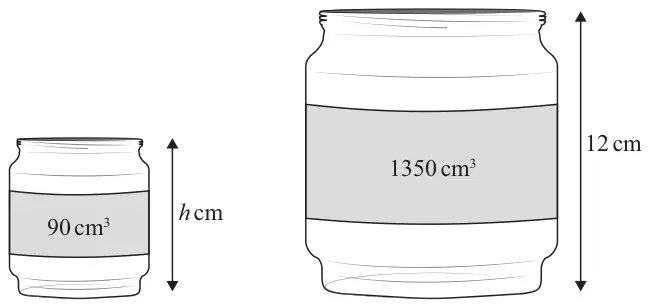
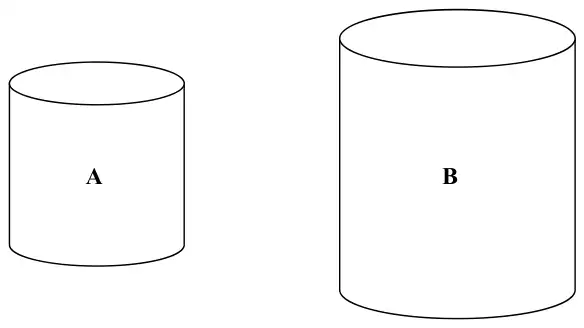
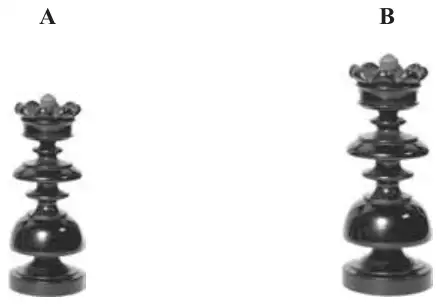
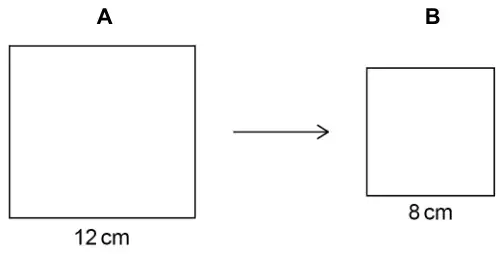
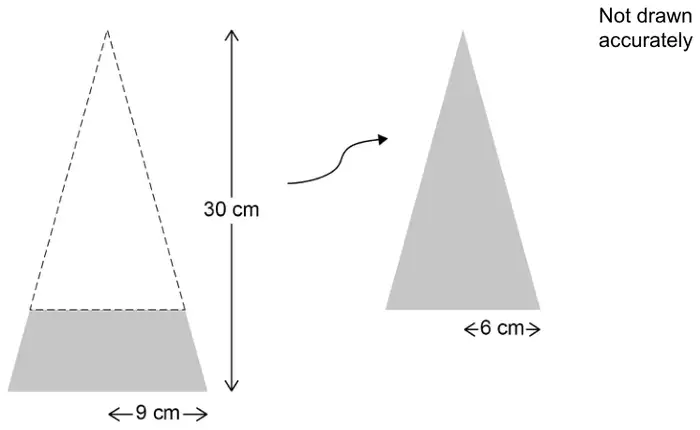
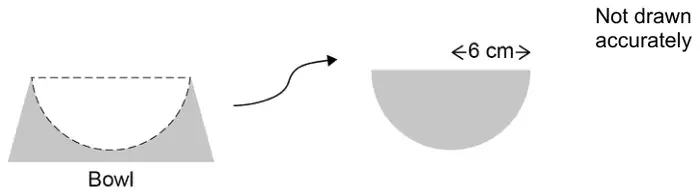
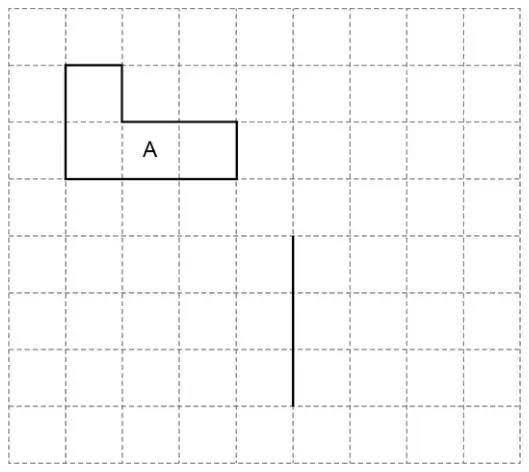
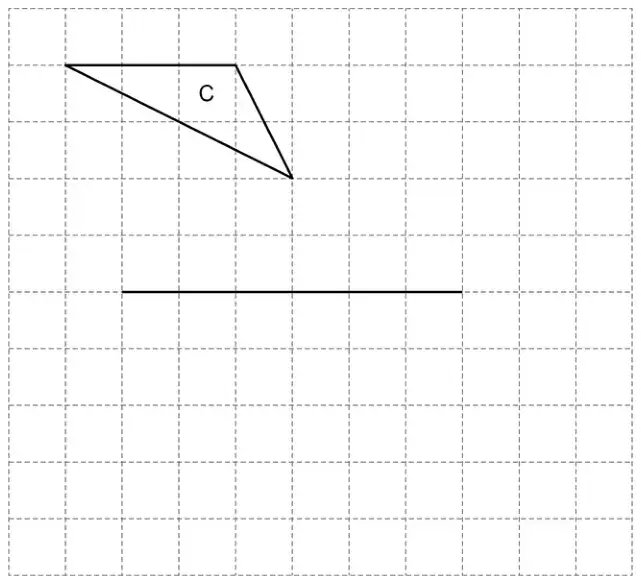
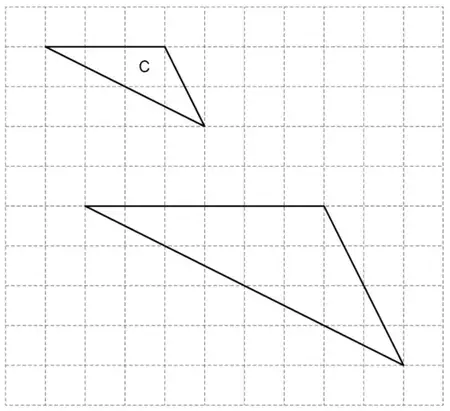
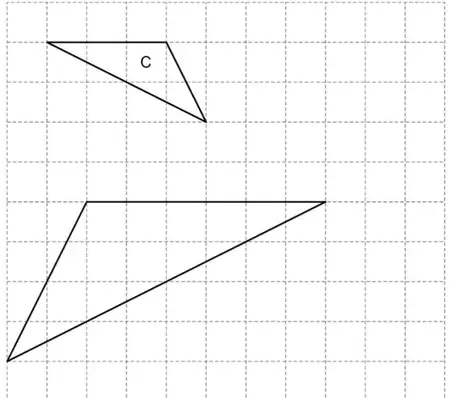
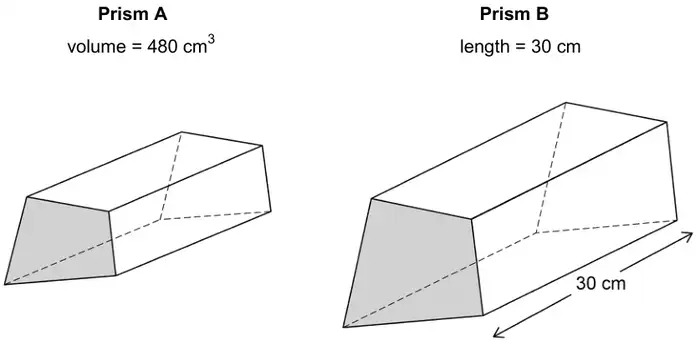
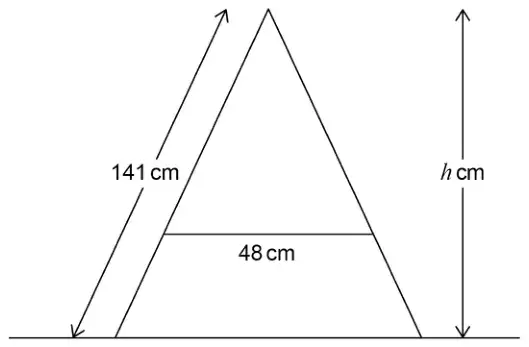
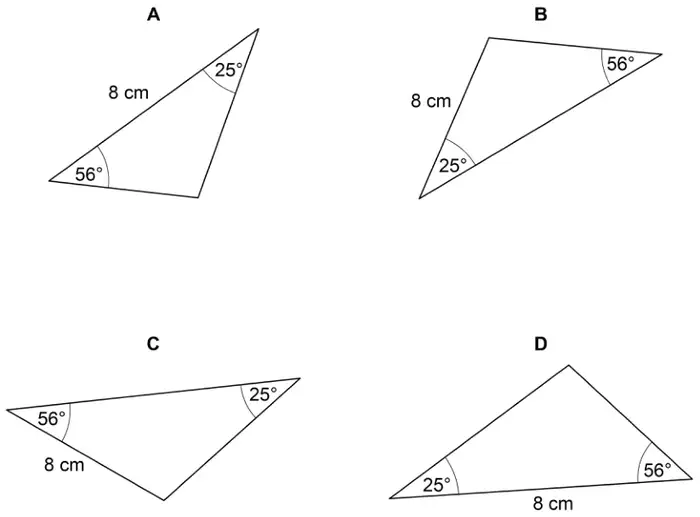
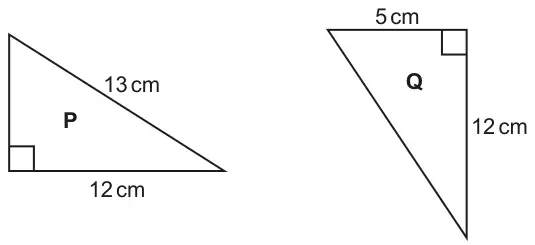
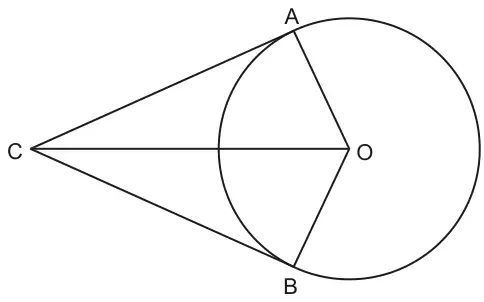
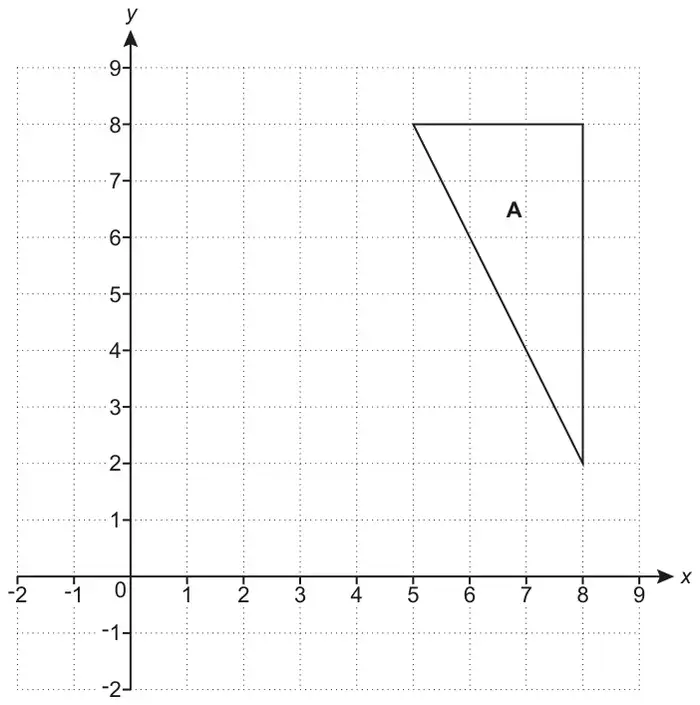
(a) Work out the height, \(h\) cm, of the smaller jar. Give your answer correct to 1 decimal place. (4)
The surface area of the smaller jar is \(A\) cm2 The surface area of the larger jar is \(pA\) cm2
(b) Find the exact value of \(p\). (1)
Mark scheme (a)
Answer
Mark
Mark scheme
4.9
P1
for beginning to work with scale factors eg \(\left(\dfrac{h}{12}\right)^3\) or \(\left(\dfrac{12}{h}\right)^3\) or \(\dfrac{90}{1350}\ \left(= \dfrac{1}{15}\right)\) or \(\dfrac{1350}{90}\ (= 15)\) or 90 : 1350 oe
P1
for equating scale factors eg \(\left(\dfrac{h}{12}\right)^3 = \dfrac{90}{1350}\) or \(\left(\dfrac{12}{h}\right)^3 = \text{``}15\text{''}\) or for finding the linear scale factor, eg \(\sqrt[3]{\dfrac{90}{1350}}\) or \(\sqrt[3]{\text{``}15\text{''}}\ (= 2.46(6\ldots))\)
P1
for a complete method eg \(\sqrt[3]{12^3 \times \dfrac{90}{1350}}\) or \(12 \times \sqrt[3]{\dfrac{90}{1350}}\) or \(\dfrac{12}{\text{``}\left(\sqrt[3]{\text{``}15\text{''}}\right)\text{''}}\)
A1
for answers in the range 4.8 to 4.9
Mark scheme (b)
Answer
Mark
Mark scheme
\((15)^{\frac{2}{3}}\)
B1
for \(15^{\frac{2}{3}}\) or \(\left(\sqrt[3]{15}\right)^2\) or \(\sqrt[3]{15^2}\) or \(225^{\frac{1}{3}}\)
Additional guidance
If given in an acceptable form, then given as a decimal, isw and award
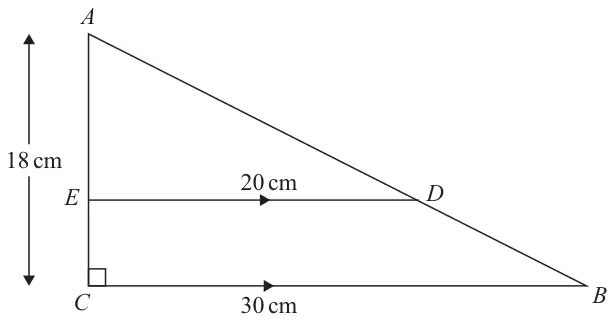
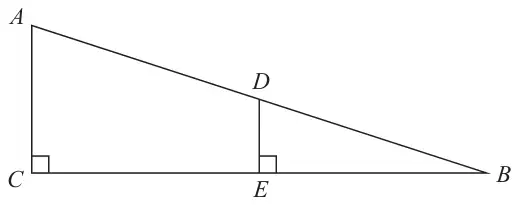
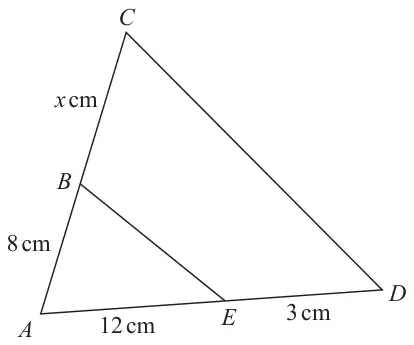
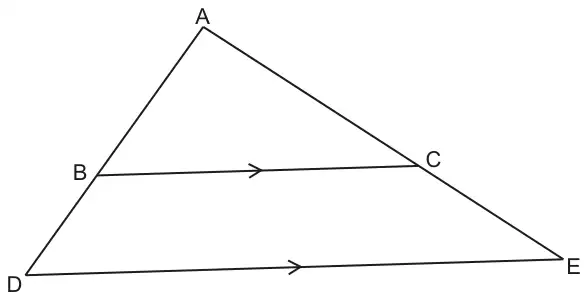
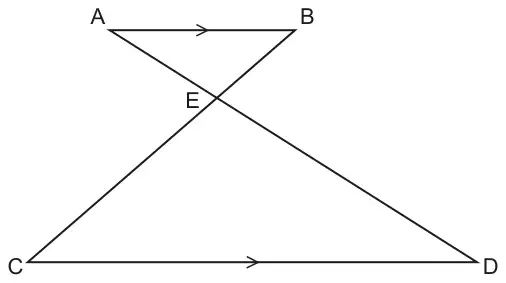
\(AEC\) and \(ADB\) are straight lines. \(ED\) is parallel to \(CB\).
(a) Prove that triangle \(ABC\) is similar to triangle \(ADE\). (2)
\(ED = 20\) cm \(CB = 30\) cm \(AC = 18\) cm
(b) Work out the length of \(EC\). (3)
Mark scheme (a)
Answer
Mark
Mark scheme
Proof
M1
for identifying angle \(A\) as common or for angle \(AED\) = angle \(ACB\) or angle \(ADE\) = angle \(ABC\) with appropriate reason(s) eg corresponding angles are equal or co-interior angles add up to 180 and angles on a straight line add up to 180
C1
for completing the proof by identifying a second pair of equal angles with appropriate reason(s) and a statement that the angles in each triangle are the same
Additional guidance
Statement can be implied by identifying a third pair of equal angles (no reason needed)
Mark scheme (b)
Answer
Mark
Mark scheme
6
P1
for a scale factor of 1.5 or \(\dfrac{2}{3}\) oe or for \(\dfrac{AE}{20} = \dfrac{18}{30}\) oe
P1
for a process to find the length of \(AE\), eg \(18 \div 1.5\ (= 12)\) oe or \((AE =)\ \dfrac{20 \times 18}{30}\) oe or for a complete process to find the length of \(EC\), eg \(18 \times \left(1 - \dfrac{2}{3}\right)\) oe
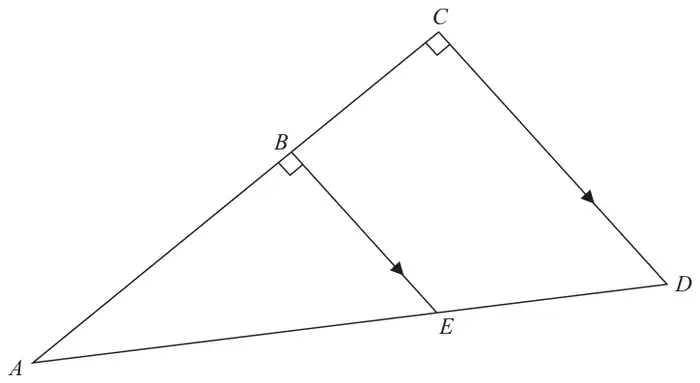
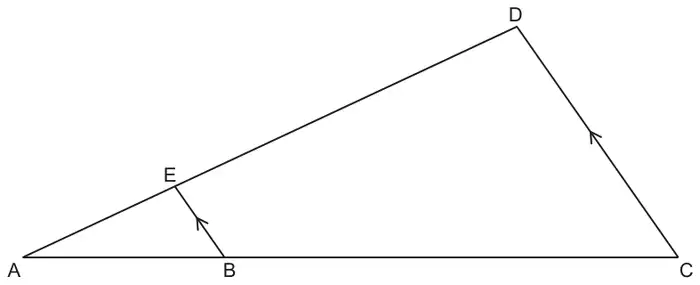
13 \(ABC\) and \(AED\) are straight lines. \(BE\) and \(CD\) are parallel.
\(BE = 4.2\) cm \(CD = 6.3\) cm \(AC = 10.8\) cm
Work out the area of trapezium \(BCDE\). (3)
Mark scheme
Answer
Mark
Mark scheme
18.9
P1
for using length scale factor to find \(AB\), eg \((AB =)\ 10.8 \div \left(\dfrac{3}{2}\right)\) or \((AB =)\ 10.8 \times \left(\dfrac{2}{3}\right)\ (= 7.2)\) or for using length scale factor to find \(BC\), eg \((BC =)\ 10.8 \div \dfrac{6.3}{6.3 - 4.2}\) or \((BC =)\ 10.8 \times \dfrac{6.3 - 4.2}{6.3}\ (= 3.6)\) or finds area scale factor, eg \(\left(\dfrac{3}{2}\right)^2\) or \(\left(\dfrac{2}{3}\right)^2\)
P1
for a complete process to find the area of trapezium, eg \(\dfrac{6.3 + 4.2}{2} \times (10.8 - \text{``}7.2\text{''})\) or \(\dfrac{(6.3 - 4.2) \times \text{``}3.6\text{''}}{2} + \text{``}3.6\text{''} \times 4.2\) or \(\dfrac{10.8 \times 6.3}{2} - \dfrac{7.2 \times 4.2}{2}\) or \(\dfrac{10.8 \times 6.3}{2} - \dfrac{10.8 \times 6.3}{2} \div \left(\text{``}\dfrac{3}{2}\text{''}\right)^2\) or \(\dfrac{10.8 \times 6.3}{2} - \dfrac{10.8 \times 6.3}{2} \times \left(\text{``}\dfrac{2}{3}\text{''}\right)^2\)
A1
accept trailing zeros eg 18.90
Additional guidance
Can use a combination of skills but must have a complete process to find \(AB\) or \(BC\) to score this mark
Sphere A has a volume of 64 cm3 Sphere B has a volume of 125 cm3
The radius of sphere C is 50% of the radius of sphere B.
Work out the ratio of the surface area of sphere A to the surface area of sphere C. Give your answer in the form \(a : b\) where \(a\) and \(b\) are integers. (4)
Mark scheme
Answer
Mark
Mark scheme
64 : 25
P1
for start of process to find ratio of lengths of A to B, eg \(\sqrt[3]{64}\ (= 4)\) or \(\sqrt[3]{125}\ (= 5)\) or 4 : 5
P1
for \(\sqrt[3]{125} \div 2\ (= 2.5)\) oe or \(\left(\text{``}\sqrt[3]{64}\text{''}\right)^2\ (= 16)\)
P1
for process to find ratio of areas of A to C, eg \(\text{``}4\text{''}^2 : \text{``}2.5\text{''}^2\ (= 16 : 6.25)\)
A1
for 64 : 25 oe in form \(a : b\) where \(a\) and \(b\) are integers
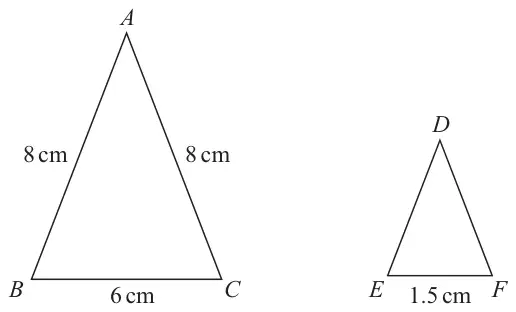
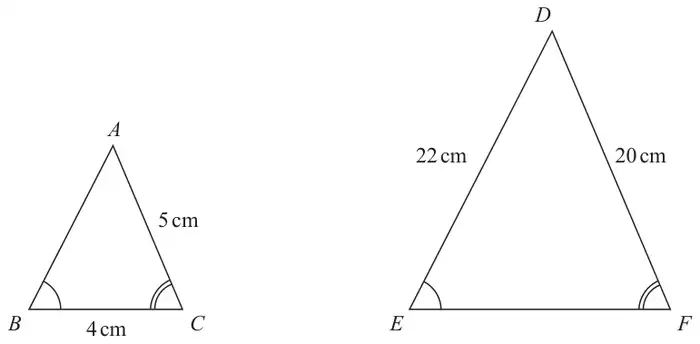
27 \(ABC\) and \(DEF\) are two similar isosceles triangles.
\(DE = DF\)
Work out the length of \(DE\). (2)
Mark scheme
Answer
Mark
Mark scheme
2
M1
for \(\dfrac{1.5}{6} \left(= \dfrac{1}{4}\right)\) or \(\dfrac{6}{1.5}\ (= 4)\) or \(\dfrac{8}{6} \left(= \dfrac{4}{3}\right)\) or \(\dfrac{6}{8} \left(= \dfrac{3}{4}\right)\) oe
\(ABC\) and \(DAB\) are similar isosceles triangles.
\(AB = AC\) \(AD = BD\)
\(BC : CD = 4 : 21\)
Find the ratio \(AB : AD\) (3)
Mark scheme
Answer
Mark
Mark scheme
2 : 5
P1
for using similar triangles to form an equation eg \(\dfrac{AB}{BC} = \dfrac{AD}{AB}\) oe or \(\dfrac{AB}{4} = \dfrac{25}{AB}\) oe or \(\dfrac{AB}{4k} = \dfrac{25k}{AB}\) oe or \(AB : 4 = 25 : AB\) oe or \(BC \times \text{sf} = BD \div \text{sf}\) oe or \(4 \times \text{sf} = 25 \div \text{sf}\) oe or for working with the perpendicular height of triangle \(ABC\) eg \((h^2 =)\ 25^2 - 23^2\ (= 96)\) or \((h =)\ \sqrt{25^2 - 23^2}\ (= \sqrt{96})\)
P1
for process to find \(AB\) eg \((AB =)\ \sqrt{4 \times 25}\ (= 10)\) oe or \(\sqrt{\text{``}96\text{''} + 2^2}\ (= 10)\) or for process to find the scale factor eg \(\sqrt{\dfrac{25}{4}}\ \left(= \dfrac{5}{2} \text{ oe}\right)\)
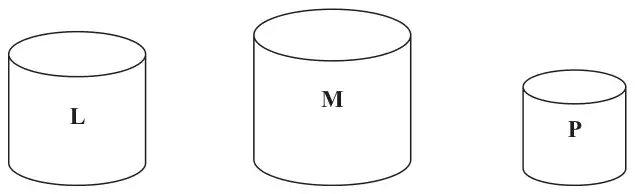
17L, M and P are three similar solid cylinders made from the same material.
L has a mass of 64 g M has a mass of 125 g
M has a total surface area of 144 cm2 P has a total surface area of 16 cm2
Work out
height of cylinder L : height of cylinder M : height of cylinder P(4)
Mark scheme
Answer
Mark
Mark scheme
12 : 15 : 5
P1
for process to find ratio of heights of L and M eg \(\sqrt[3]{64} : \sqrt[3]{125}\ (= 4 : 5)\) oe or \(\sqrt[3]{\dfrac{64}{64}} : \sqrt[3]{\dfrac{125}{64}}\ (= 1 : 1.25)\) oe or \(\sqrt[3]{\dfrac{64}{125}} : \sqrt[3]{\dfrac{125}{125}}\ (= 0.8 : 1)\) oe
P1
for process to find ratio of heights of M and P eg \(\sqrt{144} : \sqrt{16}\ (= 12 : 4 = 3 : 1)\) oe or \(\sqrt{\dfrac{144}{16}} : \sqrt{\dfrac{16}{16}}\ (= 3 : 1)\) oe or \(\sqrt{\dfrac{144}{144}} : \sqrt{\dfrac{16}{144}}\ (= 1 : 0.\dot{3})\) oe
P1
(dep on P2) for process to find ratio of heights of all 3, eg \(\text{``}(4 : 5)\text{''} \times 3\) and \(\text{``}(3 : 1)\text{''} \times 5\) or \((1 : 1.25) \times 12\) and \((3 : 1) \times 5\) or \((0.8 : 1)\) and \((1 : 0.\dot{3})\)
A1
for 12 : 15 : 5 oe
Additional guidance
Condone not written as a ratio as long as clear \(\dfrac{125}{64} = 1.953\ldots\) \(\dfrac{64}{125} = 0.512\)
Condone not written as a ratio as long as clear \(\dfrac{144}{16} = 9\) \(\dfrac{16}{144} = 0.\dot{1}\)
Can ISW incorrect simplification of a correct ratio
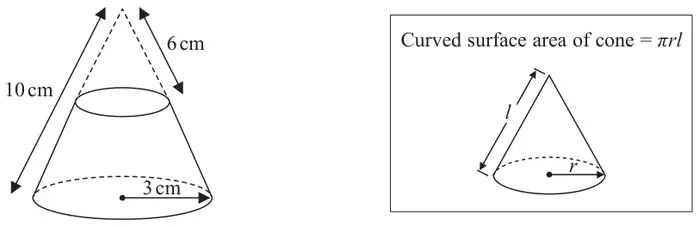
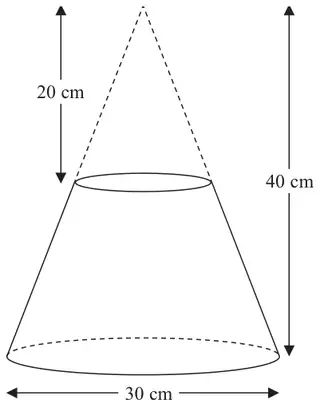
18 A solid frustum is made by removing a small cone from a large cone as shown in the diagram.
The slant height of the small cone is 6 cm. The slant height of the large cone is 10 cm. The radius of the base of the large cone is 3 cm.
Calculate the total surface area of the frustum. Give your answer correct to 3 significant figures. (5)
Mark scheme
Answer
Mark
Mark scheme
98.8
P1
for process to find the radius of the top of the frustum eg \(6 \div 10 \times 3\ (= 1.8)\)
P1
for process to find the curved surface area of the frustum eg \(3 \times \pi \times 10 - \text{``}1.8\text{''} \times \pi \times 6\ (= 60.3\ldots)\)
P1
for process to find the area of either circular face eg \(\pi \times 3^2\ (= 28.27\ldots)\) or \(\pi \times {\text{``}1.8\text{''}}^2\ (= 10.1\ldots)\)
P1
for a process to find the curved surface area + the area of at least one circular face eg \(3 \times \pi \times 10 - \text{``}1.8\text{''} \times \pi \times 6 + \pi \times 3^2\ (= 88.5\ldots)\) or \(3 \times \pi \times 10 - \text{``}1.8\text{''} \times \pi \times 6 + \pi \times {\text{``}1.8\text{''}}^2\ (= 70.49\ldots)\)
A1
for an answer in the range 98.7 to 98.8
Additional guidance
Accept rounded or truncated values Accept multiples of \(\pi\) for process marks.
If a correct answer within the range is shown in working but incorrectly rounded award full marks.
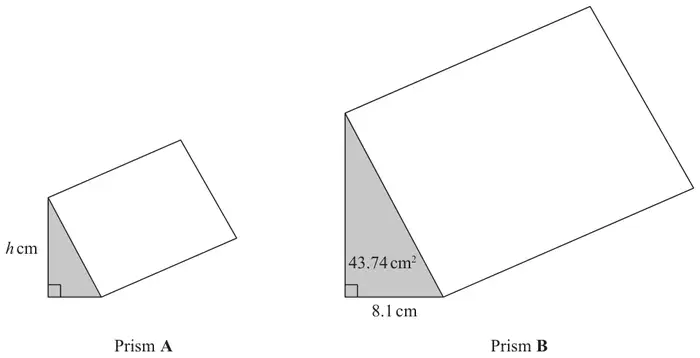
17 The diagram shows two similar solid triangular prisms, A and B.
The volume of prism A is 58.806 cm3 The volume of prism B is 1587.762 cm3
The cross section of each prism is a right-angled triangle.
For prism B: the length of the base of the triangle is 8.1 cm the area of the triangle is 43.74 cm2
The height of the triangle for prism A is \(h\) cm.
Work out the value of \(h\). (4)
Mark scheme
Answer
Mark
Mark scheme
3.6
P1
process to find the volume scale factor, eg \(1587.762 \div 58.806\ (= 27)\) or \(58.806 \div 1587.762\ (= 0.037\ldots)\)
P1
process to find the height of B, eg \(2 \times 43.74 \div 8.1\ (= 10.8)\) or process to find the area of A, eg \(43.74 \div (\sqrt[3]{\text{``}27\text{''}})^2\ (= 4.86)\) or \(43.74 \times (\sqrt[3]{\text{``}0.037...\text{''}})^2\ (= 4.86)\)
P1
complete process to find height of A, eg \(\text{``}10.8\text{''} \div \sqrt[3]{\text{``}27\text{''}}\) or \(\text{``}4.86\text{''} \times 2 \div (8.1 \div \sqrt[3]{\text{``}27\text{''}})\)
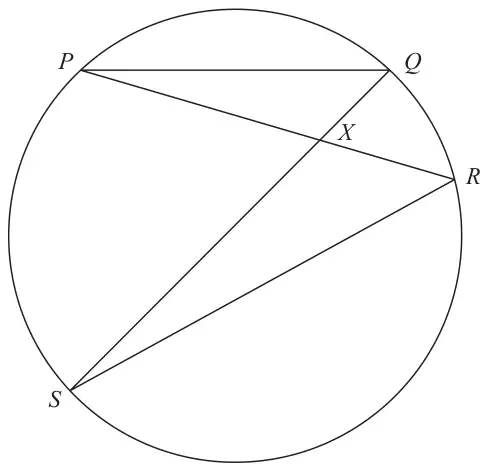
15 \(P\), \(Q\), \(R\) and \(S\) are four points on a circle.
\(PXR\) and \(SXQ\) are straight lines.
Prove that triangle \(PQX\) and triangle \(SRX\) are similar. (3)
Mark scheme
Answer
Mark
Mark scheme
Proof
C1
for angle \(PQX\) = angle \(SRX\) as angles in the same segment are equal (or angles at the circumference subtended from the same arc/chord of a circle are equal)
or angle \(QPX\) = angle \(RSX\) as angles in the same segment are equal (or angles at the circumference subtended from the same arc/chord of a circle are equal)
or angle \(PXQ\) = angle \(SXR\) as vertically opposite angles/vertically opposite angles are equal
or for identifying two pairs of corresponding equal angles with no reason given
C1
for identifying two pairs of corresponding equal angles with correct reasons given
C1
for stating that the triangles are similar because all three pairs of corresponding angles are equal with complete reasons given.
Additional guidance
Underlined words need to be shown; reasons need to be linked to their method.
Could be shown on the diagram
Note that the students third/final reason may be: Angles in a triangle add up to 180
The volume of sphere \(A\) is 125 cm\(^3\) The volume of sphere \(B\) is 27 cm\(^3\)
The ratio of the radius of sphere \(B\) to the radius of sphere \(C\) is \(1 : 2\)
Work out the ratio of the surface area of sphere \(A\) to the surface area of sphere \(C\). (3)
Mark scheme
Answer
Mark
Mark scheme
25 : 36
P1
for \(\sqrt[3]{125}\ (= 5)\) and \(\sqrt[3]{27}\ (= 3)\) oe OR for correct process to find the radius of A and radius of B (3.10… and 1.86…)
P1
for method to find values in ratio of length between \(A\) and \(C\) eg 5 and \(2 \times 3\ (= 6)\) oe or \(\text{``}3.10\ldots\text{''}\) and \(\text{``}1.86\ldots\text{''} \times 2\ (= 3.72\ldots)\) OR 25 and 36 OR for correct process to find SA of A and SA of C (120.(8…)) and (174.(0…))
A1
for 25 : 36 oe eg 1 : 1.44
Additional guidance
Accept scale factors expressed as fractions or decimals eg 1.66, 1.67, 0.6 or better Ignore units throughout
For both P marks the lengths need not be written as a ratio
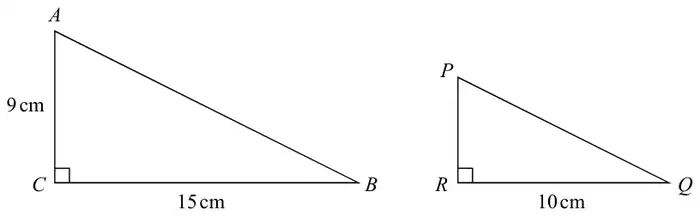
29 \(ABC\) and \(PQR\) are similar right-angled triangles.
angle \(ABC\) = angle \(PQR\)
(a) Work out the length of \(PR\). (2)
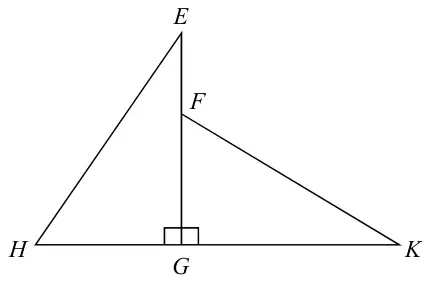
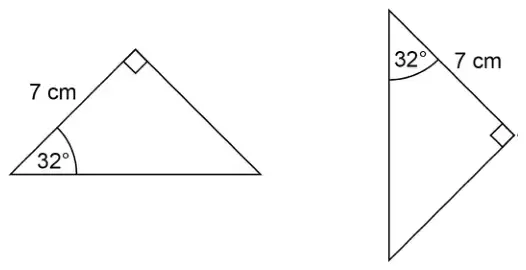
Triangle \(EGH\) is congruent to triangle \(KGF\).
\(HK = 10\) cm. \(HG = 4\) cm.
(b) Work out the length of \(EF\). (2)
Mark scheme (a)
Answer
Mark
Mark scheme
6
M1
for stating a similar triangle relationship eg \(\dfrac{AB}{PQ} = \dfrac{AC}{PR} = \dfrac{CB}{RQ}\) or equivalent set of similar triangle expressions or for substitution giving a fraction form for a scale factor eg \(\dfrac{10}{15}\left(= \dfrac{2}{3}\right)\) or \(\dfrac{15}{10}\left(= \dfrac{3}{2}\right)\) or \(\dfrac{9}{15}\left(= \dfrac{3}{5}\right)\) or \(\dfrac{15}{9}\left(= \dfrac{5}{3}\right)\)
A1
cao
Additional guidance
Accept any equivalent fractions or decimal equivalents given to at least 2 dp truncated or rounded
Mark scheme (b)
Answer
Mark
Mark scheme
2
P1
for showing understanding of the properties of congruent triangles by finding an unknown length using matching of two sides, eg \(EG\), \(KG\) and 6, or \(HG\), \(FG\) and 4 or matching corresponding angles eg \(HEG\) with \(FKG\) and \(EHG\) with \(KFG\)
A1
cao
Additional guidance
Can be shown by any complete statements that are unambiguous
Can be shown in working using algebraic statements, or given by unambiguous marking on the diagram to confirm the relationship.
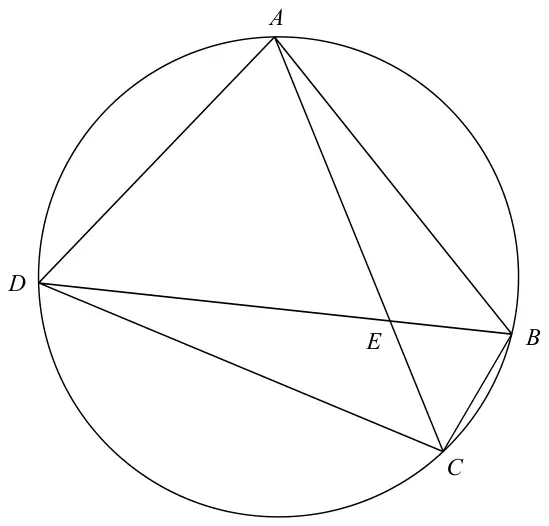
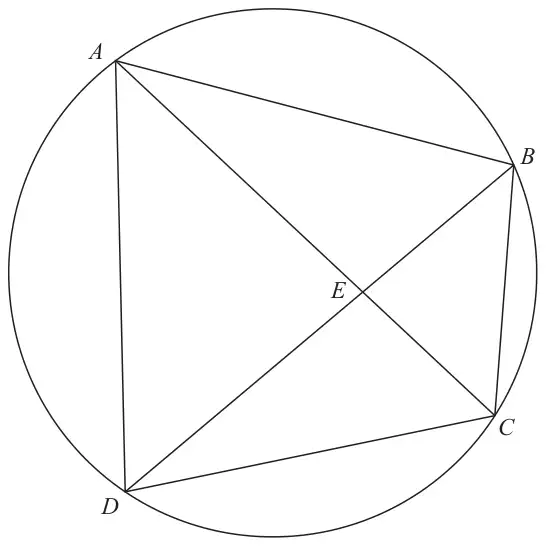
22 \(A\), \(B\), \(C\) and \(D\) are four points on a circle.
\(AEC\) and \(DEB\) are straight lines.
Triangle \(AED\) is an equilateral triangle.
Prove that triangle \(ABC\) is congruent to triangle \(DCB\). (4)
Mark scheme
Answer
Mark
Mark scheme
Proof
C1
for one correct pair of equal angles with correct reason from: angle \(ACB\) = angle \(ADB\), (angles in the same segment are equal) angle \(DBC\) = angle \(DAC\), (angles in the same segment are equal) angle \(ABD\) = angle \(ACD\), (angles in the same segment are equal) or for recognising all angles of 60 in triangle \(AED\) and in triangle \(CEB\))
C1
for one identity, with reason(s), from the following list of alternatives: Alternatives: a complete method to show that angle \(ACB\) = angle \(DBC\) (= 60), or \(BC\) being common to both triangles or \(DB = DE+EB = AE+EC = AC\) (sides of an equilateral triangle are equal) or angle \(ABC = 60 +\) angle \(ABD = 60 +\) angle \(ACD\) = angle \(DCB\) (angles in the same segment are equal) or angle \(BDC\) = angle \(CAB\) (angles in the same segment are equal)
C1
for a second identity, with reason(s), from the alternatives above
C1
for concluding the proof with a third identity, with reason(s), from the alternatives above, together with the condition for congruency, ASA or SAS or AAS
Additional guidance
Underlined words need to be shown; reasons need to be linked to their statement(s)
Pairs of equal angles may be just shown on the diagram
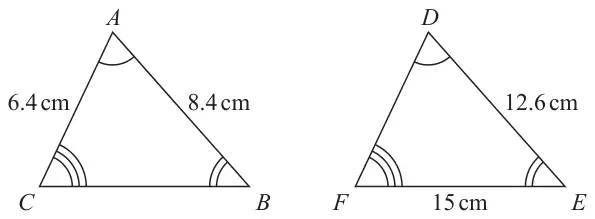
27 Triangle \(ABC\) and triangle \(DEF\) are similar.
(a) Work out the length of \(DF\). (2)
(b) Work out the length of \(CB\). (2)
Mark scheme (a)
Answer
Mark
Mark scheme
9.6
M1
for a correct ratio, eg \(\dfrac{12.6}{8.4}\ (= 1.5)\) or \(\dfrac{8.4}{12.6}\) (= 0.66..) or \(\dfrac{6.4}{8.4}\) (= 0.76..) or \(\dfrac{8.4}{6.4}\) (= 1.31) oe
A1
cao
Additional guidance
Decimal equivalents can be truncated or rounded to 2 dp Accept equivalent methods to use a sf eg \(\dfrac{6.4}{2} + 6.4\) (indicative of 1.5)
Mark scheme (b)
Answer
Mark
Mark scheme
10
M1
for \(15 \div \text{``}1.5\text{''}\) or \(15 \times \text{``}0.66..\text{''}\) or ft their ratio from part (a) oe
A1
cao
Additional guidance
Award the method mark for any (equivalent) complete method shown.
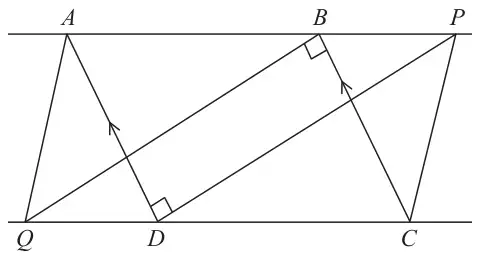
\(ABCD\) is a parallelogram. \(ABP\) and \(QDC\) are straight lines. Angle \(ADP\) = angle \(CBQ = 90^\circ\)
(a) Prove that triangle \(ADP\) is congruent to triangle \(CBQ\). (3)
(b) Explain why \(AQ\) is parallel to \(PC\). (2)
Mark scheme (a)
Answer
Mark
Mark scheme
Proof
C1
for starting the proof, identifying a pair of relevant equal sides or angles with reasons from \(AD = BC\) (opposite sides of a parallelogram are equal) angle \(PAD\) = angle \(QCB\) (opposite angles of a parallelogram are equal) angle \(ADP\) = angle \(CBQ\) (given or both 90°)
C1
(dep C1) for complete identification of all three equal aspects with reasons
C1
(dep C2) for conclusion of congruency proof
Additional guidance
Congruency conclusion must include a reference to ASA
Mark scheme (b)
Answer
Mark
Mark scheme
Explanation
C1
for identifying a pair of equal sides or angles in \(APCQ\), with reason, eg \(AP = QC\) since triangle \(ADP\) is congruent to triangle \(CBQ\)
C1
(dep C1) for reasoning that \(APCQ\) is a parallelogram so opposite sides of a parallelogram are parallel
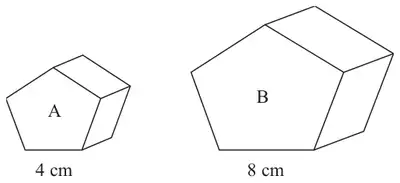
surface area of shape A : surface area of shape B = 3 : 4
The volume of shape B is 10 cm3
Work out the volume of shape A. Give your answer correct to 3 significant figures. (3)
Mark scheme
Answer
Mark
Mark scheme
6.50
M1
for method to find ratio or scale factor of lengths or volumes eg \(\sqrt{3} : 2\) or 1 : 1.15(47....) or 0.86(60…) : 1 or \(\sqrt{27} : 8\) oe
M1
for complete method to find ratio of volumes and use to find required volume eg \(10 \div (\text{``}1.15...\text{''})^3\) or \(10 \times (\text{``}0.86...\text{''})^3\)
A1
for answer in the range 6.49 to 6.53
Additional guidance
Scale factors may just be seen as 1.15..., 0.86...etc
If an answer is given within the range then incorrectly rounded to 3 sig figs, award full marks. Accept 6.5
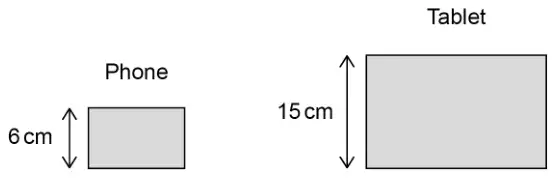
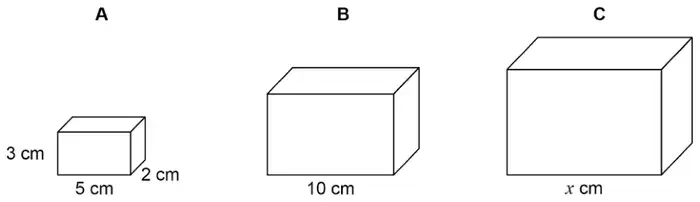
Work out each of these values. State any assumptions you make in your working. (5)
Mark scheme
Answer
Mark
Notes
2, 14.5
P1
for scale factor of \(\dfrac{12}{3}\) or \(\dfrac{3}{12}\) or \(\dfrac{15}{12}\) or \(\dfrac{12}{15}\) or \(\dfrac{8}{12}\) or \(\dfrac{12}{8}\) or \(\dfrac{15}{8}\) oe or correctly identifies 2 pairs of corresponding sides
A1
for \(x=2\)
P1
for complete method to find other value for \(x\) eg \(\dfrac{15}{8} \times 12 - 8\)
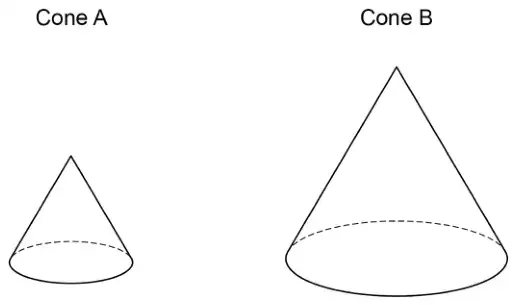
14 Cone A and cone B are mathematically similar. The ratio of the volume of cone A to the volume of cone B is 27 : 8
The surface area of cone A is 297 cm2
Show that the surface area of cone B is 132 cm2(3)
Mark scheme
Answer
Mark
Notes
Shown
M1
for \(\sqrt[3]{\dfrac{8}{27}}\ \left(= \dfrac{2}{3}\right)\) or \(\sqrt[3]{\dfrac{27}{8}}\ \left(= \dfrac{3}{2}\right)\) or 2 : 3 or 3 : 2
M1
for \(\left(\sqrt[3]{\dfrac{8}{27}}\right)^2\ \left(= \dfrac{4}{9}\right)\) or \(\left(\sqrt[3]{\dfrac{27}{8}}\right)^2\ \left(= \dfrac{9}{4}\right)\) or 4 : 9 or 9 : 4
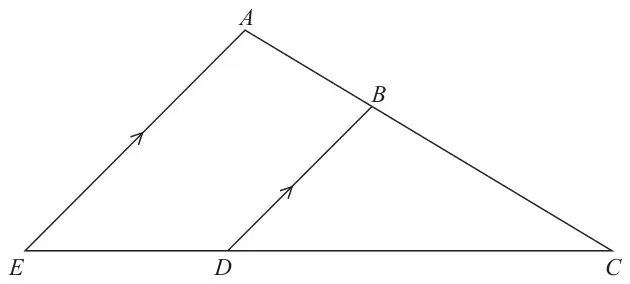
\(ABC\) and \(EDC\) are straight lines. \(EA\) is parallel to \(DB\).
\(EC = 8.1\) cm. \(DC = 5.4\) cm. \(DB = 2.6\) cm.
(a) Work out the length of \(AE\). (2)
\(AC = 6.15\) cm.
(b) Work out the length of \(AB\). (2)
Mark scheme (a)
Answer
Mark
Notes
3.9
M1
for a ratio of \(\dfrac{8.1}{5.4}\ (= 1.5)\) oe or \(\dfrac{5.4}{8.1}\ (= 0.66..)\) oe or \(\dfrac{2.6}{5.4}\ (= 0.48..)\) oe or \(\dfrac{5.4}{2.6}\ (= 2.07..)\) oe
A1
cao
Mark scheme (b)
Answer
Mark
Notes
2.05
M1
for \(\dfrac{5.4}{8.1} \times 6.15\ (= 4.1)\) or \(\dfrac{2.7}{8.1} \times 6.15\) oe or ft “scale factor” from (a)
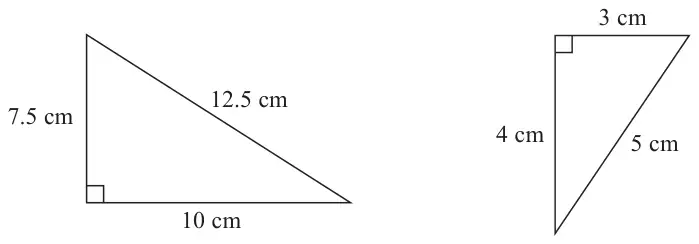
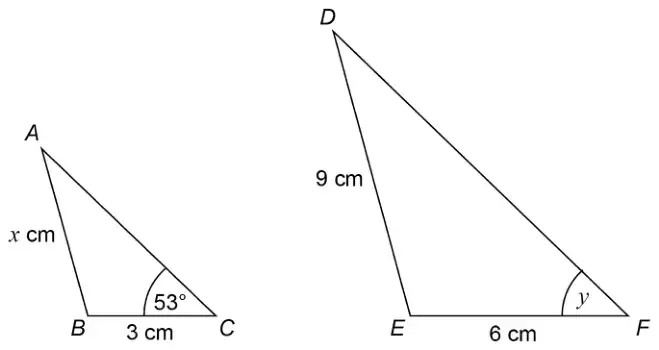
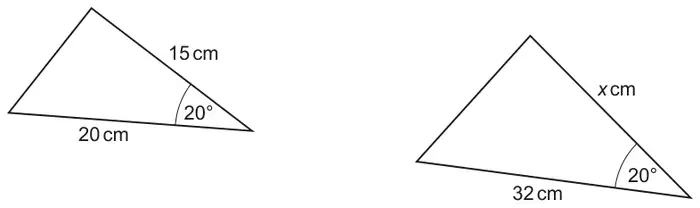
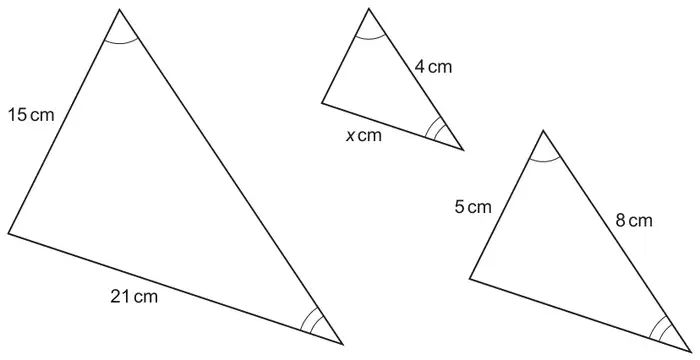
Show that these two triangles are mathematically similar. (2)
Mark scheme
Answer
Mark
Notes
Shown (supported)
M1
method to divide a pair of corresponding sides, eg \(7.5 \div 3\ (= 2.5)\) or \(3 \div 7.5\ (= 0.4)\), or states scale factor is 2.5 or 0.4 or method to work out the size of an angle, eg \(\tan^{-1}\left(\dfrac{7.5}{10}\right)\) (= 36.8 to 36.9)
C1
shows or states that all sides are enlarged by the same factor or works out a pair of corresponding angles and states that the two triangles have the same angles
15 \(A\), \(B\), \(C\) and \(D\) are four points on the circumference of a circle.
\(AEC\) and \(BED\) are straight lines.
Prove that triangle \(ABE\) and triangle \(DCE\) are similar. You must give reasons for each stage of your working. (3)
Mark scheme
Answer
Mark
Notes
Proof
C1
for identifying one pair of equal angles with a correct reason, e.g. (angle) \(BAE\) = (angle) \(CDE\); angles in the same segment are equal or angles at the circumference subtended on the same arc are equal or for identifying two pairs of equal angles with no correct reasons given (angles must be within the appropriate triangles)
C1
for identifying a second pair of equal angles with a correct reason, e.g. (angle) \(AEB\) = (angle) \(DEC\); opposite angles or vertically opposite angles are equal or for identifying the three pairs of equal angles with no correct reasons given
C1
for stating the three pairs of equal angles of the two triangles e.g. \(ABE = DCE\), \(BEA = CED\), \(EAB = EDC\) with fully correct reasons
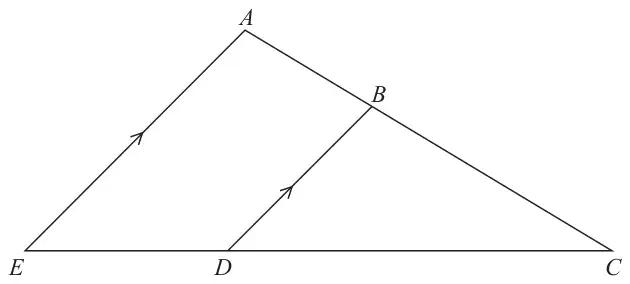
\(ABC\) and \(EDC\) are straight lines. \(EA\) is parallel to \(DB\).
\(EC = 8.1\) cm. \(DC = 5.4\) cm. \(DB = 2.6\) cm.
(a) Work out the length of \(AE\). (2)
\(AC = 6.15\) cm.
(b) Work out the length of \(AB\). (2)
Mark scheme (a)
Answer
Mark
Notes
3.9
M1
for a ratio of \(\dfrac{8.1}{5.4}\ (= 1.5)\) oe or \(\dfrac{5.4}{8.1}\ (= 0.66..)\) oe or \(\dfrac{2.6}{5.4}\ (= 0.48..)\) oe or \(\dfrac{5.4}{2.6}\ (= 2.07..)\) oe
A1
cao
Mark scheme (b)
Answer
Mark
Notes
2.05
M1
for \(\dfrac{5.4}{8.1} \times 6.15\ (= 4.1)\) or \(\dfrac{2.7}{8.1} \times 6.15\) oe or ft “scale factor” from (a)
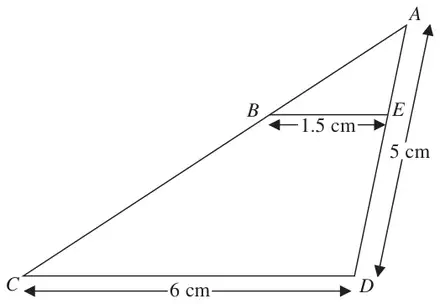
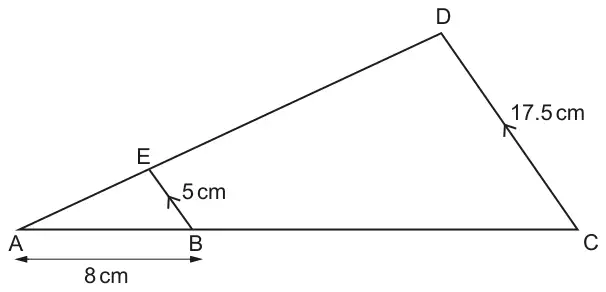
\(ABC\) and \(AED\) are straight lines. \(BE\) and \(CD\) are parallel. \(BE = 1.5\) cm. \(CD = 6\) cm. \(AD = 5\) cm.
Calculate the length of \(ED\). (3)
Mark scheme
Answer
Mark
Notes
3.75 oe
3
M1 for a correct scale factor or ratio using two corresponding sides from similar triangles or two sides from the same triangle (may be seen in an equation) e.g \(\dfrac{6}{1.5}\) oe or \(\dfrac{1.5}{6}\) oe or \(\dfrac{5}{6}\) or \(\dfrac{6}{5}\) etc. (accept these written as ratios) M1 for a complete method to find \(ED\) A1
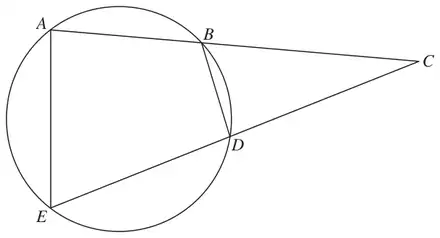
\(A\), \(B\), \(D\) and \(E\) are points on a circle. \(ABC\) and \(EDC\) are straight lines.
Prove that triangle \(BCD\) is similar to triangle \(ECA\). You must give reasons for your working. (5)
Mark scheme
Answer
Mark
Notes
Similarity and proof
5
B1 for method matching a pair of opposite angles, e.g. if \(EAB = x\), \(BDE = 180 - x\), \(EAB + BDE = 180\) B1 for linking angles between quad and triangle, e.g. if \(BDE = 180 - x\) then \(BDC = x\) B1 for stating or implying \(ACE = BCD\) (same angle) C1 for Opposite angles of a cyclic quadrilateral add up to \(180^\circ\) or statement linking three angles for similarity C1 for complete proof
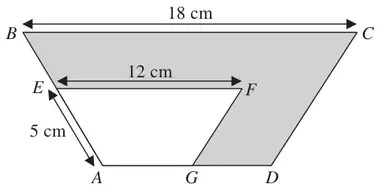
\(ABCD\) and \(AEFG\) are mathematically similar trapeziums.
\(AE = 5\) cm \(EF = 12\) cm \(BC = 18\) cm
(a) Work out the length of \(AB\). (2)
Trapezium \(AEFG\) has an area of 36 cm\(^2\).
(b) Work out the area of the shaded region. (3)
Mark scheme (a)
Answer
Mark
Notes
7.5
2
M1 for \(\dfrac{12}{18}\) oe or \(\dfrac{18}{12}\) oe or \(\dfrac{12}{5}\) oe or \(\dfrac{5}{12}\) oe A1 cao
Mark scheme (b)
Answer
Mark
Notes
45
3
M1 for \(\left(\text{``}\tfrac{3}{2}\text{''}\right)^2\) oe or \(\left(\text{``}\tfrac{2}{3}\text{''}\right)^2\) oe M1 for complete method to find area of shaded region, eg \(36 \times \text{``}1.5\text{''}^2 - 36\) A1 cao (SC B2 for 81)
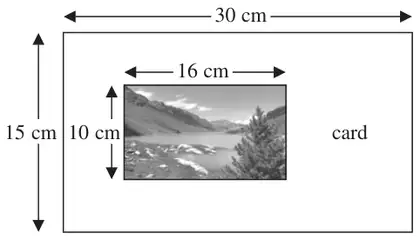
20 Steve has a photo and a rectangular piece of card.
Diagram NOT accurately drawn
The photo is 16 cm by 10 cm. The card is 30 cm by 15 cm.
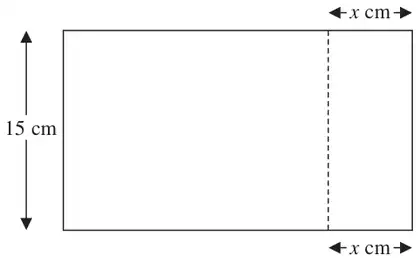
Steve cuts the card along the dotted line shown in the diagram below.
Steve throws away the piece of card that is 15 cm by \(x\) cm. The piece of card he has left is mathematically similar to the photo.
Work out the value of \(x\). (3)
Mark scheme
Answer
Mark
Notes
6
3
M1 for \(\dfrac{15}{10}\) (=1.5) or \(\dfrac{10}{15}\) (=0.66..) or \(\dfrac{16}{10}\) (=1.6) or \(\dfrac{10}{16}\) (=0.625) M1 for \(\dfrac{15}{10} \times 16\) (=24) oe A1 cao
OR
M1 for \(\dfrac{15}{16}\) (=0.9375) or \(\dfrac{16}{15}\) (=1.066…) or \(\dfrac{16}{10}\) (=1.6) or \(\dfrac{10}{16}\) (=0.625) M1 for \(\dfrac{15}{16} \times 10\) (=9.375) oe A1 20.625 oe
M1 for sight of \(\dfrac{9}{6}\) (=1.5) oe or \(\dfrac{6}{9}\) (=0.66..) oe or \(\dfrac{5}{6}\) (=0.83..) oe or \(\dfrac{6}{5}\) (=1.2) oe or a ratio, eg 6:9 oe or decimal, eg 1.5 oe A1 cao
Mark scheme (b)
Answer
Mark
Notes
8
2
M1 for \(12 \times \dfrac{6}{9}\) oe or \(12 \div \dfrac{9}{6}\) oe or \(\dfrac{12}{\text{``}7.5\text{''}} \times 5\) oe A1 cao
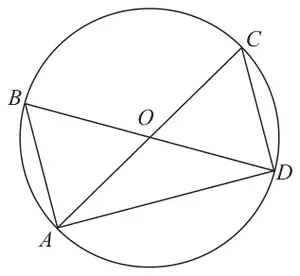
\(AOC\) and \(BOD\) are diameters of a circle, centre \(O\).
Prove that triangle \(ABD\) and triangle \(DCA\) are congruent. (3)
Mark scheme
Answer
Mark
Notes
Proof
3
M1 for one pair of equal angles or sides with reason M1 for second pair of equal angles or sides with reason C1 for proof completed correctly with full reasons and reason for congruence
Acceptable reasons: \(AD\) common (oe eg both same) Angle \(BAD\) = angle \(CDA\) (angles in a semicircle are 90°) Angle \(ABO\) = angle \(DCA\) (angles in the same segment are equal) Triangle \(ABD\) and triangle \(DCA\) are congruent - ASA
OR
\(BD = CA\) (diameters of the circle) Angle \(BAD\) = angle \(CDA\) (angles in a semicircle are 90°.) \(AD\) common Triangle \(ABD\) and triangle \(DCA\) are congruent - RHS
OR
\(BD = CA\) (diameters of the circle) \(AD\) is common Angle \(ADB\) = angle \(CAD\) (base angles of an isosceles triangle are equal.) Triangle \(ABD\) and triangle \(DCA\) are congruent - SAS
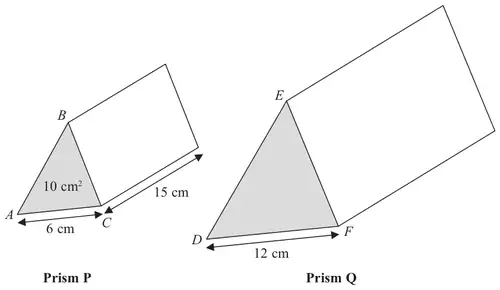
22P and Q are two triangular prisms that are mathematically similar.
Diagram NOT accurately drawn
Prism P has triangle \(ABC\) as its cross section. Prism Q has triangle \(DEF\) as its cross section.
\(AC = 6\) cm \(DF = 12\) cm
The area of the cross section of prism P is 10 cm\(^2\). The length of prism P is 15 cm.
Work out the volume of prism Q. (4)
Mark scheme
Answer
Mark
Notes
1200 cm\(^3\)
4
M1 for \(10 \times 2 \times 2\) and \(15 \times 2\) M1 for \(\text{``}40\text{''} \times \text{``}30\text{''}\) A1 for 1200 B1 (indep) for cm\(^3\)
OR
M1 for \(10 \times 15\) or \(2^3\) or 8 indicated as scale factor M1 for \(10 \times 15 \times 2 \times 2 \times 2\) A1 for 1200 B1 (indep) for cm\(^3\)
B1 for 15cm as diameter or 7.5 cm as radius of smaller cone (may be marked on diagram or used in a formula) M1 for a numerical expression for the volume of one cone eg. \(\frac{1}{3} \times \pi \times 15^2 \times 40\) (=9424...) or \(\frac{1}{3} \times \pi \times 7.5^2 \times 20\) (=1178...) M1 for \(\frac{1}{3} \times \pi \times 15^2 \times 40\) oe − \(\frac{1}{3} \times \pi \times 7.5^2 \times 20\) oe A1 for answer in the range 8240 − 8250 OR B1 for \(2^3\) M1 for a numerical expression for the volume of the large cone eg. \(\frac{1}{3} \times \pi \times 15^2 \times 40\) (=9424...) M1 volume of frustrum = \(\frac{7}{8} \times \frac{1}{3} \times \pi \times 15^2 \times 40\) oe A1 for answer in the range 8240 − 8250
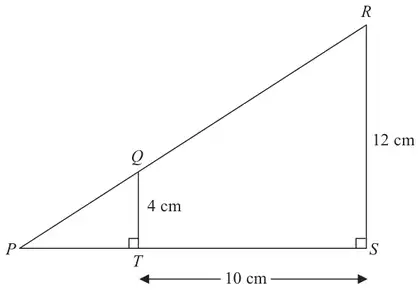
\(PQR\) and \(PTS\) are straight lines. Angle \(PTQ\) = Angle \(PSR = 90^\circ\) \(QT = 4\) cm \(RS = 12\) cm \(TS = 10\) cm
(a) Work out the area of the trapezium \(QRST\). (2)
(b) Work out the length of \(PT\). (3)
Mark scheme (a)
Working
Answer
Mark
Notes
\(\frac{1}{2} \times (4 + 12) \times 10\)
80
2
M1 for a fully correct method for area of \(QRST\) A1 cao
Mark scheme (b)
Working
Answer
Mark
Notes
For example \(\dfrac{PT + 10}{PT} = \dfrac{12}{4} = 3\) \(PT + 10 = 3PT\) \(2PT = 10\)
5
3
M1 for a correct scale factor or ratio using two corresponding sides from two similar triangles or two sides within the same triangle (may be seen within an equation) eg. \(\frac{12}{4}\) oe or 4 : 12 oe or \(\frac{PT}{4}\) or \(\frac{PS}{12}\) or \(\frac{12}{12 - 4}\) etc. M1 for a correct equation with \(PT\) or \(PS\) as the only variable or complete correct method using scale factor A1 cao
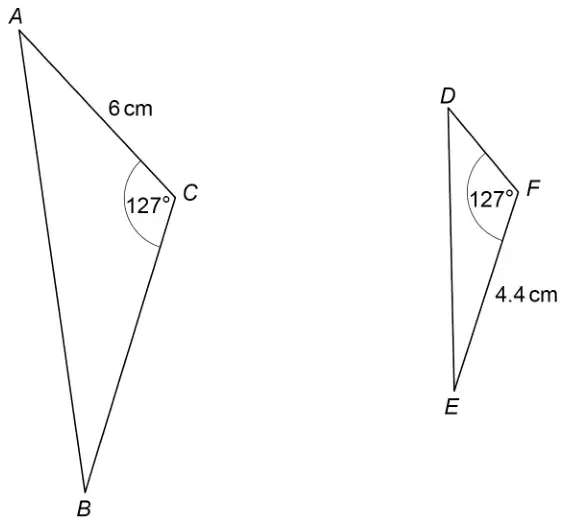
\(0.5 \times 6 \times x \times \sin 127 = 26.355\) or \(26.355 \div 6 \div \sin 127 \times 2\) or \(26.355 \div 6 \div [0.7986, 0.8] \times 2\) or [10.98, 11.001]
M1
length BC oe any letter
their \([10.98, 11.001] \div 4.4\) or [2.495, 2.50023] or \(4.4 \div\) their [10.98, 11.001] or [0.39996, 0.40073]
M1dep
length scale factor oe implied by [2.3997, 2.405] for length of DF
\(6 \div\) their [2.495, 2.50023] or \(6 \times\) their [0.39996, 0.40073] or [2.3997, 2.405] and \(0.5 \times 4.4 \times\) their [2.3997, 2.405] \(\times \sin 127\) or \(0.5 \times 4.4 \times\) their [2.3997, 2.405] \(\times\) [0.7986, 0.8] or \(26.355 \div (\text{their } [2.495, 2.50023])^2\) or \(26.355 \times (\text{their } [0.39996, 0.40073])^2\)
M1dep
length DF and area oe
area ratio and area \(26.355 \div \dfrac{[10.98, 11.001]^2}{4.4^2}\) or \(26.355 \times \dfrac{4.4^2}{[10.98, 11.001]^2}\) scores M3
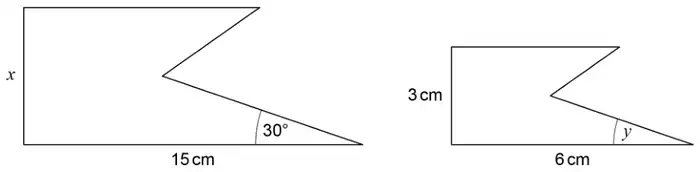
\(15 \div 6\) or 2.5 or \(6 \div 3\) or 2 or \(6 \div 15\) or 0.4 or \(3 \div 6\) or 0.5 or \(\dfrac{x}{15} = \dfrac{3}{6}\) or \(\dfrac{x}{15} = 0.5\)
M1
oe may be seen on the diagram
7.5 or \(7\dfrac{1}{2}\) or \(\dfrac{15}{2}\)
A1
Additional guidance
Accept correct answer unambiguously placed as \(x\) on the diagram provided it is not contradicted in the working space.
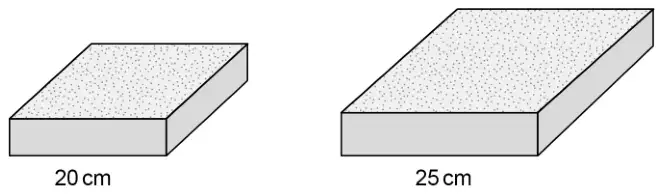
The price per cm\(^3\) is the same for both stones.
The price of the larger stone is £17.50
Work out the price of the smaller stone. [4 marks]
Mark scheme
Answer
Mark
Comments
\(\dfrac{25}{20}\) or \(\dfrac{5}{4}\) or 1.25 or \(\dfrac{20}{25}\) or \(\dfrac{4}{5}\) or 0.8 or (ratio of lengths is) 20 : 25
M1
oe
\(\left(\dfrac{25}{20}\right)^3\) or \(\left(\dfrac{5}{4}\right)^3\) or \(1.25^3\) or \(\left(\dfrac{20}{25}\right)^3\) or \(\left(\dfrac{4}{5}\right)^3\) or \(0.8^3\) or (ratio of volumes is) \(20^3 : 25^3\)
M1dep
oe eg \(\dfrac{125}{64}\) or 1.953125 or \(\dfrac{64}{125}\) or 0.512
oe eg \(4^3 : 5^3\)
\(17.5(0) \div 1.25^3\) or \(17.5(0) \times 0.8^3\)
M1dep
oe
8.96
A1
SC2 34.18
Additional guidance
Up to M2 may be awarded for correct work with no answer or incorrect answer, even if this is seen amongst multiple attempts
\(17.5(0) \times 1.25^3\) or \(17.5(0) \div 0.8^3\)
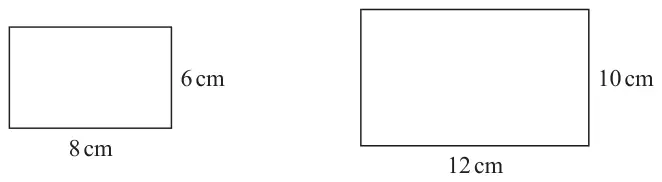
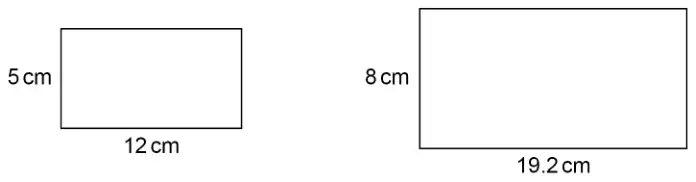
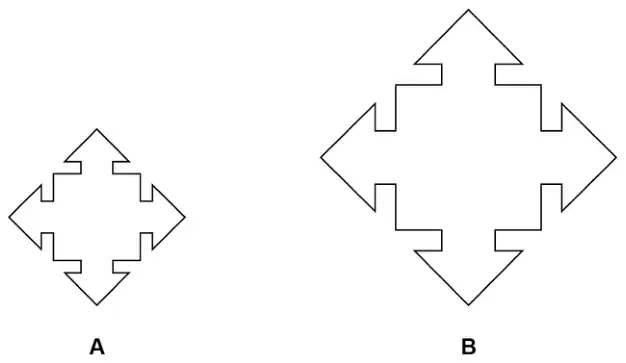
22 Show that these two rectangles are similar. [2 marks]
Not drawn accurately
Mark scheme
Answer
Mark
Comments
\(8 \div 5\) or \(19.2 \div 12\) or \(\dfrac{8}{5}\) or \(\dfrac{19.2}{12}\) or 1.6 or \(12 \div 5\) or \(19.2 \div 8\) or \(\dfrac{12}{5}\) or \(\dfrac{19.2}{8}\) or 2.4
M1
oe use of a valid pair of sides to make an appropriate calculation or value eg \(5 \div 8\) or 0.625 or \(5 \div 12\) or [0.416, 0.417]
\(8 \div 5 = 19.2 \div 12\) or \(\dfrac{8}{5} = \dfrac{19.2}{12}\) or \(12 \div 5 = 19.2 \div 8\) or \(\dfrac{12}{5} = \dfrac{19.2}{8}\)
A1
oe showing sides are in proportion eg \(5 \div 8 = 12 \div 19.2\) or \(\dfrac{5}{12} = \dfrac{8}{19.2}\)
Additional guidance
For A1 equating may be implied by two calculations or two fractions with correct evaluation eg \(8 \div 5 = 19.2 \div 12\) is implied by \(8 = 5 \times 1.6\) and \(19.2 = 12 \times 1.6\)
M1A1
For A1 equating may be implied by calculations eg1 \(8 \div 5 = 19.2 \div 12\) is implied by \(8 \div 5 = 1.6\) and \(12 \times 1.6 = 19.2\) eg2 \(8 \div 5 = 19.2 \div 12\) is implied by \(\dfrac{8}{5} \times 12 = 19.2\)
M1A1 M1A1
\(5 \times 19.2 = 8 \times 12\)
M1A1
\(5 \times 19.2 = 96\) and \(8 \times 12 = 96\)
M1A1
Non-contradictory working can be ignored eg correct response along with area calculations
M1A1
Ignore words eg references to scale factors, enlargement, angles
Working on diagrams may be seen eg1 Arrows or lines from 5 to 8 and 12 to 19.2 with \(\times\) 1.6 on them eg2 Arrows or lines from 5 to 8 and 12 to 19.2 with 1.6 on them Arrows or lines must unambiguously link relevant numbers
M1A1 M1A0
For \(8 \div 5\) or \(\dfrac{8}{5}\) allow 8 : 5 etc
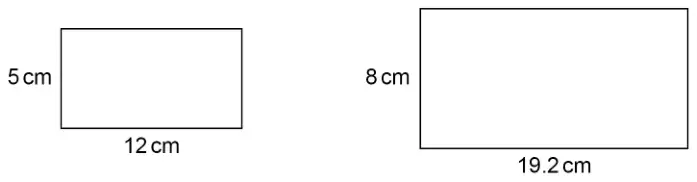
12 Show that these two rectangles are similar. [2 marks]
Not drawn accurately
Mark scheme
Answer
Mark
Comments
\(8 \div 5\) or \(19.2 \div 12\) or \(\dfrac{8}{5}\) or \(\dfrac{19.2}{12}\) or 1.6 or \(12 \div 5\) or \(19.2 \div 8\) or \(\dfrac{12}{5}\) or \(\dfrac{19.2}{8}\) or 2.4
M1
oe use of a valid pair of sides to make an appropriate calculation or value eg \(5 \div 8\) or 0.625 or \(5 \div 12\) or [0.416, 0.417]
\(8 \div 5 = 19.2 \div 12\) or \(\dfrac{8}{5} = \dfrac{19.2}{12}\) or \(12 \div 5 = 19.2 \div 8\) or \(\dfrac{12}{5} = \dfrac{19.2}{8}\)
A1
oe showing sides are in proportion eg \(5 \div 8 = 12 \div 19.2\) or \(\dfrac{5}{12} = \dfrac{8}{19.2}\)
Additional guidance
For A1 equating may be implied by two calculations or two fractions with correct evaluation eg \(8 \div 5 = 19.2 \div 12\) is implied by \(8 = 5 \times 1.6\) and \(19.2 = 12 \times 1.6\)
M1A1
For A1 equating may be implied by calculations eg1 \(8 \div 5 = 19.2 \div 12\) is implied by \(8 \div 5 = 1.6\) and \(12 \times 1.6 = 19.2\) eg2 \(8 \div 5 = 19.2 \div 12\) is implied by \(\dfrac{8}{5} \times 12 = 19.2\)
M1A1 M1A1
\(5 \times 19.2 = 8 \times 12\)
M1A1
\(5 \times 19.2 = 96\) and \(8 \times 12 = 96\)
M1A1
Non-contradictory working can be ignored eg correct response along with area calculations
M1A1
Ignore words eg references to scale factors, enlargement, angles
Working on diagrams may be seen eg1 Arrows or lines from 5 to 8 and 12 to 19.2 with \(\times 1.6\) on them eg2 Arrows or lines from 5 to 8 and 12 to 19.2 with 1.6 on them Arrows or lines must unambiguously link relevant numbers
M1A1 M1A0
For \(8 \div 5\) or \(\dfrac{8}{5}\) allow 8 : 5 etc
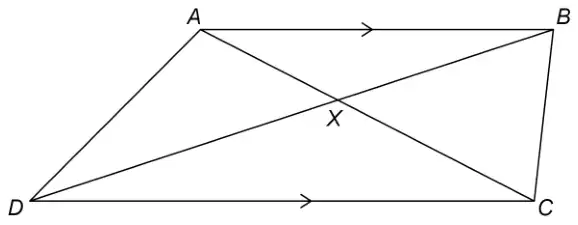
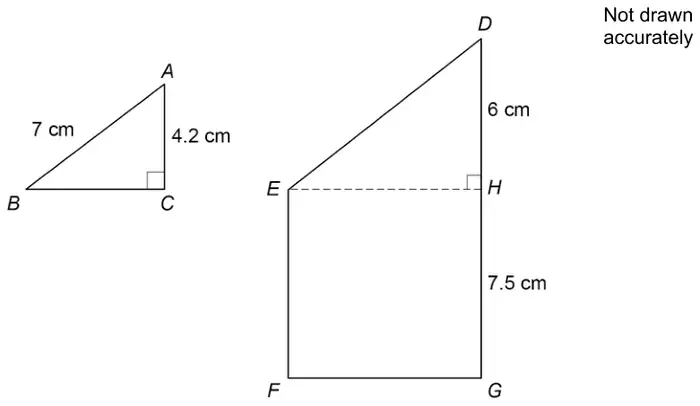
Alternative method 1 – Works out \(BC\) using Pythagoras then works out \(EH\)
\(7^2\) or 49 and \(4.2^2\) or 17.64
M1
oe
\(\sqrt{7^2 - 4.2^2}\) or \(\sqrt{49 - 17.64}\) or \(\sqrt{31.36}\) or 5.6
M1dep
oe implied by 11.76 as the area of the smaller triangle may be on diagram
\(6 \div 4.2 \times\) their 5.6 or 8
M1dep
oe full method to work out \(EH\) may be on diagram as \(EH\) or \(FG\) implied by 24 as the area of the larger triangle or 60 as the area of the rectangle
\(0.5 \times\) their \(8 \times 6\) or 24 and their \(8 \times 7.5\) or 60
M1dep
oe eg \(0.5 \times\) their \(5.6 \times 4.2 \times (6 \div 4.2)^2\) and their \(8 \times 7.5\) or \(0.5 \times\) their \(8 \times (7.5 + 13.5)\)
84
A1
Alternative method 2 – Works out \(ED\) using similar triangles then works out \(EH\)
\(6 \div 4.2 \times 7\) or 10
M1
oe may be on diagram
(their \(10)^2\) or 100 and \(6^2\) or 36
M1dep
oe
\(\sqrt{(\text{their } 10)^2 - 6^2}\) or \(\sqrt{100 - 36}\) or \(\sqrt{64}\) or 8
M1dep
oe full method to work out \(EH\) may be on diagram as \(EH\) or \(FG\) implied by 24 as the area of the larger triangle or 60 as the area of the rectangle
\(0.5 \times\) their \(8 \times 6\) or 24 and their \(8 \times 7.5\) or 60
M1dep
oe eg \(0.5 \times\) their \(5.6 \times 4.2 \times (6 \div 4.2)^2\) and their \(8 \times 7.5\) or \(0.5 \times\) their \(8 \times (7.5 + 13.5)\)
84
A1
Alternative method 3 – Uses trigonometry to work out \(BC\) then works out \(EH\) or uses trigonometry to work out \(EH\)
(angle \(ABC =\)) \(\sin^{-1}\left(\dfrac{4.2}{7}\right)\) or (angle \(ABC =\)) [36.8, 36.9] or (angle \(BAC =\)) \(\cos^{-1}\left(\dfrac{4.2}{7}\right)\) or (angle \(BAC =\)) [53.1, 53.2]
M1
oe full method to work out \(ABC\) or \(BAC\)
\(7 \times \cos\) (their [36.8, 36.9]) or \(7 \times \sin\) (their [53.1, 53.2]) or 5.6 or \(\tan\) (their [36.8, 36.9]) \(= \dfrac{6}{EH}\) or \(\tan\) (their [53.1, 53.2]) \(= \dfrac{EH}{6}\)
M1dep
oe full method to work out \(BC\) or partial method to work out \(EH\)
\(6 \div 4.2 \times\) their 5.6 or 8 or \(6 \div \tan\) (their [36.8, 36.9]) or \(6 \times \tan\) (their [53.1, 53.2])
M1dep
oe full method to work out \(EH\) may be on diagram as \(EH\) or \(FG\) implied by 24 as the area of the larger triangle or 60 as the area of the rectangle
\(0.5 \times\) their \(8 \times 6\) or 24 and their \(8 \times 7.5\) or 60
M1dep
oe eg \(0.5 \times\) their \(5.6 \times 4.2 \times (6 \div 4.2)^2\) and their \(8 \times 7.5\) or \(0.5 \times\) their \(8 \times (7.5 + 13.5)\)
84
A1
Additional guidance
Up to M3 may be awarded for correct work with no answer, or incorrect answer, even if this is seen amongst multiple attempts
\(\pi\) may be seen as any value in the interval [3.14, 3.142]
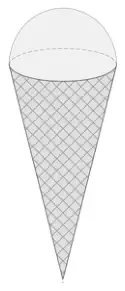
Do not allow any misreads of formulae unless recovered eg \(\pi \times 24^2 \times 117\) and \(\dfrac{2}{3} \times \pi \times 24^2\)
M0
Allow dots for multiplication
For A marks allow eg \(22\,464 \times \pi\) or \(\pi \times 31\,680\)
\(31\,680\pi\) followed by incorrect evaluation attempt
M1A1M1A1
\(31\,680\pi\) followed by further work
M1A1M1A0
31 680 only
M0A0M0A0
\(\dfrac{1}{3} \times \pi \times 24^2 \times 117 = 4725 \qquad \dfrac{2}{3} \times \pi \times 24^3 = 28\,952\) \(4725 + 28\,952\) (even though 4725 is wrong the method for \(\dfrac{1}{3} \times \pi \times 24^2 \times 117\) is seen)
M1A1 M1
Mark scheme (b)
Answer
Mark
Comments
Alternative method 1 Uses volume scale factor
\(24 \div 2\) or 12
M1
oe eg \(12 \times 2 = 24\)
(their \(12)^3\)
M1dep
oe eg \(24^3 \div 2^3\) or \(13\,824 \div 8\)
1728
A1
condone 1 : 1728 or 1728 : 1 SC2 \(\dfrac{1}{1728}\)
Alternative method 2 Compares volumes of cornets (ie compares total volumes)
\(24 \div 2\) or 12
M1
oe eg \(12 \times 2 = 24\) may be implied eg (height of cone) 9.75 or (volume of cone) \(13\pi\) or (volume of cone) [40.8, 40.85] or (total volume) \(\dfrac{55}{3}\pi\) or [57.4, 57.7]
condone 1 : 1728 or 1728 : 1 SC2 \(\dfrac{1}{1728}\)
Alternative method 3 Compares volumes of cones
\(24 \div 2\) or 12
M1
oe eg \(12 \times 2 = 24\) may be implied eg (height of cone) 9.75 or (volume of cone) \(13\pi\) or (volume of cone) [40.8, 40.85] or (total volume) \(\dfrac{55}{3}\pi\) or [57.4, 57.7]
their volume of cone from (a) \(\div \left(\dfrac{1}{3}\pi \times 2^2 \times \dfrac{117}{\text{their } 12}\right)\)
M1dep
oe eg their volume of cone from (a) \(\div\) [40.8, 40.85]
1728
A1
condone 1 : 1728 or 1728 : 1 SC2 \(\dfrac{1}{1728}\)
Alternative method 4 Compares volumes of hemispheres
their volume of hemisphere from (a) \(\div \left(\dfrac{2}{3}\pi \times 2^3\right)\)
M2
oe eg their volume of hemisphere from (a) \(\div\) [16.7, 16.8]
1728
A1
condone 1 : 1728 or 1728 : 1 SC2 \(\dfrac{1}{1728}\)
Additional guidance
\(\pi\) may be seen as any value in the interval [3.14, 3.142]
Answer \(\times 1728\) or \(1728 \times\)
M1M1A1
Answer 12
M1M0A0
Answer \(12^3\) with 1728 seen
M1M1A1
Answer \(12^3\) without 1728 seen
M1M1A0
Alts 2, 3 and 4 Allow if an incorrect volume formula from (a) is used in (b) eg Alt 4 (a) \(\dfrac{1}{2} \times \dfrac{2}{3} \times \pi \times 24^3 = 4608\pi\) (b) \(\dfrac{1}{2} \times \dfrac{2}{3} \times \pi \times 2^3 = \dfrac{8}{3}\pi\) \(4608\pi \div \dfrac{8}{3}\pi\) 1728
M2 A1
Alts 2 and 3 Allow \(\dfrac{55}{3}\) rounded to 1dp or better eg allow 18.3
Alt 4 Allow \(\dfrac{16}{3}\) rounded to 1dp or better eg allow 5.3
Alts 2 and 3 2nd M1 – allow consistent omission of \(\pi\)
Alt 4 M2 – allow consistent omission of \(\pi\)
Alts 2, 3 and 4 Answer 1728 is M1M1A1 unless it comes from rounding or truncating
eg1 Alt 2 \(99\,525.655 \div 57.595 = 1728\)
M1M1A1
eg2 Alt 2 \(99\,525.655 \div 57.595 = 1728.03\) Answer 1728
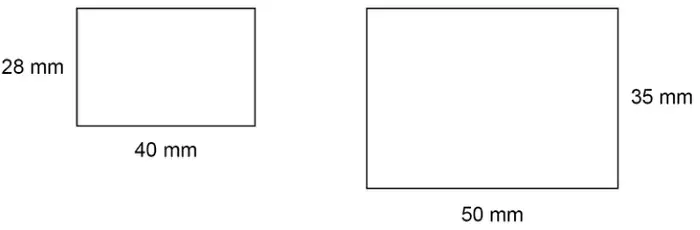
\(\dfrac{28}{35} = 0.8\) and \(\dfrac{40}{50} = 0.8\) or \(\dfrac{35}{28} = 1.25\) and \(\dfrac{50}{40} = 1.25\) or \(\dfrac{28}{40} = 0.7\) and \(\dfrac{35}{50} = 0.7\) or \(\dfrac{40}{28} = 1.42857\ldots\) and \(\dfrac{50}{35} = 1.42857\ldots\)
B1
oe decimal values must be the same, but may be correctly rounded or truncated
Alternative method 2
\(35 \times \dfrac{40}{50} = 28\) or \(35 \div \dfrac{50}{40} = 28\) or \(28 \times \dfrac{50}{40} = 35\) or \(28 \div \dfrac{40}{50} = 35\) or \(50 \times \dfrac{28}{35} = 40\) or \(50 \div \dfrac{35}{28} = 40\) or \(40 \times \dfrac{35}{28} = 50\) or \(40 \div \dfrac{28}{35} = 50\)
B1
oe calculation including all four values eg \(\dfrac{35 \times 40}{50} = 28\)
Additional guidance
Calculations must be shown
Accept decimal truncation but truncated values must be the same eg \(\dfrac{40}{28} = 1.42\) and \(\dfrac{50}{35} = 1.42\)
B1
\(\dfrac{28}{35} = \dfrac{40}{50}\) and \(28 \times 50 = 35 \times 40\) and \(1400 = 1400\) or \(\dfrac{28}{35} = \dfrac{40}{50}\) and \(28 \times 50 = 1400\) and \(35 \times 40 = 1400\)
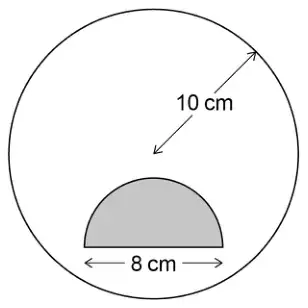
9 A shaded semicircle is inside a circle as shown.
Not drawn accurately
The radius of the circle is 10 cm
The diameter of the semicircle is 8 cm
How many times bigger is the unshaded area than the shaded area? [4 marks]
Mark scheme
Answer
Mark
Comments
Alternative method 1: areas
\(\pi \times 10^2\) or \(100\pi\)
M1
implied by [314, 314.2]
\(\pi \times (8 \div 2)^2\) or \(\pi \times 4^2\) or \(16\pi\) or \(\pi \times (8 \div 2)^2 \div 2\) or \(\pi \times 4^2 \div 2\) or \(16\pi \div 2\) or \(8\pi\)
M1
implied by [50.2, 50.3] or [25.12, 25.14] \(92\pi\) or \(84\pi\) or 92 : 8 or 8 : 92 or 84 : 16 or 16 : 84 implies M1M1
(their \(100(\pi)\) – their \(8(\pi)\)) \(\div\) their \(8(\pi)\) or \(92(\pi) \div 8(\pi)\) or their \(100(\pi) \div\) their \(8(\pi)\) (– 1) or \(12\dfrac{1}{2}\) (– 1) or 12.5 (– 1)
M1dep
dep on M2 absence of \(\pi\) must be consistent condone \(16(\pi)\) as their \(8(\pi)\) in first calculation only, ie condone (their \(100(\pi)\) – their \(16(\pi)\)) \(\div\) their \(16(\pi)\) or \(84(\pi) \div 16(\pi)\), but not their \(100(\pi) \div\) their \(16(\pi)\) (– 1)
\(11\dfrac{1}{2}\) or 11.5
A1
condone \(\dfrac{23}{2}\)
Alternative method 2: scale factor
\(\dfrac{10}{8 \div 2}\) or \(\dfrac{10}{4}\) or \(\dfrac{5}{2}\) or \(\dfrac{10 \times 2}{8}\) or \(\dfrac{20}{8}\) or 2.5
M1
oe scale factor of lengths eg \(\dfrac{2}{5}\) or 0.4 accept 2 : 5 or 5 : 2 oe ratio \(\pi\) may be present, but must be consistent in numerator and denominator
(their \(\dfrac{5}{2}\))\(^2\) or \(\dfrac{25}{4}\)
M1dep
oe scale factor of areas eg \(\dfrac{4}{25}\) accept 4 : 25 or 25 : 4 oe ratio
\(2 \times\) their \(\dfrac{25}{4}\) (– 1) or \(\dfrac{25}{2}\) (– 1) or \(12\dfrac{1}{2}\) (– 1) or 12.5 (– 1)
M1dep
oe eg \(2 \div\) their \(\dfrac{4}{25}\) (– 1)
\(11\dfrac{1}{2}\) or 11.5
A1
condone \(\dfrac{23}{2}\)
Additional guidance
Accept, for example, \(\pi 8\) or \(\pi \times 8\) or \(8 \times \pi\) for \(8\pi\)
An answer of \(11.5\pi\) with no incorrect working
M1M1M1A0
Consistent use of \(\pi d^2\) for the area of a circle gives the area of the circle as \(400\pi\), the area of the semicircle as \(32\pi\) and the area of the shaded part as \(368\pi\). This also gives the answer 11.5, but scores zero
M0M0M0A0
Irrespective of where their answer comes from and the presence of other measures such as circumference, students can gain the first two marks of alternative method 1 if it is clear that the methods or values given are for area eg 1 Big area \(= 100\pi\), little area \(= 8\pi\), big circumference \(= 20\pi\), little circumference \(= 4\pi\), \(20 \div 4 = 5\) eg 2 \(100\pi\), \(8\pi\), \(20\pi\), \(4\pi\)
M1M1M0A0
M0M0
Do not award the second mark if the value of \(8\pi\) comes from \(\pi d\) This is implied by, eg, ‘Area of circle \(= 20\pi\), area of semi-circle \(= 8\pi\)’
M?M0 M0M0
\(\dfrac{100(\pi) - 16(\pi)}{16(\pi)}\) (which may give an answer of 5.25)
M1M1M1A0
\(\dfrac{100(\pi)}{16(\pi)}\) (which may give an answer of 6.25)
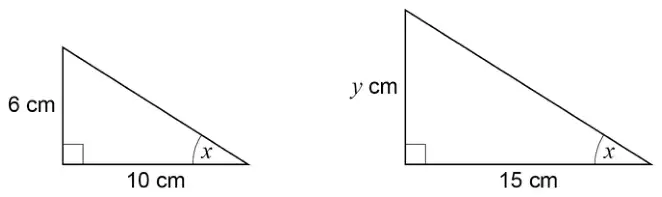
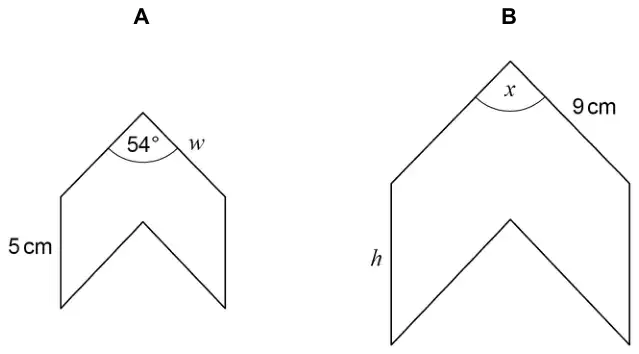
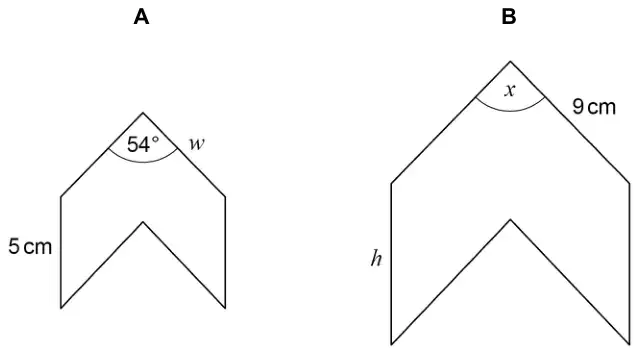
Work out the values of \(x\), \(h\) and \(w\). [3 marks]
Mark scheme
Answer
Mark
Comments
54
B1
May be on diagram
7.5 6
B2
May be on diagram B1 for 1 correct or for answers transposed
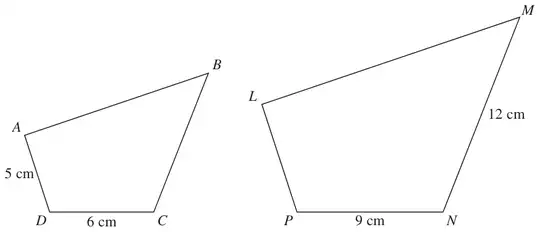
Additional guidance
If answers are in wrong position on answer lines, check working and diagram for clear indication of possible transcription errors eg \(w = 9 \div 1.5 = 6\) in working, 9 on answer line \(9 \div 1.5 = 6\) in working, 9 on answer line
B1 B0
Answer line takes precedence over diagram eg \(x = 54\) on diagram and \(x = 81\) on answer line
X has volume 64 cm\(^3\) Y has volume 343 cm\(^3\)
The surface area of X is 176 cm\(^2\)
Work out the surface area of Y. [3 marks]
Mark scheme
Answer
Mark
Comments
\(\sqrt[3]{64}\) and \(\sqrt[3]{343}\) or 4 and 7 or \(\sqrt[3]{[5.3, 5.4]}\) or [1.74, 1.754411] or \(\sqrt[3]{[0.18, 0.19]}\) or [0.56, 0.575]
M1
oe eg 4 : 7 or 7 : 4 or \(\sqrt[3]{\dfrac{343}{64}}\) or \(\dfrac{7}{4}\) or \(\sqrt[3]{\dfrac{64}{343}}\) or \(\dfrac{4}{7}\)
their \(4^2\) and their \(7^2\) or 16 and 49 or their \([1.74, 1.754411]^2\) or [3.02, 3.08] or their \([0.56, 0.575]^2\) or [0.31, 0.331]
M1dep
oe eg 16 : 49 or 49 : 16 or \(\left(\text{their } \dfrac{7}{4}\right)^2\) or \(\dfrac{49}{16}\) or \(\left(\text{their } \dfrac{4}{7}\right)^2\) or \(\dfrac{16}{49}\)
539
A1
Additional guidance
\(4^3\) and \(7^3\)
M1
\(64^{\frac{2}{3}}\) and \(343^{\frac{2}{3}}\)
M1M1
\(\left(\dfrac{343}{64}\right)^{\frac{2}{3}}\) or \(\left(\dfrac{64}{343}\right)^{\frac{2}{3}}\)
M1M1
Answer 539 with evidence of rounding to 539 scores A0
eg1 \(176 \times 3.06 = 538.56\) Answer 539
M1M1A0
eg2 \(176 \times 3.06 = 539\) (may have kept all digits on calculator)
M1M1A1
\(\left(\sqrt{176} \times \dfrac{7}{4}\right)^2\)
M1M1
\(176 \div 16 = 11\) and \(11 \times 49\)
M1M1
4 and 7 (and/or \(4^2\) and \(7^2\)) but uses different method not involving 4 and 7
Work out the values of \(x\), \(h\) and \(w\). [3 marks]
Mark scheme
Answer
Mark
Comments
54
B1
May be on diagram
7.5 6
B2
May be on diagram B1 for 1 correct or for answers transposed
Additional guidance
If answers are in wrong position on answer lines, check working and diagram for clear indication of possible transcription errors eg \(w = 9 \div 1.5 = 6\) in working, 9 on answer line \(9 \div 1.5 = 6\) in working, 9 on answer line
B1 B0
Answer line takes precedence over diagram eg \(x = 54\) on diagram and \(x = 81\) on answer line
“The volume of B is double the volume of A because the length of B is double the length of A.”
Is he correct?
Tick a box.
Yes
No
Give a reason for your answer. [1 mark]
Mark scheme
Answer
Mark
Comments
Ticks No and gives correct reason or ticks No and gives numerical counter-example for any solid
B1
eg1 (volume of) A is 8 times bigger eg2 (volume) sf \(= 2^3\) eg3 if A and B are cubes and \(l = 3\), volume of A = 27 volume of B = 216 216 is not \(27 \times 2\)
Additional guidance
Condone \(8l^3\)
B1
No, as the height/width is (also) doubled/different
\(6 \div 3\) or 2 or \(9 \div 2\) or \(3 \div 6\) or 0.5 or \(9 \times 0.5\) or \(9 \div 6\) or 1.5 or \(3 \times 1.5\) or \(6 \div 9\) or \(\dfrac{2}{3}\) or \(3 \div \dfrac{2}{3}\)
M1
oe
4.5
A1
oe
Additional guidance
Accept embedded answer \(4.5 \times 2 = 9\)
M1A1
Ignore further working in attempt to round after answer 4.5 eg \(9 \div 2 = 4.5\) with answer 5
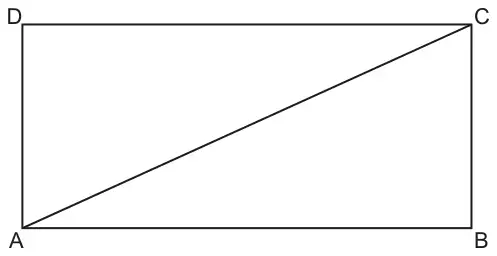
22 The diagram shows a rectangle ABCD with diagonal AC.
Not to scale
Complete each statement to show that triangle ABC is congruent to triangle ADC.
Angle ADC = angle .................. because both angles are \(90^\circ\). Side AD = side .................. because opposite sides of a rectangle are equal. Side CD = side .................. because ......................................................
The above three statements show that triangle ABC is congruent to triangle ADC because of .................. [4]
Mark scheme
Answer
Marks
Part marks and guidance
ABC or CBA
B1
Must use 3-letter notation
CB or BC
B1
AB or BA and opposite sides of a rectangle are equal oe
B1
See Appendix 1 for comment
SAS oe
B1dep
Dependent on previous B1B1B1
isw any comment made if SAS stated See Appendix 2 for SAS oe
Appendix
Appendix 1: Q22 – All exemplars below assume AB (or BA) has been given in addition to the following:
Response
Mark
A
Opposite sides of the rectangle are equal (and parallel)
B1
B
Parallel sides of a rectangle are equal
B1
C
Opposite sides are equal
B1
D
Opposite lengths are equal
B1
E
Parallel sides are equal
B1
F
They are parallel making them equal for a rectangle (They refers to sides CD and AB)
B1
G
The long sides are equal
BOD B1
H
The top and the bottom sides are equal
BOD B1
I
Both lengths are equal in a rectangle
B0
J
They are parallel
B0
K
They are equal lengths (The candidate is stating no more than CD=AB)
B0
L
Lengths of a rectangle are equal
B0
M
It’s equal
B0
N
They’re the same length
B0
O
Opposite angles are equal
B0
P
They are opposite each other
B0
Appendix 2: Q22 – All exemplars below assume that the candidate has been awarded B1, B1, B1 in the previous three parts of the question.
Response
Mark
A
Side Angle Side
1
B
Two sides and the included angle are the same in both triangles
1
C
Two sides and the angle between these sides are equal in both triangles.
1
D
SAS – All sides and angles are equal
1 - isw
E
Right angle, Hypotenuse, Side (RHS) (not related to the three given statements)
0
F
Two equal sides and one equal angle (not stating the relationship between the sides and angles)
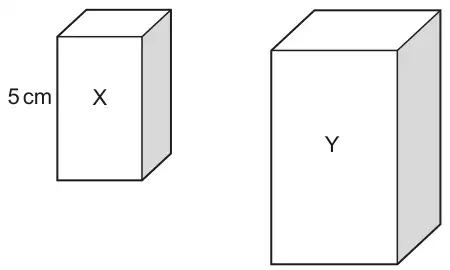
19 The diagram shows two similar cuboids, X and Y.
Not to scale
Cuboid X has a square base with area 16 cm\(^2\) and height 5 cm. Cuboid Y has a square base with area 36 cm\(^2\).
Work out the height of cuboid Y. You must show your working. [4]
Mark scheme
Answer
Marks
Part marks and guidance
7.5 with correct working
4
Correct working requires M3 or B2M1 If working in rounded decimals with 2 dp seen allow M marks but A0 if 7.5 rounded from inexact value May be implied by [5] \(\times\) 1.5 or e.g. as arrow from X to Y with “\(\times\) 1.5” on it or, in parts e.g. \(5 \times 6 = k\) then \(k \div 4\)
M3 for \(5 \times \dfrac{6}{4}\) oe or \(5 \div \dfrac{4}{6}\) oe
OR
B2 for [base lengths] 4 and 6 or B1 for [base lengths] 4 or 6 and M1 for \(5 \times \dfrac{\textit{their}\ 6}{\textit{their}\ 4}\) oe or \(5 \div \dfrac{\textit{their}\ 4}{\textit{their}\ 6}\) oe
May be on diagram 4 and 6 not number of edges so \(16 \div 4\) and \(36 \div 4\) score B0 or base edges 4 and 9 score B0
Their 4 and their 6 are their chosen base lengths and not 16 and 36
If 0 scored, SC1 for answer 7.5 with no or insufficient working
Alternative M2 for [length factor] \(\sqrt{\dfrac{36}{16}}\) or \(\dfrac{6}{4}\) oe or \(\sqrt{\dfrac{16}{36}}\) or \(\dfrac{4}{6}\) oe or M1 for area factor oe = \(\dfrac{36}{16}\) oe or \(\dfrac{16}{36}\) oe
M1 for \(5 \times \dfrac{\textit{their}\ 6}{\textit{their}\ 4}\) oe or \(5 \div \dfrac{\textit{their}\ 4}{\textit{their}\ 6}\) oe
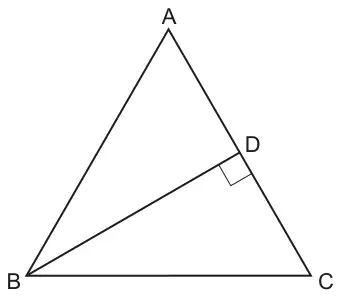
ABC is an equilateral triangle. BD is perpendicular to AC.
Prove that triangle ABD is congruent to triangle CBD. [4]
Mark scheme
Answer
Marks
Part marks and guidance
Proof of congruency e.g.
For the M marks, must be clear distinct statements involving equalities of pairs of named sides or pairs of named angles with the reason (if given) alongside the statement Throughout accept A for angle BAD and C for angle BCD.
[Angle] ADB = [Angle] CDB = 90°
BD is common oe
AB = BC equilateral [triangle] or given oe
OR
[Angle] ABD = [Angle] CBD = 30°
BD is common oe
AB = BC equilateral [triangle] or given
M3
M2 for 2 correct statements with reason[s] or 3 correct statements but incorrect/no reason[s] or M1 for 1 correct statement with reason or 2 correct but incorrect/no reasons
Do not accept ADB = 90 alone without = angle CDB, accept right angle for 90 Accept e.g. BD = BD, BD is shared, BD is in both
If more than 3 statements given, mark to candidates advantage and isw incorrect/incomplete statements alongside correct work for method marks
Accept equivalent proofs for AAS involving any two of the three angles and either BD is common or AB = BC (given) Accept [Angle] BAD= [Angle] BCD = 60 or equilateral [triangle] Do not accept AD = DC
[Triangle BDC is congruent to triangle BAD] (RHS) or (SAS)
A1
Dep on M3 and no incorrect work seen and condition must fit statements given
See Appendix 2
Appendix 2: Question 12
For the M marks, statements may be embedded within longer text but they must be clear distinct statements involving equalities of pairs of named sides or pairs of named angles with (if given) the reason alongside the statement. Do not accept annotation on the diagram as implying method. This question is also assessing clear communication of the mathematics.
Example
Candidate response
Comment
A
All sides equal Line BD is perpendicular to AC, meaning its the mid point Splitting a equilateral triangle creates 2 right angle triangles and because its equilateral it should be the same on both sides. RHS, Right angle they both have, hypotenuse is the same and the side is the same. Yes, it is congruent as said by RHS. This means they are congruent as they all have a right angle, hypotenuse is the same and side is the same as it was equilateral
Within the text there is no specific named equality of pairs of sides or pairs of angles stated. It is done in more general terms and this is not acceptable so M0
B
Equilateral = all angles are the same \(\angle ABC = \angle BAC = \angle BCA\) Each angle \(= \frac{180}{3} = 60\) \(\triangle ABD\): \(\angle ABD = 60/2 = 30°\), so \(\angle BAD = 180 - (30 + 90) = 60°\) \(\triangle CBD\): \(\angle CBD = 60/3 = 30°\), so \(\angle BCD = 180 - (30 + 90) = 60°\) → Both are right angled triangles that shares line BD → Both share the same angles of 90°, 30°, 60° → They form an equilateral triangle which has angles of the same angles (60, 60, 60) so both triangles must be equal
There are no clear distinct equality statements of pairs of sides or pairs of angles with reasons. The statement BD is shared appears in the text and earns M1
C
\(\angle DBC\) and \(\angle DBA\) both equal 30° as angle \(\angle BAD\) and \(\angle DCB\) both are 60° as triangle ABC is equilateral so with the perpendicular line creating 90° angles in order to get the full 180° they must be 30° so therefore ABD is congruent to CBD
Within the text there are two clear distinct statement of equality of angles DBC = DBA = 30 and BAD = DCB = 60 with reasons. There is no statement about equalities of pairs of sides Award M2
D
BDA = BDC so BDA is 90°. BD is the same in both triangles. SAS AC runs along both triangles so AD = AC so triangles are SAS.
BDA = BDC stated and 90 is given for BDA next to the statement BOD M1 BD is shared earns M1
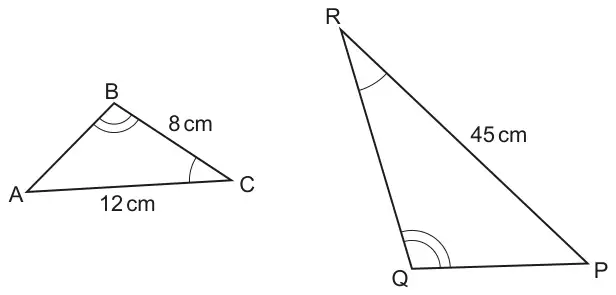
25 Triangles ABC and PQR are mathematically similar. Angle ACB = Angle PRQ. Angle ABC = Angle PQR.
Not to scale
The perimeter of triangle PQR is 99 cm.
Find the length of PQ. [4]
Mark scheme
Answer
Marks
Part marks and guidance
24
4
M2 for \(\dfrac{45}{12} \times 8\) or \(\dfrac{8}{12} \times 45\) oe or 30 or M1 for \(\dfrac{45}{12}\) or \(\dfrac{12}{45}\) or \(\dfrac{12}{8}\) or \(\dfrac{8}{12}\) oe
and
M1 for 99 – 45 – their RQ or 24 correctly placed on diagram
Equivalent factors include 3.75, \(3\dfrac{3}{4}\), \(\dfrac{4}{15}\), 0.266… , 0.267, 1.5, \(1\dfrac{1}{2}\), \(\dfrac{2}{3}\), 0.666…, 0.667 Alt.: M2 for \(99 \div \dfrac{45}{12}\) (3.75) oe or 26.4 or M1 for \(\dfrac{45}{12}\) or \(\dfrac{12}{45}\) oe and M1 for \((26.4 - 8 - 12) \times \dfrac{45}{12}\) (3.75) oe
19 Two ornaments, A and B, are mathematically similar. The table shows information about the two ornaments.
Ornament A
Ornament B
Height (m)
\(h\)
12
Surface area (m2)
216
\(A\)
Volume (m3)
240
3750
Find the value of \(h\) and the value of \(A\). You must show your working. [6]
Mark scheme
Answer
Marks
Part marks and guidance
[\(h\) =] 4.8 [\(A\) =] 1350 with correct working
6
“Correct working” requires evidence of at least M2
M2 for \(\sqrt[3]{\frac{3750}{240}}\) or 2.5 oe or \(\sqrt[3]{\frac{240}{3750}}\) or 0.4 oe or M1 for \(\frac{3750}{240}\) or 15.625 oe or \(\frac{240}{3750}\) or 0.064 oe
B2 for [\(h\) =] 4.8 or M1 for \(\frac{12}{2.5}\) oe
e.g. 12 × 0.4
B2 for [\(A\) =] 1350 or M1 for 216 × (their 2.5)2 oe
e.g. 216 ÷ (their 0.4)2 Note : Use of scale factor = \(\frac{\sqrt[3]{3750}}{\sqrt[3]{240}}\) often leads to accuracy errors so award M2 for \(\frac{\sqrt[3]{3750}}{\sqrt[3]{240}}\) M1 for \(\frac{12}{\textit{their } 2.5}\) oe (penalise accuracy once here at first occurrence) M1 A1 for 216 × (their 2.5) = answer to A involving a rounding error
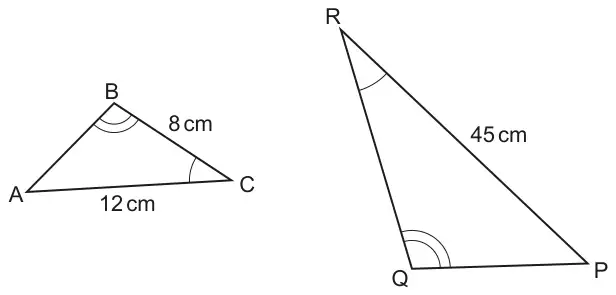
11 Triangles ABC and PQR are mathematically similar. Angle ACB = Angle PRQ. Angle ABC = Angle PQR.
Not to scale
The perimeter of triangle PQR is 99 cm.
Find the length of PQ. [4]
Mark scheme
Answer
Marks
Part marks and guidance
24
4
M2 for \(\frac{45}{12} \times 8\) or \(\frac{8}{12} \times 45\) oe or 30 or M1 for \(\frac{45}{12}\) or \(\frac{12}{45}\) or \(\frac{12}{8}\) or \(\frac{8}{12}\) oe
and
M1 for 99 – 45 – their RQ or 24 correctly placed on diagram
Equivalent factors include 3.75, \(3\frac{3}{4}\), \(\frac{4}{15}\), 0.266… , 0.267, 1.5, \(1\frac{1}{2}\), \(\frac{2}{3}\), 0.666…, 0.667 Alt.: M2 for \(99 \div \frac{45}{12}\) (3.75) oe or 26.4 or M1 for \(\frac{45}{12}\) or \(\frac{12}{45}\) oe and M1 for \((26.4 - 8 - 12) \times \frac{45}{12}\) (3.75) oe
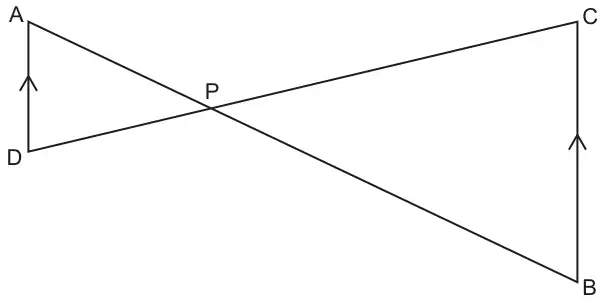
18 The diagram shows two straight lines AB and DC that intersect at P. DA is parallel to BC.
Complete these statements to show that triangle PAD is similar to triangle PBC.
Angle ADP = angle BCP because they are alternate angles
Angle APD = angle ................ because they are ................................ angles
Angle ................ = angle ................ because they are ................................ angles
Triangle PAD is similar to triangle PBC because ................................................ [4]
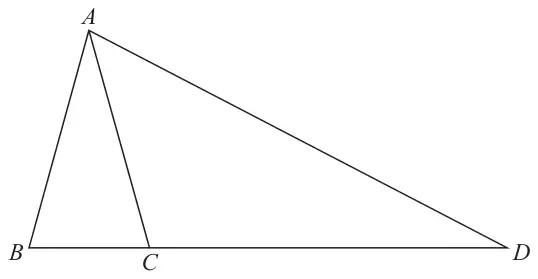
Mark scheme
Answer
Marks
Part marks and guidance
BPC or CPB and [vertically] opposite
B2
B1 for BPC or CPB
Must use 3-letter notation
DAP or PAD, CBP or PBC, alternate
B1
Must have angle and reason
Condone • A and B if clear for e.g. A for PAD and B for CBP • Changed order e.g. CBP and PAD • Use of B or C for P e.g. DAB for DAP For reason, condone poor spelling (alternative) and accept “third angle in triangle” oe
AAA oe
B1dep
Dependent on previous B2 and B1
Accept completely correct statements e.g. “All corresponding angles equal” but not “All angles equal” or “They have the same angles” See Appendix
The small bottle holds 0.5 litres and has a height of 35 cm. The large bottle holds 2 litres.
Calculate the height of the large bottle. [4]
Mark scheme
Answer
Marks
Part marks and guidance
55.5 to 55.6 nfww
4
M3 for \(35 \times \sqrt[3]{\frac{2}{0.5}}\) oe or \(35 \div \sqrt[3]{\frac{0.5}{2}}\) oe
or
M2 for \(\sqrt[3]{\frac{2}{0.5}}\) oe soi by 1.58 to 1.59 or \(\sqrt[3]{\frac{0.5}{2}}\) oe soi by 0.62 to 0.63 or \(\frac{h^3}{35^3} = \frac{2}{0.5}\) oe
or
M1 for \(\frac{2}{0.5}\) oe soi by 4 or \(\frac{0.5}{2}\) oe soi by \(\frac{1}{4}\)
If 0 scored then SC1 for 140 as final answer
Accept 56 as final answer after M3
May see as length ratio, eg M2 for \(\sqrt[3]{2} : \sqrt[3]{0.5}\) soi by 1.2599(…) to 1.26 : 0.7937(…) to 0.794
May see as volume ratio, eg. M1 for 2 : 0.5 oe May also be seen as part of wrong approach eg. \(35 \times 4\) scores M1
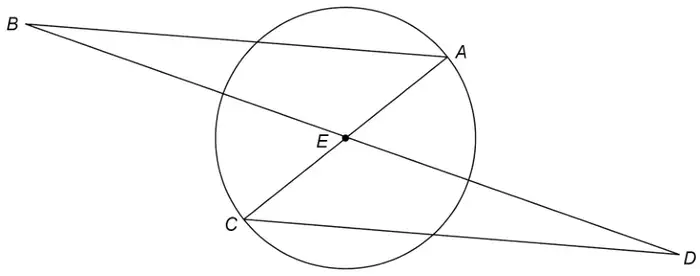
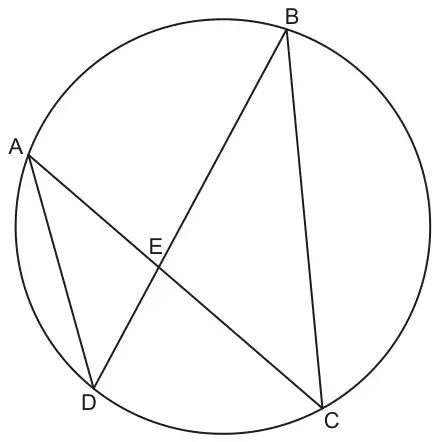
13 Points A, B, C and D lie on the circumference of a circle. Line AC intersects line BD at point E.
Not to scale
Prove that triangle AED is similar to triangle BEC. [3]
Mark scheme
Answer
Marks
Part marks and guidance
Angle AED = angle BEC and [vertically] opposite Angle DAE = angle EBC and same segment Angle ADE = angle ECB and same segment
M2
For M2 only two of the three statements and reasons are required M1 for one pair of angles with a reason
Allow any unambiguous labelling for angles e.g. DAE or DAC or A, but not E For reason accept e.g. opp ∠’s For same segment, accept same arc but not same chord Accept 3rd angle in triangle oe for reason with final angle if other two given correctly with correct reasons
[Triangle AED is similar to triangle BEC] [corresponding] angles are equal oe or AAA oe
OR
After two pairs of angles with reasons gives 3rd pair of equal angles with a reason
A1
With no errors or incorrect statements seen
If 0 scored, SC1 for at least two correct pairs of angles identified with no / incorrect reasons
Accept they have the ‘same/equal angles’ oe, AA and similar. Accept symbol ~ for similar
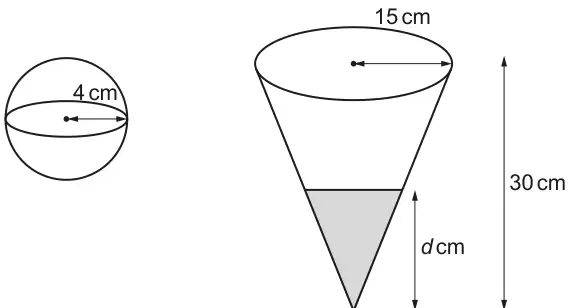
The sphere has radius 4 cm. The cone has radius 15 cm and height 30 cm.
The sphere is completely filled with water. The same amount of water is poured into the cone.
Work out the depth, \(d\) cm, of the water in the cone. You must show your working.
[The volume \(V\) of a sphere with radius \(r\) is \(V = \frac{4}{3}\pi r^3\). The volume \(V\) of a cone with radius \(r\) and height \(h\) is \(V = \frac{1}{3}\pi r^2 h\).] [6]
Mark scheme
Answer
Marks
Part marks and guidance
10.1 or 10.07 to 10.08 with correct working
6
M4 for \(\frac{4}{3}\) × π × \(4^3\) = \(\frac{1}{3}\) × π × \((\frac{1}{2}d)^2\) × \(d\) oe M1 for rearranging their equation OR M1 for \(\frac{4}{3}\) × π × \(4^3\) implied by 268.[08…] or 268.1 B1 for [radius of water =] \(\frac{1}{2}d\) M2 for \(\frac{1}{3}\) × π × \((\frac{1}{2}d)^2\) × \(d\) = their 268.08… or M1 for \(\frac{1}{3}\) × π × \((\frac{1}{2}d)^2\) × \(d\) condone one error M1 for rearranging their equation e.g. \(d^3 = \frac{their\ 268.08\ldots \times 12}{\pi}\) implied by [\(d^3\) =] 1024
Alternative method
M4 for \(\frac{\frac{256\pi}{3}}{\frac{1}{3}\pi \times 15^2 \times 30} = \left(\frac{d}{30}\right)^3\) oe M1 for rearranging their equation OR M1 for \(\frac{4}{3}\) × π × \(4^3\) implied by 268.[08…], 268.1 or \(\frac{256\pi}{3}\) M1 for \(\frac{1}{3}\)π × \(15^2\) × 30 implied by 2250π or 7068[.58…] or 7069 or 7068.6 M2 for [sf=] \(\sqrt[3]{\frac{\frac{256\pi}{3}}{\frac{1}{3}\pi \times 15^2 \times 30}}\) oe or 0.33597… rot or M1 for \(\frac{\frac{256\pi}{3}}{\frac{1}{3}\pi \times 15^2 \times 30}\) oe or 0.0379… M1 for their sf × 30
If 0 or 1 scored, instead award SC3 for answer 10.1 or 10.07 to 10.08 with no or insufficient working
allow 10 only if working supports it “Correct working” requires evidence of at least M2 or M1 M1
M1 implied by \(\frac{256\pi}{3}\)
Note they can use \(h = 2r\) so apply the scheme accordingly, 1024 will become 256
Complete method with trials giving the correct answer can score 6 marks
20 Two pyramids, A and B, are mathematically similar. Pyramid A has surface area 12 cm² and volume 8 cm³. Pyramid B has surface area 75 cm².
Work out the volume of pyramid B. You must show your working. [4]
Mark scheme
Answer
Marks
Part marks and guidance
125 with correct working
4
M3 for [8 ×] \(\left(\sqrt{\dfrac{75}{12}}\right)^3\) or \(2.5^3\) oe or M2 for \(\sqrt{\dfrac{75}{12}}\) or \(\sqrt{6.25}\) oe implied by 2.5 or \(\frac{5}{2}\) or M1 for \(\dfrac{75}{12}\) oe implied by 6.25
“correct working” requires evidence of at least M2 Accept ratios M3 for 8 : 125 oe or M2 for 2 : 5 oe or M1 for 4 : 25 oe
Alternative method: M3 for [8 ÷] \(\left(\sqrt{\dfrac{12}{75}}\right)^3\) or \(0.4^3\) oe or M2 for \(\sqrt{\dfrac{12}{75}}\) or \(\sqrt{0.16}\) oe implied by 0.4 or \(\frac{2}{5}\) or M1 for \(\dfrac{12}{75}\) oe implied by 0.16
If 0 scored, instead award SC1 for answer 125 with no or insufficient working
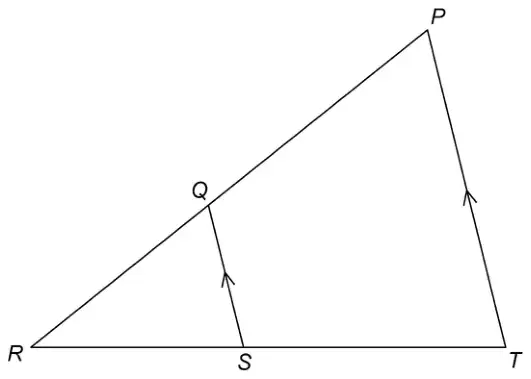
B lies on AD and C lies on AE. BC is parallel to DE.
Complete these statements to show that triangles ABC and ADE are similar.
Angle ABC = angle ADE because they are corresponding angles. Angle ACB = angle ........ because ........ Angle BAC is ........ Triangles ABC and ADE are similar because ........
[3]
Mark scheme
Answer
Marks
Part marks and guidance
AED or DEA and corresponding
1
accept CED, DEC
common oe
1
accept “same as angle DAE” oe ignore any reasons
correct reason e.g. AAA or both triangles have the same angles oe
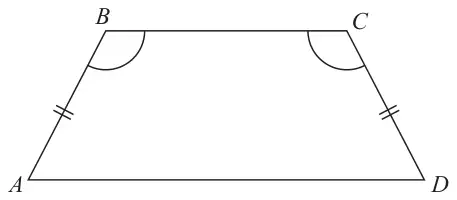
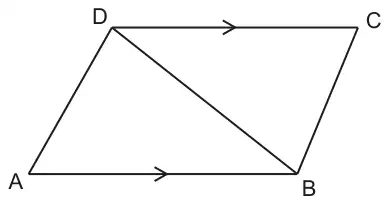
9 In the diagram, AB and DC are parallel lines of equal length.
Not to scale
Prove that angle DAB = angle BCD. [4]
Mark scheme
Answer
Marks
Part marks and guidance
Angle ABD = Angle CDB (alternate) BD is common oe AB = CD given oe
M3
M2 for 2 correct statements with reason[s] or 3 correct but no/incorrect reason[s] M1 for 1 correct statement with reason or 2 correct but no/incorrect reasons
If 0 scored, SC1 for any attempt to prove congruency
Not alternative angles
Accept BD = BD, BD is shared Accept same length oe for ‘given’
eg attempt to list pairs of equal sides or equal angles (2 or more even if incorrect)
SAS so triangles are congruent and Angle DAB = angle BCD
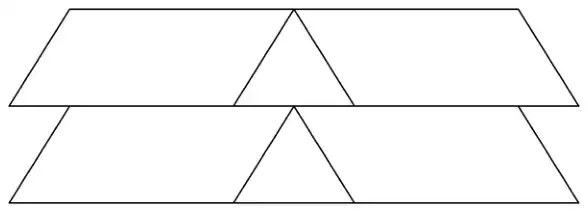
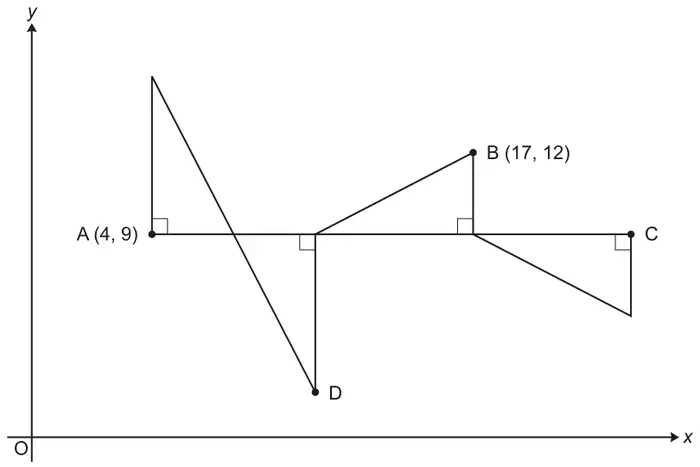
7 A pattern is made from four congruent right-angled triangles.
Not to scale
The line AC is parallel to the \(x\)-axis. The point A has coordinates (4, 9) and the point B has coordinates (17, 12).
Work out the coordinates of point C and point D. [5]
Mark scheme
Answer
Marks
Part marks and guidance
C (24, 9) D (10, 2)
5
B4 for three correct ordinates or B3 for two correct ordinates or B2 for one correct ordinate from 24, 10, 2 or for longer length of triangle = 7 soi or B1 for 9 as y-coordinate for C or for shorter length of triangle = 3 soi
OR
M1 for long = 17 – 4 – 2 × their short oe A1FT for C ((4 + 2 × their short + 2 × their long) , 9) A1FT for D (4 + 2 × their short , 9 – their long)
For part marks, check ordinates first (may be on diagram if answer line blank). If B2 or fewer check alt method and mark to candidates’ advantage
B4, B3, B2, B1 May be on diagram
For M1 and A1FT, their short and their long needs to be clear in working or on diagram
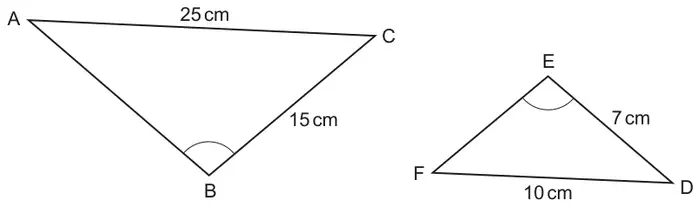
25 Are these two triangles mathematically similar? Show how you decide.
Not to scale
[3]
Mark scheme
Answer
Marks
Part marks and guidance
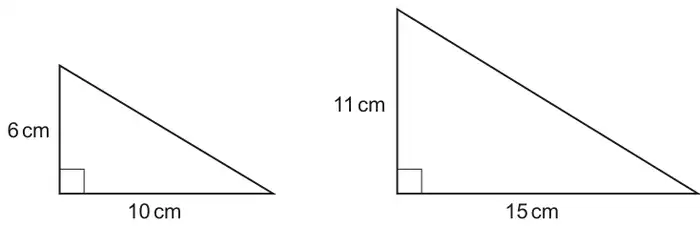
Two correct corresponding ratios evaluated correctly eg \(\dfrac{6}{10} = 0.6\) and \(\dfrac{11}{15} = 0.7[...]\)
M2
M1 for one correct ratio evaluated
\(\dfrac{11}{6} = 1.8[...]\) and \(\dfrac{15}{10} = 1.5\) \(\dfrac{6}{11} = 0.5[...]\) and \(\dfrac{10}{15} =\) 0.6 to 0.7 \(\dfrac{10}{6} =\) 1.6 to 1.7 and \(\dfrac{15}{11} =\) 1.3 to 1.4 Note. Ratios between 6 and 10 and between 15 and 11 may be seen as tangents. These give angles in left triangle of 30.9 to 31.0 or 59.0 to 59.1 and angles in right triangle of 36.2 to 36.3 or 53.7 to 53.8
or
A side calculated correctly using one ratio or scale factor and the other side
\(\left(\dfrac{15}{10} \times 6\right.\) or \(\left.\dfrac{6}{10} \times 15\right) = 9\) \(\left(\dfrac{10}{15} \times 11\right.\) or \(\left.\dfrac{11}{15} \times 10\right) = 7.3[...]\) \(\dfrac{11}{6} \times 10 = 18.3[...]\) or \(\dfrac{6}{11} \times 15 =\) 8.1 to 8.2
No + the [corresponding] ratios or sides are not the same oe or No + the 11 should be 9 oe
21 Toy building bricks are available in two sizes, small and large. The small and large bricks are mathematically similar.
A small brick has volume 8 cm\(^3\) and width 2.1 cm. A large brick has volume 15.625 cm\(^3\).
Calculate the width of a large brick. [4]
Mark scheme
Answer
Marks
Part marks and guidance
2.625 nfww
4
M3 for \(2.1 \times \sqrt[3]{\dfrac{15.625}{8}}\) oe or \(2.1 \div \sqrt[3]{\dfrac{8}{15.625}}\) or M2 for \(\sqrt[3]{\dfrac{15.625}{8}}\) soi by \(\frac{5}{4}\) or 1.25 oe or \(\sqrt[3]{\dfrac{8}{15.625}}\) soi by \(\frac{4}{5}\) or 0.8 oe or M1 for \(\dfrac{15.625}{8}\) soi by \(\frac{125}{64}\) oe or 1.95(31…) or \(\dfrac{8}{15.625}\) soi by \(\frac{64}{125}\) oe or 0.512
If 0 scored then SC1 for 4.1 to 4.11 as final answer
Accept 2.6, 2.62 or 2.63 as final answer after M3
May be done in stages, including rounding to at least 3 sig figs of intermediate steps
May see as length ratio, e.g. M2 for \(\sqrt[3]{8} : \sqrt[3]{15.625}\) soi by 2 : 2.5 oe
May see as volume ratio, e.g. M1 for 8 : 15.625 oe May also be seen as part of wrong approach e.g. \(\dfrac{15.625}{8 \div 2.1}\) seen or done in stages scores M1
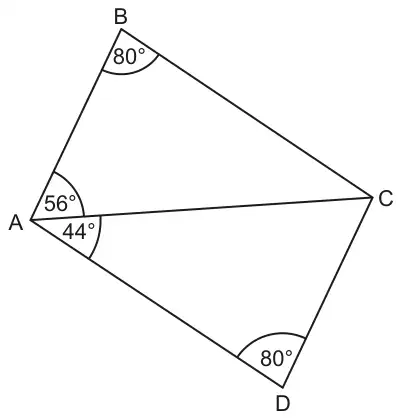
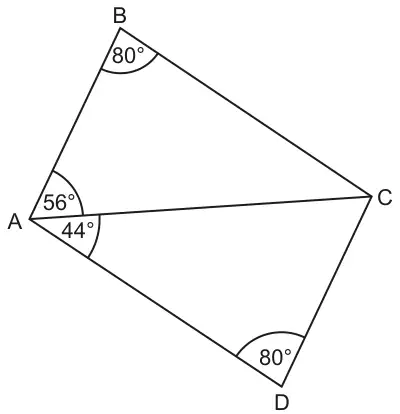
Prove that triangle ABC is congruent to triangle ACD. [4]
Mark scheme
Answer
Marks
Part marks and guidance
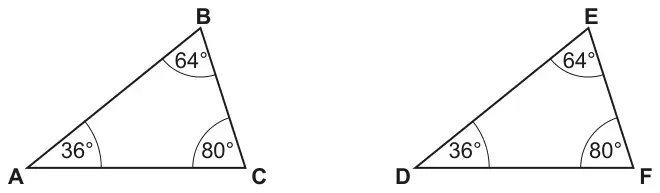
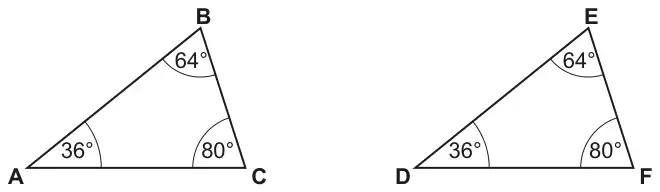
angle \(BCA = 44^\circ\) and angles [in a] triangle [\(= 180^\circ\)] or angle \(DCA = 56^\circ\) and angles [in a] triangle [\(= 180^\circ\)]
1
\(C = 44\) (or 56) is not sufficient. Accept angles shown on diagram.
0 if alternate angles is given as the reason unless the parallelogram has been justified
Best two statements from: (i) [side] \(AC\) is common (ii) [angle] \(ACB\) = [angle] \(CAD\) (iii) [angle] \(BAC\) = [angle] \(ACD\) (iv) angle \(B\) = angle \(D\) or [angle] \(ABC\) = [angle] \(CDA\)
2
B1 for each to a max of 2
Notation needed for these marks.
44 = 44 is not sufficient. 56 = 56 is not sufficient “angle” required if using just \(B\) or \(D\)
Conclusion and third statement [congruent because] ASA after stating (i), (ii), (iii) AAS after stating (i), (ii), (iv) or (i), (iii), (iv)
1
If 0 or 1 scored then, to a maximum total of 2 marks, allow: SC1 for angle \(BCA = 44^\circ\) and angle \(DCA = 56^\circ\) stated or on diagram and SC1 for a correct statement lacking precision eg “both triangles have a common side”, “both triangles have an angle of 80”, “all the angles are the same°
Final mark needs a third statement (ignore superfluous ones) and the appropriate congruence conclusion.
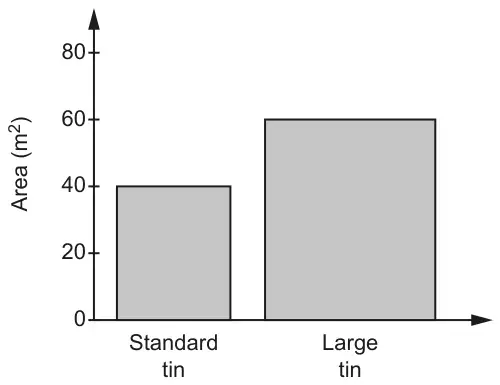
18 Percy sells paint in standard tins and large tins. The standard tin covers 40 m\(^2\) and the large tin covers 60 m\(^2\).
(a) Percy publishes this chart showing the area that can be covered with each tin of paint.
Explain why the chart is misleading. [1]
(b) The standard tin and the large tin are mathematically similar. The volume of the large tin is 50% more than the volume of the standard tin. Both tins are cylinders. The radius of the standard tin is 10 cm.
Calculate the radius of the large tin. [4]
Mark scheme (a)
Answer
Marks
Part marks and guidance
Bars are of different width oe
1
0 for large tin looks larger than it is 0 for the bars are different sizes 0 for incorrect/no \(x\)-axis
Mark scheme (b)
Answer
Marks
Part marks and guidance
11.4[...] nfww
4
B1 for 1.5 or \(\dfrac{3}{2}\) or 3 : 2 soi
AND
M2 for \(10 \times \sqrt[3]{1.5}\)
or
M1 for \(\sqrt[3]{1.5}\) soi by 1.14(47…)
If 0 scored allow SC1 for 15 as final answer or seen radius of large tin
Alternative: B1 for 0.666 to 0.667 or \(\dfrac{2}{3}\) or 2 : 3 soi AND
M2 for \(10 \div \sqrt[3]{0.666 \text{ to } 0.667}\) oe
or
M1 for \(\sqrt[3]{0.666 \text{ to } 0.667}\) oe soi 0.873(…)
12 The diagram below shows two right-angled triangles.
Not to scale
Prove that triangles PQS and QRS are similar. [5]
Mark scheme
Answer
Marks
Part marks and guidance
[\(QS\) =] \(\sqrt{80}\), \(4\sqrt{5}\) oe or 8.9[4..]
2
M2 for [\(QS\) =] \(\sqrt{4^2 + 8^2}\) oe
or
M1 for \(4^2 + 8^2\)
Accept QS on diagram First M2 may be implied by \(QP = 2\sqrt{5}\) oe or 4.47[…]
Best two from: (i) shows a pair of corresponding angles are equal (ii) shows a second pair of corrresponding angles are equal or states [angle] QRS = [angle] PQS (iii) shows two pairs of corresponding sides are in the same ratio (iv) shows the third pair of corresponding sides have the same ratio. Ratios of corresponding sides need to be seen in equiavlent form.
2
B1 for each to a max of 2 For these marks, answers to calculations are sufficient, but corresponding pairs must be either exact or the same when rot to 3sf. In (ii) accept QRS and PQS are both right angles oe (iii) and (iv) can be shown using scale factors eg QS = 1.118 × RS and PS = 1.118 × QS
Note: there is no mark for just finding QP = \(\sqrt{20}\)
Example values: angle RSQ = \(\tan^{-1}\left(\dfrac{4}{8}\right) = \cos^{-1}\left(\dfrac{8}{\sqrt{80}}\right) = \sin^{-1}\left(\dfrac{4}{\sqrt{80}}\right)\) = 26.5(…) or 26.6 angle QSP = \(\tan^{-1}\left(\dfrac{\sqrt{20}}{\sqrt{80}}\right) = \cos^{-1}\left(\dfrac{\sqrt{80}}{10}\right) = \sin^{-1}\left(\dfrac{\sqrt{20}}{10}\right)\) = 26.5(…) or 26.6
Accept as fractions or ratios. \(\dfrac{PS}{QS} = \dfrac{10}{\sqrt{80}} = \dfrac{\sqrt{5}}{2}\) =1.118[…] \(PS : QS = 10 : \sqrt{80}\) oe \(\dfrac{QS}{RS} = \dfrac{\sqrt{80}}{8}\) with any of the above \(\dfrac{PS}{QS}\) is insufficient for (iii) and (iv) as it is not clear that the ratios are the same.
Conclusion: two (or three) equal angles oe after showing (i) and (ii) or three pairs of corresponding sides in the same ratio after showing (iii) and (iv) or two pairs of corresponding sides in the same ratio and an equal angle between them oe after showing relevant combination of (i)/(ii) and (iii)
1
In all cases, it must be clear which angles and ratios are being used to support the conclusion made, usually by using labels or from values on a diagram. If it is not clear, withold the final mark. Where more than two facts are shown, allow the final mark if the conclusion is fully supported.
Prove that triangle ABC is congruent to triangle ACD. [4]
Mark scheme
Answer
Marks
Part marks and guidance
angle \(BCA\) = 44° and angles [in a] triangle [= 180°] or angle \(DCA\) = 56° and angles [in a] triangle [= 180°]
1
\(C\) = 44 (or 56) is not sufficient. Accept angles shown on diagram.
0 if alternate angles is given as the reason unless the parallelogram has been justified
Best two statements from: (i) [side] \(AC\) is common (ii) [angle] \(ACB\) = [angle] \(CAD\) (iii) [angle] \(BAC\) = [angle] \(ACD\) (iv) angle \(B\) = angle \(D\) or [angle] \(ABC\) = [angle] \(CDA\)
2
B1 for each to a max of 2
Notation needed for these marks.
44 = 44 is not sufficient. 56 = 56 is not sufficient “angle” required if using just \(B\) or \(D\)
Conclusion and third statement [congruent because] ASA after stating (i), (ii), (iii) AAS after stating (i), (ii), (iv) or (i), (iii), (iv)
1
Final mark needs a third statement (ignore superfluous ones) and the appropriate congruence conclusion.
If 0 (or 1 for statements) scored then, to a maximum total of 2 marks, allow: SC1 for angle \(BCA\) = 44° and angle \(DCA\) = 56° stated or on diagram and SC1 for a correct statement lacking precision eg “both triangles have a common side”, “both triangles have an angle of 80”, “all the angles are the same”
(b) The volume of a full-size train carriage is 220 m³. Trevor calculates the volume of a model train carriage to be 334 cm³ correct to 3 significant figures.
Is Trevor’s calculation correct? Show how you decide. [3]
Mark scheme (a)
Answer
Marks
Part marks and guidance
1.4355 or 1.436 or 1.44
2
M1 for 16.5 × 87 possibly soi by figs 14355, 1436 or 144
Mark scheme (b)
Answer
Marks
Part marks and guidance
Yes (Trevor is correct) because Eg \(220 \div 87^3 \times 100^3 = 334.[\ldots]\) or \(334 \times 87^3 \div 100^3 = 219.9\ldots\) to 220
3
M2 for \(220 \div 87^3 \times 100^3\) or \(334 \times 87^3 \div 100^3\)
OR
B1 for \(87^3\) or 658503 or \(100^3\) or 1000000 soi
AD = AB [given] oe CD = CB [given] oe AC = AC (common) oe Congruent SSS
M3
M2 for 2 correct statements with reason[s] or 3 correct but no/incorrect reason[s] M1 for 1 correct statement with reason or 2 correct but no/incorrect reasons
Angle ADC = angle ABC
A1
If 0 scored, SC1 for AC is a line of symmetry oe
or for triangle ADC is congruent to triangle ABC oe
Accept vertical line of symmetry or reflection see diagram as well if unsure
13 A and B are points on the circumference of a circle, centre O. CA and CB are tangents to the circle.
Not to scale
Prove that triangle OAC is congruent to triangle OBC. [4]
Mark scheme
Answer
Marks
Part marks and guidance
Three of these
OC is common or shared
OA = OB (equal) radii
\(\angle\)OAC = \(\angle\)OBC tangent perpendicular to radius
CA = CB tangents from a point [to a circle]
M3
M1 for each
After M0, B2 three pairs of these equal sides/angles with insufficient or no reasons or B1 for two pairs of these equal sides/angles identified with insufficient or no reasons
OR
After M1, B1 for two further pairs of these equal sides/angles identified with insufficient or no reasons
Enlarge triangle A with scale factor \(\frac{1}{3}\) and centre of enlargement (−1, 5). [3]
(b) Prism P and prism Q are similar.
The ratio of the surface area of prism P to the surface area of prism Q is 1 : 3.
(i) Jay says
The height of prism P is one third of the height of prism Q.
Explain why he is wrong. [1]
(ii) The volume of prism Q is 86 cm\(^3\).
Calculate the volume of prism P. [3]
Mark scheme (a)
Answer
Marks
Part marks and guidance
Triangle with vertices at (1, 6), (2, 6), (2, 4)
3
B2 for triangle correct size and orientation in wrong position
OR
B1 for enlargement centre (−1, 5) incorrect scale factor < 1 or for triangle with two vertices correct or for three rays from (−1, 5) to vertices of triangle A or for triangle correct size but wrong orientation
Mark scheme (b)
Answer
Marks
Part marks and guidance
(i) Height factor is square root of area factor oe in words or figures
1
Mark the best bit so long as no contradiction
Must include correct reference to square or square root
(ii) 16.5 to 16.6
3
B2 for \(\left(\sqrt{3}\right)^3\) oe or \(\dfrac{1}{\left(\sqrt{3}\right)^3}\) oe soi by 5.19 to 5.20 or 0.192 to 0.193
OR B1 for \(\sqrt{3}\) or \(\dfrac{1}{\sqrt{3}}\) oe soi by 1.73[…] or 0.577[…]
Accept \(\dfrac{86\sqrt{3}}{9}\) oe Note that \(\left(\sqrt{3}\right)^3 = 3\sqrt{3}\) and \(\dfrac{1}{\left(\sqrt{3}\right)^3} = \dfrac{\sqrt{3}}{9}\)