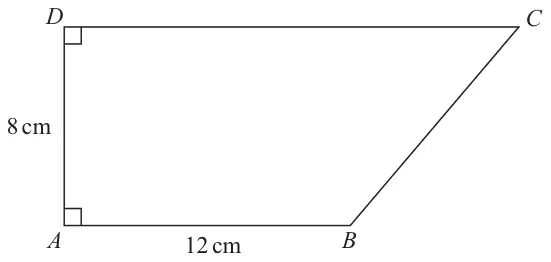
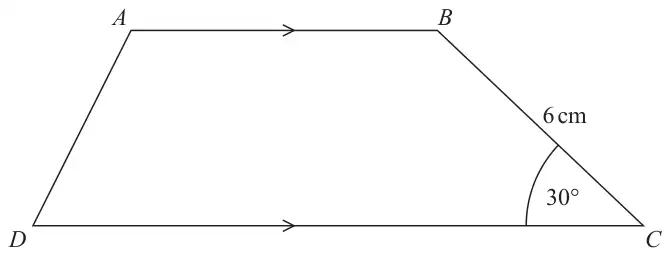
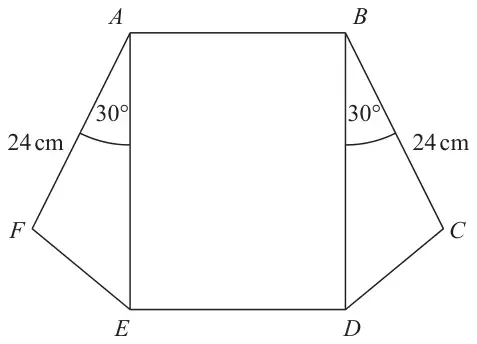
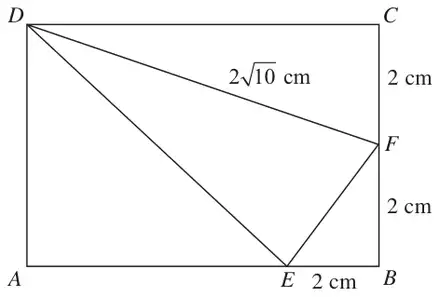
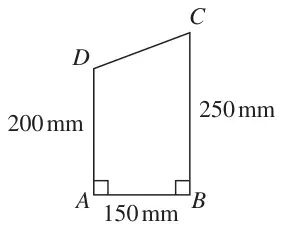
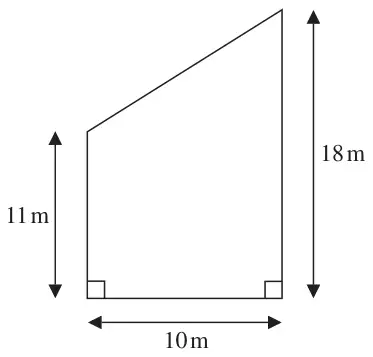
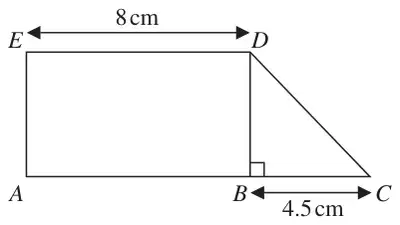
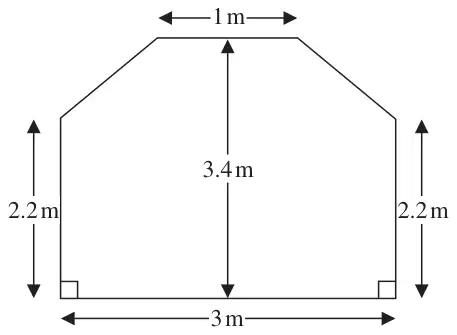
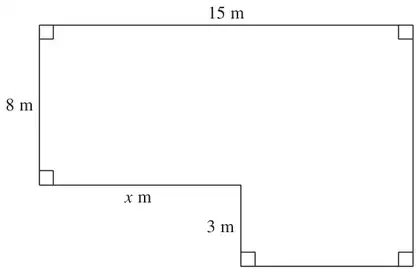
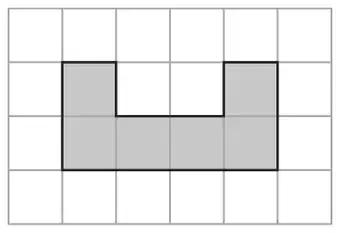
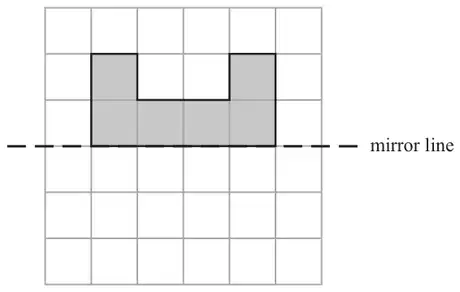
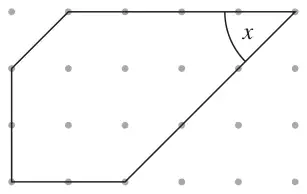
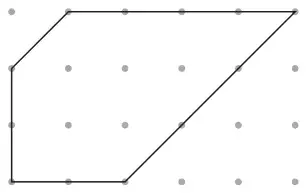
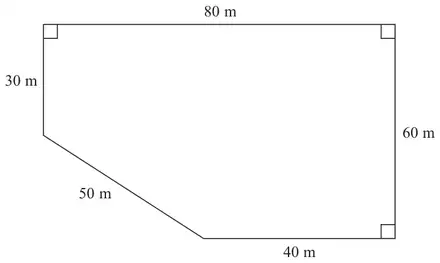
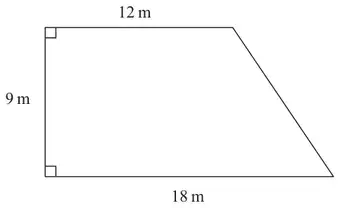
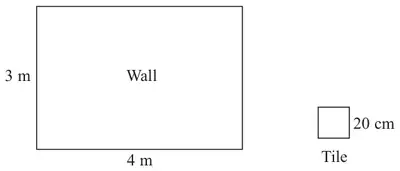
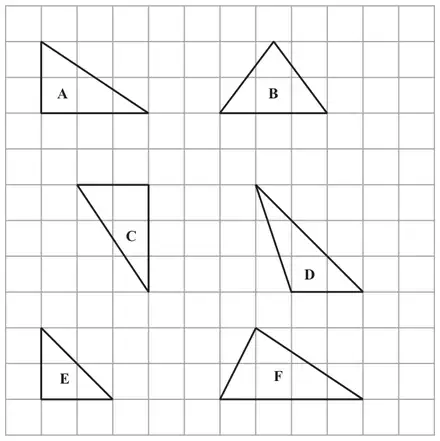
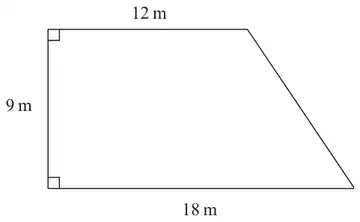
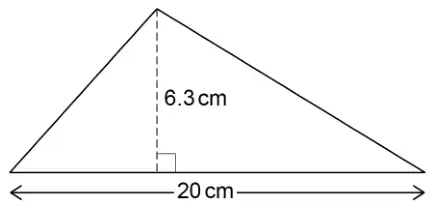
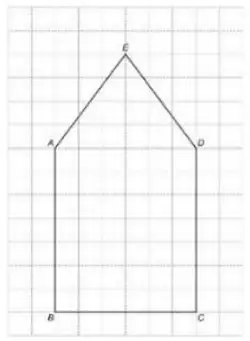
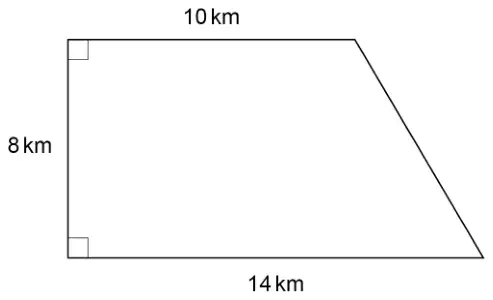
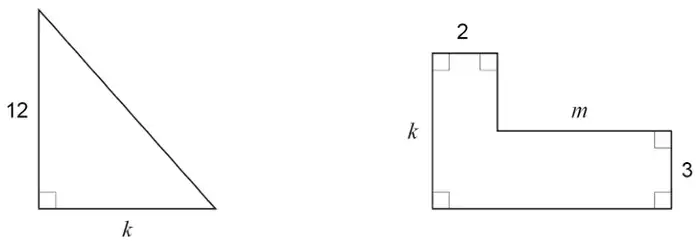
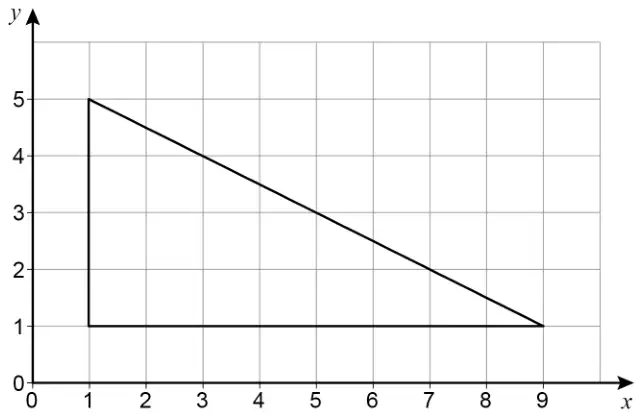
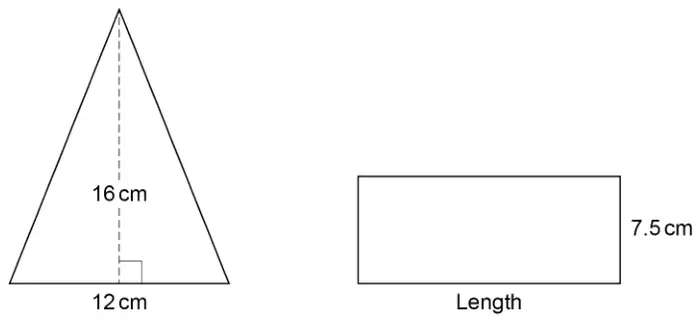
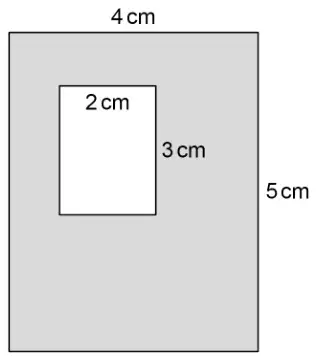
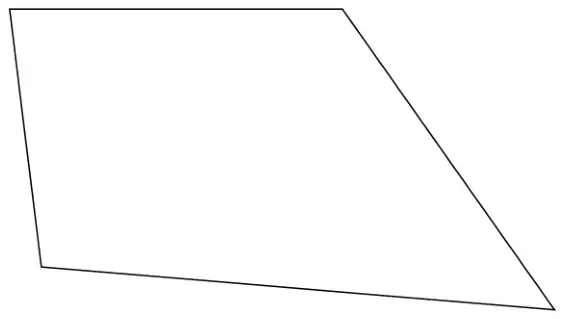
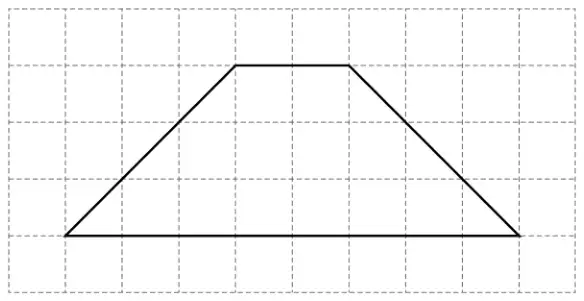
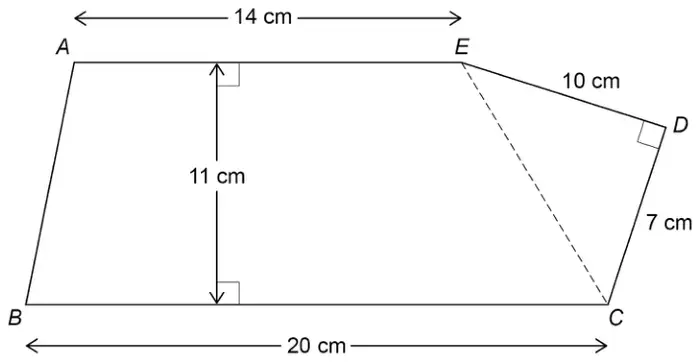
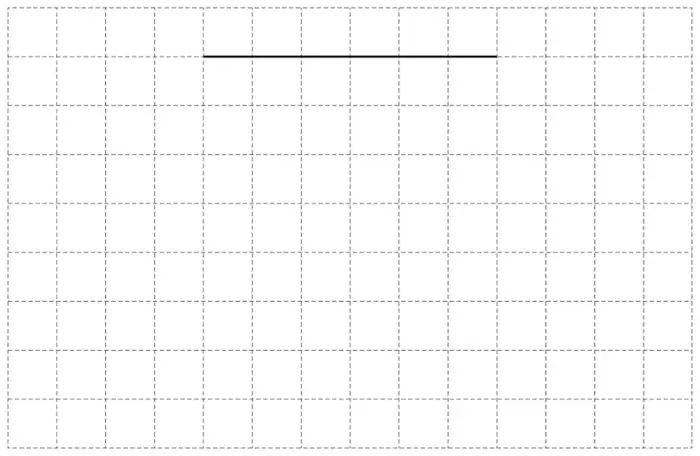
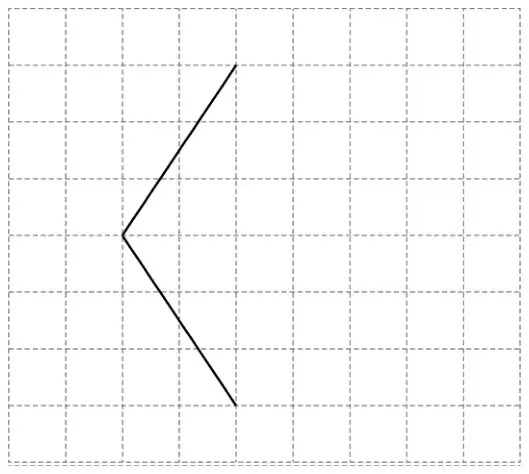
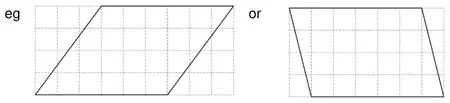
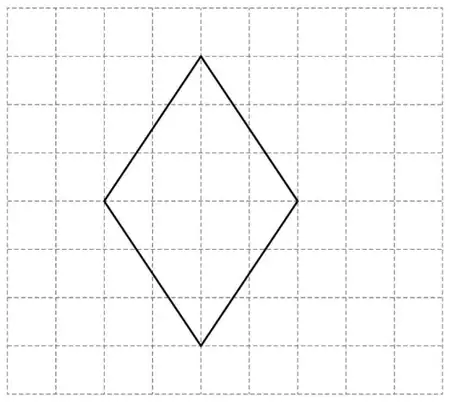
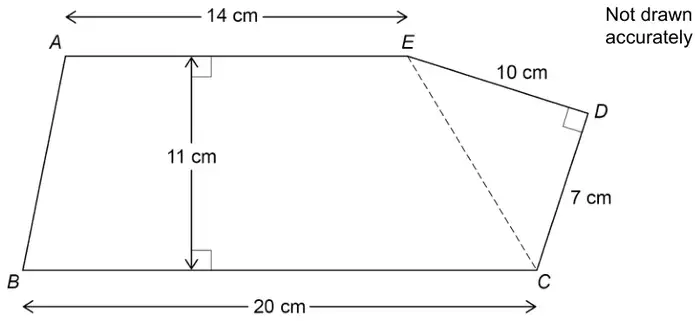
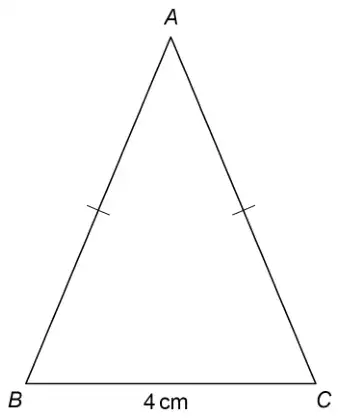
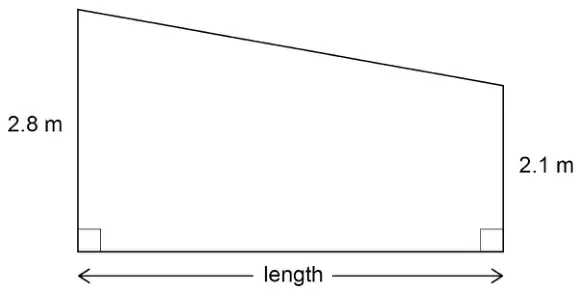
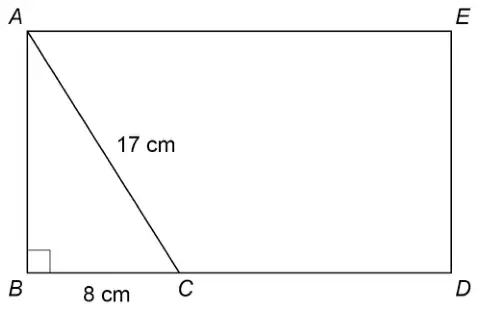
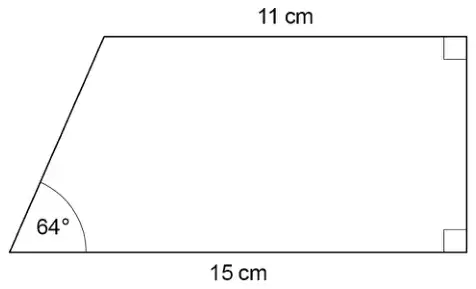
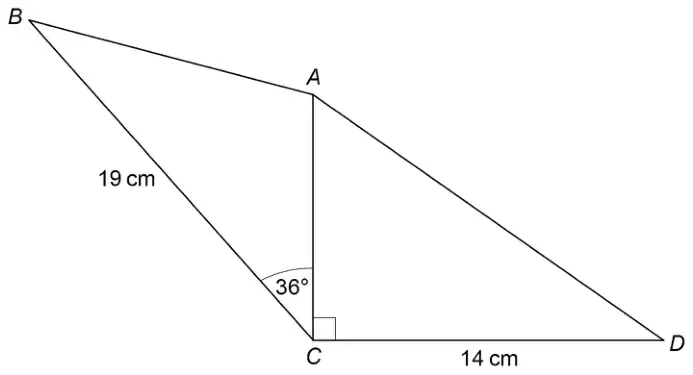
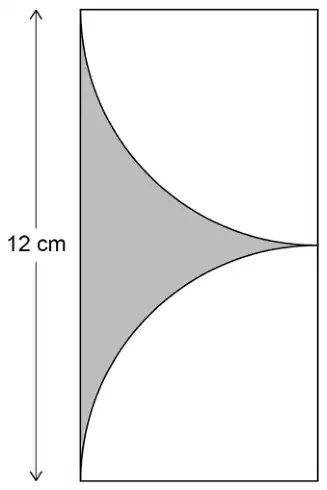
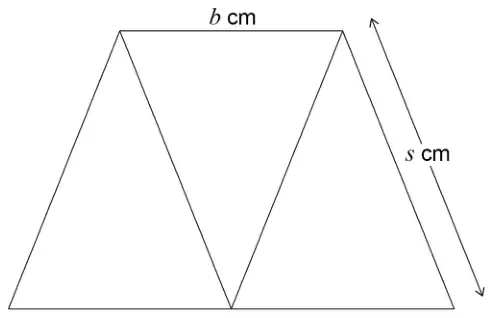
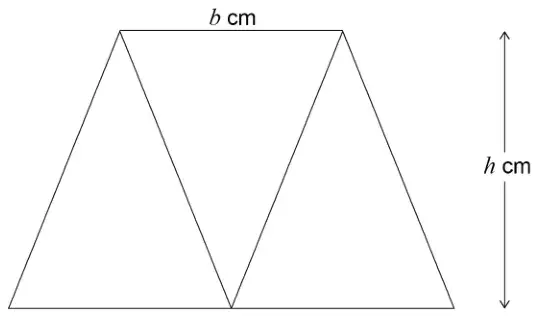
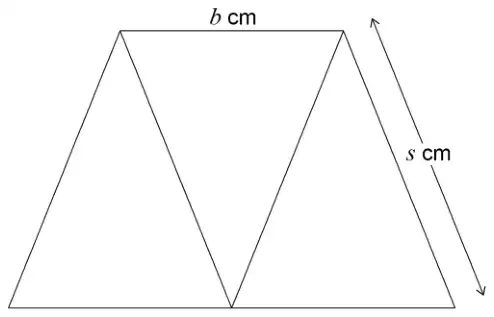
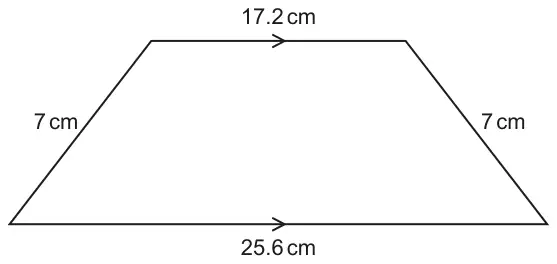
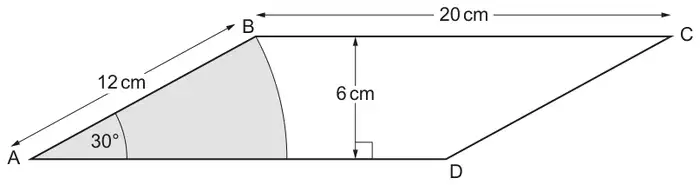
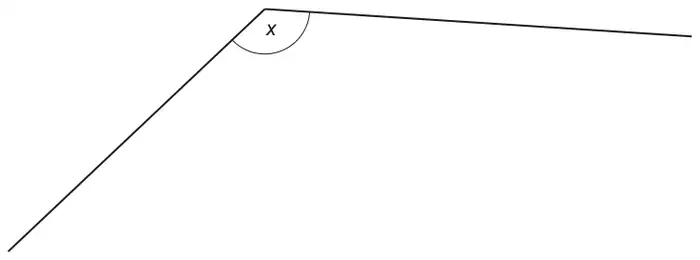
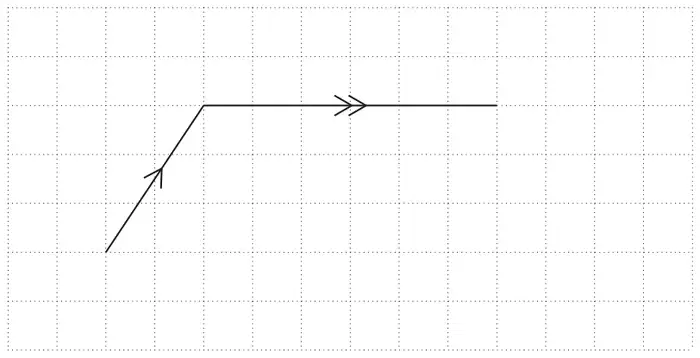
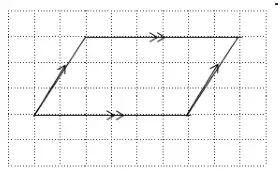
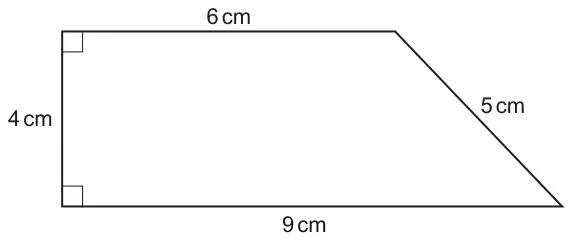
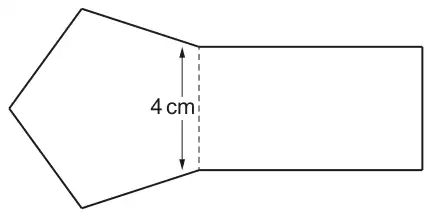
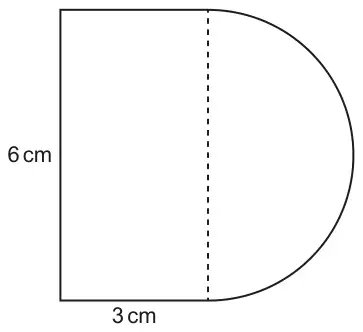
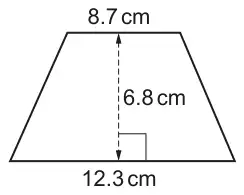
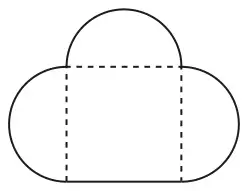
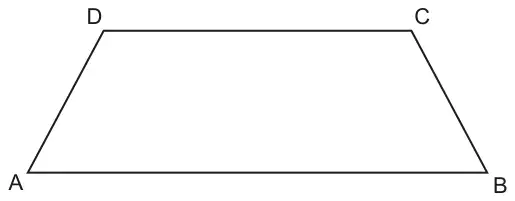
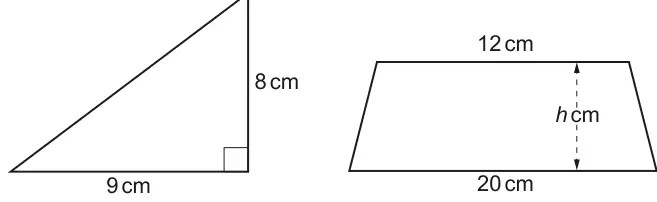
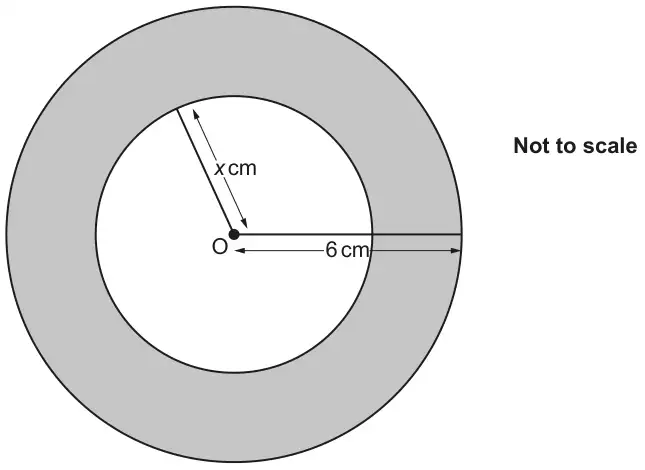
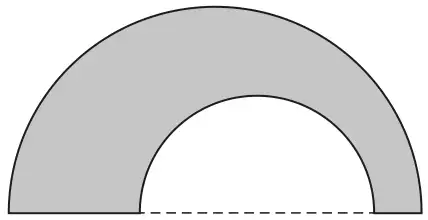
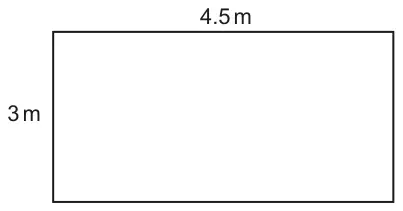
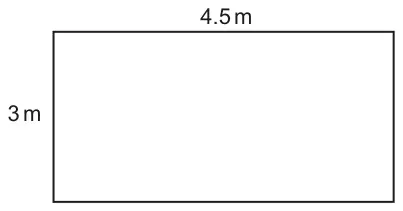
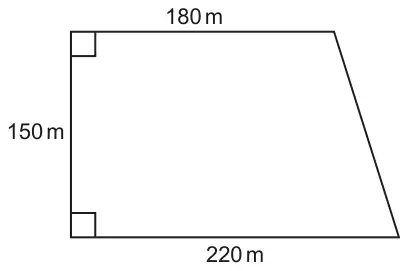
Work out the perimeter of the trapezium. Give your answer correct to 3 significant figures. (5)
Mark scheme
Answer
Mark
Mark scheme
44.9
P1
for process to find an expression for the area of the trapezium, eg \(\tfrac{1}{2}(12 + CD)8\) or \(8 \times 12 + \tfrac{1}{2} \times 8 \times x\)
or for process to find the area of the triangle, eg \(112 - 8 \times 12\ (= 16)\)
P1
for forming an equation and isolating terms in the unknown length, eg \(4CD = 112 - 48\) or \(\tfrac{1}{2} \times 8 \times x = 112 - 8 \times 12\) or \(\tfrac{1}{2} \times 8 \times x = \text{``}16\text{''}\) or \(CD = 16\) or \(x = 4\)
P1
for start of process to find length of \(BC\), eg \(8^2 + \text{``}4\text{''}^2\ (= 80)\) or \(8^2 + [\text{their } x]^2\) or \(\tan^{-1}\left(\dfrac{\text{``}4\text{''}}{8}\right)\ (= 26.5\ldots)\) oe or \(\tan^{-1}\left(\dfrac{8}{\text{``}4\text{''}}\right)\ (= 63.4\ldots)\) where “4” can be [their \(x\)]
P1
for \(\sqrt{8^2 + \text{``}4\text{''}^2}\) or \(\sqrt{64 + \text{``}16\text{''}}\) or \(\sqrt{80}\) or \(4\sqrt{5}\ (= 8.9\ldots)\) oe or \(\sqrt{8^2 + [\text{their } x]^2}\) or \(\dfrac{\text{``}4\text{''}}{\sin \text{``}26.5\ldots\text{''}}\) or \(\dfrac{8}{\cos \text{``}26.5\ldots\text{''}}\) or \(\dfrac{8}{\sin \text{``}63.4\ldots\text{''}}\) or \(\dfrac{\text{``}4\text{''}}{\cos \text{``}63.4\ldots\text{''}}\) where “4” can be [their \(x\)]
A1
for answer in the range 44.9 to 44.95
Additional guidance
\(x\) is the length of the line from \(C\) to where perpendicular from \(B\) meets \(CD\) Allow use of other letters in place of \(CD\) and \(x\) (do not have to be defined unless otherwise stated) Award P1 for \(112 - 8 \times 12\ (= 16)\) even if not used
Award P2 for \(CD = 16\) or \(x = 4\) even if not used unless clearly from incorrect working eg \(12 - 8\ (= 4)\) Only award P2 for 16 if it is clearly identified as \(CD\)
[their \(x\)] can be any value less than 12 or clearly identified as the length of the line from \(C\) to where perpendicular from \(B\) meets \(CD\) (may be seen on the diagram)
Award P4 for (\(BC =\)) \(\sqrt{80}\) or \(4\sqrt{5}\) or 8.9… unless \(x = 4\) is clearly from incorrect working
If an answer is shown in the range in working and then incorrectly rounded award full marks
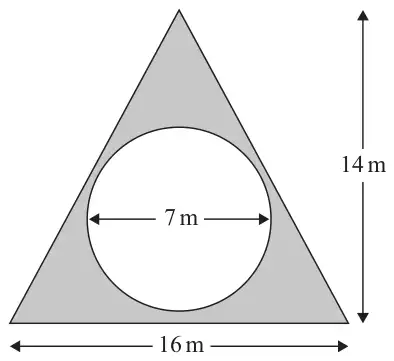
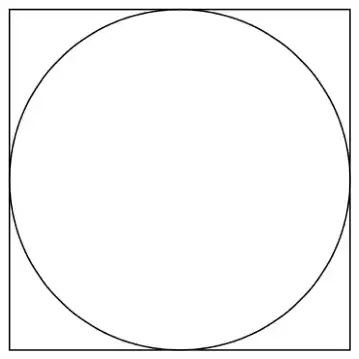
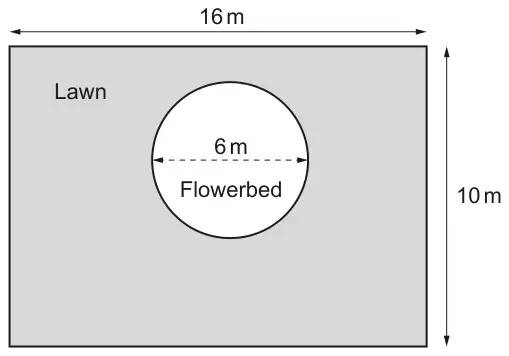
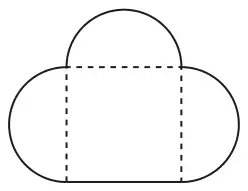
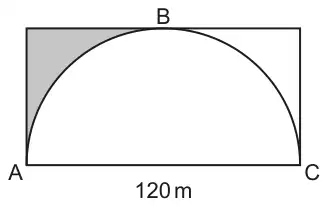
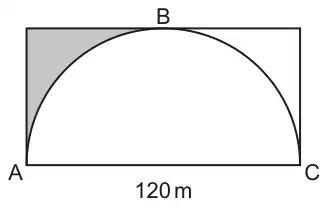
There is a circle inside a triangle. The circle has a diameter of 7 m.
Macsen will cover the shaded area with gravel.
Gravel is sold in bags. Each bag of gravel covers an area of 12.5 m2
(a) Work out the number of bags of gravel Macsen will need. (4)
Macsen finds that each bag of gravel only covers an area of 11 m2
(b) How does this affect your answer to part (a)? (1)
Mark scheme (a)
Answer
Mark
Mark scheme
6
P1
for process to find a relevant area, eg \(16 \times 14 \div 2\ (= 112)\) or \(\pi \times \left(\dfrac{7}{2}\right)^2\ (= 38.4\ldots)\)
P1
for process to find the shaded area, eg \(\text{``}112\text{''} - \text{``}38.4\ldots\text{''}\ (= 73.51\ldots)\) or \(\text{``}8.96\text{''} - \text{``}3.07\ldots\text{''}\ (= 5.88\ldots)\)
P1
for a process to find the number of bags required for a full or partial area, eg \(\text{``}73.51\ldots\text{''} \div 12.5\ (= 5.88\ldots)\) or \(\text{``}112\text{''} \div 12.5\ (= 8.96)\) or \(\text{``}38.4\ldots\text{''} \div 12.5\ (= 3.07\ldots)\) or [area] \(\div\, 12.5\) or uses 12.5 in a build up method to exceed [area], eg \(12.5 \times 6\ (= 75)\) oe
A1
cao
Additional guidance
May be implied by \(\dfrac{49}{4}\pi\)
[area] can be any area but cannot be a length
Mark scheme (b)
Answer
Mark
Mark scheme
Statement
C1
for a valid statement relating to effect on number of bags needed, eg Acceptable examples Will need more bags It will increase Will need an extra bag or will now need 7 bags He won’t have enough There is no change (ft their [area] but must be supported by calculation)
Not acceptable examples Will cover less area Needs to change the number of bags needed There is no change (unsupported or incorrect ft their [area]) He may need more bags Calculation using 11 with no supporting statement
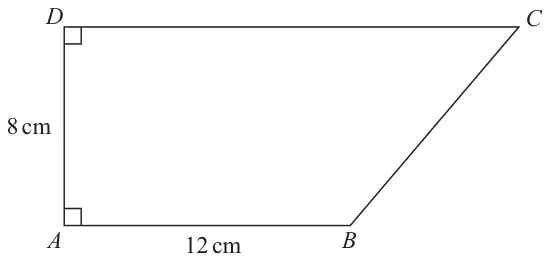
Work out the perimeter of the trapezium. Give your answer correct to 3 significant figures. (5)
Mark scheme
Answer
Mark
Mark scheme
44.9
P1
for process to find an expression for the area of the trapezium, eg \(\tfrac{1}{2}(12 + CD)8\) or \(8 \times 12 + \tfrac{1}{2} \times 8 \times x\)
or for process to find the area of the triangle, eg \(112 - 8 \times 12\ (= 16)\)
P1
for forming an equation and isolating terms in the unknown length, eg \(4CD = 112 - 48\) or \(\tfrac{1}{2} \times 8 \times x = 112 - 8 \times 12\) or \(\tfrac{1}{2} \times 8 \times x = \text{``}16\text{''}\) or \(CD = 16\) or \(x = 4\)
P1
for start of process to find length of \(BC\), eg \(8^2 + \text{``}4\text{''}^2\ (= 80)\) or \(8^2 + [\text{their } x]^2\) or \(\tan^{-1}\left(\dfrac{\text{``}4\text{''}}{8}\right)\ (= 26.5\ldots)\) oe or \(\tan^{-1}\left(\dfrac{8}{\text{``}4\text{''}}\right)\ (= 63.4\ldots)\) where “4” can be [their \(x\)]
P1
for \(\sqrt{8^2 + \text{``}4\text{''}^2}\) or \(\sqrt{64 + \text{``}16\text{''}}\) or \(\sqrt{80}\) or \(4\sqrt{5}\ (= 8.9\ldots)\) oe or \(\sqrt{8^2 + [\text{their } x]^2}\) or \(\dfrac{\text{``}4\text{''}}{\sin \text{``}26.5\ldots\text{''}}\) or \(\dfrac{8}{\cos \text{``}26.5\ldots\text{''}}\) or \(\dfrac{8}{\sin \text{``}63.4\ldots\text{''}}\) or \(\dfrac{\text{``}4\text{''}}{\cos \text{``}63.4\ldots\text{''}}\) where “4” can be [their \(x\)]
A1
for answer in the range 44.9 to 44.95
Additional guidance
\(x\) is the length of the line from \(C\) to where perpendicular from \(B\) meets \(CD\) Allow use of other letters in place of \(CD\) and \(x\) (do not have to be defined unless otherwise stated) Award P1 for \(112 - 8 \times 12\ (= 16)\) even if not used
Award P2 for \(CD = 16\) or \(x = 4\) even if not used unless clearly from incorrect working eg \(12 - 8\ (= 4)\) Only award P2 for 16 if it is clearly identified as \(CD\)
[their \(x\)] can be any value less than 12 or clearly identified as the length of the line from \(C\) to where perpendicular from \(B\) meets \(CD\) (may be seen on the diagram)
Award P4 for (\(BC =\)) \(\sqrt{80}\) or \(4\sqrt{5}\) or 8.9… unless \(x = 4\) is clearly from incorrect working
If an answer is shown in the range in working and then incorrectly rounded award full marks
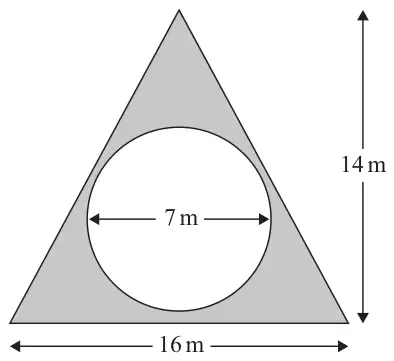
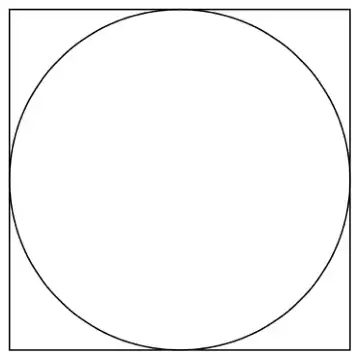
There is a circle inside a triangle. The circle has a diameter of 7 m.
Macsen will cover the shaded area with gravel.
Gravel is sold in bags. Each bag of gravel covers an area of 12.5 m2
(a) Work out the number of bags of gravel Macsen will need. (4)
Macsen finds that each bag of gravel only covers an area of 11 m2
(b) How does this affect your answer to part (a)? (1)
Mark scheme (a)
Answer
Mark
Mark scheme
6
P1
for a process to find a relevant area, eg \(16 \times 14 \div 2\ (= 112)\) or \(\pi \times \left(\dfrac{7}{2}\right)^2\ (= 38.4\ldots)\)
P1
for a process to find the shaded area, eg \(\text{``}112\text{''} - \text{``}38.4\ldots\text{''}\ (= 73.51\ldots)\) or \(\text{``}8.96\text{''} - \text{``}3.07\ldots\text{''}\ (= 5.88\ldots)\)
P1
for a complete process to find the number of bags required for a full or partial area, eg \(\text{``}73.51\ldots\text{''} \div 12.5\ (= 5.88\ldots)\) or \(\text{``}112\text{''} \div 12.5\ (= 8.96)\) or \(\text{``}38.4\ldots\text{''} \div 12.5\ (= 3.07\ldots)\) or [area] \(\div\, 12.5\) or uses 12.5 in a build up method to exceed [area], eg \(12.5 \times 6\ (= 75)\) oe
A1
cao
Additional guidance
May be implied by \(\dfrac{49}{4}\pi\)
[area] can be any area but cannot be a length.
Mark scheme (b)
Answer
Mark
Mark scheme
Statement
C1
for a valid statement relating to effect on number of bags needed, eg Acceptable examples Will need more bags It will increase Will need an extra bag or will now need 7 bags He won’t have enough There is no change (ft their [area] but must be supported by calculation)
Not acceptable examples Will cover less area Needs to change the number of bags needed There is no change (unsupported or incorrect ft their [area]) He may need more bags A calculation using 11 with no supporting statement
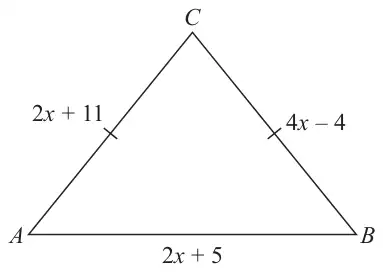
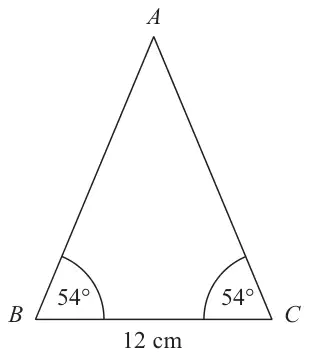
In the diagram, all measurements are in centimetres.
\(AC = BC\)
The perimeter of the triangle is 72 cm.
Work out the area of the triangle. (5)
Mark scheme
Answer
Mark
Mark scheme
240
P1
for forming an appropriate equation, eg \(2x + 11 = 4x - 4\) or \(2x + 11 + 4x - 4 + 2x + 5 = 72\) or \(8x + 12 = 72\)
P1
(dep P1) for process to correctly isolate terms in \(x\), eg \(4x - 2x = 11 + 4\) or \(2x + 4x + 2x = 72 - 11 + 4 - 5\) or \(x = 7.5\) oe
P1
for correct application of Pythagoras, eg \((\text{``}26\text{''})^2 - \left(\dfrac{\text{``}20\text{''}}{2}\right)^2\) or \([AC]^2 - \left(\dfrac{[AB]}{2}\right)^2\) or height = 24 or a complete method to find the height
or for a correct trig statement to find \(CAB\) or \(CBA\) or \(ACB\), eg \(\cos CAB = \cos CBA = \dfrac{\text{``}20\text{''} \div 2}{\text{``}26\text{''}}\) or \(\cos CAB = \cos CBA = \dfrac{20^2 + 26^2 - 26^2}{2 \times 20 \times 26}\) or \(\cos ACB = \dfrac{26^2 + 26^2 - 20^2}{2 \times 26 \times 26}\) or \(CAB = 67.3\ldots\) or \(CBA = 67.3\ldots\) or \(ACB = 45.2\ldots\)
P1
for process to find area of triangle, eg \(\text{``}20\text{''} \times \text{``}24\text{''} \div 2\) or \([AB] \times [\text{height}] \div 2\)
or for process to find area of triangle, eg \(\dfrac{1}{2} \times \text{``}26\text{''} \times \text{``}20\text{''} \times \sin \text{``}67.3\ldots\text{''}\) or \(\dfrac{1}{2} \times \text{``}26\text{''} \times \text{``}26\text{''} \times \sin \text{``}45.2\ldots\text{''}\) or \(\dfrac{1}{2} \times [AB] \times [AC] \times \sin [BAC]\) or \(\dfrac{1}{2} \times [BC] \times [AC] \times \sin [ACB]\)
A1
cao
Additional guidance
\(8x = 60\) or \(2x = 15\) implies P2 A correct length stated or shown on diagram implies P2, eg \(AB = 20\), \(AC = 26\), \(CB = 26\) \([AC]\) \([BC]\) \([AB]\) \([ACB]\) \([CAB]\) and \([BAC]\) must be clearly identified if incorrect. May be on diagram. \(AB = 2 \times \text{``}7.5\text{''} + 5\ (= 20)\) \(AC = 2 \times \text{``}7.5\text{''} + 11\ (= 26)\) \(CB = 4 \times \text{``}7.5\text{''} - 4\ (= 26)\) Alternative scheme not expected on Foundation tier but may be seen.
ft incorrect figures providing at least one previous P1 awarded. [height] is what they clearly think is the height of the triangle but not 26 or 20 or 10
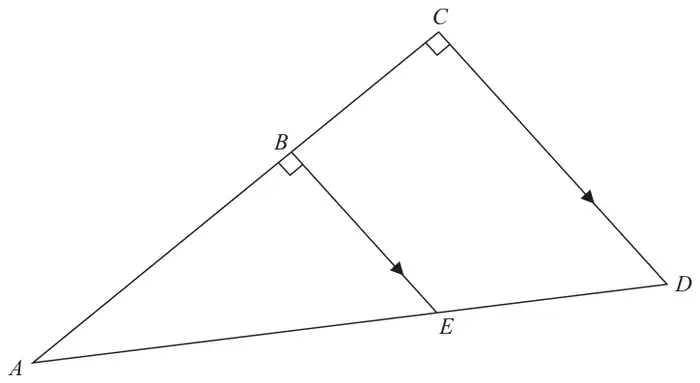
13 \(ABC\) and \(AED\) are straight lines. \(BE\) and \(CD\) are parallel.
\(BE = 4.2\) cm \(CD = 6.3\) cm \(AC = 10.8\) cm
Work out the area of trapezium \(BCDE\). (3)
Mark scheme
Answer
Mark
Mark scheme
18.9
P1
for using length scale factor to find \(AB\), eg \((AB =)\ 10.8 \div \left(\dfrac{3}{2}\right)\) or \((AB =)\ 10.8 \times \left(\dfrac{2}{3}\right)\ (= 7.2)\) or for using length scale factor to find \(BC\), eg \((BC =)\ 10.8 \div \dfrac{6.3}{6.3 - 4.2}\) or \((BC =)\ 10.8 \times \dfrac{6.3 - 4.2}{6.3}\ (= 3.6)\) or finds area scale factor, eg \(\left(\dfrac{3}{2}\right)^2\) or \(\left(\dfrac{2}{3}\right)^2\)
P1
for a complete process to find the area of trapezium, eg \(\dfrac{6.3 + 4.2}{2} \times (10.8 - \text{``}7.2\text{''})\) or \(\dfrac{(6.3 - 4.2) \times \text{``}3.6\text{''}}{2} + \text{``}3.6\text{''} \times 4.2\) or \(\dfrac{10.8 \times 6.3}{2} - \dfrac{7.2 \times 4.2}{2}\) or \(\dfrac{10.8 \times 6.3}{2} - \dfrac{10.8 \times 6.3}{2} \div \left(\text{``}\dfrac{3}{2}\text{''}\right)^2\) or \(\dfrac{10.8 \times 6.3}{2} - \dfrac{10.8 \times 6.3}{2} \times \left(\text{``}\dfrac{2}{3}\text{''}\right)^2\)
A1
accept trailing zeros eg 18.90
Additional guidance
Can use a combination of skills but must have a complete process to find \(AB\) or \(BC\) to score this mark
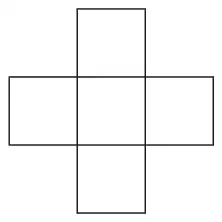
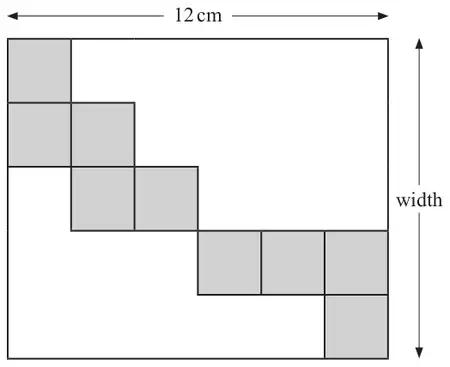
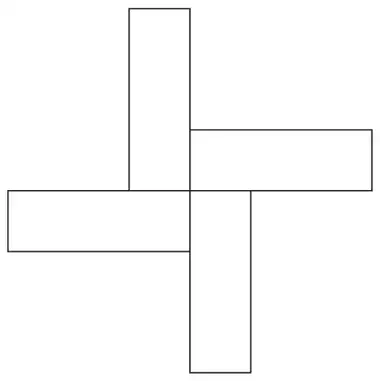
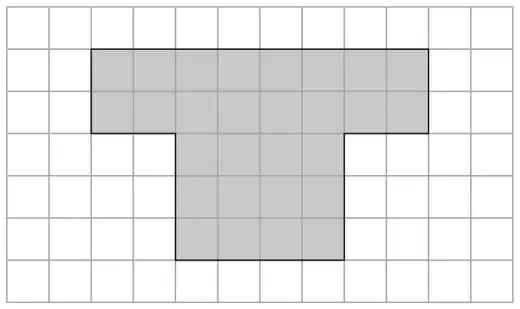
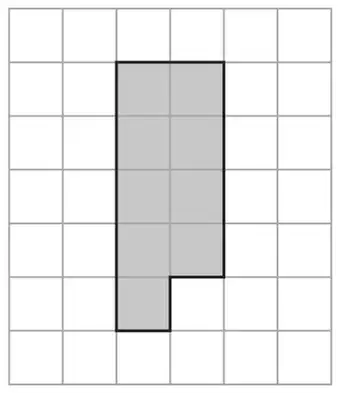
Five of these squares are used to make the shape below.
Work out the perimeter of this shape. (3)
Mark scheme
Answer
Mark
Mark scheme
120
P1
for process to work with length, eg \(40 \div 4\ (= 10)\) or \(40 \times 5\ (= 200)\) or \(40 \div 4 \times 3\ (= 30)\) or \(40 \times 4\ (= 160)\)
P1
for process to work with perimeter, eg \(\text{``}10\text{''} \times 12\) or [square side length] \(\times\, 12\) or [square side length] \(\times\, 11\) or \(\text{``}200\text{''} - 2 \times 40\) or \(\text{``}30\text{''} \times 4\) oe or \(\text{``}160\text{''} - 40\)
A1
cao
Additional guidance
May be shown on the diagram
[square side length] is what they clearly think is the length of one side of the square.
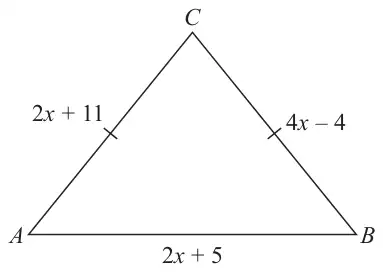
In the diagram, all measurements are in centimetres.
\(AC = BC\)
The perimeter of the triangle is 72 cm.
Work out the area of the triangle. (5)
Mark scheme
Answer
Mark
Mark scheme
240
P1
for forming an appropriate equation, eg \(2x + 11 = 4x - 4\) or \(2x + 11 + 4x - 4 + 2x + 5 = 72\) or \(8x + 12 = 72\)
P1
(dep P1) for process to isolate terms in \(x\) for their equation, eg \(4x - 2x = 11 + 4\) or \(2x + 4x + 2x = 72 - 11 + 4 - 5\) or \(x = 7.5\) oe
P1
for correct application of Pythagoras, eg \((\text{``}26\text{''})^2 - \left(\dfrac{\text{``}20\text{''}}{2}\right)^2\) or \([AC]^2 - \left(\dfrac{[AB]}{2}\right)^2\) or height = 24 or a complete method to find the height
or for a correct trig statement to find \(CAB\) or \(CBA\) or \(ACB\), eg \(\cos CAB = \cos CBA = \dfrac{\text{``}20\text{''} \div 2}{\text{``}26\text{''}}\) or \(\cos CAB = \cos CBA = \dfrac{20^2 + 26^2 - 26^2}{2 \times 20 \times 26}\) or \(\cos ACB = \dfrac{26^2 + 26^2 - 20^2}{2 \times 26 \times 26}\) or \(CAB = 67.3\ldots\) or \(CBA = 67.3\ldots\) or \(ACB = 45.2\ldots\)
P1
for process to find area of triangle, eg \(\text{``}20\text{''} \times \text{``}24\text{''} \div 2\) or \([AB] \times [\text{height}] \div 2\)
or for process to find area of triangle, eg \(\dfrac{1}{2} \times \text{``}26\text{''} \times \text{``}20\text{''} \times \sin \text{``}67.3\ldots\text{''}\) or \(\dfrac{1}{2} \times \text{``}26\text{''} \times \text{``}26\text{''} \times \sin \text{``}45.2\ldots\text{''}\) or \(\dfrac{1}{2} \times [AB] \times [AC] \times \sin [BAC]\) or \(\dfrac{1}{2} \times [BC] \times [AC] \times \sin [ACB]\)
A1
cao
Additional guidance
\(8x = 60\) or \(2x = 15\) implies P2 A correct length stated or shown on diagram implies P2 Eg \(AB = 20\), \(AC = 26\), \(CB = 26\) \([AC]\) \([BC]\) \([AB]\) \([ACB]\) \([CAB]\) and \([BAC]\) must be clearly identified if incorrect. May be on diagram. \(AB = 2 \times \text{``}7.5\text{''} + 5\ (= 20)\) \(AC = 2 \times \text{``}7.5\text{''} + 11\ (= 26)\) \(CB = 4 \times \text{``}7.5\text{''} - 4\ (= 26)\) Alternative scheme not expected on Foundation tier but may be seen.
ft incorrect figures providing at least one previous P1 awarded. [height] is what they clearly think is the height of the triangle but not 26 or 20 or 10
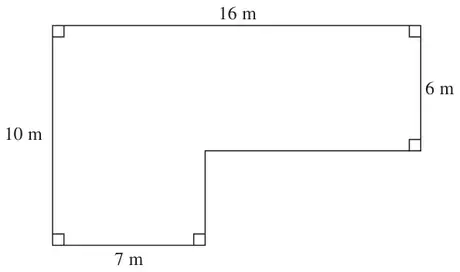
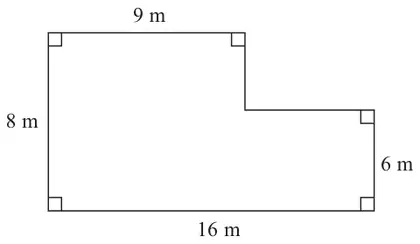
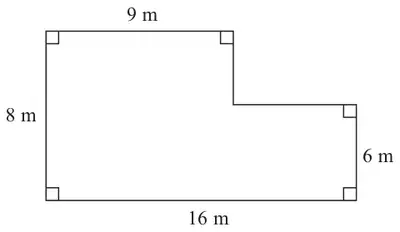
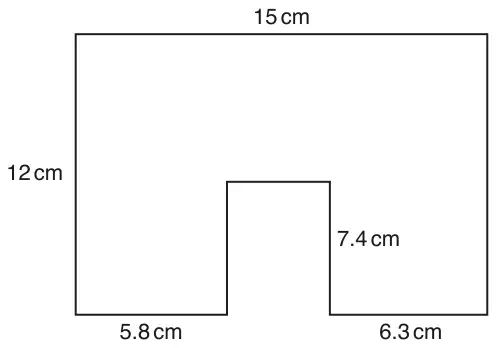
Petra has 3 tins of paint. There are 2.5 litres of paint in each tin.
Petra thinks 1 litre of paint will cover 10 m\(^2\) of floor.
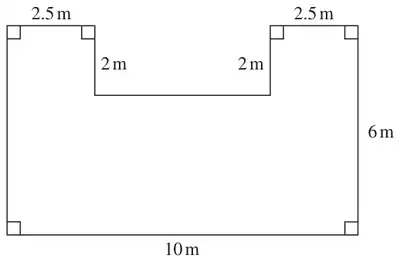
(a) Assuming Petra is correct, does she have enough paint to cover the floor? You must show all your working. (4)
Actually, 1 litre of paint will cover 11 m\(^2\) of floor.
(b) Does this affect your answer to part (a)? You must give a reason for your answer. (1)
Mark scheme (a)
Answer
Mark
Mark scheme
Yes (supported)
P1
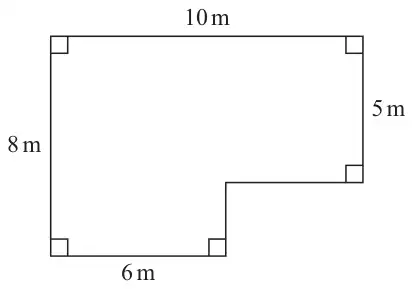
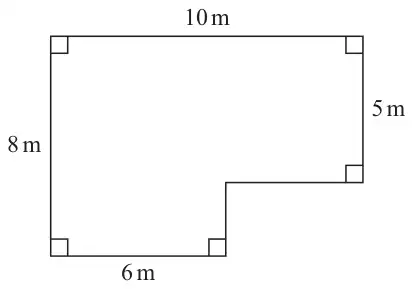
for a process to find the area of one shape, eg \(10 \times 8\ (= 80)\) or \(10 \times 5\ (= 50)\) or \(8 \times 6\ (= 48)\) or \((10 - 6) \times 5\ (= 20)\) or \((10 - 6) \times (8 - 5)\ (= 12)\) or \(6 \times (8 - 5)\ (= 18)\) or \(5 \times 6\ (= 30)\)
P1
for a complete process to find the total area, eg \(\text{``}80\text{''} - \text{``}12\text{''}\ (= 68)\) or \(\text{``}50\text{''} + \text{``}18\text{''}\ (= 68)\) or \(\text{``}48\text{''} + \text{``}20\text{''}\ (= 68)\)
P1
for a complete process to find the area covered by 3 tins eg \(3 \times 2.5 \times 10\ (= 75)\) or for a complete process to find the number of litres needed eg \(\text{``}68\text{''} \div 10\ (= 6.8)\) or [area] \(\div\, 10\) or for a complete process to find the number of tins needed eg \(\text{``}68\text{''} \div 10 \div 2.5\ (= 2.72)\) or [area] \(\div\, 10 \div 2.5\)
A1
for ‘Yes’ supported by correct figures eg 68 (m\(^2\)) and 75 (m\(^2\)) or 6.8 (litres) and 7.5 (litres) or 68 (m\(^2\)) and 2.72 (tins needed)
Additional guidance
Do not award this mark if they go on to multiply by a third length
[area] is what they believe to be the area
Ignore incorrect amount of paint left over if correct figures seen.
Mark scheme (b)
Answer
Mark
Mark scheme
No effect (supported)
C1
ft from (a) for “has no effect” with reason
Acceptable examples No effect, she will need less paint It won’t change, she will still have enough No, she will have more paint left over No, as this will cover 82.5m\(^2\)
Not acceptable examples Petra will need less paint She will have more paint left over She won’t have enough paint She will need more paint
Additional guidance
Must have a decision in (a).
Must include a decision eg yes / no / no effect. If figures included in the statement they must be correct for their [area] in (a).
Petra has 3 tins of paint. There are 2.5 litres of paint in each tin.
Petra thinks 1 litre of paint will cover 10 m2 of floor.
(a) Assuming Petra is correct, does she have enough paint to cover the floor? You must show all your working. (4)
Actually, 1 litre of paint will cover 11 m2 of floor.
(b) Does this affect your answer to part (a)? You must give a reason for your answer. (1)
Mark scheme (a)
Answer
Mark
Mark scheme
Yes (supported)
P1
for a process to find the area of one shape, eg \(10 \times 8\ (= 80)\) or \(10 \times 5\ (= 50)\) or \(8 \times 6\ (= 48)\) or \((10 - 6) \times 5\ (= 20)\) or \((10 - 6) \times (8 - 5)\ (= 12)\) or \(6 \times (8 - 5)\ (= 18)\) or \(5 \times 6\ (= 30)\)
P1
for a complete process to find the total area, eg \(\text{``}80\text{''} - \text{``}12\text{''}\ (= 68)\) or \(\text{``}50\text{''} + \text{``}18\text{''}\ (= 68)\) or \(\text{``}48\text{''} + \text{``}20\text{''}\ (= 68)\)
P1
for a complete process to find the area covered by 3 tins eg \(3 \times 2.5 \times 10\ (= 75)\) or for a complete process to find the number of litres needed eg \(\text{``}68\text{''} \div 10\ (= 6.8)\) or \([\text{area}] \div 10\) or for a complete process to find the number of tins needed eg \(\text{``}68\text{''} \div 10 \div 2.5\ (= 2.72)\) or \([\text{area}] \div 10 \div 2.5\)
A1
for ‘Yes’ supported by correct figures eg 68 (m2) and 75 (m2) or 6.8 (litres) and 7.5 (litres) or 68 (m2) and 2.72 (tins needed)
Additional guidance
Do not award this mark if they go on to multiply by a third length
[area] is what they believe to be the area
Ignore incorrect amount of paint left over if correct figures seen
Mark scheme (b)
Answer
Mark
Mark scheme
No effect (supported)
C1
ft from (a) for “has no effect” with reason
Acceptable examples No effect, she will need less paint It won’t change, she will still have enough No, she will have more paint left over No, as this will cover 82.5m2
Not acceptable examples Petra will need less paint She will have more paint left over She won’t have enough paint She will need more paint
Additional guidance
Must have a decision in (a)
Must include a decision eg yes / no / no effect If figures included in the statement they must be correct for their [area] in (a)
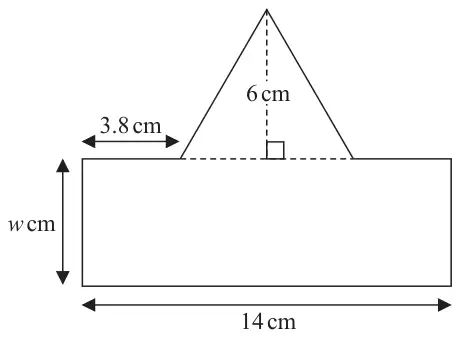
for method to find area of triangle, eg \([\text{missing length}] \times 6 \div 2\ (= 19.2)\)
P1
for method to find area of rectangle, eg \([\text{area of triangle}] \times 3.5\ (= 67.2)\) or writes an expression for the area of rectangle eg \(14w\) or \(14w \div 3.5\)
P1
for method to link both areas eg \(14w = [\text{area of triangle}] \times 3.5\) or \([\text{area of triangle}] = 14w \div 3.5\) or \([\text{area of triangle}] \times 3.5 \div 14\)
A1
cao
Additional guidance
Where [missing length] can be “6.4” or identified in working or on the diagram as the missing length
[area of triangle] must be identified as the area of the triangle OR come from: [missing length] × 6 ÷ 2 or [missing length] × 6 or [decimal] × 6 ÷ 2
Award 0 marks for a correct answer without correct supportive working.
13 Milo is trying to find the area of this rectangle.
He writes,
“The area is 400 cm2 because \(5 \times 4 \times 5 \times 4 = 400\)”
(a) Explain what is wrong with Milo’s method. (1)
Anya works out the area of a shape.
Her answer is 86 cm.
(b) Explain why her answer cannot be fully correct. (1)
Mark scheme (a)
Answer
Mark
Mark scheme
Explanation
C1
for correct explanation Acceptable response should have multiplied 5 and 4 (once) it should be (just) \(5 \times 4\) it is \(b \times h\) or \(l \times w\) she has not used the formula for area it should be 20 (cm2) shouldn’t multiply all (four) sides
Not acceptable response he has found the area twice he is correct he has worked out volume he has worked out the perimeter or he should have added the 4 sides
Additional guidance
Units may be ignored
Mark scheme (b)
Answer
Mark
Mark scheme
Explanation
C1
for correct explanation Acceptable response units should be cm2 or units should be squared it should be 86 cm2or 20 cm2 she didn’t use the correct units (for area) cm is wrong
Not acceptable response she is correct it is not squared or they should have squared it should be 400 cm or it should be 20 cm she has found the perimeter
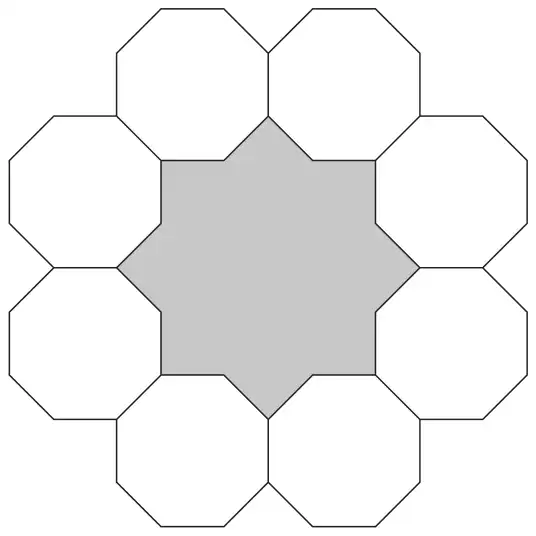
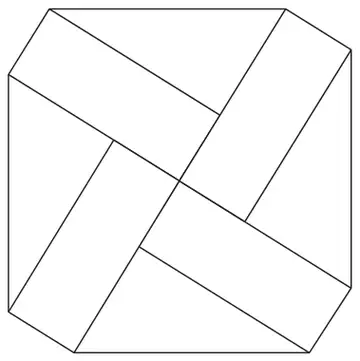
24 The diagram shows 8 identical regular octagons joined to enclose a shaded shape.
Each octagon has sides of length \(a\).
Find, in terms of \(a\), an expression for the area of the shaded shape. Give your answer in the form \(p\left(2 + \sqrt{2}\right)a^2\) where \(p\) is an integer. You must show all your working. (5)
Mark scheme
Answer
Mark
Mark scheme
\(4\left(2 + \sqrt{2}\right)a^2\)
P1
for process to find area required and identifying \(135^\circ\) or \(45^\circ\) or \(90^\circ\) angle(s), eg splitting shape into square and 4 triangles and an angle relevant to the triangle clearly identified.
P1
for process to find the area of a relevant triangle using \(45^\circ\), eg \(\dfrac{1}{2} \times a \times \left(2 \times \dfrac{a}{\sqrt{2}}\right) \times \dfrac{1}{\sqrt{2}}\ \left(= \dfrac{a^2}{2}\right)\) or using \(90^\circ\), eg \(\dfrac{1}{2} \times a \times a\ \left(= \dfrac{a^2}{2}\right)\) or process to find the area of a square made from 2 small triangles, eg \(a \times a\ (= a^2)\)
P1
for process to find the length of the square, eg \(a + a + \sqrt{a^2 + a^2}\ \left(= 2a + a\sqrt{2}\right)\)
P1
for process to find the total area, eg \(\left(\text{``}2a + a\sqrt{2}\text{''}\right)^2 + 4 \times \text{``}\dfrac{a^2}{2}\text{''}\)
A1
(dep on P3) for \(4\left(2 + \sqrt{2}\right)a^2\)
Additional guidance
\(90^\circ\) must be in a triangle to gain credit. May be seen on diagram.
Accept \(0.49\ldots a^2\)
May be seen as the area of 2 squares (from 4 small triangles)
Accept \(3.41a\)
Accept \((11.655 + 4 \times 0.49)a^2\)
Answer only award no marks. If working in decimals accept \(\dfrac{13.656}{2 + \sqrt{2}}\) leading to 4 Accept \(p = 4\) if supported by correct working
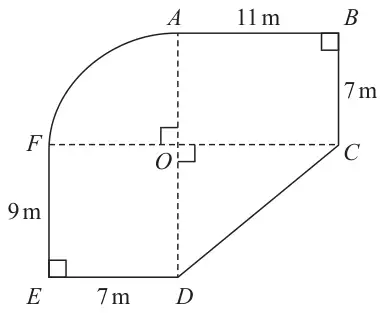
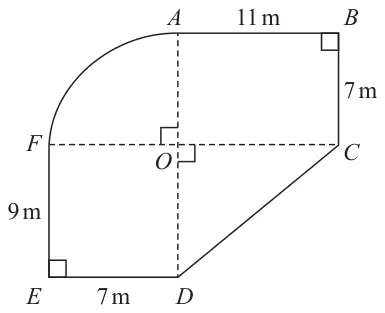
\(ABCO\) and \(DEFO\) are rectangles. \(CDO\) is a right-angled triangle. \(AFO\) is a sector of a circle with centre \(O\) and angle \(AOF = 90^\circ\)
Jason is going to cover his garden with grass seed. Each bag of grass seed covers 14 m\(^2\) of garden. Each bag of grass seed costs £10.95
Work out how much it will cost Jason to buy all the bags of grass seed he needs. (5)
Mark scheme
Answer
Mark
Mark scheme
186.15
P1
for correctly finding the area of at least three sections, eg 3 of \(11 \times 7\ (= 77)\), or \(9 \times 7\ (= 63)\), or \(\dfrac{1}{2} \times 11 \times 9\ (= 49.5)\), or \(\dfrac{1}{4} \times \pi \times 7^2\ (= 38.4845..)\)
P1
for a method to find the number of bags required for one area or a combination of areas eg \(\text{``}77\text{''} \div 14\ (= 5.5)\) or \(\text{``}227.9845..\text{''} \div 14\ (= 16.2846…)\)
P1
for method to work out the total area for all four sections eg \(\text{``}77\text{''} + \text{``}63\text{''} + \text{``}49.5\text{''} + \text{``}38.4845…\text{''}\ (= 227.9845…)\) or adding the exact number of bags per section for all four sections eg \(\text{``}5.5\text{''} + \text{``}4.5\text{''} + \text{``}3.53..\text{''} + \text{``}2.74..\text{''}\ (= 16.28...)\)
P1
for method to find the cost, eg integer number of bags \(\times\ 10.95\)
A1
cao
Additional guidance
Note a trapezium for the rectangle and triangle should be classed as two areas. Accept figures rounded or truncated to 1 dp or better throughout.
The third P1 mark is dependent upon correct processes seen for all four sections.
integer number of bags must come from area ÷ 14 rounded up
\(ABCO\) and \(DEFO\) are rectangles. \(CDO\) is a right-angled triangle. \(AFO\) is a sector of a circle with centre \(O\) and angle \(AOF = 90^\circ\)
Jason is going to cover his garden with grass seed. Each bag of grass seed covers 14 m2 of garden. Each bag of grass seed costs £10.95
Work out how much it will cost Jason to buy all the bags of grass seed he needs. (5)
Mark scheme
Answer
Mark
Mark scheme
186.15
P1
for correctly finding the area of at least three sections, eg 3 of \(11 \times 7\ (= 77)\), or \(9 \times 7\ (= 63)\), or \(\frac{1}{2} \times 11 \times 9\ (= 49.5)\), or \(\frac{1}{4} \times \pi \times 7^2\ (= 38.4845..)\)
P1
for a method to find the number of bags required for one area or a combination of areas eg \(\text{``}77\text{''} \div 14\ (= 5.5)\) or \(\text{``}227.9845..\text{''} \div 14\ (= 16.2846\ldots)\)
P1
for method to work out the total area for all four sections eg \(\text{``}77\text{''} + \text{``}63\text{''} + \text{``}49.5\text{''} + \text{``}38.4845\ldots\text{''}\ (= 227.9845\ldots)\) or adding the exact number of bags per section for all four sections eg \(\text{``}5.5\text{''} + \text{``}4.5\text{''} + \text{``}3.53..\text{''} + \text{``}2.74..\text{''}\ (= 16.28...)\)
P1
for method to find the cost, eg integer number of bags \(\times\) 10.95
A1
cao
Additional guidance
Note a trapezium for the rectangle and triangle should be classed as two areas. Accept figures rounded or truncated to 1 dp or better throughout.
This mark is dependent upon correct processes seen for all four sections.
integer number of bags must come from area ÷ 14 rounded up
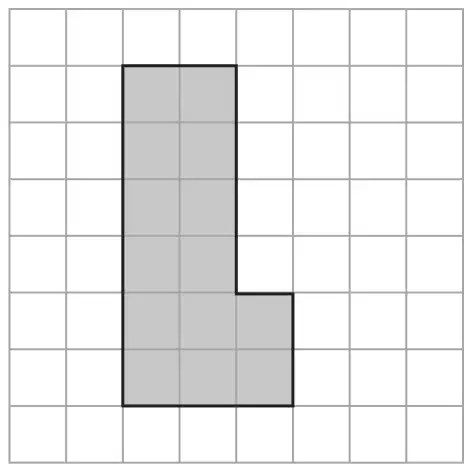
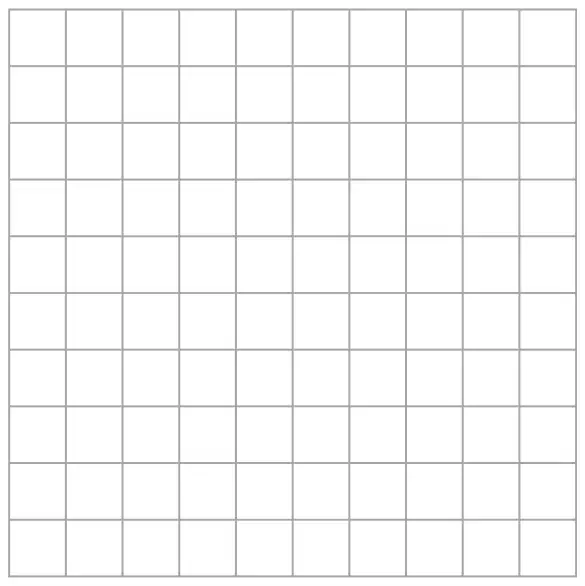
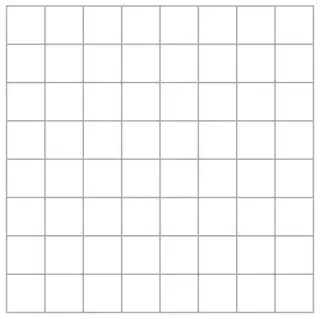
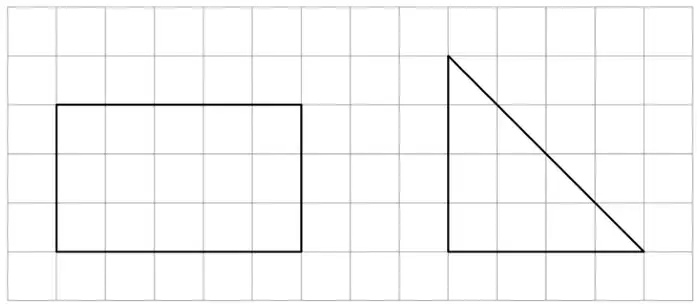
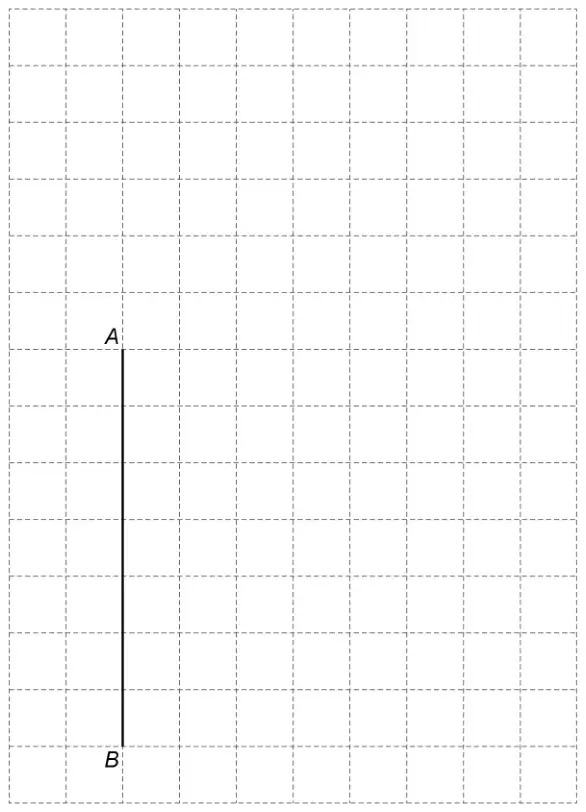
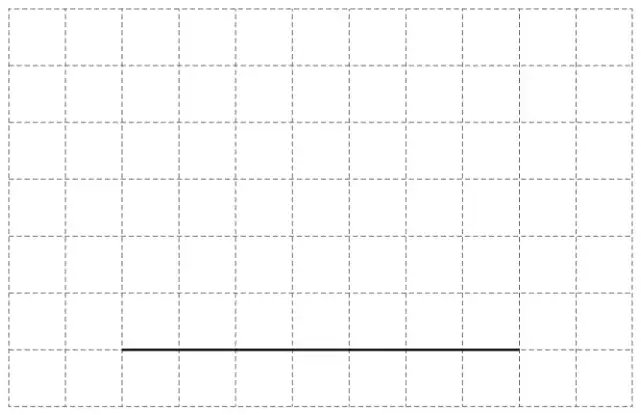
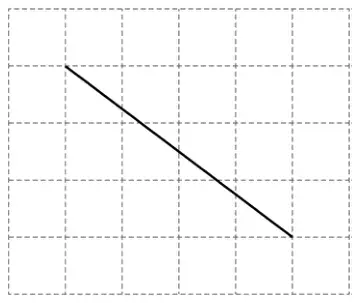
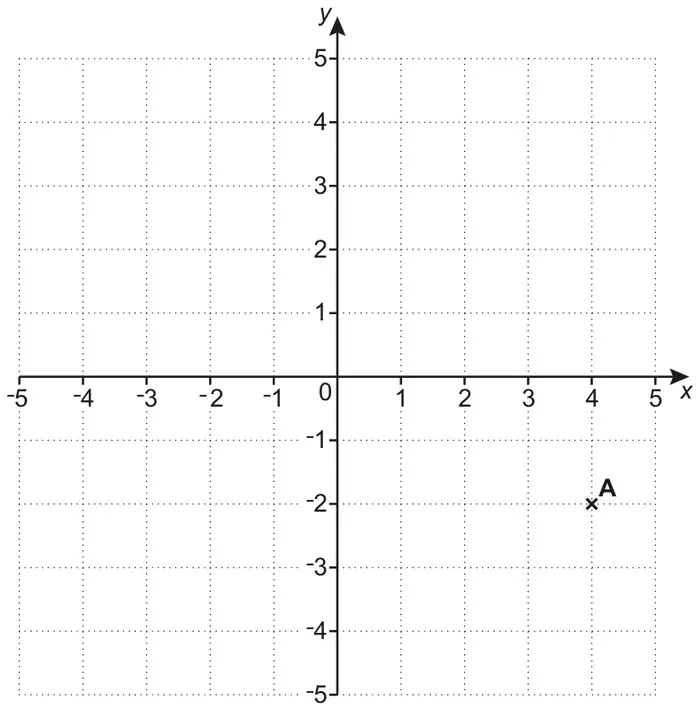
16 On the centimetre grid, draw an isosceles triangle with an area of 12 cm2(2)
Mark scheme
Answer
Mark
Mark scheme
Triangle drawn
B2
for an isosceles triangle drawn with the product of the base and perpendicular height being 24, eg \(6 \times 4\) or \(4 \times 6\) or \(8 \times 3\) or \(3 \times 8\)
(B1
for any isosceles triangle drawn or for any triangle with 24 as the product of the base and the perpendicular height)
Additional guidance
Accept triangle drawn in any orientation or drawn freehand.
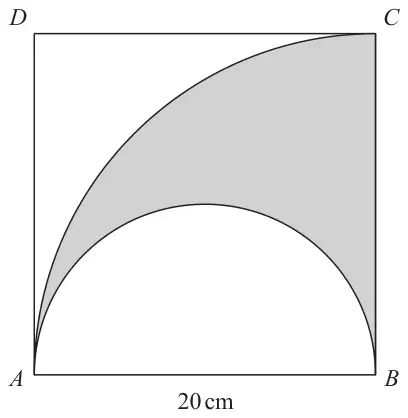
Work out the area of the square shown shaded in the diagram. (4)
Mark scheme
Answer
Mark
Mark scheme
34 cm²
P1
for finding one area eg \(8 \times 8\ (= 64)\) or \(0.5 \times 3 \times 5\ (= 7.5)\) or for first stage in working with Pythagoras eg sight of \(3^2 + 5^2\) or \(9 + 25\)
P1
for a complete process to find the area eg \(\text{``}64\text{''} - 4 \times \text{``}7.5\text{''}\ (= 34)\) or for full use of Pythagoras eg \(\sqrt{3^2 + 5^2}\) or \(\sqrt{34}\) or 5.83…
A1
for an answer in the range 33.6 to 34
B1
(indep) for cm²
Additional guidance
Any figure used must come from a correct process
Can be awarded with incorrect units stated
Can be awarded with an incorrect or absent numerical answer
the length of \(AB\) : the length of \(CD = 2 : 3\)
Find the length of \(AB\). (5)
Mark scheme
Answer
Mark
Mark scheme
17.6
P1
for correct trig statement, eg \(\sin 30 = \dfrac{h}{6}\)
P1
for complete process to find \(h\), eg \(6 \times \dfrac{1}{2}\ (= 3)\)
P1
for correct substitution into the area of a trapezium formula, eg \(\dfrac{1}{2}(a + b) \times \text{``}3\text{''} = 66\) or \(a + b = 44\) or \(\dfrac{1}{2}(2x + 3x) \times h = 66\)
P1
for complete correct process to find the length of \(AB\), eg \(\left[\dfrac{66 \times 2}{3} \div (2 + \text{``}3\text{''})\right] \times 2\)
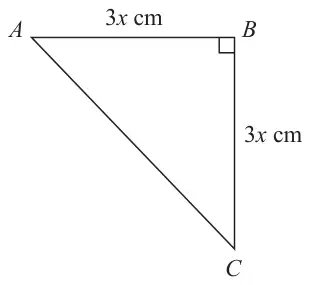
Iram solves a problem about this triangle to find the value of \(x\).
Her answer is
\(x = -2\)
(b) Explain why Iram’s answer must be wrong. (1)
Mark scheme (a)
Answer
Mark
Mark scheme
Explanation
C1
for a correct explanation, eg that he has found the area not perimeter Acceptable examples He has found the area (not perimeter) He should have added The perimeter is \(7+3+7+3\ (=20)\) oe He did base\(\times\)height He has timesed (not added)
Not acceptable examples He has worked it out wrong He should have squared it He should have done \(14 \times 6\) or \(7 \times 3 \times 7 \times 3\) or \(7 \times 3\) twice then add them He didn’t include the top or the other side He should have doubled it It should be \(P = 7 \times 3\) or he has done the sum not found the answer
Additional guidance
Any incorrect statement as part of a correct response can be ignored unless it contradicts the statement, eg, he found area but perimeter equals 10
Mark scheme (b)
Answer
Mark
Mark scheme
Explanation
C1
for correct explanation, eg that you cannot have a length of \(-2\) Acceptable examples \(x\) cannot be negative Cannot have a negative length Has to be positive It is impossible Can’t have \(-2\)(cm) (as a measurement) It has to be more than 0
Not acceptable examples You can have \(-2\) Won’t add to 180 He has a minus sign and the other sides have add signs It has to be a whole number or decimal there are no negative numbers to get a negative answer there is no cm after his answer It should be +2
Additional guidance
Any incorrect statement as part of a correct response can be ignored unless it contradicts the statement.
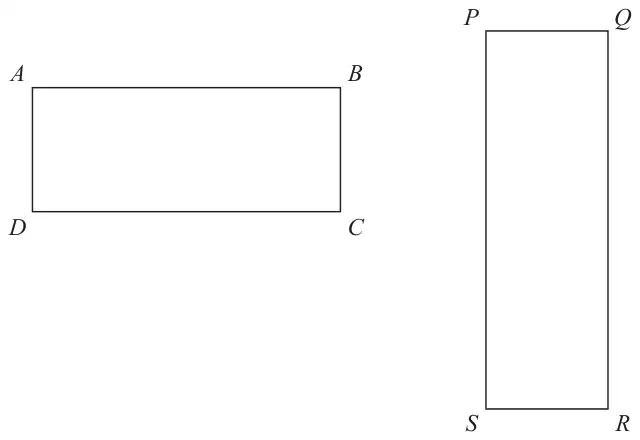
The perimeter of \(ABCD\) is 26 cm The area of \(PQRS\) is 45 cm2
Find the length of \(AB\). (4)
Mark scheme
Answer
Mark
Mark scheme
8.5
P1
for process to use the area of \(PQRS\) to find the length of \(PQ\), eg \(10y = 45\) or \(45 \div 10\ (= 4.5)\)
P1
for process to use the perimeter of \(ABCD\), eg \(2x + 2 \times \text{``}4.5\text{''} = 26\) or \(26 - 2 \times \text{``}4.5\text{''}\ (= 17)\) or \(26 \div 2\ (= 13)\)
P1
for process to use length of \(BC\) to find length of \(AB\), eg solves \(2x + 2 \times \text{``}4.5\text{''} = 26\) or \((26 - 2 \times \text{``}4.5\text{''}) \div 2\) or \(\text{``}13\text{''} - \text{``}4.5\text{''}\)
Wasim is going to cover the path with paving stones. Each paving stone is a square of side 30 cm. Each paving stone costs £2.50
Wasim has £220 to spend on paving stones.
Show that he has enough money to buy all the paving stones he needs. (4)
Mark scheme
Answer
Mark
Mark scheme
Accurate figures with supportive working
M1
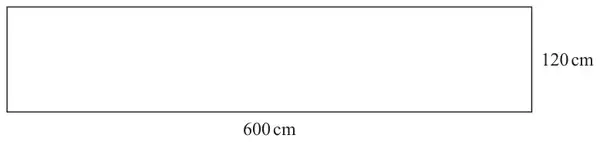
for a correct first step eg \(600 \div 30\ (= 20)\) or \(120 \div 30\ (=4)\) or \(600 \times 120\ (=72\,000)\) or \(30 \times 30\ (=900)\)
M1
for finding an appropriate cost \(2.5 \times \text{``}20\text{''}\ (=50)\) or \(2.5 \times \text{``}4\text{''}\ (=10)\) OR number of tiles required \(\text{``}72\,000\text{''} \div \text{``}900\text{''}\ (=80)\) or \(\text{``}4\text{''} \times \text{``}20\text{''}\ (=80)\) OR number they can afford \(220 \div 2.5\ (=88)\)
M1
for full method to get figures to compare eg cost to tile whole area eg \(\text{``}80\text{''} \times 2.5\) OR number of tiles they need and number they can afford eg \(\text{``}72\,000\text{''} \div \text{``}900\text{''}\) and \(220 \div 2.5\)
A1
for 200 OR 80 and 88 OR 72 000 and 79 200 OR 132 (cm) OR 660 (cm)
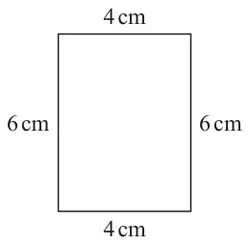
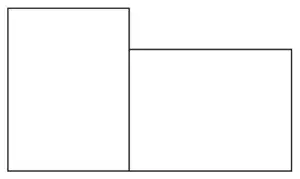
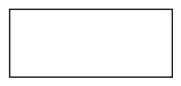
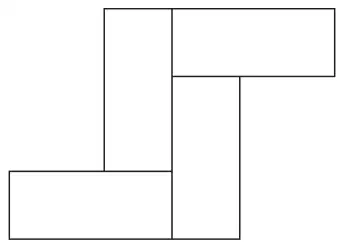
The 6-sided shape below is made from two of these rectangles.
Work out the perimeter of this 6-sided shape. (3)
Mark scheme
Answer
Mark
Mark scheme
32
P1
for a process to work out the missing length eg \(6 - 4\ (=2)\) or for a process to work out the length of the base eg \(4 + 6\ (= 10)\) OR for finding total perimeter of 2 rectangles, eg \(2(6 + 4 + 6+ 4)\ (= 40)\) OR for writing at least 5 figures correctly on the diagram
P1
for a process to work out the perimeter eg \(4 + \text{``}2\text{''} + 6 + 4 + 6 + 4 + 6\) or \(20 + 20 - 2 \times 4\) or \(16 + 14 + \text{``}2\text{''}\)
14 The diagram shows a rectangle, \(ABDE\), and two congruent triangles, \(AFE\) and \(BCD\).
area of rectangle \(ABDE\) = area of triangle \(AFE\) + area of triangle \(BCD\)
\(AB : AE = 1 : 3\)
Work out the length of \(AE\). (4)
Mark scheme
Answer
Mark
Mark scheme
36
P1
for process to find an expression for the area of triangle eg \(\tfrac{1}{2} \times 24 \times AE \times \sin 30\ (= 6AE)\)
P1
(dep P1) for process to link the area of rectangle with the area of the triangle eg \(2 \times \tfrac{1}{2} \times 24 \times AE \times \sin 30\ (= 12AE)\) or for \(AB = 12\)
P1
(indep) for use of given ratio eg \(AE = 3AB\) oe, eg area of rectangle = \(AE \times AB = 3x \times x\)
A1
cao
Additional guidance
Accept any correct expression, eg \(\tfrac{1}{2} \times 24 \times y \times \sin 30\)
May be shown on the diagram by labelling \(AE\) and \(AB\) with, for example, \(3x\), \(x\) or \(x\), \(\tfrac{1}{3}x\) or \(\tfrac{3}{4}x\), \(\tfrac{1}{4}x\) Do not accept 3, 1 or 1, \(\tfrac{1}{3}\) or \(\tfrac{3}{4}\), \(\tfrac{1}{4}\) for this mark.
The perimeter of \(ABCD\) is 26 cm The area of \(PQRS\) is 45 cm2
Find the length of \(AB\). (4)
Mark scheme
Answer
Mark
Mark scheme
8.5
P1
for process to use the area of \(PQRS\) to find the length of \(PQ\), eg \(10y = 45\) or \(45 \div 10\ (= 4.5)\)
P1
for process to use the perimeter of \(ABCD\), eg \(2x + 2 \times \text{``}4.5\text{''} = 26\) or \(26 - 2 \times \text{``}4.5\text{''}\ (= 17)\) or \(26 \div 2\ (= 13)\)
P1
for process to use length of \(BC\) to find length of \(AB\), eg solves \(2x + 2 \times \text{``}4.5\text{''} = 26\) or \((26 - 2 \times \text{``}4.5\text{''}) \div 2\) or \(\text{``}13\text{''} - \text{``}4.5\text{''}\)
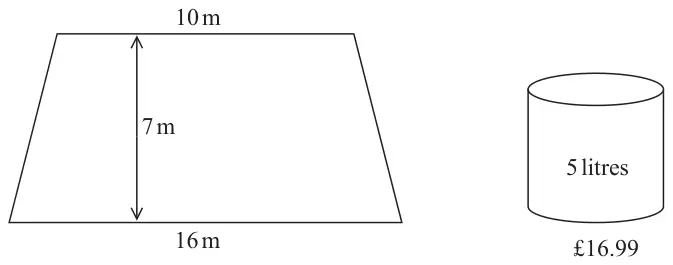
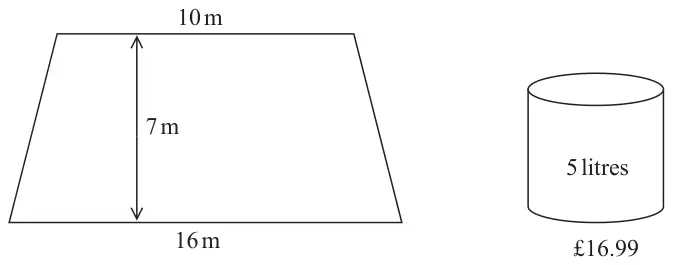
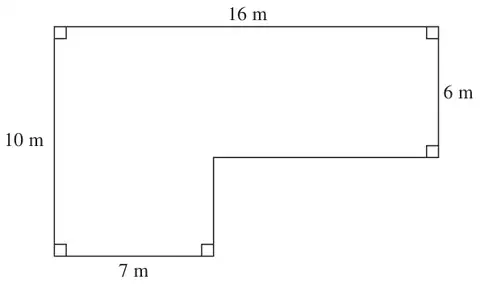
24 The diagram shows a floor in the shape of a trapezium.
John is going to paint the floor.
Each 5 litre tin of paint costs £16.99 1 litre of paint covers an area of 2 m2
John has £160 to spend on paint.
Has John got enough money to buy all the paint he needs? You must show how you get your answer. (5)
Mark scheme
Answer
Mark
Mark scheme
No (supported)
P1
calculates area of trapezium eg \(\frac{1}{2} \times 7 \times (10 + 16)\) (= 91)
P1
for division by coverage eg \(\div 2\) or [area of trapezium] \(\div\, 2\) (= 45.5) or process to find coverage per tin eg \(5 \times 2\ (= 10)\)
P1
for division to find the number of tins eg \(\div 5\) or \(\text{``}45.5\text{''} \div 5\ (= 9.1)\) or [area of trapezium] \(\div \text{``}10\text{''}\ (= 9.1)\)
P1
(dep on at least P2) for a process to multiply a whole number of tins (rounded up) by 16.99
C1
for ‘No’ supported by correct figures eg 169.9 or 90 and 91
Alternative
Answer
Mark
Mark scheme
No (supported)
P1
calculates area of trapezium eg \(\frac{1}{2} \times 7 \times (10 + 16)\) (= 91)
P1
for process to find number of tins bought eg \(160 \div 16.99 = 9\) tins
P1
for using whole no. of tins to find total litres eg \(9 \times 5\ (= 45)\)
P1
(dep on at least P2) for a process to find the total coverage eg \(\text{``}45\text{''} \times 2\ (= 90)\)
C1
for ‘No’ supported by correct figures eg 169.9 or 90 and 91
Additional guidance
[area of trapezium] needs to be clearly stated if the process of finding the area is not clear
There must be a conclusion (“No” or equivalent wording) including the figure 169.9 and working showing processes followed.
5 The diagram shows a floor in the shape of a trapezium.
John is going to paint the floor.
Each 5 litre tin of paint costs £16.99 1 litre of paint covers an area of 2 m2
John has £160 to spend on paint.
Has John got enough money to buy all the paint he needs? You must show how you get your answer. (5)
Mark scheme
Answer
Mark
Mark scheme
No (supported)
P1
calculates area of trapezium eg \(\frac{1}{2} \times 7 \times (10 + 16)\) (= 91)
P1
for division by coverage eg \(\div 2\) or [area of trapezium] \(\div\, 2\) (= 45.5) or process to find coverage per tin eg \(5 \times 2\ (= 10)\)
P1
for division to find the number of tins eg \(\div 5\) or \(\text{``}45.5\text{''} \div 5\ (= 9.1)\) or [area of trapezium] \(\div \text{``}10\text{''}\ (= 9.1)\)
P1
(dep on at least P2) for a process to multiply a whole number of tins (rounded up) by 16.99
C1
for ‘No’ supported by correct figures eg 169.9 or 90 and 91
Alternative
Answer
Mark
Mark scheme
No (supported)
P1
calculates area of trapezium eg \(\frac{1}{2} \times 7 \times (10 + 16)\) (= 91)
P1
for process to find number of tins bought eg \(160 \div 16.99 = 9\) tins
P1
for using whole no. of tins to find total litres eg \(9 \times 5\ (= 45)\)
P1
(dep on at least P2) for a process to find the total coverage eg \(\text{``}45\text{''} \times 2\ (= 90)\)
C1
for ‘No’ supported by correct figures eg 169.9 or 90 and 91
Additional guidance
[area of trapezium] needs to be clearly stated if the process of finding the area is not clear
There must be a conclusion (“No” or equivalent wording) including the figure 169.9 and working showing processes followed.
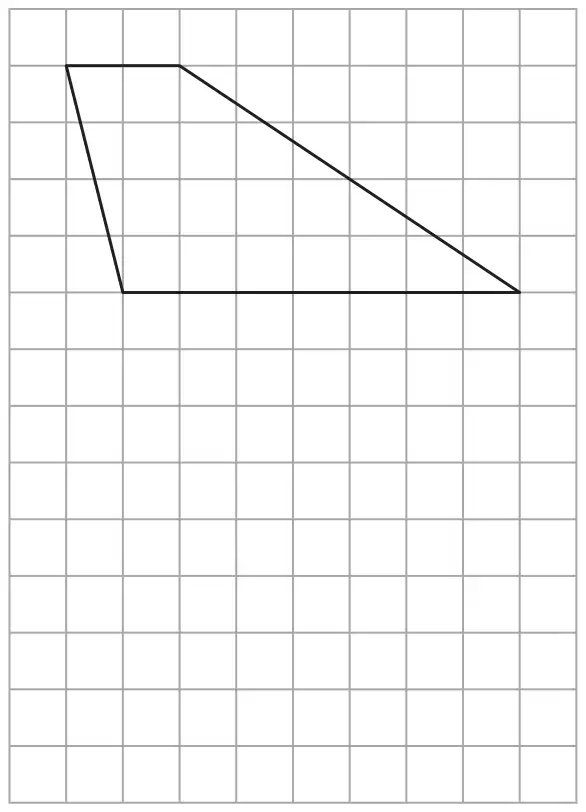
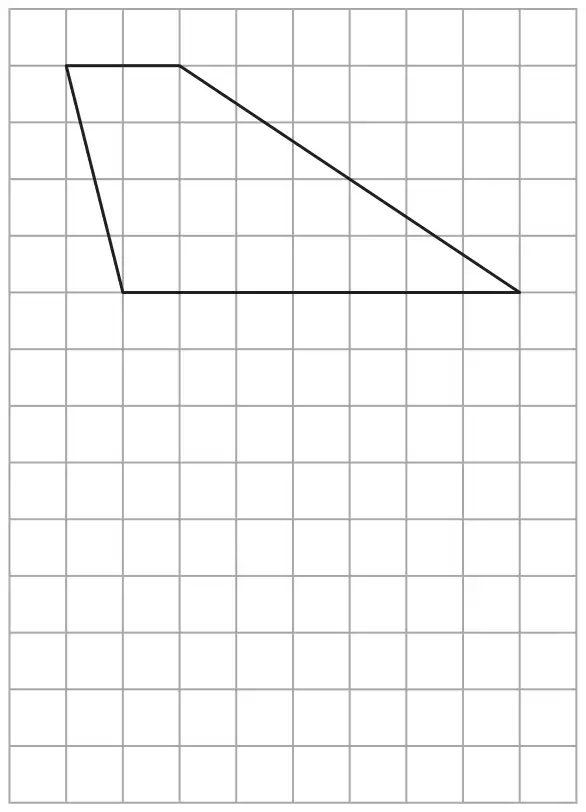
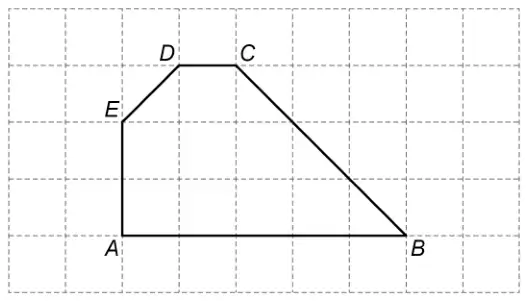
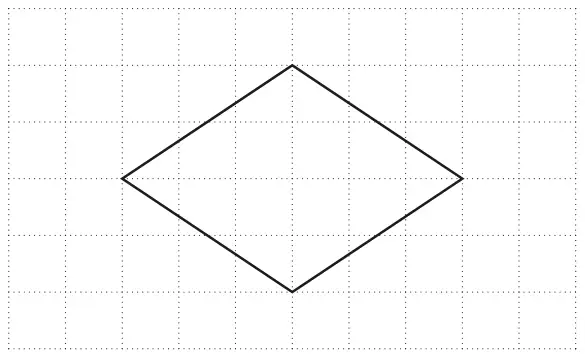
21 Here is a trapezium drawn on a centimetre grid.
On the grid, draw a triangle equal in area to this trapezium. (2)
Mark scheme
Answer
Mark
Mark scheme
Triangle of area 18
M1
for a complete method to find area of trapezium eg \(\dfrac{1}{2}(2 + 7) \times 4\ (= 18)\) OR for a triangle drawn of area 36 OR for a triangle that would give an area ft their area of trapezium
A1
for a triangle drawn of area 18 eg base = 6, height = 6 or base = 9, height = 4
Additional guidance
The value for the area of the trapezium must be clear for the ft to be checked.
Accept use of dimensions that are not whole numbers as long as the intention is clear
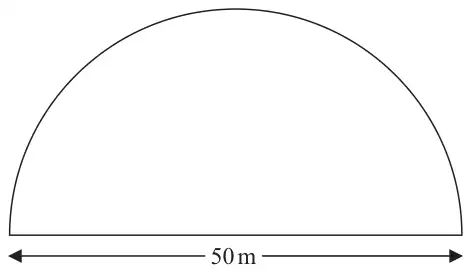
19 A farmer has a field in the shape of a semicircle of diameter 50 m.
The farmer asks Jim to build a fence around the edge of the field. Jim tells him how much it will cost.
Total cost = £29.86 per metre of fence plus £180 for each day’s work
Jim takes three days to build the fence.
Work out the total cost. (5)
Mark scheme
Answer
Mark
Mark scheme
4378.2(0)
P1
for a process to find the circumference of the circle or the semi circle, eg \(\pi \times 50\ (= 157.0796327)\) or \(0.5 \times \pi \times 50\ (= 78.53981634)\)
P1
for a complete process to find the perimeter of the field, eg \((0.5 \times \pi \times 50) + 50\) (= 128.5...) OR for working with one cost eg \(\text{``}157.07...\text{''} \times 29.86\) (= 4690.11..) or \(\text{``}78.5...\text{''} \times 29.86\) (= 2345.198...) or \(50 \times 29.86\) (=1493) or \(3 \times 180\) (= 540)
P1
For finding the costs of two different aspects eg 2 of \(\text{``}78.5...\text{''} \times 29.86\) (= 2345.1..) or \(50 \times 29.86\) (= 1493) or \(3 \times 180\) (= 540)
P1
for a adding at least 2 costs eg \(\text{``}2345.1..\text{''} + \text{``}540\text{''}\) (=2885.1..) or \(\text{``}1493\text{''} + \text{``}540\text{''}\) (=2033) or \(\text{``}128.5...\text{''} \times 29.86\) (= 3838.2..)
A1
for answer in the range 4377 – 4392
Additional guidance
Figures may be truncated or rounded
May use circle at this point, figures imply method One cost is 1 length or labour Figures may be truncated or rounded
Two different aspects means arc and straight edge or arc and labour or straight edge and labour Condone circle and labour or circle and straight edge.
Finding the cost of the perimeter is two costs added and so implies the previous P1 The circle is not allowed to be counted as one of the two costs for this mark
On the grid, draw a triangle equal in area to this trapezium. (2)
Mark scheme
Answer
Mark
Mark scheme
Triangle of area 18
M1
for a complete method to find area of trapezium eg \(\dfrac{1}{2}(2 + 7) \times 4\ (= 18)\) OR for a triangle drawn of area 36 OR for a triangle that would give an area ft their area of trapezium
A1
for a triangle drawn of area 18 eg base = 6, height = 6 or base = 9, height = 4
Additional guidance
The value for the area of the trapezium must be clear for the ft to be checked.
Accept use of dimensions that are not whole numbers as long as the intention is clear
The length of the rectangle is 7 cm longer than the width of the rectangle.
4 of these rectangles are used to make this 8-sided shape.
The perimeter of the 8-sided shape is 70 cm.
Work out the area of the 8-sided shape. (5)
Mark scheme
Answer
Mark
Notes
147
P1
starts process, eg uses \(x\) and \(x + 7\)
P1
starts to work with at least 6 correct sides, may be on the diagram or in an expression
P1
(dep on previous P1) gives a correct expression for the perimeter, eg \(x + x + 7 + x + 7 + x + 7 + x + x + 7 + x + 7 + x + 7\) or adds at least 6 correct sides and equates to 70
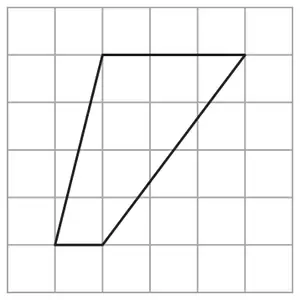
15 A quadrilateral has been drawn on a centimetre grid.
(a) Write down the mathematical name of this quadrilateral. (1)
(b) Work out the area of the quadrilateral. (2)
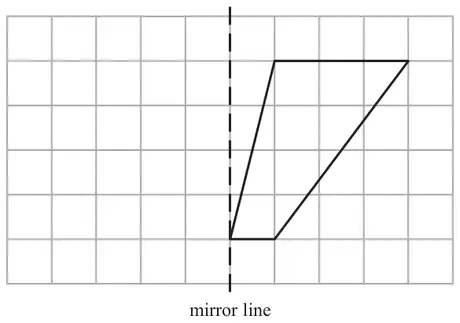
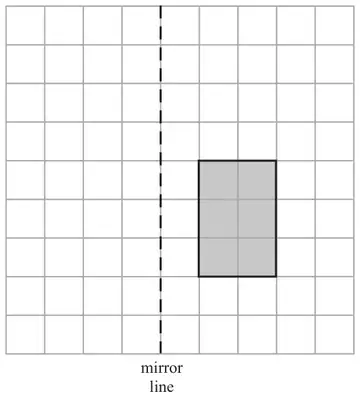
(c) On the grid below, reflect the quadrilateral in the mirror line.(2)
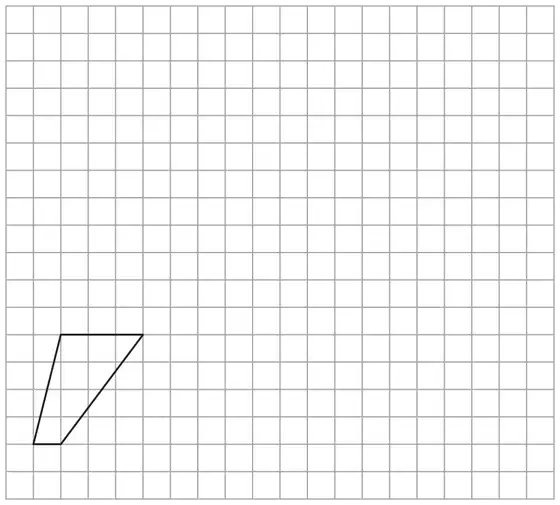
(d) On the grid, draw an enlargement of the quadrilateral with a scale factor of 3 (2)
Mark scheme (a)
Answer
Mark
Notes
trapezium
1
B1 cao
Mark scheme (b)
Answer
Mark
Notes
8
2
M1 for a strategy to find the area, eg splitting the shape into two triangles or drawing a rectangle around it or using the formula for the area of a trapezium A1 cao
Mark scheme (c)
Answer
Mark
Notes
Shape reflected
2
B2 for correct reflection drawn (B1 for 3 vertices correct or correct orientation, incorrect position)
Mark scheme (d)
Answer
Mark
Notes
Enlargement sf 3 drawn
2
B2 correct enlargement drawn (B1 for any two sides correct or a correct enlargement with scale factor other than 3)
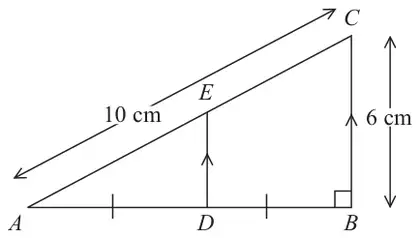
\(ADB\) and \(AEC\) are straight lines. \(DE\) is parallel to \(BC\).
Angle \(ABC = 90^\circ\) \(AC = 10\) cm. \(BC = 6\) cm. \(D\) is the midpoint of \(AB\).
Work out the area of trapezium \(BCED\). (4)
Mark scheme
Answer
Mark
Notes
18
4
M1 for correct initial use of Pythagoras eg (\(AB^2\) =) \(10^2 - 6^2\) (= 64) or \(AB = 8\) M1 (dep M1) for \(\text{``}\sqrt{64}\text{''} \div 2\) (= 4) M1 for method to find area of trapezium eg \(\dfrac{1}{2} \times \text{``}4\text{''} \times (6 \div 2 + 6)\) A1 cao
OR M1 for correct initial use of Pythagoras eg (\(AB^2\) =) \(10^2 - 6^2\) (= 64) or \(AB = 8\) M1 (dep M1) for method to find area of \(\Delta ABC\) eg \(\tfrac{1}{2} \times \text{``}\sqrt{64}\text{''} \times 6\) (= 24) or area of \(\Delta AED\) \(\tfrac{1}{2} \times 6 \div 2 \times \text{``}4\text{''}\) (= 6) or \(24 \times \left(\tfrac{1}{2}\right)^2\) (= 6) M1 for a complete method to find area of \(EDBC\) e.g \(\tfrac{3}{4} \times \text{``}24\text{''}\) eg \(\text{``}24\text{''} - \text{``}6\text{''}\) A1 cao
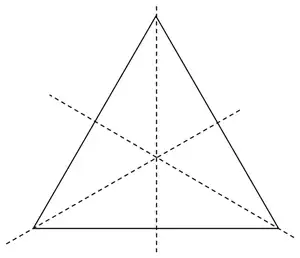
(a) On the triangle, draw all the lines of symmetry. (2)
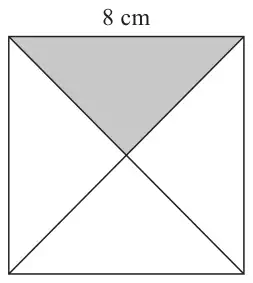
The diagram shows a square and its diagonals.
Diagram NOT accurately drawn
The square has sides of length 8 cm.
(b) Work out the area of the shaded triangle. (3)
Mark scheme (a)
Answer
Mark
Notes
Correct lines
2
B2 exactly 3 correct lines of symmetry (B1 for 1 or 2 correct lines and no incorrect lines)
Mark scheme (b)
Answer
Mark
Notes
16
3
M1 for a method to find the area of the square e.g. \(8 \times 8\) (= 64) or the height of the shaded triangle e.g. \(8 \div 2\) (= 4) M1 for a complete method to find the area of the shaded triangle e.g. \(\text{``}64\text{''} \div 4\) or \(\frac{1}{2} \times 8 \times \text{``}4\text{''}\) A1 cao
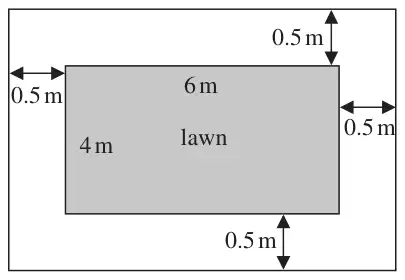
M1 for a correct method to find the area of one appropriate rectangle M1 for a complete method to find the area of the path M1 (dep on M1) for \(\text{``}102\text{''} \div 10\) A1 cao
M1 for a correct method to find the area of one appropriate rectangle M1 for a complete method to find the area of the path M1 (dep on M1) for “102” ÷ 10 A1 cao from correct working
She needs 1 litre of varnish for 5 m2 of floor. There are 2.5 litres of varnish in each tin of varnish.
Angie has 3 tins of varnish.
Does she have enough varnish for all the floor? You must show all your working. (5)
Mark scheme
Answer
Mark
Notes
Conclusion (supported)
5
M1 for finding the area of one rectangle which is not \(6 \times 10\) eg \(2 \times 2.5\) (= 5) or \(4 \times 10\) (= 40) or \(2.5 \times 6\) or \(5 \times 2\) M1 for a complete method to find the total area eg \(5 + 5 + 40\) or \(60 - 10\) (= 50) M1 for a complete method to find the number of tins needed eg \(\text{``}50\text{''} \div 5 \div 2.5\) (= 4) OR for a complete method to find the number of litres needed eg \(\text{``}50\text{''} \div 5\) (= 10) OR for a complete method to find the area covered by 3 tins eg \(3 \times 2.5 \times 5\) (= 37.5) A1 for 50 (m2) and (4 tins needed) or for 10 (litres) and 7.5 (litres) or for 50 (m2) and 37.5 (m2) C1 (dep M2) for a conclusion supported by their calculations
Tina has marked the six parts she needs on a piece of wood, as shown in the diagram below.
Diagram NOT accurately drawn
(a) Work out the total length of the six parts. (2)
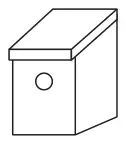
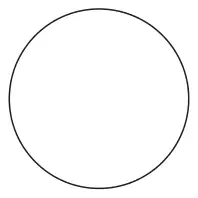
Tina is going to cut a circular hole in the front of the nest box. She makes this accurate full size drawing to represent the hole.
(b) Measure the diameter of the hole. (1)
Here is a sketch of one side of the nest box.
Diagram NOT accurately drawn
(c) In the space below, make an accurate scale drawing of this side of the nest box. Use a scale of 1 cm to 20 mm. The line AB has been drawn for you.(3)
Mark scheme (a)
Answer
Mark
Notes
1270 or 1320
2
M1 for adding the six lengths or an answer of digits 127(0) or digits 132(0) A1 for 1270 or 1320
Mark scheme (b)
Answer
Mark
Notes
32 mm or 3.2 cm
1
B1 for answer in range 30 mm to 34 mm or in range 3 cm to 3.4 cm
Mark scheme (c)
Answer
Mark
Notes
Drawing
3
M1 for at least one right angle M1 for 10cm line or 12.5cm line A1 for fully correct drawing
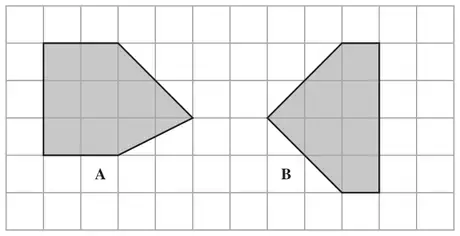
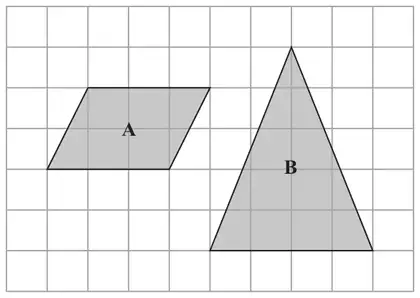
*9 Shape A and shape B are drawn on a centimetre grid.
One shape has a greater area than the other.
How much greater? (3)
Mark scheme
Answer
Mark
Notes
1 cm2
3
M1 for method to find the area of A or area of B eg for A 6 + 3 (= 9), 12 – 3 (= 9) eg for B 4 + 4 (= 8), 12 – 4 (= 8) A1 for 9 and 8 C1 (dep M1) for 1 cm2 or ft from their 2 areas
She needs 1 litre of varnish for 5 m\(^2\) of floor. There are 2.5 litres of varnish in each tin of varnish. Angie has 3 tins of varnish.
Does she have enough varnish for all the floor? You must show all your working. (5)
Mark scheme
Answer
Mark
Notes
Conclusion (supported)
5
M1 for finding the area of one rectangle which is not \(6 \times 10\) eg \(2 \times 2.5\) (=5) or \(4 \times 10\) (=40) or \(2.5 \times 6\) or \(5 \times 2\)
M1 for a complete method to find the total area eg \(5 + 5 + 40\) or \(60 - 10\) (=50)
M1 for a complete method to find the number of tins needed eg \(\text{``}50\text{''} \div 5 \div 2.5\) (=4) OR for a complete method to find the number of litres needed. eg \(\text{``}50\text{''} \div 5\) (=10) OR for a complete method to find the area covered by 3 tins eg \(3 \times 2.5 \times 5\) (=37.5)
A1 for 50 (m\(^2\)) and 4 (tins needed) or for 10 (litres) and 7.5 (litres) or for 50(m\(^2\)) and 37.5(m\(^2\))
C1 (dep M2) for a conclusion supported by their calculations
This part of the field is in the shape of a trapezium. A farmer wants to put a fence all the way around the edge of this part of the field.
The farmer has 50 m of fence.
Does he have enough fence? You must show all your working. (5)
Mark scheme
Answer
Mark
Notes
No not enough
5
M1 for substituting into Pythagoras’ theorem M1 for complete correct use of Pythagoras’ theorem M1 for a complete method to find the perimeter of the trapezium A1 51.(20655..) C1 (dep on first two Ms) for correct conclusion dependent upon supporting calculations
Method 1 (partitioning) M1 for method to find paving stones for 2 (or more) rectangles M1 (dep) for addition of paving stones for complete path A1 for 44 (tiles) C1 (dep on M1) ft for correct decision supported by working
Method 2 (area 1) M1 for \(7 \times 5 - 6 \times 4\) (= 11) oe M1 (dep) for \(\text{``}11\text{''} \div 0.5^2\) (= 44) A1 for 44 (paving stones) C1 (dep on M1) ft for correct decision supported by working
Method 3 (area 2) M1 for \(7 \times 5 - 6 \times 4\) (= 11) oe M1 for \(0.5^2 \times 35\) (= 8.75) A1 for 11 and 8.75 C1 (dep on M1) ft for correct decision supported by working
Method 4 (using perimeter) M1 for \((6 + 4 + 6 + 4) \div 0.5\) (= 40) M1 for \(\text{``}40\text{''} + 4\) A1 for 44 (tiles) C1 (dep on M1) ft for correct decision supported by correct working
*27 The diagram shows the floor plan of Mary’s conservatory.
Diagram NOT accurately drawn
Mary is going to cover the floor with tiles.
The tiles are sold in packs. One pack of tiles will cover 2 m2
A pack of tiles normally costs £24.80 Mary gets a discount of 25% off the cost of the tiles.
Mary has £100
Does Mary have enough money to buy all the tiles she needs? You must show all your working. (5)
Mark scheme
Answer
Mark
Notes
Has enough (with evidence)
5
M1 for splitting the shape (or showing recognition of the “absent” triangles) and using a method to find the area of one shape M1 for a complete method to find the total area, (= 9 m2) M1 (dep M1) for a method to find the number of packs required from their total area, eg. \(\text{``}9\text{''} \div 2 = 4.5\) rounded up to 5 M1 for a method to find 75% of 24.80 or 75% of the cost of their total number of packs, eg. \(24.80 \times 5 \times \tfrac{75}{100}\) (= 93) or \(24.80 \times \tfrac{75}{100}\) (= 18.6) C1 for a conclusion supported by fully correct answers, eg. showing 9 (m2), 5 (packs) and 93 or 7 (from \(100 - 93\))
OR
M1 for method to find 75% of £24.80, eg. \(24.80 \times \tfrac{75}{100}\) (= 18.6) M1 for method to find total number of packs Mary can buy, eg. \(100 \div \text{``}18.60\text{''} = 5.3\ldots\) truncated to 5 or 10 (m2) M1 for finding area of one relevant shape or showing how one pack (2 m2) can fit in the diagram M1 (dep on previous M1) for complete method to show that 5 packs can cover the floor C1 for a conclusion supported by fully correct answers, showing the capacity (10) greater than total area (9)
*10 The diagram shows the floor plan of Mary’s conservatory.
Diagram NOT accurately drawn
Mary is going to cover the floor with tiles.
The tiles are sold in packs. One pack of tiles will cover 2 m\(^2\) A pack of tiles normally costs £24.80 Mary gets a discount of 25% off the cost of the tiles.
Mary has £100
Does Mary have enough money to buy all the tiles she needs?
You must show all your working.(5)
Mark scheme
Answer
Mark
Notes
Has enough (with evidence)
5
M1 for splitting the shape (or showing recognition of the “absent” triangles) and using a method to find the area of one shape M1 for a complete method to find the total area, (= 9 m\(^2\)) M1 (dep on M1) for a method to find the number of packs required from their total area, eg. \(\text{``}9\text{''} \div 2 = 4.5\) rounded up to 5 M1 for a method to find 75% of 24.80 or 75% of the cost of their total number of packs, eg. \(24.80 \times \text{``}5\text{''} \times \tfrac{75}{100}\) (= 93) or \(24.80 \times \tfrac{75}{100}\) (= 18.6) C1 for a conclusion supported by fully correct answers, eg. showing 9 (m\(^2\)), 5 (packs) and 93 or 7 (from 100 – 93)
OR M1 for method to find 75% of £24.80, eg. \(24.80 \times \tfrac{75}{100}\) (= 18.6) M1 for method to find total number of packs Mary can buy, eg. \(100 \div \text{``}18.60\text{''} = 5.3....\) truncated to 5 or 10 (m\(^2\)) M1 for finding area of one relevant shape or showing how one pack (2 m\(^2\)) can fit in the diagram M1 (dep on previous M1) for complete method to show that 5 packs can cover the floor C1 for a conclusion supported by fully correct answers, showing the capacity (10) greater than total area (9)
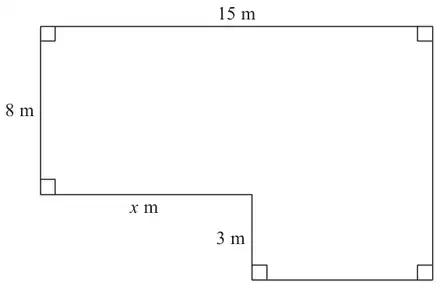
The area of the floor is 138 m2. Work out the value of \(x\). (4)
Mark scheme
Answer
Mark
Notes
9
4
M1 for method to find the area of one rectangle eg \(15 \times 8\) (= 120) or \(15 \times 11\) (= 165) M1 (dep) for subtraction from/by given area eg \(138 - \text{``}120\text{''}\) (= 18) or \(\text{``}165\text{''} - 138\) (= 27) M1 for final step from complete method shown eg \(15 - \text{``}18\text{''} \div 3\) or for \(\text{``}27\text{''} \div 3\) A1 cao
OR
M1 for a correct expression for the area of one rectangle eg \((8 + 3) \times (15 - x)\) or \(8 \times x\) M1 (dep) for a correct equation eg \((8 + 3) \times (15 - x) + 8 \times x = 138\) M1 for correct method to isolate \(x\) eg \(3x = 27\) A1 cao
M1 for method to find area of one rectangle, eg \(15 \times 8\) (=120) or \(15 \times 11\) (=165) M1 (dep) for subtracting from/by given area, eg \((138 - \text{``}120\text{''})\) (=18) or \(\text{``}165\text{''} - 138\) (=27) M1 for final step from complete method shown, eg \(15 - \text{``}18\text{''} \div 3\) or \(\text{``}27\text{''} \div 3\) A1 cao
OR M1 for a correct expression for the area of one rectangle, eg \((8 + 3) \times (15 - x)\) or \(8 \times x\) M1 (dep) for a correct equation eg \((8 + 3) \times (15 - x) + 8 \times x = 138\) M1 for correct method to isolate \(x\), eg \(3x = 27\) A1 cao
Kevin is going to keep some pigs in the field. Each pig needs an area of 36 square metres.
Work out the greatest number of pigs Kevin can keep in the field. (4)
Mark scheme
Answer
Mark
Notes
3
4
M1 for attempt to calculate at least one area eg 10 × 7 (=70) or 16 × 10 (=160) M1 for a method to find the total area (=124) M1 (dep on M1) for “124” ÷ 36 C1 (dep on M3) for 3 (pigs) clearly identified and supported by correct calculations Or M1 for an area of 36m² drawn with dimensions shown M1 for 3 areas of 36m² drawn with dimensions shown M1 for method to find the area left (=16) C1 (dep on M3) for 3 (pigs) clearly identified and supported by correct calculations
Kevin is going to keep some pigs in the field. Each pig needs an area of 36 square metres.
Work out the greatest number of pigs Kevin can keep in the field. (4)
Mark scheme
Answer
Mark
Notes
3
4
M1 for a method to calculate at least one area eg \(10 \times 7\) (=70) or \(16 \times 10\) (=160) M1 for a method to find the total area (=124) M1 (dep on M1) for \(\text{``}124\text{''} \div 36\) C1 (dep on M3) for 3 (pigs) clearly identified and supported by correct calculations
Or
M1 for an area of 36m² drawn with dimensions shown M1 for 3 areas of 36m² drawn with dimensions shown M1 (dep on M1) for method to find the area left (=16) C1 (dep on M3) for 3 (pigs) clearly identified and supported by correct calculations
*24 The diagram shows the floor of a village hall.
Diagram NOT accurately drawn
The caretaker needs to polish the floor.
One tin of polish normally costs £19 One tin of polish covers 12 m\(^2\) of floor.
There is a discount of 30% off the cost of the polish.
The caretaker has £130
Has the caretaker got enough money to buy the polish for the floor?
You must show all your working.(5)
Mark scheme
Answer
Mark
Notes
Not enough, needs £133
5
M1 for splitting the shape (or showing recognition of the “absent” rectangle) and using a correct method to find the area of one shape M1 for a complete and correct method to find the total area M1 for a complete method to find 70% of 19 (= 13.3) or 70% of their total cost or 70% of their area A1 114(m²) and (£)133 or 114(m²) and (£)13.3(0) and 108(m²) C1 (dep on M2) for a conclusion supported by their calculations OR M1 for a complete method for the number of tins required for one section of the area of the floor M1 for a complete method to find the number of tins for the whole floor M1 for a complete method to find 70% of their total number of tins and multiply by 19 A1 (£)133 C1 (dep on M2) for a conclusion supported by their calculations
*10 The diagram shows the floor of a village hall.
Diagram NOT accurately drawn
The caretaker needs to polish the floor.
One tin of polish normally costs £19 One tin of polish covers 12 m\(^2\) of floor.
There is a discount of 30% off the cost of the polish.
The caretaker has £130
Has the caretaker got enough money to buy the polish for the floor? You must show all your working. (5)
Mark scheme
Answer
Mark
Notes
Not enough, needs £133
5
M1 for splitting the shape (or showing recognition of the “absent” rectangle) and using a correct method to find the area of one shape M1 for a complete and correct method to find the total area M1 for a complete method to find 70% of 19 (= 13.3) or 70% of their total cost or 70% of their area A1 114(m\(^2\)) and (£)133 or 114(m\(^2\)) and (£)13.3(0) and 108(m\(^2\)) C1 (dep on M2) for a conclusion supported by their calculations
OR
M1 for a complete method for the number of tins required for one section of the area of the floor M1 for a complete method to find the number of tins for the whole floor M1 for a complete method to find 70% of their total number of tins and multiply by 19 A1 (£)133 C1 (dep on M2) for a conclusion supported by their calculations
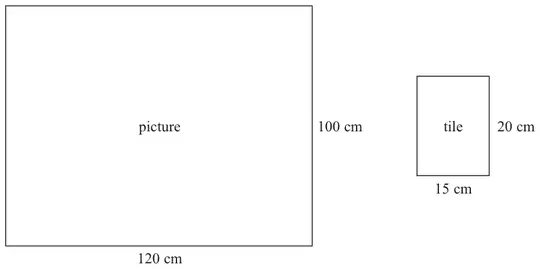
The diagram shows the picture in the shape of a rectangle, 120 cm by 100 cm. It also shows a tile in the shape of a rectangle, 15 cm by 20 cm.
Diagram NOT accurately drawn
(a) Work out the number of these tiles needed to make the picture. (3)
The total cost of the tiles is £52 plus VAT. The rate of VAT is 20%.
(b) Work out 20% of £52 (2)
Mark scheme (a)
Answer
Mark
Notes
40
3
M1 for 120 × 100 (=12 000) or 20 × 15 (=300) M1 (dep) for ‘12 000’ ÷ ‘300’ A1 cao OR M1 for 120 ÷ 15 (= 8) or 100 ÷ 20 (= 5) M1 (dep) for ‘8’ × ‘5’ A1 cao OR M1 for 120 ÷ 20 (=6) or 100 ÷ 15 (=6.66…) M1 (dep) for ‘6’ × ‘6.66…’ (=40) or ‘6’ × ‘6’ (=36) or ‘6’ × ‘7’ (=42) A1 cao
Mark scheme (b)
Answer
Mark
Notes
10.40
2
M1 for \(\dfrac{20}{100} \times 52\) oe A1 for 10.4(0) [SC B1 for 62.4(0) or 41.6(0)]
Bill is going to cover the playground with tarmac. It costs £2.56 to cover each square metre with tarmac.
Work out the total cost of the tarmac Bill needs. (4)
Mark scheme
Answer
Mark
Notes
10752
4
M1 for splitting the pentagon (or show the recognition of the “absent” triangle) and using a correct method to find the area of one shape M1 for a complete and correct method to find the total area M1 (dep on at least one prev M1) for multiplying their total area by 2.56 (where total area is a calculation involving at least two areas) A1 cao
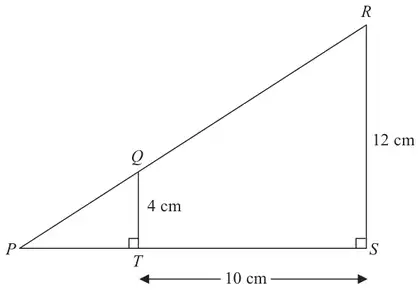
\(PQR\) and \(PTS\) are straight lines. Angle \(PTQ\) = Angle \(PSR = 90^\circ\) \(QT = 4\) cm \(RS = 12\) cm \(TS = 10\) cm
(a) Work out the area of the trapezium \(QRST\). (2)
(b) Work out the length of \(PT\). (3)
Mark scheme (a)
Working
Answer
Mark
Notes
\(\frac{1}{2} \times (4 + 12) \times 10\)
80
2
M1 for a fully correct method for area of \(QRST\) A1 cao
Mark scheme (b)
Working
Answer
Mark
Notes
For example \(\dfrac{PT + 10}{PT} = \dfrac{12}{4} = 3\) \(PT + 10 = 3PT\) \(2PT = 10\)
5
3
M1 for a correct scale factor or ratio using two corresponding sides from two similar triangles or two sides within the same triangle (may be seen within an equation) eg. \(\frac{12}{4}\) oe or 4 : 12 oe or \(\frac{PT}{4}\) or \(\frac{PS}{12}\) or \(\frac{12}{12 - 4}\) etc. M1 for a correct equation with \(PT\) or \(PS\) as the only variable or complete correct method using scale factor A1 cao
M1 for \(\frac{9}{2} \times (12 + 18)\) or \(18 \times 9 - \frac{1}{2}(6 \times 9)\) or \(9 \times 12 + \frac{1}{2} \times (18 - 12) \times 9\) or 135 seen M1 (dep) for \(\text{`}135\text{'} \div 20\) or 6 or 7 seen M1 (dep on previous M1) for \(\text{`}6\text{'} \times 4.99\) or \(\text{`}7\text{'} \times 4.99\) A1 cao
[SC: M1 for \((12 \times 9 + 6 \times 9) \div 20\) (= \(162 \div 20\)) or 8 or 9 seen M1 (dep) for \(\text{`}8\text{'} \times 4.99\) or \(\text{`}9\text{'} \times 4.99\) OR M1 for \((18 \times 9 - 6 \times 9) \div 20\) (= \(108 \div 20\)) or 5 or 6 seen M1 (dep) for \(\text{`}5\text{'} \times 4.99\) or \(\text{`}6\text{'} \times 4.99\)]
B1 for a correct conversion of 3 m or 4 m to cm or 20 cm to m or a correct and appropriate area conversion. M1 for \(300 \times 400\) (=120000) or \(3 \times 4\) (=12) M1 for \(20 \times 20\) or \(0.20 \times 0.20\) M1 for \(\text{`}120000\text{'} \div \text{`}400\text{'}\) or \(\text{`}12\text{'} \div \text{`}0.04\text{'}\) A1 for 1049.7(0) C1 (dep M1) for comparison and correct deduction using their total cost with supportive working OR B1 for a correct conversion of 3 m or 4 m to cm or 20 cm to m or a correct and appropriate area conversion. M1 for \(300 \div 20\) or \(400 \div 20\) or \(3 \div 0.2(0)\) or \(4 \div 0.2(0)\) M1 for \(300 \div 20\) and \(400 \div 20\) or \(3 \div 0.2(0)\) and \(4 \div 0.2(0)\) M1 for \(\text{`}15\text{'} \times \text{`}20\text{'}\) A1 for 1049.7(0) C1 (dep M1) for comparison and correct deduction using their total cost with supportive working
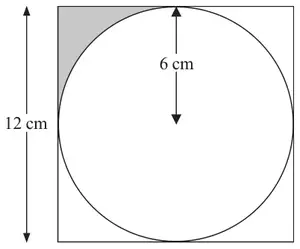
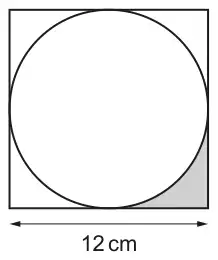
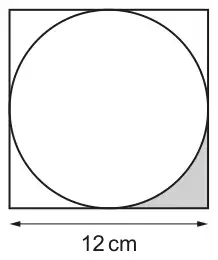
12 The diagram shows a circle drawn inside a square.
Diagram NOT accurately drawn
The circle has a radius of 6 cm. The square has a side of length 12 cm.
Work out the shaded area. Give your answer in terms of \(\pi\). (3)
Mark scheme
Answer
Mark
Notes
\(36 - 9\pi\)
3
M1 for \(\pi \times 6 \times 6\) or \(36\pi\) seen value 113.03-113.2 M1 for (12×12 – ‘\(\pi \times 6 \times 6\)’)÷4 or value 7.7-7.8 A1 for \(36 - 9\pi\) oe OR M1 for \(\pi \times 6 \times 6 \div 4\) or \(9\pi\) seen or value 28.2-28.3 M1 for 6×6 – ‘\(\pi \times 6 \times 6 \div 4\)’ or value 7.7-7.8 A1 for \(36 - 9\pi\) oe NB: for M marks \(\pi\) may be given numerically.
M1 for \(\frac{9}{2} \times (12 + 18)\) or \(18 \times 9 - \frac{1}{2}(6 \times 9)\) or \(9 \times 12 + \frac{1}{2} \times (18 - 12) \times 9\) or 135 seen M1 (dep) for ‘135’÷ 20 or 6 or 7 seen M1 (dep on previous M1) for ‘6’ × 4.99 or ‘7’ × 4.99 A1 cao [SC: M1 for (12×9 + 6×9) ÷ 20 (= 162÷20) or 8 or 9 seen M1 (dep) for ‘8’ × 4.99 or ‘9’ × 4.99 OR M1 for (18×9 − 6×9) ÷ 20 (= 108÷20) or 5 or 6 seen M1 (dep) for ‘5’ × 4.99 or ‘6’ × 4.99]
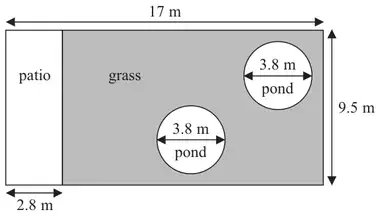
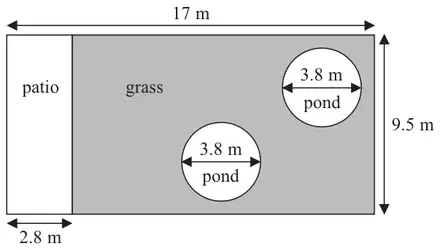
M1 for \((17 - 2.8) \times 9.5\) (=134.9) or \(17 \times 9.5 - 2.8 \times 9.5\) (\(= 161.5 - 26.6 = 134.9\)) M1 for \(\pi \times (3.8 \div 2)^2\) (=11.33 – 11.35) M1(dep on M1) for ‘134.9’ \(- 2 \times\) ‘11.34’ A1 for 112 - 113 C1(dep on at least M1) for 'He needs 5 boxes' ft from candidate's calculation rounded up to the next integer.
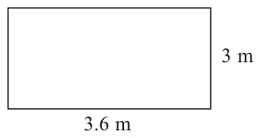
M1 for dividing side of patio by side of paving slab eg \(360 \div 60\) or \(300 \div 60\) or \(3.6 \div 0.6\) or \(3 \div 0.6\) or 6 and 5 seen or 6 divisions seen on length of diagram or 5 divisions seen on width of diagram M1 for correct method to find number of paving slabs eg \((360 \div 60) \times (300 \div 60)\) oe or \(6 \times 5\) or 30 squares seen on diagram (units may not be consistent) A1 for Yes and 30 ( or 2 extra) with correct calculations OR M1 for correct method to find area of patio or paving slab eg \(360 \times 300\) or 108000 seen or \(60 \times 60\) or 3600 seen or \(3.6 \times 3\) or 10.8 seen or \(0.6 \times 0.6\) or 0.36 seen M1 for dividing area of patio by area of a paving slab eg. \((3.6 \times 3) \div (0.6 \times 0.6)\) oe (units may not be consistent) A1 for Yes and 30 ( or 2 extra) with correct calculations OR M1 for method to find area of patio and area of 32 slabs eg. \(60 \times 60 \times 32\) or \(360 \times 300\) M1 for method to find both areas eg. \(60 \times 60 \times 32\) and \(360 \times 300\) (units may not be consistent) A1 for Yes and 115200 and 108000 OR Yes and 11.52 and 10.8 NB : Throughout the question, candidates could be working in metres or centimetres
Mark scheme (b)
Working
Answer
Mark
Notes
276.16
3
M1 for complete correct method with relative place value correct. Condone 1 multiplication error, addition not necessary. OR M1 for a complete grid. Condone 1 multiplication error, addition not necessary. OR M1 for sight of a complete partitioning method, condone 1 multiplication error. Final addition not necessary. A1 for digits 27616 A1 ft (dep on M1) for correct placement of decimal point after addition (of appropriate values) (SC: B1 for attempting to add 32 lots of 8.63 )
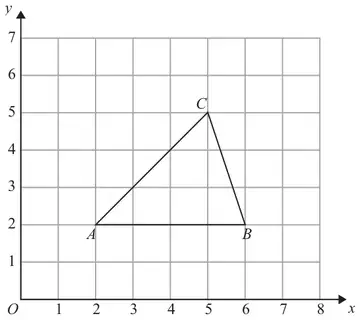
M1 for \(\frac{1}{2} \times 4 \times 3\) oe M1 for \(\left(\frac{1}{2}\right)^2 \times\) “6” A1 cao OR M2 for \(\frac{1}{2} \times 2 \times 1.5\) oe (M1 for triangle with all lengths \(\frac{1}{2}\) corresponding lengths of triangle \(ABC\) seen in any position or vertices seen at (1, 1) (3,1) and (2.5, 2.5) or stated) A1 cao
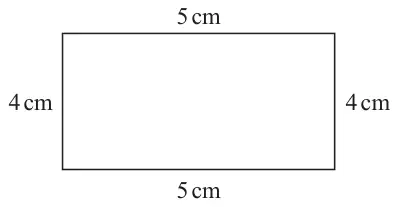
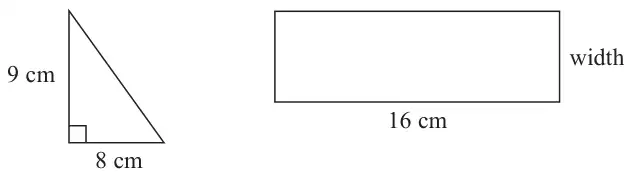
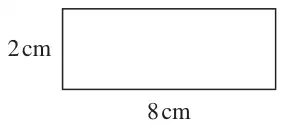
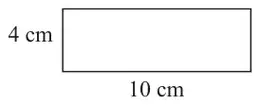
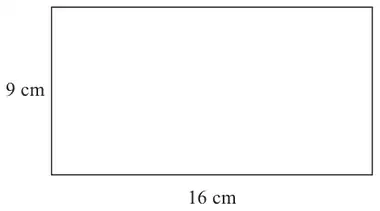
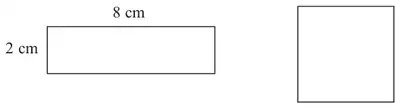
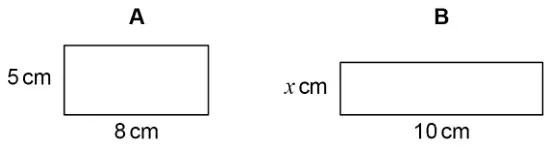
The perimeter of the rectangle is the same as the perimeter of the square.
Work out the length of one side of the square. cm (4)
Mark scheme
Working
Answer
Mark
Notes
\(2 + 8 + 2 + 8 = 20\) \(20 \div 4 =\)
5
4
M2 for \(2 + 8 + 2 + 8\) oe or 20 seen or \((2 + 8) \div 2\) oe (M1 for the sum of 3 sides of the rectangle) M1 (dep) for the sum of 3 or 4 sides of the rectangle \(\div 4\) or an attempt to evaluate \((2 + 8) \div 2\) oe to get the length of one side A1 cao SC: B1 for an answer of 4 coming from \(2 \times 8\) oe
M1 for (17 – 2.8) × 9.5 (=134.9) or 17×9.5 – 2.8×9.5 ( = 161.5 – 26.6 = 134.9) M1 for \(\pi \times (3.8 \div 2)^2\) (= 11.33 – 11.35) M1 (dep on M1) for ‘134.9’ – 2 × ‘11.34’ A1 for 112 - 113 C1 (dep on at least M1) for ‘He needs 5 boxes’ ft from candidate’s calculation rounded up to the next integer
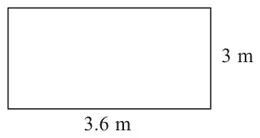
2 The diagram shows a patio in the shape of a rectangle.
Diagram NOT accurately drawn
The patio is 3.6 m long and 3 m wide.
Matthew is going to cover the patio with paving slabs. Each paving slab is a square of side 60 cm.
Matthew buys 32 of the paving slabs.
(a) Does Matthew buy enough paving slabs to cover the patio? You must show all your working. (3)
The paving slabs cost £8.63 each.
(b) Work out the total cost of the 32 paving slabs. (3)
Mark scheme (a)
Working
Answer
Mark
Notes
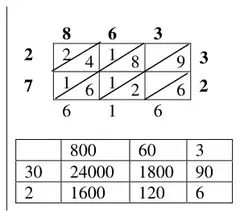
360 ÷ 60 = 6 300 ÷ 60 = 5 6 × 5 =
Yes and 30
3
M1 for dividing side of patio by side of paving slab eg. 360 ÷ 60 or 300 ÷ 60 or 3.6 ÷ 0.6 or 3 ÷ 0.6 or 6 and 5 seen (may be on a diagram) or 6 divisions seen on length of diagram or 5 divisions seen on width of diagram M1 for correct method to find number of paving slabs eg. (360 ÷ 60) × (300 ÷ 60) oe or 6 × 5 or 30 squares seen on diagram (units may not be consistent) A1 for Yes and 30 (or 2 extra) with correct calculations OR M1 for correct method to find area of patio or paving slab eg 360 × 300 or 108000 seen or 60 × 60 or 3600 seen or 3.6 × 3 or 10.8 seen or 0.6 × 0.6 or 0.36 seen M1 for dividing area of patio by area of a paving slab eg. (3.6 × 3) ÷ (0.6 × 0.6) oe (units may not be consistent) A1 for Yes and 30 (or 2 extra) with correct calculations OR M1 for method to find area of patio or area of 32 slabs eg. 60 × 60 × 32 or 360 × 300 M1 for method to find both area of patio and area of 32 slabs eg. 60 × 60 × 32 and 360 × 300 (units may not be consistent) A1 for Yes and 115200 and 108000 OR Yes and 11.52 and 10.8 NB : Throughout the question, candidates could be working in metres or centimetres
Mark scheme (b)
Working
Answer
Mark
Notes
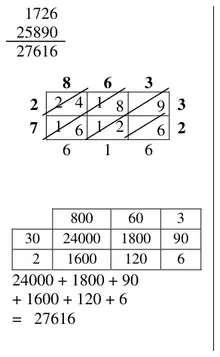
1726 25890 2761624000+1800+90+1600+120+6 = 27616
276.16
3
M1 for complete correct method with relative place value correct. Condone 1 multiplication error, addition not necessary. OR M1 for a complete grid. Condone 1 multiplication error, addition not necessary. OR M1 for sight of a complete partitioning method, condone 1 multiplication error. Final addition not necessary. A1 for digits 27616 A1 ft (dep on M1) for correct placement of decimal point after addition (of appropriate values) (SC: B1 for attempting to add 32 lots of 8.63)
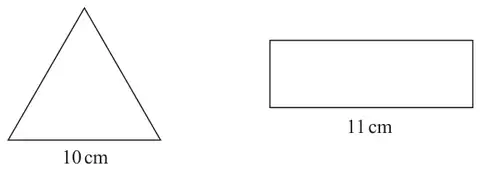
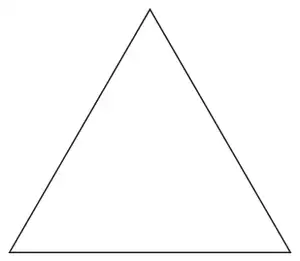
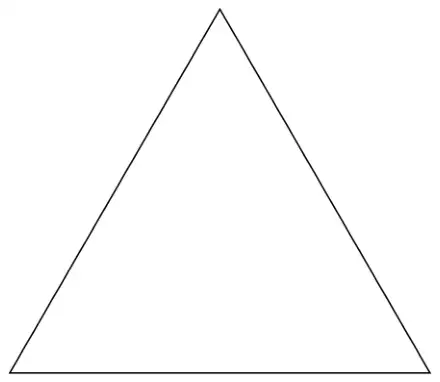
Here is an accurate drawing of an equilateral triangle.
By measuring, work out the perimeter of the triangle.
State the units of your answer. [3 marks]
Mark scheme
Answer
Mark
Comments
Alternative method 1: one side measured
7.4 (cm) or 74 (mm) or 2.9 (inches)
B1
\(\pm\) 2 mm
allow [2.8, 3)
their \(7.4 \times 3\) or their \(74 \times 3\) or their \(2.9 \times 3\) or [21.6, 22.8] or [216, 228] or [8.4, 9)
M1
oe their 7.4 must be [7, 8] their 74 must be [70, 80] their 2.9 must be [2.6, 3.2]
[21.6, 22.8] cm or [216, 228] mm or [8.4, 9) inches
A1ft
ft their 7.4 or their 2.9 with B0M1 awarded
Alternative method 2: more than one side measured
Each side measured as 7.4 (cm) or 74 (mm) or 2.9 (inches)
B1
\(\pm\) 2 mm
allow [2.8, 3)
their \(7.4 +\) their \(7.4 +\) their 7.4 or their \(74 +\) their \(74 +\) their 74 or their \(2.9 +\) their \(2.9 +\) their 2.9 or [21.6, 22.8] or [216, 228] or [8.4, 9)
M1
oe their 7.4 must be [7, 8] their 74 must be [70, 80] their 2.9 must be [2.6, 3.2]
[21.6, 22.8] cm or [216, 228] mm or [8.4, 9) inches
A1ft
ft their 7.4 or their 2.9 with B0M1 awarded
Additional guidance
In alternative method 2 the sides do not have to be equal eg 7.5, 7.5, 7.6 \(= 22.6\) Cannot access the A mark as there are no units.
B1 M1A0ft
eg sides measured as 7.6, 7.6, 7.7 \(7.6 + 7.6 + 7.7\) \(= 22.9\) cm Cannot gain the B mark as 7.7 is out of range
B0 M1 A1ft
eg 75, 80, 80 answer 235 mm 80 is out of range for the B mark but in range for the M mark. Method mark implied by correct answer for their values
B0 M1A1ft
Further work after the correct answer seen eg 7.4 and \(22.2 \div 2 = 11.1\) cm
B1M1A0
Ignore subsequent rounding once correct answer is seen
Accept correct units seen with their answer in the working, even if missing from the answer line, provided they are not contradicted.
Ignore any measurement of the height for the B mark
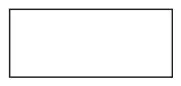
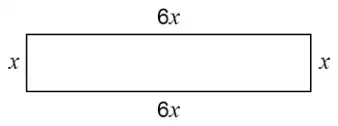
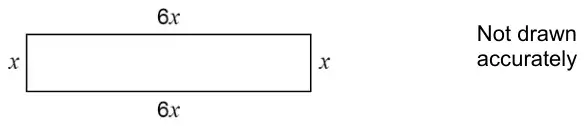
27 The length of this rectangle is 6 times the width.
Not drawn accurately
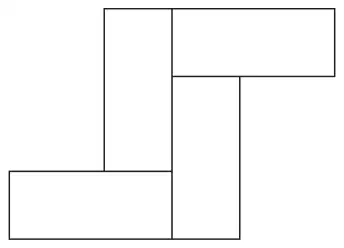
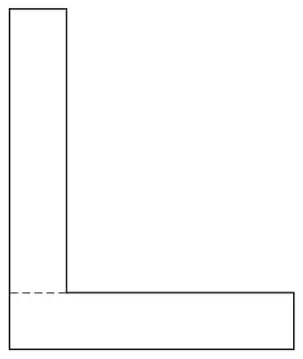
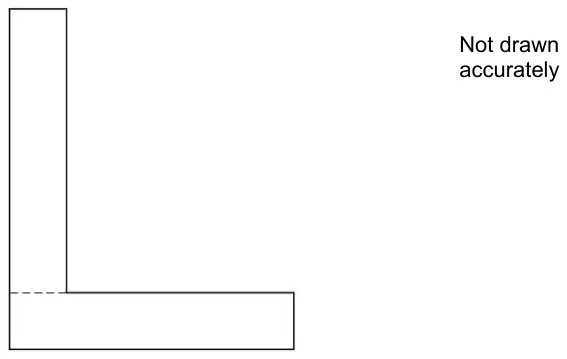
Two of these rectangles are joined, with no overlap, to make this L-shape.
Not drawn accurately
The perimeter of the L-shape is 98.8 cm
Work out the value of the perimeter of one of the rectangles. [4 marks]
Mark scheme
Answer
Mark
Comments
Alternative method 1
\(6x + x + 5x + 6x + x + 6x + x\) or \(26x\) or \(6 + 1 + 5 + 6 + 1 + 6 + 1\) or 26
M1
oe eg \(7x + 6x - x + 6x + x + 6x + x\) \(26x\) or 26 is implied by 3.8 oe if addition not seen
their \(26x = 98.8\) or \(98.8 \div\) their 26 or 3.8 or \(\dfrac{19}{5}\)
M1
oe equation must have terms collected if 1st M1 not awarded their \(26x\) must be \(24x\) or \(25x\) or \(27x\) if 1st M1 not awarded their 26 must be 24 or 25 or 27
their \(3.8 \times 14\)
M1dep
dep on 2nd M1 oe eg \(45.6 + 7.6\)
53.2
A1ft
oe ft their 3.8 if M0M2 awarded
Alternative method 2
\(6x + x + 6x\) or \(13x\) or \(6 + 1 + 6\) or 13
M1
oe eg \(6x + x + 5x + x\) \(13x\) or 13 is implied by 3.8 oe if addition not seen
their \(13x = 98.8 \div 2\) or \(49.4 \div\) their 13 or 3.8 or \(\dfrac{19}{5}\)
M1
oe equation must have terms collected if 1st M1 not awarded their \(13x\) must be \(12x\) if 1st M1 not awarded their 13 must be 12
their \(3.8 \times 14\)
M1dep
dep on 2nd M1 oe eg \(49.4 + 3.8\)
53.2
A1ft
oe ft their 3.8 if M0M2 awarded
Additional guidance
Up to M3 may be awarded for correct work with no answer, or incorrect answer, even if this is seen amongst multiple attempts
Follow through must be to at least 1 dp and their 26 or their 13 must be seen For information: \(24 \to 57.6\ldots\) \(25 \to 55.3\ldots\) \(27 \to 51.2\ldots\) \(12 \to 57.6\ldots\)
M0M1M1A1ft
Both 2nd and 3rd method marks may be implied by their answer. If not using 24, 25, 26, 27, 12 or 13 you must have seen the first M1.
\(27x = 98.8\) (1st M0, no addition seen, but \(27x\) allowed) \(\dfrac{98.8}{27} \times 14\), answer 51.2
M0M1 M1A1ft
\(7x + 5x + 6x + x + 6x + x = 20x\) (correct terms added with incorrect total) \(98.8 \div 20 = 4.94\) 69.16 (multiplication by 14 implied)
M1 M1 M1A0
\(98.8 \div 20 = 4.94\) (1st M0, no addition seen, and 20 not allowed) \(4.94 \times 14\), answer 69.16
12 The length of this rectangle is 6 times the width.
Two of these rectangles are joined, with no overlap, to make this L-shape.
The perimeter of the L-shape is 98.8 cm
Work out the value of the perimeter of one of the rectangles. [4 marks]
Mark scheme
Answer
Mark
Comments
Alternative method 1
\(6x + x + 5x + 6x + x + 6x + x\) or \(26x\) or \(6 + 1 + 5 + 6 + 1 + 6 + 1\) or 26
M1
oe eg \(7x + 6x - x + 6x + x + 6x + x\) \(26x\) or 26 is implied by 3.8 oe if addition not seen
their \(26x = 98.8\) or \(98.8 \div\) their 26 or 3.8 or \(\dfrac{19}{5}\)
M1
oe equation must have terms collected if 1st M1 not awarded their \(26x\) must be \(24x\) or \(25x\) or \(27x\) if 1st M1 not awarded their 26 must be 24 or 25 or 27
their \(3.8 \times 14\)
M1dep
dep on 2nd M1 oe eg \(45.6 + 7.6\)
53.2
A1ft
oe ft their 3.8 if M0M2 awarded
Alternative method 2
\(6x + x + 6x\) or \(13x\) or \(6 + 1 + 6\) or 13
M1
oe eg \(6x + x + 5x + x\) \(13x\) or 13 is implied by 3.8 oe if addition not seen
their \(13x = 98.8 \div 2\) or \(49.4 \div\) their 13 or 3.8 or \(\dfrac{19}{5}\)
M1
oe equation must have terms collected if 1st M1 not awarded their \(13x\) must be \(12x\) if 1st M1 not awarded their 13 must be 12
their \(3.8 \times 14\)
M1dep
dep on 2nd M1 oe eg \(49.4 + 3.8\)
53.2
A1ft
oe ft their 3.8 if M0M2 awarded
Additional guidance
Up to M3 may be awarded for correct work with no answer, or incorrect answer, even if this is seen amongst multiple attempts
Follow through must be to at least 1 dp and their 26 or their 13 must be seen For information: \(24 \to 57.6\ldots \quad 25 \to 55.3\ldots \quad 27 \to 51.2\ldots \quad 12 \to 57.6\ldots\)
M0M1M1A1ft
Both 2nd and 3rd method marks may be implied by their answer. If not using 24, 25, 26, 27, 12 or 13 you must have seen the first M1.
\(27x = 98.8\) (1st M0, no addition seen, but \(27x\) allowed) \(\dfrac{98.8}{27} \times 14\), answer 51.2
M0M1 M1A1ft
\(7x + 5x + 6x + x + 6x + x = 20x\) (correct terms added with incorrect total) \(98.8 \div 20 = 4.94\) 69.16 (multiplication by 14 implied)
M1 M1 M1A0
\(98.8 \div 20 = 4.94\) (1st M0, no addition seen, and 20 not allowed) \(4.94 \times 14\), answer 69.16
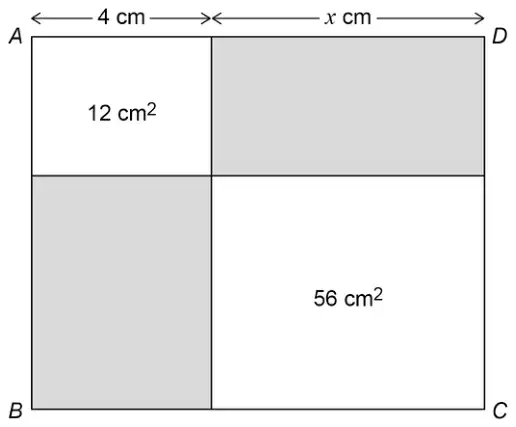
9 Rectangle \(ABCD\) is split into four smaller rectangles.
Two of the smaller rectangles are shaded.
Not drawn accurately
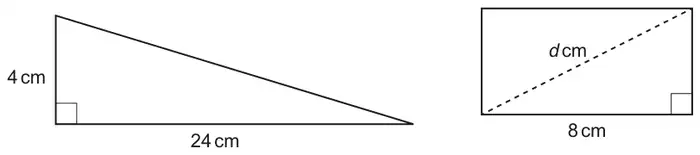
\(4 : x = 1 : 2\)
For rectangle \(ABCD\), work out the ratio \(\quad\) shaded area : unshaded area
Give your answer in its simplest form. [4 marks]
Mark scheme
Answer
Mark
Comments
\((x =)\ 4 \times 2\) or \((x =)\ 8\) or area of top right rectangle is \(12 \times 2\) or \(12 \div 4 \times\) their 8 or 24 or area of bottom left rectangle is \(56 \div 2\) or \(4 \times 56 \div\) their 8 or 28
M1
may be on diagram implied by length of bottom left or bottom right vertical section is 7
Area of top right rectangle is \(12 \times 2\) or \(12 \div 4 \times\) their 8 or 24 and area of bottom left rectangle is \(56 \div 2\) or \(4 \times 56 \div\) their 8 or 28 or Total area is \((4 +\) their \(8) \times (12 \div 4 + 56 \div\) their \(8)\) or \(12 \times 10\) or 120
M1dep
may be on diagram
(Total shaded area is) 52
A1
implied by 52 : 68
13 : 17 or 1 : \(\dfrac{17}{13}\) or \(\dfrac{13}{17}\) : 1
B1ft
ft simplification of their ratio or conversion into the form 1 : \(n\) or \(n\) : 1 with M2A0 or M1M0A0 scored
Additional guidance
If their ratio cannot be simplified by dividing by a common factor they can only score B1ft by converting into the form 1 : \(n\) or \(n\) : 1
\(\dfrac{52}{120}\) : \(\dfrac{68}{120}\)
M1M1A1B0
68 : 52 simplified to 17 : 13
M1M1A0B1ft
13 cm2 : 17 cm2
M1M1A1B0
For B1, accept values as decimals rounded or truncated to 2 dp or better eg 1 : 1.31 or 0.76 : 1
The 2nd M is for a complete method that would lead to an answer of 42 eg \(9 \times 2 = 18\), \(6 \times 4 = 24\), \(18 + 24 = 42\), then \(42 \div 2 = 21\)
M1M0
Beware eg \(8 + 4 + 8 + 4 = 24\) which is M0 without a correct area seen
M0
Ignore any units given with answer
Mark scheme (b)
Answer
Mark
Comments
Valid criticism
B1
eg the formula is \(\dfrac{1}{2} \times \text{base} \times \text{height}\) or the answer is double the correct answer or he has forgotten the \(\dfrac{1}{2}\) or it should be \(\dfrac{1}{2} \times 12 \times 8\) or it should be 48
Additional guidance
He needs to halve 12 (which is 6, \(6 \times 8 = 48\))
B1
He hasn’t halved the base
B1
\(0.5 \times 12 \times 8 = 48\)
B1
His method was to work out a rectangle (insufficient)
B0
He should divide by half
B0
He didn’t use the area of a triangle formula
B0
He should have timesed all the measurements and divided by 2
B0
Ignore irrelevant statements alongside a correct statement eg1 he has forgotten to divide by 2, the base should be shorter eg2 should have divided by 2, he worked out the area of a rectangle
B1 B1
Two statements, one correct, one incorrect eg1 he has forgotten to divide by 2, it should be \(14 \times 8 \div 2\) eg2 should have divided by 2, he worked out the area of a square eg3 forgot to halve the base, should have been \(6 \times 8 = 49\)
12 An isosceles triangle has base 16 cm and perpendicular height 15 cm
Not drawn accurately
Some of these triangles are used to make a large triangle.
Not drawn accurately
Work out the perimeter of the large triangle. [4 marks]
Mark scheme
Answer
Mark
Comments
Alternative method 1
\(15^2\) or 225 and \((16 \div 2)^2\) or \(8^2\) or 64
M1
oe
\(\sqrt{15^2 + (16 \div 2)^2}\) or \(\sqrt{\text{their } 225 + \text{their } 64}\) or \(\sqrt{289}\) or 17
M1dep
oe full trigonometric method leading to 17 scores M2 eg \(\dfrac{15}{\sin\left(\tan^{-1}\dfrac{15}{8}\right)}\)
\(6 \times\) their \(17 + 3 \times 16\) or \(102 + 48\)
M1dep
oe
150
A1
SC2 \(48 + 6\sqrt{161}\) or [124.08, 124.2]
Alternative method 2
\((48 \div 2)^2\) or \(24^2\) or 576 and \((15 \times 3)^2\) or \(45^2\) or 2025
M1
oe eg \((16 \times 1.5)^2\) and \((3 \times 15)^2\)
\(\sqrt{(48 \div 2)^2 + (3 \times 15)^2}\) or \(\sqrt{\text{their } 576 + \text{their } 2025}\) or \(\sqrt{2601}\) or 51
M1dep
oe full trigonometric method leading to 51 scores M2 eg \(\dfrac{45}{\sin\left(\tan^{-1}\dfrac{15}{8}\right)}\) or \(\dfrac{45}{\sin\left(\tan^{-1}\dfrac{45}{24}\right)}\)
\(2 \times\) their \(51 + 3 \times 16\) or \(102 + 48\)
M1dep
oe
150
A1
SC2 \(48 + 6\sqrt{161}\) or [124.08, 124.2]
Additional guidance
\(15^2 - 8^2\) or \(45^2 - 24^2\)
M1M0M0A0 (unless SC2 scored)
Allow 61.9(2…) or 61.93 or 62 for \(\tan^{-1}\dfrac{15}{8}\) but do not award A1 if premature approximation seen
Give your answer to 3 significant figures. [4 marks]
Mark scheme
Answer
Mark
Comments
\(\dfrac{1}{2} \times 14 \times AC = 80.5\)
M1
oe eg \(7AC = 80.5\) any letter for \(AC\)
\(\dfrac{80.5 \times 2}{14}\) or \(\dfrac{161}{14}\) or 11.5
M1dep
oe eg \(\dfrac{80.5}{7}\) implies M2 may be seen on diagram
\(\dfrac{1}{2} \times 19 \times\) their \(11.5 \times \sin 36\) or 64.21... or 64.22 or 64
M1
oe 64.21... or 64.22 or 64 scores M3 if no incorrect formula used
64.2 with no incorrect formula used
A1
Additional guidance
Answer 64.2 with no incorrect working
M3A1
11.5 scores M2 even if not subsequently used
Answer 64.2 from using ‘\(bh\)’ and ‘\(ab\sin C\)’ (unless clear explanation that \(\dfrac{1}{2}\) has been cancelled in both area formulae) \(14 \times AC = 80.5\) \(\dfrac{80.5}{14} = 5.75\) \(19 \times 5.75 \times \sin 36\) 64.2
M0 M0 M0 A0
3rd M1 can be scored if they have a value for \(AC\) eg \(AC = 6\) (may be seen on diagram) \(\dfrac{1}{2} \times 19 \times 6 \times \sin 36 = 33.5\)
M0M0 M1A0
3rd M1 may be seen in stages eg1 \(11.5 \times \sin 36\) or [6.7, 6.8] \(\dfrac{1}{2} \times 19 \times\) [6.7, 6.8] eg2 19 sin 36 or [11.1, 11.2] \(\dfrac{11.5 \times [11.1, 11.2]}{2}\)
two parallel straight sections, each of length 0.75 km a semicircle of diameter 0.9 km three equal, smaller semicircles.
Not drawn accurately
The length of a motor race must be greater than 305 km
What is the lowest number of full laps needed at this circuit?
You must show your working. [5 marks]
Mark scheme
Answer
Mark
Comments
\(0.9 \times \pi \div 2\) or \(0.9\pi \div 2\) or \(0.45\pi\) or \(0.9 \times [3.14, 3.142] \div 2\) or \([2.82, 2.83] \div 2\) or \(2.8 \div 2\) or 1.4…
M1
Large semicircle
\(0.9 \div 3 \times \pi \div 2\) or \(0.3\pi \div 2\) or \(0.15\pi\) or \(0.9 \div 3 \times [3.14, 3.142] \div 2\) or \(0.94… \div 2\) or 0.47…
M1
Small semicircle May be implied from using 1.4… for three small semicircles in next mark
In all methods, marks can be awarded for annotation of the diagram, with lengths clearly identified, or working inside or alongside the diagram
eg 2.5 and 5 marked correctly as the dimensions of the small rectangle
M1M1A1
2.5 marked as the width of the small rectangle and 7.5 marked as the length of the large rectangle
M1M1A1
If full marks not awarded, mark both the diagram and working then award the better mark
In alt 4, one or more trials may be crossed out to indicate that they do not give the correct perimeter. Do not treat this as the usual crossed out work not to be marked if replaced.
\(2 \times 2 + 2 \times 2 = 8\) (misconception on area of rug) cannot score for \(2 \times 2\)
M0A0
\(6 \times 8 = 48\) and \(48 \times 2 = 96\) (ignore additional ‘method’ and give M1 for 48) \(6 \times 8 = 48\) and \(48 \div 2 = 24\) (ignore additional ‘method’ and give M1 for 48) \(6 \times 8 \times 2\) (ignore additional ‘method’ and give M1 for \(6 \times 8\))
M1A0
\(6 \times 8 = 48\) and \(48 \div 2 \div 2 = 12\) (equivalent to dividing by 4)
M1A1
Ignore references to perimeter or units if it is clear they are working out area
B1 diagram labelled with numbers that give area 28 eg \(A\) labelled 20, \(B\) labelled \(-8\), \(C\) labelled 2 or calculation of form \(\dfrac{b \times h}{2}\) seen that equals 28 or \(b \times h\) that equals \(2 \times 28\) eg \(\dfrac{8 \times 7}{2}\) (\(= 28\)) or \(8 \times 7\) (\(= 56\))
A is the point (–3, –2) B is the point (1, –2) C is a point on the line \(y = 4\)
(a) Draw triangle ABC on the centimetre grid below. [3 marks]
(b) Work out the area of triangle ABC. [2 marks]
Mark scheme (a)
Answer
Mark
Comments
Right-angled triangle ABC drawn with A at (–3, –2) and B at (1, –2) and C at (–3, 4) or (1, 4)
B3
B2 for A, B and C correctly plotted with no triangle drawn or A and B correctly plotted and a right-angled triangle drawn with A and B at two of the vertices or C plotted on the line \(y = 4\) and a right-angled triangle drawn with C at one of the vertices or A and B correctly plotted with C plotted at \((k, 4)\) with \(k \ne -3\) or 1 and triangle ABC drawn
B1 for A and B correctly plotted or C plotted on the line \(y = 4\) or a right-angled triangle drawn
Additional guidance
Condone incorrect or omitted labelling
Mark scheme (b)
Answer
Mark
Comments
Alternative method 1
\(\dfrac{1}{2} \times\) their base \(\times\) their height
19 The diagram shows a shape formed by a semicircle joined to a sector of a circle, BAC, along a common length AB.
Not to scale
The area of the sector BAC is \(16\pi\) cm\(^2\).
Work out the total area of the shape. Give your answer in terms of \(\pi\).
You must show your working. [5]
Mark scheme
Answer
Marks
Part marks and guidance
\(34\pi\) final answer with correct working
5
M2 for \(\text{AB}^2 = \frac{16 \times 360}{40}\) or better or M1 for \(\frac{40}{360}[\pi]\text{AB}^2 [= 16[\pi]]\) oe or area of full circle = \(\frac{360}{40} \times 16\ [\pi]\) or \(144[\pi]\)
Correct working requires at least M2A1 For M2 accept AB\(^2\) = 144 Accept other variable for AB e.g. \(r\) , \(d\)
A1 for AB = 12 or better e.g. \(\frac{\text{AB}}{2} = 6\) M1 for \(\pi\left(\frac{\textit{their } \text{AB}}{2}\right)^2 \div 2\ [+\ 16\pi]\) oe
After M1, A1 implies M2 their AB must be clearly indicated in working or on diagram . Allow AB as the answer to their work with the sector BAC
If 0 or 1 scored instead award SC2 for answer \(34\pi\) with no or insufficient working If 0 scored, award SC1 for AB = 12 with no or insufficient working
Do not award SC2 if clearly from wrong working Do not award SC1 if clearly from wrong working
Calculate the area of the trapezium. You must show your working. [5]
Mark scheme
Answer
Marks
Part marks and guidance
119.8[4] with correct working
5
M1 for \(\frac{25.6 - 17.2}{2}\) oe or 4.2
Correct working requires evidence of at least M2 or M1M1
M2 for \(\sqrt{7^2 - (\textit{their}\,4.2)^2}\) or better or 5.6 or M1 for \([h]^2 + (\textit{their}\,4.2)^2 = 7^2\) or 31.36
their 4.2 must be an attempt at \(\frac{25.6 - 17.2}{2}\) and must be less than 7
M1 for \(\frac{25.6 + 17.2}{2} \times \textit{their height}\) oe
for their height do not allow 7 but condone e.g. 31.36
If 0 or 1 scored, instead SC3 for answer 119.8[4] with no or insufficient working
Longer methods must be complete and correct : e.g. M1 for 4.2 as before M1 for e.g. \(\cos^{-1}(4.2 \div 7) = 53.13\ldots\) M1 for e.g. \(7\sin(53.13) = 5.59\ldots\) or 5.6 M1 for area as before
3 The diagram shows a shape formed from a rectangle measuring 8 cm by 17 cm with a semicircle removed from one side.
Not to scale
Calculate the perimeter of the shape. [4]
Mark scheme
Answer
Marks
Part marks and guidance
55.7 to 55.71 or \(40 + 5\pi\)
4
B1 for diameter = 10 cm or radius = 5 cm
B1 might be seen on diagram and can be implied by 5 or 10 with \(\pi\) e.g. \(5\pi\), 31.4 to 31.42, \(5^2 \times \pi\)
M1 for \(\left[\frac{1}{2}\right] 2 \times \pi \times\) their5 oe
M1 implied by \(10\pi\), \(5\pi\), 31.4 to 31.42 or 15.7 to 15.71 Award M marks even if not used to find final answer as long as it is not contradicted. Note : their 5 in the M1 should be their radius of the circle
M1 for \(8 + 17 + 8 + 3 + 4 +\) their 15.7 or better
their 15.7 should involve \(\pi\) and be an attempt at the circumference of the semicircle, not the area or whole circle
Allow equivalents for both M1s but it must be full and correct working and allow any correct method e.g. M1 for \(\frac{9 + 15}{2} \times 4.8 = 57.6\) M1 for \(57.6 \div 9 = 6.4\) = height A1 for 6.4
Condone 24 for \(9 + 15\) and 9 for \(\frac{1}{2} \times 18\) e.g. \(\frac{115.2}{2}\)
9 The diagram shows a shaded sector inside a parallelogram. The sector has an angle of 30°. The parallelogram, ABCD, has length BC = 20 cm and AB = 12 cm. The perpendicular distance between BC and AD is 6 cm.
Not to scale
(a) Show that the area of the sector is \(37.7\,\text{cm}^2\), correct to 3 significant figures. [3]
(b) Work out the percentage of the parallelogram that is not shaded. [4]
Mark scheme (a)
Answer
Marks
Part marks and guidance
\(\frac{30}{360} \times \pi \times 12^2\) oe
M2
M1 for \(\pi \times 12^2\) implied by \(144\pi\) or 452.3 to 452.45
M2 oe e.g. \(\frac{360}{30} = 12\) and \(\frac{\pi \times 12^2}{12}\) Condone 3.14 or \(\frac{22}{7}\) for \(\pi\) in M marks M0 for \(12\pi\) without working
37.69 to 37.704
A1
A0 for just 37.7
Mark scheme (b)
Answer
Marks
Part marks and guidance
68.5 to 68.6 nfww
4
With area of parallelogram as 120 or from an attempt at 20 × 6:
If 120 not used, their (20 × 6) must come from attempt at 20 × 6 Note there are other methods for finding area of a parallelogram 37.7 may be their more accurate 37.69 to 37.704 from (a)
M3 for \(\frac{\textit{their}(20 \times 6) - 37.7}{\textit{their}(20 \times 6)}\) [× 100] oe or M2 for their (20 × 6) – 37.7 implied by 82.3 or for \(\frac{37.7}{\textit{their}(20 \times 6)}\) [× 100] implied by 31.4 to 31.5 or M1 for 20 × 6 implied by 120
M3 oe e.g. \(100 - \frac{37.7 \times 100}{\textit{their}(20 \times 6)}\)
If correct method for area of parallelogram is not shown or an incorrect value is used:
If \(A \gt 37.7\) SC2 for \(\frac{A - 37.7}{A}\) [× 100] oe or SC1 for \(\frac{37.7}{A}\) [× 100]
e.g SC2 for \(\frac{240 - 37.7}{240}\) [× 100] oe
For SC marks method must be shown; do not imply from an answer only
(b) The angles of a triangle are \(27^\circ\), \(126^\circ\) and \(27^\circ\).
Explain how you know the triangle is isosceles. [1]
(c) The diagram shows two sides of a parallelogram drawn on a one-centimetre grid.
(i) Complete the drawing of the parallelogram. Include notation to show that the drawing is a parallelogram. [2]
(ii) Work out the area of the parallelogram. [2]
Mark scheme (a)
Answer
Marks
Part marks and guidance
133
1
Allow 131 to 135
Mark scheme (b)
Answer
Marks
Part marks and guidance
2 of the angles are equal oe
1
Must refer to angles not sides, statements must not be contradicted
Appendix
Exemplar responses for Q3b
Response
Mark
Two angles are identical and one is different.
1
Only two of the angles are the same so it cannot be equilateral.
1
Because two of the angles being the same means it is equal lines.
1
Two angles of an isosceles have to be the same.
1
27\(^\circ\) and 27\(^\circ\) are equal meaning it has two equal sides.
1
Only 2 numbers are the same and it's not all equal
1 bod
Because others don’t have same two angles
1 bod
Because others don’t have two angles the same/2 same angles
1 bod
Base angles in an isosceles triangle are always equal.
1 bod
Because isosceles triangles have equal sides and they are 27\(^\circ\).
0
Because 2 sides of the triangle are the same which is 27\(^\circ\) and the last side is different.
0
One angle is bigger than the others
0
Because they’re both 27 degree angles'
0
2 sides are the same
0
Both of isosceles have the same number
0
Mark scheme (c)
Answer
Marks
Part marks and guidance
(i)
1
Correct parallelogram drawn
Accept reasonable freehand, tolerance \(\pm\) 2mm by eye
1 dep
dep on parallelogram drawn Accept other, complete, standard notations that indicate a parallelogram eg two pairs of opposite sides have equal length or two pairs of opposite angles are equal or any combination of these properties that define a parallelogram
Mark intent
Arrows must be correct single/double and pointing in correct direction
(ii) 18 nfww
2
FTtheir parallelogram
M1 for their length \(\times\) their perpendicular height oe
e.g. \(6 + 3 + 6 + 3 = 18\) scores 0 M1 and 2 marks are dependent on a parallelogram being drawn in (i) Must be in cm\(^2\)
If not 6 and 3 their dimensions need to be verifiable eg shown on the diagram eg M0 for \(\sqrt{13}\) or 3.6… etc as their perpendicular height
oe includes two triangles + the \(4 \times 3\) rectangle or the \(8 \times 3\) rectangle – two triangles
Need to be certain that 3 is slant height to withhold the marks
Allow equivalents for both M1s but it must be full and correct working and allow any correct method e.g. M1 for \(\frac{9 + 15}{2} \times 4.8 = 57.6\) M1 for \(57.6 \div 9 = 6.4\) = height A1 for 6.4
\(\frac{9 + 15}{2} \times 4.8\) oe
M1
Condone 24 for 9 + 15 and 9 for \(\frac{1}{2} \times 18\).
[No] and 10 + 10 = 20 or 20 ÷ 2 = 10 and recognition that height is 0 or not included oe
2
B1 for each
See appendix Accept \(10 \times 2 = 20\) (unless clearly implying area) Accept e.g. “adding lengths makes 20” for 10 + 10 = 20 B0 B1 and B1 B0 are possible
Appendix
Question 17b
Statement
Reason
Mark
[No as] the length is 10 cm, the top and bottom would already add to 20 cm
BOD 10 + 10 = 20 and ALREADY implies 0 cm for other sides
2
[No.] To find the perimeter, you add up all of the sides and 10 + 10 = 20 which does not include the 2 extra sides
Sum seen for B1. Recognises other sides not included
2
2 lengths make 20 so any width would be more than 20
Sum implied for B1 Recognises other sides not included
Find the area of the pentagon. You must show your working. [6]
Mark scheme
Answer
Marks
Part marks and guidance
4242 with correct working
6
“Correct working” requires evidence of either M2 or M1 M1
M2 for \(\sqrt{42.5^2 - 20^2}\) or M1 for \([\ldots]^2 + 20^2 = 42.5^2\) or B1 for 20
M2 implied by 37.5
Accept any correct method for the area e.g. M1 for (48 + their 37.5) × 54 or 4617 M1 for \(\frac{1}{2} \times\) their 37.5 × 20 or 375 M1 for their 4617 – their 375
Alternative for area e.g. : M1 for 48 × 54 implied by 2592 M1 for \(\frac{1}{2} \times (54 + 34) \times\) their 37.5 implied by 1650 M1 for their 2592 + their 1650 OR M1 for 48 × 54 implied by 2592 M1 for 34 × their 37.5 + \(\frac{1}{2} \times\) their 37.5 × 20 implied by 1275 + 375 M1 for their 2592 + their 1275 + their 375 i.e adding all their areas together
If 0, 1 or 2 marks scored instead award SC3 for answer 4242 with no or insufficient working
If 0 or M1 scored instead award SC2 for 37.5 with no or insufficient working
Note : M1 M1 M1 for the area requires a correct method
27 The diagram shows a circle inside a square of side 12 cm.
Work out the percentage of the square that is shaded. You must show your working. [6]
Mark scheme
Answer
Marks
Part marks and guidance
5.36 to 5.4 and correct working
6
B5 for the correct answer in the wrong format with correct working e.g. 0.0536 OR M5 for \(\dfrac{12^2 - \pi \times 6^2}{12^2 \times 4}\) [\(\times\) 100] oe
OR
Square M1 for \(12^2\) or 144 or \(6^2\) or 36 (must be consistent with \(\dfrac{1}{4} \times \pi \times 6^2\))
and
Circle M2 for \(\pi \times 6^2\) or \(\dfrac{1}{4} \times \pi \times 6^2\) or M1 for radius of 6 may be implied e.g. \(2 \times \pi \times 6\) (with \(\pi\)) and
M1 for (their \(12^2\) – their \((\pi \times 6^2)\)) [\(\div\)4] or their \((\pi \times 6^2) \div\) their \(12^2\) or their (\(6^2 -\) their \(\left(\dfrac{1}{4} \times \pi \times 6^2\right)\)) [\(\div\)their \(12^2\)] or their \(\left(\dfrac{1}{4} \times \pi \times 6^2\right) \div \dfrac{\textit{their}\ 12^2}{4}\)
If 0 or M1 or M2 scored, instead award SC3 for answer 5.36 to 5.4 with no or insufficient working
If 0 or M1 scored, instead award SC2 for 30.88 to 31 or 7.72 to 7.75 or 0.785 to 0.786 with no or insufficient working
“Correct working” requires evidence of at least M1 AND M2 AND M1
their 144 must come from attempt at area of a square
M2 implied by 113.04 to 113.12 or 28.26 to 28.28 6 [cm] could be on diagram FTtheir incorrect 6 identified as radius implied by 30.88 to 31 or 7.72 to 7.75 implied by 0.785 to 0.786 implied by 7.72 to 7.75 implied by 0.785 or 0.7852 to 0.7856
their area of the circle has to be an attempt at \(\pi r^2\) not \(2\pi r\) so that, if they do not, the most they can be awarded is M1 for 144 and M1 for radius = 6 cm
8 The diagram shows a circle inside a square of side 12 cm.
Work out the percentage of the square that is shaded. You must show your working. [6]
Mark scheme
Answer
Marks
Part marks and guidance
5.36 to 5.4 and correct working
6
B5 for the correct answer in the wrong format with correct working e.g. 0.0536 OR M5 for \(\frac{12^2 - \pi \times 6^2}{12^2 \times 4}\) [× 100] oe
OR
Square M1 for \(12^2\) or 144 or \(6^2\) or 36 (must be consistent with \(\frac{1}{4} \times \pi \times 6^2\)) and
Circle M2 for \(\pi \times 6^2\) or \(\frac{1}{4} \times \pi \times 6^2\) or M1 for radius of 6 may be implied e.g. 2×π×6 (with \(\pi\)) and
M1 for (their \(12^2\) – their (\(\pi \times 6^2\))) [÷4] or their (\(\pi \times 6^2\)) ÷ their \(12^2\) or their (\(6^2\) – their (\(\frac{1}{4} \times \pi \times 6^2\))) [÷their \(12^2\)] or their (\(\frac{1}{4} \times \pi \times 6^2\)) ÷ \(\frac{their\ 12^2}{4}\)
If 0 or M1 or M2 scored, instead award SC3 for answer 5.36 to 5.4 with no or insufficient working
If 0 or M1 scored, instead award SC2 for 30.88 to 31 or 7.72 to 7.75 or 0.785 to 0.786 with no or insufficient working
“Correct working” requires evidence of at least M1 AND M2 AND M1
their 144 must come from attempt at area of a square
M2 implied by 113.04 to 113.12 or 28.26 to 28.28 6 [cm] could be on diagram FTtheir incorrect 6 identified as radius implied by 30.88 to 31 or 7.72 to 7.75
implied by 0.785 to 0.786 implied by 7.72 to 7.75 implied by 0.785 or 0.7852 to 0.7856
their area of the circle has to be an attempt at \(\pi r^2\) not \(2\pi r\) so that, if they do not, the most they can be awarded is M1 for 144 and M1 for radius = 6 cm
25 The diagram shows a right-angled triangle and a rectangle.
Not to scale
The triangle and rectangle have the same area.
Calculate the length, \(d\) cm, of the diagonal of the rectangle. You must show your working.
\(d =\) .................... cm [6]
Mark scheme
Answer
Marks
Part marks and guidance
10 with correct working
6
M1 for \(\dfrac{24 \times 4}{2}\)
M1 for height of rectangle = their \(\dfrac{24 \times 4}{2} \div 8\) A1 for [height of rectangle =] 6
AND
M2 for \(\sqrt{8^2 + (\textit{their } 6^2)}\) or better or M1 for [\(d^2 =\) ] \(8^2 + (\textit{their } 6)^2\)
If 0, 1 or 2 scored, instead award SC3 for answer 10 with no or insufficient working If 0 or 1 instead award SC2 for [height of rectangle =] 6 with no or insufficient working If 0 scored, instead award SC1 for [area of triangle =] 48 with no or insufficient working
“Correct working” requires evidence of at least M1A1 AND M1
M1 Allow embedded e.g. \(8 \times 6 = 48\)
Could be shown on the diagram
their 6 must be clearly identified as the height of the rectangle, e.g. written on the diagram.
Eg SC3 Insufficient working includes statement that 6, 8, 10 is a Pythagorean triple
10 The parallelogram and the trapezium have the same area.
Not to scale
The ratio of \(x : y\) is 3 : 5.
Find the value of \(x\) and the value of \(y\). You must show your working. [6]
Mark scheme
Answer
Marks
Part marks and guidance
[\(x\) = ] 7.5 oe [\(y\) = ] 12.5 oe with correct working
6
M4 for 20 and \(x + y\) or 20 and (3 + 5) oe or M3 for 40 and 2(\(x + y\)) or M2 for 8 × 5 soi by 40 and \(\frac{4}{2}(x + y)\) oe or M1 for 8 × 5 soi by 40 or \(\frac{4}{2}(x + y)\) oe
AND
M1 for their 20 ÷ (3 + 5)
Alternative if trials used for the trapezium: M4 for [parallelogram =] 40 and \(\frac{4}{2}(x + y)\) correctly evaluated with \(x + y\) = 20 or M3 for 40 and \(\frac{4}{2}(x + y)\) correctly evaluated with \(x : y\) in the ratio 3 : 5 but \(x \ne 3\) \(y \ne 5\) or M2 for 8 × 5 soi by 40 and \(\frac{4}{2}(x + y)\) correctly evaluated using any \(x\) and \(y\) or M1 8 × 5 soi by 40 or substitution into \(\frac{4}{2}(x + y)\) with any \(x\) and \(y\)
If 0, 1 or 2 scored, instead award SC3 for answer [\(x\) =] 7.5 and [\(y\) =] 12.5 with no or insufficient working
If 0 or 1 scored, instead award SC2 for answer [\(x\) =] 9 and [\(y\) =] 15
‘Correct working’ requires evidence of at least M3 For all method marks allow for \(x + y\) e.g. \(\frac{3}{5}y + y\), \(a + b\) oe or other variables, Method may be seen in stages
Implied by two answers in the ratio \(x : y\) = 3 : 5
10 The diagram shows Kai’s garden. It is in the shape of a right-angled triangle.
Not to scale
Kai is going to spread grass seed on the garden.
A bag of grass seed covers an area of 35 m\(^2\).
Each bag of grass seed costs £8.99.
Kai can only buy whole bags of grass seed. Kai buys the least number of bags needed for the garden.
Calculate the cost of buying the bags of grass seed that Kai needs. You must show your working. [6]
Mark scheme
Answer
Marks
Part marks and guidance
44.95 with correct working
6
correct working requires evidence of at least M1M1
M1 for \(\dfrac{1}{2} \times 20 \times 15\) oe A1 for 150
150 implies M1A1
M1 for their area \(\div\) 35 soi by 4.2... to 4.3 or repeated addition of 35 to at least 140 or to the multiple of 35 below their area oe A1FT for [number of bags =] 5 or their area \(\div\) 35 rounded up to an integer
From an area, not a perimeter or length Allow 1 arithmetic slip in their list
May be implied by their final calculation of cost
M1 for \(k \times 8.99\) A1FT for 44.95 or \(k \times 8.99\) evaluated correctly
If 0 or M1 scored, instead award SC2 for answer 44.95 with no or insufficient working.
Where \(k\) is an integer but not \(k = 1\) or 10 Mark the calculation that leads to their final answer
Calculate the area of the rectangle. You must show your working. [5]
Mark scheme
Answer
Marks
Part marks and guidance
60 with correct working
5
B3 for 12 as third side with correct working or M2 for \(\sqrt{13^2 - 5^2}\) oe or M1 for \(13^2 = 5^2 + [\text{DC}^2]\)
OR M1 for \(\angle\text{BDC} = \sin^{-1}\left(\dfrac{5}{13}\right)\) oe or \(\angle\text{CBD} = \cos^{-1}\left(\dfrac{5}{13}\right)\) oe M1 for \(13 \cos\) their \(\angle\text{BDC}\) or \(13 \sin\) their \(\angle\text{CBD}\)
AND
M1 for \(5 \times\) their DC (or AB)
If 0 or 1 scored with no/insufficient working SC2 for answer 60 or If 0 scored with no/insufficient working SC1 for 12 as third side
For full marks, correct working requires Pythagoras or trig leading to 12 For B3 “correct working” requires evidence of M2 or M1 or mention of 5:12:13 triangle
22.6… or 67.3 to 67.4 oe may be in \(\triangle\)ABD
Their DC (or AB) not = 13.
If M1 scored and SC2 available, award SC2 only May be on diagram
12 The shape below is formed by a rectangle of width 4 cm and a regular pentagon. For the rectangle, the ratio of the width to the length is \(2 : 5\).
Not to scale
Work out the perimeter of the shape. [4]
Mark scheme
Answer
Marks
Part marks and guidance
40 nfww
4
B2 for length of rectangle = 10 or M1 for \(4 \div 2 \times 5\) M1 for \(5 \times 4 + 2 \times\) their length oe
25 The diagram shows Jane’s lawn. It is in the shape of a square of side 36 m and three semi-circles.
Not to scale
She is going to spread fertiliser on the lawn at a rate of 30 g per square metre. The fertiliser is only sold in 10 kg bags costing £15.80 each.
Calculate the cost of buying the bags of fertiliser for her lawn. You must show all your working. [6]
Mark scheme
Answer
Marks
Part marks and guidance
142.2[0] with correct working
6
M1 for \(36^2\) or 1296
M1 for \(k \times \pi \times 18^2\) oe where \(k = \tfrac{1}{2}\), 1, \(1\tfrac{1}{2}\) or 3
AND
M1 for their area × 30
M1 for their mass ÷ 1000 and ÷ 10 or counting up in 10 000s to their mass
AND
M1 for their 9 × 15.8
If 0, 1 or 2 scored instead award SC3 for answer of 142.2[0] with insufficient working
If 0 or 1 scored instead award SC2 for 2822 to 2823.02
If 0 scored award SC1 for 1526 to 1527.02, 1017 to 1018.008, 508 to 509.004, 3051 to 3054.024, \(162\pi\), \(324\pi\), \(486\pi\) rot to at least nearest integer
Correct working requires M1 AND M1 AND M1
M2 implied by 2822 to 2823.02 or M1 implied by 1526 to 1527.02, 1017 to 1018.008, 508 to 509.004, 3051 to 3054.024, \(162\pi\), \(324\pi\), \(486\pi\) rot to at least nearest integer
their area cannot be 36 and M1 implied by 84660 to 84 690.6 or 84.66 to 84.7
their mass is attempt at (rectangle and circle(s)) × 30, M1 implied by 8.46 to 8.47
their 9 dep. on fourth M1 scored with a rounding up to next integer
17 The area of the triangle is equal to the area of the trapezium.
Not to scale
Calculate the height, \(h\) cm, of the trapezium. [5]
Mark scheme
Answer
Marks
Part marks and guidance
2.25 nfww
5
B2 for 36 or M1 for \(\dfrac{9 \times 8}{2}\)
AND
M2 for \(\dfrac{1}{2} \times (12 + 20) \times h =\) their area of triangle oe
or
M1 for \(\dfrac{1}{2} \times (12 + 20) \times h\) oe
\(8 \times 9 = 72\) then \(72 \div (20 + 12) = 2.25\) is wrong working May be in stages
Allow (their area of triangle) \(\div 16\) or better e.g. \(36 \div 16\) or \(72 \div 32\) for M2 M2 and M1 may have area in stages e.g. \(12h + \dfrac{8h}{2}\) (rectangle + one or two triangles) May be two trials approaching their area of triangle or one correct trial with 2.25
May be \(16h\) or one trial with value for \(h\) substituted to attempt their area of triangle
10 The diagram shows Jane’s lawn. It is in the shape of a square of side 36 m and three semi-circles.
Not to scale
She is going to spread fertiliser on the lawn at a rate of 30 g per square metre. The fertiliser is only sold in 10 kg bags costing £15.80 each.
Calculate the cost of buying the bags of fertiliser for her lawn. You must show all your working. [6]
Mark scheme
Answer
Marks
Part marks and guidance
142.2[0] with correct working
6
M1 for 362 or 1296
M1 for k ×π × 182 oe where k = ½, 1, 1½ or 3
AND
M1 for their area × 30
M1 for their mass ÷ 1000 and ÷ 10 or counting up in 10 000s to their mass
AND M1 for their 9 × 15.8
If 0, 1 or 2 scored instead award SC3 for answer of 142.2[0] with insufficient working
If 0 or 1 scored instead award SC2 for 2822 to 2823.02
If 0 scored award SC1 for 1526 to 1527.02, 1017 to 1018.008, 508 to 509.004, 3051 to 3054.024, 162π, 324π, 486π rot to at least nearest integer
Correct working requires M1 AND M1 AND M1
M2 implied by 2822 to 2823.02 or M1 implied by 1526 to 1527.02, 1017 to 1018.008, 508 to 509.004, 3051 to 3054.024, 162π, 324π, 486π rot to at least nearest integer
their area cannot be 36 and M1 implied by 84660 to 84 690.6 or 84.66 to 84.7
their mass is attempt at (rectangle and circle(s)) × 30, M1 implied by 8.46 to 8.47
their 9 dep. on fourth M1 scored with a rounding up to next integer
7 Point A is plotted at \((4, {}^{-}2)\) on this one-centimetre square grid.
Point A is a corner of a square with area 36 cm\(^2\). The other corners of the square have integer coordinates and lie on the grid.
Find the coordinates for the corner of the square that is diagonally opposite point A. You may use the grid above to help you. [3]
Mark scheme
Answer
Marks
Part marks and guidance
\(({}^{-}2, 4)\)
3
B1 for [a length =] 6 soi
M1 for square or partial square anchored on (4, -2) and fitting entirely on the grid or two or three plots only that define a square anchored on (4, -2)
Rectangle A has a width of 25 cm and a height of 12 cm. The width of rectangle B is three times the height of rectangle B.
The area of rectangle A is equal to the area of rectangle B.
Find the perimeter of rectangle B. [5]
Mark scheme
Answer
Marks
Part marks and guidance
80 nfww
5
B3 for height [of B =] 10
OR
M2 for \(3x^2 =\) their (12 × 25) or better
or
M1 for \(3x \times x\) oe or 300 seen A1 for \(x = 10\)
AND
M1 for (2 × their 10) + (2 × 3 × their 10) oe or for \(2a + 2b\) where \(ab = 300\) but not with 25 and 12
May be seen on diagram
May be implied by arithmetic processing e.g. \(\sqrt{\dfrac{\textit{their } (12 \times 25)}{3}}\) or at least two trials of 3 × number × number intending 300
Allow their 10 if clearly intended as height e.g. “h =” or marked on diagram e.g. M1M1 for 2 × 36 + 2 × 8.3[3…]
13 The midpoints of the sides of a rectangle are joined by straight lines as shown.
Work out the percentage of the rectangle that is shaded. [4]
Mark scheme
Answer
Marks
Part marks and guidance
75 cao nfww
4
M1 for inventing a length and width and correct answer to their length × their width
M1 for correct area of one triangle
M1 for their rectangle area – 2 × their triangle area oe
OR M1 for subdividing shape into right triangles and/or rectangles
B2 for shaded area = \(\dfrac{6}{8}\) oe of rectangle or B1 for one triangle = \(\dfrac{1}{8}\) oe or 12.5% of rectangle oe
OR M1 for recognising two triangles = rectangle B2 for shaded area = \(\dfrac{3}{4}\) or oe \(\dfrac{6}{8}\) of rectangle or M1 for two triangles = \(\dfrac{1}{4}\) or \(\dfrac{2}{8}\) oe or 25% of rectangle
May be algebraic “x by y” rectangle (Diagram is 11 cm by 5 cm) Accept equal length and width Or a trapezium = half shaded area
May be 6 × one triangle or 2 × one trapezium
e.g. May be as 8 triangles make the rectangle
May be as 8 triangles or 4 rectangles make the rectangle
Example for 11 by 5 M1 for 11 × 5 = 55 M1 for 5.5 × 2.5 ÷ 2 = 6.875 M1 for 55 – 13.75 = 41.25
Rectangle A has a width of 25 cm and a height of 12 cm. The width of rectangle B is three times the height of rectangle B.
The area of rectangle A is equal to the area of rectangle B.
Find the perimeter of rectangle B. [5]
Mark scheme
Answer
Marks
Part marks and guidance
80 nfww
5
B3 for height [of B =] 10
OR
M2 for \(3x^2 = \textit{their}\ (12 \times 25)\) or better
or
M1 for \(3x \times x\) oe or 300 seen A1 for \(x = 10\)
AND
M1 for (2 × their 10) + (2 × 3 × their 10) oe or for \(2a + 2b\) where \(ab = 300\) but not with 25 and 12
May be seen on diagram
May be implied by arithmetic processing e.g. \(\sqrt{\frac{\textit{their}\ (12 \times 25)}{3}}\) or at least two trials of 3 × number × number intending 300
Allow their 10 if clearly intended as height e.g. “\(h\) =” or marked on diagram e.g. M1M1 for 2 × 36 + 2 × 8.3[3…] after 300 seen
B2 for two of \(\dfrac{16\pi}{2}\) oe, \(\dfrac{2t\pi}{2}\) oe, or \(16 - 2t\) oe seen or B1 for one of \(\dfrac{16\pi}{2}\) oe, \(\dfrac{2t\pi}{2}\) oe, or \(16 - 2t\) oe seen
Mark final answer Equivalent simplified expressions include: \(\pi(8 + t) + 16 - 2t\) or \(t(\pi - 2) + 8(\pi + 2)\) Penalise use of 3.14 once e.g. 25.1… and 3.14\(t\) scores B1
Each tile is a square measuring 50 cm by 50 cm. The tiles are only sold in packs of ten. Each pack costs £20. Tim pays for fitting at a rate of £7.50 per square metre, with any fraction of a square metre rounded up.
Work out the total cost of the tiles and fitting. [6]
Mark scheme
Answer
Marks
Part marks and guidance
[£]225[.00] nfww
6
B3 for 54 [tiles] OR M1 3 \(\times\) 4.5 oe or 300 \(\times\) 450 oe or 4.5 ÷ 0.5 or 450 ÷ 50 oe soi and M1 0.5 \(\times\) 0.5 oe or 50 \(\times\) 50 oe or 3 ÷ 0.5 or 300 ÷ 50 oe soi
AND
M1 for their 6 \(\times\) 20
M1 for their 14 \(\times\) 7.5
Could be on diagram
Could be in diagram
their 6 is correct number of packs for their number of tiles – must be positive integer, implied by 120
their 14 is their answer to (3 \(\times\) 4.5) rounded up to next integer, implied by 105
Each tile is a square measuring 50 cm by 50 cm. The tiles are only sold in packs of ten. Each pack costs £20. Tim pays for fitting at a rate of £7.50 per square metre, with any fraction of a square metre rounded up.
Work out the total cost of the tiles and fitting. [6]
Mark scheme
Answer
Marks
Part marks and guidance
225[.00] nfww
6
B3 for 54 [tiles] OR
M1 3 × 4.5 oe or 300 × 450 oe or 4.5 ÷ 0.5 or 450÷ 50 oe soi
Could be on diagram
and M1 0.5 × 0.5 oe or 50 × 50 oe or 3 ÷ 0.5 or 300 ÷ 50 oe soi
Could be on diagram
AND
M1 for their 6 × 20
their 6 is correct number of packs for their number of tiles – must be positive integer, implied by 120
M1 for their 14 × 7.5
their 14 is their answer to (3 × 4.5) rounded up to next integer, implied by 105
17 PQRS is a square. G is the midpoint of PQ and H is the midpoint of QR. Triangle GHS is shaded.
Not to scale
Find the ratio shaded area : area of square in its simplest form. Show all your working. [4]
Mark scheme
Answer
Marks
Part marks and guidance
3 : 8 cao
4
Using fractions M1 for \(\dfrac{1}{4}\) [+] \(\dfrac{1}{4}\) [+] \(\dfrac{1}{8}\) M1 for 1 – their \(\dfrac{5}{8}\) B1 for their \(\dfrac{3}{8} : \dfrac{8}{8}\)
Using Areas M1 for un-shaded area = 2 \(\times\) 2 \(\times\) 1 \(\div\) 2 + 1 \(\times\) 1 \(\div\) 2 (= 2.5) oe M1 shaded area = their 4 – their 2.5 B1 for their (1.5 : 4)
9 The diagram represents a rectangular garden of length 10 m and width 8 m. The flower bed is a triangle and the patio is a trapezium. The rest of the garden is lawn.
Not to scale
Work out the area of the lawn. [6]
Mark scheme
Answer
Marks
Part marks and guidance
42
6
M1 for \(\dfrac{6 \times 2}{2}\) oe A1 for [area triangle] = 6
M1 for \(\dfrac{3 + 5}{2} \times 8\) oe A1 for [area trapezium] = 32
M1 for 10 \(\times\) 8 – (their area of triangle + their area of trapezium) or for 2 \(\times\) 2 + (their area of triangle + their area of trapezium)
21 The diagram shows a semi-circle inside a rectangle of length 120 m. The semi-circle touches the rectangle at A, B and C.
Not to scale
Calculate the perimeter of the shaded region. Give your answer correct to 3 significant figures. [5]
Mark scheme
Answer
Marks
Part marks and guidance
214
5
B4 for 214.2 or 214.24 to 214.26
OR
B1 for 60 marked or used as width of rectangle or distance from B to the corner
AND
M2 for \(\dfrac{1}{4} \times \pi \times 120\) soi by \(30\pi\), 94.2 or 94.24 to 94.26 or M1 for \(\pi \times 120\) soi by 376.8 to 377.1 or \(\dfrac{1}{2}\pi \times 120\) soi by 188.4 to 188.6
AND
M1 for \(2 \times\) their 60 + their \(30\pi\)
AND
B1 for their final answer written to more than 3 figs correctly rounded to 3 s.f.
12 A farmer has a field that is in the shape of a trapezium. He measures the field so that he can work out the area. He puts his measurements on this diagram of the field.
Not to scale
(a) The farmer has rounded his measurements to two significant figures.
Give a reason why he may have done this. [1]
(b) The field produces 6400 kilograms of wheat per hectare. One hectare is 10 000 m\(^2\).
Work out how many kilograms of wheat the field produces. [5]
Mark scheme (a)
Answer
Marks
Part marks and guidance
Valid reason
1
Such as ‘to make it easier to work out the area’
See Appendix B
Appendix B
Acceptable answers are likely to include reference to easier, approximate or estimate
Exemplar responses for Q12(a)
Response
Mark
Rounding it to 1 significant figure could be too inaccurate.
1
To make it easier to find the area
1
He will be able to work out easier the area of his field with a bit of extra space.
1
So that the area of his field is a whole number. Implies easier to calculate because of ‘area’
1
So the farmer can get an estimate
1
Easier and more efficient than having measurements with lots of decimal places
1
As it gives an easier length to have whole numbers rather than a decimal ‘Easier’ is the key word to score
1
It can give him an approximate idea on the field quicker and easier
1
It is easier to calculate
1
It makes it easier for him
1
So he does not get decimal answers
0
To make it a whole number.
0
So he can get a rounded number with no decimals.
0
So that he gets a whole number instead of a decimal. This could apply to 1sf
0
because it is difficult to work out the area of the whole field
0
To give a accurate measurement
0
He will have just over what he needs for the field
0
to give him a more accurate and easier figure to use Contradictory
0
The exact area is quite difficult to measure ‘calculate’ instead of ‘measure’ would score
0
The measurement of the field was probably not accurate
0
So the measurements would be more accurate
0
To get a rough measurement of the field ‘calculation’ instead of ‘measurement’ would score
0
Mark scheme (b)
Answer
Marks
Part marks and guidance
19 000 or 19 200
5
M2 for \(150 \times (180 + 220) \div 2\) soi Or M1 attempt at an area
And M1 attempt to convert their area to hectares soi
And M1 for \(6400 \times\) their area
Mark answer line first, award 5 for a correct answer. If incorrect, then award M marks for correct steps seen
Area of trapezium 30000
Such as \(180 \times 150\) or \(220 \times 150\)
Eg their area \(\div\) 10000 oe
Their area in m\(^2\) or hectares eg \(180 \times 150 \times 6400\) or \(6400 \times 30000\) or eg \(6400 \times 3\)
For the final 2 marks their area may have come from an attempt at perimeter, volume, etc
6 The diagram shows a semi-circle inside a rectangle of length 120 m. The semi-circle touches the rectangle at A, B and C.
Not to scale
Calculate the perimeter of the shaded region. Give your answer correct to 3 significant figures. [5]
Mark scheme
Answer
Marks
Part marks and guidance
214
5
B4 for 214.2 or 214.24 to 214.26
Accept \(120 + 30\pi\) for B4
OR
B1 for 60 marked or used as width of the rectangle or distance from B to the corner
Allow eg \(r = 60\) for B1
AND
M2 for \(\frac{1}{4} \times \pi \times 120\) soi by \(30\pi\), 94.2 or 94.24 to 94.26 or M1 for \(\pi \times 120\) soi by 376.8 to 377.1 or \(\frac{1}{2}\pi \times 120\) soi by 188.4 to 188.56
AND
M1 for \(2 \times\) their 60 + their \(30\pi\)
AND
B1 for their final answer written to more than 3 figs correctly rounded to 3 s.f.