29 The first three terms of a Fibonacci sequence are
\(a\) \(3a\) \(4a\)
The 5th term of this sequence is 286
Work out the value of \(a\). (3)
Mark scheme
Answer
Mark
Mark scheme
26
M1
for continuing the sequence to find the 5th term, eg \(3a + 4a + 4a\ (= 11a)\)
M1
(dep M1) for equating the fifth term with 286, eg \(3a + 4a + 4a = 286\) oe or \(286 \div \text{``}11\text{''}\)
A1
cao
Additional guidance
May be seen next to sequence Award M2 for a correct numerical statement relating 26, 11 and 286
An answer of 26 coming from an incorrect method, eg \(a + 3a + 4a + 7a + 11a = 26a\) scores M1 only unless numerical statement relating 26, 11 and 286 with no \(a\) is seen
16 1 cup of tea and 1 cup of coffee cost £4.50 3 cups of tea and 1 cup of coffee cost £8.50
Work out the total cost of 4 cups of tea and 3 cups of coffee. You must show all your working. (5)
Mark scheme
Answer
Mark
Mark scheme
15.5(0)
P1
for a correct process to find the cost of some teas only or some coffees only eg (2 teas =) \(8.50 - 4.50\ (= 4)\) or (2 coffees =) \(3 \times 4.50 - 8.50\ (= 5)\)
P1
for a process to find the cost of one tea or four teas, eg (1 tea =) \(\text{``}4\text{''} \div 2\ (= 2)\) or (4 teas =) \(\text{``}4\text{''} \times 2\ (= 8)\)
P1
for a process to find cost of one coffee or three coffees, eg (1 coffee =) \(4.50 - \text{``}2\text{''}\ (= 2.50)\) or \(8.50 - \text{``}2\text{''} \times 3\ (= 2.50)\) or \(1.5 \times \text{``}5\text{''}\ (= 7.50)\)
P1
for a complete process, eg \(\text{``}2\text{''} \times 4 + \text{``}2.50\text{''} \times 3\)
A1
cao
Additional guidance
Use of simultaneous equations – marks awarded at the stages shown in the scheme.
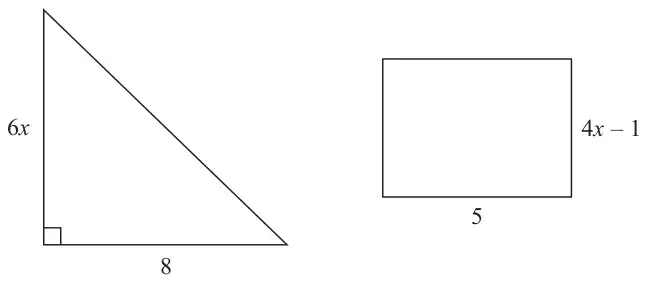
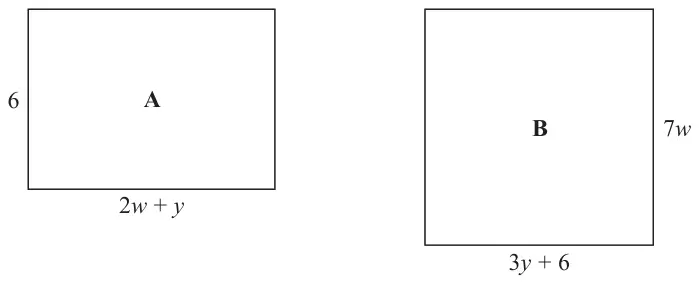
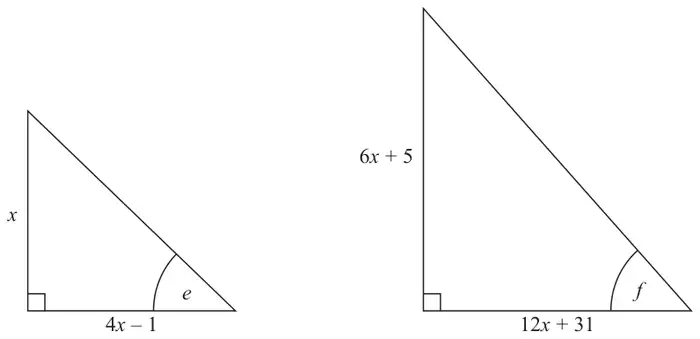
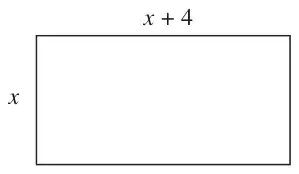
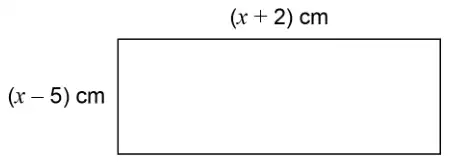
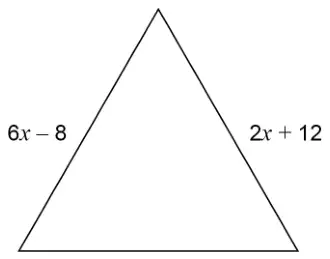
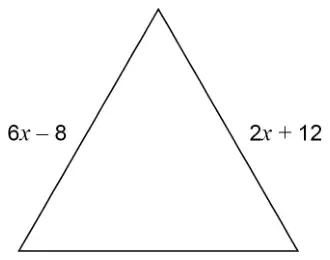
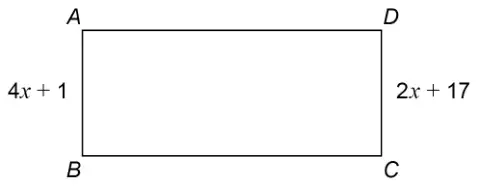
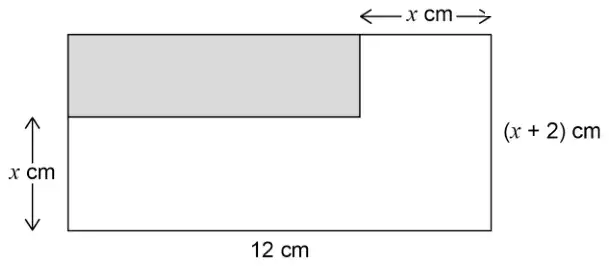
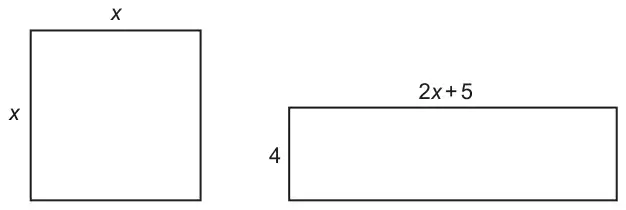
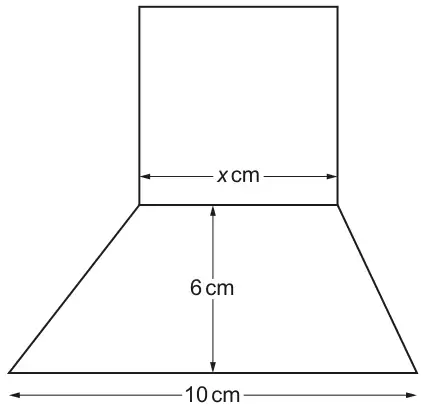
The area of the triangle is 10 cm\(^2\) greater than the area of the rectangle.
Work out the value of \(x\). (4)
Mark scheme
Answer
Mark
Mark scheme
1.25
P1
for finding an expression for the area of one shape, eg \(\dfrac{1}{2} \times 8 \times 6x\ (= 24x)\) or \(5(4x - 1)\ (= 20x - 5)\) oe
P1
for finding an expression for the area of both shapes, eg \(\dfrac{1}{2} \times 8 \times 6x\) and \(5(4x - 1)\) oe or [area of triangle] – 10 or [area of rectangle] + 10 oe or [area of triangle] – [area of rectangle]
P1
for writing a correct equation, eg \(\dfrac{1}{2} \times 8 \times 6x = 5(4x - 1) + 10\) oe or (dep on 1st P1) eg [area of triangle] – 10 = [area of rectangle] or [area of triangle] = [area of rectangle] + 10 or [area of triangle] – [area of rectangle] = 10
A1
for 1.25 oe
Additional guidance
Condone missing brackets for area of rectangle for all process marks
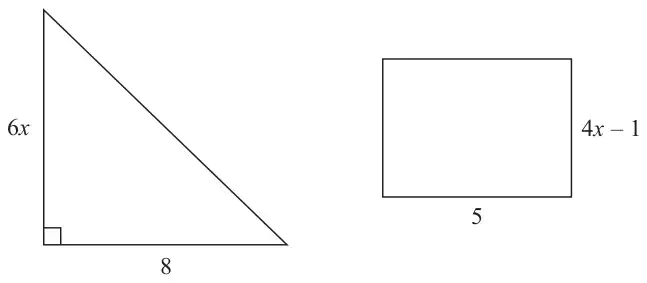
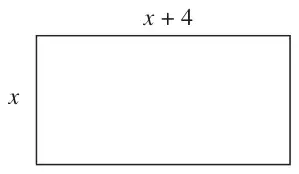
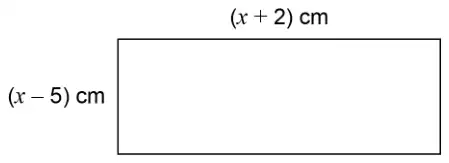
The area of the triangle is 10 cm2 greater than the area of the rectangle.
Work out the value of \(x\). (4)
Mark scheme
Answer
Mark
Mark scheme
1.25
P1
for finding an expression for the area of one shape, eg \(\dfrac{1}{2} \times 8 \times 6x\ (= 24x)\) or \(5(4x - 1)\ (= 20x - 5)\) oe
P1
for finding an expression for the area of both shapes, eg \(\dfrac{1}{2} \times 8 \times 6x\) and \(5(4x - 1)\) oe or [area of triangle] − 10 or [area of rectangle] + 10 oe or [area of triangle] − [area of rectangle]
P1
for writing a correct equation, eg \(\dfrac{1}{2} \times 8 \times 6x = 5(4x - 1) + 10\) oe or (dep on 1st P1) eg, [area of triangle] − 10 = [area of rectangle] or [area of triangle] = [area of rectangle] + 10 or [area of triangle] − [area of rectangle] = 10
A1
for 1.25 oe
Additional guidance
Condone missing brackets for area of rectangle for all process marks
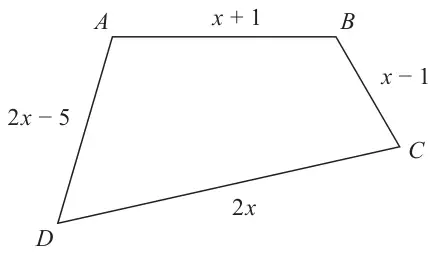
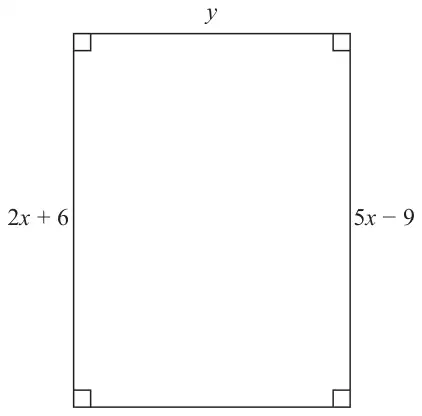
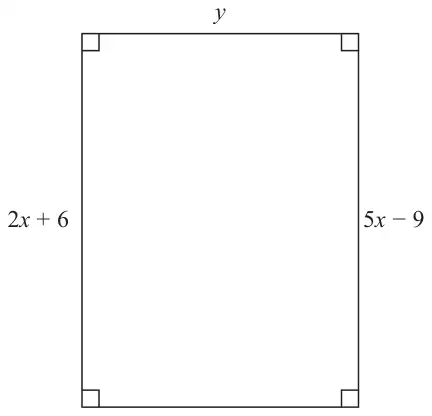
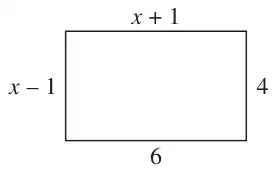
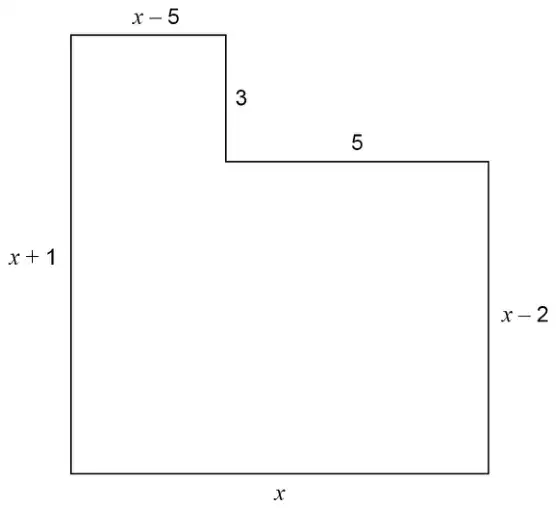
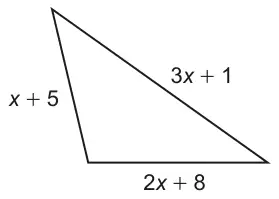
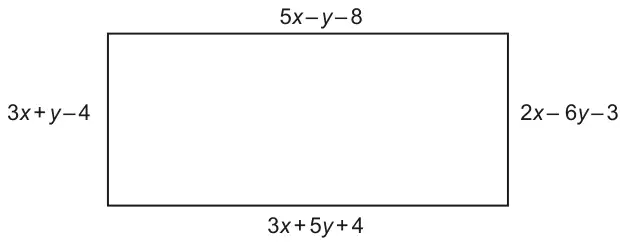
for process of finding perimeter in terms of \(x\), eg \(2x - 5 + x + 1 + x - 1 + 2x\) oe
P1
for process to form equation, eg \(\text{``}6x - 5\text{''} = 52\)
P1
(dep on P2) for a correct process to find \(x\), eg \((52 + 5) \div 6\ (= 9.5)\) or for a correct process to find \(2x\), eg \((52 + 5) \div 3\) or ft an equation of the form \(ax + b = c\),
A1
cao
Additional guidance
This mark may be awarded for a correct but unsimplified equation, eg. \(2x - 5 + x + 1 + x - 1 + 2x = 52\) oe
Trial & Improvement attempts must be fully correct giving \(x = 9.5\) before any credit given \(a\), \(b\) and \(c\) must be clearly stated but need not be correct
24 Rick, Selma and Tony are playing a game with counters.
Rick has some counters. Selma has twice as many counters as Rick. Tony has 6 counters less than Selma.
In total they have 54 counters.
the number of counters Rick has : the number of counters Tony has \(= 1 : p\)
Work out the value of \(p\). (5)
Mark scheme
Answer
Mark
Mark scheme
1.5
P1
for process to develop 3 algebraic expressions, eg (\(R =\)) \(n\), (\(S =\)) \(2n\), (\(T =\)) \(2n - 6\), oe, at least two must be correct. or for selecting 3 values satisfying the given criteria, eg (\(R =\)) 10, (\(S =\)) 20, (\(T =\)) 14
P1
for process to sum 3 algebraic expressions and equating to 54, eg \(n + \text{``}2n\text{''} + \text{``}2n - 6\text{''} = 54\) or for finding the correct sum of their values eg \(\text{``}10\text{''} + \text{``}20\text{''} + \text{``}14\text{''} = 44\)
P1
for start of process to solve the correct linear equation, eg \(5n = 54 + 6\ (n = 12)\) or for 12, 24, 18
P1
for \(\text{``}12\text{''} : 2 \times \text{``}12\text{''} - 6\) oe eg \(12 : 18\) oe or \(18 : 12\) linked to \(T\), \(R\)
3 Rick, Selma and Tony are playing a game with counters.
Rick has some counters. Selma has twice as many counters as Rick. Tony has 6 counters less than Selma.
In total they have 54 counters.
the number of counters Rick has : the number of counters Tony has \(= 1 : p\)
Work out the value of \(p\). (5)
Mark scheme
Answer
Mark
Mark scheme
1.5
P1
for process to develop 3 algebraic expressions, eg (\(R =\)) \(n\), (\(S =\)) \(2n\), (\(T =\)) \(2n - 6\), oe, at least two must be correct. or for selecting 3 values satisfying the given criteria, eg (\(R =\)) 10, (\(S =\)) 20, (\(T =\)) 14
P1
for process to sum 3 algebraic expressions and equating to 54, eg \(n + \text{``}2n\text{''} + \text{``}2n - 6\text{''} = 54\) or for finding the correct sum of their values eg \(\text{``}10\text{''} + \text{``}20\text{''} + \text{``}14\text{''} = 44\)
P1
for start of process to solve the correct linear equation, eg \(5n = 54 + 6\ (n = 12)\) or for 12, 24, 18
P1
for \(\text{``}12\text{''} : 2 \times \text{``}12\text{''} - 6\) oe eg \(12 : 18\) oe or \(18 : 12\) linked to T, R
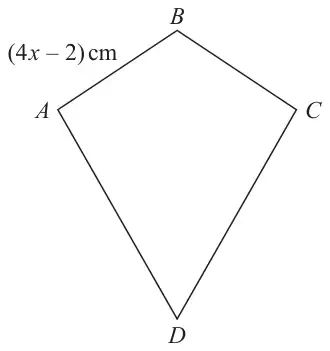
for explanation, eg \(AB\) cannot be zero (cm) or shows \(AB\) to be zero, eg \(4 \times 0.5 - 2 = 0\)
Additional guidance
Accept say ‘\(AB\) would then be 0’
Mark scheme (b)
Answer
Mark
Mark scheme
2.5
P1
for a correct expression for \(AD\), eg \(3(4x - 2)\) or \(12x - 6\) OR \(2(3AB + AB) = 64\) oe or \(3AB + AB = 32\) oe or \(AB = 8\) OR for an equation with mixed variables, eg \(6AB + 2(4x - 2) = 64\)
P1
for forming a correct equation in \(x\), eg \(4x - 2 + 4x - 2 + 3(4x - 2) + 3(4x - 2) = 64\) or \(4x - 2 = 8\) or \(4x - 2 + 3(4x - 2) = 32\)
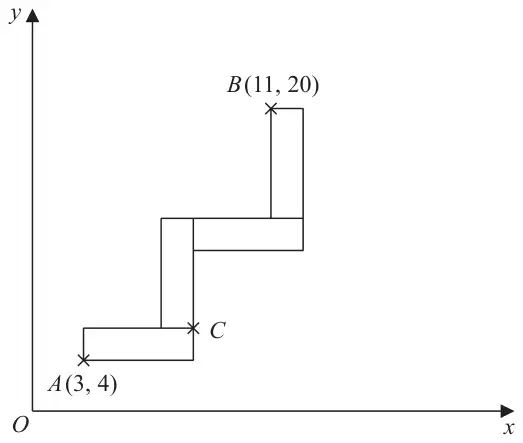
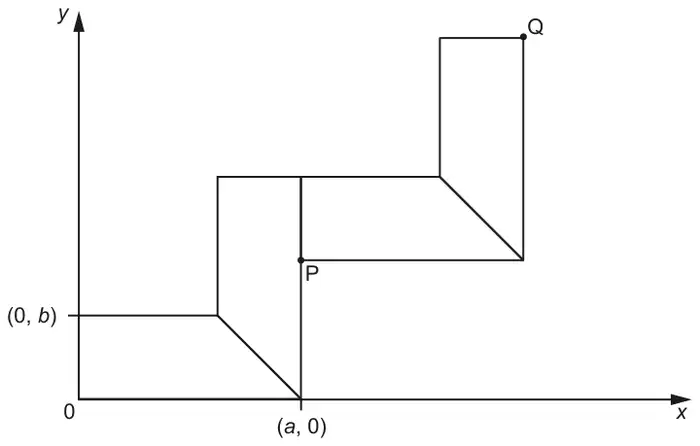
13 A pattern is made from four identical rectangles. The sides of the rectangles are parallel to the axes.
Point \(A\) has coordinates (3, 4) Point \(B\) has coordinates (11, 20) Point \(C\) is marked on the diagram.
Work out the coordinates of \(C\). You must show all your working. (5)
Mark scheme
Answer
Mark
Mark scheme
(9, 8)
P1
for setting up an equation for one dimension (width) of the pattern eg \(2b - a = 8\) oe or \(2x + y = 8\) oe
P1
for setting up an equation for the other dimension (height) of the pattern eg \(2b + a = 16\) oe or \(2x + 3y = 16\) oe
P1
(dep P2) for a full process to solve for both variables eg \(4b = 24\), \(b = 6\) and \(12 - a = 8\), \(a = 4\) or \(8 = 2y\), \(y = 4\) and \(8 = 2x + y\), \(x = 2\)
P1
(dep P3) for a full process to find one of the coordinates of \(C\) eg \(3 + 6\ (= 9)\) or \(4 + 4\ (= 8)\) or \(3 + 2 + 4\ (= 9)\) or \(4 + 4\ (= 8)\)
A1
cao
Additional guidance
\(a\) and \(b\) are the width and length \(x\) is the difference between the length and width, \(y\) is the width of the rectangle
Both values correct implies this mark
Award 0 marks for a correct answer with no supportive working.
5 The first four terms of a Fibonacci sequence are
\(a \qquad 2a \qquad 3a \qquad 5a\)
The sum of the first five terms of this sequence is 228
Work out the value of \(a\). (3)
Mark scheme
Answer
Mark
Mark scheme
12
P1
for a process to find the fifth term, eg \(3a + 5a\ (= 8a)\)
P1
for setting up the equation eg \(a + 2a + 3a + 5a + [8a] = 228\)
A1
cao
Additional guidance
[\(8a\)] allow use of what is clearly indicated as the missing term \(\dfrac{228}{19}\) or \(\dfrac{228}{1+2+3+5+8}\) scores P1 P1 \(\dfrac{228}{1+2+3+5+[8]}\) scores P0P1
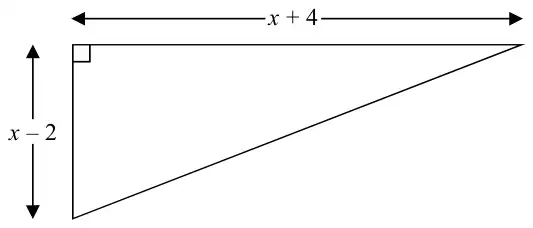
Work out the length of the shortest side of the triangle. You must show all your working. (4)
Mark scheme
Answer
Mark
Mark scheme
5
P1
for process to find the area of the triangle, eg. \(0.5 \times (x + 4)(x - 2)\) oe OR for process to find the area of rectangle and \(27.5 \times 2\), eg. \((x + 4)(x - 2)\) and 55
P1
(dep P1) for process to expand the brackets and derive a quadratic equation, eg. \(x^2 + 4x - 2x - 8 = 55\) or \(0.5(x^2 + 4x - 2x - 8) = 27.5\) oe
P1
(dep P2) for complete process to solve the quadratic equation \(x^2 + 2x - 63 = 0\) eg \((x - 7)(x + 9)\ (= 0)\) or \(\dfrac{-2 \pm \sqrt{2^2 - 4 \times 1 \times -63}}{2 \times 1}\) or \((x + 1)^2 - 1 - 63\ (= 0)\)
A1
cao
SC: B1 for \(x^2 + 4x - 2x - 8 = 27.5\)
Additional guidance
Trial and improvement methods must be fully correct identifying the value of \(x\) as 7 (3 marks) or the shortest side as 5 (4 marks)
An answer of 5 with no supportive working gets no marks
22 There are only \(r\) red counters and \(g\) green counters in a bag.
A counter is taken at random from the bag. The probability that the counter is green is \(\dfrac{3}{7}\)
The counter is put back in the bag.
2 more red counters and 3 more green counters are put in the bag. A counter is taken at random from the bag. The probability that the counter is green is \(\dfrac{6}{13}\)
Find the number of red counters and the number of green counters that were in the bag originally. (5)
Mark scheme
Answer
Mark
Mark scheme
12 red, 9 green
P1
for process to find a relationship between \(r\) and \(g\) eg \(\dfrac{g}{r + g} = \dfrac{3}{7}\) or \(\dfrac{g}{r} = \dfrac{3}{4}\)
P1
for process to find a second relationship between \(r\) and \(g\) eg \(\dfrac{g + 3}{r + 2 + g + 3} = \dfrac{6}{13}\) or \(\dfrac{g + 3}{r + 2} = \dfrac{6}{7}\)
P1
(dep P2) for start to process of solving pair of equations, eg eliminates one variable from the equations or removes fractions from both equations
P1
(dep P3) for complete process to solve equations to find \(g\) or \(r\)
A1
cao
OR
P1
for two of \(3x + 3\), \(4x + 2\) and \(7x + 5\)
P1
for \(\dfrac{3x + 3}{7x + 5} = \dfrac{6}{13}\)
P1
(dep P2) for removing fractions from the equation, eg \(13(3x + 3) = 6(7x + 5)\) or \(39x + 39 = 42x + 30\)
P1
(dep P3) for complete process to solve \(13(3x + 3) = 6(7x + 5)\)
17 \(p\) and \(q\) are two numbers such that \(p \gt q\)
When you subtract 5 from \(p\) and subtract 5 from \(q\) the answers are in the ratio 5 : 1 When you add 20 to \(p\) and add 20 to \(q\) the answers are in the ratio 5 : 2
Find the ratio \(p : q\) Give your answer in its simplest form. (5)
Mark scheme
Answer
Mark
Mark scheme
4 : 1
P1
for associating algebraic expressions with the correct ratio eg \(p - 5 : q - 5\ (= 5 : 1)\) or \(p + 20 : q + 20\ (= 5 : 2)\)
P1
for \(\dfrac{p + 20}{q + 20} = \dfrac{5}{2}\) or \(\dfrac{p - 5}{q - 5} = \dfrac{5}{1}\) oe or \(p - 5 = 5(q - 5)\) or \(2(p + 20) = 5(q + 20)\) oe
M1
for a complete method shown to find \(p\) or \(q\)
M1
for a complete method shown to find \(p\) and \(q\) or two values for \(p\) and \(q\) that are in the ratio 4 : 1 or an unsimplified ratio 4 : 1 (eg 80 : 20) or an answer of 1 : 4
A1
cao
Additional guidance
Award for one of the two simultaneous equations eg \(5q - p = 20\), \(5q - 2p = -60\) oe
Award for a simultaneous equation method to eliminate one variable leading to either \(p = 80\) or \(q = 20\)
Award for a simultaneous equation method to eliminate both variables leading to either \(p = 80\) and \(q = 20\)
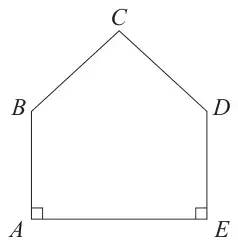
17 The diagram shows a pentagon. The pentagon has one line of symmetry.
\(AE = 4x\) \(AB = 2x + 1\) \(BC = x + 2\)
All these measurements are given in centimetres.
The perimeter of the pentagon is 18 cm.
(a) Show that \(10x + 6 = 18\) (3)
(b) Find the value of \(x\). (2)
Mark scheme (a)
Answer
Mark
Mark scheme
Full working seen
M1
for an initial step with the expressions eg doubling \(2x + 1\) or \(x + 2\) or halving \(4x\) or for identifying \(CD\) as \(x + 2\) or for identifying \(DE\) as \(2x + 1\)
M1
for an expression for the total perimeter, eg \(4x + 2 \times (2x + 1) + 2 \times (x + 2)\)
C1
for full simplification and equating to 18
Additional guidance
May be seen in working or on diagram
Mark scheme (b)
Answer
Mark
Mark scheme
1.2
M1
for isolating terms in \(x\) can ft an equation stated in (a) provided in form \(ax + b = c\)
24 Kiaria is 7 years older than Jay. Martha is twice as old as Kiaria. The sum of their three ages is 77
Find the ratio of Jay’s age to Kiaria’s age to Martha’s age. (4)
Mark scheme
Answer
Mark
Notes
14:21:42
P1
for 2 out of 3 expressions in one letter eg from \(x\), \(x+7\), \(2x+14\) or see a set of numbers to show interpretation of the relationships, eg 10, 17, 34
P1
(dep) for sum of their 3 expressions \(= 77\) eg \(x + x+7+2x+14 = 77\) oe or 2 systematic correct trials including addition
P1
for a correct process to isolate their term in \(x\) or \(x = 14\)
2 Kiaria is 7 years older than Jay. Martha is twice as old as Kiaria. The sum of their three ages is 77
Find the ratio of Jay’s age to Kiaria’s age to Martha’s age. (4)
Mark scheme
Answer
Mark
Notes
14:21:42
P1
for 2 out of 3 expressions in one letter eg from \(x\), \(x+7\) \(2x+14\) or see a set of numbers to show interpretation of the relationships, eg 10, 17, 34
P1
(dep) for sum of their 3 expressions \(=77\) eg \(x + x+7+2x+14 =77\) oe or 2 systematic correct trials including addition
P1
for a correct process to isolate their term in \(x\) or \(x=14\)
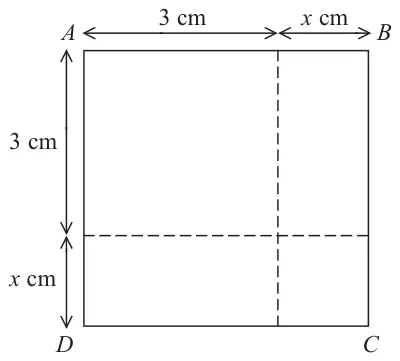
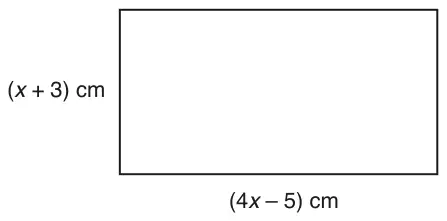
writes the area using algebraic terms e.g. \((x + 3) \times (x + 3)\) or at least two correct area expressions, may be written on the diagram or \(x\) given as \(\sqrt{10} - 3\)
M1
expands and includes the given 10 e.g. \(x^2 + 3x + 3x + 9 = 10\); condone one error in the four terms when expanding or \(10 - 3\sqrt{10} - 3\sqrt{10} + 9 + 6\sqrt{10} - 18\ (=1)\) condone 1 error in the 6 terms
A1
rearranges to give the given equation or shows surd expression simplifies to 1
writes the area using algebraic terms e.g. \((x + 3) \times (x + 3)\) or at least two correct area expressions which may be written on the diagram or \(x\) given as \(\sqrt{10} - 3\)
M1
expands and includes the given 10 e.g. \(x^2 + 3x + 3x + 9 = 10\); condone one error in the four terms when expanding or \(10 - 3\sqrt{10} - 3\sqrt{10} + 9 + 6\sqrt{10} - 18\ (=1)\) condone 1 error in the 6 terms
A1
rearranges to give the given equation or shows surd expression simplifies to 1
28 Gemma has the same number of sweets as Betty. Gemma gives 24 of her sweets to Betty. Betty now has 5 times as many sweets as Gemma.
Work out the total number of sweets that Gemma and Betty have. (4)
Mark scheme
Answer
Mark
Notes
72
4
M1 for \(\text{``}x\text{''} + 24\) or \(\text{``}x\text{''} - 24\) or for “\(g\)” and 5“\(g\)” M1 for forming an appropriate equation eg \(x + 24 = 5(x - 24)\) or for \((5g - g) \div 2 = 24\) or \(g = 12\) M1 for correct operations to isolate \(x\) terms and non-\(x\) terms in an equation of the form \(ax + b = cx + d\) or \(ax + b = c(x + d)\) or \(x = 36\) or for \(6 \times \text{``}12\text{''}\) oe A1 cao
Hassan thinks of a number. He multiplies the number by 3 He then adds 12 His answer is 60
(c) What number did Hassan think of? (2)
Mark scheme (a)
Answer
Mark
Notes
12
1
B1 cao
Mark scheme (b)
Answer
Mark
Notes
45
1
B1 cao
Mark scheme (c)
Answer
Mark
Notes
16
2
M1 for correct order of inverse operations \(-12\) then \(\div 3\) or for forming the equation \(3x + 12 = 60\) and showing intention to subtract 12 from both sides or divide each term by 3 as a first step A1 cao
10 Gemma has the same number of sweets as Betty. Gemma gives 24 of her sweets to Betty. Betty now has 5 times as many sweets as Gemma.
Work out the total number of sweets that Gemma and Betty have. (4)
Mark scheme
Answer
Mark
Notes
72
4
M1 for \(\text{``}x\text{''} + 24\) or \(\text{``}x\text{''} - 24\) or for \(\text{``}g\text{''}\) and \(5\text{``}g\text{''}\) M1 for forming an appropriate equation eg \(x + 24 = 5(x - 24)\) or for \((5g - g) \div 2 = 24\) or \(g = 12\) M1 for correct operations to isolate \(x\) terms and non-\(x\) terms in an equation of the form \(ax + b = cx + d\) or \(ax + b = c(x + d)\) or \(x = 36\) or for \(6 \times \text{``}12\text{''}\) oe A1 cao
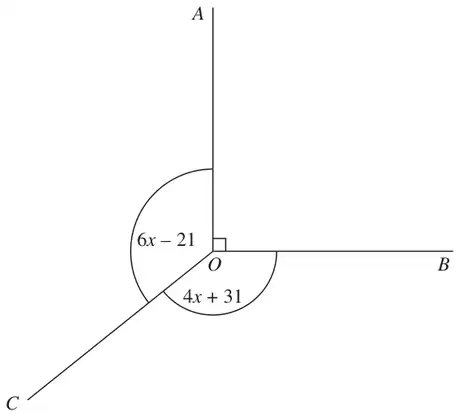
Angle \(AOB\) is a right angle. Angle \(AOC\) = Angle \(BOC\).
Work out the value of \(x\). (3)
Mark scheme
Answer
Mark
Notes
26
3
M1 for \((360 - 90) \div 2\) (= 135) M1 for \(4x + 31 = \text{``}135\text{''}\) or \(6x - 21 = \text{``}135\text{''}\) A1 cao
OR M1 for forming an appropriate equation eg \(4x + 31 = 6x - 21\) or \(6x - 21 + 4x + 31 + 90 = 360\) oe M1 (dep) for isolating terms in \(x\) and number terms A1 cao
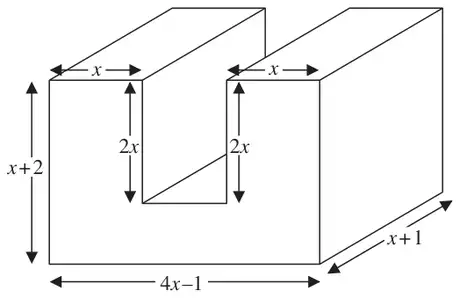
All measurements are in centimetres. All corners are right angles.
Find an expression, in terms of \(x\), for the volume, in cm\(^3\), of the prism. You must show your working. Give your answer in its simplest form. (4)
Mark scheme
Answer
Mark
Notes
\(9x^2 + 7x - 2\)
4
M1 for finding an expression for a missing length eg \(4x - 1 - x - x\) (\(=2x - 1\)) or \(x + 2 - 2x\) (\(=2 - x\)) M1 for a correct expression for one area from the cross-section, eg. \(x \times 2x\) or \((4x - 1)(x + 2 - 2x)\) or for one volume of cuboid(s), eg. \(x \times 2x \times (x + 1)\) M1 for a complete method to find the volume A1 for \(9x^2 + 7x - 2\) or \((9x - 2)(x + 1)\) oe
Julie multiplies the number by 5 and then adds 4 to the result. She writes down her answer.
Liam subtracts the number from 10 He writes down his answer.
Julie’s answer is two thirds of Liam’s answer.
Work out the number that Julie and Liam started with. You must show your working. (5)
Mark scheme
Answer
Mark
Notes
\(\dfrac{8}{17}\)
5
M1 for \(5x + 4\) or \(10 - x\) M1 (dep) for \(\text{``}5x + 4\text{''} = \dfrac{2}{3}\text{``}(10 - x)\text{''}\) M1 for expanding the bracket or multiplying both sides by 3 in an equation of the form \((ax + b) = \dfrac{2}{3}(cx + d)\) A1 for correct equation with terms in \(x\) and number terms isolated, eg \(15x + 2x = 20 - 12\) or \(5x + \dfrac{2x}{3} = \dfrac{20}{3} - 4\) A1 for \(\dfrac{8}{17}\) oe accept 0.47(0588...)
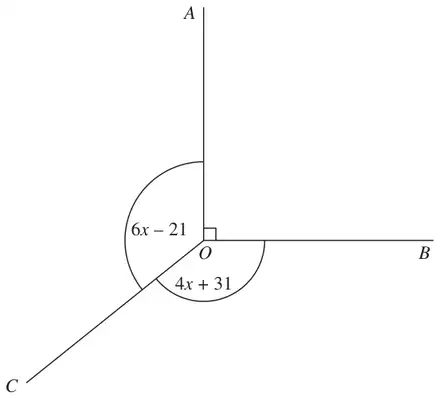
Angle \(AOB\) is a right angle. Angle \(AOC\) = Angle \(BOC\).
Work out the value of \(x\). (3)
Mark scheme
Answer
Mark
Notes
26
3
M1 for \((360 - 90) \div 2\) (= 135) M1 for \(4x + 31 = \text{``}135\text{''}\) or \(6x - 21 = \text{``}135\text{''}\) A1 cao OR M1 for forming an appropriate equation eg \(4x + 31 = 6x - 21\) or \(6x - 21 + 4x + 31 + 90 = 360\) oe M1 (dep) for isolating terms in \(x\) and number terms A1 cao
There are 5 envelopes in a small packet. There are 20 envelopes in a large packet.
There is a total of \(T\) envelopes in \(x\) small packets and \(y\) large packets.
Write down a formula for \(T\) in terms of \(x\) and \(y\). (3)
Mark scheme
Answer
Mark
Notes
\(T = 5x + 20y\)
3
B3 for \(T = 5x + 20y\) oe (B2 for \(5x + 20y\) or \(T = 5x + y\) or \(T = x + 20y\) or \(T = 20x + 5y\)) (B1 for \(T\) = a two term linear expression in \(x\) and \(y\), or \(5x + y\) or \(x + 20y\))
M2 for \(x + x + 4 + x + x + 4 = 45\) oe or \(x + x + 4 = 22.5\) oe (M1 for \(x + x + 4 + x + x + 4\) oe) A1 for 9.25 or \(\dfrac{37}{4}\) oe OR M1 for \(45 - 8\) (= 37) or \(22.5 - 4\) (= 18.5) M1 for \((45 - 8) \div 4\) or \((22.5 - 4) \div 2\) A1 for 9.25 or \(\dfrac{37}{4}\) oe
23 Ali is \(y\) years old. Bhavara is twice as old as Ali. Ceris is 3 years younger than Ali.
The total of their ages is 125 years.
Work out the age of each person. (4)
Mark scheme
Answer
Mark
Notes
32 64 29
4
M1 for \(2y\) or \(y - 3\) M1 for adding their three expressions and setting equal to 125 M1 for correct method to solve \(ay + b = 125\) A1 Ali 32, Bhavara 64 and Ceris 29
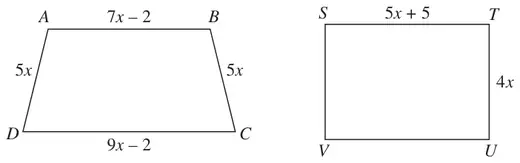
\(ABCD\) is a trapezium. \(STUV\) is a rectangle. All measurements are in centimetres.
The two shapes have the same perimeter.
Work out the length of \(ST\). (5)
Mark scheme
Answer
Mark
Notes
13.75
5
M1 for finding perimeter of rectangle e.g. \(5x + 5 + 5x + 5 + 4x + 4x\) \((= 18x + 10)\) M1 for finding perimeter of trapezium e.g. \(9x - 2 + 7x - 2 + 10x\) \((= 26x - 4)\) M1 for equation e.g. \(26x - 4 = 18x + 10\) (or \(8x = 14\)) A1 for finding the value of \(x\) as 1.75 B1 ft for subs of \(x\) into \(5x + 5\) and evaluated (=13.75)
3 Ali is \(y\) years old. Bhavara is twice as old as Ali. Ceris is 3 years younger than Ali.
The total of their ages is 125 years.
Work out the age of each person. (4)
Mark scheme
Answer
Mark
Notes
32 64 29
4
M1 for \(2y\) or \(y - 3\) M1 for adding their three expressions and setting equal to 125 M1 for correct method to solve \(ay + b = 125\) A1 Ali 32, Bhavara 64 and Ceris 29
*23 Redlands School sent \(x\) students to a revision day. St Samuel’s School sent twice as many students as Redlands School. Francis Long School sent 7 fewer students than Redlands School.
Each student paid £15 for the revision day. The students paid a total of £1155
Work out how many students were sent by each school to the revision day. You must show all your working. (5)
M1 for \(2x\) or \(x - 7\) M1 for \(1155 \div 15\) (= 77) M1 (dep M2) for equation summing their three expressions to ‘77’ A1 for 21,42 and 14 C1 for fully correct answer with correct labels
OR
M1 an expression for the cost of the pupils from Redlands M1 for expression for the cost of the pupils from either St Samuels or Francis Long M1 (dep M2) for equation summing their three expressions to 1155 A1 for 21,42 and 14 C1 for fully correct answer with correct labels
There are 6 buttons in a packet. There are 15 buttons in a box.
Nomusa buys \(d\) packets of buttons and \(f\) boxes of buttons. She buys a total of \(T\) buttons.
Write a formula for \(T\) in terms of \(d\) and \(f\). (3)
Mark scheme
Answer
Mark
Notes
\(T = 6d + 15f\)
3
M1 for \(6d\) or \(15f\) or \(T =\) a linear expression in \(d\) and/or \(f\) M1 for \(6d + 15f\) oe or \(T = 6d\ (+\,kf)\) oe or \(T = 15f\ (+\,kd)\) A1 \(T = 6d + 15f\) oe
*5 Redlands School sent \(x\) students to a revision day. St Samuel’s School sent twice as many students as Redlands School. Francis Long School sent 7 fewer students than Redlands School.
Each student paid £15 for the revision day. The students paid a total of £1155
Work out how many students were sent by each school to the revision day.
M1 for \(2x\) or \(x - 7\) M1 for \(1155 \div 15\) (= 77) M1 (dep M2) for equation summing their three expressions to “77” A1 for 21, 42 and 14 C1 for fully correct answer with correct labels
OR M1 for an expression for the cost of the pupils from Redlands M1 for expression for the cost of the pupils from either St Samuels or Francis Long M1 (dep M2) for equation summing their three expressions to 1155 A1 for 21, 42, and 14 C1 for fully correct answer with correct labels
(a) \(L = 3a + 2c\) \(a = 5\) \(c = 8\) Work out the value of \(L\). (2)
(b) Kirsty buys some buns. She buys \(x\) packs of currant buns and \(y\) boxes of iced buns. There are 6 currant buns in a pack of currant buns. There are 8 iced buns in a box of iced buns. Write down an expression, in terms of \(x\) and \(y\), for the total number of buns Kirsty buys. (2)
Mark scheme (a)
Answer
Mark
Notes
31
2
M1 for \(3 \times 5 + 2 \times 8\) or 15 and 16 A1 cao
Mark scheme (b)
Answer
Mark
Notes
\(6x + 8y\)
2
M1 for \(6x\) or \(8y\) A1 for \(6x + 8y\) oe as final answer
4 Kalinda buys \(x\) packs of currant buns and \(y\) boxes of iced buns.
There are 6 currant buns in a pack of currant buns. There are 8 iced buns in a box of iced buns.
Kalinda buys a total of \(T\) buns.
Write down a formula for \(T\) in terms of \(x\) and \(y\). (3)
Mark scheme
Answer
Mark
Notes
\(T = 6x + 8y\)
3
M1 for \(6x\) or \(8y\) oe or \(T =\) (a linear expression in \(x\) and \(y\)) M1 for \(6x + 8y\) oe or \(T = 6x\) \((+ay)\) oe or \(T = 8y\) \((+bx)\) oe A1 for \(T = 6x + 8y\) oe
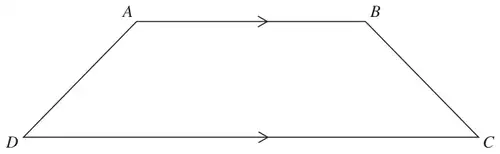
\(AD = x\) cm. \(BC\) is the same length as \(AD\). \(AB\) is twice the length of \(AD\). \(DC\) is 4 cm longer than \(AB\).
The perimeter of the trapezium is 38 cm.
Work out the length of \(AD\). (4)
Mark scheme
Answer
Mark
Notes
\(5\dfrac{2}{3}\)
4
M1 for \(AB = 2x\) or \(DC = 2x + 4\) or for 38 – 4 ( = 34) M1(dep) for \(x + x + \text{‘}2x\text{’} + \text{‘}2x + 4\text{’}\) or for “38 – 4” ÷ 6 M1 for ‘\(6x + 4\)’ = 38 A1 for \(5\frac{2}{3}\) oe N.B. Accept answers in the range 5.6 to 5.7 if M3 scored SC if M0 then B2 for an answer in the range 5.6 to 5.7
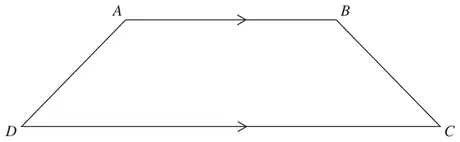
\(AD = x\) cm. \(BC\) is the same length as \(AD\). \(AB\) is twice the length of \(AD\). \(DC\) is 4 cm longer than \(AB\).
The perimeter of the trapezium is 38 cm.
Work out the length of \(AD\). (4)
Mark scheme
Answer
Mark
Notes
\(5\dfrac{2}{3}\)
4
M1 for \(AB = 2x\) or \(DC = 2x + 4\) or for \(38 - 4\) M1(dep) for \(x + \text{``}x\text{''} + \text{``}2x\text{''} + \text{``}2x + 4\text{''}\) or for \(\text{``}38 - 4\text{''} \div 6\) M1 for \(\text{``}6x + 4\text{''} = 38\) A1 for \(5\dfrac{2}{3}\) oe NB: Accept answers in the range 5.6 to 5.7 if M3 scored. SC if M0 then B2 for answer in range 5.6 – 5.7
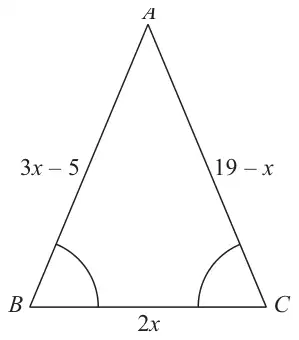
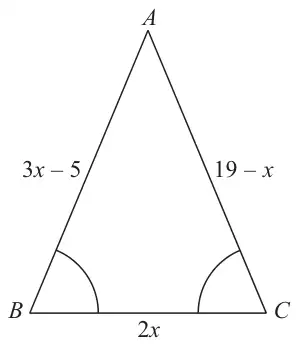
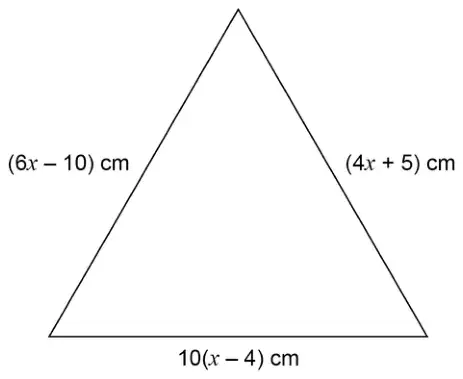
The length of side \(AB\) is \((3x - 5)\) cm. The length of side \(AC\) is \((19 - x)\) cm. The length of side \(BC\) is \(2x\) cm.
Diagram NOT accurately drawn
Work out the perimeter of the triangle. Give your answer as a number of centimetres. (5)
Mark scheme
Answer
Mark
Notes
38
5
M1 \(3x - 5 = 19 - x\) M1 for a correct operation to collect the \(x\) terms or the number terms on one side of an equation of the form \(ax + b = cx + d\) A1 for \(x = 6\) M1 for substituting their value of \(x\) in the three expressions and adding or substituting their value of \(x\) after adding the three expressions A1 cao
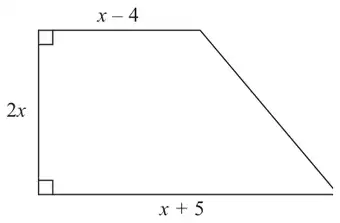
22 The diagram shows a trapezium. All the measurements are in centimetres.
Diagram NOT accurately drawn
The area of the trapezium is 351 cm\(^2\).
(a) Show that \(2x^2 + x - 351 = 0\) (2)
(b) Work out the value of \(x\). (3)
Mark scheme (a)
Answer
Mark
Notes
‘show’
2
M1 for \(\frac{1}{2} \times (x - 4 + x + 5) \times 2x\) or \(2x \times (x - 4) + \frac{1}{2} \times 2x \times 9\) A1 for completion with correct processes seen
Notes
Corrected from the printed mark scheme, which shows \(\frac{1}{2} \times (x - 4 + x + 5) \times 2\) (the height is \(2x\)).
Mark scheme (b)
Answer
Mark
Notes
13
3
M1 for \(\dfrac{-1 \pm \sqrt{1^2 - 4 \times 2 \times -351}}{2 \times 2}\) condone incorrect sign for 351 M1 for \(\dfrac{-1 \pm \sqrt{2809}}{4}\) A1 for 13 NB for either M mark accept + only in place of \(\pm\)
OR
M2 for \((2x + 27)(x - 13)\) (M1 for \((2x \pm 27)(x \pm 13)\)) A1 for 13
She multiplies the number by 3 She then subtracts 7
Her answer is 5
What number did Jessica think of? (2)
Mark scheme
Answer
Mark
Notes
4
2
M1 for correct order of operations +7 then ÷3 A1 cao OR M1 for forming the equation \(3x - 7 = 5\) and showing intention to add 7 to both sides or divide each term by 3 as a first step A1 cao NB Embedded solutions get M1 mark provided the equation or working is complete.
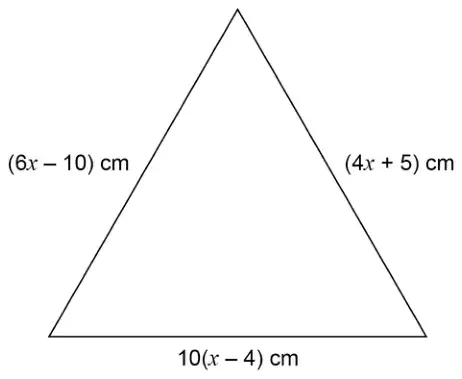
The length of side \(AB\) is \((3x - 5)\) cm. The length of side \(AC\) is \((19 - x)\) cm. The length of side \(BC\) is \(2x\) cm.
Work out the perimeter of the triangle. Give your answer as a number of centimetres. (5)
Mark scheme
Answer
Mark
Notes
38
5
M1 \(3x - 5 = 19 - x\) M1 for a correct operation to collect the \(x\) terms or the number terms on one side of an equation of the form \(ax + b = cx + d\) A1 for \(x = 6\) M1 for substituting their value of \(x\) in the three expressions and adding or substituting their value of \(x\) after adding the three expressions A1 cao
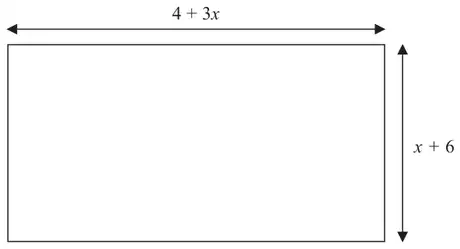
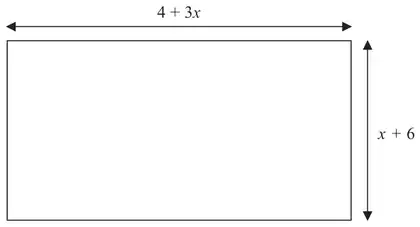
10 The diagram shows a garden in the shape of a rectangle.
Diagram NOT accurately drawn
All measurements are in metres. The perimeter of the garden is 32 metres.
Work out the value of \(x\) (4)
Mark scheme
Answer
Mark
Notes
1.5
4
M1 for correct expression for perimeter eg. \(4 + 3x + x + 6 + 4 + 3x + x + 6\) oe M1 for forming a correct equation eg. \(4 + 3x + x + 6 + 4 + 3x + x + 6 = 32\) oe M1 for \(8x = 12\) or \(12 \div 8\) A1 for 1.5 oe
OR
M1 for correct expression for semi-perimeter eg. \(4 + 3x + x + 6\) oe M1 for forming a correct equation eg. \(4 + 3x + x + 6 = 16\) oe M1 for \(4x = 6\) or \(6 \div 4\) A1 for 1.5 oe
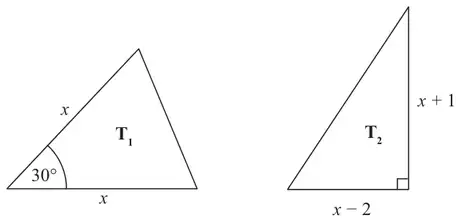
25 Here are two triangles \(\mathbf{T}_1\) and \(\mathbf{T}_2\).
Diagram NOT accurately drawn
The lengths of the sides are in centimetres.
The area of triangle \(\mathbf{T}_1\) is equal to the area of triangle \(\mathbf{T}_2\).
Work out the value of \(x\), giving your answer in the form \(a + \sqrt{b}\) where \(a\) and \(b\) are integers. (5)
Mark scheme
Answer
Mark
Notes
\(1 + \sqrt{5}\)
5
M1 for \(\frac{1}{2} \times x \times x \times \sin 30^\circ\) oe M1 for \(\frac{1}{2}(x - 2)(x + 1)\) oe or \(\frac{1}{2} \times (x - 2) \times (x + 1) \times \sin 90\) M1 (dep on at least one previous M1) for formation of equation from equating areas with \(x\) as the only variable A1 for \(x^2 - 2x - 4 = 0\) oe in the form \(ax^2 + bx + c = 0\) or \(ax^2 + bx = c\) A1 cao
13 You can use this rule to work out the total cost of hiring a car.
Total cost = £4 per hour plus £12
Arun hires a car for 5 hours.
(a) Work out the total cost. (2)
Raj hires a car. The total cost is £40
(b) Work out how many hours Raj hires the car for. (3)
Mark scheme (a)
Answer
Mark
Notes
32
2
M1 for \(4 \times 5 + 12\) oe A1 cao
Mark scheme (b)
Answer
Mark
Notes
7
3
M1 for \(40 - 12\) or 28 seen M1 (dep) for \('28' \div 4\) A1 cao OR M1 for \(12 + 4 + 4 + \ldots\) M1 for \(12 + 7 \times 4\) oe A1 cao OR M1 for \(12 + 4x = 40\) oe M1 for \(4x = 40 - 12\) oe A1 cao NOTE: A correct embedded answer scores M2 A0 OR M1 ft for \('32' + 4\ldots\) or \(40 - '32'\) M1 ft for \(5 + 1 \ldots\) oe A1 ft Note: Do not follow through from part a an answer of 40
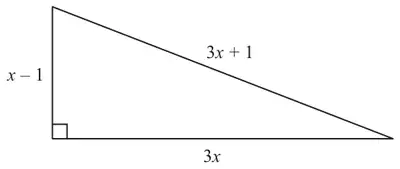
In the diagram, all the measurements are in metres.
The perimeter of the triangle is 56 m. The area of the triangle is \(A\) m\(^2\).
Work out the value of \(A\). (4)
Mark scheme
Answer
Mark
Notes
84
4
M1 for \(x - 1 + 3x + 1 + 3x\) (= 56) or \(7x = 56 + 1 - 1\) or \(\dfrac{3x(x - 1)}{2}\) oe M1 for \(7x = 56\) or 8 seen M1 for \(0.5 \times\) (‘8’ – 1) × (3 × ’8’) A1 cao Ignore any statement of units. SC B2 for 8 as the answer or 7 identified as the height and 24 identified as the base of the triangle.
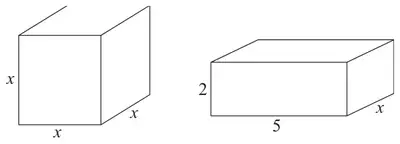
The volume of the cube is 100 cm\(^3\) more than the volume of the cuboid.
(a) Show that \(x^3 - 10x = 100\) (2)
(b) Use a trial and improvement method to find the value of \(x\). Give your answer correct to 1 decimal place. You must show all your working. (4)
Mark scheme (a)
Answer
Mark
Notes
show
2
M1 for \(x \times x \times x\) or \(2 \times 5 \times x\) or vol of cube \(= x^3\) or vol cuboid \(= 10x\) A1 correct completion leading to \(x^3 - 10x = 100\)
Mark scheme (b)
Working
Answer
Mark
Notes
\(x = 1\)
−9
\(x = 2\)
−2
\(x = 3\)
−3
\(x = 4\)
24
\(x = 5\)
75
\(x = 6\)
156
\(x = 10\)
900
\(x = 5.1\)
81.(651)
\(x = 5.2\)
88.(608)
\(x = 5.3\)
95.(877)
\(x = 5.4\)
103.(464)
\(x = 5.5\)
111.(375)
\(x = 5.6\)
119.(616)
\(x = 5.7\)
128.(193)
\(x = 5.8\)
137.(112)
\(x = 5.9\)
146.(379)
\(x = 5.35\)
99.6(30375)
\(x = 5.36\)
100.3(90656)
\(x = 5.355\)
100.0(101139)
5.4
4
B2 for a trial \(5 \leqslant x \leqslant 6\) evaluated correctly (B1 for any two trials evaluated correctly for positive values of \(x\)) B1 for a different trial \(5.3 \lt x \lt 5.4\) evaluated correctly B1 (dep on at least one previous B1) for 5.4 Accept trials correct to the nearest whole number (rounded or truncated) if the value of \(x\) is to 1 d.p., but correct to 1 d.p. (rounded or truncated) if the value of \(x\) is to 2 or more d.p. NB. Allow 100 for a trial of \(x = 5.355\)
M1 for \(110 - 30\) (=80) M1 (dep) for \(\text{`}80\text{'} \div 8\) or A1 cao OR M1 for \(110 - 62\) (= 48) M1(dep) for \(\text{`}48\text{'} \div 8 = 6\) A1 cao
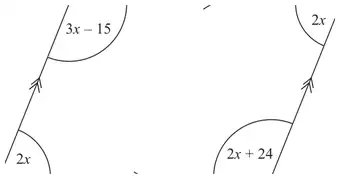
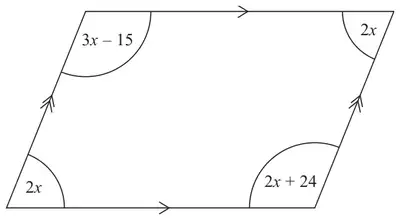
M1 for forming an appropriate equation eg \(3x - 15 = 2x + 24\) or \(2x + 3x - 15 + 2x + 2x + 24 = 360\) oe or \(2x + 2x + 24 = 180\) oe or \(2x + 3x - 15 = 180\) oe or \(2x + 3x - 15 = 2x + 2x + 24\) M1 (dep) for correct operation(s) to isolate \(x\) and non-\(x\) terms in an equation to get \(ax = b\) A1 cao OR M2 for \(\frac{351}{9}\) or \(\frac{195}{5}\) or \(\frac{156}{4}\) oe A1 cao
15 The table shows the minimum distance and the maximum distance people should sit from different sized TV screens when watching TV.
TV screen size (inches)
Minimum distance (feet)
Maximum distance (feet)
28
3.5
7
30
3.75
7.5
32
4
8
36
4.5
9
38
4.75
9.5
40
5
10
42
5.25
10.5
James has a TV with a screen size of 32 inches. He is going to watch his TV.
(a) What is the minimum distance James should sit from the screen? feet (1)
Sheraz has a TV with a screen size of 38 inches. He is going to watch his TV.
(b) Work out the difference between the minimum distance and the maximum distance Sheraz should sit from the screen. feet (2)
You can use this rule to work out the maximum distance to sit from a TV screen.
Maximum distance in feet = screen size in inches \(\div\) 4
Clare has a TV with a screen size of 24 inches. She is going to watch her TV.
(c) Use the rule to work out the maximum distance Clare should sit from the screen. feet (1)
Richard should sit a maximum distance of 12 feet from his screen.
(d) Work out the screen size of Richard’s TV. inches (2)
Mark scheme (a)
Answer
Mark
Notes
4
1
B1 cao
Mark scheme (b)
Working
Answer
Mark
Notes
\(9.5 - 4.75 =\) OR \(9.5 \div 2 =\)
4.75
2
M1 for \(9.5 - 4.75\) or \(9.5 \div 2\) or \(4.75 - 9.5\) A1 cao
Mark scheme (c)
Answer
Mark
Notes
6
1
B1 cao
Mark scheme (d)
Working
Answer
Mark
Notes
\(12 \times 4 =\)
48
2
M1 for \(\times 4\) seen or identifying \(+ 0.5\) for every 2 inches or \(12 + 12 + 12 + 12\) oe or build up method eg 12, 24, 36, 48 allow one error A1 cao
M1 for forming an appropriate equation eg. \(3x - 15 = 2x + 24\) OR \(2x + 3x - 15 + 2x + 2x + 24 = 360\) OR \(2x + 2x + 24 = 180\) OR \(2x + 3x - 15 = 180\) OR \(2x + 3x - 15 = 2x + 2x + 24\) M1 (dep) for correct operation(s) to isolate \(x\) and non-\(x\) terms in an equation to get to \(ax = b\) A1 cao OR M2 for \(\dfrac{351}{9}\) oe or \(\dfrac{195}{5}\) oe or \(\dfrac{156}{4}\) oe A1 cao
oe with brackets expanded four terms in any order with three correct from \(x^2 \quad (+)2x \quad -5x \quad -10\) terms may be seen in a grid implied by \(x^2 - 3x + k \quad (k \ne 0)\) or \(ax^2 - 3x - 10 \quad (a \ne 0)\)
For their three-term quadratic, correctly factorises or correctly substitutes into the quadratic formula or correctly completes the square to the form \(x = \ldots\) for their quadratic or \(-10\) and 13
Correctly rearranges their equation, which must be correct or of the form \(\dfrac{6}{n} \times \dfrac{a}{n + b} = \dfrac{1}{8}\), where \(a\) and \(b\) are integers, into a quadratic equation with brackets expanded and no unknowns in denominators
M1dep
dep on 1st M1 \(n^2 - n = 240\) or \(n^2 - n - 240 = 0\) implies M1M1M1
For their three-term quadratic, correctly factorises or correctly substitutes into the quadratic formula or correctly completes the square to the form \(n = \ldots\) for their quadratic or \(-15\) and 16
The second mark may be awarded for work done in stages eg \(\dfrac{6}{n} \times \dfrac{5}{n - 1} = \dfrac{36}{n(n - 1)}\) then \(\dfrac{36}{n(n - 1)} = \dfrac{1}{8}\) implies \(\dfrac{6}{n} \times \dfrac{5}{n - 1} = \dfrac{1}{8}\) (36 should be 30, which does not affect these marks but means they cannot get the third mark)
oe with brackets expanded four terms in any order with three correct from \(x^2 \quad (+)2x \quad -5x \quad -10\) terms may be seen in a grid implied by \(x^2 - 3x + k \quad (k \ne 0)\) or \(ax^2 - 3x - 10 \quad (a \ne 0)\)
For their three-term quadratic, correctly factorises or correctly substitutes into the quadratic formula or correctly completes the square to the form \(x = \ldots\) for their quadratic or \(-10\) and 13
\(4x - 2x = 17 - 1\) or \(1 - 17 = 2x - 4x\) or \((x =)\ 8\)
M1dep
oe collection of terms
Correctly substitutes their 8 into a correct expression for the length or width of the rectangle
M1
their \(8 \gt 0\) and their \(8 \ne 1\)
Correct method for both the length and the width of the rectangle using their 8
M1dep
their \(8 \gt 0\) and their \(8 \ne 1\) dep on 3rd M
3267
A1
SC1 \(12x + 3\) or \(6x + 51\)
Additional guidance
The first M1 or SC1 may be awarded for correct work with no answer or incorrect answer, even if this is seen amongst multiple attempts
Trial and improvement to find \((x =)\ 8\) is M2
Using an incorrect value of \(x\) for 3rd and 4th marks eg when \(x = 10\) \(4 \times 10 + 1 = 41\) and \(41 \times 3 = 123\) or \(12 \times 10 + 3 = 123\) and \(123 \div 3 = 41\) or \(2 \times 10 + 17 = 37\) and \(6 \times 10 + 51 = 111\)
14 4 chocolate bars and 3 packets of mints cost £4.70
5 chocolate bars and 1 packet of mints cost £4.50
Work out the cost of a chocolate bar and the cost of a packet of mints. [4 marks]
Mark scheme
Answer
Mark
Comments
Alternative method 1: elimination
at least one correct equation
M1
eg \(4x + 3y = 4.7(0)\) or \(5x + y = 4.5(0)\) or \(15x + 3y = 13.5(0)\) or \(9x + 4y = 9.2(0)\) may work in pounds or pence any letters
correctly multiplies one or two correct equations to equate coefficients of \(x\) or \(y\)
M1dep
eg \(4x + 3y = 4.7(0)\) and \(15x + 3y = 13.5(0)\) or \(20x + 15y = 23.5(0)\) and \(20x + 4y = 18.(00)\)
correctly adds or subtracts correct equations to eliminate one variable
M1dep
eg \(11x = 8.8(0)\) or \(11y = 5.5(0)\) may be implied by one correct value of \(x\) or \(y\) with M2 scored
chocolate bar £0.80 and packet of mints £0.50 or chocolate bar 80p and packet of mints 50p
A1
correct money notation condone £0.80p and £0.50p
Alternative method 2: substitution
\(4x + 3y = 4.7(0)\) or \(5x + y = 4.5(0)\) or \(15x + 3y = 13.5(0)\) or \(9x + 4y = 9.2(0)\)
M1
oe may work in pounds or pence any letters
correctly makes \(x\) or \(y\) the subject of a correct equation
M1dep
eg \(x = \dfrac{4.7(0) - 3y}{4}\) or \(x = \dfrac{4.5(0) - y}{5}\) or \(y = \dfrac{4.7(0) - 4x}{3}\) or \(y = 4.5(0) - 5x\)
correctly substitutes to eliminate a variable
M1dep
eg \(5\dfrac{(4.7(0) - 3y)}{4} + y = 4.5(0)\) or \(4\dfrac{(4.5(0) - y)}{5} + 3y = 4.7(0)\) or \(5x + \dfrac{4.7(0) - 4x}{3} = 4.5(0)\) or \(4x + 3(4.5(0) - 5x) = 4.7(0)\) may be implied by one correct value of \(x\) or \(y\) with M2 scored
chocolate bar £0.80 and packet of mints £0.50 or chocolate bar 80p and packet of mints 50p
A1
correct money notation condone £0.80p and £0.50p
Additional guidance
Up to M3 may be awarded for correct work with no answer or incorrect answer if this is seen amongst multiple attempts
Condone multiple letters in equations eg \(cb\) for \(x\)
Trial and improvement is 0, 3 (incorrect money notation) or 4 (fully correct)
Final answer chocolate bar £0.8 and packet of mints £0.5
M3A0
Final answer chocolate bar 0.80p and packet of mints 0.50p
13 Multiplying \(y\) by 6 gives the same result as adding 15 to \(y\)
(a) Write this as an equation. [2 marks]
(b) Show that the value of \(y\) is not 4 [1 mark]
Mark scheme (a)
Answer
Mark
Comments
\(6y = y + 15\)
B2
correct single equation with \(6y\) and \(y + 15\) eg \(15 + y = y \times 6\)
B1 \(6y\) or \(y + 15\) or rearranged equation eg \(6y - 15 = y\) or \(5y = 15\) but not \(y = 3\) only
Additional guidance
B1 may be awarded for a correct term even if this is seen amongst multiple attempts or embedded in an incorrect equation or incorrect term eg \(6y + 15\) or \(6y + 15y\) or \(6(y + 15)\)
Allow any variable for B1 but must be consistent for B2
Allow unprocessed terms for B1 or B2 eg \(6 \times y\) or \(y6\)
\(6y = y + 15\) seen, but then correctly simplified or solved
B2
\(6y = y + 15\) seen, but then incorrectly simplified or solved
B1
\(6y = 18\) or \(y + 15 = 18\) or both (unless combined to a single equation)
B1
No work worth B2 or B1 and answer \(y = 3\)
B0
Mark scheme (b)
Answer
Mark
Comments
Alternative method 1: substitutes \(y = 4\) into both sides
\((6y =)\ 24\) and \((y + 15 =)\ 19\)
B1ft
oe eg \(4 \times 6 = 24\) and \(4 + 15 = 19\) correct or ft their equation if their equation has a term in \(y\) on each side
Alternative method 2: solves equation
\((y =)\ 3\)
B1ft
oe eg \(3 \times 6 = 18\) and \(3 + 15 = 18\) correct or ft their equation if their equation has a term in \(y\) on each side
Additional guidance
Allow any variable
Only allow \((y =)\ 3\) seen in (a) if referenced in (b) and not contradicted
B1
For Alt 1, accept substituting into one side and then equating and solving the other eg \(4 \times 6 = 24\) and \(24 - 15 = 9\)
Second trial of three numbers which fit the criteria, with either their sum correctly evaluated or their sum divided by 3
M1dep
dep on previous M1 eg \(3 + 2 + 6 = 11\) or \((3 + 2 + 6) \div 3\) condone missing brackets
4, 3 and 8 selected as their final combination
M1dep
any order implies M4
8
A1
Additional guidance
Up to M4 may be awarded for correct work seen in multiple attempts even if not subsequently used
Correct expressions, but the sum of the three ages is equated to 5 eg \(4x - 1 = 5\)
M0M1M0M0A0
In alt 1, the correct value of \(x\) or the correct age for Joel for their two terms for Beth and Joel, with one correct, implies the first 4 marks eg \(x\) and \(x + 1\) and \(2x\), with \(x = 3.5\) or answer 7
M1M1M1M1A0
In alt 2, the correct value of \(y\) for their two terms for Sunita and Beth, with one correct, implies the first 4 marks eg \(y\) and \(\dfrac{y}{2}\) and \(\left(\dfrac{y}{2} + 1\right)\), with \(y = 7\) or answer 7
M1M1M1M1A0
In alt 1 and alt 2, condone missing brackets in equations if not recovered for up to M1M1M1 eg \(x + x - 1 + 2x \div 3 = 5\) not recovered
13 Luke wants to make a number machine so that \(\quad y = 5x + 3\)
Here is his attempt.
What mistake has he made? [1 mark]
Mark scheme
Answer
Mark
Comments
Valid explanation
B1
eg it should be \(\times 5\) then \(+ 3\) or he has done \((x + 3) \times 5\)
Additional guidance
Ignore irrelevant statements alongside correct statements, unless contradictory eg it should be \(\times 5\) then \(+ 3\) and he should change his equation
B1
Do not ignore incorrect statements alongside a correct statement eg it should be \(\times 5\) then \(+ 3\) and \(x\) and \(y\) should be swapped
B0
The operations are in the wrong order
B1
Misplacing the 3 and 5 with their operations
B0
The order is wrong
B0
\(+ 3\) and \(\times 5\) are in the wrong order
B1
3 and 5 are the wrong way round
B0
\(\times 5\) needs to go before the \(+ 3\)
B1
He has added the 3 first when he should have multiplied by 5
B1
\(\times 5\) needs to go first
B1
\(\times 5\) needs to go in the first box
B1
He has put the \(+ 3\) in the wrong place (condone)
B1
He has put the numbers in the wrong squares
B0
He has added 3 to \(x\) and not multiplied by 5
B1
He should have multiplied by 5 first (before adding 3)
25 Towns \(P\), \(Q\) and \(R\) are connected by roads \(PQ\), \(PR\) and \(QR\).
\(PR\) is 10 km longer than \(PQ\). \(QR\) is twice as long as \(PR\). The total length of the three roads is 170 km
Not drawn accurately
Work out the length of \(PQ\). [4 marks]
Mark scheme
Answer
Mark
Comments
Alternative method 1 – PQ as the unknown
\(x + 10\) or \(2(x + 10)\)
M1
any unknown
\(x + x + 10 + 2(x + 10) = 170\)
M1dep
oe any consistent unknown \(x\) + their two expressions (with at least one correct) = 170
\(4x + 30 = 170\)
M1dep
oe \(4x = 140\) must be correct
35
A1
Alternative method 2 – PR as the unknown
\(x - 10\) or \(2x\)
M1
any unknown
\(x + x - 10 + 2x = 170\)
M1dep
oe any consistent unknown \(x\) + their two expressions (with at least one correct) = 170
\(4x - 10 = 170\) or \(x = 45\)
M1dep
oe \(4x = 180\) must be correct
35
A1
Alternative method 3 – QR as the unknown
\(\dfrac{x}{2}\) or \(\dfrac{x}{2} - 10\)
M1
any unknown
\(x + \dfrac{x}{2} + \dfrac{x}{2} - 10 = 170\)
M1dep
oe any consistent unknown \(x\) + their two expressions (with at least one correct) = 170
\(2x - 10 = 170\) or \(x = 90\)
M1dep
oe \(2x = 180\) must be correct
35
A1
Alternative method 4 – trial and improvement with addition of three lengths
A correctly evaluated trial with a difference of 10 (km) between the two shorter lengths and the longest length twice the length of the middle length
M1
may be seen as a subtraction of three numbers from 170
A different correctly evaluated trial with a difference of 10 (km) between the two shorter lengths and the longest length twice the length of the middle length
M1dep
may be seen as a subtraction of three numbers from 170
35, 45 and 90
A1
35
A1
Alternative method 5 – trial and improvement with subtraction from 170
A correctly evaluated trial of two lengths subtracted from 170 with a difference of 10 (km) between the two lengths or one length twice the length of the other
M1
A different correctly evaluated trial of two lengths subtracted from 170 with a difference of 10 (km) between the two lengths or one length twice the length of the other
M1dep
35, 45 and 90
A1
35
A1
Additional guidance
If the student attempts more than one method, mark each method and award the highest mark
Alt 1 \(\quad PQ + PQ + 10 + 2(PQ + 10) = 170\)
M1M1
Alt 1 \(\quad PQ + PQ + 10 + 2PR = 170\)
M1
Alt 2 \(\quad x\), \(x + 10\) and \(2x\) seen on diagram, \(4x + 10 = 170\)
M1M1M0A0
Alt 4 \(\quad 35 + 45 + 90\) with no choice made
M1M1A1A0
Alt 4 \(\quad 170 - 30 - 40 - 80 = 20\)
M1
Alt 4 \(\quad 170 - 30 - 40 - 60 = 40\) incorrect number is doubled
The product of half of a number and three more than the number is the same as the square of the number
Toby uses \(y\) to represent the number.
Write an equation that Toby could form. [2 marks]
(b) Toby forms another equation.\[x = \frac{9}{8x}\]
He wants to work out the values of \(x\).
Here is his working.
\(x = \dfrac{9}{8x}\)
\(8x^2 = 9\)
\(8x = 3 \quad\text{or}\quad 8x = -3\)
\(x = \dfrac{3}{8} \quad\text{or}\quad x = -\dfrac{3}{8}\)
What error has he made in his working? [1 mark]
Mark scheme (a)
Answer
Mark
Comments
\(y^2 = \dfrac{1}{2}y(y + 3)\)
B2
oe equation eg \(2y^2 = y^2 + 3y\) or \(y^2 = 3y\) or \(y = 0\) or \(y = 3\) or \(y = 0\) or 3 B1 \(\dfrac{1}{2}y(y + 3)\) oe expression or an otherwise correct equation using a different unknown or combination of unknowns
\(y^2 = \dfrac{1}{2}y(y + 3)\) followed by incorrect simplification or attempt to solve the equation
B2
\(y^2 = \dfrac{1}{2}y + y + 3\)
B0
3 only or 0 only or 0 and 3 only
B0
Do not allow missing or partially missing brackets unless recovered eg1 \(y^2 = \dfrac{1}{2}y \times y + 3\) without correct equation seen eg2 \(y^2 = \dfrac{1}{2}y(y + 3\) without correct equation seen
B0 B0
Mark scheme (b)
Answer
Mark
Comments
Correct comment or shows correct working
B1
eg1 he hasn’t square rooted (correctly) eg2 it should be \(\sqrt{8}\,x = 3\) eg3 he should have divided (by 8) before square rooting
Additional guidance
\(\sqrt{8}\) may be given as \(2\sqrt{2}\)
Comment that he shouldn’t have a negative answer
B0
Mathematically incorrect statement
B0
Correct comment and an incorrect comment
B0
Example responses
He has taken it as \((8x)^2\)
B1
He has divided \(8x^2\) by \(x\) (instead of square rooting) and square rooted the 9
B1
He \(\sqrt{\phantom{x}}\) first when supposed to divide it by 8
B1
He didn’t divide 9 by 8 to get \(x^2\)
B1
At the start he took the 8 over when you want \(\sqrt{\dfrac{9}{8}}\)
B1
Toby should have got \(\pm\sqrt{\dfrac{9}{8}}\)
B1
He should have divided by 8
B0
Toby didn’t square root \(8x\)
B0
He hasn’t square rooted the \(8x^2\) to leave \(x\) on its own
B0
He hasn’t square rooted the other side to just get \(x\)
B0
Didn’t divide by 8
B0
He should have divided by \(8x\)
B0
He found the square root of 9 but didn’t write \(\sqrt{8x} = 9\)
17 In a bag there are 10p coins, 20p coins and 50p coins.
There are two fewer 20p coins than 10p coins. There are five more 50p coins than 10p coins.
(a) Complete the table. [1 mark]
Coin
Number of coins
10p
\(n\)
20p
\(n - 2\)
50p
(b) Altogether, there are 60 coins.
Work out the total value of the 20p coins. [4 marks]
Mark scheme (a)
Answer
Mark
Comments
\(n + 5\) or \(5 + n\)
B1
oe eg \(N - 2 + 7\)
Additional guidance
Letters other than \(n\) or \(N\) eg \(x + 5\)
B0
Mark scheme (b)
Answer
Mark
Comments
\(n + n - 2 +\) their \((n + 5)\) or \(3n + 3\)
M1
condone any letter ft their algebraic expression in (a)
\(3n + 3 = 60\) or \((n =)\ 19\) or \((n - 2 =)\ 17\)
M1dep
ft their algebraic expression in (a) correct ft equation with terms on LHS collected 19 10p coins or 17 20p coins or 19, 17, 24 chosen implies M2
(their \(19 - 2) \times 0.2\) or their \(17 \times 0.2\) or 3.4 or (their \(19 - 2) \times 20\) or their \(17 \times 20\) or 340
M1dep
ft their algebraic expression in (a) 3.4 or 340 implies M3
3.40
A1
condone 3.40p SC2 answer 17
Additional guidance
Allow a restart in this part ie answer £3.40 scores full marks
Working may be seen by the table
Answer 340p
M1M1M1A0
£3.40 with answer eg £17.30 (total of all coins)
M1M1M1A0
Only follow through their algebraic expression from (a) if an expression and / or equation for the total number of coins is used in this part
Award the M mark(s) for a correct ft expression or equation even if not subsequently used
The solution to an equation derived from an incorrect expression in (a) can score the first three marks eg answer in (a) \(n - 5\) then working in (b) \(\quad n + n - 2 + n - 5 = 60 \quad n = [22, 23]\) \(([22, 23] - 2) \times 0.2 = [4, 4.20]\)
9 Towns \(P\), \(Q\) and \(R\) are connected by roads \(PQ\), \(PR\) and \(QR\).
\(PR\) is 10 km longer than \(PQ\). \(QR\) is twice as long as \(PR\). The total length of the three roads is 170 km
Not drawn accurately
Work out the length of \(PQ\). [4 marks]
Mark scheme
Answer
Mark
Comments
Alternative method 1 – PQ as the unknown
\(x + 10\) or \(2(x + 10)\)
M1
any unknown
\(x + x + 10 + 2(x + 10) = 170\)
M1dep
oe any consistent unknown \(x\) + their two expressions (with at least one correct) = 170
\(4x + 30 = 170\)
M1dep
oe \(4x = 140\) must be correct
35
A1
Alternative method 2 – PR as the unknown
\(x - 10\) or \(2x\)
M1
any unknown
\(x + x - 10 + 2x = 170\)
M1dep
oe any consistent unknown \(x\) + their two expressions (with at least one correct) = 170
\(4x - 10 = 170\) or \(x = 45\)
M1dep
oe \(4x = 180\) must be correct
35
A1
Alternative method 3 – QR as the unknown
\(\dfrac{x}{2}\) or \(\dfrac{x}{2} - 10\)
M1
any unknown
\(x + \dfrac{x}{2} + \dfrac{x}{2} - 10 = 170\)
M1dep
oe any consistent unknown \(x\) + their two expressions (with at least one correct) = 170
\(2x - 10 = 170\) or \(x = 90\)
M1dep
oe \(2x = 180\) must be correct
35
A1
Alternative method 4 – trial and improvement with addition of three lengths
A correctly evaluated trial witha difference of 10 (km) between the two shorter lengthsandthe longest length twice the length of the middle length
M1
may be seen as a subtraction of three numbers from 170
A different correctly evaluated trial witha difference of 10 (km) between the two shorter lengthsandthe longest length twice the length of the middle length
M1dep
may be seen as a subtraction of three numbers from 170
35, 45 and 90
A1
35
A1
Alternative method 5 – trial and improvement with subtraction from 170
A correctly evaluated trial of two lengths subtracted from 170 witha difference of 10 (km) between the two lengthsorone length twice the length of the other
M1
A different correctly evaluated trial of two lengths subtracted from 170 witha difference of 10 (km) between the two lengthsorone length twice the length of the other
M1dep
35, 45 and 90
A1
35
A1
Additional guidance
If the student attempts more than one method, mark each method and award the highest mark
Alt 1 \(\ PQ + PQ + 10 + 2(PQ + 10) = 170\)
M1M1
Alt 1 \(\ PQ + PQ + 10 + 2PR = 170\)
M1
Alt 2 \(\ x,\ x + 10\) and \(2x\) seen on diagram, \(4x + 10 = 170\)
M1M1M0A0
Alt 4 35 + 45 + 90 with no choice made
M1M1A1A0
Alt 4 170 – 30 – 40 – 80 = 20
M1
Alt 4 170 – 30 – 40 – 60 = 40 incorrect number is doubled
15 A company uses this formula to work out the cost, £\(A\), of a taxi ride.
\[A = 4 + 1.8m + b\]
£4 is a fixed charge \(m\) is the number of miles travelled £\(b\) is a charge for booking online
(a) Clare books a taxi online and travels 8 miles.
She pays £20 altogether.
How much is the charge for booking online? [3 marks]
(b) A different company
has a fixed charge of £3 charges £1.90 per mile has no charge for booking online.
Write a formula for the cost, £\(C\), of a taxi ride with this company. [1 mark]
Mark scheme (a)
Answer
Mark
Comments
Alternative method 1
\(1.8(0) \times 8\) or 14.4(0)
M1
implied by 5.6(0) or 18.4(0)
\(20 -\) their \(14.4(0) - 4\) or \(20 - 18.4(0)\) or 1.6
M1dep
1.60
A1
condone £1.60p
Alternative method 2
\(b = A - 4 - 1.8m\)
M1
oe correct formula with \(b\) as the subject
\(20 - 4 - 1.8(0) \times 8\) or 1.6
M1dep
1.60
A1
condone £1.60p
Additional guidance
\(1.8(0) \times 8\) may be within an incorrect calculation eg \(4 + 1.8(0) \times 8 + 20\)
M1
Mark scheme (b)
Answer
Mark
Comments
\(C = 3 + 1.9(0)m\)
B1
oe formula with \(C\) as subject accept \(C = 3 + 1.9(0) \times m\) condone \(+ 0\) or \(+ 0b\)
Additional guidance
\(3 + 1.9m\)
B0
Do not accept eg \(A = \ldots\) for \(C = \ldots\)
B0
Allow \(m\) to be \(\times\) mile(s) but not a different letter unless defined eg1 \(C = 3 + 1.9(0) \times\) miles eg2 \(C = 3 + 1.9(0)\) miles eg3 \(C = 3 + 1.9(0)\) per mile or \(C = 3 + 1.9(0)\)pm eg4 \(C = 3 + 1.9(0)x\)
B1 B0 B0 B0
Ignore £ inserted in part or all of equation eg \(C = 3 + £1.90m\)
B1
Correct formula followed by substitution (and evaluation)
(their 190 – 20) \(\div\) 2 or 85 or (their 190 + 20) \(\div\) 2 or 105
M1dep
16
A1
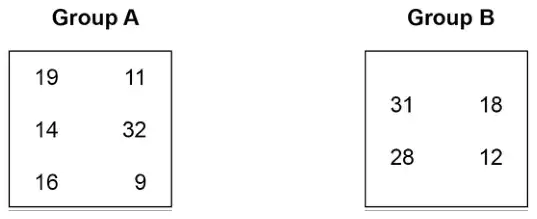
Alternative method 3
16 and correct evaluation of the two groups after 16 moved from A to B
B3
B2 at least two correct evaluations of the two groups after numbers moved from A to B or a correct single evaluation of the two groups after 16 moved from A to B
B1 a correct evaluation of the two groups after a number moved from A to B
Additional guidance
16 with no or insufficient working for M1 (Alt1 and Alt2)
M0
Number
A
B
Diff
19
82
108
26
11
90
100
10
14
87
103
16
32
69
121
52
16
85
105
20
9
92
98
6
Differences do not need to be shown
101 – 16 = 85 and 89 + 16 = 105 with answer 20
B2
A correct evaluation of the two groups after 16 moved from A to B together with only one other evaluation which is incorrect, without 16 as answer
28 \(y = p \times q^{\,x - 1} \qquad\) where \(p\) and \(q\) are numbers.
\(y = 10 \;\) when \(\; x = 1\) \(y = 0.3125 \;\) when \(\; x = 6\)
Work out the value of \(y\) when \(x = 3\) [5 marks]
Mark scheme
Answer
Mark
Comments
\(p \times q^{1 - 1} = 10\) or \(p \times q^0 = 10\) or \(p \times q^{6 - 1} = 0.3125\) or \(p \times q^5 = 0.3125\)
M1
oe
\(p = 10\) or \(10 \times q^{6 - 1} = 0.3125\) or \(q^5 = 0.3125 \div\) their 10 or \(q^5 = 0.03125\)
M1dep
\(\sqrt[5]{\text{their } 0.03125}\) or 0.5
M1dep
oe
their \(10 \times\) their \(0.5^2\) or their \(10 \times\) their \(\left(\sqrt[5]{\text{their } 0.03125}\right)^2\) or their \(10 \times\) their \(0.03125^{\frac{2}{5}}\)
22 Kai plays an online game. Kai collects diamonds and rubies. Each diamond and each ruby is worth a fixed number of points.
In game 1, Kai collects 4 diamonds and 3 rubies and scores 47 points. In game 2, Kai collects 3 diamonds and 5 rubies and scores 49 points.
Work out the number of points for a diamond and the number of points for a ruby. You must show your working. [5]
Mark scheme
Answer
Marks
Part marks and guidance
[diamond =] 8 [ruby =] 5 with correct working
5
B4 for one correct answer with correct working
Correct working requires evidence of at least M1 M1 M1 Mark the method leading to answer. If no answer, treat different methods as choice and mark the worst
OR
M1 for \(4d + 3r = 47\) oe M1 for \(3d + 5r = 49\) oe
Accept other letters and “diamonds/rubies” seen in equations The last two M marks are dependent on first M1M1 (two correct equations)
M1 for correct method to equate coefficients of one variable allowing one arithmetic error
e.g. \(12d + 9r = 141\) and \(12d + 20r = 196\) or \(20d + 15r = 235\) and \(9d + 15r = 147\)
M1 for correct method to eliminate one variable allowing one arithmetic error
e.g. \(11r = 55\) or \(11d = 88\) Note: A sign error is not an arithmetic error
If 0 or 1 scored, instead award SC2 for [diamond =] 8 and [ruby =] 5 with no or insufficient working
If 0 scored, instead award SC1 for two integer answers which satisfy one of the original conditions
If substitution method used apply first two M1s then, if M1M1 awarded, M1 for correctly rearranging an equation M1 for correct substitution into other equation
Alternative method of Trials \(4 \times \mathbf{8} + 3 \times \mathbf{5} = 47\) and \(3 \times \mathbf{8} + 5 \times \mathbf{5} = 49\) and correct answer scores 5 or \(4 \times \mathbf{8} = 32\) then \((47 - 32) \div 3 = \mathbf{5}\) and \(3 \times \mathbf{8} = 24\) then \((49 - 24) \div 5 = 5\) (or \(3 \times \mathbf{8} + 5 \times \mathbf{5} = 49\)) (5 may be substituted and used to find 8) or M1 for one correct trial of integer values for \(d\) and \(r\) in one case e.g. \(4 \times \mathbf{6} + 3 \times \mathbf{5} = 39\) oe or \(3 \times \mathbf{6} + 5 \times \mathbf{5} = 43\) oe oe may be substitution of an integer value into one relationship and “solving” to find the second value, which may be non-integer e.g \(4 \times \mathbf{6} = 24\) then \((47 - 24) \div 3 = \mathbf{7.6...}\)
22 In this question, all lengths are in centimetres.
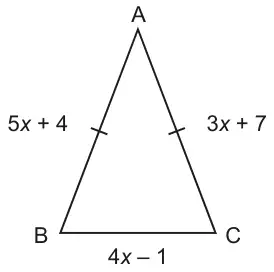
The diagram shows an isosceles triangle ABC. AB = AC.
Not to scale
Find the perimeter of the triangle. You must show your working. [6]
Mark scheme
Answer
Marks
Part marks and guidance
28[cm] with correct working
6
Correct working requires evidence of at least M1M1A1M1 or M1M1A1M2
M1 for \(5x + 4 = 3x + 7\) M1 for \(5x - 3x = 7 - 4\) oe
FT their equation if wrong sides equated Accept only: \(4x - 1 = 5x + 4\) or \(4x - 1 = 3x + 7\)
A1 for \(x = 1.5\) oe
After M1, \(x = 1.5\) implies M1M1A1
Do not penalise if their value of \(x\) is not subsequently used in their work leading to an algebraic final answer e.g. \(12x + 10\).
M1 for \(5x + 4 + 3x + 7 + 4x - 1\) soi
implied by \(12x + 10\)
M1 for substitution of their \(x\) into \(5x + 4\) or \(3x + 7\) or \(4x - 1\) or their \(12x + 10\)
their \(x\) must be > 0 and clearly stated as \(x =\)…. Substitution of their \(x\) into \(5x + 4\), \(3x + 7\) and \(4x - 1\) and then adding implies M1 M1.
If 0 or 1 scored, instead award SC2 for answer 28 If 0 scored, instead award SC1 for \(x = 1.5\)
Alternative method using trials:
In all trials \(x\) must be > 0 M1M1A1 for both \(5x + 4\) and \(3x + 7\) correctly evaluated with \(x = 1.5\) or M1M1 for three correctly evaluated trials of both \(5x + 4\) and \(3x + 7\) with consistent value of \(x\) or M1 for two correctly evaluated trials of both \(5x + 4\) and \(3x + 7\) with consistent value of \(x\) AND M2 dep on at least M1 for their \(x\) substituted into their \(12x + 10\) oe or M1 dep on at least M1 for their \(x\) substituted into \(4x - 1\) M1 dep on previous M1 adding their three lengths
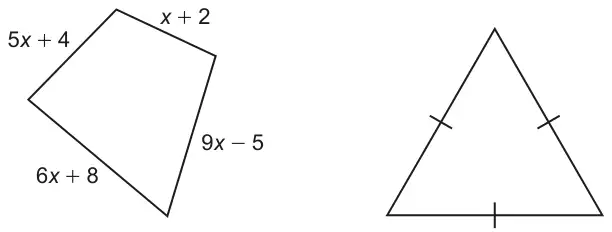
14 Five adults and two children go to a theme park. The cost of an adult ticket is £6 more than the cost of a child ticket. The total cost of the seven tickets is £142.
Work out the cost of an adult ticket. You must show your working. [5]
Mark scheme
Answer
Marks
Part marks and guidance
22 with correct working
5
Correct answer from trials scores 5 “Correct working” requires evidence of at least 3 method marks
M2 for 142 – 30 or M1 for \(6 \times 5\) used, may be implied by use 30
M1 for their \((142 - 30) \div 7\)
M1 for their\((142 - 30) \div 7 + 6\)
Simultaneous Equations M1 for \(5a + 2c = 142\) M1 for \(a - c = 6\)
M1 for correct method to equate coefficients of one variable, allow one arithmetic error
M1 for correct method to eliminate one variable, allow one arithmetic error
Trials: M3 for correctly evaluated trial using [\(a =\)] 22 and [\(c =\)] 16 or M2 for two correctly evaluated trials where \(c = a - 6\) or M1 for one correctly evaluated trial where \(c = a - 6\)
If 0 or 1 scored, instead award SC2 for 22 with no working or insufficient working
If 0 scored instead award SC1 for 16 with no working or insufficient working
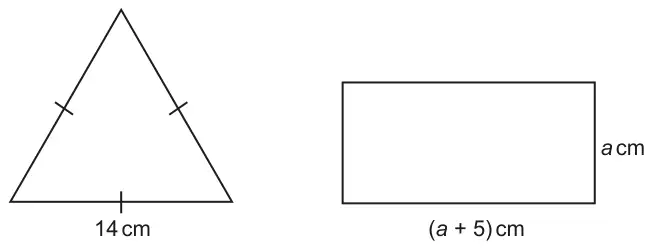
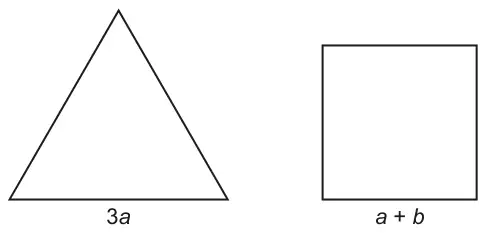
23 The diagram shows an equilateral triangle and a rectangle.
Not to scale
The equilateral triangle has the same perimeter as the rectangle.
Find the value of \(a\). [4]
Mark scheme
Answer
Marks
Part marks and guidance
8
4
M2 for \(a + a + a + 5 + a + 5 = 42\) oe or M1 for \(3 \times 14\) oe or \(a + a + a + 5 + a + 5\) oe
AND
M1 for \(a = \frac{42 - 10}{4}\) oe or FTtheir equation of the form \(ka + c = d\) oe to \(a = \frac{d - c}{k}\) oe
Allow M2 if correct expression seen first and then incorrectly simplified before equation = 42
M1 implied by 42 or \(4a + 10\) oe
FT only from written equation Where \(k\), \(c\) and \(d\) are positive integers and \(k \gt 1\) Allow M1 for one trial into \(2(a + 5) + 2a\) evaluated correctly
15 In this question all measurements are in centimetres.
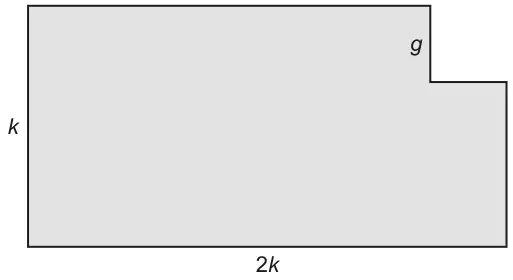
The shaded shape is made by cutting a square from the corner of a rectangle.
The width of the rectangle is \(k\). The length of the rectangle is \(2k\). Each side of the square is \(g\).
(a) Write down the relationship between the length and the width of the rectangle. [1]
(b) Find an expression for the area of the shaded shape. Give your answer in its simplest form. [2]
(c)
(i) Find an expression for the perimeter of the shaded shape. Give your answer in its simplest form. [3]
(ii) Find the value of \(k\) when the perimeter of the shaded shape is 62.4. [2]
Mark scheme (a)
Answer
Marks
Part marks and guidance
The length is twice the width oe or The width is half the length
1
“Twice” or “double” or “half” is not enough unless it is clear that length = 2 × width
Accept \(2k\) is double \(k\) oe or \(L = 2W\) oe
Do not accept values or length = \(2 \times k\)
Mark the best response as long as it is not contradictory or has an incorrect statement
Mark scheme (b)
Answer
Marks
Part marks and guidance
\(2k^2 - g^2\) final answer
2
M1 for \(2k \times k - g \times g\) oe
Ignore units if included oe for M1 may be e.g. \(2k \times k - g^2\)
Mark scheme (c)
Answer
Marks
Part marks and guidance
(i) \(6k\) final answer
3
B2 for correct answer unsimplified or B2 for \(6k - 2g\) [\(+ g + g\)] or M2 for \(2k + k + 2k - g + k - g\) [\(+ g + g\)] oe or M1 for [height =] \(k - g\) or [length =] \(2k - g\)
Condone \(6k + 0\)[\(g\)] for 3 marks Accept in any order Accept e.g. \(2g\) for \(g + g\)
Identified or seen on diagram in correct position
(ii) 10.4 nfww
2
M1 for their part (i) = 62.4 or \(\frac{62.4}{6}\)
Their part (i) must be algebraic in terms of \(k\) or \(k\) and \(g\) Their (a) can be rearranged
Note: \(6k - 2g = 62.4\) scores M1 but does not score the second mark as from wrong working
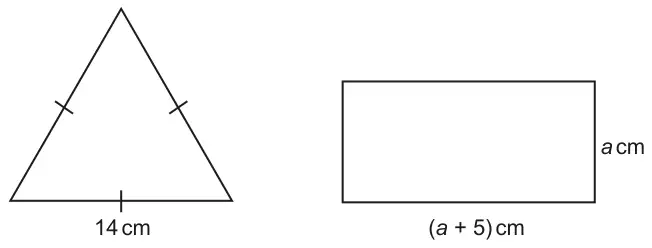
10 The diagram shows an equilateral triangle and a rectangle.
Not to scale
The equilateral triangle has the same perimeter as the rectangle.
Find the value of \(a\). [4]
Mark scheme
Answer
Marks
Part marks and guidance
8
4
M2 for \(a + a + a + 5 + a + 5 = 42\) oe or M1 for 3 × 14 oe or \(a + a + a + 5 + a + 5\) oe
AND
Allow M2 if correct expression seen first and then incorrectly simplified before in eqn = 42 M1 implied by 42 or \(4a + 10\) oe
M1 for \(a = \frac{42 - 10}{4}\) oe or FT their equation of the form \(ka + c = d\) oe to \(a = \frac{d - c}{k}\) oe
FT only from written equation Where \(k\), \(c\) and \(d\) are positive integers and \(k \gt 1\) Allow M1 for one trial into \(2(a + 5) + 2a\) evaluated correctly
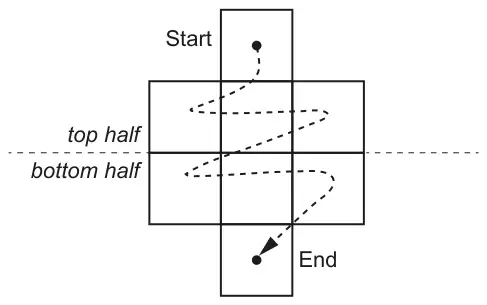
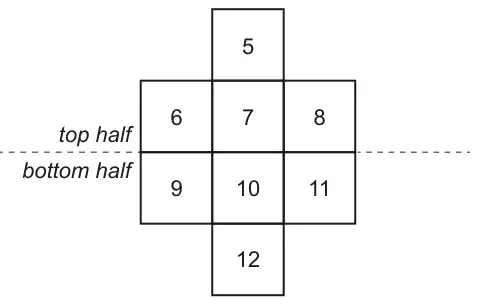
10 Eight consecutive numbers are written in ascending order in this grid, starting from the top and working left to right.
(a) Kareem writes the numbers 5 to 12 in the grid.
Show that for Kareem’s grid, the sum of the numbers in the top half of the grid is 16 less than the sum of the numbers in the bottom half of the grid. [1]
(b)Use algebra to prove that for any set of eight consecutive numbers written in this grid in the same way, the sum of the numbers in the top half of the grid is 16 less than the sum of the numbers in the bottom half of the grid. [5]
Mark scheme (a)
Answer
Marks
Part marks and guidance
(9 + 10 + 11 + 12) – (5 + 6 + 7 + 8) = 16
1
May be shown in stages Accept 42 – 26 = 16
May be explained via sum of differences of paired cells eg 4 × 4 from (9 – 5), (10 – 6) etc
For M2 and M1 FT expressions of form \(an + b\), \(b \ne 0\) eg. Top half: \(2n + (2n + 1) + (2n + 2) + (2n + 3) = 8n + 6\) Bottom half: \((2n + 4) + (2n + 5) + (2n + 6) + (2n + 7) = 8n + 22\) Accept unsimplified or simplified for M marks
M2 for algebraic sums for top half and bottom half of grid or M1 for algebraic sum for top half or bottom half of grid
AND
A1dep for sum of bottom half – sum of top half = 16 shown algebraically or explained from correct working.
A1 is dep on B2M2 scored Condone \(\begin{array}{r} 4n + 22 \\ [-]\ 4n + 6 \\ \hline 16 \end{array}\) A0 for \(4n + 22 - 4n + 6\) or for just 22 – 6 or for use of \(2n\), \(2n + 1\), \(2n + 2\) etc as their algebraic terms
Alternative method for pairs of numbers B2 as above AND M2 for the difference of four pairs of algebraic terms from top and bottom calculated or M1 for the one pair of algebraic terms from top and bottom calculated AND A1dep for all four differences summed to 16 shown numerically or explained from correct working
eg. “difference between \(n\)+4 and \(n\) is 4”
If 0 scored, allow SC1 for a correct numerical or described example showing an overall difference of 16
3 Four numbers are written, in ascending order, as algebraic expressions.
\(a \qquad a + b \qquad a + 2b \qquad 3a - b\)
The mean of these four numbers is 27. The range of these four numbers is 24.
Find the value of \(a\) and the value of \(b\). You must show your working. [5]
Mark scheme
Answer
Marks
Part marks and guidance
[\(a =\)] 15.6 [\(b =\)] 7.2 with correct working
5
B4 for one correct answer with correct working
“Correct working” requires evidence of at least M1M1 for the two equations and M1 for some evidence of solving them
OR
M1 for \(\dfrac{a + a + b + a + 2b + 3a - b}{4} = 27\) oe
e.g. \(6a + 2b = 108\)
M1 for \(3a - b - a = 24\) oe
e.g. \(2a - b = 24\)
M1 for equating coefficients of one variable for their linear equations
dependant on two linear equations e.g. \(6a - 3b = 72\) or \(4a - 2b = 48\) or \(3a + b = 54\)
M1 for correct method to eliminate one variable for their original linear equations
dependant on two linear equations e.g. \(5b = 36\) Allow one numerical error in each step of solving their equations A sign error is not an arithmetic error
If 0, M1 or M2 scored, instead award SC3 for answers 15.6 and 7.2 with no working or insufficient working If 0 or M1 scored, instead award SC2 for \(a = 7.2\) and \(b = 15.6\) with no working or insufficient working If 0 scored, instead award SC1 for two answers which satisfy one of the original conditions
Substitution method: M1 and M1 for the two equations M1 dependant on two linear equations and for rearranging one equation to make one variable the subject e.g. \(a = \frac{24 + b}{2}\) M1 for substituting it into their other equation
Trials (need to see the mean or total, and the range evaluated for each): M1 for each correct trial up to a maximum of 3 After three correct trials, correct final answers score 5
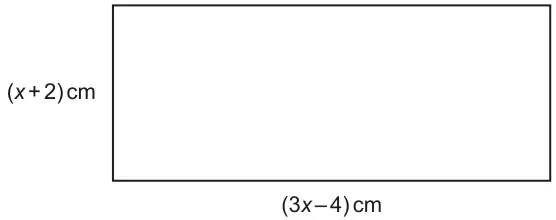
21 The diagram shows a rectangle with length \((3x - 4)\) cm and width \((x + 2)\) cm.
Not to scale
The length of the rectangle is twice the width of the rectangle.
Calculate the area of the rectangle. You must show your working. [6]
Mark scheme
Answer
Marks
Part marks and guidance
200 with correct working
6
M1 for \(2(x + 2) = 3x - 4\) oe M1 for reaching \(ax = b\) FT their equation A1 for \(x = 8\) OR Trials M1 for one trial into \(2(x + 2)\) and \(3x - 4\) evaluated correctly M1 for two trials of \(2(x + 2)\) and \(3x - 4\) evaluated correctly A1 for [\(w =\)] 10 and [\(l =\)] 20 AND M2 for (their \(x\) \(+ 2) \times (3 \times\) their \(x\) \(- 4)\) or M1 for (their \(x\) \(+ 2)\) or \((3 \times\) their \(x\) \(- 4)\)
If 0 or M1 scored, instead allow SC2 for answer 200 with no or insufficient working If 0 scored, instead allow SC1 for \(x = 8\) with no or insufficient working
“Correct working” requires evidence of at least M1M1A1 or alternate convincing approach
FT from an equation with \(x\) on both sides only.
their \(x\) must be a positive integer and stated
their \(x\) or their length/width may be on the diagram
Finley hired a motorhome and travelled 560 miles. The total cost of hiring the motorhome was £916.
Calculate how many days Finley hired the motorhome for. You must show your working. [5]
Mark scheme
Answer
Marks
Part marks and guidance
6 with correct working
5
M1 for \(560 \times 0.6\) or \(560 \times 60\) M1 for \(916 - 130\) or \(916 -\) their \((560 \times 0.6)\) M1 for \(916 - (130 +\) their \((560 \times 0.6))\) M1 for \((916 - (130 +\) their \((560 \times 0.6))) \div 90\)
Trials M4 for \(560 \times 0.6 + 5 \times 90 + 130 = 916\) oe or M3 for two trials of the form \(560 \times 0.6 + n \times 90 + 130\) oe seen and correctly evaluated where \(n \geqslant 1\), \(n \ne 5\) or M2 for one trial of the form \(560 \times 0.6 + n \times 90 + 130\) seen and correctly evaluated where \(n \geqslant 1\), \(n \ne 5\) or M1 for \(560 \times 0.6\) [\(+\ldots\)]
If 0, 1 or 2 scored, instead award SC3 for answer 6 with no working or insufficient working If 0 or 1 scored, instead award SC2 for answer 5 with no working or insufficient working If 0 scored, SC1 for 450 with no working or insufficient working
“Correct working” requires evidence of at least M3 or M1 M1 M1
Their \(560 \times 0.6\) may be \(560 \times 60\) with an attempt to convert to pounds
\(\div 90\) may be repeated subtraction or addition
egs for Trial and +90s M4 for \(560 \times 0.6 + 3 \times 90 + 130 = 736\) and \(736 + 90 + 90 = 916\) M3 for \(560 \times 0.6 + 3 \times 90 + 130 = 736\) and \(736 + 90 = 826\) M2 for \(560 \times 0.6 + 3 \times 90 + 130 = 736\) M1 for \(560 \times 0.6\) [\(+\ldots\)]
For trials and trials + 90s, accept correct rearrangements that have a target of 786, 580 or 450 rather than 916
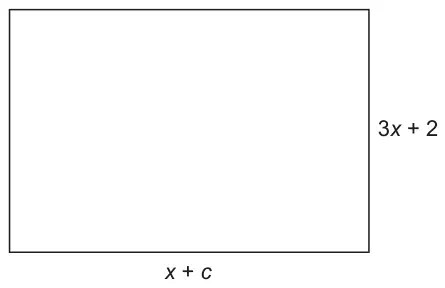
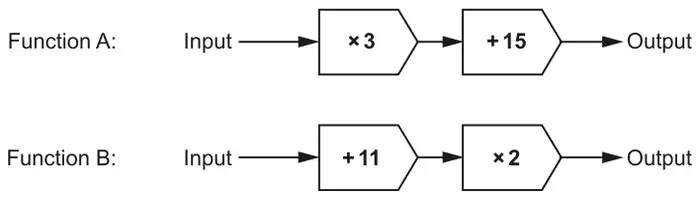
5 is input into Function A. 5 is also input into Function B. The output of Function A is 10 times the output of Function B.
Work out the value of \(k\). You must show your working. [5]
Mark scheme
Answer
Marks
Part marks and guidance
[0].7 oe with correct working
5
By Equation: M3 for \(5k + 21\) and \(10(5 - 1.5)k\) oe or M1 for \(5k + 21\) M1 for \((5 - 1.5)k\) or \(3.5k\)
AND
M1FT for \(30k = 21\)
“correct working” requires evidence of at least M3
\(5k + 21\) [M1] = \(26k\) [isw, but ruled out of M3 and M1FT if \(26k\) used] \(5 - 1.5k = 3.5k\) [M1 bod]
FT their linear equation in the form \(ak + b = ck\)
If 0 or 1 scored, instead award SC2 for answer [0].7 with no working or insufficient working If 0 scored, instead award SC1 for \(-\frac{140}{31}\) or −4.516… to −4.52 as final answer
SC1 is from ×10 of wrong function
By Trials: M4 for \(5k + 21\) and either \(10(5 - 1.5)k\) oe or \((5 - 1.5)k\) oe both correctly evaluated with \(k = 0.7\)
or
M3 for \(5k + 21\) and either \(10(5 - 1.5)k\) oe or \((5 - 1.5)k\) oe both correctly evaluated in one trial with consistent \(k\)
or M1 for \(5k + 21\) correctly evaluated in one trial M1 for either \(10(5 - 1.5)k\) oe or \((5 - 1.5)k\) oe correctly evaluated in one trial
21 The length of a word is classed as short, medium or long depending on the number of characters in the word.
This table shows the percentage, in terms of \(x\), of each word length found in a book.
Length of word
Percentage (%)
Short
\(2x + 5\)
Medium
\(3x - 1\)
Long
\(x\)
Find the percentage of words in this book which are classed as short words. You must show your working. [5]
Mark scheme
Answer
Marks
Part marks and guidance
37 with correct working
5
M1 for \(2x + 5 + 3x - 1 + x = 100\) may be implied by a subsequent correct equation
M1 for simplifying their equation to \(ax + b = c\) or \(6x + 4 = 100\)
M1 for the first correct step in solving their \(ax + b = c\)
and
M1 for substituting their 16 into \(2x + 5\)
OR
M3 for one complete correct evaluation of \(2x + 5 + 3x - 1 + x = 100\) or M2 for one complete correct evaluation of \(2x + 5 + 3x - 1 + x =\) a total or M1 for one correct evaluation of each expression \(2x + 5\) [+] \(3x - 1\) [+] \(x\)
If 0, 1 or 2 scored, instead award SC3 for answer 37 with no or insufficient working
If 0 or 1 scored, instead award SC2 for \(x = 16\) with no or insufficient working
“Correct working” requires evidence of first method and at least M1 and \(x = 16\) or M3 if using trials or M2M1 for non-algebraic method Three separate expressions are not enough
Ignore inclusion of % in working
\(6x + 4 = 100\) scores M1M1
e.g. \(6x = 100 - 4\) \(6x = 96\) scores M1M1M1
For M marks with trials: allow each term or each expression from the question evaluated separately e.g. (Use 10) 20 + 5 + 30 – 1 + 10 = 64 or 25 (+) 29 (+) 10 = 64
19 The graph shows the velocity of a particle over the first 20 minutes of its motion.
Not to scale
Between 7 minutes and 15 minutes the velocity of the particle is \(v\) metres per minute. The average velocity of the particle over the 20 minutes is 11.55 metres per minute.
Find the value of \(v\). You must show your working. [5]
Mark scheme
Answer
Marks
Part marks and guidance
16.5 with correct working
5
M1 for 11.55 × 20 implied by 231
AND
M2 for \(\frac{1}{2}\)(20+(15 – 7)) × \(v\) implied by \(14v\) or \(\frac{28v}{2}\) or M1 for an attempt at area e.g. one of the three areas correct e.g. \(\frac{1}{2}\) × 7 × \(v\)
M1 for their 231 ÷ their 14 oe
If 0 or M1 scored, instead award SC2 for answer 16.5 with no or insufficient working
“Correct working” requires evidence of at least M1 AND M2
Condone letters other than \(v\) and working could be on the diagram.
in parts \(\frac{1}{2}\) × 7 × \(v\) + (15−7) × \(v\) + \(\frac{1}{2}\) ×(20−15) × \(v\) For M2 allow a proportionality argument e.g. \(\frac{1}{2}\) × 7 mins + (15 − 7) mins + \(\frac{1}{2}\) × (20 − 15) mins [= 14 mins at \(v\) m/min] their 231 is any number derived from 11.55 and implied by 0.825 and their 14 has got to be an attempt at the whole ‘area’ implied by e.g 20
condone the use of trials, we must see one at 16.5, award M2 for a trial at 16.5 and M1 for any other positive trial (see appendix)
Appendix: Question 19
Trials are for values of \(v\) and evaluate the area ÷20 so here are some :
16 The diagram shows a quadrilateral and an equilateral triangle. The perimeter of the quadrilateral is equal to the perimeter of the equilateral triangle.
Not to scale
Find an expression for the length of one side of the equilateral triangle. Give your answer in terms of \(x\) in its simplest form. [4]
Mark scheme
Answer
Marks
Part marks and guidance
\(7x + 3\) final answer
4
M2 for \(21x + 9\) isw or M1 for \(5x + 4 + x + 2 + 9x - 5 + 6x + 8\)
M1 for their \((21x + 9) \div 3\)
Must be an algebraic expression in the form \(ax + b\) \(b \ne 0\)
SR is 6 cm longer than PQ. The area of quadrilateral PQRS is \(A\) cm2.
Write a simplified expression for the length PQ in terms of \(A\). You must show your working. [5]
Mark scheme
Answer
Marks
Part marks and guidance
\(\frac{A}{10} - 3\) or \(\frac{1}{10}(A - 30)\) or \(\frac{A - 30}{10}\) with correct working
or other simplified equivalents
5
B4 for \(\frac{A\text{cm}^2}{10} - 3\) etc with correct working
OR
The below assumes PQ = \(x\). Mark similarly use of SR = \(x\).
M2 for \(10x + \frac{1}{2} \times 6 \times 10\) or \(\frac{10(x + x + 6)}{2}\) oe or for \(10x\) and 30, may be indicated on diagram A1 for [\(A\) =] \(10x + 30\) or \(10(x + 3)\)
or
M1 for lengths \(x\) and \(x + 6\) oe or for area \(10x\) or area 30
AND
M1FT for \(10x = A - 30\) or \(x + 3 = \frac{A}{10}\)
If 0 or 1 scored, instead award SC2 for \(\frac{A}{10} - 3\) or \(\frac{1}{10}(A - 30)\) or \(\frac{A - 30}{10}\) with no or insufficient working
‘Correct working’ requires evidence of at least M2
Condone use of PQ, PQ + 6 etc instead of \(x\) and \(x + 6\)
Working may be on diagram
For M2 accept area \(A - 30\) for area \(10x\)
For A1 accept equivalents such as \(\frac{A}{5} = 2x + 6\), \(2A = 20x + 60\)
For M and A marks, both lengths must be in terms of the same variable eg PQ and PQ + 6, not \(x\) and \(y\) unless \(y = x + 6\) subsequently seen
FT \(ax + b = A\) or \(a(x + b) = A\) (\(a \ne \pm 1\) or 0, \(b \ne 0\))
9 The sides of this triangle are given in centimetres. The perimeter of the triangle is 80 cm.
Not to scale
(a) Find the length of each side of the triangle. You must show your working. [5]
(b) Is the triangle above a right-angled triangle? Use calculations to show how you decide. [3]
Mark scheme (a)
Answer
Marks
Part marks and guidance
16, 30, 34 in any order with correct working
5
M1 for \(x + 5 + 3x + 1 + 2x + 8 = 80\) may be implied by a subsequent correct equation M1 for simplifying their equation to \(ax + b = c\) implied by \(6x + 14 = 80\) M1 for the first correct step in solving their \(ax + b = c\) e.g. \(6x = 80 - 14\) M1 for substituting their 11 into \(x + 5\), \(3x + 1\) and \(2x + 8\)
Alternative method using trials M2 for at least one complete correct evaluation of \(x + 5 + 3x + 1 + 2x + 8\)
If 0 or 1 scored, instead award SC2 for 16, 30, 34 in any order with no or insufficient working
If 0 scored SC1 for \(x = 11\) with no or insufficient working
“Correct working” requires evidence of at least M1 leading to \(x = 11\) or M2 if using trials
Note for all methods: \(x = 11\) scores M1M1M1 if there is some supporting work but on its own scores SC1 Alternative method M2 for 80 – 5 – 1 – 8 oe or 66 or M1 for 5 + 1 + 8 or 14 M1 for their 66 ÷ their 6 implied by 11 M1 for substituting their 11 into \(x + 5\), \(3x + 1\) and \(2x + 8\)
Mark scheme (b)
Answer
Marks
Part marks and guidance
Their fully correct conclusion after M2 scored
3
M2 for \(\sqrt{(their\ 16)^2 + (their\ 30)^2}\) correctly evaluated or for (their 16)\(^2\) + (their 30)\(^2\) and (their 34)\(^2\) both correctly evaluated
OR
M1 for \(\sqrt{(their\ 16)^2 + (their\ 30)^2}\) either not evaluated or incorrectly evaluated or for (their 16)\(^2\) + (their 30)\(^2\) and (their 34)\(^2\) either not evaluated or incorrectly evaluated or for (their 16)\(^2\) + (their 30)\(^2\) correctly evaluated
eg 3 marks for Yes, \(\sqrt{16^2 + 30^2} = 34\) Yes, \(16^2 + 30^2 = 1156\) and \(34^2 = 1156\) or eg after 15, 30, 34 No, \(15^2 + 30^2 = 1125\) and \(34^2 = 1156\)
Adapt the scheme for equivalent correct methods e.g. Pythagoras using hypotenuse and subtraction
Appendix: Question 9(b)
Alternative methods Cosine rule : [cos … =] \(\frac{16^2 + 30^2 - 34^2}{2 \times 16 \times 30}\) = 0 hence angle … = 90 M1 for correct cos rule statement for angle, M1 for 0 OR \(\cos^{-1}\) or arc cos with 90 and A1 for “Yes” (A1 dep on M2)
Algebra : M1 for both \((x + 5)^2 + (2x + 8)^2 = x^2 + 10x + 25 + 4x^2 + 32x + 64 = 5x^2 + 42x + 89\) and \((3x + 1)^2 = 9x^2 + 6x + 1\) [ leading to \(4x^2 - 36x - 88 = 0\) and \((x - 11)(4x + 8)\) ] and M1 for substituting \(x = 11\) into \(5x^2 + 42x + 89\) and \(9x^2 + 6x + 1\) and getting 1156 or for accepting \(x = 11\) and rejecting \(x = -2\) for correct reason “Yes”
Trigonometry(not cos rule) : The use of sin, cos or tan to find the other two acute angles will not lead to an exact angle of 90° therefore award just M1 for two correct statements, one about each angle e.g \(\sin[\ldots] = \frac{16}{34}\) and \(\sin[\ldots] = \frac{30}{34}\) and M1 for two angles to at least 2 dp e.g. 28.07[2…] and 61.92[7…] or 61.93 an award max. of M2 because this method will not show exactly that it is a right-angle. The one exception is \(\sin^{-1}\left(\frac{16}{34}\right) + \sin^{-1}\left(\frac{30}{34}\right)\) etc which, if seen, could score 3 marks.
Work out the numbers. You must show your working. [5]
Mark scheme
Answer
Marks
Part marks and guidance
[127] 148 149 296 in any order With correct working
5
M3 for \(4x\) and 592 or for \((180 \times 4 - 127 - 1) \div 4\) A1 for 148
“correct working” requires at least M2
\(180 \times 4\) can be implied by 720 throughout
or M2 for a correct algebraic expression and correct constant or for \(180 \times 4 - 127\ [-\ 1]\) or for \(127 + 148 + 149 + 296 = 180 \times 4\) oe or for trials leading to the correct answer
eg \(127 + x + x + 1 + 2x\) and 720; \(4x + 1\) and 593 Do not accept \(x\), \(2x\) or \(x + 1\) as correct algebraic expressions for M2
Condone e.g. \(127 + x + x + 1 + 2x \div 4\) for M1
or M1 for \(127 + x + x + 1 + 2x\) nfww or \(180 \times 4\) or 720
Mark to candidates advantage
If 0 or 1 scored, instead award SC2 for 148 149 296 in any order with no or insufficient working
17 Charlie is making some wooden frames. Charlie has a strip of wood 1.6 m long and 2 cm wide.
Not to scale
Each frame will be made from four pieces of wood cut from the strip to form a rectangle, as shown below.
Not to scale
The width of each frame is \(x\) cm. The length of each frame is \(2x\) cm. The area enclosed by each frame must be 96 cm2.
Work out the maximum number of frames Charlie can make from the 1.6 m length of wood. You must show your working. [6]
Mark scheme
Answer
Marks
Part marks and guidance
3 frames with correct working
6
“Correct working” requires B5
Algebraic method: B5 for [one frame =] 52 [cm] with \(x = 10\) and \(2x^2 - 12x - 80\) [= 0] or better or M3 for \(2x^2 - 12x - 80\) [= 0] or better A1 for [\(x\) =] 10 or M2 for \((2x - 4)(x - 4)\) [= 96] oe or better seen or B1 for \(2x - 4\) or \(x - 4\) seen
For B5 and M3A1 isw for use of \(x = -4\)
For B5 or M3 allow equivalent 3 term quadratic e.g. \(2x^2 - 12x = 80\)
Allow equivalents for M2 e.g. \(2 \times 2 \times 2x + 2 \times 2(x - 4) + 96 = 2x^2\)
May be on diagram
OR
Trial and improvement: B5 for [one frame =] 52 [cm] with \(x = 10\) and 16 by 6 [= 96] shown or B4 for \(x = 10\) and 16 by 6 [= 96] selected or B3 for selects 6 by 16 [= 96]
B3 not just for seeing 6 by 16 it must be selected in some way e.g. ringed, underlined, used
If 0, 1 or 2 scored, instead award SC3 for [one frame =] 52 [cm] with no or insufficient working If 0 or 1 scored, instead award SC2 for \(x = 10\) with no or insufficient working
16 A town square has a fountain (F) at the centre. There is also a bell tower (B) and a statue (S).
The bearing of the statue from the fountain is \(x^\circ\).
Not to scale
(a) The bearing of the bell tower from the fountain is \(140^\circ\) more than the bearing of the statue from the fountain.
Write down, in terms of \(x\), the bearing of the bell tower from the fountain. [1]
(b) The bearing of the bell tower from the fountain is also three times the bearing of the statue from the fountain.
Work out the bearing of the bell tower from the fountain. [4]
Mark scheme (a)
Answer
Marks
Part marks and guidance
\(x + 140\)
1
Mark scheme (b)
Answer
Marks
Part marks and guidance
210 nfww
4
B1 for \(3x\) M1 for \(3x = \textit{their}\ (x + 140)\)
their \((x + 140)\) cannot be numeric and must lead to an equation that can be solved when equated to \(3x\) eg if their \((x + 140)\) is \(3x\) then M0
A1FT for \(x = 70\)
FT correctly solving their linear equation in \(x\)
Dependent on first M1 and not from rearrangement of original equation
\(x^2\) and/or \(8x + 20\) may be written with correct shape(s)
Correctly rearranging to \(x^2 - 8x - 20 = 0\) without error
A1
Mark scheme (b)
Answer
Marks
Part marks and guidance
\(-2\) 10 nfww
3
B2 for one correct solution nfww
OR M2 for \((x + 2)(x - 10) = 0\) or M1 for \((x + a)(x + b)\) where \(ab = -20\) or \(a + b = -8\)
OR M2 for two correct trials using \(-4 \leqslant x \leqslant 0\) and two correct trials using \(8 \leqslant x \leqslant 12\) or M1 for two correct trials using \(-4 \leqslant x \leqslant 0\) or two correct trials using \(8 \leqslant x \leqslant 12\)
If 0 scored SC1 for answers 2 and −10
e.g. one trial is when \(x = 2\), \(2^2 - 8 \times 2 - 20 = -32\) Accept as trial \(x = 2\) and \(-32\) See trials table below
Guidance
Trials for Q22(b)
\(x\)
\(x^2\)
\(-8x\)
\(-20\)
total
−4
16
32
−20
28
−3
9
24
−20
13
−2
4
16
−20
0
−1
1
8
−20
−11
0
0
0
−20
−20
8
64
−64
−20
−20
9
81
−72
−20
−11
10
100
−80
−20
0
11
121
−88
−20
13
12
144
−96
−20
28
Mark scheme (c)
Answer
Marks
Part marks and guidance
Length [of square] cannot be negative
1
Dependent on negative answer in (b)
Do not accept \(x\) cannot be negative
Mark scheme (d)
Answer
Marks
Part marks and guidance
(i) 100
1
FT (their positive root from (b))\(^2\)
If two positive roots seen in (b) accept either or both used in (i) and in (ii) BUT, if one answer right and one wrong in any part, 0 marks
(ii) 25
1
FT (their positive root from (b)) \(\times 2 + 5\)
22 Kai buys 5 drinks and 3 cakes for £16.35. Azmi buys 2 drinks and 6 cakes for £14.70. Assume that each drink costs the same and that each cake costs the same.
Calculate the cost of one drink and the cost of one cake. You must show your working. [5]
Mark scheme
Answer
Marks
Part marks and guidance
[\(d =\)] 2.25 [\(c =\)] 1.7[0] with correct working
5
B4 for 1 correct answer with correct working
OR
M1 for \(5d + 3c = 16.35\) oe M1 for \(2d + 6c = 14.7[0]\) oe M1 for method to find a common coefficient, allow 1 arithmetic error M1 for correct method to eliminate 1 variable, allow one arithmetic error
OR
If 0 or M1 scored instead award SC2 for both answers correct with no or insufficient working or SC1 for two answers which satisfy one of the original equations
Accept other variables for \(d\) and \(c\) “Correct working” requires evidence of at least M1M1M1
Correct answers from trial and improvement score 5
If substitution method used M1 for correct rearrangement of equation M1 for correctly substituting into other equation
15 A rectangle is three times as long as it is wide. It has a perimeter of 44 cm.
Find the length of the rectangle. [4]
Mark scheme
Answer
Marks
Part marks and guidance
16.5
4
B3 for 5.5 [cm] nfww or M2 for \(3x + x + 3x + x = 44\) or better or \(44 \div 8\) oe or M1 for \(3x\) [as length] and \(x\) [as width] or \(4x\) [as length + width] or \(8x\) [as perimeter]
OR Using trial length and width with length \(= 3 \times\) width M1 for a perimeter found M1 for a second perimeter closer to 44
(i) Jo chooses a number, \(x\). She inputs \(x\) into each function. The two outputs are equal.
Work out the value of \(x\). [4]
(ii) Explain why there is no other input that gives two outputs that are equal. [1]
(b) Here is function C.
Kai chooses values for \(p\) and \(q\) so that if he inputs any number into both function A and function C, he will always get two outputs that are equal.
Find the value of \(p\) and the value of \(q\). [3]
Mark scheme (a)
Answer
Marks
Part marks and guidance
(i) 7
4
M2 for \(3x + 15 = 2(x + 11)\) oe or M1 for \(3x + 15\) or \(2(x + 11)\) oe
M1 for a productive step towards solving their linear equation
Alternative method by trials: M2 for at least two complete trials using the same inputs for both functions or M1 for one complete trial using the same input for both functions
A1 for at least one correct evaluation for A and one for B
Starting equation must have x on both sides e.g. from \(3x + 15 = 2(x + 11)\): M1 for \(2x + 22\) or \(x + 15 = 22\) or \(3x = 2x + 7\) or \(1.5x + 7.5 = x + 11\) e.g. from \(3x + 15 = 2x + 11\): M1 for \(x + 15 = 11\) or \(3x = 2x - 4\)
(ii) Because \(3x + 15\) and \(2(x + 11)\) are not equivalent oe
OR
\(3x + 15 = 2(x + 11)\) only has one solution oe
1
If not using the words ‘not equivalent’, must clearly imply that the two expressions will not be equal for all values of \(x\)
The mark is unlikely to be awarded unless algebra is used
Mark scheme (b)
Answer
Marks
Part marks and guidance
\(p = 5\), \(q = 3\)
3
B1 for \(p = 5\) or \(q = 3\)
M1 for \(q(x + p)\) oe or [\(3x + 15 =\)] \(3(x + p)\) or [\(3x + 15 =\)] \(q(x + 5)\)
If no working SC1 for \(p = 3\) and \(q = 5\) as answers
May be seen with a particular value of \(x\), eg. \(q(2 + p)\)
24 In this question, all lengths are in centimetres.
Here is a square.
Not to scale
Find the length of one side of the square when \(b = 4\). [6]
Mark scheme
Answer
Marks
Part marks and guidance
18 nfww
6
B4 for \(2a = 5\) OR M3 for \(6a - 4a = 8 - 4 + 1\) or better or M2 for \(6a + 4 - 1 = 4a + 2 \times 4\) or better or \(6a - 4a = 2b - b + 1\) or better or M1 for \(6a + b - 1 = 4a + 2b\)
AND
M1dep for correct substitution of 4 and their 2.5 in \(4a + 2b\) or \(6a + b - 1\)
Isolating \(a\)
Expect \(6a + 3 = 4a + 8\) Expect \(2a = b + 1\)
Dependent on at least M1 or B4 May be implied by 10 + 8 or 15 + 3
10 Nine consecutive numbers are written on a 3-by-3 grid. They are arranged, in ascending order, in a spiral as shown.
(a) Karen writes the numbers 3 to 11 on her grid.
3
4
5
10
11
6
9
8
7
The total of the first column is \(3 + 10 + 9 = 22\).
Karen says
The total of the first column is one less than the total of the second column.
Show that this is correct for Karen’s grid. [1]
(b) Victor says
If any nine consecutive numbers are arranged in ascending order in this spiral on a 3-by-3 grid, the total of the first column will always be one less than the total of the second column.
Prove that Victor is correct. [5]
Mark scheme (a)
Answer
Marks
Part marks and guidance
4 + 11 + 8 = 23 seen
1
Accept written as a sum in a column
Mark scheme (b)
Answer
Marks
Part marks and guidance
e.g. First column: \(n + (n + 7) + (n + 6) = 3n + 13\)
B2 for consistent algebraic terms for at least first two columns of the grid or B1 for at least 3 algebraic terms for consecutive numbers seen
AND
M1 for algebraic sum of first or second column shown M1 for algebraic sum of first and second columns shown and correctly simplified A1 for sum of second column – sum of first column = 1 calculated or explained from correct working
or
M1 for difference of one pair of algebraic terms from first and second column shown M1 for differences of two further pairs of algebraic terms from first and second column, with all three pairs correctly simplified A1 for each difference found as +1 or –1 oe and summed/explained to a difference of +1. Correct algebra and reasoning throughout
If 0 scored, allow SC1 for a correct numerical or descriptive example using either method and stating an overall difference of 1
e.g. \(n\), \((n + 7)\), \((n + 6)\) and \((n + 1)\), \((n + 8)\), \((n + 5)\)
e.g. \(n\), \((n + 1)\), \((n + 2)\)
e.g. \(n + (n + 7) + (n + 6)\) or in column e.g. \(n + (n + 7) + (n + 6) = 3n + 13\)
A1 for e.g. \(3n + 14\) and \(3n + 13\) and “second column is 1 more than the first” but A0 for e.g. \(3n + 14\) and \(3n + 13\) and “difference of 1” or for \((3n + 14) - 3n + 13 = 1\)
e.g. “the difference between \(n + 1\) and \(n\) is 1” e.g. “\(n + 1\) is 1 more than \(n\)”
9 Mr and Mrs Jones buy cinema tickets for themselves and their three children. The cost of an adult ticket is £6 more than a child ticket. The total cost of the five tickets is £45.
Work out the cost of an adult ticket. [5]
Mark scheme
Answer
Marks
Part marks and guidance
12.6[0]
5
B4 for 6.6[0] nfww
OR (working with \(x\) as cost of a child) M1 for \(x + 6\) M1 for \(x + 6 + x + 6 + x + x + x = 45\) M1 for \(5x + 12 = 45\)
OR (working with \(y\) as cost of adult) M1 for \(y - 6\) M1 for \(y + y + y - 6 + y - 6 + y - 6 = 45\) M1 for \(5y - 18 = 45\) M1 for \(5y = 63\)
OR M1 for \(a = c + 6\) or \(a = x + 6\) or \(c = a - 6\) M1 for \(2a + 3c = 45\) oe M1 for correct method to eliminate one variable. Allow one arithmetic error
8 The diagrams show the price paid by two groups of people visiting a funfair.
Assume each adult pays the same price and each child pays the same price.
Find the price for an adult and the price for a child. [5]
Mark scheme
Answer
Marks
Part marks and guidance
[adult =] 12[.00] [child =] 4.5[0]
5
B1 for \(5a + 4c = 78\) B1 for \(3a + 6c = 63\) M1 for multiplying/dividing both equations to get the coefficient of one variable equal (allow one error) M1 for correctly adding or subtracting both equations to eliminate one variable (allow one error)
25 Bennie is 7 years older than Ayesha. Chloe is twice as old as Bennie. The sum of their three ages is 57.
Work out the ages of Ayesha, Bennie and Chloe. [6]
Mark scheme
Answer
Marks
Part marks and guidance
9 16 32
6
Allow any letter providing use is consistent this method assumes Ayesha’s age = \(a\) B4 for \(a + a + 7 + 2(a + 7) = 57\) or better
OR
B1 for [\(b =\)] \(a + 7\) oe e.g. \(a = b - 7\) B1 for \(c = 2b\) oe e.g. \(\dfrac{c}{2} = b\) or [\(c =\)] \(2(a + 7)\) B1 for their’\(a\)’ + their’\(b\)’ + their’\(c\)’ = 57 e.g. \(a + b + c = 57\) must be algebraic
AND
M1FT for correctly solving their linear equation in one variable e.g. \(4a = 36\) and \(a = 9\)
AND
M1 for substituting their \(a\) into \(b = a + 7\) and \(c = 2b\) e.g. \(a = 8\), \(b = 15\) and \(c = 30\) implied by their answer which must be integers
See appendix for other methods
Mark working first,
if 0 scored then SC2 for 2 answers correct in the correct place or SC1 for 1 answer correct in the correct place
or if 1 scored then award the better of 1 or SC2 for 2 answers correct in the correct place
to a maximum of 5 marks
Appendix
Q25 Alternatives
e.g. assumes Bennie’s age = \(b\) B4 for \(b - 7 + b + 2b = 57\) or better OR B1 for [\(a =\)] \(b - 7\) oe e.g. \(b = a + 7\) B1 for [\(c =\)] \(2b\) oe e.g. \(\dfrac{c}{2} = b\) or \(c = 2(a + 7)\) B1 for their’\(a\)’ + their’\(b\)’ + their’\(c\)’ = 57 e.g. \(a + b + c = 57\) must be algebraic
AND
M1FT for correctly solving their linear equation in one variable e.g. \(4b = 64\) and \(b = 16\) AND M1 for substituting their \(b\) into \(a = b - 7\) and \(\dfrac{c}{2} = b\) e.g. \(a = 8\), \(b = 15\) and \(c = 30\) implied by their answer which must be integers
e.g. assumes Chloe’s age = \(c\) B4 for \(\dfrac{c}{2} - 7 + \dfrac{c}{2} + c = 57\) or better OR B1 for [\(a =\)] \(\dfrac{c}{2} - 7\) oe e.g. \(c = 2(a + 7)\) B1 for [\(b =\)] \(\dfrac{c}{2}\) oe e.g. \(c = 2b\) or \(b = (a + 7)\) B1 for their’\(a\)’ + their’\(b\)’ + their’\(c\)’ = 57 e.g. \(a + b + c = 57\) must be algebraic
AND
M1FT for correctly solving their linear equation in one variable e.g. \(2c = 64\) and \(c = 32\) AND M1 for substituting their \(c\) into \(b = \dfrac{c}{2}\) and \(a = \dfrac{c}{2} - 7\) e.g. \(a = 8\), \(b = 15\) and \(c = 30\) implied by their answer which must be integers
13 Prove that the mean of any four consecutive even integers is an integer. [4]
Mark scheme
Answer
Marks
Part marks and guidance
\(\dfrac{(2x) + (2x + 2) + (2x + 4) + (2x + 6)}{4}\) \(= \dfrac{8x + 12}{4}\) \(= 2x + 3\) which is an integer
OR
\((2x) + (2x + 2) + (2x + 4) + (2x + 6)\) \(= 8x + 12\) \(= 4(2x + 3)\) which is divisible by 4 oe
4
M1 for \(2x\), \(2x + 2\), \(2x + 4\) and \(2x + 6\) seen and M1 for adding their four terms in \(x\), e.g. \((2x) + (2x + 2) + (2x + 4) + (2x + 6)\) and M1 for their \((8x + 12) \div 4\) or better, condoning lack of brackets, or for \(4(2x + 3)\) and A1dep (dep on M0M1M1 or M1M1M1) for correct algebraic mean for their four terms and conclusion, e.g. \(2x + 3\) is an integer or \(4(2x + 3)\) which is divisible by 4
If 0 scored, allow SC1 for a numerical example with any 4 consecutive even integers with mean correctly calculated
Or equivalent algebraic representations of 4 consecutive even numbers. In this case, \(x\) does not need to be defined as being an integer.
Using \(x\), \(x + 2\), \(x + 4\), \(x + 6\) oe does not score the first M mark unless \(x\) stated as even integer, but can score up to 3 marks for \((x) + (x + 2) + (x + 4) + (x + 6)\), their \((4x + 12) \div 4\) or better, or for \(4(x + 3)\) and the relevant conclusion
Using \(x + 1\), \(x + 3\), \(x + 5\), \(x + 7\) oe does not score the first M mark unless \(x\) stated as odd integer but can score up to 3 marks similar to above.
5 Bennie is 7 years older than Ayesha. Chloe is twice as old as Bennie. The sum of their three ages is 57.
Work out the ages of Ayesha, Bennie and Chloe. [6]
Mark scheme
Answer
Marks
Part marks and guidance
Ayesha 9 Bennie 16 Chloe 32
6
allow any letter providing use is consistent this method assumes Ayesha’s age = \(a\) B4 for \(a + a + 7 + 2(a + 7) = 57\) or better
OR
B1 for [\(b\) =] \(a + 7\) oe e.g. \(a = b - 7\) B1 for \(c = 2b\) oe e.g. \(\frac{c}{2} = b\) or [\(c\) =] \(2(a + 7)\) B1 for their ‘\(a\)’ + their ‘\(b\)’ + their ‘\(c\)’ = 57 e.g. \(a + b + c = 57\) must be algebraic
AND
M1FT for correctly solving their linear equation in one variable e.g. \(4a = 36\) and \(a = 9\)
AND
M1 for substituting their \(a\) into \(b = a + 7\) and \(c = 2b\) e.g. \(a = 8\), \(b = 15\) and \(c = 30\) implied by their answer which must be integers
see appendix for other methods
mark working first,
if 0 scored then SC2 for 2 answers correct in the correct place or SC1 for 1 answer correct in the correct place
or if 1 scored then award the better of 1 or SC2 for 2 answers correct in the correct place
to a maximum of 5 marks
Appendix: Question 5 alternatives
e.g. assumes Bennie’s age = \(b\) B4 for \(b - 7 + b + 2b = 57\) or better OR B1 for [\(a\) =] \(b - 7\) oe e.g. \(b = a + 7\) B1 for [\(c\) =] \(2b\) oe e.g. \(\frac{c}{2} = b\) or \(c = 2(a + 7)\) B1 for their ‘\(a\)’ + their ‘\(b\)’ + their ‘\(c\)’ = 57 e.g. \(a + b + c = 57\) must be algebraic
AND
M1FT for correctly solving their linear equation in one variable e.g. \(4b = 64\) and \(b = 16\) AND M1 for substituting their \(b\) into \(a = b - 7\) and \(\frac{c}{2} = b\) e.g. \(a = 8\), \(b = 15\) and \(c = 30\) implied by their answer which must be integers
e.g. assumes Chloe’s age = \(c\) B4 for \(\frac{c}{2} - 7 + \frac{c}{2} + c = 57\) or better OR B1 for [\(a\) =] \(\frac{c}{2} - 7\) oe e.g. \(c = 2(a + 7)\) B1 for [\(b\) =] \(\frac{c}{2}\) oe e.g. \(c = 2b\) or \(b = (a + 7)\) B1 for their ‘\(a\)’ + their ‘\(b\)’ + their ‘\(c\)’ = 57 e.g. \(a + b + c = 57\) must be algebraic
AND
M1FT for correctly solving their linear equation in one variable e.g. \(2c = 64\) and \(c = 32\) AND M1 for substituting their \(c\) into \(b = \frac{c}{2}\) and \(a = \frac{c}{2} - 7\) e.g. \(a = 8\), \(b = 15\) and \(c = 30\) implied by their answer which must be integers
12 In the diagram, the square and the trapezium share a common side of length \(x\) cm.
Not to scale
The area of the square is equal to the area of the trapezium.
Work out the value of \(x\). [6]
Mark scheme
Answer
Marks
Part marks and guidance
7.17 to 7.18 or 7.2 nfww
6
M3 for \(x^2 - 3x - 30 = 0\) or M2 for \(\dfrac{6}{2}(10 + x) = x^2\) oe or M1 for \(\dfrac{6}{2}(10 + x)\) oe
AND
M2FT for \(\dfrac{3 + \sqrt{(-3)^2 - 4 \times (-30)}}{2}\) or better or 7.17 to 7.18 and –4.18 to –4.17 or M1FT for either formula with at most two errors
Condone missing brackets for M1
FT from their 3 term quadratic
Allow M2FT for \(\dfrac{3 \pm \sqrt{(-3)^2 - 4 \times (-30)}}{2}\) or better
Alternative by completing the square: M2FT for \(1.5 + \sqrt{32.25}\) or \(1.5 \pm \sqrt{32.25}\) or 7.17 to 7.18 and –4.18 to –4.17 or M1FT for \((x - 1.5)^2 - 32.25\)
21 The dimensions, in centimetres, of this rectangle are shown as algebraic expressions.
Not to scale
Work out the length and width of the rectangle. [6]
Mark scheme
Answer
Marks
Part marks and guidance
15
9
6
B5 for [\(x\) =] 4.5 or \(4\frac{1}{2}\) and [\(y\) =] \(-0.5\) or \(-\frac{1}{2}\) even given as answers ORB2 for \(5x - y - 8 = 3x + 5y + 4\) or \(3x + y - 4 = 2x - 6y - 3\) and M1dep for rearranging either equation correctly so that the \(x\)’s, \(y\)’s and numbers are combined in one of the equations
and
M1dep for multiplying one equation to equate coefficients of one variable and M1dep for the correct method to eliminate a variable
If 0 scored SC1 for equating two adjacent sides e.g. \(5x - y - 8 = 2x - 6y - 3\)
accept 15 or 9 either way round for 6 marks
The next M1s are dep on B2 gained. For M1 need an equation with one \(x\) term, one \(y\) term and one number term and allow one numerical error e.g. \(2x - 6y = 12\) oe or \(x + 7y = 1\) oe .
allow one numerical error e.g. \(2x - 6y = 12\) and \(2x + 14y = 2\)
9 The dimensions, in centimetres, of this rectangle are shown as algebraic expressions.
Not to scale
Work out the length and width of the rectangle. [6]
Mark scheme
Answer
Marks
Part marks and guidance
15
9
6
B5 for [\(x\)=] 4.5 or \(4\frac{1}{2}\) and [\(y\) =] −0.5 or \(-\frac{1}{2}\) even given as answers OR B2 for \(5x - y - 8 = 3x + 5y + 4\) or \(3x + y - 4 = 2x - 6y - 3\)
accept 15 or 9 either way round for 6 marks
and M1dep for rearranging either equation correctly so that the \(x\)’s, \(y\)’s and numbers are combined in one of the equations
The next M1s are dep on B2 gained. For M1 need an equation with one \(x\) term, one \(y\) term and one number term and allow one numerical error e.g. \(2x - 6y = 12\) oe or \(x + 7y - 1 = 0\) oe .
and M1dep for multiplying one equation to equate coefficients of one variable
allow one numerical error e.g. \(2x - 6y = 12\) and \(2x + 14y = 2\)
and M1dep for the correct method to eliminate a variable
If 0 scored SC1 for equating two adjacent sides e.g. \(5x - y - 8 = 2x - 6y - 3\)
14 Katy buys \(x\) cakes. Gugu buys 3 times as many cakes as Katy. Deanna buys 2 more cakes than Katy.
Each cake costs 85p. The total cost of the cakes is £52.70.
How many cakes did each girl buy? [6]
Mark scheme
Answer
Marks
Part marks and guidance
12, 36, 14
6
B1 for one of [Gugu] \(3x\) or [Deanna] \(x + 2\) M1 for 52.7 \(\div\) [0.]85 oesoi by figs 62 M1 for \(x + 3x + x + 2\) M1ft for \(5x = 60\) A1 for \(x = 12\)
14 The diagram shows a cross placed on a number grid.
\(L\) is the product of the left and right numbers of the cross. \(T\) is the product of the top and bottom numbers of the cross. \(M\) is the middle number of the cross.
(a) Show that when \(M = 35\), \(L - T = 99\). [2]
(b) Prove that, for any position of the cross on the number grid above, \(L - T = 99\). [5]
Mark scheme (a)
Answer
Marks
Part marks and guidance
(34 × 36) – (25 × 45) = 99
2
M1 for either 34 × 36 or 25 × 45 soi by 1224 or 1125
6 This rectangle has length \((4x - 5)\) cm and width \((x + 3)\) cm.
Not to scale
The perimeter of the rectangle is 46 cm.
Calculate the area of the rectangle.
........................................ cm2[5]
Mark scheme
Answer
Marks
Part marks and guidance
120
5
B3 for \(x = 5\) OR M1 for \(x + 3 + x + 3 + 4x - 5 + 4x - 5\) [= 46] oe M1 for \(10x = 46 + 4\) FT their linear eqn M1 for 50 ÷10 FT their \(ax = b\) M1 for (4 × their \(x\) – 5) × (their \(x\) + 3)
\(\dfrac{16}{6}\) or \(\dfrac{8}{3}\) or \(2\dfrac{4}{6}\) or \(2\dfrac{2}{3}\) or 2.6[6…] or 2.7
3
M1 for \(4(4 - n)\) oe or \(4 \times 4 \div 3\) or better And M1 for their \(4(4 - n) = 2n\) or better or \(2n = \dfrac{16}{3}\) oe or \(4(4 - n) = \dfrac{16}{3}\) oe
Isw Accept eg \(5\dfrac{1}{3}\) or 5.33[…] for \(\dfrac{16}{3}\)