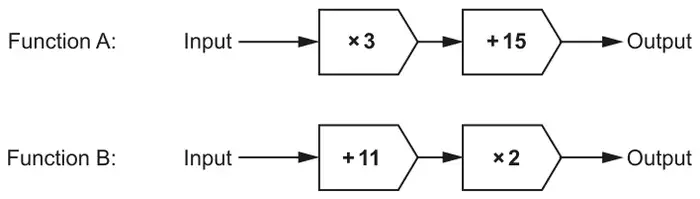
(i) Jo chooses a number, \(x\). She inputs \(x\) into each function. The two outputs are equal.
Work out the value of \(x\). [4]
(ii) Explain why there is no other input that gives two outputs that are equal. [1]
(b) Here is function C.
Kai chooses values for \(p\) and \(q\) so that if he inputs any number into both function A and function C, he will always get two outputs that are equal.
Find the value of \(p\) and the value of \(q\). [3]
Mark scheme (a)
Answer
Marks
Part marks and guidance
(i) 7
4
M2 for \(3x + 15 = 2(x + 11)\) oe or M1 for \(3x + 15\) or \(2(x + 11)\) oe
M1 for a productive step towards solving their linear equation
Alternative method by trials: M2 for at least two complete trials using the same inputs for both functions or M1 for one complete trial using the same input for both functions
A1 for at least one correct evaluation for A and one for B
Starting equation must have x on both sides e.g. from \(3x + 15 = 2(x + 11)\): M1 for \(2x + 22\) or \(x + 15 = 22\) or \(3x = 2x + 7\) or \(1.5x + 7.5 = x + 11\) e.g. from \(3x + 15 = 2x + 11\): M1 for \(x + 15 = 11\) or \(3x = 2x - 4\)
(ii) Because \(3x + 15\) and \(2(x + 11)\) are not equivalent oe
OR
\(3x + 15 = 2(x + 11)\) only has one solution oe
1
If not using the words ‘not equivalent’, must clearly imply that the two expressions will not be equal for all values of \(x\)
The mark is unlikely to be awarded unless algebra is used
Mark scheme (b)
Answer
Marks
Part marks and guidance
\(p = 5\), \(q = 3\)
3
B1 for \(p = 5\) or \(q = 3\)
M1 for \(q(x + p)\) oe or [\(3x + 15 =\)] \(3(x + p)\) or [\(3x + 15 =\)] \(q(x + 5)\)
If no working SC1 for \(p = 3\) and \(q = 5\) as answers
May be seen with a particular value of \(x\), eg. \(q(2 + p)\)