for substitution of a rearranged equation into a correct equation to form an equation in one variable. eg \(3x^2 + 2(2 - 3x)^2 = 44\) or \(3\left(\dfrac{2 - y}{3}\right)^2 + 2y^2 = 44\)
M1
(dep on first M1) for multiplying out all brackets and collecting terms to form a simplified three term quadratic in any form of \(ax^2 + bx + c\ (= 0)\) where at least 2 coefficients (\(a\), \(b\), \(c\)) are correct
(dep on first M1) for a suitable method to solve their 3 term quadratic using any correct method,
for factorising, eg \((7x + 6)(x - 2)\) or \((7x + 6)(3x - 6)\) or \((21x + 18)(x - 2)\) or \((7y - 32)(y + 4)\)
or correct use of formula, eg \(\dfrac{8 \pm \sqrt{(-8)^2 - 4 \times 7 \times -12}}{2 \times 7}\) or \(\dfrac{4 \pm \sqrt{(-4)^2 - 4 \times 7 \times -128}}{2 \times 7}\) or completing the square
M1
(dep on first M1) for substituting their 2 found values of \(x\) or \(y\) in a suitable equation or (dep on first M1) for one correct pair of values following from a correct quadratic
A1
for \(x = -\dfrac{6}{7}\) oe, \(y = \dfrac{32}{7}\) oe and \(x = 2\), \(y = -4\)
Additional guidance
Allow \((\pm 2 \pm 3x)\) for \((2 - 3x)\) (or \(\left(\dfrac{\pm 2 \pm y}{3}\right)\) for \(\left(\dfrac{2 - y}{3}\right)\)) Implied by a correct equation (simplified or unsimplified) in terms of \(x\) or \(y\) eg \(3x^2 + 2(4 - 12x + 9x^2) = 44\) or \(3x^2 + 8 - 24x + 18x^2 = 44\) or \(21x^2 - 24x = 36\)
Look out for signs reversed The quadratic does not have to equal 0, ie accept \(21x^2 - 24x = 36\)
Can be implied by both \(x\) values or both \(y\) values correct (condone incorrect labelling) if the quadratic is correct If using the quadratic formula (condone one sign error, omission of brackets around the \(b\) in the \(b^2 - 4ac\) and the fraction line not being under the \(-\) in the \(-b\). Allow some simplification – as far as eg \(\dfrac{8 \pm \sqrt{64 + 336}}{14}\) or if factorising allow brackets which expand to give 2 out of 3 terms correct for their quadratic
Condone substitution into their \((\pm 2 \pm 3x)\) or \(\left(\dfrac{\pm 2 \pm y}{3}\right)\)
Allow \(-0.85(7\ldots)\) or \(-0.86\) for \(-\dfrac{6}{7}\) Allow 4.57(1…) for \(\dfrac{32}{7}\) If values of \(x\) or \(y\) are incorrect then working must be shown
Accept as coordinates Assume correct pairing unless clearly incorrect eg \(\left(-\tfrac{6}{7}, -4\right), \left(2, \tfrac{32}{7}\right)\) Allow \(-0.85(7\ldots)\) or \(-0.86\) for \(-\dfrac{6}{7}\) Allow 4.57(1…) for \(\dfrac{32}{7}\) If an answer is shown in the range in working and then incorrectly rounded award full marks
A correct answer with no supportive working gets 0 marks
for correct substitution for \(y^2\) or \(x^2\), eg \((7 - 2x)^2 = 3x^2 + 4\) OR for correct rearrangement and expansion of \((7 - 2x)^2\) to obtain 4 terms with all correct without considering signs or for 3 terms out of 4 correct with correct signs and substitution eg \((7 - 2x)^2 = 49 - 14x - 14x + 4x^2\) and \(49 - 14x - 14x + 4x^2 = 3x^2 + 4\)
M1
for method to write a correct simplified equation eg \(x^2 - 28x + 45\ (= 0)\)
M1
for a method to solve a correct quadratic eg \(\dfrac{28 \pm \sqrt{(-28)^2 - 4 \times 1 \times 45}}{2 \times 1}\) or \(\dfrac{28 \pm \sqrt{604}}{2}\) or \(14 \pm \sqrt{151}\) or \((x - 14)^2 - 14^2 + 45 = 0\) oe
A1
\(x = 26.2\) to 26.3, \(y = -45.6\) to \(-45.5\) and \(x = 1.7\) to 1.712, \(y = 3.5\) to 3.6
Additional guidance
NB \(49 - 28x\) or \(-28x + 4x^2\) can be considered 3 terms out of 4 correct with correct signs
The quadratic does not have to equal 0, ie accept \(x^2 - 28x = -45\)
Can be implied by both \(x\) values correct or both \(y\) values correct
Answers must be correctly paired (May be in the body of the working) If answers are given in the range in working and then rounded incorrectly award full marks
20 \(x - 4\), \(x + 2\) and \(3x + 1\) are three consecutive terms of an arithmetic sequence.
(a) Find the value of \(x\). (2)
\(y - 4\), \(y + 2\) and \(3y + 1\) are three consecutive terms of a geometric sequence.
(b) Find the possible values of \(y\). (5)
Mark scheme (a)
Answer
Mark
Mark scheme
3.5
P1
for process to find the common difference between the first and second and the common difference between the third and second term eg \((3x + 1) - (x + 2)\ (= 2x - 1)\) and \((x + 2) - (x - 4)\ (= 6)\)
or for process to write a correct equation in \(x\), eg \((3x + 1) - (x + 2) = (x + 2) - (x - 4)\) or \(2x - 1 = 6\) oe
A1
for 3.5 oe eg \(\dfrac{7}{2}\)
Mark scheme (b)
Answer
Mark
Mark scheme
\(-0.5\), 8
P1
for process to write a correct equation in terms of the common ratio and \(y\) eg \(r(y - 4) = y + 2\) or \(r(y + 2) = 3y + 1\)
P1
for process to write a correct equation in \(y\) eg \(\dfrac{3y + 1}{y + 2} = \dfrac{y + 2}{y - 4}\) oe
P1
for process to write a correct equation without fractions eg \((3y + 1)(y - 4) = (y + 2)(y + 2)\) oe
P1
for process of writing a correct simplified equation eg \(2y^2 - 15y - 8\ (= 0)\)
A1
cao
Additional guidance
\(r\) can be any letter apart from \(y\)
The quadratic does not have to equal 0, ie accept \(2y^2 - 15y = 8\)
(i) Write \(x^2 - 8x + 3\) in the form \((x - a)^2 - b\) where \(a\) and \(b\) are integers. (2)
(ii) Hence, write down the coordinates of the turning point on the graph of \(y = x^2 - 8x + 3\) (1)
(b) Solve \(7x^2 + 8x - 5 = 0\) Give your solutions correct to 3 significant figures. (3)
Alex has to find the solutions of the quadratic equation \(3k^2 + 10k - 8 = 0\) Here is his working and answer.
\[\begin{gathered} (3k - 2)(k + 4) = 0 \\ k = 2 \text{ or } k = -4 \end{gathered}\]
(c) What mistake has Alex made? (1)
Mark scheme (a)
Answer
Mark
Mark scheme
(i) \((x - 4)^2 - 13\)
M1
for start to method of completing the square, eg \((x - 4)^2\ldots\)
A1
cao
(ii) \((4, -13)\)
B1
ft from answer of form \((x - a)^2 - b\)
Additional guidance
(ii) This mark is dependent on a completed square form given in (a)(i)
Mark scheme (b)
Answer
Mark
Mark scheme
0.449 and \(-1.59\)
M1
for substitution into quadratic formula, eg \(\dfrac{-8 \pm \sqrt{8^2 - 4 \times 7 \times -5}}{2 \times 7}\) oe
M1
for simplification to \(\dfrac{-8 \pm \sqrt{204}}{14}\) or \(\dfrac{-4 \pm \sqrt{51}}{7}\) oe or for one correct solution in decimal form.
A1
for 0.448 to 0.449 and \(-1.59\) to \(-1.6(0)\)
Additional guidance
Condone one sign error
One correct solution in the required form out of two solutions given scores 2 marks
If an answer is shown in the range in working and then incorrectly rounded award full marks.
Mark scheme (c)
Answer
Mark
Mark scheme
Explanation
C1
for explanation Acceptable He hasn’t considered the coefficient of 3 He forgot about the 3 The answer \(x = 2\) should be \(x = \dfrac{2}{3}\) The first bracket was not \(k - 2\) \(k = 2\) is wrong, he should have divided by 3
Not acceptable One of the answers is wrong The solutions are not correct He should have written \(3(k - 2)(k + 4)\) The \(3k\) should not be inside the bracket 2 added to \(-4\) does not give 10 \(k = 2\) is wrong
for writing a correct equation without fractions eg \((2 - 2x) + 3(x + 4) = (2 - 2x)(x + 4)\) oe
M1
for simplifying to a correct equation in the form \(ax^2 + bx + c\ (= 0)\), eg \(2x^2 + 7x + 6\ (= 0)\)
M1
for method to solve a correct quadratic equation, eg \((2x + 3)(x + 2)\ (= 0)\) or correct substitution into the formula or for correctly completing the square
Give your answer in the form \(\dfrac{p \pm \sqrt{q}}{2}\) where \(p\) and \(q\) are integers. (4)
Mark scheme
Answer
Mark
Mark scheme
\(\dfrac{5 \pm \sqrt{15}}{2}\)
M1
for using a common denominator eg \(\dfrac{x - 1}{(2x - 1)(x - 1)} + \dfrac{3(2x - 1)}{(2x - 1)(x - 1)}\ (= 1)\) or \((x - 1) + 3(2x - 1) = (2x - 1)(x - 1)\)
M1
for expanding and rearranging to get \(2x^2 - 10x + 5\ (= 0)\)
M1
(dep M1) ft for a method to solve their 3 term quadratic equation eg \(\dfrac{10 \pm \sqrt{(-10)^2 - 4 \times 2 \times 5}}{2 \times 2}\) or \(\dfrac{10 \pm \sqrt{60}}{4}\) or \(2\left[\left(x - \dfrac{5}{2}\right)^2 - \left(\dfrac{5}{2}\right)^2\right] + 5 = 0\) oe
A1
cao
Additional guidance
Note we don’t need to see “= 0”; just the LHS is sufficient Accept other forms of the 3 term quadratic, eg \(2x^2 - 10x = -5\)
showing the coordinates of the turning point and the exact coordinates of any intercepts with the coordinate axes. (5)
Mark scheme
Answer
Mark
Mark scheme
Sketch graph with TP at \((2, -13)\) and intercepts at \((0, -5)\), \(\left(2 + \sqrt{\frac{13}{2}}, 0\right)\) and \(\left(2 - \sqrt{\frac{13}{2}}, 0\right)\)
B1
for a parabola drawn with intercept at the point \((0, -5)\)
M1
for the start of a method to find the roots of \(y = 0\), eg. \(2(x - 2)^2 - 13\ (= 0)\) oe or (\(x =\)) \(\dfrac{--8 \pm \sqrt{(-8)^2 - 4 \times 2 \times -5}}{2 \times 2}\)
M1
(dep) for method to find the roots, eg. \(2 \pm \sqrt{\dfrac{13}{2}}\) oe
B1
for turning point at \((2, -13)\)
C1
for a fully correct parabola drawn with turning point at \((2, -13)\) and intercepts at \((0, -5)\), \(\left(2 + \sqrt{\dfrac{13}{2}}, 0\right)\) oe and \(\left(2 - \sqrt{\dfrac{13}{2}}, 0\right)\) oe clearly shown
Additional guidance
Turning point may be just seen and labelled on the sketch
for \(\mathrm{f}^{-1}(x) = \sqrt[3]{\dfrac{x+4}{2}}\) OR for \(2x^3 - 4 = 50\) OR for substituting \(x = 3\) to find f(3)
C1
for substituting \(x = 50\) to show the result giving \(\mathrm{f}^{-1}(50) = 3\) OR solving for \(x\) to give \(x = 3\) OR for showing that \(\mathrm{f}(3) = 50\)
Mark scheme (b)
Answer
Mark
Mark scheme
\(x = -1\) and \(x = 2.5\)
P1
for \(\mathrm{hg}(x) = (x + 2)^2\)
P1
(dep) for start to a process to derive a quadratic equation eg. \(x^2 + 4x + 4 = 3x^2 + x - 1\)
P1
for a process to solve the quadratic equation \(2x^2 - 3x - 5 = 0\) eg \((2x - 5)(x + 1)\ (= 0)\) or \(\dfrac{--3 \pm \sqrt{(-3)^2 - 4 \times 2 \times -5}}{2 \times 2}\) or \(2\left[\left(x - \dfrac{3}{4}\right)^2 - \dfrac{9}{16} - \dfrac{5}{2}\right]\ (= 0)\)
A1
for \(x = -1\) and \(x = 2.5\)
Additional guidance
\((x + 2)^2\) must be correctly expanded
2.5 or \(2\frac{1}{2}\) or \(\frac{5}{2}\) acceptable
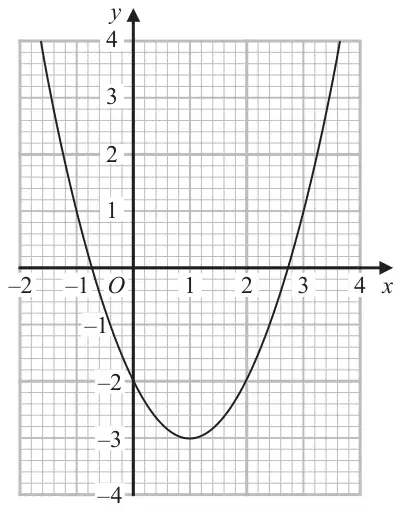
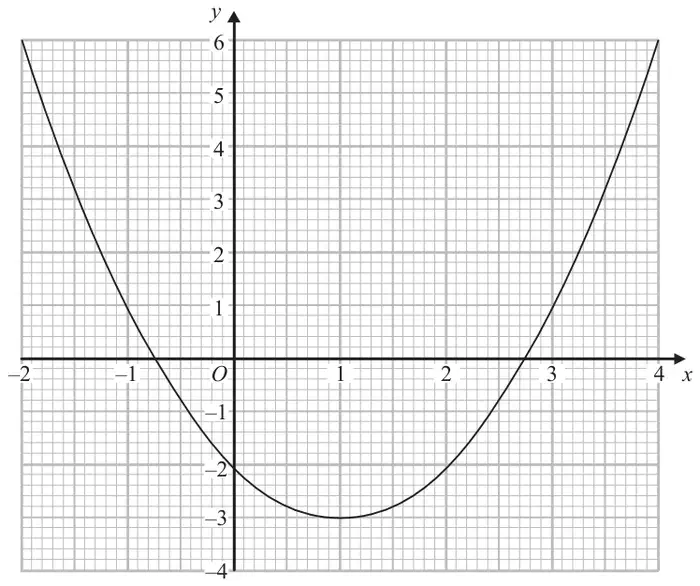
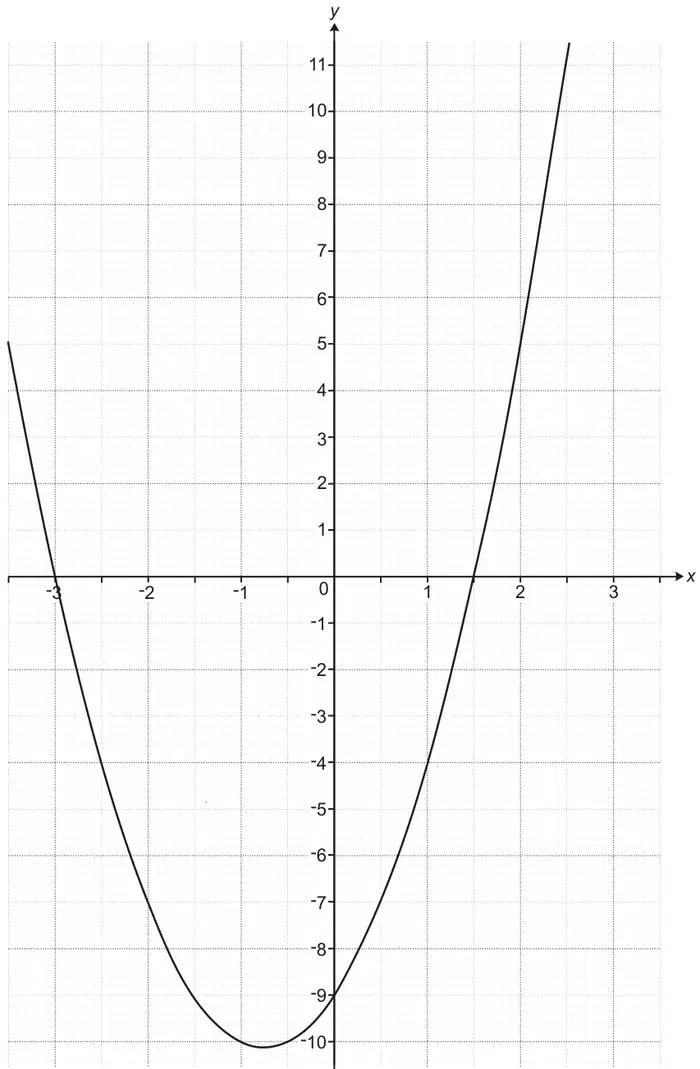
Use the graph to find estimates for the solutions to the equation \(x^2 - 2x - 2 = 0\) You must show how you get your solutions. (4)
Mark scheme
Answer
Mark
Mark scheme
2.7 and \(-0.7\)
M1
for \(x^2 - 3 = 2x - 1\) oe or \(x^2 - 3 - 2x + 1\ (= 0)\) or completing the square eg \((y =)\ (x - 1)^2 - 1 - 2\)
M1
(dep M1) draws graph of \(y = 2x - 1\) or drawing the translated graph or describing the translation in words or \(-1.7 + 1\ (= -0.7)\) or \(1.7 + 1\ (= 2.7)\)
M1
shows the points of intersection clearly for the given quadratic graph and linear graph or for one correct solution from appropriate supportive working
A1
for \(x\) in the range 2.6 to 2.8 and \(-0.6\) to \(-0.8\)
SC B2 for plotting \(y = 2x + 1\) and values for \(x\) in the range \(-1.1\) to \(-1.3\) and 3.1 to 3.3
Additional guidance
Line segments required For 1.7 allow from 1.6 to 1.8 For \(-1.7\) allow from \(-1.8\) to \(-1.6\)
Points indicated or attempt to read off \(x\)-axis at the appropriate points – maybe indicated by dashes
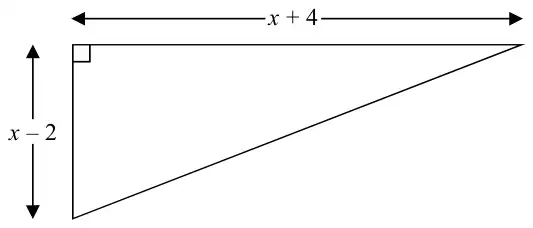
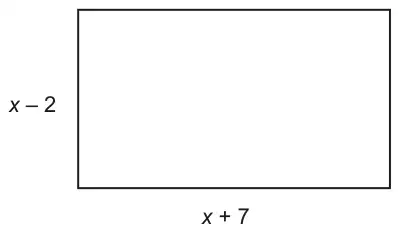
Work out the length of the shortest side of the triangle. You must show all your working. (4)
Mark scheme
Answer
Mark
Mark scheme
5
P1
for process to find the area of the triangle, eg. \(0.5 \times (x + 4)(x - 2)\) oe OR for process to find the area of rectangle and \(27.5 \times 2\), eg. \((x + 4)(x - 2)\) and 55
P1
(dep P1) for process to expand the brackets and derive a quadratic equation, eg. \(x^2 + 4x - 2x - 8 = 55\) or \(0.5(x^2 + 4x - 2x - 8) = 27.5\) oe
P1
(dep P2) for complete process to solve the quadratic equation \(x^2 + 2x - 63 = 0\) eg \((x - 7)(x + 9)\ (= 0)\) or \(\dfrac{-2 \pm \sqrt{2^2 - 4 \times 1 \times -63}}{2 \times 1}\) or \((x + 1)^2 - 1 - 63\ (= 0)\)
A1
cao
SC: B1 for \(x^2 + 4x - 2x - 8 = 27.5\)
Additional guidance
Trial and improvement methods must be fully correct identifying the value of \(x\) as 7 (3 marks) or the shortest side as 5 (4 marks)
An answer of 5 with no supportive working gets no marks
for substitution of a rearrangement eg for \(2(1 - 2y)^2 - y^2 = 17\) or \(2x^2 - \left(\dfrac{1 - x}{2}\right)^2 = 17\) or expansion of \((1 - 2y)^2 = 1 - 4y + 4y^2\) or \(\left(\dfrac{1 - x}{2}\right)^2 = \dfrac{1 - 2x + x^2}{4}\)
M1
for expansion of bracket and substitution eg \(2(1 - 4y + 4y^2) - y^2\) (= 17) or \(8x^2 - (1 - 2x + x^2)\) (= 68)
A1
for forming quadratic ready for solving eg \(7y^2 - 8y - 15\) (= 0) or \(7x^2 + 2x - 69\) (= 0)
M1
ft a 3 term quadratic, factorising eg \((7y - 15)(y + 1)\) (= 0) or \((7x + 23)(x - 3)\) (= 0) or correct use of formula eg \(\dfrac{8 \pm \sqrt{64 + 420}}{14}\) or \(\dfrac{-2 \pm \sqrt{4 + 1932}}{14}\) or completing the square
M1 (third method mark): Can be implied by both \(x\) values correct or both \(y\) values correct.
Answers must be correctly paired. (Maybe in the body of the working) Accept for \(x\) between \(-3.29\) and \(-3.28\) and for \(y\) between 2.14 and 2.15
The equation of the curve is \(y = x^2 + ax + b\) where \(a\) and \(b\) are integers.
The points \((0, -5)\) and \((5, 0)\) lie on the curve.
Find the coordinates of the turning point of the curve. (4)
Mark scheme
Answer
Mark
Mark scheme
\((2, -9)\)
P1
substitutes \(x = 0\), \(y = -5\) into \(y = x^2 + ax + b\) \((b = -5)\) or substitutes \(x = 5\), \(y = 0\) into \(y = x^2 + ax + b\) \((0 = 25 + 5a + b)\) or starts process to find other intercept, eg writes \(y = (x - 5)(x - k)\)
P1
for complete process to find two intercepts, eg. substitutes the second point into \(y = x^2 + ax + b\) and solves to find \(a\ (= -4)\) and \(b\ (= -5)\) or substitutes \(x = 0\), \(y = -5\) into \(y = (x - 5)(x - k)\) and solves to find \(k\ (= -1)\)
P1
(dep on P2) for factorising or completing the square of \(x^2 + \text{``}{-}4\text{''}x + \text{``}{-}5\text{''}\) and identifying the \(x\)-coordinate of the turning point or for a complete process to find the \(x\)-coordinate of the turning point, eg \((5 + \text{``}{-}1\text{''})/2\)
A1
cao
Additional guidance
\(x\)-coordinate of 2 with no or incorrect working gets NO marks
19 Prove algebraically that the straight line with equation \(x - 2y = 10\) is a tangent to the circle with equation \(x^2 + y^2 = 20\) (5)
Mark scheme
Answer
Mark
Notes
Proof (supported)
M1
starts process to find point of intersection by substituting, eg \((10 + 2y)^2 + y^2\ (= 20)\)
M1
for expanding, eg \(4y^2 + 20y + 20y + 100\) (3 out of 4 terms correct)
M1
(dep M2) for 3-term quadratic equation ready for solving, eg \(5y^2 + 40y + 80 = 0\)
M1
(dep on previous M1) for method to solve an equation of the form \(ay^2 + by + c = 0\), eg by factorising or correct substitution into quadratic formula
C1
fully correct method leading to \(y = -4\) or \(x = 2\) or \((y + 4)^2 = 0\) or \((x - 2)^2 = 0\) and statement, eg only one point of intersection so the line is a tangent to the circle
for factorisation or for substitution into quadratic formula \((x \pm a)(x \pm b)\) where product of \(a\) and \(b = 24\), eg \((x \pm 4)(x \pm 6)\) or difference of \(a\) and \(b = 5\), eg \((x \pm 2)(x \pm 7)\) \(\dfrac{-5 \pm \sqrt{5^2 - 4 \times 1 \times {-24}}}{2}\) oe (condone one sign error)
M1
for \((x + 8)(x - 3)\) or for \(\dfrac{-5 \pm \sqrt{121}}{2}\) oe
for substitution of a rearrangement of \(y - 3x = 13\) e.g. \((3x + 13)^2 + x^2 = 25\)
M1
(dep M1) for expansion of bracket after substitution (at least 3 terms correct out of the 4 terms) e.g. \(9x^2 + 39x + 39x + 169\)
M1
for forming quadratic ready for solving e.g. \(10x^2 + 78x + 144\ (= 0)\)
M1
for factorising e.g. \((5x + 24)(x + 3)\ (= 0)\) oe
A1
\(x = -\dfrac{24}{5}\), \(y = -\dfrac{7}{5}\) and \(x = -3\), \(y = 4\) SC: B1 (if M0) for all 4 values mis-associated or one correct pair of values or values given as coordinates.
M1 for substitution of \(a = 2\), \(b = 3\), \(c = -7\) (condone one sign error) M1 for \(\dfrac{-3 \pm \sqrt{65}}{4}\) A1 for solutions in range 1.26 to 1.27 and \(-2.76\) to \(-2.77\)
(c) Solve \(3x^2 - x - 1 = 0\) Give your solutions correct to 2 decimal places. (3)
Mark scheme (a)
Answer
Mark
Notes
\(y^2 + 7y + 10\)
2
M1 for all 4 terms (and no additional terms) correct ignoring signs or 3 terms correct A1 for \(y^2 + 7y + 10\)
Mark scheme (b)
Answer
Mark
Notes
\((e - 3)(e + 4)\)
2
M1 for \((e \pm 3)(e \pm 4)\) A1 for \((e - 3)(e + 4)\)
Mark scheme (c)
Answer
Mark
Notes
0.77, \(-0.43\)
3
M1 for \(\dfrac{--1 \pm \sqrt{(-1)^2 - 4 \times 3 \times -1}}{2 \times 3}\) (condone one sign error) M1 for \(\dfrac{1 \pm \sqrt{13}}{6}\) A1 for one answer in the range 0.767 to 0.77 and one answer in the range \(-0.43\) to \(-0.4343\)
M1 for substitution of \(a = 3\), \(b = 6\), \(c = -2\) into the formula or for completing the square (condone one sign error) M1 for \(\dfrac{-6 \pm \sqrt{60}}{6}\) or \(-1 \pm \sqrt{\dfrac{5}{3}}\) or in simplified form A1 for answers in the range 0.29 to 0.292 and \(-2.292\) to \(-2.29\)
22 Alison is using the quadratic formula to solve a quadratic equation. She substitutes values into the formula and correctly gets
\[x = \frac{-7 \pm \sqrt{49 - 32}}{4}\]
Work out the quadratic equation that Alison is solving. Give your answer in the form \(ax^2 + bx + c = 0\), where \(a\), \(b\) and \(c\) are integers. (3)
Mark scheme
Answer
Mark
Notes
\(2x^2 + 7x + 4\) \(= 0\)
3
M1 for finding a correct coefficient M1 for a method to find \(a\) and \(c\) or \(b\) and \(c\) A1 \(2x^2 + 7x + 4 = 0\) or \(a = 2\), \(b = 7\), \(c = 4\)
M1 for substitution of \(a = 3\), \(b = 4\), \(c = -12\) into the formula (condone one sign error) or for completing the square M1 for \(\dfrac{-4 \pm \sqrt{160}}{6}\) or in simplified form A1 for answers in the ranges 1.43 to 1.45 and \(-2.76\) to \(-2.78\)
Give your solutions correct to 3 significant figures. (3)
Mark scheme
Answer
Mark
Notes
1.85 and \(-0.180\)
3
M1 for \(\dfrac{--5 \pm \sqrt{-5^2 - 4 \times 3 \times -1}}{2 \times 3}\) (condone one sign error) M1 for \(\dfrac{5 \pm \sqrt{37}}{6}\) (=1.8 to 1.85 or \(-0.18\) to \(-0.181\)) A1 for answers in the ranges 1.8 to 1.85, and \(-0.18\) to \(-0.181\)
M1 for substitution for elimination eg \((2y + 6)^2 + y^2 = 36\) M1 (dep on M1) for expansion eg \(4y^2 + 12y + 12y + 36\) (3 out of 4 terms correct) A1 for \(4y^2 + 24y + 36 + y^2 = 36\) oe M1 for a correct attempt to solve a 2 or 3 term quadratic equation eg by factorising or correct substitution into a quadratic formula A1 for \(x = 6\), \(y = 0\) and \(x = -3.6\) oe, \(y = -4.8\) oe SC: B1 (if M0 scored) for all 4 values mis-associated or one correct pair of values.
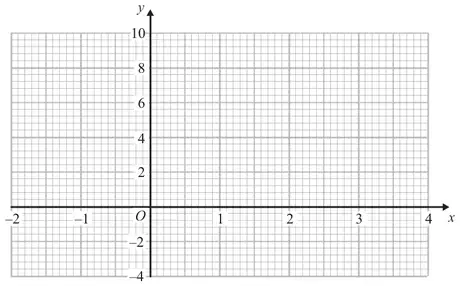
(a) Complete the table of values for \(y = x^2 - 2x - 1\)
\(x\)
\(-2\)
\(-1\)
0
1
2
3
4
\(y\)
7
\(-2\)
\(-1\)
(2)
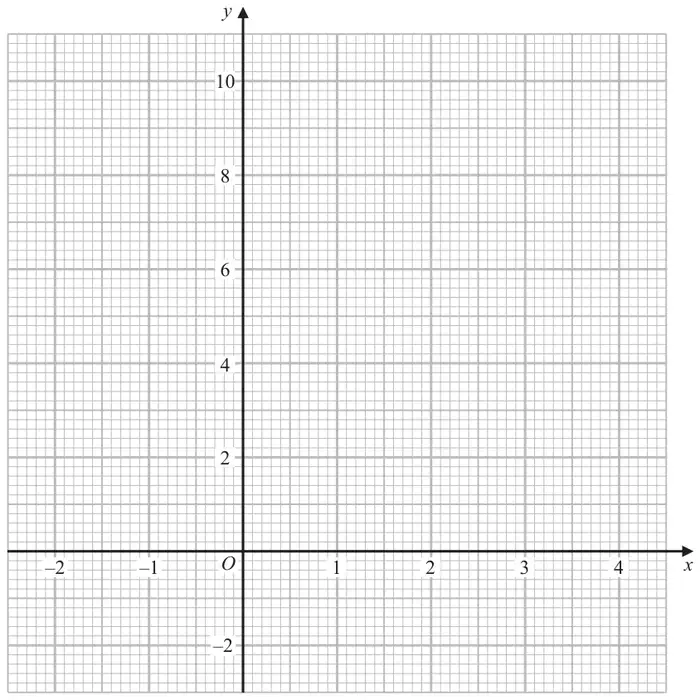
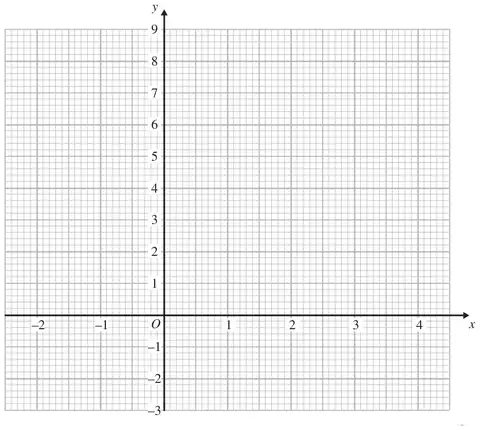
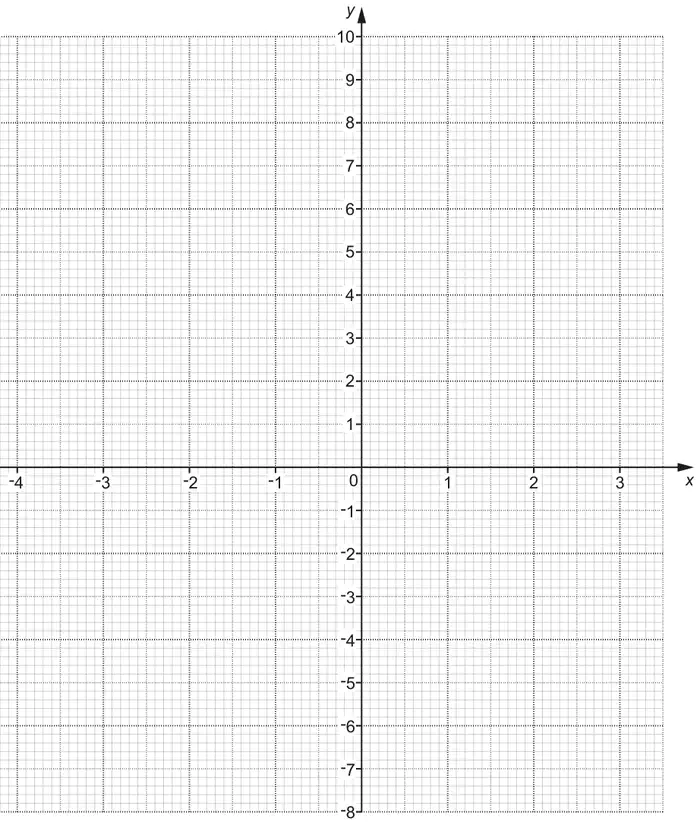
(b) On the grid, draw the graph of \(y = x^2 - 2x - 1\) for values of \(x\) from \(-2\) to 4(2)
(c) Solve \(x^2 - 2x - 1 = x + 3\) (2)
Mark scheme (a)
Answer
Mark
Notes
\(2, -1, 2, 7\)
2
B2 for all correct (B1 for 2 or 3 correct)
Mark scheme (b)
Answer
Mark
Notes
Correct graph
2
M1 (dep on at least B1) for at least 6 points from their table plotted correctly A1 cao for fully correct graph
Mark scheme (c)
Working
Answer
Mark
Notes
\(x^2 - 3x - 4 = 0\) \((x - 4)(x + 1) = 0\)
\(-1, 4\)
2
M1 for line \(y = x + 3\) drawn correctly or for reduction to correct 3 term quadratic (=0) and : \((x \pm 1)(x \pm 4)\) or formula using \(a = 1\), \(b = -3\) and \(c = -4\), allow one sign error in the formula, or \(\left(x - \dfrac{3}{2}\right)^2 = 4 + \left(\dfrac{3}{2}\right)^2\) A1 cao
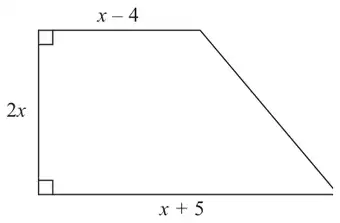
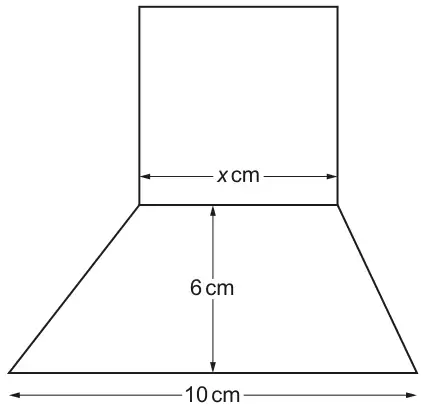
22 The diagram shows a trapezium. All the measurements are in centimetres.
Diagram NOT accurately drawn
The area of the trapezium is 351 cm\(^2\).
(a) Show that \(2x^2 + x - 351 = 0\) (2)
(b) Work out the value of \(x\). (3)
Mark scheme (a)
Answer
Mark
Notes
‘show’
2
M1 for \(\frac{1}{2} \times (x - 4 + x + 5) \times 2x\) or \(2x \times (x - 4) + \frac{1}{2} \times 2x \times 9\) A1 for completion with correct processes seen
Notes
Corrected from the printed mark scheme, which shows \(\frac{1}{2} \times (x - 4 + x + 5) \times 2\) (the height is \(2x\)).
Mark scheme (b)
Answer
Mark
Notes
13
3
M1 for \(\dfrac{-1 \pm \sqrt{1^2 - 4 \times 2 \times -351}}{2 \times 2}\) condone incorrect sign for 351 M1 for \(\dfrac{-1 \pm \sqrt{2809}}{4}\) A1 for 13 NB for either M mark accept + only in place of \(\pm\)
OR
M2 for \((2x + 27)(x - 13)\) (M1 for \((2x \pm 27)(x \pm 13)\)) A1 for 13
M1 for \(x^2 + (2 - x)^2 = 9\) M1 for \(4 - 4x + x^2\) A1 for \(2x^2 - 4x - 5 = 0\) oe 3 term simplified quadratic M1 for a correct method to solve their quadratic Eg \(x = \dfrac{4 \pm \sqrt{16 - 4 \times 2 \times -5}}{4}\) A1 for \(x = 2.87\), \(y = -0.87\) or better A1 for \(x = -0.87\), \(y = 2.87\) or better Award marks for equivalent algebraic expressions. Apply the same scheme as above for \(y\) first.
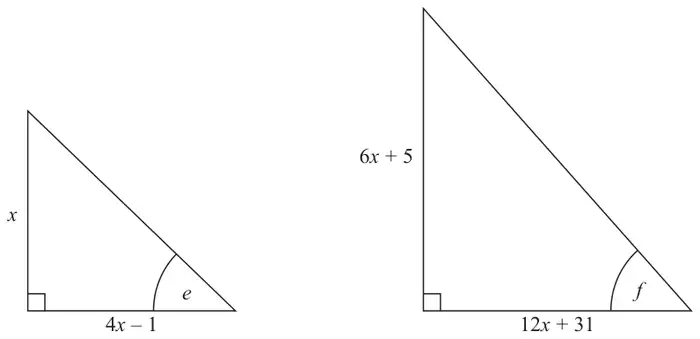
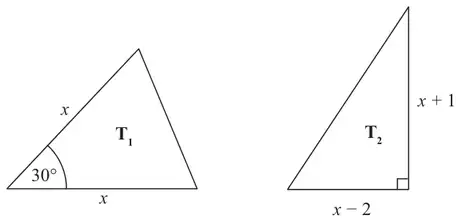
25 Here are two triangles \(\mathbf{T}_1\) and \(\mathbf{T}_2\).
Diagram NOT accurately drawn
The lengths of the sides are in centimetres.
The area of triangle \(\mathbf{T}_1\) is equal to the area of triangle \(\mathbf{T}_2\).
Work out the value of \(x\), giving your answer in the form \(a + \sqrt{b}\) where \(a\) and \(b\) are integers. (5)
Mark scheme
Answer
Mark
Notes
\(1 + \sqrt{5}\)
5
M1 for \(\frac{1}{2} \times x \times x \times \sin 30^\circ\) oe M1 for \(\frac{1}{2}(x - 2)(x + 1)\) oe or \(\frac{1}{2} \times (x - 2) \times (x + 1) \times \sin 90\) M1 (dep on at least one previous M1) for formation of equation from equating areas with \(x\) as the only variable A1 for \(x^2 - 2x - 4 = 0\) oe in the form \(ax^2 + bx + c = 0\) or \(ax^2 + bx = c\) A1 cao
M1 \(\dfrac{-9 \pm \sqrt{9^2 - 4 \times 2 \times -7}}{2 \times 2}\) allow substitution of \(\pm 7\) for \(c\) M1 \(\dfrac{-9 \pm \sqrt{137}}{4}\) A1 answers in ranges 0.67 - 0.68 and − 5.17 to − 5.18 OR M1 \(\left(x + \frac{9}{4}\right)^2\) oe M1 for method leading to \(\pm\sqrt{\dfrac{137}{16}} - \dfrac{9}{4}\) A1 answers in ranges 0.67 - 0.68 and − 5.17 to − 5.18
Mark scheme (b)
Working
Answer
Mark
Notes
Put \(y = \dfrac{1}{x}\) and use part (a) Or \(7y^2 - 9y - 2 = 0\) \(y = \dfrac{--9 \pm \sqrt{(-9)^2 - 4 \times 7 \times (-2)}}{2 \times 7}\) \(\dfrac{9 \pm \sqrt{137}}{14}\)
1.48, − 0.193
2
M1 \(y = \dfrac{1}{x}\) or \(x = \dfrac{1}{y}\) A1 (ft) answers in range 1.47 - 1.48 and − 0.19 to − 0.194 OR M1 fully correct method which leads to \(7y^2 - 9y - 2 = 0\) or \(-7y^2 + 9y + 2 = 0\) with correct method to solve (condone sign errors in substitution) A1 (ft) answers in range 1.47 - 1.48 and − 0.19 to − 0.194
M1 for \(\dfrac{--4 \pm \sqrt{(-4)^2 - 4 \times 3 \times -2}}{2 \times 3}\) (condone incorrect signs for –4 and –2) M1 for \(\dfrac{4 \pm \sqrt{40}}{6}\) or \(\dfrac{2 \pm \sqrt{10}}{3}\) A1 for one answer in the range 1.72 to 1.721 and one answer in the range – 0.387 to – 0.38743 OR M1 for \(\left(x - \frac{2}{3}\right)^2\) oe M1 for method leading to \(\frac{2}{3} \pm \sqrt{\frac{10}{9}}\) oe A1 for one answer in the range 1.72 to 1.721 and one answer in the range – 0.387 to – 0.38743
oe with brackets expanded four terms in any order with three correct from \(x^2 \quad (+)2x \quad -5x \quad -10\) terms may be seen in a grid implied by \(x^2 - 3x + k \quad (k \ne 0)\) or \(ax^2 - 3x - 10 \quad (a \ne 0)\)
For their three-term quadratic, correctly factorises or correctly substitutes into the quadratic formula or correctly completes the square to the form \(x = \ldots\) for their quadratic or \(-10\) and 13
Correctly rearranges their equation, which must be correct or of the form \(\dfrac{6}{n} \times \dfrac{a}{n + b} = \dfrac{1}{8}\), where \(a\) and \(b\) are integers, into a quadratic equation with brackets expanded and no unknowns in denominators
M1dep
dep on 1st M1 \(n^2 - n = 240\) or \(n^2 - n - 240 = 0\) implies M1M1M1
For their three-term quadratic, correctly factorises or correctly substitutes into the quadratic formula or correctly completes the square to the form \(n = \ldots\) for their quadratic or \(-15\) and 16
The second mark may be awarded for work done in stages eg \(\dfrac{6}{n} \times \dfrac{5}{n - 1} = \dfrac{36}{n(n - 1)}\) then \(\dfrac{36}{n(n - 1)} = \dfrac{1}{8}\) implies \(\dfrac{6}{n} \times \dfrac{5}{n - 1} = \dfrac{1}{8}\) (36 should be 30, which does not affect these marks but means they cannot get the third mark)
oe with brackets expanded four terms in any order with three correct from \(x^2 \quad (+)2x \quad -5x \quad -10\) terms may be seen in a grid implied by \(x^2 - 3x + k \quad (k \ne 0)\) or \(ax^2 - 3x - 10 \quad (a \ne 0)\)
For their three-term quadratic, correctly factorises or correctly substitutes into the quadratic formula or correctly completes the square to the form \(x = \ldots\) for their quadratic or \(-10\) and 13
oe correct for their 3-term quadratic in the form \(ax^2 + bx + c\ (= 0)\) if the quadratic formula is used with \(+\) and \(-\) separately, both must be seen correctly for this mark
oe correct for their 3-term quadratic in the form \(ay^2 + by + c\ (= 0)\) if the quadratic formula is used with \(+\) and \(-\) separately, both must be seen correctly for this mark
\((y =)\) \(-8\) and \((y =)\) 1
A1
\((-2, -8)\) and \((1, 1)\)
A1
SC1 for 1 correct coordinate
Additional guidance
Trial and improvement may be awarded SC1 for one correct coordinate or full marks if both coordinates are correct
\(d = k \quad e = 14k^2 \quad f = k\) where \(k\) is a non-zero constant
A1
eg \(d = 1 \quad e = 14 \quad f = 1\) or \(d = 2 \quad e = 56 \quad f = 2\) or \(d = 6 \quad e = 504 \quad f = 6\)
Additional guidance
Take the values on the answer lines as the final answer eg \(\dfrac{2 \pm \sqrt{56}}{2}\) in working with \(d = 2 \quad e = \sqrt{56} \quad f = 2\) on answer lines
M3A0
\(1 \pm \sqrt{14}\) in working with \(d = 1 \quad e = 14 \quad f =\) (blank)
M3A0
For terms seen in a grid accept eg \(3x\) for \(+3x\)
For up to M2 accept algebraic fractions but do not allow 3rd M1 unless recovered eg \(\dfrac{x^2 - 9x + 3x - 27}{x + 3} = \dfrac{12 - 2x^2}{x + 3}\)
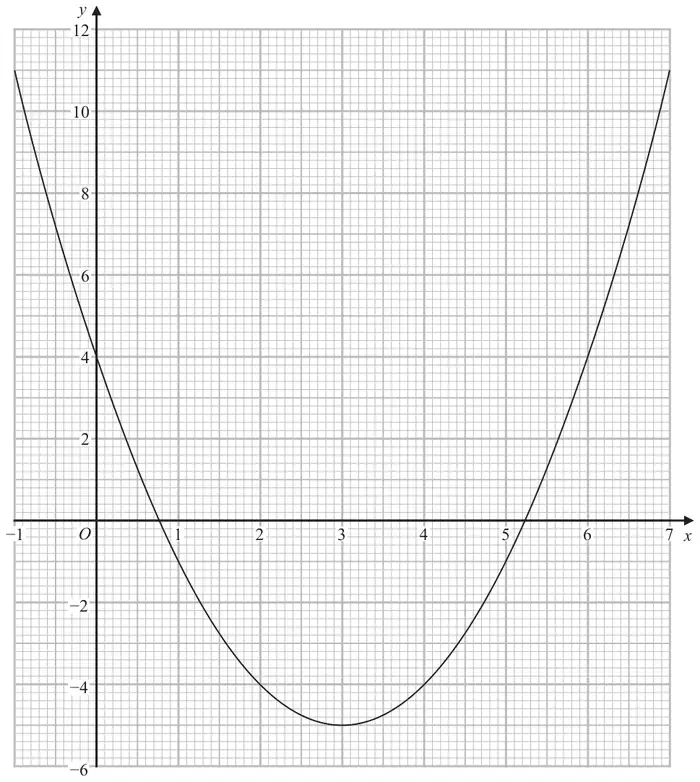
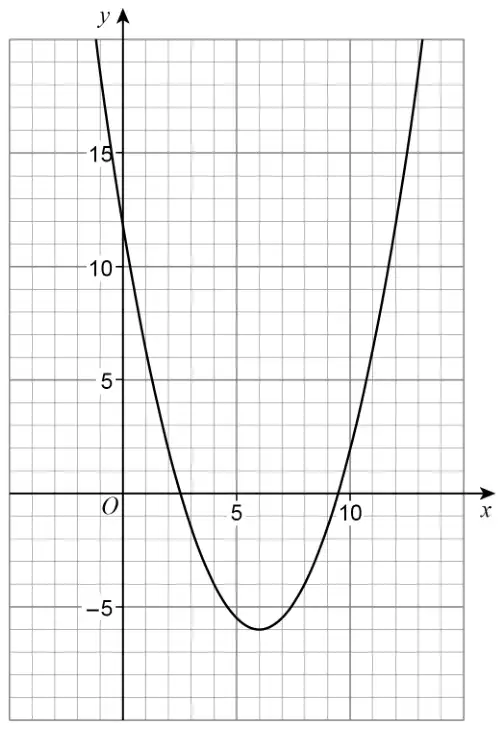
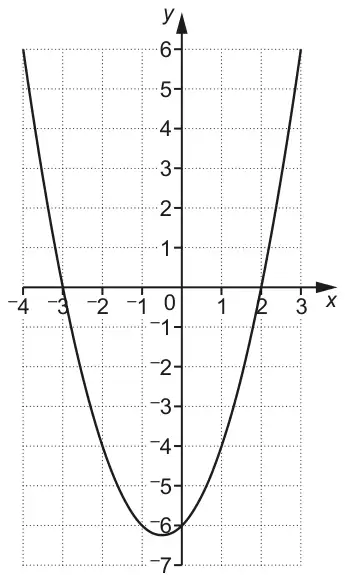
26 Here is the graph of \(\quad y = 0.5x^2 - 6x + 12\)
Use the graph to estimate the solutions of \(\quad 0.5x^2 - 6x + 12 = 0\) [2 marks]
Mark scheme
Answer
Mark
Comments
\((x =)\ [2.25, 2.75]\) and \((x =)\ [9.25, 9.75]\)
B2
B1 \((x =)\ [2.25, 2.75]\) or \((x =)\ [9.25, 9.75]\) or one or both values identified but not given in correct notation eg (2.5, 0) and/or (9.5, 0) or \(2.5 \lt x \lt 9.5\) or 2.5 and/or 9.5 written on the graph or in working
Additional guidance
\(x =\) can be \(x \approx\)
[2.25, 2.75] and/or [9.25, 9.75] with one extra value
B1
[2.25, 2.75] and/or [9.25, 9.75] with more than one extra value
B0
Answer from use of formula or completing the square
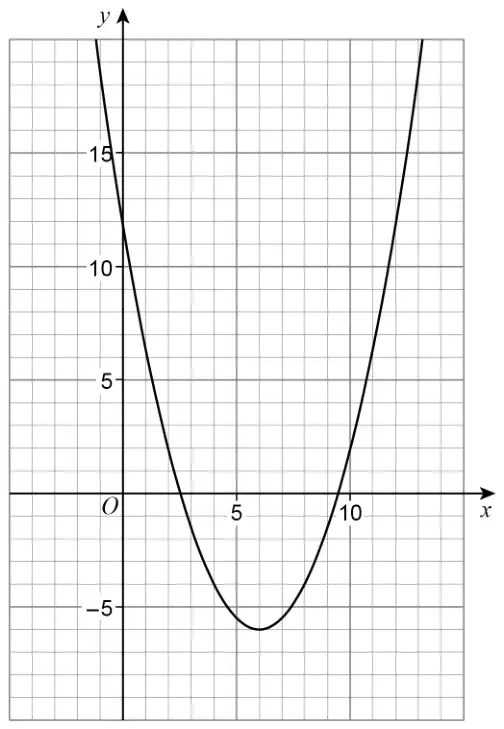
9 Here is the graph of \(\quad y = 0.5x^2 - 6x + 12\)
Use the graph to estimate the solutions of \(\quad 0.5x^2 - 6x + 12 = 0\) [2 marks]
Mark scheme
Answer
Mark
Comments
\((x =)\) [2.25, 2.75] and \((x =)\) [9.25, 9.75]
B2
B1 \((x =)\) [2.25, 2.75] or \((x =)\) [9.25, 9.75] or one or both values identified but not given in correct notation eg \((2.5, 0)\) and/or \((9.5, 0)\) or \(2.5 \lt x \lt 9.5\) or 2.5 and/or 9.5 written on the graph or in working
Additional guidance
\(x =\) can be \(x \approx\)
[2.25, 2.75] and/or [9.25, 9.75] with one extra value
B1
[2.25, 2.75] and/or [9.25, 9.75] with more than one extra value
B0
Answer from use of formula or completing the square
\(\dfrac{-1 \pm \sqrt{61}}{6}\) or \(-\dfrac{1}{6} \pm \sqrt{\dfrac{61}{36}}\) or 1.135… and \(-1.468\)…
A1
oe two solutions eg \(-\dfrac{1}{6} + \dfrac{1}{6}\sqrt{61}\) and \(-\dfrac{1}{6} - \dfrac{1}{6}\sqrt{61}\) allow decimal solutions rounded to at least 1 dp eg allow 1.14 and \(-1.5\)
Additional guidance
Both solutions correct
M1A1
Both solutions seen in working but only one on answer line
M1A0
Ignore conversion attempt after correct surd form solutions seen unless only one solution is subsequently selected
Working must be for two solutions to score eg \(\dfrac{-1 + \sqrt{1^2 - 4 \times 3 \times -5}}{2 \times 3}\) not recovered
M0
Square root sign should cover all appropriate work unless recovered eg \(-\dfrac{1}{6} \pm \sqrt{\dfrac{5}{3}} + \dfrac{1}{36}\) not recovered
M0
Fraction line should be under all appropriate work unless recovered eg \(-1 \pm \dfrac{\sqrt{61}}{6}\) not recovered
M0
One solution correct does not imply M1
Both solutions seen in working but signs transposed on answer line
M1A0
√(12 – 4 × 3 × –5) is correct for \(\sqrt{1^2 - 4 \times 3 \times -5}\)
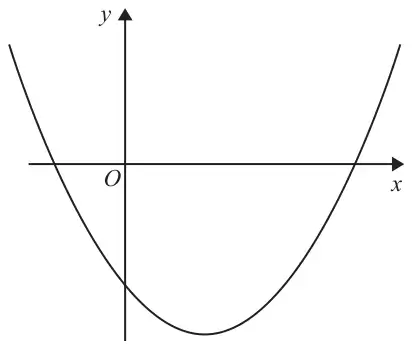
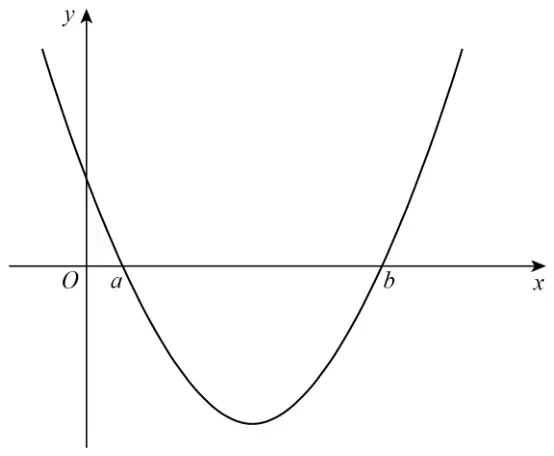
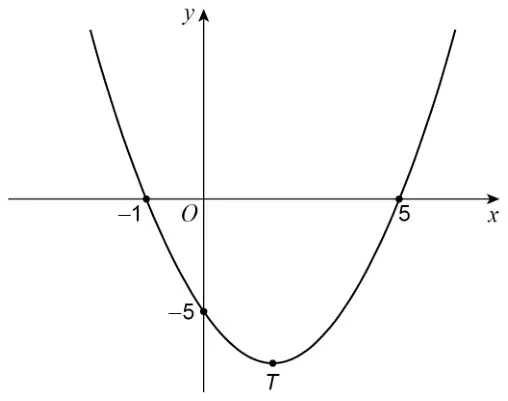
23 Here is a sketch of the curve \(\quad y = x^2 - 4x - 5\)
(a) Write down the two roots of \(\quad x^2 - 4x - 5 = 0\) [1 mark]
(b) Work out the coordinates of \(T\), the turning point of the curve. [2 marks]
Mark scheme (a)
Answer
Mark
Comments
\(-1\) and 5
B1
either order
Additional guidance
Ignore \(x =\) written before answers
\((-1, 0)\) or \((5, 0)\)
B0
Mark scheme (b)
Answer
Mark
Comments
\((2, -9)\)
B2
B1 \(x = 2\) or \((2, \ldots)\) or \(y = -9\) or \((\ldots, -9)\) or \((x - 2)^2 - 9\) B1ft correct \(y\)-coordinate for their \(x\)-coordinate with \(x \ne -1\), 0 or 5 SC1 \((-9, 2)\)
Additional guidance
If answer line is blank, check diagram for indication of \(x\) or \(y\) values
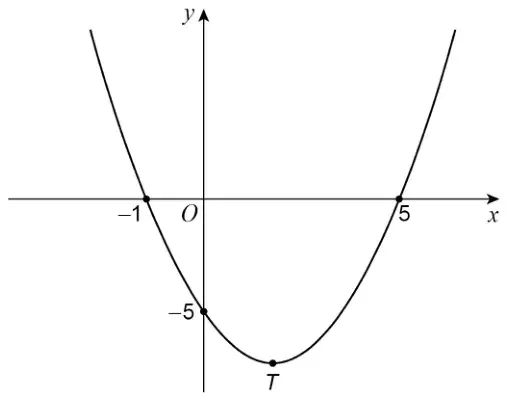
6 Here is a sketch of the curve \(\quad y = x^2 - 4x - 5\)
(a) Write down the two roots of \(\quad x^2 - 4x - 5 = 0\) [1 mark]
(b) Work out the coordinates of \(T\), the turning point of the curve. [2 marks]
Mark scheme (a)
Answer
Mark
Comments
\(-1\) and 5
B1
either order
Additional guidance
Ignore \(x =\) written before answers
(\(-1\), 0) or (5, 0)
B0
Mark scheme (b)
Answer
Mark
Comments
(2, \(-9\))
B2
B1 \(x = 2\) or (2, …) or \(y = -9\) or (…, \(-9\)) or \((x - 2)^2 - 9\) B1ft correct \(y\)-coordinate for their \(x\)-coordinate with \(x \ne -1\), 0 or 5 SC1 (\(-9\), 2)
Additional guidance
If answer line is blank, check diagram for indication of \(x\) or \(y\) values
(a) Write \(\quad x(3x - 9) = 4 \quad\) in the form \(\quad ax^2 + bx + c = 0 \quad\) where \(a\), \(b\) and \(c\) are integers. [1 mark]
(b) Solve \(\quad x(3x - 9) = 4\)
Give your answers to 2 decimal places. [2 marks]
Mark scheme (a)
Answer
Mark
Comments
\(3x^2 - 9x - 4 = 0\) or \(-3x^2 + 9x + 4 = 0\)
B1
must see = 0 on answer line
Additional guidance
Do not accept \(x9\) or \(9 \times x\) for \(9x\)
\(3x^2 + {-9x} + {-4} = 0\)
B1
\(3x^2 - {+9x} - {+4} = 0\)
B0
Mark scheme (b)
Answer
Mark
Comments
\(\dfrac{-{-9} \pm \sqrt{(-9)^2 - 4 \times 3 \times -4}}{2 \times 3}\) or \(\dfrac{9 \pm \sqrt{129}}{6}\) or \(\left(x - \dfrac{3}{2}\right)^2 - \dfrac{9}{4} = \dfrac{4}{3}\) or \(\dfrac{3}{2} \pm \sqrt{\dfrac{43}{12}}\) or 3.392… or 3.393 or \(-0.392…\) or \(-0.393\)
M1
oe correct or ft their 3-term quadratic seen
3.39 and \(-0.39\)
A1ft
correct or ft their 3-term quadratic seen ft answers must be rounded to 2 dp
Additional guidance
The word ‘and’ does not need to be seen to award A mark
Full fraction line, correct full square root, \(\pm\) and \((-9)^2\) or \(9^2\) must be seen to award M1 but can be recovered by sight of correct solution(s)
\(3x^2 - 9x + 4 = 0\) in 18(a) \(\dfrac{9 \pm \sqrt{33}}{6}\) or \(\dfrac{3}{2} \pm \sqrt{\dfrac{11}{12}}\) or 2.457… or 0.542… 2.46 and 0.54
M1 A1ft
3.39 and \(-0.39\) on answer line with no incorrect working
M1A1
2.46 and 0.54 on answer line with no incorrect working
The product of half of a number and three more than the number is the same as the square of the number
Toby uses \(y\) to represent the number.
Write an equation that Toby could form. [2 marks]
(b) Toby forms another equation.\[x = \frac{9}{8x}\]
He wants to work out the values of \(x\).
Here is his working.
\(x = \dfrac{9}{8x}\)
\(8x^2 = 9\)
\(8x = 3 \quad\text{or}\quad 8x = -3\)
\(x = \dfrac{3}{8} \quad\text{or}\quad x = -\dfrac{3}{8}\)
What error has he made in his working? [1 mark]
Mark scheme (a)
Answer
Mark
Comments
\(y^2 = \dfrac{1}{2}y(y + 3)\)
B2
oe equation eg \(2y^2 = y^2 + 3y\) or \(y^2 = 3y\) or \(y = 0\) or \(y = 3\) or \(y = 0\) or 3 B1 \(\dfrac{1}{2}y(y + 3)\) oe expression or an otherwise correct equation using a different unknown or combination of unknowns
\(y^2 = \dfrac{1}{2}y(y + 3)\) followed by incorrect simplification or attempt to solve the equation
B2
\(y^2 = \dfrac{1}{2}y + y + 3\)
B0
3 only or 0 only or 0 and 3 only
B0
Do not allow missing or partially missing brackets unless recovered eg1 \(y^2 = \dfrac{1}{2}y \times y + 3\) without correct equation seen eg2 \(y^2 = \dfrac{1}{2}y(y + 3\) without correct equation seen
B0 B0
Mark scheme (b)
Answer
Mark
Comments
Correct comment or shows correct working
B1
eg1 he hasn’t square rooted (correctly) eg2 it should be \(\sqrt{8}\,x = 3\) eg3 he should have divided (by 8) before square rooting
Additional guidance
\(\sqrt{8}\) may be given as \(2\sqrt{2}\)
Comment that he shouldn’t have a negative answer
B0
Mathematically incorrect statement
B0
Correct comment and an incorrect comment
B0
Example responses
He has taken it as \((8x)^2\)
B1
He has divided \(8x^2\) by \(x\) (instead of square rooting) and square rooted the 9
B1
He \(\sqrt{\phantom{x}}\) first when supposed to divide it by 8
B1
He didn’t divide 9 by 8 to get \(x^2\)
B1
At the start he took the 8 over when you want \(\sqrt{\dfrac{9}{8}}\)
B1
Toby should have got \(\pm\sqrt{\dfrac{9}{8}}\)
B1
He should have divided by 8
B0
Toby didn’t square root \(8x\)
B0
He hasn’t square rooted the \(8x^2\) to leave \(x\) on its own
B0
He hasn’t square rooted the other side to just get \(x\)
B0
Didn’t divide by 8
B0
He should have divided by \(8x\)
B0
He found the square root of 9 but didn’t write \(\sqrt{8x} = 9\)
oe Correct factorisation of their 3-term quadratic or correct substitution in formula for their 3-term quadratic or correct completion of square to expression for \(x\)
(\(x =\)) \(-2.6\)
A1
oe
\(({-2.6}, {-6.8})\)
A1
oe
Additional guidance
After scoring first M1, they substitute \(p = {-13}\) \((p - 1)(p + 13)\) or \(p = 1\) (and \(p = {-13}\))
(\(x =\)) \(-\dfrac{1}{2}\) with no other solutions with M2A1 seen or states that as brackets are the same there is only one solution with M2A1 seen or \(b^2 - 4ac = 4^2 - 4 \times 4 \times 1 = 0\) and states there is only one solution with M2A1 seen or D(iscriminant) \(= 4^2 - 4 \times 4 \times 1 = 0\) and states there is only one solution with M2A1 seen
A1
oe allow \(b^2 - 4ac = 16 - 16 = 0\) and states there is only one solution with M2A1 seen allow D(iscriminant) \(= 16 - 16 = 0\) and states there is only one solution with M2A1 seen
(\(y =\)) \(\dfrac{3}{2}\) with no other solutions with M2A1 seen or states that as brackets are the same there is only one solution with M2A1 seen or \(b^2 - 4ac = (-12)^2 - 4 \times 4 \times 9 = 0\) and states there is only one solution with M2A1 seen or D(iscriminant) \(= (-12)^2 - 4 \times 4 \times 9 = 0\) and states there is only one solution with M2A1 seen
A1
oe allow \(b^2 - 4ac = 144 - 144 = 0\) and states there is only one solution with M2A1 seen allow D(iscriminant) \(= 144 - 144 = 0\) and states there is only one solution with M2A1 seen
Additional guidance
Alt 1 (\(x =\)) \(-\dfrac{1}{2}\) with no working or Alt 2 (\(y =\)) \(\dfrac{3}{2}\) with no working
M0M0A0A0
Alt 1 Ignore any \(y\)-coordinate whether correct \(\left(= \dfrac{3}{2}\right)\) or incorrect
Alt 2 Ignore any \(x\)-coordinate whether correct \(\left(= -\dfrac{1}{2}\right)\) or incorrect
T & I leading to \(x = -\dfrac{1}{2}\)
M0M0A0A0
To award M1dep you must see a correct expression with terms collected or a correct equation with terms collected
\(4x^2 + 5x + 3 = x + 2\) \(4x^2 + 1 = -4x\) (all \(x\) terms not collected on one side)
M1 M0dep
\(4x^2 + 5x + 3 = x + 2\) \(4x^2 + 4x + 3 = 2\) (all constant terms not collected on one side)
M1 M0dep
If using the discriminant to award A marks, you must see either \(b^2 - 4ac\) or D(iscriminant) \(b^2 - 4ac = 4^2 - 4 \times 4 \times 1\) can be implied eg \(b + \sqrt{b^2 - 4ac}\) and \(4 + \sqrt{4^2 - 4 \times 4 \times 1}\) scores first A1 For final A1 must see \(b^2 - 4ac = 4^2 - 4 \times 4 \times 1 = 0\) and statement that there is only one solution with M2A1 seen
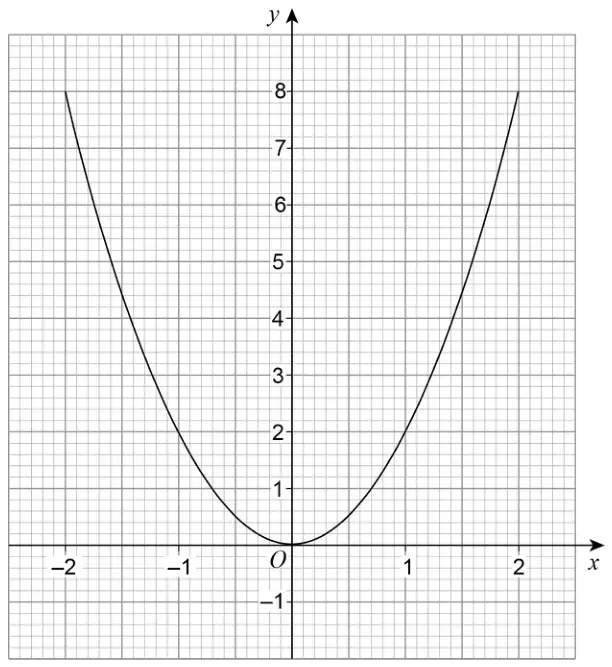
(a) Meera is using a graphical method to solve \(\quad 2x^2 - 3x = 0\)
She draws the graph of \(\quad y = 2x^2 \quad\) and a straight line graph on the same grid.
Here is the graph of \(\quad y = 2x^2\)
Complete her method to solve \(\quad 2x^2 - 3x = 0\) [2 marks]
(b) Levi is solving \(\quad 2x^2 + 5x = 0\)
He uses this method.
\[\begin{aligned} 2x^2 + 5x &= 0 && \text{subtract } 5x \text{ from both sides} \\ 2x^2 &= -5x && \text{divide both sides by } x \\ 2x &= -5 && \text{divide both sides by } 2 \\ x &= -2.5 && \end{aligned}\]
Evaluate his method and his answer. [2 marks]
Mark scheme (a)
Answer
Mark
Comments
Draws \(y = 3x\) and (\(x =\)) [−0.1, 0.1] and (\(x =\)) [1.4, 1.6]
B2
B1 Draws \(y = 3x\) or states \(y = 3x\) \(\pm\dfrac{1}{2}\) square tolerance for drawing graph Graph must be seen for \(x\) values from 0 to 1.5
Additional guidance
Ignore any \(y\) values seen
Solutions from a non-graphical method
B0
Ignore other lines drawn on grid
Mark scheme (b)
Answer
Mark
Comments
Full evaluation of method and answer
B2
eg1 Cannot divide by \(x\) as it could be zero eg2 Should have factorised and then he would have also found that \(x = 0\) eg3 Should have used the formula and then he would have also found that \(x = 0\) eg4 Should have used a graphical method then he would have also found that \(x = 0\) eg5 Should have completed the square then he would have also found that \(x = 0\)
B1 Partial evaluation eg1 \(x = 0\) has been omitted eg2 Should have factorised eg3 Should have used the formula eg4 Should have drawn a graph eg5 Only found one solution eg6 Cannot divide by zero
Additional guidance
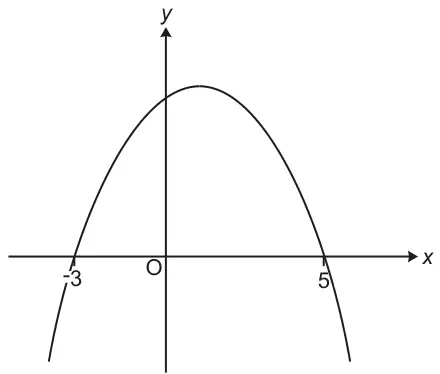
For B2 there needs to be an evaluation of the method and an indication that \(x = 0\) has been omitted from the answer
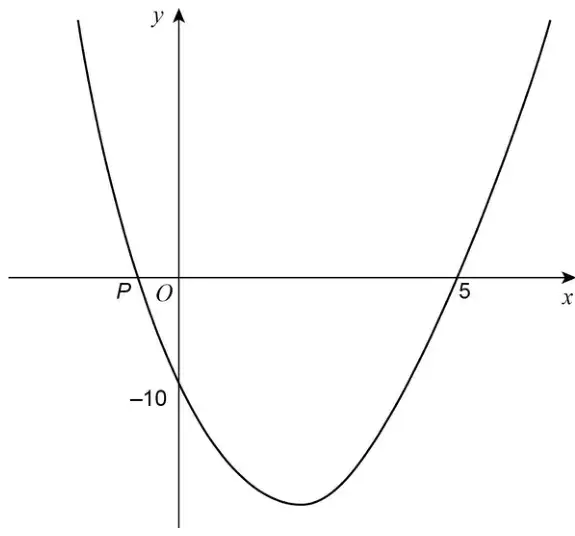
the \(x\)-axis at (5, 0) and point P the \(y\)-axis at (0, \(-10\))
Not drawn accurately
Work out the \(x\)-coordinate of the turning point of the graph. [4 marks]
Mark scheme
Answer
Mark
Comments
\(0 = 5^2 + 5b + c\) or \(-10 = 0^2 + b(0) + c\) or \(c = -10\)
M1
oe
\(b = -3\) or \(\;x^2 - 3x + c\) or (\(y =\)) \(x^2 - 3x - 10\)
M1dep
oe \((x - 5)(x + k)\) and \(-5k = -10\)
\((x - 5)(x + 2)\) or \(\dfrac{--3 \pm \sqrt{(-3)^2 - 4 \times 1 \times -10}}{2 \times 1}\) or \(\dfrac{3 \pm \sqrt{49}}{2}\) or \(\left(x - \dfrac{3}{2}\right)^2 + \ldots\) or \(2x - 3 = 0\) or \(\;x\)-coordinate of P = \(-2\) or two symmetrical coordinates eg (1, −12) and (2, −12)
M1dep
oe Correctly factorises the 3-term quadratic expression or correctly substitutes into quadratic formula for the 3-term quadratic dep on M1 M1
\(1\dfrac{1}{2}\) or \(\dfrac{3}{2}\) with no incorrect working
ft their 3-term quadratic (equation) seen Allow one sign error Allow \(10^2\) for \((-10)^2\) (do not count as a sign error) Allow recovery of invisible brackets Conceptual error (omission of square root, incomplete square root symbol, \(\pm\) not included, short fraction line) is M0 unless recovered
\(\dfrac{--10 \pm \sqrt{(-10)^2 - 4 \times 5 \times -4}}{2 \times 5}\) or \(\dfrac{10 \pm \sqrt{100 + 80}}{10}\) or \(\dfrac{10 \pm \sqrt{180}}{10}\) or \(\dfrac{10 \pm 6\sqrt{5}}{10}\) or 2.341(…) or 2.342 and \(-0.341(\ldots)\) or \(-0.342\)
A1ft
Fully correct substitution ft their 3-term quadratic (equation) seen oe eg \(\dfrac{5 \pm 3\sqrt{5}}{5}\) Allow \(10^2\) for \((-10)^2\) Allow recovery of invisible brackets Two correct solutions > 2 dp for their 3-term quadratic equation
2.34 and \(-0.34\)
A1ft
ft B0M1A1ft ft answers must be rounded to 2 dp
Alternative method 2
\(5\left(x^2 - 2x - \dfrac{4}{5}\right)\ (= 0)\) or \(x^2 - 2x - \dfrac{4}{5}\ (= 0)\) or \(5(x^2 - 2x) = 4\) or \(x^2 - 2x = \dfrac{4}{5}\)
ft their 3-term quadratic (equation) seen Allow one sign error but \((x - 1)^2\) must be correct
\(1 \pm \sqrt{1^2 + \dfrac{4}{5}}\) or 2.341(…) or 2.342 and \(-0.341(\ldots)\) or \(-0.342\)
A1ft
Fully correct ft their 3-term quadratic (equation) seen oe eg \(\dfrac{5 \pm 3\sqrt{5}}{5}\) Two correct solutions > 2 dp for their 3-term quadratic equation seen
2.34 and \(-0.34\)
A1ft
ft B0M1A1ft ft answers must be rounded to 2 dp
Additional guidance
Do not count a sign error in \(a\) (or \(b\)) as two sign errors eg If \(a\) should be \(-5\) but \(a = 5\) is used in both \(4ac\) and \(2a\), only count as one sign error
Final A1 mark can be awarded if both answers seen in working but only one is written on answer line
\(5x^2 + 10x - 4\ (= 0)\) seen with solutions \(-2.34\) and 0.34 (no incorrect method seen)
B0M1A1ftA1ft
\(5x^2 - 10x + 4\ (= 0)\) seen with solutions 0.55 and 1.45 (no incorrect method seen)
B0M1A1ftA1ft
\(5x^2 + 10x + 4\ (= 0)\) seen with solutions \(-0.55\) and \(-1.45\) (no incorrect method seen)
B0M1A1ftA1ft
Note that the pairs of solutions seen in the three rows above can come from incorrect method so will not always score 3 marks
M2 for \((3x - 1)(x - 5)\) [= 0] or M1 for \(3x(x - 5) - 1(x - 5)\) or for \(x(3x - 1) - 5(3x - 1)\) or for \((3x + a)(x + b)\) where \(ab = 5\) or \(3b + a = -16\)
M2 and M1 FT their 3-term quadratic M2 alt method correct substitution into formula or correct complete square M1 condone 1 error in substitution into formula For complete square, correct FT \((x + a)^2\)
If 0 or 1 scored instead award SC2 for correct answers
10 Here is a table of values for \(y = x^2 - x - 8\).
\(x\)
-4
-3
-2
-1
0
1
2
3
4
\(y\)
12
4
-2
-6
-8
-8
-6
-2
4
(a) Draw the graph of \(y = x^2 - x - 8\) for \(-4 \leqslant x \leqslant 4\). [3]
(b) Write down the equation of the line of symmetry of the graph. [1]
(c) Use the graph to solve the equation \(x^2 - x - 8 = 0\). Give your answers to 1 decimal place. [2]
Mark scheme (a)
Answer
Marks
Part marks and guidance
correct curve within tolerance
3
B2 for 8 points accurately plotted or B1 for 5 points accurately plotted
tolerance \(\pm\frac{1}{2}\) small square radially for curve and points, some daylight between \(y = -8\) and curve, condone a wobbly curve and slight feathering or tram lines in no more than 3 sections but no ruled lines and no dashed lines
Mark scheme (b)
Answer
Marks
Part marks and guidance
\(x = 0.5\) oe
1
Mark scheme (c)
Answer
Marks
Part marks and guidance
–2.3 or –2.4 3.3 or 3.4
2
B1 for either answer SC1 for an answer to more than 1 dp in each of –2.4 to –2.3 and 3.3 to 3.4
If 1 scored FTtheir curve for 2 marks or if 0 scored FTtheir curve for 1 or 2 marks or for SC1
tolerance \(\pm\frac{1}{2}\) small square radially
21 Work out the coordinates of the intersection of the graphs of \(y = 5 - 2x\) and \(y = 3x^2\).
You must show your working. [6]
Mark scheme
Answer
Marks
Part marks and guidance
\(\left(-\frac{5}{3}, \frac{25}{3}\right)\) oe and (1, 3) with correct working
6
Accept ( –1.67 or –1.666 to –1.667 , 8.33[3]…) Correct working requires evidence of at least M2M2
M2 for \(3x^2 + 2x - 5\) [= 0]
or M1 for \(3x^2 = 5 - 2x\)
For M2 accept e.g. \(5 - 2x - 3x^2\) [= 0]
M2 for \((3x + 5)(x - 1)\) [= 0]
or M1 for \((3x + a)(x + b)\) where \(ab = -5\) or \(3b + a = 2\) or for correct partial factors \(3x(x - 1) + 5(x - 1)\) or \(x(3x + 5) - [1](3x + 5)\)
Strict FT their 3-term quadratic equation or expression e.g.If M2 awarded for \(5 - 2x - 3x^2\) [= 0] then factors should be correct for this equation for M2 or M1 Accept correct use of quad formula or completing the square, M2 if completely correct, M1 if one error in substitution in formula or \((x + a)^2\) correct if completing the square
A1dep on M2M2 for either pair of coordinates correct or for both \(x\) values correct or both \(y\) values correct
If 0, 1 or 2 scored, instead award SC3 for answers \(\left(-\frac{5}{3}, \frac{25}{3}\right)\) oe and (1, 3) If 0 or 1 scored, instead award SC2 for answer \(\left(-\frac{5}{3}, \frac{25}{3}\right)\) oe or for both \(x\) values correct or both \(y\) values correct If 0 scored, SC1 for one answer (1, 3)
If A1 for correct \(x\)–values or \(y\) – values after correct partial factorisation award M2 for factors
See AG for work with equations in terms of \(y\)
Additional guidance: Question 21
A few may choose to work in terms of \(y\)
If working in terms of \(y\)
M2 for \(3y^2 - 34y + 75\) [ = 0] or M1 for \(\frac{5 - y}{2} = \sqrt{\frac{y}{3}}\) oe or better
or M1 for \((3y + a)(y + b)\) where \(ab = 75\) or \(3b + a = -34\)
accept equivalent negative version factors \(-(3y + a)(y + b)\) Allow M1 for factors that when expanded give one other term correct as well as ‘\(3y^2\)’
or for correct partial factors \(3y(y - 3) - 25(y - 3)\) or \(y(3y - 25) - 3(3y - 25)\)
accept equivalent negative version partial factors
If A1 for correct \(y\) values after correct partial factors award M2 for factors
(b) Write \(x^2 + 8x + 11\) in the form \((x + a)^2 - b\). [3]
(c)
(i) Write down the coordinates of the turning point of the graph \(y = (x - 3)^2 + 8\). [2]
(ii) Describe the single transformation which maps the graph of \(y = x^2\) onto the graph of \(y = (x - 3)^2 + 8\). [2]
Mark scheme (a)
Answer
Marks
Part marks and guidance
\((3x - 2)(x + 4)\) oe
M2
M1 for \((3x + a)(x + b)\) with \(a + 3b = 10\) or \(ab = -8\) or \(3x(x + 4) - 2(x + 4)\) or \(x(3x - 2) + 4(3x - 2)\)
For M2 and M1 condone the omission of the final bracket. \(\frac{(3x - 2)(3x + 12)}{3}\) followed by \(3x - 2\) [= 0] and \(x + 4\) [= 0] scores M2. If no products of factors shown then \(3x - 2 = 0\) and \(x + 4 = 0\) scores M1. After \(3x(x + 4) - 2(x + 4)\) or \(x(3x - 2) + 4(3x - 2)\) followed by correct answers award M2B1 BOD
– 4 and \(\frac{2}{3}\)
B1FT
correct or FTtheir linear factors
Condone \(0.\dot{6}\) or 0.666… or 0.67 for \(\frac{2}{3}\)
Mark scheme (b)
Answer
Marks
Part marks and guidance
\((x + 4)^2 - 5\)
3
B1 for \((x + 4)^2\) B2FTtheir \((x + a)^2\) for their – 5 If 0 scored SC2 for ‘correct’ answer with missing power or power written in the wrong place
e.g. \((x + 11)^2 - 110\) scores B2FT e.g. SC2 for \((x + 4) - 5\) or \((x + 4^2) - 5\)
Mark scheme (c)
Answer
Marks
Part marks and guidance
(i) 3 8
2
B1 for either 3 or 8 in the correct place
(ii) Translation \(\begin{pmatrix} 3 \\ 8 \end{pmatrix}\)
2
B1 for each correct or FT the vector from their answer from (c)(i)
24 The \(x\)-coordinates of the intersections of the graphs of \(y = x^2 + ax + 7\) and \(y = 3x + b\) are the solutions to the equation \(x^2 + 8x + 13 = 0\).
Find the value of \(a\) and the value of \(b\). [3]
Mark scheme
Answer
Marks
Part marks and guidance
\(a = 11\) \(b = -6\)
3
B2 for \(a - 3 = 8\) or \(7 - b = 13\) or better or M1 for \(x^2 + ax + 7 = 3x + b\) oe
Decide who is correct, Sasha or Taylor, and give the reason for your decision. [1]
(b) Solve this equation algebraically. Give your answers correct to 2 decimal places. You must show your working.
\(x^2 - 5x + 3 = 0\) [4]
Mark scheme (a)
Answer
Marks
Part marks and guidance
Taylor and square root of 9 is 3 and −3 oe
1
Accept: Taylor because Sasha only used the positive square root; Taylor because verification of −5.
Do not accept: Two solutions expected for a quadratic; Sasha because …
Mark scheme (b)
Answer
Marks
Part marks and guidance
4.30 and [0].70 with correct algebraic working
4
“Correct working” requires evidence of at least M2
M2 for correct substitution into the formula, eg. \(\dfrac{-(-5) \pm \sqrt{(-5)^2 - 4[\times 1] \times 3}}{2[\times 1]}\) oe allowing one error or for solving by completing the square eg. \(\left(x - \frac{5}{2}\right)^2 - \left(\frac{5}{2}\right)^2 + 3 = 0\) oe and \(x = \pm\sqrt{(-3) + \left(\frac{5}{2}\right)^2} + \frac{5}{2}\) oe or better
or
M1 for correct substitution into the formula, allowing two errors, or for completing the square eg. \(\left(x - \frac{5}{2}\right)^2 - \left(\frac{5}{2}\right)^2 + 3\) [= 0] oe or better
For oe allow better up to \(\frac{5 \pm \sqrt{25 - 12}}{2}\) but do not allow \(\frac{5 \pm \sqrt{13}}{2}\) Condone \(5^2\) for \((-5)^2\)
and
A1 for 4.30 or [0].70 nfww or for both solutions correct nfww but to more than 2 dp, to just 1 dp or in exact form
If 0 scored, instead award SC1 for both answers correct or to more than 2 dp, to just 1 dp or in exact form with no working or insufficient working
eg. 4.30277… and 0.69722…. 4.3 and 0.7, \(\frac{5 \pm \sqrt{13}}{2}\)
(a) Describe fully the graph of \(x^2 + y^2 = 20\). [3]
(b) The graph of \(y = 3x + 10\) intersects the graph of \(x^2 + y^2 = 20\) at two points.
Use an algebraic method to work out the coordinates of the two points. You must show your working. [6]
Mark scheme (a)
Answer
Marks
Part marks and guidance
Circle
1
Accept circular graph
Centre (0, 0) oe
1
Accept origin or O for (0, 0) but not turning point (0, 0)
Radius \(\sqrt{20}\) or \(2\sqrt{5}\) or 4.47[2..] or 4.5
1
If their description uniquely defines the circle then award full marks eg After “circle” and “centre (0, 0)”, passes through one correct stated point, scores 3 “circle” and (\(\pm\sqrt{20}\) , 0) and (0, \(\pm\sqrt{20}\) ), scores 3 “circle” and two correct stated points, scores 1
Mark scheme (b)
Answer
Marks
Part marks and guidance
(\(-2\), 4) and (\(-4\), \(-2\)) with correct working
6
M1 for \(x^2 + (3x + 10)^2 = 20\)
M1 for expanding their square term e.g. \(9x^2 + 30x + 30x + 100\)
M1 for simplifying their quadratic equation e.g. \(10x^2 + 60x + 100 = 20\) or better
M1 for correctly factorising their 3-term quadratic equation or for correct use of quadratic formula for their 3-term quadratic equation or for correct completing the square
A1 for one correct point or two correct \(x\)-values
If 0 or 1 scored, instead award SC2 for 2 correct points with no or insufficient working
If 0 scored SC1 for 1 correct point or 2 correct \(x\)-coordinates or 2 correct \(y\)-coordinates with no or insufficient working
‘Correct working’ requires evidence of at least M1M1M1
Award equivalent marks if working in terms of \(y\) May be in a grid May be implied by subsequent working
Their quadratic must include an \(x\) term Simplified: \(10x^2 + 60x + 80\) [= 0] or \(x^2 + 6x + 8\) [= 0]
M1 for answer a pair of factors of the type \((ax + b)(ax - b)\), where \(a = 3\) or \(b = 2\) or for correct answer seen
For 2 marks or M1, condone omission of final bracket
Mark scheme (b)
Answer
Marks
Part marks and guidance
\((3x + 4)(x - 2)\)
M2
M1 for \(3x(x - 2) + 4(x - 2)\) or \(x(3x + 4) - 2(3x + 4)\) or for \((3x + a)(x + b)\) where \(ab = -8\) or \(3b + a = -2\)
For M2 and M1 condone omission of final bracket For M2, condone \(\frac{(3x - 6)(3x + 4)}{3}\) followed by \(x - 2\) [= 0] and \(3x + 4\) [= 0] If no product of factors shown, \(x - 2 = 0\) and \(3x + 4 = 0\) gets M1 only After \(3x(x - 2) + 4(x - 2)\) or \(x(3x + 4) - 2(3x + 4)\) and then correct answers allow M2B1
\(-\frac{4}{3}\) oe and 2
B1
Correct or FTtheir two factors dep on factors of the form \((3x \pm a)(x \pm b)\)
Accept –1.33…
Mark scheme (c)
Answer
Marks
Part marks and guidance
1.5 or \(1\frac{1}{2}\) or \(\frac{3}{2}\)
4
M1 for \(2(x - 5) = 2(1 - 3x)\) or \(\frac{x - 5}{1 - 3x} = 1\)
M1 for \(2x - 10 = 2 - 6x\) or \(x - 5 = 1 - 3x\) M1 for reaching \(ax = b\), FT their previous working provided previous working is of the form \(dx + e = f + gx\)
For 4 marks, condone \(\frac{12}{8}\) or \(\frac{6}{4}\) isw incorrect cancelling/conversion Embedded answer scores M3 maximum
This final method mark may be implied from the answer
They multiplied the 2 by \((x - 1)\) it should have been \((x + 4)\)
1
The brackets have been multiplied by the wrong number it should be \(2(x + 4)\)
1
The \((x - 1)\) and \((x + 4)\) should be the other way round
1
The numerators have been multiplied by the wrong/own denominators
1
(Correct answer is given)
1
They have multiplied the wrong numerator by the wrong denominator
1
It should be this \(\frac{2(x + 4) + 3(x - 1)}{(x - 1)(x + 4)}\) (single fraction only)
1
They multiply the numerator and the denominator rather than the opposite denominator
1(BOD)
They did not cross multiply
0
They have multiplied their denominators by their numerators instead of adding them
0
Mark scheme (b)
Answer
Marks
Part marks and guidance
This question was discounted and all candidates were awarded 1 mark.
1
Notes
Editor’s note: the solution line shown is not actually wrong: \(x = -\frac{7 \pm \sqrt{7^2 - 4 \times 1 \times 5}}{2 \times 1}\) gives the same two values as \(x = \frac{-7 \pm \sqrt{7^2 - 4 \times 1 \times 5}}{2 \times 1}\), because \(\pm\) covers both signs, which is presumably why the part was discounted.
Some algebraic working leading to an answer of 3 −3
5
M1 for e.g. \(x^2 + (x - 6)^2 = 18\) M1 for expanding their square term e.g. \(x^2 - 12x + 36\) M1 for \(2x^2 - 12x + 18 = 0\) or better M1 for [2]\((x - 3)^2\) or \((2x - 6)(x - 3)\)
If 0 scored SC2 for correct answers with no algebraic working
condone one error in expanding brackets
simplifying to \(ax^2 - bx + c\) e.g. solving their quadratic equation by e.g. factors or quadratic formula
Note : apply scheme to substitution for \(x\) e.g. M1 for \((y + 6)^2 + y^2 = 18\) etc
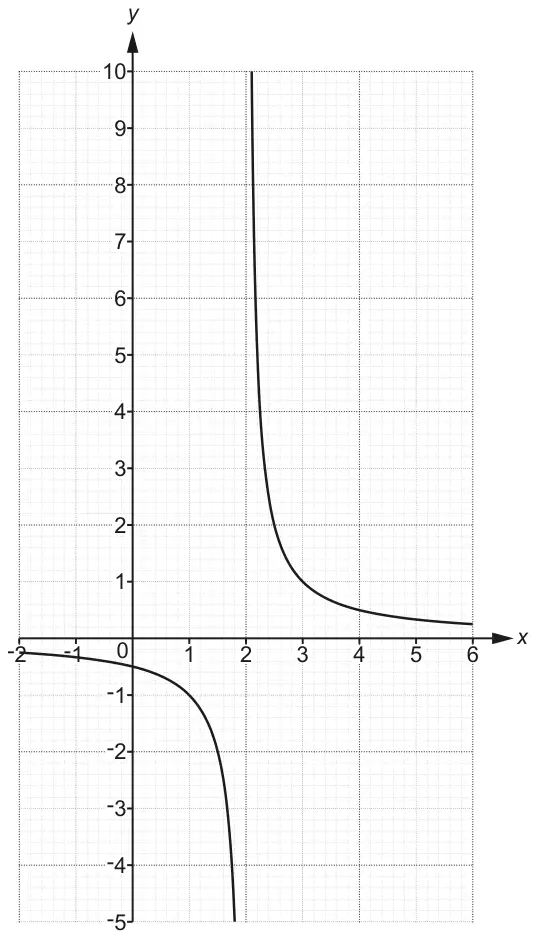
21 The graph of \(y = \dfrac{1}{x - 2}\) is drawn on the grid for \(-2 \leqslant x \leqslant 6\).
(a) There are no values of \(x\) for which \(\dfrac{1}{x - 2} = k\).
Find the value of \(k\). [1]
(b)
(i)Use the graph to find approximate solutions to the equation \(\dfrac{1}{x - 2} = 3x - 1\). Give your answers to 1 decimal place. Show your working on the graph. [4]
(ii) Show algebraically that \(\dfrac{1}{x - 2} = 3x - 1\) has the same solutions as \(3x^2 - 7x + 1 = 0\). [4]
Mark scheme (a)
Answer
Marks
Part marks and guidance
[k = ] 0
1
Mark scheme (b)
Answer
Marks
Part marks and guidance
(b)(i)
\(y = 3x - 1\) ruled
M2
M1 for correct freehand or short line or for \(y = 3x - k\) ruled or \(y = ax - 1\) ruled but not \(y = -1\)
For M2 must cross curve twice Accuracy ± 1mm at (0, -1) and (1, 2)
0.1 to 0.3 and 2.1 to 2.3
A2
A1 for each After A0, SC1 for both values correct
Only award if M2 scored previously 0.15287… , 2.1804….
(b)(ii)
\(1 = (3x - 1)(x - 2)\)
M1
Allow recovery from missing brackets for M1 or ‘ = 1’
\(3x^2 - x - 6x + 2\)
B2
For correctly expansion of brackets B1 for 3 terms correct in expansion
For B2 accept \(3x^2 - 7x + 2\) For B1 \(-7x\) counts as two terms
\(x =\) .................... or \(x =\) .................... [3]
Mark scheme
Answer
Marks
Part marks and guidance
–11 15 with correct working
3
M2 for \((x + 11)(x - 15)\) or M1 for \((x + a)(x + b)\) where either \(ab = -165\) or \(a + b = -4\)
OR
M2 for 2 correct trials with any number or M1 for 1 correct trial with any number
If 0 scored, SC1 for –11 and 15 with no working or insufficient working
“correct working” requires M2
M2 and M1 may be implied by grids and other forms such as \(x(x - 15) + 11(x - 15)\)
Must see substitutions e.g. \(5^2 - 4 \times 5 - 165\)
Use of formula M2 for \(\dfrac{[--]4 \pm \sqrt{([-]4)^2 - 4 \times [1] \times -165}}{2\,[\times 1]}\) or better e.g. \(\dfrac{4 \pm \sqrt{676}}{2}\) M1 for formula with at most two errors
Darcy says that the statement in the box is an equation. Ellis says that the statement in the box is an identity. One of them is correct.
Explain which one of Darcy or Ellis is correct. [2]
(b) Solve by factorising.
\(x^2 + 4x - 12 = 0\) [3]
Mark scheme (a)
Answer
Marks
Part marks and guidance
\(x^2 + 4x + 3x + 12\) [\(= x^2 + 7x + 12\)]
M1
May be seen in the work space or within their statement and it might be seen in e.g. a table where the addition can be implied
Ellis with a correct statement about definition of an identity or of an equation or Ellis with correct supporting work and statement
B1
e.g. an identity is true for all values of \(x\) or e.g. this cannot be solved to get a value of \(x\) or e.g. left-hand side is the same as the right-hand side
Accept “neither, because if it was an identity then it would have ≡”
See Appendix
Alternative Method
M1 for shows LHS = RHS for at least three values of \(x\)
B1 dep for Ellis with their correct statement e.g. a quadratic equation does not have three solutions [so by elimination it is an identity]
Appendix
Exemplar responses for Question 21a
Response for the B marks
Mark
1
Ellis – the expression before and after the equal sign are the same (‘same’ implies identical in form)
1
2
Ellis – \((x + 4)(x + 3)\) is the same as \(x^2 + 7x + 12\)
1
3
Ellis – the statement in the box doesn’t gives a value, an equation would be to find a specific number
1
4
Identity – \((x+4)(x+3)\) has the same answer expanded as \(x^2 + 7x + 12\) (condone identity instead of Ellis)
1
5
Ellis – they are written differently but are equal to the same (this is ok to score as they have clarified that the 2 sides are the same but in different forms)
1 BOD
6
Ellis – \((x + 4)(x + 3)\) is equal \(x^2 + 7x + 12\) when expanded
0
7
Ellis there is nothing to work out (not enough)
0
8
Ellis – it is identifying how each formula is equal to each other (equal to each other is not enough)
0
9
Ellis – you’re not asked to work anything out, it gives you the answer (they say you’re not asked to work it out rather than saying it cannot be solved)
0
Mark scheme (b)
Answer
Marks
Part marks and guidance
\((x + 6)(x - 2)\)
M2
M1 for \((x + a)(x + b)\) where \(a + b = 4\) or \(ab = -12\) or for \(x + 6\) [= 0] and \(x - 2\) [= 0]
For M2 or M1 condone omission of final bracket
e.g. \((x + 1)(x + 3)\) as \(a + b = 4\) or e.g. \((x - 3)(x + 4)\) as \(ab = -12\)
\(-6\) and 2 final answer
B1FT
strict FT for correct solutions from their quadratic factors
If 0 scored SC1 for answer \(\pm 2\) and \(\pm 6\)
e.g. FT \(x = -1\) and \(x = -3\) from \((x + 1)(x + 3)\)
(a) Write \(x^2 - 8x + 9\) in the form \((x - a)^2 - b\). [3]
(b) Use your answer from part (a) to solve.\[x^2 - 8x + 9 = 0\]
Give your answers in exact form. You must show your working. [2]
Mark scheme (a)
Answer
Marks
Part marks and guidance
\((x - 4)^2 - 7\) final answer
3
B1 for \((x - 4)^2\) AND B2FT for \(-7\) or M1 for \(9 - (\textit{their } {-4})^2\) oe shown
No FT from \((x - 3)^2\) FT can be implied, check \(9 - (\textit{their } {-4})^2\)
If 0 or 1 scored, allow SC2 for final answer \((x - 4) - 7\)
Mark scheme (b)
Answer
Marks
Part marks and guidance
\(4 + \sqrt{7}\), \(4 - \sqrt{7}\) final answer with working from (a)
2FT
M1 for \((x - 4)^2 = \textit{their } 7\) FT from their (a) for solutions in exact form if working shown
Answers only score 0 Do not FT where \(b = 0\) e.g. \((x - 4)^2\) If their \(b\) is a perfect square, allow FT for \(a + \sqrt{b}\) and \(a - \sqrt{b}\) or simplified as two integers If \(b < 0\), a max of M1
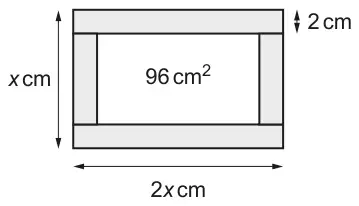
17 Charlie is making some wooden frames. Charlie has a strip of wood 1.6 m long and 2 cm wide.
Not to scale
Each frame will be made from four pieces of wood cut from the strip to form a rectangle, as shown below.
Not to scale
The width of each frame is \(x\) cm. The length of each frame is \(2x\) cm. The area enclosed by each frame must be 96 cm2.
Work out the maximum number of frames Charlie can make from the 1.6 m length of wood. You must show your working. [6]
Mark scheme
Answer
Marks
Part marks and guidance
3 frames with correct working
6
“Correct working” requires B5
Algebraic method: B5 for [one frame =] 52 [cm] with \(x = 10\) and \(2x^2 - 12x - 80\) [= 0] or better or M3 for \(2x^2 - 12x - 80\) [= 0] or better A1 for [\(x\) =] 10 or M2 for \((2x - 4)(x - 4)\) [= 96] oe or better seen or B1 for \(2x - 4\) or \(x - 4\) seen
For B5 and M3A1 isw for use of \(x = -4\)
For B5 or M3 allow equivalent 3 term quadratic e.g. \(2x^2 - 12x = 80\)
Allow equivalents for M2 e.g. \(2 \times 2 \times 2x + 2 \times 2(x - 4) + 96 = 2x^2\)
May be on diagram
OR
Trial and improvement: B5 for [one frame =] 52 [cm] with \(x = 10\) and 16 by 6 [= 96] shown or B4 for \(x = 10\) and 16 by 6 [= 96] selected or B3 for selects 6 by 16 [= 96]
B3 not just for seeing 6 by 16 it must be selected in some way e.g. ringed, underlined, used
If 0, 1 or 2 scored, instead award SC3 for [one frame =] 52 [cm] with no or insufficient working If 0 or 1 scored, instead award SC2 for \(x = 10\) with no or insufficient working
M2 for \(0 = -(-3)^2 - 3b + c\) and \(0 = -5^2 + 5b + c\) or M1 for \(y = -x^2 + bx + c\) or for \(0 = (-3)^2 - 3b + c\) and \(0 = 5^2 + 5b + c\)
Appendix: exemplar response for Q16(a)
Response
Judgement
Mark
\((x + 3)(x - 5)\) \(= x^2 - 2x - 15\) But the quadratic is upside down so it will be \(-x^2 + 2x + 15\) [there then was an arrow from the +15 to the intercept]
The response doesn’t quite fit the scheme but is thought worthy of full marks This line on its own scores M1 But this line makes it equivalent to the M2 and it also a correct expansion with + 15 The linking of +15 to the intercept is an added bonus
Mark scheme (b)
Answer
Marks
Part marks and guidance
The equation could be a multiple E.g. [\(y =\)] \(-k(x + 3)(x - 5)\) So the intercept could be a multiple of 15
2
B1 for giving an example in the form \(-k(x + 3)(x - 5)\) (where \(k > 0\), \(k \ne 1\), \(k\) need not be an integer) or stating that the intercept could be a multiple of 15
Allow full or part marks for a fully correct algebraic example E.g. [\(y =\)] \(-2(x + 3)(x - 5)\) would have a \(y\)-intercept of 30
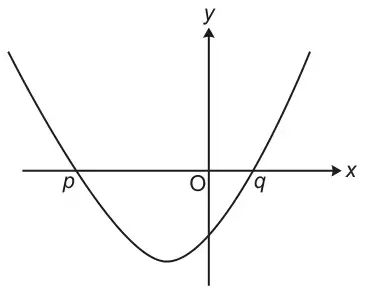
13 The graph of \(y = x^2 + 6x - 2\) is shown below. The roots of the equation \(x^2 + 6x - 2 = 0\) are at \(p\) and \(q\).
(a)
(i) Calculate \(y\) when \(x = 1\). [1]
(ii) Without solving the equation, explain why \(q\) must lie between 0 and 1. [2]
(iii) Explain why using a method of iteration is not the most appropriate way of finding a solution to this equation. [1]
(b) The exact value of \(q\) is \(\dfrac{-6 + \sqrt{44}}{2}\).
Write \(\dfrac{-6 + \sqrt{44}}{2}\) in the form \(a + \sqrt{b}\). [3]
Mark scheme (a)
Answer
Marks
Part marks and guidance
(i) 5
1
(ii) At \(x = 0\) oe and \(y \lt 0\) or \(y\) is negative or \(y = -2\) or curve is below \(x\)-axis and at \(x = 1\) , \(y\) is positive or \(y \gt 0\) or \(y = 5\) or curve is above the \(x\) - axis and change of sign oe [between \(x = 0\) and \(x = 1\)] or the curve crosses the \(x\)-axis between 0 and 1 or solution/q lies between 0 and 1
1
1dep
If \(y\) value evaluated then must be correct for 2 marks or 1 mark
Dep on first mark
If 0 scored, SC1 for change of sign oe or the curve crosses the \(x\)-axis between 0 and 1 oe
For 2 marks needs to refer \(x = 0\) negative oe and \(x = 1\) positive oe and change of sign/graph crosses axis/solution between 0 and 1 oe e.g. For 2 marks At \(x = 0\) the curve is below the \(x\)–axis, at \(x = 1\) the curve is above the \(x\)–axis so there is a change of sign
See Appendix
(iii) Correct response concerning accuracy/time taken/refer to specific more efficient methods e.g. Iteration gives an estimate oe
Iteration can be a lengthy process oe [to get an accurate result]
1
e.g. The quadratic formula/complete the square is quicker/more accurate/easier Trial and improvement is less efficient/takes too long You can always go to more decimal places It will not give an exact/accurate answer It will take many iterations There are two solutions, iteration is used to find one at a time Mark the best if more than one answer given
Do not accept incorrect statement e.g. It would be quicker/easier to factorise the equation
Appendix: additional guidance for Q13(a)(ii)
Response
Mark
1
The graph is below the \(x\)-axis at \(x = 0\) and above the \(x\) – axis at \(x = 1\) so the solution lies between 0 and 1
2
2
\(0^2 - (6 \times 0) - 2 = -2\) and \(1^2 + (6 \times 1) - 2 = 5\) so there is a sign change from −2 to 5 BOD \(x = 0\) and \(x = 1\) implied in reasoning and a correct statement regarding sign change
2
3
Because at \(q\), \(y = 0\), but at 1 \(y = 5\) and at 0 \(y\) is negative. So the solution is in between 0 and 1 (BOD \(x = 0\) and \(x = 1\) implied in reasoning similar to above and correct conclusion stated)
2
4
When \(q = 0\) graph is negative, when \(q = 1\) graph is positive so there is a sign change (BOD \(q\) is on the \(x\)-axis so take \(q\) as \(x\) here)
BOD2
5
The graph is positive at 1 and negative at zero so the solution lies in between 0 and 1 [BOD first mark allow as 1 and 0 imply \(x = 1\) and \(x = 0\) and the conclusion is correct for 2nd mark)
BOD2
6
When \(x = 1\), \(y = 5\) and the graph intersects the \(x\)- axis between 0 and 1 so that is where the solution lies [Does not mention \(x = 0\) and negative and second mark dep on first but gets SC1]
SC1
7
The graph crosses the \(x\)-axis between 0 and 1 [ 2nd mark dep on 1st mark and does not specifically mention \(x = 0\) and \(x = 1\) being negative and positive so zero but gets SC1]
SC1
8
There is a change of sign (2nd mark dep on first mark buts gets SC1)
SC1
9
The root lies between 0 and 1 (not adding to question asked – no reasons given for this)
0
Mark scheme (b)
Answer
Marks
Part marks and guidance
\(-3 + \sqrt{11}\) final answer
3
B2 for answer \(p + \sqrt{11}\) or M1 for [\(\sqrt{44}\) =] \(2\sqrt{11}\) seen or \(\frac{\sqrt{44}}{\sqrt{4}}\) seen
8 Here is a table of values for \(y = x^2 + 2x - 2\).
\(x\)
−4
−3
−2
−1
0
1
2
\(y\)
6
1
−2
−3
−2
1
6
(a) Draw the graph of \(y = x^2 + 2x - 2\) for \(-4 \leqslant x \leqslant 2\).
[3]
(b) Write down the equation of the line of symmetry of the graph. [1]
(c) Use the graph to solve the equation \(x^2 + 2x - 2 = 0\). Give your answers to 1 decimal place. [2]
Mark scheme (a)
Answer
Marks
Part marks and guidance
accurate curve
3
B2 for 6 or 7 points accurately plotted or B1 for 4 or 5 points accurately plotted
tolerance \(\pm \frac{1}{2}\) small square radially for curve and points, condone a wobbly curve and slight feathering or tram lines in no more than 3 sections but no ruled lines
Mark scheme (b)
Answer
Marks
Part marks and guidance
\(x = -1\) oe
1
Mark scheme (c)
Answer
Marks
Part marks and guidance
−2.8 or −2.7 0.7 or 0.8
2
B1 for either If 0 or 1 scored FTtheir curve for 1 or 2 marks or SC1 for an answer in each of −2.8 to −2.7 and 0.7 to 0.8
tolerance \(\pm \frac{1}{2}\) small square radially
Dependent on first M1 and not from rearrangement of original equation
\(x^2\) and/or \(8x + 20\) may be written with correct shape(s)
Correctly rearranging to \(x^2 - 8x - 20 = 0\) without error
A1
Mark scheme (b)
Answer
Marks
Part marks and guidance
\(-2\) 10 nfww
3
B2 for one correct solution nfww
OR M2 for \((x + 2)(x - 10) = 0\) or M1 for \((x + a)(x + b)\) where \(ab = -20\) or \(a + b = -8\)
OR M2 for two correct trials using \(-4 \leqslant x \leqslant 0\) and two correct trials using \(8 \leqslant x \leqslant 12\) or M1 for two correct trials using \(-4 \leqslant x \leqslant 0\) or two correct trials using \(8 \leqslant x \leqslant 12\)
If 0 scored SC1 for answers 2 and −10
e.g. one trial is when \(x = 2\), \(2^2 - 8 \times 2 - 20 = -32\) Accept as trial \(x = 2\) and \(-32\) See trials table below
Guidance
Trials for Q22(b)
\(x\)
\(x^2\)
\(-8x\)
\(-20\)
total
−4
16
32
−20
28
−3
9
24
−20
13
−2
4
16
−20
0
−1
1
8
−20
−11
0
0
0
−20
−20
8
64
−64
−20
−20
9
81
−72
−20
−11
10
100
−80
−20
0
11
121
−88
−20
13
12
144
−96
−20
28
Mark scheme (c)
Answer
Marks
Part marks and guidance
Length [of square] cannot be negative
1
Dependent on negative answer in (b)
Do not accept \(x\) cannot be negative
Mark scheme (d)
Answer
Marks
Part marks and guidance
(i) 100
1
FT (their positive root from (b))\(^2\)
If two positive roots seen in (b) accept either or both used in (i) and in (ii) BUT, if one answer right and one wrong in any part, 0 marks
(ii) 25
1
FT (their positive root from (b)) \(\times 2 + 5\)
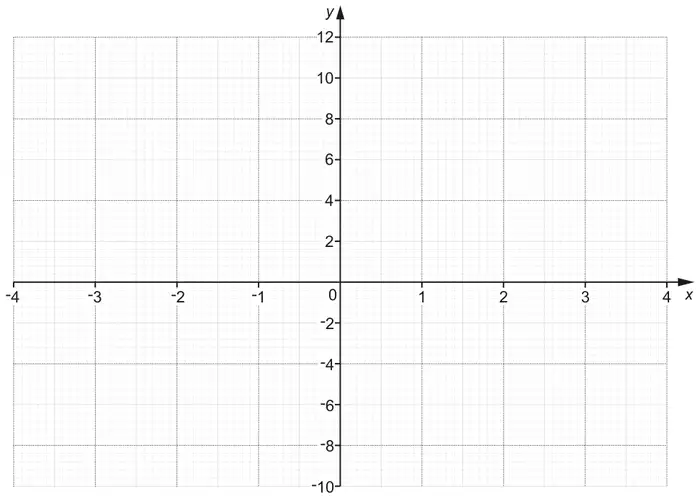
(b) Draw the graph of \(y = x^2 - 3\) for values of \(x\) from \(-3\) to 3.
[3]
(c) Use your graph to solve \(x^2 - 3 = 2\). [2]
Mark scheme (a)
Answer
Marks
Part marks and guidance
6 and \(-3\)
2
B1 for each
Mark scheme (b)
Answer
Marks
Part marks and guidance
Correct curve
3
B2FT for 6 or 7 correct plots B1FT for 4 or 5 correct plots
Tolerance \(\pm 1\) small square for plotting and curve through correct points. Condone slight feathering – must not be ruled If large blob for plot, check centre of blob
Mark scheme (c)
Answer
Marks
Part marks and guidance
\(-2.3\) to \(-2.2\) and 2.2 to 2.3
2FT
Strict FT B1 for either FT their graph
Tolerance \(\pm\tfrac{1}{2}\) a small square Do not allow exact answers or answers with no graph Do not FT from a straight line graph
If more than 2 intersections, B1 for each correct intersection on the answer line. If more than 2 answers, mark the worst.
\[\begin{aligned} y &= x + 3 \\ (x - 3)^2 + y^2 &= 50 \end{aligned}\]
You must show your working. [5]
Mark scheme
Answer
Marks
Part marks and guidance
[\(x\)=] −4 [\(y\)=] −1 [\(x\)=] 4 [\(y\)=] 7 with correct algebraic working
5
accept any correct method
M1 for correct substitution e.g. \((x - 3)^2 + (x + 3)^2\) [= 50] M1 for expanding both brackets correctly e.g. \(x^2 - 3x - 3x + 9 + x^2 + 3x + 3x + 9\) [=50] M1 for simplifying their equation e.g. \(2x^2 = 32\) or \(2x^2 - 32\) [= 0]
“Correct algebraic working” requires evidence of at least M1M1
implied by \(2x^2 + 18\) [= 50]
condoning one error
or better to \(ax^2 = b\) or to \(ax^2 + bx + c\) [= 0]
A1FT for \(x = -4, 4\)
If 0 scored SC2 for [\(x\)=] −4 [\(y\)=] −1, [\(x\)=] 4 [\(y\)=] 7 with no working or SC1 for both \(x\) values with no working or a correct pair of \(x\) and \(y\) values with no working
FTtheir quadratic equation
See appendix for alternative methods
Appendix: Question 20
M1 for correct substitution e.g. \((y - 3 - 3)^2 + y^2\) [= 50] M1 for expanding the bracket correctly e.g. \(y^2 - 6y - 6y + 36 + y^2\) [=50] M1 for simplifying their equation e.g. \(2y^2 - 12y - 14\) [= 0] or better e.g. \(y^2 - 6y - 7\) [= 0] A1FT for \(y = -1, 7\)
16 The following kinematics formulas may be used in this question.
\[v = u + at \qquad s = ut + \tfrac{1}{2}at^2 \qquad v^2 = u^2 + 2as\]
The initial velocity of a particle is 20 m/s. The acceleration of the particle is −8 m/s². After \(t\) seconds, the particle has travelled 25 m.
(a) Show that \(4t^2 - 20t + 25 = 0\). [3]
(b) Solve \(4t^2 - 20t + 25 = 0\). [3]
(c) Show that the particle is stationary when it has travelled 25 m. [3]
Mark scheme (a)
Answer
Marks
Part marks and guidance
Subst into correct formula (may be implied) and partial simplification
2
B2 for \(25 = 20t - \frac{1}{2} \times 8 \times t^2\) oe or \(25 = 20t + (-4)t^2\) or B1 for subst eg \(25 = 20t + \frac{1}{2}(-8)t^2\)
Only accept \(25 = 20t - 4t^2\) if subst seen For B1 condone ambiguity caused by missing brackets
\(25 = 20t - 4t^2\) seen and correct completion to \(4t^2 - 20t + 25 = 0\)
1dep
Dep on previous 2 marks
Mark scheme (b)
Answer
Marks
Part marks and guidance
2.5 oe
3
M2 for \((2t - 5)(2t - 5)\) or M1 for any two factors that give two correct terms when expanded or for partial factorisation \(2t(2t - 5) - 5(2t - 5)\)
OR M2 for [\(t =\)] \(\dfrac{20 \pm \sqrt{400 - 400}}{8}\) or better or M1 for [\(t =\)] \(\dfrac{-(-20) \pm \sqrt{(-20)^2 - 4 \times 4 \times 25}}{2 \times 4}\) with at most one error
eg a sign error, short fraction line, short root, but condone missing brackets
Mark scheme (c)
Answer
Marks
Part marks and guidance
Shows \(v = 0\) and concludes “stationary”
3
M1 for [\(v^2 =\)] \(20^2 + 2(-8)25\) or [\(v =\)] \(20 + (-8) \times\) their (b) A1 \(v = 0\)
If 0 scored, instead award SC2 for \(v = 0\) and other values substituted into a relevant equation as a correct check or SC1 for \(v = 0\)
19 The graph of \(y = 2x^2 + 3x - 9\) is drawn below.
(a) Use the graph to solve \(2x^2 + 3x - 9 = 0\). [2]
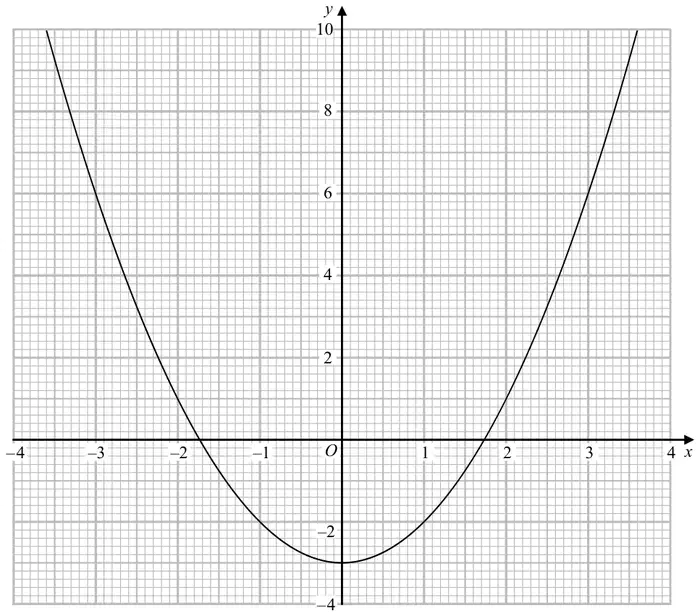
(b) The equation \(2x^2 + x - 4 = 0\) can be solved by finding the intersection of the graph of \(y = 2x^2 + 3x - 9\) and the line \(y = ax + b\).
(i) Find the value of \(a\) and the value of \(b\). [2]
(ii) Hence use the graph to solve the equation \(2x^2 + x - 4 = 0\). [3]
Mark scheme (a)
Answer
Marks
Part marks and guidance
[x =] -3, 1.5
2
B1 for 1 correct
Mark scheme (b)
Answer
Marks
Part marks and guidance
(i) [a =] 2
[b =] -5
2
B1 for each or for \(2x - 5\) seen
(ii) \(y = 2x - 5\) or FT \(y = \textit{their}\ ax + \textit{their}\ b\) ruled on grid
M2
M2 and M1 apply to \(y = 2x - 5\) or FT \(y = \textit{their}\ ax + \textit{their}\ b\)
M1 for ‘correct’ \(y\)-intercept or for ‘correct’ gradient or for freehand or broken ‘correct’ line or for at least 3 ‘correct’ plots and no ‘incorrect’ plots
For M2 line must cross curve For M2 and M1, accuracy 1 small square at y-intercept (extended if necessary provided it fits on the grid) and gradient ±1 small square vertically for a run of 1 unit horizontally Do not FT if a = 0 or b = 0
M2 for \((x + 4)\) and \((x + 5)\) or M1 for \((x + a)\) and \((x + b)\) where \(ab = 20\) or \(a + b = 9\) or \(x(x + 4) + 5(x + 4)\) or \(x(x + 5) + 4(x + 5)\)
If M0 scored SC1 for \(x + 4 = 0\) and \(x + 5 = 0\)
For M2 or M1 condone omission of final bracket
\({}^{-}5\) and \({}^{-}4\) nfww
B1
STRICT FTtheir factors dep on two brackets in factors.
If 0 scored SC1 for answers \(\pm 5\) and \(\pm 4\)
(b) Draw the graph of \(y = x^2 - 4x + 1\) for \(-1 \leqslant x \leqslant 5\).[3]
(c) On the same grid, draw the graph of \(y = 2x - 6\) for \(-1 \leqslant x \leqslant 5\). [3]
(d) Use your graphs to solve the equation \(x^2 - 4x + 1 = 2x - 6\).
Give your answers to 1 decimal place. [2]
Mark scheme (a)
Answer
Marks
Part marks and guidance
Completes table with
\(x\)
–1
0
1
2
3
4
5
\(y\)
6
1
–2
–3
–2
1
6
2
B1 for at least 2 correct values
Mark scheme (b)
Answer
Marks
Part marks and guidance
Correct curve
3
B2 for 6 or 7 points correctly plotted FT their table or B1 for 4 or 5 points correctly plotted FT their table
Tolerance ±2 mm for plotting and curve through the correct points. Strict marking of ‘smooth curve’ – must not be ruled or ‘feathered’
Mark scheme (c)
Answer
Marks
Part marks and guidance
Straight line passing through (0, –6) and (3, 0)
3
M2 for a correct unruled line or a straight line of gradient 2 or a straight line passing through (0, –6) or two correct points correctly stated or plotted or M1 for one correct point stated or plotted
\(x\)
–1
0
1
2
3
4
5
\(y\)
–8
–6
–4
–2
0
2
4
Mark scheme (d)
Answer
Marks
Part marks and guidance
1.6 and 4.4
2FT
B1 for each or both answers as decimals to a greater accuracy Correct answer or FT their straight line
Tolerance ±1 mm.
Do not allow exact answers \(3 + \sqrt{2}\) and \(3 - \sqrt{2}\)
M2 for \((x + 4)\) and \((x + 5)\) or M1 for \((x + a)\) and \((x + b)\) where \(ab = 20\) or \(a + b = 9\) or \(x(x + 4) + 5(x + 4)\) or \(x(x + 5) + 4(x + 5)\)
If M0 scored SC1 for \(x + 4 = 0\) and \(x + 5 = 0\)
For M2 or M1 condone omission of final bracket
-5 and -4
B1
STRICT FTtheir factors dep on two brackets in factors.
19 Solve this equation algebraically. Give your solutions correct to 2 decimal places.
\[3x^2 + 8x - 5 = 0\]
[4]
Mark scheme
Answer
Marks
Part marks and guidance
−3.19 [0].52 with some correct algebraic working
4
M2 for correct substitution into the formula, allow one error e.g. \(\dfrac{-8 \pm \sqrt{8^2 - 4 \times 3 \times -5}}{2 \times 3}\) or for e.g. \(3\left[\left(x + \frac{8}{6}\right)^2 - \left(\frac{8}{6}\right)^2\right] - 5 = 0\) oe and \(x = \sqrt{\frac{5}{3} + \left(\frac{8}{6}\right)^2} - \frac{8}{6}\) oe or better
or
M1 for correct substitution into the formula, allow two errors or for e.g. \(3\left[\left(x + \frac{8}{6}\right)^2 - \left(\frac{8}{6}\right)^2\right] - 5 = 0\) oe or better
and
A1 for −3.19 or [0].52 or for both solutions correct but to more than 2dp. e.g. −3.189254… or 0.522588…..
If 0 scored allow SC1 for two correct answers with no correct algebraic working.
\((5x + 2)(x + 1)\) oe using two pairs of brackets
2
M1 for any two factors that give two correct terms when expanded or partial factorisation such as \(5x(x + 1) + 2(x + 1)\) or \(x(5x + 2) + [1](5x + 2)\)
Condone missing final bracket for up to full marks
Up to full marks can be awarded for solving using non-integer factorisations such as \(5(x + 0.4)(x + 1)\) oe
NB Working backwards from the answers scores only the final mark e.g. \((x + 0.4)(x + 1) = 0\) without seeing a factor of 5 or division by 5 leading to –0.4 and –1
Any other method, award B1 for both answers correct
\(6x^2 + 7x + 2\), \(7x\) counts as 2 terms For B1 accept terms on a grid
[\(x(3x + 5) =\)] \(3x^2 + 5x\)
M1
\(9x^2 + 12x + 4\)
M1
FT their expansions dep on 3 term quadratic
Condone if expression ‘= 0’
\((3x + 2)^2\)
A1
For A1 accept \((3x + 2)(3x + 2)\)
which is a perfect square
A1
Mark scheme (b)
Answer
Marks
Part marks and guidance
Cannot square root a negative value oe or for \(9x^2 + 12x + 16\) [= 0] and \(b^2 - 4ac \lt 0\) with \(a\), \(b\), \(c\) substituted or values shown oe
1
Correction: the published mark scheme prints \(9x^2 + 12x + 4\) [= 0] here. Setting the expression equal to –12 gives \(9x^2 + 12x + 16 = 0\), for which \(b^2 - 4ac = 144 - 576 \lt 0\).
(i) Write \(x^2 + 4x - 16\) in the form \((x + a)^2 - b\). [3]
(ii) Solve the equation \(x^2 + 4x - 16 = 0\). Give your answers in surd form as simply as possible. [4]
(b) Sketch the graph of \(y = x^2 + 4x - 16\), showing clearly the coordinates of any turning points.
[3]
Mark scheme (a)
Answer
Marks
Part marks and guidance
(i) \((x + 2)^2\) final answer
1
– 20 final answer
2
FTtheir \((x + 2)^2\) final answer M1 for after \((x + a)^2\) shows \(-16 -\) their \(a^2\)
(ii) \(-2 \pm 2\sqrt{5}\)
4
B3FTtheir (a)(i) for \(-2 + \sqrt{20}\) or \(-2 - \sqrt{20}\) or better or M2 for \(x + 2 = (\pm)\sqrt{20}\) FT their (a)(i) or M1 for \((x + 2)^2 = 20\) FT their (a)(i) OR Alternative method B3 for \(\dfrac{-4 \pm 4\sqrt{5}}{2}\) or M2 for \(\dfrac{-4 \pm \sqrt{80}}{2}\) oe or M1 for \(\dfrac{-4 \pm \sqrt{4^2 - 4 \times 1 \times -16}}{2 \times 1}\) oe
FT dep on expression in form \((x + a)^2 - b\) in part (a)(i)
Condone 1 slip e.g. 1 sign error, 1² for 1, short fraction line, short root
Mark scheme (b)
Answer
Marks
Part marks and guidance
U shaped parabola
1
Be generous for the U shape condone broken line Values must be shown but could be marked on axes. Mark intention Accept turning point = (–2, –20) written in working provided no contradiction on sketch If point (–2, –20) only plotted on graph in 3rd quadrant and no sketch then award 2 marks
with turning point in 3rd quadrant indicated at (–2, –20) soi
2
B1FT for turning point at (\(k\), –20) or (–2, \(k\)) soi FT their (a)(i)
Work out the value of \(c\) and the value of \(d\). [5]
(c) Solve by factorising.\[x^2 - 7x + 10 = 0\]
[3]
Mark scheme (a)
Answer
Marks
Part marks and guidance
\(3x^2 + xy - 2y^2\) final answer
3
M2 for \(3x^2 - 2xy + 3xy - 2y^2\) oe or M1 for two correct terms
Accept e.g. 3yx May be seen in a table for M1
Mark scheme (b)
Answer
Marks
Part marks and guidance
\(c = 4\) \(d = {}^{-}1\)
5
M4 for \(3d + 20 = 17\) oe or M3 for \(6 + c = 10\) or \(3d + 5c = 17\) or \(6x + cx = 10x\) or M2 for \(6x + 3d + cx + 5c\) oe or M1 for \(6x + 3d\) or \(cx + 5c\)
OR
B3 for \(c = 4\) and B2 for \(d = {}^{-}1\)
Accept e.g. c5
Mark scheme (c)
Answer
Marks
Part marks and guidance
2, 5 nfww
3
M2 for \((x - 2)\) and \((x - 5)\) or M1 for \((x + a)\) and \((x + b)\) where \(ab = 10\) or \(a + b = {}^{-}7\) B1 ft their quadratic factors If 0 scored SC1 for answer \(\pm 2\) and \(\pm 5\)
12 In the diagram, the square and the trapezium share a common side of length \(x\) cm.
Not to scale
The area of the square is equal to the area of the trapezium.
Work out the value of \(x\). [6]
Mark scheme
Answer
Marks
Part marks and guidance
7.17 to 7.18 or 7.2 nfww
6
M3 for \(x^2 - 3x - 30 = 0\) or M2 for \(\dfrac{6}{2}(10 + x) = x^2\) oe or M1 for \(\dfrac{6}{2}(10 + x)\) oe
AND
M2FT for \(\dfrac{3 + \sqrt{(-3)^2 - 4 \times (-30)}}{2}\) or better or 7.17 to 7.18 and –4.18 to –4.17 or M1FT for either formula with at most two errors
Condone missing brackets for M1
FT from their 3 term quadratic
Allow M2FT for \(\dfrac{3 \pm \sqrt{(-3)^2 - 4 \times (-30)}}{2}\) or better
Alternative by completing the square: M2FT for \(1.5 + \sqrt{32.25}\) or \(1.5 \pm \sqrt{32.25}\) or 7.17 to 7.18 and –4.18 to –4.17 or M1FT for \((x - 1.5)^2 - 32.25\)
20 Solve this equation, giving your answers correct to 1 decimal place.
\[\frac{5}{x + 2} + \frac{3}{x - 3} = 2\][6]
Mark scheme
Answer
Marks
Part marks and guidance
−0.3 5.3
6
B1 for \((x + 2)(x - 3)\) oe seen
likely seen in \(2(x + 2)(x - 3)\) implied by \(x^2 - x - 6\)
M1 for \(5(x - 3) + 3(x + 2)\) oe or better
implied by \(5x - 15 + 3x + 6\) or \(8x - 9\)
M1FT for \(2x^2 - 10x - 3\) [= 0] or FT their correct attempt to form a quadratic equation with at most two errors
\(2x^2 - 10x - 3\) [=0] seen scores 3 marks, condone e.g. \(2x^2 - 10x = 3\) for 3 marks
M1FT for \(\dfrac{-(-10) \pm \sqrt{(-10)^2 - 4 \times 2 \times -3}}{2 \times 2}\) oe condoning at most two errors or better FTtheir ‘quadratic equation’
for completing the square see additional guidance
A1 for each of −0.3 or 5.3 or for both answers correct but to more than 1dp. or A1FT for two answers correct to 1 d.p. FT from their ‘quadratic equation’
For A1 the correct answers are −0.28388… and 5.28388… and can be rounded or truncated. Note: for A1FT they must get M1 first.
M1 for \(8x = 46 + 6\) or better or \(x = \dfrac{b}{a}\) from their \(ax = b\) \(a \ne 1\)
Accept \(6\frac{1}{2}\) or \(\dfrac{13}{2}\)
must be an equation Accept a fully correct flow chart for M1
Mark scheme (b)
Answer
Marks
Part marks and guidance
\(-6\) and \(-5\) final answer
3
B2 for \((x + 6)(x + 5)\) Or M1 for \((x \pm a)(x \pm b)\) where \((a + b) = 11\) or \((ab) = 30\) or pairs of factors giving two correct terms may be implied in a table And B1 for correct solutions FTtheir quadratic factors
M1 for \(2x^2 - 7x + 4 = 4x - 1\) oe M1 for \(2x^2 - 11x + 5\) [ = 0] oe 3 term eqn
Implies previous M1
M2 for \((2x - 1)(x - 5)\) [ = 0]
or M1 for \((2x + a)(x + b)\) [ = 0] where \(ab = 5\) or \(2b + a = -11\)
FT their 3 term quadratic equation M2 for complete the square or for formula condone 1 error M1 for \(\left(x - \dfrac{11}{4}\right)^2\) oe or for correct formula used with 2 errors
18 Solve this equation algebraically. Give your solutions correct to 2 decimal places.
\[3x^2 + 5x - 1 = 0\][4]
Mark scheme
Answer
Marks
Part marks and guidance
−1.85 [0].18
4
M2 for \(\dfrac{-5 \pm \sqrt{5^2 - 4 \times 3 \times -1}}{2 \times 3}\) or better and condone one error
or
M1 for the formula with at most two errors and A1 for −1.85 or [0].18 or for both answers correct but to more than 2dp. e.g. 0.180... and −1.847…
Accept any correct algebraic method e.g. completing the square \(3\left[x^2 + \frac{5}{3}x - \frac{1}{3}\right] = 0\) \(3\left[\left(x + \frac{5}{6}\right)^2 - \frac{37}{36}\right] = 0\)
Notes
(corrected from the printed mark scheme: the completing-the-square example is printed as \(3\left[x^2 + \frac{5}{3}x + \frac{1}{3}\right] = 0\) and \(3\left[\left(x + \frac{5}{6}\right)^2 - \frac{13}{36}\right] = 0\))
B1 for \(x^2 - 9x + 20 = 0\) M2 for \((x - 4)(x - 5) = 0\) or use of the formula with at most one error or M1 for two factors which when expanded give two terms correctly or use of the formula with at most two errors
if 0 scored SC1 for correctly factorising their quadratic expression
Mark scheme (b)
Answer
Marks
Part marks and guidance
\(6x^3 + 23x^2 - 33x + 10\)
4
M3 for a fully correct method with at most one error e.g. \((2x^2 + 9x - 5)(3x - 2) = 6x^3 + 27x^2 - 15x - 4x^2 - 18x + 10\) or better or M2 for a correct method to multiply two brackets e.g. \(2x^2 + 10x - x - 5\) or \(3x^2 + 15x - 2x - 10\) or better or M1 for a correct method with at most two errors or a correct method to multiply two brackets with at most one error
(b) Draw the graph of \(y = x^2 + x - 4\) for \(-4 \leqslant x \leqslant 3\).[3]
(c) Use your graph to solve \(x^2 + x - 4 = 0\). [2]
(d) On the same grid, draw the graph of \(y = -2x - 1\) for \(-4 \leqslant x \leqslant 3\).
You may use the table if you wish.
\(x\)
−4
\(y\)
7
[3]
(e) Use your graphs to solve the equation \(x^2 + x - 4 = -2x - 1\). [2]
Mark scheme (a)
Answer
Marks
Part marks and guidance
8 −2 −2 8
2
B1 for any 2 correct
Mark scheme (b)
Answer
Marks
Part marks and guidance
correct curve which dips below the line \(y = -4\)
3
B2 for 6 or 7 points correctly plotted FTtheir table or B1 for 4 or 5 points correctly plotted FTtheir table
tolerance ± 2 mm for plotting and the curve through the correct points
Mark scheme (c)
Answer
Marks
Part marks and guidance
−2.7 to −2.5 1.5 to 1.7
2
B1 for each Correct answer or FT their graph
tolerance ± 2 mm
Mark scheme (d)
Answer
Marks
Part marks and guidance
correct ruled line
3
M2 for a correct unruled line or a line of gradient −2 or a line going through (0, −1) or two further correct points in the table or plotted or M1 for one point correctly plotted or one further correct point in the table
points are
\(x\)
−3
−2
−1
0
1
2
3
\(y\)
5
3
1
−1
−3
−5
−7
tolerance ± 2 mm
Mark scheme (e)
Answer
Marks
Part marks and guidance
−3.9 to −3.7 [0].7 to [0].9
2
B1 for each Correct answer or FTtheir straight line
(b) Solve this equation. Give each value correct to 2 decimal places.\[3x^2 + 2x - 3 = 0\]
[3]
Mark scheme (a)
Answer
Marks
Part marks and guidance
\((2x - 3)(x + 4)\) oe
2
M1 for any two factors that give two correct terms when expanded
If they use another method then award B1 for both answers correct.
1.5 oe and −4
1
Correct or FTtheir two factors
Mark scheme (b)
Answer
Marks
Part marks and guidance
[0].72
−1.39
3
M2 for one correct answer or \(\dfrac{-2 \pm \sqrt{2^2 - 4 \times 3 \times -3}}{2 \times 3}\) or better or M1 for this formula with at most two errors if 0 scored allow SC1 for answers [0].720… or [0].721 and −1.38…..
for completing the square M1 for \(\left(x + \frac{1}{3}\right)^2 - \frac{10}{9}\) M1 for \(\sqrt{\frac{10}{9}} - \frac{1}{3}\)
M2 for \((x + 3)\) and \((x + 7)\) M1 for \((x + a)\) and \((x + b)\) where \(ab = 21\) or \(a + b = 10\) B1 ft their quadratic factors If 0 scored SC1 for answer \(\pm 7\) and \(\pm 3\)
ft their quadratic factors condone omission of final bracket