
Higher June 2022 Paper 5 Q13
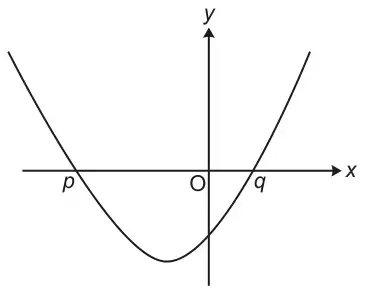
13 The graph of \(y = x^2 + 6x - 2\) is shown below.
The roots of the equation \(x^2 + 6x - 2 = 0\) are at \(p\) and \(q\).
(a)
(i) Calculate \(y\) when \(x = 1\). [1]
(ii) Without solving the equation, explain why \(q\) must lie between 0 and 1. [2]
(iii) Explain why using a method of iteration is not the most appropriate way of finding a solution to this equation. [1]
(b) The exact value of \(q\) is \(\dfrac{-6 + \sqrt{44}}{2}\).
Write \(\dfrac{-6 + \sqrt{44}}{2}\) in the form \(a + \sqrt{b}\). [3]
| Answer | Marks | Part marks and guidance | |
|---|---|---|---|
| (i) 5 | 1 | ||
| (ii) At \(x = 0\) oe and \(y \lt 0\) or \(y\) is negative or \(y = -2\) or curve is below \(x\)-axis and at \(x = 1\) , \(y\) is positive or \(y \gt 0\) or \(y = 5\) or curve is above the \(x\) - axis and change of sign oe [between \(x = 0\) and \(x = 1\)] or the curve crosses the \(x\)-axis between 0 and 1 or solution/q lies between 0 and 1 | 1 1dep | If \(y\) value evaluated then must be correct for 2 marks or 1 mark Dep on first mark If 0 scored, SC1 for change of sign oe or the curve crosses the \(x\)-axis between 0 and 1 oe | For 2 marks needs to refer \(x = 0\) negative oe and \(x = 1\) positive oe and change of sign/graph crosses axis/solution between 0 and 1 oe e.g. For 2 marks At \(x = 0\) the curve is below the \(x\)–axis, at \(x = 1\) the curve is above the \(x\)–axis so there is a change of sign See Appendix |
| (iii) Correct response concerning accuracy/time taken/refer to specific more efficient methods e.g. Iteration gives an estimate oe Iteration can be a lengthy process oe [to get an accurate result] | 1 | e.g. The quadratic formula/complete the square is quicker/more accurate/easier Trial and improvement is less efficient/takes too long You can always go to more decimal places It will not give an exact/accurate answer It will take many iterations There are two solutions, iteration is used to find one at a time Mark the best if more than one answer given Do not accept incorrect statement e.g. It would be quicker/easier to factorise the equation | |
Appendix: additional guidance for Q13(a)(ii)
| Response | Mark | |
|---|---|---|
| 1 | The graph is below the \(x\)-axis at \(x = 0\) and above the \(x\) – axis at \(x = 1\) so the solution lies between 0 and 1 | 2 |
| 2 | \(0^2 - (6 \times 0) - 2 = -2\) and \(1^2 + (6 \times 1) - 2 = 5\) so there is a sign change from −2 to 5 BOD \(x = 0\) and \(x = 1\) implied in reasoning and a correct statement regarding sign change | 2 |
| 3 | Because at \(q\), \(y = 0\), but at 1 \(y = 5\) and at 0 \(y\) is negative. So the solution is in between 0 and 1 (BOD \(x = 0\) and \(x = 1\) implied in reasoning similar to above and correct conclusion stated) | 2 |
| 4 | When \(q = 0\) graph is negative, when \(q = 1\) graph is positive so there is a sign change (BOD \(q\) is on the \(x\)-axis so take \(q\) as \(x\) here) | BOD2 |
| 5 | The graph is positive at 1 and negative at zero so the solution lies in between 0 and 1 [BOD first mark allow as 1 and 0 imply \(x = 1\) and \(x = 0\) and the conclusion is correct for 2nd mark) | BOD2 |
| 6 | When \(x = 1\), \(y = 5\) and the graph intersects the \(x\)- axis between 0 and 1 so that is where the solution lies [Does not mention \(x = 0\) and negative and second mark dep on first but gets SC1] | SC1 |
| 7 | The graph crosses the \(x\)-axis between 0 and 1 [ 2nd mark dep on 1st mark and does not specifically mention \(x = 0\) and \(x = 1\) being negative and positive so zero but gets SC1] | SC1 |
| 8 | There is a change of sign (2nd mark dep on first mark buts gets SC1) | SC1 |
| 9 | The root lies between 0 and 1 (not adding to question asked – no reasons given for this) | 0 |
| Answer | Marks | Part marks and guidance | |
|---|---|---|---|
| \(-3 + \sqrt{11}\) final answer | 3 | B2 for answer \(p + \sqrt{11}\) or M1 for [\(\sqrt{44}\) =] \(2\sqrt{11}\) seen or \(\frac{\sqrt{44}}{\sqrt{4}}\) seen B1 for answer \(-3 + \sqrt{k}\) | \(p \ne 0\) \(k \gt 0\) but not 44 |