
Higher November 2018 Paper 1 Q25
25 A quadratic curve intersects the axes at \((-3, 0)\), \((3, 0)\) and \((0, 18)\)
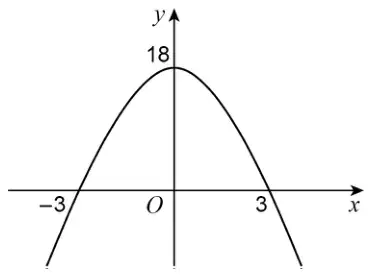
Not drawn accurately
Work out the equation of the curve. [3 marks]
| Answer | Mark | Comments |
|---|---|---|
| Alternative method 1 | ||
| \(a(-3)^2 + b(-3) + c = 0\) or \(a(3)^2 + b(3) + c = 0\) | M1 | oe |
| any two of \((-)6b = 0,\ c = 18\) and \(9a + 18 = 0\) | M1dep | oe |
| \(y = 18 - 2x^2\) | A1 | oe equation |
| Alternative method 2 | ||
| \(y = 18 - 2x^2\) | B3 | oe equation B2 correct equation missing \(y =\) eg \(18 - 2x^2\) B1 equation of a quadratic curve that passes through \((-3, 0)\) or \((3, 0)\) or \((0, 18)\) condone missing \(y =\) eg \((y =)\ 18 - x^2\) or \((y =)\ (3 + x)(3 - x)\) or \((y =)\ x^2 - 2x - 3\) or \((y =)\ (x + 3)(x - 3)\) |
Additional guidance
Correct equations include
\(y = 2(3 + x)(3 - x)\)
\(y = -2(x + 3)(x - 3)\)
\(y = (6 + 2x)(3 - x)\)
\(y = (3 + x)(6 - 2x)\)
For B3, B2 or B1 ignore incorrect expansion after correct equation or expression seen