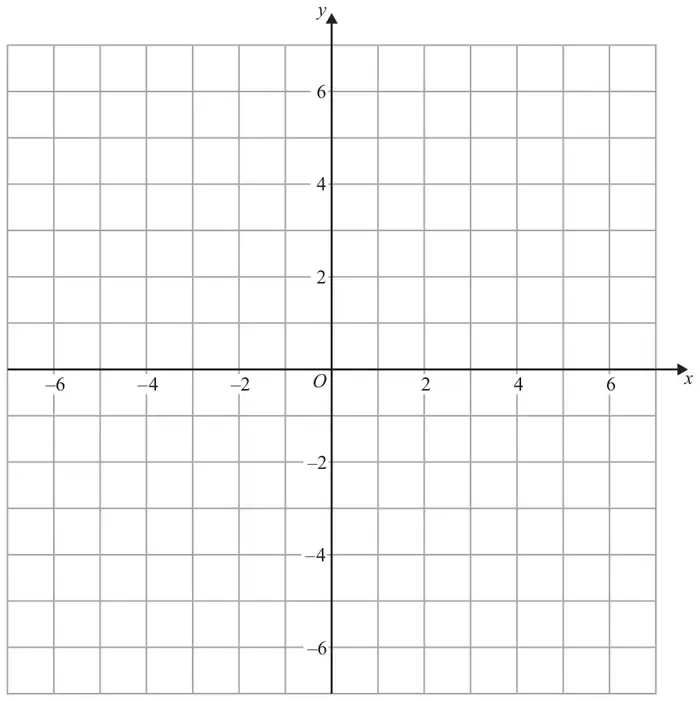
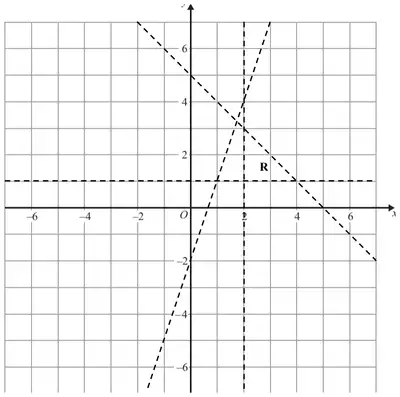
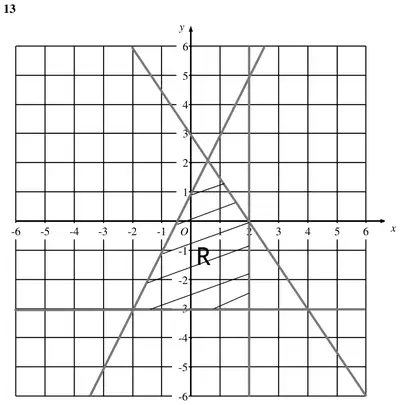
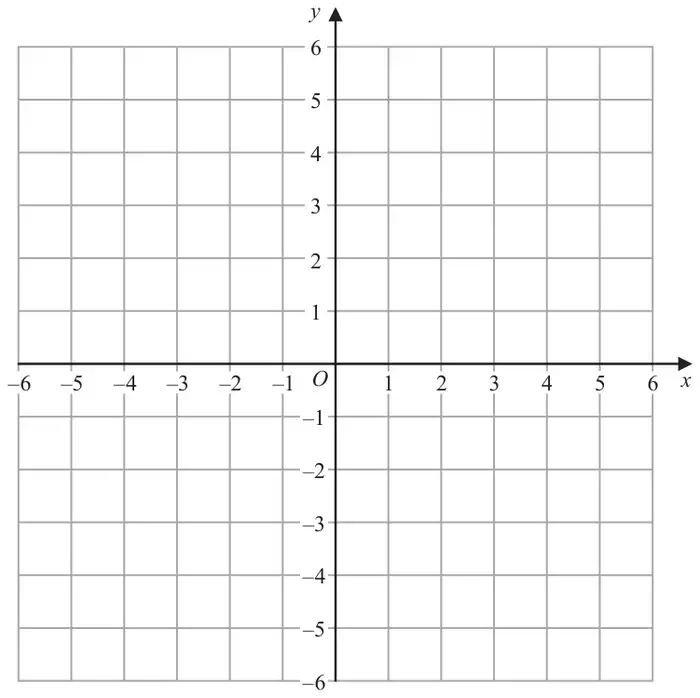
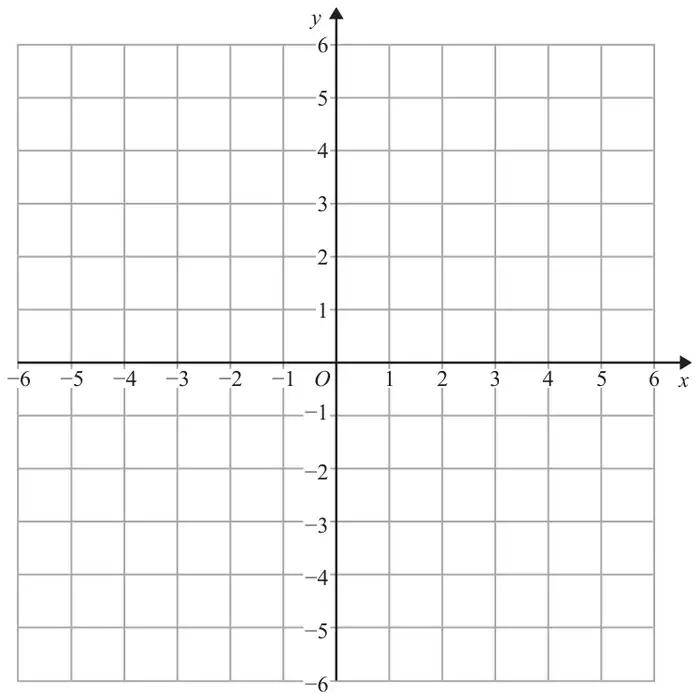
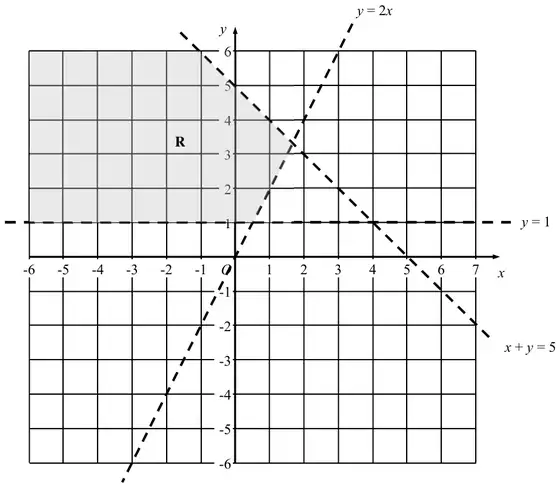
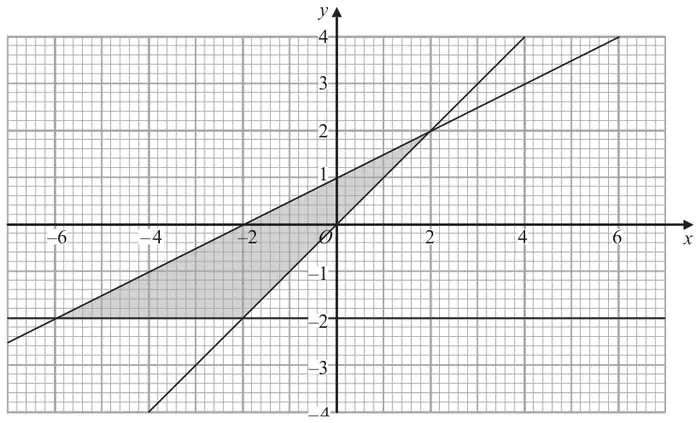
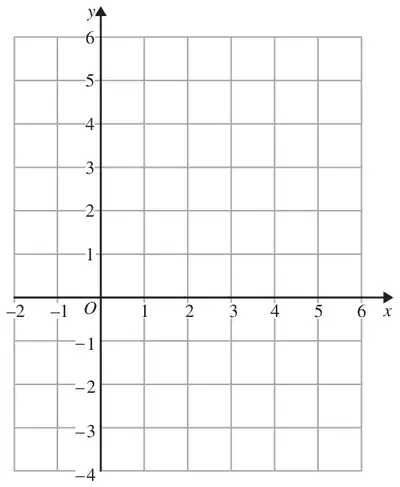
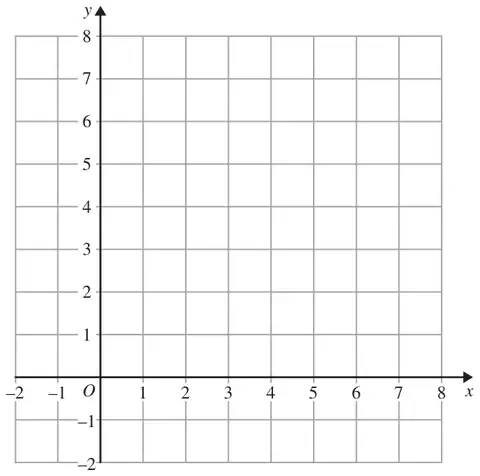
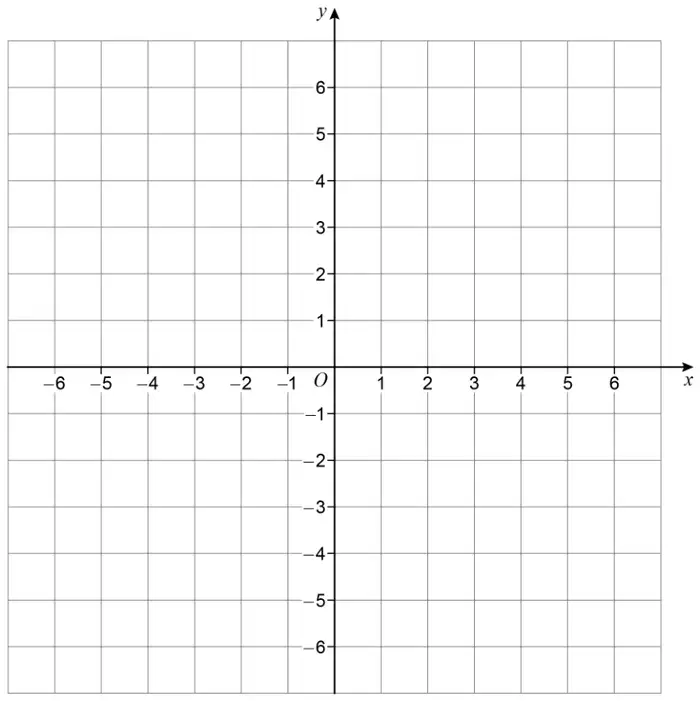
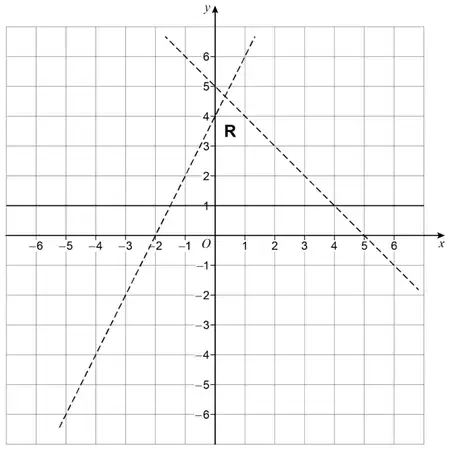
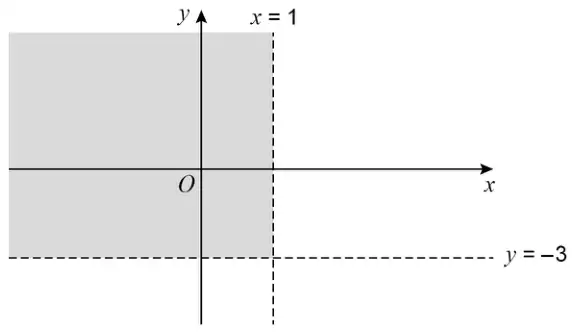
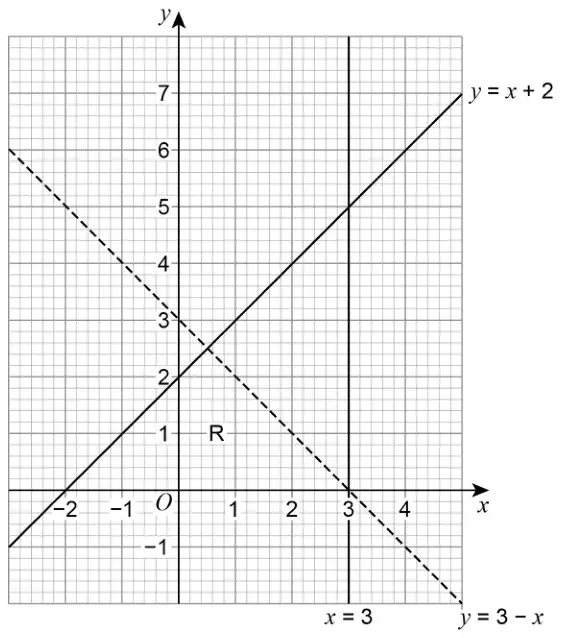
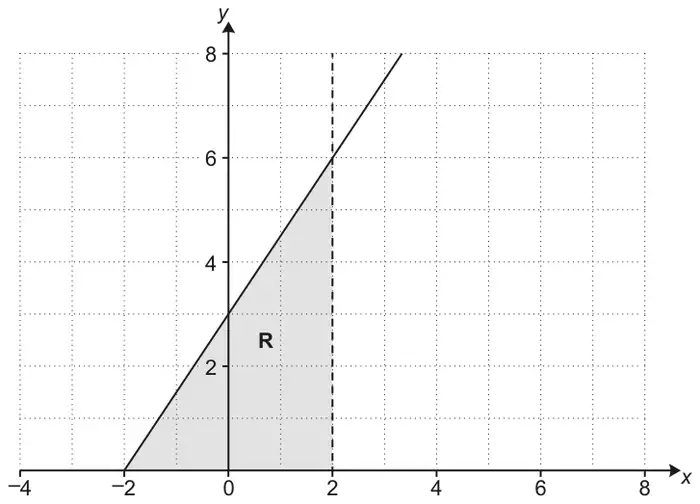
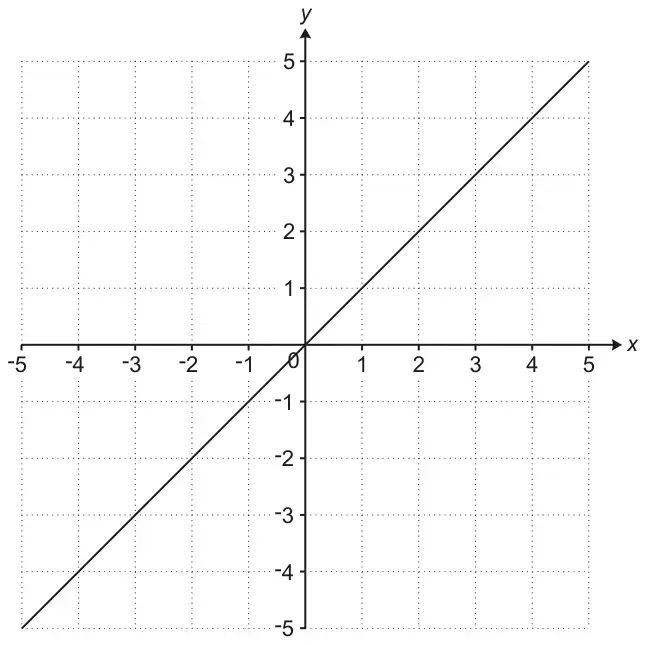
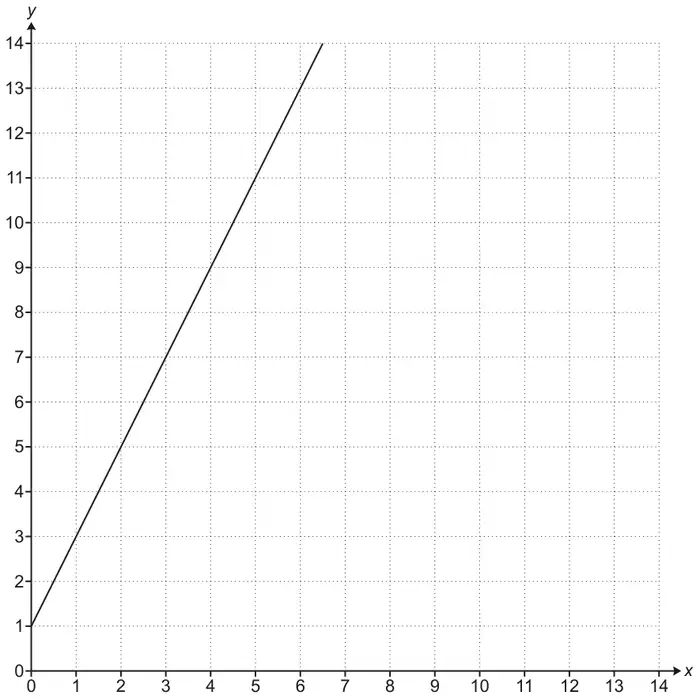
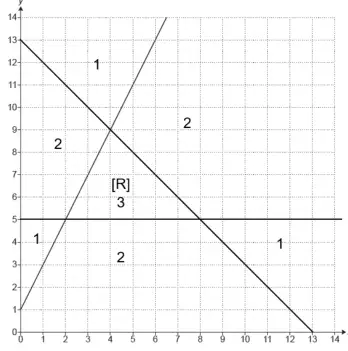
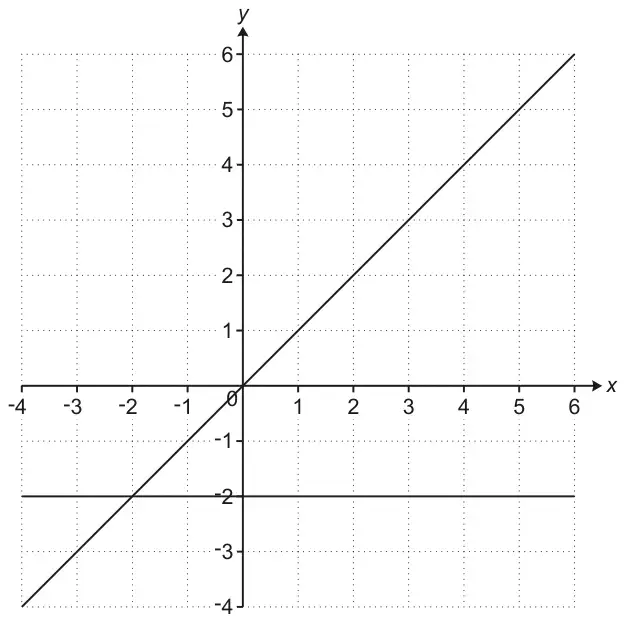
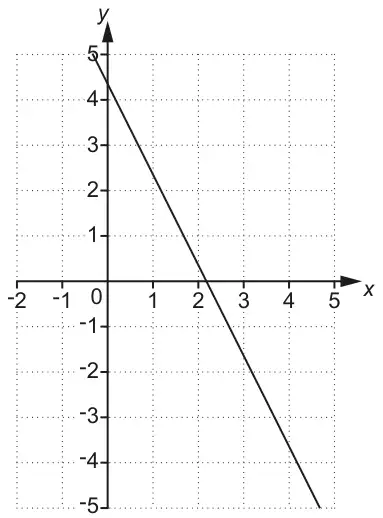
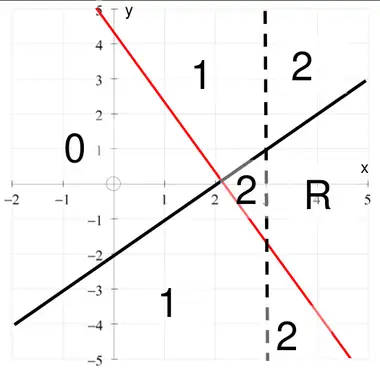
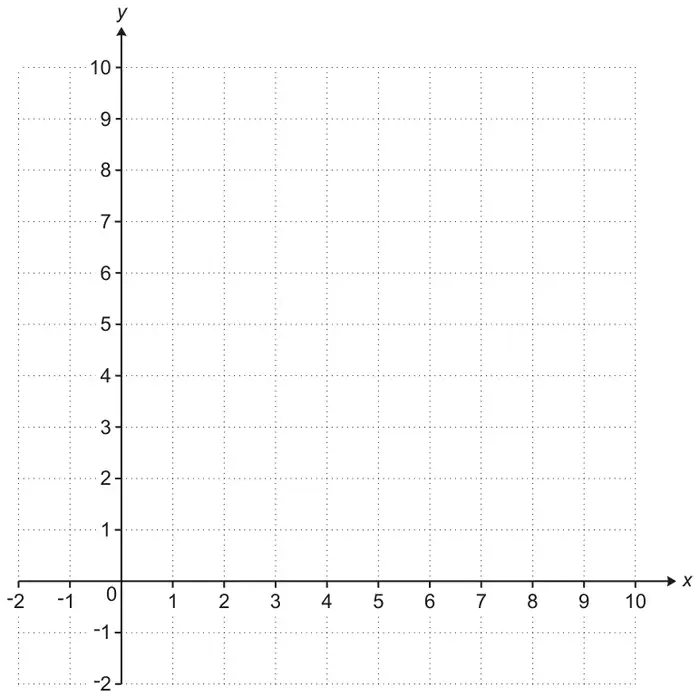
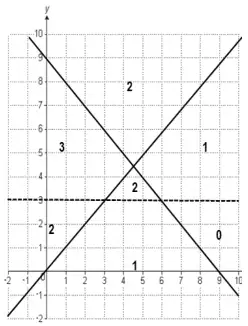
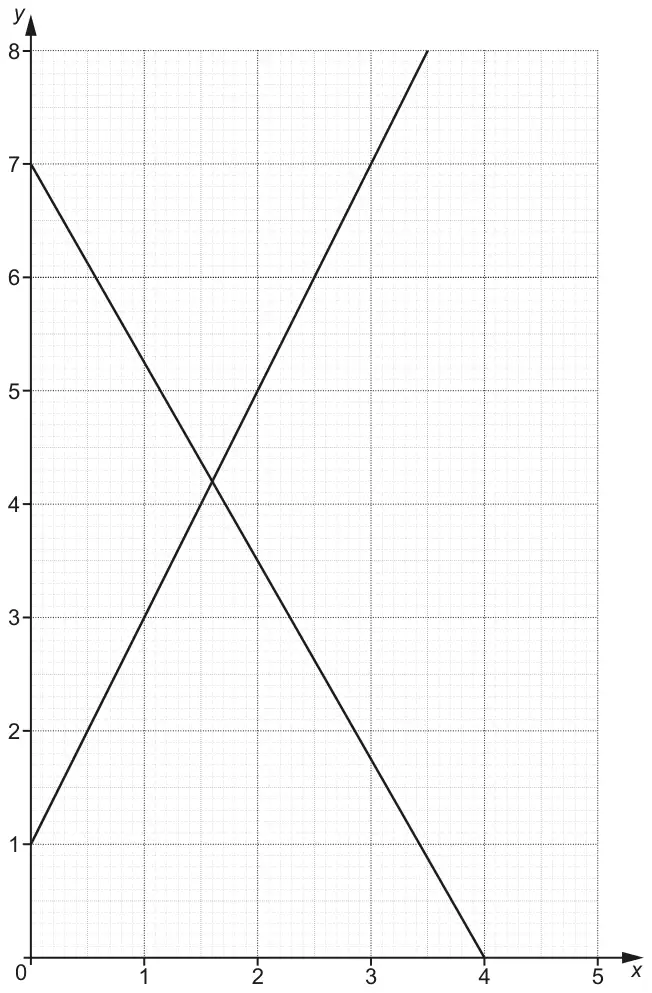
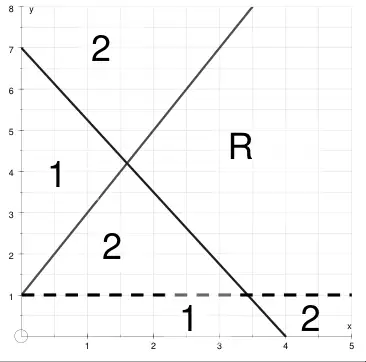
(a) On the grid, show by shading, the region that satisfies all of these inequalities.\[x + y \lt 5 \qquad y \gt 1 \qquad x \gt 2 \qquad y \lt 3x - 2\]Label the region R.(4)
Ron says,
“I can remove one of the four inequalities from the grid so that the region R will not change.”
Ron is correct.
(b) Which inequality can be removed so that the region R will not change? (1)
Mark scheme (a)
Answer
Mark
Mark scheme
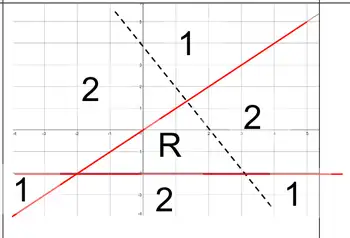
Region shown
B4
for a fully correct region identified
(B3
for drawing three correct lines)
(B2
for drawing two correct lines, must include at least one of \(x + y = 5\) or \(y = 3x - 2\))
(B1
for drawing \(x = 2\) and \(y = 1\) correctly OR for drawing \(x + y = 5\) correctly OR for drawing \(y = 3x - 2\) correctly)
Additional guidance
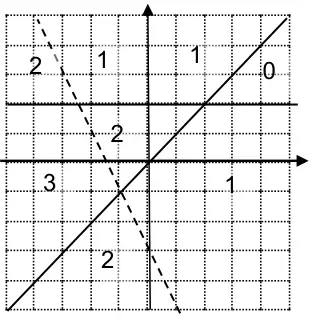
See diagram at end of mark scheme Can exclude \(y = 3x - 2\) for B4 Condone solid lines for all marks Region can be identified by shading in or shading out Lines need to be long enough to enclose the region
Mark scheme (b)
Answer
Mark
Mark scheme
\(y \lt 3x - 2\)
B1
(dep on B1 in (a)) for \(y \lt 3x - 2\) or ft their diagram if 1 line is redundant
Additional guidance
Condone use of ‘=’ or ‘\(\leqslant\)’ and \(3x - 2\)
(b) Solve \(7 + x \leqslant \dfrac{5x}{2} - 8\) (3)
(c) Solve \(9 \lt 2y + 4 \lt 12\) (2)
Mark scheme (a)
Answer
Mark
Mark scheme
\(6 - 3m\)
B1
for \(6 - 3m\) oe
Additional guidance
Accept \(3(2 - m)\)
Mark scheme (b)
Answer
Mark
Mark scheme
\(x \geqslant 10\)
M1
for a correct first step working with an inequality or an equation, eg \(7 + x + 8 \leqslant \dfrac{5x}{2} - 8 + 8\) or \(15 + x \leqslant \dfrac{5x}{2}\) or \(7 + x - x \leqslant \dfrac{5x}{2} - 8 - x\) or \(7 \leqslant \dfrac{3x}{2} - 8\) or \(7 \times 2 + x \times 2 \leqslant \dfrac{5x}{2} \times 2 - 8 \times 2\) or \(14 + 2x \leqslant 5x - 16\)
M1
(dep M1) for a correct second step, eg subtracts \(x\) from both sides or adds 8 to both sides or subtracts \(2x\) from both sides or multiplies both sides by 2
or gives the critical value of 10
A1
for \(x \geqslant 10\) as final answer
Additional guidance
Can work with an equation or incorrect inequality symbol for both M marks
For M marks step must be carried out not just intention shown. For example, if you see \[\begin{array}{ccc} 7 + x &\leqslant& \dfrac{5x}{2} - 8 \\ +8 && +8 \end{array}\] award M1 for \(k + x \leqslant \dfrac{5x}{2}\) where \(k \gt 7\) or indicating \(-x\) and reaching \(7 \leqslant kx - 8\) where \(k \lt \dfrac{5}{2}\) or indicating multiplying by 2 and obtaining an equation or inequality with no more than one term incorrect and no term unchanged.
The first 2 marks can be awarded for critical value of 10, eg \(x = 10\)
Accept \(10 \leqslant x\)
Mark scheme (c)
Answer
Mark
Mark scheme
\(2.5 \lt y \lt 4\)
M1
for a correct first step, eg \(9 - 4 \lt 2y \lt 12 - 4\) or \(5 \lt 2y \lt 8\) or \(9 \div 2 \lt y + 2 \lt 12 \div 2\) or \(4.5 \lt y + 2 \lt 6\) or showing 2.5 and 4 as the critical values
A1
for \(2.5 \lt y \lt 4\) oe as final answer
Additional guidance
For M mark condone use of “=” and incorrect inequality signs
For M mark step must be carried out not just intention shown. For example, if you see \[\begin{array}{ccccc} 9 &\lt & 2y + 4 &\lt & 12 \\ -4 && -4 && -4 \end{array}\] award M1 for \(a \lt 2y \lt b\) where \(a \lt 9\) and \(b \lt 12\)
or if you see \[\begin{array}{ccccc} 9 &\lt & 2y + 4 &\lt & 12 \\ \div 2 && \div 2 && \div 2 \end{array}\] award M1 for \(a \lt y + 2 \lt b\) where \(a \lt 9\) and \(b \lt 12\)
for a correct first step working with an equation or inequality eg \(x + 11 - 11 \leqslant 5 - \frac{1}{2}x - 11\) or \(x + 11 + \frac{1}{2}x \leqslant 5 - \frac{1}{2}x + \frac{1}{2}x\) or \(2 \times x + 2 \times 11 \leqslant 2 \times 5 - 2 \times \frac{1}{2}x\)
M1
for a full method to solve the inequality or for a critical value of \(-4\)
A1
for \(x \leqslant -4\) oe as final answer
Additional guidance
Can work with an equation or incorrect inequality symbol for both M marks Allow for subtracting 5 from both sides or subtracting \(x\) from both sides. For M marks step must be carried out not just intention shown.
For example, if you see\[\begin{array}{ccc} x + 11 & \leqslant & 5 - \frac{1}{2}x \\ -11 & & -11 \end{array}\]Award M1 for:\[x \leqslant k - \frac{1}{2}x\]with \(k \ne 5,\ k \ne 16\)
or indicating \(+\frac{1}{2}x\) reaching\[kx + 11 \quad \leqslant \quad 5\]with \(k \ne \frac{1}{2},\ k \ne 1\)
or indicating multiplying by 2 obtaining an equation or inequality with three of four terms correct and no term unchanged.
Award 2 marks for answer of \(x\,?\,-4\) where ? is an = or any incorrect inequality symbol, or for answer shown as just \(-4\)
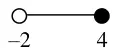
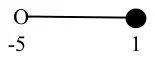
23 Jenna is asked to show the inequality \(\ -3 \lt x \leqslant 4\ \) on a number line.
Here is her answer.
(a) Write down two mistakes Jenna has made. (2)
(b) Work out the greatest integer that satisfies the inequality \(5y - 7 \lt 16\)(2)
Mark scheme (a)
Answer
Mark
Mark scheme
Explanations
C2
for two different correct explanations
Acceptable examples She should have a solid/full/shaded/coloured circle at 4 It does not show that \(x\) could be equal to 4 She should have marked/drawn a (clear/empty) circle at \(-3\) The line should be drawn to \(-3\) Jenna started from \(-2\) not \(-3\)
Not acceptable examples Both circles should be black One circle should be filled in (needs to say which circle) She shouldn’t have to reach number 4 Jenna has made no mistakes
(C1
for one correct mistake described)
Additional guidance
Any incorrect statement as part of a correct response can be ignored unless it contradicts the statement.
Mark scheme (b)
Answer
Mark
Mark scheme
4
M1
for a correct first step, eg for adding 7 to both sides \(5y - 7 + 7 \lt 16 + 7\) or for dividing throughout by 5 eg \(\dfrac{5y}{5} - \dfrac{7}{5} \lt \dfrac{16}{5}\) or for showing 4.6 (oe) as the critical value or for \(5 \times 4 - 7\) with 13 seen as answer
A1
for 4 or \(y = 4\) with no incorrect working
Additional guidance
Allow use of any inequality or as an equation for the first mark
Award 1 mark for 4.6 oe, eg \(y = \dfrac{23}{5}\) or \(y \lt 4.6\)
An answer of 4 from incorrect working can score 1 mark at most.
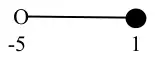
4 Jenna is asked to show the inequality \(-3 \lt x \leqslant 4\) on a number line.
Here is her answer.
(a) Write down two mistakes Jenna has made. (2)
(b) Work out the greatest integer that satisfies the inequality \(5y - 7 \lt 16\) (2)
Mark scheme (a)
Answer
Mark
Mark scheme
Explanations
C2
for two different correct explanations
Acceptable examples She should have a solid/full/shaded/coloured circle at 4 It does not show that \(x\) could be equal to 4 She should have marked/drawn a (clear/empty) circle at \(-3\) The line should be drawn to \(-3\) Jenna started from \(-2\) not \(-3\)
Not acceptable examples Both circles should be black One circle should be filled in (needs to say which circle) She shouldn’t have to reach number 4 Jenna has made no mistakes
(C1
for one correct mistake described)
Additional guidance
Any incorrect statement as part of a correct response can be ignored unless it contradicts the statement.
Mark scheme (b)
Answer
Mark
Mark scheme
4
M1
for a correct first step, eg for adding 7 to both sides \(5y - 7 + 7 \lt 16 + 7\) or for dividing throughout by 5 eg \(\dfrac{5y}{5} - \dfrac{7}{5} \lt \dfrac{16}{5}\) or for showing 4.6 (oe) as the critical value
or for \(5 \times 4 - 7\) with 13 seen as answer
A1
for 4 or \(y = 4\) with no incorrect working
Additional guidance
Allow use of any inequality or as an equation for the first mark
Award 1 mark for 4.6 oe, eg \(y = \dfrac{23}{5}\) or \(y \lt 4.6\)
An answer of 4 from incorrect working can score 1 mark at most.
(a) Write down the greatest possible value of \(n\). (1)
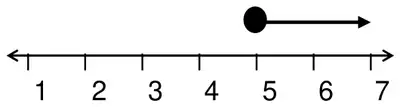
(b) On the number line below, show the inequality \(\quad -4 \leqslant m \lt 1\)(2)
(c) Solve \(\quad \dfrac{2}{5}g - 4 \lt 6\) (3)
Mark scheme (a)
Answer
Mark
Mark scheme
4
B1
cao
Mark scheme (b)
Answer
Mark
Mark scheme
correct diagram
C2
for a fully correct diagram, eg
(C1
for drawing a line from –4 to 1 or (indep) for an open circle at 1 or (indep) for a closed circle at –4)
Additional guidance
Condone arrow heads or line ending to denote the ‘end’ of the line
Mark scheme (c)
Answer
Mark
Mark scheme
\(g \lt 25\)
M1
for a correct first step, eg adding 4 to both sides, eg \(\dfrac{2}{5}g \lt 6 + 4\) or multiplying throughout by 5, eg \(2g - 4 \times 5 \lt 6 \times 5\) or dividing throughout by 2, eg \(\dfrac{1}{5}g - 4 \div 2 \lt 6 \div 2\)
M1
for a correct second step, eg \(2g \lt \text{``}10\text{''} \times 5\) or \(\dfrac{1}{5}g \lt \text{``}10\text{''} \div 2\) or \(2g \lt \text{``}30\text{''} + \text{``}20\text{''}\) or \(g - \text{``}20\text{''} \div 2 \lt \text{``}30\text{''} \div 2\) or \(\dfrac{g}{5} \lt \text{``}3\text{''} + \text{``}2\text{''}\) or \(g - \text{``}2\text{''} \times 5 \lt \text{``}3\text{''} \times 5\)
or showing 25 as the critical value
A1
for \(g \lt 25\) oe
Additional guidance
Allow use of any inequality or as an equation for both method marks \(\dfrac{2}{5}g \lt 10\) \(2g - 20 \lt 30\) \(\dfrac{g}{5} - 2 \lt 3\)
(a) Write down the greatest possible value of \(n\). (1)
(b) On the number line below, show the inequality \(-4 \leqslant m \lt 1\)(2)
(c) Solve \(\dfrac{2}{5}g - 4 \lt 6\) (3)
Mark scheme (a)
Answer
Mark
Mark scheme
4
B1
cao
Mark scheme (b)
Answer
Mark
Mark scheme
correct diagram
C2
for a fully correct diagram, eg
(C1
for drawing a line from −4 to 1 or (indep) for an open circle at 1 or (indep) for a closed circle at −4)
Additional guidance
Condone arrow heads or line ending to denote the ‘end’ of the line
Mark scheme (c)
Answer
Mark
Mark scheme
\(g \lt 25\)
M1
for a correct first step, eg adding 4 to both sides, eg \(\dfrac{2}{5}g \lt 6 + 4\) or multiplying throughout by 5, eg \(2g - 4 \times 5 \lt 6 \times 5\) or dividing throughout by 2, eg \(\dfrac{1}{5}g - 4 \div 2 \lt 6 \div 2\)
M1
for a correct second step, eg \(2g \lt \text{``}10\text{''} \times 5\) or \(\dfrac{1}{5}g \lt \text{``}10\text{''} \div 2\) or \(2g \lt \text{``}30\text{''} + \text{``}20\text{''}\) or \(g - \text{``}20\text{''} \div 2 \lt \text{``}30\text{''} \div 2\) or \(\dfrac{g}{5} \lt \text{``}3\text{''} + \text{``}2\text{''}\) or \(g - \text{``}2\text{''} \times 5 \lt \text{``}3\text{''} \times 5\)
or showing 25 oe as the critical value
A1
for \(g \lt 25\) oe
Additional guidance
Allow use of any inequality or as an equation for both method marks \(\dfrac{2}{5}g \lt 10\) \(2g - 20 \lt 30\) \(\dfrac{g}{5} - 2 \lt 3\)
for a correct first step, eg subtracts 3 from both sides or multiplies all terms by 2
M1
(dep M1) for a correct second step, eg multiplies both sides by 2 or divides both sides by 5 or gives the critical value, 6.
A1
for \(x \gt 6\)
Additional guidance
Could be seen as an equation for both method marks, eg \(5x + 6 = 36\) or \(5x = 30\)
First 2 marks may be awarded for critical value of 6, eg \(x = 6\)
Mark scheme (b)
Answer
Mark
Mark scheme
\((x + 9)(x + 1)\)
M1
for \((x \pm 1)(x \pm 9)\) or for \((x + a)(x + b)\) where product of \(a\) and \(b\) = 9, eg \((x + 3)(x + 3)\) or \((x - 3)(x - 3)\) or the sum of \(a\) and \(b\) = 10, eg \((x + 5)(x + 5)\) or \((x + 6)(x + 4)\)
(a) On the number line, show the inequality \(x \lt 4\)(2)
\(3 \lt y \leqslant 7\) where \(y\) is an integer.
(b) Write down all the possible values of \(y\). (2)
(c) Solve \(3x + 5 \geqslant x + 17\) (3)
Mark scheme (a)
Answer
Mark
Mark scheme
Inequality shown
B2
for fully correct solution with all three aspects with no ambiguity Aspect 1: circle at 4 Aspect 2: circle not shaded Aspect 3: arrow pointing left or line extending beyond \(-5\), starting from their circle
(B1
for any two aspects)
Additional guidance
Circling the number 4 alone scores B0 Aspect 1 and Aspect 2 must relate to the same circle.
Mark scheme (b)
Answer
Mark
Mark scheme
4,5,6,7
B2
for all four numbers in any order
(B1
for 2 or 3 correct values with no errors or 4 correct values with one extra)
Mark scheme (c)
Answer
Mark
Mark scheme
\(x \geqslant 6\)
M1
for a correct intention to subtract 5 from both sides or a correct intention to subtract \(x\) from both sides
M1
for a full method to solve the inequality or showing a critical value of 6
A1
cao
Additional guidance
Can work with an equation for both M marks
Award 2 marks for an answer of \(x\ ?\ 6\) where ? is an = or any incorrect inequality symbol, or for an answer shown as just 6.
20 \(n\) is an integer such that \(3n + 2 \leqslant 14\) and \(\dfrac{6n}{n^2 + 5} \gt 1\)
Find all the possible values of \(n\). (5)
Mark scheme
Answer
Mark
Mark scheme
2, 3, 4
M1
for method to solve \(3n + 2 \leqslant 14\) eg \(n \leqslant (14 - 2) \div 3\) oe
M1
for complete method to rearrange \(\dfrac{6n}{n^2 + 5} \gt 1\) to the form \(an^2 + bn + c\ (\lt 0)\)
M1
for method to begin to solve \(n^2 - 6n + 5\ (\lt 0)\) eg \((n \pm 5)(n \pm 1)\ (\lt 0)\)
M1
(dep on previous M2) for \(n \gt 1\) and \(n \leqslant 4\) or \(1 \lt n \lt 5\)
A1
(dep M4) cao
Additional guidance
This could be shown within an equation rather than an inequality at this stage
For the 2nd and 3rd M marks condone no ‘\(\lt 0\)’ and condone use of incorrect inequality signs or ‘=’ Accept \(\dfrac{-(-6) \pm \sqrt{(-6)^2 - 4 \times 1 \times 5}}{2 \times 1}\) (condone one sign error)
Must come from correct working Could be shown on a number line
Alternative method
Answer
Mark
Mark scheme
2, 3, 4
M1
for method to solve \(3n + 2 \leqslant 14\) eg \(n \leqslant (14 - 2) \div 3\) oe OR for \(3 \times 4 + 2 = 14\)
M3
for trials with 1, 2, 3 and 4 in the quadratic inequality, correctly evaluated
(M2
for trials with three of 1, 2, 3 and 4, correctly evaluated)
(M1
for trials with two of 1, 2, 3 and 4, correctly evaluated)
A1
(dep M4) cao
This could be shown within an equation rather than an inequality at this stage
The values from the trials may be given as improper fractions eg \(\dfrac{24}{21}\), \(\dfrac{18}{14}\), \(\dfrac{12}{9}\), \(\dfrac{6}{6}\)
(a) Show the inequality \(x \lt 3\) on the number line below.(2)
(b) Solve the inequality \(4x - 7 \geqslant 13\) (2)
Mark scheme (a)
Answer
Mark
Notes
Diagram
2
B2 for fully correct solution with all three aspects with no ambiguity Aspect 1: circle at 3 Aspect 2: circle not shaded Aspect 3: arrow pointing left indicating extension beyond \(-4\) or line extending beyond \(-4\) (B1 for any two aspects)
Mark scheme (b)
Answer
Mark
Notes
\(x \geqslant 5\)
2
M1 for intention to add 7 to both sides (of inequality or equation) or to divide all 3 terms by 4 as a first step, or \((x =)\ 5\) A1 for \(x \geqslant 5\) oe
(a) Show the inequality \(x \lt 3\) on the number line below.(2)
(b) Solve the inequality \(4x - 7 \geqslant 13\) (2)
Mark scheme (a)
Answer
Mark
Notes
Diagram
2
B2 for fully correct solution with all three aspects with no ambiguity Aspect 1: circle at 3 Aspect 2: circle not shaded Aspect 3: arrow pointing left indicating extension beyond −4 or line extending beyond −4 (B1 for any two aspects)
Mark scheme (b)
Answer
Mark
Notes
\(x \geqslant 5\)
2
M1 for intention to add 7 to both sides (of inequality or equation) or to divide all 3 terms by 4 as a first step, or (\(x\) =) 5 A1 for \(x \geqslant 5\) oe
M1 for isolating term in \(x\) eg \(3x \lt 16 + 5\) or \(3x \lt 21\) or for \((x =)\ 7\) or \(x \gt 7\) etc A1 cao
Mark scheme (b)
Answer
Mark
Notes
\(\dfrac{7}{5}\)
3
M1 for multiplying by 4 or adding \(\dfrac{w}{4}\) or subtracting \(\dfrac{11}{4}\) or subtracting 1 [all applied to both sides and as a first step] M1 for isolating terms in \(w\) on one side and number terms on the other side of the equation A1 for \(\dfrac{7}{5}\) oe
(a) Given that \(x\) and \(y\) are integers such that \[\begin{gathered} 3 \lt x \lt 7 \\ 4 \lt y \lt 9 \\ \text{and } x + y = 13 \end{gathered}\] find all the possible values of \(x\). (2)
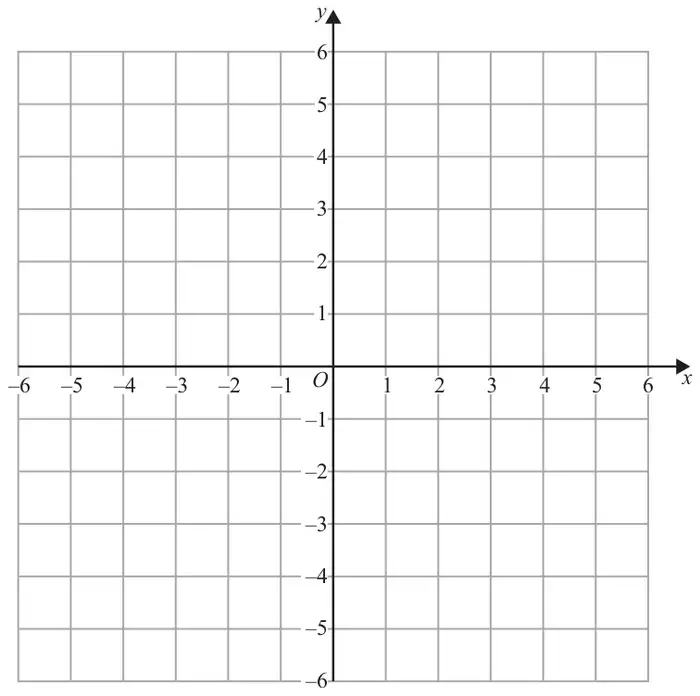
(b) On the grid below show, by shading, the region defined by the inequalities \(y \geqslant -1\) \(y \leqslant 4 - x\) \(y \leqslant 3x - 1\) Mark this region with the letter R.(4)
Mark scheme (a)
Answer
Mark
Notes
5 and 6
2
M1 for evidence that \((x =)\) 4, 5, 6 or evidence that \((y =)\) 5, 6, 7, 8 A1 cao
Mark scheme (b)
Answer
Mark
Notes
Region identified
4
M1 for two of the lines \(y = -1\), \(y = 3x - 1\) and \(y = 4 - x\) drawn M1 for three of the lines \(y = -1\), \(y = 3x - 1\) and \(y = 4 - x\) drawn M1 any correct shading (in or out) satisfying at least two of the inequalities where the shading must extend from the appropriate line A1 Fully correct region shown by either shading in, shading out or the use of R Accept lines that are solid or dashed
18 On the grid show, by shading, the region that satisfies all three of the inequalities
\(x + y \lt 7\) \(y \lt 2x\) \(y \gt 3\)
Label the region R.
(4)
Mark scheme
Answer
Mark
Notes
Region identified
4
M1 for the graph of \(x + y = 7\) or \(y = 2x\) drawn M1 for the graphs of \(x + y = 7\), \(y = 2x\) and \(y = 3\) drawn M1 for any correct shading (in or out), satisfying at least two correct inequalities where the shading must extend from the appropriate lines. A1 for correct region identified by either shading in, or shading out; the letter R is not required. Accept without shading only with the correct region indicated by R. NB accept lines that are solid or dotted/dashed etc or lines defined by unambiguous shading
(b) Here is an inequality, in \(x\), shown on a number line.Write down the inequality. (2)
Mark scheme (a)
Answer
Mark
Notes
\(y \gt 0.5\)
2
M1 for clear intention to subtract 5 from both sides of inequality or equation or divide all terms of the inequality or equation by 6 or \(6y \gt 3\) or 0.5 oe seen A1 for \(y \gt 0.5\) oe as final answer
Mark scheme (b)
Answer
Mark
Notes
\(-3 \lt x \leqslant 4\)
2
B2 for \(-3 \lt x \leqslant 4\) oe (B1 for one correct inequality, eg \(-3 \lt x\) or \(x \gt -3\) or \(x \leqslant 4\) or \(4 \geqslant x\) or \(-3 \leqslant x \lt 4\)) NB Accept the use of any letter
(b) Write down all the possible values of \(y\). (2)
Mark scheme (a)
Answer
Mark
Notes
\(\dfrac{2}{3}\)
2
M1 for intention to subtract 4 from both sides or divide each term by 3 or \(3p = 2\) written in the workspace A1 for \(\frac{2}{3}\) accept answer to two decimal places rounded or truncated
Mark scheme (b)
Answer
Mark
Notes
\(-4\), \(-3\), \(-2\), \(-1\), 0
2
B2 for all 5 correct values; ignore repeats, any order (B1 for 4 correct (and no incorrect) values or all five correct values and \(-5\))
(a) Write down all the possible values of \(y\). (2)
(b) Solve \(6(x - 2) \gt 15\) (2)
Mark scheme (a)
Answer
Mark
Notes
\(-4, -3, -2, -1, 0\)
2
B2 for all 5 correct values; ignore repeats, any order (B1 for 4 correct (and no incorrect) values or all 5 correct values and \(-5\))
Mark scheme (b)
Answer
Mark
Notes
\(x \gt 4\frac{1}{2}\)
2
M1 for an attempt to expand brackets (eg \(6 \times x - 6 \times 2\)) or \(6x - 12\) or for an intention to divide both sides by 6 as the first step or for 4½ oe seen A1 for \(x \gt 4\frac{1}{2}\) oe
Line joins an empty circle at \(-2\) to a solid circle at 3 diagram
2
B2 cao (B1 for line from \(-2\) to 3)
Mark scheme (b)
Working
Answer
Mark
Notes
\(2x \geqslant 7\)
\(x \geqslant 3.5\)
2
M1 for correct method to isolate variable and number terms (condone use of =, \(\gt\), \(\leqslant\), or \(\lt\)) or (\(x =\)) 3.5 A1 for \(x \geqslant 3.5\) oe as final answer
(a) Write down all the possible values of \(n\). (2)
(b) Solve the inequality \(3p - 7 \gt 11\) (2)
Mark scheme (a)
Answer
Mark
Notes
\(-2\), \(-1\), 0, 1
2
B2 for all 4 correct values; ignore repeats, any order (B1 for 3 correct (and no incorrect values) eg. \(-2\), \(-1\), 0 or one additional value eg. \(-3\), \(-2\), \(-1\), 0, 1)
Mark scheme (b)
Answer
Mark
Notes
\(p \gt 6\)
2
M1 for clear intention to add 7 to both sides or \(3p \gt 11 + 7\) or clear intention to divide all 3 terms by 3 as a first step or \(3p \gt 18\) or \(3p = 18\) or \(3p \lt 18\) or \(\frac{18}{3}\) A1 for \(p \gt 6\) as final answer NB: (\(p =\)) 6 on the answer line scores M1 A0
(a) \(n\) is an integer. \(-1 \leqslant n \lt 4\) List the possible values of \(n\). (2)
(b)Write down the inequality shown in the diagram. (2)
(c) Solve \(3y - 2 \gt 5\) (2)
Mark scheme (a)
Answer
Mark
Notes
\(-1\), 0, 1, 2, 3
2
B2 for all 5 correct values; ignore repeats, any order (B1 for 4 correct (and no incorrect values) eg. 0, 1, 2, 3 or one additional value, eg \(-1\), 0, 1, 2, 3, 4)
Mark scheme (b)
Answer
Mark
Notes
\(-4 \lt x \leqslant 3\)
2
B2 for \(-4 \lt x \leqslant 3\) or \(\gt -4\) and \(\leqslant 3\) (B1 for \(-4 \lt x\) or \(x \gt -4\) or \(x \leqslant 3\) or \(3 \geqslant x\) or \(\gt -4\) or \(\leqslant 3\) or \(-4 \leqslant x \lt 3\)) (NB Accept the use of any letter)
Mark scheme (c)
Working
Answer
Mark
Notes
\(3y - 2 \gt 5\) \(3y \gt 7\)
\(y \gt \dfrac{7}{3}\)
2
M1 for clear intention to add 2 to both sides (of inequality or equation) or clear intention to divide all terms by 3 or \(3y \gt 7\) or \(3y \lt 7\) or \(3y = 7\) A1 \(y \gt \frac{7}{3}\) or \(y \gt 2\frac{1}{3}\) or \(y \gt 2.\dot{3}\) NB. final answer must be an inequality (SC B1 for \(\frac{7}{3}\) oe seen if M0 scored)
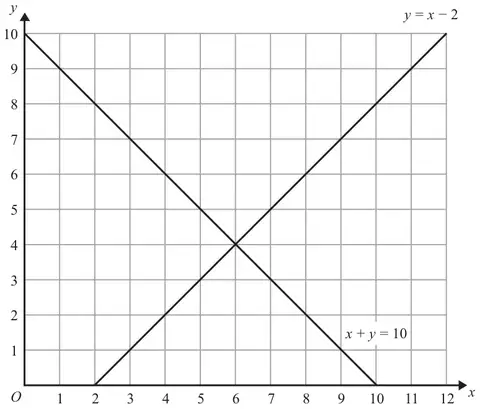
17 The lines \(y = x - 2\) and \(x + y = 10\) are drawn on the grid.
On the grid, mark with a cross (×) each of the points with integer coordinates that are in the region defined by
\[\begin{aligned} y &\gt x - 2 \\ x + y &\lt 10 \\ x &\gt 3 \end{aligned}\]
(3)
Mark scheme
Answer
Mark
Notes
(4,3), (4,4), (4,5), (5,4) marked
3
M2 for identifying the correct region or at least 3 correct points with no more than 3 incorrect points (M1 for drawing \(x = 3\) (solid or dashed line) or at least 1 correct point with no more than 3 incorrect points) A1 cao
(a) \(n\) is an integer. \(-1 \leqslant n \lt 4\) List the possible values of \(n\). (2)
(b)Write down the inequality shown in the diagram. (2)
(c) Solve \(3y - 2 \gt 5\) (2)
Mark scheme (a)
Answer
Mark
Notes
\(-1\), 0, 1, 2, 3
2
B2 for all 5 correct values; ignore repeats, any order (B1 for 4 correct (and no incorrect values) eg. 0, 1, 2, 3 or one additional value, eg \(-1\), 0, 1, 2, 3, 4)
Mark scheme (b)
Answer
Mark
Notes
\(-4 \lt x \leqslant 3\)
2
B2 for \(-4 \lt x \leqslant 3\) or \(\gt -4\) and \(\leqslant 3\) (B1 for \(-4 \lt x\) or \(x \gt -4\) or \(x \leqslant 3\) or \(3 \geqslant x\) or \(\gt -4\) or \(\leqslant 3\) or \(-4 \leqslant x \lt 3\)) NB : Accept the use of any letter
Mark scheme (c)
Working
Answer
Mark
Notes
\(3y - 2 \gt 5\) \(3y \gt 7\)
\(y \gt \dfrac{7}{3}\)
2
M1 for clear intention to add 2 to both sides (of inequality or equation) or clear intention to divide all three terms by 3 or \(3y \gt 7\) or \(3y \lt 7\) or \(3y = 7\) A1 \(y \gt \dfrac{7}{3}\) or \(y \gt 2\frac{1}{3}\) or \(y \gt 2.\dot{3}\) NB. final answer must be an inequality (SC B1 for \(\dfrac{7}{3}\) oe seen if M0 scored)
10 \(m\) is an integer such that \(-2 \lt m \leqslant 3\)
(a) Write down all the possible values of \(m\). (2)
(b) Solve \(7x - 9 \lt 3x + 4\) (2)
Mark scheme (a)
Answer
Mark
Notes
\(-1\), 0, 1, 2, 3
2
B2 for all 5 correct values; ignore repeats, any order. (–1 for each omission or additional value)
Mark scheme (b)
Working
Answer
Mark
Notes
\(7x - 3x \lt 4 + 9\) \(4x \lt 13\)
\(x \lt 3.25\)
2
M1 for a clear intention to use a correct operation to collect \(x\) terms or non-\(x\) terms in an (in)equality A1 for \(x \lt 3.25\) oe (SC: B1 for 3.25 oe seen if M0 scored)
19 On the grid, identify the region represented by
\[x + y \lt 5 \quad \text{and} \quad y \lt 2x + 4 \quad \text{and} \quad y \geqslant 1\]
Label the region R. [4 marks]
Mark scheme
Answer
Mark
Comments
\(x + y = 5\) and \(y = 2x + 4\) drawn as dashed line and \(y = 1\) drawn as a solid line and correct region identified
B4
B3 \(x + y = 5\), \(y = 2x + 4\) and \(y = 1\) drawn as dashed or solid lines B2 two of \(x + y = 5\), \(y = 2x + 4\) and \(y = 1\) drawn as dashed or solid lines B1 \(x + y = 5\) or \(y = 2x + 4\) or \(y = 1\) drawn as dashed or solid line
Additional guidance
Allow any unambiguous identification of the correct region, eg labelled R or shaded in or shaded out
If there are more than three lines plotted, treat as choice for positive gradients, negative gradients or horizontal/vertical lines. A shaded region may imply the chosen lines
Work out a possible pair of values for \(c\) and \(d\). [2 marks]
(b) \(w\) is greater than 1 and less than 2
\(x\) is greater than 0 and less than 1
\(w + x = 2.6\)
Work out a possible pair of values for \(w\) and \(x\). [2 marks]
Mark scheme (a)
Answer
Mark
Comments
Pair of numbers satisfying all criteria
B2
B1 pair of numbers satisfying two criteria eg \(c = 20\quad d = 14\) or \(c = 7\quad d = 0\)
Additional guidance
\(c\) and \(d\) can be decimals eg \(c = 8.6\quad d = 2.6\)
B2
Correct integer values for B2 \(c = 9\quad d = 3\) \(c = 8\quad d = 2\) \(c = 7\quad d = 1\) \(c = 6\quad d = 0\) \(c = 5\quad d = -1\)
Examples of correct integer values for B1 \(c = 10\quad d = 4\) \(c = 4\quad d = -2\)
Mark scheme (b)
Answer
Mark
Comments
Pair of numbers satisfying all criteria
B2
eg \(w = 1.9\quad x = 0.7\) B1 pair of numbers satisfying two criteria eg \(w = 1.6\quad x = 1\) or \(w = 2.4\quad x = 0.2\) or \(w = 1.4\quad x = 0.9\) SC1 pair of numbers with a sum of 2.6 satisfying neither inequality
23 On the grid, identify the region represented by
\[x \gt 3 \qquad \text{and} \qquad y \gt 1 \qquad \text{and} \qquad x + y \leqslant 7\]
Label the region R. [3 marks]
Mark scheme
Answer
Mark
Comments
Correct dashed lines for \(x = 3\) and \(y = 1\) and correct solid line for \(x + y = 7\) and correct region identified
B3
B2 correct dashed lines for \(x = 3\) and \(y = 1\) and correct solid line for \(x + y = 7\) and no or incorrect region identified or correct lines for \(x = 3\) and \(y = 1\) and \(x + y = 7\) with any or all of the lines of the wrong type and correct region identified B1 correct lines for \(x = 3\) and \(y = 1\) and \(x + y = 7\) with any or all of the lines of the wrong type and no or incorrect region identified or any correct line of the correct type
Additional guidance
Mark intention to draw correct lines
The region can be identified by being labelled R or being shaded or being left unshaded with all external regions shaded
\(x = 3\) must go from (3, 1) to at least (3, 4) \(y = 1\) must go from (3, 1) to at least (6, 1) \(x + y = 7\) must go at least from (3, 4) to (6, 1)
For B2 or B1 ignore other lines on the grid For B3 ignore other lines on the grid if the correct region is identified
(b) Write down the inequality represented by the number line. [2 marks]
Mark scheme (a)
Answer
Mark
Comments
\(5x - 3x\) or \(2x\) or \(3x - 5x\) or \(-2x\) or \(15 - 6\) or 9 or \(6 - 15\) or \(-9\)
M1
may be seen as an annotation to the given inequality eg \(-\ 6\) written under \(+\ 15\)
\(2x \gt 9\) or \(-9 \gt -2x\) or 4.5 or \(\dfrac{9}{2}\) or \(4\dfrac{1}{2}\)
A1
implied by correct answer
\(x \gt 4.5\) or \(x \gt \dfrac{9}{2}\) or \(x \gt 4\dfrac{1}{2}\)
A1ft
ft solution of inequality of the form \(2x \gt k\) where \(k\) is a number or \(m \gt -2x\) where \(m\) is a number or \(ax \gt 9\) where \(a\) is an integer not equal to 1 or \(-9 \gt bx\) where \(b\) is an integer not equal to 1
Additional guidance
In all cases accept the inequality written correctly in reverse order For example, for \(2x \gt 9\) accept \(9 \lt 2x\)
\(4.5 \lt x\)
M1A1A1
\(2x \gt 21\), \(x \gt 10.5\)
M1A0A1ft
\(8x \gt 9\), \(x \gt 1.125\)
M1A0A1ft
Do not allow a correct answer in working followed by an incorrect answer on the answer line eg \(x \gt \dfrac{9}{2}\) in working with 4.5 on the answer line
M1A1A0
Do not allow the correct answer with another answer eg \(x \gt 4.5\) and \(x = 4.5\) on the answer line
M1A1A0
Mark scheme (b)
Answer
Mark
Comments
\(2 \leqslant x \lt 5\) or \(5 \gt x \geqslant 2\)
B2
any letter B1 \(2 \leqslant x\) or \(x \geqslant 2\) or \(x \lt 5\) or \(5 \gt x\) SC1 \(2 \lt x \leqslant 5\) or \(5 \geqslant x \gt 2\)
18 On the grid, identify the region represented by
\(x \leqslant 5 \qquad y \leqslant 4 \qquad x + y \gt 6\)
Label the region R. [3 marks]
Mark scheme
Answer
Mark
Comments
\(x = 5\) and \(y = 4\) drawn as solid lines and \(x + y = 6\) drawn as dashed line and correct region identified
B3
B2 \(x = 5\) and \(y = 4\) drawn as solid lines and \(x + y = 6\) drawn as dashed line and correct region not identified or \(x = 5\) and \(y = 4\) and \(x + y = 6\) drawn as solid or dashed lines and correct region identified B1 \(x = 5\) and \(y = 4\) drawn as solid or dashed lines or \(x + y = 6\) drawn as solid or dashed line
Additional guidance
Allow any unambiguous identification of the correct region eg Labelled R or shaded in or shaded out
(b) Write down the inequality represented by the number line.
[2 marks]
Mark scheme (a)
Answer
Mark
Comments
\(5x - 3x\) or \(2x\) or \(3x - 5x\) or \(-2x\) or \(15 - 6\) or 9 or \(6 - 15\) or \(-9\)
M1
may be seen as an annotation to the given inequality eg \(-6\) written under \(+15\)
\(2x \gt 9\) or \(-9 \gt -2x\) or 4.5 or \(\dfrac{9}{2}\) or \(4\dfrac{1}{2}\)
A1
implied by correct answer
\(x \gt 4.5\) or \(x \gt \dfrac{9}{2}\) or \(x \gt 4\dfrac{1}{2}\)
A1ft
ft solution of inequality of the form \(2x \gt k\) where \(k\) is a number or \(m \gt -2x\) where \(m\) is a number or \(ax \gt 9\) where \(a\) is an integer not equal to 1 or \(-9 \gt bx\) where \(b\) is an integer not equal to 1
Additional guidance
In all cases accept the inequality written correctly in reverse order For example, for \(2x \gt 9\) accept \(9 \lt 2x\)
\(4.5 \lt x\)
M1A1A1
\(2x \gt 21,\ x \gt 10.5\)
M1A0A1ft
\(8x \gt 9,\ x \gt 1.125\)
M1A0A1ft
Do not allow a correct answer in working followed by an incorrect answer on the answer line
eg \(x \gt \dfrac{9}{2}\) in working with 4.5 on the answer line
M1A1A0
Do not allow the correct answer with another answer
eg \(x \gt 4.5\) and \(x = 4.5\) on the answer line
M1A1A0
Mark scheme (b)
Answer
Mark
Comments
\(2 \leqslant x \lt 5\) or \(5 \gt x \geqslant 2\)
B2
any letter B1 \(2 \leqslant x\) or \(x \geqslant 2\) or \(x \lt 5\) or \(5 \gt x\) SC1 \(2 \lt x \leqslant 5\) or \(5 \geqslant x \gt 2\)
Examples of intervals that contain only the integers \(-1 \ \ 0 \ \ 1 \ \ 2\) \(-1 \leqslant x \leqslant 2\) or \([-1, 2]\) or \(-2 \lt x \lt 3\) or \((-2, 3)\)
\(-1 \ \ 0 \ \ 1 \ \ 2 \ \ 3 \ \ 4 \ \ 5\) may be shown as an interval that contains only these integers eg \(-1 \leqslant x \lt 6\) or \([-1, 6)\)
Intervals can be shown on a number line
\(-3 \ \ -2 \ \ -1 \ \ 0 \ \ 1 \ \ 2\) can not be shown as an interval or on a number line
Lists may be in any order eg \(1 \ \ 2 \ \ 3 \ \ 4 \ \ 5 \ \ -1 \ \ 0\)
Examples of intervals that contain only the integers \(-1 \quad 0 \quad 1 \quad 2\) \(-1 \leqslant x \leqslant 2\) or \([-1, 2]\) or \(-2 < x < 3\) or \((-2, 3)\)
\(-1 \quad 0 \quad 1 \quad 2 \quad 3 \quad 4 \quad 5\) may be shown as an interval that contains only these integers eg \(-1 \leqslant x < 6\) or \([-1, 6)\)
Intervals can be shown on a number line
\(-3 \quad {-2} \quad {-1} \quad 0 \quad 1 \quad 2\) can not be shown as an interval or on a number line
Lists may be in any order eg \(1 \quad 2 \quad 3 \quad 4 \quad 5 \quad {-1} \quad 0\)
6 How are the whole number solutions to A and B different?
A
Solve
\(3 \leqslant 3x \lt 18\)
B
Solve
\(3 \lt 3x \leqslant 18\)
[2 marks]
Mark scheme
Answer
Mark
Comments
Alternative method 1
A includes 1 or B does not include 1
B1
oe Correct statement about 1 without contradiction
A does not include 6 or B includes 6
B1
oe Correct statement about 6 without contradiction
Alternative method 2
\(1 \leqslant x \lt 6\) or \(\;1 \lt x \leqslant 6\) or \(1 \leqslant x\;\) and \(\;1 \lt x\) or \(x \lt 6\;\) and \(\;x \leqslant 6\) or A is 1, 2, 3, 4, 5 or B is 2, 3, 4, 5, 6
M1
oe eg \(x \geqslant 1\) and \(x \lt 6\) for 1st statement A includes 3 and B includes 18 A is 3, … 17 and B is 4, … 18
A is 1, 2, 3, 4, 5 and B is 2, 3, 4, 5, 6
A1
oe eg A = 1 to 5 and B = 2 to 6
Additional guidance
For 2 marks, must have clearly indicated both sets of integer solutions
M1A1
For 2 marks, must have clearly indicated both differences
B1B1
A could be 1 but not 6, B could be 6 but not 1
B1B1
A is \(x = 1\) and B is \(x = 6\)
B1B1
A: 3, 6, 9, 12, 15 and B: 6, 9, 12, 15, 18
M1A0
Comment that inequality signs are switched with no other working
B0B0
‘1 and 6 don’t appear in both’ – need to be correctly linked to A and B
M1 for \(2x \leqslant 11 + 1\) or better or for \(x - \dfrac{1}{2} \leqslant \dfrac{11}{2}\) or better or for answer 6 with or without equals sign or wrong inequality symbol
For M1 allow any inequality or equals signs: e.g. M1 for \(2x > 11 + 1\).
(b) Show your solution to part (a) on the number line. [2]
Mark scheme (a)
Answer
Marks
Part marks and guidance
\(x \leqslant 5\) final answer
1
Mark scheme (b)
Answer
Marks
Part marks and guidance
2
Allow correct or FTtheir inequality in part (a)
B1FTtheir inequality in part (a) for an open circle with correct arrow/line or for a solid circle with incorrect arrow/line or for a solid circle with correct line/arrow but one additional circle on the line at the end
Arrow can be short If line rather than arrow, then line will need to reach 1 on number line for 2 marks
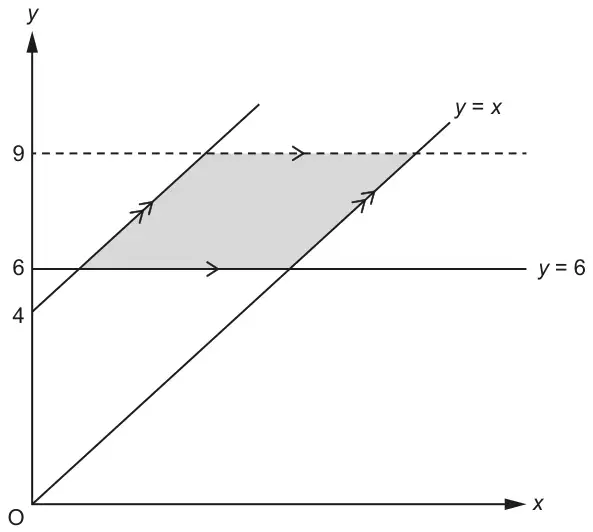
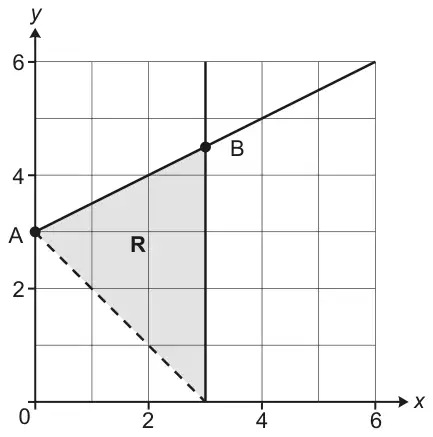
16 In the diagram below, the shaded region is a parallelogram. The parallelogram can be identified by four inequalities. Two of the inequalities are \(y \geqslant 6\) and \(y \geqslant x\).
Not to scale
(a) Write down the other two inequalities that identify the parallelogram. [3]
(b) Work out the area of the parallelogram. You must show your working. [4]
Mark scheme (a)
Answer
Marks
Part marks and guidance
\(y \leqslant x + 4\) oe
and
\(y \lt 9\)
3
B2 for \(y \leqslant x + 4\) oe or B1 for \(y \ldots x + 4\) oe but with = or an incorrect inequality symbol
B1 for \(y \lt 9\)
Accept inequalities in either order
Mark scheme (b)
Answer
Marks
Part marks and guidance
12 nfww
4
B2 for (2, 6) and (6, 6) or (5, 9) and (9, 9) identified or for base 4 and perpendicular height 3 both identified or B1 for (2, 6) or (6, 6) or (5, 9) or (9, 9) or for base = 4 or height = 3
May be seen on diagram
AND
M1 for their base × their perpendicular height
Must identify base and perpendicular height of parallelogram in working or on diagram Do not allow if slant height used
Allow M1 for this expression with other inequality symbols or equals sign or [\(x =\)] 2 as solution (can be implied by mark/circle on the diagram) or trials leading to selection of 2 or final correct trial using 2
AND
AND
B2FT for their inequality correctly shown or B1FT for correctly placed circle for their \(x \lt 2\) but with hollow circle and incorrect arrow or for filled circle with correct arrow
Displaying the solution:
Display must show an inequality that fits on the number line for FT Mark to candidate’s advantage either \(x \lt 2\) or their inequality
Accept an arrow of any length or a line reaching \(-3\)
If no solution to inequality seen: Hollow circle at 2 arrow to left M1B2 Hollow circle at 2 arrow to right M1B1 Solid circle at 2 arrow to left M1B1 Solid circle at 2 arrow to right M1B0 Mark at 2 no line or arrow M1B0
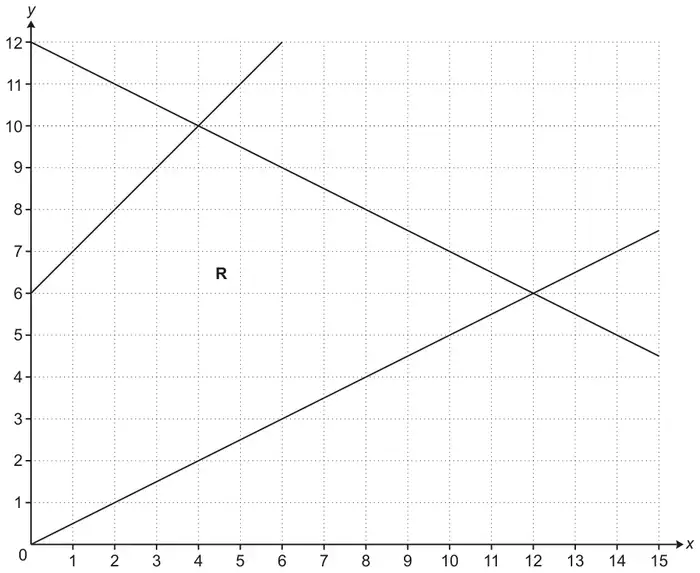
The region R satisfies the following inequalities.
\(y \geqslant x \qquad y \leqslant 2 \qquad y < -2x - 3\)
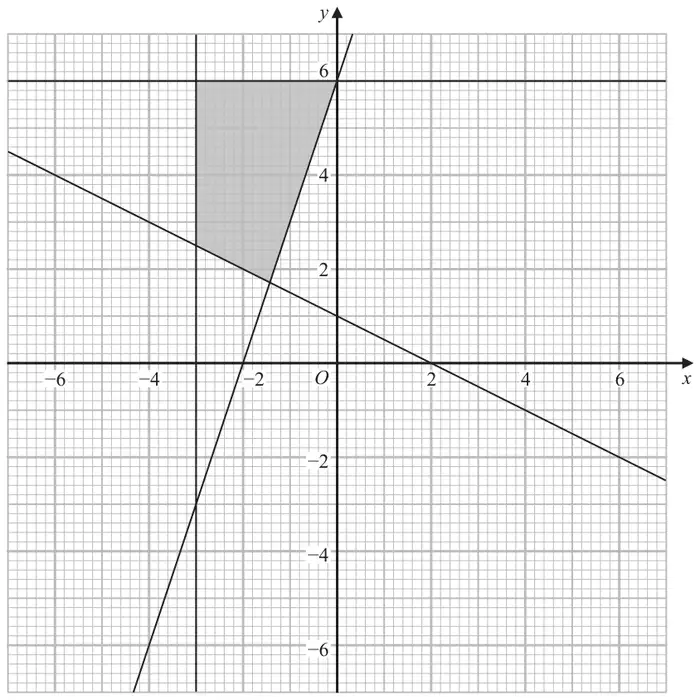
By drawing two more straight lines on the grid, find and label the region R. [6]
Mark scheme
Answer
Marks
Part marks and guidance
\(y = 2\) ruled and \(y = -2x - 3\) broken line and correct region indicated
6
B1 for \(y = 2\) ruled B2 for \(y = -2x - 3\) broken line or B1 for \(y = -2x - 3\) solid line
Penalise one mark only for good freehand lines Additional lines treat as choice Length of line should be fit for purpose to identify their region
AND B1 for R on correct side of \(y = x\)
B1 for R on correct side of \(y = 2\)
B1 for R on correct side of their \(y = -2x - 3\)
See marks on diagram for the final B3 marks provided all lines drawn correctly For region, FT their \(y = -2x - 3\) provided line with negative gradient only but no FT for \(y = 2\) if incorrect
Condone shading in or out of region provided R is clearly identified
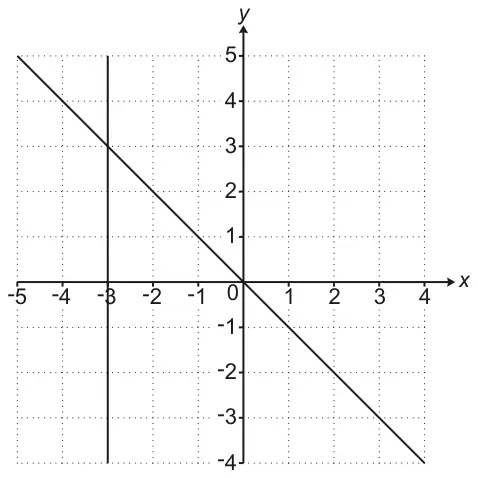
14 The graphs of \(x = -3\) and \(y = -x\) are drawn on the grid.
The region R satisfies the following inequalities.
\[x \leqslant -3 \qquad y \leqslant -x \qquad y - 1 \gt \frac{1}{2}x\]
By drawing one more line, find and label the region R. [5]
Mark scheme
Answer
Marks
Part marks and guidance
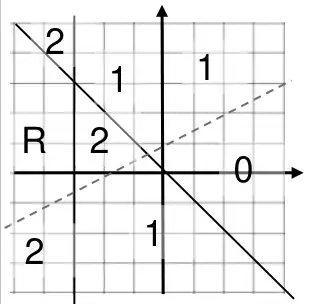
Correct region indicated
5
B2 for \(y - 1 = \frac{1}{2}x\) broken line or B1 for \(y - 1 = \frac{1}{2}x\) solid line
AND B1FT for \(R\) correct side of \(y - 1 = \frac{1}{2}x\)
B1 for \(R\) correct side of \(x = -3\) B1 for \(R\) correct side of \(y = -x\)
Use overlay as a guide for accuracy must pass through or touch small circles (when extended if necessary) position is 2 small dots each way from correct position of ends of line Allow shorter accurate line provided it defines their region
See marks on diagram for next 3 marks Grid assumes \(y - 1 = \frac{1}{2}x\) is correct Mark position of R first. If R not labelled then accept other clear indication. If \(y - 1 = \frac{1}{2}x\) not attempted then allow B1B1 max for region FT dep on sloping line drawn that is long enough to define the region chosen on grid
2 Find all the possible integer values that satisfy the inequality \(-4 \leqslant x - 3 \lt 1\). [3]
Mark scheme
Answer
Marks
Part marks and guidance
−1, 0, 1, 2, 3
3
B2 for 5 correct values with one extra or for 4 correct with no extras or for \(-1 \leqslant x \lt 4\) or M1 for \(-4 + 3 \leqslant x\) or \(x \lt 1 + 3\) oe
For M1, condone incorrect inequality sign or equals
18 The graph of \(y = 2x + 1\) is drawn on this one centimetre grid.
The region \(R\) satisfies these inequalities.
\[y \leqslant 2x + 1 \qquad y \geqslant 5 \qquad x + y \leqslant 13\]
Show that the area of region \(R\) is 12 cm². [6]
Mark scheme
Answer
Marks
Part marks and guidance
E.g. Correct inequalities shown on diagram, correct region \(R\) identified and correct area calculation \(\frac{1}{2} \times 6 \times 4\) [= 12]
6
B1 for line \(y = 5\) B1 for line \(x + y = 13\)
Condone good freehand lines, which can be dashed or solid. Lines need only be one square long for line mark but they must be fit for purpose to define their region.
AND B1 for correct side of \(y = 2x + 1\) B1 for correct side of \(y = 5\) B1 for correct side of \(x + y = 13\)
Mark the region which is labelled, but if no labelling mark the single region which is shaded (or unshaded) or implied by area calculation of correct region \(R\) Use diagram for these three marks If extra lines, mark those bounding \(R\). If no \(R\), mark poorest two
AND M1dep for \(\frac{1}{2} \times 6 \times 4\) [= 12] oe
Dep on region \(R\) being correct Accept counting squares but check areas bounding \(y = 2x + 1\) Accept split into two triangles 4 and 8 oe
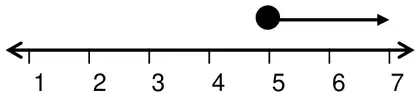
17 Solve \(2x + 5 \geqslant 11\). Show your solution on the number line.
[4]
Mark scheme
Answer
Marks
Part marks and guidance
\(x \geqslant 3\)
4
B2 for \(x \geqslant 3\) or M1 for \(2x \geqslant 11 - 5\) or better or \(x + 2.5 \geqslant 5.5\) or better
Solution to inequality
Allow M1 for this expression with other inequality symbols or equals sign or [x =] 3 as solution (can be implied by mark/circle on the diagram) or trials leading to selection of 3 or final correct trial using 3
AND
AND
B2FT for their inequality correctly shown or B1FT for correctly placed circle for their \(x \geqslant 3\) but with hollow circle and correct arrow or for filled circle with incorrect arrow
Displaying the solution:
Display must show an inequality that fits on the number line for FT Mark to candidate’s advantage either \(x \geqslant 3\) or their inequality
Accept an arrow of any length or a line reaching 9
If no solution to inequality seen: Filled circle at 3 arrow to right M1B2 Filled circle at 3 arrow to left M1B1 Hollow circle at 3 arrow to right M1B1 Hollow circle at 3 arrow to left M1B0 Mark at 3 no line or arrow M1B0 Circle and/or arrow at other than 3 M0B0
(b) Show your answer to part (a) on the number line.
[2]
Mark scheme (a)
Answer
Marks
Part marks and guidance
\(x < 4\)
3
Mark final answer M1 for \(4x - 12 < x\) or \(x - 3 < \dfrac{x}{4}\) M1 for correct step[s] to \(ax < b\) FT their first step
For method marks, condone incorrect inequality sign or ‘equals’ sign
e.g. Answer \(x = 4\), \(x > 4\) implies M1M1
Mark scheme (b)
Answer
Marks
Part marks and guidance
Correct representation of their (a) on number line
2
Strict FTtheir (a) dep on an inequality in (a)
B1FT for their correct hollow or solid circle
B1FT for their correct arrow direction
If e.g. 3 on answer line and \(x < 3\) in working then allow FT from \(x < 3\) If answer 4 in (a) then allow \(x < 4\) here Both B1’s must be with their value from part (a) If no arrow then their line must stretch to end of line
B2 for \(x \lt 5\) or M1 for \(3x \lt 19 - 4\) or better
Solution to inequality:
Allow M1 for this expression with other inequality symbols or equals sign or [\(x =\)] 5 as solution (can be implied by mark/circle on the diagram) or trials leading to selection of 5 or final correct trial using 5
AND
AND
B2FT for \(x \lt 5\), or their inequality, correctly shown or B1 for \(x \lt 5\), or their inequality, correctly shown with a hollow circle and wrong arrow or filled circle and correct arrow
Displaying the solution:
Display must show an inequality that fits on the number line for FT Mark to candidate’s advantage either \(x \lt 5\) or their inequality Accept an arrow of any length or a line reaching 1
If no solution to inequality seen: Hollow circle at 5 arrow to left M1B2 Filled circle at 5 arrow to left M1B1 Hollow circle at 5 arrow to right M1B1 Filled circle at 5 arrow to right M1B0 Mark at 5 no line or arrow M1B0 Circle and/or arrow at other than 5 M0B0
2 Solve \(3x + 4 \lt 19\). Show your solution on the number line.
[4]
Mark scheme
Answer
Marks
Part marks and guidance
\(x \lt 5\)
4
B2 for \(x \lt 5\) or M1 for \(3x \lt 19 - 4\) or better
Solution to inequality:
Allow M1 for this expression with other inequality symbols or equals sign or [x =] 5 as solution (can be implied by mark/circle on the diagram) or trials leading to selection of 5 or final correct trial using 5
AND
AND
B2FT for \(x \lt 5\), or their inequality, correctly shown or B1FT for \(x \lt 5\), or their inequality, shown with a hollow circle and wrong arrow or filled circle and correct arrow
Displaying the solution:
Display must show an inequality that fits on the number line for FT Mark to candidate’s advantage either \(x \lt 5\) or their inequality Accept an arrow of any length or a line reaching 1
If no solution to inequality seen: Hollow circle at 5 arrow to left M1B2 Filled circle at 5 arrow to left M1B1 Hollow circle at 5 arrow to right M1B1 Filled circle at 5 arrow to right M1B0 Mark at 5 no line or arrow M1B0 Circle and/or arrow at other than 5 M0B0
B2 for \(x \geqslant 5\) as final answer or M1 for \(3x \geqslant 10 + 5\) or better
AND
B2FT for \(x \geqslant 5\), or their inequality, correctly shown or B1FT for \(x \geqslant 5\), or their inequality, shown with a correct circle and wrong arrow or wrong circle and correct arrow
Solution to inequality
Allow M1 for this expression with other inequality symbols or equals sign or [\(x =\)] 5 as solution (can be implied by mark/circle on the diagram) or trials leading to selection of 5 or final correct trial using 5
Displaying the solution Diagram must show an inequality that fits on the number line for FT Mark to candidate’s advantage either \(x \geqslant 5\) or their inequality Accept a line or arrow
If no solution to inequality seen: Filled circle at 5 arrow to right M1 B2 Empty circle at 5 arrow to right M1 B1 Filled circle at 5 arrow to left M1 B1 Empty circle at 5 arrow to left M1 B0 Mark at 5 no line or arrow M1B0 Circle and/or arrow at other than 5 M0B0
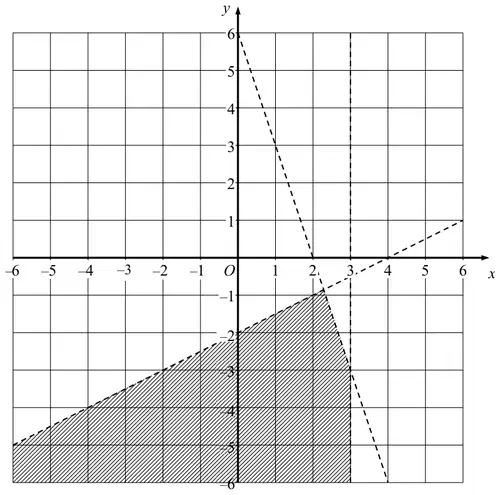
By drawing two more straight lines, find and label the region R. [6]
Mark scheme
Answer
Marks
Part marks and guidance
6
B1 for \(y = x - 2\) drawn B2 for \(x = 3\) broken line or B1 \(x = 3\) solid line
AND B1 for R correct side of \(3y + 6x = 13\)
B1 for R correct side of their \(y = x - 2\)
B1 for R correct side of \(x = 3\)
Penalise one mark only for good freehand lines Additional lines treat as choice
See marks on diagram for the final B3 marks provided all lines drawn correctly For region, FT their \(y = x - 2\) provided line with positive gradient only but no FT for \(x = 3\) if incorrect
B2 for \(x \geqslant 5\) as final answer or M1 for \(3x \geqslant 10 + 5\) or better
AND
B2FT for \(x \geqslant 5\), or their inequality, correctly shown or B1FT for \(x \geqslant 5\), or their inequality, shown with a correct circle and wrong arrow or wrong circle and correct arrow
Solution to inequality Allow M1 for this expression with other inequality symbols or equals sign or [\(x\) =] 5 as solution (can be implied by mark/circle on the diagram) or trials leading to selection of 5 or final correct trial using 5
Displaying the solution Display must show an inequality that fits on the number line for FT Mark to candidate’s advantage either \(x \geqslant 5\) or their inequality Accept an arrow of any length or a line reaching 7
If no solution to inequality seen: Filled circle at 5 arrow to right M1B2 Empty circle at 5 arrow to right M1B1 Filled circle at 5 arrow to left M1B1 Empty circle at 5 arrow to left M1B0 Mark at 5 no line or arrow M1B0 Circle and/or arrow at other than 5 M0B0
\[\begin{aligned} &y \gt 3 \\ &y \geqslant x \\ &x + y \leqslant 9 \end{aligned}\]
By drawing three straight lines on the grid, find and label the region R. [6]
Mark scheme
Answer
Marks
Part marks and guidance
Three correct lines and region R correctly labelled with an ‘R’ or unambiguous wording or shading
6
B1 for line \(y = 3\) and B1dep indicates correct side B1 for line \(y = x\) and B1dep indicates correct side B1 for line \(x + y = 9\) and B1dep indicates correct side to a maximum of 5 marks
Condone good freehand lines, which can be dashed or solid. Mark the region which is labelled, but if no labelling mark the single region which is shaded (or unshaded). Condone regions that are just in the first quadrant. Region mark depends on the line being a close attempt.
Note : lines need only be one square long for line mark but they must be fit for purpose to define their region up to the intersections and the \(y\)-axis.
Appendix: Question 18
Marks for regions if all lines are correctly drawn. The line \(x + y = 9\) must go very close to one of the points (0,9) or (9,0) to score its region mark after awarding B0 for that line.
9 Martha’s solution to the inequality \(8x + 5 \leqslant 3x - 10\) is shown on the number line.
Is her solution correct? Explain your reasoning. [4]
Mark scheme
Answer
Marks
Part marks and guidance
Correct solution is \(x \leqslant -3\) from algebraic working
M3
M2 for \(8x - 3x \leqslant -10 - 5\) or better, or for \(5 + 10 \leqslant 3x - 8x\) or better or M1 for \(8x - 3x\), or \(3x - 8x\), or [±]\(5x\), or –10 – 5, or 5 + 10, or [±]15 seen
For M2 and M1 condone incorrect inequality sign or “equals”.
Alternative method 3 trials for values of \(x\) where \(x \lt -3\), \(x = -3\) and \(x \gt -3\) and correct conclusion can score full marks. Without the correct conclusion, maximum for this approach is SC1 for only the 3 correct trials (as described below) See table of values below
No and number line shows \(x \geqslant -3\) oe or No and draws the correct inequality on number line or No and “the arrow points the wrong way” oe
A1dep
A1 dep on M3
After 0 scored, allow SC1 for number line shows \(x \geqslant -3\) or “the arrow points the wrong way” oe but only if no incorrect working shown or correct substitution of a value ≠ –3 and conclusion that inequality is false oe
By drawing a third straight line, find and label the region R that satisfies these inequalities. [5]
Mark scheme
Answer
Marks
Part marks and guidance
5
B2 for \(y = 1\) broken line or B1 \(y = 1\) solid line AND B1 for R correct side of \(7x + 4y = 28\) B1 for R correct side of \(y = 2x + 1\) B1 for R correct side of \(y = 1\)
Line long enough to define region If other lines, treat as choice unless labelled
See marks on diagram for the final B3 marks (assumes \(y = 1\) is drawn)
Condone R not labelled if shading (in or out) is clear
2 Gemma’s solution to the inequality \(3x + 1 \gt -5\) is shown on the number line.
Is Gemma’s solution correct? Explain your reasoning. [3]
Mark scheme
Answer
Marks
Part marks and guidance
Correct solution is \(x \gt -2\)
M2
M1 for \(3x \gt -5 - 1\) oe or evaluates \(3x + 1\) correctly for \(x = -3\) or \(x = -4\), or \(x = -5\) or \(x = -6\)
For M2 accept in words, \(x\) is greater than −2, accept correctly drawn solution on a number line For M1 condone incorrect inequality sign or ‘equals’ e.g. \(x = -2\) implies M1 M1 implied by −8 or −11 or −14 or −17
No and number line shows \(x \lt -2\) oe or No and draws the correct inequality on number line or No [the circle is correctly placed but] the arrow points the wrong way oe
A1
After 0 scored, allow SC1 for number line shows \(x \lt -2\) oe isw or for [the circle is correctly placed but] the arrow points the wrong way oe
But for A1 or SC1 if just ‘it points the wrong way’ oe accept this provided there is no incorrect statement about where the circle should be placed and no incorrect working shown
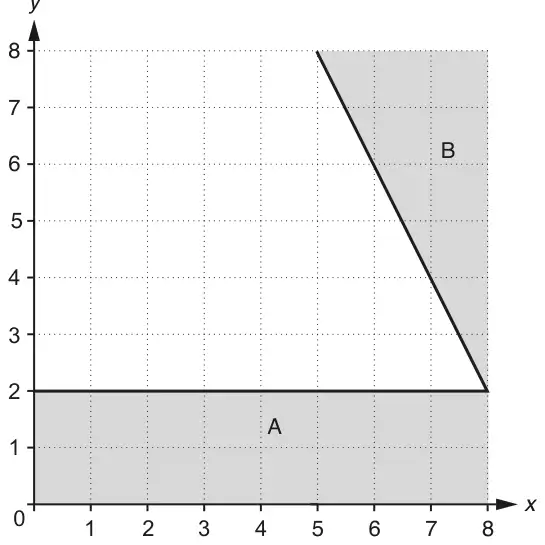
18 The diagram below shows a 1 cm coordinate grid.
(a) Find an inequality that defines region A and another inequality that defines region B.
Region A: ................................................ Region B: ................................................ [4]
(b) Shade the region on the grid given by the inequality \(y \geqslant 6\). [2]
(c) A fourth shaded region, given by the inequality\[y \geqslant kx + 2,\]
is added to the grid.
The unshaded region now has area 23 cm².
Find the value of \(k\). [5]
Mark scheme (a)
Answer
Marks
Part marks and guidance
\(y \leqslant 2\)
1
If both inequalities are wrong way round, condone once (max penalty 1 mark)
and
\(y \geqslant -2x + 18\) oe
3
B1 for [‘gradient’=] −2 soi and M1 for suitable method to find equation of line eg. \(y - 8 = (\textit{their } {-2}) \times (x - 5)\) or \(y - 2 = (\textit{their } {-2}) \times (x - 8)\)
Or M1 for \(y = \textit{their } {-2}x + c\) with a point from the line substituted in to find \(c\) For M1 allow use of an inequality symbol in place of =
Mark scheme (b)
Answer
Marks
Part marks and guidance
\(y = 6\) shown as a solid line and correct region shaded
2
B1 for line drawn at \(y = 6\)
OR
B1 for correct squares shaded but no line
Accept dashed line for B1
Mark scheme (c)
Answer
Marks
Part marks and guidance
\(\dfrac{8}{5}\) oe
5
M1 for \(\dfrac{1}{2} \times 4 \times (8 + 6)\) soi by 28 M1 for \(\dfrac{1}{2} \times 4h = \textit{their } 28 - 23\) oe A1 for [\(h\) =] 2.5
AND
M1 for [\(k\) =] 4 ÷ their 2.5 oe
‘h’ is ‘top of triangle’
Alternative method M1 for \(\dfrac{1}{2} \times 4 \times (8 + \text{‘}t\text{’})\) M1 for their \(\dfrac{1}{2} \times 4 \times (8 + \text{‘}t\text{’}) = 23\) oe A1 for [\(t\) =] 3.5