24 This year the total weight of potatoes grown on a farm is \(\dfrac{1}{5}\) less than last year.
This year the total weight of potatoes grown is 8000 tonnes.
Work out the total weight of potatoes grown last year. (3)
Mark scheme
Answer
Mark
Mark scheme
10 000
M1
for recognising 8000 is \(\dfrac{4}{5}\), eg \(8000 \div 4\ (= 2000)\) or \(\dfrac{4}{5} = 8000\) or 8000 = 80% or \(8000 \div 80\ (= 100)\) or \(x \times 0.8 = 8000\) oe
M1
for a complete method, eg \(\text{``}2000\text{''} \times 5\) or \(8000 \times \dfrac{5}{4}\) or \(\text{``}100\text{''} \times 100\) or \(\dfrac{8000}{0.8}\)
22 There are 280 chocolates in a box. There are only dark chocolates, milk chocolates and white chocolates.
\(\dfrac{1}{7}\) of the 280 chocolates are dark chocolates.
The number of milk chocolates : the number of white chocolates = 1 : 3
The number of white chocolates : the number of dark chocolates = \(n : 1\)
(a) Work out the value of \(n\). You must show all your working. (5)
10 milk chocolates from the box are eaten.
(b) Does this affect your answer to part (a)? Give a reason for your answer. (1)
Mark scheme (a)
Answer
Mark
Mark scheme
4.5
P1
for a process to find the number of dark chocolates, eg \(280 \times \dfrac{1}{7}\) oe (= 40)
P1
for a process to find one part of the ratio for milk chocolates to white chocolates eg \((280 - \text{``}40\text{''}) \div (1 + 3)\ (= 60)\)
P1
for process to find the number of white chocolates, eg \(\text{``}60\text{''} \times 3\ (= 180)\) or \(280 - \text{``}40\text{''} - \text{``}60\text{''}\ (= 180)\)
P1
for a ratio of white chocolates : dark chocolates eg \(\text{``}180\text{''} : \text{``}40\text{''}\) oe or for a process to find the value of \(n\) eg \(\text{``}180\text{''} \div \text{``}40\text{''}\)
A1
(dep P3) for 4.5 oe
Additional guidance
Condone milk, white incorrectly labelled
Labels not required for this mark, but if seen must be correct Must be a 2-part ratio. Allow \(\text{``}40\text{''} : \text{``}180\text{''}\) if labelled as dark chocolate : white chocolate oe
A correct answer with no supportive working gets 0 marks Condone answer of 4.5:1
Mark scheme (b)
Answer
Mark
Mark scheme
No with reason
C1
for No with reason Acceptable examples No, the number of dark chocolates and white chocolates has not changed No, the ratio of \(n\):1 only involved white and dark chocolates No, eating milk chocolates doesn’t change the rest No, the ratio of dark to white chocolates doesn’t change. Not acceptable examples Yes,… No, it doesn’t matter how many milk chocolates are eaten No, the number of white chocolates doesn’t change No, the number of dark chocolates doesn’t change
Additional guidance
Reason must refer to or imply both dark and white chocolates
The number of games the team loses is the same as the number of games the team draws.
Work out the number of games the team loses. (3)
Mark scheme
Answer
Mark
Mark scheme
15
P1
for process to find the number of games won, eg \(48 \div 8 \times 3\ (= 18)\) oe or \(48 -\) [games won] or for process to find the fraction of games drawn and lost or lost only, eg \(1 - \dfrac{3}{8}\left(= \dfrac{5}{8}\right)\) oe eg \(1 - 0.375\ (= 0.625)\) or \(\left(1 - \dfrac{3}{8}\right) \div 2\left(= \dfrac{5}{16}\right)\) oe eg \(\dfrac{2.5}{8}\) or for representing the games in a ratio eg 3 : 2.5 : 2.5 oe
P1
for a correct next step, eg \(48 - \text{``}18\text{''}\ (= 30)\) or \(\text{``}\dfrac{5}{8}\text{''} \times 48\ (= 30)\) oe eg \(\text{``}0.625\text{''} \times 48\ (= 30)\) or \(\text{``}\dfrac{2.5}{8}\text{''} \times 48\) or \(48 \div 8 \times 2.5\) oe or 18 : 15 : 15
A1
cao
Additional guidance
[games won] needs to be clearly stated and must be an integer less than 48 and not \(48 \div 8 \times 3\ (= 18)\) oe
Work out the value of \(xy\). Give your answer as a fraction in its simplest form. (5)
Mark scheme
Answer
Mark
Mark scheme
\(\dfrac{5}{33}\)
M1
for \(10x = 2.\dot{2}\) or 2.22… or \((10x - x =)\ 2.\dot{2} - 0.\dot{2}\ (= 2)\) or \(2.22\ldots - 0.22\ldots\ (= 2)\) or \(\dfrac{2}{9}\) oe fraction
M1
for a method using two recurring decimals that leads to a terminating decimal difference, using correct multiples of \(y\) eg \((1000y - 10y =)\ 681.\dot{8}\dot{1} - 6.\dot{8}\dot{1}\ (= 675)\) or \(681.81\ldots - 6.81\ldots\ (= 675)\) or \(\dfrac{675}{990}\) or \((100y - y) = 68.\dot{1}\dot{8} - 0.6\dot{8}\dot{1}\ (= 67.5)\) or \(68.181\ldots - 0.681\ldots\ (= 67.5)\) or \(\dfrac{67.5}{99}\)
A1
for \((x =)\ \dfrac{2}{9}\) oe and \((y =)\ \dfrac{675}{990}\) oe
M1
for \(\text{``}\dfrac{2}{9}\text{''} \times \text{``}\dfrac{675}{990}\text{''}\)
A1
cao
Additional guidance
eg \(\dfrac{20}{90}, \dfrac{22}{99}\)
Accept \((y =)\ \dfrac{67.5}{99}\)
Award 4 marks for an answer equivalent to \(\dfrac{5}{33}\), eg \(\dfrac{15}{99}, \dfrac{135}{891}, \dfrac{1350}{8910}\) unless from incorrect working
for method to subtract using a correct common denominator, with at least one correct numerator, eg. \(\dfrac{5}{8} - \dfrac{2}{8}\) or \(\dfrac{10}{16} - \dfrac{4}{16}\) or \(\dfrac{20}{32} - \dfrac{8}{32}\) or for correct method to convert both fractions to decimals and subtract, eg \(0.625 - 0.25\)
A1
for \(\dfrac{3}{8}\) oe, eg \(\dfrac{6}{16}\), \(\dfrac{9}{24}\), \(\dfrac{12}{32}\), 0.375
Additional guidance
Do not condone working with fractions with decimal numerators unless it leads to a fraction or fractions where both numerator and denominator are integers.
Ignore errors in cancelling after sight of an equivalent fraction to \(\dfrac{3}{8}\)
Mark scheme (b)
Answer
Mark
Mark scheme
16
M1
for dividing by 5 and multiplying by 2, in any order or for \(0.4 \times 40\) oe
A1
cao
Additional guidance
Accept \(\dfrac{2}{5} \times 40\) or \(\dfrac{2}{5} \times \dfrac{40}{1}\)
5 This year the total weight of potatoes grown on a farm is \(\dfrac{1}{5}\) less than last year.
This year the total weight of potatoes grown is 8000 tonnes.
Work out the total weight of potatoes grown last year. (3)
Mark scheme
Answer
Mark
Mark scheme
10 000
M1
for recognising 8000 is \(\dfrac{4}{5}\) eg \(8000 \div 4\ (= 2000)\) or \(\dfrac{4}{5} = 8000\) or 8000 = 80% or \(8000 \div 80\ (= 100)\) or \(x \times 0.8 = 8000\)
M1
for a complete method, eg \(\text{``}2000\text{''} \times 5\) or \(8000 \times \dfrac{5}{4}\) or \(\text{``}100\text{''} \times 100\) or \(\dfrac{8000}{0.8}\)
4 There are 280 chocolates in a box. There are only dark chocolates, milk chocolates and white chocolates.
\(\dfrac{1}{7}\) of the 280 chocolates are dark chocolates.
The number of milk chocolates : the number of white chocolates = 1 : 3
The number of white chocolates : the number of dark chocolates = \(n : 1\)
(a) Work out the value of \(n\). You must show all your working. (5)
10 milk chocolates from the box are eaten.
(b) Does this affect your answer to part (a)? Give a reason for your answer. (1)
Mark scheme (a)
Answer
Mark
Mark scheme
4.5
P1
for a process to find the number of dark chocolates, eg \(280 \times \dfrac{1}{7}\) oe (= 40)
P1
for a process to find one part of the ratio for milk chocolates to white chocolates eg \((280 - \text{``}40\text{''}) \div (1 + 3)\ (= 60)\)
P1
for a process to find the number of white chocolates, eg \(\text{``}60\text{''} \times 3\ (= 180)\) or \(280 - \text{``}40\text{''} - \text{``}60\text{''}\ (= 180)\)
P1
for a ratio of white chocolates : dark chocolates eg \(\text{``}180\text{''} : \text{``}40\text{''}\) oe or for a process to find the value of \(n\) eg \(\text{``}180\text{''} \div \text{``}40\text{''}\)
A1
(dep P3) for 4.5 oe
Additional guidance
Condone milk, white incorrectly labelled
Labels not required for this mark, but if seen must be correct Must be a 2-part ratio Allow \(\text{``}40\text{''} : \text{``}180\text{''}\) if labelled as dark chocolate : white chocolate oe
A correct answer with no supportive working gets 0 marks Condone answer of 4.5 : 1
Mark scheme (b)
Answer
Mark
Mark scheme
No with reason
C1
for No with reason Acceptable examples No, the number of dark chocolates and white chocolates has not changed No, the ratio of \(n\):1 only involved white and dark chocolates No, eating milk chocolates doesn’t change the rest No, the ratio of dark to white chocolates doesn’t change Not acceptable examples Yes,… No, it doesn’t matter how many milk chocolates are eaten No, the number of white chocolates doesn’t change No, the number of dark chocolates doesn’t change
Additional guidance
Reason must refer to or imply both dark and white chocolates
(a) Work out \(3\dfrac{1}{2} - 1\dfrac{1}{6}\) Give your answer as a mixed number. (2)
(b) Show that \(5\dfrac{1}{4} \div 2\dfrac{1}{3} = 2\dfrac{1}{4}\) (3)
Mark scheme (a)
Answer
Mark
Mark scheme
\(2\dfrac{1}{3}\)
M1
for a method to subtract by writing both fractions with a common denominator with at least one correct numerator, eg \(3\dfrac{3}{6} - 1\dfrac{1}{6}\) or \(\dfrac{3}{6} - \dfrac{1}{6}\ \left(= \dfrac{2}{6}\right)\) or \(\dfrac{21}{6} - \dfrac{7}{6}\ \left(= \dfrac{14}{6}\right)\) or \(\dfrac{42}{12} - \dfrac{14}{12}\ \left(= \dfrac{28}{12}\right)\)
A1
for \(2\dfrac{1}{3}\) or an equivalent mixed number
Additional guidance
Do not ISW incorrect further work from correct equivalent mixed number
Mark scheme (b)
Answer
Mark
Mark scheme
Shown
M1
for conversion to improper fractions, eg \(\dfrac{21}{4}\) or \(\dfrac{7}{3}\) or \(\dfrac{9}{4}\)
M1
(dep) for method to divide by a fraction, eg \(\dfrac{21}{4} \times \dfrac{3}{7}\) or \(\dfrac{63}{12} \div \dfrac{28}{12}\)
C1
for complete work showing each stage as far as \(\dfrac{9}{4}\) or \(2\dfrac{7}{28}\)
Additional guidance
Must see an intermediate step, eg \(\dfrac{63}{28}\) must be seen and then cancelled or correct cancelling seen before the multiplication
14 Harry works in a shop. From Monday to Friday his basic rate of pay is £8 per hour.
On Saturday and Sunday, Harry’s rate of pay is \(1\dfrac{1}{2}\) times his basic rate of pay.
The table shows the number of hours Harry worked each day last week.
Day
Mon
Tue
Wed
Thu
Fri
Sat
Sun
Hours worked
6
6
6
6
6
4
3
Work out Harry’s total pay last week. (4)
Mark scheme
Answer
Mark
Mark scheme
324
P1
for a process to work out daily pay on a weekday, eg \(8 \times 6\ (= 48)\)
or a process to work out the number of hours of pay for weekdays, eg \(6 \times 5\ (= 30)\)
or the number of hours of pay for Saturday and Sunday, eg \((4 + 3) \times 1.5\ (= 10.5)\)
or a process to work out rate of pay for Saturday or Sunday, eg \(8 \times 1.5\ (= 12)\)
P1
for a process to work out the total pay from Monday to Friday, eg \(\text{``}48\text{''} \times 5\ (= 240)\) or \(\text{``}30\text{''} \times 8\ (= 240)\)
or for a process to work out the total pay from Saturday and Sunday, eg \(\text{``}10.5\text{''} \times 8\ (= 84)\) or \(\text{``}12\text{''} \times (4 + 3)\ (= 84)\)
or a process to work out the total number of hours of pay, eg \(\text{``}30\text{''} + \text{``}10.5\text{''}\ (= 40.5)\)
P1
for a complete process, eg \(\text{``}240\text{''} + \text{``}84\text{''}\) or \(\text{``}40.5\text{''} \times 8\)
(a) Work out \(3\dfrac{1}{2} - 1\dfrac{1}{6}\) Give your answer as a mixed number. (2)
(b) Show that \(5\dfrac{1}{4} \div 2\dfrac{1}{3} = 2\dfrac{1}{4}\) (3)
Mark scheme (a)
Answer
Mark
Mark scheme
\(2\dfrac{1}{3}\)
M1
for a method to subtract by writing both fractions with a common denominator with at least one correct numerator, eg \(3\dfrac{3}{6} - 1\dfrac{1}{6}\) or \(\dfrac{3}{6} - \dfrac{1}{6}\ \left(= \dfrac{2}{6}\right)\) or \(\dfrac{21}{6} - \dfrac{7}{6}\ \left(= \dfrac{14}{6}\right)\) or \(\dfrac{42}{12} - \dfrac{14}{12}\ \left(= \dfrac{28}{12}\right)\)
A1
for \(2\dfrac{1}{3}\) or an equivalent mixed number
Additional guidance
Do not isw incorrect further work from correct equivalent mixed number
Mark scheme (b)
Answer
Mark
Mark scheme
Shown
M1
for conversion to improper fractions, eg \(\dfrac{21}{4}\) or \(\dfrac{7}{3}\) or \(\dfrac{9}{4}\)
M1
(dep) for method to divide by a fraction, eg \(\dfrac{21}{4} \times \dfrac{3}{7}\) or \(\dfrac{63}{12} \div \dfrac{28}{12}\)
C1
for complete work showing each stage as far as \(\dfrac{9}{4}\) or \(2\dfrac{7}{28}\)
Additional guidance
Must see an intermediate step, eg \(\dfrac{63}{28}\) must be seen and then cancelled or correct cancelling seen before the multiplication
for a method to subtract using a common denominator with at least one fraction correct (suitable common denominator for original fractions with at least one correct numerator) eg \(\dfrac{57}{15} - \dfrac{25}{15}\) or \((3)\dfrac{12}{15} - (1)\dfrac{10}{15}\)
A1
for \(2\dfrac{2}{15}\) oe eg \(\dfrac{32}{15}\)
Additional guidance
Use of decimals gets no credit unless it leads to a correct fraction
ISW incorrect conversion from improper fraction to mixed number or incorrect simplification of improper fraction.
Mark scheme (b)
Answer
Mark
Mark scheme
Mistake identified
C1
for explaining that Kevin did not convert to the correct mixed number
Acceptable examples In his answer \(\dfrac{9}{24}\) should have been \(\dfrac{11}{24}\) The 9 should be 11 He has not got the numerator right in his final answer He simplified into the mixed number incorrectly He has not put the remainder as the numerator \(1\frac{9}{24}\) would give you \(\frac{33}{24}\) rather than \(\frac{35}{24}\) \(\frac{35}{24} = 1\frac{11}{24}\)
Not acceptable examples He should have used a common denominator He has not simplified his answer He should have done keep, flip, change He converted the fraction wrongly The answer should be \(1\frac{10}{24}\)
\(\dfrac{2}{3}\) of the 24 bars are white chocolate.
The rest of the 24 bars are milk chocolate.
Each milk chocolate bar has a weight of 35 grams.
Work out the total weight of the milk chocolate bars that Saira buys. (3)
Mark scheme
Answer
Mark
Mark scheme
280
P1
for process to find the number of bars of white chocolate or milk chocolate, eg \(24 \div 3 \times 2\) oe \((= 16)\) or \(24 \div 3\ (= 8)\) or for process to work with total weight of chocolate, eg \(24 \times 35\ (= 840)\)
P1
for complete process, eg \((24 - \text{``}16\text{''}) \times 35\) or \(\text{``}8\text{''} \times 35\) or \(\text{``}840\text{''} \div 3\)
A1
cao
Additional guidance
Allow use of 0.66.. or better or 0.33.. or better for both process marks
for a method to subtract using a common denominator with at least one fraction correct (suitable common denominator for original fractions with at least one correct numerator) eg \(\dfrac{57}{15} - \dfrac{25}{15}\) or \((3)\dfrac{12}{15} - (1)\dfrac{10}{15}\)
A1
for \(2\dfrac{2}{15}\) oe eg \(\dfrac{32}{15}\)
Additional guidance
Use of decimals gets no credit unless it leads to a correct fraction
ISW incorrect conversion from improper fraction to mixed number or incorrect simplification of improper fraction
Mark scheme (b)
Answer
Mark
Mark scheme
Mistake identified
C1
for explaining that Kevin did not convert to the correct mixed number
Acceptable examples In his answer \(\dfrac{9}{24}\) should have been \(\dfrac{11}{24}\) The 9 should be 11 He has not got the numerator right in his final answer He simplified into the mixed number incorrectly He has not put the remainder as the numerator \(1\dfrac{9}{24}\) would give you \(\dfrac{33}{24}\) rather than \(\dfrac{35}{24}\) \(\dfrac{35}{24} = 1\dfrac{11}{24}\)
Not acceptable examples He should have used a common denominator He has not simplified his answer He should have done keep, flip, change He converted the fraction wrongly The answer should be \(1\dfrac{10}{24}\)
21 Work out \(\quad 7\dfrac{3}{8} - 2\dfrac{1}{2}\)
Give your answer as a mixed number. (3)
Mark scheme
Answer
Mark
Mark scheme
\(4\dfrac{7}{8}\)
M2
for a complete method, eg \(7 - 2 + \dfrac{3}{8} - \dfrac{4}{8}\) condoning error with one numerator or for \(\dfrac{59}{8} - \dfrac{5}{2} = \dfrac{59}{8} - \dfrac{20}{8}\ \left(= \dfrac{39}{8}\right)\) with no more than one error OR for an answer of 4.875
(M1
for finding two fractions with a correct common denominator, with at least one correct corresponding numerator, eg \(\dfrac{3}{8}, \dfrac{4}{8}\) or for converting both to improper fractions, eg \(\dfrac{59}{8}, \dfrac{5}{2}\) OR for \(7.375 - 2.5\))
A1
for \(4\dfrac{7}{8}\) oe eg \(4\dfrac{14}{16}\)
Additional guidance
At least one improper fraction must be correct Both decimals must be correct
15 Work out \(\quad \dfrac{6}{7} \times \dfrac{5}{12}\)
Give your answer as a fraction in its simplest form. (2)
Mark scheme
Answer
Mark
Mark scheme
\(\dfrac{5}{14}\)
M1
for method to multiply fractions, eg \(\dfrac{6 \times 5}{7 \times 12}\) or to simplify, eg \(\dfrac{1}{7} \times \dfrac{5}{2}\) OR for a fractional answer equivalent to \(\dfrac{5}{14}\)
2 Work out \(7\dfrac{3}{8} - 2\dfrac{1}{2}\) Give your answer as a mixed number. (3)
Mark scheme
Answer
Mark
Mark scheme
\(4\dfrac{7}{8}\)
M2
for a complete method, eg \(7 - 2 + \dfrac{3}{8} - \dfrac{4}{8}\) condoning error with one numerator or for \(\dfrac{59}{8} - \dfrac{5}{2} = \dfrac{59}{8} - \dfrac{20}{8}\ \left(= \dfrac{39}{8}\right)\) with no more than one error OR for an answer of 4.875
(M1
for finding two fractions with a correct common denominator, with at least one correct corresponding numerator, eg \(\dfrac{3}{8}, \dfrac{4}{8}\) or for converting both to improper fractions, eg \(\dfrac{59}{8}, \dfrac{5}{2}\) OR for \(7.375 - 2.5\))
A1
for \(4\dfrac{7}{8}\) oe eg \(4\dfrac{14}{16}\)
Additional guidance
At least one improper fraction must be correct Both decimals must be correct
(a) Work out \(\quad 1\dfrac{3}{5} + 2\dfrac{1}{4}\) Give your answer as a mixed number. (2)
(b) Show that \(\quad 2\dfrac{2}{3} \div 6 = \dfrac{4}{9}\) (2)
Mark scheme (a)
Answer
Mark
Mark scheme
\(3\dfrac{17}{20}\)
M1
for finding two fractions with a correct common denominator (multiple of 20), with at least one correct corresponding numerator, eg. \(\dfrac{12}{20}, \dfrac{5}{20}\) or \(\dfrac{32}{20}, \dfrac{45}{20}\)
A1
for \(3\dfrac{17}{20}\) or an equivalent mixed number SC: B1 for 3.85 if M0 scored
Additional guidance
May be from \(\dfrac{3}{5}\) and \(\dfrac{1}{4}\) or from \(\dfrac{8}{5}\) and \(\dfrac{9}{4}\)
Mark scheme (b)
Answer
Mark
Mark scheme
shown
M1
for \(\dfrac{8}{3} \times \dfrac{1}{6}\) oe or \(\dfrac{4}{9} \times \dfrac{6}{1}\) oe or \(\dfrac{8}{3} \times \dfrac{9}{4}\) oe
A1
for unsimplified fraction which could lead to \(\dfrac{4}{9}\), eg \(\dfrac{8}{18}\) or for \(\dfrac{4}{3} \times \dfrac{1}{3}\) or \(\dfrac{24}{9} \div 6\) or for unsimplified fraction which could lead to \(2\dfrac{2}{3}\), eg \(\dfrac{24}{9}\) or for unsimplified fraction which could lead to 6, eg \(\dfrac{72}{12}\)
(b) Write the following fractions in order of size. Start with the smallest fraction.\[\dfrac{3}{8} \qquad \dfrac{9}{32} \qquad \dfrac{1}{4} \qquad \dfrac{21}{64}\] (2)
converts into decimals or percentages or equivalent fractions, at least 2 conversions correct or for any 3 fractions in correct order 0.25, 0.28(125), 0.32(8125), 0.37(5)
A1
cao
Additional guidance
Accept in reverse order for this mark
Accept expressed in equivalent decimals or percentages or fractions or in mixed numerical form
\(\dfrac{1}{4}\) of these bars of chocolate were large bars. The rest of the bars of chocolate were small bars.
All the large bars of chocolate were sold for £1 each. All the small bars of chocolate were sold for 60p each.
Work out the total amount of money for which the 208 bars of chocolate were sold. Give your answer in pounds. (3)
Mark scheme
Answer
Mark
Mark scheme
145.60
P1
for a process to work out the value of the large bars eg \(208 \div 4\ (=52 \text{ or } 5200)\)
P1
for a process to work out the value of the small bars eg \((208 - \text{``}52\text{''}) \times 60\) or \(\left(1 - \dfrac{1}{4}\right) \times 208 \times 60\ (=9360 \text{ or } 93.6(0))\) or for 145.6
(a) Work out \(1\dfrac{3}{5} + 2\dfrac{1}{4}\) Give your answer as a mixed number. (2)
(b) Show that \(2\dfrac{2}{3} \div 6 = \dfrac{4}{9}\) (2)
Mark scheme (a)
Answer
Mark
Mark scheme
\(3\dfrac{17}{20}\)
M1
for finding two fractions with a correct common denominator (multiple of 20), with at least one correct corresponding numerator, eg \(\dfrac{12}{20}\), \(\dfrac{5}{20}\) or \(\dfrac{32}{20}\), \(\dfrac{45}{20}\)
A1
for \(3\dfrac{17}{20}\) or an equivalent mixed number SC B1 for an answer of 3.85 if M0 scored
Additional guidance
May be from \(\dfrac{3}{5}\) and \(\dfrac{1}{4}\) or from \(\dfrac{8}{5}\) and \(\dfrac{9}{4}\)
Mark scheme (b)
Answer
Mark
Mark scheme
shown
M1
for \(\dfrac{8}{3} \times \dfrac{1}{6}\) oe or \(\dfrac{4}{9} \times \dfrac{6}{1}\) oe or \(\dfrac{8}{3} \times \dfrac{9}{4}\) oe
A1
for unsimplified fraction which could lead to \(\dfrac{4}{9}\), eg \(\dfrac{8}{18}\) or for \(\dfrac{4}{3} \times \dfrac{1}{3}\) or \(\dfrac{24}{9} \div 6\) or for unsimplified fraction which could lead to \(2\dfrac{2}{3}\), eg \(\dfrac{24}{9}\) or for unsimplified fraction which could lead to 6, eg \(\dfrac{72}{12}\)
19 There are 400 counters in a box. The counters are red or yellow or green.
\(\dfrac{3}{8}\) of the counters are red. 82 of the counters are yellow.
What percentage of the counters are green? (4)
Mark scheme
Answer
Mark
Mark scheme
42
P1
for process to find number of red counters, eg \(400 \div 8 \times 3\ (= 150)\) or process to convert both to percentages: \(3/8\) as 37.5 and \(82/400\) as 20.5 or process to convert both to fractions with common denominator: eg \(3/8\) as \(75/200\) and \(82/400\) as \(41/200\) oe
P1
for process to find number of green counters, eg \(400 - \text{``}150\text{''} - 82\ (= 168)\) or process to find the percentage of red and yellow counters eg \(\text{``}37.5\text{''} + \text{``}20.5\text{''}\ (= 58)\) or \((\text{``}150\text{''} + 82) \div 400 \times 100\ (= 58)\)
P1
for complete process to find the percentage of counters that are green, eg \(\text{``}168\text{''} \div 400 \times 100\) or \(100 - (37.5 + 20.5)\) or \(100 - \text{``}58\text{''}\)
A1
cao
Additional guidance
NB could use other decimals eg 0.375, 0.205 or % or fractions
(b) Work out \(\dfrac{3}{10} \times \dfrac{5}{8}\) Give your answer as a fraction in its simplest form. (2)
Mark scheme (a)
Answer
Mark
Mark scheme
\(\dfrac{7}{12}\)
M1
for finding two fractions with a correct common denominator, with at least one correct corresponding numerator, eg. \(\dfrac{5}{12}, \dfrac{2}{12}\)
A1
for \(\dfrac{7}{12}\) oe eg \(\dfrac{14}{24}, \dfrac{21}{36}, \dfrac{28}{48}, \dfrac{35}{60}, \dfrac{42}{72}\), …
Additional guidance
Ignore errors in cancelling following sight of an equivalent fraction to \(\dfrac{7}{12}\)
Mark scheme (b)
Answer
Mark
Mark scheme
\(\dfrac{3}{16}\)
M1
for method to multiply fractions, eg \(\dfrac{3 \times 5}{10 \times 8}\ \left(= \dfrac{15}{80}\right)\) or simplifies the calculation eg \(\dfrac{3}{2} \times \dfrac{1}{8}\) or for an answer equivalent to \(\dfrac{3}{16}\) unsimplified
for a complete method, eg \(4 - 2 + \dfrac{3}{15} - \dfrac{10}{15}\) condoning error with one numerator or for \(\dfrac{21}{5} - \dfrac{8}{3} = \dfrac{63}{15} - \dfrac{40}{15} \left(= \dfrac{23}{15}\right)\) with no more than one error
(M1
for finding two fractions with a correct common denominator, with at least one correct corresponding numerator, eg \(\dfrac{3}{15}, \dfrac{10}{15}\) or for converting both to improper fractions, eg \(\dfrac{21}{5}, \dfrac{8}{3}\))
19 Rachel, Samina and Tom share £600 between them.
Rachel gets \(\dfrac{2}{5}\) of the £600 Samina gets \(\dfrac{1}{4}\) of the money that is left over. Tom gets the rest of the money.
Tom says,
“I would have got more money if we had shared the £600 equally between us.”
Is Tom correct? You must show how you get your answer. (4)
Mark scheme
Answer
Mark
Mark scheme
No (supported)
P1
for a process to find Rachel’s share, eg \(600 \div 5 \times 2\ (= 240)\)
P1
for process to find Samina’s share eg \((600 - \text{``}240\text{''}) \div 4\ (= 90)\)
P1
for a process to find either of Tom’s share, eg \(600 - \text{``}240\text{''} - \text{``}90\text{''}\ (= 270)\) or \(3 \times \text{``}90\text{''}\ (= 270)\) or \(600 \div 3\ (= 200)\) for comparison purposes
C1
for “No” and accurate figures eg 270 and 200 or 270 and 70 (difference)
Additional guidance
Note This mark, if awarded for 200, may be the only mark awarded
“No” may be implied by a statement Answer only with no working, no marks
In the other group, \(\dfrac{3}{7}\) of the students are boys and the rest of the students are girls.
Ann says,
“The ratio of the number of boys to the number of girls is the same for both groups.”
Is Ann correct? You must show how you get your answer. (3)
Mark scheme
Answer
Mark
Mark scheme
Yes, supported by correct working
P1
for \(36 : 48\) oe OR \(\dfrac{36}{84}\) oe or \(\dfrac{48}{84}\) oe (relating to drama group 1)
P1
for \(\dfrac{4}{7}\) or \(3 : 4\) oe (for group 2) OR \(\left(\dfrac{36}{84} = \dfrac{3}{7}\right)\) or \(\left(\dfrac{48}{84} = \dfrac{4}{7}\right)\) or \(84 \times 3 \div 7\) (= 36 boys) or \(84 \times 4 \div 7\) (= 48 girls) or \(N \times 3 \div 7\) and \(N \times 4 \div 7\) (relating to drama group 2)
A1
for Yes with both ratios \(3 : 4\) oe or for a correct pair of fractions and stating they are equivalent.
Additional guidance
\(N\) can be any number (other than 84) of students in the 2nd group
Both equivalent forms of the ratios (fractions) must be the same “Yes” may be implied from working
for a complete method, eg \(4 - 2 + \dfrac{3}{15} - \dfrac{10}{15}\) condoning error with one numerator or for \(\dfrac{21}{5} - \dfrac{8}{3} = \dfrac{63}{15} - \dfrac{40}{15}\ \left(= \dfrac{23}{15}\right)\) with no more than one error
(M1
for finding two fractions with a correct common denominator, with at least one correct corresponding numerator, eg \(\dfrac{3}{15}, \dfrac{10}{15}\) or for converting both to improper fractions, eg \(\dfrac{21}{5}, \dfrac{8}{3}\))
22 Work out \(1\dfrac{3}{4} \times 1\dfrac{1}{3}\)
Give your answer as a mixed number. (3)
Mark scheme
Answer
Mark
Mark scheme
\(2\dfrac{1}{3}\)
M1
for either \(\dfrac{7}{4}\) oe or \(\dfrac{4}{3}\) oe
M1
for method to find the product, eg \(\dfrac{7 \times 4}{4 \times 3}\) or \(\dfrac{21 \times 16}{12 \times 12}\) oe or for \(\dfrac{28}{12}\) or \(\dfrac{7}{3}\) oe
A1
for \(2\dfrac{1}{3}\) or an equivalent mixed number
21 There are 60 people in a choir. Half of the people in the choir are women.
The number of women in the choir is 3 times the number of men in the choir. The rest of the people in the choir are children.
the number of children in the choir : the number of men in the choir = \(n : 1\)
Work out the value of \(n\). You must show how you get your answer. (4)
Mark scheme
Answer
Mark
Mark scheme
2 (supported)
P1
for a process to find the number of men, eg. \((60 \div 2) \div 3\ (= 10)\)
P1
for a process to find the number of children, eg. \(60 - \text{``}30\text{''} - \text{``}10\text{''}\ (= 20)\)
P1
for a start of a process to find the value of \(n\), eg. \((\text{``}20\text{''} : \text{``}10\text{''}) \div 5\) or \(20 : 10 = 10 : 5\) or \(\text{``}20\text{''} \div \text{``}10\text{''}\)
A1
for 2 with supportive working
Additional guidance
\(60 \div 3 = 20\) scores no marks.
Any ratio must come from correct processes to find the number of children and the number of men
Award 0 marks for 2 with no correct supportive working
Award full marks for 2 : 1 given as final answer from correct supportive working
14 A group of people went to a restaurant. Each person chose one starter and one main course.
starter
main course
soup
lasagne
prawns
curry
the number of people who chose soup : the number of people who chose prawns = 2 : 3
Of those who chose soup, the number of people who chose lasagne : the number of people who chose curry = 5 : 3
Of those who chose prawns, the number of people who chose lasagne : the number of people who chose curry = 1 : 5
What fraction of the people chose curry? You must show how you get your answer. (4)
Mark scheme
Answer
Mark
Mark scheme
\(\dfrac{13}{20}\)
P1
for finding the fraction who chose either soup \(\left(\dfrac{2}{5}\text{ oe}\right)\) or chose prawns \(\left(\dfrac{3}{5}\text{ oe}\right)\) or for process to share any number in the ratio 2 : 3 eg \(100 \div (2 + 3) \times 2\ (= 40)\)
P1
for a process that could lead to the proportion who chose lasagne or curry for either starter, eg sharing 40% (soup) in the ratio 5 : 3 or sharing 60% (prawns) in the ratio 1 : 5 or \(\dfrac{2}{5} \times \dfrac{5}{8}\) or \(\dfrac{2}{5} \times \dfrac{3}{8}\) or \(\dfrac{3}{5} \times \dfrac{1}{6}\) or \(\dfrac{3}{5} \times \dfrac{5}{6}\) or for continuing the process with their starting number to find the number who chose lasagne or curry for either starter
P1
for a complete process to find the proportion who chose curry for both starters, eg \(\left(\dfrac{2}{5} \times \dfrac{3}{8}\right) + \left(\dfrac{3}{5} \times \dfrac{5}{6}\right)\) or to find the number who chose curry for both starters for their starting number
12 Find the number that is exactly halfway between \(\dfrac{1}{10}\) and \(\dfrac{3}{5}\) (2)
Mark scheme
Answer
Mark
Mark scheme
0.35
P1
for \(\left(\dfrac{1}{10} + \dfrac{3}{5}\right) \div 2\) or 0.1 and 0.6 or 10(%) and 60(%) or 35(%) or for converting to equivalent fractions with a common denominator eg \(\dfrac{1}{10}\) and \(\dfrac{6}{10}\)
for either \(\dfrac{7}{4}\) oe or \(\dfrac{4}{3}\) oe
M1
for method to find the product, eg. \(\dfrac{7 \times 4}{4 \times 3}\) or \(\dfrac{21 \times 16}{12 \times 12}\) oe or for \(\dfrac{28}{12}\) or \(\dfrac{7}{3}\) oe
A1
for \(2\dfrac{1}{3}\) or an equivalent mixed number
(b) Work out \(\dfrac{2}{3} \times \dfrac{3}{4}\) Give your answer as a fraction in its simplest form. (2)
Mark scheme (a)
Answer
Mark
Mark scheme
\(\dfrac{7}{15}\)
M1
for suitable common denominator with at least one fraction out of two correct, eg \(\dfrac{10}{15} - \dfrac{3}{15}\) oe
A1
oe
Mark scheme (b)
Answer
Mark
Mark scheme
\(\dfrac{1}{2}\)
M1
for method to multiply fractions, eg \(\dfrac{2 \times 3}{3 \times 4}\), \(\dfrac{8 \times 9}{12 \times 12}\) or to simplify, \(\dfrac{1}{3} \times \dfrac{3}{2}\) or \(\dfrac{2}{1} \times \dfrac{1}{4}\) OR for an answer equivalent to \(\dfrac{1}{2}\) (unsimplified) eg \(\dfrac{2}{4}\), 0.5
Fiona has to work out the exact value of \(48 \div \dfrac{1}{2}\) She writes
\(48 \div \dfrac{1}{2} = 24\)
Fiona’s reason is,
“There are 2 halves in 1, so there will be 24 halves in 48”
(b) Explain what is wrong with Fiona’s reason. (1)
Mark scheme (a)
Answer
Mark
Mark scheme
14
B1
for 14
Mark scheme (b)
Answer
Mark
Mark scheme
Explanation
C1
for explanation Acceptable examples she divided by 2 but should have multiplied by 2 there are 96 halves in 48 \(48 \times 2 = 96\) Not acceptable examples \(24 \times 2 = 48\)
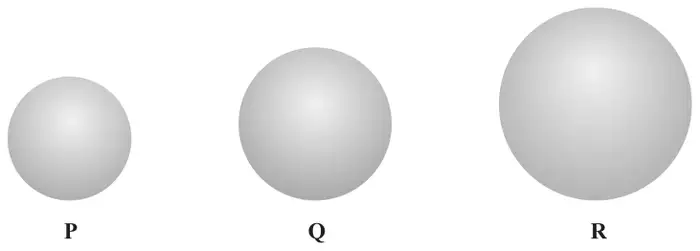
The volume of sphere Q is 50% more than the volume of sphere P. The volume of sphere R is 50% more than the volume of sphere Q.
Find the volume of sphere P as a fraction of the volume of sphere R. (3)
Mark scheme
Answer
Mark
Mark scheme
\(\dfrac{4}{9}\)
P1
for process to find link between volume of Q and volume of P or between volume of R and volume of Q, eg ratio 1.5 : 1 or Q = 1.5P or P = \(\dfrac{2}{3}\)Q or two values in the ratio 1 : 1.5 such as 100 and 150
P1
for process to find link between volume of R and volume of P eg \(1.5^2 : 1\) or two values in the ratio 1 : 2.25 such as 100 and 225
A1
for \(\dfrac{4}{9}\) oe fraction eg \(\dfrac{100}{225}\)
Additional guidance
\(1.5^2\ \left(= \dfrac{9}{4}\right)\) is enough for this mark, award P1P1
He gives 35 of the counters to Sameena 50 of the counters to Henry 75 of the counters to Lucas
What fraction of the 400 counters is left in Bill’s bag? Give your fraction in its simplest form. (3)
Mark scheme
Answer
Mark
Mark scheme
\(\dfrac{3}{5}\)
M1
for a start in the method eg \(35 + 50 + 75\ (= 160)\) or \(400 - 35 - 50 - 75\ (= 240)\) or \(\dfrac{160}{400}\) oe
M1
for eg \(\dfrac{400 - \text{``}160\text{''}}{400}\) or \(\dfrac{2}{5}\) or \(1 - \dfrac{160}{400}\) or for an unsimplified answer eg \(\dfrac{\text{``}240\text{''}}{400}\) oe or as 60% oe
converts fractions to a common equivalent form, at least two conversions correct eg fractions with a denominator of 12, decimals or percentages, or any 4 fractions in correct order
A1
cao
Additional guidance
For the M1: 0.25, 0.33(...), 0.5, 0.58(...), 0.75
For the A1: Accept list in reverse order for this mark Accept expressed in equivalent decimals or percentages or any other appropriate from or mixed forms
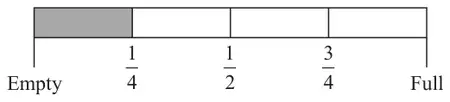
The fuel tank holds 52 litres of fuel when the tank is full.
The tank is \(\dfrac{1}{4}\) full of fuel.
Work out how many more litres of fuel are needed to fill the tank. (3)
Mark scheme
Answer
Mark
Mark scheme
39
M1
for finding one quarter of 52, eg \(52 \div 4\ (= 13)\) OR for finding the fraction to be filled, eg \(1 - \dfrac{1}{4}\ \left(= \dfrac{3}{4}\right)\) oe
M1
for a complete method eg \(52 - \text{``}13\text{''}\) or \(\text{``}13\text{''} \times 3\) OR for \(\text{``}\dfrac{3}{4}\text{''} \times 52\)
A1
cao
Additional guidance
For the first M1: Accept equivalent decimals or percentages
One of these fractions is not equivalent to \(\dfrac{3}{4}\)
(a) Which fraction? (1)
(b) Work out \(\dfrac{1}{12} + \dfrac{5}{6}\) (2)
Mark scheme (a)
Answer
Mark
Mark scheme
\(\dfrac{10}{16}\)
B1
cao
Mark scheme (b)
Answer
Mark
Mark scheme
\(\dfrac{11}{12}\)
M1
for \(\dfrac{10}{12}\) OR for using a suitable common denominator other than 12 with at least one of the two fractions correct, eg \(\dfrac{2}{24} + \dfrac{20}{24}\)
6 Sue has 2 cats. Each cat eats \(\dfrac{1}{4}\) of a tin of cat food each day.
Sue buys 8 tins of cat food.
Has Sue bought enough cat food to feed her 2 cats for 14 days? You must show how you get your answer. (3)
Mark scheme
Answer
Mark
Mark scheme
Yes (supported)
P1
starts process to find the number of tins or meals needed, eg \(2 \times \dfrac{1}{4}\ \left(= \dfrac{2}{4} = \dfrac{1}{2}\right)\) or \(14 \times \dfrac{1}{4}\) (\(= \dfrac{14}{4}\) oe) or \(2 \times 14\ (= 28)\) or \(8 \div 2\) or to find the number of meals from 8 tins, eg \(8 \div \dfrac{1}{4}\ (= 32)\)
P1
a complete process to find the number of tins needed, eg \(14 \times \dfrac{2}{4}\ (= 7)\) or \(8 \div 2\) and \(\text{``}\dfrac{14}{4}\text{''}\) OR to find the numbers of meals \(8 \div \dfrac{1}{4}\ (= 32)\) and \(2 \times 14\ (= 28)\) or \(8 \div \dfrac{2}{4}\ (= 16)\)
C1
‘Yes’ from a comparison of correct values, eg 7 (and 8) or 32 and 28 or 16 (and 14) or \(\dfrac{14}{4}\) and 4
Additional guidance
Numbers may be expressed in decimal form
Correct working needs to be accompanied by a statement confirming enough food has been bought.
(a) Work out \(2\dfrac{1}{7} + 1\dfrac{1}{4}\) (2)
(b) Work out \(1\dfrac{1}{5} \div \dfrac{3}{4}\) Give your answer as a mixed number in its simplest form. (2)
Mark scheme (a)
Answer
Mark
Mark scheme
\(\dfrac{95}{28}\)
M1
for a method to add using common denominators with at least one fraction correct (matching numerator with common denominator) eg \(\dfrac{60}{28} + \dfrac{35}{28}\) or \((2)\dfrac{4}{28} + (1)\dfrac{7}{28}\)
A1
\(\dfrac{95}{28}\) oe eg \(3\dfrac{11}{28}\)
Additional guidance
Use of decimals gets no credit unless it leads to a correct fraction
Mark scheme (b)
Answer
Mark
Mark scheme
\(1\dfrac{3}{5}\)
M1
for \(\dfrac{6}{5} \times \dfrac{4}{3}\) or \(\dfrac{24}{20} \div \dfrac{15}{20}\) or \(\dfrac{8}{5}\) oe eg \(1\dfrac{9}{15}\)
A1
cao
Additional guidance
Use of decimals gets no credit unless it leads to a correct fraction
\(\dfrac{1}{4}\) of the chocolates contain nuts. The rest of the chocolates do not contain nuts.
Write down the ratio of the number of chocolates that contain nuts to the number of chocolates that do not contain nuts. Give your answer in the form \(1 : n\) (2)
Mark scheme
Answer
Mark
Mark scheme
1 : 3
M1
for \(\dfrac{1}{4} : \dfrac{3}{4}\) oe OR for any correct un-simplified ratio, eg 25 : 75
A1
cao SC: B1 for an answer of 3 : 1 or \(1 : \dfrac{1}{3}\) if M0 scored
Additional guidance
Ignore ‘units’ such as 1 nuts : 3 no nuts \(1 : 3n\) gets M1A0
amount of money Alan gets : amount of money Chan gets
Give your answer in the form \(a : b\) where \(a\) and \(b\) are whole numbers. (3)
Mark scheme (a)
Answer
Mark
Mark scheme
10
M1
for a start of method to find Bispah’s share, eg \(2.50 \times 8\ (= 20)\) or \(\dfrac{1}{2} \div \dfrac{1}{8}\ (= 4)\)
A1
cao
Additional guidance
Accept 10.00
Mark scheme (b)
Answer
Mark
Mark scheme
1 : 3
P1
for a process to find Chan’s share, eg \(\text{``}20\text{''} - 2.5 -\) [Bispah’s money] (=7.5) or \(1 - \dfrac{1}{8} - \dfrac{1}{2} \left(= \dfrac{3}{8}\right)\)
P1
for a correct ratio eg 2.5 : “7.5” or \(\dfrac{1}{8} : \text{``}\dfrac{3}{8}\text{''}\) or 3 : 1 oe
A1
for 1 : 3 oe eg 5 : 15
Additional guidance
Accept working in pence, or in £ given as a decimal oe NB: award this mark if the working is seen in part (a)
Accept 3:1 (correct answer in reverse order) which can also be an equivalent ratio to 3:1
Award full marks for 1 : 3 or an equivalent ratio. If an equivalent ratio to 1:3 is shown and then simplified incorrectly award full marks.
(a) Work out \(2\dfrac{1}{7} + 1\dfrac{1}{4}\) (2)
(b) Work out \(1\dfrac{1}{5} \div \dfrac{3}{4}\) Give your answer as a mixed number in its simplest form. (2)
Mark scheme (a)
Answer
Mark
Mark scheme
\(\dfrac{95}{28}\)
M1
for a method to add using common denominators with at least one fraction correct (matching numerator with common denominator) eg \(\dfrac{60}{28} + \dfrac{35}{28}\) or \((2)\dfrac{4}{28} + (1)\dfrac{7}{28}\)
A1
\(\dfrac{95}{28}\) oe eg \(3\dfrac{11}{28}\)
Additional guidance
Use of decimals gets no credit unless it leads to a correct fraction
Mark scheme (b)
Answer
Mark
Mark scheme
\(1\dfrac{3}{5}\)
M1
for \(\dfrac{6}{5} \times \dfrac{4}{3}\) or \(\dfrac{24}{20} \div \dfrac{15}{20}\) or \(\dfrac{8}{5}\) oe eg \(1\dfrac{9}{15}\)
A1
cao
Additional guidance
Use of decimals gets no credit unless it leads to a correct fraction
Work out which of the fractions is closer to 1 You must show all your working. (3)
Mark scheme
Answer
Mark
Notes
\(\dfrac{5}{7}\) supported
P1
for \(\dfrac{7}{5} = 1.4\) or \(\dfrac{5}{7} = 0.7..\) or compares \(\dfrac{1}{7}\) to \(\dfrac{1}{5}\) or compare \(\dfrac{5}{7}\) to 1 eg \(1 - \dfrac{5}{7}\ \left(= \dfrac{2}{7}\right)\) or compare \(\dfrac{7}{5}\) to 1 eg \(\dfrac{7}{5} = 1\dfrac{2}{5}\) or eg \(\dfrac{49}{35}\) or \(\dfrac{14}{35}\) or \(\dfrac{25}{35}\) oe
P1
for \(\dfrac{7}{5} = 1.4\) and \(\dfrac{5}{7} = 0.7..\) or compares \(\dfrac{5}{7}\) to 1 eg \(1 - \dfrac{5}{7}\ \left(= \dfrac{2}{7}\right)\) and \(\dfrac{7}{5}\) to 1 eg \(\dfrac{7}{5} = 1\dfrac{2}{5}\) or two correct fractions with common denominator eg \(\dfrac{49}{35}\) and \(\dfrac{25}{35}\)
14 White shapes and black shapes are used in a game.
Some of the shapes are circles. All the other shapes are squares.
The ratio of the number of white shapes to the number of black shapes is 3 : 7 The ratio of the number of white circles to the number of white squares is 4 : 5 The ratio of the number of black circles to the number of black squares is 2 : 5
Work out what fraction of all the shapes are circles. (4)
Mark scheme
Answer
Mark
Notes
\(\dfrac{1}{3}\)
P1
process to solve the problem e.g. \(\dfrac{3}{10} \times \dfrac{4}{9} \left(= \dfrac{12}{90} = \dfrac{2}{15}\right)\) OR finds the number of white circles for their chosen number OR for 9 : 21 (or a multiple of 9 : 21)
P1
second step of the process e.g. \(\dfrac{7}{10} \times \dfrac{2}{7} \left(= \dfrac{14}{70} = \dfrac{2}{10} = \dfrac{1}{5}\right)\) OR finds the number of black circles for their chosen number OR for a multiple of 2 : 5 where the ratio parts sum to “21”
P1
for complete process e.g. \(\text{``}\tfrac{2}{15}\text{''} + \text{``}\tfrac{1}{5}\text{''} \left(= \dfrac{4}{30} + \dfrac{6}{30}\right)\) OR finds the total number of circles for their chosen number OR for 3 ratios that could be used to solve the problem eg 9 : 21 with 4 : 5 with 6 : 15
9 Sean works for a company. His normal rate of pay is £12 per hour.
When Sean works more than 8 hours a day, he is paid overtime for each hour he works more than 8 hours.
Sean’s rate of overtime pay per hour is \(1\dfrac{1}{4}\) times his normal rate of pay per hour.
On Monday Sean worked for 10 hours.
Work out the total amount of money Sean earned on Monday. (4)
Mark scheme
Answer
Mark
Notes
126
P1
for working with time, eg \(10 - 8 (=2)\) or \(12 \times 8 (=96)\) or \(12 \times 10 (=120)\)
P1
for working with overtime, eg \(12 \div 4 (=3)\) or \(1.25 \times \text{``}2\text{''} (=2.5)\) or \(0.25 \times \text{``}2\text{''} (=0.5)\) or \(1.25 \times 12 (=15)\)
P1
for a complete process, eg \((10 - 8) \times\) overtime rate \(+\ 12 \times 8\) or \(12 \times 10 + \text{``}0.5\text{''} \times 12\)
\(\dfrac{1}{3}\) of the coins are £1 coins. 124 of the coins are 50p coins. The rest of the coins are 20p coins.
Work out the total value of the 495 coins. (4)
Mark scheme
Answer
Mark
Notes
268.20
P1
for a process to work out the value of the £1 coins, eg. \(495 \div 3\ (= 165)\) or \(495 \times 0.33\ldots\) or of the 50p coins, eg. \(124 \div 2\ (= 62)\)
P1
for process to find the number of 20p coins, eg. \((495 - 124 - (\text{``}165\text{''})\ (= 206)\)
P1
for complete process to find total value using consistent units., eg. \((\text{``}165\text{''}) + (124 \div 2) + (\text{``}206\text{''} \times 0.2)\) or \(165 + 62 + 41.2\)
converts fractions to a common form, e.g. fractions with a denominator of 30, decimals or percentages, at least two conversions correct or any 3 fractions in correct order
*24 Two shops, Mega Bathrooms and Bathroom Mart, each have a sale.
Mega Bathrooms
Bathroom Mart
Sale
60% off normal price then 15% off
Sale
\(\frac{2}{3}\) off normal price
Sally wants to buy some bathroom units. The units have a normal price of £1500
Sally wants to buy the units as cheaply as possible.
Which shop should she buy the units from? You must show all your working. (4)
Mark scheme
Answer
Mark
Notes
Bathroom Mart and correct figures
4
M1 for \(\frac{1}{3} \times 1500\) (= 500) or \(\frac{2}{3} \times 1500\) (= 1000) M2 for a correct method to reduce 1500 by 60% and then by a further 15% eg \(1500 \times \text{``}0.4\text{''} \times 0.85\) (= 510) oe (M1 for method to find 60% or 40% of 1500 e.g. \(\frac{60}{100} \times 1500\) (= 900)) C1 for 510 and 500 with a correct conclusion.
M1 for conversion to decimals with one error or conversion to percentages with one error or conversion to fractions with a common denominator with one error or correct order with one error or correct in reverse order A1 for correct order in any format
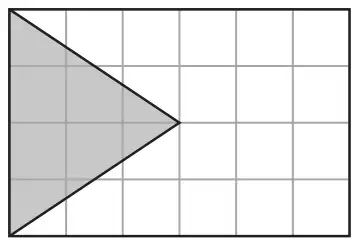
12 The diagram shows a flag drawn on a grid of squares.
(a) Colin says that \(\frac{1}{4}\) of the flag is shaded. Colin is right. Explain why. (2)
(b) What percentage of the flag is not shaded? (1)
Mark scheme (a)
Answer
Mark
Notes
Correct explanation
2
M1 for working out area of triangle (= 6) and area of rectangle (= 24) or for dividing rectangle into eighths or other comparable areas A1 for explaining that that \(24 \div 6\) is 4 or \(\frac{2}{8} = \frac{1}{4}\) or that \(\frac{1}{2} \times \frac{1}{2} = \frac{1}{4}\) from symmetry of shape
*8 Two shops, Mega Bathrooms and Bathroom Mart, each have a sale.
Mega Bathrooms
Bathroom Mart
Sale
Sale
60% off normal price then 15% off
\(\dfrac{2}{3}\) off normal price
Sally wants to buy some bathroom units. The units have a normal price of £1500
Sally wants to buy the units as cheaply as possible.
Which shop should she buy the units from? You must show all your working. (4)
Mark scheme
Answer
Mark
Notes
Bathroom Mart and correct figures
4
M1 for \(\dfrac{1}{3} \times 1500\) (= 500) or \(\dfrac{2}{3} \times 1500\) (= 1000) M2 for a correct method to reduce 1500 by 60% and then by a further 15% eg \(1500 \times \text{``}0.4\text{''} \times \text{``}0.85\text{''}\) (= 510) oe (M1 for method to find 60% or 40% of 1500 e.g. \(\dfrac{60}{100} \times 1500\) (= 900)) C1 for 510 and 500 with a correct conclusion.
(a) Work out \(1\dfrac{1}{5} \times 2\dfrac{1}{3}\) Give your answer as a mixed number in its simplest form. (3)
(b) Work out \(2\dfrac{7}{15} - 1\dfrac{2}{3}\) (3)
Mark scheme (a)
Answer
Mark
Notes
\(2\dfrac{4}{5}\)
3
M1 for writing as improper fractions eg \(\dfrac{6}{5}\) or \(\dfrac{7}{3}\) M1 (dep) for multiplying improper fractions eg \(\dfrac{6 \times 7}{5 \times 3}\) or \(\dfrac{14}{5}\) oe A1 cao
Mark scheme (b)
Answer
Mark
Notes
\(\dfrac{4}{5}\)
3
M1 for finding two correct fractions with a common denominator eg \(\dfrac{7}{15} - \dfrac{10}{15}\) or \(\dfrac{21 - 30}{45}\) M1 (dep) for complete and correct method eg \(1 - \dfrac{3}{15}\) or \(\dfrac{37}{15} - \dfrac{25}{15}\) or \(\dfrac{111 - 75}{45}\) oe A1 for \(\dfrac{4}{5}\) oe
M1 for method to calculate the time Celina sings M1 for method to calculate the time Zoe sings M1 (dep on at least M1) for finding the difference between two times A1 cao
Or
M1 for a conversion to all decimals, fractions or percentages M1 for finding their difference in their chosen system M1 (dep on at least M1) for using their proportional difference multiplied by 80 A1 cao
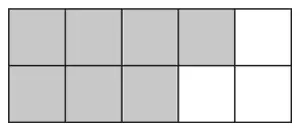
(a) Write down the fraction of this shape that is shaded. (1)
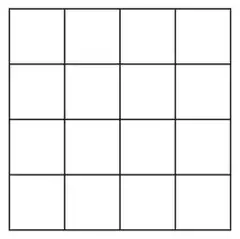
(b) Shade 40% of this shape. (1)
(c) Work out 0.75 of 200 (2)
Michael says \(\dfrac{5}{7} - \dfrac{3}{5} = \dfrac{2}{2}\)
Michael is wrong.
(*d) Explain why. (2)
Mark scheme (a)
Answer
Mark
Notes
\(\dfrac{3}{7}\)
1
B1 cao
Mark scheme (b)
Answer
Mark
Notes
2 squares shaded
1
B1 cao
Mark scheme (c)
Answer
Mark
Notes
150
2
M1 \(200 \div 4 \times 3\) or \(0.75 \times 200\) oe A1 cao
Mark scheme (d)
Answer
Mark
Notes
Explanation
2
C2 for a full explanation, eg answer given as \(\tfrac{4}{35}\) or “He subtracted \(\tfrac{3}{5}\) from a fraction less than 1 so the answer must be less than 1” (C1 for a partial explanation, eg use of a suitable common denominator or “He should have used a common denominator”)
\(\dfrac{1}{10}\) of the balloons were yellow. \(\dfrac{3}{5}\) of the balloons were red. The rest of the balloons were blue.
How many of the balloons were blue? (3)
Mark scheme
Answer
Mark
Notes
18
3
M1 for \(\tfrac{1}{10} \times 60\) (= 6) or \(\tfrac{1}{10} + \tfrac{3}{5}\) or \(\text{``}\tfrac{7}{10}\text{''}\) oe M1 for \(\tfrac{3}{5} \times 60\) (= 36) or \(1 - \text{``}\tfrac{7}{10}\text{''}\) (= \(\tfrac{3}{10}\)) or \(\text{``}\tfrac{7}{10}\text{''} \times 60\) (= 42) A1 cao
21 Suha has a full 600 ml bottle of wallpaper remover. She is going to mix some of the wallpaper remover with water.
Here is the information on the label of the bottle.
Wallpaper remover 600 ml
Mix \(\dfrac{1}{4}\) of the wallpaper remover with 4500 ml of water
Suha is going to use 750 ml of water.
How many millilitres of wallpaper remover should Suha use? You must show your working. (4)
Mark scheme
Answer
Mark
Notes
25
4
M1 for \(600 \div 4\) (= 150) M1 for \(4500 \div \text{``}150\text{''}\) (= 30) M1 for \(750 \div \text{``}30\text{''}\) A1 for 25 with supporting working
OR
M1 for \(4500 \div 750\) (= 6) M1 for \(600 \div 4\) (= 150) or \(600 \div \text{``}6\text{''}\) (= 100) M1 for \(\text{``}150\text{''} \div \text{``}6\text{''}\) or \(\text{``}100\text{''} \div 4\) A1 for 25 with supporting working
OR
M1 for \(4500 \div 750\) (= 6) or \(750 \div 4500\) (= \(\tfrac{1}{6}\)) M1 for \(\text{``}\tfrac{1}{6}\text{''} \times \tfrac{1}{4} = \tfrac{1}{24}\) M1 for \(\text{``}\tfrac{1}{24}\text{''} \times 600\) A1 for 25 with supporting working
19 There are 240 counters in a bag. The counters are green or yellow or blue.
\(\dfrac{3}{5}\) of the counters are green. \(\dfrac{1}{4}\) of the counters are yellow.
Work out the number of blue counters in the bag. (4)
Mark scheme
Answer
Mark
Notes
36
4
M1 for \(\tfrac{3}{5} \times 240\) (= 144) M1 for \(\tfrac{1}{4} \times 240\) (= 60) M1 (dep on M2) for \(240 - (\text{‘}144\text{’} + \text{‘}60\text{’})\) A1 cao
OR
M1 for \(\tfrac{3}{5} + \tfrac{1}{4}\) or \(\tfrac{17}{20}\) oe M1 for \(1 - \text{‘}\tfrac{17}{20}\text{’}\) (= \(\tfrac{3}{20}\)) or \(\text{‘}\tfrac{17}{20}\text{’} \times 240\) (= 204) M1 (dep on M2) for \(\text{‘}\tfrac{3}{20}\text{’} \times 240\) or \(240 - \text{‘}204\text{’}\) A1 cao
Which of these fractions has a value closer to \(\dfrac{3}{4}\)? You must show clearly how you get your answer. (3)
Mark scheme
Answer
Mark
Notes
\(\dfrac{2}{3}\)
3
M1 for attempting to write at least two fractions expressed with a common denominator with at least one of the two fractions correct A1 for three correct fractions with suitable common denominator C1 (dep M1) for correct conclusion from comparison of their three OR M1 for writing at least two of the fractions as decimals ie \(\dfrac{2}{3}\) as 0.66(…) or 66(.6…)%, \(\dfrac{7}{8}\) as 0.87(5) or 87.(5)%, \(\dfrac{3}{4}\) as 0.75 or 75% A1 for three correct decimals or percentages C1 (dep M1) for correct conclusion from comparison of their three OR M1 for finding two fractions of the same number e.g. \(\dfrac{2}{3}\) of 48 or \(\dfrac{7}{8}\) of 48 (may be implied by shading a fraction of a rectangle divided into e.g. 48 parts) A1 for three correct values or three correct diagrams with shading C1 (dep M1) for correct conclusion from comparison of their three OR M1 for attempting to find the difference between \(\dfrac{3}{4}\) and \(\dfrac{2}{3}\) and between \(\dfrac{3}{4}\) and \(\dfrac{7}{8}\) at least one pair of fractions expressed with a suitable common denominator and at least one of the two fractions correct A1 for \(\frac{1}{12}\) and \(\frac{1}{8}\) or 0.08(333...) and 0.12(5) C1 (dep M1) for correct conclusion from comparison of the 2 differences.
17 Write these numbers in order of size. Start with the smallest number.
0.6 \(\dfrac{2}{3}\) 65% 0.606
(2)
Mark scheme
Answer
Mark
Notes
0.6, 0.606, 65%, \(\dfrac{2}{3}\)
2
M1 for attempt to convert all to the same form for comparison with at least one correct conversion (Accept at least 0.66, 0.67, 66%, 67% or better for \(\frac{2}{3}\)) A1 for a correctly ordered list (in any form) SC B1 for correct numbers in reverse order if no method seen.
(e) Add brackets ( ) to make this statement correct.
\(12 - 2 \times 3 + 1 = 4\)
(1)
(f) Why does \(\dfrac{1}{4} = \dfrac{2}{8}\)? (1)
Mark scheme (a)
Answer
Mark
Notes
10
1
B1 cao
Mark scheme (b)
Answer
Mark
Notes
16
1
B1 cao
Mark scheme (c)
Answer
Mark
Notes
\(-11\)
1
B1 cao
Mark scheme (d)
Answer
Mark
Notes
17
1
B1 cao
Mark scheme (e)
Answer
Mark
Notes
\(12 - 2 \times (3 + 1)\)
1
B1 cao
Mark scheme (f)
Answer
Mark
Notes
Explanation/ reason
1
B1 Correct explanation of equivalence eg: Indication that the same operation needs to be applied to both numerator and denominator. Correct shading on diagrams to demonstrate 1 quarter and 2 eighths Conversion of both fractions to a common format 2 is \(\frac{1}{4}\) of 8 oe
Emma and Dave share the rest of the money in the ratio 3 : 2
What is Dave’s share of the money? (4)
Mark scheme
Answer
Mark
Notes
28% or \(\dfrac{14}{50}\)
4
M1 for 100 − 30 (=70) or \(1 - \dfrac{3}{10}\) (\(= \dfrac{7}{10}\)) M1 for ‘+70’ ÷ (3 + 2) (=14) or ‘\(\dfrac{7}{10}\)’ ÷ (3 + 2) (\(= \dfrac{7}{50}\)) M1 for ‘14’ × 2 or \(\dfrac{7}{50} \times 2\) A1 for 28% or \(\dfrac{14}{50}\) oe OR M1 for a correct method to find (100−30)% of any actual sum of money, eg 0.7×500 M1 for ‘350’ ÷ (3 + 2) (=70) M1 for ‘70’ × 2 (=140) A1 for 28% or \(\dfrac{14}{50}\) oe OR M1 for starting with a two numbers in ratio 3:2, eg 21 and 14 M1 for equating sum of their numbers to 100 – 30 (=70), eg ‘21’ + ‘14’ (=35) M1 for scaling sum of their numbers to 100%, eg ‘35’ ÷ 70 × 100 (=50) A1 for 28% or \(\dfrac{14}{50}\) oe [SC award B3 for oe answers expressed in an incorrect form eg \(\dfrac{2.8}{10}\)]
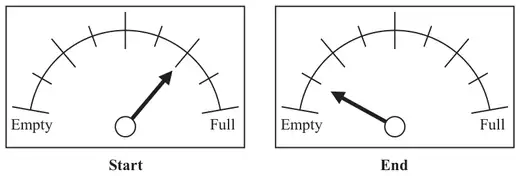
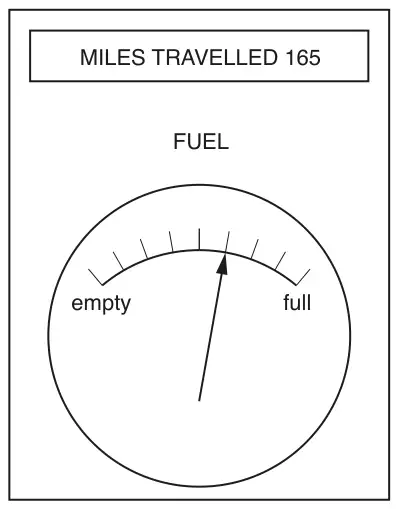
12 The diagram shows a car fuel gauge at the start of a journey and at the end of the journey.
There are 80 litres of fuel in the fuel tank when it is full.
(a) Work out how many litres of fuel the car used on this journey. (3)
On a different journey, the car went 180 kilometres. The car went 15 kilometres for each litre of fuel used.
(b) How many litres of fuel did the car use? (2)
Mark scheme (a)
Answer
Mark
Notes
50
3
M1 for \(\dfrac{6}{8} \times 80\) oe (= 60) or \(\dfrac{1}{8} \times 80\) oe (= 10) (may be seen on gauges eg. 10 by \(\frac{1}{8}\) position or 60 by \(\frac{6}{8}\) position on either gauge) M1 (dep) for a complete correct method eg. “60” – “10” or 5 × “10” A1 for 50 (accept answers in the range 49 - 51) or M1 for \(\dfrac{6}{8} - \dfrac{1}{8}\) (\(= \dfrac{5}{8}\)) M1 (dep) for “\(\dfrac{5}{8}\)” × 80 A1 for 50 (accept answers in the range 49 - 51)
Emma and Dave share the rest of the money in the ratio 3 : 2
What is Dave’s share of the money? (4)
Mark scheme
Answer
Mark
Notes
28% or \(\dfrac{14}{50}\)
4
M1 for \(100 - 30\) (= 70) or \(1 - \dfrac{3}{10}\) \(\left(= \dfrac{7}{10}\right)\) M1 for “70” \(\div (3 + 2)\) (= 14) or \(\text{``}\dfrac{7}{10}\text{''} \div (3 + 2)\) \(\left(= \dfrac{7}{50}\right)\) M1 for “14” × 2 or \(\dfrac{7}{50} \times 2\) A1 for 28% or \(\dfrac{14}{50}\) oe
OR
M1 for a correct method to find (100-30)% of any actual sum of money M1 for “350” \(\div (3 + 2)\) (= 70) M1 for “70” × 2 A1 for 28% or \(\dfrac{14}{50}\) oe
OR
M1 for starting with two numbers in ratio 3:2, eg 21 and 14 M1 for equating sum of their numbers to 100 – 30 (=70%), eg ‘21’ + ‘14’ (=35) M1 for scaling sum of their numbers to 100%, eg ‘35’÷70×100 (=50) A1 for 28% or \(\dfrac{14}{50}\) oe
SC: award B3 for oe answers expressed in an incorrect form eg \(\dfrac{2.8}{10}\)
9 The table shows information about two workers on one day.
Total working time (hours)
Working time spent online (minutes)
Zeke
8
200
Margot
4
110
(a) Margot started work at 10:30am
What time did she finish? [1 mark]
(b) Zeke says he spent more than one quarter of his total working time online.
Is he correct? [3 marks]
Tick a box.
Yes
No
Show working to support your answer.
Mark scheme (a)
Answer
Mark
Comments
2:30pm or 14:30
B1
Additional guidance
Condone 14:30 pm or half past two in the afternoon
B1
2:30 am or 2:30 or half past two
B0
Mark scheme (b)
Answer
Mark
Comments
Alternative method 1
\(8 \div 4\) or 2
M1
oe may be seen by the table
their \(2 \times 60\) or 120
M1dep
oe may be seen by the table
120 and Yes
A1
oe eg Yes and 80 minutes more
Alternative method 2
\(8 \times 60\) or 480
M1
oe may be seen by the table
\(\dfrac{1}{4} \times\) their 480 or 120
M1dep
oe may be seen by the table
120 and Yes
A1
oe eg Yes and 80 minutes more
Alternative method 3
\(8 \times 60\) or 480
M1
oe may be seen by the table
\(\dfrac{200}{8 \times 60}\) or \(\dfrac{200}{480}\)
M1dep
oe fraction, decimal or percentage eg \(0.41\dot{6}\)
\(\dfrac{5}{12}\) and \(\dfrac{3}{12}\) and Yes
A1
oe fractions with common denominator or decimals or percentages eg \(0.41\dot{6}\) and 0.25
Alternative method 4
\(8 \times 60\) or 480
M1
oe may be seen by the table
\(200 \times 4\) or 800
M1
oe may be seen by the table
480 and 800 and Yes
A1
oe
Alternative method 5
\(8 \div 4\) or 2
M1
oe may be seen by the table
\(200 \div 60\) or \(3\dfrac{1}{3}\) or 3.(…)
M1
oe eg 3 hours 20 minutes may be seen by the table
2 and 3.(…) and Yes or 2 and \(3\dfrac{1}{3}\) and Yes
A1
oe eg Yes and 2 hrs and 3 hrs 20 mins eg Yes and 80 minutes more
Additional guidance
Lists: 1h \(=\) 60, 2h \(=\) 120, 3h \(=\) 180, 4h \(=\) 240 … up to 8h \(=\) 480 would gain M1 from alts 2, 3, or 4 for converting 8h to 480 minutes 2h \(=\) 120 needs to be chosen from the list or at the end of the list to gain M2 from alt 1
Accept any unambiguous indication for ticking a box
Ignore any reference to Margot
Accept \(0.41\dot{6}\) and \(41.\dot{6}\) rounded or truncated to at least 2 sf
Alts 4 and 5 the second method mark is independent
(a) Write \(\;\)2 weeks\(\;\) as a fraction of \(\;\)8 days.
Give your answer in its simplest form. [1 mark]
(b) Write \(\quad\) 56 centimetres : 2.73 metres \(\quad\) as a ratio in the form \(\;1 : n\) [1 mark]
(c) A : B \(= \dfrac{1}{5} : \dfrac{7}{10}\)
Write A as a fraction of B. [2 marks]
Mark scheme (a)
Answer
Mark
Comments
\(\dfrac{7}{4}\)
B1
Additional guidance
Do not accept \(1\dfrac{3}{4}\) or 1.75
B0
Mark scheme (b)
Answer
Mark
Comments
4.875 or \(\dfrac{39}{8}\) or \(4\dfrac{7}{8}\)
B1
oe decimal, fraction or mixed number eg \(\dfrac{273}{56}\) accept 4.88 or 4.9 if 4.875 seen in working
Additional guidance
\(\dfrac{2.73}{0.56}\)
B0
Units included
B0
Mark scheme (c)
Answer
Mark
Comments
\(\left(\dfrac{1}{5} =\right) \dfrac{2}{10}\) or \(\left(\dfrac{7}{10} =\right) \dfrac{3.5}{5}\) or \(\dfrac{\;\dfrac{1}{5}\;}{\dfrac{7}{10}}\) or \(\dfrac{1}{5} \times \dfrac{10}{7}\) or \(\dfrac{0.2}{0.7}\) or 2 : 7
M1
oe both fractions with a common denominator oe ratio
24 Work out \(\quad 1\dfrac{1}{5} - \dfrac{3}{10}\)
Give your answer as a fraction. [2 marks]
Mark scheme
Answer
Mark
Comments
Correct conversion of or correct method to convert \(1\dfrac{1}{5}\) to \(\dfrac{12}{10}\) or \(1\dfrac{2}{10}\) with no incorrect conversion of \(\dfrac{3}{10}\) or correct method for or correct result of conversion of both fractions to a common denominator \(\ne 10\) or \(1 - \dfrac{1}{10}\) or \(1.2 - 0.3\) or 0.9
M1
\(\dfrac{9}{10}\)
A1
oe fraction eg \(\dfrac{45}{50}\)
Additional guidance
Ignore attempt to simplify if correct fraction seen
6 Work out \(\quad 1\dfrac{1}{5} - \dfrac{3}{10}\)
Give your answer as a fraction. [2 marks]
Mark scheme
Answer
Mark
Comments
Correct conversion of or correct method to convert \(1\dfrac{1}{5}\) to \(\dfrac{12}{10}\) or \(1\dfrac{2}{10}\) with no incorrect conversion of \(\dfrac{3}{10}\) or correct method for or correct result of conversion of both fractions to a common denominator \(\ne 10\) or \(1 - \dfrac{1}{10}\) or \(1.2 - 0.3\) or 0.9
M1
\(\dfrac{9}{10}\)
A1
oe fraction eg \(\dfrac{45}{50}\)
Additional guidance
Ignore incorrect simplifying if correct fraction seen
\(1\dfrac{1}{5}\) converted to \(1\dfrac{2}{10}\) and \(\dfrac{3}{10}\) converted to \(\dfrac{6}{10}\)
Accept correct conversions to equivalent fractions or decimals eg 0.25, \(\dfrac{4}{8}\), \(\dfrac{7}{8}\), \(3\dfrac{1}{10}\)
B2
Do not accept any incorrect working or incorrect conversions for B2 eg1 \(\dfrac{1}{4}\), \(\dfrac{1}{2}\), \(\dfrac{7}{8}\), \(3\dfrac{1}{10}\) with 3.01 seen in working eg2 \(\dfrac{1}{4}\), \(\dfrac{1}{2}\), \(\dfrac{7}{8}\), 3.01
B1 B1
Condone any incorrect working or incorrect conversions for B1 eg \(\dfrac{1}{4}\), 0.3, \(\dfrac{1}{2}\), \(\dfrac{7}{8}\)
B1
Condone correct percentage value without percentage sign for B2 eg \(\dfrac{1}{2} = 50\) is condoned as not incorrect working
21 People in a stadium are in the North Stand, East Stand, South Stand or West Stand.
Of the people in the stadium,
\(\dfrac{1}{4}\) are in the North Stand
\(\dfrac{3}{10}\) are in the East Stand
number in South Stand : number in West Stand \(= 2 : 7\)
There are 4480 people in the West Stand.
How many people are in the stadium? [4 marks]
Mark scheme
Answer
Mark
Comments
Alternative method 1: uses total and proportion in S with W
\(4480 \times \dfrac{9}{7}\) or 5760
M1
oe total in S with W eg \(640 \times 9\)
\(1 - \dfrac{1}{4} - \dfrac{3}{10}\) or \(\dfrac{9}{20}\)
M1
oe proportion in S with W eg 0.45 or 45%
their 5760 \(\div\) their \(\dfrac{9}{20}\)
M1dep
oe full method dep on M2
12 800
A1
Alternative method 2: uses total in S with W and total in N with E
\(4480 \times \dfrac{9}{7}\) or 5760
M1
oe total in S with W eg \(640 \times 9\)
\(4480 \times \dfrac{11}{7}\) or 7040
M1
oe total in N with E eg \(640 \times 11\)
their 5760 \(+\) their 7040
M1dep
oe full method eg \(640 \times 20\) dep on M2
12 800
A1
Alternative method 3: sets up an equation
\(4480 \times \dfrac{9}{7}\) or 5760
M1
oe total in S with W eg \(640 \times 9\)
\(\dfrac{1}{4}x + \dfrac{3}{10}x +\) their \(5760 = x\)
M1dep
oe equation in any variable eg \(10x + 12x + 230\,400 = 40x\)
their 5760 \(\div \left(1 - \dfrac{1}{4} - \dfrac{3}{10}\right)\)
M1dep
oe full method eg \(230\,400 \div 18\)
12 800
A1
Alternative method 4: works out proportion in W or proportion in S
\(1 - \dfrac{1}{4} - \dfrac{3}{10}\) or \(\dfrac{9}{20}\)
M1
oe proportion in S with W eg 0.45 or 45%
\(\dfrac{7}{9} \times\) their \(\dfrac{9}{20}\) or \(\dfrac{7}{20}\) or \(\dfrac{2}{9} \times\) their \(\dfrac{9}{20}\) or \(\dfrac{2}{20}\)
M1dep
oe proportion in W eg 0.35 or 35% eg \(\dfrac{7}{7 + 2} \times\) their \(\dfrac{9}{20}\) or oe proportion in S eg 0.1 or 10% eg \(\dfrac{2}{7 + 2} \times\) their \(\dfrac{9}{20}\)
\(4480 \div\) their \(\dfrac{7}{20}\) or \(4480 \times \dfrac{2}{7} \div\) their \(\dfrac{2}{20}\)
M1dep
oe full method eg \(640 \times 20\)
12 800
A1
Additional guidance
Up to M2 may be awarded for correct work with no answer or incorrect answer, even if this is seen amongst multiple attempts
Proportions can be percentages but in calculations values must be used eg Alt 1 \(5760 \div 45\%\) is awarded M2 but cannot be awarded the 3rd M1 unless \(\dfrac{9}{20}\) or 0.45 is subsequently used correctly
oe fraction with \(A\) on numerator and denominator eg \(\left(\dfrac{C}{B} =\right)\) \(\dfrac{2.5A}{1.75A}\) or \(\dfrac{5}{2}A \div \dfrac{7}{4}A\)
\(\left(\dfrac{C}{B} =\right)\) \(\dfrac{\frac{5}{2}}{\frac{7}{4}}\) or \(14C = 20B\)
M1dep
oe fraction with \(A\) eliminated eg \(\left(\dfrac{C}{B} =\right)\) \(\dfrac{2.5}{1.75}\) oe method to eliminate \(A\)
\(\dfrac{10}{7}\) or \(1\dfrac{3}{7}\)
A1
oe fraction SC3 \(\dfrac{7}{10}\) oe fraction with \(A\) eliminated SC2 \(\dfrac{6}{7}\) oe fraction with \(A\) eliminated
Alternative method 2: using a value for \(A\)
Chooses a value for \(A\) works out the correct value of \(B\) or \(C\)
M1
eg \(A = 100\) and \(B = 175\) or \(A = 20\) and \(C = 50\)
Chooses a value for \(A\) and works out correct values for \(B\) and \(C\)
M1dep
eg \(A = 10\) and \(B = 17.5\) and \(C = 25\)
Puts the correct values for \(B\) and \(C\) into fraction form (may have non-integer values)
M1dep
oe eg \(\dfrac{25}{17.5}\)
\(\dfrac{10}{7}\) or \(1\dfrac{3}{7}\)
A1
oe fraction eg \(\dfrac{250}{175}\) SC3 \(\dfrac{7}{10}\) oe fraction with \(A\) eliminated SC2 \(\dfrac{6}{7}\) oe fraction with \(A\) eliminated
Additional guidance
Ignore an incorrect conversion of \(\dfrac{10}{7}\) to a mixed number
\(\dfrac{6}{7}\) is from taking \(C\) as \(1.5A\)
SC2
Condone the inclusion of \(B\) in the fraction eg \((C =)\ \dfrac{10}{7}(\times)\ B\) or \((C =)\ \dfrac{10B}{7}\)
M3A1
Alt 2 The chosen value of \(A\) does not need to be explicitly stated if method is shown and working is unambiguous or values are in correct proportion
12 Two bags, X and Y, each contain coloured discs.
In bag X, \(\dfrac{7}{20}\) of the discs are red. In bag Y, \(\dfrac{2}{5}\) of the discs are red.
Which bag has the greater proportion of red discs, X or Y?
You must show your working. [2 marks]
Mark scheme
Answer
Mark
Comments
Two comparable values and Y
B2
B1 attempts to convert both to comparable form with at least one non-given value correct eg \(\left(\dfrac{7}{20} \text{ and}\right) \dfrac{8}{20}\) or \(\dfrac{1.75}{5} \left(\text{and } \dfrac{2}{5}\right)\) or 0.35 and 0.4 or 35% and 40% or two values in the ratio 7 : 8
Additional guidance
Accept two comparable values for “not red” \(\dfrac{13}{20}\) and \(\dfrac{12}{20}\) and Y \(\dfrac{13}{20}\) and \(\dfrac{12}{20}\) \(\dfrac{13}{20}\) only
B2 B1 B0
Two comparable values and \(\dfrac{2}{5}\) on answer line 35% and 40%, answer 40% (implies bag Y)
B2 B2
8 and Y
B2
200 discs in each bag, 70 and 80, answer Y 200 discs in each bag, 70 (one non-given value correct) 70 and 50 (number of discs in each bag not specified)
B2 B1 B0
35% and 20% (attempt to convert each to a percentage) 35% only
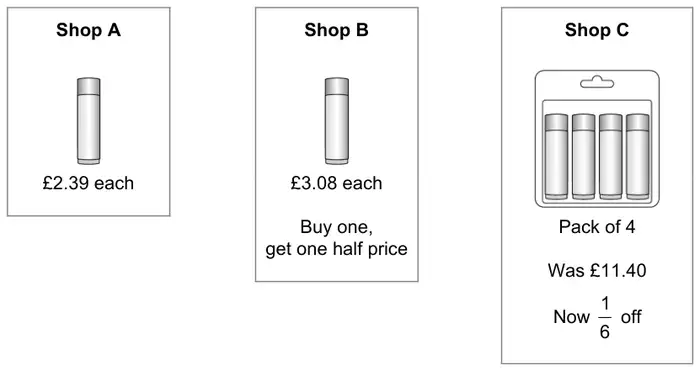
23 Three shops sell the same type and size of lip balm stick.
Which shop is the best value for 8 sticks and what is the total cost in that shop?
Show working to support your answer. [5 marks]
Shop \(\ldots\ldots\ldots\) Total cost £ \(\ldots\ldots\ldots\)
Mark scheme
Answer
Mark
Comments
Alternative method 1: price of buying 8 from each shop
\(2.39 \times 8\) or 19.12
M1
oe shop A
\(3.08 \times 4 + 3.08 \div 2 \times 4\) or 18.48
M1
oe shop B
\(11.4 \div 6\) or 1.9(0) or \(11.4 \times 2 \div 6\) or 3.8(0)
M1
oe shop C
\(11.4 \times 2 -\) their \(1.9(0) \times 2\) or \(11.4 \times 2 -\) their 3.8(0) or 19(.00)
M1dep
oe dep on previous mark \(11.4 \times \dfrac{5}{6} \times 2\) oe scores 3rd & 4th marks
B and 18.48 with 19.12 and 19(.00) seen
A1
Alternative method 2: compares price of individual sticks first
\(3.08 \times 1.5 \div 2\) or 2.31
M1
oe shop B
\((11.4 \div 4) \div 6\) or 0.47(5) or 0.48
M1
oe shop C
\(11.4 \div 4 -\) their 0.475 or 2.37(5) or 2.38
M1dep
oe dep on previous mark \(11.4 \times \dfrac{5}{6} \div 4\) oe scores 2nd & 3rd marks
their \(2.31 \times 8\) or 18.48 with M3 awarded
M1dep
oe
B and 18.48 with 2.31 and 2.37(5) or 2.38 seen
A1
Alternative method 3: compares the price of 4 sticks first
\(2.39 \times 4\) or 9.56 and \(3.08 \times 1.5 \times 2\) or 9.24
M1
oe shops A and B
\(11.4 \div 6\) or 1.9(0)
M1
oe shop C
\(11.4 -\) their 1.9(0) or 9.5(0)
M1dep
dep on previous mark \(11.4 \times \dfrac{5}{6}\) oe scores 2nd & 3rd marks
their \(9.24 \times 2\) or 18.48 with M3 awarded
M1dep
oe
B and 18.48 with 9.56 and 9.24 and 9.5(0) seen
A1
Alternative method 4: compares the price of 2 sticks first
\(2.39 \times 2\) or 4.78 and \(3.08 \times 1.5\) or 4.62
M1
oe shops A and B
\((11.4 \div 2) \div 6\) or 0.95
M1
oe shop C
\(11.4 \div 2 -\) their 0.95 or 4.75
M1dep
dep on previous mark \(11.4 \times \dfrac{5}{6} \div 2\) oe scores 2nd & 3rd marks
their \(4.62 \times 4\) or 18.48 with M3 awarded
M1dep
oe
B and 18.48 with 4.78 and 4.62 and 4.75 seen
A1
Additional guidance
Up to M4 may be awarded for correct work with no answer or incorrect answer, even if this is seen amongst multiple attempts
Use the scheme which gives the highest mark
NB The 4th mark in Alts 2, 3 and 4 does not imply any earlier marks Either the method or values must have been seen and awarded for the first 3 marks in order to give this mark However 18.48 always implies M1 by Alt 1
If students use different numbers of sticks for different shops do not combine marks from different schemes but note that there are possible valid methods that compare eg 2 sticks from A and B and then 4 sticks from B and C (escalate if seen)
All schemes can be oe in pence and allow work in a mix of pounds or pence for up to M4
Allow \(\times\, 0.16(6\ldots)\) or \(\times\, 16(.6\ldots)\%\) or \(\times\, 0.167\) or \(\times\, 16.7\%\) or \(\times\, 0.17\) or \(\times\, 17\%\) if seen for method for one sixth for shop C but must recover to given values for A mark
Allow \(\times\, 0.83(3\ldots)\) or \(\times\, 83(.3\ldots)\%\) if seen for method for five sixths for shop C but must recover to given values for A mark
19 When converted to a fraction \(\quad 0.\dot{7} = \dfrac{7}{9}\)
Work out \(\quad 0.\dot{4} + 0.0\dot{7}\)
Give your answer as a fraction. [3 marks]
Mark scheme
Answer
Mark
Comments
Alternative method 1
\((0.\dot{4} =)\ \dfrac{4}{9}\) or \(10x - x = 4\) or \(9x = 4\)
M1
oe eg \(100x - x = 44\) or \(99x = 44\) or \(100x - 10x = 40\) or \(90x = 40\) any letter
\(\dfrac{7}{9} \div 10\) or \(\dfrac{7}{90}\) or \(10y - y = 0.7\) or \(9y = 0.7\)
M1
oe eg \(100y - y = 7.7\) or \(99y = 7.7\) or \(100y - 10y = 7\) or \(90y = 7\) any letter
\(\dfrac{47}{90}\)
A1
oe single fraction
Alternative method 2
\(0.5\dot{2}\)
M1
oe
\(10x - x = 4.7\) or \(9x = 4.7\)
M1dep
oe eg \(100x - x = 51.7\) or \(99x = 51.7\) or \(100x - 10x = 47\) or \(90x = 47\) any letter
\(\dfrac{47}{90}\)
A1
oe single fraction
Additional guidance
For M marks, allow fractions with decimal numerator or denominator eg in alt 1, \(\dfrac{0.7}{9}\) scores M1 and in alt 2, \(\dfrac{4.7}{9}\) scores M2
19 Andrew and Bruce share some money in the ratio \(\quad\) 5 : 6
Bruce gets £96
Andrew gives \(\dfrac{1}{4}\) of his share to Carl.
Bruce gives \(\dfrac{2}{3}\) of his share to Carl.
How much money does Carl receive? [4 marks]
Mark scheme
Answer
Mark
Comments
\(\dfrac{5}{6} \times 96\) or 80
M1
oe eg \(96 \div 6 \times 5\) implied by 176
\(\dfrac{1}{4} \times\) their 80 or 20
M1dep
oe eg \(80 \div 4\)
\(\dfrac{2}{3} \times 96\) or 64
M1
oe eg \(96 \div 3 \times 2\) accept 0.66 or better for \(\dfrac{2}{3}\)
84(.00)
A1
SC2 100.8(0) or [77.32, 77.34] condone incorrect money notation eg 84.0 or 84.00p
Additional guidance
SC2 for 100.8(0) is from misreading as Andrew gets £96
SC2 for [77.32, 77.34] is from \(\dfrac{2}{3}\) of 80 plus \(\dfrac{1}{4}\) of 96
Do not accept ‘\(\dfrac{5}{6}\) of 96’ or ‘\(\dfrac{1}{4}\) of 80’ or ‘\(\dfrac{2}{3}\) of 96’ for M marks unless accompanied by a correct method or value
6 Andrew and Bruce share some money in the ratio 5 : 6
Bruce gets £96
Andrew gives \(\dfrac{1}{4}\) of his share to Carl.
Bruce gives \(\dfrac{2}{3}\) of his share to Carl.
How much money does Carl receive? [4 marks]
Mark scheme
Answer
Mark
Comments
\(\dfrac{5}{6} \times 96\) or 80
M1
oe eg \(96 \div 6 \times 5\) implied by 176
\(\dfrac{1}{4} \times\) their 80 or 20
M1dep
oe eg \(80 \div 4\)
\(\dfrac{2}{3} \times 96\) or 64
M1
oe eg \(96 \div 3 \times 2\) accept 0.66 or better for \(\dfrac{2}{3}\)
84(.00)
A1
SC2 100.8(0) or [77.32, 77.34] condone incorrect money notation eg 84.0 or 84.00p
Additional guidance
SC2 for 100.8(0) is from misreading as Andrew gets £96
SC2 for [77.32, 77.34] is from \(\dfrac{2}{3}\) of 80 plus \(\dfrac{1}{4}\) of 96
Do not accept ‘\(\dfrac{5}{6}\) of 96’ or ‘\(\dfrac{1}{4}\) of 80’ or ‘\(\dfrac{2}{3}\) of 96’ for M marks unless accompanied by a correct method or value
3 Work out the value of \(\quad \left(\dfrac{3}{2}\right)^2\)
Give your answer as a mixed number. [1 mark]
Mark scheme
Answer
Mark
Comments
\(2\dfrac{1}{4}\)
B1
oe mixed number
Additional guidance
\(\dfrac{9}{4} = 2\dfrac{1}{4}\) or \(2.25 = 2\dfrac{1}{4}\) on answer line \(2\dfrac{1}{4} = \dfrac{9}{4}\) or \(2\dfrac{1}{4} = 2.25\) on answer line
B1 B0
Otherwise, \(2\dfrac{1}{4}\) and \(\dfrac{9}{4}\) or \(2\dfrac{1}{4}\) and 2.25 on answer line in either order (or in working with answer line blank and answer unclear)
B0
\(1\dfrac{5}{4}\)
B0
\(2\left(\dfrac{1}{4}\right)\) or \(2 + \dfrac{1}{4}\)
(b) Work out \(\quad \dfrac{5}{6} \div 3\) [1 mark]
(c) Work out \(\quad 27 \div 0.6\) [1 mark]
Mark scheme (a)
Answer
Mark
Comments
(0).35
B1
oe
Additional guidance
Mark the answer line. If this is blank, mark the working
If values are given in one or more forms, either on the answer line or in working with nothing on the answer line, all values must be correct eg1 \(0.35 = \dfrac{7}{20}\) on answer line eg2 \(\dfrac{35}{100}\) and 3.5 in working with \(\dfrac{35}{100}\) on answer line eg3 \(\dfrac{35}{100}\) and 3.5 in working with 3.5 on answer line eg4 \(\dfrac{35}{100}\) and 3.5 in working with answer line blank
B1 B1 B0 B0
Mark scheme (b)
Answer
Mark
Comments
\(\dfrac{5}{18}\)
B1
oe eg \(\dfrac{10}{36}\)
Additional guidance
Mark the answer line. If this is blank, mark the working
Allow 0.277… (minimum two 7s and two dots) or correct notation for recurring decimals
If values are given in one or more forms, either on the answer line or in working with nothing on the answer line, all values must be correct eg1 \(\dfrac{5}{18} = 0.277\ldots\) on answer line eg2 \(\dfrac{5}{18}\) and 0.518 in working with answer line blank
B1 B0
\(\dfrac{1\frac{2}{3}}{6}\) or \(\dfrac{1.66\ldots}{6}\) without answer in correct form
B0
Mark scheme (c)
Answer
Mark
Comments
45
B1
Additional guidance
Mark the answer line. If this is blank, mark the working
If values are given in one or more forms, either on the answer line or in working with nothing on the answer line, all values must be correct eg1 \(\dfrac{270}{6} = 45\) on answer line eg2 \(\dfrac{270}{6}\) and \(44\dfrac{5}{6}\) in working with answer line blank
B1 B0
Do not allow unprocessed answers eg \(\dfrac{270}{6}\)
22 Work out \(\quad \left(\dfrac{7}{10} - \dfrac{4}{15}\right) \div \dfrac{2}{3}\)
Give your answer as a fraction. [3 marks]
Mark scheme
Answer
Mark
Comments
Valid common denominator for subtraction with at least one numerator correct
M1
eg \(\dfrac{21}{30} - \dfrac{8}{30}\) or \(\dfrac{13}{30}\) or \(\dfrac{105}{150} - \dfrac{40}{150}\) or \(\dfrac{65}{150}\) condone decimals in numerator(s)
their \(\dfrac{13}{30} \times \dfrac{3}{2}\) or \(\dfrac{\text{their } 13 \div 2}{\text{their } 30 \div 3}\)
M1
oe product their \(\dfrac{13}{30}\) can be any single fraction, mixed number or decimal other than their \(\dfrac{13}{30}\) inverted or \(\dfrac{7}{10}\) or \(\dfrac{4}{15}\) condone decimals in numerator(s) correct answer not in correct fraction form eg \(\dfrac{6.5}{10}\) scores M1M1
\(\dfrac{13}{20}\) or \(\dfrac{39}{60}\)
A1
oe fraction SC2 \(\dfrac{29}{20}\) oe fraction or mixed number
Additional guidance
If 10 or 15 is used as the common denominator, both numerators must be correct for the first mark
Correct fraction in working with incorrectly simplified fraction on answer line
M2A1
Correct fraction in working with conversion to decimal on answer line
M2A0
\(\dfrac{65}{150} \div \dfrac{2}{3} = \dfrac{32}{50}\) \(\dfrac{65}{150} \div \dfrac{2}{3} = \dfrac{32.5}{50}\) with no further working
8 Work out \(\quad \left(\dfrac{7}{10} - \dfrac{4}{15}\right) \div \dfrac{2}{3}\)
Give your answer as a fraction. [3 marks]
Mark scheme
Answer
Mark
Comments
Valid common denominator for subtraction with at least one numerator correct
M1
eg \(\dfrac{21}{30} - \dfrac{8}{30}\) or \(\dfrac{13}{30}\) or \(\dfrac{105}{150} - \dfrac{40}{150}\) or \(\dfrac{65}{150}\) condone decimals in numerator(s)
their \(\dfrac{13}{30} \times \dfrac{3}{2}\) or \(\dfrac{\text{their } 13 \div 2}{\text{their } 30 \div 3}\)
M1
oe product their \(\dfrac{13}{30}\) can be any single fraction, mixed number or decimal other than their \(\dfrac{13}{30}\) inverted or \(\dfrac{7}{10}\) or \(\dfrac{4}{15}\) condone decimals in numerator(s) correct answer not in correct fraction form eg \(\dfrac{6.5}{10}\) scores M1M1
\(\dfrac{13}{20}\) or \(\dfrac{39}{60}\)
A1
oe fraction SC2 \(\dfrac{29}{20}\) oe fraction or mixed number
Additional guidance
If 10 or 15 is used as the common denominator, both numerators must be correct for the first mark
Correct fraction in working with incorrectly simplified fraction on answer line
M2A1
Correct fraction in working with conversion to decimal on answer line
7 The only animals on a farm are 30 cows and 80 sheep.
\(\dfrac{1}{5}\) of the 30 cows are sold and \(\dfrac{5}{8}\) of the 80 sheep are sold.
Work out the total number of animals that are sold. [3 marks]
Mark scheme
Answer
Mark
Comments
\(\dfrac{1}{5} \times 30\) or \(\dfrac{1}{8} \times 80\) or 10 or \(\dfrac{5}{8} \times 80\)
M1
oe
6 or 50
A1
56
A1
SC2 54
Additional guidance
May be seen as a set of equivalent fraction numerators eg \(\dfrac{1}{5} = \dfrac{6}{30}\) and \(\dfrac{5}{8} = \dfrac{10}{16} = \dfrac{100}{160} = \dfrac{50}{80}\), \(6 + 50 = 56\) eg \(\dfrac{1}{5} = \dfrac{6}{30}\) and \(\dfrac{5}{8} = \dfrac{10}{16} = \dfrac{100}{160} = \dfrac{50}{80}\), answer \(\dfrac{56}{110}\)
M1A1A1 M1A1A0
6 out of 30 or 50 in 80 56 out of 110
M1A1 M1A1A1
Up to M1 may be awarded for correct work, with no or incorrect answer, even if seen amongst multiple attempts
(a) In each box, write a fraction less than 1 to make a correct calculation. [1 mark]
(b) In each box, write a decimal less than 1 to make a correct calculation. [1 mark]
Mark scheme (a)
Answer
Mark
Comments
Two fractions less than 1 with product \(\dfrac{3}{10}\)
B1
eg \(\dfrac{3}{5}\) and \(\dfrac{1}{2}\) or \(\dfrac{6}{10}\) and \(\dfrac{5}{10}\) either order
Additional guidance
Accept negatives if each processed fraction is less than 1 eg \(-\dfrac{3}{2}\) and \(-\dfrac{1}{5}\) eg \(\dfrac{-1}{-2}\) and \(\dfrac{3}{5}\) eg \(\dfrac{-3}{-2}\) and \(\dfrac{1}{5}\)
B1 B1 B0
Do not accept decimals within the fractions eg \(\dfrac{0.6}{1}\) and \(\dfrac{0.5}{1}\)
B0
\(\dfrac{11}{10}\) and \(\dfrac{3}{11}\)
B0
\(\dfrac{3}{10}\) and \(\dfrac{1}{1}\)
B0
0.6 and 0.5
B0
Mark scheme (b)
Answer
Mark
Comments
Two decimals less than 1 with product 0.06
B1
eg 0.3 and 0.2 or 0.60 and 0.10 or 0.5 and 0.12 or 0.75 and 0.08 either order
The table shows the number of hours she works on two weekends.
Saturday
Sunday
Weekend 1
3
2
Weekend 2
\(5\dfrac{1}{2}\)
\(3\dfrac{1}{2}\)
Work out the percentage increase in her total hours from Weekend 1 to Weekend 2 [3 marks]
Mark scheme
Answer
Mark
Comments
\(3 + 2\) or 5 and \(5\tfrac{1}{2} + 3\tfrac{1}{2}\) or 9 or \(5\tfrac{1}{2} - 3\) or \(2\tfrac{1}{2}\) and \(3\tfrac{1}{2} - 2\) or \(1\tfrac{1}{2}\) or 4
M1
oe eg \(180 + 120\) or 300 and \(330 + 210\) or 540 implied by \(5\tfrac{1}{2} + 3\tfrac{1}{2} - 3 - 2\)
\(\dfrac{9 - 5}{5}\) or \(\dfrac{2\tfrac{1}{2} + 1\tfrac{1}{2}}{3 + 2}\) or \(\dfrac{4}{5}\) or 0.8 or \(\dfrac{5\tfrac{1}{2} + 3\tfrac{1}{2}}{3 + 2}\) (\(\times\) 100) or \(\dfrac{9}{5}\) (\(\times\) 100) or 1.8 (\(\times\) 100) or 180
15 In the grid, the product of each row, column and diagonal is 1
\(\dfrac{1}{4}\)
4
\(\dfrac{1}{8}\)
Complete the grid. [2 marks]
Mark scheme
Answer
Mark
Comments
8
\(\dfrac{1}{4}\)
\(\dfrac{1}{2}\)
\(\dfrac{1}{16}\)
1
16
2
4
\(\dfrac{1}{8}\)
B2
oe values eg 0.0625 for \(\dfrac{1}{16}\) condone unprocessed values eg for 8 allow \(\dfrac{16}{2}\) or \(\dfrac{8}{1}\) B1 at least three of the eight rows, columns and diagonals have a product of 1 do not count rows, columns or diagonals that only have ones do not count incomplete rows, columns or diagonals
Additional guidance
If decimal values are used they must be exact
The given values in the grid cannot be changed
B1 can be awarded with an incomplete grid eg
8
\(\dfrac{1}{4}\)
\(\dfrac{1}{16}\)
1
2
4
\(\dfrac{1}{8}\)
B1
1
\(\dfrac{1}{4}\)
1
1
1
\(\dfrac{1}{2}\)
1
4
\(\dfrac{1}{8}\)
Three products of 1 but two are not counted as they only have ones
He uses \(\dfrac{5}{7}\) of his savings to buy sports equipment.
(a) Assume that he will use \(\dfrac{1}{3}\) of the rest of the money to buy a shirt.
How much of his savings, in £, will he have left? [3 marks]
(b) In fact, he uses more than \(\dfrac{1}{3}\) of the rest of the money to buy a shirt.
What does this tell you about how much of his savings he has left?
Tick one box. [1 mark]
It is more than the answer to part (a)
It is the same as the answer to part (a)
It is less than the answer to part (a)
It is not possible to tell
Mark scheme (a)
Answer
Mark
Comments
Alternative method 1
\(\dfrac{5}{7} \times 168\) or 120
M1
oe eg \(168 \div 7 \times 5\) implied by 48 allow 0.71(4…) or 71(.4…)% for \(\dfrac{5}{7}\)
\(\dfrac{1}{3} \times (168 -\) their 120) or \(\dfrac{1}{3} \times 48\) or 16 or \(\left(1 - \dfrac{1}{3}\right)\) \(\times\ (168 -\) their 120) or \(\left(1 - \dfrac{1}{3}\right)\) \(\times\) 48
M1
oe must subtract their 120 from 168 with \(10 \lt\) their \(120 \lt 150\) allow 0.33(3…) or 33(.3…)% for \(\dfrac{1}{3}\) allow 0.66(6…) or 0.67 or 66(.6…)% or 67% for \(\left(1 - \dfrac{1}{3}\right)\) 16 is M1M1
32(.00p)
A1
SC2 80 SC1 40
Alternative method 2
\(\left(1 - \dfrac{5}{7}\right)\) \(\times\) 168 or 48
M1
oe eg \(168 \div 7 \times 2\) allow 0.28(6…) or 0.29 or 28(.6…)% or 29% for \(\left(1 - \dfrac{5}{7}\right)\)
\(\dfrac{1}{3} \times\) their 48 or 16 or \(\left(1 - \dfrac{1}{3}\right)\) \(\times\) their 48
M1
oe \(18 \lt\) their \(48 \lt 100\) allow 0.33(3…) or 33(.3…)% for \(\dfrac{1}{3}\) allow 0.66(6…) or 0.67 or 66(.6…)% or 67% for \(\left(1 - \dfrac{1}{3}\right)\) 16 is M1M1
32(.00p)
A1
SC2 80 SC1 40
Additional guidance
Up to M2 may be awarded for correct work with no, or incorrect answer, even if this is seen amongst multiple attempts
(a) In each box, write a fraction less than 1 to make a correct calculation. [1 mark]
(b) In each box, write a decimal less than 1 to make a correct calculation. [1 mark]
Mark scheme (a)
Answer
Mark
Comments
Two fractions less than 1 with product \(\dfrac{3}{10}\)
B1
eg \(\dfrac{3}{5}\) and \(\dfrac{1}{2}\) or \(\dfrac{6}{10}\) and \(\dfrac{5}{10}\) either order
Additional guidance
Accept negatives if each processed fraction is less than 1 eg \(-\dfrac{3}{2}\) and \(-\dfrac{1}{5}\) eg \(\dfrac{-1}{-2}\) and \(\dfrac{3}{5}\) eg \(\dfrac{-3}{-2}\) and \(\dfrac{1}{5}\)
B1 B1 B0
Do not accept decimals within the fractions eg \(\dfrac{0.6}{1}\) and \(\dfrac{0.5}{1}\)
B0
\(\dfrac{11}{10}\) and \(\dfrac{3}{11}\)
B0
\(\dfrac{3}{10}\) and \(\dfrac{1}{1}\)
B0
0.6 and 0.5
B0
Mark scheme (b)
Answer
Mark
Comments
Two decimals less than 1 with product 0.06
B1
eg 0.3 and 0.2 or 0.60 and 0.10 or 0.5 and 0.12 or 0.75 and 0.08 either order
The table shows the number of hours she works on two weekends.
Saturday
Sunday
Weekend 1
3
2
Weekend 2
\(5\dfrac{1}{2}\)
\(3\dfrac{1}{2}\)
Work out the percentage increase in her total hours from Weekend 1 to Weekend 2 [3 marks]
Mark scheme
Answer
Mark
Comments
\(3 + 2\) or 5 and \(5\dfrac{1}{2} + 3\dfrac{1}{2}\) or 9 or \(5\dfrac{1}{2} - 3\) or \(2\dfrac{1}{2}\) and \(3\dfrac{1}{2} - 2\) or \(1\dfrac{1}{2}\) or 4
M1
oe eg \(180 + 120\) or 300 and \(330 + 210\) or 540 implied by \(5\dfrac{1}{2} + 3\dfrac{1}{2} - 3 - 2\)
\(\dfrac{9 - 5}{5}\) or \(\dfrac{2\frac{1}{2} + 1\frac{1}{2}}{3 + 2}\) or \(\dfrac{4}{5}\) or 0.8 or \(\dfrac{5\frac{1}{2} + 3\frac{1}{2}}{3 + 2}\) (\(\times\) 100) or \(\dfrac{9}{5}\) (\(\times\) 100) or 1.8 (\(\times\) 100) or 180
Write Lily’s age in months as a fraction of Hugo’s age in months.
Give your fraction in its simplest form. [2 marks]
Mark scheme
Answer
Mark
Comments
\(\dfrac{7}{5}\) or \(1\dfrac{2}{5}\)
B2
B1 28 and 20 or \(2\dfrac{1}{3}\) and \(1\dfrac{2}{3}\) oe mixed numbers or fractions with common denominator or correct unsimplified fraction or mixed number eg \(\dfrac{14}{10}\) or \(1\dfrac{8}{20}\) or correct simplification of a fraction where at least one of the values is 28 or 20 and the other is not 12 SC1 \(\dfrac{5}{7}\)
Additional guidance
Allow a fractional numerator and/or denominator in a correct fraction eg \(\dfrac{2\frac{1}{3}}{1\frac{8}{12}}\) or \(\dfrac{\frac{28}{12}}{\frac{5}{3}}\)
B1
\(\dfrac{2.4}{1.8}\) simplified to \(\dfrac{4}{3}\)
B0
Ignore an attempt to convert \(\dfrac{7}{5}\) to an improper fraction eg \(\dfrac{7}{5} = 1\dfrac{2}{7}\) on the answer line
19 Work out which of these fractions is closer in value to 0.5
\(\dfrac{5}{16} \qquad\qquad \dfrac{17}{25}\)
You must show your working. [2 marks]
Mark scheme
Answer
Mark
Comments
Alternative method 1
0.31(25) or 0.68
M1
oe eg 31(.25)% or 68%
0.31(25) and 0.68 and \(\dfrac{17}{25}\)
A1
accept 0.68 as the answer with both values seen
Alternative method 2
Converts both fractions to a valid common denominator with at least one numerator correct
M1
eg \(\dfrac{125}{400}\) and \(\dfrac{272}{400}\) with one numerator correct
Two correct fractions with a common denominator and \(\dfrac{17}{25}\)
A1
accept \(\dfrac{272}{400}\) oe as the answer with both values seen
Alternative method 3
Gives differences from \(\dfrac{1}{2}\) in same form with at least one correct
M1
eg \(\dfrac{75}{400}\) and \(\dfrac{72}{400}\) with one numerator correct or 0.1875 and 0.18 with one correct
Both differences correct and \(\dfrac{17}{25}\)
A1
accept 0.18 as the answer with both values seen
Additional guidance
Accept \(\dfrac{17}{25}\) circled in question with both values seen
Ignore subsequent rounding or truncation once 0.31 and 0.68 seen
Ignore incorrect attempts at differences in Alt 1 and Alt 2 and award up to full marks
Choose the scheme that favours the student
Use of other methods requires comparable forms eg \(0.5 - \dfrac{5}{16} = \dfrac{3}{16}\), \(0.5 + \dfrac{3}{16} = \dfrac{11}{16}\) and compares with \(\dfrac{17}{25}\)
13 Convert \(\quad \dfrac{5}{6} \quad\) to a recurring decimal. [2 marks]
Mark scheme
Answer
Mark
Comments
\(5 \div 6\) attempted with at least 0.8 shown and a carry of any integer from 1 to 7 or \(0.1\dot{6} \times 5\) or \(1.\dot{6} \div 2\) or \(1 - 0.1\dot{6}\)
M1
oe calculation involving a correct recurring decimal which would give an outcome of \(0.8\dot{3}\)
\(0.8\dot{3}\)
A1
condone any number of 3s immediately before the recurring 3
Additional guidance
Condone other recurring symbols or repeated dots eg \(0.83^{\text{r}}\) or 0.83…
Write Lily’s age in months as a fraction of Hugo’s age in months.
Give your fraction in its simplest form. [2 marks]
Mark scheme
Answer
Mark
Comments
\(\dfrac{7}{5}\) or \(1\dfrac{2}{5}\)
B2
B1 28 and 20
or \(2\dfrac{1}{3}\) and \(1\dfrac{2}{3}\) oe mixed numbers or fractions with common denominator
or correct unsimplified fraction or mixed number eg \(\dfrac{14}{10}\) or \(1\dfrac{8}{20}\)
or correct simplification of a fraction where at least one of the values is 28 or 20 and the other is not 12
SC1 \(\dfrac{5}{7}\)
Additional guidance
Allow a fractional numerator and/or denominator in a correct fraction eg \(\dfrac{2\frac{1}{3}}{1\frac{8}{12}}\) or \(\dfrac{\frac{28}{12}}{\frac{5}{3}}\)
B1
\(\dfrac{2.4}{1.8}\) simplified to \(\dfrac{4}{3}\)
B0
Ignore an attempt to convert \(\dfrac{7}{5}\) to a mixed number eg \(\dfrac{7}{5} = 1\dfrac{2}{7}\) on the answer line
B1 \(\dfrac{18}{30}\) or \(\dfrac{9}{15}\) or \(\dfrac{6}{10}\) or 0.6(0) or 60% SC1 \(\dfrac{2}{5}\)
Additional guidance
\(\dfrac{18}{30}\) or \(\dfrac{9}{15}\) or \(\dfrac{6}{10}\) followed by incorrect simplification or any conversion
B1
Mark scheme (b)
Answer
Mark
Comments
\(\dfrac{64}{100} \times (30 + 20)\)
M1
oe eg \(0.64 \times 50\) or \(64 \div 2\) build up method must be complete
32
A1
14 (out of 20)
A1ft
ft their 32 − 18 with M1A0 scored their 32 must be greater than 18 SC1 12.8 (or 13 after 12.8 is seen)
Additional guidance
\(\dfrac{14}{20}\) or 70%
M1A1A0
14 = 70% on answer line
M1A1A1
Answer 32 or \(\dfrac{32}{50}\)
M1A1A0
\(64\% \times 50\) with no further work
M0
\(\dfrac{64}{100} \times 50 = 30\) Answer 12
M1A0A1ft
Example of complete build-up (for 64% of 50) 10% = 5 (no working but correct) \(6 \times 5 = 30\) (correct with working) 1% = 0.5 (no working but correct) \(4 \times 0.5 = 0.20\) (incorrect but working shown so still on for M1) = 30.20 (implied correct addition) then 30.20 − 18 = 12.20 Answer 12.20 (condone decimal value for ft)
M1A0A1ft
Example of incomplete build-up (for 64% of 50) 50% = 25 (no working but correct) 10% = 5 (no working but correct) 2% = 2 (incorrect and no working shown M0) ……… (A0ft cannot award ft when M1 not awarded)
The number of small is \(\dfrac{5}{3}\) of the number of large. The number of green is 300% of the number of yellow. There are 12 small yellow buttons.
How many large green buttons are there?
You may use the two-way table to help you. [4 marks]
Mark scheme
Answer
Mark
Comments
Alternative method 1
\(45 \times \dfrac{5}{3}\) or 75
M1
75 seen as total of Small column implied by 120 seen as overall total
(their \(75 + 45) \div (1 + 3)\) or \(120 \div 4\) or 30 (Yellow)
M1dep
30 seen as total of Yellow row
their \(30 - 12\) or 18 (Large Yellow)
M1dep
18 in Large Yellow cell
27
A1
Accept 27 in correct cell if answer blank
Alternative method 2
\(45 \times \dfrac{5}{3}\) or 75
M1
75 seen as total of Small column implied by 120 seen as overall total
their \(75 - 12\) or 63 (Small Green)
M1dep
63 in Small Green cell
(their \(75 + 45) \div (1 + 3) \times 3\) or \(120 \div 4 \times 3\) or 90 (Green)
M1dep
dep on first M1 90 seen as total of Green row
27
A1
Accept 27 in correct cell if answer blank
Alternative method 3
\(45 \times \dfrac{5}{3}\) or 75
M1
75 seen as total of Small column implied by 120 seen as overall total
their \(75 - 12\) or 63 (Small Green)
M1dep
63 in Small Green cell
their \(63 + x = 3(45 - x + 12)\)
M1dep
oe \(\quad 63 + x = 171 - 3x\)
27
A1
Accept 27 in correct cell if answer blank
Additional guidance
In alt 2, 90 only implies M1M0M1 – 63 is also needed for M1M1M1
18 In a bag there are blue discs, green discs and white discs.
There are four times as many blue discs as green discs. number of blue discs : number of white discs = 3 : 5
One disc is selected at random.
Work out the probability that the disc is either blue or white. [3 marks]
Mark scheme
Answer
Mark
Comments
(b : g =) 4 : 1 or (b : w =) 6 : 10 or states a number of blue discs that is four times the number of green discs or states a number of blue discs and a number of white discs that are in the ratio 3 : 5 (not 3 and 5) or \(b = 4g\) or \(\dfrac{b}{w} = \dfrac{3}{5}\)
M1
oe ratio or equation eg (b : g =) 3 : 0.75 or 4 blue 1 green or 6 blue 10 white or \(5b = 3w\) do not allow (b : w =) 3 : 5
Three numbers of the form \(12n\), \(3n\) and \(20n\) where \(n > 0\) or unsimplified fraction equivalent to \(\dfrac{32}{35}\)
A1
any order may be seen in a ratio or as numbers of discs eg 12 : 3 : 20 or 100 15 60 or 3 0.75 5 or 4 : 1 : \(\dfrac{20}{3}\) or \(\dfrac{12 + 20}{12 + 3 + 20}\) or \(\dfrac{3 + 5}{3 + 0.75 + 5}\) or \(\dfrac{8}{8.75}\) or \(\dfrac{b + \frac{5}{3}b}{b + \frac{5}{3}b + \frac{1}{4}b}\) or \(\dfrac{\frac{8}{3}b}{\frac{35}{12}b}\)
\(\dfrac{32}{35}\) or 0.91(4…) or 91.(4…)%
A1
oe fraction eg \(\dfrac{64}{70}\)
Additional guidance
Ignore conversion of a correct fraction to a decimal or percentage
Ignore incorrect simplification of a correct fraction
Answer 32 : 35
M1A1A0
Final A1 fraction answers must be \(\dfrac{\text{integer}}{\text{integer}}\)
1 : 4 only scores M1 if indicated as g : b
10 : 6 only scores M1 if indicated as w : b
1st M1 may be embedded eg1 b : g : w = 4 : 1 : 10 eg2 b : g : w = 6 : 3 : 10
M1 M1
Condone 4b : g as an indication of 4 blue and 1 green etc
5 Which is longer, \(\quad \dfrac{3}{4}\) of a day \(\quad\) or \(\quad\) 1000 minutes?
You must show your working. [3 marks]
Mark scheme
Answer
Mark
Comments
Alternative method 1
\(24 \div 4 \times 3\) or 18
M1
oe
their \(18 \times 60\) or 1080
M1dep
oe 1080 implies M2
1080 and \(\dfrac{3}{4}\) (of a day)
A1
Alternative method 2
\(24 \times 60\) or 1440
M1
oe
their \(1440 \div 4 \times 3\) or 1080
M1dep
oe 1080 implies M2
1080 and \(\dfrac{3}{4}\) (of a day)
A1
Alternative method 3
\(24 \div 4 \times 3\) or 18
M1
oe
\(1000 \div 60\) or 16(.6…) or 16.7 or 17
M1
may be seen in either order (M marks not dependent) [16 h 36 m, 16 h 42 m] implies division 16 or 17 may be embedded
16(.6…) or 16.7 or 17 or [16 h 36 m, 16 h 42 m] and 18 and \(\dfrac{3}{4}\) (of a day)
A1
16 or 17 may be embedded
Alternative method 4
\(24 \times 60\) or 1440
M1
oe
\(1000 \div\) their 1440 (\(\times\) 100) or \(\dfrac{25}{36}\) or 0.69… or 69(…)%
M1dep
oe \(\dfrac{25}{36}\) or 0.69… or 69(…)% implies M2
\(\dfrac{25}{36}\) and \(\dfrac{27}{36}\) and \(\dfrac{3}{4}\) (of a day) or 0.69… and 0.75 and \(\dfrac{3}{4}\) (of a day) or 69(…)% and 75% and \(\dfrac{3}{4}\) (of a day)
A1
Additional guidance
Ignore units for the M marks but they must be correct, if given, for the A mark
\(\dfrac{3}{4}\) of 24 is insufficient method unless a correct method or 18 is seen
Once \(1000 \div 60\) or 16 or 16.6… or 16.7 or 17 is seen in Alt method 3, ignore any incorrect conversion to hours and minutes. If the student only shows hours and minutes, they must be in the given range.
Do not accept \(\dfrac{3}{4}\) (of a day) in equivalent form eg 1080 or 18
25 Work out \(\quad 8\dfrac{1}{2} \div 2\dfrac{2}{3}\)
Give your answer as a mixed number. [4 marks]
Mark scheme
Answer
Mark
Comments
Alternative method 1
\(\dfrac{17}{2}\) or \(\dfrac{8}{3}\)
M1
oe fractions
their \(\dfrac{17}{2} \times\) their \(\dfrac{3}{8}\)
M1
conversion of both mixed numbers to improper fractions and multiplication of the conversion of \(8\dfrac{1}{2}\) by the reciprocal of the conversion of \(2\dfrac{2}{3}\)
\(\dfrac{51}{16}\)
A1
oe fraction or decimal
\(3\dfrac{3}{16}\)
B1ft
oe mixed number ft correct conversion of their improper fraction to a mixed number
Alternative method 2
\(\dfrac{17}{2}\) or \(\dfrac{8}{3}\)
M1
oe fractions
\(\dfrac{51}{6} \div \dfrac{16}{6}\)
M1
conversion of both mixed numbers to improper fractions, correct conversion to improper fractions with a common denominator and division of the conversion of \(8\dfrac{1}{2}\) by the conversion of \(2\dfrac{2}{3}\)
\(\dfrac{51}{16}\)
A1
oe fraction or decimal
\(3\dfrac{3}{16}\)
B1ft
oe mixed number ft correct conversion of their improper fraction to a mixed number
Additional guidance
Working with decimals
0, 3 or 4
Ignore incorrect attempt to simplify a mixed number eg \(3\dfrac{3}{16} = 3\dfrac{1}{8}\)
M1M1A1B1
\(3\dfrac{3}{16}\) seen, then \(\dfrac{51}{16}\) on answer line
18 Beth and Mia translate documents from Spanish into English.
A set of documents that would take Beth 8 days would take Mia 10 days.
Beth starts to translate the documents.
After 2 days Beth and Mia both work on translating the documents.
How many more days will it take to complete the work?
You must show your working. [4 marks]
Mark scheme
Answer
Mark
Comments
Alternative method 1
\(\dfrac{1}{4}\) (completed) or \(\dfrac{3}{4}\) (left)
M1
oe eg 25% (completed) or 75% (left)
\(\dfrac{1}{8} + \dfrac{1}{10}\) or \(\dfrac{9}{40}\)
M1
oe eg 12.5% + 10% or 22.5%
\(\dfrac{3}{4} \div\) their \(\dfrac{9}{40}\)
M1dep
oe eg 75% \(\div\) their 22.5% dep on M1M1
\(3\dfrac{1}{3}\) or 4 days with correct working seen
A1
oe
Alternative method 2 – assumes a number of pages (eg 80)
\(\dfrac{3}{4} \times\) their 80 or 60
M1
oe
\(\dfrac{1}{8} \times\) their 80 or 10 and \(\dfrac{1}{10} \times\) their 80 or 8
M1
oe
their \(60 \div\) (their 10 + their 8)
M1dep
oe dep on M1M1
\(3\dfrac{1}{3}\) or 4 days with correct working seen
A1
oe
Additional guidance
8 – 2 = 6, 10 – 6 = 4, answer 4
M0M0M0A0
In alt 1, for the third mark allow a build-up method in percentages, fractions or decimals showing that 3 days is not enough (and 4 is enough) eg 47.5%, 70%, 92.5%, (115%), answer 4
(b) Laura also wants to work out \(\quad \dfrac{30}{29}\) of 60
Her answer is 58
Is her answer correct?
Tick a box.
Yes
No
Give a reason for your answer. [1 mark]
Mark scheme (a)
Answer
Mark
Comments
Ticks ‘No’ and gives correct explanation indicating her error
B1
eg It should be 0.03 0.3 would give 30% It’s 10 times too big You need to divide by 10 as well
Additional guidance
‘Yes’ ticked
B0
If ‘No’ is not ticked, explanation must include a decision that the statement is incorrect ‘No’ not ticked and ‘it should be 0.03’ (only implies ‘No’) ‘No’ not ticked and ‘it should be 0.03 so she is wrong’
B0 B1
It is not sufficient to only show a different correct method, eg ‘No’ and ‘divide by 100 and multiply by 3’ eg ‘No’ and ‘she has divided by 10 and multiplied by 3 but she should have divided by 100 then multiplied by 3’
B0 B1
‘No’ and ‘\(1700 \times 0.03\)’ (a correction of Laura’s method)
B1
Calculating the correct answer must come with the correct evaluation of Laura’s method eg ‘No’ and ‘should be 51’ eg ‘No’ and ‘Laura gets 510 but it should be 51’
B0 B1
Mark scheme (b)
Answer
Mark
Comments
Ticks ‘No’ and gives correct explanation
B1
eg \(\dfrac{30}{29}\) is bigger than 1 58 is from \(\dfrac{29}{30}\) the answer would have to be bigger than 60 it will be a decimal
Additional guidance
‘Yes’ ticked
B0
‘60 doesn’t divide by 29’ oe
B0
‘No’ ticked and ‘the numerator and denominator are wrong way round’
B1
If ‘No’ is not ticked, explanation must include a decision that the statement is incorrect ‘No’ not ticked and ‘it should be more than 60’ (only implies ‘No’) ‘No’ not ticked and ‘it should be more than 60 so she is wrong’
B0 B1
‘No’ ticked and \(60 \div 29 = 2.(\ldots)\) then \(2.(\ldots) \times 30 = [60, 70)\) accept 2 r2 for 2.( …)
B1
‘No’ ticked and \(30 \div 29 = 1.(\ldots)\) and \(1.(\ldots) \times 60 = [60, 70)\) accept 1 r1 for 1.( …)
B1
‘No’ ticked and ‘because it’s a top heavy fraction’ ‘No’ ticked and ‘because it’s a top heavy fraction so it’s bigger than 1’
B0 B1
‘No’ ticked and ‘\(1\dfrac{1}{29} \times 60\)’ ‘No’ ticked and ‘\(1\dfrac{1}{29} \times 60\) so the answer is over 60’
accept equivalent in percentages but must see % sign
\((0.5 + 0.75 \div 2 =)\) 0.875 or \((1.25 - 0.75 \div 2 =)\) 0.875 or \(\left(\dfrac{1.25 + 0.5}{2} =\right)\) 0.875 or 87.5%
M1dep
0.875 must be correct
accept equivalent in percentages but must see % sign
\(\dfrac{7}{8}\)
A1
oe fraction
Alternative method 5
Positions of \(\dfrac{1}{2}\) and \(1\dfrac{1}{4}\) correctly marked on line or correct midpoint marked on line
M1
if more points are marked, labels of \(\dfrac{1}{2}\) and \(1\dfrac{1}{4}\) must be given or indicated mark intention in terms of exact position accept decimals or equivalent fractions
Correct midpoint marked on line and \(\dfrac{3}{4}\) marked as \(\dfrac{6}{8}\) and 1 marked as \(\dfrac{8}{8}\)
M1dep
oe fractions with common denominator > 4
\(\dfrac{7}{8}\)
A1
oe fraction
Additional guidance
In alternative method 5: \(\dfrac{1}{4}\) marked at \(1\dfrac{1}{4}\) is sufficient for \(1\dfrac{1}{4}\)
In all schemes, award of M1dep means that M2 is awarded
Use the scheme that gives the greatest number of marks – ignore errors in the scheme(s) you do not use
conversion of both mixed numbers to improper fractions and multiplication of the conversion of \(8\dfrac{1}{2}\) by the reciprocal of the conversion of \(2\dfrac{2}{3}\)
\(\dfrac{51}{16}\)
A1
oe fraction or decimal
\(3\dfrac{3}{16}\)
B1ft
oe mixed number ft correct conversion of their improper fraction to a mixed number
Alternative method 2
\(\dfrac{17}{2}\) or \(\dfrac{8}{3}\)
M1
oe fractions
\(\dfrac{51}{6} \div \dfrac{16}{6}\)
M1
conversion of both mixed numbers to improper fractions, correct conversion to improper fractions with a common denominator and division of the conversion of \(8\dfrac{1}{2}\) by the conversion of \(2\dfrac{2}{3}\)
\(\dfrac{51}{16}\)
A1
oe fraction or decimal
\(3\dfrac{3}{16}\)
B1ft
oe mixed number ft correct conversion of their improper fraction to a mixed number
Additional guidance
Working with decimals
0, 3 or 4
Ignore incorrect attempt to simplify a mixed number eg \(3\dfrac{3}{16} = 3\dfrac{1}{8}\)
M1M1A1B1
\(3\dfrac{3}{16}\) seen, then \(\dfrac{51}{16}\) on answer line
29 The range of a set of numbers is \(\;15\dfrac{1}{4}\)
The smallest number is \(\;-2\dfrac{7}{8}\)
Work out the largest number. [3 marks]
Mark scheme
Answer
Mark
Comments
Alternative method 1
\(-2\dfrac{7}{8} + 15\dfrac{1}{4}\) or \(15\dfrac{2}{8}\) or \((-)2.875\) and 15.25 or \((-)\dfrac{23}{8}\) and \(\dfrac{61}{4}\)
M1
oe common denominator for both fractional parts of the mixed numbers conversion of both numbers to decimals with at least one correct conversion of both numbers to improper fractions with at least one correct
\(-2\dfrac{7}{8} + 15\dfrac{2}{8}\) or \(-2.875 + 15.25\) or \(-\dfrac{23}{8} + \dfrac{122}{8}\)
M1dep
oe common denominator correct decimals oe common denominator
\(\dfrac{99}{8}\) or \(12\dfrac{3}{8}\) or 12.375
A1
oe fraction, mixed number or decimal
Alternative method 2
\(-2 + 15\) and \((-)\dfrac{7}{8} + \dfrac{1}{4}\)
M1
\(-2 + 15\) and \((-)\dfrac{7}{8} + \dfrac{2}{8}\) or \(13 - \dfrac{5}{8}\)
M1dep
oe common denominator
\(\dfrac{99}{8}\) or \(12\dfrac{3}{8}\) or 12.375
A1
oe fraction, mixed number or decimal
Additional guidance
\(15\dfrac{1}{4} - -2\dfrac{7}{8}\) scores M0, but followed by \(15\dfrac{2}{8} + 2\dfrac{7}{8}\) scores M1 on Alt 1
Values in 2nd mark must be correct; no ft from incorrect conversion
\(\dfrac{99}{8}\) incorrectly converted to a decimal or mixed number
23 A shopkeeper compares the income from sales of a laptop in March and April.
April
Price
\(\dfrac{1}{5}\) more than March
Number sold
\(\dfrac{1}{4}\) less than March
By what fraction does the income from these sales decrease in April? [3 marks]
Mark scheme
Answer
Mark
Comments
Alternative method 1
\(\dfrac{6}{5}\) or \(\dfrac{3}{4}\)
M1
oe fractions, decimals or percentages, but not \(\dfrac{6}{5}\) as a mixed number
\(\dfrac{6}{5} \times \dfrac{3}{4}\) or \(\dfrac{18}{20}\) or \(\dfrac{9}{10}\) or 0.9 or 90% or 0.1 or 10%
M1dep
oe fractions or decimals, but not \(\dfrac{6}{5}\) as a mixed number
\(\dfrac{1}{10}\)
A1
oe fraction
Alternative method 2
Chooses value for price and increases by \(\dfrac{1}{5}\) or chooses number of laptops and decreases by \(\dfrac{1}{4}\)
M1
correct method or value for either eg (£)5 and (£)6 or 20 (laptops) and 15 (laptops)
Chooses value for price and increases by \(\dfrac{1}{5}\) and chooses number of laptops and decreases by \(\dfrac{1}{4}\) and \(\dfrac{\text{reduced income}}{\text{original income}}\) (\(\times\) 100) or \(\dfrac{\text{reduction}}{\text{original}}\) (\(\times\) 100)
9 The range of a set of numbers is \(\;15\dfrac{1}{4}\)
The smallest number is \(\;-2\dfrac{7}{8}\)
Work out the largest number. [3 marks]
Mark scheme
Answer
Mark
Comments
Alternative method 1
\(-2\dfrac{7}{8} + 15\dfrac{1}{4}\) or \(15\dfrac{2}{8}\) or (\(-\))2.875 and 15.25 or (\(-\))\(\dfrac{23}{8}\) and \(\dfrac{61}{4}\)
M1
oe common denominator for both fractional parts of the mixed numbers conversion of both numbers to decimals with at least one correct conversion of both numbers to improper fractions with at least one correct
\(-2\dfrac{7}{8} + 15\dfrac{2}{8}\) or \(-2.875 + 15.25\) or \(-\dfrac{23}{8} + \dfrac{122}{8}\)
M1dep
oe common denominator correct decimals oe common denominator
\(\dfrac{99}{8}\) or \(12\dfrac{3}{8}\) or 12.375
A1
oe fraction, mixed number or decimal
Alternative method 2
\(-2 + 15\) and (\(-\))\(\dfrac{7}{8} + \dfrac{1}{4}\)
M1
\(-2 + 15\) and (\(-\))\(\dfrac{7}{8} + \dfrac{2}{8}\) or \(13 - \dfrac{5}{8}\)
M1dep
oe common denominator
\(\dfrac{99}{8}\) or \(12\dfrac{3}{8}\) or 12.375
A1
oe fraction, mixed number or decimal
Additional guidance
\(15\dfrac{1}{4} - -2\dfrac{7}{8}\) scores M0, but followed by \(15\dfrac{2}{8} + 2\dfrac{7}{8}\) scores M1 on Alt 1
Values in 2nd mark must be correct; no ft from incorrect conversion
\(\dfrac{99}{8}\) incorrectly converted to a decimal or mixed number
Work out the highest possible value of \(\;\dfrac{a}{b}\) [4 marks]
Mark scheme
Answer
Mark
Comments
At least two common factors of 72 and 120 from 2, 3, 4, 6, 8, 12, 24 or \(72 = 2\ (\times)\ 2\ (\times)\ 2\ (\times)\ 3\ (\times)\ 3\) or \(120 = 2\ (\times)\ 2\ (\times)\ 2\ (\times)\ 3\ (\times)\ 5\)
M1
May be seen on a diagram, eg factor tree
At least two common multiples of 6 and 9 from 18, 36, 54…
M1
(HCF =) 24 selected from factors or \(a = 24\) or (LCM =) 18 selected from multiples or \(b = 18\)
M1
oe eg HCF \(= 2\ (\times)\ 2\ (\times)\ 2\ (\times)\ 3\) 24 can be implied from their numerator oe eg LCM \(= 2\ (\times)\ 3\ (\times)\ 3\) 18 can be implied from their denominator oe eg \(\dfrac{2 \times 2 \times 2 \times 3}{2 \times 3 \times 3}\)
\(1\dfrac{1}{3}\) or \(\dfrac{4}{3}\) or 1.33…
A1
oe Accept \(\dfrac{24}{18}\) Ignore further incorrect cancelling
Ticks second box and [7.425, 7.5375] or Ticks second box and correctly evaluates \(\dfrac{2}{3} \times\) their 11.25
B2ft
ft correct box ticked for comparing with their answer to (a) B1ft [7.425, 7.5375] with no or incorrect decision or Correctly evaluates \(\dfrac{2}{3} \times\) their 11.25 with no or incorrect decision
Alternative method 2
Ticks second box and valid comparison
B2
eg \(\dfrac{8}{12}\) and \(\dfrac{9}{12}\) 0.66… or 0.67 and 0.75 66.(...)% or 67% and 75% \(\dfrac{9}{16}\) and \(\dfrac{8}{16}\) clear diagrams showing \(\dfrac{2}{3}\) and \(\dfrac{3}{4}\)
B1 Ticks second box and incomplete comparison eg \(\dfrac{8}{12}\) and \(\dfrac{3}{4}\) two thirds is less than three quarters \(\dfrac{3}{4} \times \dfrac{3}{4} = \dfrac{9}{16}\) and \(\dfrac{3}{4} \times \dfrac{2}{3} = \dfrac{6}{12}\) or Valid comparison (that would score B2) with no or incorrect decision
Additional guidance
In Alt 1 only follow through their answer to (a) for the comparison, the working for \(\dfrac{2}{3}\) of their 11.25 must be correct
multiply the three numbers in any column, row or diagonal the answer is 1 [3 marks]
10
\(\dfrac{1}{2}\)
\(\dfrac{1}{20}\)
20
2
5
Mark scheme
Answer
Mark
Comments
\(\dfrac{1}{5}\) in top centre cell 1 in centre cell \(\dfrac{1}{10}\) in bottom right cell
B3
oe decimals B2 any two correct or the product of the centre column and the diagonal from top left to bottom right are both 1 B1 any one correct or the product of the centre column or the diagonal from top left to bottom right is 1
Additional guidance
A response can be awarded B2 if it meets both ways of scoring B1 Eg one correct value and the product of the centre column is 1 (see example below right)
Ticks second box and [7.425, 7.5375] or Ticks second box and correctly evaluates \(\dfrac{2}{3} \times\) their 11.25
B2ft
ft correct box ticked for comparing with their answer to (a) B1ft [7.425, 7.5375] with no or incorrect decision or Correctly evaluates \(\dfrac{2}{3} \times\) their 11.25 with no or incorrect decision
Alternative method 2
Ticks second box and valid comparison
B2
eg \(\dfrac{8}{12}\) and \(\dfrac{9}{12}\) 0.66… or 0.67 and 0.75 66.(...)% or 67% and 75% \(\dfrac{9}{16}\) and \(\dfrac{8}{16}\) clear diagrams showing \(\dfrac{2}{3}\) and \(\dfrac{3}{4}\)
B1 Ticks second box and incomplete comparison eg \(\dfrac{8}{12}\) and \(\dfrac{3}{4}\) two thirds is less than three quarters \(\dfrac{3}{4} \times \dfrac{3}{4} = \dfrac{9}{16}\) and \(\dfrac{3}{4} \times \dfrac{2}{3} = \dfrac{6}{12}\) or Valid comparison (that would score B2) with no or incorrect decision
Additional guidance
In Alt 1 only follow through their answer to (a) for the comparison, the working for \(\dfrac{2}{3} \times\) their 11.25 must be correct
(b) Work out \(\qquad \dfrac{5}{6} + \dfrac{3}{7}\)
Give your answer as a mixed number. [3 marks]
Mark scheme (a)
Answer
Mark
Comments
Division set up, with 8 and a remainder 3 seen in correct position or \(830 \leqslant\) answer \(< 840\) but not 834
M1
834
A1
Additional guidance
Build up method or chunking method must lead to \(830 \leqslant\) answer \(< 840\) to score M1 or better
Mark scheme (b)
Answer
Mark
Comments
\(\dfrac{35}{42}\) (+) \(\dfrac{18}{42}\)
M1
oe fractions with a correct common denominator and at least one correct numerator
\(\dfrac{53}{42}\)
A1
oe improper fraction
\(1\dfrac{11}{42}\)
B1ft
oe mixed number ft for correct conversion of an improper fraction to a mixed number
Additional guidance
For B1ft the mixed number must not be an integer
Beware \(5 + 3 = 53\)
M0
When attempts are made to cancel the fraction, full marks cannot be scored \(\dfrac{53}{42} = \dfrac{9}{4} = 2\dfrac{1}{4}\) (attempt to cancel occurs before conversion to mixed number) \(\dfrac{53}{42} = 1\dfrac{11}{42} = 1\dfrac{1}{3}\) (attempt to cancel occurs after completely correct answer seen)
bread (B) or a roll (R) and ham (H) or cheese (C) and salad (S) or pickle (P)
(a) List all the possible types of sandwich Gina could make.
One has been done for you. [2 marks]
B H S
(b) What fraction of the possible types of sandwich have cheese and pickle? [1 mark]
Mark scheme (a)
Answer
Mark
Comments
BHS RHS BHP RHP BCS RCS BCP RCP
B2
B1 for four additional correct combinations with no errors or repetitions or five additional correct combinations with at most one error or repetition or six or seven additional correct combinations with at most two errors or repetitions
Additional guidance
Do not allow repetition of BHS for B2
Ingredients may be written as full words
Accept letters or words in any order eg BPC for BCP
Do not accept tree diagrams without combinations listed
Mark scheme (b)
Answer
Mark
Comments
\(\dfrac{2}{8}\) or \(\dfrac{1}{4}\)
B1ft
ft their (a) with at least three additional combinations, at least one of which contains cheese and pickle ignore further working if attempting to simplify
Additional guidance
\(\dfrac{2}{8}\) or \(\dfrac{1}{4}\) is B1, if not \(\dfrac{2}{8}\) or \(\dfrac{1}{4}\) refer to (a) for possible ft
BHS, BHS, BHP, BCS, BCP, RHS, RHP, RCS and RCP in (a) with answer \(\dfrac{2}{9}\)
25 In an office there are twice as many females as males.
\(\dfrac{1}{4}\) of the females wear glasses.
\(\dfrac{3}{8}\) of the males wear glasses.
84 people in the office wear glasses.
Work out the number of people in the office. [4 marks]
Mark scheme
Answer
Mark
Comments
Alternative method 1 – based on a fraction of the number of males
\(\dfrac{1}{4} \times 2x\ (+)\ \dfrac{3}{8} \times x\) or \(\dfrac{7}{8}x\) where \(x\) is the number of males
M1
\(\dfrac{1}{4} \times 2\ (+)\ \dfrac{3}{8}\ (\times 1)\) or \(\dfrac{7}{8}\)
\(\dfrac{1}{4} \times 2x + \dfrac{3}{8} \times x = 84\) or \(\dfrac{7}{8}x = 84\) or \(7x = 672\)
M1dep
oe \(\dfrac{1}{4} \times 2 + \dfrac{3}{8}\ (\times 1)\) linked to 84 or \(\dfrac{7}{8}\) linked to 84
\(x = 84 \div\) their \(\dfrac{7}{8}\) or \(x = 84 \times\) their \(\dfrac{8}{7}\) or \(x = 96\)
M1dep
oe dep on M1M1 \(84 \div\) their \(\dfrac{7}{8}\) or \(84 \times\) their \(\dfrac{8}{7}\) or 96
288
A1
Alternative method 2 - based on a fraction of the number of females
\(\dfrac{1}{4} \times y\ (+)\ \dfrac{3}{8} \times \dfrac{y}{2}\) or \(\dfrac{7}{16}y\) where \(y\) is the number of females
M1
\(\dfrac{1}{4}\ (\times 1)\ (+)\ \dfrac{3}{8} \times \dfrac{1}{2}\) or \(\dfrac{7}{16}\)
\(\dfrac{1}{4} \times y + \dfrac{3}{8} \times \dfrac{y}{2} = 84\) or \(\dfrac{7}{16}y = 84\) or \(7y = 1344\)
M1dep
oe \(\dfrac{1}{4}\ (\times 1) + \dfrac{3}{8} \times \dfrac{1}{2}\) linked to 84 or \(\dfrac{7}{16}\) linked to 84
\(y = 84 \div\) their \(\dfrac{7}{16}\) or \(y = 84 \times\) their \(\dfrac{16}{7}\) or \(y = 192\)
M1dep
oe dep on M1M1 \(84 \div\) their \(\dfrac{7}{16}\) or \(84 \times\) their \(\dfrac{16}{7}\) or 192
288
A1
Alternative method 3 – based on a fraction of the total number of people
\(\dfrac{1}{4} \times \dfrac{2}{3} \times z\) or \(\dfrac{4z}{24}\) or \(\dfrac{3}{8} \times \dfrac{1}{3} \times z\) or \(\dfrac{3z}{24}\) where \(z\) is the number of people in the office
M1
oe \(\dfrac{1}{4} \times \dfrac{2}{3}\) or \(\dfrac{4}{24}\) or \(\dfrac{3}{8} \times \dfrac{1}{3}\) or \(\dfrac{3}{24}\)
\(\dfrac{1}{4} \times \dfrac{2}{3} \times z + \dfrac{3}{8} \times \dfrac{1}{3} \times z = 84\) or \(\dfrac{7z}{24} = 84\)
M1dep
oe \(\;\dfrac{3}{8} \times \dfrac{1}{3} + \dfrac{1}{4} \times \dfrac{2}{3}\) linked to 84 or \(\dfrac{7}{24}\) linked to 84
\(z = 84 \div\) their \(\dfrac{7}{24}\) or \(z = 84 \times\) their \(\dfrac{24}{7}\) or \(7z = 2016\)
M1dep
oe dep on M1M1 \(84 \div\) their \(\dfrac{7}{24}\) or \(84 \times\) their \(\dfrac{24}{7}\)
288
A1
Alternative method 4 – chooses numbers of females and males and factors up or down
Chooses numbers for females and males in the ratio 2 : 1 and works out the numbers of females and males wearing glasses (which should be in the ratio 4 : 3)
M1
eg 32 females and 16 males and \(\dfrac{1}{4} \times 32\ (+)\ \dfrac{3}{8} \times 16\) or 8 and 6 or 14
Works out multiplying factor by \(84 \div\) their total number of people wearing glasses
Multiplies their total of females and males by their multiplying factor
M1dep
eg \(32 \times\) their \(6 + 16 \times\) their 6 or \((32 + 16) \times\) their 6
288
A1
Additional guidance
If more than one method is attempted: if an answer is given, mark the method leading to that answer if no answer is given, mark each method and award the best mark
ft their improper fraction correctly converted to a mixed number answer only of \(4\dfrac{1}{8}\) scores B1B1
Additional guidance
If their initial answer is a proper fraction they cannot access the second mark eg \(\dfrac{3}{8} \times 11 = \dfrac{33}{88}\)
B0B0ft
If their ft mixed number can be simplified, the simplification is not required for the second mark eg \(\dfrac{3}{8} \times 11 = \dfrac{44}{8} = 5\dfrac{4}{8}\)
B0B1ft
\(0.375 \times 11 = 4.125\)
B1B0
\(33 \div 8\)
B0B0
\(33 \div 8 = 4\dfrac{1}{8}\)
B1B1
\(\dfrac{11}{8} = 1\dfrac{3}{8}\) then \(1\dfrac{3}{8} \times 3 = 3\dfrac{9}{8}\) (this gets first B1) \(= 4\dfrac{1}{8}\)
20 Sasha makes some cupcakes. Each cupcake is topped with red or white or yellow icing.
\(\dfrac{1}{3}\) of the cupcakes have red icing.
\(\dfrac{1}{4}\) of the cupcakes have white icing.
(a) Work out the fraction of the cupcakes that have yellow icing. [2]
(b) Sasha makes all of the icing using butter and sugar in the ratio 1 : 2. Each cupcake has 60 g of icing.
Sasha uses 0.7 kg of butter to make the yellow icing.
Find the total number of cupcakes Sasha makes. You must show your working. [5]
Mark scheme (a)
Answer
Marks
Part marks and guidance
\(\dfrac{5}{12}\) or equivalent fraction
2
M1 for [1–] \(\dfrac{1}{3} + \dfrac{1}{4}\) oe isw
M1 May be implied by \(\dfrac{7}{12}\) or 0.58[3…] M1 may be seen as decimals or percentages allowing incorrect/inexact conversions if clearly from \(\dfrac{1}{3}\) and/or \(\dfrac{1}{4}\) e.g. \(\dfrac{1}{3}\) = 1.3 and \(\dfrac{1}{4}\) = 1.4 and 1.3 + 1.4
Mark scheme (b)
Answer
Marks
Part marks and guidance
84 with correct working
5
B3 for 35 [yellow cupcakes] or 5040 [g icing] OR M2 for \((700 + 1400) \div 60\) or \(700 \div 20\) or [yellow cupcakes =] figs 35 or \((700 + 1400) \times\) their \(\dfrac{12}{5}\) FT (a)
Correct working requires evidence of at least M2 or B3 Allow in kg or \((0.7 + 1.4) \div 0.06\) or \(0.7 \div 0.02\)
or B1 for figs 14 or 20 [g of butter per cake] or 0.02 [kg of butter per cake]
May be ratio in which butter is 20 e.g. [butter : sugar] 20 : 40
AND M1 for their 35 \(\times\) their \(\dfrac{12}{5}\) FT (a) or their \(5040 \div 60\)
If 0 or 1 scored, instead award SC2 for answer 84 with no or insufficient working
Their 35 any integer understood to be the number of yellow cupcakes
M2 for \(\dfrac{11}{20}\) or \(\dfrac{22}{40}\) or \([1]\dfrac{15}{20} - [1]\dfrac{4}{20}\) or \([1]\dfrac{4}{20} + \dfrac{22}{d} = [1]\dfrac{15}{20}\) or \(\left[\dfrac{22}{d} =\right] \dfrac{35}{20} - \dfrac{24}{20}\) oe or \(\dfrac{24}{20} + \dfrac{22}{d} = \dfrac{35}{20}\) oe
Accept other equivalent fractions with a common denominator for M2 or M1 M2 implied by \(\dfrac{22}{0.55}\) For M2 accept e.g. \(\dfrac{7 \times 5}{4 \times 5} - \dfrac{6 \times 4}{4 \times 5}\) Accept e.g. \(\left[-\dfrac{22}{d} =\right] \dfrac{24}{20} - \dfrac{35}{20}\) for M2
or M1 for \([1]\dfrac{3}{4} - [1]\dfrac{1}{5}\) oe or \(\dfrac{35}{20}\) and \(\dfrac{k}{20}\) or \(\dfrac{k}{20}\) and \(\dfrac{24}{20}\) or \([1]\dfrac{15}{20}\) and \([1]\dfrac{p}{20}\) or \([1]\dfrac{p}{20}\) and \([1]\dfrac{4}{20}\)
M1 implied by 0.55 or [1].75 – [1].2
\(p < 20\)
OR
M2 for \(7 \times 5 \times d - 6 \times 4 \times d = 22 \times 5 \times 4\) or better or M1 for \(\dfrac{6 \times d + 22 \times 5}{5d} = \dfrac{7}{4}\) oe or \(\dfrac{4 \times 6 \times d + 22 \times 5 \times 4}{20d} = \dfrac{7 \times 5 \times d}{20d}\) oe
Give your answer as a mixed number in its simplest form.
You must show your working. [5]
Mark scheme
Answer
Marks
Part marks and guidance
\(6\frac{2}{5}\) final answer with correct working
5
Correct working requires \(\frac{2}{9}\) oe fraction seen and \(\frac{128}{90}\) oe fraction seen or alternate convincing approach
B4 for \(\frac{64}{10}\) oe with correct working isw cancelling
e.g. B4 for \(6\frac{4}{10}\), \(\frac{32}{5}\), \(\frac{576}{90}\), \(\frac{1152}{180}\) with correct working
OR
B1 for \([0.\dot{2} =]\ \frac{2}{9}\) oe fraction
B2 for \(\frac{128}{90}\) oe fraction
For B2 condone e.g. \(\frac{12.8}{9}\)
or M1 for [\(n\) =1.422….] and [100\(n\) =] 142.2… oe or better or [\(n\) =] 1.422…. and [10\(n\) =] 14.22… or better
oe any correct approach that allows elimination of the recurring decimal Implied by e.g. 90\(n\) = 128 , 9\(n\) = 12.8
or shows e.g. [\(n\) = 0.422….] and [100\(n\) =] 42.2… oe or better
implied by [1]\(\frac{38}{90}\) oe seen
If 0, 1 or 2 scored, instead award SC3 for \(6\frac{2}{5}\) with no or insufficient working If 0 or 1 scored, instead award SC2 for answer \(\frac{64}{10}\) oe with no or insufficient working
A student scores 10 out of 15 marks on Part 1. They score 4 out of 10 marks on Part 2.
To pass the examination the student needs to score 54% of the total marks.
Show that the student passes the examination. [3]
Mark scheme
Answer
Marks
Part marks and guidance
Shows 56% or 0.56 and 0.54 or \(\dfrac{56}{100}\) and \(\dfrac{54}{100}\) or equivalent fractions with a common denominator or shows 13.5 [out of 25] and 14
3
M2 for \(\dfrac{14}{25} \times 100\) oe or 0.56
or for \(\dfrac{54}{100} \times 25\) oe
Allow 3 marks or M2 for correct values/method isw other working For M2 accept \(\dfrac{10 + 4}{10 + 15} \times 100\) instead of \(\dfrac{14}{25} \times 100\) For \(\dfrac{14}{25} \times 100\) oe e.g. \(\dfrac{14 \times 4}{25 \times 4}\) M2 implied by 13.5
OR M1 for \(\dfrac{14}{25}\) seen or for \(\dfrac{54}{100}\) or 0.54 seen
(a) Heidi and Ben both work with the same positive number \(N\).
Heidi works out \(\dfrac{5}{8} \times N\).
Ben works out \(0.63 \times N\).
Tick (✓) the correct statement.
Heidi gets a larger answer than Ben
Heidi gets a smaller answer than Ben
Heidi gets the same answer as Ben
Give a reason why you ticked the statement. [2]
(b) Heidi correctly works out the area of a circle with radius 10 cm. Heidi uses the formula \(A = \pi r^2\).
Heidi’s answer is 314.1592654 cm\(^2\).
Ben correctly works out the area of the same circle using the same formula. Ben’s answer is bigger than Heidi’s answer.
Show how this can happen. [2]
Mark scheme (a)
Answer
Marks
Part marks and guidance
Correct row only
Heidi gets a larger answer than Ben
Heidi gets a smaller answer than Ben
✓
Heidi gets the same answer as Ben
2
B1 for correct statement only selected
Accept any clear indication
and \(\left[\dfrac{5}{8} =\right]\) 0.625
B1 for correct conversion isw
or
correctly finding 0.63 and \(\dfrac{5}{8}\) of the same amount isw
For second B1 Mark converted value(s) on the answer line first If insufficient converted value(s) on line, mark converted value(s) in body
Accept both converted to comparable form e.g. 63% and 62.5% or \(\dfrac{630}{1000}\) and \(\dfrac{625}{1000}\). Condone \(\dfrac{63}{100}\) and \(\dfrac{62.5}{100}\) condone rounding/truncation to a level to compare quantities
Mark scheme (b)
Answer
Marks
Part marks and guidance
\(k \times 10^2\) where \(k\) is one from 3.1415927, 3.141593, 3.1416, 3.142 leading to 314.15927, 314.1593, 314.16, 314.2
2
B1 for \(k \times 10^2\) where \(k\) is one from 3.1415927, 3.141593, 3.1416, 3.142
For 1 or 2 marks
Accept 100 for \(10^2\)
must see value of \(\pi\) not just \(\pi \times 10^2\)
Do not accept answer giving rounded value from use of accurate \(\pi\) e.g 314.1592654 = 314.2 [to 1dp]
(a) Sundip has some £5, £10, £20 and £50 bank notes. She buys 30 litres of fuel for her car. One litre of fuel costs £1.50.
Sundip pays the exact amount of money for the fuel using three bank notes.
Work out the three bank notes that she uses to pay for the fuel. [3]
(b) On one journey, Sundip’s car uses fuel at a rate of one litre every 16 kilometres.
At the start of the journey, her car has 50 litres of fuel. At the end of the journey, her car has used \(\dfrac{7}{10}\) of this fuel.
Use the conversion 5 miles = 8 kilometres to work out the number of miles Sundip travels on this journey.
You must show your working. [5]
Mark scheme (a)
Answer
Marks
Part marks and guidance
20, 20 and 5 nfww
3
B2 for [£]45
or M1 for \(30 \times 1.5[0]\)
Accept answers in any order
Mark scheme (b)
Answer
Marks
Part marks and guidance
350 with correct working
5
Correct working requires evidence of M4 or M2A1 Need to see supporting M marks to award A marks, otherwise SC applies All M marks may be seen performed in steps
M4 for \(16 \times 50 \times \dfrac{7}{10} \times \dfrac{5}{8}\) oe or \(35 \times 10\) after M1 awarded
Allow M4 for \(\dfrac{7}{10} \times 50 \times 10\)
or M2 for \(16 \times 50 \times \dfrac{7}{10}\) oe or \(16 \times 50 \times \dfrac{5}{8}\) oe or \(16 \times 50 \times \dfrac{3}{10} \times \dfrac{5}{8}\) oe A1 for 560 or 500 or 150
Allow M2 for \(16 \times 35\) Allow M2 for \(10 \times 50\) Allow M2 for \(10 \times 15\)
or M1 for \(16 \times 50\) or \(16 \times \dfrac{5}{8}\) oe or \(50 \times \dfrac{7}{10}\) oe A1 for 800 or 10 or 35
1 litre = 10 miles implies M1 A1 \(\dfrac{7}{10}\) oe of 50 = 35 or \(\dfrac{5}{8}\) of 16 = 10 implies M1 A1 \(\dfrac{7}{10} = \dfrac{35}{50}\) implies M1 but 35 must be stated or used for A1 \(\dfrac{7}{10}\) of 50 or \(\dfrac{5}{8}\) of 16 alone is M0
If 0, 1 or 2 scored instead award SC3 for answer 350 with no or insufficient working
If 0 or 1 scored instead award SC2 for 560 or 500 or answer of 150 with no or insufficient working
If 0 scored instead award SC1 for 800 or 10 or 35 with no or insufficient working
9 A school has three terms, Autumn, Spring and Summer.
In class A there were 90 absences in the Autumn term, 120 absences in the Spring term and 40 absences in the Summer term.
Compared to class A, class B had:
\(\frac{3}{10}\) fewer absences in the Autumn term
5% more absences in the Spring term
7 more absences in the Summer term.
Design and complete a two-way table to show this information. [6]
Mark scheme
Answer
Marks
Part marks and guidance
Correct two-way table constructed and completed
Autumn
Spring
Summer
Class A
90
120
40
Class B
63
126
47
6
B3 for 63 and 126 or B2 for 63 or 126 or M1 for 120 × 1.05 oe or for [5% =] 6 or for \(\frac{7}{10} \times 90\) oe or for \(\left[\frac{3}{10} =\right]\) 27
For all marks ignore additional columns or rows on table for attempts to find totals. Ignore extra rows if not used For M and A marks ignore calculations in cells alongside values in 3 by 2 table
M2 for correctly designed table with headings
or M1 for 3 by 2 or 2 by 3 table with no headings or error[s] in headings
Accept e.g. 3 by 2 table Condone internal/external lines omitted in table Accept abbreviated heading e.g. A S S Allow table headings in any order
A1 (dep on M2 or M1 for table) for six correct or FT entries placed consistently in table
M2 for \(\frac{11}{20}\) or \(\frac{22}{40}\) or \([1]\frac{15}{20} - [1]\frac{4}{20}\) or \([1]\frac{4}{20} + \frac{22}{d} = [1]\frac{15}{20}\) or \(\left[\frac{22}{d} =\right] \frac{35}{20} - \frac{24}{20}\) oe or \(\frac{24}{20} + \frac{22}{d} = \frac{35}{20}\) oe
Accept other equivalent fractions with a common denominator for M2 or M1 M2 implied by \(\frac{22}{0.55}\) For M2 accept e.g. \(\frac{7 \times 5}{4 \times 5} - \frac{6 \times 4}{4 \times 5}\) Accept e.g. \(\left[-\frac{22}{d} =\right] \frac{24}{20} - \frac{35}{20}\) for M2
or M1 for \([1]\frac{3}{4} - [1]\frac{1}{5}\) oe or \(\frac{35}{20}\) and \(\frac{k}{20}\) or \(\frac{k}{20}\) and \(\frac{24}{20}\) or \([1]\frac{15}{20}\) and \([1]\frac{p}{20}\) or \([1]\frac{p}{20}\) and \([1]\frac{4}{20}\)
M1 implied by 0.55 or [1].75 – [1].2
\(p \lt 20\)
OR
M2 for \(7 \times 5 \times d - 6 \times 4 \times d = 22 \times 5 \times 4\) or better
\(35d - 24d = 440\)
or M1 for \(\frac{6 \times d + 22 \times 5}{5d} = \frac{7}{4}\) oe
(b) Write 35% as a fraction. Give your answer in its simplest form. [2]
(c) Work out 15% of 2 litres. Give your answer in millilitres. [3]
Mark scheme (a)
Answer
Marks
Part marks and guidance
[0].01
1
Mark scheme (b)
Answer
Marks
Part marks and guidance
\(\dfrac{7}{20}\)
2
B1 for \(\dfrac{35}{100}\)
Allow equivalent proper fraction for B1 e.g. \(\dfrac{350}{1000}\) but not \(\dfrac{3.5}{10}\)
Mark scheme (c)
Answer
Marks
Part marks and guidance
300
3
M2 for \(0.15 \times 2000\) oe OR M1 for \(0.15 \times\) figs 2 oe or B1 for [2 litres =] 2000 [ml]
If 0 or 1 scored, instead award SC2 for \(0.15 \times 200\) oe with answer 30
See appendix for non-calculator methods
Appendix
Non Calculator methods for percentages.
Labels only This is when labels such as 10% = are used. If only labels are used the final answer scores full marks if it is correct. Condone a numerical slip if the answer is correct. If there is an error in the values and so the final answer is incorrect this cannot score method marks e.g. Find 65% of 80
10% = 8 5% = 6 ✖ Do not condone this slip as answer incorrect 50% = 40 65% = 54 ✖ M0
Build up method This is where the candidate finds the percentages to build up to the required value but shows the operations used. e.g. Find 65% of 80 10% = \(80 \div 10 = x\) 5% = \(x \div 2 = y\) 50% = \(x \times 5 = z\) 65% = \(x + z + y\) Because the operations have been shown and they are correct, if there is an error in one of \(x\), \(y\) or \(z\), method marks can still be earned
2 An examination has two parts. A student scores 10 out of 15 marks on Part 1. They score 4 out of 10 marks on Part 2.
To pass the examination the student needs to score 54% of the total marks.
Show that the student passes the examination. [3]
Mark scheme
Answer
Marks
Part marks and guidance
Shows 56% or 0.56 and 0.54 or \(\frac{56}{100}\) and \(\frac{54}{100}\) or equivalent fractions with a common denominator or shows 13.5 [out of 25] and 14
3
M2 for \(\frac{14}{25} \times 100\) oe or 0.56
or for \(\frac{54}{100} \times 25\) oe
Allow 3 marks or M2 for correct values/method isw other working For M2 accept \(\frac{10+4}{10+15} \times 100\) instead of \(\frac{14}{25} \times 100\) For \(\frac{14}{25} \times 100\) oe e.g. \(\frac{14 \times 4}{25 \times 4}\) M2 implied by 13.5
OR M1 for \(\frac{14}{25}\) seen or for \(\frac{54}{100}\) or 0.54 seen
14 Rosa is thinking of a fraction. The numerator is a cube number less than 100. The denominator is a square number less than 100. The fraction is equivalent to \(\dfrac{1}{8}\).
Find the fraction that Rosa is thinking of. [3]
Mark scheme
Answer
Marks
Part marks and guidance
\(\dfrac{8}{64}\) cao
3
B2 for a fraction with numerator a cube number >1 and denominator a square number as final answer or for \(\dfrac{8}{64}\) seen in workings but not their final answer
Condone \(\dfrac{8}{64} = \dfrac{1}{8}\) on answer line for 3 marks e.g. answers \(\dfrac{27}{36}\), \(\dfrac{64}{25}\) scores B2
OR
B1 for a fraction with numerator a cube number >1 or denominator a square number as final answer B1 for answer \(\dfrac{1k}{8k}\)
For B1 allow e.g. \(\dfrac{x}{64}\) or \(\dfrac{\square}{64}\) e.g. answer \(\dfrac{2}{16}\) scores B1B1
Where \(k\) is an integer >1
OR
B1 for [1,] 8,27,64, [125] B1 for [1,] 4,9,16,25,36,49,64,81,[100]
(a) Machine A makes enough lollipops to fill 300 packs. There are 8 lollipops in each pack.
Show that 2400 lollipops are made by machine A. [1]
(b) Machine B makes 3600 lollipops in the same time it took by machine A to make 2400 lollipops. Machine B makes lollipops one at a time and at a constant rate.
What fraction of the time needed to fill 300 packs is saved if machine B is used rather than machine A? Give your answer in its simplest form. [3]
Mark scheme (a)
Answer
Marks
Part marks and guidance
\(300 \times 8\) [= 2400]
1
Condone also doing the reverse \(2400 \div 8\) or \(2400 \div 300\) as a check
Mark scheme (b)
Answer
Marks
Part marks and guidance
\(\dfrac{1}{3}\)
3
B2 for \(\dfrac{1200}{3600}\) oe
or
M2 for \(1 - \dfrac{2400}{3600}\) oe
or
B1 for \(\dfrac{2400}{3600}\) oe or \(\dfrac{3600}{2400}\) oe or 1200
May be \(\dfrac{3600}{1200}\) oe Answers of 33.3[3...]% or 0.333[3...] or 3 score B2
May be \(1 - \dfrac{1}{1.5}\) or \(1 - \dfrac{x}{1.5x}\) or \(\dfrac{3600 - 2400}{3600}\) etc
e.g. \(\dfrac{2}{3}\) or \(\dfrac{3}{2}\) 66% to 67% or 0.66 to 0.67 or \(\dfrac{300}{450}\) or 1.5 A time may be chosen e.g. 1 hour 3600 in 60 min, 60 per min 2400 in 60 min, 40 per min B1 for \(\dfrac{40}{60}\), M2 for \(1 - \dfrac{40}{60}\) etc
Find the value of R. Give your answer as a mixed number in its simplest form. You must show your working. [5]
Mark scheme
Answer
Marks
Part marks and guidance
\(2\frac{1}{9}\) final answer with correct working
5
Correct working requires evidence of at least M2 M1 or other alternate correct approach leading to \(2\frac{1}{9}\), correct working may be shown on a diagram
M2 for \(0.\dot{4}\) or 0.44[4…] oe or M1 for \(1.\dot{6} - 1.\dot{2}\) oe seen
For M1 accept 1.66[6…] – 1.22[2…] or better
M2 for \(2.\dot{1}\) oe or M1 for \(1.\dot{6} + 0.\dot{4}\) oe
If 0 or 1 scored, instead award SC2 for answer \(2\frac{1}{9}\)
For M2, accept any clear indication that the decimal figure 1 recurs e.g. 2.1r, 2.111… For M1 accept 1.66[6…] + 0.44[4…] or better Accept oe e.g. \(1.\dot{2} + 2(0.\dot{4})\)
Alt method M2 for \(\frac{11}{9}\) oe fraction or M1 for \(1.\dot{2}\) and \(12.\dot{2}\) oe seen
Allow oe for any pair allowing ‘recurrence’ to be removed, accept e.g. 1.22… and 12.22…
M2 for \(\frac{15}{9} + \left(\frac{15}{9} - \textit{their } \frac{11}{9}\right)\) oe
For M2 and M1 must be using a common denominator for FT and could work with mixed numbers . The method must be shown for FT e.g. M2 for their \(\frac{11}{9} + 2\left(\frac{15}{9} - \textit{their } \frac{11}{9}\right)\) oe
or M1 for \(\left(\frac{15}{9} - \textit{their } \frac{11}{9}\right)\) oe
If 0 or 1 scored, instead award SC2 for answer \(2\frac{1}{9}\)
9 Work out the following, giving each answer as a fraction in its simplest form.
(a) \(\dfrac{7}{16} - \dfrac{1}{4}\) [2]
(b) \(\dfrac{5}{12} \div \dfrac{5}{9}\) [3]
Mark scheme (a)
Answer
Marks
Part marks and guidance
\(\dfrac{3}{16}\)
2
M1 for \(\frac{4}{16}\) or \(\frac{7k}{16k} - \frac{4k}{16k}\) or \(\frac{3k}{16k}\)
e.g \(\frac{28}{64} - \frac{16}{64}\)
Mark scheme (b)
Answer
Marks
Part marks and guidance
\(\dfrac{3}{4}\)
3
B2 for \(\frac{45}{60}\) oe fraction or \(\frac{1}{4} \times \frac{3}{1}\) or M1 for \(\frac{5}{12} \times \frac{9}{5}\) or \(\dfrac{1}{\frac{12}{9}}\) or \(\dfrac{1}{\frac{4}{3}}\)
If 0 scored, award SC1 for converting the fractions to a common denominator
isw attempts to convert after correct answer seen e.g. 0.75
\(\frac{15k}{36k} \div \frac{20k}{36k}\) e.g. \(\frac{15}{36} \div \frac{20}{36}\) or \(\frac{15}{36}\) and \(\frac{20}{36}\)
They organise their stamp collections according to where the stamps come from: United Kingdom (UK), European Union (EU), Other.
The table shows the number of stamps in each collection and the ratio UK : EU : Other.
Number of stamps
Ratio UK : EU : Other
Sasha’s collection
1638
9 : 3 : 2
Taylor’s collection
660
8 : 1 : 2
When they put the two stamp collections together, Sasha and Taylor claim that at least \(\frac{2}{3}\) of all the stamps come from the UK.
Are they correct? Show how you decide. [5]
Mark scheme
Answer
Marks
Part marks and guidance
Correct statement with supporting working yes/correct oe and e.g. 1533 with 1532 or 0.667[1]… oe with 0.666… oe or \(\frac{511}{766} - \frac{2}{3} \gt 0\) or \(\frac{511}{766}\) and 510.6
5
B4 for 1533 and 1532
OR
M1 for \(\frac{1638}{9 + 3 + 2}\) [× 9] or better
implied by 117 or 1053
M1 for \(\frac{660}{8 + 1 + 2}\) [× 8] or better
implied by 60 or 480
M1 for their1053 + their480 or 1638 + 660
implied by 1533 or 2298
M1 for \(\frac{\textit{their } 1533}{\textit{their } 2298}\) or for their 2298 × \(\frac{2}{3}\) or 1532
implied by 0.667[1]… oe or \(\frac{511}{766}\)
for those that sum the columns (i.e 17 : 4 : 4); M1 for \(\frac{1638 + 660}{\textit{their}(17 + 4 + 4)}\) [× 17] or better or \(\frac{\textit{their } 17}{\textit{their}(17 + 4 + 4)}\)
implied by 91.92 or1562.64 or \(\frac{17}{25}\) or 0.68
M1 for \(\frac{\textit{their } 1562.64}{\textit{their } 2298}\) or for their 2298 × \(\frac{2}{3}\) or 1532 or \(\frac{2}{3}\) [× 25]
implied by 0.68 oe or 1532 or 16.6.. or 0.66… or \(0.\dot{6}\)
7 A bottle contains \(1\frac{3}{4}\) litres of cordial. To make orange squash, 1 part of this cordial is mixed with 7 parts of water. Cups that can hold \(\frac{1}{6}\) of a litre are completely filled with this orange squash.
Work out the maximum number of cups that can be filled from the bottle of cordial. You must show your working. [6]
Mark scheme
Answer
Marks
Part marks and guidance
84 with correct working
6
B1 for \(\frac{1}{8}\) or 8 soi
Correct working requires evidence of at least B1M3 (could be done in stages) or other alternate correct approach leading to 84 accept use of equivalent decimals throughout
M4 for \(\frac{7}{4} \times \frac{6}{1} \times \frac{8}{1}\) oe or better
e.g. M4 for 1750 ÷ 1000 × 6 × 8
or M3 for \(\frac{7}{4} \times \frac{6}{1}\) oe isw or better \(\frac{7}{4} \times \frac{8}{1}\) oe isw or better
or 1750 × 6 × 8 oe or better
M3 implied by \(\frac{42}{4}\) oe or 10.5 nfww or \(\frac{56}{4}\) oe or 14 nfww oe e.g. M3 for 1750 ÷ 1000 × 6 [or × 8] oe If \(\frac{1}{7}\) or 7 used as ratio then max mark is M3 for \(\frac{7}{4} \times \frac{6}{1}\) oe isw (leads to answer 73.5)
or M2 for \(\frac{7}{4} \div \frac{1}{6}\) oe or \(\frac{7}{4} \div \frac{1}{8}\) oe
or for equivalent improper fraction to \(\frac{7}{4}\) M2 oe for both decimal values correct e.g. 1.75 ÷ 0.167 or 1.75 ÷ 0.125, For M2, allow error in decimal e.g. 0.160 for 0.167 if 1 ÷ 6 method shown
or for \(\frac{1}{6} \times \frac{1}{8}\) oe or better or 1750 × 6 oe or 1750 × 8 oe or better
Accept 8 × 6
or M1 for \(1\frac{3}{4} \div \frac{1}{6}\) oe or \(1\frac{3}{4} \div \frac{1}{8}\) oe
Allow M1 for \(1.75 \div \frac{1}{6}\) or \(1.75 \div \frac{1}{8}\)
If 0 or 1 scored, instead award SC2 for answer 84 If 0 scored SC1 for \(\frac{7}{4} \times 7\) oe seen
Implied by \(\frac{49}{4}\) oe seen , 12.25 seen See AG
Additional guidance: Question 7
Example
Response
Comment
Example A
1.75 × 8 = 14 14 × 6 = 84
Concise complete method with decimals award 6 marks
B1 earned when they add \(12\frac{1}{4}\) and \(1\frac{3}{4}\) as ×8 implied and \(\frac{7}{4} \times 8\) oe earns M3 There is an arithmetic error but does not affect the method Division by 0.6 is incorrect, should be \(\frac{1}{6}\) Award B1M3
B1 for 8 in line 1 Works in ml and earns M4 for a correct method 1750 ÷ 1000 × 8 × 6 oe, the only error is using 160 but this comes from 1000 ÷ 6 which is correct Award B1M4
B1 for 8 in line 1 There is an error in dividing \(\frac{7}{4}\) by \(\frac{8}{1}\) After this error the remaining steps imply \(\frac{1}{6} \times \frac{1}{8}\) and earn M2 Award B1M2
Non-standard approach using ratio after \(\frac{1}{6} \times \frac{1}{8} = \frac{1}{48}\) and finding an equivalent fraction over 48 resulting in 84 cups Award 6 marks for convincing alternate approach
7 Two bags of fruit contain only apples and bananas. In bag X, the ratio of apples to bananas is 5 : 7.
In bag Y, \(\frac{5}{12}\) of the fruit are apples.
(a) Finley says
Bag X and bag Y contain the same number of apples.
Tick the correct statement.
☐ Finley is definitely correct
☐ Finley might be correct, or might not be correct
☐ Finley is definitely not correct
Show how you decided. [3]
(b) Finley adds 4 apples to bag X. The ratio of apples to bananas is now 11 : 14.
How many bananas are in bag X? [3]
Mark scheme (a)
Answer
Marks
Part marks and guidance
Both bags may have 5 apples and 7 bananas or both bags may have 5 apples and 12 fruit
1
Accept 5 : 7 and \(\frac{5}{12}\) are equivalent or 5 + 7 = 12 with \(\frac{5}{12}\) or \(\frac{5}{12}\), \(\frac{7}{12}\) with 5 : 7
See Appendix Check for working at the top of the page
A numerical example with some explanation (\(n\) fruit where \(n\) is a multiple of 12, \(n \ne 12\))
1
More than just numbers
“Finley might be correct or might not be correct”
1dep
Dep on at least one other mark
If 0 scored SC1 for explanation along lines of: don’t know how many fruit in the bag and middle box ticked
Accept single tick, cross or other highlight
Appendix: Question 7(a)
Response
Mark
Reason
5 apples : 7 bananas means the same as \(\frac{5}{12}\) of the fruit are apples. 10 apples :14 bananas also means \(\frac{5}{12}\) of the fruit are apples C&NC
1 1 1
An example with the same number of apples An example with a different number of apples with some words of explanation
Sufficient for first mark. Middle column of mark scheme. Insufficient for second mark. Some words of explanation required.
\(5 : 7 = \frac{5}{12}\). 1 × 5 = 5 apples and 1 × 7 = 7 bananas. 3 × 5 = 15 apples and 3 × 7 = 21 bananas still has the same ratio but different numbers. C&NC
1 1 1
Sufficient. Middle column of mark scheme.
Bag Y must be \(5x : 7x\) as \(\frac{5x}{12x} = \frac{5}{12}\) for the number of apples. This ratio is 5 : 7. The number of apples will only be equal if \(x = 1\). In other case the number of apples will not be equal. C&NC.
1 0 1
Not true
5 + 7 = 12. So, \(a : b = 5 : 7\) and \(a = \frac{5}{12}\) However, the amount of fruit in each bag is unknown, so it cannot be certain. C&NC.
1 0 1
Not numerical but would be SC if 0 scored
5 + 7 = 12. So, \(a = \frac{5}{12}\). C&NC.
1 NR 1
Sufficient. Middle column of mark scheme
There may be \(\frac{5}{12}\) apples in one bag but \(\frac{10}{24}\) apples in the other. C&NC.
0 1bod 1
Implies different numbers of apples but same fraction
5 : 7 means that there must be 5 apples so the fraction of apples must be \(\frac{5}{12}\). C.
1 NR 0
Not strictly true; condone use of “must”
25 apples and 35 bananas is 25 : 35 which is 5 : 7 and the fraction of apples is \(\frac{25}{60} = \frac{5}{12}\). C.
1 0 0
25 apples and 35 bananas give 5 : 7 and \(\frac{5}{12}\) 0, 1, 0 is also acceptable
If both bags have same number of fruits they will have the same proportion and the same number of apples. However, if A or B have more fruits than the other, they will have more apples than the other. C&NC.
SC1
No numbers. Correct statement and tick.
\(\frac{5}{12}\) of the fruit are apples in both bags. Both bags could have the same number of apples but they could be different as we do not know how much fruit is in each bag. C&NC.
SC1
First sentence does not refer to ratio
Bag Y is \(\frac{5}{12}\) apples so bag X is \(\frac{5}{12}\) apples. C&NC.
0 NR 0
Insufficient compared with middle column of scheme. Ticked box mark is dependent on at least one other mark
Mark scheme (b)
Answer
Marks
Part marks and guidance
56 as answer nfww
3
By ratios: B2 for both 40 : 56 and 44 : 56 identified or for 10 : 14, 11 : 14 and 44 : 56
or
B1 for 2 ratios equivalent to 5 : 7 and 11 : 14 with a common number of bananas
eg. 10 : 14 and 11 : 14 or 20 : 28 and 22 : 28
By equation: B2 for a correct equation that would lead directly to the number of bananas or B1 for a correct equation that would lead directly to the number of apples or total fruit, either before or after the addition of 4 apples
eg: \(b\) = bananas, \(a\) = apples, \(t\) = original total B2 for \(\frac{5b}{7} + 4 = \frac{11b}{14}\) oe or better or B1 for \(\frac{5t}{12} + 4 = \frac{11(t + 4)}{25}\) oe or better or for \(\frac{5a + 4}{7a} = \frac{11}{14}\) oe or better
By fractions: B2 for \(\frac{40[+4]}{96[+4]}\) and \(\frac{44}{100}\) identified or B1 for 2 fractions of the form \(\frac{5k + 4}{12k + 4}\) , where \(k\) is a positive integer
16 Dev and Emma share some money in the ratio 2 : 3.
(a) Dev says
I get \(\dfrac{2}{3}\) of the money.
What mistake has Dev made? Give the fraction of the money Dev actually receives. [2]
(b) Dev receives £100.
Work out how much money Dev and Emma shared between them. [3]
Mark scheme (a)
Answer
Marks
Part marks and guidance
Correct comment implying addition or 5 parts and \(\dfrac{2}{5}\)
2
B1 for each
Mark the best bit if no contradiction See appendix Accept denominator should be 5 Condone add them to get \(\frac{2}{5}\) Accept he hasn’t added them with 2 + 3 = 5 seen Expect no reference to numerator but, if referenced, must be 2.
Appendix
Question 16(a)
Statement
Reason
Mark
He should have used 5
Correct, though stronger with “as denominator”
1
He should have added the parts
Correct
1
2 + 3 = 5
Sufficient to highlight the mistake
1
He adds the[m] both up [he gets 2/5]
BOD as implication of addition of 2 and 3
1
He needs to add the numbers to get the bottom
BOD as implication of addition of 2 and 3
1
He adds 2 and 3 to get 5
Clear what is added
1
He didn’t add up the total amount of money given
Ignore the reference to the amount of money and mark the “adding”
1
He hasn’t added the ratios together
BOD implies adding shares/parts
1
He has only split the money into thirds [and not fifths]
Dev’s error is correctly highlighted.
1
He has not figured out the total he has based it on the ratio
BOD total implies adding
1
He has forgotten to solve out how much money there is
No implication of adding
0
He only used the numbers in the ratio
No indication of the error made
0
Mark scheme (b)
Answer
Marks
Part marks and guidance
[£]250
3
M2 for \(\frac{100}{2} \times (2 + 3)\) or 100 + 150 or M1 for \(\frac{100}{2}\) soi 50 or [Emma] 150
Accept 5 for 2 + 3
50 may be multiplier in ratio method: e.g. 2 : 3 (both \(\times 50\)) gives 100 : 150
13 A student has a pencil case containing 60 pencils.
\(\dfrac{1}{4}\) of the pencils are red.
\(\dfrac{2}{5}\) of the red pencils need sharpening.
Work out how many of the red pencils need sharpening. [3]
Mark scheme
Answer
Marks
Part marks and guidance
6
3
M2 for \(\frac{1}{4} \times 60 \times \frac{2}{5}\) oe or M1 for \(\frac{1}{4} \times 60\) soi 15 or \(\frac{1}{4} \times \frac{2}{5}\) soi \(\frac{2}{20}\) or \(\frac{1}{10}\) or 0.1
If 0 scored, SC1 for 15 or 24 seen
e.g. \(0.25 \times 60 \times 0.4\) or \(60 \div 4 \div 2.5\) May use percentage method
NB \(\frac{1}{4}\) of 60 = 16 is incorrect and scores M0 as no operation is shown
(b) A carpenter has a plank of wood of length \(w\) metres.
The carpenter cuts \(\frac{3}{5}\) of the plank of wood into 20 equal pieces.
Each piece has length 0.06 metres.
Work out the value of \(w\), the original length of the plank of wood. You must show your working. [4]
Mark scheme (a)
Answer
Marks
Part marks and guidance
200
1
Mark scheme (b)
Answer
Marks
Part marks and guidance
2 with correct working
4
Accept 200 cm with correct working “Correct working” requires evidence of at least M1A1M1 or alternate convincing approach
M1 for 0.06 × 20 or 6 × 20 A1 for 1.2 oe or 120 [cm] M1 for (their 1.2) ÷ \(\frac{3}{5}\) oe
M1 may be done in steps e.g. 60% = 120 cm, 10% = 20 cm, 100% = 200 cm
OR M1 for \(\frac{3}{5} \div 20\) or \(20 \div \frac{3}{5}\) A1 for \(\frac{3}{100}\) or 0.03 or 33 or 33.3… M1 for 0.06 ÷ (their \(\frac{3}{5}\) ÷ 20) or 6 ÷ (their \(\frac{3}{5}\) ÷ 20) [cm] or 0.06 × (their 20 ÷ \(\frac{3}{5}\)) oe
If 0 scored SC1 for answer 2 with no/insufficient working
14 A college offers 41 different subjects including 9 different languages. Students are asked to choose one subject from Option A, one subject from Option B and one subject from Option C.
Each of the 41 different subjects appears only once, either in Option A, or in Option B or in Option C.
Option A : 14 subjects including 2 languages Option B : 12 subjects including 3 languages Option C : 15 subjects including 4 languages
Work out the proportion of all the possible subject combinations that include at least one language. You must show your working. [5]
Mark scheme
Answer
Marks
Part marks and guidance
\(\frac{1332}{2520}\) oe or 0.53 or 0.529 or 0.5286 or 0.52857… or 53% or 52.9%, 52.86% or 52.857% with correct working
5
M4 for \(1 - \frac{12}{14} \times \frac{9}{12} \times \frac{11}{15}\) oe OR M3 for \(\frac{12}{14} \times \frac{9}{12} \times \frac{11}{15}\) OR M1 for \(\frac{2}{14} \times \frac{3}{12} \times \frac{4}{15}\) OR
M1 for [total choices=] 14 × 12 × 15 implied by 2520 and M3 for (2 × 12 × 15) + (12 × 3 × 15) + (12 × 9 × 4) or 360 + 540 + 432 implied by 1332 or M2 for (2 × 12 × 15) + (14 × 3 × 15) + (14 × 12 × 4) or 360 + 630 + 672 implied by 1662 or M1 for one bracketed term correct from the M3 expression e.g 2 × 12 × 15
OR
M1 for [total choices=] 14 × 12 × 15 implied by 2520 and M2 for [choices no languages=] (14 – 2) × (12 – 3) × (15 – 4) implied by 1188 or M1 for this expression with one error and M1 for their 2520 − their 1188 or 1332
If 0 or M1 scored SC2 for correct answer with no or insufficient working Note : For MR see appendix
“Correct working requires evidence of at least M3 or M1M1M1 Equivs. Include \(\frac{666}{1260}, \frac{333}{630}, \frac{111}{210}, \frac{37}{70}\)
condone \(\frac{1}{14} \times \frac{1}{12} \times \frac{1}{15} \left[= \frac{1}{2520}\right]\) for M1 [total choices] Alternative equivalent methods M4 for fully correct method leading to their 2520 and their 1332 or M1 for [total choices=] 14 × 12 × 15 implied by 2520 and M3 for (2×3×4) + (12×3×4+2×9×4+2×3×11) + (2×9×11+12×3×11+12×9×4) or (24) + (144 + 72 + 66) + (198 + 396 + 432) implied by 1332 or M2 for this expression with at least two of the bracketed terms correct or M1 for at least one of the bracketed terms correct or any three of the individual terms correct e.g 2 × 3 × 4 Use of tree diagrams See appendix
Appendix: Question 14
Using tree diagrams : M4 for method A: \(1 - \frac{12}{14} \times \frac{9}{12} \times \frac{11}{15}\) oe e.g. method B : \(\frac{2}{14} \times \frac{3}{12} \times \frac{4}{15} + \frac{2}{14} \times \frac{3}{12} \times \frac{11}{15} + \frac{2}{14} \times \frac{9}{12} \times \frac{4}{15} + \frac{12}{14} \times \frac{3}{12} \times \frac{4}{15} + \frac{2}{14} \times \frac{9}{12} \times \frac{11}{15} + \frac{12}{14} \times \frac{3}{12} \times \frac{11}{15} + \frac{12}{14} \times \frac{9}{12} \times \frac{4}{15}\) M3 for \(\frac{12}{14} \times \frac{9}{12} \times \frac{11}{15}\) or method B with at least five relevant branches correct or M2 for method B with at least four relevant branches correct or M1 for method B with at least one relevant branch correct
Misreads Some candidates read this as 16, 15 and 19 subjects. Treat this as a misread (MR) so the mark scheme for them will be (max. of 4 marks): M4 for \(1 - \frac{14}{16} \times \frac{12}{15} \times \frac{15}{19}\) oe implied by answer \(\frac{2040}{4560} = \frac{102}{228} = \frac{51}{114} = \frac{17}{38}\) or 0.447368…..etc rot to at least 3 s.f. OR M3 for \(\frac{14}{16} \times \frac{12}{15} \times \frac{15}{19}\) oe implied by \(\frac{2520}{4560} = \frac{126}{228} = \frac{63}{114} = \frac{21}{38}\) or 0.55263…etc rot to at least 3 s.f. OR M1 for [total choices=] 16 × 15 × 19 implied by 4560 AND M3 for 2 × 15 × 19 + 14 × 3 × 19 + 14 × 12 × 4 or 570 + 798 + 672 implied by 2040 or M2 for 2 × 15 × 19 + 16 × 3 × 19 + 16 × 15 × 4 or 570 + 912 + 960 implied by 2442 or M1 for this expression with one term correct or at least 5 numbers correct
OR M1 for [total choices=] 16 × 15 × 19 implied by 4560 M2 for [choices no langs =] (16 – 2) × (15 – 3) × (19 – 4) implied by 2520 or M1 for this expression with one error and M1 for their 4560 − their 2520 Alternative equivalent methods M4 for fully correct method leading to their 4560 and their 2040 or M1 for [total choices=] 16 × 15 × 19 implied by 4560 and M3 for (2×3×4) + (14×3×4 + 2×12×4 + 2×3×15) + (2×12×15 + 14×3×15 + 14×12×4) or (24) + (168 + 96 + 90) + (360 + 630 + 672) or 2040 or M2 for two of the bracketed terms or M1 for one of the bracketed terms or any three of the individual terms correct
Will Sundip’s plan work? Give a reason and show working to support your decision. [2]
(b) Sundip gives Mia and Sara the fractions of the money that she planned. Mia gets £320.
Work out how much money Sara gets. [2]
Mark scheme (a)
Answer
Marks
Part marks and guidance
No and \(\dfrac{73}{70}\) or 1.04[...] or 104% AND is greater than 1 oe or is not equal to 1 oe or He won’t have enough money oe
2
Not “It’s improper fraction” or “Top heavy”
M1 for \(\dfrac{1}{2} + \dfrac{2}{5} + \dfrac{1}{7}\) soi \(\dfrac{73}{70}\) or 0.5 + 0.4 + 0.14[…] soi 1.04[...] or 50[%] + 40[%] + 14[...%] soi 104[...%]
Accept equivalent fractions, decimals or percentages
Allow using an amount of money. Check their total or difference for 2 marks
If comparing fractions, must have common denominator or numerator.
Accept e.g. \(\dfrac{10.4[\ldots]}{10}\) for \(\dfrac{73}{70}\) May be
M1 for \(1 - \left(\dfrac{1}{2} + \dfrac{2}{5}\right)\) soi \(\dfrac{1}{10}\) and for 2 marks No \(\dfrac{1}{7} \gt \dfrac{1}{10}\) or \(\dfrac{10}{70} \gt \dfrac{7}{70}\) or
M1 for 1 – (0.5 + 0.4) soi 0.1 and for 2 marks No \(\dfrac{1}{7} = 0.14[\ldots] \gt 0.1\)
or
M1 for \(1 - \left(\dfrac{1}{2} + \dfrac{1}{7}\right)\) soi \(\dfrac{5}{14}\) and for 2 marks No \(\dfrac{5}{14} = \dfrac{25}{70}\) \(\dfrac{2}{5} = \dfrac{28}{70} \gt \dfrac{25}{70}\) oe
Mark scheme (b)
Answer
Marks
Part marks and guidance
256
2
M1 for \(320 \times \dfrac{2}{5}\) [\(\times\) 2] oe soi 128
e.g. \(\dfrac{4}{5} \times 320\) or \(640 \times \dfrac{2}{5}\) or \(640 \times 0.4\) or 320 × 2 [= 640] and [their 640] \(\div\) 5 = [their 128]
Give your answer as a fraction in its simplest form. [3]
Mark scheme
Answer
Marks
Part marks and guidance
\(\frac{3}{5}\) cao
3
B1 for \(\frac{11}{7}\) or \(\frac{7}{11}\) oe
M1 for \(\frac{33}{35} \times \frac{7}{11}\) or \(\frac{33}{35} \div \frac{55}{35}\) or better or \(\frac{33}{35} \times \frac{7}{k}\) oe where \(\frac{7}{k}\) is their improper fraction \(k \gt 7\)
0.6 or equivalent unsimplified fraction e.g. \(\frac{231}{385}\), \(\frac{33}{55}\) gets B1M1
(a) Complete this statement by writing a positive whole number in each box to make two different but equivalent fractions.\[\dfrac{2}{\boxed{\phantom{M}}} = \dfrac{\boxed{\phantom{M}}}{8}\] [2]
(b) Complete this statement by writing a possible positive whole number in the box.\[\dfrac{1}{5} \lt \dfrac{\boxed{\phantom{M}}}{10} \lt \dfrac{1}{2}\] [2]
Mark scheme (a)
Answer
Marks
Part marks and guidance
16 and 1 or 8 and 2 or 4 and 4 or 1 and 16
2
M1 for \(8 \times 2 = 16\) seen
Mark scheme (b)
Answer
Marks
Part marks and guidance
3 or 4
2
B1 for \(\left[\dfrac{1}{5} =\right] 0.2\) and \(\left[\dfrac{1}{2} =\right] 0.5\) or \(\left[\dfrac{1}{5} =\right] \dfrac{2}{10}\) and \(\left[\dfrac{1}{2} =\right] \dfrac{5}{10}\) or 0.3 or 0.4 seen
She travels by taxi for \(\frac{1}{8}\) of the journey.
She travels by train for \(\frac{4}{5}\) of the journey.
She walks for the remaining 900 m of the journey.
Find the length of this journey in kilometres. You must show your working. [6]
Mark scheme
Answer
Marks
Part marks and guidance
12 with correct working
6
B2 for \(\frac{37}{40}\) oe or \(\frac{3}{40}\) oe or M1 for \(\frac{1}{8} + \frac{4}{5}\) oe soi M2dep on M1 for [distance in m =] 900 ÷ \(\left(1 - their\ \frac{37}{40}\right)\) oe or M1dep on M1 for 900 = 1 – their \(\frac{37}{40}\) M1 for their distance ÷ 1000 soi with no further incorrect conversion
If 0, 1 or 2 scored then instead award SC3 for answer 12 If 0 or 1 scored then instead award SC2 for answer 12000
‘‘Correct working” requires evidence of at least M1M2 or convincing pictorial/alternate convincing approach 0.925 or 92.5% or 0.075 or 7.5%
0.125 + 0.8 or 12.5% + 80%
eg 900 ÷ 3 = 300 and 300 × 40 = 12000
allow M1 for 900 ÷ 1000 with no further incorrect conversion seen Must see written distance to convert
16 Work out \(0.\dot{6} \times 0.\dot{5}\dot{4}\) giving your answer as a fraction in its simplest form. You must show your working. [5]
Mark scheme
Answer
Marks
Part marks and guidance
\(\frac{4}{11}\) final answer with correct working
5
“Correct working” requires \(\frac{6}{9}\) oe fraction seen and \(\frac{54}{99}\) oe fraction seen or B1 and B2 if alt method
B4 for \(\frac{324}{891}\) oe with correct working isw cancelling or B1 for [\(0.\dot{6}\) =] \(\frac{6}{9}\) oe fraction B2 for \(\frac{54}{99}\) oe fraction or M1 for [100\(n\) =] 54.54… oe or better
e.g. \(\frac{36}{99}\) with correct working gets B4
oe any correct method for conversion
Alternative method: B4 for \(\frac{324}{891}\) oe with correct working or B1 for [\(0.\dot{6}\) =] \(\frac{6}{9}\) oe fraction B2 for [100\(n\) =] 36.36… or better or M1 for [\(\frac{2}{3} \times 0.\dot{5}\dot{4}\) =] \(0.\dot{3}\dot{6}\)
e.g. \(\frac{36}{99}\) with correct working gets B4
If 0, 1 or 2 scored, instead award SC3 for \(\frac{4}{11}\) with no or insufficient working If 0 or 1 scored, instead award SC2 for answer \(\frac{324}{891}\) oe with no or insufficient working
13 In a fish tank, the fish are either blue or gold or red. There are 22 red fish. \(\dfrac{2}{5}\) of the fish are blue. \(\dfrac{5}{12}\) of the fish are gold.
Work out the total number of fish in the fish tank. You must show your working. [5]
Mark scheme
Answer
Marks
Part marks and guidance
120 with correct working
5
M2 for \(1 - \left(\dfrac{2}{5} + \dfrac{5}{12}\right)\) oe soi \(\dfrac{11}{60}\) or M1 for \(\dfrac{2}{5} + \dfrac{5}{12}\) oe soi \(\dfrac{49}{60}\)
AND
M2 for \(22 \div\) their \(\dfrac{11}{60}\) oe or M1their \(\dfrac{11}{60}\) equated to 22
If 0 or M1 scored, instead award SC2 for 120 as final answer with no or insufficient working
Correct working requires evidence of at least M1M1 or M2
Equivalent fraction or [0].183 to [0].184 Equivalent fraction or [0].816 to [0].817 Accept in decimals but their \(\dfrac{11}{60}\) must come from some working
May be \(22 \div 11 \times 60\) May be \(22 \div\) their 11 or their \(\dfrac{11}{60} = \dfrac{22}{k}\)
(a) A 3-course meal consists of one starter, one main and one dessert. Work out how many different 3-course meals can be chosen from the menu. [2]
(b) Find the fraction of the 3-course meals which are completely vegetarian (V). [2]
Mark scheme (a)
Answer
Marks
Part marks and guidance
280
2
M1 for 5 × 8 × 7 or 5 × 56 or 40 × 7 or 35 × 8 If 0 scored SC1 for 6 × 8 × 7
Condone for M1 e.g. \(\frac{12}{280}\)
Mark scheme (b)
Answer
Marks
Part marks and guidance
\(\frac{12}{280}\) oe
2
M1 for 2 × 3 × 2 or 12 or \(\frac{2}{5} \times \frac{3}{8} \times \frac{2}{7}\) FT 280 from their answer to (a) for 2 marks i.e \(\frac{12}{\textit{their } 280}\) If 0 scored SC2 for \(\frac{18}{336}\)
Equivs. include \(\frac{6}{140}\), \(\frac{3}{70}\), 0.043, 0.0429, 0.04286 and 0.04285… and allow percentages with sign e.g 4.3%, isw changing form after correct answer seen
B2 for figs 45 in final answer or 1.5 oe nfww or \(\left(2.1 - \textit{their}\ \dfrac{3}{5}\right) \times 0.3\) evaluated accurately or \(\textit{their}\,(2.1 - 0.6) \times 0.3\) evaluated accurately
or B1 for [\(\dfrac{3}{5} =\)] 0.6 or \(\left(2.1 - \textit{their}\ \dfrac{3}{5}\right)\) evaluated accurately or the result of \(\textit{their}\left(2.1 - \textit{their}\ \dfrac{3}{5}\right) \times 0.3\) evaluated accurately
i.e. B2 for two accurate processes or B1 for one accurate process
18 Charlie and Jasmine share cartons of apple juice.
Charlie drinks \(\dfrac{1}{3}\) of a carton every day.
Jasmine drinks \(\dfrac{2}{5}\) of a carton every day.
Any apple juice left in a carton at the end of the day is used the following day.
The cost of a carton is 70p. Charlie and Jasmine buy just enough cartons to last them for 10 days.
How much do they spend in total for these cartons? Give your answer in £. Show your working. [6]
Mark scheme
Answer
Marks
Part marks and guidance
5.6[0] with correct working
6
M2 for \(\left(\dfrac{1}{3} + \dfrac{2}{5}\right) \times 10\) oe
or M1 for \(\dfrac{1}{3} \times 10\) or \(\dfrac{2}{5} \times 10\)
A1 for \(\dfrac{110}{15}\) oe
or
M1 for \(\dfrac{1}{3} + \dfrac{2}{5}\) oe
A1 for \(\dfrac{11}{15}\) oe
AND
M1 dep for their improper fraction/decimal/mixed number rounded up to next integer
M1 for their integer multiplied by 70 or 0.7
If 0 scored, SC1 for answer 5.60 or 5.6
“Correct working” requires full evidence of M1A1 AND M1 or convincing pictorial/alternate convincing approach For method accept equivalent decimals or percentages (to 2 sf) M2 could be split into \(\dfrac{1}{3} \times 10 + \dfrac{2}{5} \times 10\)
Dep on their improper fraction \(\ne\) integer Must show a more accurate value first, could be in two parts eg \(4 + 3\tfrac{1}{3}\) then 8
This may be earned by those with wrong working then doing eg 8 x 0.7. Must see a calculation implying an integer × 70 or 0.7, could be in several parts
This week she walked an average of 2300 steps a day. Next week she plans to increase this by 15%.
Work out how many steps she plans to walk in total next week? [4]
(b) Jo buys a pair of walking boots for £63 in a sale.
She saves \(\dfrac{1}{10}\) of the original price of the boots.
Work out how much money Jo saves. [3]
Mark scheme (a)
Answer
Marks
Part marks and guidance
18 515
4
M3 for \(7 \times 2300 \times 1.15\) oe or M2 for \(2300 \times 1.15\) oe soi 2645 or \(7 \times 2300 \times 0.15\) soi 2415 or M1 for \(2300 \times 0.15\) oe soi 345 or \(7 \times 2300\) soi 16 100
oe may be \(\div 100\) and \(\times 115\). If non calculator method then must see operations to award M unless implied by correct value.
See Appendix
Appendix
Exemplar responses for 8a
8a Non calculator methods. e.g.
2300 ÷ 100 = n n × 115 (or 2300 + n × 15)
2300 ÷ 100 = n n × 15
100% → 2300 1% → 23 ÷ 100 115% → 2645 × 115
100% → 2300 1% → 23 15% → 345 115% → 2300 + 345
100% → 2300 1% → 25 15% → 375 115% → 2675
n can be incorrect but operations seen so M2
n can be incorrect but operations seen so M1
“→” may be “of 2300” or “is” or “=” or missed out Values can be incorrect as operations seen. M2
“→” may be “of 2300” or “is” or “=” or missed out Values must be correct as no operations seen: M2 If stopping at line 3 or next step incorrect then M1
“→” may be “of 2300” or “is” or “=” or missed out Values incorrect. As no operations seen: M0
If a candidate successfully demonstrates a step in the method the marks are awarded, even if they then misuse the step
However, if the method is embedded in other, wrong steps, so there is no clear step shown from the scheme, the mark is not awarded.
Mark scheme (b)
Answer
Marks
Part marks and guidance
7
3
M2 for \(63 \div 9\)
OR
M1 \(\dfrac{1}{10} : \dfrac{9}{10} = x : 63\) oe soi or B1 for \(\dfrac{9}{10}\) or 0.9 or 9 or 7 seen
Alternative: M2 for \(63 \div [0].9 - 63\) oe or M1 for \(63 \div [0].9\) oe
5 Charlie and Jasmine share cartons of apple juice.
Charlie drinks \(\frac{1}{3}\) of a carton every day.
Jasmine drinks \(\frac{2}{5}\) of a carton every day.
Any apple juice left in a carton at the end of the day is used the following day.
The cost of a carton is 70p. Charlie and Jasmine buy just enough cartons to last them for 10 days.
How much do they spend in total for these cartons? Give your answer in £. Show your working. [6]
Mark scheme
Answer
Marks
Part marks and guidance
5.6[0] with correct working
6
M2 for \(\left(\frac{1}{3} + \frac{2}{5}\right) \times 10\) oe
or M1 for \(\frac{1}{3} \times 10\) or \(\frac{2}{5} \times 10\)
A1 for \(\frac{110}{15}\) oe or M1 for \(\frac{1}{3} + \frac{2}{5}\) oe A1 for \(\frac{11}{15}\) oe
AND
M1dep for their improper fraction/decimal/mixed number rounded up to next integer
M1 for their integer multiplied by 70 or 0.7
If 0 scored, SC1 for answer 5.6[0] or 5.6
“Correct working” requires full evidence of M1A1 AND M1 or convincing pictoral/alternate convincing approach For method accept equivalent decimals or percentages (to 2 sf)
M2 could be split into \(\frac{1}{3} \times 10 + \frac{2}{5} \times 10\)
Dep on their improper fraction ≠ integer Must show a more accurate value first, could be in two parts eg 4 + 3⅓ then 8
This may be earned by those with wrong working then doing eg 8 x 0.7. Must see a calculation implying an integer × 70 or 0.7, could be in several parts
On Friday, he is paid £8.50 per hour. On Saturday, he is paid \(1\frac{1}{2}\) times that rate.
He works for 4 hours on Friday. He works from 8 am until 1 pm on Saturday.
How much does Harry earn in total for these two days? [6]
Mark scheme
Answer
Marks
Part marks and guidance
97.75
6
M1 for 4 × 8.5 implied by 34
B1 for 5 [hours]
M2 for 8.5 ×1.5 × their 5 implied by 63.75 or M1 for 8.5 ×1.5 implied by 12.75 or their 5 ×1.5 implied by 7.5 or their 5 × 8.5 implied by 42.5 and M1 for their Friday total + their Saturday total
Alternative method
M1 for 9.5 × 8.5 implied by 76.5[0] B1 for 5 [hours] M1 for 0.5 × 8.5 implied by 4.25 M1 for their 5 × their ( 0.5 × 8.5) implied by 21.25 M1 for their (9 × 8.5) + their ((5)× 0.5 ×8.5)
6 A bag of sweets contains only mints, sherberts and toffees.
The ratio of the number of mints to sherberts is 2 : 3. The ratio of the number of sherberts to toffees is 7 : 5.
What fraction of the sweets are sherberts? [3]
Mark scheme
Answer
Marks
Part marks and guidance
\(\frac{21}{50}\)
3
M1 for two ratios with a common number of sherberts e.g. 14 : 21 or 21 : 15 or 50 and M1 for \(\frac{\textit{their}\ 21}{\textit{their}\ (14 + 21 + 15)}\) only after valid attempt to create a triple ratio eg 0 for \(\frac{3 + 7}{2 + 3 + 7 + 5}\) etc allow any correct method
Alternative : M1 for 7 ÷ 3 implied by 2.3[3…] oe or better and M1 for 5 ÷ 2.3[3…] oe implied by 2.1428…… (exact = \(\frac{15}{7}\)) or 2 × 2.3[3..] oe and e.g. 2 : 3 : their \(\frac{15}{7}\) (= 14 : 21 : 15) or their \(\frac{14}{3}\) : 7 : 5
(a) Anne, Barry and Colin share a prize in the ratio 3 : 4 : 5.
Colin gives \(\dfrac{1}{3}\) of his share to a charity.
What fraction of the whole prize does Colin give to the charity? [3]
(b) Delia, Edwin and Freya share some money in the ratio 5 : 7 : 8. Freya’s share is £1600.
How much money did they share? [2]
Mark scheme (a)
Answer
Marks
Part marks and guidance
\(\dfrac{5}{36}\) or equivalent fraction
3
M2 for \(\dfrac{5}{3 + 4 + 5} \times \dfrac{1}{3}\) oe implied by e.g. [0].139, [0].1388…, 13.9%, 13.88..%, \(\dfrac{1.\dot{6}}{12}\), \(\dfrac{1.66[6..]}{12}\), \(\dfrac{1.67}{12}\), \(\dfrac{1.7}{12}\), \(\dfrac{5/3}{12}\) or better
OR B1 for \(\dfrac{5}{12}\) or equivalent fraction or \(0.41\dot{6}\) or better
OR M1 for \(\left(\dfrac{3}{3 + 4 + 5}\right.\) or \(\left.\dfrac{4}{3 + 4 + 5}\right) \times \dfrac{1}{3}\) oe or \(\dfrac{1}{3} \times 5\) oe, implied by \(1.\dot{6}\), 1.66[6…], 1.67 or 1.7 or better
Mark scheme (b)
Answer
Marks
Part marks and guidance
4000
2
M1 for \(1600 \div 8\) or \((5 + 7 + 8) \div 8\) implied by 200 or 2.5
19 One day, a group of people had a driving test. 40 of this group were men and the rest were women. \(\dfrac{3}{5}\) of the men and \(\dfrac{2}{3}\) of the women passed the driving test. The number of men and women that passed the driving test was the same.
Work out the number of women that took the driving test that day. [5]
Mark scheme
Answer
Marks
Part marks and guidance
36
5
M4 for \(40 \times \dfrac{3}{5} \times \dfrac{3}{2}\) oe
OR
M3 for “women” \(\times \dfrac{2}{3} = 40 \times \dfrac{3}{5}\)
(a) Write \(\frac{1}{6}\) as a recurring decimal. [2]
(b) Elsa divides a two-digit number by another two-digit number. She gets the answer \(0.1\dot{5}\).
She says that there is only one possible pair of numbers that will give this answer. Is she correct? Show how you decide. [4]
Mark scheme (a)
Answer
Marks
Part marks and guidance
\(0.1\dot{6}\) final answer
2
B1 for 0.16….
Accept unambiguous alternate notation for the recurring decimal e.g. B1 for 0.166, 0.168, \(0.\dot{1}\dot{6}\)
Mark scheme (b)
Answer
Marks
Part marks and guidance
She is correct oe OR She is not correct oe AND 7 [and] 45 and 14 [and] 90 or 14 [and] 90 and \(14k\) [and] \(90k\) shown
4
B3 for \(\frac{7}{45}\) and \(\frac{14}{90}\) or for \(\frac{14}{90}\) and \(\frac{14k}{90k}\) or B2 for \(\frac{14}{90}\) oe fraction or M1 for 1.5... [× 10n] and 15.5… [× 10n] seen
For 4 marks there must be no incorrect fractions shown Accept yes for she is correct and no for she is not correct
Where \(k\) is a positive integer For B2 and B3 accept as pairs of values instead of fractions
Where \(n\) is an integer e.g. allow M1 for 0.15… and 1.5… or for 15.5.. and 155.5…
9 Mike drinks \(\dfrac{2}{5}\) of a litre of juice each day. Juice costs £4.40 for a 2 litre carton and £2.60 for a 1 litre carton.
Mike buys enough juice to last for 7 days.
What is the lowest price Mike can pay for this juice? Show how you decide. [4]
Mark scheme
Answer
Marks
Part marks and guidance
[£]7 as answer with 7.8[0] and 8.8[0] and either 2.8 oe, 2800 or 3 [L...]
4
All values must be correct for 4 marks
M1 for \(7 \times \dfrac{2}{5}\) implied by 2.8 oe or 2800 or showing he needs to buy 3 litres
AND
M2 4.4 + 2.6 may be implied by 7 and \(3 \times 2.6\) may be implied by 7.8[0] and \(2 \times 4.4\) may be implied by 8.8[0] or M1 for \(3 \times 2.6\) may be implied by 7.8[0] or \(2 \times 4.4\) may be implied by 8.8[0]
(a) Anne, Barry and Colin share a prize in the ratio 3 : 4 : 5. Colin gives \(\frac{1}{3}\) of his share to a charity.
What fraction of the whole prize does Colin give to the charity? [3]
(b) Delia, Edwin and Freya share some money in the ratio 5 : 7 : 8. Freya’s share is £1600.
How much money did they share? [2]
Mark scheme (a)
Answer
Marks
Part marks and guidance
\(\frac{5}{36}\) or equivalent fraction
3
M2 for \(\frac{5}{3 + 4 + 5} \times \frac{1}{3}\) oe implied by e.g. [0].139, [0].1388…, 13.9%, 13.88..%, \(\frac{1.\dot{6}}{12}\), \(\frac{1.66[6..]}{12}\), \(\frac{1.67}{12}\), \(\frac{1.7}{12}\), \(\frac{5/3}{12}\) or better
OR B1 for \(\frac{5}{12}\) or equivalent fraction or \(0.41\dot{6}\) or better
OR M1 for \(\left(\frac{3}{3+4+5}\right.\) or \(\left.\frac{4}{3+4+5}\right) \times \frac{1}{3}\) or \(\frac{1}{3} \times 5\) oe, implied by \(1.\dot{6}\), 1.66[6…], 1.67 or 1.7 or better
Mark scheme (b)
Answer
Marks
Part marks and guidance
4000
2
M1 for 1600 ÷ 8 or (5+7+8) ÷ 8 implied by 200 or 2.5
17 James works from 2pm until 8.30pm on both Thursday and Friday. He is paid £12 per hour.
On Saturday he is paid \(1\frac{1}{2}\) times this hourly pay.
He works for 5 hours on Saturday.
Calculate how much James earns in total for these three days. [6]
Mark scheme
Answer
Marks
Part marks and guidance
246
6
B1 for \(6\frac{1}{2}\), 6.5 or 6 h 30 m
AND
M2 for their \(6\frac{1}{2} \times 2 \times 12\) soi by 156 or M1 for their \(6\frac{1}{2} \times 12\) soi by 78 or their \(6\frac{1}{2} \times 2\)
AND
M2 for \(12 \times 1\frac{1}{2} \times 5\) soi by 90 or M1 for \(12 \times 1\frac{1}{2}\) soi by 18 or \(1\frac{1}{2} \times 5\) soi by \(7\frac{1}{2}\) or \(12 \times 5\) soi by 60
She cuts strips each of length \(2\frac{2}{5}\) feet from the ribbon.
Sally says
I can cut 13 of these strips from this ribbon.
Is she correct? Show how you decide. [4]
Mark scheme
Answer
Marks
Part marks and guidance
No and she can only get 12[.5] strips nfww or No and \(31\frac{1}{5}\) oe [> 30] oe nfww
4
B3 for 12.5 or \(\dfrac{25}{2}\) oe or \(31\frac{1}{5}\) oe or B2 for \(28\frac{4}{5}\) oe seen or \(1\frac{1}{5}\) oe or for \(30 \times \dfrac{5}{12}\) oe or \(\dfrac{150}{5} \div \dfrac{12}{5}\) oe or M1 for \(30 \div 2\frac{2}{5}\) oe or \(13 \times 2\frac{2}{5}\) oe
\(28\frac{4}{5}\): amount of material used for 12 strips \(1\frac{1}{5}\): amount left over from 12 strips
For M1 accept attempt for repeated addition of \(2\frac{2}{5}\) oe to make 30 (at least 3 repeats) condone 1 error in the addition
Maya then eats \(\dfrac{3}{5}\) of the remaining pizza.
What fraction of the original pizza is left? [4]
Mark scheme (a)
Answer
Marks
Part marks and guidance
6
2
M1 for 12 \(\div\) 2 oe
Mark scheme (b)
Answer
Marks
Part marks and guidance
\(1\dfrac{3}{5}\)
2
M1 for \(\dfrac{8}{5}\) or \(\dfrac{8 \times 1}{5}\)
Mark scheme (c)
Answer
Marks
Part marks and guidance
\(\dfrac{2}{6}\) oe nfww
4
M3 for \(1 - \dfrac{1}{6} -\) their \(\left(\dfrac{3}{6}\right)\) oe or M2 for their \(\left(\dfrac{5}{6}\right) \times \dfrac{3}{5}\) soi or \(\dfrac{3}{6}\) seen or M1 for \(1 - \dfrac{1}{6}\) or \(\dfrac{5}{6}\) seen
If 0 scored SC2 \(1 - \dfrac{23}{30} = \dfrac{7}{30}\) or SC1 for \(\dfrac{1}{6} + \dfrac{3}{5} = \dfrac{23}{30}\)
Mark to candidates advantage
Alternative method using diagram SC1 drawing pizza and shading \(\dfrac{1}{6}\) Or SC2 for drawing 3 more of the five Slices (i.e. 4 out of 6 parts shaded)
19 Ifsaw noticed this information on her car’s dashboard at the end of her journey. She started her journey with a full tank of fuel and her miles travelled set to zero.
(a) Work out how far Ifsaw’s car can travel on a full tank of fuel. [3]
(b) What assumption have you made when answering part (a)? [1]
Mark scheme (a)
Answer
Marks
Part marks and guidance
440
3
M2 for 165 ÷ 3 \(\times\) 8 or M1 for 165 is \(1 - \dfrac{5}{8}\) soi or for 165 ÷ 3 soi
If 0 scored, SC1 for answer 264
M1 implied by 55 or 275 seen
(from 165 ÷ 5 \(\times\) 8)
Mark scheme (b)
Answer
Marks
Part marks and guidance
Correct comment
1
Any statement that implies the assumption is that the rate of petrol consumption remains constant
e.g. Speed stays the same Same type of roads The car uses fuel at the same rate Does not get stuck in traffic Weather stays the same See AG
Appendix
Exemplar responses for Q19b
Response
Mark
Travelled at same speed
1
Car burns fuel same as for first 165 miles
1
Same amount of fuel is used for each bar
1
She travels constantly and does not stop BOD (speed is constant)
BOD 1
The roads are similar without having to stop and start in traffic
1
When the arrow reaches each point, she has travelled the same distance
1
The roads were similar for the rest of the journey
1
The tank empties at a consistent rate
1
Fuel gauge reading is accurate/correct
1
She did not have a fuel leak
1
She did not stop (not enough)
0
How efficiently she drove the car
0
The speed of the car
0
Car uses same amount of fuel each time
0
Every 4 bars would travel 165 miles (4 is incorrect – OK if 3 bars mentioned)
0
There are no diversions to her route
0
The fuel is used solely on covering distance (vague)
0
There are no hills (not enough as there may have been on the first part of the journey)
(a) Two bags each contain only red counters and yellow counters.
In Bag A, the ratio of red counters to yellow counters is 1 : 4.
In Bag B, \(\dfrac{1}{4}\) of the counters are red.
(i) Sharon says
The proportion of the counters that are red is the same in both bags.
Explain why Sharon is not correct. [1]
(ii) The number of counters in the two bags is the same.
Complete the table below to show how many counters of each colour could be in the bags.
Red counters
Yellow counters
Bag A
Bag B
[3]
(b) In another bag, Bag C, the ratio of red counters to yellow counters is 3 : 4. If 3 of the red counters are removed from Bag C, the ratio of red counters to yellow counters is 3 : 5.
How many yellow counters are in Bag C? [3]
Mark scheme (a)
Answer
Marks
Part marks and guidance
(i) \(\dfrac{1}{5}\) of Bag A’s counters [are red] or The ratio of red to yellow in Bag B is 1:3
1
Accept 1 : 4 = \(\dfrac{1}{5}\)
Accept \(\dfrac{1}{4}\) = 1 : 3
Equivalents may be percentages or decimals Eg. Bag A: 20% red, Bag B: 25% red.
(ii) Correct answer is any integer multiple of this. Bag A: Red 4, Yellow 16 Bag B: Red 5, Yellow 15
3
B1 for (Bag A) yellow = 4 \(\times\) red and A total = B total
B1 for (Bag B) yellow = 3 \(\times\) red
If 0 scored SC2 for correct figures but transposed horizontally
Eg \(\times\)2: 8, 32 and 10, 30 \(\times\)3: 12, 48 and 15, 45 \(\times\)4: 16, 64 and 20, 60 \(\times\)5: 20, 80 and 25, 75 \(\times\)6: 24, 96 and 30, 90 \(\times\)10: 40, 160 and 50, 150
Mark scheme (b)
Answer
Marks
Part marks and guidance
20 nfww
3
B1 for two ratios equivalent to 3:4
M1 for their 15:20 reduced to (15-3):20
Alternative approach
B1 for two fractions equivalent to \(\dfrac{3}{7}\)
M1 for their \(\dfrac{15}{35}\) reduced to \(\dfrac{15 - 3}{32}\)
6:8, 9:12, 12:16, 15:20,…
their 15:20 any ratio but not 3:4
using equivalent fractions:
Eg \(\dfrac{6}{14}\) or \(\dfrac{9}{21}\) or \(\dfrac{12}{28}\) or \(\dfrac{15}{35}\)
their \(\dfrac{15}{35}\) any fraction but not \(\dfrac{3}{7}\)
(a) Two bags each contain only red counters and yellow counters.
In Bag A, the ratio of red counters to yellow counters is 1 : 4.
In Bag B, \(\dfrac{1}{4}\) of the counters are red.
(i) Sharon says
The proportion of the counters that are red is the same in both bags.
Explain why Sharon is not correct. [1]
(ii) The number of counters in the two bags is the same.
Complete the table below to show how many counters of each colour could be in the bags.
Red counters
Yellow counters
Bag A
Bag B
[3]
(b) In another bag, Bag C, the ratio of red counters to yellow counters is 3 : 4. If 3 of the red counters are removed from Bag C, the ratio of red counters to yellow counters is 3 : 5.
How many yellow counters are in Bag C? [3]
Mark scheme (a)
Answer
Marks
Part marks and guidance
(i) \(\dfrac{1}{5}\) of Bag A’s counters [are red] or The ratio of red to yellow in Bag B is 1:3
1
Accept 1 : 4 = \(\dfrac{1}{5}\)
Accept \(\dfrac{1}{4}\) = 1 : 3
Equivalents may be percentages or decimals Eg. Bag A: 20% red, Bag B: 25% red.
(ii) Correct answer is any integer multiple of this.
Red
Yellow
Bag A
4
16
Bag B
5
15
3
B1 for (Bag A) yellow = 4 × red and A total = B total
B1 for (Bag B) yellow = 3 × red
If 0 scored SC2 for correct figures but transposed horizontally
8 32 10 30
Mark scheme (b)
Answer
Marks
Part marks and guidance
20 nfww
3
B1 for two ratios equivalent to 3:4
M1 for their 15:20 reduced to (15-3):20
Alternative approach
B1 for two fractions equivalent to \(\dfrac{3}{7}\)
M1 for their \(\dfrac{15}{35}\) reduced to \(\dfrac{15 - 3}{32}\)
6:8, 9:12, 12:16, 15:20,…
their 15:20 any ratio but not 3:4
using equivalent fractions: Eg \(\dfrac{6}{14}\) or \(\dfrac{9}{21}\) or \(\dfrac{12}{28}\) or \(\dfrac{15}{35}\)
their \(\dfrac{15}{35}\) any fraction but not \(\dfrac{3}{7}\)
4 In a school, \(\frac{2}{3}\) of the students study a language.
Of those students who study a language, \(\frac{2}{5}\) study Spanish.
Find the ratio of students who study Spanish to students who do not study Spanish. [3]
Mark scheme
Answer
Marks
Part marks and guidance
4 : 11 or exact equivalent
3
B2 for \(\frac{4}{15}\) nfww oe soi by 0.26[6…] to 0.27 or answer 11 : 4 or answer 4 : 15
OR
M1 for \(\frac{2}{3} \times \frac{2}{5}\) OR B1 for \(\frac{2n}{3}\) evaluated where \(n\) is their total number of students
Implied by eg \(\frac{4n}{15}\) evaluated where \(n\) is their total number of students NB \(0.2\dot{6} : 0.7\dot{3}\) scores 3 marks but \(0.2\dot{6} : 0.7\dot{4}\) only scores B2 NB \(\frac{4}{15}\) from \(\frac{2}{3} - \frac{2}{5}\) scores 0
Alternative method: [Spanish : Other : None] B2 4 : 6 : 5 soi OR Spanish : Other [: None] M1 2 : 3 [: 2.5]
(b) Show that \(\dfrac{4}{5}\) is bigger than \(\dfrac{7}{9}\). [2]
(c) Find a fraction which is bigger than \(\dfrac{1}{5}\) and smaller than \(\dfrac{1}{4}\). [2]
Mark scheme (a)
Answer
Marks
Part marks and guidance
(i) \(7\frac{1}{4}\) oe
1
Accept eg \(\dfrac{58}{8}\) ISW
Do not accept eg \(6\dfrac{5}{4}\)
(ii) 36
2
M1 for \(63 \div 7\) soi
Implied by [\(\dfrac{1}{7}\) of 63] = 9
\(\dfrac{63}{7}\) not enough for M1 without 9 or division sign or bus stop eg \(7\overline{)63}\)
Mark scheme (b)
Answer
Marks
Part marks and guidance
[\(\dfrac{4}{5} =\)] \(\dfrac{36}{45}\) and [\(\dfrac{7}{9} =\)] \(\dfrac{35}{45}\) oe or [\(\dfrac{4}{5} =\)] 0.8 and [\(\dfrac{7}{9} =\)] 0.77… or 0.78
2
M1 for correct equivalent fraction or decimal to \(\dfrac{4}{5}\) or \(\dfrac{7}{9}\) ISW
Or M1 for finding \(\dfrac{4}{5}\) and \(\dfrac{7}{9}\) of a common multiple of 5 and 9
Accept any valid complete comparison Condone equivalent percentage.
Accept \(0.\dot{7}\)
Mark scheme (c)
Answer
Marks
Part marks and guidance
Any fraction \(n\) st \(0.2 \lt n \lt 0.25\) such as \(\dfrac{9}{40}\)
2
M1 for either a fraction equivalent to 0.2 and a fraction equivalent to 0.25 seen, where the denominators or the numerators are the same e.g. \(\dfrac{8}{40}\) and \(\dfrac{10}{40}\) seen or [\(\dfrac{1}{5} =\)] 0.2 and [\(\dfrac{1}{4} =\)] 0.25 seen or \(n\) st \(0.2 \lt n \lt 0.25\) where \(n\) not a fraction