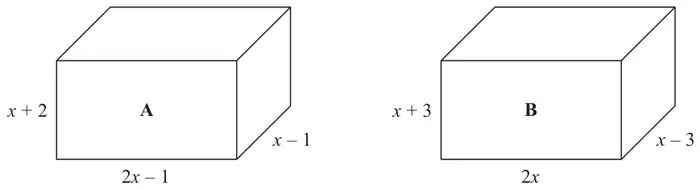
13 Show that \((2x + 3)(x - 1)(x + 2)\) can be written in the form \(ax^3 + bx^2 + cx + d\) where \(a\), \(b\), \(c\) and \(d\) are integers. (3)
Mark scheme
Answer
Mark
Mark scheme
Shown
M1
for a method to find the product of any two linear expressions (3 out of 4 terms correct or 4 terms ignoring signs) eg \(2x^2 - 2x + 3x - 3\ (= 2x^2 + x - 3)\) or \(x^2 - x + 2x - 2\ (= x^2 + x - 2)\) or \(2x^2 + 4x + 3x + 6\ (= 2x^2 + 7x + 6)\)
M1
(dep on M1) for a complete method to obtain all terms, half of which are correct (ft their first product) eg \(2x^3 - 2x^2 + 3x^2 + 4x^2 - 3x - 4x + 6x - 6\) or \(2x^3 - 2x^2 + 4x^2 - 4x + 3x^2 - 3x + 6x - 6\) or \(2x^3 + 4x^2 + 3x^2 + 6x - 2x^2 - 4x - 3x - 6\) or \(2x^3 + 4x^2 + x^2 - 3x + 2x - 6\) or \(2x^3 + 2x^2 + 3x^2 - 4x + 3x - 6\) or \(2x^3 - 2x^2 + 7x^2 - 7x + 6x - 6\)
C1
for \(2x^3 + 5x^2 - x - 6\) from correct working
Additional guidance
Note that, for example, \(2x^2 + x\) in the expansion of \((2x + 3)(x - 1)\) is regarded as 3 correct terms
First product must be quadratic with at least 3 terms but need not be simplified or may be simplified incorrectly
Accept \(a = 2, b = 5, c = -1, d = -6\) Condone \(-1x\)
10 Prove that the difference in the squares of two consecutive even numbers is always a multiple of 4 (3)
Mark scheme
Answer
Mark
Mark scheme
Proof
M1
for writing expressions for two consecutive even numbers, eg \(2n\) and \(2n + 2\) or \(2n - 2\) and \(2n\) or \(2n + 2\) and \(2n + 4\) oe (assuming \(n\) is any integer)
M1
(dep M1) for correctly expanding the squares of both expressions, eg \((2n + 2)^2 = 4n^2 + 4n + 4n + 4\) and \((2n)^2 = 4n^2\) or \((2n)^2 = 4n^2\) and \((2n - 2)^2 = 4n^2 - 4n - 4n + 4\) or \((2n + 4)^2 = 4n^2 + 8n + 8n + 16\) and \((2n + 2)^2 = 4n^2 + 4n + 4n + 4\)
or for a correct expression using the difference of two squares eg \((2n + 2 + 2n)(2n + 2 - 2n)\) oe or \((2n + 2n - 2)(2n - (2n - 2))\) oe
C1
for a complete proof without any errors leading to eg \(4(2n + 1)\) or \(4(2n - 1)\) or to a statement that eg \(8n + 4\) is a multiple of 4 because \(8n\) and 4 are both multiples of 4
Additional guidance
For both M marks accept use of linear expressions with a difference of 2, eg \(n\) and \(n + 2\) or \(n + 1\) and \(n + 3\)
A proof using eg \(n\) and \(n + 2\) must include a statement that \(n\) is even for the C mark to be awarded and a proof using eg \(n + 1\) and \(n + 3\) must include a statement that \(n\) is odd
for method to find the product of any two linear expressions (3 out of 4 terms correct or 4 correct terms ignoring signs) eg \(6x^2 + 9x - 2x - 3\) or \(3x^2 - 15x - x + 5\) or \(2x^2 - 10x + 3x - 15\)
M1
for a complete method to obtain all terms, half of which are correct (ft their first product) eg \(6x^3 + 7x^2 - 30x^2 - 35x - 3x + 15\) or \(6x^3 + 9x^2 - 32x^2 - 48x + 10x + 15\) or \(6x^3 - 2x^2 - 21x^2 - 45x + 7x + 15\)
A1
cao
Additional guidance
Note that, for example, \(7x - 3\) in expansion of \((3x - 1)(2x + 3)\) is regarded as 3 correct terms Do not award this mark for eg \(6x^2 + 9x - 2x - 3 + 3x^2 - 15x - x + 5\)
First product must be quadratic with at least 3 terms but need not be simplified or may be simplified incorrectly
(c) Make \(g\) the subject of the formula \(\ f = 3g + 11\) (2)
Mark scheme (a)
Answer
Mark
Mark scheme
\(13y - 1\)
M1
for method to expand one bracket or collect like terms eg \(3 \times 2y - 3 \times 5\ (= 6y - 15)\) or \(7 \times y + 7 \times 2\ (= 7y + 14)\) or \(3 \times 2y + 7 \times y\ (= 6y + 7y)\) or \(3 \times -5 + 7 \times 2\ (= -15 + 14)\)
A1
oe
Additional guidance
May be implied by \(13y\) or \(-1\)
Mark scheme (b)
Answer
Mark
Mark scheme
\(3x(2x + 5)\)
B2
oe
(B1
for \(3(2x^2 + 5x)\) or \(x(6x + 15)\) or \(3x(ax + b)\))
Mark scheme (c)
Answer
Mark
Mark scheme
\(g = \dfrac{f - 11}{3}\)
M1
for correct first step to rearrange eg \(f - 11 = 3g + 11 - 11\) or \(f - 11 = 3g\) or eg \(\dfrac{f}{3} = \dfrac{3g}{3} + \dfrac{11}{3}\) or \(-3g = 11 - f\) or answer ambiguously shown, eg \(g = f - 11 \div 3\) or given as \(\dfrac{f - 11}{3}\)
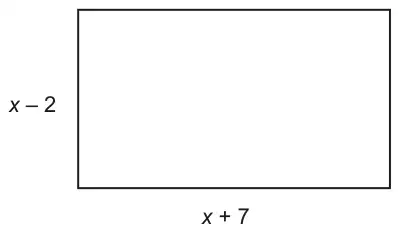
for a method to find the product of two linear expression (3 out of 4 terms correct or 4 correct terms ignoring signs), eg \(x^2 - 2x + 7x - 14\) or \(x^2 + 3x - 2x - 6\) or \(x^2 + 3x + 7x + 21\)
M1
for a complete method to obtain all terms, half of which are correct (ft their first product), eg \(x^3 + 3x^2 - 2x^2 + 7x^2 - 6x + 21x - 14x - 42\)
A1
cao
Additional guidance
Note that (eg) \(5x - 14\) in expansion of \((x + 7)(x - 2)\) is to be regarded as 3 correct terms.
First product must be quadratic with at least 3 terms but need not be simplified or may be simplified incorrectly
12 Show that \((x - 1)(x + 3)(x - 5)\) can be written in the form \(ax^3 + bx^2 + cx + d\) where \(a\), \(b\), \(c\) and \(d\) are integers. (3)
Mark scheme
Answer
Mark
Mark scheme
Shown
M1
for a method to find the product of two linear expressions (3 out of 4 terms correct or 4 correct terms ignoring signs) eg \(x^2 + 3x - x - 3\) or \(x^2 + 3x - 5x - 15\) or \(x^2 - 5x - x + 5\)
M1
for a complete method to obtain all terms, half of which are correct (ft their first product) eg \(x^3 - 5x^2 - 10x + 2x^2 - 3x + 15\)
(a) Prove that \[(2m + 1)^2 - (2n - 1)^2 = 4(m + n)(m - n + 1)\] (3)
Sophia says that the result in part (a) shows that the difference of the squares of any two odd numbers must be a multiple of 4
(b) Is Sophia correct? You must give reasons for your answer. (1)
Mark scheme (a)
Answer
Mark
Mark scheme
Proof
M1
for expansion of \((2m + 1)^2\) or \((2n - 1)^2\), all 4 terms correct with or without signs (and no additional terms) or 3 out of 4 terms correct with signs, eg \(4m^2 + 2m + 2m + 1\) or \(4n^2 - 2n - 2n + 1\)
or for correct expansion of \(4(m + n)(m - n + 1)\) or \((m + n)(m - n + 1)\) eg \(4m^2 - 4mn + 4m + 4mn - 4n^2 + 4n\) oe or \(m^2 - mn + m + mn - n^2 + n\) oe
for yes with explanation, eg \(2m + 1\) and \(2n - 1\) are odd numbers (for any positive integer value of \(m\), \(n\)) and the right-hand side is a multiple of 4
(b) Show that \((m + 4)(2m - 5)(3m + 1)\) can be written in the form \(am^3 + bm^2 + cm + d\) where \(a\), \(b\), \(c\) and \(d\) are integers. (3)
Mark scheme (a)
Answer
Mark
Mark scheme
\(4(p - 3)(p + 3)\)
M1
for \(4(p^2 - 9)\) or partial factorisation which includes the product of 2 linear factors eg \((4p - 12)(p + 3)\) or \((p - 3)(4p + 12)\) or \((2p - 6)(2p + 6)\) or \(2(2p - 6)(p + 3)\) or \(2(2p + 6)(p - 3)\) or \(2(p - 3)2(p + 3)\)
A1
for \(4(p - 3)(p + 3)\)
Mark scheme (b)
Answer
Mark
Mark scheme
\(6m^3 + 11m^2 - 57m - 20\)
M1
for a method to find the product of two linear expressions, 3 correct terms out of 4 terms, eg \(6m^2 + 2m - 15m - 5 = 6m^2 - 13m - 5\) or \(2m^2 + 8m - 5m - 20 = 2m^2 + 3m - 20\) or \(3m^2 + 12m + m + 4 = 3m^2 + 13m + 4\)
M1
for a complete method to obtain all terms, at least half of which are correct (ft their first product), eg \(6m^3 + 2m^2 - 15m^2 + 24m^2 + 8m - 60m - 5m - 20\)
A1
for \(6m^3 + 11m^2 - 57m - 20\)
Additional guidance
Note that, for example, \(3m - 20\) is regarded as three terms in the expansion of \((m + 4)(2m - 5)\)
First product must be a 3 or 4 term quadratic but need not be simplified or may be incorrect.
for a correct first stage eg expanding the brackets, \(2 \times 5x - 2 \times 4\ (= 10x - 8)\) or division of both sides by 2, eg \(\dfrac{2(5x - 4)}{2} = \dfrac{21}{2}\)
M1
for isolating terms in \(x\) eg \(10x = 21 + 8\)
A1
oe
Mark scheme (d)
Answer
Mark
Mark scheme
\(20e^3f^4\)
M1
for any two of \(4 \times 5\ (= 20)\), \(e^{2+1}\ (= e^3)\), \(f^{1+3}\ (= f^4)\) in a product or written as individual terms
for method to find the product of any two linear expressions (3 out of no more than 4 terms correct with correct signs or 4 correct terms ignoring signs), eg. \(6x^2 + 9x + 4x + 6\) or \(3x^2 + 2x - 6x - 4\) or \(2x^2 + 3x - 4x - 6\)
M1
for method of multiplying out remaining products, half of which are correct (ft their first product), eg. \(6x^3 + 13x^2 - 12x^2 + 6x - 26x - 12\)
A1
cao
Additional guidance
Note that, for example, \(6x^2 + 13x\) or \(13x + 6\) are regarded as three terms in the expansion of \((3x + 2)(2x + 3)\) (corrected from the printed mark scheme: it says \((x - 2)(3x + 2)\), but these terms come from \((3x + 2)(2x + 3)\))
First product must be quadratic but need not be simplified or may be simplified incorrectly.
for method to find the product of any two linear expressions (3 out of no more than 4 terms correct with correct signs or 4 correct terms ignoring signs)
M1
for method of multiplying out remaining products, half of which are correct (ft their first product)
A1
cao
Additional guidance
Note that, for example, \(6x^2 + 7x\) or \(7x + 2\) are regarded as three terms in the expansion of \((3x + 2)(2x + 1)\)
First product must be quadratic but need not be simplified or may be simplified incorrectly
(a) Show that \((2x + 1)(x + 3)(3x + 7)\) can be written in the form \(ax^3 + bx^2 + cx + d\) where \(a\), \(b\), \(c\) and \(d\) are integers. (3)
(b) Solve \((1 - x)^2 \lt \dfrac{9}{25}\) (3)
Mark scheme (a)
Answer
Mark
Mark scheme
\(6x^3 + 35x^2 + 58x + 21\)
M1
for a method to find the product of two linear expressions, 3 correct terms out of 4 terms e.g. \(2x^2 + x + 6x + 3\) or \(3x^2 + 7x + 9x + 21\) or \(6x^2 + 14x + 3x + 7\)
M1
for a complete method to obtain all terms, at least half of which are correct (ft their first product) e.g. \(6x^3 + 32x^2 + 42x + 3x^2 + 16x + 21\)
A1
cao
Additional guidance
Note that, for example, \(7x + 3\) is regarded as three terms in the expansion of \((2x + 1)(x + 3)\)
First product must be a 3 or 4 term quadratic but need not be simplified or may be simplified incorrectly
for first step of finding the square root of both sides eg \(1 - x \lt \pm\dfrac{3}{5}\) OR for writing in the form \(ax^2 + bx + c\ (\lt 0)\) eg \(x^2 - 2x + \dfrac{16}{25}\ (\lt 0)\) or \(25x^2 - 50x + 16\ (\lt 0)\)
M1
for showing critical values \(\dfrac{2}{5}\ (= 0.4)\) and \(1\dfrac{3}{5}\ (= 1.6)\) oe
A1
for \(\dfrac{2}{5} \lt x \lt 1\dfrac{3}{5}\) oe
Additional guidance
Condone use of an “=” sign; accept one square root (eg \(\tfrac{3}{5}\)) only shown.
Critical values can be stated, or shown in an expression (which may have incorrect inequality symbols)
Could be written as two separate expressions eg \(x \gt \dfrac{2}{5}\) and \(x \lt 1\dfrac{3}{5}\) oe
15 Prove algebraically that the difference between the squares of any two consecutive odd numbers is always a multiple of 8 (3)
Mark scheme
Answer
Mark
Mark scheme
proof
C1
for writing an expression for an odd number, eg \(2n + 1\) or \(2n - 1\) (assuming \(n\) is any integer) or states \(n\) is even and eg \((n + 1)\) or \((n + 3)\) as odd numbers
C1
for a correct expression of the form \((2n + 1)^2 - (2n - 1)^2\) expanded eg \(4n^2 + 12n + 9 - (4n^2 + 4n + 1)\) or \(4n^2 + 4n + 1 - (4n^2 - 4n + 1)\) or \((2n + 1 + 2n - 1)(2n + 1 - (2n - 1))\) or when \(n\) is even and eg \((n^2 + 6n + 9) - (n^2 + 2n + 1)\) (\(= 4n + 8\))
C1
for a correct simplified expression as a multiple of 8 eg \(8n + 8\) or \(8n\) or when \(n\) is even and eg \(4n + 8\) and full explanation as to why \(4(n + 2)\) is always a multiple of 8
Additional guidance
Expansion of \((2n - 1)^2 - (2n + 1)^2\) oe is acceptable
for \(4 \times 5\) and \(3 \times -2\), the substitution may be seen in two separate calculations, eg \(4 \times 5\ (= 20)\) and \(3 \times -2\ (= -6)\)
A1
cao
Mark scheme (b)
Answer
Mark
Mark scheme
\(4e^2 + 8e\)
B2
for \(4e^2 + 8e\)
(B1
for \(4e^2\) or \(8e\))
Additional guidance
Note: \(4e^2 + 8e = 12e^3\) for example gets B1 only
Mark scheme (c)
Answer
Mark
Mark scheme
11
M1
for a correct first step eg \(3 \times m - 3 \times 4 = 21\) oe or \(m - 4 = 21 \div 3\ (= 7)\) oe
A1
cao
Additional guidance
Showing \(\div 3\) by each side of equation is sufficient
for using ‘\(a\)’ \(= x^2 + 4\) and ‘\(b\)’ \(= x^2 - 2\) OR multiplying out both brackets, at least one fully correct
M1
(dep) for a correct expression for (‘\(a\)’ + ‘\(b\)’)(‘\(a\)’ − ‘\(b\)’) with no additional brackets, simplified or unsimplified eg \((x^2 + 4 + x^2 - 2)(x^2 + 4 - x^2 + 2)\) or \((2x^2 + 2) \times 6\) OR ft for a correct expression without brackets, simplified or unsimplified eg \(x^4 + 8x^2 + 16 - x^4 + 4x^2 - 4\)
A1
for \(12(x^2 + 1)\) or \(12x^2 + 12\) oe
Additional guidance
M1 (first): Correct 4 terms if not simplified or 3 terms if simplified
Prove algebraically that the sum of \(\dfrac{1}{2}n(n + 1)\) and \(\dfrac{1}{2}(n + 1)(n + 2)\) is always a square number. (2)
Mark scheme
Answer
Mark
Notes
Completes proof
M1
Expands both expressions eg \(\dfrac{1}{2}(n^2 + n + n^2 + n + 2n + 2)\) or \(n^2 + n\) and \(n^2 + n + 2n + 2\) or factorises \(\dfrac{1}{2}(n+1)(n+n+2)\)
C1
Completes proof with explanation and reference to \((n+1)^2\)
for correct expansion of the bracket or dividing all terms by 3 as a first step eg \(3x - 3\) or \((5x - 6)/3 = 3(x - 1)/3\)
M1
for isolating terms in \(x\) on one side of an equation eg \(5x - 6 - 3x = -3\) or both constants on one side of an equation, eg \(5x = 3x - 3 + 6\), ft \(5x - 6 = 3x - 1\)
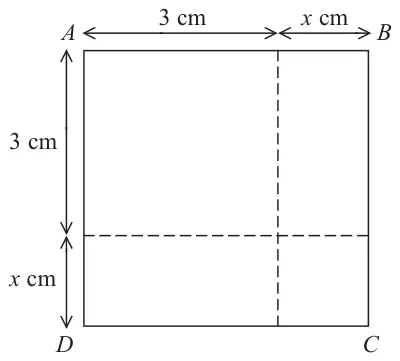
writes the area using algebraic terms e.g. \((x + 3) \times (x + 3)\) or at least two correct area expressions, may be written on the diagram or \(x\) given as \(\sqrt{10} - 3\)
M1
expands and includes the given 10 e.g. \(x^2 + 3x + 3x + 9 = 10\); condone one error in the four terms when expanding or \(10 - 3\sqrt{10} - 3\sqrt{10} + 9 + 6\sqrt{10} - 18\ (=1)\) condone 1 error in the 6 terms
A1
rearranges to give the given equation or shows surd expression simplifies to 1
10 Show that \((x + 1)(x + 2)(x + 3)\) can be written in the form \(ax^3 + bx^2 + cx + d\) where \(a\), \(b\), \(c\) and \(d\) are positive integers. (3)
Mark scheme
Answer
Mark
Notes
\(x^3 + 6x^2 + 11x + 6\)
M1
for method to find the product of any two linear expressions (3 correct terms) e.g. \(x^2 + x + 2x + 2\) or \(x^2 + 2x + 3x + 6\) or \(x^2 + x + 3x + 3\)
M1
for method of multiplying out remaining products, half of which are correct (ft their first product) e.g. \(x^3 + x^2 + 2x^2 + 3x^2 + 2x + 3x + 6x + 6\)
writes the area using algebraic terms e.g. \((x + 3) \times (x + 3)\) or at least two correct area expressions which may be written on the diagram or \(x\) given as \(\sqrt{10} - 3\)
M1
expands and includes the given 10 e.g. \(x^2 + 3x + 3x + 9 = 10\); condone one error in the four terms when expanding or \(10 - 3\sqrt{10} - 3\sqrt{10} + 9 + 6\sqrt{10} - 18\ (=1)\) condone 1 error in the 6 terms
A1
rearranges to give the given equation or shows surd expression simplifies to 1
M1 for expanding brackets e.g. \(4x + 12\ (= 2x + 8)\) or divide by 4 as a first step e.g. \(x + 3 = \dfrac{2x}{4} + \dfrac{8}{4}\) M1 ft their equations which have to be of the form \(ax + b = 2x + 8\) or \(x + 3 = ax + b\) for isolating terms in \(x\) and numbers e.g. \(4x - 2x = 8 - 12\) seen as part of their solution oe A1 cao
M1 for correct method to expand \((n + 2)^2\) or \((n + 1)^2\) M1 for correct simplification of numerator M1 for factorisation of \(2n^2 + 3n\) or for clearing the fractions on both sides correctly C1 for complete and correct proof
OR M1 for \(\{(n + 2) - (n + 1)\}\{(n + 2) + (n + 1)\}\) M1 for \(1 \times (2n + 3)\) M1 for factorisation of \(2n^2 + 3n\) or for clearing the fractions on both sides correctly C1 for complete and correct proof
OR M1 for \(n\{(n + 2)^2 - (n + 1)^2\} = (2n^2 + 3n) \times 1\) M1 for \(n(n + 2)^2 - n(n + 1)^2\) or for correct expansion of \((n + 2)^2 - (n + 1)^2\) M1 for correct expansion of \(n\{(n + 2)^2 - (n + 1)^2\}\) C1 for complete and correct proof (must include statement recognising the equality of LHS and RHS)
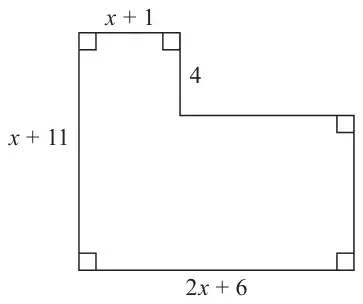
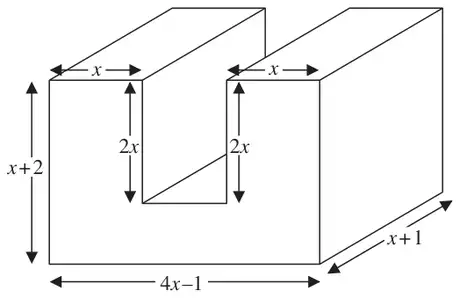
All measurements are in centimetres. All corners are right angles.
Find an expression, in terms of \(x\), for the volume, in cm\(^3\), of the prism. You must show your working. Give your answer in its simplest form. (4)
Mark scheme
Answer
Mark
Notes
\(9x^2 + 7x - 2\)
4
M1 for finding an expression for a missing length eg \(4x - 1 - x - x\) (\(=2x - 1\)) or \(x + 2 - 2x\) (\(=2 - x\)) M1 for a correct expression for one area from the cross-section, eg. \(x \times 2x\) or \((4x - 1)(x + 2 - 2x)\) or for one volume of cuboid(s), eg. \(x \times 2x \times (x + 1)\) M1 for a complete method to find the volume A1 for \(9x^2 + 7x - 2\) or \((9x - 2)(x + 1)\) oe
M1 for \(\dfrac{n^{10}}{n^6}\) oe or \(\dfrac{n^7}{n^3}\) oe or \(n \times n^3\) oe A1 cao
Mark scheme (b)
Answer
Mark
Notes
\(3x^2 + 4x\)
2
B2 for \(3x^2 + 4x\) or \(x(3x + 4)\) (B1 for \(x^2 - 2x\) or \(2x^2 + 6x\) or \(3x^2 + nx\) or \(px^2 + 4x\))
Mark scheme (c)
Answer
Mark
Notes
\(5(y - 3)\)
1
B1 cao
Mark scheme (d)
Answer
Mark
Notes
\(9ab(2 + 3b)\)
2
B2 for \(9ab(2 + 3b)\) (B1 for \(9a(2b + 3b^2)\) or \(9b(2a + 3ab)\) or \(ab(18 + 27b)\) or \(3ab(6 + 9b)\) or \(3a(6b + 9b^2)\) or \(3b(6a + 9ab)\) or \(9ab\)(a two term algebraic expression))
M1 for 3 out of 4 terms correct in the expansion of \((2n + 1)^2\) or \((2n + 1)\{(2n + 1) - 1\}\) A1 for \(4n^2 + 2n\) or equivalent expression in factorised form C1 for convincing statement using \(2n(2n + 1)\) or \(2(2n^2 + n)\) or \(4n^2 + 2n\) to prove the result
B2 for \(6x^2 + 15x\) (B1 for \(6x^2\) or \(15x\))
Mark scheme (c)
Working
Answer
Mark
Notes
\(m^2 + 10m + 3m + 30\)
\(m^2 + 13m + 30\)
2
M1 for all 4 terms (and no additional terms) correct with or without signs or 3 out of no more than four terms correct with signs A1 for \(m^2 + 13m + 30\)
M1 for any two consecutive integers expressed algebraically eg \(n\) and \(n + 1\) M1 (dep on M1) for the difference between the squares of ‘two consecutive integers’ expressed algebraically eg \((n + 1)^2 - n^2\) A1 for correct expansion and simplification of difference of squares, eg \(2n + 1\) C1 (dep on M2A1) for showing statement is correct, eg \(n + n + 1 = 2n + 1\) and \((n + 1)^2 - n^2 = 2n + 1\) from correct supporting algebra
M1 for correct method to expand one bracket eg \(3 \times x + 3 \times 4\) or \(3x + 12\) or \(2 \times 5x - 2 \times 1\) or \(10x - 2\) A1 for \(13x + 10\)
Mark scheme (b)
Working
Answer
Mark
Notes
\(2x^2 - 8x + x - 4\)
\(2x^2 - 7x - 4\)
2
M1 for all 4 terms (and no additional terms) correct ignoring signs or 3 out of no more than four terms correct A1 for \(2x^2 - 7x - 4\)
Mark scheme (c)
Answer
Mark
Notes
\(3y(2y - 3x)\)
2
B2 for \(3y(2y - 3x)\) (B1 for \(3(2y^2 - 3xy)\) or \(y(6y - 9x)\) or \(3y(2y + 3x)\) or \(3y(2y - ax)\) where \(a\) is any positive integer except 3 or \(3y(by - 3x)\) where \(b\) is any positive integer except 2)
M1 for \(2 \times x - 2 \times 4\) or \(3 \times x + 3 \times 5\) A1 cao
Mark scheme (c)
Answer
Mark
Notes
\(x^2 + 10x + 24\)
2
B2 cao (B1 for 4 correct terms with or without signs, or 3 out of no more than 4 terms, with correct signs. The terms may be in an expression or in a table)
M1 for 3 out of 4 terms correct in expansion of either \((2n + 3)^2\) or \((2n - 3)^2\) or \(((2n + 3) - (2n - 3))((2n + 3) + (2n - 3))\) A1 for \(24n\) from correct expansion of both brackets A1 (dep on A1) for \(24n\) is a multiple of 8 or \(24n = 8 \times 3n\) or \(24n \div 8 = 3n\)
M1 for attempting to multiply both sides by 3 as a first step (this can be implied by equations of the form \(5w - 8 = 12w + ?\) or \(5w - 8 = ?w + 6\) i.e. the LHS must be correct M1 for isolating terms in \(w\) and the number terms correctly from \(aw + b = cw + d\) A1 cao OR M1 for \(\dfrac{5w}{3} - \dfrac{8}{3} = 4w + 2\) M1 for isolating terms in \(w\) and the number terms correctly A1 cao
Mark scheme (c)
Answer
Mark
Notes
\((x + 7)(x - 7)\)
1
B1 cao
Mark scheme (d)
Answer
Mark
Notes
\(3x^4y^{\frac{3}{2}}\)
2
B2 for \(3x^4y^{\frac{3}{2}}\) or \(3x^4y^{1.5}\) or \(3x^4y^{1\frac{1}{2}}\) (B1 for any two terms correct in a product eg. \(3x^4y^n\))
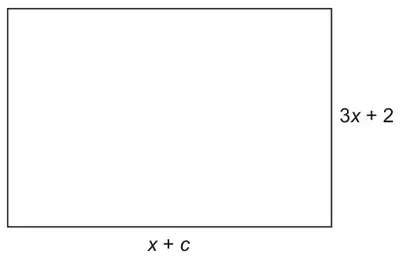
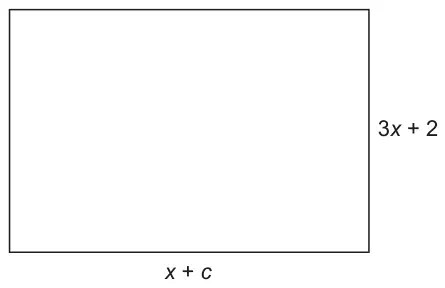
B2 \(3b + c = 10\) oe equation or \(a = 5\) and values for \(b\) and \(c\) other than the correct values such that \(3b + c = 10\) B1 \(a = 5\) or values for \(b\) and \(c\) such that \(3b + c = 2 \times\) their \(a\)
Additional guidance
The value of a letter omitted on the answer line and not evaluated in working is not taken to mean the value is zero
\(a = 5\) \(b = 0\) \(c = 10\)
B2
\(a = 5\) \(b = 4\) \(c = -2\)
B2
\(a = 5\) \(b = \dfrac{5}{3}\) \(c = 5\)
B2
\(a = 50\) \(b = 40\) \(c = -20\)
B1
Condone use of \(\equiv\) for \(=\) eg \(3b + c \equiv 10\)
(b) Use your answer from part (a) to work out \(\quad 102 \times 203 \times 304\) [2 marks]
Mark scheme (a)
Answer
Mark
Comments
Alternative method 1: multiplies \((x + 2)(2x + 3)\) first
\(2x^2 + 3x + 4x + 6\) or \(2x^2 + 7x + 6\)
M1
oe four terms with at least three correct implied by \(2x^2 + 7x + k\) or \(px^2 + 7x + 6\) where \(k\) and \(p\) are a non-zero constants may be seen in a grid
oe full expansion with correct multiplication of their 3 or 4 terms by \(3x\) or 4 may be seen in a grid
\(6x^3 + 29x^2 + 46x + 24\)
A1
Alternative method 2: multiplies \((2x + 3)(3x + 4)\) first
\(6x^2 + 8x + 9x + 12\) or \(6x^2 + 17x + 12\)
M1
oe four terms with at least three correct implied by \(6x^2 + 17x + k\) or \(px^2 + 17x + 12\) where \(k\) and \(p\) are non-zero constants may be seen in a grid
oe full expansion with correct multiplication of their 3 or 4 terms by \(x\) or 2 may be seen in a grid
\(6x^3 + 29x^2 + 46x + 24\)
A1
Alternative method 3: multiplies \((x + 2)(3x + 4)\) first
\(3x^2 + 4x + 6x + 8\) or \(3x^2 + 10x + 8\)
M1
oe four terms with at least three correct implied by \(3x^2 + 10x + k\) or \(px^2 + 10x + 8\) where \(k\) and \(p\) are non-zero constants may be seen in a grid
exactly 4 terms with 3 correct terms in any order may be seen in a grid implied by \(2x^3 - 13x^2y\) with one other term or \(-13x^2y - 45xy^2\) with one other term
Work out the values of \(a\), \(b\) and \(c\). [3 marks]
Mark scheme
Answer
Mark
Comments
\(2ax^3 + 2x^2 + 4x - 10\) and \(bx^2 + cx\) or \(2ax^3 + (2 + b)x^2 + (4 + c)x - 10\) or \(2a = 12\) or \(a = 6\)
M1
oe correct expansions
allow \(2ax^3 = 12x^3\)
\(2 + b = 7\) or \(b = 5\) or \(4 + c = 3\) or \(c = -1\)
M1
oe equation
\(a = 6\) and \(b = 5\) and \(c = -1\)
A1
SC2 any two of \(a = 6\) and \(b = 5\) and \(c = -1\)
Additional guidance
One correct value without working only scores one mark eg \(a = 6\) and \(b = -5\) and \(c = 1\) with no working eg \(a = -6\) and \(b = 5\) and \(c = 1\) with no working
M1M0A0 M0M1A0
Condone an incorrect \(-10\) in the expansion if A1 is awarded
\(10cd + 5c\) or \(10dc + 5c\) or \(5c + 10cd\) or \(5c + 10dc\)
B2
B1 fully simplified first term ie \(10cd\) or \(10dc\) or correct expansion not fully simplified eg \(10 \times cd + 5c\) or \(5c \times 2d + 5c\) (\(\times\) 1) or \(5c2d + 5 \times c\)
Additional guidance
Further incorrect work after a B2 response is B1 eg \(10cd + 5c = 15cd\)
B1
Further incorrect work after a B1 response is still B1 eg \(10cd + 1 = 11cd\)
B1
Mark scheme (c)
Answer
Mark
Comments
\(7(3x + 4)\)
B1
Additional guidance
Condone missing final bracket ie \(7(3x + 4\)
B1
Allow multiplying back out to check their answer
Further incorrect work after a correct response is B0 eg \(7(3x + 4) = 7(7x)\)
their \(10x - 6x = 9 +\) their 5 or \(4x = 14\) or \(14 \div 4\) or \(7 \div 2\)
M1
oe eg their \(-5 - 9 = 6x -\) their \(10x\) or \(4x - 14 = 0\) collecting two terms in \(x\) and two constant terms correctly
\(\dfrac{14}{4}\) or \(3\dfrac{2}{4}\) or \(\dfrac{7}{2}\) or \(3\dfrac{1}{2}\) or 3.5
A1ft
oe ft M1M0 or M0M1 with exactly one error
Alternative method 2
\(\dfrac{6x}{5} + \dfrac{9}{5}\)
M1
oe two terms eg \(1.2x + 1.8\)
\(2x -\) their \(\dfrac{6x}{5} =\) their \(\dfrac{9}{5} + 1\) or \(\dfrac{4x}{5} = \dfrac{14}{5}\)
M1
oe eg \(-1 -\) their \(\dfrac{9}{5} =\) their \(\dfrac{6x}{5} - 2x\) or \(\dfrac{4x}{5} - \dfrac{14}{5} = 0\) collecting two terms in \(x\) and two constant terms correctly
\(\dfrac{14}{4}\) or \(3\dfrac{2}{4}\) or \(\dfrac{7}{2}\) or \(3\dfrac{1}{2}\) or 3.5
A1ft
oe ft M1M0 or M0M1 with exactly one error
Additional guidance
Ignore simplification or conversion if correct answer seen
Correct answer from trial and improvement
M1M1A1
Correct equation with terms collected or division with no or incorrect answer
M1M1A0
Embedded 3.5 with no or incorrect answer
M1M1A0
\(10x - 5 = 6x + 9\) \(10x - 6x = 9 - 5\) \(x = 1\) (exactly one error in line 2)
M1 M0 A1ft
\(7x - 5 = 6x + 9\) \(7x - 6x = 9 + 5\) \(x = 14\) (exactly one error in line 1)
oe full expansion of their 4 terms by \((x - 4)\) with at least 4 terms correct or full expansion of their 3 terms by \((x - 4)\) with at least 3 terms correct ft \((x + 4)^3\) only
\(x^3 - 12x^2 + 48x - 58\)
A1
Additional guidance
Using \((x + 4)^3\) can score a maximum of B0M1M1A0 \(x^2 + 4x + 4x + 16\) with 3 terms correct or \(x^2 + 8x + k\) where \(k\) is a non-zero constant \(x^3 + 4x^2 + 4x^2 + 16x + 4x^2 + 16x + 16x + 64\ (+ 6)\) or \(x^3 + 8x^2 + 16x + 4x^2 + 32x + 64\ (+ 6)\) or \(x^3 + 12x^2 + 48x + 64\) or \(x^3 + 12x^2 + 48x + 70\)
A1 \(2(n + 1)\,\dfrac{n + 1}{2}\) or \(\dfrac{2(n + 1)^2}{2}\) allow \((n + 1)(n + 1)\) for \((n + 1)^2\)
Additional guidance
Only substituting in values of \(n\)
M0M0A0A0
Consistently using a different letter to \(n\) can score up to M1M1A1A1
Using two different letters consistently within the two fractions (eg \(n\) replaced by \(x\) in the first equation and \(n\) replaced by \(y\) in the second equation) can score a maximum of M1M1A0A0 unless recovered to the same letter
Multiplying fractions instead of adding can score a maximum of M2A0
Equating to \(n^2\) in working can score a maximum of M1M1A0A0 (equating to eg \(x^2\) can score up to M1M1A1A1)
\(1n\) is allowed for \(n\) throughout
Alts 2 and 3 \(\dfrac{n + 1}{2}(2n + 2)\) with M1 seen scores M2 If they attempt to expand \((n + 1)(2n + 2)\) use Alt 2 If they attempt to expand \(\dfrac{1}{2}(2n + 2)\) use Alt 3
their \(12x - 2x = -5 +\) their 8 or \(10x = 3\) or their \(-8 + 5 = 2x -\) their \(12x\) or \(-3 = -10x\)
M1
Collecting two terms in \(x\) and two constant terms correctly oe eg \(10x - 3 = 0\)
0.3 or \(\dfrac{3}{10}\)
A1ft
ft M1M0 or M0M1 with exactly one error
Alternative method 2
\(\dfrac{x}{2} - \dfrac{5}{4}\)
M1
\(3x -\) their \(\dfrac{x}{2}\) = their \(-\dfrac{5}{4} + 2\) or \(\dfrac{5}{2}x = \dfrac{3}{4}\) or \(-2 +\) their \(\dfrac{5}{4}\) = their \(\dfrac{x}{2} - 3x\) or \(-\dfrac{3}{4} = -\dfrac{5}{2}x\)
M1
Collecting two terms in \(x\) and two constant terms correctly oe eg \(\dfrac{5}{2}x - \dfrac{3}{4} = 0\)
(a) Write this expression in its simplest factorised form.
\((x + 4)(x - 4)^2 - x^2(x - 5)\)
You must show your working. [6]
(b) Use your answer to part (a) to write down the value of \(x\) which gives the smallest value of this expression. [1]
Mark scheme (a)
Answer
Marks
Part marks and guidance
\((x - 8)^2\) or \((x - 8)(x - 8)\) final answer with correct working
6
B5 for answer \(x^2 - 16x + 64\) with correct working
correct working requires at least M3 or M1 M1 M1 or M2 M1
If you award B marks do not award any extra M marks
OR B4 for answer \(-9x^2 - 16x + 64\) with correct working
OR M3 for correctly expanding the triple bracket e.g. \(x^3 - 4x^2 - 16x + 64\) oe
e.g. \(x^3 - 8x^2 + 16x + 4x^2 - 32x + 64\) oe
or M2 for correctly expanding any two brackets from the triple bracket e.g. \(x^2\ [-4x + 4x] - 16\) or \(x^2 - 4x - 4x + 16\) oe or \((x^2 - 8x + 16)(x + 4)\)
e.g. \(x^2 - 16\) or \(x^2 - 8x + 16\)
condone one error in the previous step e.g \((x^2 - 8x + 8)(x + 4) = x^3 + 4x^2 - 8x^2 - 32x + 8x + 32\) or better scores M2
or M1 for attempting to expand any two brackets e.g. \(x^2 + 4x - 4x - 16\) oe with at most one error
e.g. \(x^2 - 8\)
AND M1 for correctly expanding final bracket e.g. \(-x^3 + 5x^2\) oe
Note : brackets must be removed and \((-x^3 + 5x^2)\) must not be used for multiplication
AND M1 for correctly simplifying their final expression by collecting like terms e.g. \(x^2 - 16x + 64\)
If 0,1 or 2 scored instead SC3 for answer \((x - 8)^2\) or \((x - 8)(x - 8)\)
Note : once mark(s) are awarded they are not lost for subsequent incorrect working
Mark scheme (b)
Answer
Marks
Part marks and guidance
8
1FT
Note : correct answer 8 scores 1 FTtheir \((ax^2 + bx + c)\) where \(a \gt 0\) and their answer should be \(-\frac{b}{2a}\).
If the quadratic expression is factorised, expand the brackets first.
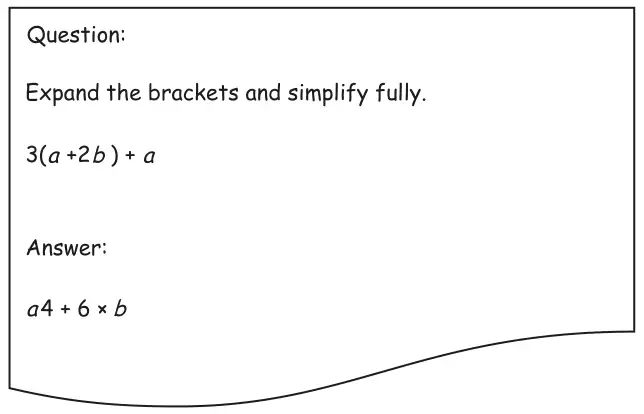
Reason includes a4 should be written as \(4a\) oe or the 4 is written after the \(a\) oe
and
\(6 \times b\) should be written as \(6b\) oe or the 6 and \(b\) should not be separated oe
2
B1 for correct explanation for one term a4 should be written as \(4a\) oe or the 4 is written after the \(a\) oe
or
\(6 \times b\) should be written as \(6b\) oe or the 6 and b should not be separated oe
or
correct expression written \(4a + 6b\)
Must refer to error in each term for 2 marks Incorrect statements apply penalty 1 mark if 2 marks earned
See appendix 3
Appendix
APPENDIX 3 Question 20
Answers that imply the brackets have been multiplied incorrectly treat as incorrect statements Do not accept for 2 marks \(4a + 6b\) alone without some explanation but allow for B1
Response
Mark
A
He didn’t put the 6 and the \(b\) together to show it is multiplied. He put the 4 after the \(a\) when it should be before (oe)
2
B
Because they separated the \(b\) from the 6 and put the a in front of the 4
2
C
In algebra the 4 should come before the a so it is \(4a\), the multiplication sign is not needed so it should be \(6b\) \(4a + 6b\) should not be simplified so the answer is \(2a + 3b\) (penalty 1 after correct explanation for 2 marks then incorrect statement)
1
D
It is correct \(4a + 6b\)
B1
E
It is not written correctly, it should be \(4a + 6b\) (B1 for \(4a + 6b\))
B1
F
The answer is \(4a + 6b\)
B1
G
Because numbers have to be placed in front of letters BOD for term in \(a\) term in \(b\) not explained
B1
H
Shows \(4a + 6b\) in working and then ‘because they can further simplify the answer by \(2(2a + 3b)\)’
B1
I
It should be \(4a + 6b\), the student has not timesed the 6 and the b together
B1
J
It is \(6b\) not \(6 \times b\) – it has not been fully simplified
B1
K
a4 is incorrect as 4 is the coefficient – it should be \(4a\)
B1
L
The answer should be \(4a + 6b\), he did the \(2b\) calculation wrong he should have multiplied them together by 3 to get the answer
B1
M
The number must be before the letter \(4a + 6b\)
B1
N
\(4a + 6b\) written above answer lines and answer line blank
B1
O
She has put 4 after the \(a\) and has only multiplied the number 2 by 3 without the \(b\) (one correct statement about \(a\))
B1
P
He has put \(4a\) as a power and \(6 \times b\) should be \(6b\), should be \(4a + 6b\) (B1 for \(4a + 6b\))
B1
Q
They should not be separating the 6 and the \(b\) it should be \(6b\)
B1
R
The contents of the bracket were not expanded correctly it should be \(2 \times 3b = 6b\) (not explained error how term is written)
0
S
He has written \(a\)4 and \(6 \times b\) (further explanation about the error needed)
Find the two possible pairs of values for \(a\) and \(b\). You must show your working. [6]
Mark scheme
Answer
Marks
Part marks and guidance
\(a = 5\) \(b = 7\) \(a = -5\) \(b = 7\) with correct working
6
M1 for constant term identified as \(-2a^2\) or seen in their expansion
M1 for their constant term \(= -50\)
A1 for \(a = 5\) or \(a = -5\)
Correct working requires evidence of at least M1 AND M1 Full expansion is \(16x^4 + 4ax^3 - 4ax^3 + 32x^2 - a^2x^2 + 8ax - 8ax - 2a^2\) or better scores at least M1 AND M1
AND
M1 for \(b = 32 - a^2\) or for coefficient of \(x^2\) identified as \(32 - a^2\) or seen in their expansion
M1 for \(b = 32 - (\textit{their } a)^2\) evaluated
May be seen as \(32x^2\) and \(-a^2x^2\) in the expansion
Trials: M1M1M1M1 for \((4x + 5)(4x - 5)(x^2 + 2)\) expanded and simplified to \(16x^4 + 7x^2 - 50\) A1 for \(a = 5\) or \(a = -5\) or M1M1M1 for \((4x + 5)(4x - 5)(x^2 + 2)\) expanded to \(16x^4 + 20x^3 - 20x^3 + 32x^2 - 25x^2 + 40x - 40x - 50\) or better A1 for \(a = 5\) or \(a = -5\)
If 0, 1 or 2 scored instead award SC3 for both correct pairs of answers \(a = 5\) and \(b = 7\) \(a = -5\) and \(b = 7\)
If 0 or 1 scored instead award SC2 for \(a = 5\) and \(a = -5\) or for \(a = 5\) and \(b = 7\) or for \(a = -5\) and \(b = 7\)
If 0 scored instead award M1 for \((4x + a)(4x - a) = 16x^2 - a^2\) or for \((4x + a)(x^2 + 2) = 4x^3 + ax^2 + 8x + 2a\) or for \((4x - a)(x^2 + 2) = 4x^3 - ax^2 + 8x - 2a\) or SC1 for \(a = 5\) or \(a = -5\) or at least one answer with \(b = 7\)
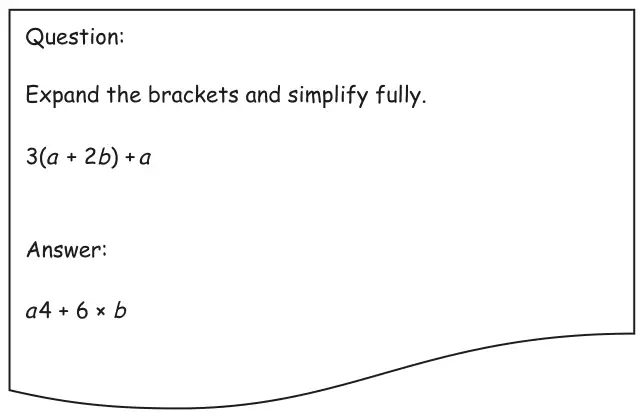
Reason includes \(a4\) should be written as \(4a\) oe or the 4 is written after the \(a\) oe
and
\(6 \times b\) should be written as \(6b\) oe or the 6 and \(b\) should not be separated oe
2
B1 for correct explanation for one term \(a4\) should be written as \(4a\) oe or the 4 is written after the \(a\) oe
or
\(6 \times b\) should be written as \(6b\) oe or the 6 and b should not be separated oe
or
correct expression written \(4a + 6b\)
Must refer to error in each term for 2 marks Incorrect statements apply penalty 1 mark if 2 marks earned
See appendix 2
Appendix 2: Question 8
Answers that imply the brackets have been multiplied incorrectly treat as incorrect statements Do not accept for 2 marks 4a + 6b alone without some explanation but allow for B1
Response
Mark
A
He didn’t put the 6 and the b together to show it is multiplied. He put the 4 after the a when it should be before (oe)
2
B
Because they separated the b from the 6 and put the a in front of the 4
2
C
In algebra the 4 should come before the a so it is 4a, the multiplication sign is not needed so it should be 6b 4a + 6b should not be simplified so the answer is 2a + 3b (penalty 1 after correct explanation for 2 marks then incorrect statement)
1
D
It is correct 4a + 6b
B1
E
It is not written correctly, it should be 4a + 6b (B1 for 4a + 6b)
B1
F
The answer is 4a + 6b
B1
G
Because numbers have to be placed in front of letters (BOD for term in a, term in b not explained)
B1
H
Shows 4a + 6b in working and then ‘because they can further simplify the answer by 2(2a + 3b)’
B1
I
It should be 4a + 6b, the student has not timesed the 6 and the b together
B1
J
It is 6b not 6 x b – it has not been fully simplified
B1
K
a4 is incorrect as 4 is the coefficient – it should be 4a
B1
L
The answer should be 4a + 6b, he did the 2b calculation wrong he should have multiplied them together by 3 to get the answer
B1
M
The number must be before the letter 4a + 6b
B1
N
4a + 6b written above answer lines and answer line blank
B1
O
She has put 4 after the a and has only multiplied the number 2 by 3 without the b (one correct statement about a)
B1
P
He has put 4a as a power and 6 x b should be 6b, should be 4a + 6b (B1 for 4a + 6b)
B1
Q
They should not be separating the 6 and the b it should be 6b
B1
R
The contents of the bracket were not expanded correctly it should be 2 x 3b = 6b (not explained error how term is written)
0
S
He has written a4 and 6 × b (further explanation about the error needed)
or B1 for expansion of any two of the given brackets with three correct terms
the simplified \(x\) term counts as two correct terms \(4x^2 + 12x + x + 3\) [+] \(13x\) counts as two terms \(x^2 + 3x - 2x - 6\) [+1] \(x\) counts as two terms \(4x^2 - 8x + x - 2\) \(-7x\) counts as two terms
For B1 accept e.g. \(x^2\), [+] \(3x - 2x\), \(-6\) on grid
If in a longer train of ‘random’ terms only award B1 if four correct consecutive terms are given
M2 for three correct terms from \(3x^2 + 6xy + [1]xy + 2y^2\) or M1 for two correct terms in the expansion above
More than 4 terms mark the worst 4 Accept values in a grid \(7xy\) is 2 terms Do not accept for M2 or M1 \(3x2y\), \(3xx\), \(2yy\), \(1x1y\) unless processed further
Darcy says that the statement in the box is an equation. Ellis says that the statement in the box is an identity. One of them is correct.
Explain which one of Darcy or Ellis is correct. [2]
(b) Solve by factorising.
\(x^2 + 4x - 12 = 0\) [3]
Mark scheme (a)
Answer
Marks
Part marks and guidance
\(x^2 + 4x + 3x + 12\) [\(= x^2 + 7x + 12\)]
M1
May be seen in the work space or within their statement and it might be seen in e.g. a table where the addition can be implied
Ellis with a correct statement about definition of an identity or of an equation or Ellis with correct supporting work and statement
B1
e.g. an identity is true for all values of \(x\) or e.g. this cannot be solved to get a value of \(x\) or e.g. left-hand side is the same as the right-hand side
Accept “neither, because if it was an identity then it would have ≡”
See Appendix
Alternative Method
M1 for shows LHS = RHS for at least three values of \(x\)
B1 dep for Ellis with their correct statement e.g. a quadratic equation does not have three solutions [so by elimination it is an identity]
Appendix
Exemplar responses for Question 21a
Response for the B marks
Mark
1
Ellis – the expression before and after the equal sign are the same (‘same’ implies identical in form)
1
2
Ellis – \((x + 4)(x + 3)\) is the same as \(x^2 + 7x + 12\)
1
3
Ellis – the statement in the box doesn’t gives a value, an equation would be to find a specific number
1
4
Identity – \((x+4)(x+3)\) has the same answer expanded as \(x^2 + 7x + 12\) (condone identity instead of Ellis)
1
5
Ellis – they are written differently but are equal to the same (this is ok to score as they have clarified that the 2 sides are the same but in different forms)
1 BOD
6
Ellis – \((x + 4)(x + 3)\) is equal \(x^2 + 7x + 12\) when expanded
0
7
Ellis there is nothing to work out (not enough)
0
8
Ellis – it is identifying how each formula is equal to each other (equal to each other is not enough)
0
9
Ellis – you’re not asked to work anything out, it gives you the answer (they say you’re not asked to work it out rather than saying it cannot be solved)
0
Mark scheme (b)
Answer
Marks
Part marks and guidance
\((x + 6)(x - 2)\)
M2
M1 for \((x + a)(x + b)\) where \(a + b = 4\) or \(ab = -12\) or for \(x + 6\) [= 0] and \(x - 2\) [= 0]
For M2 or M1 condone omission of final bracket
e.g. \((x + 1)(x + 3)\) as \(a + b = 4\) or e.g. \((x - 3)(x + 4)\) as \(ab = -12\)
\(-6\) and 2 final answer
B1FT
strict FT for correct solutions from their quadratic factors
If 0 scored SC1 for answer \(\pm 2\) and \(\pm 6\)
e.g. FT \(x = -1\) and \(x = -3\) from \((x + 1)(x + 3)\)
15 Use algebra to prove that an odd number multiplied by a different odd number always gives an answer that is an odd number. [4]
Mark scheme
Answer
Marks
Part marks and guidance
accept any correct method e.g. \((2n + 1)(2m + 1)\)
M1
accept any letters condone poor use of brackets throughout if the terms are correct
for M1 accept e.g. \((2n + 1)(2m + 1)\) without any explanation BUT only accept e.g. \((x + 1)(x + 3)\) if they state that \(x\) is even
e.g. \(4nm + 2n + 2m + 1\) or \(4nm + 2(n + m) + 1\)
M2
correctly expanding their brackets M1 for any three terms out of the four correct (middle term of three counts as two terms)
for M1 and M2 only accept brackets that could be the product of two odd numbers e.g. M2 for \(x^2 + [1]x + 3x + 3\) or better
Statement showing that the expression is odd e.g. first three terms are even and add 1 to an even gives odd
A1
e.g. \(2(2nm + n + m) + 1\) and a short statement “even + odd = odd” A1 dep. on two method marks If 0 scored award SC1 for \(2n + 1\) etc seen or for the correct expansion of any two brackets including e.g. \(x(x + 1)\)
A1 for statement showing expression is odd e.g. \(x\) is even so \(x^2\) and \(4x\) are even so +3 makes odd
Find the value of \(a\) and the value of \(b\). [2]
Mark scheme
Answer
Marks
Part marks and guidance
[\(a =\)] −5 [\(b =\)] 2
2
B1 for one correct or M1 for any pair of original brackets correctly expanded e.g. \(3x^2 + ax + 6x + 2a\) or \(1[x] \times 3[x] \times b[x] = 6[x^3]\) or \(2 \times a \times 3 = -30\) or better
M1 for \(p + 5 = 3r\) or for \(\dfrac{p}{3} = r - \dfrac{5}{3}\) or for answer \(\dfrac{p + 5}{3}\) or \(\dfrac{p}{3} + \dfrac{5}{3}\) or for correct step to answer after incorrect first step shown
M3 for \(2n^3 + n^2 - 6n^2 + 4n^2 + 2n - 12n - 3n - 6\) oe or better or condone one error in coefficients in simplified expression \(2n^3 + 2n^2 + 8n - 6\)
\(2n^3 - n^2 - 13n - 6\) when simplified
or M2 for one correct expanded pair
or M1 for 3 correct terms out of 4 in expanded pair (term in \(n\) counts as 2 terms)
ie \(2n^2 + n - 6n - 3\) or better or \(2n^2 + 4n + n + 2\) or better or \(n^2 + 2n - 3n - 6\) or better
M1 for \(3n^2 + 21n\)
\(2(n^3 + n^2 + 4n - 3)\)
A1
Accept e.g. each term is divisible by 2 or \((2n^3 + 2n^2 + 8n - 6) \div 2 = n^3 + n^2 + 4n - 3\)
Alt method Alt method for 6 marks Fully correct reasoning with even and odds for \(n\) and for each term when \(n\) is even and when \(n\) is odd \((2n + 1)(n - 3)(n + 2)\) and \(3n(n + 7)\) e.g. if \(n\) is even, \((2n + 1)\) is odd etc
Must include e.g. if \(n\) is even, \(2n + 1\) is odd, \(n - 3\) is odd, \(n + 2\), is even then odd × odd × even = even and \(3n\) is even and \(n + 7\) is odd, even × odd = even, then even + even = even and repeat when \(n\) = odd
or M3 for fully correct reasoning with even and odds but only considering \(n\) is even or \(n\) is odd not both
M2 for the correct expansion and simplification of any two of the given brackets e.g. \(x^2 - 1\), \(x^2 + 3x + 2\) or \(x^2 + x - 2\) or M1 for expansion of any two of the given brackets with three correct terms
Work out the value of \(c\) and the value of \(d\). [5]
Mark scheme
Answer
Marks
Part marks and guidance
\(c = 2\) final answer \(d = {}^{-}3\) final answer
5
B3 for \(c = 2\) and B2 for \(d = {}^{-}3\) OR M4 for \(5 + 2d = {}^{-}1\) oe or M3 for \(10 + c = 12\) or \(5 + cd = {}^{-}1\) or \(10x + cx = 12x\) or M2 for \(10x + 5 + cx + cd\) [\(= 12x - 1\)] oe or M1 for \(10x + 5\) or \(cx + cd\)
Must not come from wrong working
Accept e.g. \(d2\) or \(2 \times d\) etc for \(2d\)
\(6x^2 + 7x + 2\), \(7x\) counts as 2 terms For B1 accept terms on a grid
[\(x(3x + 5) =\)] \(3x^2 + 5x\)
M1
\(9x^2 + 12x + 4\)
M1
FT their expansions dep on 3 term quadratic
Condone if expression ‘= 0’
\((3x + 2)^2\)
A1
For A1 accept \((3x + 2)(3x + 2)\)
which is a perfect square
A1
Mark scheme (b)
Answer
Marks
Part marks and guidance
Cannot square root a negative value oe or for \(9x^2 + 12x + 16\) [= 0] and \(b^2 - 4ac \lt 0\) with \(a\), \(b\), \(c\) substituted or values shown oe
1
Correction: the published mark scheme prints \(9x^2 + 12x + 4\) [= 0] here. Setting the expression equal to –12 gives \(9x^2 + 12x + 16 = 0\), for which \(b^2 - 4ac = 144 - 576 \lt 0\).
Work out the value of \(c\) and the value of \(d\). [5]
(c) Solve by factorising.\[x^2 - 7x + 10 = 0\]
[3]
Mark scheme (a)
Answer
Marks
Part marks and guidance
\(3x^2 + xy - 2y^2\) final answer
3
M2 for \(3x^2 - 2xy + 3xy - 2y^2\) oe or M1 for two correct terms
Accept e.g. 3yx May be seen in a table for M1
Mark scheme (b)
Answer
Marks
Part marks and guidance
\(c = 4\) \(d = {}^{-}1\)
5
M4 for \(3d + 20 = 17\) oe or M3 for \(6 + c = 10\) or \(3d + 5c = 17\) or \(6x + cx = 10x\) or M2 for \(6x + 3d + cx + 5c\) oe or M1 for \(6x + 3d\) or \(cx + 5c\)
OR
B3 for \(c = 4\) and B2 for \(d = {}^{-}1\)
Accept e.g. c5
Mark scheme (c)
Answer
Marks
Part marks and guidance
2, 5 nfww
3
M2 for \((x - 2)\) and \((x - 5)\) or M1 for \((x + a)\) and \((x + b)\) where \(ab = 10\) or \(a + b = {}^{-}7\) B1 ft their quadratic factors If 0 scored SC1 for answer \(\pm 2\) and \(\pm 5\)
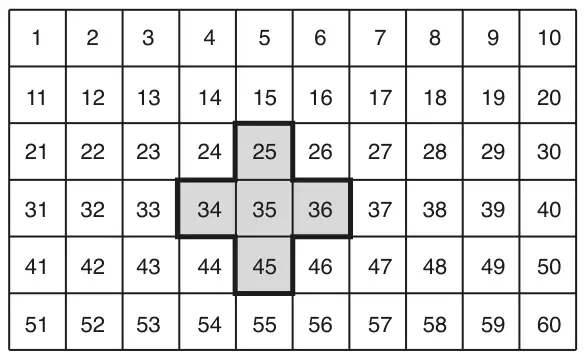
14 The diagram shows a cross placed on a number grid.
\(L\) is the product of the left and right numbers of the cross. \(T\) is the product of the top and bottom numbers of the cross. \(M\) is the middle number of the cross.
(a) Show that when \(M = 35\), \(L - T = 99\). [2]
(b) Prove that, for any position of the cross on the number grid above, \(L - T = 99\). [5]
Mark scheme (a)
Answer
Marks
Part marks and guidance
(34 × 36) – (25 × 45) = 99
2
M1 for either 34 × 36 or 25 × 45 soi by 1224 or 1125
B1 for \(x^2 - 9x + 20 = 0\) M2 for \((x - 4)(x - 5) = 0\) or use of the formula with at most one error or M1 for two factors which when expanded give two terms correctly or use of the formula with at most two errors
if 0 scored SC1 for correctly factorising their quadratic expression
Mark scheme (b)
Answer
Marks
Part marks and guidance
\(6x^3 + 23x^2 - 33x + 10\)
4
M3 for a fully correct method with at most one error e.g. \((2x^2 + 9x - 5)(3x - 2) = 6x^3 + 27x^2 - 15x - 4x^2 - 18x + 10\) or better or M2 for a correct method to multiply two brackets e.g. \(2x^2 + 10x - x - 5\) or \(3x^2 + 15x - 2x - 10\) or better or M1 for a correct method with at most two errors or a correct method to multiply two brackets with at most one error
(b) Prove that the difference between the squares of two consecutive odd numbers is a multiple of 8. [5]
Mark scheme (a)
Answer
Marks
Part marks and guidance
\(2n\) is even and adding 1 gives an odd number oe
1
Must interpret the \(2n\) as even or not odd and then the +1 giving odd oe
Accept ‘\(2n\) is a multiple of 2’ for \(2n\) is even Accept 2 times any number is even oe for \(2n\) is even (as \(n\) is defined as an integer in the stem of question) Accept ‘next number’ or ‘odd’ for +1 Do not accept e.g. \(2n\) = even \(2n + 1\) is odd (does not interpret the 1)
Mark scheme (b)
Answer
Marks
Part marks and guidance
\((2n + 3)^2 - (2n + 1)^2\) oe
M2
Allow \((2n + a)^2 - \{2n + (a \pm 2)\}^2\) where \(a\) is odd Or M1 for \(2n - 1\) or \(2n + 3\) used with \(2n + 1\) Allow \(\{2n + (a \pm 2)\}\) used with \((2n + a)\) where \(a\) is odd
Could use alternate correct expressions for consecutive odd numbers. Allow M and A marks if correct. Could reverse the algebraic terms their\((2n + 1)^2 - (2n + 3)^2\) leading to \(-8n - 8\), allow method and accuracy marks if correct. If brackets omitted allow recovery for M2 if correct expansion
\(4n^2 + 12n + 9 - 4n^2 - 4n - 1\)
M2
Dep on M2 for expanding brackets in their expressions.
Or M1indep for one correct expansion of their brackets
If seen alone and completely correct then implies previous M2 Allow \(4n^2 + 12n + 9 - (4n^2 + 4n + 1)\)
\(8n\) or \(8n + 8 = 8(n + 1)\) Or \(8n + 8\) is a multiple of 8
A1
With no errors or omissions seen. Correct for their two consecutive odd number expressions
After 0 scored, Allow SC1 for two correctly evaluated numeric examples of subtracting consecutive odd squares isw
Accept \(-8n\) or \(-8n - 8\) oe if subtraction is reversed NB: M2M1A1 not possible – must earn all method marks for A mark
(b) \((x + 3)(x - 4)(x + 5)\) is identical to \(x^3 + ax^2 - 17x + b\).
Find the value of \(a\) and the value of \(b\). [2]
Mark scheme (a)
Answer
Marks
Part marks and guidance
\(\dfrac{x + 4}{x + 1}\) final answer nfww
4
M1 for \((x + 4)(x - 4)\) AND M2 for \((x - 4)(x + 1)\) Or M1 for \(x(x + 1) - 4(x + 1)\) seen or \(x(x - 4) + 1(x - 4)\) seen or for \((x + a)(x + b)\) where \(a + b = -3\) or \(ab = -4\)
nfww please check working not just answer
Mark scheme (b)
Answer
Marks
Part marks and guidance
4 and −60
2
B1 for each
For 2 marks or B1, accept answers embedded in expression provided no contradiction seen