1. Riana has been asked to erase digits from the number 12 323 314 to obtain a number which reads the same from left to right as it does from right to left. What is the smallest number of digits Riana needs to erase?
The only digit 4 is at the end of the number and hence to obtain a number which reads the same from left to right as it does from right to left (known as a palindromic number), the first step is to erase the 4 leaving the number 1 232 331. There are now three different possibilities to produce a palindromic number - erasing the two 2s to leave 13 331, erasing the final two 3s to obtain 12 321 or erasing the first 2 and the either the last or second last 3 to obtain 13 231. However, in each case three digits have been erased.
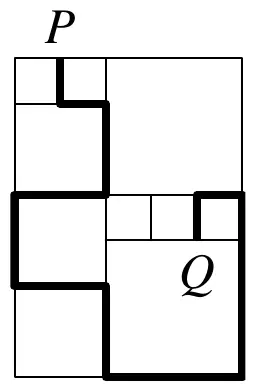
2. The diagram shows squares of three different sizes arranged into a rectangle. The length of each side of the smallest squares is 20 cm. Adam Ant walks along the path marked from \(P\) to \(Q\). How far does Adam walk?
From the diagram, it can be seen that the sides of the larger squares are 2 × 20 cm = 40 cm and 3 × 20 cm = 60 cm. Therefore the distance Adam walks is (5 × 20 + 5 × 40 + 2 × 60) cm = 420 cm.
3. A bridge is built across a river. One quarter of the bridge is over the left bank of the river and one third of the bridge is over the right bank. The river is 120 m wide. How long is the bridge?
The river is 120 m wide and represents \((1 - \frac{1}{4} - \frac{1}{3}) = \frac{5}{12}\) of the length of the bridge. Therefore \(\frac{1}{12}\) of the length of the bridge is 24 m. Hence the total length of the bridge is 12 × 24 m = 288 m.
Let Evie’s age in years now be \(x\). The information in the question tells us that \(x + 4 = 3(x - 2)\). Therefore \(x + 4 = 3x - 6\) and hence \(2x = 10\) and \(x = 5\). Therefore in one year’s time Evie will be 6.
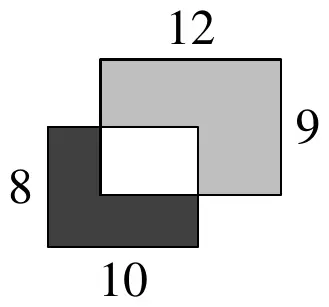
5. Two rectangles of dimensions 8 cm by 10 cm and 9 cm by 12 cm overlap as shown in the diagram. The area of the black region is 37 cm2. What is the area of the grey region?
The areas of the two rectangles are (8 × 10) cm2 = 80 cm2 and (9 × 12) cm2 = 108 cm2. Since the area of the black region is 37 cm2, the area of the unshaded region is (80 − 37) cm2 = 43 cm2. Hence the area of the grey region is (108 − 43) cm2 = 65 cm2.
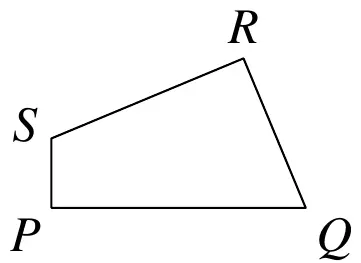
6. In the quadrilateral \(PQRS\), the length of \(PQ\) is 11 cm, the length of \(QR\) is 7 cm, the length of \(RS\) is 9 cm and the length of \(SP\) is 3 cm. Both \(\angle QRS\) and \(\angle SPQ\) are 90°. What is the area of the quadrilateral \(PQRS\)?
The information in the question tells us that both triangle \(SPQ\) and triangle \(QRS\) are right-angled. The area of the quadrilateral \(PQRS\) is equal to the sum of the areas of triangle \(SPQ\) and triangle \(QRS\).
Therefore the area of \(PQRS\) is \(\frac{1}{2}(11 \times 3)\) cm2 + \(\frac{1}{2}(7 \times 9)\) cm2 = \(\frac{1}{2}(33 + 63)\) cm2 = \(\frac{1}{2}(96)\) cm2 = 48 cm2.
7. There are 30 pupils in my class. 20 pupils like Maths and 18 pupils like English. Twice as many pupils like both subjects as like neither of them. How many pupils like only Maths?
Let the number of pupils who like neither subject be \(x\). Hence the number who like both subjects is \(2x\). Therefore the number of pupils who like only Maths is \(20 - 2x\) and the number who like only English is \(18 - 2x\). Since there are 30 pupils in my class, we have \((20 - 2x) + 2x + (18 - 2x) + x = 30\) and hence \(38 - x = 30\). This has solution \(x = 8\) and hence the number of pupils who like only Maths is 20 − 2 × 8 = 4.
8. The mean of five numbers is 25. Abbie adds 5 to the first number, 10 to the second number, 15 to the third number, 20 to the fourth number and 25 to the fifth number to obtain a new set of five numbers. What is the mean of the numbers in the new set?
Since the mean of the original five numbers is 25, their total is 25 × 5 = 125. The total of the new set of five numbers is 125 + 5 + 10 + 15 + 20 + 25 = 200. Therefore the mean of the new set of five numbers is 200 ÷ 5 = 40.
Since the product of the two positive integers is 240, the possible pairs of integers are (1, 240), (2, 120), (3, 80), (4, 60), (5, 48), (6, 40), (8, 30), (10, 24), (12, 20) and (15, 16). The respective sums of these pairs are 241, 122, 83, 64, 53, 46, 38, 34, 32 and 31. Of these, the smallest value is 31.
10. There are 39 boys and 23 girls in a dance group. Every week, 6 boys and 8 girls join the group and no one leaves the group. What is the total number of people in the dance group in the week when the number of boys is equal to the number of girls?
Initially there are (39 − 23) = 16 more boys than girls in the group. Each week (8 − 6) = 2 more girls than boys join the group. Therefore it will take 16 ÷ 2 = 8 weeks for the number of girls to equal the number of boys. Hence the total number of people in the group when this occurs is 2 × (39 + 8 × 6) = 2 × 87 = 174.
If \(N\) were divisible by 55, then it would also be divisible by 5 and 11, making three statements true. Hence \(N\) is not divisible by 55. Therefore exactly two of the remaining statements are true. It is not possible for \(N\) to be both less than 10 and divisible by 11, and it is not possible for \(N\) to be divisible by both 5 and 11 without also being divisible by 55. Therefore the two true statements are \(N\) is divisible by 5 and \(N\) is less than 10. Hence the value of \(N\) is 5.
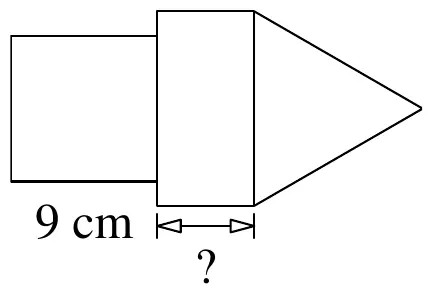
12. The shape in the diagram is made up of a rectangle, a square and an equilateral triangle, all of which have the same perimeter. The length of the side of the square is 9 cm. What is the length of the shorter sides of the rectangle?
The perimeter of the square is 4 × 9 cm = 36 cm. Therefore, since the perimeter of the square and the equilateral triangle are the same, the side-length of the equilateral triangle is 36 cm ÷ 3 = 12 cm. Hence the length of each of the longer sides of the rectangle is 12 cm. Since the perimeter of the rectangle is also 36 cm, the length of each of the shorter sides of the rectangle is (36 − 2 × 12) cm ÷ 2 = 6 cm.
To fill the box, the side-length of the cube needs to divide exactly into the length, width and height of the box. To obtain the minimum number of cubes to fill the box, we need this side-length to be as large as possible. Therefore we need this side-length, in cm, to be the highest common factor of 30, 40 and 50, which is 10. Hence with cubes of side-length 10 cm, we get the minimum to fill the box. Therefore the minimum number of cubes required is (30 ÷ 10) × (40 ÷ 10) × (50 ÷ 10) = 3 × 4 × 5 = 60.
14. Henry starts to read a 290-page book on a Sunday. He reads four pages every day except on Sundays when he reads 25 pages. How many days does it take him to finish the book?
In each week, the number of pages Henry reads is 25 + 6 × 4 = 49. Now note that 290 = 5 × 49 + 45 and that 45 = 49 − 4. Therefore, since Henry reads 49 pages a week and 4 pages every day except Sunday and he starts reading the book on a Sunday, it will take him 5 weeks and 6 days to finish the book. Hence he will take 41 days to finish the book.
15. Amy, Bob, Cat and Dee occupy the top four positions in a chess tournament. The sum of Amy’s position, Bob’s position and Dee’s position is 6. The sum of Bob’s position and Cat’s position is 6. Bob finished ahead of Amy. Who came first in the tournament?
Since 1 + 2 + 3 + 4 = 10 and the sum of Amy’s position, Bob’s position and Dee’s position is 6, Cat came fourth. Hence, since the sum of Bob’s position and Cat’s position is also 6, Bob came second. Therefore, since Bob finished ahead of Amy, Amy finished third. Therefore Dee came first in the tournament.
16. Eight cards are numbered from 1 to 8. The cards are placed in two boxes \(P\) and \(Q\) so that the sum of the numbers on the three cards in box \(P\) is equal to the sum of the numbers on the five cards in box \(Q\). Which of the following statements must be true?
A The card numbered 1 is not in box \(Q\)
B Four cards in box \(Q\) have even numbers on
C The card numbered 5 is in box \(Q\)
D The card numbered 2 is in box \(Q\)
E Exactly three cards in box \(Q\) have odd numbers on.
Note first that the sum of the numbers on the eight cards is 36. Therefore the sum of the numbers on the cards in each of the boxes is 18. There are only three cards in box \(P\) and hence the possible combinations for the numbers on the cards in box \(P\) are (8, 7, 3), (8, 6, 4) and (7, 6, 5) with the corresponding combinations for box \(Q\) being (6, 5, 4, 2, 1), (7, 5, 3, 2, 1) and (8, 4, 3, 2, 1). The only statement which is true for all three possible combinations for box \(Q\) is that the card numbered 2 is in box \(Q\). Hence the only statement which must be true is statement D.
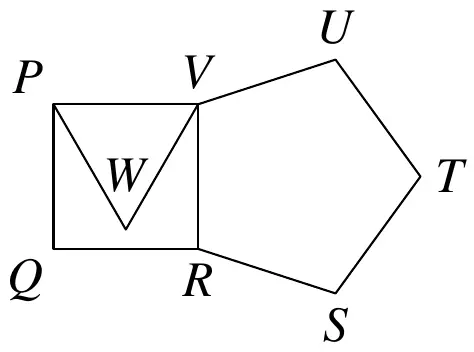
The interior angles of an equilateral triangle, a square and a regular pentagon are 180° ÷ 3 = 60°, 2 × 180° ÷ 4 = 90° and 3 × 180° ÷ 5 = 108° respectively. Therefore the size of the obtuse \(\angle UVW\) is 108° + 90° − 60° = 138°. Since the pentagon and the square share a side and the square and the equilateral triangle also share a side, the side-length of the pentagon is equal to the side-length of the equilateral triangle. Therefore \(UV = VW\) and hence the triangle \(UVW\) is isosceles and \(\angle VWU = \angle WUV\). Therefore the size of \(\angle WUV\) is (180° − 138°) ÷ 2 = 21°.
Consider the left-hand column and the top row of the diagram. When we add the values in these lines together, we obtain 3♠ + 3♦ = 105 and hence ♠ + ♦ = 35. Therefore, from the middle column, 35 + ♣ = 47 and hence ♣ = 12. Therefore the value of ♠ + ♦ − ♣ is 35 − 12 = 23.
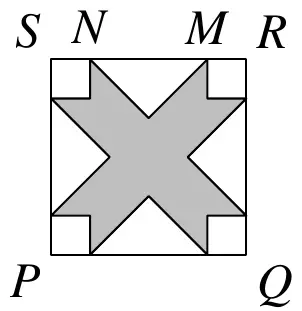
19. In the diagram, \(PQRS\) is a square of side 10 cm. The distance \(MN\) is 6 cm. The square is divided into four congruent isosceles triangles, four congruent squares and the shaded region.
Since the non-shaded squares are congruent and since \(MN = 6\) cm, both \(SN\) and \(MR\) have length (10 − 6) cm ÷ 2 = 2 cm. Therefore the areas of the four non-shaded squares are each (2 × 2) cm2 = 4 cm2.
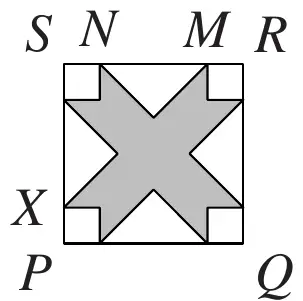
Label the point \(X\) on \(SP\) as shown. Since all of the non-shaded squares are congruent, the lengths of \(SM\) and \(SX\) are equal and hence triangle \(MSX\) is an isosceles, right-angled triangle with angles of 90°, 45° and 45°. Therefore, since the non-shaded triangles are all isosceles and have an angle of 45°, they are also right-angled. Therefore these four triangles can be fitted together to form a square of side-length 6 cm. Hence the total area of the non-shaded triangles is (6 × 6) cm2. Therefore the area of the shaded region is (10 × 10 − 4 × 4 − 6 × 6) cm2 = (100 − 16 − 36) cm2 = 48 cm2.
20. The diagram shows a 2 × 4 table in which the numbers in each column except the first column are the sum and the difference of the numbers in the previous column.
Carl completes a 2 × 7 table in the same way and obtains the numbers 96 and 64 in the final column. What is the sum of the numbers in the first column of Carl’s table?
Consider a 2 × 7 table with entries \(a\) and \(b\) in the first column. Since the entries in the following columns are the sum and the difference of the numbers in the previous column, the completed table will be as shown below.
\(a\)
\(a + b\)
\((a + b)\) \(+\,(a - b)\) \(= 2a\)
\(2a + 2b\)
\((2a + 2b)\) \(+\,(2a - 2b)\) \(= 4a\)
\(4a + 4b\)
\((4a + 4b)\) \(+\,(4a - 4b)\) \(= 8a\)
\(b\)
\(a - b\)
\((a + b)\) \(-\,(a - b)\) \(= 2b\)
\(2a - 2b\)
\((2a + 2b)\) \(-\,(2a - 2b)\) \(= 4b\)
\(4a - 4b\)
\((4a + 4b)\) \(-\,(4a - 4b)\) \(= 8b\)
Since the numbers in the final column of Carl’s table are 96 and 64, we have \(8a = 96\) and \(8b = 64\) which have solution \(a = 12\) and \(b = 8\). Therefore the sum of the numbers in the first column of Carl’s table is 12 + 8 = 20.
21. Ellis’s Eel Emporium contains a large tank holding three different types of eel: electric eels, moray eels and freshwater eels. A notice on the tank reads as follows:
All the eels are electric eels except 12 All the eels are moray eels except 14 All the eels are freshwater eels except 16
Let the number of electric eels be \(x\), the number of moray eels be \(y\) and the number of freshwater eels be \(z\). The information on the notice tells us that \(y + z = 12\), \(x + z = 14\) and \(x + y = 16\). When you add these three equations, you obtain \(2x + 2y + 2z = 42\) and hence \(x + y + z = 21\). Therefore the number of eels in the tank is 21.
22. Geraint always cycles to work, leaving at 8am every morning. When he averages 15 km/h, he arrives 10 minutes late. However, when he averages 30 km/h, he arrives 10 minutes early. What speed should he average to arrive on time?
Let \(x\) km be the distance Geraint cycles and let \(t\) hours be the time his journey should take if he is to be on time. Since \(\frac{\text{distance}}{\text{speed}}\) = time, the information in the question tells us that \(\frac{x}{15} = t + \frac{1}{6}\) and that \(\frac{x}{30} = t - \frac{1}{6}\). When we subtract the second equation from the first, we obtain \(\frac{x}{30} = \frac{2}{6}\) and so \(x = 10\). Hence, from the second equation, \(\frac{10}{30} = t - \frac{1}{6}\) and so \(t = \frac{1}{3} + \frac{1}{6} = \frac{1}{2}\). Therefore, to arrive on time, Geraint needs to travel 10 km in \(\frac{1}{2}\) hour, which is an average speed of 20 km/h.
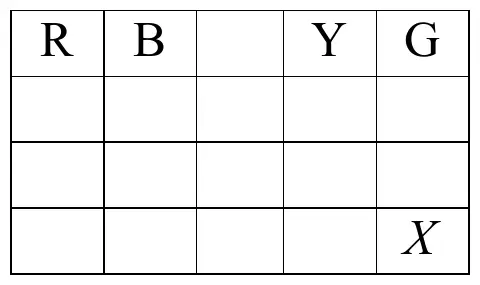
23. Sid is colouring the cells in the grid using the four colours red, blue, yellow and green in such a way that any two cells that share a vertex are coloured differently. He has already coloured some of the cells as shown.
What colour will he use for the cell marked \(X\)?
Since any two cells which share a vertex are coloured differently, the centre cell in the top row could only be coloured red or green. The cell below that cannot be coloured blue or yellow or the same colour as the centre cell in the top row and so is coloured green or red opposite to the choice of the colour to the first cell considered. The remaining cells in the second row can then be coloured out from the centre with only one possible colour for each cell. This argument can then be repeated for the colours of the third row and the fourth row, which turn out to be exactly the same as the colours of the first and second row respectively, as shown in the diagram. Hence the colour used for the cell marked \(X\) is red.
24. There are two ponds at the bottom of Gabrielle’s garden, each containing frogs and toads. In one pond the ratio of frogs to toads is 3 : 4. In the other pond the ratio of frogs to toads is 5 : 6. Suppose there are 36 frogs in total. What then would be the largest possible total number of toads in the ponds?
Since the ratios of frogs to toads in the two ponds are 3 : 4 and 5 : 6 respectively, the numbers of frogs and toads are \(3x\) and \(4x\) in the first pond and \(5y\) and \(6y\) in the second pond for some positive integers \(x\) and \(y\). Therefore, since there are 36 frogs in total, we have \(3x + 5y = 36\). Since both 3 and 36 are multiples of 3, \(y\) is also a multiple of 3 and since \(5y \leq 36\) we have \(y = 3\) or 6. If \(y\) were 3, \(x\) would be 7 and the total number of toads would be 4 × 7 + 6 × 3 = 46. Similarly, if \(y\) were 6, \(x\) would be 2 and the total number of toads would be 4 × 2 + 6 × 6 = 44. Hence, the largest possible number of toads in the ponds would be 46.
25. The room numbers of a hotel are all three-digit numbers. The first digit represents the floor and the last two digits represent the room number. The hotel has rooms on five floors, numbered 1 to 5. It has 35 rooms on each floor, numbered n01 to n35 where n is the number of the floor. In numbering all the rooms, how many times will the digit 2 be used?
Each floor has 35 rooms. On every floor except floor 2, the digit 2 will be used for rooms ‘n02’, ‘n12’, ‘n20’ to ‘n29’ (including ‘n22’) and ‘n32’. Hence the digit 2 will be used 14 times on each floor except floor 2. On floor 2, the digit 2 will be used an extra 35 times as the first digit of the room number. Therefore the total number of times the digit 2 will be used is 5 × 14 + 35 = 105.
We'd like to use Google Analytics cookies to count visits and see which pages help most. They're optional, and the site works exactly the same either way. Privacy policy