11 Junior Kangaroo questions from every year we have, newest year first. Use Difficulty › Position in the paper to practise the early (easier) or late (harder) questions, or the Year filter for one year.
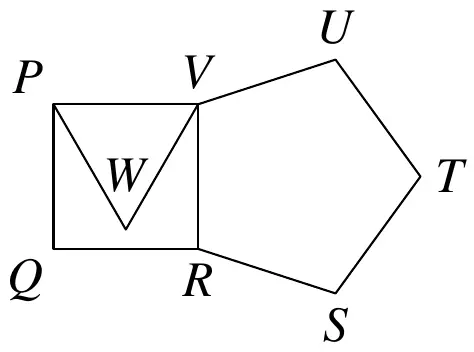
The interior angles of an equilateral triangle, a square and a regular pentagon are 180° ÷ 3 = 60°, 2 × 180° ÷ 4 = 90° and 3 × 180° ÷ 5 = 108° respectively. Therefore the size of the obtuse \(\angle UVW\) is 108° + 90° − 60° = 138°. Since the pentagon and the square share a side and the square and the equilateral triangle also share a side, the side-length of the pentagon is equal to the side-length of the equilateral triangle. Therefore \(UV = VW\) and hence the triangle \(UVW\) is isosceles and \(\angle VWU = \angle WUV\). Therefore the size of \(\angle WUV\) is (180° − 138°) ÷ 2 = 21°.
5. Emily has two identical cards in the shape of equilateral triangles. She places them both onto a sheet of paper so that they touch or overlap and draws around the shape she creates. Which one of the following is it impossible for her to draw?
The dotted lines on the diagrams which complete equilateral triangles show that she can create shapes A, B, C and D. Therefore it is shape E that is impossible for her to draw.
6. Lucy has lots of identical lolly sticks. She arranges the lolly sticks end to end to make different triangles. Which number of lolly sticks could she not use to make a triangle?
Let us consider each lollystick as having length 1. Hence the number of lollysticks used will be the length of the perimeter of the triangle and the question is then equivalent to asking if triangles with the given perimeters can be drawn with integer length sides. A triangle of perimeter 7 is possible with sides 2, 2 and 3 (or 3, 3 and 1), perimeter 6 is possible with sides 2, 2 and 2, perimeter 5 with sides 2, 2 and 1 and perimeter 3 with sides 1, 1 and 1. However, it is impossible to create a triangle with perimeter 4 since the largest possible sum for the lengths of the two shortest sides is 1 + 1 = 2 and this is not greater than the smallest possible length of the largest side. Hence the answer is 4.
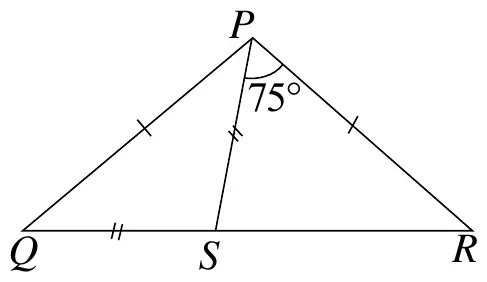
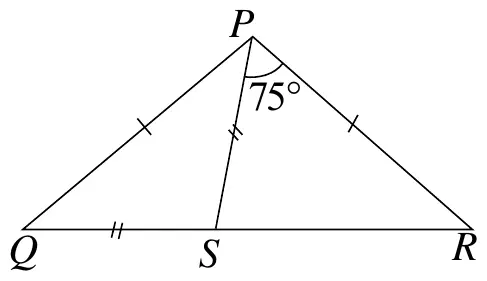
7. In the triangle \(PQR\), the lengths of sides \(PQ\) and \(PR\) are the same. The point \(S\) lies on \(QR\) so that \(QS = PS\) and \(\angle RPS = 75°\). What is the size of \(\angle QRP\)?
Let \(\angle PQS\) be \(x°\). Since \(PQ = PR\), the triangle \(PQR\) is isosceles and hence \(\angle QRP = x°\). Also, since \(QS = PS\), the triangle \(PQS\) is isosceles and hence \(\angle SPQ = x°\). Therefore, since angles in a triangle add to 180°, we have \(x + x + x + 75 = 180\), which has solution \(x = 35\). Hence the size of \(\angle QRP\) is 35°.
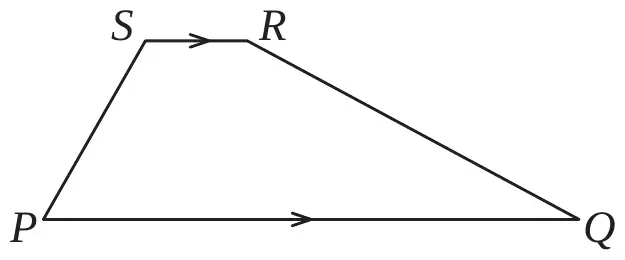
13. In trapezium \(PQRS\), \(\angle RSP = 2 \times \angle SPQ\) and \(\angle SPQ = 2 \times \angle PQR\). Also \(\angle QRS = k \times \angle PQR\). What is the value of \(k\)?
Let the size in degrees of \(\angle PQR\) and of \(\angle QRS\) be \(x\) and \(kx\). Therefore the size of \(\angle SPQ\) and of \(\angle RSP\) are \(2x\) and \(2 \times 2x = 4x\) respectively. Since the angles between parallel lines (sometimes called co-interior or allied angles) add to 180°, we have \(2x + 4x = 180\). This has solution \(x = 30\). Similarly \(x + kx = 180\) and hence \(30k = 150\). Therefore the value of \(k\) is 5.
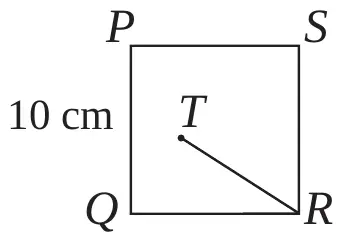
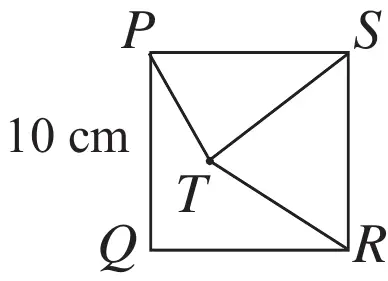
18. In the diagram, \(PQRS\) is a square of side 10 cm. \(T\) is a point inside the square so that \(\angle SPT = 75°\) and \(\angle TSP = 30°\). What is the length of \(TR\)?
Draw in lines \(PT\) and \(TS\) as shown. Since angles in a triangle add to 180° and we are given \(\angle SPT = 75°\) and \(\angle TSP = 30°\), we obtain \(\angle PTS = 75°\). Therefore \(\triangle PTS\) is isosceles and hence \(TS = PS = 10\) cm. Therefore, since \(RS = 10\) cm as it is a side of the square, \(\triangle RST\) is also isosceles. Since \(\angle RSP = 90°\) and \(\angle TSP = 30°\), we have \(\angle RST = 60°\). Therefore \(\triangle RST\) is isosceles with one angle equal to 60°. Hence \(\triangle RST\) is equilateral and therefore the length of \(TR\) is 10 cm.
At all the times given, the minute hand is pointing to 12. When the minute hand is pointing to 12 and the angle between the hands is 150°, the hour hand has turned \(\frac{150}{360} = \frac{5}{12}\) of a complete turn. Therefore the hour hand will point at 5 and the time will be 5 pm. (There are other times when the angle between the hands is 150° but, of these, only at 7 pm does the minute hand point to 12 and 7 pm is not one of the times given.)
Since one angle of the isosceles triangle is 30°, there are two possibilities. Either the other two angles are equal, in which case the difference between them is 0°, or one of the other angles is 30°. In this case, since angles in a triangle add to 180°, the second missing angle is 120° and hence the difference between the two missing angles is 120° − 30° = 90°.
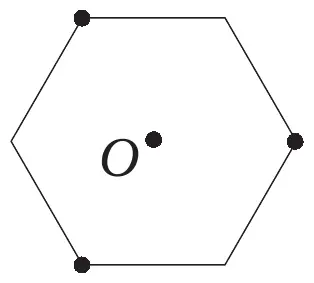
9. A piece of paper in the shape of a regular hexagon, as shown, is folded so that the three marked vertices meet at the centre \(O\) of the hexagon. What is the shape of the figure that is formed?
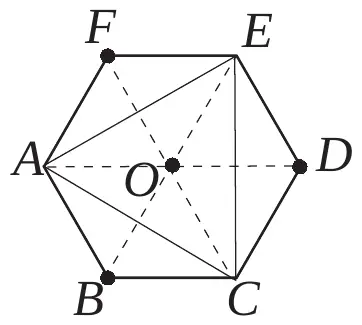
Label vertices \(A\),\(B\),\(C\),\(D\),\(E\), \(E\) and \(F\) as shown. Since the hexagon is regular, it can be divided into six equilateral triangles as shown. Therefore quadrilateral \(OABC\) is a rhombus and hence its diagonal \(AC\) is a line of symmetry. Therefore, if vertex \(B\) is folded onto \(O\), the fold will be along \(AC\). Similarly, if vertices \(D\) and \(F\) are folded onto \(O\), the folds will be along \(CE\) and \(EA\) respectively. Hence the figure that is formed will be a triangle and, since all three of the rhombuses \(OABC\), \(OCDE\) and \(OEFA\) are made out of two congruent equilateral triangles, the lengths of their diagonals \(AC\), \(CE\) and \(EA\) will be equal. Hence the shape \(ACE\) that is formed is an equilateral triangle.
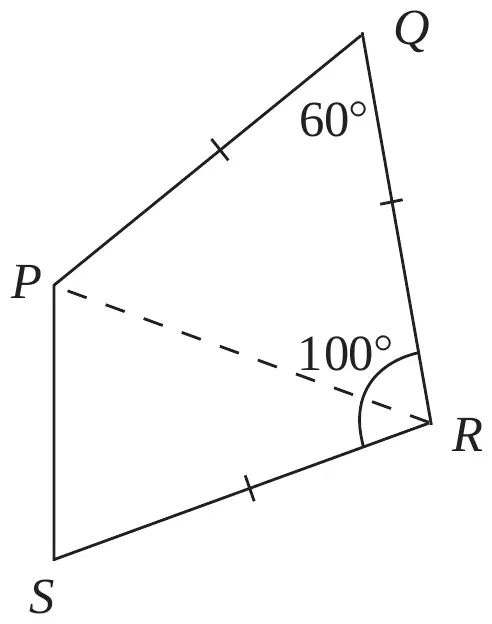
24. The lengths of three adjacent sides of a quadrilateral are equal. The angle between the first and second of these sides is 60° and the angle between the second and third of these sides is 100°. What is the largest angle of the quadrilateral?
Consider the quadrilateral \(PQRS\) as shown with \(PQ = QR = RS\), \(\angle RQP = 60°\) and \(\angle SRQ = 100°\).
Draw line \(PR\). Since \(PQ = QR\) and \(\angle PQR = 60°\), triangle \(PQR\) is equilateral and hence \(PR = PQ = QR = RS\) and \(\angle PRQ = 60°\). Since \(\angle SRQ = 100°\),\(\angle SRP = 100° - 60° = 40°\). Since \(PR = RS\), triangle \(PRS\) is isosceles and hence \(\angle RPS = \angle PSR = \frac{1}{2}(180° - 40°) = 70°\). Therefore the largest angle of the quadrilateral is \(\angle QPS = 70° + 60° = 130°\).
16. A caterpillar starts from its hole and moves across the ground, turning 90° either left or right after each hour. It moves 2 m in the first hour, followed by 3 m in the second hour and 4 m in the third hour and so on. What is the greatest distance it can be from its hole after seven hours?
The caterpillar will be as far away as possible from its hole if, at each turn, it always heads away from the hole. Hence its maximum distance will occur when it has travelled (2 + 4 + 6 + 8) metres = 20 metres in one direction and (3 + 5 + 7) metres = 15 metres in a perpendicular direction. Using Pythagoras' Theorem, the maximum distance in metres is then \(\sqrt{20^2 + 15^2} = \sqrt{625} = 25\).
We'd like to use Google Analytics cookies to count visits and see which pages help most. They're optional, and the site works exactly the same either way. Privacy policy