33 Junior Kangaroo questions from every year we have, newest year first. Use Difficulty › Position in the paper to practise the early (easier) or late (harder) questions, or the Year filter for one year.
1. Riana has been asked to erase digits from the number 12 323 314 to obtain a number which reads the same from left to right as it does from right to left. What is the smallest number of digits Riana needs to erase?
The only digit 4 is at the end of the number and hence to obtain a number which reads the same from left to right as it does from right to left (known as a palindromic number), the first step is to erase the 4 leaving the number 1 232 331. There are now three different possibilities to produce a palindromic number - erasing the two 2s to leave 13 331, erasing the final two 3s to obtain 12 321 or erasing the first 2 and the either the last or second last 3 to obtain 13 231. However, in each case three digits have been erased.
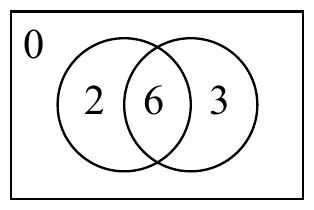
7. There are 30 pupils in my class. 20 pupils like Maths and 18 pupils like English. Twice as many pupils like both subjects as like neither of them. How many pupils like only Maths?
Let the number of pupils who like neither subject be \(x\). Hence the number who like both subjects is \(2x\). Therefore the number of pupils who like only Maths is \(20 - 2x\) and the number who like only English is \(18 - 2x\). Since there are 30 pupils in my class, we have \((20 - 2x) + 2x + (18 - 2x) + x = 30\) and hence \(38 - x = 30\). This has solution \(x = 8\) and hence the number of pupils who like only Maths is 20 − 2 × 8 = 4.
If \(N\) were divisible by 55, then it would also be divisible by 5 and 11, making three statements true. Hence \(N\) is not divisible by 55. Therefore exactly two of the remaining statements are true. It is not possible for \(N\) to be both less than 10 and divisible by 11, and it is not possible for \(N\) to be divisible by both 5 and 11 without also being divisible by 55. Therefore the two true statements are \(N\) is divisible by 5 and \(N\) is less than 10. Hence the value of \(N\) is 5.
15. Amy, Bob, Cat and Dee occupy the top four positions in a chess tournament. The sum of Amy’s position, Bob’s position and Dee’s position is 6. The sum of Bob’s position and Cat’s position is 6. Bob finished ahead of Amy. Who came first in the tournament?
Since 1 + 2 + 3 + 4 = 10 and the sum of Amy’s position, Bob’s position and Dee’s position is 6, Cat came fourth. Hence, since the sum of Bob’s position and Cat’s position is also 6, Bob came second. Therefore, since Bob finished ahead of Amy, Amy finished third. Therefore Dee came first in the tournament.
16. Eight cards are numbered from 1 to 8. The cards are placed in two boxes \(P\) and \(Q\) so that the sum of the numbers on the three cards in box \(P\) is equal to the sum of the numbers on the five cards in box \(Q\). Which of the following statements must be true?
A The card numbered 1 is not in box \(Q\)
B Four cards in box \(Q\) have even numbers on
C The card numbered 5 is in box \(Q\)
D The card numbered 2 is in box \(Q\)
E Exactly three cards in box \(Q\) have odd numbers on.
Note first that the sum of the numbers on the eight cards is 36. Therefore the sum of the numbers on the cards in each of the boxes is 18. There are only three cards in box \(P\) and hence the possible combinations for the numbers on the cards in box \(P\) are (8, 7, 3), (8, 6, 4) and (7, 6, 5) with the corresponding combinations for box \(Q\) being (6, 5, 4, 2, 1), (7, 5, 3, 2, 1) and (8, 4, 3, 2, 1). The only statement which is true for all three possible combinations for box \(Q\) is that the card numbered 2 is in box \(Q\). Hence the only statement which must be true is statement D.
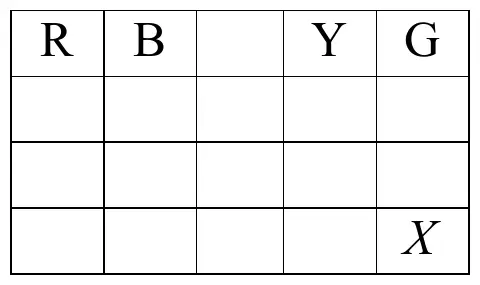
23. Sid is colouring the cells in the grid using the four colours red, blue, yellow and green in such a way that any two cells that share a vertex are coloured differently. He has already coloured some of the cells as shown.
What colour will he use for the cell marked \(X\)?
Since any two cells which share a vertex are coloured differently, the centre cell in the top row could only be coloured red or green. The cell below that cannot be coloured blue or yellow or the same colour as the centre cell in the top row and so is coloured green or red opposite to the choice of the colour to the first cell considered. The remaining cells in the second row can then be coloured out from the centre with only one possible colour for each cell. This argument can then be repeated for the colours of the third row and the fourth row, which turn out to be exactly the same as the colours of the first and second row respectively, as shown in the diagram. Hence the colour used for the cell marked \(X\) is red.
25. The room numbers of a hotel are all three-digit numbers. The first digit represents the floor and the last two digits represent the room number. The hotel has rooms on five floors, numbered 1 to 5. It has 35 rooms on each floor, numbered n01 to n35 where n is the number of the floor. In numbering all the rooms, how many times will the digit 2 be used?
Each floor has 35 rooms. On every floor except floor 2, the digit 2 will be used for rooms ‘n02’, ‘n12’, ‘n20’ to ‘n29’ (including ‘n22’) and ‘n32’. Hence the digit 2 will be used 14 times on each floor except floor 2. On floor 2, the digit 2 will be used an extra 35 times as the first digit of the room number. Therefore the total number of times the digit 2 will be used is 5 × 14 + 35 = 105.
8. William has four cards with different integers written on them. Three of these integers are 2, 3 and 4. He puts one card in each cell of the 2 × 2 grid shown. The sum of the two integers in the second row is 6. The sum of the two integers in the second column is 10. Which number is on the card he places in the top left cell?
Let the integers on the cards placed in each cell be as shown. The sum of the two integers in the second row is 6 and the sum of the two integers in the second column is 10. Since no pair of the integers 2, 3 and 4 add to 10, we can conclude that the unknown integer is written in the second column. Therefore the integer \(a\) is one of 2, 3 or 4. Consider each possibility in turn. If \(a = 2\), then \(b = 4\) (since \(a + b = 6\)), \(c = 6\) (since \(c + b = 10\)) and hence \(d = 3\). If \(a = 3\), then \(b = 3\), which is impossible since \(a\) and \(b\) are different. If \(a = 4\), then \(b = 2\), \(c = 8\) and hence \(d = 3\). Therefore the number William writes in the top left cell is 3.
9. Tom throws two darts at the target shown in the diagram. Both his darts hit the target. For each dart, he scores the number of points shown in the region he hits. How many different totals could he score?
10. The diagram below shows five rectangles, each containing some of the letters P, R, I, S and M.
Harry wants to cross out letters so that each rectangle contains only one letter and each rectangle contains a different letter. Which letter does he not cross out in rectangle 2?
Rectangle 4 only contains one letter and hence letter S must be crossed out in any other rectangle. Therefore letter P is the only letter left in rectangle 1 and must be crossed out in all the other rectangles. This means letter I is the only one left in rectangle 3 and must be crossed out in all other rectangles. This leaves letter R not crossed out in rectangle 2.
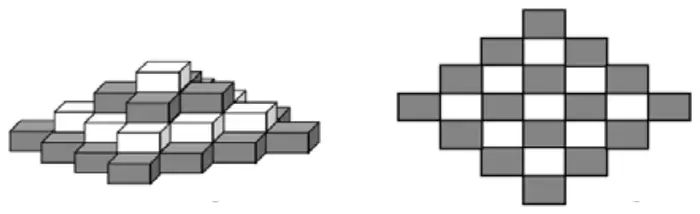
12. The two diagrams show a side view and a plan view of a tower made with light and dark coloured blocks. In the tower, only dark coloured blocks are placed on top of dark coloured blocks and only light coloured blocks are placed on top of light coloured blocks. How many blocks in the tower are light coloured?
The central light coloured column is four blocks high. The eight outer light coloured columns are two blocks high. Hence the total number of light coloured blocks in the tower is 4 + 8 × 2 = 20.
14. A box contains seven cards, each with a different integer from 1 to 7 written on it. Avani takes three cards from the box and then Niamh takes two cards, leaving two cards in the box. Avani looks at her cards and then tells Niamh “I know the sum of the numbers on your cards is even.” What is the sum of the numbers on Avani's cards?
To obtain an even number when adding two integers, both integers must be even or both integers must be odd. Therefore the four integers remaining once Avani has removed her three integers must all be odd or all be even or there would be a possibility that the sum of Niamh's two integers could be odd. Since there were four odd integers and three even integers on the cards in the box initially, the integers on the cards remaining once Avani has removed her cards are all odd. Therefore the cards Avani removed had the three even integers 2, 4 and 6 written on them which have sum 12.
17. A large circular table has 60 chairs around it. What is the largest number of people who can sit around the table so that each person is only sitting next to exactly one other person?
Since no person can sit next to more than one person, each block of three adjacent seats can contain no more than 2 people. Hence no more than (60 ÷ 3) × 2 = 40 people can sit at the table. To show that this is possible, consider twenty groups of three seats around the table with the seats successively occupied, occupied and empty within each block so that every person is sitting next to exactly one other person. Therefore the maximum number of people who can sit around the table is 40.
18. The points \(P\),\(Q\), \(R\) and \(S\) are marked on a straight line in some order. The lengths of the line segments \(PQ\),\(QR\), \(RS\) and \(SP\) are 13 cm, 11 cm, 14 cm and 12 cm respectively. What is the distance between the two points that are furthest apart?
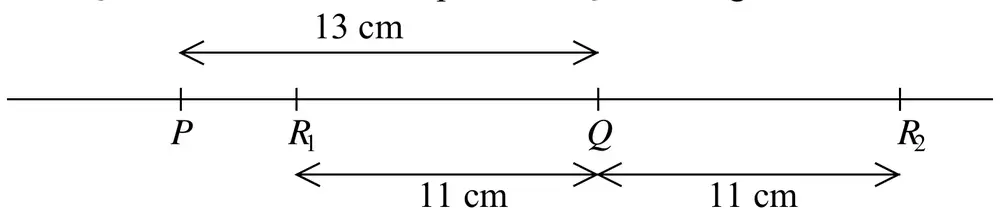
Let points \(P\) and \(Q\) be a distance 13 cm apart with \(Q\) to the right of \(P\) as shown.
The information in the question tells us that \(QR = 11\) cm but not which side of \(Q\) the point \(R\) is. Therefore either \(PR = (13 + 11)\) cm = 24 cm or \(PR = (13 - 11)\) cm = 2 cm, giving two possible positions for \(R\), marked as \(R_1\) and \(R_2\) on the diagram. In a similar way, since \(RS = 14\) cm, the distance \(PS\) is then equal to (24 ± 14) cm or (14 ± 2) cm. However, the question also tells us that \(PS = 12\) cm and, of the possible distances, only (14 − 2) cm gives us a distance 12 cm. Therefore \(S\) is 14 cm to the left of \(R_1\) and the two points furthest apart are \(S\) and \(Q\) at a distance (12 + 13) cm = 25 cm.
23. Three friends, Ms Raja, Ms Omar and Ms Beatty all live in the same street. They are a doctor, an engineer and a musician in some order. The youngest one, the doctor, does not have a brother. Ms Beatty is older than the engineer and is married to Ms Omar's brother. What are the names, in order, of the doctor and the engineer?
The doctor is the youngest and does not have a brother. Since Ms Omar has a brother and Ms Beatty is older than the engineer, the doctor is Ms Raja. Also, since Ms Beatty is older than the engineer she cannot be the engineer. Hence the engineer is Ms Omar. Therefore the doctor and the engineer in order are Raja and Omar.
2. Sophie wants to complete the grid shown so that each row and each column of the grid contains the digits 1, 2 and 3 exactly once. What is the sum of the digits she will write in the shaded cells?
Label the numbers to be written in the cells of the grid as shown.
1
\(a\)
\(b\)
2
1
\(c\)
\(d\)
\(e\)
\(f\)
Each row and column contains the digits 1, 2 and 3 exactly once. Hence \(c = d = 3\). Therefore \(b = e = 2\) (and \(a = 3\) and \(f = 1\) for completeness). Hence the sum of the digits in the shaded cells is 2 + 2 = 4.
The smallest and largest totals Beattie can obtain are 1 + 3 + 5 = 9 and 2 + 4 + 6 = 12 respectively. Totals of 10 and 11 can also be obtained, for example from 2 + 3 + 5 = 10 and 1 + 4 + 6 = 11. Therefore, since all Beattie's totals will be integers, she can obtain four different totals.
9. Alex colours all the small squares that lie on the two longest diagonals of a square grid. She colours 2017 small squares. What is the size of the square grid?
The two longest diagonals of an \(n \times n\) square grid each contain \(n\) squares. When \(n\) is an odd number, the two diagonals meet at the square in the centre of the grid and hence there are \(2n - 1\) squares in total on the diagonals. Alex coloured 2017 squares and hence \(2n - 1 = 2017\), which has solution \(n = 1009\). Therefore the size of the square grid is 1009 × 1009.
The sequence KANGAROOKANGAROOKANG... repeats every 8 letters. Since 2017 = 8 × 252 + 1, the 2017th letter in the sequence is the first of the repeating sequence and hence is K.
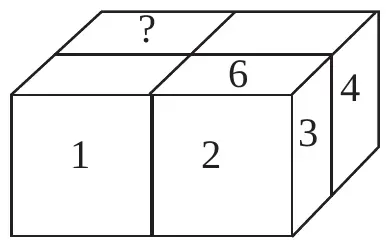
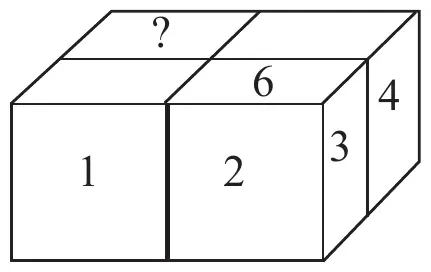
21. Rory uses four identical standard dice to build the solid shown in the diagram. Whenever two dice touch, the numbers on the touching faces are the same. The numbers on some of the faces of the solid are shown. What number is written on the face marked with question mark? (On a standard die, the numbers on opposite faces add to 7.)
The information in the question tells us that the numbers on touching faces of the solid are the same and that numbers on opposite faces of a die add to 7. Since the number 4 is visible on the rear of the right-hand side of the solid, there is a 3 on the left-hand face of the rear right die and hence a 3 and a 4 on the right- and left-hand faces of the rear left die. Similarly, since the number 1 is visible on the left-hand side of the front of the solid, there is a 6 and a 1 on the front and back faces of the rear left die. Therefore the top and bottom faces of the rear left die have a 2 and a 5 written on them. Since the four dice are identical, comparison with the front right die of the solid tells us that a die with a 6 on its front face and a 3 on its right-hand face has a 2 on its lower face and hence a 5 on its upper face.
22. Harriet tells Topaz that she is thinking of three positive integers, not necessarily all different. She tells her that the product of her three integers is 36. She also tells her the sum of her three integers. However, Topaz still cannot work out what the three integers are. What is the sum of Harriet's three integers?
The possible groups of three integers with product 36 are (1, 1, 36), (1, 2, 18), (1, 3, 12), (1, 4, 9), (1, 6, 6), (2, 2, 9), (2, 3, 6) and (3, 3, 4) with sums 38, 21, 16, 14, 13, 13, 11 and 10 respectively. The only value for the sum that occurs twice is 13. Hence, since Topaz does not know what the three integers chosen are, the sum of Harriet's three integers is 13.
2. Twelve people, and no more, can sit evenly spaced around a large square table. Rohan arranges eight of these square tables in a row to make one long rectangular table. What is the maximum number of people that can sit evenly spaced around this long table?
The number of people who can sit on each side of the square table is 12 ÷ 4 = 3. When eight of these tables are arranged to make a long rectangular table, there will be room for 8 × 3 = 24 people on each long side and for three extra people at each end. Hence, the number of people that can sit round the long table is 2 × 24 + 2 × 3 = 48 + 6 = 54.
Consider the case where two opposite faces are coloured red. Whichever of the four remaining faces is also coloured red, the resulting arrangement is equivalent under rotation to a cube with top, bottom and front faces coloured red. Hence, there is only one distinct colouring of a cube consisting of three red and three blue faces with two opposite faces coloured red. Now consider the case where no two opposite faces are coloured red. This is only possible when the three red faces share a common vertex and, however these faces are arranged, the resulting arrangement is equivalent under rotation to a cube with top, front and right-hand faces coloured red. Hence there is also only one distinct colouring of a cube consisting of three red and three blue faces in which no two opposite faces are coloured red. Therefore there are exactly two different colourings of the cube as described in the question.
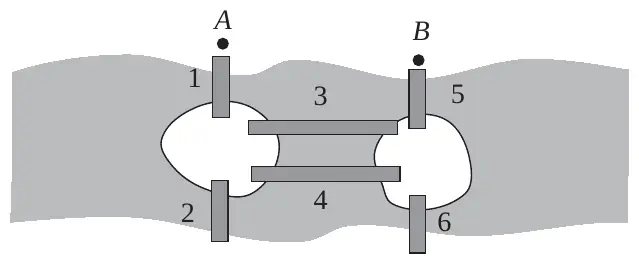
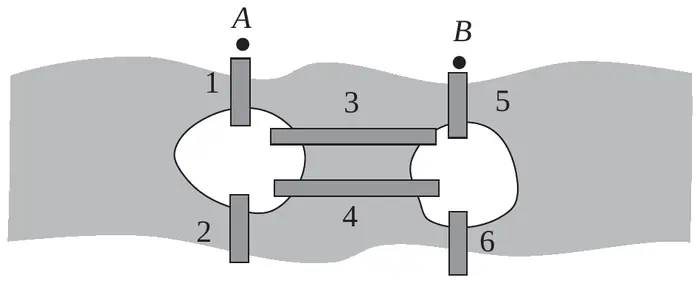
16. The diagram shows part of a river which has two islands in it. There are six bridges linking the islands and the two banks as shown. Leonhard goes for a walk every day in which he walks over each bridge exactly once. He always starts at point \(A\), goes first over bridge 1 and always finishes at point \(B\). What is the maximum number of days that he can walk without repeating the order in which he crosses the bridges?
Since Leonhard's walk always goes over bridge 1 first, it must conclude by going over bridge 5 to enable him to reach to B. Note also that bridges 2 and 6 must be crossed consecutively, in some order, as they are the only way to get to and from the opposite bank to the one from which he started and is to finish and so can be considered together.
Hence the number of days he can walk without repeating the order in which he crosses the bridges is the same as the number of ways of choosing ordered crossings of bridges 3, 4 and the pair 2 and 6. These can be chosen in six different ways (three choices for the first bridge, two for the second and then only one choice for the third). Hence Leonhard can walk for six days without repeating the order in which he crosses the bridges. (The six orders are 126345, 126435, 134265, 136245, 143265 and 146235.)
21. In Carl's pencil case there are nine pencils. At least one of the pencils is blue. In any group of four pencils, at least two have the same colour. In any group of five pencils, at most three have the same colour. How many pencils are blue?
The information that in any group of four pencils, at least two have the same colour, tells us that there at most three different coloured pencils in Carl's pencil case. The information that in any group of five pencils, at most three have the same colour, tells us that there are at most three pencils of any single colour in the pencil case. Hence there are three pencils of each of the three different colours and so Carl's pencil case contains three blue pencils.
25. The whole numbers from 1 to 2016 inclusive are written on a blackboard. Moritz underlines all the multiples of two in red, all the multiples of three in blue and all the multiples of four in green. How many numbers does Moritz underline exactly twice?
There is no number that is both a multiple of three and a multiple of four without also being a multiple of two. Hence, the numbers underlined exactly twice are those that are a multiple of two and of three but not of four and those that are a multiple of two and four but not of three. The first set of numbers consists of the set of odd multiples of six. Since 2016 ÷ 6 = 336, there are 336 multiples of 6 in the list of numbers and hence 336 ÷ 2 = 168 odd multiples of six that would be underlined in red and blue but not green. The second set of numbers consists of two out of every three multiples of four and, since 2016 ÷ 4 = 504, there are \(\frac{2}{3}\) × 504 = 336 numbers that would be underlined in red and green but not blue. Hence there are 168 + 336 = 504 numbers that Moritz would underline exactly twice.
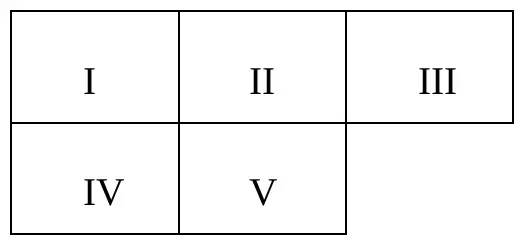
Look first at the numbers labelling the left- and right-hand sides of the rectangles. It can be seen that only rectangles \(A\), \(C\) and \(E\) can be arranged in a row of three with their touching sides equal and so they must form the top row of the diagram. The only common value on the right- and left-hand sides of rectangles \(B\) and \(D\) is 3 and so rectangle \(D\) will be placed in position IV. Therefore, the rectangle to be placed in position I needs to have 2 on its lower edge. Hence rectangle \(C\) should be placed in position I (with A in position II, E in position III and B in position V).
7. Selina takes a sheet of paper and cuts it into 10 pieces. She then takes one of these pieces and cuts it into 10 smaller pieces. She then takes another piece and cuts it into 10 smaller pieces and finally cuts one of the smaller pieces into 10 tiny pieces. How many pieces of paper has the original sheet been cut into?
Each time Selina cuts up a piece of paper, she turns one piece into ten smaller pieces and so the number of pieces she has increases by nine. Selina makes four cuts so the total number of pieces she finishes with is 1 + 4 × 9 = 37.
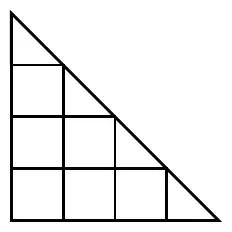
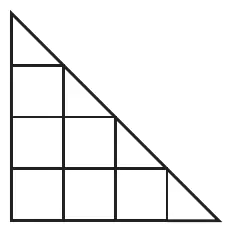
10. The diagram on the right shows a large triangle divided up into squares and triangles. \(S\) is the number of squares of any size in the diagram and \(T\) is the number of triangles of any size in the diagram. What is the value of \(S \times T\)?
In the diagram, there are six 1 × 1 squares and one 2 × 2 square. There are also four triangles that are half of a 1 × 1 square, three triangles that are half of a 2 × 2 square, two triangles that are half of a 3 × 3 square and one triangle that is half of a 4 × 4 square. Hence \(S = 7\) and \(T = 10\) so \(S \times T = 70\).
17. In a pirate's trunk there are 5 chests. In each chest there are 4 boxes and in each box there are 10 gold coins. The trunk, the chests and the boxes are all locked. Blind Pew unlocks 9 locks and takes all the coins in all the boxes he unlocks. What is the smallest number of gold coins he could take?
To obtain the smallest number of gold coins, the least possible number of boxes must be opened. Therefore, Blind Pew must open the trunk and all five chests, leaving only three boxes to be opened. Hence the smallest number of gold coins he could take is 3 × 10 = 30.
19. From noon till midnight, Clever Cat sleeps under the oak tree and from midnight till noon he is awake telling stories. A poster on the tree above him says “Two hours ago, Clever Cat was doing the same thing as he will be doing in one hour's time”. For how many hours a day does the poster tell the truth?
Consider the times when the poster does not tell the truth. The poster will not tell the truth one hour before Clever Cat changes his activity and will remain untrue until he has been doing his new activity for two hours. Hence the poster does not tell the truth for three hours around each change of activity but tells the truth the rest of the time. Therefore, the poster will tell the truth for (24 − 2 × 3) hours = 18 hours.
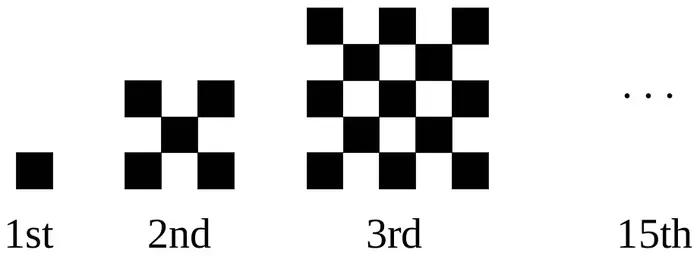
20. The diagram below shows a sequence of shapes made up of black and white floor tiles where each shape after the first has two more rows and two more columns than the one before it.
How many black tiles would be required to create the 15th shape in the sequence?
The \(n\)th term of the sequence 1, 3, 5, … is \(2n - 1\). Therefore at the start of the solution the total number of tiles in the 15th shape is \((2 \times 15 - 1)^2 = 29^2 = 841\). In each shape, there is one more black tile than white tile. Hence there would be \(\frac{1}{2}(841 + 1) = 421\) black tiles in the 15th shape.
24. Molly, Dolly, Sally, Elly and Kelly are sitting on a park bench. Molly is not sitting on the far right and Dolly is not sitting on the far left. Sally is not sitting at either end. Kelly is not sitting next to Sally and Sally is not sitting next to Dolly. Elly is sitting to the right of Dolly but not necessarily next to her. Who is sitting at the far right end?
The question tells us that Sally is not sitting at either end. This leaves three possible positions for Sally, which we will call positions 2, 3 and 4 from the left-hand end. Were Sally to sit in place 2, neither Dolly nor Kelly could sit in places 1 or 3 as they cannot sit next to Sally and, since Elly must sit to the right of Dolly, there would be three people to fit into places 4 and 5 which is impossible. Similarly, were Sally to sit in place 3, Dolly could not sit in place 2 or 4 and the question also tells us she cannot sit in place 1 so Dolly would have to sit in place 5 making it impossible for Elly to sit to the right of Dolly. However, were Sally to sit in place 4, Dolly could sit in place 2, Kelly in place 1, Molly (who cannot sit in place 5) in place 3 leaving Elly to sit in place 5 at the right-hand end.
We'd like to use Google Analytics cookies to count visits and see which pages help most. They're optional, and the site works exactly the same either way. Privacy policy