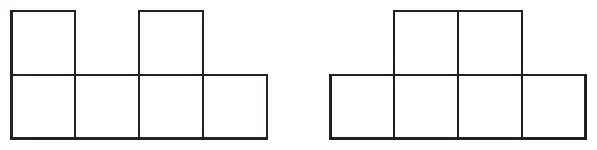
1. Ben lives in a large house with his father, mother, sister and brother as well as 2 dogs, 3 cats, 4 parrots and 5 goldfish. How many legs are there in the house?
Ben, his father, his mother, his sister, his brother and all four of the parrots have two legs each, making 18 legs in total. The two dogs and the three cats have four legs each, making 20 legs in total. Hence there are 38 legs in the house.
Let the five consecutive integers be \(n - 2\),\(n - 1\),\(n\), \(n + 1\) and \(n + 2\). These have a sum of \(5n\). Hence \(5n = 2015\) and therefore \(n = 403\). Therefore, the smallest integer is 403 − 2 = 401.
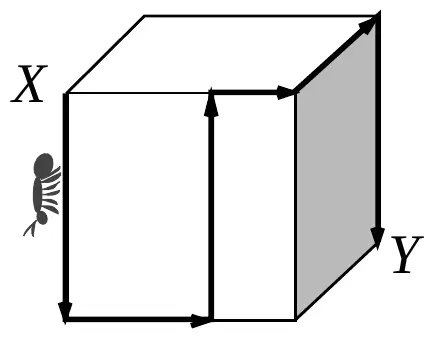
3. The diagram on the right shows a cube of side 18 cm. A giant ant walks across the cube's surface from X to Y along the route shown. How far does it walk?
One day contains 24 hours. Hence \(\frac{1}{8}\) of a day is three hours and \(\frac{1}{6}\) of this is half an hour. Half an hour contains \((\frac{1}{2} \times 60 \times 60)\) seconds = 1800 seconds and \(\frac{1}{4}\) of this is 450 seconds. Hence there are 450 seconds in the required fraction of a day.
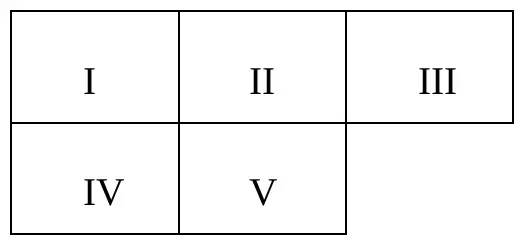
Look first at the numbers labelling the left- and right-hand sides of the rectangles. It can be seen that only rectangles \(A\), \(C\) and \(E\) can be arranged in a row of three with their touching sides equal and so they must form the top row of the diagram. The only common value on the right- and left-hand sides of rectangles \(B\) and \(D\) is 3 and so rectangle \(D\) will be placed in position IV. Therefore, the rectangle to be placed in position I needs to have 2 on its lower edge. Hence rectangle \(C\) should be placed in position I (with A in position II, E in position III and B in position V).
7. Selina takes a sheet of paper and cuts it into 10 pieces. She then takes one of these pieces and cuts it into 10 smaller pieces. She then takes another piece and cuts it into 10 smaller pieces and finally cuts one of the smaller pieces into 10 tiny pieces. How many pieces of paper has the original sheet been cut into?
Each time Selina cuts up a piece of paper, she turns one piece into ten smaller pieces and so the number of pieces she has increases by nine. Selina makes four cuts so the total number of pieces she finishes with is 1 + 4 × 9 = 37.
8. John takes 40 minutes to walk to school and then to run home. When he runs both ways, it takes him 24 minutes. He has one fixed speed whenever he walks, and another fixed speed whenever he runs. How long would it take him to walk both ways?
It takes John 24 minutes to run both ways so it will take him \(\frac{1}{2}\) × 24 minutes = 12 minutes to run one way. Also, it takes him 40 minutes to walk one way and run the other so walking one way takes him (40 − 12) minutes = 28 minutes. Hence it will take 2 × 28 minutes = 56 minutes to walk both ways.
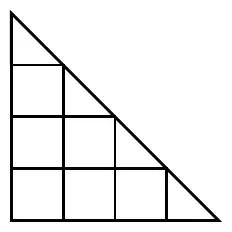
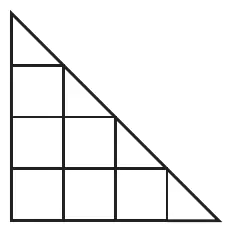
10. The diagram on the right shows a large triangle divided up into squares and triangles. \(S\) is the number of squares of any size in the diagram and \(T\) is the number of triangles of any size in the diagram. What is the value of \(S \times T\)?
In the diagram, there are six 1 × 1 squares and one 2 × 2 square. There are also four triangles that are half of a 1 × 1 square, three triangles that are half of a 2 × 2 square, two triangles that are half of a 3 × 3 square and one triangle that is half of a 4 × 4 square. Hence \(S = 7\) and \(T = 10\) so \(S \times T = 70\).
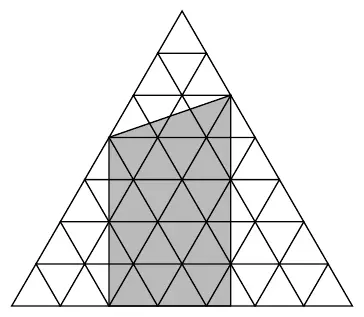
Let \(b\) cm be the length of the base and let \(h\) cm be the height of the small equilateral triangles. The area of each triangle is 4 cm2 so \(\frac{1}{2} \times b \times h = 4\).
The shaded area is a trapezium with parallel sides of length \(4h\) and \(5h\) and with distance \(\frac{5}{2}b\) between the parallel lines. Using the formula for the area of a trapezium, the shaded area is equal to \(\frac{1}{2}(4h + 5h) \times \frac{5}{2}b = \frac{1}{4} \times 45bh\). From above, \(bh = 8\) so this area is equal to \(\frac{1}{4}\) × 45 × 8 cm2 = 90 cm2.
(Alternatively, one could observe that the first four horizontal rows of the shaded region have area equivalent to five of the small equilateral triangles while the fifth layer has area equivalent to half of that or 2.5 equilateral triangles. Hence the shaded region has area equivalent to 22.5 small equilateral triangles and so has area 22.5 × 4 cm2 = 90 cm2.)
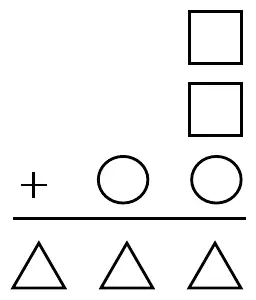
The maximum value one can obtain by adding a two-digit number and two one-digit numbers is 99 + 9 + 9 = 117. Hence the triangle must represent 1 and therefore the sum of the three numbers is 111. To obtain this answer to the sum, the circle must represent 9 since 89 + 9 + 9 is less than 111. Hence the two squares must sum to 111 − 99 = 12. Therefore the square represents the digit 6.
To have one of the integers in the sum as large as possible, the other nine must be as small as possible. The minimum possible sum of nine distinct positive integers is 1 + 2 + 3 + 4 + 5 + 6 + 7 + 8 + 9 = 45. Hence the largest possible integer in the sum is 100 − 45 = 55.
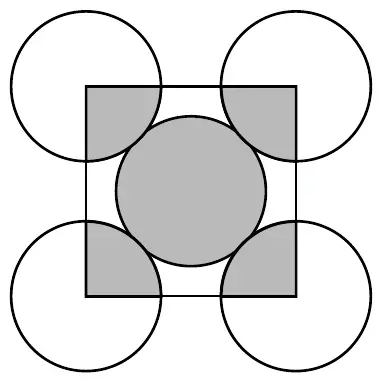
14. The diagram shows five circles of the same radius touching each other. A square is drawn so that its vertices are at the centres of the four outer circles. What is the ratio of the area of the shaded parts of the circles to the area of the unshaded parts of the circles?
The shaded area is equal to that of 1 circle + 4 × \(\frac{1}{4}\) circles = 2 circles. The area of the unshaded parts of the circles is equal to that of 4 × \(\frac{3}{4}\) circles = 3 circles. Hence the required ratio is 2 : 3.
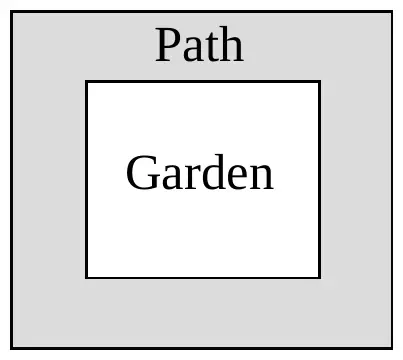
15. A rectangular garden is surrounded by a path of constant width. The perimeter of the garden is 24 m shorter than the distance along the outside edge of the path. What is the width of the path?
Let the length and width of the garden be \(a\) metres and \(b\) metres respectively and let the width of the path be \(x\) metres. The perimeter of the garden is \(2(a + b)\) metres and the perimeter of the larger rectangle formed by the garden and the path is \(2(a + 2x + b + 2x)\) metres. Hence the difference between the distance along the outside edge of the path and the perimeter of the garden in metres is \(2(a + 2x + b + 2x) - 2(a + b) = 8x\). Therefore \(8x = 24\) which has solution \(x = 3\). Hence the width of the path is 3 metres.
16. A caterpillar starts from its hole and moves across the ground, turning 90° either left or right after each hour. It moves 2 m in the first hour, followed by 3 m in the second hour and 4 m in the third hour and so on. What is the greatest distance it can be from its hole after seven hours?
The caterpillar will be as far away as possible from its hole if, at each turn, it always heads away from the hole. Hence its maximum distance will occur when it has travelled (2 + 4 + 6 + 8) metres = 20 metres in one direction and (3 + 5 + 7) metres = 15 metres in a perpendicular direction. Using Pythagoras' Theorem, the maximum distance in metres is then \(\sqrt{20^2 + 15^2} = \sqrt{625} = 25\).
17. In a pirate's trunk there are 5 chests. In each chest there are 4 boxes and in each box there are 10 gold coins. The trunk, the chests and the boxes are all locked. Blind Pew unlocks 9 locks and takes all the coins in all the boxes he unlocks. What is the smallest number of gold coins he could take?
To obtain the smallest number of gold coins, the least possible number of boxes must be opened. Therefore, Blind Pew must open the trunk and all five chests, leaving only three boxes to be opened. Hence the smallest number of gold coins he could take is 3 × 10 = 30.
18. Brian chooses an integer, multiplies it by 4 then subtracts 30. He then multiplies his answer by 2 and finally subtracts 10. His answer is a two-digit number. What is the largest integer he could choose?
Let the integer Brian chooses be \(x\). Following the operations in the question, his final result is \(2(4x - 30) - 10\). His answer is a two-digit number so \(9 < 2(4x - 30) - 10 < 100\). Hence we have \(9 < 8x - 70 < 100\) which has solution \(9\frac{7}{8} < x < 21\frac{1}{4}\). Therefore the largest integer Brian could choose is 21.
19. From noon till midnight, Clever Cat sleeps under the oak tree and from midnight till noon he is awake telling stories. A poster on the tree above him says “Two hours ago, Clever Cat was doing the same thing as he will be doing in one hour's time”. For how many hours a day does the poster tell the truth?
Consider the times when the poster does not tell the truth. The poster will not tell the truth one hour before Clever Cat changes his activity and will remain untrue until he has been doing his new activity for two hours. Hence the poster does not tell the truth for three hours around each change of activity but tells the truth the rest of the time. Therefore, the poster will tell the truth for (24 − 2 × 3) hours = 18 hours.
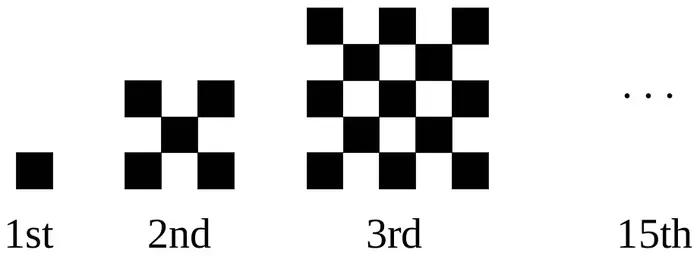
20. The diagram below shows a sequence of shapes made up of black and white floor tiles where each shape after the first has two more rows and two more columns than the one before it.
How many black tiles would be required to create the 15th shape in the sequence?
The \(n\)th term of the sequence 1, 3, 5, … is \(2n - 1\). Therefore at the start of the solution the total number of tiles in the 15th shape is \((2 \times 15 - 1)^2 = 29^2 = 841\). In each shape, there is one more black tile than white tile. Hence there would be \(\frac{1}{2}(841 + 1) = 421\) black tiles in the 15th shape.
21. Peter has a lock with a three-digit code. He knows that all the digits of his code are different and that if he divides the second digit by the third and then squares his answer, he will get the first digit. What is the difference between the largest and smallest possible codes?
The digits in the code are all different, so the result of dividing the second digit by the third cannot be 1. The first digit is a square number and, since it cannot be 1, is 4 or 9. The largest possible code will start with 9 and have second digit ÷ third digit = 3 and is 962. The smallest possible code will start with 4 and have second digit ÷ third digit = 2 and is 421. Hence the difference between the largest and smallest possible codes is 962 − 421 = 541.
The diagram above shows the front and right-hand views of a solid made up of cubes of side 3 cm. The maximum volume that the solid could have is V cm3. What is the value of V?
Each cube has volume 33 cm3 = 27 cm3. There are four cubes visible in the base layer from both the front and the side so the maximum number of cubes in the base layer is 4 × 4 = 16. Similarly, the maximum number of cubes in the second layer is 2 × 2 = 4. Hence the maximum number of cubes in the solid is 16 + 4 = 20 with a corresponding maximum volume of 20 × 27 cm3 = 540 cm3.
It can be shown that a positive integer has an odd number of factors if and only if it is square. The smallest three-digit square number is \(10^2 = 100\) and the largest is \(31^2 = 961\). Hence there are 31 − 9 = 22 three-digit numbers which have an odd number of factors.
24. Molly, Dolly, Sally, Elly and Kelly are sitting on a park bench. Molly is not sitting on the far right and Dolly is not sitting on the far left. Sally is not sitting at either end. Kelly is not sitting next to Sally and Sally is not sitting next to Dolly. Elly is sitting to the right of Dolly but not necessarily next to her. Who is sitting at the far right end?
The question tells us that Sally is not sitting at either end. This leaves three possible positions for Sally, which we will call positions 2, 3 and 4 from the left-hand end. Were Sally to sit in place 2, neither Dolly nor Kelly could sit in places 1 or 3 as they cannot sit next to Sally and, since Elly must sit to the right of Dolly, there would be three people to fit into places 4 and 5 which is impossible. Similarly, were Sally to sit in place 3, Dolly could not sit in place 2 or 4 and the question also tells us she cannot sit in place 1 so Dolly would have to sit in place 5 making it impossible for Elly to sit to the right of Dolly. However, were Sally to sit in place 4, Dolly could sit in place 2, Kelly in place 1, Molly (who cannot sit in place 5) in place 3 leaving Elly to sit in place 5 at the right-hand end.
25. Anna, Bridgit and Carol run in a 100 m race. When Anna finishes, Bridgit is 16 m behind her and when Bridgit finishes, Carol is 25 m behind her. The girls run at constant speeds throughout the race. How far behind was Carol when Anna finished?
Carol finishes 25 metres behind Bridgit, so she travels 75 metres while Bridgit runs 100 metres. Therefore she runs 3 metres for every 4 metres Bridgit runs. When Anna finishes, Bridgit has run 84 metres, so that at that time Carol has run \(\frac{3}{4}\) × 84 metres = 63 metres. Hence Carol finishes (100 − 63) metres = 37 metres behind Anna.
We'd like to use Google Analytics cookies to count visits and see which pages help most. They're optional, and the site works exactly the same either way. Privacy policy