21 Junior Kangaroo questions from every year we have, newest year first. Use Difficulty › Position in the paper to practise the early (easier) or late (harder) questions, or the Year filter for one year.
1. Riana has been asked to erase digits from the number 12 323 314 to obtain a number which reads the same from left to right as it does from right to left. What is the smallest number of digits Riana needs to erase?
The only digit 4 is at the end of the number and hence to obtain a number which reads the same from left to right as it does from right to left (known as a palindromic number), the first step is to erase the 4 leaving the number 1 232 331. There are now three different possibilities to produce a palindromic number - erasing the two 2s to leave 13 331, erasing the final two 3s to obtain 12 321 or erasing the first 2 and the either the last or second last 3 to obtain 13 231. However, in each case three digits have been erased.
Since the product of the two positive integers is 240, the possible pairs of integers are (1, 240), (2, 120), (3, 80), (4, 60), (5, 48), (6, 40), (8, 30), (10, 24), (12, 20) and (15, 16). The respective sums of these pairs are 241, 122, 83, 64, 53, 46, 38, 34, 32 and 31. Of these, the smallest value is 31.
If \(N\) were divisible by 55, then it would also be divisible by 5 and 11, making three statements true. Hence \(N\) is not divisible by 55. Therefore exactly two of the remaining statements are true. It is not possible for \(N\) to be both less than 10 and divisible by 11, and it is not possible for \(N\) to be divisible by both 5 and 11 without also being divisible by 55. Therefore the two true statements are \(N\) is divisible by 5 and \(N\) is less than 10. Hence the value of \(N\) is 5.
To fill the box, the side-length of the cube needs to divide exactly into the length, width and height of the box. To obtain the minimum number of cubes to fill the box, we need this side-length to be as large as possible. Therefore we need this side-length, in cm, to be the highest common factor of 30, 40 and 50, which is 10. Hence with cubes of side-length 10 cm, we get the minimum to fill the box. Therefore the minimum number of cubes required is (30 ÷ 10) × (40 ÷ 10) × (50 ÷ 10) = 3 × 4 × 5 = 60.
25. The room numbers of a hotel are all three-digit numbers. The first digit represents the floor and the last two digits represent the room number. The hotel has rooms on five floors, numbered 1 to 5. It has 35 rooms on each floor, numbered n01 to n35 where n is the number of the floor. In numbering all the rooms, how many times will the digit 2 be used?
Each floor has 35 rooms. On every floor except floor 2, the digit 2 will be used for rooms ‘n02’, ‘n12’, ‘n20’ to ‘n29’ (including ‘n22’) and ‘n32’. Hence the digit 2 will be used 14 times on each floor except floor 2. On floor 2, the digit 2 will be used an extra 35 times as the first digit of the room number. Therefore the total number of times the digit 2 will be used is 5 × 14 + 35 = 105.
14. A box contains seven cards, each with a different integer from 1 to 7 written on it. Avani takes three cards from the box and then Niamh takes two cards, leaving two cards in the box. Avani looks at her cards and then tells Niamh “I know the sum of the numbers on your cards is even.” What is the sum of the numbers on Avani's cards?
To obtain an even number when adding two integers, both integers must be even or both integers must be odd. Therefore the four integers remaining once Avani has removed her three integers must all be odd or all be even or there would be a possibility that the sum of Niamh's two integers could be odd. Since there were four odd integers and three even integers on the cards in the box initially, the integers on the cards remaining once Avani has removed her cards are all odd. Therefore the cards Avani removed had the three even integers 2, 4 and 6 written on them which have sum 12.
20. Steven subtracts the units digit from the tens digit for each two-digit number. He then finds the sum of all his answers. What is the value of Steven's sum?
Since \(N \neq G\), to obtain the same value of \(O\) for both the units and tens digits of the addition implies that there has been a ‘carry’ of 1 from the addition \(N + A\) and therefore \(N = G + 1\). Similarly, since \(K \neq R\), there has been a ‘carry’ of 1 from the addition \(A + G\) and hence \(R = K + 1\). Therefore \[10R + N - (10K + G) = 10(K + 1) + G + 1 - (10K + G) = 10 + 1 = 11.\]
25. What is the largest number of digits that can be erased from the 1000-digit number 201820182018....2018 so that the sum of the remaining digits is 2018?
Since we want as few digits remaining in the number as possible, we require as many 8s (the highest digit) as possible. Also, since 2018 = 252 × 8 + 2 and there are only 250 8s in the 1000-digit number, some 2s (the next highest digit) will also be required. Therefore, since 2018 − 250 × 8 = 18 and 18 = 9 × 2, the smallest number of digits remaining for the sum of these digits to be 2018 is 250 + 9 = 259. Therefore the largest number of digits that can be erased is 1000 − 259 = 741.
6. Hasan writes down a two-digit number. He then writes the same two-digit number next to his original number to form a four-digit number. What is the ratio of his four-digit number to his two-digit number ?
Let Hasan's two-digit number be ‘ab’, which is equal to \(10a + b\). The four-digit number he forms is therefore ‘abab’, which is equal to \(1000a + 100b + 10a + b\) and hence to \(100(10a + b) + 10a + b = 101 \times (10a + b)\). Therefore the ratio of his four-digit number to his two-digit number is 101 : 1.
Note first that 7632 = 2 × 2 × 2 × 2 × 3 × 3 × 53. Therefore either the two-digit number \(de = 53\) or the three-digit number \(abc\) is a multiple of 53. Since the multiplication uses each of the digits 1 to 9 once and 7632 contains a 3, the option \(de = 53\) is not allowable. Hence we need to find a three-digit multiple of 53 that does not share any digits with 7632 and divides into 7632 leaving an answer that also does not share any digits with 7632. We can reject 2 × 53 = 106 since it contains a 6 but 3 × 53 = 159 is a possibility. The value of 7632 ÷ 159 is 2 × 2 × 2 × 2 × 3 = 48 which does not have any digits in common with 7632 nor with 159. We can also check that no other multiple of 53 will work. Therefore the required multiplication is 159 × 48 = 7632 and hence the value of \(b\) is 5.
22. Harriet tells Topaz that she is thinking of three positive integers, not necessarily all different. She tells her that the product of her three integers is 36. She also tells her the sum of her three integers. However, Topaz still cannot work out what the three integers are. What is the sum of Harriet's three integers?
The possible groups of three integers with product 36 are (1, 1, 36), (1, 2, 18), (1, 3, 12), (1, 4, 9), (1, 6, 6), (2, 2, 9), (2, 3, 6) and (3, 3, 4) with sums 38, 21, 16, 14, 13, 13, 11 and 10 respectively. The only value for the sum that occurs twice is 13. Hence, since Topaz does not know what the three integers chosen are, the sum of Harriet's three integers is 13.
Let the three-digit number be \(100a + 10b + c\). Since each suitable number is 34 times the sum of its digits, we have \(100a + 10b + c = 34(a + b + c)\). Therefore \(66a - 33c = 24b\). Since the left-hand side of this equation is a multiple of 11, the right-hand side is also a multiple of 11 and hence \(b = 0\). Therefore \(66a - 33c = 0\) and hence \(c = 2a\). Therefore the three-digit numbers with the required property are 102, 204, 306 and 408 and hence there are four three-digit numbers with the required property.
11. Joey calculated the sum of the largest and smallest two-digit numbers that are multiples of three. Zoë calculated the sum of the largest and smallest two-digit numbers that are not multiples of three. What is the difference between their answers?
Joey's two numbers are 99 and 12 and hence his sum is 111. Zoë's two numbers are 98 and 10 and hence her sum is 108. Therefore the difference between their answers is 111 − 108 = 3.
13. The tens digit of a two-digit number is three more than the units digit. When this two-digit number is divided by the sum of its digits, the answer is 7 remainder 3. What is the sum of the digits of the two-digit number?
Let the units digit of the number be \(x\). Hence the tens digit of the number is \(x + 3\) and the sum of the digits of the number is \(2x + 3\). The information in the question tells us that \(10(x + 3) + x = 7(2x + 3) + 3\). Hence \(11x + 30 = 14x + 24\) which has solution \(x = 2\). Therefore the sum of the digits of the two-digit number is 2 × 2 + 3 = 7.
23. In the addition sum below, \(a\), \(b\) and \(c\) stand for different digits. \[\begin{array}{cr} & a\,b\,c \\ + & \underline{a\,c\,b} \\ & c\;4\;a. \end{array}\] What is the value of \(a + b + c\)?
\(\begin{array}{cr} & a\,b\,c \\ + & \underline{a\,c\,b} \\ & c\;4\;a. \end{array}\) Since \(c\) is the digit in the hundreds column of the answer, we can deduce that \(c > a\). Therefore, there must be a carry from the units column to the tens column and hence \(a = 4 - 1 = 3\). Since there will also be a carry from the tens column to the hundreds column, we have \(c = a + a + 1 = 7\). Therefore, \(7 + b = 13\) and hence \(b = 6\). Therefore the value of \(a + b + c\) is 3 + 6 + 7 = 16.
25. The whole numbers from 1 to 2016 inclusive are written on a blackboard. Moritz underlines all the multiples of two in red, all the multiples of three in blue and all the multiples of four in green. How many numbers does Moritz underline exactly twice?
There is no number that is both a multiple of three and a multiple of four without also being a multiple of two. Hence, the numbers underlined exactly twice are those that are a multiple of two and of three but not of four and those that are a multiple of two and four but not of three. The first set of numbers consists of the set of odd multiples of six. Since 2016 ÷ 6 = 336, there are 336 multiples of 6 in the list of numbers and hence 336 ÷ 2 = 168 odd multiples of six that would be underlined in red and blue but not green. The second set of numbers consists of two out of every three multiples of four and, since 2016 ÷ 4 = 504, there are \(\frac{2}{3}\) × 504 = 336 numbers that would be underlined in red and green but not blue. Hence there are 168 + 336 = 504 numbers that Moritz would underline exactly twice.
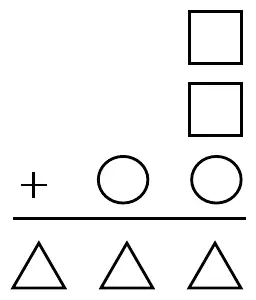
The maximum value one can obtain by adding a two-digit number and two one-digit numbers is 99 + 9 + 9 = 117. Hence the triangle must represent 1 and therefore the sum of the three numbers is 111. To obtain this answer to the sum, the circle must represent 9 since 89 + 9 + 9 is less than 111. Hence the two squares must sum to 111 − 99 = 12. Therefore the square represents the digit 6.
21. Peter has a lock with a three-digit code. He knows that all the digits of his code are different and that if he divides the second digit by the third and then squares his answer, he will get the first digit. What is the difference between the largest and smallest possible codes?
The digits in the code are all different, so the result of dividing the second digit by the third cannot be 1. The first digit is a square number and, since it cannot be 1, is 4 or 9. The largest possible code will start with 9 and have second digit ÷ third digit = 3 and is 962. The smallest possible code will start with 4 and have second digit ÷ third digit = 2 and is 421. Hence the difference between the largest and smallest possible codes is 962 − 421 = 541.
It can be shown that a positive integer has an odd number of factors if and only if it is square. The smallest three-digit square number is \(10^2 = 100\) and the largest is \(31^2 = 961\). Hence there are 31 − 9 = 22 three-digit numbers which have an odd number of factors.
We'd like to use Google Analytics cookies to count visits and see which pages help most. They're optional, and the site works exactly the same either way. Privacy policy