27 Junior Kangaroo questions from every year we have, newest year first. Use Difficulty › Position in the paper to practise the early (easier) or late (harder) questions, or the Year filter for one year.
Let Evie’s age in years now be \(x\). The information in the question tells us that \(x + 4 = 3(x - 2)\). Therefore \(x + 4 = 3x - 6\) and hence \(2x = 10\) and \(x = 5\). Therefore in one year’s time Evie will be 6.
7. There are 30 pupils in my class. 20 pupils like Maths and 18 pupils like English. Twice as many pupils like both subjects as like neither of them. How many pupils like only Maths?
Let the number of pupils who like neither subject be \(x\). Hence the number who like both subjects is \(2x\). Therefore the number of pupils who like only Maths is \(20 - 2x\) and the number who like only English is \(18 - 2x\). Since there are 30 pupils in my class, we have \((20 - 2x) + 2x + (18 - 2x) + x = 30\) and hence \(38 - x = 30\). This has solution \(x = 8\) and hence the number of pupils who like only Maths is 20 − 2 × 8 = 4.
10. There are 39 boys and 23 girls in a dance group. Every week, 6 boys and 8 girls join the group and no one leaves the group. What is the total number of people in the dance group in the week when the number of boys is equal to the number of girls?
Initially there are (39 − 23) = 16 more boys than girls in the group. Each week (8 − 6) = 2 more girls than boys join the group. Therefore it will take 16 ÷ 2 = 8 weeks for the number of girls to equal the number of boys. Hence the total number of people in the group when this occurs is 2 × (39 + 8 × 6) = 2 × 87 = 174.
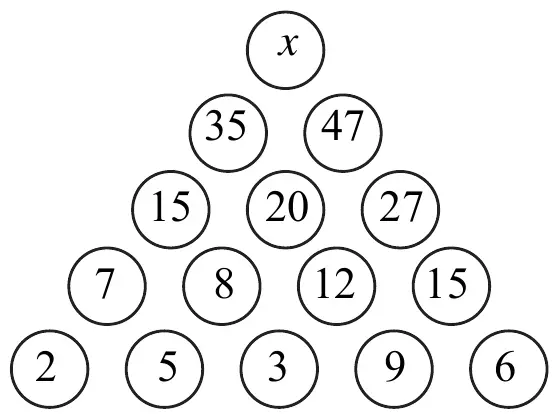
Consider the left-hand column and the top row of the diagram. When we add the values in these lines together, we obtain 3♠ + 3♦ = 105 and hence ♠ + ♦ = 35. Therefore, from the middle column, 35 + ♣ = 47 and hence ♣ = 12. Therefore the value of ♠ + ♦ − ♣ is 35 − 12 = 23.
20. The diagram shows a 2 × 4 table in which the numbers in each column except the first column are the sum and the difference of the numbers in the previous column.
Carl completes a 2 × 7 table in the same way and obtains the numbers 96 and 64 in the final column. What is the sum of the numbers in the first column of Carl’s table?
Consider a 2 × 7 table with entries \(a\) and \(b\) in the first column. Since the entries in the following columns are the sum and the difference of the numbers in the previous column, the completed table will be as shown below.
\(a\)
\(a + b\)
\((a + b)\) \(+\,(a - b)\) \(= 2a\)
\(2a + 2b\)
\((2a + 2b)\) \(+\,(2a - 2b)\) \(= 4a\)
\(4a + 4b\)
\((4a + 4b)\) \(+\,(4a - 4b)\) \(= 8a\)
\(b\)
\(a - b\)
\((a + b)\) \(-\,(a - b)\) \(= 2b\)
\(2a - 2b\)
\((2a + 2b)\) \(-\,(2a - 2b)\) \(= 4b\)
\(4a - 4b\)
\((4a + 4b)\) \(-\,(4a - 4b)\) \(= 8b\)
Since the numbers in the final column of Carl’s table are 96 and 64, we have \(8a = 96\) and \(8b = 64\) which have solution \(a = 12\) and \(b = 8\). Therefore the sum of the numbers in the first column of Carl’s table is 12 + 8 = 20.
21. Ellis’s Eel Emporium contains a large tank holding three different types of eel: electric eels, moray eels and freshwater eels. A notice on the tank reads as follows:
All the eels are electric eels except 12 All the eels are moray eels except 14 All the eels are freshwater eels except 16
Let the number of electric eels be \(x\), the number of moray eels be \(y\) and the number of freshwater eels be \(z\). The information on the notice tells us that \(y + z = 12\), \(x + z = 14\) and \(x + y = 16\). When you add these three equations, you obtain \(2x + 2y + 2z = 42\) and hence \(x + y + z = 21\). Therefore the number of eels in the tank is 21.
8. William has four cards with different integers written on them. Three of these integers are 2, 3 and 4. He puts one card in each cell of the 2 × 2 grid shown. The sum of the two integers in the second row is 6. The sum of the two integers in the second column is 10. Which number is on the card he places in the top left cell?
Let the integers on the cards placed in each cell be as shown. The sum of the two integers in the second row is 6 and the sum of the two integers in the second column is 10. Since no pair of the integers 2, 3 and 4 add to 10, we can conclude that the unknown integer is written in the second column. Therefore the integer \(a\) is one of 2, 3 or 4. Consider each possibility in turn. If \(a = 2\), then \(b = 4\) (since \(a + b = 6\)), \(c = 6\) (since \(c + b = 10\)) and hence \(d = 3\). If \(a = 3\), then \(b = 3\), which is impossible since \(a\) and \(b\) are different. If \(a = 4\), then \(b = 2\), \(c = 8\) and hence \(d = 3\). Therefore the number William writes in the top left cell is 3.
Since 3 × @ = * and 3 × # = ^, both * and ^ must represent single digit multiples of 3. Also, since * + ^ = &, the digit represented by & is a single digit multiple of 3 larger than * or ^. Therefore, since the only single digit multiples of 3 are 3, 6 and 9, the value of & is 9.
15. Today Rachel realised the following facts were true: in two years' time her brother Tim will be twice as old as he was two years ago and in three years' time her sister Tina will be three times as old as she was three years ago. Which of the following statements is also true?
Let Tim's and Tina's age now be \(x\) and \(y\) respectively. The information in the question tells us that \(x + 2 = 2(x - 2)\) and that \(y + 3 = 3(y - 3)\). Therefore \(x + 2 = 2x - 4\), which has solution \(x = 6.\) and \(y + 3 = 3y - 9\), which has solution \(y = 6\). Hence Tim and Tina are the same age.
Since \(N \neq G\), to obtain the same value of \(O\) for both the units and tens digits of the addition implies that there has been a ‘carry’ of 1 from the addition \(N + A\) and therefore \(N = G + 1\). Similarly, since \(K \neq R\), there has been a ‘carry’ of 1 from the addition \(A + G\) and hence \(R = K + 1\). Therefore \[10R + N - (10K + G) = 10(K + 1) + G + 1 - (10K + G) = 10 + 1 = 11.\]
When Anna is 13, Annie is 3 × 13 = 39 and so Annie is 26 years older than Anna. When Anna is three times as old as she is now, she will be 39 and Annie will still be 26 years older. Therefore Annie will be 65.
8. Niko counted a total of 60 birds perching in three trees. Five minutes later, 6 birds had flown away from the first tree, 8 birds had flown away from the second tree and 4 birds had flown away from the third tree. He noticed that there was now the same number of birds in each tree. How many birds were originally perched in the second tree?
Let the number of birds remaining in each tree be \(x\). Therefore \(x + 6 + x + 8 + x + 4 = 60\), which has solution \(x = 14\). Hence the number of birds originally perched in the second tree is 14 + 8 = 22.
14. Taran thought of a whole number and then multiplied it by either 5 or 6. Krishna added 5 or 6 to Taran's answer. Finally Eshan subtracted either 5 or 6 from Krishna's answer. The final result was 73. What number did Taran choose?
Let Taran's original number be \(x\). When he multiplied it, he obtained either \(5x\) or \(6x\). When Krishna added 5 or 6, his answer was one of \(5x + 5\),\(5x + 6\), \(6x + 5\) or \(6x + 6\). Finally, when Eshan subtracted 5 or 6, his answer was one of \(5x\),\(5x + 1\),\(6x\),\(6x + 1\),\(5x - 1\),\(5x\), \(6x - 1\) or \(6x\). Since the final result was 73 and since 73 is neither a multiple of 5 or 6, nor 1 less than a multiple of 5 or 6, nor 1 more than a multiple of 5, the only suitable expression for the answer is \(6x + 1\). The equation \(6x + 1 = 73\) has solution \(x = 12\). Hence the number Taran chose is 12.
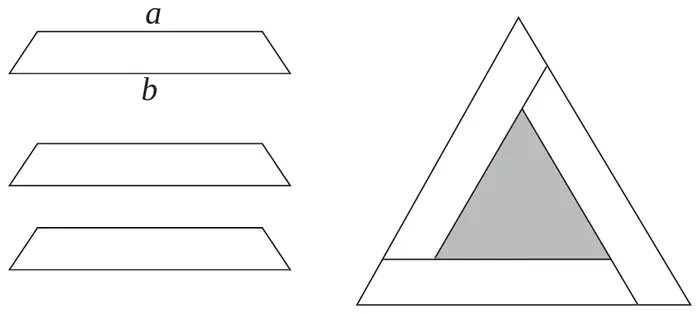
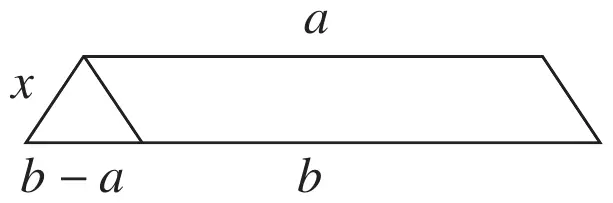
Since the triangle formed when the trapeziums are put together is equilateral, the smaller angles in the isosceles trapeziums are both 60°. Consider one trapezium split into a parallelogram and a triangle as shown.
Since the original trapezium contains two base angles of 60°, the triangle also contains two base angles of 60°. Hence the triangle is equilateral and has side length \((b - a)\). Now consider the large equilateral triangle with the hole. The perimeter of the hole is \(3(a - x)\) where \(x\) is the length of the shortest sides of the trapezium. Therefore the perimeter of the hole is \(3(a - (b - a)) = 3(2a - b) = 6a - 3b\).
24. Jacob and Zain take pencils from a box of 21 pencils without replacing them. On Monday Jacob takes \(\frac{2}{3}\) of the number of pencils that Zain takes. On Tuesday Jacob takes \(\frac{1}{2}\) of the number of pencils that Zain takes. On Wednesday morning the box is empty. How many pencils does Jacob take?
Let the number of pencils Zain takes on Monday and Tuesday be \(x\) and \(y\) respectively. Therefore \(x + \frac{2}{3}x + y + \frac{1}{2}y = 21\). Hence, when we multiply the equation through by 6 to eliminate the fractions and simplify, we obtain \(10x + 9y = 126\). Since \(x\) and \(y\) are both positive integers and since the units digit of \(10x\) is 0, the units digit of \(9y\) is 6 and hence \(y = 4\). Therefore \(x = 9\) and hence the number of pencils Zain takes is 9 + 4 = 13. Therefore the number of pencils Jacob takes is 21 − 13 = 8.
Let the three-digit number be \(100a + 10b + c\). Since each suitable number is 34 times the sum of its digits, we have \(100a + 10b + c = 34(a + b + c)\). Therefore \(66a - 33c = 24b\). Since the left-hand side of this equation is a multiple of 11, the right-hand side is also a multiple of 11 and hence \(b = 0\). Therefore \(66a - 33c = 0\) and hence \(c = 2a\). Therefore the three-digit numbers with the required property are 102, 204, 306 and 408 and hence there are four three-digit numbers with the required property.
Since one ball and one bat cost £90, two balls and two bats cost 2 × £90 = £180. Now, since three balls and two bats cost £210, one ball costs £210 − £180 = £30. Therefore a bat costs £90 − £30 = £60.
6. Miss Spelling has enough sheets of paper to give each pupil in her class 3 sheets and have 31 sheets left over. Alternatively, she could give each pupil 4 sheets and have 8 sheets left over. How many sheets of paper does she have?
Let the number of pupils in the class be \(x\). The information in the question tells us that \(3x + 31 = 4x + 8\), which has solution \(x = 23\). Hence the number of sheets of paper Miss Spelling has is 3 × 23 + 31 = 100.
13. The tens digit of a two-digit number is three more than the units digit. When this two-digit number is divided by the sum of its digits, the answer is 7 remainder 3. What is the sum of the digits of the two-digit number?
Let the units digit of the number be \(x\). Hence the tens digit of the number is \(x + 3\) and the sum of the digits of the number is \(2x + 3\). The information in the question tells us that \(10(x + 3) + x = 7(2x + 3) + 3\). Hence \(11x + 30 = 14x + 24\) which has solution \(x = 2\). Therefore the sum of the digits of the two-digit number is 2 × 2 + 3 = 7.
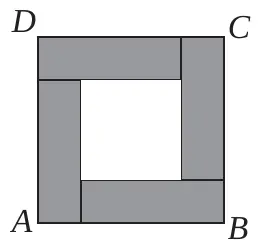
17. The square \(ABCD\) consists of four congruent rectangles arranged around a central square. The perimeter of each of the rectangles is 40 cm. What is the area of the square \(ABCD\)?
Let the length of each of the rectangles be \(x\) cm and the width be \(y\) cm. The perimeter of each of the rectangles is 40 cm and hence \(2x + 2y = 40\). Therefore \(x + y = 20\). From the diagram we can see that the length of each side of the square \(ABCD\) is \((x + y)\) cm. Therefore the square \(ABCD\) has side length 20 cm. Hence the area of \(ABCD\) is (20 × 20) cm2 = 400 cm2.
18. When Ellen went to the shop, she found she could spend all her money on 6 cans of cola and 7 croissants or on 8 cans of cola and 4 croissants. If she decided to buy only croissants, how many croissants could she buy?
Let the cost of a can of cola be \(x\) pence and the cost of a croissant be \(y\) pence. The information in the question tells us that \(6x + 7y = 8x + 4y\) and that both sides of the equation represent the total amount of money Ellen has. Hence \(3y = 2x\). Therefore the total amount of money she has is \(3 \times 3y + 7y\) pence = \(16y\) pence. Hence she could buy 16 croissants if she bought only croissants.
23. In the addition sum below, \(a\), \(b\) and \(c\) stand for different digits. \[\begin{array}{cr} & a\,b\,c \\ + & \underline{a\,c\,b} \\ & c\;4\;a. \end{array}\] What is the value of \(a + b + c\)?
\(\begin{array}{cr} & a\,b\,c \\ + & \underline{a\,c\,b} \\ & c\;4\;a. \end{array}\) Since \(c\) is the digit in the hundreds column of the answer, we can deduce that \(c > a\). Therefore, there must be a carry from the units column to the tens column and hence \(a = 4 - 1 = 3\). Since there will also be a carry from the tens column to the hundreds column, we have \(c = a + a + 1 = 7\). Therefore, \(7 + b = 13\) and hence \(b = 6\). Therefore the value of \(a + b + c\) is 3 + 6 + 7 = 16.
Let the five consecutive integers be \(n - 2\),\(n - 1\),\(n\), \(n + 1\) and \(n + 2\). These have a sum of \(5n\). Hence \(5n = 2015\) and therefore \(n = 403\). Therefore, the smallest integer is 403 − 2 = 401.
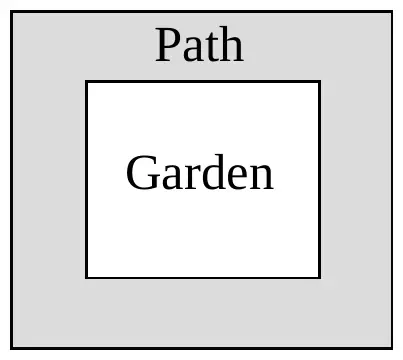
15. A rectangular garden is surrounded by a path of constant width. The perimeter of the garden is 24 m shorter than the distance along the outside edge of the path. What is the width of the path?
Let the length and width of the garden be \(a\) metres and \(b\) metres respectively and let the width of the path be \(x\) metres. The perimeter of the garden is \(2(a + b)\) metres and the perimeter of the larger rectangle formed by the garden and the path is \(2(a + 2x + b + 2x)\) metres. Hence the difference between the distance along the outside edge of the path and the perimeter of the garden in metres is \(2(a + 2x + b + 2x) - 2(a + b) = 8x\). Therefore \(8x = 24\) which has solution \(x = 3\). Hence the width of the path is 3 metres.
18. Brian chooses an integer, multiplies it by 4 then subtracts 30. He then multiplies his answer by 2 and finally subtracts 10. His answer is a two-digit number. What is the largest integer he could choose?
Let the integer Brian chooses be \(x\). Following the operations in the question, his final result is \(2(4x - 30) - 10\). His answer is a two-digit number so \(9 < 2(4x - 30) - 10 < 100\). Hence we have \(9 < 8x - 70 < 100\) which has solution \(9\frac{7}{8} < x < 21\frac{1}{4}\). Therefore the largest integer Brian could choose is 21.
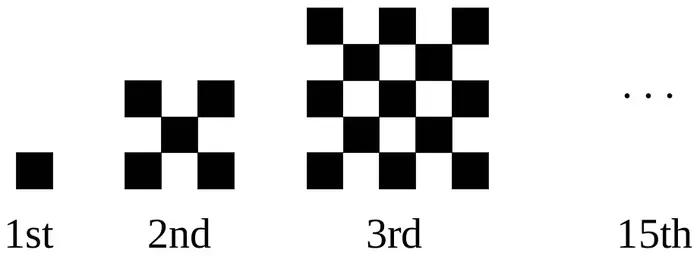
20. The diagram below shows a sequence of shapes made up of black and white floor tiles where each shape after the first has two more rows and two more columns than the one before it.
How many black tiles would be required to create the 15th shape in the sequence?
The \(n\)th term of the sequence 1, 3, 5, … is \(2n - 1\). Therefore at the start of the solution the total number of tiles in the 15th shape is \((2 \times 15 - 1)^2 = 29^2 = 841\). In each shape, there is one more black tile than white tile. Hence there would be \(\frac{1}{2}(841 + 1) = 421\) black tiles in the 15th shape.
We'd like to use Google Analytics cookies to count visits and see which pages help most. They're optional, and the site works exactly the same either way. Privacy policy