15 Junior Kangaroo questions from every year we have, newest year first. Use Difficulty › Position in the paper to practise the early (easier) or late (harder) questions, or the Year filter for one year.
22. Geraint always cycles to work, leaving at 8am every morning. When he averages 15 km/h, he arrives 10 minutes late. However, when he averages 30 km/h, he arrives 10 minutes early. What speed should he average to arrive on time?
Let \(x\) km be the distance Geraint cycles and let \(t\) hours be the time his journey should take if he is to be on time. Since \(\frac{\text{distance}}{\text{speed}}\) = time, the information in the question tells us that \(\frac{x}{15} = t + \frac{1}{6}\) and that \(\frac{x}{30} = t - \frac{1}{6}\). When we subtract the second equation from the first, we obtain \(\frac{x}{30} = \frac{2}{6}\) and so \(x = 10\). Hence, from the second equation, \(\frac{10}{30} = t - \frac{1}{6}\) and so \(t = \frac{1}{3} + \frac{1}{6} = \frac{1}{2}\). Therefore, to arrive on time, Geraint needs to travel 10 km in \(\frac{1}{2}\) hour, which is an average speed of 20 km/h.
24. There are two ponds at the bottom of Gabrielle’s garden, each containing frogs and toads. In one pond the ratio of frogs to toads is 3 : 4. In the other pond the ratio of frogs to toads is 5 : 6. Suppose there are 36 frogs in total. What then would be the largest possible total number of toads in the ponds?
Since the ratios of frogs to toads in the two ponds are 3 : 4 and 5 : 6 respectively, the numbers of frogs and toads are \(3x\) and \(4x\) in the first pond and \(5y\) and \(6y\) in the second pond for some positive integers \(x\) and \(y\). Therefore, since there are 36 frogs in total, we have \(3x + 5y = 36\). Since both 3 and 36 are multiples of 3, \(y\) is also a multiple of 3 and since \(5y \leq 36\) we have \(y = 3\) or 6. If \(y\) were 3, \(x\) would be 7 and the total number of toads would be 4 × 7 + 6 × 3 = 46. Similarly, if \(y\) were 6, \(x\) would be 2 and the total number of toads would be 4 × 2 + 6 × 6 = 44. Hence, the largest possible number of toads in the ponds would be 46.
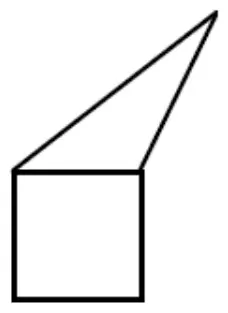
13. The diagram shows a triangle joined to a square to form an irregular pentagon. The triangle has the same perimeter as the square. What is the ratio of the perimeter of the pentagon to the perimeter of the square?
Let the length of the edge of the square be 1 unit. Therefore the perimeter of the square and hence the perimeter of the triangle is 4 units. Since the pentagon is made by joining the square and the triangle along one common edge, the perimeter of the pentagon is equal to the sum of their perimeters minus twice the length of the common edge or (4 + 4 − 2) units = 6 units. Therefore the ratio of the perimeter of the pentagon to the perimeter of the square is 6 : 4 = 3 : 2.
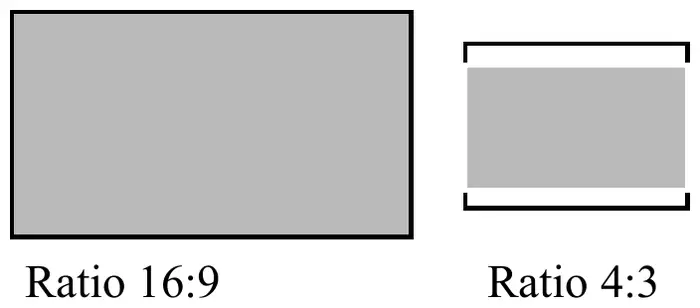
19. My TV screen has sides in the ratio 16 : 9. My mother's TV screen has sides in the ratio 4 : 3. A picture which exactly fills the screen of my TV only fills the width of the screen of my mother's TV. What fraction of the screen on my mother's TV is not covered?
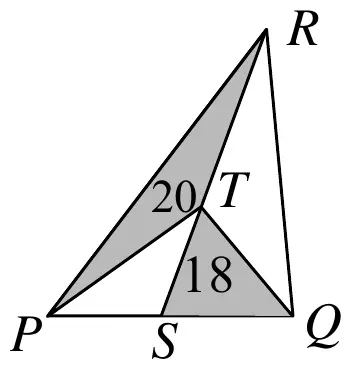
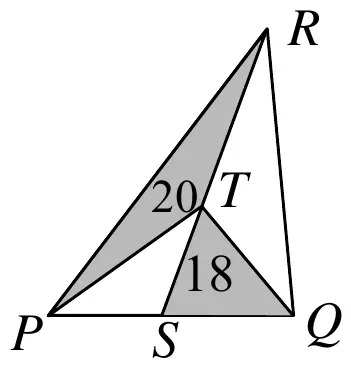
21. In triangle \(PQR\), the point \(S\) is on \(PQ\) so that the ratio of the length of \(PS\) to the length of \(SQ\) is 2: 3. The point \(T\) lies on \(SR\) so that the area of triangle \(PTR\) is 20 and the area of triangle \(SQT\) is 18, as shown in the diagram. What is the area of triangle \(PQR\)?
Note first that the triangles \(PST\) and \(SQT\) have the same perpendicular height. Hence the ratio of their areas is equal to the ratio of their bases. Therefore area of triangle \(PST\) : 18 = 2 : 3 and hence the area of triangle \(PST\) is 12. Similarly, triangles \(PSR\) and \(SQR\) have the same perpendicular height and hence (12 + 20): area of triangle \(SQR\) = 2 : 3. Therefore the area of triangle \(SQR\) is \(\frac{3}{2}\) × 32 = 48. Therefore the total area of triangle \(PQR\) is 12 + 20 + 48 = 80.
3. Ben has exactly the right number of cubes, each of side 5 cm, to make a solid cube of side 1 m. He places the smaller cubes side by side to form a single row. How long is this row?
The number of small cubes along each edge of the large cube is 100 ÷ 5 = 20. Therefore Ben has 20 × 20 × 20 = 8000 small cubes in total. Hence the row he forms is 8000 × 5 cm = 40 000 cm long. Since there are 100 cm in 1 m, his row is 400 m long.
6. Hasan writes down a two-digit number. He then writes the same two-digit number next to his original number to form a four-digit number. What is the ratio of his four-digit number to his two-digit number ?
Let Hasan's two-digit number be ‘ab’, which is equal to \(10a + b\). The four-digit number he forms is therefore ‘abab’, which is equal to \(1000a + 100b + 10a + b\) and hence to \(100(10a + b) + 10a + b = 101 \times (10a + b)\). Therefore the ratio of his four-digit number to his two-digit number is 101 : 1.
19. Adam, Bill and Chris went swimming 15 times last summer. Adam paid for everyone eight times and Bill paid for everyone seven times. At the end of the summer, Chris calculated that he owed £30. How should he split this between Adam and Bill so that each has paid the same amount?
If each person paid their fair share, each would have paid five times. Therefore Adam has paid on an extra three occasions and Bill has paid on an extra two occasions. Hence the £30 Chris owes should be divided in the ratio 3:2. Therefore Adam should get \(\frac{3}{5}\) × £30 = £18 and Bill should get \(\frac{2}{5}\) × £30 = £12.
22. Lewis drives from London to Brighton at an average speed of 60 mph. On the way back, he gets stuck in traffic and his average speed is only 40 mph. What is his average speed for the whole journey?
Let the distance from London to Brighton be \(d\) miles. Since time = distance/speed, the times Lewis spent on the two parts of his journey are \(\frac{d}{60}\) hours and \(\frac{d}{40}\) hours. Hence the total time in hours that he travelled is \[\frac{d}{60} + \frac{d}{40} = \frac{2d + 3d}{120} = \frac{5d}{120} = \frac{d}{24}.\] Therefore his average speed for the whole journey is \(2d \div \left(\frac{d}{24}\right)\) mph = 48 mph.
One day contains 24 hours. Hence \(\frac{1}{8}\) of a day is three hours and \(\frac{1}{6}\) of this is half an hour. Half an hour contains \((\frac{1}{2} \times 60 \times 60)\) seconds = 1800 seconds and \(\frac{1}{4}\) of this is 450 seconds. Hence there are 450 seconds in the required fraction of a day.
8. John takes 40 minutes to walk to school and then to run home. When he runs both ways, it takes him 24 minutes. He has one fixed speed whenever he walks, and another fixed speed whenever he runs. How long would it take him to walk both ways?
It takes John 24 minutes to run both ways so it will take him \(\frac{1}{2}\) × 24 minutes = 12 minutes to run one way. Also, it takes him 40 minutes to walk one way and run the other so walking one way takes him (40 − 12) minutes = 28 minutes. Hence it will take 2 × 28 minutes = 56 minutes to walk both ways.
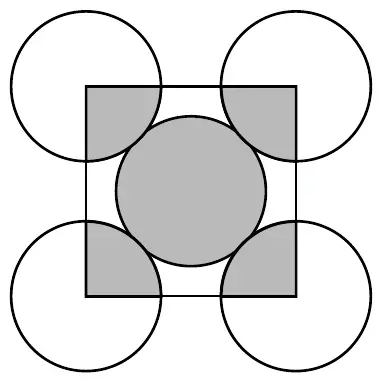
14. The diagram shows five circles of the same radius touching each other. A square is drawn so that its vertices are at the centres of the four outer circles. What is the ratio of the area of the shaded parts of the circles to the area of the unshaded parts of the circles?
The shaded area is equal to that of 1 circle + 4 × \(\frac{1}{4}\) circles = 2 circles. The area of the unshaded parts of the circles is equal to that of 4 × \(\frac{3}{4}\) circles = 3 circles. Hence the required ratio is 2 : 3.
19. From noon till midnight, Clever Cat sleeps under the oak tree and from midnight till noon he is awake telling stories. A poster on the tree above him says “Two hours ago, Clever Cat was doing the same thing as he will be doing in one hour's time”. For how many hours a day does the poster tell the truth?
Consider the times when the poster does not tell the truth. The poster will not tell the truth one hour before Clever Cat changes his activity and will remain untrue until he has been doing his new activity for two hours. Hence the poster does not tell the truth for three hours around each change of activity but tells the truth the rest of the time. Therefore, the poster will tell the truth for (24 − 2 × 3) hours = 18 hours.
25. Anna, Bridgit and Carol run in a 100 m race. When Anna finishes, Bridgit is 16 m behind her and when Bridgit finishes, Carol is 25 m behind her. The girls run at constant speeds throughout the race. How far behind was Carol when Anna finished?
Carol finishes 25 metres behind Bridgit, so she travels 75 metres while Bridgit runs 100 metres. Therefore she runs 3 metres for every 4 metres Bridgit runs. When Anna finishes, Bridgit has run 84 metres, so that at that time Carol has run \(\frac{3}{4}\) × 84 metres = 63 metres. Hence Carol finishes (100 − 63) metres = 37 metres behind Anna.
We'd like to use Google Analytics cookies to count visits and see which pages help most. They're optional, and the site works exactly the same either way. Privacy policy