When we perform each calculation in turn (remembering to complete all multiplications before doing any additions) we obtain 11, 9, 10, 10 and 8. Therefore the calculation which gives the largest result is A.
3. Each of the designs shown is initially divided into squares. For how many of the designs is the total area of the shaded region equal to three-fifths of the area of the whole design?
The fractions of the shapes which are shaded are \(\dfrac{3}{8}\),\(\dfrac{12}{20}\),\(\dfrac{2}{3}\), \(\dfrac{15}{25}\) and \(\dfrac{4}{8}\) respectively. Of these, only \(\dfrac{12}{20}\) and \(\dfrac{15}{25}\) are equivalent to \(\dfrac{3}{5}\). Therefore two designs (B and D) have three-fifths of the shape shaded.
4. Milly likes to multiply by 3, Abby likes to add 2 and Sam likes to subtract 1. In what order should they perform their favourite actions to start with 3 and end with 14?
When we apply the different orders of actions to a start number of 3, we obtain the following sequences: 3 → 9 → 11 → 10, 3 → 9 → 8 → 10, 3 → 5 → 15 → 14, 3 → 5 → 4 → 12 and 3 → 2 → 6 → 8. Hence the required sequence is the one given in C and is AMS.
5. Emily has two identical cards in the shape of equilateral triangles. She places them both onto a sheet of paper so that they touch or overlap and draws around the shape she creates. Which one of the following is it impossible for her to draw?
The dotted lines on the diagrams which complete equilateral triangles show that she can create shapes A, B, C and D. Therefore it is shape E that is impossible for her to draw.
6. Lucy has lots of identical lolly sticks. She arranges the lolly sticks end to end to make different triangles. Which number of lolly sticks could she not use to make a triangle?
Let us consider each lollystick as having length 1. Hence the number of lollysticks used will be the length of the perimeter of the triangle and the question is then equivalent to asking if triangles with the given perimeters can be drawn with integer length sides. A triangle of perimeter 7 is possible with sides 2, 2 and 3 (or 3, 3 and 1), perimeter 6 is possible with sides 2, 2 and 2, perimeter 5 with sides 2, 2 and 1 and perimeter 3 with sides 1, 1 and 1. However, it is impossible to create a triangle with perimeter 4 since the largest possible sum for the lengths of the two shortest sides is 1 + 1 = 2 and this is not greater than the smallest possible length of the largest side. Hence the answer is 4.
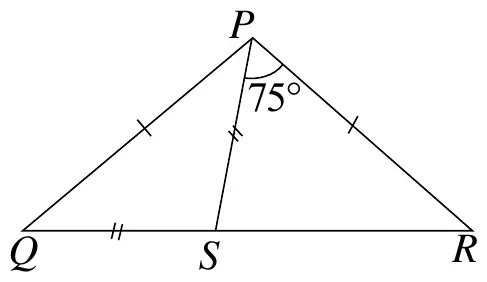
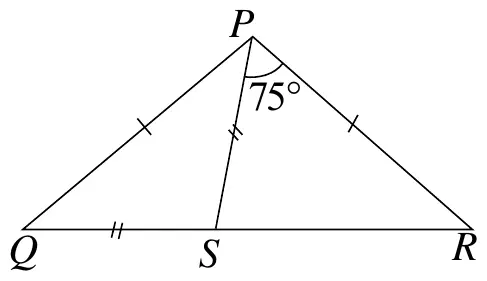
7. In the triangle \(PQR\), the lengths of sides \(PQ\) and \(PR\) are the same. The point \(S\) lies on \(QR\) so that \(QS = PS\) and \(\angle RPS = 75°\). What is the size of \(\angle QRP\)?
Let \(\angle PQS\) be \(x°\). Since \(PQ = PR\), the triangle \(PQR\) is isosceles and hence \(\angle QRP = x°\). Also, since \(QS = PS\), the triangle \(PQS\) is isosceles and hence \(\angle SPQ = x°\). Therefore, since angles in a triangle add to 180°, we have \(x + x + x + 75 = 180\), which has solution \(x = 35\). Hence the size of \(\angle QRP\) is 35°.
8. William has four cards with different integers written on them. Three of these integers are 2, 3 and 4. He puts one card in each cell of the 2 × 2 grid shown. The sum of the two integers in the second row is 6. The sum of the two integers in the second column is 10. Which number is on the card he places in the top left cell?
Let the integers on the cards placed in each cell be as shown. The sum of the two integers in the second row is 6 and the sum of the two integers in the second column is 10. Since no pair of the integers 2, 3 and 4 add to 10, we can conclude that the unknown integer is written in the second column. Therefore the integer \(a\) is one of 2, 3 or 4. Consider each possibility in turn. If \(a = 2\), then \(b = 4\) (since \(a + b = 6\)), \(c = 6\) (since \(c + b = 10\)) and hence \(d = 3\). If \(a = 3\), then \(b = 3\), which is impossible since \(a\) and \(b\) are different. If \(a = 4\), then \(b = 2\), \(c = 8\) and hence \(d = 3\). Therefore the number William writes in the top left cell is 3.
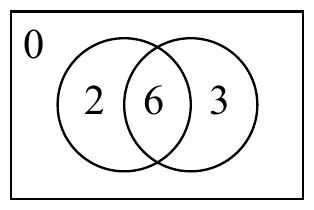
9. Tom throws two darts at the target shown in the diagram. Both his darts hit the target. For each dart, he scores the number of points shown in the region he hits. How many different totals could he score?
10. The diagram below shows five rectangles, each containing some of the letters P, R, I, S and M.
Harry wants to cross out letters so that each rectangle contains only one letter and each rectangle contains a different letter. Which letter does he not cross out in rectangle 2?
Rectangle 4 only contains one letter and hence letter S must be crossed out in any other rectangle. Therefore letter P is the only letter left in rectangle 1 and must be crossed out in all the other rectangles. This means letter I is the only one left in rectangle 3 and must be crossed out in all other rectangles. This leaves letter R not crossed out in rectangle 2.
Since 3 × @ = * and 3 × # = ^, both * and ^ must represent single digit multiples of 3. Also, since * + ^ = &, the digit represented by & is a single digit multiple of 3 larger than * or ^. Therefore, since the only single digit multiples of 3 are 3, 6 and 9, the value of & is 9.
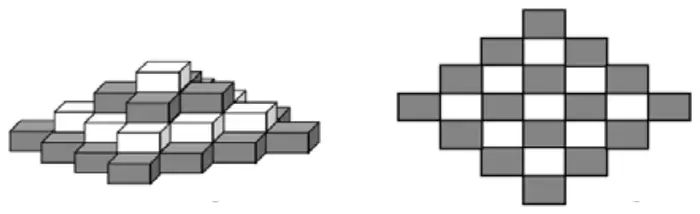
12. The two diagrams show a side view and a plan view of a tower made with light and dark coloured blocks. In the tower, only dark coloured blocks are placed on top of dark coloured blocks and only light coloured blocks are placed on top of light coloured blocks. How many blocks in the tower are light coloured?
The central light coloured column is four blocks high. The eight outer light coloured columns are two blocks high. Hence the total number of light coloured blocks in the tower is 4 + 8 × 2 = 20.
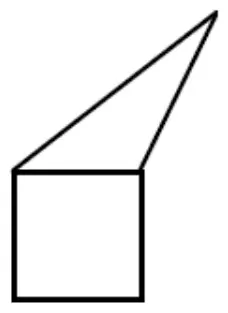
13. The diagram shows a triangle joined to a square to form an irregular pentagon. The triangle has the same perimeter as the square. What is the ratio of the perimeter of the pentagon to the perimeter of the square?
Let the length of the edge of the square be 1 unit. Therefore the perimeter of the square and hence the perimeter of the triangle is 4 units. Since the pentagon is made by joining the square and the triangle along one common edge, the perimeter of the pentagon is equal to the sum of their perimeters minus twice the length of the common edge or (4 + 4 − 2) units = 6 units. Therefore the ratio of the perimeter of the pentagon to the perimeter of the square is 6 : 4 = 3 : 2.
14. A box contains seven cards, each with a different integer from 1 to 7 written on it. Avani takes three cards from the box and then Niamh takes two cards, leaving two cards in the box. Avani looks at her cards and then tells Niamh “I know the sum of the numbers on your cards is even.” What is the sum of the numbers on Avani's cards?
To obtain an even number when adding two integers, both integers must be even or both integers must be odd. Therefore the four integers remaining once Avani has removed her three integers must all be odd or all be even or there would be a possibility that the sum of Niamh's two integers could be odd. Since there were four odd integers and three even integers on the cards in the box initially, the integers on the cards remaining once Avani has removed her cards are all odd. Therefore the cards Avani removed had the three even integers 2, 4 and 6 written on them which have sum 12.
15. Today Rachel realised the following facts were true: in two years' time her brother Tim will be twice as old as he was two years ago and in three years' time her sister Tina will be three times as old as she was three years ago. Which of the following statements is also true?
Let Tim's and Tina's age now be \(x\) and \(y\) respectively. The information in the question tells us that \(x + 2 = 2(x - 2)\) and that \(y + 3 = 3(y - 3)\). Therefore \(x + 2 = 2x - 4\), which has solution \(x = 6.\) and \(y + 3 = 3y - 9\), which has solution \(y = 6\). Hence Tim and Tina are the same age.
16. Ali is arranging the books on his bookshelves. He puts half his books on the bottom shelf and two-thirds of what remains on the second shelf. Finally he splits the rest of his books over the other two shelves so that the third shelf contains four more books than the top shelf. There are three books on the top shelf. How many books are on the bottom shelf?
Since Ali places half his books on the bottom shelf and \(\frac{2}{3}\) of the remainder on the second shelf, he places \(\frac{2}{3} \times \frac{1}{2} = \frac{1}{3}\) of his books on the second shelf, leaving \((1 - \frac{1}{2} - \frac{1}{3}) = \frac{1}{6}\) of his books for the top two shelves. There are three books on the top shelf and four more, so seven books, on the third shelf. Therefore these 10 books represent \(\frac{1}{6}\) of the total number of books on the bookshelves. Hence there are 60 books on the bookshelves and half of these, or 30 books, on the bottom shelf.
17. A large circular table has 60 chairs around it. What is the largest number of people who can sit around the table so that each person is only sitting next to exactly one other person?
Since no person can sit next to more than one person, each block of three adjacent seats can contain no more than 2 people. Hence no more than (60 ÷ 3) × 2 = 40 people can sit at the table. To show that this is possible, consider twenty groups of three seats around the table with the seats successively occupied, occupied and empty within each block so that every person is sitting next to exactly one other person. Therefore the maximum number of people who can sit around the table is 40.
18. The points \(P\),\(Q\), \(R\) and \(S\) are marked on a straight line in some order. The lengths of the line segments \(PQ\),\(QR\), \(RS\) and \(SP\) are 13 cm, 11 cm, 14 cm and 12 cm respectively. What is the distance between the two points that are furthest apart?
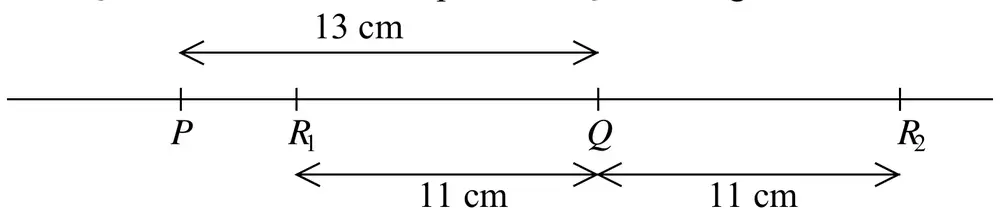
Let points \(P\) and \(Q\) be a distance 13 cm apart with \(Q\) to the right of \(P\) as shown.
The information in the question tells us that \(QR = 11\) cm but not which side of \(Q\) the point \(R\) is. Therefore either \(PR = (13 + 11)\) cm = 24 cm or \(PR = (13 - 11)\) cm = 2 cm, giving two possible positions for \(R\), marked as \(R_1\) and \(R_2\) on the diagram. In a similar way, since \(RS = 14\) cm, the distance \(PS\) is then equal to (24 ± 14) cm or (14 ± 2) cm. However, the question also tells us that \(PS = 12\) cm and, of the possible distances, only (14 − 2) cm gives us a distance 12 cm. Therefore \(S\) is 14 cm to the left of \(R_1\) and the two points furthest apart are \(S\) and \(Q\) at a distance (12 + 13) cm = 25 cm.
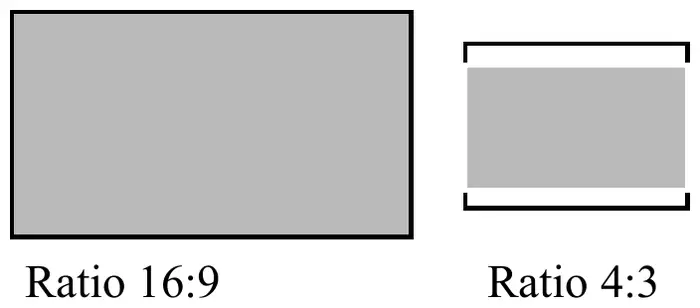
19. My TV screen has sides in the ratio 16 : 9. My mother's TV screen has sides in the ratio 4 : 3. A picture which exactly fills the screen of my TV only fills the width of the screen of my mother's TV. What fraction of the screen on my mother's TV is not covered?
20. Steven subtracts the units digit from the tens digit for each two-digit number. He then finds the sum of all his answers. What is the value of Steven's sum?
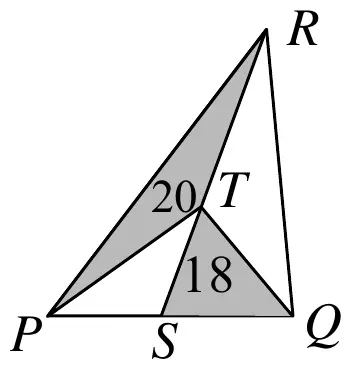
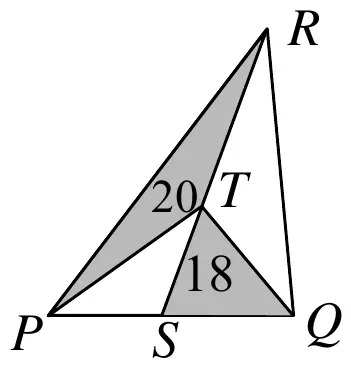
21. In triangle \(PQR\), the point \(S\) is on \(PQ\) so that the ratio of the length of \(PS\) to the length of \(SQ\) is 2: 3. The point \(T\) lies on \(SR\) so that the area of triangle \(PTR\) is 20 and the area of triangle \(SQT\) is 18, as shown in the diagram. What is the area of triangle \(PQR\)?
Note first that the triangles \(PST\) and \(SQT\) have the same perpendicular height. Hence the ratio of their areas is equal to the ratio of their bases. Therefore area of triangle \(PST\) : 18 = 2 : 3 and hence the area of triangle \(PST\) is 12. Similarly, triangles \(PSR\) and \(SQR\) have the same perpendicular height and hence (12 + 20): area of triangle \(SQR\) = 2 : 3. Therefore the area of triangle \(SQR\) is \(\frac{3}{2}\) × 32 = 48. Therefore the total area of triangle \(PQR\) is 12 + 20 + 48 = 80.
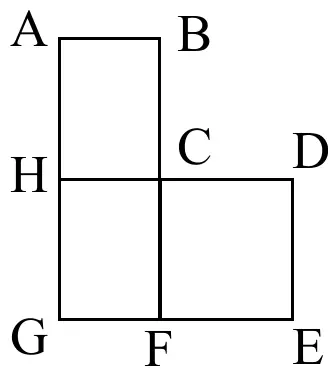
22. The diagram shows a plan of a town with various bus stops. There are four bus routes in the town. Route 1 goes C − D − E − F − G − H − C and is 17 km long. Route 2 goes A − B − C − F − G − H − A and is 12 km long. Route 3 goes A − B − C − D − E − F − G − H − A and is 20 km long. Route 4 goes C − F − G − H − C. How long is route 4?
The roads covered in routes 1 and 2 combined are the same as the roads covered in routes 3 and 4 combined. Therefore the length of route 4 is (17 + 12 − 20) km = 9 km.
23. Three friends, Ms Raja, Ms Omar and Ms Beatty all live in the same street. They are a doctor, an engineer and a musician in some order. The youngest one, the doctor, does not have a brother. Ms Beatty is older than the engineer and is married to Ms Omar's brother. What are the names, in order, of the doctor and the engineer?
The doctor is the youngest and does not have a brother. Since Ms Omar has a brother and Ms Beatty is older than the engineer, the doctor is Ms Raja. Also, since Ms Beatty is older than the engineer she cannot be the engineer. Hence the engineer is Ms Omar. Therefore the doctor and the engineer in order are Raja and Omar.
Since \(N \neq G\), to obtain the same value of \(O\) for both the units and tens digits of the addition implies that there has been a ‘carry’ of 1 from the addition \(N + A\) and therefore \(N = G + 1\). Similarly, since \(K \neq R\), there has been a ‘carry’ of 1 from the addition \(A + G\) and hence \(R = K + 1\). Therefore \[10R + N - (10K + G) = 10(K + 1) + G + 1 - (10K + G) = 10 + 1 = 11.\]
25. What is the largest number of digits that can be erased from the 1000-digit number 201820182018....2018 so that the sum of the remaining digits is 2018?
Since we want as few digits remaining in the number as possible, we require as many 8s (the highest digit) as possible. Also, since 2018 = 252 × 8 + 2 and there are only 250 8s in the 1000-digit number, some 2s (the next highest digit) will also be required. Therefore, since 2018 − 250 × 8 = 18 and 18 = 9 × 2, the smallest number of digits remaining for the sum of these digits to be 2018 is 250 + 9 = 259. Therefore the largest number of digits that can be erased is 1000 − 259 = 741.
We'd like to use Google Analytics cookies to count visits and see which pages help most. They're optional, and the site works exactly the same either way. Privacy policy