13 Junior Kangaroo questions from every year we have, newest year first. Use Difficulty › Position in the paper to practise the early (easier) or late (harder) questions, or the Year filter for one year.
14. Henry starts to read a 290-page book on a Sunday. He reads four pages every day except on Sundays when he reads 25 pages. How many days does it take him to finish the book?
In each week, the number of pages Henry reads is 25 + 6 × 4 = 49. Now note that 290 = 5 × 49 + 45 and that 45 = 49 − 4. Therefore, since Henry reads 49 pages a week and 4 pages every day except Sunday and he starts reading the book on a Sunday, it will take him 5 weeks and 6 days to finish the book. Hence he will take 41 days to finish the book.
16. Eight cards are numbered from 1 to 8. The cards are placed in two boxes \(P\) and \(Q\) so that the sum of the numbers on the three cards in box \(P\) is equal to the sum of the numbers on the five cards in box \(Q\). Which of the following statements must be true?
A The card numbered 1 is not in box \(Q\)
B Four cards in box \(Q\) have even numbers on
C The card numbered 5 is in box \(Q\)
D The card numbered 2 is in box \(Q\)
E Exactly three cards in box \(Q\) have odd numbers on.
Note first that the sum of the numbers on the eight cards is 36. Therefore the sum of the numbers on the cards in each of the boxes is 18. There are only three cards in box \(P\) and hence the possible combinations for the numbers on the cards in box \(P\) are (8, 7, 3), (8, 6, 4) and (7, 6, 5) with the corresponding combinations for box \(Q\) being (6, 5, 4, 2, 1), (7, 5, 3, 2, 1) and (8, 4, 3, 2, 1). The only statement which is true for all three possible combinations for box \(Q\) is that the card numbered 2 is in box \(Q\). Hence the only statement which must be true is statement D.
When we perform each calculation in turn (remembering to complete all multiplications before doing any additions) we obtain 11, 9, 10, 10 and 8. Therefore the calculation which gives the largest result is A.
4. Milly likes to multiply by 3, Abby likes to add 2 and Sam likes to subtract 1. In what order should they perform their favourite actions to start with 3 and end with 14?
When we apply the different orders of actions to a start number of 3, we obtain the following sequences: 3 → 9 → 11 → 10, 3 → 9 → 8 → 10, 3 → 5 → 15 → 14, 3 → 5 → 4 → 12 and 3 → 2 → 6 → 8. Hence the required sequence is the one given in C and is AMS.
Since 3 × @ = * and 3 × # = ^, both * and ^ must represent single digit multiples of 3. Also, since * + ^ = &, the digit represented by & is a single digit multiple of 3 larger than * or ^. Therefore, since the only single digit multiples of 3 are 3, 6 and 9, the value of & is 9.
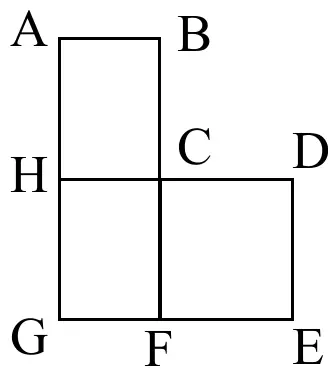
22. The diagram shows a plan of a town with various bus stops. There are four bus routes in the town. Route 1 goes C − D − E − F − G − H − C and is 17 km long. Route 2 goes A − B − C − F − G − H − A and is 12 km long. Route 3 goes A − B − C − D − E − F − G − H − A and is 20 km long. Route 4 goes C − F − G − H − C. How long is route 4?
The roads covered in routes 1 and 2 combined are the same as the roads covered in routes 3 and 4 combined. Therefore the length of route 4 is (17 + 12 − 20) km = 9 km.
2. Twelve people, and no more, can sit evenly spaced around a large square table. Rohan arranges eight of these square tables in a row to make one long rectangular table. What is the maximum number of people that can sit evenly spaced around this long table?
The number of people who can sit on each side of the square table is 12 ÷ 4 = 3. When eight of these tables are arranged to make a long rectangular table, there will be room for 8 × 3 = 24 people on each long side and for three extra people at each end. Hence, the number of people that can sit round the long table is 2 × 24 + 2 × 3 = 48 + 6 = 54.
1. Ben lives in a large house with his father, mother, sister and brother as well as 2 dogs, 3 cats, 4 parrots and 5 goldfish. How many legs are there in the house?
Ben, his father, his mother, his sister, his brother and all four of the parrots have two legs each, making 18 legs in total. The two dogs and the three cats have four legs each, making 20 legs in total. Hence there are 38 legs in the house.
Let the five consecutive integers be \(n - 2\),\(n - 1\),\(n\), \(n + 1\) and \(n + 2\). These have a sum of \(5n\). Hence \(5n = 2015\) and therefore \(n = 403\). Therefore, the smallest integer is 403 − 2 = 401.
7. Selina takes a sheet of paper and cuts it into 10 pieces. She then takes one of these pieces and cuts it into 10 smaller pieces. She then takes another piece and cuts it into 10 smaller pieces and finally cuts one of the smaller pieces into 10 tiny pieces. How many pieces of paper has the original sheet been cut into?
Each time Selina cuts up a piece of paper, she turns one piece into ten smaller pieces and so the number of pieces she has increases by nine. Selina makes four cuts so the total number of pieces she finishes with is 1 + 4 × 9 = 37.
To have one of the integers in the sum as large as possible, the other nine must be as small as possible. The minimum possible sum of nine distinct positive integers is 1 + 2 + 3 + 4 + 5 + 6 + 7 + 8 + 9 = 45. Hence the largest possible integer in the sum is 100 − 45 = 55.
We'd like to use Google Analytics cookies to count visits and see which pages help most. They're optional, and the site works exactly the same either way. Privacy policy