30 Junior Kangaroo questions from every year we have, newest year first. Use Difficulty › Position in the paper to practise the early (easier) or late (harder) questions, or the Year filter for one year.
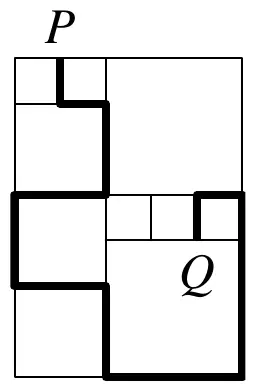
2. The diagram shows squares of three different sizes arranged into a rectangle. The length of each side of the smallest squares is 20 cm. Adam Ant walks along the path marked from \(P\) to \(Q\). How far does Adam walk?
From the diagram, it can be seen that the sides of the larger squares are 2 × 20 cm = 40 cm and 3 × 20 cm = 60 cm. Therefore the distance Adam walks is (5 × 20 + 5 × 40 + 2 × 60) cm = 420 cm.
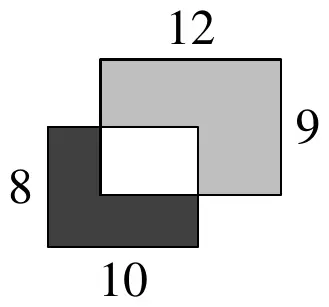
5. Two rectangles of dimensions 8 cm by 10 cm and 9 cm by 12 cm overlap as shown in the diagram. The area of the black region is 37 cm2. What is the area of the grey region?
The areas of the two rectangles are (8 × 10) cm2 = 80 cm2 and (9 × 12) cm2 = 108 cm2. Since the area of the black region is 37 cm2, the area of the unshaded region is (80 − 37) cm2 = 43 cm2. Hence the area of the grey region is (108 − 43) cm2 = 65 cm2.
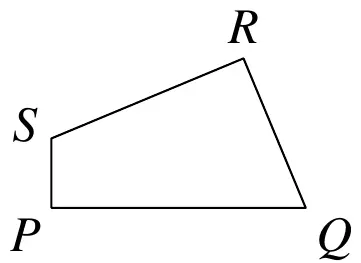
6. In the quadrilateral \(PQRS\), the length of \(PQ\) is 11 cm, the length of \(QR\) is 7 cm, the length of \(RS\) is 9 cm and the length of \(SP\) is 3 cm. Both \(\angle QRS\) and \(\angle SPQ\) are 90°. What is the area of the quadrilateral \(PQRS\)?
The information in the question tells us that both triangle \(SPQ\) and triangle \(QRS\) are right-angled. The area of the quadrilateral \(PQRS\) is equal to the sum of the areas of triangle \(SPQ\) and triangle \(QRS\).
Therefore the area of \(PQRS\) is \(\frac{1}{2}(11 \times 3)\) cm2 + \(\frac{1}{2}(7 \times 9)\) cm2 = \(\frac{1}{2}(33 + 63)\) cm2 = \(\frac{1}{2}(96)\) cm2 = 48 cm2.
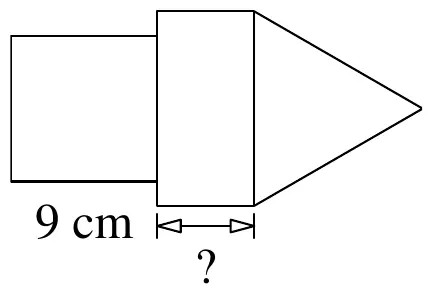
12. The shape in the diagram is made up of a rectangle, a square and an equilateral triangle, all of which have the same perimeter. The length of the side of the square is 9 cm. What is the length of the shorter sides of the rectangle?
The perimeter of the square is 4 × 9 cm = 36 cm. Therefore, since the perimeter of the square and the equilateral triangle are the same, the side-length of the equilateral triangle is 36 cm ÷ 3 = 12 cm. Hence the length of each of the longer sides of the rectangle is 12 cm. Since the perimeter of the rectangle is also 36 cm, the length of each of the shorter sides of the rectangle is (36 − 2 × 12) cm ÷ 2 = 6 cm.
To fill the box, the side-length of the cube needs to divide exactly into the length, width and height of the box. To obtain the minimum number of cubes to fill the box, we need this side-length to be as large as possible. Therefore we need this side-length, in cm, to be the highest common factor of 30, 40 and 50, which is 10. Hence with cubes of side-length 10 cm, we get the minimum to fill the box. Therefore the minimum number of cubes required is (30 ÷ 10) × (40 ÷ 10) × (50 ÷ 10) = 3 × 4 × 5 = 60.
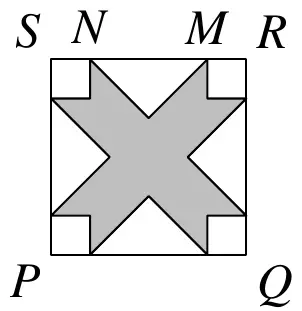
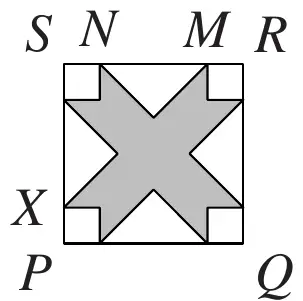
19. In the diagram, \(PQRS\) is a square of side 10 cm. The distance \(MN\) is 6 cm. The square is divided into four congruent isosceles triangles, four congruent squares and the shaded region.
Since the non-shaded squares are congruent and since \(MN = 6\) cm, both \(SN\) and \(MR\) have length (10 − 6) cm ÷ 2 = 2 cm. Therefore the areas of the four non-shaded squares are each (2 × 2) cm2 = 4 cm2.
Label the point \(X\) on \(SP\) as shown. Since all of the non-shaded squares are congruent, the lengths of \(SM\) and \(SX\) are equal and hence triangle \(MSX\) is an isosceles, right-angled triangle with angles of 90°, 45° and 45°. Therefore, since the non-shaded triangles are all isosceles and have an angle of 45°, they are also right-angled. Therefore these four triangles can be fitted together to form a square of side-length 6 cm. Hence the total area of the non-shaded triangles is (6 × 6) cm2. Therefore the area of the shaded region is (10 × 10 − 4 × 4 − 6 × 6) cm2 = (100 − 16 − 36) cm2 = 48 cm2.
3. Each of the designs shown is initially divided into squares. For how many of the designs is the total area of the shaded region equal to three-fifths of the area of the whole design?
The fractions of the shapes which are shaded are \(\dfrac{3}{8}\),\(\dfrac{12}{20}\),\(\dfrac{2}{3}\), \(\dfrac{15}{25}\) and \(\dfrac{4}{8}\) respectively. Of these, only \(\dfrac{12}{20}\) and \(\dfrac{15}{25}\) are equivalent to \(\dfrac{3}{5}\). Therefore two designs (B and D) have three-fifths of the shape shaded.
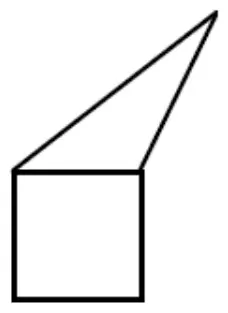
13. The diagram shows a triangle joined to a square to form an irregular pentagon. The triangle has the same perimeter as the square. What is the ratio of the perimeter of the pentagon to the perimeter of the square?
Let the length of the edge of the square be 1 unit. Therefore the perimeter of the square and hence the perimeter of the triangle is 4 units. Since the pentagon is made by joining the square and the triangle along one common edge, the perimeter of the pentagon is equal to the sum of their perimeters minus twice the length of the common edge or (4 + 4 − 2) units = 6 units. Therefore the ratio of the perimeter of the pentagon to the perimeter of the square is 6 : 4 = 3 : 2.
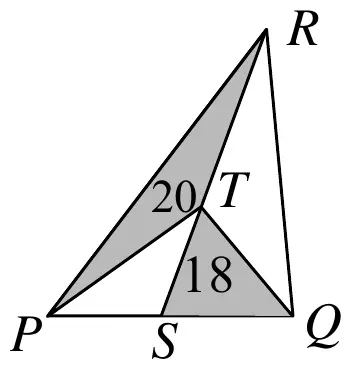
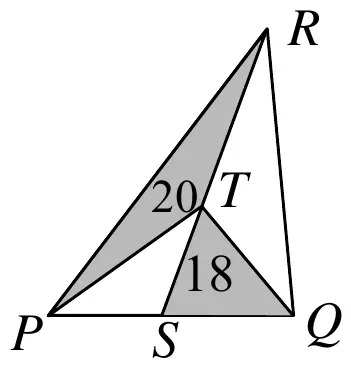
21. In triangle \(PQR\), the point \(S\) is on \(PQ\) so that the ratio of the length of \(PS\) to the length of \(SQ\) is 2: 3. The point \(T\) lies on \(SR\) so that the area of triangle \(PTR\) is 20 and the area of triangle \(SQT\) is 18, as shown in the diagram. What is the area of triangle \(PQR\)?
Note first that the triangles \(PST\) and \(SQT\) have the same perpendicular height. Hence the ratio of their areas is equal to the ratio of their bases. Therefore area of triangle \(PST\) : 18 = 2 : 3 and hence the area of triangle \(PST\) is 12. Similarly, triangles \(PSR\) and \(SQR\) have the same perpendicular height and hence (12 + 20): area of triangle \(SQR\) = 2 : 3. Therefore the area of triangle \(SQR\) is \(\frac{3}{2}\) × 32 = 48. Therefore the total area of triangle \(PQR\) is 12 + 20 + 48 = 80.
3. Ben has exactly the right number of cubes, each of side 5 cm, to make a solid cube of side 1 m. He places the smaller cubes side by side to form a single row. How long is this row?
The number of small cubes along each edge of the large cube is 100 ÷ 5 = 20. Therefore Ben has 20 × 20 × 20 = 8000 small cubes in total. Hence the row he forms is 8000 × 5 cm = 40 000 cm long. Since there are 100 cm in 1 m, his row is 400 m long.
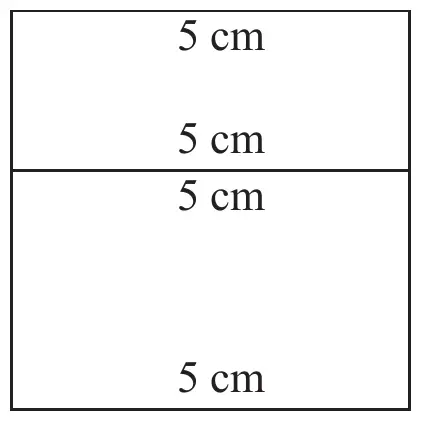
7. A square piece of card has perimeter 20 cm. Charlie cuts the card into two rectangles. The perimeter of one of the rectangles is 16 cm. What is the perimeter of the other rectangle?
The length of the edge of Charlie's original square is (20 ÷ 4) cm = 5 cm. Since he cuts his square into two rectangles, he cuts parallel to one side of the square to create two rectangles each with two sides 5 cm long as shown in the diagram.
Hence the total perimeter of his two rectangles is 2 × 5 cm = 10 cm longer than the perimeter of his square. Since the perimeter of one of the rectangles is 16 cm, the perimeter of the other rectangle is (20 + 10 − 16) cm = 14 cm.
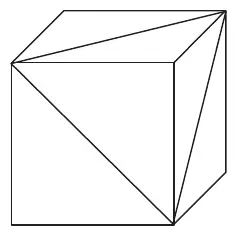
On each net, label the four vertices of the right-hand square 1, 2, 3 and 4 as shown. Also label any vertex on any of the other squares that will meet vertices 1, 2, 3 or 4 when the net of the cube is assembled into a cube with the corresponding value.
Since there are three vertices of the original cube at which two diagonals meet, to be a suitable net for the cube shown, any diagonal drawn meets another diagonal at a vertex with the same label. As can be seen, only in net D are the ends of the diagonals at vertices with the same label. Therefore Usman could only use net D to make the cube shown.
12. Maddie has a paper ribbon of length 36 cm. She divides it into four rectangles of different lengths. She draws two lines joining the centres of two adjacent rectangles as shown.
What is the sum of the lengths of the lines that she draws?
Let the lengths of the four rectangles be \(p\) cm, \(q\) cm, \(r\) cm and \(s\) cm with \(p + q + r + s = 36\). The lines Maddie draws join the centres of two pairs of rectangles and hence have total length \((\frac{1}{2}p + \frac{1}{2}q)\) cm + \((\frac{1}{2}r + \frac{1}{2}s)\) cm = \(\frac{1}{2}(p + q + r + s)\) cm. Therefore the sum of the lengths of the lines she draws is \(\frac{1}{2}\) × 36 cm = 18 cm.
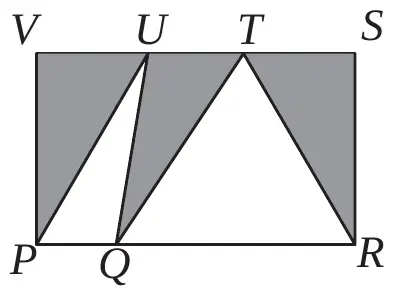
15. In the diagram, \(PRSV\) is a rectangle with \(PR = 20\) cm and \(PV = 12\) cm. Jeffrey marks points \(U\) and \(T\) on \(VS\) and \(Q\) on \(PR\) as shown. What is the shaded area?
Consider the two unshaded triangles. Each has height equal to 12 cm and hence their total area is \((\frac{1}{2} \times PQ \times 12 + \frac{1}{2} \times QR \times 12)\) cm2 = 6 × \((PQ + QR)\) cm2 = 6 × 20 cm2 = 120 cm2. Therefore the shaded area is (20 × 12 − 120) cm2 = 120 cm2.
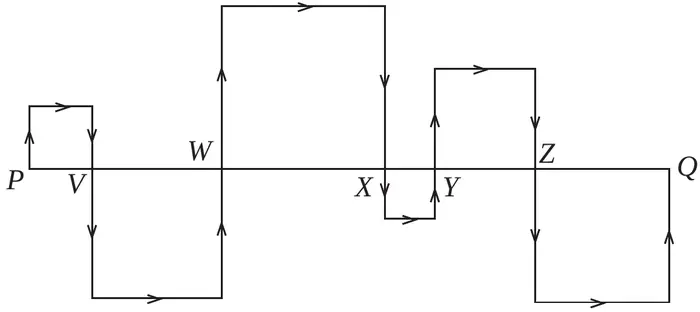
16. The line \(PQ\) is divided into six parts by the points \(V\),\(W\),\(X\), \(Y\) and \(Z\). Squares are drawn on \(PV\),\(VW\),\(WX\),\(XY\), \(YZ\) and \(ZQ\) as shown in the diagram. The length of line \(PQ\) is 24 cm. What is the length of the path from \(P\) to \(Q\) indicated by the arrows?
The path indicated follows three sides of each of the squares shown. The sum of the lengths of one side of each square is equal to the length of \(PQ\), which is 24 cm. Therefore the length of the path is 3 × 24 cm = 72 cm.
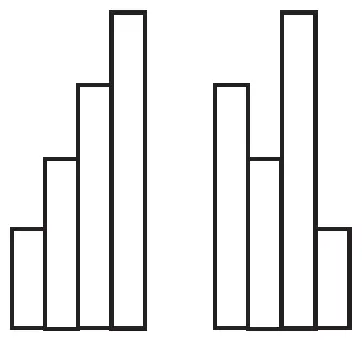
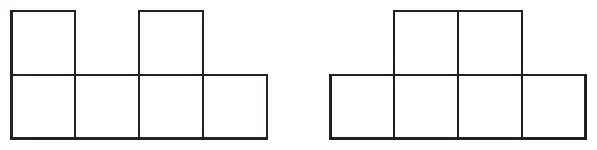
17. Henna has four hair ribbons of width 10 cm. When she measures them, she finds that each ribbon is 25 cm longer than the next smallest ribbon. She then arranges the ribbons to form two different shapes as shown in the diagram. How much longer is the perimeter of the second shape than the perimeter of the first shape?
Let the length of the shortest ribbon be \(x\) cm. Therefore the lengths of the other ribbons are \((x + 25)\) cm, \((x + 50)\) cm and \((x + 75)\) cm. The perimeter of the first shape (starting from the lower left corner and working clockwise) is \((x + 10 + 25 + 10 + 25 + 10 + 25 + 10 + x + 75 + 40)\) cm = \((2x + 230)\) cm while the perimeter of the second shape (again starting from the lower left corner) is \((x + 50 + 10 + 25 + 10 + 50 + 10 + 75 + 10 + x + 40)\) cm = \((2x + 280)\) cm. Hence the difference between the two perimeters is \((2x + 280)\) cm − \((2x + 230)\) cm = 50 cm.
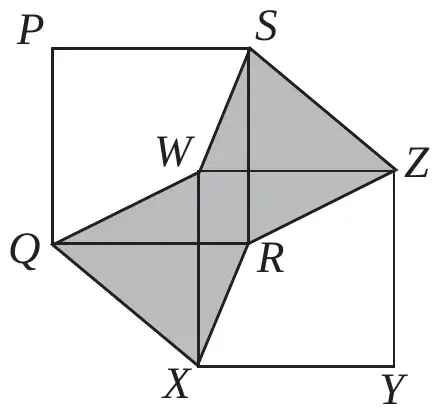
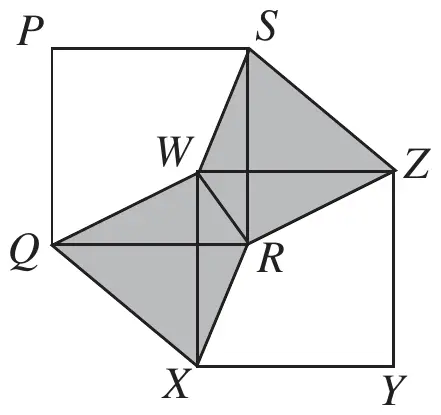
19. In the diagram, \(PQRS\) and \(WXYZ\) are congruent squares. The sides \(PS\) and \(WZ\) are parallel. The shaded area is equal to 1 cm2. What is the area of square \(PQRS\)?
Let the length of a side of \(PQRS\) and of \(WXYZ\) be \(x\) cm. Consider quadrilateral \(QXRW\).
The diagonals \(QR\) and \(WX\) are perpendicular and of length \(x\) cm. Therefore the area of \(QXRW\) is half the area of a rectangle with sides equal in length to \(QR\) and \(WX\) and hence is equal to \(\frac{1}{2} \times QR \times WX = \frac{1}{2}x^2\) cm2. Similarly, the area of quadrilateral \(SWRZ\) is also \(\frac{1}{2}x^2\) cm2. Therefore the total shaded area is \(x^2\) cm2. However, the question tells us that the shaded area is equal to 1 cm2. Therefore \(x^2 = 1\). Hence the area of \(PQRS\) is 1 cm2.
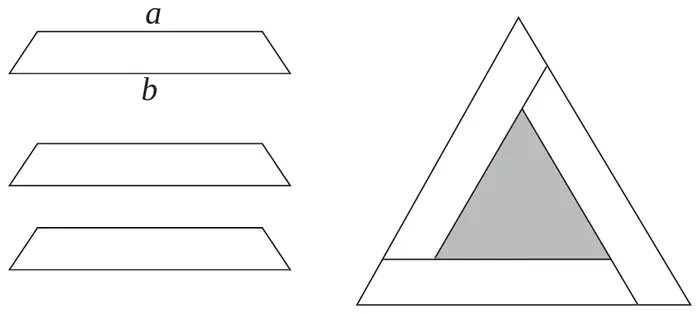
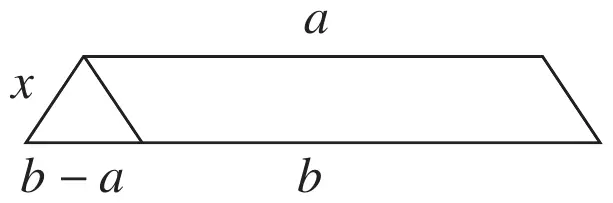
Since the triangle formed when the trapeziums are put together is equilateral, the smaller angles in the isosceles trapeziums are both 60°. Consider one trapezium split into a parallelogram and a triangle as shown.
Since the original trapezium contains two base angles of 60°, the triangle also contains two base angles of 60°. Hence the triangle is equilateral and has side length \((b - a)\). Now consider the large equilateral triangle with the hole. The perimeter of the hole is \(3(a - x)\) where \(x\) is the length of the shortest sides of the trapezium. Therefore the perimeter of the hole is \(3(a - (b - a)) = 3(2a - b) = 6a - 3b\).
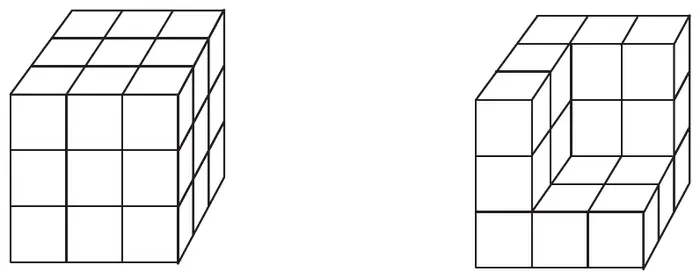
The surface areas of the two solids are the same. Hence the same amount of paint is required to cover them. Therefore it would take 9 litres of paint to cover the surface of the second solid.
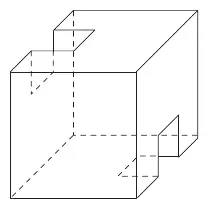
Nets A and D would produce cubes with holes on two edges of the same face. Net E would produce a cube with a hole in the centre of two opposite faces while net B would produce a cube with one hole on an edge and two small holes. The given partial cube has holes on two opposite edges and therefore its net will have a hole on the edge of four different faces. Hence only net C can be used to build the required shape.
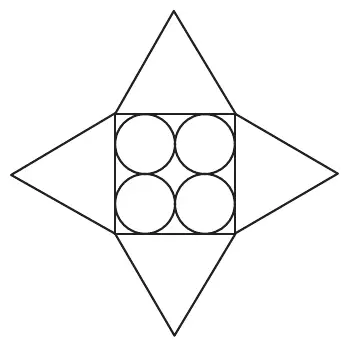
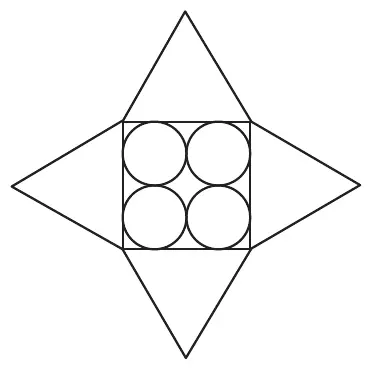
10. Four circles of radius 5 cm touch the sides of a square and each other, as shown in the diagram. On each side of the square, an equilateral triangle is drawn to form a four-pointed star.
The radius of each of the circles is 5 cm and hence the diameter of each is 10 cm. The length of the side of the square is equal to the sum of the diameters of two circles and hence is equal to 20 cm. The length of each side of the equilateral triangle is equal to the length of the side of the square. Hence the perimeter of the star, which is made up of eight sides of congruent equilateral triangles, is 8 × 20 cm = 160 cm.
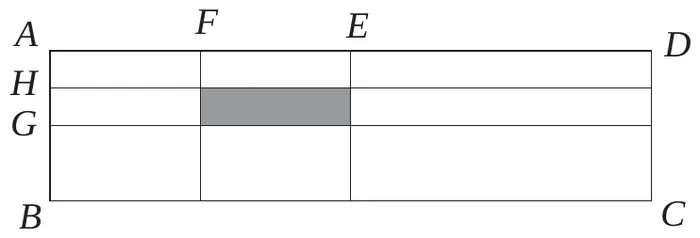
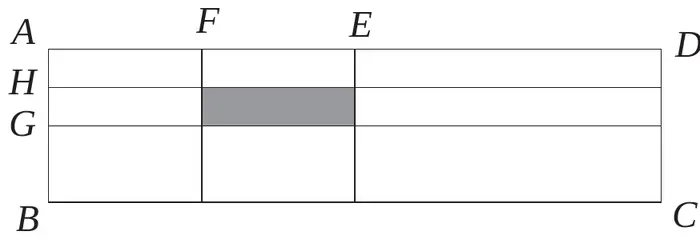
12. The diagram shows a rectangle \(ABCD\) in which \(AB = 1\) metre and \(AD = 4\) metres. The points \(E\) and \(G\) are the midpoints of \(AD\) and \(AB\) and the points \(F\) and \(H\) are the midpoints of \(AE\) and \(AG\).
Since \(E\) is the midpoint of \(AD\) and \(F\) is the midpoint of \(AE\), the length of \(FE\) is \(\frac{1}{2} \times \frac{1}{2} \times 4\) cm = 1 cm. Similarly, since \(G\) is the midpoint of \(AB\) and \(H\) is the midpoint of \(AG\), the length of \(HG\) is \(\frac{1}{2} \times \frac{1}{2} \times 1\) cm = \(\frac{1}{4}\) cm. Therefore the area of the shaded rectangle is \((1 \times \frac{1}{4})\) cm2 = \(\frac{1}{4}\) cm2.
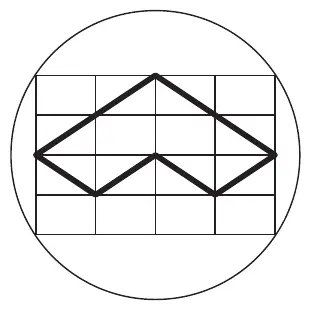
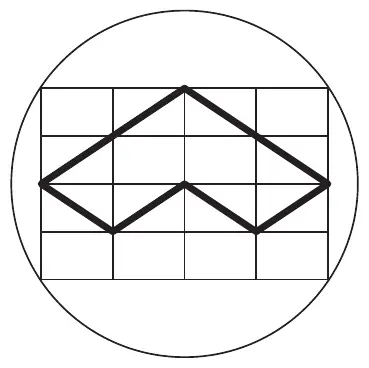
15. The diameter of the circle shown is 10 cm. The circle passes through the vertices of a large rectangle which is divided into 16 identical smaller rectangles.
What is the perimeter of the shape drawn with a dark line?
The diagonals of a rectangle bisect each other at the midpoint of the rectangle. Hence, the midpoint of a rectangle is equidistant from all four vertices and is the centre of a circle through its vertices. In this case, the diameter of the circle is 10 cm. This is equal to the sum of the lengths of the diagonals of four of the smaller rectangles. Hence the diagonal of each small rectangle has length 2.5 cm. The perimeter of the marked shape is made up of eight diagonals of the small rectangles and hence has length 8 × 2.5 cm = 20 cm.
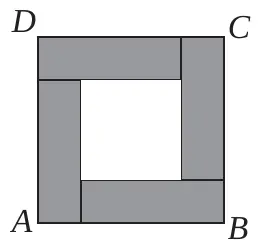
17. The square \(ABCD\) consists of four congruent rectangles arranged around a central square. The perimeter of each of the rectangles is 40 cm. What is the area of the square \(ABCD\)?
Let the length of each of the rectangles be \(x\) cm and the width be \(y\) cm. The perimeter of each of the rectangles is 40 cm and hence \(2x + 2y = 40\). Therefore \(x + y = 20\). From the diagram we can see that the length of each side of the square \(ABCD\) is \((x + y)\) cm. Therefore the square \(ABCD\) has side length 20 cm. Hence the area of \(ABCD\) is (20 × 20) cm2 = 400 cm2.
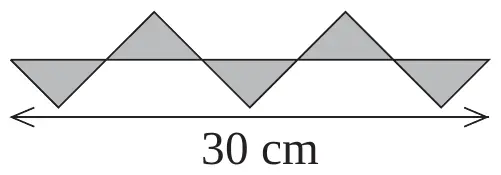
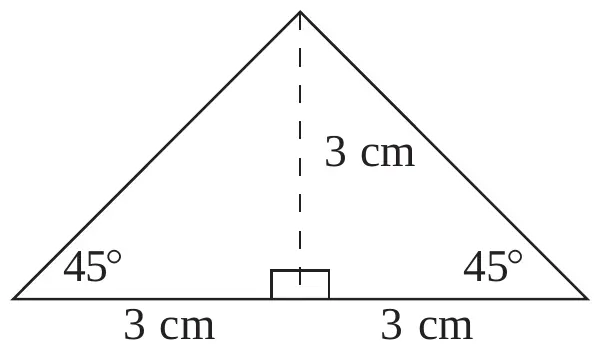
Consider one of the right-angled isosceles triangles as shown.
The longest side is (30 / 5) cm = 6 cm. The triangle can be divided into two identical right-angled isosceles triangles with base 3 cm and hence with height 3 cm. Therefore the area of each of the original triangles is \((\frac{1}{2} \times 6 \times 3)\) cm2 = 9 cm2. Hence the total shaded area is 5 × 9 cm2 = 45 cm2.
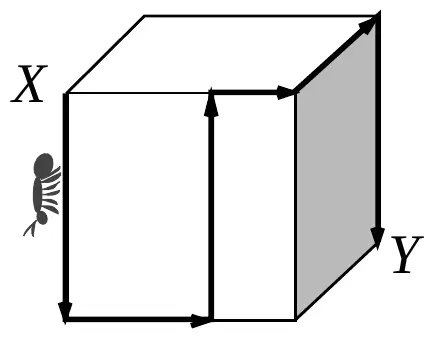
3. The diagram on the right shows a cube of side 18 cm. A giant ant walks across the cube's surface from X to Y along the route shown. How far does it walk?
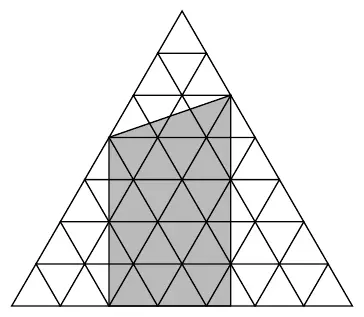
Let \(b\) cm be the length of the base and let \(h\) cm be the height of the small equilateral triangles. The area of each triangle is 4 cm2 so \(\frac{1}{2} \times b \times h = 4\).
The shaded area is a trapezium with parallel sides of length \(4h\) and \(5h\) and with distance \(\frac{5}{2}b\) between the parallel lines. Using the formula for the area of a trapezium, the shaded area is equal to \(\frac{1}{2}(4h + 5h) \times \frac{5}{2}b = \frac{1}{4} \times 45bh\). From above, \(bh = 8\) so this area is equal to \(\frac{1}{4}\) × 45 × 8 cm2 = 90 cm2.
(Alternatively, one could observe that the first four horizontal rows of the shaded region have area equivalent to five of the small equilateral triangles while the fifth layer has area equivalent to half of that or 2.5 equilateral triangles. Hence the shaded region has area equivalent to 22.5 small equilateral triangles and so has area 22.5 × 4 cm2 = 90 cm2.)
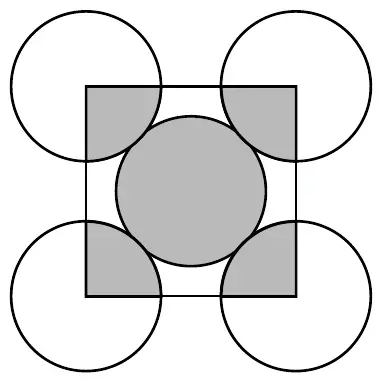
14. The diagram shows five circles of the same radius touching each other. A square is drawn so that its vertices are at the centres of the four outer circles. What is the ratio of the area of the shaded parts of the circles to the area of the unshaded parts of the circles?
The shaded area is equal to that of 1 circle + 4 × \(\frac{1}{4}\) circles = 2 circles. The area of the unshaded parts of the circles is equal to that of 4 × \(\frac{3}{4}\) circles = 3 circles. Hence the required ratio is 2 : 3.
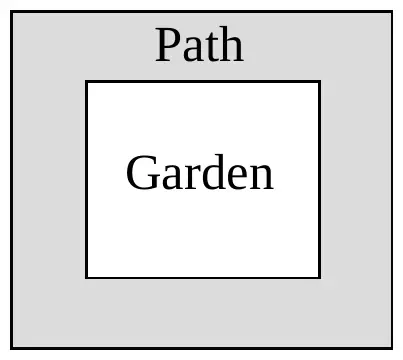
15. A rectangular garden is surrounded by a path of constant width. The perimeter of the garden is 24 m shorter than the distance along the outside edge of the path. What is the width of the path?
Let the length and width of the garden be \(a\) metres and \(b\) metres respectively and let the width of the path be \(x\) metres. The perimeter of the garden is \(2(a + b)\) metres and the perimeter of the larger rectangle formed by the garden and the path is \(2(a + 2x + b + 2x)\) metres. Hence the difference between the distance along the outside edge of the path and the perimeter of the garden in metres is \(2(a + 2x + b + 2x) - 2(a + b) = 8x\). Therefore \(8x = 24\) which has solution \(x = 3\). Hence the width of the path is 3 metres.
The diagram above shows the front and right-hand views of a solid made up of cubes of side 3 cm. The maximum volume that the solid could have is V cm3. What is the value of V?
Each cube has volume 33 cm3 = 27 cm3. There are four cubes visible in the base layer from both the front and the side so the maximum number of cubes in the base layer is 4 × 4 = 16. Similarly, the maximum number of cubes in the second layer is 2 × 2 = 4. Hence the maximum number of cubes in the solid is 16 + 4 = 20 with a corresponding maximum volume of 20 × 27 cm3 = 540 cm3.
We'd like to use Google Analytics cookies to count visits and see which pages help most. They're optional, and the site works exactly the same either way. Privacy policy