
JK 2017 Q19
19. In the diagram, \(PQRS\) and \(WXYZ\) are congruent squares. The sides \(PS\) and \(WZ\) are parallel. The shaded area is equal to 1 cm2.
What is the area of square \(PQRS\)?
- A 1 cm2
- B 2 cm2
- C \(\frac{1}{2}\) cm2
- D \(1\frac{1}{2}\) cm2
- E \(\frac{3}{4}\) cm2
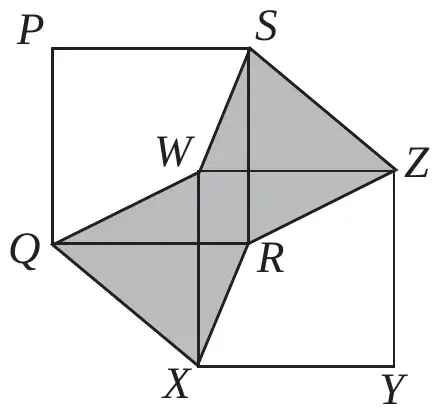
Junior Kangaroo 2017, Question 19. © UK Mathematics Trust. Original paper on ukmt.org.uk
Answer: A 1 cm2
Let the length of a side of \(PQRS\) and of \(WXYZ\) be \(x\) cm. Consider quadrilateral \(QXRW\).
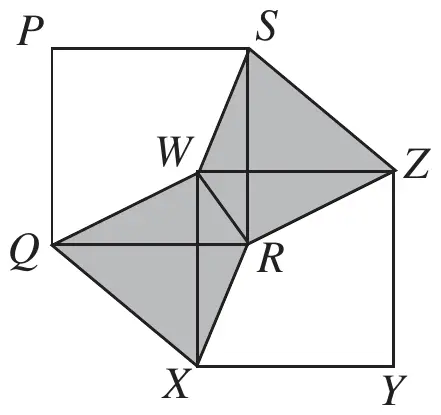
The diagonals \(QR\) and \(WX\) are perpendicular and of length \(x\) cm. Therefore the area of \(QXRW\) is half the area of a rectangle with sides equal in length to \(QR\) and \(WX\) and hence is equal to \(\frac{1}{2} \times QR \times WX = \frac{1}{2}x^2\) cm2. Similarly, the area of quadrilateral \(SWRZ\) is also \(\frac{1}{2}x^2\) cm2. Therefore the total shaded area is \(x^2\) cm2. However, the question tells us that the shaded area is equal to 1 cm2. Therefore \(x^2 = 1\). Hence the area of \(PQRS\) is 1 cm2.
Solution © UK Mathematics Trust, from the JK 2017 solutions.