
JK 2015 Q11
11. In the diagram, the small equilateral triangles have area 4 cm2. What is the area of the shaded region?
- A 80 cm2
- B 90 cm2
- C 100 cm2
- D 110 cm2
- E 120 cm2
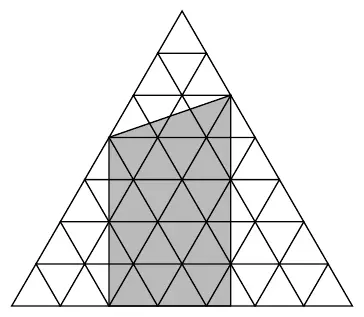
Junior Kangaroo 2015, Question 11. © UK Mathematics Trust. Original paper on ukmt.org.uk
Answer: B 90 cm2
Let \(b\) cm be the length of the base and let \(h\) cm be the height of the small equilateral triangles. The area of each triangle is 4 cm2 so \(\frac{1}{2} \times b \times h = 4\).
The shaded area is a trapezium with parallel sides of length \(4h\) and \(5h\) and with distance \(\frac{5}{2}b\) between the parallel lines. Using the formula for the area of a trapezium, the shaded area is equal to \(\frac{1}{2}(4h + 5h) \times \frac{5}{2}b = \frac{1}{4} \times 45bh\). From above, \(bh = 8\) so this area is equal to \(\frac{1}{4}\) × 45 × 8 cm2 = 90 cm2.
(Alternatively, one could observe that the first four horizontal rows of the shaded region have area equivalent to five of the small equilateral triangles while the fifth layer has area equivalent to half of that or 2.5 equilateral triangles. Hence the shaded region has area equivalent to 22.5 small equilateral triangles and so has area 22.5 × 4 cm2 = 90 cm2.)
Solution © UK Mathematics Trust, from the JK 2015 solutions.