At all the times given, the minute hand is pointing to 12. When the minute hand is pointing to 12 and the angle between the hands is 150°, the hour hand has turned \(\frac{150}{360} = \frac{5}{12}\) of a complete turn. Therefore the hour hand will point at 5 and the time will be 5 pm. (There are other times when the angle between the hands is 150° but, of these, only at 7 pm does the minute hand point to 12 and 7 pm is not one of the times given.)
2. Twelve people, and no more, can sit evenly spaced around a large square table. Rohan arranges eight of these square tables in a row to make one long rectangular table. What is the maximum number of people that can sit evenly spaced around this long table?
The number of people who can sit on each side of the square table is 12 ÷ 4 = 3. When eight of these tables are arranged to make a long rectangular table, there will be room for 8 × 3 = 24 people on each long side and for three extra people at each end. Hence, the number of people that can sit round the long table is 2 × 24 + 2 × 3 = 48 + 6 = 54.
Since one ball and one bat cost £90, two balls and two bats cost 2 × £90 = £180. Now, since three balls and two bats cost £210, one ball costs £210 − £180 = £30. Therefore a bat costs £90 − £30 = £60.
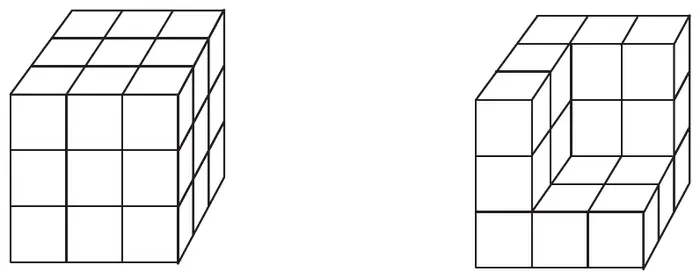
The surface areas of the two solids are the same. Hence the same amount of paint is required to cover them. Therefore it would take 9 litres of paint to cover the surface of the second solid.
6. Miss Spelling has enough sheets of paper to give each pupil in her class 3 sheets and have 31 sheets left over. Alternatively, she could give each pupil 4 sheets and have 8 sheets left over. How many sheets of paper does she have?
Let the number of pupils in the class be \(x\). The information in the question tells us that \(3x + 31 = 4x + 8\), which has solution \(x = 23\). Hence the number of sheets of paper Miss Spelling has is 3 × 23 + 31 = 100.
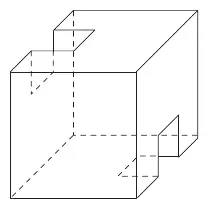
Nets A and D would produce cubes with holes on two edges of the same face. Net E would produce a cube with a hole in the centre of two opposite faces while net B would produce a cube with one hole on an edge and two small holes. The given partial cube has holes on two opposite edges and therefore its net will have a hole on the edge of four different faces. Hence only net C can be used to build the required shape.
Since one angle of the isosceles triangle is 30°, there are two possibilities. Either the other two angles are equal, in which case the difference between them is 0°, or one of the other angles is 30°. In this case, since angles in a triangle add to 180°, the second missing angle is 120° and hence the difference between the two missing angles is 120° − 30° = 90°.
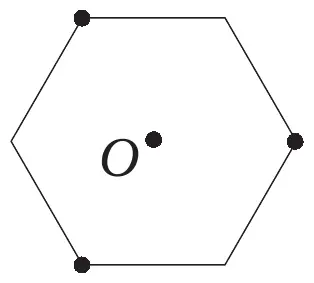
9. A piece of paper in the shape of a regular hexagon, as shown, is folded so that the three marked vertices meet at the centre \(O\) of the hexagon. What is the shape of the figure that is formed?
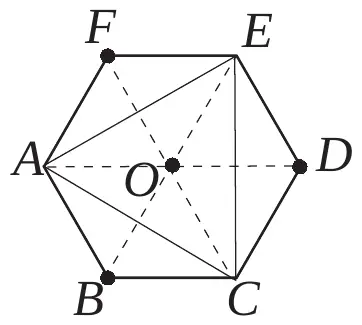
Label vertices \(A\),\(B\),\(C\),\(D\),\(E\), \(E\) and \(F\) as shown. Since the hexagon is regular, it can be divided into six equilateral triangles as shown. Therefore quadrilateral \(OABC\) is a rhombus and hence its diagonal \(AC\) is a line of symmetry. Therefore, if vertex \(B\) is folded onto \(O\), the fold will be along \(AC\). Similarly, if vertices \(D\) and \(F\) are folded onto \(O\), the folds will be along \(CE\) and \(EA\) respectively. Hence the figure that is formed will be a triangle and, since all three of the rhombuses \(OABC\), \(OCDE\) and \(OEFA\) are made out of two congruent equilateral triangles, the lengths of their diagonals \(AC\), \(CE\) and \(EA\) will be equal. Hence the shape \(ACE\) that is formed is an equilateral triangle.
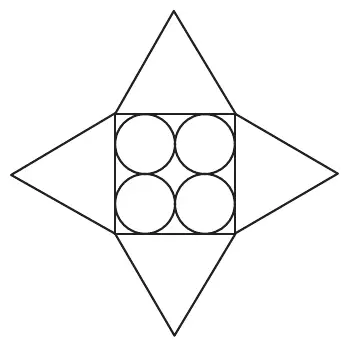
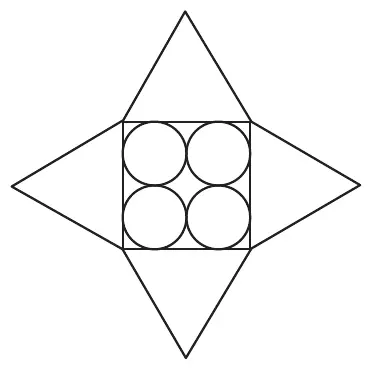
10. Four circles of radius 5 cm touch the sides of a square and each other, as shown in the diagram. On each side of the square, an equilateral triangle is drawn to form a four-pointed star.
The radius of each of the circles is 5 cm and hence the diameter of each is 10 cm. The length of the side of the square is equal to the sum of the diameters of two circles and hence is equal to 20 cm. The length of each side of the equilateral triangle is equal to the length of the side of the square. Hence the perimeter of the star, which is made up of eight sides of congruent equilateral triangles, is 8 × 20 cm = 160 cm.
11. Joey calculated the sum of the largest and smallest two-digit numbers that are multiples of three. Zoë calculated the sum of the largest and smallest two-digit numbers that are not multiples of three. What is the difference between their answers?
Joey's two numbers are 99 and 12 and hence his sum is 111. Zoë's two numbers are 98 and 10 and hence her sum is 108. Therefore the difference between their answers is 111 − 108 = 3.
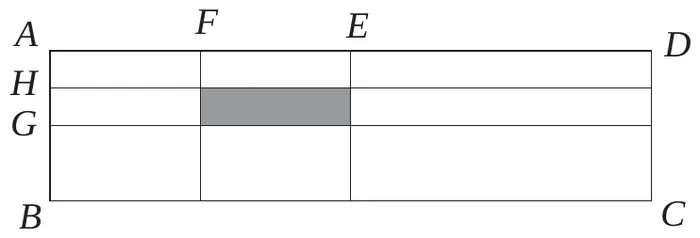
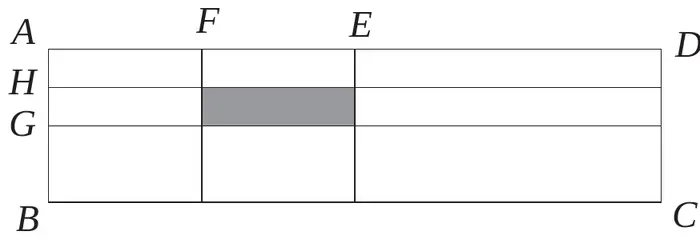
12. The diagram shows a rectangle \(ABCD\) in which \(AB = 1\) metre and \(AD = 4\) metres. The points \(E\) and \(G\) are the midpoints of \(AD\) and \(AB\) and the points \(F\) and \(H\) are the midpoints of \(AE\) and \(AG\).
Since \(E\) is the midpoint of \(AD\) and \(F\) is the midpoint of \(AE\), the length of \(FE\) is \(\frac{1}{2} \times \frac{1}{2} \times 4\) cm = 1 cm. Similarly, since \(G\) is the midpoint of \(AB\) and \(H\) is the midpoint of \(AG\), the length of \(HG\) is \(\frac{1}{2} \times \frac{1}{2} \times 1\) cm = \(\frac{1}{4}\) cm. Therefore the area of the shaded rectangle is \((1 \times \frac{1}{4})\) cm2 = \(\frac{1}{4}\) cm2.
13. The tens digit of a two-digit number is three more than the units digit. When this two-digit number is divided by the sum of its digits, the answer is 7 remainder 3. What is the sum of the digits of the two-digit number?
Let the units digit of the number be \(x\). Hence the tens digit of the number is \(x + 3\) and the sum of the digits of the number is \(2x + 3\). The information in the question tells us that \(10(x + 3) + x = 7(2x + 3) + 3\). Hence \(11x + 30 = 14x + 24\) which has solution \(x = 2\). Therefore the sum of the digits of the two-digit number is 2 × 2 + 3 = 7.
Consider the case where two opposite faces are coloured red. Whichever of the four remaining faces is also coloured red, the resulting arrangement is equivalent under rotation to a cube with top, bottom and front faces coloured red. Hence, there is only one distinct colouring of a cube consisting of three red and three blue faces with two opposite faces coloured red. Now consider the case where no two opposite faces are coloured red. This is only possible when the three red faces share a common vertex and, however these faces are arranged, the resulting arrangement is equivalent under rotation to a cube with top, front and right-hand faces coloured red. Hence there is also only one distinct colouring of a cube consisting of three red and three blue faces in which no two opposite faces are coloured red. Therefore there are exactly two different colourings of the cube as described in the question.
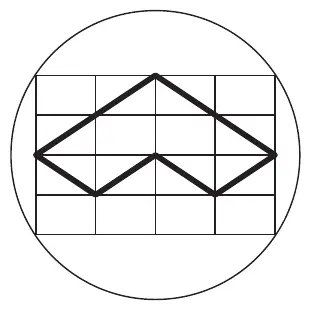
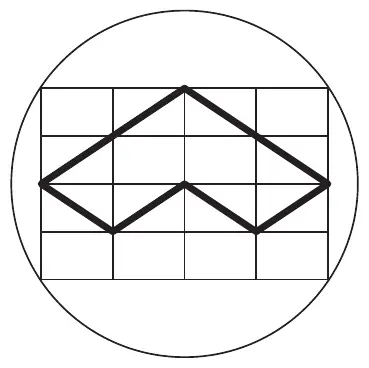
15. The diameter of the circle shown is 10 cm. The circle passes through the vertices of a large rectangle which is divided into 16 identical smaller rectangles.
What is the perimeter of the shape drawn with a dark line?
The diagonals of a rectangle bisect each other at the midpoint of the rectangle. Hence, the midpoint of a rectangle is equidistant from all four vertices and is the centre of a circle through its vertices. In this case, the diameter of the circle is 10 cm. This is equal to the sum of the lengths of the diagonals of four of the smaller rectangles. Hence the diagonal of each small rectangle has length 2.5 cm. The perimeter of the marked shape is made up of eight diagonals of the small rectangles and hence has length 8 × 2.5 cm = 20 cm.
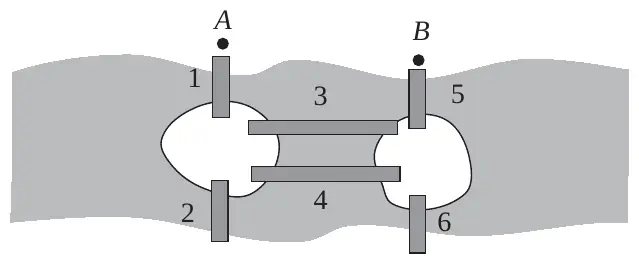
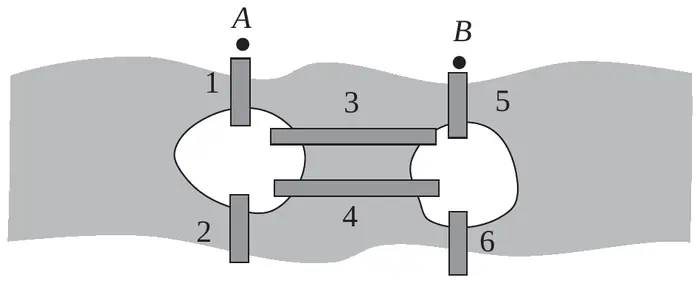
16. The diagram shows part of a river which has two islands in it. There are six bridges linking the islands and the two banks as shown. Leonhard goes for a walk every day in which he walks over each bridge exactly once. He always starts at point \(A\), goes first over bridge 1 and always finishes at point \(B\). What is the maximum number of days that he can walk without repeating the order in which he crosses the bridges?
Since Leonhard's walk always goes over bridge 1 first, it must conclude by going over bridge 5 to enable him to reach to B. Note also that bridges 2 and 6 must be crossed consecutively, in some order, as they are the only way to get to and from the opposite bank to the one from which he started and is to finish and so can be considered together.
Hence the number of days he can walk without repeating the order in which he crosses the bridges is the same as the number of ways of choosing ordered crossings of bridges 3, 4 and the pair 2 and 6. These can be chosen in six different ways (three choices for the first bridge, two for the second and then only one choice for the third). Hence Leonhard can walk for six days without repeating the order in which he crosses the bridges. (The six orders are 126345, 126435, 134265, 136245, 143265 and 146235.)
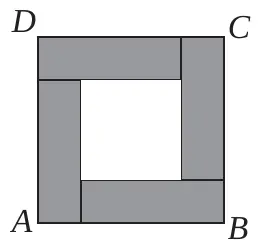
17. The square \(ABCD\) consists of four congruent rectangles arranged around a central square. The perimeter of each of the rectangles is 40 cm. What is the area of the square \(ABCD\)?
Let the length of each of the rectangles be \(x\) cm and the width be \(y\) cm. The perimeter of each of the rectangles is 40 cm and hence \(2x + 2y = 40\). Therefore \(x + y = 20\). From the diagram we can see that the length of each side of the square \(ABCD\) is \((x + y)\) cm. Therefore the square \(ABCD\) has side length 20 cm. Hence the area of \(ABCD\) is (20 × 20) cm2 = 400 cm2.
18. When Ellen went to the shop, she found she could spend all her money on 6 cans of cola and 7 croissants or on 8 cans of cola and 4 croissants. If she decided to buy only croissants, how many croissants could she buy?
Let the cost of a can of cola be \(x\) pence and the cost of a croissant be \(y\) pence. The information in the question tells us that \(6x + 7y = 8x + 4y\) and that both sides of the equation represent the total amount of money Ellen has. Hence \(3y = 2x\). Therefore the total amount of money she has is \(3 \times 3y + 7y\) pence = \(16y\) pence. Hence she could buy 16 croissants if she bought only croissants.
19. Adam, Bill and Chris went swimming 15 times last summer. Adam paid for everyone eight times and Bill paid for everyone seven times. At the end of the summer, Chris calculated that he owed £30. How should he split this between Adam and Bill so that each has paid the same amount?
If each person paid their fair share, each would have paid five times. Therefore Adam has paid on an extra three occasions and Bill has paid on an extra two occasions. Hence the £30 Chris owes should be divided in the ratio 3:2. Therefore Adam should get \(\frac{3}{5}\) × £30 = £18 and Bill should get \(\frac{2}{5}\) × £30 = £12.
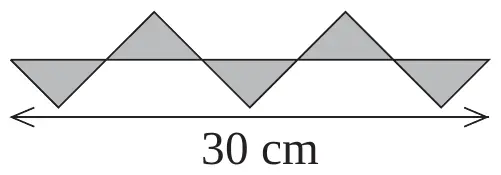
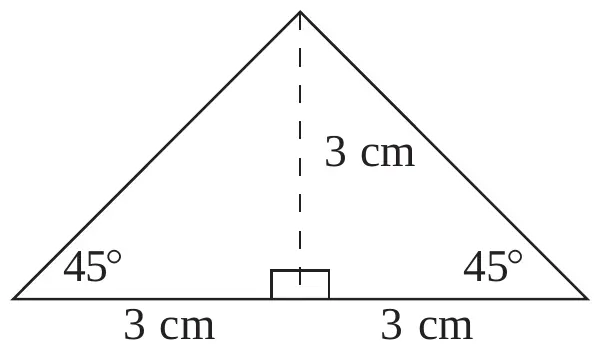
Consider one of the right-angled isosceles triangles as shown.
The longest side is (30 / 5) cm = 6 cm. The triangle can be divided into two identical right-angled isosceles triangles with base 3 cm and hence with height 3 cm. Therefore the area of each of the original triangles is \((\frac{1}{2} \times 6 \times 3)\) cm2 = 9 cm2. Hence the total shaded area is 5 × 9 cm2 = 45 cm2.
21. In Carl's pencil case there are nine pencils. At least one of the pencils is blue. In any group of four pencils, at least two have the same colour. In any group of five pencils, at most three have the same colour. How many pencils are blue?
The information that in any group of four pencils, at least two have the same colour, tells us that there at most three different coloured pencils in Carl's pencil case. The information that in any group of five pencils, at most three have the same colour, tells us that there are at most three pencils of any single colour in the pencil case. Hence there are three pencils of each of the three different colours and so Carl's pencil case contains three blue pencils.
22. Lewis drives from London to Brighton at an average speed of 60 mph. On the way back, he gets stuck in traffic and his average speed is only 40 mph. What is his average speed for the whole journey?
Let the distance from London to Brighton be \(d\) miles. Since time = distance/speed, the times Lewis spent on the two parts of his journey are \(\frac{d}{60}\) hours and \(\frac{d}{40}\) hours. Hence the total time in hours that he travelled is \[\frac{d}{60} + \frac{d}{40} = \frac{2d + 3d}{120} = \frac{5d}{120} = \frac{d}{24}.\] Therefore his average speed for the whole journey is \(2d \div \left(\frac{d}{24}\right)\) mph = 48 mph.
23. In the addition sum below, \(a\), \(b\) and \(c\) stand for different digits. \[\begin{array}{cr} & a\,b\,c \\ + & \underline{a\,c\,b} \\ & c\;4\;a. \end{array}\] What is the value of \(a + b + c\)?
\(\begin{array}{cr} & a\,b\,c \\ + & \underline{a\,c\,b} \\ & c\;4\;a. \end{array}\) Since \(c\) is the digit in the hundreds column of the answer, we can deduce that \(c > a\). Therefore, there must be a carry from the units column to the tens column and hence \(a = 4 - 1 = 3\). Since there will also be a carry from the tens column to the hundreds column, we have \(c = a + a + 1 = 7\). Therefore, \(7 + b = 13\) and hence \(b = 6\). Therefore the value of \(a + b + c\) is 3 + 6 + 7 = 16.
24. The lengths of three adjacent sides of a quadrilateral are equal. The angle between the first and second of these sides is 60° and the angle between the second and third of these sides is 100°. What is the largest angle of the quadrilateral?
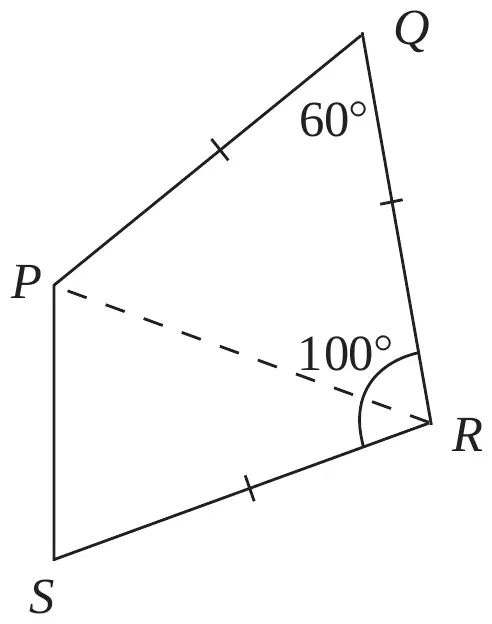
Consider the quadrilateral \(PQRS\) as shown with \(PQ = QR = RS\), \(\angle RQP = 60°\) and \(\angle SRQ = 100°\).
Draw line \(PR\). Since \(PQ = QR\) and \(\angle PQR = 60°\), triangle \(PQR\) is equilateral and hence \(PR = PQ = QR = RS\) and \(\angle PRQ = 60°\). Since \(\angle SRQ = 100°\),\(\angle SRP = 100° - 60° = 40°\). Since \(PR = RS\), triangle \(PRS\) is isosceles and hence \(\angle RPS = \angle PSR = \frac{1}{2}(180° - 40°) = 70°\). Therefore the largest angle of the quadrilateral is \(\angle QPS = 70° + 60° = 130°\).
25. The whole numbers from 1 to 2016 inclusive are written on a blackboard. Moritz underlines all the multiples of two in red, all the multiples of three in blue and all the multiples of four in green. How many numbers does Moritz underline exactly twice?
There is no number that is both a multiple of three and a multiple of four without also being a multiple of two. Hence, the numbers underlined exactly twice are those that are a multiple of two and of three but not of four and those that are a multiple of two and four but not of three. The first set of numbers consists of the set of odd multiples of six. Since 2016 ÷ 6 = 336, there are 336 multiples of 6 in the list of numbers and hence 336 ÷ 2 = 168 odd multiples of six that would be underlined in red and blue but not green. The second set of numbers consists of two out of every three multiples of four and, since 2016 ÷ 4 = 504, there are \(\frac{2}{3}\) × 504 = 336 numbers that would be underlined in red and green but not blue. Hence there are 168 + 336 = 504 numbers that Moritz would underline exactly twice.
We'd like to use Google Analytics cookies to count visits and see which pages help most. They're optional, and the site works exactly the same either way. Privacy policy