
JK 2016 Q9
9. A piece of paper in the shape of a regular hexagon, as shown, is folded so that the three marked vertices meet at the centre \(O\) of the hexagon.
What is the shape of the figure that is formed?
- A Six-pointed star
- B Dodecagon
- C Hexagon
- D Square
- E Equilateral Triangle
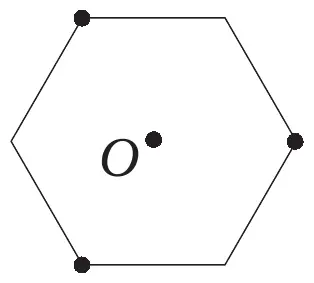
Junior Kangaroo 2016, Question 9. © UK Mathematics Trust. Original paper on ukmt.org.uk
Answer: E Equilateral Triangle
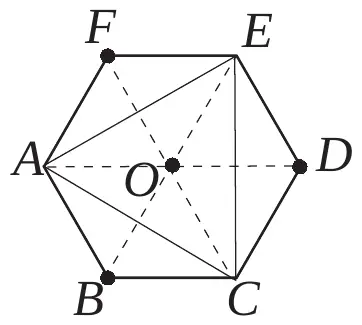
Label vertices \(A\), \(B\), \(C\), \(D\), \(E\), \(E\) and \(F\) as shown. Since the hexagon is regular, it can be divided into six equilateral triangles as shown. Therefore quadrilateral \(OABC\) is a rhombus and hence its diagonal \(AC\) is a line of symmetry. Therefore, if vertex \(B\) is folded onto \(O\), the fold will be along \(AC\). Similarly, if vertices \(D\) and \(F\) are folded onto \(O\), the folds will be along \(CE\) and \(EA\) respectively. Hence the figure that is formed will be a triangle and, since all three of the rhombuses \(OABC\), \(OCDE\) and \(OEFA\) are made out of two congruent equilateral triangles, the lengths of their diagonals \(AC\), \(CE\) and \(EA\) will be equal. Hence the shape \(ACE\) that is formed is an equilateral triangle.
Solution © UK Mathematics Trust, from the JK 2016 solutions.