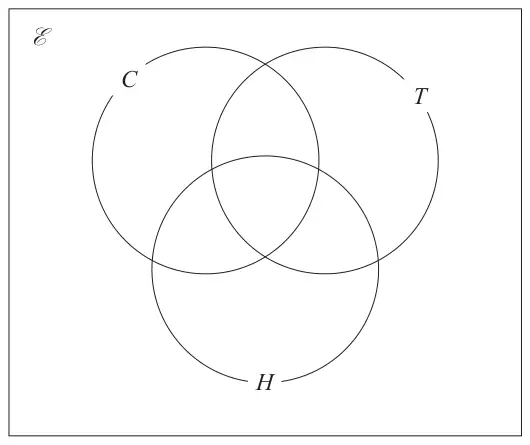
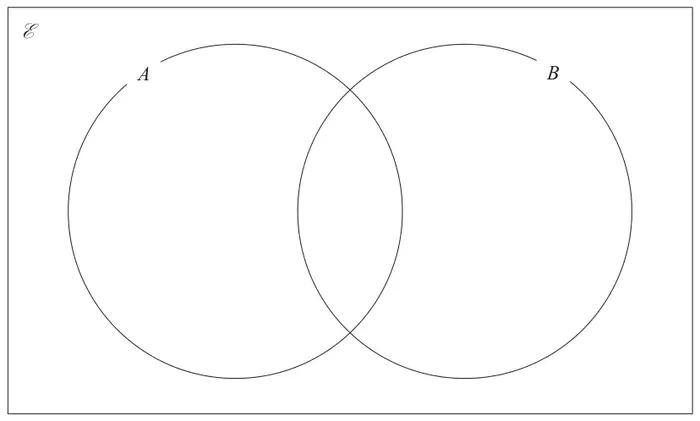
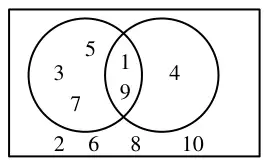
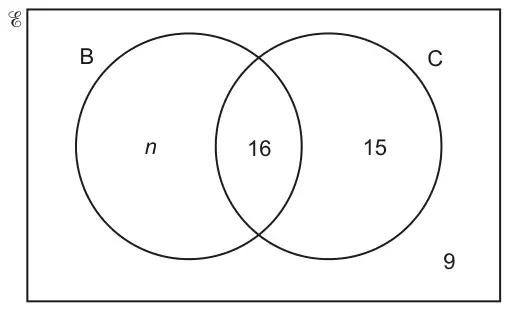
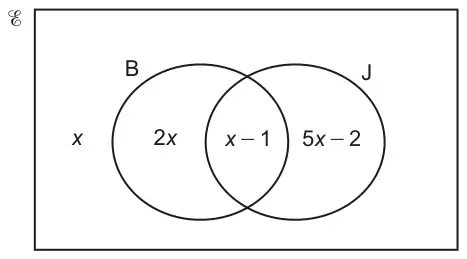
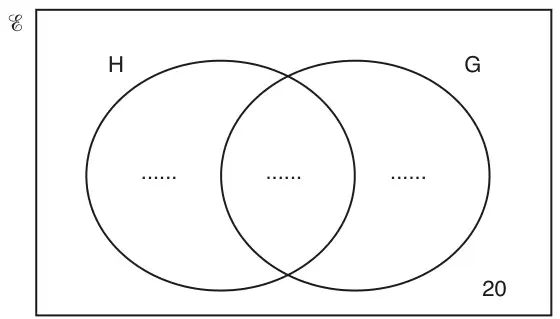
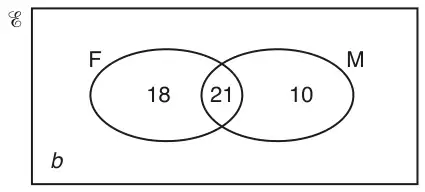
18 Magda carried out a survey to find out the drinks that people like.
She asked 100 people if they like coffee (\(C\)) or tea (\(T\)) or hot chocolate (\(H\)).
32 people like all three drinks. 15 people like coffee and hot chocolate but not tea. 43 people like coffee and tea. 39 people like tea and hot chocolate. 67 people like coffee. 58 people like hot chocolate. 5 people like only tea.
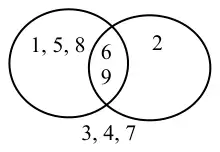
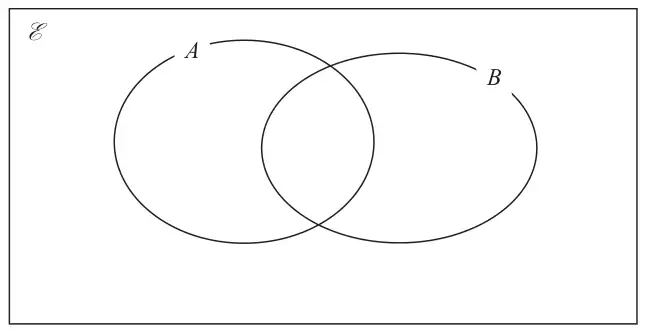
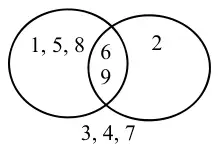
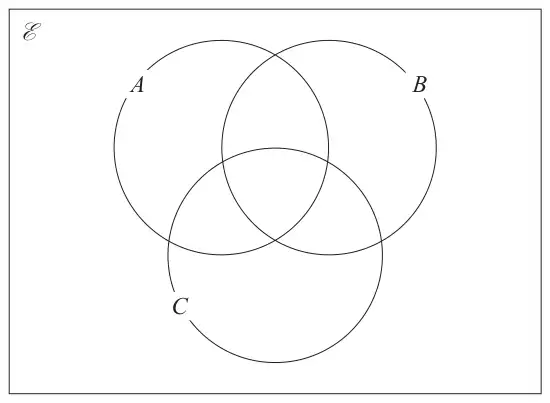
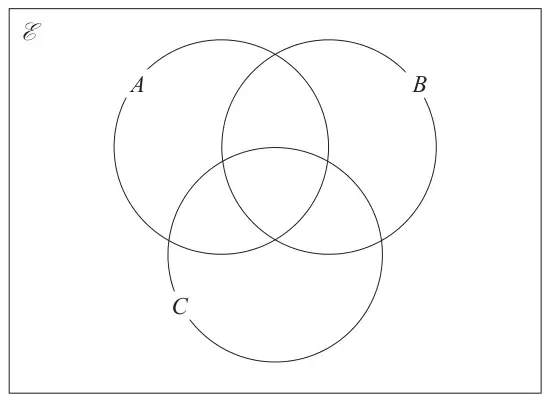
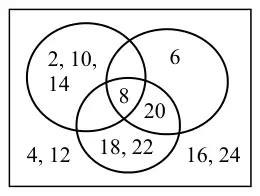
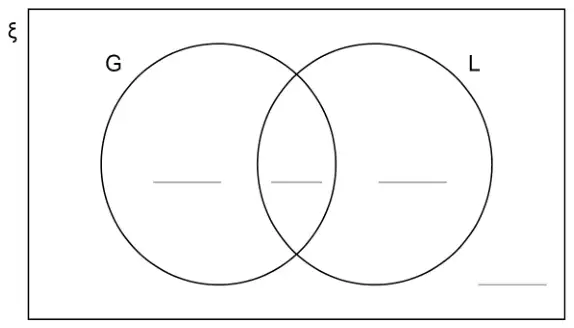
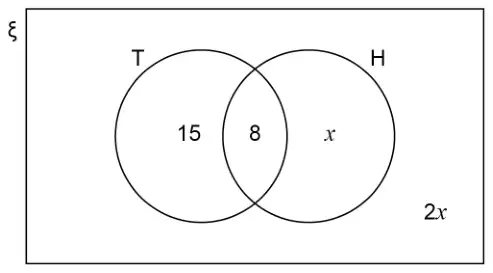
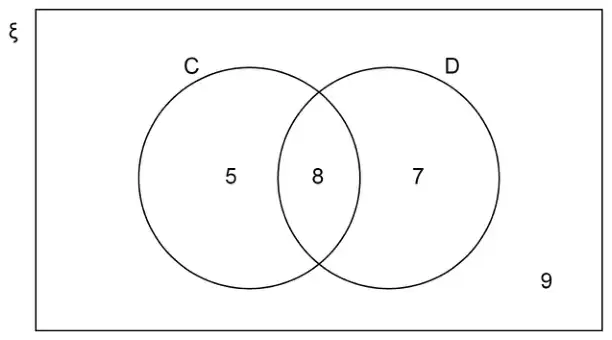
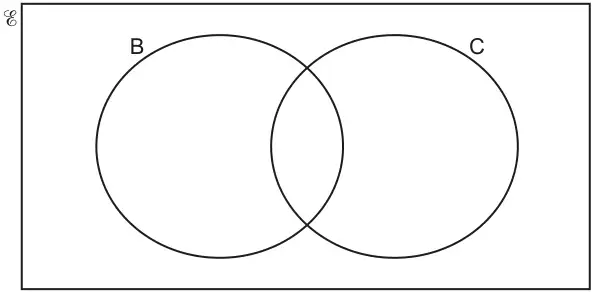
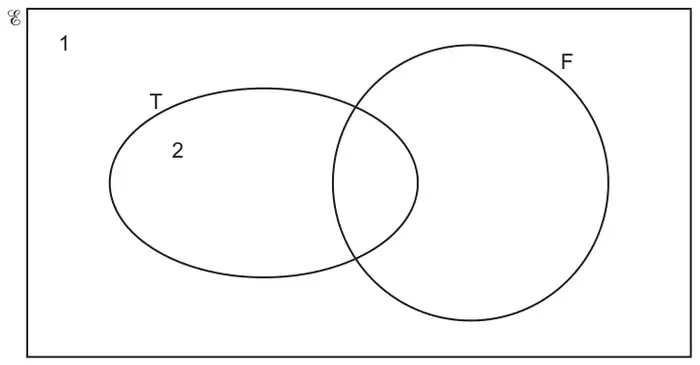
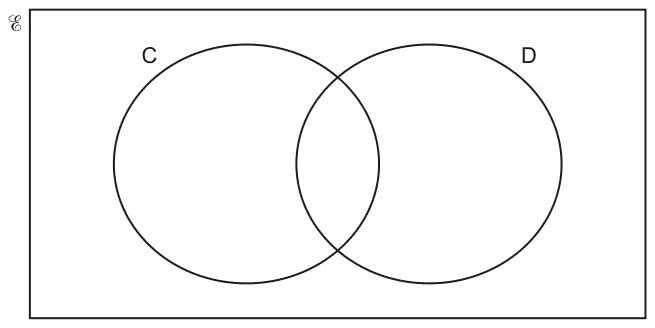
(a) Complete the Venn diagram for this information.(4)
One of the people is chosen at random.
Given that this person likes coffee,
(b) find the probability that this person also likes hot chocolate. (2)
Mark scheme (a)
Answer
Mark
Mark scheme
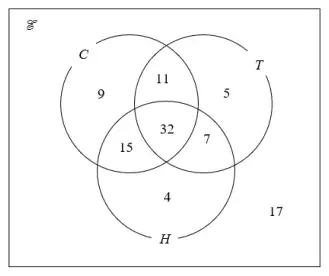
Venn diagram
C4
fully correct Venn diagram
(C3
6 or 7 of the 8 regions correct)
(C2
4 or 5 of the 8 regions correct)
(C1
2 or 3 of the 8 regions correct)
Additional guidance
Ignore all entries except the region you are marking for each C mark
Repeated digits in the diagram should be counted as 2 elements
Mark scheme (b)
Answer
Mark
Mark scheme
\(\dfrac{47}{67}\)
M1
for \(\dfrac{47}{b}\) where \(b \gt 47\) or ft \(\dfrac{\text{``}47\text{''}}{b}\) where \(b \gt \text{``}47\text{''}\)
or \(\dfrac{a}{67}\) where \(0 \lt a \lt 67\) or ft \(\dfrac{a}{\text{``}67\text{''}}\) where \(0 \lt a \lt \text{``}67\text{''}\)
A1
for \(\dfrac{47}{67}\) oe or ft \(\dfrac{\text{``}47\text{''}}{\text{``}67\text{''}}\) oe
Additional guidance
Need not be written in correct form at this stage eg could be a ratio 47 : 67 \(\text{``}47\text{''} = \text{``}15\text{''} + \text{``}32\text{''}\) \(\text{``}67\text{''} = \text{``}9\text{''} + \text{``}11\text{''} + \text{``}32\text{''} + \text{``}15\text{''}\)
Accept any equivalent fraction, decimal form 0.70(14..) or percentage form 70(.14…)%
There are 6 blue buttons 9 green buttons 5 red buttons.
Jai puts 12 more buttons in the box. These buttons are either blue buttons or red buttons.
Jai is going to pick at random one button from the box. The probability that this button will be blue is \(\dfrac{1}{4}\)
How many more red buttons did Jai put in the box? You must show all your working. (4)
Mark scheme
Answer
Mark
Mark scheme
10
P1
for process to find total number of buttons \(20 + 12\ (= 32)\)
P1
for process to work with probability, eg \(\text{``}32\text{''} \div 4\ (= 8)\) or \(\text{``}32\text{''} \div 4 \times 3\ (= 24)\)
P1
for process to find number of extra blue buttons required, eg \(\text{``}8\text{''} - 6\ (= 2)\) or for process to find number of extra reds, eg \(12 - (\text{``}8\text{''} - 6)\) or for process to find new total number of red buttons, eg \((6 + 5 + 12) - \text{``}8\text{''}\ (= 15)\) or \(\text{``}32\text{''} - \text{``}8\text{''} - 9\ (= 15)\) or \(\text{``}24\text{''} - 9\ (= 15)\)
A1
(dep P2) cao
Additional guidance
May be implied by \(\dfrac{\text{``}8\text{''}}{\text{``}32\text{''}}\)
May be implied by 8 : 9 : 15 or \(\dfrac{\text{``}10\text{''}}{\text{``}32\text{''}}\)
19 The table shows the probabilities that a biased dice will land on 3, on 4, on 5 and on 6
Number on dice
1
2
3
4
5
6
Probability
0.10
0.30
0.05
0.25
Karim assumes that the probabilities that the dice will land on 1 and on 2 are the same.
Karim rolls the biased dice 500 times.
(a) Assuming Karim is right, work out an estimate for the number of times the dice will land on 2 (3)
Karim is wrong. The probability that the dice will land on 2 is greater than the probability that the dice will land on 1
(b) How does this information affect your answer to part (a)? (1)
Mark scheme (a)
Answer
Mark
Mark scheme
75
P1
for process to find sum of unknown probabilities eg \(1 - (0.10 + 0.30 + 0.05 + 0.25)\ (= 0.3)\) oe
or for process to find number of times dice lands on 3, 4, 5 or 6 eg \((0.10 + 0.30 + 0.05 + 0.25) \times 500\ (= 350)\) oe
P1
for a complete process, eg \((\text{``}0.3\text{''} \div 2) \times 500\) oe
or \((500 - \text{``}350\text{''}) \div 2\) oe
A1
cao
Additional guidance
Award mark for any two probabilities that sum to 0.3 eg in the table or probability of 2 = 0.15
P1P1A0 for answer of 75:500 or \(\dfrac{75}{500}\)
Mark scheme (b)
Answer
Mark
Mark scheme
Answer to part (a) will be greater
C1
for an explanation that the answer will be greater
Acceptable examples It makes the answer an underestimate The number will be higher The answer will increase / will go up The number of 2’s will increase It would be more than [75]
Not acceptable examples My answer will change My answer is incorrect The calculation will change The probability will change It would make the probability of 2 go up My answer won’t change
16 Aisha has two boxes of sweets, box A and box B.
In box A, there are only 10 red sweets and 30 green sweets. In box B, there are only 7 red sweets and 18 green sweets.
Aisha is going to take at random a sweet from box A and a sweet from box B.
Which box gives Aisha the greater probability of taking a red sweet, box A or box B? You must show how you get your answer. (3)
Mark scheme
Answer
Mark
Mark scheme
Box B and correct figures
P1
for process to find one probability or proportion, eg \(\dfrac{10}{10 + 30}\left(= \dfrac{10}{40}\right)\) or \(\dfrac{7}{7 + 18}\left(= \dfrac{7}{25}\right)\)
P1
(dep P1) for process to find figures to compare using a common format, eg \(10 \div [40]\ (= 0.25)\) and \(7 \div [25]\ (= 0.28)\) or \(10 \div [40] \times 100\ (= 25)\) and \(7 \div [25] \times 100\ (= 28)\) or \(\dfrac{10}{[40]} = \dfrac{25}{100}\) oe and \(\dfrac{7}{[25]} = \dfrac{28}{100}\) oe or \(\dfrac{10 \div 10}{[40] \div 10}\left(= \dfrac{1}{4}\right)\) and \(\dfrac{7 \div 7}{[25] \div 7}\left(= \dfrac{1}{3.57\ldots}\right)\)
C1
(dep on P2) for Box B and correct comparative figures, eg 0.25 and 0.28 or 25% and 28%
Additional guidance
Accept 10 : 30 or 7 : 18
Accept eg 30 : 90 and 35 : 90 [40] is any value >10 [25] is any value >7 but one probability or proportion must be correct from previous P1
Comparative figures may be probabilities, ratios or comparative proportions eg box A: 70R and 210G and box B: 70R and 180G
2 The table shows the probabilities that a biased dice will land on 3, on 4, on 5 and on 6
Number on dice
1
2
3
4
5
6
Probability
0.10
0.30
0.05
0.25
Karim assumes that the probabilities that the dice will land on 1 and on 2 are the same.
Karim rolls the biased dice 500 times.
(a) Assuming Karim is right, work out an estimate for the number of times the dice will land on 2 (3)
Karim is wrong. The probability that the dice will land on 2 is greater than the probability that the dice will land on 1
(b) How does this information affect your answer to part (a)? (1)
Mark scheme (a)
Answer
Mark
Mark scheme
75
P1
for process to find sum of unknown probabilities eg \(1 - (0.10 + 0.30 + 0.05 + 0.25)\ (= 0.3)\) oe
or for process to find number of times dice lands on 3, 4, 5 or 6 eg \((0.10 + 0.30 + 0.05 + 0.25) \times 500\ (= 350)\) oe
P1
for a complete process, eg \((\text{``}0.3\text{''} \div 2) \times 500\) oe
or \((500 - \text{``}350\text{''}) \div 2\) oe
A1
cao
Additional guidance
Award mark for any two probabilities that sum to 0.3 eg in the table or probability of 2 = 0.15
P1P1A0 for answer of 75:500 or \(\dfrac{75}{500}\)
Mark scheme (b)
Answer
Mark
Mark scheme
Answer to part (a) will be greater
C1
for an explanation that the answer will be greater
Acceptable examples It makes the answer an underestimate The number will be higher The answer will increase / will go up The number of 2s will increase It would be more than [75]
Not acceptable examples My answer will change My answer is incorrect The calculation will change The probability will change It would make the probability of 2 go up My answer won’t change
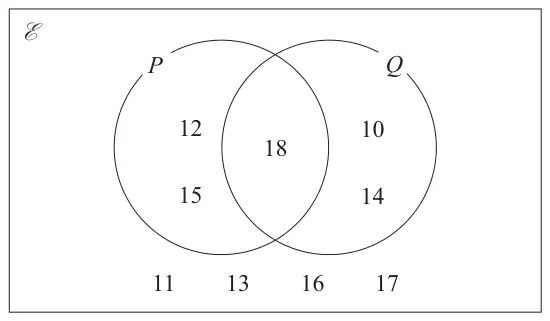
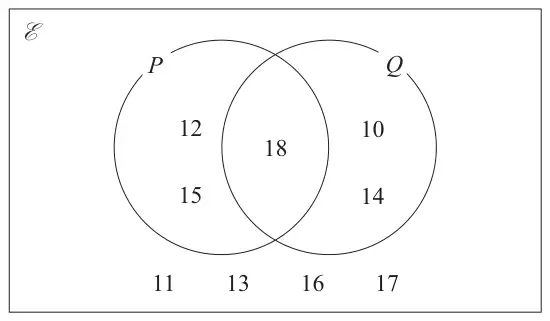
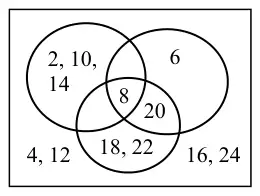
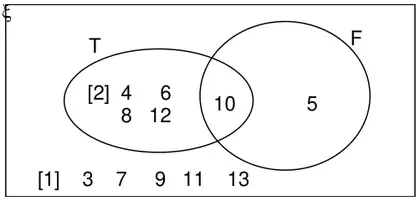
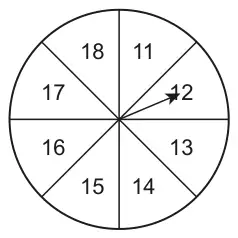
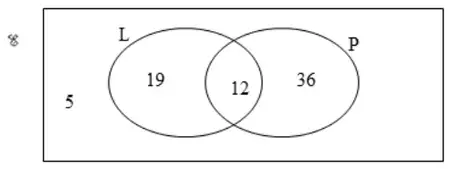
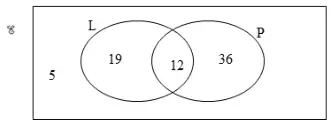
(a) Write down the numbers that are in set \(\ P^{\prime}\) (1)
A number is chosen at random from the universal set, \(\mathscr{E}\)
(b) Find the probability that this number is in the set \(\ P \cup Q\) (2)
Mark scheme (a)
Answer
Mark
Mark scheme
10, 11, 13, 14, 16, 17
B1
cao
Mark scheme (b)
Answer
Mark
Mark scheme
\(\dfrac{5}{9}\)
M1
for identification of 10, 12, 14, 15, 18 or for \(\dfrac{a}{9}\) where \(1 \leqslant a \leqslant 8\), \(a\) an integer, or \(\dfrac{5}{b}\) where \(b > 5\), \(b\) an integer or for incorrect form, eg 5 : 9
A1
oe
Additional guidance
Accept any equivalent fraction, decimal form, 0.55(5...) or 0.56 or percentage form, 55(.5...)% or 56%
23 There are only red discs, blue discs and yellow discs in a bag. There are 24 yellow discs in the bag.
Mel is going to take at random a disc from the bag. The probability that the disc will be yellow is 0.16
\(\qquad\) the number of red discs : the number of blue discs = 5 : 4
Work out the number of red discs in the bag. (4)
Mark scheme
Answer
Mark
Mark scheme
70
P1
for process to find number of discs in the bag, eg \(24 \div 0.16\ (= 150)\) or for process to find the total probability of red or blue, eg \(1 - 0.16 \left(= 0.84 \text{ or } \dfrac{21}{25} \text{ oe}\right)\)
P1
for process to work with ratio, eg \(([\text{total}] - 24) \div (5 + 4)\ (= 14)\) or for a process to find the probability of red, eg \([\text{probability}] \div (5 + 4) \times 5 \left(= 0.46\ldots \text{ or } \dfrac{7}{15}\right)\)
P1
for a complete correct process to find the number of red discs, eg \(\text{``}14\text{''} \times 5\) or \(\text{``}0.46\ldots\text{''} \times 24 \div 0.16\) or an answer of \(\dfrac{70}{150}\)
A1
for 70
Additional guidance
May be implied by 126
0.46 or better or 0.47 may imply P2 [total] can be any integer [probability] can be any value less than 1
If correct processes seen to find the total for both red and blue or 70 : 56 award P3 Must come from correct use of probability and ratio in either order
If the values for red and blue are found, the value for red must be clearly identified as the answer to gain A1
13 There are only £10 notes and £20 notes in a wallet.
Ali takes at random a note from the wallet.
(a) Write down the probability that Ali takes a note with a value of more than £5 (1)
There are only 1p coins and 2p coins in a bag. The total value of the coins in the bag is 40p The total value of the 1p coins is the same as the total value of the 2p coins.
Simon takes at random a coin from the bag.
(b) Find the probability that Simon takes a 1p coin. (2)
Mark scheme (a)
Answer
Mark
Mark scheme
1
B1
Allow 100%
Additional guidance
Allow \(\dfrac{k}{k}\) Do not accept 100, do not accept certain.
Mark scheme (b)
Answer
Mark
Mark scheme
\(\dfrac{2}{3}\)
P1
for start of process to write down proportion of each coin, writes down a correct ratio, eg 1p : 2p = 2 : 1 oe or a process to work out number of 1p coins and 2p coins, eg \(40 \div 2\ (= 20)\) and \((40 \div 2) \div 2\ (= 10)\) or assigns numbers in correct proportion, eg 6 1p coins and 3 2p coins or finding the probability of a 2p coin \(\left(= \dfrac{1}{3}\right)\)
A1
for \(\dfrac{2}{3}\) oe
Additional guidance
Accept any equivalent fraction, decimal form, 0.66(6…) or 0.67 or percentage form, 66(.6…)% or 67%
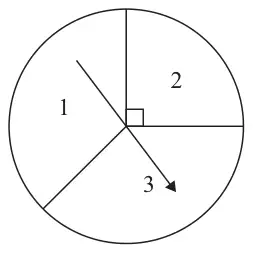
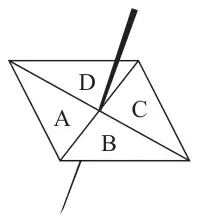
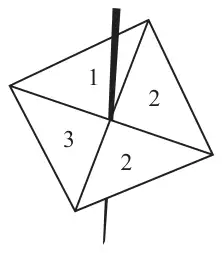
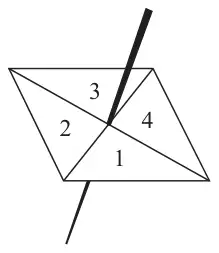
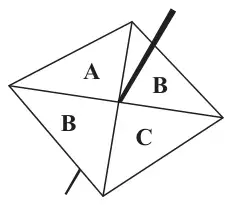
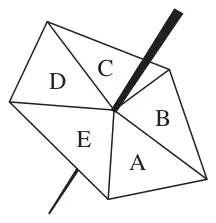
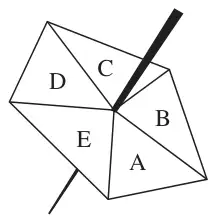
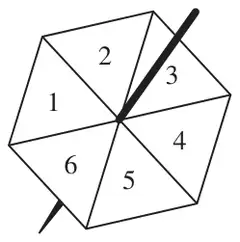
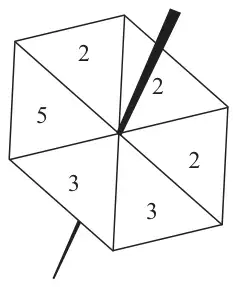
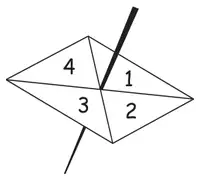
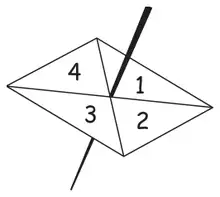
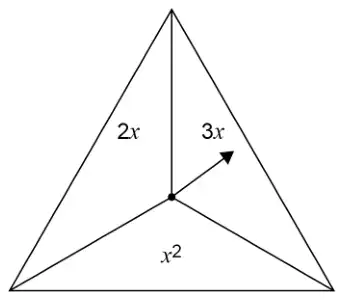
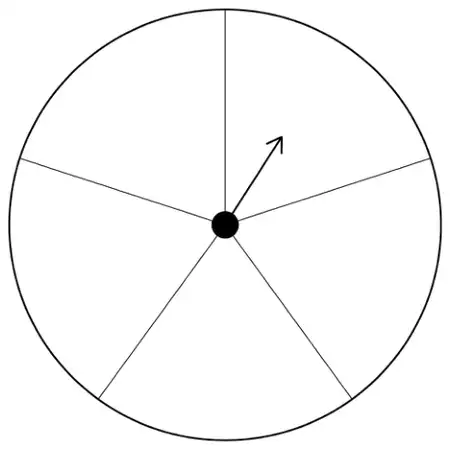
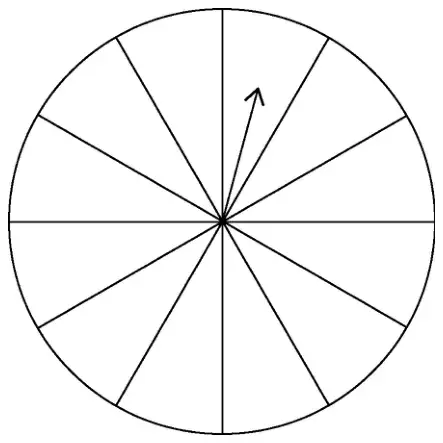
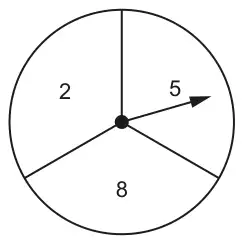
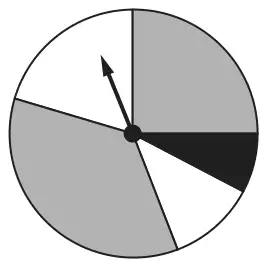
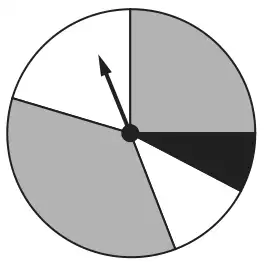
Majid is going to spin the arrow. The arrow can land on 1 or on 2 or on 3
Majid says,
“The probability that the arrow will land on 2 is \(\dfrac{1}{3}\) because the spinner has three sections.”
Is Majid correct? You must give a reason for your answer. (1)
Mark scheme
Answer
Mark
Mark scheme
No with reason
C1
No with reason Acceptable reasons: (The sections are) not the same size or the angles are not the same (The arrow is) more likely to land on 1 or 3 than on 2 (The probability for) 2 should be \(\frac{1}{4}\) 2 has a \(90^\circ\) angle but 1 and 3 both have obtuse angles or \(135^\circ\) each 2 has a \(90^\circ\) angle but the others are bigger 2 has a smaller area (the sections have) different sizes/angles/areas (the spinner is) not split equally (the angle for) 2 would be 120 not 90 (The angle for) 2 would be 120 or all angles would be 120 (landing on) 2 is less than a third the chances for the other two are higher than (for) 2
Not acceptable: Yes with any reason given No it should be \(\dfrac{2}{3}\) (No because) 2 has a \(90^\circ\) angle the bigger the angle the more likely
4 There are only red discs, blue discs and yellow discs in a bag. There are 24 yellow discs in the bag.
Mel is going to take at random a disc from the bag.
The probability that the disc will be yellow is 0.16
the number of red discs : the number of blue discs = 5 : 4
Work out the number of red discs in the bag. (4)
Mark scheme
Answer
Mark
Mark scheme
70
P1
for process to find number of discs in the bag, eg \(24 \div 0.16\ (= 150)\) or for process to find the total probability of red or blue, eg \(1 - 0.16\ \left(= 0.84 \text{ or } \dfrac{21}{25} \text{ oe}\right)\)
P1
for process to work with the ratio eg \(([\text{total}] - 24) \div (5 + 4)\ (= 14)\) or for a process to find the probability of red, eg \([\text{probability}] \div (5 + 4) \times 5\ \left(= 0.46\ldots \text{ or } \dfrac{7}{15}\right)\)
P1
for a complete correct process to find the number of red discs eg \(\text{``}14\text{''} \times 5\) or \(\text{``}0.46\ldots\text{''} \times 24 \div 0.16\) or an answer of \(\dfrac{70}{150}\)
A1
for 70
Additional guidance
May be implied by 126
0.46 or better or 0.47 may imply P2 [total] can be any integer [probability] can be any value less than 1
If correct processes seen to find the total for both red and blue or 70 : 56 award P3 Must come from correct use of probability and ratio in either order
If the values for red and blue are found, the value for red must be clearly identified as the answer to gain A1
(a) Write down the numbers that are in set \(P'\) (1)
A number is chosen at random from the universal set, \(\mathscr{E}\)
(b) Find the probability that this number is in the set \(P \cup Q\) (2)
Mark scheme (a)
Answer
Mark
Mark scheme
10, 11, 13, 14, 16, 17
B1
cao
Mark scheme (b)
Answer
Mark
Mark scheme
\(\dfrac{5}{9}\)
M1
for identification of 10, 12, 14, 15, 18 or for \(\dfrac{a}{9}\) where \(1 \le a \le 8\), \(a\) an integer, or \(\dfrac{5}{b}\) where \(b > 5\), \(b\) an integer or for incorrect form, eg 5 : 9
A1
oe
Additional guidance
Accept any equivalent fraction, decimal form, 0.55(5...) or 0.56 or percentage form, 55.(5...)% or 56%
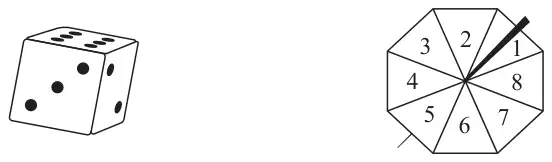
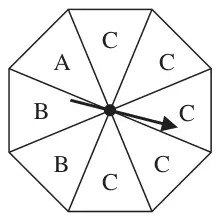
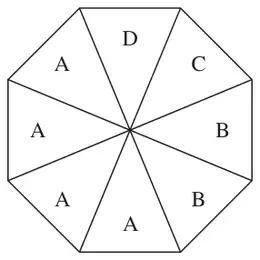
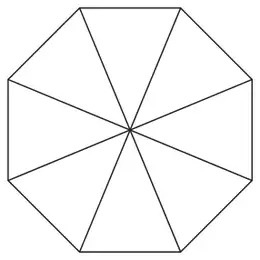
15 Here is a fair ordinary dice and a fair 8-sided spinner.
Charlie throws the dice once and spins the spinner once.
Is Charlie more likely to get
a number less than 3 on the dice or a number greater than 5 on the spinner?
You must show all your working. (3)
Mark scheme
Answer
Mark
Mark scheme
Spinner (supported)
P1
for a process to express one relationship, eg \(\dfrac{2}{6}\) oe or \(\dfrac{3}{8}\) oe or 2 : 4 oe or 3 : 5 oe or 2 : 6 oe or 3: 8 oe
P1
for process to express both relationships, eg \(\dfrac{2}{6}\) oe and \(\dfrac{3}{8}\) oe or 2 : 4 oe and 3 : 5 oe or 2 : 6 oe and 3: 8 oe
C1
for indicating (number greater than 5 on) spinner supported by correct values, eg \(\dfrac{8}{24}\) and \(\dfrac{9}{24}\) or 0.33(3..) and 0.37(5) or 33(.3..)% and 37(.5)% or 10 : 20 and 12 : 20 or 16 : 48 and 18 : 48
Additional guidance
Allow use of words to describe relationship, eg 2 out of 6
Conclusion may be indicated in body of question eg circling spinner or phrase
The table shows information about the number that the dice lands on each time.
Number on dice
1
2
3
4
5
6
Frequency
12
7
8
9
9
15
Gethin throws the dice twice.
(a) Work out an estimate for the probability that the dice will land on 6 both times. (3)
Sally is going to throw the same dice \(n\) times and record the number it lands on each time.
She will use her results to work out a more reliable estimate for the probability in part (a).
(b) What can you say about the value of \(n\)? (1)
Mark scheme (a)
Answer
Mark
Mark scheme
\(\dfrac{225}{3600}\)
P1
for process to use relative frequency for landing on a 6, eg \(\dfrac{15}{60}\) oe
P1
for \(\dfrac{15}{60} \times \dfrac{15}{60}\) oe, eg \(\dfrac{1}{4} \times \dfrac{1}{4}\)
A1
for \(\dfrac{225}{3600}\) oe, eg \(\dfrac{1}{16}\)
Additional guidance
Accept any equivalent fraction, decimal form 0.06(25) or 0.062 or 0.063, percentage form 6(.25)% or 6.2% or 6.3% Ignore subsequent attempts to write the correct answer in a different form.
Mark scheme (b)
Answer
Mark
Mark scheme
Explanation
C1
for a correct explanation Acceptable examples \(n\) must be greater than 60 She must do it more times than in (a) \(n\) must be bigger, eg 100
Not acceptable examples If you increase the number of results, you increase the accuracy \(n\) must be bigger \(n\) is an integer \(n\) is 100
17 There are only blue counters, green counters, red counters and yellow counters in a bag.
The table shows the number of blue counters in the bag.
Colour
blue
green
red
yellow
Number of counters
30
There is a total of 100 counters in the bag.
Ashin takes at random a counter from the bag.
(a) Find the probability that the counter is not blue. (2)
The ratio of the number of blue counters to the number of green counters is 2 : 3
(b) Work out the number of green counters in the bag. (2)
Bradley says,
“The number of red counters in the bag is the same as the number of yellow counters in the bag.”
(c) Can Bradley be correct? Give a reason for your answer. (1)
Mark scheme (a)
Answer
Mark
Mark scheme
\(\dfrac{70}{100}\)
M1
for \(100 - 30\ (= 70)\) or \(\dfrac{30}{100}\) oe
A1
for \(\dfrac{70}{100}\) oe
Additional guidance
Accept any equivalent fraction, decimal form 0.7 or percentage form 70%
Mark scheme (b)
Answer
Mark
Mark scheme
45
P1
for start to process, eg \(30 \div 2\ (= 15)\)
A1
cao
Mark scheme (c)
Answer
Mark
Mark scheme
No with reason
C1
for No with reason or ft (b)
Acceptable examples the number of red and yellow counters is an odd number 25 cannot be divided by 2 to give a whole number You can’t have half a counter You can’t split it evenly
Not acceptable examples Yes ….. they are in the ratio 2 : 3 one must be more than the other
Additional guidance
If the reason is supported by numerical evidence then that evidence must be accurate. can ft (b)
Note: if the answer to part (b) is an even number then ‘yes’ with supporting evidence is an acceptable answer
5 A car factory is going to make four different car models A, B, C and D.
80 people are asked which of the four models they would be most likely to buy.
The table shows information about the results.
Car model
Number of people
A
23
B
15
C
30
D
12
The factory is going to make 40 000 cars next year.
Work out how many model B cars the factory should make next year. (2)
Mark scheme
Answer
Mark
Mark scheme
7500
M1
for method to find expected number of model B, eg \(\dfrac{15}{80} \times 40000\) oe or \(\dfrac{15}{\text{``}23 + 15 + 30 + 12\text{''}} \times 40000\) oe
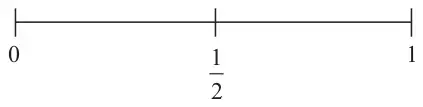
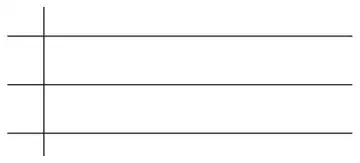
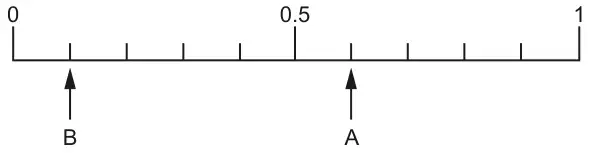
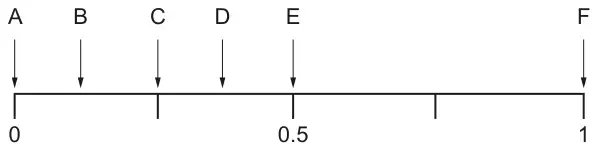
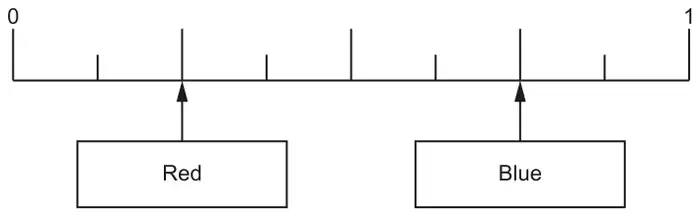
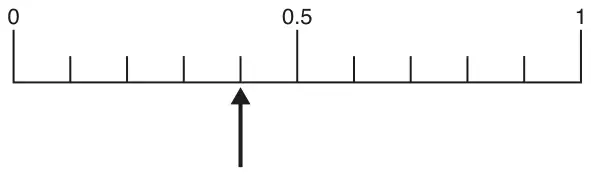
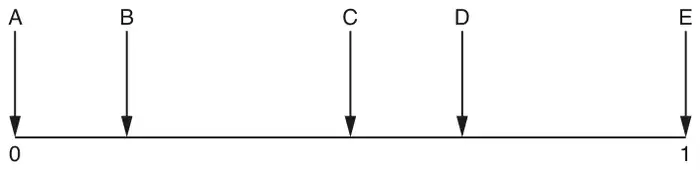
(a) On the probability scale below, mark with a cross (×) the probability that Kim picks a number 7(1)
(b) On the probability scale below, mark with a cross (×) the probability that Kim picks a number greater than 5(1)
(c) Find the probability that Kim picks an even number. (2)
Mark scheme (a)
Answer
Mark
Mark scheme
cross at 0
B1
cao
Mark scheme (b)
Answer
Mark
Mark scheme
cross at \(\dfrac{1}{2}\)
B1
cao
Mark scheme (c)
Answer
Mark
Mark scheme
\(\dfrac{5}{8}\)
M1
for \(\dfrac{\text{``}5\text{''}}{a}\) where \(a \gt \text{``}5\text{''}\) or \(\dfrac{b}{8}\) where \(b \lt 8\) or for identifying all the even numbers, 2, 6 and 8 or for writing the correct probability using the wrong notation eg \(5 : 8\)
A1
for \(\dfrac{5}{8}\) oe
Additional guidance
To ft “5” the “5” needs to be clearly stated as being the number of even numbers; otherwise accept 5 only; could be indicated alongside the given numbers.
Could be written as a decimal (0.62, 0.625 or 0.63) or equivalent percentages to these
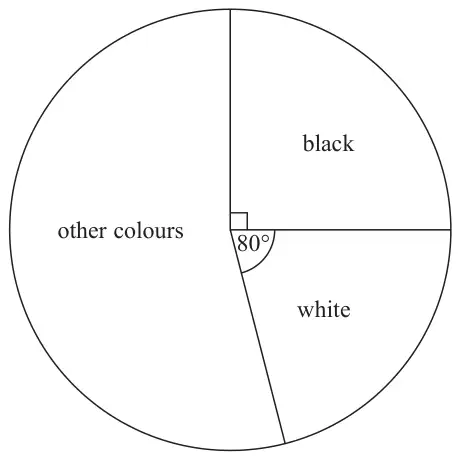
16 The pie chart gives information about the colour of each car in a car park.
There are 135 black cars in the car park.
(a) Work out the number of white cars in the car park. (3)
There are 50 grey cars in the car park. A car in the car park is picked at random.
(b) Find the probability that this car is grey. (2)
Mark scheme (a)
Answer
Mark
Mark scheme
120
M1
for sensible use of proportion eg \(\dfrac{135}{90}\ (= 1.5)\) or \(\dfrac{90}{135}\ \left(= \dfrac{2}{3}\right)\) or \(135 \times 4\ (= 540)\) or \(135 \div 9\ (= 15)\) or \(80 \div 90\ (= 0.888...)\)
M1
for a complete method eg \(80 \times \text{``}1.5\text{''}\) or \(80 \div \text{``}\dfrac{2}{3}\text{''}\) or \(\text{``}540\text{''} \times \dfrac{80}{360}\) or \(\text{``}15\text{''} \times 8\) or \(\text{``}0.888...\text{''} \times 135\)
A1
cao
Additional guidance
ie \(135 \div 9\) but not \(135 \div 10\) without \(80 \div 9\)
Mark scheme (b)
Answer
Mark
Mark scheme
\(\dfrac{50}{540}\)
M1
for method to find total number of cars, eg \(135 \times \dfrac{360}{90}\ (= 540)\) or for \(\dfrac{50}{135} \times \dfrac{1}{4}\) oe or begins to work with probability by using a numerator of 50 eg \(\dfrac{50}{a}\) where \(a \gt 50\) and an integer
A1
for \(\dfrac{50}{540}\) oe ft “540” from part (a)
Additional guidance
Accept any equivalent fraction, decimal form 0.09(25..) or percentage form 9(.25..)%
24 Each person in a fitness club is going to get a free gift. Stan is going to order the gifts.
Stan takes a sample of 50 people in the fitness club. He asks each person to tell him the gift they would like.
The table shows information about his results.
Gift
Number of people
sports bag
17
gym towel
7
headphones
11
voucher
15
There are 700 people in the fitness club.
(i) Work out how many sports bags Stan should order. (2)
(ii) Write down any assumption you made and explain how this could affect your answer. (1)
Mark scheme (i)
Answer
Mark
Mark scheme
238
P1
for working with proportion eg \(\dfrac{17}{50} \times 700\) oe
A1
cao
Mark scheme (ii)
Answer
Mark
Mark scheme
statement
C1
for statement Acceptable Sample is representative (otherwise answer wrong) Random sample (otherwise answer will be different) The 50 people are from the 700 (otherwise not accurate) 17 out of every 50 want a sports bag (otherwise answer will be different / wrong) There is no bias That the other 650 will want the same gifts as the 50
Not acceptable There would be more than 17 people who want the sports bag I rounded my answer 17 out of 50 want a sports bag A repeat of the calculation done in (i) Most of the people would want a sports bag References as what might change in the future (eg a change in membership) That all 700 people wanted a type of gift rather than no gift (otherwise would have changed my answer)
16 In a bag there are only red counters, blue counters, green counters and yellow counters. A counter is taken at random from the bag.
The table shows the probabilities of getting a red counter or a yellow counter.
Colour
red
blue
green
yellow
Probability
0.4
\(\ldots\ldots\)
\(\ldots\ldots\)
0.25
the number of blue counters : the number of green counters = 3 : 4
Complete the table. (4)
Mark scheme
Answer
Mark
Mark scheme
blue 0.15 green 0.2
P1
for \(1 - 0.4 - 0.25\ (=0.35)\) oe
P1
for using the ratio, eg \(\text{``}0.35\text{''} \div (3 + 4)\ (=0.05)\) or \(\text{``}0.35\text{''} \times \frac{3}{7}\ (=0.15)\) or \(\text{``}0.35\text{''} \times \frac{4}{7}\ (=0.2)\)
P1
for a complete process \(3 \times \text{``}0.05\text{''}\ (=0.15)\) and \(4 \times \text{``}0.05\text{''}\ (=0.2)\) or \(\text{``}0.35\text{''} - \text{``}0.15\text{''}\ (=0.2)\) or \(\text{``}0.35\text{''} - \text{``}0.2\text{''}\ (=0.15)\) or green 0.15, blue 0.2
A1
oe
Additional guidance
May work in percentages, condone missing % sign If the two numbers in the table sum to 0.35 that implies P1
One correct value in the table implies P2 7 can come from 3+4
Accept answers given in decimals, fractions or percentages.
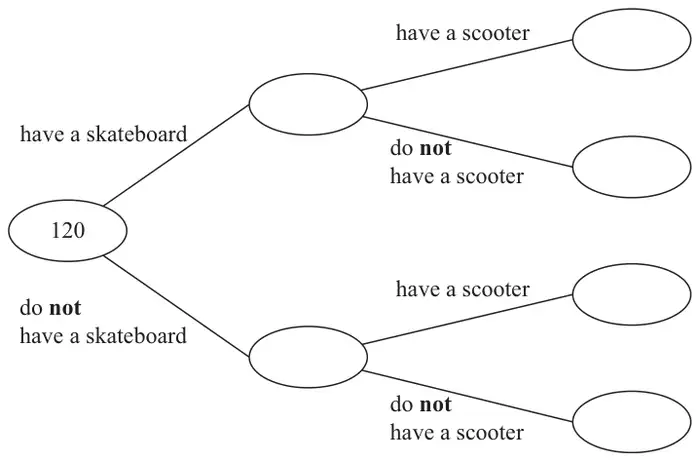
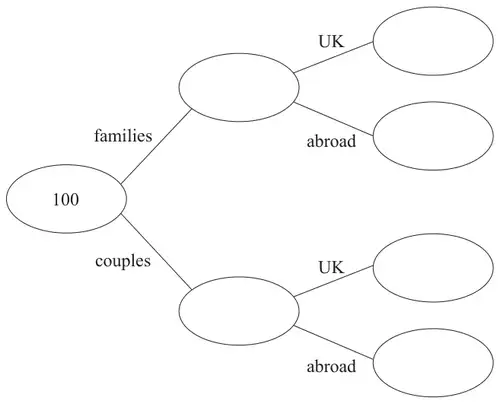
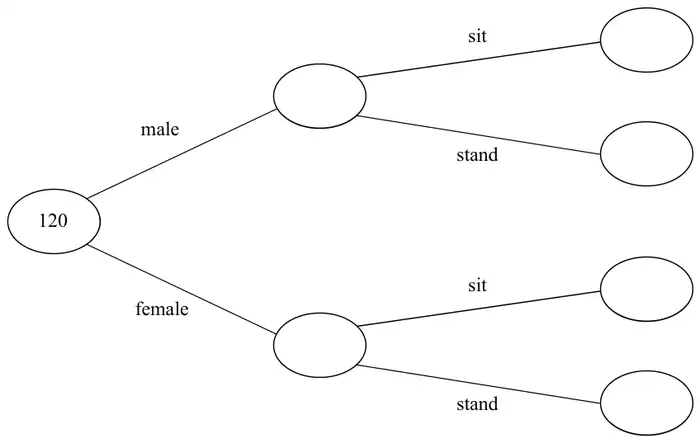
Each person was asked if they wanted to stand or to sit to watch the match.
75 of the people were female 29 of the males wanted to stand 30 of the people wanted to sit
(a) Use this information to complete the frequency tree.(3)
One of the 120 people is chosen at random.
(b) Write down the probability that this person is a male who wanted to stand. (1)
Mark scheme (a)
Answer
Mark
Mark scheme
male 45: sit 16, stand 29 female 75: sit 14, stand 61
C1
starts to interpret information eg 75 or 29 in the correct place
C1
for \(120 - 75\ (= 45)\) and \(\text{``}45\text{''} - 29\ (= 16)\)
C1
Complete and correct frequency tree
Additional guidance
May be seen as numerators of fractions for the first 2 marks.
Could be seen in working or on the diagram
Mark scheme (b)
Answer
Mark
Mark scheme
\(\dfrac{29}{120}\)
B1
for \(\dfrac{29}{120}\) or ft “29” from part (a)
Additional guidance
Accept any equivalent fraction, decimal form 0.24(166...) or percentage form 24(.166.. ) Ignore subsequent incorrect attempts to write the correct answer in a different form.
22 There are only blue cubes, red cubes and yellow cubes in a box.
The table shows the probability of taking at random a blue cube from the box.
Colour
blue
red
yellow
Probability
0.2
The number of red cubes in the box is the same as the number of yellow cubes in the box.
(a) Complete the table. (2)
There are 12 blue cubes in the box.
(b) Work out the total number of cubes in the box. (2)
Mark scheme (a)
Answer
Mark
Mark scheme
0.4, 0.4
P1
for process to find sum of unknown probabilities, eg \(1 - 0.2\ (= 0.8)\)
A1
oe
Additional guidance
For the P1: Award mark for any two probabilities given that sum to 0.8, eg given in the table
For the A1: Accept any equivalent fraction or 40%
Mark scheme (b)
Answer
Mark
Mark scheme
60
P1
for complete process to find total number of cubes, eg \(12 \div 0.2\) or \(12 \times 5\) or \((\text{``}0.4\text{''} \div 0.2) \times 12 + (\text{``}0.4\text{''} \div 0.2) \times 12 + 12\) OR states \(0.1 = 6\) or \(0.4 = 24\)
22 Hannah is planning a day trip for 195 students.
She asks a sample of 30 students where they want to go. Each student chooses one place.
The table shows information about her results.
Place
Number of students
Theme Park
10
Theatre
5
Sports Centre
8
Seaside
7
(i) Work out how many of the 195 students you think will want to go to the Theme Park. (2)
(ii) State any assumption you made and explain how this may affect your answer. (1)
Mark scheme (i)
Answer
Mark
Mark scheme
65
M1
for working with proportion eg. \(10 \div 30 \times 195\ (= 65)\)
A1
cao
Additional guidance
Condone use of 200 for 195
Mark scheme (ii)
Answer
Mark
Mark scheme
statement
C1
for statement Acceptable examples sample is representative (otherwise answer wrong) random sample (otherwise answer will be different) the 30 students are from the 195 (otherwise not accurate) 10 out of every 30 want to go to the Theme Park (otherwise answer will be different/wrong) there is no bias Not acceptable examples There would be more than 10 people who want to go to the Theme Park I rounded my answer
17 Stuart throws a biased coin 10 times. He gets 7 Tails.
Maxine throws the same coin 50 times. She gets 30 Tails.
Prasha is going to throw the coin once.
(i) Whose results will give the better estimate for the probability that she will get Tails, Stuart’s or Maxine’s? You must give a reason for your answer. (1)
(ii) Use Stuart’s and Maxine’s results to work out an estimate for the probability that Prasha will get Tails. (1)
Mark scheme (i)
Answer
Mark
Mark scheme
Maxine with bigger number of trials
C1
for Maxine with reason Acceptable examples She throws the coin more times than Stuart Not acceptable examples Maxine throws it 50 times She gets more Tails Stuart (he) ......
The probability that each coin will land on Heads is shown in the table.
Coin
Probability
A
0.33
B
0.033
C
\(\dfrac{1}{3}\)
D
30%
(a)
(i) Which coin is least likely to land on Heads? (1)
(ii) Which coin is most likely to land on Heads? (1)
Julie says,
“The probability that coin C will land on Heads is the same as the probability that coin C will land on Tails.”
(b) Is she correct? Give a reason for your answer. (1)
Coin B is going to be thrown 4000 times.
(c) Work out an estimate for the number of times coin B will land on Heads. (2)
Mark scheme (a)(i)
Answer
Mark
Mark scheme
B
B1
for B, accept 0.033 on the answer line
Mark scheme (a)(ii)
Answer
Mark
Mark scheme
C
B1
for C, accept \(\frac{1}{3}\) on the answer line
Mark scheme (b)
Answer
Mark
Mark scheme
Statement
C1
eg No with \(\left(\frac{1}{3}\right)\) and \(\frac{2}{3}\) or No, probabilities would need to be \(\frac{1}{2}\) or No since \(\frac{1}{3} + \frac{1}{3}\) does not equal 1 or No since tails is 67% (or 0.67)
Additional guidance
Accept rounded conversions seen to decimals or percentages if the reasoning is correct
Mark scheme (c)
Answer
Mark
Mark scheme
132
M1
for \(4000 \times 0.033\) OR \(\dfrac{132}{4000}\)
1 There are only blue cubes, red cubes and yellow cubes in a box.
The table shows the probability of taking at random a blue cube from the box.
Colour
blue
red
yellow
Probability
0.2
The number of red cubes in the box is the same as the number of yellow cubes in the box.
(a) Complete the table. (2)
There are 12 blue cubes in the box.
(b) Work out the total number of cubes in the box. (2)
Mark scheme (a)
Answer
Mark
Mark scheme
0.4, 0.4
P1
for process to find sum of unknown probabilities, eg \(1 - 0.2\ (= 0.8)\)
A1
oe
Additional guidance
Award mark for any two probabilities given that sum to 0.8, eg given in the table
Accept any equivalent fraction or 40%
Mark scheme (b)
Answer
Mark
Mark scheme
60
P1
for complete process to find total number of cubes, eg \(12 \div 0.2\) or \(12 \times 5\) or \((\text{``}0.4\text{''} \div 0.2) \times 12 + (\text{``}0.4\text{''} \div 0.2) \times 12 + 12\) OR states 0.1 = 6 or 0.4 = 24
14 Victoria throws an ordinary fair 6-sided dice once.
She says,
“The probability of getting a 3 is half the probability of getting a 6”
(a) Is Victoria correct? You must explain your answer. (1)
Andy throws the dice twice. He says,
“The probability of getting a 6 on both throws is \(\dfrac{2}{6}\)”
(b) Is Andy correct? You must explain your answer. (1)
Indre throws the dice once. She also throws a coin to get Heads or Tails.
(c) List all the possible outcomes she can get. (2)
Mark scheme (a)
Answer
Mark
Mark scheme
No (supported)
C1
No and explanation eg “it is \(\dfrac{1}{6}\)” or “each number is the same probability”
Acceptable examples No, they are both 1/6 (accept 1 in 6 or 1 : 6 etc) No, they are both the same No, an equal chance No, it’s a fair dice No, there’s only one of each number
Not acceptable examples No, it’s an even chance No, it’s 50 – 50 No, 1 : 6
Mark scheme (b)
Answer
Mark
Mark scheme
No (supported)
C1
No and explanation eg “it is out of 36” or “it is \(\dfrac{1}{6}\) times \(\dfrac{1}{6}\)”
Acceptable examples No, the probability is 1/36 No, it’s out of 36 No, he should times not add
Not acceptable examples No, it’s \(1/6 \times 1/6\), the probability is 1/12 No, he’s more likely to get it once only No, there’s only one 6 on a dice No, you will have a 2/12 chance
Mark scheme (c)
Answer
Mark
Mark scheme
1H, 2H, 3H, 4H, 5H, 6H, 1T, 2T, 3T, 4T, 5T, 6T
B2
for all 12 outcomes with no extras or repeats
(B1
for at least 6 correct outcomes, ignoring extras and repeats)
Additional guidance
Pairs must be unambiguous Accept words and abbreviations
20 of the counters are red. The rest of the counters are blue. One of the counters is taken at random. Find the probability that the counter is blue. (2)
Mark scheme
Answer
Mark
Mark scheme
\(\dfrac{29}{49}\)
P1
for \(\dfrac{29}{a}\) where \(a \gt 29\) or \(\dfrac{b}{49}\) where \(b \lt 49\) or \(1 - \dfrac{20}{49}\) or \(\dfrac{49 - 20}{c}\) where \(c \gt 49 - 20\) OR for 29 and 49 with incorrect notation eg 29 : 49
A1
oe
Additional guidance
Acceptable equivalents are any equivalent fraction to \(\dfrac{29}{49}\), decimal 0.59 (…) or 59 (…)%
24 There are some counters in a bag. The counters are red or white or blue or yellow.
Bob is going to take at random a counter from the bag.
The table shows each of the probabilities that the counter will be blue or will be yellow.
Colour
red
white
blue
yellow
Probability
0.45
0.25
There are 18 blue counters in the bag.
The probability that the counter Bob takes will be red is twice the probability that the counter will be white.
(a) Work out the number of red counters in the bag. (4)
A marble is going to be taken at random from a box of marbles. The probability that the marble will be silver is 0.5
There must be an even number of marbles in the box.
(b) Explain why. (1)
Mark scheme (a)
Answer
Mark
Mark scheme
8
P1
for process to find sum of unknown probabilities, eg \(1 - 0.45 - 0.25\ (= 0.3)\) OR to find the total number of counters in the bag, eg \(\dfrac{18}{0.45}\ (= 40)\) OR to find the number of yellow counters, eg \(\dfrac{0.25}{0.45} \times 18\ (= 10)\)
P1
for process to find P(red) = 0.2 oe or P(white) = 0.1 oe
OR for process to find the total number of red and white counters, eg \(\text{``}40\text{''} - 18 - \text{``}10\text{''}\ (=12)\)
OR for process to derive an equation in \(x\), eg \(2x + x = 1 - 0.45 - 0.25\) or \(2x + x = \text{``}0.3\text{''}\) or \(x = 0.1\)
P1
for a complete process to find the number of red counters, eg \(\dfrac{2 \times 0.1}{0.45} \times 18\) or \(\dfrac{2}{3} \times \text{``}12\text{''}\) or \(0.2 \times \text{``}40\text{''}\) or \(\dfrac{0.2}{0.025}\)
A1
cao
Additional guidance
Award mark for any two probabilities given that sum to 0.3 eg given in the table.
Award P2 for P(red) or P(white) (could be shown in table)
Equations could be given as written statements or working but must be fully equivalent.
Mark scheme (b)
Answer
Mark
Mark scheme
Explanation
C1
for explanation eg 0.5 multiplied by an odd number will never be a whole number, for half of a number to be an integer that number must be even, you can’t have half a marble
16 There are only red counters, blue counters and purple counters in a bag.
The ratio of the number of red counters to the number of blue counters is 3 : 17
Sam takes at random a counter from the bag.
The probability that the counter is purple is 0.2
Work out the probability that Sam takes a red counter. (3)
Mark scheme
Answer
Mark
Mark scheme
0.12
P1
for process to start eg \((1 - 0.2) \div (3 + 17)\) (= 0.04) or \((3 + 17) \div (1 - 0.2)\) oe (= 25) or \((100 - 20) \div (3 + 17)\) (= 4) or \(3 \times 4\) (= 12) and \(17 \times 4\) (= 68)
P1
full process to find the required probability eg \(3 \times \text{``}0.04\text{''}\) or \(\dfrac{3}{20} \times (1 - 0.2)\) oe or \(3 \div \text{``}25\text{''}\) or \(3 \times \text{``}4\text{''} \div 100\)
A1
oe
Additional guidance
Just \(1 - 0.2 = 0.8\) is not sufficient for P1 May be seen in a ratio
(a) Show this information in a stem and leaf diagram.(3)
One of these students is going to be chosen at random.
The pass mark in the French test is 71
Omar writes,
The probability that this student failed the French test is \(\dfrac{1}{4}\)
Omar is wrong.
(b) Explain why. (2)
Mark scheme (a)
Answer
Mark
Mark scheme
Stem and leaf diagram
B2
for correct ordered stem and leaf
(B1
for fully correct unordered or ordered with one error or omission)
B1
(indep) for key (units not required but must be correct if stated) eg 6 | 4 = 64 (marks)
Correct diagram
6
4799
7
0015667
8
0011247
9
14
Mark scheme (b)
Answer
Mark
Mark scheme
Explanation
C1
for identifying “6” students failed (ft their diagram) OR for \(20 \div 4\ (= 5)\)
C1
for comparing \(\dfrac{1}{4}\) with \(\dfrac{6}{20}\) or \(\dfrac{3}{10}\) (ft their diagram) OR for comparing “6” with 5
Additional guidance
Explanation does not need to state that Omar is wrong, but just needs to provide two comparable values (that are not the same) unless ft values show that Omar is not wrong in which case a statement is needed.
13 A scout group has a raffle to raise money for charity. There is 1 prize to be won in the raffle.
Laura buys 12 raffle tickets. A total of 350 raffle tickets are sold. Find the probability that Laura does not win the prize. (2)
Mark scheme
Answer
Mark
Mark scheme
\(\dfrac{338}{350}\)
M1
for \(350 - 12\) (=338) or \(\dfrac{y}{350}\) oe where \(y \lt 350\) and \(y \neq 12\) or \(1 - \dfrac{12}{350}\) oe
A1
oe
Additional guidance
For the method mark probability fractions can be expressed as equivalent expressions, even if not correct probability notation eg. 338 : 350 scores M1 A0
Using correct probability notation Allow 0.96 to 0.97 or 96% to 97%
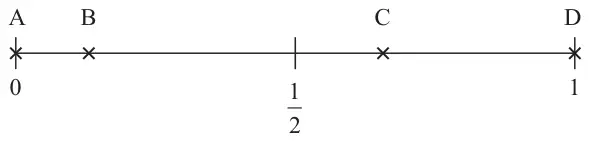
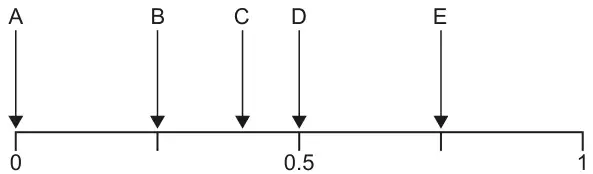
7 Here is a probability scale. It shows the probability of each of the events A, B, C and D.
(a) Write down the letter of the event that is certain. (1)
(b) Write down the letter of the event that is unlikely. (1)
There are 12 counters in a bag.
3 of the counters are red. 1 of the counters is blue. 2 of the counters are yellow. The rest of the counters are green.
Caitlin takes at random a counter from the bag.
(c) Show that the probability that this counter is yellow or green is \(\dfrac{2}{3}\) (3)
Mark scheme (a)
Answer
Mark
Mark scheme
D
B1
cao
Mark scheme (b)
Answer
Mark
Mark scheme
B
B1
cao
Mark scheme (c)
Answer
Mark
Mark scheme
Shown
M1
for number of green counters, eg \(12 - (3 + 1 + 2) = 6\) OR for \(\dfrac{3}{12}\) oe or \(\dfrac{1}{12}\) oe or \(\dfrac{2}{12}\) oe linked to the appropriate colour
M1
for \(1 - \left(\text{``}\dfrac{3}{12}\text{''} + \text{``}\dfrac{1}{12}\text{''}\right) \left(= \dfrac{8}{12}\right)\) or \(\text{``}\dfrac{2}{12}\text{''} + \dfrac{\text{``}6\text{''}}{12} \left(= \dfrac{8}{12}\right)\) OR for method to find \(\dfrac{2}{3}\) of 12, eg. \(12 \div 3 \times 2\ (= 8)\)
C1
for correct conclusion supported by accurate figures, eg \(\dfrac{8}{12} = \dfrac{2}{3}\) or \(\dfrac{2}{3}\) of \(12 = 8\) and number of yellow + green \(= 2 + 6 = 8\)
Additional guidance
This is awarded for a correct first step
This is awarded for a fully correct method from which the correct answer of \(\dfrac{2}{3}\) can be found Sight of \(\dfrac{8}{12}\) gets M2
6 There are some counters in a bag. The counters are red or white or blue or yellow.
Bob is going to take at random a counter from the bag.
The table shows each of the probabilities that the counter will be blue or will be yellow.
Colour
red
white
blue
yellow
Probability
0.45
0.25
There are 18 blue counters in the bag.
The probability that the counter Bob takes will be red is twice the probability that the counter will be white.
(a) Work out the number of red counters in the bag. (4)
A marble is going to be taken at random from a box of marbles. The probability that the marble will be silver is 0.5
There must be an even number of marbles in the box.
(b) Explain why. (1)
Mark scheme (a)
Answer
Mark
Mark scheme
8
P1
for process to find sum of unknown probabilities, eg \(1 - 0.45 - 0.25\ (= 0.3)\) OR to find the total number of counters in the bag, eg \(\dfrac{18}{0.45}\ (= 40)\) OR to find the number of yellow counters, eg \(\dfrac{0.25}{0.45} \times 18\ (= 10)\)
P1
for process to find P(red) = 0.2 oe or P(white) = 0.1 oe
OR for process to find the total number of red and white counters, eg \(\text{``}40\text{''} - 18 - \text{``}10\text{''}\ (=12)\)
OR for process to derive an equation in \(x\), eg \(2x + x = 1 - 0.45 - 0.25\) or \(2x + x = \text{``}0.3\text{''}\) or \(x = 0.1\)
P1
for a complete process to find the number of red counters, eg \(\dfrac{2 \times 0.1}{0.45} \times 18\) or \(\dfrac{2}{3} \times \text{``}12\text{''}\) or \(0.2 \times \text{``}40\text{''}\) or \(\dfrac{0.2}{0.025}\)
A1
cao
Additional guidance
Award mark for any two probabilities given that sum to 0.3 eg given in the table.
Award P2 for P(red) or P(white) (could be shown in table)
Equations could be given as written statements or working but must be fully equivalent.
Mark scheme (b)
Answer
Mark
Mark scheme
Explanation
C1
for explanation eg 0.5 multiplied by an odd number will never be a whole number, for half of a number to be an integer that number must be even, you can’t have half a marble
26 When a drawing pin is dropped it can land point down or point up.
Lucy, Mel and Tom each dropped the drawing pin a number of times.
The table shows the number of times the drawing pin landed point down and the number of times the drawing pin landed point up for each person.
Lucy
Mel
Tom
point down
31
53
16
point up
14
27
9
Rachael is going to drop the drawing pin once.
(a) Whose results will give the best estimate for the probability that the drawing pin will land point up? Give a reason for your answer. (1)
Stuart is going to drop the drawing pin twice.
(b) Use all the results in the table to work out an estimate for the probability that the drawing pin will land point up the first time and point down the second time. (2)
Mark scheme (a)
Answer
Mark
Notes
Mel (supported)
B1
Mel with reference to greatest number of throws
Mark scheme (b)
Answer
Mark
Notes
\(\dfrac{2}{9}\)
M1
selects overall total and multiplies P(point up) \(\times\) P(point down) eg \(\dfrac{50}{150} \times \dfrac{100}{150}\) oe (accept \(\dfrac{14}{45} \times \dfrac{31}{45}\) or \(\dfrac{27}{80} \times \dfrac{53}{80}\) or \(\dfrac{9}{25} \times \dfrac{16}{25}\))
19 There are only blue cubes, yellow cubes and green cubes in a bag.
There are
twice as many blue cubes as yellow cubes
and
four times as many green cubes as blue cubes.
Hannah takes at random a cube from the bag.
Work out the probability that Hannah takes a yellow cube. (3)
Mark scheme
Answer
Mark
Notes
\(\dfrac{1}{11}\)
P1
for starting the process, eg by writing down a correct ratio or using a given number of cubes for one relationship, eg 2B 1Y or B:Y = 2:1 or 4G 1B or G:B = 4:1 or 8G, 1Y or G:Y = 8:1 oe or yellow = 2, blue = 4, or states 2:1:8 oe in any order (can be algebraic)
P1
for complete process to find possible number of each colour or equivalent ratio, eg 8G 2B 1Y or G:B:Y = 8:2:1 oe or yellow = 2, blue = 4, green = 16 oe (can be algebraic)
10 There are only blue counters, yellow counters, green counters and red counters in a bag. A counter is taken at random from the bag.
The table shows the probabilities of getting a blue counter or a yellow counter or a green counter.
Colour
blue
yellow
green
red
Probability
0.2
0.35
0.4
(a) Work out the probability of getting a red counter. (1)
(b) What is the least possible number of counters in the bag? You must give a reason for your answer. (2)
Mark scheme (a)
Answer
Mark
Notes
0.05
B1
for 0.05 oe
Mark scheme (b)
Answer
Mark
Notes
20
C1
for stating that at least 20 required
Reason
C1
for reason eg explains that number of each colour must be a whole number or that there must be (at least) 1 red counter or shows that \(0.05 = \dfrac{1}{20}\)
8 When a drawing pin is dropped it can land point down or point up.
Lucy, Mel and Tom each dropped the drawing pin a number of times.
The table shows the number of times the drawing pin landed point down and the number of times the drawing pin landed point up for each person.
Lucy
Mel
Tom
point down
31
53
16
point up
14
27
9
Rachael is going to drop the drawing pin once.
(a) Whose results will give the best estimate for the probability that the drawing pin will land point up? Give a reason for your answer. (1)
Stuart is going to drop the drawing pin twice.
(b) Use all the results in the table to work out an estimate for the probability that the drawing pin will land point up the first time and point down the second time. (2)
Mark scheme (a)
Answer
Mark
Notes
Mel (supported)
B1
Mel with reference to greatest number of throws
Mark scheme (b)
Answer
Mark
Notes
\(\dfrac{2}{9}\)
M1
selects overall total and multiplies P(point up) \(\times\) P(point down) eg \(\dfrac{50}{150} \times \dfrac{100}{150}\) oe (accept \(\dfrac{14}{45} \times \dfrac{31}{45}\) or \(\dfrac{27}{80} \times \dfrac{53}{80}\) or \(\dfrac{9}{25} \times \dfrac{16}{25}\))
4 There are only blue cubes, yellow cubes and green cubes in a bag.
There are
twice as many blue cubes as yellow cubes and four times as many green cubes as blue cubes.
Hannah takes at random a cube from the bag.
Work out the probability that Hannah takes a yellow cube. (3)
Mark scheme
Answer
Mark
Notes
\(\dfrac{1}{11}\)
P1
for starting the process, eg by writing down a correct ratio or using a given number of cubes for one relationship, eg 2B 1Y or B:Y = 2:1 or 4G 1B or G:B = 4:1 or 8G, 1Y or G:Y = 8:1 oe or yellow = 2, blue = 4, or states 2:1:8 oe in any order (can be algebraic)
P1
for complete process to find possible number of each colour or equivalent ratio, eg 8G 2B 1Y or G:B:Y = 8:2:1 oe or yellow = 2, blue = 4, green = 16 oe (can be algebraic)
17 The table shows the probabilities that a biased dice will land on 2, on 3, on 4, on 5 and on 6
Number on dice
1
2
3
4
5
6
Probability
0.17
0.18
0.09
0.15
0.1
Neymar rolls the biased dice 200 times.
Work out an estimate for the total number of times the dice will land on 1 or on 3 (3)
Mark scheme
Answer
Mark
Notes
98
P1
for process to find P(1), e.g. \(1 - 0.17 - 0.18 - 0.09 - 0.15 - 0.1\ (= 0.31)\) or for a process to find P(1 or 3), e.g. \(1 - 0.17 - 0.09 - 0.15 - 0.1\ (= 0.49)\)
P1
for process to find the number of 3s, e.g. \(0.18 \times 200\ (=36)\) or process to find the number of 1s, e.g. \(\text{P}(1) \times 200\ (= 62)\), or process to find the number of (1 or 3)s, eg \([\text{P}(1) + 0.18] \times 200\) or process to find any expected frequency, using any probability \(\times\, 200\), eg \(0.17 \times 200\)
A1
cao
OR
98
P1
for process to find P(2 or 4 or 5 or 6), eg \(0.17 + 0.09 + 0.15 + 0.1\ (= 0.51)\)
P1
for process to find the number of (2 or 4 or 5 or 6)’s, eg \(\text{``}0.51\text{''} \times 200\ (= 102)\)
17 The table shows some information about the dress sizes of 25 women.
Dress size
Number of women
8
2
10
9
12
8
14
6
(a) Find the median dress size. (1)
3 of the 25 women have a shoe size of 7
Zoe says that if you choose at random one of the 25 women, the probability that she has either a shoe size of 7 or a dress size of 14 is \(\dfrac{9}{25}\) because
\[\frac{3}{25} + \frac{6}{25} = \frac{9}{25}\]
(b) Is Zoe correct? You must give a reason for your answer. (1)
Mark scheme (a)
Answer
Mark
Notes
12
B1
cao
Mark scheme (b)
Answer
Mark
Notes
Explanation
C1
No with statement about not being mutually exclusive events eg a person could be in both categories
3 The table shows some information about the dress sizes of 25 women.
Dress size
Number of women
8
2
10
9
12
8
14
6
(a) Find the median dress size. (1)
3 of the 25 women have a shoe size of 7
Zoe says that if you choose at random one of the 25 women, the probability that she has either a shoe size of 7 or a dress size of 14 is \(\dfrac{9}{25}\) because
\[\frac{3}{25} + \frac{6}{25} = \frac{9}{25}\]
(b) Is Zoe correct? You must give a reason for your answer. (1)
Mark scheme (a)
Answer
Mark
Notes
12
B1
cao
Mark scheme (b)
Answer
Mark
Notes
Explanation
C1
No with statement about not being mutually exclusive events eg a person could be in both categories
1 The table shows the probabilities that a biased dice will land on 2, on 3, on 4, on 5 and on 6
Number on dice
1
2
3
4
5
6
Probability
0.17
0.18
0.09
0.15
0.1
Neymar rolls the biased dice 200 times.
Work out an estimate for the total number of times the dice will land on 1 or on 3 (3)
Mark scheme
Answer
Mark
Notes
98
P1
for process to find P(1), e.g. \(1 - 0.17 - 0.18 - 0.09 - 0.15 - 0.1\ (= 0.31)\) or for a process to find P(1 or 3), e.g. \(1 - 0.17 - 0.09 - 0.15 - 0.1\ (= 0.49)\)
P1
for process to find the number of 3s, e.g. \(0.18 \times 200\ (=36)\) or process to find the number of 1s, e.g. \(\text{P}(1) \times 200\ (= 62)\), or process to find the number of (1 or 3)s, eg \([\text{P}(1) + 0.18] \times 200\) or process to find any expected frequency, using any probability \(\times\, 200\), eg \(0.17 \times 200\)
A1
cao
OR
98
P1
for process to find P(2 or 4 or 5 or 6), eg \(0.17 + 0.09 + 0.15 + 0.1\ (= 0.51)\)
P1
for process to find the number of (2 or 4 or 5 or 6)’s, eg \(\text{``}0.51\text{''} \times 200\ (= 102)\)
24 There are 5 girls, 6 boys and some adults in a room. Jenny selects at random one of these people. The probability that Jenny selects a girl is \(\frac{1}{3}\)
Work out the probability that Jenny selects an adult. (3)
Mark scheme
Answer
Mark
Notes
\(\frac{4}{15}\)
3
M1 for a method to find the total number of people e.g. \(3 \times 5\) (= 15) or writing \(\frac{5}{15}\) as an equivalent fraction to \(\frac{1}{3}\) M1 (dep) for \(\text{``}15\text{''} - 5 - 6\) (= 4) A1 oe
or M1 for a method to find prob (boy) e.g. \(\frac{6}{5} \times \frac{1}{3}\ \left(= \frac{6}{15}\right)\) M1 (dep) for \(1 - \text{``}\frac{6}{15}\text{''} - \frac{1}{3}\) A1 oe
or M1 for an expression for the probability of the number of girls in the room e.g. \(\dfrac{5}{5 + 6 + x}\) M1 (dep) for \(\text{``}\dfrac{5}{5 + 6 + x}\text{''} = \dfrac{1}{3}\) or \(x = 4\) A1 oe
SC B2 for \(\frac{4}{n}\) where \(n \gt 4\) and \(\ne 15\)
9 There are 5 girls, 6 boys and some adults in a room. Jenny selects at random one of these people.
The probability that Jenny selects a girl is \(\dfrac{1}{3}\)
Work out the probability that Jenny selects an adult. (3)
Mark scheme
Answer
Mark
Notes
\(\dfrac{4}{15}\)
3
M1 for a method to find the total number of people eg \(3 \times 5\) (= 15) or \(\dfrac{5}{15} = \dfrac{1}{3}\) M1 (dep) for \(\text{``}15\text{''} - 5 - 6\) (= 4) A1 oe
OR M1 for a method to find prob (boy) eg \(\dfrac{6}{5} \times \dfrac{1}{3}\left(= \dfrac{6}{15}\right)\) M1 (dep) for \(1 - \text{``}\dfrac{6}{15}\text{''} - \dfrac{1}{3}\) A1 oe
OR M1 for an expression for the number of adults eg \(\dfrac{5}{5 + 6 + x}\) M1 (dep) for \(\text{``}\dfrac{5}{5 + 6 + x}\text{''} = \dfrac{1}{3}\) or \(x = 4\) A1 oe
SC: B2 for \(\dfrac{4}{n}\) where \(n \gt 4\), \(n \neq 15\)
The table shows the probabilities that the spinner will land on A or on B or on C or on D.
Letter
A
B
C
D
E
Probability
0.25
0.10
0.20
0.15
Kirsty spins the spinner once.
(a) Work out the probability that the spinner will land on E. (2)
Chris is going to spin the spinner 60 times.
(b) Work out an estimate for the number of times the spinner will land either on A or on B. (3)
Mark scheme (a)
Answer
Mark
Notes
0.3
2
M1 for \(1 - (0.25 + 0.10 + 0.20 + 0.15)\) oe A1 for 0.3 oe
Mark scheme (b)
Answer
Mark
Notes
21
3
M1 for \(0.25 + 0.10\) (= 0.35) or \(0.25 \times 60\) (= 15) or \(0.10 \times 60\) (= 6) M1(dep) for \(60 \times \text{``}0.35\text{''}\) or \(\text{``}15\text{''} + \text{``}6\text{''}\) A1 cao
(a) Work out an estimate for the number of times that Beth will get a C. (2)
Carol spins a different spinner 80 times. The table shows information about her results.
Outcome
Frequency
J
39
K
25
L
16
Dan spins this spinner 300 times.
(b) Work out an estimate for the number of times that Dan will get an L. (3)
Mark scheme (a)
Answer
Mark
Notes
250
2
M1 for \(400 \div 8\) or \(\frac{5}{8}\) oe A1 cao
Mark scheme (b)
Answer
Mark
Notes
60
3
M1 for \(\frac{16}{80}\) or \(\frac{300}{80}\) oe M1 (dep) for \(\text{``}\frac{16}{80}\text{''} \times 300\) or \(\text{``}\frac{300}{80}\text{''} \times 16\) A1 cao
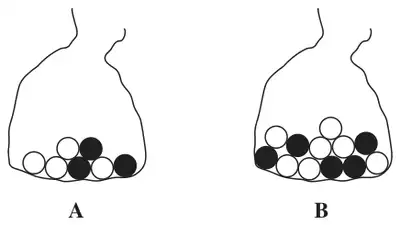
*16 There are only black balls and white balls in bag A and in bag B, as shown in the diagram.
Heidi is going to take at random a ball from bag A and a ball from bag B.
Which bag gives Heidi the greater probability of taking a black ball, bag A or bag B? You must show how you get your answer. (3)
Mark scheme
Answer
Mark
Notes
Bag A (supported)
3
M1 for \(\frac{3}{7}\) or \(\frac{5}{12}\) M1 (dep) for method to compare the two probabilities, e.g using a common denominator, eg \(\frac{3}{7} = \frac{36}{84}\); \(\frac{5}{12} = \frac{35}{84}\) or writing as decimals eg \(\frac{3}{7} = 0.428571...\) and \(\frac{5}{12} = 0.416666...\) C1 (dep on M2) for Bag A and correct method of comparison with correct figures using \(\frac{3}{7}\) and \(\frac{5}{12}\)
8 Carol spins a spinner 80 times. The table shows information about her results.
Outcome
Frequency
J
39
K
25
L
16
Dan spins this spinner 300 times.
Work out an estimate for the number of times that Dan will get an L. (3)
Mark scheme
Answer
Mark
Notes
60
3
M1 for \(\dfrac{16}{80}\) or \(\dfrac{300}{80}\) oe M1 (dep) for \(\text{``}\dfrac{16}{80}\text{''} \times 300\) or \(\text{``}\dfrac{300}{80}\text{''} \times 16\) A1 cao
6 One of the teachers at a school is chosen at random.
The probability that this teacher is female is \(\dfrac{3}{5}\)
There are 36 male teachers at the school. Work out the total number of teachers at the school. (3)
Mark scheme
Answer
Mark
Notes
90
3
M1 for \(1 - \dfrac{3}{5}\) (= \(\dfrac{2}{5}\) or 40%) oe M1 for a complete method to find the number of female teachers (54) eg \(36 \div 2 \times 3\) or determines \(\dfrac{3}{5}\) (60%) is 54, or 10% is 9 A1 cao
OR M1 for F : M = 3 : 2 M1 for a complete method to find the number of female teachers (54) eg \(\dfrac{3}{2} \times 36\) oe A1 cao
(a) Show this information in an ordered stem and leaf diagram.(3)
One of these students is going to be chosen at random.
(b) Find the probability that this student has a test mark less than 28 (2)
Mark scheme (a)
Answer
Mark
Notes
1
4 6 8 9
2
1 2 3 5 7 9
3
0 4 6 8 8
4
1 3 6 6 8
3
B2 for correct ordered stem and leaf (B1 for fully correct unordered, or ordered with one error or omission) B1 (indep) for key (units not required but must be correct if stated) eg. 1 | 4 = 14 (marks)
Mark scheme (b)
Answer
Mark
Notes
\(\dfrac{9}{20}\) oe
2
B2 for \(\dfrac{9}{20}\) oe or ft from stem and leaf diagram (B1 for \(\dfrac{x}{20}\) where \(x \lt 20\), \(x \neq 9\) or \(\dfrac{9}{y}\) where \(y \gt 9\) or ft from stem and leaf diagram)
21 There are only red counters and blue counters in a bag. The ratio of the number of red counters to the number of blue counters is 4 : 6
(a) Write this ratio in its simplest form. (1)
A counter is to be taken at random from the bag.
(b) Write down the probability that the counter will be blue. (2)
Mark scheme (a)
Answer
Mark
Notes
2 : 3
1
B1 cao
Mark scheme (b)
Answer
Mark
Notes
\(\dfrac{3}{5}\)
2
M1 ft for adding the numbers in their ratio to get an acceptable total AND using this as their denominator eg \(4 + 6 = 10\) or \(2 + 3 = 5\) A1ft \(\tfrac{3}{5}\) oe
11 Karl wants to raise money for charity. He designs a game for people to play.
Karl uses a fair 10-sided dice for the game. The dice is numbered from 1 to 10 Each person will roll the dice once. A person wins the game if the dice lands on a multiple of 4
Ali plays the game once.
(a) Work out the probability that Ali will win the game. (2)
Each person pays 30p to play the game once. The prize for a win is £1
Karl thinks that the game will be played 100 times.
(b) Work out an estimate for how much money Karl will raise for charity. (3)
Mark scheme (a)
Answer
Mark
Notes
\(\dfrac{2}{10}\)
2
M1 for \(\dfrac{2}{a}\) with \(a \gt 2\) or \(\dfrac{b}{10}\) with \(b \lt 10\) A1 for \(\dfrac{2}{10}\) oe
Mark scheme (b)
Answer
Mark
Notes
£10 or 1000p
3
M1 for \(\text{``}\dfrac{2}{10}\text{''} \times 100\) (= 20) or 30(p) × 100 (= 3000p or £30) M1 (dep) for "30(p) × 100" – (£)1 × “20” oe A1 ft from (a), provided the answer is not negative. Units must be shown
8 Lorna carries out a survey about the number of times customers go to a shop. She asks at random 100 customers how many times they went to the shop last month.
The table shows Lorna’s results.
Number of times
0
1
2
3
4
5
6
more than 6
Frequency
4
12
13
17
25
13
11
5
One of the 100 customers is chosen at random.
(a) What is the probability that this customer went to the shop 5 or more times? (2)
Last month the shop had a total of 1500 customers.
(b) Work out an estimate for the number of customers who went to the shop exactly 2 times last month. (2)
The owner of a different shop is carrying out a survey on the ages of his customers. He records the ages of the first 10 customers in his shop after 9 am one morning.
(c) This may not be a suitable sample. Give two reasons why. (2)
Mark scheme (a)
Answer
Mark
Notes
\(\dfrac{29}{100}\)
2
M1 for 13 + 11 + 5 (=29) A1 for \(\dfrac{29}{100}\) oe (SC B1 for \(\dfrac{16}{100}\) oe)
Mark scheme (b)
Answer
Mark
Notes
195
2
M1 for \(1500 \times \dfrac{13}{100}\) oe A1 for 195
Mark scheme (c)
Answer
Mark
Notes
reasons
2
B2 for 2 valid reasons eg sample too small, customers at this time may not be representative of ages of all customers (B1 for 1 reason)
26 Here is a four sided spinner. The spinner is biased.
The table shows the probabilities that the spinner will land on 1 or on 3
Number
1
2
3
4
Probability
0.2
0.1
The probability that the spinner will land on 2 is the same as the probability that the spinner will land on 4
(a) Work out the probability that the spinner will land on 4 (3)
Shunya is going to spin the spinner 200 times.
(b) Work out an estimate for the number of times the spinner will land on 3 (2)
Mark scheme (a)
Working
Answer
Mark
Notes
\(1 - 0.2 - 0.1\) \(0.7 \div 2\)
0.35
3
M1 for correctly using total probability 1 or 100% if percentages used M1 (dep) for complete correct method to complete the solution A1 for 0.35 or 35% or \(\frac{35}{100}\) oe
Mark scheme (b)
Working
Answer
Mark
Notes
\(0.1 \times 200\)
20
2
M1 for \(0.1 \times 200\) A1 cao [SC: B1 for an answer of \(\frac{20}{200}\) if M0 scored]
The table shows the probabilities that the spinner will land on 1 or on 3
Number
1
2
3
4
Probability
0.2
0.1
The probability that the spinner will land on 2 is the same as the probability that the spinner will land on 4
(a) Work out the probability that the spinner will land on 4 (3)
Shunya is going to spin the spinner 200 times.
(b) Work out an estimate for the number of times the spinner will land on 3 (2)
Mark scheme (a)
Working
Answer
Mark
Notes
1 − 0.2 − 0.1 0.7 ÷ 2
0.35
3
M1 for correctly using total probability is 1 or 100% if percentages used M1 (dep) for complete correct method to complete the solution A1 for 0.35 or 35% or \(\frac{35}{100}\) oe
Mark scheme (b)
Answer
Mark
Notes
20
2
M1 for 0.1 × 200 oe A1 cao SC : If M0 then award B1 for an answer of \(\frac{20}{200}\)
(a) On the probability scale below, mark with a cross (\(\times\)) the probability that he gets a head.(1)
Ann rolls a fair dice once.
(b) On the probability scale below, mark with a cross (\(\times\)) the probability that she gets a 7(1)
Fred throws a fair coin and rolls a fair dice.
(c)
(i) List all the possible combinations. The first one has been done for you. (H, 1)
(ii) Write down the probability that Fred gets a head and an even number. (4)
Mark scheme (a)
Answer
Mark
Notes
Cross at \(\frac{1}{2}\)
1
B1 for cross (\(\times\)) within overlay
Mark scheme (b)
Answer
Mark
Notes
Cross at 0
1
B1 for cross (\(\times\)) within overlay
Mark scheme (c)
Working
Answer
Mark
Notes
(i) H1 H2 H3 H4 H5 H6 T1 T2 T3 T4 T5 T6
(ii)
\(\frac{3}{12}\)
4
(i) M1 for evidence of attempting combinations eg at least 5 correct A1 for all 12, no extras or repeats (Can repeat H1)
(ii) M1 ft for evidence of correct numerator or denominator in a fraction less than 1 A1 ft from (i) Note probability must written as a percentage, decimal or fraction
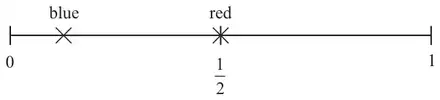
(a) The probability scale shows the probability that a spinner will land on red. It also shows the probability that the spinner will land on blue.Tony says the spinner is more likely to land on blue than on red. Is he right? Explain your answer. (1)
(b) There are 3 white counters and 4 black counters in a box. Jenny is going to take at random a counter from the box.
(i) Write down the probability that Jenny will take a black counter.
(ii) Write down the probability that Jenny will take a yellow counter. (2)
Mark scheme (a)
Answer
Mark
Notes
No + reason
1
B1 for no and the (prob.) of red is (bigger than the (prob.) of blue. OR (prob.) of blue is nearer 0 OR (prob.) of red is closer to 1 OR (prob.) of red is 50% and the (prob.) of blue is about 20% oe
Mark scheme (b)
Answer
Mark
Notes
(i) \(\frac{4}{7}\) (ii) 0
2
(i) B1 for \(\frac{4}{7}\) oe (ii) B1 for 0 or \(\frac{0}{7}\) or 0% (accept 0 out of 7, but not 0:7 or 0 to 7)
17 When a biased coin is spun, \(\quad\) P(Heads) : P(Tails) \(= 5 : 2\)
In a game, the player spins the coin four times.
The player can win in two ways.
1st way to win Spin 4 heads
2nd way to win Spin a Head, then a Tail, then a Head, then a Tail
How many times more likely is a player to win the 1st way than the 2nd way? [3 marks]
Mark scheme
Answer
Mark
Comments
\(\left(\dfrac{5}{5 + 2}\right)^4\) or \(\left(\dfrac{5}{7}\right)^4\) or \(\dfrac{625}{2401}\) or \(\left(\dfrac{5}{7}\right)^2 \times \left(1 - \dfrac{5}{7}\right)^2\) or \(\left(\dfrac{5}{7}\right)^2 \times \left(\dfrac{2}{7}\right)^2\) or \(\dfrac{100}{2401}\)
M1
oe eg \([0.71, 0.72]^4\) or [0.25, 0.27] or \([0.71, 0.72]^2 \times [0.28, 0.29]^2\) or [0.039, 0.044]
\(\left(\dfrac{5}{7}\right)^4 \div \left[\left(\dfrac{5}{7}\right)^2 \times \left(\dfrac{2}{7}\right)^2\right]\) or \(\dfrac{625}{2401} \div \dfrac{100}{2401}\)
M1dep
oe full method eg \([0.71, 0.72]^4 \div ([0.71, 0.72]^2 \times [0.28, 0.29]^2)\) or \([0.25, 0.27] \div [0.039, 0.044]\)
6.25 or \(6\dfrac{1}{4}\)
A1
oe value eg \(\dfrac{625}{100}\)
Additional guidance
Working in percentages can score up to 3 marks eg \([71, 72]^4\) or [25 000 000, 27 000 000] or \([71, 72]^2 \times [28, 29]^2\) or [3 900 000, 4 400 000] \([71, 72]^4 \div ([71, 72]^2 \times [28, 29]^2)\) 6.25
M1
M1dep A1
\(5^4\) or 625 or \(5^2 \times 2^2\) or 100 with no further correct working scores M0 but \(5^4 \div (5^2 \times 2^2)\) or \(625 \div 100\) scores M1M1
(a) Work out the relative frequency of Heads for the 200 throws. [2 marks]
(b) Which results would give the best estimate of the probability of Heads?
Tick one box.
Sid’s 80 throws
Zak’s 120 throws
All 200 throws
Give a reason for your answer. [1 mark]
Mark scheme (a)
Answer
Mark
Comments
\(0.75 \times 80\) or 60
M1
oe implied by 132
0.66 or \(\dfrac{132}{200}\) or \(\dfrac{66}{100}\) or \(\dfrac{33}{50}\)
A1
oe fraction, decimal or percentage
Additional guidance
Ignore simplification or conversion attempts after correct answer
60 from \(\dfrac{72}{120} = 0.60\)
M0
\(\dfrac{80}{120} = 0.66\)
M0
Mark scheme (b)
Answer
Mark
Comments
Ticks All 200 throws and valid reason
B1
eg ticks All 200 throws and more throws
Additional guidance
Valid reason with non-contradictory work
B1
No box ticked but clear indication of correct box stated in working lines or implied within valid reason
B1
Incorrect box ticked
B0
Examples of valid reasons 200 is the most Bigger number of trials (gives a more accurate result) Both sets of results is more More data Shows us how much they both got (referring to both people) How many times it landed for both (referring to both people) Better result by adding (implies better is more) Examples of invalid reasons More possibility it will land on heads Amount of heads out of 200 More accurate
20 Beth and Lynn each spin the same biased coin a number of times.
The table shows information about the results.
Beth
Lynn
Number of spins
125
80
Relative frequency of Heads
0.32
0.35
(a) How many more Heads did Beth spin than Lynn? [2 marks]
(b) Lynn says,
“My estimate of the probability of the coin landing on Heads must be the best, because 0.35 is greater than 0.32”
Is she correct?
Tick a box.
Yes
No
Give a reason for your answer. [1 mark]
Mark scheme (a)
Answer
Mark
Comments
\(125 \times 0.32\) or 40 or \(80 \times 0.35\) or 28
M1
oe
12
A1
Additional guidance
M1 may be awarded for correct work with no answer or incorrect answer, even if this is seen amongst multiple attempts
\(80 \times 0.5 = 40\)
M0
Mark scheme (b)
Answer
Mark
Comments
No and valid reason involving the number of trials
B1
eg reasons she didn’t do the most she did fewer spins Beth did more they should use all 205 spins
Additional guidance
Ignore irrelevant or incorrect statements alongside a correct statement as long as not contradictory eg1 No and Beth did most but she could have done more eg2 No and Beth has more number of spins so there is a higher probability of landing on heads eg3 No and Beth did most spins but Lynn did more
B1 B1 B0
Allow ‘she’ to refer to Lynn unless clearly referring to Beth eg No and Because she tried 125 times however Lynn tried only 80 times
B1
No and She did not do as many spins so her answer is less accurate than Beth’s
B1
No and Beth spun the wheel more times. Therefore her probability would be lower
B1
No and Beth spun more times so her final outcome will be higher
B1
No and Beth did 125 spins and Lynn did 80 spins
B0
No and Beth did 125 spins so she has more chance of being accurate
9 A number is picked at random from the first three positive odd numbers.
A number is picked at random from the first four prime numbers.
The two numbers are multiplied to get a score.
(a) Complete the table. [4 marks]
prime
\(\times\)
2
3
7
odd
1
5
15
(b) What is the probability that the score is a square number?
Give your answer as a fraction. [2 marks]
Mark scheme (a)
Answer
Mark
Comments
3 in left column
B1
5 in top row
B1
All products correct
B2ft
ft their 3 and their 5 B1ft 3 to 10 correctly evaluated products
Additional guidance
If their 3 is 0, 1 or 5, do not consider those products If their 5 is 0, 2, 3 or 7, do not consider those products
Mark scheme (b)
Answer
Mark
Comments
\(\dfrac{\text{their number of square numbers}}{\text{their number of completed cells}}\)
B2ft
oe fraction ft their table even if incomplete B1ft their number of square numbers as a numerator or their number of completed cells as a denominator or square numbers identified on their grid or in working
Additional guidance
ft must produce a non-zero probability to score
Ignore attempt to simplify or convert if correct fraction seen
M1 may be awarded for correct work with no answer or incorrect answer, even if this is seen in multiple attempts
15 and answer 15 out of 24
M1M1A1
15 and answer \(\dfrac{15}{24}\) or \(\dfrac{3}{8}\)
M1M1A0
Answer \(\dfrac{15}{24}\)
M1M1A0
80 seen embedded in a fraction
M1
Answer \(\dfrac{3}{8}\) with no other creditworthy work
M0M0A0
Condone \(80 \times 40\%\)
M1M1
40% of 80 is 2nd M0 unless recovered
Build up methods for finding 40% of 80 must be completed to be awarded the M mark eg 80 followed by 10% \(= 8\) and \(4 \times 8 = 32\) eg \(0.1 \times 80 = 6\) and \(4 \times 6 = 24\) eg 80 followed by 10% \(= 6\) and \(4 \times 6 = 24\)
The chocolates are milk or dark and have hard or soft centres.
\(\dfrac{4}{9}\) of the chocolates have soft centres.
There are twice as many milk chocolates as dark. 5 of the dark chocolates have soft centres.
(a) Complete the two-way table. [4 marks]
Hard centre
Soft centre
Milk
Dark
5
One chocolate is chosen at random.
(b) What is the probability that it is a dark chocolate with a soft centre? [1 mark]
(c) What is the probability that it has a hard centre? [1 mark]
Mark scheme (a)
Answer
Mark
Comments
\(36 \times \dfrac{4}{9}\) or 16 (Soft) or \(36 \times \dfrac{5}{9}\) or 20 (Hard) or \(36 \times \dfrac{1}{3}\) or 12 (Dark) or \(36 \times \dfrac{2}{3}\) or 24 (Milk)
M1
oe implied by the numbers in the relevant row or column making the correct total accept 16 seen in Milk Soft accept 12 in Dark Hard
Hard
Soft
Milk
13
11
Dark
7
5
A3
A2 two of Milk Soft \(= 11\), Dark Hard \(= 7\) and Milk Hard \(= 13\)
A1 Milk Soft \(= 11\) or Dark Hard \(= 7\)
Additional guidance
Hard
Soft
Milk
10
11
Dark
7
5
M1A2
Hard
Soft
Milk
10
11
Dark
10
5
M1A1
For M1 the values must be seen outside the table or implied by the table but also accept 16 seen in Milk Soft or 12 in Dark Hard
Hard
Soft
Milk
10
16
Dark
5
5
M1
Mark scheme (b)
Answer
Mark
Comments
\(\dfrac{5}{36}\) or \(0.13\dot{8}\) or \(13.\dot{8}\%\)
B1
oe fraction, decimal or percentage accept rounding to 2 sf or better
Additional guidance
Ignore incorrect simplification or conversion attempt to fraction, decimal or percentage (but not ratio) after correct probability seen
Do not allow eg 5 in 36 or 5 out of 36 unless the correct probability seen
Do not allow ratio
Ignore words if correct probability seen
Mark scheme (c)
Answer
Mark
Comments
\(\dfrac{\text{their } 20}{36}\) or \(\dfrac{5}{9}\) or \(0.\dot{5}\) or \(55.\dot{5}\%\)
B1ft
oe fraction, decimal or percentage correct or ft their Hard total from the table accept rounding to 2 sf or better
Additional guidance
Ignore incorrect simplification or conversion attempt to fraction, decimal or percentage (but not ratio) after correct probability seen
Do not allow eg 20 in 36 or 20 out of 36 unless the correct probability seen
(a) The probability that the student is taking a GCSE resit is 0.09
How many of the students are taking a GCSE resit? [2 marks]
(b) The probability that the student is studying
A-levels is 0.67
Core Maths is 0.48
Show that some students are studying A-levels and Core Maths. [2 marks]
Mark scheme (a)
Answer
Mark
Comments
\(0.09 \times 1400\)
M1
oe
126
A1
Additional guidance
M1 may be awarded for correct work, with no answer or incorrect answer, even if this is seen amongst multiple attempts
Do not ignore further working after 126 seen
Do not allow a misread of 0.9 for 0.09
\(1400 - 126 = 1274\) in working
M1
\(\dfrac{126}{1400}\) in working
M1
\(\dfrac{126}{1400}\) on answer line
M1A0
Mark scheme (b)
Answer
Mark
Comments
Alternative method 1
\(0.67 + 0.48 = 1.15\) and the sum (of the probabilities) is greater than 1 or \(0.67 + 0.48 = 1.15\) and 0.15 study both or \(0.67 + 0.48 = 1.15\) and more than the total number of students at school
B2
oe B1 1.15 oe or the sum (of the probabilities) is greater than 1 or 0.15 oe
Alternative method 2
\(938 + 672 = 1610\) and more than the total number of students at school or \(938 + 672 = 1610\) and the total (number of students) is greater than 1400 or 938 and 672 and 210 study both
B2
oe B1 \(0.67 \times 1400\) oe and \(0.48 \times 1400\) oe or 938 and 672 or 1610 or the total (number of students) is greater than 1400 or 210
Additional guidance
B1 may be awarded for correct work, with no answer or incorrect answer, even if this is seen amongst multiple attempts
\(938 + 672 = 1610\) and \(1610 \gt 1400\)
B2
\(938 + 672 = 1610\) and students doing both as more than the total
B2
\(0.67 + 0.48 = 1.15\) and \(1.15 \gt 1\)
B2
\(67 + 48 = 115\) and students doing both as over 100
B2
\(67 + 48 = 115\) and 15% doing both
B2
\(67 + 48 = 115\) and 15 doing both
B1
\(0.67 + 0.48 = 1.15\) and needs to add to one
B1
\(67 + 48 = 115\)
B1
\(0.67 + 0.48 = 1.15\) and students doing both as over 100 (must be consistent form for comparison)
The score is the dice number substituted into the spinner expression.
(a) Complete the table to show all of the possible scores. [2 marks]
1
2
3
4
5
6
\(2x\)
8
\(3x\)
6
\(x^2\)
25
(b) A player wins the game if their score is 10 or more.
Work out the probability that they win the game. [1 mark]
(c) The game is played 711 times.
Estimate the number of games that are won. [2 marks]
Mark scheme (a)
Answer
Mark
Comments
All values correct
B2
B1 1 or 2 rows correct
Additional guidance
1
2
3
4
5
6
\(2x\)
2
4
6
8
10
12
\(3x\)
3
6
9
12
15
18
\(x^2\)
1
4
9
16
25
36
B2
Mark scheme (b)
Answer
Mark
Comments
\(\dfrac{8}{18}\) or \(\dfrac{4}{9}\) or 0.44(4…) or 44(.4…)%
B1ft
oe fraction, decimal or percentage ft their table with \(\geqslant 12\) values must be using 18 for the total number of possible scores
Additional guidance
Ignore simplification or conversion attempt (not ratio) after correct probability seen
Ratio answer eg 8 : 18, even alongside a correct probability is B0
ft decimals or percentages must be correct to the same accuracy as in the scheme eg 10 winning values in their table \(\dfrac{10}{18}\) or 0.55(5…) or 0.56 or 0.556 or 55(.5…)% or 56% or 55.6%
B1ft
Mark scheme (c)
Answer
Mark
Comments
\(711 \times\) their \(\dfrac{8}{18}\)
M1
oe ft their probability from (b) or if no probability in (b), ft their table with \(\geqslant 12\) values where \(0 \lt\) their probability \(\lt 1\) probabilities, if rounded in (c), must be truncated or rounded to at least 2 sf
316
A1
SC2 395
Additional guidance
Answer 316
M1A1
\(\dfrac{316}{711}\) on answer line
M1A0
Condone 316 out of 711
M1A1
Do not treat estimating by rounding as a misread eg1 700 used instead of 711 eg2 (b) 0.44 (c) \(0.4 \times 711\) (rounded to 1sf in (c) for the probability) eg3 (b) 0.4 (c) \(0.4 \times 711\) (follows through their (b))
M0A0 M0A0 M1A0
Do not allow ft for a ratio from (b) but may ft their (a) instead
For \(0.44 \times 711\), accept \(44\% \times 711\) but do not accept 44% of 711 unless recovered
The method mark may be implied by a ft answer (decimal or truncated to the nearest integer or rounded up to the nearest integer) eg1 (b) \(\dfrac{7}{18}\) (c) 276.5 or 276 or 277 (correct ft method implied using (b)) eg2 (a) completed table has 7 winning values (b) no probability shown (c) 276.5 or 276 or 277 (correct ft method implied using (a))
The spinner is most likely to land on section \(\ldots\ldots\)
The spinner is equally likely to land on sections \(\ldots\ldots\) and \(\ldots\ldots\)
(b) Two different spinners are spun.
One spinner has sections labelled with colours. The other spinner has sections labelled with numbers.
Here is a list of all the possible outcomes.
Red 1
Red 2
Red 3
Red 4
Blue 1
Blue 2
Blue 3
Blue 4
Green 1
Green 2
Green 3
Green 4
Show the possible sections on the two spinners. [2 marks]
Mark scheme (a)
Answer
Mark
Comments
D
B1
A and E
B1
either order
Mark scheme (b)
Answer
Mark
Comments
Colour spinner with all sections labelled red, blue or green with at least one of each and number spinner with all sections labelled 1, 2, 3 or 4 with at least one of each
B2
B1 one spinner with all sections labelled red, blue or green with at least one of each or one spinner with all sections labelled 1, 2, 3 or 4 with at least one of each
Additional guidance
Allow any unambiguous labelling eg R for Red
Allow any unambiguous splitting into sections eg unruled
Number spinner under Colour heading and/or Colour spinner under Number heading can score a maximum of B1
7 Three groups of people, A, B and C, have taken driving tests.
(a) Here is information about the number of tests taken by the people in A.
Here is information about the number of tests taken by the people in B.
One test
Half the number in A who have taken one test.
Two tests
4 fewer than the number in A who have taken two tests.
Three tests
10 more than the number in A who have taken three tests.
Complete this pictogram for the people in B. [3 marks]
(b) In group C there are 25 people.
17 of these people have passed a test.
One person is picked at random from C.
Work out the probability that the person has not passed a test. [2 marks]
Mark scheme (a)
Answer
Mark
Comments
(One test) One and a half symbols
B1
allow any orientation for the half circle
(Two tests) Three symbols
B1
(Three tests) Four symbols
B1
SC1 totals seen for either pictogram ie 12, 16, 6 for group A or 6, 12, 16 or 1.5, 3, 4 for group B
Additional guidance
Mark intention eg accept any attempt at circle and half circle symbol (unless obviously intended to be quarter or three-quarter circle) and allow different sizes and symbols such as plain circles
Two half circle symbols are not acceptable for a whole circle (unless joined to make a circle)
Alignment of symbols is not being tested
Apart from the Special Case, ignore numbers given
SC1 may be implied by 6, 12 and 16 symbols
B1B1B1
Mark scheme (b)
Answer
Mark
Comments
\(\dfrac{17}{25}\) or 0.68 or 68% or \(25 - 17\) or 8 seen
M1
oe may be seen in a calculation eg \(1 - \dfrac{17}{25}\)
\(\dfrac{8}{25}\) or 0.32 or 32%
A1
oe
Additional guidance
Ignore simplification or conversion if correct answer seen
\(\dfrac{8}{25}\) in working or on answer line with 8 on answer line
M1A0
Ignore words if correct answer seen eg \(\dfrac{8}{25}\) unlikely
M1A1
Answer 8 : 25 or 8 : 17 or 17 : 8 (even if correct answer also seen)
M1A0
8 out of 25 without correct answer seen
M1A0
Answer 17 : 25 only
M0A0
eg \(\dfrac{8}{17}\) or \(\dfrac{1}{8}\) or 8% implies 8
A sample of the crowd was asked about the importance of a family area.
The pie chart represents the answers.
(a) The total number of people in the crowd was 29 250
Estimate how many people in the crowd think that a family area is very important.
Assume that the sample is representative of the crowd. [3 marks]
(b) In fact,
50% of the sample were sitting in the family area
10% of the crowd were sitting in the family area.
What is this likely to mean about the actual number of people in the crowd who think that a family area is very important?
Tick one box. [1 mark]
It is larger than the answer to part (a)
It is the same as the answer to part (a)
It is lower than the answer to part (a)
Mark scheme (a)
Answer
Mark
Comments
Alternative method 1
\(375 + 400 + 1475\) or 2250 or 13 seen or \(\dfrac{59}{90}\) seen or [0.65, 0.66] seen
M1
oe for 375 allow 350 or 370 or 380 or 400 for 1475 allow 1450 or 1470 or 1480 or 1500 eg \(400 + 400 + 1500\) any estimated values must be seen eg only seeing 2300 is M0
\(\dfrac{1475}{375 + 400 + 1475} \times 29\,250\) or \(1475 \times 13\) or [0.65, 0.66] \(\times\) 29 250 or [19012.5, 19305]
M1dep
oe for 375 allow 350 or 370 or 380 or 400 for 1475 allow 1450 or 1470 or 1480 or 1500 for 29 250 allow 29 000 or 29 200 or 29 300 or 29 500 or 30 000
19 175
A1
Alternative method 2
[234, 238]
M1
may be on the diagram
\(\dfrac{\text{their } [234, 238]}{360} \times 29\,250\) or their [234, 238] \(\times\) 81.25
M1dep
oe for 29 250 allow 29 000 or 29 200 or 29 300 or 29 500 or 30 000
19 175
A1
Additional guidance
\(375 + 400 + 1475 = 2250\) If they subsequently estimate 2250 no further marks can be scored
M1
Answer 19 175 is M1M1A1 unless it comes from rounding or truncating
The table shows the number of each type of card in the bags.
Yes
No
Bag A
3
2
Bag B
1
9
In the game, a player picks one card at random from each bag.
The cards are then put back into the bags.
(a) Complete the tree diagram. [2 marks]
(b) To win a prize, a player must pick two cards marked Yes.
450 people each play the game once.
How many people are expected to win a prize? [3 marks]
Mark scheme (a)
Answer
Mark
Comments
Yes \(\dfrac{3}{5}\) and No \(\dfrac{2}{5}\) for Bag A
B1
oe fraction, decimal or percentage
Yes \(\dfrac{1}{10}\) and No \(\dfrac{9}{10}\) for both pairs of branches on Bag B
B1
oe fraction, decimal or percentage
Mark scheme (b)
Answer
Mark
Comments
their \(\dfrac{3}{5}\) \(\times\) their \(\dfrac{1}{10}\) or \(\dfrac{3}{50}\)
M1
oe may be on tree diagram ft their tree diagram if their \(\dfrac{3}{5}\) and their \(\dfrac{1}{10}\) are \(\gt 0\) and \(\lt 1\)
their \(\dfrac{3}{5}\) \(\times\) their \(\dfrac{1}{10}\) \(\times\) 450 or \(\dfrac{3}{50}\) \(\times\) 450
M1dep
oe their \(\dfrac{3}{50}\) must be \(\gt 0\) and \(\lt 1\)
27
A1ft
ft their tree diagram if their \(\dfrac{3}{5}\) and their \(\dfrac{1}{10}\) are \(\gt 0\) and \(\lt 1\)
Additional guidance
For the first mark, accept the correct probability shown on the tree diagram and ignore other probabilities
For the first mark, do not allow \(\dfrac{3}{5} \times \dfrac{1}{10}\) seen as part of a longer multiplication string of probabilities eg \(\dfrac{3}{5} \times \dfrac{1}{10} \times \dfrac{9}{10}\)
M0
Check tree diagram for working
\(\dfrac{27}{450}\) implies
M1M1A0
Students with incorrect probabilities on the tree diagram can score marks for follow through in part (b) or from the correct probabilities recovered eg probabilities of \(\dfrac{3}{4}\) and \(\dfrac{9}{10}\) on the top row of the tree diagram but an answer of 27 in part (b)
B0B0 in (a) M1M1A1 in (b)
Allow follow through from values rather than probabilities on the branches, with denominator 5 for Bag A and 10 for Bag B eg from 2 on Bag A and 9 on Bag B allow \(\dfrac{2}{5} \times \dfrac{9}{10} \times 450 = 162\)
M1M1A1ft
For A1ft allow a correct decimal answer or the answer truncated or rounded up to the nearest integer eg from \(\dfrac{3}{4}\) and \(\dfrac{1}{10}\) leading to \(\dfrac{3}{40} \times 450\) accept 33 or 33.75 or 34
The number of trains that were late was recorded after every 50 trains.
The table shows some information about the results.
Total number of trains
50
100
150
200
250
Total number of late trains
16
21
36
38
55
Relative frequency of late trains
0.32
0.21
(a) Complete the relative frequency graph. [3 marks]
(b) Write down the best estimate of the probability that a train arriving at the station is late. [1 mark]
Mark scheme (a)
Answer
Mark
Comments
Any one of 0.24 or 0.19 or 0.22 in the correct cell
M1
oe fraction, decimal or percentage eg \(\dfrac{36}{150}\) or \(\dfrac{38}{200}\) or \(\dfrac{55}{250}\) implied by any correct point for these three values
At least two of their relative frequencies plotted accurately
M1dep
\(\pm\,\dfrac{1}{2}\) square
(150, 0.24), (200, 0.19) and (250, 0.22) plotted and graph completed with straight lines
A1
\(\pm\,\dfrac{1}{2}\) square allow dotted or solid lines
Additional guidance
Mark intention for straightness of lines
Ignore any continuation of line after the last point or any other lines drawn on the graph, for example a line of best fit
Mark scheme (b)
Answer
Mark
Comments
0.22
B1ft
oe fraction, decimal or percentage eg \(\dfrac{55}{250}\) ft their relative frequency for 250 trains (> 0 and < 1) given in table or plotted on graph
Additional guidance
The mark may be awarded for a correct restart or a follow through from their table or a follow through from their graph
Ignore attempts to convert a correct relative frequency once seen in (b)
NB \(\dfrac{166}{750} = 0.2213\ldots\) is incorrect (unless it is given as their relative frequency for 250 trains)
11 In a game, the player going first uses crosses and the player going second uses circles.
To win the game, a player must get three crosses or three circles together in a line.
The line must be horizontal, vertical or diagonal.
(a) Here is the position in a game.
It is Amy’s turn to put a cross on the grid.
She wins if she puts a cross in B3
Write down all the other squares where she could put a cross to win the game. [2 marks]
(b) Amy goes first in the next game.
Assume that she will choose a square at random.
Write down the probability that she will put her first cross in square F6 [1 mark]
(c) In fact, Amy decides to put her first cross into a corner square.
What does this mean about the probability that she will put her first cross in square F6?
Tick a box.
It is smaller than the answer to part (b)
It is greater than the answer to part (b)
It is the same as the answer to part (b)
Give a reason for your answer. [1 mark]
Mark scheme (a)
Answer
Mark
Comments
B2, C5, E3, D5
B2
B1 4 correct with at most 2 incorrect or any 2 or 3 correct with at most 1 incorrect or any 1 correct with none incorrect or no written answer, but all 4 correct marked on diagram with none incorrect
Additional guidance
Only mark the diagram with no written answer or 4 on answer line
4 on answer line with all 4 correct marked on diagram
B2
Ignore B3 repeated
Ignore repetition of correct answers
Condone eg 5C, 5,C, C,5, (5,C), (C,5) for B2 and B1
B2, 5C, (E,3), 5,D, B3
B2
Mark scheme (b)
Answer
Mark
Comments
\(\dfrac{1}{36}\) or 0.027(…) or 0.028 or 2.7(…)% or 2.8%
B1
oe
Additional guidance
Ignore attempts to convert a correct fraction
Ignore probability words
1 out of 36 or 1 in 36 together with a correct answer
B1
1 out of 36 or 1 in 36 alone
B0
1 : 36 with a correct answer
B0
Mark scheme (c)
Answer
Mark
Comments
It is greater than the answer to part (b) with valid reason
B1
eg now there are 4 squares to choose from (it is) \(\dfrac{1}{4}\) or (it is) \(\dfrac{9}{36}\)
The number of trains that were late was recorded after every 50 trains.
The table shows some information about the results.
Total number of trains
50
100
150
200
250
Total number of late trains
16
21
36
38
55
Relative frequency of late trains
0.32
0.21
(a) Complete the relative frequency graph. [3 marks]
(b) Write down the best estimate of the probability that a train arriving at the station is late. [1 mark]
Mark scheme (a)
Answer
Mark
Comments
Any one of 0.24 or 0.19 or 0.22 in the correct cell
M1
oe fraction, decimal or percentage eg \(\dfrac{36}{150}\) or \(\dfrac{38}{200}\) or \(\dfrac{55}{250}\) implied by any correct point for these three values
At least two of their relative frequencies plotted accurately
M1dep
\(\pm\dfrac{1}{2}\) square
(150, 0.24), (200, 0.19) and (250, 0.22) plotted and graph completed with straight lines
A1
\(\pm\dfrac{1}{2}\) square allow dotted or solid lines
Additional guidance
Mark intention for straightness of lines
Ignore any continuation of line after the last point or any other lines drawn on the graph, for example a line of best fit
Mark scheme (b)
Answer
Mark
Comments
0.22
B1ft
oe fraction, decimal or percentage eg \(\dfrac{55}{250}\) ft their relative frequency for 250 trains (\(\gt 0\) and \(\lt 1\)) given in table or plotted on graph
Additional guidance
The mark may be awarded for a correct restart or a follow through from their table or a follow through from their graph
Ignore attempts to convert a correct relative frequency once seen in (b)
NB \(\dfrac{166}{750}\) = 0.2213… is incorrect (unless it is given as their relative frequency for 250 trains)
6 16 people were asked to name their favourite fruit juice.
Here are the results.
Favourite juice
Frequency
Apple
6
Grapefruit
1
Orange
4
Mango
5
(a) One of the people was picked at random.
Work out the probability that their favourite juice was orange or mango. [1 mark]
(b) On the grid, draw a bar chart to represent the results. [3 marks]
Mark scheme (a)
Answer
Mark
Comments
\(\dfrac{9}{16}\)
B1
oe fraction, decimal or percentage eg 0.5625 or 56.25%
Additional guidance
Ignore incorrect simplification or conversion of a correct probability to a fraction, decimal or percentage but not a ratio
eg1 \(\dfrac{9}{16}\) 0.55
B1
eg2 \(\dfrac{9}{16}\) 9 : 16
B0
Ignore words alongside a correct probability
eg1 \(\dfrac{9}{16}\) unlikely
B1
eg2 9 out of 16 \(\dfrac{9}{16}\)
B1
Do not accept answer given in words or as a ratio eg 9 out of 16
B0
Mark scheme (b)
Answer
Mark
Comments
Linear scale starting at 0 and increasing in 1s or 2s on vertical axis Vertical axis labelled frequency or f or Number or How many Bars or horizontal axis labelled with four types of juice (accept A, G, O, M) Four bars with equal widths Equal gaps or no gaps between the four bars All four heights correct
B3
bar chart could be horizontal bars may be in any order B3 for all criteria met B2 for 4 or 5 criteria met B1 for 3 criteria met or a fully correct 2-bar or 3-bar chart
Additional guidance
Mark intention throughout
If axes and labels do not match the orientation of the bar chart then only criteria 4, 5 and 6 may be awarded
B1 max
All values not needed for axis scale. For example 0 can be implied, but spacing must be linear
Allow words after ‘Number’ on axis label, eg ‘Number chosen’ or ‘Number of people’
Condone a different gap between the vertical axis and the first bar to the other, equal gaps
If no scale or a non-linear scale is given, bars with heights 6, 1, 4, 5 squares meet the height criterion
Allow heights criterion if their heights match their labels for their non-linear scale and it is linear between 1 and 6
Points only or vertical lines can score the marks for criteria 1, 2, 3 and 6
30 counters Each counter is green, white or yellow
5 counters 3 green and 2 red
(a) P(green counter from X) = P(red counter from Y)
Work out the number of green counters in X. [2 marks]
(b) All 35 counters are put into one bag.
One counter is picked at random.
Work out the probability that the counter is not red. [2 marks]
Mark scheme (a)
Answer
Mark
Comments
\(\dfrac{2}{5}\) or \(\dfrac{30}{5}\) or \((30 \div 5 =)\) 6 or \(5 \times 6\)
M1
oe fraction, decimal or percentage implied by \(2 \times \dfrac{30}{5}\) or \(2 \times 6\)
12
A1
SC1 18
Additional guidance
Accept a fully correct ratio build up method: eg 2 : 5, 4 : 10, 6 : 15, 8 : 20, 10 : 25, 12 : 30 with nothing on answer line eg 2 : 3, 4 : 6, 6 : 9, 8 : 12, 10 : 15, 12 : 18 with nothing on answer line
M1A0 M1A0
\(30 \div 5 = 6\) and \(30 \div 3 = 10\) and \(30 \div 2 = 15\) (choice)
M0A0
6 must not come from \(2 \times 3\)
Mark scheme (b)
Answer
Mark
Comments
\(30 + 3\) or \(35 - 2\) or 33 or \((1 -)\ \dfrac{2}{35}\)
M1
oe
\(\dfrac{33}{35}\)
A1
oe fraction, decimal or percentage
Additional guidance
Ignore attempts to simplify or convert a correct fraction
Ignore probability words
Decimals or percentages to 2sf or better
Condone 33 out of 35 or 33 in 35 with a correct fraction, decimal or percentage (together on answer line) but do not accept 33 : 35 with a correct fraction, decimal or percentage (together on answer line)
16 The table shows information about how 150 students travel to school.
Walk
Bus
Car
Girls
22
33
17
Total = 72
Boys
24
41
13
Total = 78
(a) What fraction of the girls walk to school?
Give your answer in its simplest form. [2 marks]
(b) One of the boys is chosen at random.
What is the probability that the boy travels to school by bus? [1 mark]
(c) What percentage of the 150 students travel to school by car? [2 marks]
Mark scheme (a)
Answer
Mark
Comments
\(\dfrac{11}{36}\)
B2
B1 \(\dfrac{22}{72}\) or 11 out of 36 or correctly simplified proper fraction that originally had a denominator >13
Additional guidance
Condone 11 out of 36 with \(\dfrac{11}{36}\) (together on the answer line) \(\dfrac{11}{36}\) in working and 11 out of 36 on answer line
B2 B1
\(\dfrac{22}{150} = \dfrac{11}{75}\)
B1
\(\dfrac{2}{4} = \dfrac{1}{2}\)
B0
22 out of 72 with no other working 22 out of 72 with \(\dfrac{22}{72}\)
B0 B1
11 : 36
B0
Mark scheme (b)
Answer
Mark
Comments
\(\dfrac{41}{78}\)
B1
oe fraction, decimal or percentage
Additional guidance
Ignore attempts to simplify or convert a correct fraction
Ignore probability words
Decimals or percentages to 2sf or better
41 out of 78 or 41 in 78 or 41 : 78 is B0 however, condone 41 out of 78 or 41 in 78 with a correct fraction, decimal or percentage (together on answer line) but do not accept 41 : 78 with a correct fraction, decimal or percentage (together on answer line)
B1 B0
Mark scheme (c)
Answer
Mark
Comments
\(\dfrac{17 + 13}{150}\) or \(\dfrac{30}{150}\) or \(30 \div 150\) or 0.2
M1
oe
20
A1
SC1 for 80 (not car) or 49 or better (Bus) or 31 or better (Walk)
The flavour of each sweet is lemon, orange or apple.
A sweet is taken at random.
(a) P(lemon or orange) \(\leqslant\) 0.85
Work out the minimum possible number of apple sweets in the packet. [2 marks]
(b) P(lemon or apple) < 0.71
There are 31 lemon sweets.
Work out the maximum possible number of apple sweets in the packet. [2 marks]
Mark scheme (a)
Answer
Mark
Comments
12
B2
B1 \((1 - 0.85) \times 80\) or \(0.15 \times 80\) or \(0.85 \times 80\) or 68
Additional guidance
For B1 allow oe calculations eg \(17 \times 4\)
B1
Mark scheme (b)
Answer
Mark
Comments
25
B2
B1 \(0.71 \times 80\) or 56.8 or 56 or \((1 - 0.71) \times 80\) or \(0.29 \times 80\) or 23.2 or 24 or \((0.71 - 0.3875) \times 80\) or \(0.3225 \times 80\) or 25.8
(a) What is the probability that the winning ticket is green? [1 mark]
(b) 79 children and 90 women buy one ticket each.
Men buy the rest of the tickets.
Work out the probability that a man buys the winning ticket. [2 marks]
Mark scheme (a)
Answer
Mark
Comments
0
B1
oe fraction, decimal or percentage
Additional guidance
zero or nought
B1
0%
B1
\(\dfrac{0}{n}\); \(n\) is an integer > 0, eg \(\dfrac{0}{200}\)
B1
With B1 scored, ignore probability words unless contradictory eg 0, impossible eg 0, unlikely
B1 B0
Zero chance
B0
Nothing or nil
B0
0 out of 200
B0
0 in 200
B0
No
B0
No chance
B0
Impossible
B0
Not possible
B0
Any of the B0 responses above, with a B1 answer
B1
0 : 200 or 0 to 200 (even with B1 response, still scores B0)
B0
Mark scheme (b)
Answer
Mark
Comments
\(200 - 79 - 90\) or 31 or \(\dfrac{79}{200} + \dfrac{90}{200}\) or \(1 - \left(\dfrac{79}{200} + \dfrac{90}{200}\right)\) or \(\dfrac{(200 - 79 - 90)}{200}\) or \(\dfrac{169}{200}\)
Ignore attempts to simplify or convert a correct fraction
B1
Ignore probability words unless contradictory, eg \(\dfrac{4}{50}\) unlikely
B1
4 out of 50 or 4 in 50 or 4 : 50 is B0 however, condone 4 out of 50 or 4 in 50 with a correct fraction, decimal or percentage (together on answer line) but do not accept 4 : 50 with a correct fraction, decimal or percentage (together on answer line)
B1 B0
\(\dfrac{4}{50}\) seen, but answer 4
B0
Mark scheme (c)
Answer
Mark
Comments
\(8 + 10 + 14 + 7\) or \(50 - 4 - 7\) or \(50 - 11\) or 39
M1
allow one error (but not omission) in the 4 frequencies being added frequencies may be seen as numerators of fractions (as probabilities) – ignore denominators as long as they are all the same and all probabilities are < 1 in subtraction method, both frequencies must be correct Condone 51 for 50 for M1
\(\dfrac{39}{50}\)
A1
oe fraction, decimal or percentage eg 0.78 78%
Additional guidance
Ignore attempts to simplify or convert a correct fraction
M1A1
\(\dfrac{8}{100} + \dfrac{10}{100} + \dfrac{14}{100} + \dfrac{6.5}{100}\) (frequencies have one error and no omissions, seen as probabilities, with same denominator)
M1A0
\(1 - \dfrac{11}{50}\) or \(1 - \dfrac{7}{50} - \dfrac{4}{50}\) is correct for M1 (allow \(\dfrac{50}{50}\) in place of 1) also accept the above with any consistent denominator eg \(\dfrac{52}{52} - \dfrac{11}{52}\)
at least M1 M1A0
\(\dfrac{39}{50}\) then 39 as final answer
M1A0
39 out of 50 or 39 in 50 or 39 : 50 is M1A0 however, condone 39 out of 50 or 39 in 50 with a correct fraction, decimal or percentage (together on answer line) but do not accept 39 : 50 with a correct fraction, decimal or percentage (together on answer line)
M1A1 M1A0
Ignore probability words unless contradictory, eg \(\dfrac{39}{50}\) unlikely
M1A0
Numbers may be shown on the diagram but must then be added (or subtracted from 50 as appropriate) to score M1
Work out the probability that the total of the two numbers is more than 30 [3 marks]
Mark scheme
Answer
Mark
Comments
Alternative Method 1
Lists at least 5 correct combinations or at least 5 correct outcomes or constructs correct two-way table eg 17 and 12 or 29 17 and 23 or 40 17 and 15 or 32 17 and 16 or 33 12 and 23 or 35 12 and 15 or 27 12 and 16 or 28 23 and 15 or 38 23 and 16 or 39 15 and 16 or 31 or
17
12
23
15
16
17
12
23
15
16
M1
outcomes may be seen in the two-way table
ignore additional combinations such as 17 and 17 for M1
ignore any totals in a correctly constructed two-way table
17 and 12 & 12 and 17 are accepted as two different combinations
Fully correct list or two-way table eg 29, 40, 32, 33, 35, 27, 28, 38, 39, 31 or 40, 32, 33, 35, 38, 39, 31 or
17
12
23
15
16
17
29
40
32
33
12
29
35
27
28
23
40
35
38
39
15
32
27
38
31
16
33
28
39
31
A1
accept ticks/crosses with correct pairs instead of values
in the two-way table, it is acceptable to have only one set of ten cells completed (top right or bottom left) if all correct
accept ticks and/or crosses in cells
do not accept incorrect combinations such as 17 and 17 for A1
\(\dfrac{7}{10}\) or 0.7 or 70%
A1ft
oe ft their list or two-way table with M1 scored and a probability > 0 and < 1
Alternative Method 2
States that outcomes of 30 or under may only be achieved by using the 12
M1
oe
Lists the three (or six) combinations which give outcomes of 30 or under 12 and 15 (15 and 12) 12 and 16 (16 and 12) 12 and 17 (17 and 12) or Lists the three outcomes of 30 or under (may be repeated) 27 28 29
A1
\(\dfrac{7}{10}\) or 0.7 or 70%
A1ft
oe ft their list with M1 scored and a probability > 0 and < 1 eg if only 27 and 28 found and answer 0.8 given score M1A0A1ft
Additional guidance
Correct answer with no incorrect working
M1A1A1
If work is crossed out, this may be the removal of totals not above 30 and these should still be considered if appropriate
This example shows that the answer 0.7 may not score full marks.
17
12
23
15
16
17
29
40
32
33
12
29
36
27
28
23
40
36
37
39
15
32
27
37
31
16
33
28
39
31
and answer of 0.7
M1A0A1ft
This is an example of following through from their table to give A1ft.
17
12
23
15
16
17
29
40
32
33
12
29
35
27
28
23
40
36
38
39
15
32
27
37
21
16
33
28
39
21
and answer of 0.6
M1A0A1ft
Ignore use of probability words unless contradictory
(a) Write down the relative frequency it lands on heads. [1 mark]
(b) Raj says,
“The coin is biased towards heads.”
Use the data to give a reason why he might be correct. [1 mark]
Mark scheme (a)
Answer
Mark
Comments
\(\dfrac{31}{50}\) or 0.62 or 62%
B1
oe fraction, decimal or percentage
Additional guidance
31 or 62
B0
31 : 50
B0
31 out of 50 or 31 in 50
B0
Ignore subsequent attempts to simplify \(\dfrac{31}{50}\) or convert it to a decimal or percentage, eg \(\dfrac{31}{50} = 0.6\)
B1
\(\dfrac{31}{50} = 0.5\) oe is considered as choice
B0
Mark scheme (b)
Answer
Mark
Comments
Valid reason
B1ft
eg 31 is more than 19 (12) more heads than tails 31 is more than 25 \(31 \ne 25\) (6) more than expected it should be 25 times heads and tails should be (roughly) equal it landed on heads more than half the times relative frequency/probability is more than 0.5 ft if their \(0.62 > 0.5\) \(0.62 > 0.5\) ft if their \(0.62 > 0.5\)
Additional guidance
ft is only available if comparing their relative frequency to 0.5, and their relative frequency must be greater than 0.5
Condone the probability given as 50/50 in otherwise correct reasons eg Probability is 50/50 so there should be 25 heads
B1
There were only 19 tails
B1
There weren’t enough tails
B1
Because it landed on heads 31 times and it should be 25/25
B1
It should be \(\dfrac{1}{2}\)
B1
The probability should be \(\dfrac{1}{2}\) but it lands on heads 31 times
(a) Work out two different estimates for the probability of Ali hitting the target. [2 marks]
(b) Which of your two answers is the better estimate for the probability of Ali hitting the target?
Give a reason for your answer. [1 mark]
Mark scheme (a)
Answer
Mark
Comments
Two different probabilities from \(\dfrac{15}{20}\) or 0.75 or 75% or \(\dfrac{22}{30}\) or 0.73… or 73.(…)% or \(\dfrac{17}{40}\) or 0.425 or 0.43 or 42.5% or 43% or \(\dfrac{54}{90}\) or 0.6 or 60% or \(\dfrac{37}{50}\) or 0.74 or 74% or \(\dfrac{32}{60}\) or 0.53… or 53.(…)% or \(\dfrac{39}{70}\) or 0.557… or 0.56 or 55.7…% or 56%
B2
oe B1 for one correct probability
Additional guidance
Accept \(\dfrac{108}{180}\) as one of the probabilities
Mark the answer line if it has two answers ignoring any incorrect probabilities in the working lines
Ignore any incorrect cancelling or change of form (fraction, decimal or percentage)
If the answer line only has one answer, check the working lines for a second answer for B2. Ignore any extra probabilities, unless incorrect, in which case award B1 max
eg Working lines \(\dfrac{15}{20}\) Answer line \(\dfrac{54}{90}\)
B2
eg Working lines \(\dfrac{15}{20}\), \(\dfrac{5}{15}\) Answer line \(\dfrac{54}{90}\)
B1
If the answer line is blank, check the working lines for answers for B1 or B2. Ignore any extra probabilities, unless incorrect, in which case award B1 max
eg Working lines \(\dfrac{15}{20}\), \(\dfrac{22}{30}\), \(\dfrac{54}{90}\) Answer line blank
B2
eg Working lines \(\dfrac{15}{20}\), \(\dfrac{5}{15}\), \(\dfrac{54}{90}\) Answer line blank
B1
Probabilities must not be given as ratios
Do not accept the average of the given probabilities as answer
Mark scheme (b)
Answer
Mark
Comments
Alternative method 1 (ft their part (a))
Their probability with the greater number of trials and valid reason eg More throws
B1ft
ft their two different probabilities from part (a) both probabilities must have a denominator based on throws
Alternative method 2 (independent of part (a))
\(\dfrac{54}{90}\) and valid reason eg Total throws
B1
oe
Additional guidance
Accept any unambiguous indication of their probability eg the day
Using ratios
B0
Ignore any non-contradictory statements
60% and It’s for all three days
B1
\(\dfrac{54}{90}\) and It takes into account more throws
B1
\(\dfrac{17}{40}\) (with \(\dfrac{22}{30}\) also in (a)) and Because he threw it more on Wednesday
B1ft
\(\dfrac{54}{90}\) and Shows the overall probability
B1
\(\dfrac{54}{90}\) and Probability over total throws
B1
\(\dfrac{54}{90}\) (with Wednesday probability in (a)) and It’s the average total days, not just Wednesdays
B1ft
Correct ft probability or \(\dfrac{54}{90}\) and It’s more reliable
B0
\(\dfrac{54}{90}\) and There’s a lot of data
B0
Correct ft probability or \(\dfrac{54}{90}\) and He may get better with more throws
B0
\(\dfrac{54}{90}\) and He throws 90 times
B0
Correct ft probability or \(\dfrac{54}{90}\) and More hits
(a) Write down the relative frequency it lands on heads. [1 mark]
(b) Raj says,
“The coin is biased towards heads.”
Use the data to give a reason why he might be correct. [1 mark]
Mark scheme (a)
Answer
Mark
Comments
\(\dfrac{31}{50}\) or 0.62 or 62%
B1
oe fraction, decimal or percentage
Additional guidance
31 or 62
B0
31 : 50
B0
31 out of 50 or 31 in 50
B0
Ignore subsequent attempts to simplify \(\dfrac{31}{50}\) or convert it to a decimal or percentage, eg \(\dfrac{31}{50} = 0.6\)
B1
\(\dfrac{31}{50} = 0.5\) oe is considered as choice
B0
Mark scheme (b)
Answer
Mark
Comments
Valid reason
B1ft
eg 31 is more than 19 (12) more heads than tails 31 is more than 25 \(31 \neq 25\) (6) more than expected it should be 25 times heads and tails should be (roughly) equal it landed on heads more than half the times relative frequency/probability is more than 0.5 ft if their \(0.62 \gt 0.5\) \(0.62 \gt 0.5\) ft if their \(0.62 \gt 0.5\)
Additional guidance
ft is only available if comparing their relative frequency to 0.5, and their relative frequency must be greater than 0.5
Condone the probability given as 50/50 in otherwise correct reasons eg Probability is 50/50 so there should be 25 heads
B1
There were only 19 tails
B1
There weren’t enough tails
B1
Because it landed on heads 31 times and it should be 25/25
B1
It should be \(\dfrac{1}{2}\)
B1
The probability should be \(\dfrac{1}{2}\) but it lands on heads 31 times
(a) Work out two different estimates for the probability of Ali hitting the target. [2 marks]
(b) Which of your two answers is the better estimate for the probability of Ali hitting the target?
Give a reason for your answer. [1 mark]
Mark scheme (a)
Answer
Mark
Comments
Two different probabilities from \(\dfrac{15}{20}\) or 0.75 or 75% or \(\dfrac{22}{30}\) or 0.73… or 73.(…)% or \(\dfrac{17}{40}\) or 0.425 or 0.43 or 42.5% or 43% or \(\dfrac{54}{90}\) or 0.6 or 60% or \(\dfrac{37}{50}\) or 0.74 or 74% or \(\dfrac{32}{60}\) or 0.53… or 53.(…)% or \(\dfrac{39}{70}\) or 0.557… or 0.56 or 55.7…% or 56%
B2
oe B1 for one correct probability
Additional guidance
Accept \(\dfrac{108}{180}\) as one of the probabilities
Mark the answer line if it has two answers ignoring any incorrect probabilities in the working lines
Ignore any incorrect cancelling or change of form (fraction, decimal or percentage)
If the answer line only has one answer, check the working lines for a second answer for B2. Ignore any extra probabilities, unless incorrect, in which case award B1 max
eg Working lines \(\dfrac{15}{20}\) Answer line \(\dfrac{54}{90}\)
B2
eg Working lines \(\dfrac{15}{20}\), \(\dfrac{5}{15}\) Answer line \(\dfrac{54}{90}\)
B1
If the answer line is blank, check the working lines for answers for B1 or B2. Ignore any extra probabilities, unless incorrect, in which case award B1 max
eg Working lines \(\dfrac{15}{20}\), \(\dfrac{22}{30}\), \(\dfrac{54}{90}\) Answer line blank
B2
eg Working lines \(\dfrac{15}{20}\), \(\dfrac{5}{15}\), \(\dfrac{54}{90}\) Answer line blank
B1
Probabilities must not be given as ratios
Do not accept the average of the given probabilities as answer
Mark scheme (b)
Answer
Mark
Comments
Alternative method 1 (ft their part (a))
Their probability with the greater number of trials and valid reason eg More throws
B1ft
ft their two different probabilities from part (a) both probabilities must have a denominator based on throws
Alternative method 2 (independent of part (a))
\(\dfrac{54}{90}\) and valid reason eg Total throws
B1
oe
Additional guidance
Accept any unambiguous indication of their probability eg the day
Using ratios
B0
Ignore any non-contradictory statements
60% and It’s for all three days
B1
\(\dfrac{54}{90}\) and It takes into account more throws
B1
\(\dfrac{17}{40}\) (with \(\dfrac{22}{30}\) also in (a)) and Because he threw it more on Wednesday
B1ft
\(\dfrac{54}{90}\) and Shows the overall probability
B1
\(\dfrac{54}{90}\) and Probability over total throws
B1
\(\dfrac{54}{90}\) (with Wednesday probability in (a)) and It’s the average total days, not just Wednesdays
B1ft
Correct ft probability or \(\dfrac{54}{90}\) and It’s more reliable
B0
\(\dfrac{54}{90}\) and There’s a lot of data
B0
Correct ft probability or \(\dfrac{54}{90}\) and He may get better with more throws
B0
\(\dfrac{54}{90}\) and He throws 90 times
B0
Correct ft probability or \(\dfrac{54}{90}\) and More hits
Misread of working out L or M (must see method) eg L: \(500 \times\) their 0.27 or \(54 \times \dfrac{500}{200}\) eg M: \(500 \times\) their 0.31 or their \(62 \times \dfrac{500}{200}\)
M1A0
Build up steps must be correct or have fully correct method shown for any incorrect steps
Label each section A, B, C or D so that when the arrow is spun,
the probability it lands on A is \(\dfrac{1}{6}\) the probability it lands on B is equal to the probability it lands on C the probability it lands on D is double the probability it lands on A.
[3 marks]
Mark scheme
Answer
Mark
Comments
A in two sections
B1
B and C have equal number of sections and 12 sections labelled using only A, B, C or D
B1
P(B) = P(C) \(\ne\) 0
D in twice as many sections as A
B1
Additional guidance
2As, 3Bs, 3Cs, 4Ds
B1B1B1
2As, 5Bs, 5Cs B and C have equal number of sections and 12 sections labelled using only A, B, C or D
Each star is behind a different square on this board.
(a) A square is chosen at random.
What is the probability that there is a star behind it? [1 mark]
(b) In one game, the stars are behind three consecutive squares.
The squares are in one row or one column.
One of the squares is E2
Write down all the possible pairs for the other two squares. [2 marks]
Mark scheme (a)
Answer
Mark
Comments
\(\dfrac{3}{25}\) or 0.12 or 12%
B1
oe fraction, decimal or percentage
Additional guidance
Do not accept ratios
Ignore use of words eg 3 out of 25 = \(\dfrac{3}{25}\) eg 3 in 25 (only)
B1
B0
12
B0
Ignore attempts to simplify \(\dfrac{3}{25}\) eg \(\dfrac{3}{25} = \dfrac{1}{8}\) (attempt to simplify) \(\dfrac{3}{25} = 0.03\) (attempt to convert to a decimal) \(\dfrac{3}{25} = 3 : 25\) (choice)
B1 B1 B0
Mark scheme (b)
Answer
Mark
Comments
E1, E3 and E3, E4 and C2, D2
B2
B1 for 1 pair correct and 0 incorrect or 2 pairs correct and 0 incorrect or 2 pairs correct and 1 incorrect or 3 pairs correct and 1 incorrect or E1, E3, (E3), E4, C2 and D2 listed, but not clearly in pairs and with no additional squares other than E2 listed
Additional guidance
Accept 1E for E1 etc
Ignore listing of E2 if included
Ignore any annotations on diagram
If pairings seen in working, allow list without pairings on answer line
\(2 + x + 2x + 5 =\) their 40 or \(3x + 7 =\) their 40 or (their \(40 - 2 - 5) \div 3\) or \(33 \div 3\)
M1
oe equation eg \(\;3x + 5 = 38\) (scores B1M1) their 40 must be an integer
\((x =)\ 11\)
A1ft
ft B0M1 Does not have to be an integer Accept answer rounded or truncated to at least 2 sf
\(\dfrac{27}{40}\) or 0.675 or 67.5%
B1ft
Only ft evaluation of \(\dfrac{2 \times \text{their integer } x + 5}{40}\) and \(0 \lt\) answer \(\lt 1\) Denominator must be 40 (may subsequently be simplified)
Alternative method 2
\(\dfrac{2}{2 + x + 2x + 5} = \dfrac{1}{20}\) or \(\dfrac{x + 2x + 5}{2 + x + 2x + 5} = \dfrac{19}{20}\)
M2
oe equation
\((x =)\ 11\)
A1
\(\dfrac{27}{40}\) or 0.675 or 67.5%
B1ft
Only ft evaluation of \(\dfrac{2 \times \text{their integer } x + 5}{40}\) and \(0 \lt\) answer \(\lt 1\) Denominator must be 40 (may subsequently be simplified)
14 A number is picked at random from the first four prime numbers.
A number is picked at random from the first four square numbers.
The two numbers are added to get a score.
(a) Complete the table. [4 marks]
Square numbers
+
1
4
9
Prime numbers
2
3
12
7
(b) What is the probability that the score is a prime number? [1 mark]
Mark scheme (a)
Answer
Mark
Comments
16 in top row
B1
5 in left column
B1
All totals correct or All totals correct including for their 16 and their 5
B2ft
B1ft for seven or more correct totals for the given numbers and their 16 and their 5 (if present) If their 16 is 0, 1, 4 or 9, do not consider those totals If their 5 is 0, 2, 3 or 7, do not consider those totals
Additional guidance
Fully correct table
+
1
4
9
16
2
3
6
11
18
3
4
7
12
19
5
6
9
14
21
7
8
11
16
23
B4
Mark scheme (b)
Answer
Mark
Comments
\(\dfrac{\text{their correct number of primes}}{\text{their number of completed cells}}\) \(\dfrac{6}{16}\) or \(\dfrac{3}{8}\) if (a) fully correct
B1ft
oe ft their table even if incomplete but must be attempted
Additional guidance
Correct decimal and percentage values are 0.375 and 37.5% Do not accept truncated or rounded values unless the correct value has been seen Do not accept ratios or words
\(2 + x + 2x + 5 =\) their 40 or \(3x + 7 =\) their 40 or (their \(40 - 2 - 5) \div 3\) or \(33 \div 3\)
M1
oe equation eg \(3x + 5 = 38\) (scores B1M1) their 40 must be an integer
\((x =)\ 11\)
A1ft
ft B0M1 Does not have to be an integer Accept answer rounded or truncated to at least 2 sf
\(\dfrac{27}{40}\) or 0.675 or 67.5%
B1ft
Only ft evaluation of \(\dfrac{2 \times \text{their integer } x + 5}{40}\) and \(0 \lt\) answer \(\lt 1\) Denominator must be 40 (may subsequently be simplified)
Alternative method 2
\(\dfrac{2}{2 + x + 2x + 5} = \dfrac{1}{20}\) or \(\dfrac{x + 2x + 5}{2 + x + 2x + 5} = \dfrac{19}{20}\)
M2
oe equation
\((x =)\ 11\)
A1
\(\dfrac{27}{40}\) or 0.675 or 67.5%
B1ft
Only ft evaluation of \(\dfrac{2 \times \text{their integer } x + 5}{40}\) and \(0 \lt\) answer \(\lt 1\) Denominator must be 40 (may subsequently be simplified)
21 There are 10 sweets in a bag. 4 of the sweets are red, 4 are green and 2 are yellow.
(a) Charlie says,
The probability of picking the two yellow sweets at random from the bag can be found by working out \(\frac{2}{10} \times \frac{2}{10}\).
Write down the assumption that Charlie has made. [1]
(b) Mia takes one of the 10 sweets from the bag at random and eats it. Ben then takes a sweet from the bag and eats it.
Find the probability that the bag now holds more red sweets than green sweets.
You must show your working. [5]
Mark scheme (a)
Answer
Marks
Part marks and guidance
The two events are independent or probability of yellow stays the same or there are 10 sweets in the bag for the 2nd pick
OR Puts the first sweet back oe e.g. the sweets are replaced
1
Do not accept incorrect statements e.g. You do not pick a yellow sweet first and if you do you put it back in the bag
Mark scheme (b)
Answer
Marks
Part marks and guidance
\(\frac{28}{90}\) oe with correct working
5
Correct working requires evidence of at least M4 isw cancelling/conversion to dec/% after \(\frac{28}{90}\) leading to answer For method marks throughout e.g. RY = \(\frac{4}{10} \times \frac{2}{9}\) ignore label RY
11 A student has a three-sided spinner with sides labelled A, B and C. They spin the spinner a number of times and record the results.
The student works out the correct relative frequencies for the spinner landing on sides A and B. The relative frequencies are shown on this scale.
(a) Write down the relative frequency that the spinner landed on side A. [1]
(b)
(i) The student then works out the relative frequency that the spinner landed on side C is 0.4.
Explain, using a calculation, why the relative frequencies show that the student has made a mistake. [2]
(ii) On the scale above, mark with an arrow (↑) the correct relative frequency that the spinner landed on side C. [1]
(c) The student says
The probability that the spinner will land on side B on my next spin is 0.1.
What assumption is the student making? [1]
Mark scheme (a)
Answer
Marks
Part marks and guidance
0.6 or 60% or \(\dfrac{6}{10}\)
1
Accept any equivalent fraction Do not accept in words or ratio
Mark scheme (b)
Answer
Marks
Part marks and guidance
(i) 1 0.1 + their 0.6 + 0.4 or 2 1 – (0.1 + their 0.6) oe or 3 0.6 + 0.4 = 1
B1
May be fractions or percentages Case 1 or 2: An answer does not need to be seen/correct to award first B1
and A valid comment implying not equal to 1 or 0.4 matching the calculation used
B1
Dep on relevant calculation with correct answer seen
Case 1 or 2: an answer must be seen and correct to award comment Example comments 1 The total should be 1 2 It should be 0.3 (not 0.4) 3 Nothing left for B See appendix
(ii) Arrow drawn at 0.3 cao
1
No FT Mark intention
Appendix
Question 11(b)(i)
Assumption
Mark
Reason
0.1 + 0.6 = 0.7 which means it’s 0.3 He didn’t add 0.1
B0B0
Calculation is correct but incomplete B0 and final comment does not need to be considered following B0
1 + 6 + 4 adds up to 1.1 not 1
B0B0
The calculation is incorrect B0 and so the comment does not score
0.4 + 0.1 + 0.6 = 11.1 and frequencies have to add to 1
B1B0
B1 for the calculation (answer does not need to be correct for first B1) but B0 for comment as answer does need to be correct to reward this
8 A town council are going to do a survey on how people travel to work or school and for how long they travel.
One day their interviewer stands outside the town railway station and chooses 20 people at random to form their sample.
Make three different criticisms or suggestions for improving the council’s method for selecting their sample. [3]
Mark scheme
Answer
Marks
Part marks and guidance
Three correct and different criticisms or suggestions for improvement
3
We need three statements, only one from each category (in guidance) for 3 marks. B2 for two correct or B1 for one correct
Different means different category Note : the same criticism and suggestion e.g. standing by station will only get people using trains and they should stand in the middle of town is only 1 mark
Categories:
Larger sample size
Vary the time (hour or day)
Vary the location e.g biased towards railway users
No control over numbers of genders
No control over numbers in age groups
see appendix for exemplars and treat stratified sample as one category (usually age or gender)
Appendix: exemplar responses for Q8
Larger sample size
Vary the time (hour or day)
Vary the location e.g biased towards railway users
No control over numbers of genders
No control over numbers in age groups
Response
Mark
1
The sample size is too small (1)
1
2
20 people is not enough (1)
1
3
Too few people (1)
1
4
Ask a wider group of people (1)
1(BOD)
5
He only got a sample for one day (2)
1
6
Do School and work on different days(2)
1
7
Do this more than once because schools might be closed (2)
1
8
Only on one day(2)
1
9
Only in one place (3)
1
10
They assume they all travel by train (3)
1
11
Go to bus stop and other places(3)
1
12
Look at different modes of transport (3)
1
13
There may not be school students if school isn’t near a railway station(3)
1
14
It excludes other methods of transport (3)
1
15
Some people may not take the train to work or school (3)
1
16
Go to more than 1 location / area (3)
1
17
Ask random people in town centre(3)
1
18
Consider different factors such as gender (4)
1
19
Ask a variety of people (4 or 5)
1
20
They should select only workers or schoolchildren (5)
1
21
Use different aged people (5)
1
22
Use a stratified sample(4 or 5)
1
23
Survey the same amount of old people and young people (5)
1 A fair four-sided dice is numbered 3, 4, 5 and 6. The dice is rolled twice and the two scores are multiplied together.
(a) Complete the table to show all the possible outcomes.
First roll
×
3
4
5
6
Second roll
3
12
15
18
4
12
16
20
24
5
15
20
30
6
18
24
30
[1]
(b) Find the probability that the outcome is a multiple of 8. [2]
Mark scheme (a)
Answer
Marks
Part marks and guidance
First roll
×
3
4
5
6
Second roll
3
9
12
15
18
4
12
16
20
24
5
15
20
25
30
6
18
24
30
36
1
Mark scheme (b)
Answer
Marks
Part marks and guidance
\(\frac{3}{16}\) oe
2FT
Strict FTtheir table for multiples of 8
M1 for 16 and both 24s and any FT multiples of 8 identified with no extras or omissions or for \(\frac{\textit{their } 3}{n}\) where \(n \geqslant 13\)
Do not accept ratio or words Accept 0.187[5], 0.188, 18.7[5]% or 18.8% If scoring fraction seen in body isw attempt to change form or cancel to final answer
Note: If (a) is NR (b) \(\frac{3}{16}\) scores 2 marks and \(\frac{3}{n}\) where \(n \geqslant 13\) scores 1 mark
18 Jack has ten cards numbered 11 to 20. He picks a card at random.
Jack says,
In these ten cards, there are two multiples of 5 and five even numbers. Therefore, the probability that I pick a card that is a multiple of 5 or an even number is \(\dfrac{2}{10} + \dfrac{5}{10} = \dfrac{7}{10}\).
Describe the error in Jack’s method and give the correct answer.
The error is .................................................................. The correct answer is .............................. [2]
Mark scheme
Answer
Marks
Part marks and guidance
The two events are not mutually exclusive oe
and \(\dfrac{6}{10}\) oe
2
B1 for correct reason or \(\dfrac{6}{10}\) oe
e.g. He has counted the same card/number/20 twice It should be \(\dfrac{1}{10} + \dfrac{5}{10}\) or \(\dfrac{2}{10} + \dfrac{4}{10}\)
No contradictory statements for the reason
See appendix 2
Appendix
APPENDIX 2 Question 18
Response
Mark
A
Some multiples of 5 may intersect with the five even numbers so it may not be \(\dfrac{5}{10}\) BOD
1
B
One of the multiples of 5 could be even BOD
1
C
He has counted the same card more than once
1
D
20 is repeated/in both
1
E
He did not minus the repeated card
1
F
He forgot to take away the multiples of 5 from the even numbers
1
G
They have counted 20 twice and they have not added the fractions correctly (we can ignore the second part of the statement as it does not contradict they have counted 20 twice)
1
H
Some even numbers are also numbers that are multiples of 5
1
I
Even numbers are also numbers that are multiples of 5 (not true – only some even numbers are)
0
J
The two multiples of 5 are also even numbers (incorrect statement)
15 In a survey, some students were asked whether they had travelled to school by bus (B) or by car (C) in the last week. The Venn diagram shows some of the results.
(a) One of the students is chosen at random. The probability that, in the last week, this student had travelled to school by bus and by car is \(\frac{1}{4}\).
Find the value of \(n\). [3]
(b) One of the students is chosen at random.
Find the probability that, in the last week, this student had travelled to school by car given that they had also travelled to school by bus. [2]
Mark scheme (a)
Answer
Marks
Part marks and guidance
24
3
M1 for \(16 = \frac{1}{4}\) or 4 × 16 oe or 64 M1 for their 64 – 16 – 15 – 9 oe
Alt.: M1 for 16 × 3 and M1 for 48 – 15 – 9
Mark scheme (b)
Answer
Marks
Part marks and guidance
\(\frac{16}{40}\) oe or \(\frac{16}{16 + \textit{their } 24}\) oe
2FT
B1FT for \(\frac{16}{k}\) or \(\frac{k}{16 + \textit{their } 24}\) (both proper fractions)
12 A spinner has five sides numbered 1 to 5. If the spinner is fair, the probability that it lands on the number 1 is 0.2.
A student spins the spinner 300 times.
(a) Assuming the spinner is fair, use the information to work out how many times the spinner is expected to land on the number 1. [2]
(b) The spinner actually landed on the number 1 on 58 of the 300 spins.
Decide whether or not the result suggests this spinner is likely to be a fair spinner? Give a reason for your answer.
............................... because ............................... [1]
Mark scheme (a)
Answer
Marks
Part marks and guidance
60
2
M1 for \(0.2 \times 300\) oe
e.g. \(\dfrac{300}{5}\). Final answer \(\dfrac{60}{300}\) implies M1
Mark scheme (b)
Answer
Marks
Part marks and guidance
Fair/Yes oe and valid reason
1
FTtheir 60 from 12(a) to appropriate conclusion with correct reasons.
Candidates must either: compare their answer to 12(a) approximately to the number 58 or compares their 12(a) answer to 58 and correctly explain why the spinner is or isn’t fair or state that 300 spins is enough/a lot of spins
Accept “maybe/don’t know because 300 is not enough spins”
Do not allow incorrect statements
See appendix 1
Appendix
APPENDIX 1 Question 12b
12(a)
Response
Mark
A
60
Yes – The probability is 60 therefore 58 out of 300 spins is fair (BOD use of “probability” has implied approximation)
1
B
60
I think so – I got 60 if it was fair so being two out is pretty fair. (shows the approximate relationship)
1
C
60
Fair – it is close to my estimate and it wouldn’t 100% land on it every time. (shows the approximate relationship)
1
D
60
Yes – as there is only 5 numbers they should be expected to land on each number roughly the same amount of times (The words “expected” and “roughly” imply the approximate relationship)
1
E
60
Yes – it was expected to land on 1 60 times and it landed 58 times. (Stated both numbers and implied approximation)
1
F
60
Yes – if it was fair it would have landed on one 60 times but it’s close enough. (“Close enough” implies approximation)
1
G
60
Yes – it’s an estimate not a definite answer. (No approximation or comparison)
0
H
60
Yes – unless you spin it infinite times your result will never be 100% correct. (Incorrect can imply fairness from a sample)
0
I
60
No – if it was a completely a fair spinner it would land on one 60 of the 300 spins. (Incorrect is stating that it has to land on one exactly 60 times)
0
J
60
No – 58 landed on 1 meaning the other numbers on the spinner landed will be different amount of times, if it was a fair spinner 60 would be the correct answer. (Incorrect is stating that it has to land on one exactly 60 times)
0
K
60
Yes - It spins 300 times (Not enough - needs to comment that 300 spins is enough to be reliable)
0
L
60
Yes – is inside of 60 times what could land (The use of the word “inside” does not imply approximation)
0
N
5
Yes – if you divide the 300 spins divided by 5 it is 60 and he was almost on 60 so is fair. (Not a strict FT & use of “almost”)
1
M
12
No – it landed on the number 1 too often (Does not compare their 12(a) to justify the “too often” statement)
0
O
20
No – if the spinner was fair it wouldn’t be 58 times (Does not explain why)
0
P
50
No – if it was a fair spinner then it would have landed on number one 49-51 times. (Implied approximation from 49-51)
1FT
Q
58
Yes – it lands on the number 1 the exact number of time.(allow ONLY as their answer to 12(a) is 58)
1FT
R
58
Yes – because its roughly about 50 spins given for each number (50 is incorrect (should be 60)- no incorrect statements)
0
S
75
Yes – it is not far off (Not enough for approximation as they do not explain which numbers they are comparing)
(a) Which month, November or December, had the highest proportion of rainy days? Show how you decide.
............................... because ............................... [3]
(b) Sam says,
I think the probability it will rain on December 25th next year is \(\dfrac{18}{31}\).
What assumption has Sam made? [1]
Mark scheme (a)
Answer
Marks
Part marks and guidance
December
and
two correct values in comparable form
3
Allow B and M marks, even if not used in final reason or November chosen
B2 for 0.56 to 0.57 and 0.58[0] to 0.58[1] or 56% to 57% and 58[.0]% to 58[.1]% or \(\dfrac{17 \times 31}{30 \times 31}\) and \(\dfrac{18 \times 30}{30 \times 31}\) or better
or M1 for \(\dfrac{17}{30}\) or \(17 \div 30\) soi by 0.56 to 0.57 or \(\dfrac{18}{31}\) or \(18 \div 31\) soi by 0.58[0] to 0.58[1]
Values may be in working isw attempts to change form once correct value seen
Condone \(0.\dot{5}8\) for 0.58
Condone any missing % signs
Accept 527 and 540 for \(\dfrac{17 \times 31}{30 \times 31}\) and \(\dfrac{18 \times 30}{30 \times 31}\)
Alternatively accept for all marks \(\dfrac{13}{30}\) and \(\dfrac{13}{31}\) soi by 0.43[3] or \(0.4\dot{3}\) and 0.41 to 0.42 etc or \(\dfrac{30}{17}\) and \(\dfrac{31}{18}\) soi by 1.76 or \(1.\dot{7}6\) and 1.72 or \(1.7\dot{2}\) etc May also be \(\dfrac{30}{13}\) and \(\dfrac{31}{13}\) oe and division e.g. \(30 \div 13\)
Mark scheme (b)
Answer
Marks
Part marks and guidance
Relative frequency can be used as an estimate of probability Probability/proportion of rainy days is the same as last year
1
See appendix
Do not accept amount / number of times / rain / weather for “number of rainy days”
Appendix
Question 11(b)
Response
Mark
There will be the same proportion of rainy days as the year before
Reason correct
1
It will be the same number of rainy days in December every year
BOD including “every” in the statement
1
There will be 18 rainy days in December next year
Reason correct
1
It will not rain on 13 days next year
Reason correct
1
It will rain 18/31 days in December
BOD 18/31 as 18 “out of” 31
1
December next year will have the same (amount of) rainfall as last December
Does not mention “number of days”
0
Each day will have the same chance of rain
Not a proportion and doesn’t reference last year
0
That the highest proportion will remain the same
No mention of proportion of rainy days
0
Rainy days occur at random/independently
Doesn’t justify the given probability
0
Rainy days are equally distributed
Doesn’t justify the given probability
0
That it rains the same amount of times each year in every December
Does not mention “number of days”
0
That rainfall will stay the same
Does not mention “number of days”
0
He has assumed that it will be the same every year
11 A bag only contains green, red, blue and yellow discs.
Orla carries out an experiment. She picks one disc at a time from the bag, records its colour and then returns the disc to the bag. When she has finished the experiment, Orla works out the relative frequency of each colour. Some of her results are shown in the table.
Colour
Green
Red
Relative frequency
0.35
0.25
The relative frequency of the yellow discs was three times the relative frequency of the blue discs.
In total, there are 2000 discs in the bag.
(a) Use this information to find an estimate for the total number of green and yellow discs that are in the bag. You must show your working. [5]
(b) Explain why your estimate may not be reliable. [1]
Mark scheme (a)
Answer
Marks
Part marks and guidance
1300 with correct working
5
‘Correct working’ requires evidence of M3 Condone 1300 rounded to 1000 as answer for 5 marks
M3 for \((1 - (0.35 + 0.25)) \times \frac{3}{4} \times 2000\) oe M1 for 0.35 × 2000 oe
For M3 accept 600 yellow M1 implied by 700
OR B2 for rel freq of yellow disc = 0.3 or for 1200 Green and red discs in bag or M1 for 0.35+ 0.25 + P(y) + P(b) = 1 or better or for (0.35 + 0.25) × 2000 oe
For B2 accept 700 for green and 500 for red M1 for e.g.1 – (0.35 + 0.25) oe
M2dep for (their 0.3 + 0.35) × 2000 oe or M1dep for (their 0.3 + 0.35) oe
If 0 or M1 only scored, instead award SC2 for answer 1300 If 0 scored, award SC1 for 700
M2dep and M1 dep on at least M1 earned M1dep implied by 0.65
Mark scheme (b)
Answer
Marks
Part marks and guidance
She may not have done the experiment a lot of times oe
6 Jack has ten cards numbered 11 to 20. He picks a card at random.
Jack says,
In these ten cards, there are two multiples of 5 and five even numbers. Therefore, the probability that I pick a card that is a multiple of 5 or an even number is \(\dfrac{2}{10} + \dfrac{5}{10} = \dfrac{7}{10}\).
Describe the error in Jack’s method and give the correct answer. [2]
Mark scheme
Answer
Marks
Part marks and guidance
The two events are not mutually exclusive oe
and
\(\frac{6}{10}\) oe
2
B1 for correct reason or \(\frac{6}{10}\) oe
e.g. He has counted the same card/number/20 twice It should be \(\frac{1}{10} + \frac{5}{10}\) or \(\frac{2}{10} + \frac{4}{10}\)
No contradictory statements for the reason
See appendix 1
Appendix 1: Question 6
Response
Mark
A
Some multiples of 5 may intersect with the five even numbers so it may not be \(\frac{5}{10}\) BOD
1
B
One of the multiples of 5 could be even BOD
1
C
He has counted the same card more than once
1
D
20 is repeated/in both
1
E
He did not minus the repeated card
1
F
He forgot to take away the multiples of 5 from the even numbers
1
G
They have counted 20 twice and they have not added the fractions correctly (we can ignore the second part of the statement as it does not contradict they have counted 20 twice)
1
H
Some even numbers are also numbers that are multiples of 5
1
I
Even numbers are also numbers that are multiples of 5 (not true – only some even numbers are)
0
J
The two multiples of 5 are also even numbers (incorrect statement)
One card is taken at random from each set. Sasha adds the numbers on the two cards to get a total.
(a) Complete the table to show all the possible totals.
Set A
Total
1
2
3
4
Set B
8
10
11
12
9
11
13
10
11
12
[2]
(b) Find the probability that the total is a prime number. Give your answer as a fraction. [2]
Mark scheme (a)
Answer
Marks
Part marks and guidance
Set A
Total
1
2
3
4
Set B
8
9
10
11
12
9
10
11
12
13
10
11
12
13
14
2
B1 for 3 or 4 correct
Mark scheme (b)
Answer
Marks
Part marks and guidance
\(\frac{5}{12}\)
2
\(\frac{5}{12}\) or FTtheir table
B1FT for their correct numerator B1FT for their correct denominator
If 0 scored, SC1 for answer only rounding to 0.42 or 42% without \(\frac{5}{12}\) seen or answer \(\frac{7}{16}\)
Their table may be complete or incomplete eg \(\frac{4}{7}\) after NR in (a) scores 2 Ignore attempts to change form once correct answer seen Do not accept ratio or words
6 of the 10 bolts in the sample are of the correct length. That is 60%. Therefore, 1200 of the 2000 bolts will be of the correct length because that is 60%.
Give a reason why Jane’s claim may be unreliable. [1]
Mark scheme
Answer
Marks
Part marks and guidance
Correct reason given e.g. Her sample may not be representative oe
Her sample is too small oe
1
She should do the test more than 10 times She should do the test e.g. 100/1000 times.
Mark best response as long as not contradictory or incorrect
See Appendix 4
Appendix
APPENDIX 4 Question 25
Response
Mark
1
The machine took a random sample so it will not always be 6 bolts out of 10 to the correct length (implies not representative)
1
2
Janes claim may be unreliable as she only did 1 sample and it might not be 60% all the time (‘only’ implies too small a sample)
1
3
Because she’s only checked 10 out of thousands so she needs to check a higher amount to measure probability
1
4
Because not every 10 bolts will have 6 correct ones
1
5
6/10 of the bolts may not always be 6/10 it could be 4/10 she needs to do the test again
1
6
Only collects 10 bolts (implies small sample)
1
7
It’s a random selection
0
8
Because the more samples you have the more unreliable it is
0
9
Because she hasn’t sampled all 2000 bolts meaning she cannot claim 1200 are of the correct length
0
10
They may not be reliable because her evidence on these lengths are facts its not 60%
0
11
Because they have to be correct to 1 decimal place
0
12
The machine took a random sample so it will not always be 6 bolts to the correct length (not enough)
0
13
Only an estimate
0
14
Because there could be more or less bolts which are longer or shorter
0
15
Might not be accurate, and she is going off the 10 bolts (Not as good as Exemplar 6, ‘only’ needs a reference here)
One at a time, 99 children each take a tile at random from the bag. They record the letter and then put the tile back in the bag.
Work out how many times the letter M is expected to be taken from the bag. [3]
Mark scheme
Answer
Marks
Part marks and guidance
18 nfww
3
B2 for answer \(\frac{18}{99}\) or M2 for \(\frac{2 \times 99}{11}\) oe or B1 for \(\frac{2}{11}\) or M1 for [\(k \times\)] \(\frac{99}{11}\) or M1 for \(\frac{a}{b} \times 99\)
e.g. \(\frac{99}{11} = 9\) and then \(2 \times 9\)
For B1 accept \(\frac{2}{11}\), 0.181 to 0.182 or 18.1% to 18.2%
Condone \(k\) as 0.5 or 1 or an integer \(3 \leqslant k \leqslant 10\) Do not imply M1 from just 9 seen
\(0 \lt \frac{a}{b} \lt 1\) and either \(a = 2\) or \(b = 11\)
Tennis and [R =] 37 or \(11 + 12 + 5 + 9\) [S =] 20 or \(3 + 5 + 5 +\) their 7 [T =] 43 or their \(8 + 6 + 25 + 4\)
3
FTtheir (a) even if NR
M2 for two from [R =] 37 or \(11 + 12 + 5 + 9\) [S =] 20 or \(3 + 5 + 5 +\) their 7 [T =] 43 or their \(8 + 6 + 25 + 4\) or M1 for one from [R =] 37 or \(11 + 12 + 5 + 9\) [S =] 20 or \(3 + 5 + 5 +\) their 7 [T =] 43 or their \(8 + 6 + 25 + 4\)
If 0 or 1 scored, instead award SC2 for Tennis = 43 which is 6 more than R and 23 more than S
Accept their most popular with strict FT from their three correct totals for these sports
Sums must be correctly evaluated May be on diagram Accept labelled or in correct order
Check \(13 +\) their 7 Check \(35 +\) their 8
If (a) is NR, FT all marks. The values will be: [R =] \(11 + 12 + 5 + 9\) or 37 [S =] \(3 + 5 + 5\) or 13 [T =] \(6 + 25 + 4\) or 35 and the answer R[afting] and the sums or totals seen
Mark scheme (c)
Answer
Marks
Part marks and guidance
\(\dfrac{57}{100}\) oe
2
FTtheir 22 or \(11 + 3 +\) their 8
B1 for their \(22 + 35\) correctly evaluated or 57 seen
If (a) is NR, award SC1 for answer \(\frac{35}{100}\) oe or answer \(\frac{1}{35}\)
Ignore attempts to change form
Accept fraction, decimal (e.g. 0.57) and percentage (e.g. 57%) but not ratio nor in words
For B1, condone \(\frac{1}{57}\) as 57 seen
Mark scheme (d)
Answer
Marks
Part marks and guidance
[That] these [100] children are representative of all children [who attend the adventure park] oe
1
See Appendix
Representative sample
Appendix
Appendix Question 12d
Assumption
Mark
Reason
All children choose in the same way as these children
1
Has the idea of a representative sample
Every group of 100 will chose the same options every time
1
BOD does not say “in the same proportion” but implies representative sample
45% of children that weren’t in the 100 would choose football
1
Indicates representative sample
That every child that turns up for the adventure park will choose the same options as the 100
1
BOD. Does not say “in the same way as the 100” but indicates representative sample
The same proportions apply to all other children coming to the park
1
Representative sample
Because 45 is 45% of every 100 children that come to the park
Jack’s results are shown on this partly completed frequency tree.
(a) Find the relative frequency of there being no seats available on Jack’s train journey. [2]
(b) Jack says
If the train is late, travellers are less likely to find seats available than if the train was on time.
Does Jack’s data suggest he is correct? Show how you decide. [3]
Mark scheme (a)
Answer
Marks
Part marks and guidance
\(\frac{10}{28}\) oe
2
M1 for \(\frac{10}{k}\) with \(k \gt 10\) or \(\frac{m}{28}\) with \(0 \lt m \lt 28\) or for \(\frac{4 + 6}{13 + 6 + 5 + 4}\)
If 0 scored, SC1 for answer 10 : 28 or 5 : 14
Accept 0.357 to 0.36
Mark scheme (b)
Answer
Marks
Part marks and guidance
Eg. P(seats given late) = \(\frac{5}{9}\)
P(seats given on time) = \(\frac{13}{19}\)
0.55[5…] to 0.56 and 0.68 to 0.68[4…] or 0.6 and 0.7 or \(\frac{95}{171}\) and \(\frac{117}{171}\) AND Yes/correct [because] oe
3
M1 for P(seats given late) = \(\frac{5}{9}\) oe
M1 for P(seats given on time) = \(\frac{13}{19}\) oe
Condone lack of labelling; mark to candidate’s benefit. Condone wrong labelling for M marks only Include working on the diagram
Allocate similar marks if working with probabilities for “no seats”: \(\frac{4}{9}\) \(\frac{6}{19}\) 0.4[4…] and 0.3[1] to 0.32 \(\frac{76}{171}\) and \(\frac{54}{171}\)
For full marks must convert both to a comparable form and give a correct conclusion Comparable form may be decimal, percentage or fractions with common denominator or numerator
25 Riley has a set of cards. Each card has a triangle or circle drawn on it and is coloured red or blue.
The table gives some information about the number of each type of card.
Number of cards with a triangle
Number of cards with a circle
Number of blue cards
3
8
Number of red cards
9
2
Riley chooses three of these cards at random without replacement. All three of these cards have a circle drawn on them.
Riley says
The probability that two of these three cards are blue and one is red is less than \(\frac{1}{2}\).
Is Riley correct? You must show your working. [5]
Mark scheme
Answer
Marks
Part marks and guidance
Yes and \(\frac{336}{720}\) oe or better with correct working
5
M4 for \(3 \times \frac{8}{10} \times \frac{7}{9} \times \frac{2}{8}\) oe or M3 for \(k \times \frac{8}{10} \times \frac{7}{9} \times \frac{2}{8}\) oe or M2 for \(\frac{8}{10}\), \(\frac{7}{9}\) and \(\frac{2}{8}\) oe used or M1 for \(\frac{8}{10}\) oe seen or for three combinations soi BBR, BRB, RBB
“Correct working” requires M4 For 5 marks oe or better e.g. \(\frac{7}{15}\), \(\frac{21}{45}\), 0.467 or 0.4666..
where \(k\) = 1 or 2
Alternative Method: M4 for \(3 \times \dfrac{\frac{8}{22} \times \frac{7}{21} \times \frac{2}{20}}{\frac{10}{22} \times \frac{9}{21} \times \frac{8}{20}}\) oe or M3 for \(k \times \dfrac{\frac{8}{22} \times \frac{7}{21} \times \frac{2}{20}}{\frac{10}{22} \times \frac{9}{21} \times \frac{8}{20}}\) oe or M2 for \(\frac{10}{22} \times \frac{9}{21} \times \frac{8}{20}\) oe or \(\frac{8}{22} \times \frac{7}{21} \times \frac{2}{20}\) oe or M1 for \(\frac{10}{22}\) oe seen or \(\frac{8}{22}\) oe seen
where \(k\) = 1 or 2
If 0 or M1 scored, instead award SC2 for answer \(\frac{336}{720}\) oe (or better) with no or insufficient working
If 0 scored, instead award SC1 for answer \(\frac{112}{720}\) or \(\frac{224}{720}\) oe (or better) with no or insufficient working
With replacement (apply similar to the alternative method): SC2 for \(3 \times \frac{8}{10} \times \frac{8}{10} \times \frac{2}{10}\) oe \(\left[\frac{48}{125}\right]\) or SC1 for \(k \times \frac{8}{10} \times \frac{8}{10} \times \frac{2}{10}\) oe (\(k\) = 1 or 2)
Circle condition missed (apply similar to the alternative method): SC2 for \(3 \times \frac{11}{22} \times \frac{10}{21} \times \frac{11}{20}\) oe \(\left[\frac{11}{28}\right]\) or SC1 for \(k \times \frac{11}{22} \times \frac{10}{21} \times \frac{11}{20}\) oe (\(k\) = 1 or 2)
22 A teacher is planning a theme day for the 500 pupils at their school. The teacher asks a sample of 20 pupils from year 8 which theme they would prefer. The results are shown in the table.
Theme
Number of pupils
Sport
7
Art and design
3
Recipes
2
Music and movies
8
(a) Describe two disadvantages of the teacher’s sampling method. [2]
(b) Using the results from the table, the teacher estimates that 175 pupils in the school would prefer a sport theme.
Here is the teacher’s method.
\[\frac{7}{20} \times 500 = 175\]
Write down one assumption the teacher has made when making their estimate. [1]
Mark scheme (a)
Answer
Marks
Part marks and guidance
Any two from Small sample oe Limited to one age group oe May all be one gender oe
2
B1 for each correct reason
Accept e.g: They should have asked more pupils Do not accept they should ask all the pupils They should have asked different age groups They should make sure they ask males and females
Accept two disadvantages given in one statement Ignore incorrect statements
Mark scheme (b)
Answer
Marks
Part marks and guidance
The sample is representative of the whole school oe
1
See Appendix 5
Appendix
Appendix 5 Q22b
Response
Mark
1
The sample is representative of the whole school (in mark scheme)
1
2
The same proportion of pupils will choose sports for the rest of the school
1
3
That the 7 [or 20] students reflect the choices of the rest
1
4
7/20 of the rest of the school will choose sports
1
5
The teacher assumes the sample will be proportional for all 500 pupils
1
6
For every 20 people [in the school] 7 will choose sport
1
7
The ratio/fraction/proportion stays the same if more/all people were asked
1
8
Every 20 people will give the same response
1
9
The sample reflects the rest of the school (hints at representative sample)
1
10
The whole school has the same interests as year 8 BOD hints at representative sample
1
11
That 7 out of 20 is accurate (It is accurate as the results for the sample)
0
12
Other students in the school will choose the same theme (Not referring to proportion/fraction)
0
13
The same amount will choose sports for the rest of the years (needs proportion not amount)
0
14
There will be 175 students that prefer a sports theme (Not referring to sample)
0
15
All of the students will take part / attend /choose an option
12 A cafe owner recorded information about customer orders for coffee. They recorded whether the customer asked for milk (M) and whether the customer asked for sugar (S).
The results are shown in this Venn diagram.
(a) One of the customers is chosen at random.
Find the probability that the customer asked for sugar. [2]
(b) One of the customers is chosen at random.
Find the probability that the customer asked for sugar given that they asked for milk. [2]
Mark scheme (a)
Answer
Marks
Part marks and guidance
\(\frac{29}{70}\) oe
2
B1 for 11 + 18 or 29 or for \(\frac{n}{25 + 11 + 18 + 16}\) or \(\frac{n}{70}\) with \(n < 70\)
Accept 0.41[4…] or 41[.4…]%
Mark scheme (b)
Answer
Marks
Part marks and guidance
\(\frac{11}{36}\) oe
2
B1 for \(\frac{11}{n}\) with \(n > 11\) or for \(\frac{n}{25 + 11}\) or \(\frac{n}{36}\) with \(n < 36\)
11 140 people are asked if they have a bicycle (B) or a car (C).
22 people only have a bicycle.
72 people only have a car.
29 people have both a bicycle and a car.
(a) Show this information on the Venn diagram.
[1]
(b)
(i) How many people do not have a bicycle or a car? [1]
(ii) Write your answer in the correct place on the Venn diagram. [1]
(c) One of the 140 people is chosen at random.
Work out the probability they have a car. [2]
Mark scheme (a)
Answer
Marks
Part marks and guidance
1
In this part, condone b(i) misplaced
Mark scheme (b)
Answer
Marks
Part marks and guidance
(i) 17
1
(ii) 17 in correct place on diagram
1
FT their (b)(i)
Not strict FT as they may have started again
Mark scheme (c)
Answer
Marks
Part marks and guidance
\(\dfrac{101}{140}\) oe
2
FT \(\dfrac{\textit{their } 72 + \textit{their } 29}{140}\)
M1 for their 72 + their 29 may be implied by 101
their 72 + their 29 must be \(\lt 140\) for 2 or 1 mark
Accept 0.721 or 72.1% isw an incorrect simplification of their correct probability or incorrect conversion to decimal or percentage Do not accept ratio
4 A fair spinner has five sides, numbered 1, 2, 3, 4 and 5.
(a)
(i) Write down the probability of the spinner landing on 2. [1]
(ii) Write down the probability of the spinner not landing on 2. [1]
(b) Write down an outcome for the spinner that has a probability of 0. [1]
Mark scheme (a)
Answer
Marks
Part marks and guidance
(i) \(\frac{1}{5}\) or 0.2 or 20%
1
Accept an equivalent fraction or “one fifth” but not ratio e.g. 1 : 5 or 1 in 5 or words e.g. unlikely Ignore attempts to cancel or change form once correct answer seen
(ii) \(\frac{4}{5}\) or 0.8 or 80%
1FT
FT 1 – their (a)(i)
Accept equivalent fraction or “four fifths” but not ratio e.g. 4 : 5 or 4 in 5 or words e.g. likely Ignore attempts to cancel or change form once correct answer seen
Mark scheme (b)
Answer
Marks
Part marks and guidance
An example using the spinner that has a probability of 0 e.g. [landing/spinning/getting a] 6
1
Condone: “Getting a number that is not on the spinner” oe Do not accept descriptions of events other than numbers e.g. it never stops spinning “There’s no 0 on the spinner” scores 0 “Getting a 0” scores 1 Condone “dice” for “spinner”
19 A bag contains 150 counters. The counters are either red or yellow.
(a) Riley picks a counter from the bag, records its colour, and replaces it. They do this nine times.
Here are Riley’s results.
Use Riley’s results to work out how many red counters are likely to be in the bag. [3]
(b) Ling uses the same bag of counters and picks the counters in the same way.
Here are Ling’s results.
Use Ling’s results to estimate the probability of choosing a red counter from the bag. Give your answer as a fraction in its simplest form. [2]
(c) Explain why Ling’s results are likely to give a better estimate of the probability of choosing a red counter from the bag than Riley’s results. [1]
Mark scheme (a)
Answer
Marks
Part marks and guidance
83 or 84
3
M2 for \(150 \times \dfrac{5}{9}\) oe implied by answer 83.3… or M1 for \(\dfrac{5}{9}\) or for \(\dfrac{150}{9}\)
Non calculator methods must be fully correct, see appendix, and would lead to 83.3
May be implied by 0.55 to 0.56 or 55% to 56%
May be implied by 16.6 to 16.7
Appendix
Non Calculator methods for percentages.
Labels only
This is when labels such as 10% = are used.
If only labels are used the final answer scores full marks if it is correct. Condone a numerical slip if the answer is correct. If there is an error in the values and so the final answer is incorrect this cannot score method marks
Because the operations have been shown and they are correct, if there is an error in one of \(x\), \(y\) or \(z\), method marks can still be earned
Mark scheme (b)
Answer
Marks
Part marks and guidance
\(\dfrac{3}{5}\)
2
B1 for \(\dfrac{12}{20}\) oe
For B1 accept 0.6 or 60% or \(\dfrac{12}{20} \times 150\)
Mark scheme (c)
Answer
Marks
Part marks and guidance
[Ling has] more results [than Riley] oe
1
See appendix Accept he/they/she as reference to Ling May be inverse: [Riley has] fewer results [than Ling] oe Do not accept comments about more/less in the bag
Appendix
Question 19c
Response
Mark
Ling chose more counters
1
There is more counters
BOD as does not say “in the bag” and could mean “in the sample”
1 bod
Lin picked more times
1
Ling took more samples
1
Ling took a larger sample
Could mention numbers such as “more than 9”
1
She has more in the tally
BOD
1
Ling did it 20 times and Riley did it 9 times
BOD a comparison (would be better if “only” included)
3 A bag contains 150 counters. The counters are either red or yellow.
(a) Riley picks a counter from the bag, records its colour, and replaces it. They do this nine times.
Here are Riley’s results.
Use Riley’s results to work out how many red counters are likely to be in the bag. [3]
(b) Ling uses the same bag of counters and picks the counters in the same way.
Here are Ling’s results.
Use Ling’s results to estimate the probability of choosing a red counter from the bag. Give your answer as a fraction in its simplest form. [2]
(c) Explain why Ling’s results are likely to give a better estimate of the probability of choosing a red counter from the bag than Riley’s results. [1]
Mark scheme (a)
Answer
Marks
Part marks and guidance
83 or 84
3
M2 for 150 × \(\frac{5}{9}\) oe implied by answer 83.3…
or
M1 for \(\frac{5}{9}\)
or for \(\frac{150}{9}\)
Non calculator methods must be fully correct, see appendix, and would lead to 83.3
May be implied by 0.55 to 0.56 or 55% to 56%
May be implied by 16.6 to 16.7
Appendix
Non Calculator methods for percentages.
Labels only This is when labels such as 10% = are used. If only labels are used the final answer scores full marks if it is correct. Condone a numerical slip if the answer is correct. If there is an error in the values and so the final answer is incorrect this cannot score method marks e.g. Find 65% of 60
Method scoring M0A0 10% = 6 5% = 4 ✗ M0 Do not condone this slip as answer incorrect 50% = 30 65% = 40 ✗
Build up method This is where the candidate finds the percentages to build up to the required value but shows the operations used. e.g. Find 65% of 60 10% = 60 ÷ 10 = \(x\) 5% = \(x\) ÷ 2 = \(y\) 50% = \(x\) × 5 = \(z\) 65% = \(x + z + y\) Because the operations have been shown and they are correct, if there is an error in one of \(x\), \(y\) or \(z\), method marks can still be earned
Mark scheme (b)
Answer
Marks
Part marks and guidance
\(\frac{3}{5}\)
2
B1 for \(\frac{12}{20}\) oe
For B1 accept 0.6 or 60% or \(\frac{12}{20}\) × 150
Mark scheme (c)
Answer
Marks
Part marks and guidance
[Ling has] more results [than Riley] oe
1
See appendix Accept he/they/she as reference to Ling May be inverse: [Riley has] fewer results [than Ling] oe Do not accept comments about more/less in the bag
Appendix: Question 3c
Response
Comment
Mark
Ling chose more counters
1
There is more counters
BOD as does not say “in the bag” and could mean “in the sample”
1 bod
Lin picked more times
1
Ling took more samples
1
Ling took a larger sample
Could mention numbers such as “more than 9”
1
She has more in the tally
BOD
1
Ling did it 20 times and Riley did it 9 times
BOD a comparison (would be better if “only” included)
15 A researcher asked 53 customers leaving a fish and chip shop what they had bought.
The Venn diagram shows some of the results.
(a) How many customers bought chips but not fish? [1]
(b) Complete the Venn diagram to show the number of customers who did not buy fish or chips. [2]
(c) One of the 53 customers is chosen at random.
Write down the probability that this customer bought fish. [2]
Mark scheme (a)
Answer
Marks
Part marks and guidance
11
1
Mark scheme (b)
Answer
Marks
Part marks and guidance
19 in correct position
2
M1 for \(53 - (16 + 7 + 11)\) may be implied by 19 in working space
For 2 marks only 19 added to diagram
Mark scheme (c)
Answer
Marks
Part marks and guidance
\(\dfrac{23}{53}\) or 0.43, 0.434 or 43%, 43.4%
2
M1 for \(16 + 7\) implied by 23
23 must clearly be their final total Isw incorrect cancelling of correct fraction but do not allow conversion to incorrect form e.g 23 out of 53 or 23 : 53 for 2 marks
12 Kai has a bag of marbles that are red or blue or green or yellow.
Kai takes a marble at random, records the colour and returns the marble to the bag. Kai does this 800 times.
The table shows some of the results.
Colour
Red
Blue
Green
Yellow
Frequency
48
80
296
Relative frequency
0.06
0.10
0.37
0.47
(a) Complete the table to show the number of times a yellow marble is taken. [2]
(b)
(i) There are 40 marbles in the bag.
Work out how many blue marbles are likely to be in the bag. [2]
(ii) Is your answer to part (b)(i) likely to be the actual number of blue marbles in the bag?
Give a reason for your answer.
.................... because ........................................ [1]
Mark scheme (a)
Answer
Marks
Part marks and guidance
376
2
M1 for \(800 - (48 + 80 + 296)\) or \(80 + 296\) or \(800 \times 0.47\) oe
Mark scheme (b)
Answer
Marks
Part marks and guidance
(i) 4
2
M1 for \(\dfrac{n}{40} = 0.1\) or \(40 \times 0.1\) oe
Answer \(\dfrac{4}{40}\) implies M1 Do not accept \(\rightarrow\) for \(\times\) M1 for \(\dfrac{80}{800} = \dfrac{4}{40}\) or \(\dfrac{800}{40} = 20\) and \(\dfrac{80}{20}\)
(ii) Yes oe and large number of trials oe or No and it is an estimate [of the actual number] oe
1
If “Yes” must state or imply large sample. Mention of 800 without saying sample is large is not enough. e.g. Yes, they picked lots of times. 1 Yes, they picked 800 times. 0
If “no” must state or imply estimate e.g. No, the relative frequency is only close to the real value 1 No, it’s an estimate of probability 0
18 A bag only contains red marbles, blue marbles and yellow marbles.
The probability of picking a red marble is \(\dfrac{2}{5}\).
There are nine yellow marbles.
The probability of picking a blue marble is three times as likely as picking a yellow marble.
Work out the total number of marbles in the bag. You must show your working. [5]
Mark scheme
Answer
Marks
Part marks and guidance
60 with correct working
5
“correct working” requires at least M2
M4 for \(36 \times \dfrac{5}{3}\) oe or \(9 \times \dfrac{20}{3}\) oe or \(27 \times \dfrac{20}{9}\) oe or \(24 \times \dfrac{5}{2}\) oe or M3 for \(\dfrac{2}{5} + \dfrac{9}{n} + \dfrac{3 \times 9}{n}\) [= 1] oe or \(\dfrac{3}{5} = \dfrac{9 + 3 \times 9}{n}\) oe or \(\dfrac{1}{4}\) of \(\dfrac{3}{5} = \dfrac{9}{n}\) oe or \(\dfrac{3}{4}\) of \(\dfrac{3}{5} = \dfrac{3 \times 9}{n}\) oe
or M2 for \(\dfrac{3 \times 9}{n} + \dfrac{9}{n}\) oe or M1 for \(\dfrac{3 \times 9}{n}\) oe
M4 for any fully correct method
e.g. For M3 accept e.g. \(\dfrac{3}{5} = 36\), \(\dfrac{3}{20} = 9\), \(\dfrac{9}{20} = 27\) or \(\dfrac{2}{5} = 24\) oe, \(x = \dfrac{3}{20}\) oe (where \(x\) is probability of Y) M2 for \(3x + x = \dfrac{3}{5}\) oe (from \(x = \text{P(Y)}\))
OR
M2 for [no. of B + Y =] \(9 + 3 \times 9\) oe or M1 for [no. of B =] \(3 \times 9\) oe B2 for no. of red = 24 or M1 for ratio of R : B + Y = 2 : 3 oe
M2 implied by [no. B + Y =] \(9 + 27\) or 36
M1 for e.g. R = \(\dfrac{2}{5}\), B + Y = \(\dfrac{3}{5}\)
OR
M2 for [no. of B + Y =] \(9 + 3 \times 9\) oe or M1 for [no. of B =] \(3 \times 9\) oe M1 \(\dfrac{3}{5}[n]\) is \(9 + 3 \times 9\) oe A1 \(\dfrac{1}{5}[n]\) is 12 oe
If 0 or M1 scored, instead award SC2 for answer 60 with no or insufficient working. If 0 scored, SC1 for \(\dfrac{1}{5}[n]\) oe is 12 with no working.
M2 implied by [no. B + Y =] \(9 + 27\) or 36
May work in equivalent decimals or percentages e.g. 60% is 36, 20% is 12
17 Morgan is playing a computer game. They can score 0, 1, 2 or 3 points on each turn. They record their scores for 100 turns. The table shows the relative frequencies of their scores.
Score
0
1
2
3
Relative frequency
0.08
0.42
0.38
(a) Complete the table. [2]
(b) Morgan says
I scored more than 160 points in total in my 100 turns.
Is Morgan correct? Show how you decide. [4]
Mark scheme (a)
Answer
Marks
Part marks and guidance
[0].12 oe
2
M1 for \(1 - (0.08 + 0.42 + 0.38)\) oe
Accept e.g. 12%, 12/100 oe
M1 implied by \(1 - 0.88\)
Mark scheme (b)
Answer
Marks
Part marks and guidance
154 [points]
and
4FT
B3 for 154 or \(118 + 3 \times \textit{their}\ 0.12 \times 100\) correctly evaluated or M2 for \([0.08 \times 0 \times 100 +]\ ([1 \times]\ 0.42 \times 100) + (2 \times 0.38 \times 100) + (3 \times \textit{their}\ 0.12 \times 100)\) or better or M1 for \(2 \times 0.38\) and \(3 \times \textit{their}\ 0.12\) or for one of \(([1 \times]\,0.42 \times 100)\), \((2 \times 0.38 \times 100)\), \((3 \times \textit{their}\ 0.12 \times 100)\)
M2 for full method implied by \(42 + 76 + 36\) or \(1.54 \times 100\)
M1 implied by [0].76 and [0].36 or 1.54 or one of 42, 76, 36
No/Morgan is not correct oe
FT dep on B3 for correct conclusion from their 0.12
For conclusion accept e.g. 154 and No, \(154 \lt 160\)
If FT from e.g. 0.22 in (a) then 184 and yes gets 4FT
8 A bag only contains red marbles, blue marbles and yellow marbles.
The probability of picking a red marble is \(\frac{2}{5}\).
There are nine yellow marbles.
The probability of picking a blue marble is three times as likely as picking a yellow marble.
Work out the total number of marbles in the bag. You must show your working. [5]
Mark scheme
Answer
Marks
Part marks and guidance
60 with correct working
5
“correct working” requires at least M2
M4 for \(36 \times \frac{5}{3}\) oe or \(9 \times \frac{20}{3}\) oe or \(27 \times \frac{20}{9}\) oe or \(24 \times \frac{5}{2}\) oe or M3 for \(\frac{2}{5} + \frac{9}{n} + \frac{3 \times 9}{n}\) [= 1] oe or \(\frac{3}{5} = \frac{9 + 3 \times 9}{n}\) oe or \(\frac{1}{4}\) of \(\frac{3}{5} = \frac{9}{n}\) oe or \(\frac{3}{4}\) of \(\frac{3}{5} = \frac{3 \times 9}{n}\) oe
or M2 for \(\frac{3 \times 9}{n} + \frac{9}{n}\) oe or M1 for \(\frac{3 \times 9}{n}\) oe
M4 for any fully correct method
e.g. For M3 accept e.g. \(\frac{3}{5}\) = 36, \(\frac{3}{20}\) = 9, \(\frac{9}{20}\) = 27 or \(\frac{2}{5}\) = 24 oe, \(x = \frac{3}{20}\) oe ( where \(x\) is probability of Y) M2 for \(3x + x = \frac{3}{5}\) oe (from \(x\) = P(Y))
OR
M2 for [no. of B + Y =] 9 + 3 × 9 oe or M1 for [no. of B =] 3 × 9 oe B2 for no. of red = 24 or M1 for ratio of R : B + Y = 2 : 3 oe
M2 implied by [no. B + Y =] 9 + 27 or 36
M1 for e.g. R = \(\frac{2}{5}\), B + Y = \(\frac{3}{5}\)
OR
M2 for [no. of B + Y =] 9 + 3 × 9 oe or M1 for [no. of B = ] 3 × 9 oe M1 \(\frac{3}{5}[n]\) is 9 + 3 × 9 oe A1 \(\frac{1}{5}[n]\) is 12 oe
M2 implied by [no. B + Y =] 9 + 27 or 36
May work in equivalent decimals or percentages eg 60% is 36, 20% is 12
If 0 or M1 scored, instead award SC2 for answer 60 with no or insufficient working. If 0 scored, SC1 for \(\frac{1}{5}[n]\) oe is 12 with no working.
6 Morgan is playing a computer game. They can score 0, 1, 2 or 3 points on each turn. They record their scores for 100 turns. The table shows the relative frequencies of their scores.
Score
0
1
2
3
Relative frequency
0.08
0.42
0.38
(a) Complete the table. [2]
(b) Morgan says
I scored more than 160 points in total in my 100 turns.
Is Morgan correct? Show how you decide. [4]
Mark scheme (a)
Answer
Marks
Part marks and guidance
[0].12 oe
2
M1 for 1 – (0.08 + 0.42 + 0.38) oe
Accept e.g. 12%, 12/100 oe
M1 implied by 1 – 0.88
Mark scheme (b)
Answer
Marks
Part marks and guidance
154 [points]
and
4FT
B3 for 154 or 118 + 3 × their 0.12 × 100 correctly evaluated or M2 for [0.08 × 0 × 100 + ] ([1 × ]0.42 × 100) + (2 × 0.38 ×100) + (3 × their 0.12 × 100) or better or M1 for 2 × 0.38 and 3 × their 0.12 or for one of ([1×]0.42 × 100), (2 × 0.38 × 100), (3 × their 0.12 × 100)
M2 for full method implied by 42 + 76 + 36 or 1.54 × 100
M1 implied by [0].76 and [0].36 or 1.54 or one of 42, 76, 36
No/Morgan is not correct oe
FT dep on B3 for correct conclusion from their 0.12
For conclusion accept e.g. 154 and No, 154 < 160
If FT from e.g. 0.22 in (a) then 184 and yes gets 4FT
4 A student makes a fair 8-sided spinner. They write the numbers 11, 12, 13, 14, 15, 16, 17 and 18 on the spinner.
(a) Write down the probability of the student’s spinner landing on a number which is less than 12. [1]
(b) Find the probability of the student’s spinner landing on a multiple of 3. [2]
Mark scheme (a)
Answer
Marks
Part marks and guidance
\(\dfrac{1}{8}\)
1
In (a) and (b) accept equivalent fractions, decimals or %’s with the % sign Isw attempts to convert after correct answer seen Do not accept ratio or words
Mark scheme (b)
Answer
Marks
Part marks and guidance
\(\dfrac{3}{8}\)
2
M1 for 12, 15, 18 chosen
For M1 12, 15, 18 may be circled or underlined – intention that only these 3 numbers selected must be clear
17 Ling throws a six-sided dice 300 times. The table shows the frequencies of their results.
(a) Complete the table to show the relative frequencies.
Number on dice
1
2
3
4
5
6
Frequency
42
27
57
60
39
75
Relative frequency
0.19
[2]
(b) Ling thinks that the dice may be biased.
(i) Explain why evidence from the table could support their opinion. [1]
(ii) Explain why the dice may, in fact, not be biased. [1]
Mark scheme (a)
Answer
Marks
Part marks and guidance
0.14, 0.09, (0.19), 0.2[0], 0.13, 0.25
2
B1 for three or four correct relative frequencies in the correct place
Accept fractions
Mark scheme (b)
Answer
Marks
Part marks and guidance
(i) [Unbiased dice] would have each [rf =] 0.16–0.17 or [Unbiased dice] would have each [f =] 50 or comment about very unequal [relative] frequencies and implied comparison
1
Accept “about 0.16”
Accept “about 50”
Not enough to say one number was rolled the most. Must say 6 [and 4] or some numbers are much higher or 2 or 5 or some numbers are much lower
(ii) need larger sample oe
1
Appendix
Exemplar responses for Q17b(i)
Response
Mark
The frequency of 2 is much lower than for the rest of the numbers
OK as MUCH lower (and for 2)
1
6 has a much larger number than the all the other numbers
Allow for “much” [and mention of the other numbers]
1
Frequency of rolling the numbers are very high compared to others such as 27 – 75 big difference
BOD 27 and 75 implying 2 and 6 and a BIG difference
1
It lands on a certain number most of the time
Does not say which number and most is not enough
0
It has a higher chance of landing on the same number
Does not say much higher or which number
0
It may be biased as the frequency of a number changes all the time
Only different not very different
0
Because 6 was rolled 75 times
Does not compare to other numbers or mention expected frequency
0
One number was rolled the most
Not enough as most could just be one more
0
6 seemed to be landed on more than any other
Does not mention MUCH oe
0
Dice landed on 6, 75 times
Doesn’t compare using MUCH oe
0
The number 6 was most frequent and 2 was least frequent
Doesn’t mention MUCH oe
0
It’s bound to land on every number almost the same number of times
And so… nothing said to answer the question
0
Number is considerably higher than all the others
Doesn’t say “Some numbers” or identify 6
0
Some numbers have a higher frequency that others
Doesn’t mention MUCH oe
0
Exemplar responses for Q17b(ii)
Response
Mark
It has not been thrown enough times
Indicates needs more trials
1
It depends on how you throw the dice
0
The larger/smaller numbers may just be anomalies
Does not indicate needs more trials
0
It could land on any number at any time, there is no specific way to get a certain number
16 In a group of 60 students, 40 own a smartphone, 27 own a tablet and 8 own neither.
A student is chosen at random from those that own a tablet.
Find the probability that they also own a smartphone. You must show your working. [5]
Mark scheme
Answer
Marks
Part marks and guidance
\(\dfrac{15}{27}\) oe with correct working
5
isw cancelling/conversion to other forms
With \(x\) representing the number of smartphone and tablet:
B3 for [smartphone and tablet =] 15 may be on a Venn diagram oe or M2 for [\(x\) = ] 40 + 27 + 8 – 60 oe or M1 for \(40 - x + x + 27 - x + 8 = 60\) oe or for Venn diagram with \(40 - x\), \(x\) and \(27 - x\) correctly placed
For full marks “correct working” requires B3 ie [smartphone and tablet =] 15 with evidence of M1 or M2 or alternate convincing approach
M1 FT their 15 provided < 27 For Venn diagrams, condone omission of universal set rectangle and 8 for M1, M2, B3 and full marks
and M1 for fraction \(\dfrac{n}{27}\) or \(\dfrac{15}{n}\) that leads to the answer
If 0 scored SC2 for \(\dfrac{15}{27}\) oe with no working
11 Ali (A), Blake (B), Rowan (R) and Sam (S) are in a relay team. Sam always runs fourth in the team. The order for the other three is chosen at random.
(a) Complete this table to show all the possible orders for the team. The first row has been completed for you. You may not need to use all the rows.
First
Second
Third
Fourth
A
B
R
S
[2]
(b) Find the probability that Ali will run first. [2]
Mark scheme (a)
Answer
Marks
Part marks and guidance
[A B R S] A R B S R A B S R B A S B R A S B A R S
2
B1 for at least 3 additional correct arrangements
For 2 marks no repeats or extras apart from A B R S
Mark scheme (b)
Answer
Marks
Part marks and guidance
\(\dfrac{2}{6}\) oe isw
2
FTtheir table
M1 for correct numerator or denominator FTtheir table
For 2 marks or M1 denominator \(\lt 11\) Not ratio or words isw cancelling/conversion to other forms
5 Ling throws a six-sided dice 300 times. The table shows the frequencies of their results.
(a) Complete the table to show the relative frequencies.
Number on dice
1
2
3
4
5
6
Frequency
42
27
57
60
39
75
Relative frequency
0.19
[2]
(b) Ling thinks that the dice may be biased.
(i) Explain why evidence from the table could support their opinion. [1]
(ii) Explain why the dice may, in fact, not be biased. [1]
Mark scheme (a)
Answer
Marks
Part marks and guidance
0.14, 0.09, (0.19), 0.2[0], 0.13, 0.25
2
B1 for three or four correct relative frequencies in the correct place
Accept fractions
Mark scheme (b)
Answer
Marks
Part marks and guidance
(i) [Unbiased dice] would have each [rf =] 0.16–0.17 or [Unbiased dice] would have each [f =] 50 or comment about very unequal [relative] frequencies and implied comparison
1
Accept “about 0.16” Accept “about 50” Not enough to say one number was rolled the most Must say 6 [and 4] or some numbers are much higher, or 2 or 5 or some numbers are much lower
4 Li throws two fair four-sided dice, each numbered 1, 2, 3 and 4. Li multiplies together the two numbers that the dice land on to produce a score.
Find the probability that Li’s score is a prime number. [4]
Mark scheme
Answer
Marks
Part marks and guidance
\(\dfrac{4}{16}\) oe nfww
4
M2 for 16 correct outcomes shown or for [4 × 4 =] 16 [outcomes]
or M1 for table, list etc, with at least 10 correct outcomes to a maximum of 16 (ignoring repeats)
M marks are for products
The outcomes may be a list or table showing 16 outcomes which may have numbers or ticks and crosses to show primes etc, if just numbers with nothing above 8 assume addition
AND M2FT for correctly indicating all the primes in their outcomes (at least 6) and gives the correct response for their outcomes or M1FT for writing their correct response from their outcomes or for indicating all the primes in their outcomes with maximum one error to a maximum of 3 marks
By e.g. shading, underlining or ringing M1 implied by a correct numerator and a correct denominator for their list
if 0 scored then SC3 for a correct response from adding 16 outcomes i.e. \(\frac{9}{16}\) or SC2 for a correct response from adding (at least 6 outcomes), primes must be indicated or SC1 for correct response from adding (at least 6 outcomes), primes are not indicated
Note : an alternative method is M3 for [P(1 with 2,3 OR 2,3 with 1)=] \(\frac{1}{4} \times \frac{2}{4} + \frac{2}{4} \times \frac{1}{4}\) or M2 for the above method with one error or M1 for a correct tree diagram drawn
Note that \(\frac{2}{4} \times \frac{2}{4}\) is an incorrect method
19 One morning Kai records the colour of the cars passing his house. He then works out the relative frequency of each colour. Some of his results are shown in this table.
Colour
Silver
Red
Green
Black
Other
Relative frequency
0.16
0.10
0.24
0.32
The following morning, Kai is going to record the colour of the first 200 cars to pass his house.
Work out an estimate for the total number of cars, coloured silver or red, that he should expect to see. [4]
Mark scheme
Answer
Marks
Part marks and guidance
68
4
B3 for 36 and 32 nfww OR B1 for [silver =] 0.18 or 18% and M2 for their 0.18 × 200 + 0.16 × 200 oe implied by their 0.34 × 200 or M1 for their 0.18 × 200 implied by 36 or 0.16 × 200 implied by 32 or their 0.18 + 0.16 implied by 0.34
13 A bag only contains red, blue, yellow and white counters. A counter is taken at random from the bag. The table shows the probability it is red and the probability it is blue.
Colour
red
blue
yellow
white
Probability
0.24
0.34
There are twice as many yellow counters as white counters in the bag.
Complete the table. [5]
Mark scheme
Answer
Marks
Part marks and guidance
0.28 and 0.14
5
B4 for 0.14 identified as white or for 0.28 and 0.14 reversed
or
M1 for 1 – (0.34 + 0.24) A1 for 0.42
M1 for their 0.42 ÷ (1 + 2) A1 for 0.14
Allow equivalent fractions or percentages Condone lack of % sign for M marks
A1 Implies previous M1 or may be implied by their y + their w = 0.42
20 A bag contains 100 pencils that are either red or green.
Describe a method you could use to estimate the number of red pencils in the bag without looking into the bag or having more than one of the pencils out of the bag at any one time. [4]
Mark scheme
Answer
Marks
Part marks and guidance
Select a pencil from the bag and record results and put it back in the bag oe
1
Steps may be combined together
Repeat trial at least 10 times
1
Accept many, a lot etc clearly implied
Find rel frequency or prob
1
eg \(\dfrac{\text{no of red pencils}}{\text{no of trials}}\) oe or no of red pencils recorded and no of trials recorded or number of greens recorded oe
oe eg if number of trials = 20 and then number of reds × 5 or no of red pencils × \(\dfrac{100}{\text{no of trials}}\) oe then allow both marks
Find the probability that this person also sailed. [5]
Mark scheme
Answer
Marks
Part marks and guidance
\(\frac{11}{40}\) oe
5
B3 for walk [only] = 29, walk and sail = 11
or B2 for walk and sail = 11
or M1 for 40 + 18 + 3 – 50 oe
M1 for answer \(\frac{n}{40}\) or \(\frac{11}{k}\)
OR
M1 for 40 + 18 + 3 – 50 oe
B2FT for correctly completed Venn diagram with \(40 - x\), \(x\) [their 11], \(18 - x\), [3] correctly placed FT their \(x\) (can be algebraic or \(x\) is an integer \((0 \lt x \lt 18)\) or B1FT for attempt at Venn diagram with \(40 - x\) or \(18 - x\) or 3 correctly placed FT their \(x\) (can be algebraic or \(x\) is an integer \(0 \lt x \lt 18)\) M1 for answer \(\frac{n}{40}\) or \(\frac{11}{k}\)
Accept dec or % equivalents (3 figures) 0.275 or 27.5 % isw cancelling, conversion to other forms For B3 and B2 11 must be identified for both walk and sail
M1 implied by 11 seen
where \(0 \lt n \lt 40\) and \(11 \lt k \lt 50\) Check previous working for signs of cancelling e.g. \(\frac{18}{40} = \frac{9}{20}\) gets M1
M1 implied by 11 seen
For B2 or B1, condone omission of universal set rectangle
where \(0 \lt n \lt 40\) and \(11 \lt k \lt 50\) Check previous working for signs of cancelling e.g. \(\frac{18}{40} = \frac{9}{20}\) gets M1
11 A bag contains 100 pencils that are either red or green.
Describe a method you could use to estimate the number of red pencils in the bag without looking into the bag or having more than one of the pencils out of the bag at any one time. [4]
Mark scheme
Answer
Marks
Part marks and guidance
Select a pencil from the bag and record results and put it back in the bag oe
1
Steps may be combined together
Repeat trial at least 10 times
1
Accept many, a lot etc clearly implied
Find rel frequency or probability
1
eg \(\frac{\text{no of red pencils}}{\text{no of trials}}\) oe or no of red pencils recorded and no of trials recorded or number of greens recorded oe
oe eg if number of trials = 20 and then number of reds × 5 or no of red pencils × \(\frac{100}{\text{no of trials}}\) oe then allow both marks
10 Nada is planning the colour scheme for her bedroom.
The colour of her carpet can be blue (B), grey (G) or red (R). The walls can be painted yellow (Y), white (W) or pink (P).
(a) Complete the table to show all of the possible colour combinations she can make. You may not need all the rows.
Carpet
Walls
B
Y
[2]
(b) Explain why it would not be mathematically correct to find the probability that Nada decides on a grey carpet and pink walls using this formula.\[\frac{1}{\text{the total number of colour combinations}}\]
[1]
Mark scheme (a)
Answer
Marks
Part marks and guidance
[BY] GY RY BW GW RW BP GP RP
2
B1 for 6 or more correct with repeats and/or errors or B1 for 4 to 7 correct with no repeats and/or errors
Number does not include BY Mark only the contents of the table unless clearly a restart or table continued
Mark scheme (b)
Answer
Marks
Part marks and guidance
Not a random choice oe
1
Accept explanations suggesting unequal / not random EG Grey and pink do not match and so less likely to be used; she may not like the colours and so won’t choose them, it’s a decision…
Anything suggesting she may have a preference or that colours would not “go together”
4 A theme park asked 900 people to choose their favourite activity from a list of five. The pictogram shows the results for four of the activities.
(a)
(i) How many people chose entertainment? [1]
(ii) How many more people chose water rides than family rides? [2]
(iii) All 900 people chose one of the five activities.
Complete the pictogram for children’s rides. [3]
(b) Will plays a game at the theme park.
There are 20 cards numbered from 1 to 20. Will takes a card at random. He wins if the card he chooses shows a prime number.
Work out the probability that Will wins. Give your answer as a fraction in its simplest form. [4]
(c) A family ticket for the theme park costs £68. If the ticket is bought online it costs 15% less.
How much does it cost to buy a family ticket online? [3]
Mark scheme (a)
Answer
Marks
Part marks and guidance
(i) 200
1
(ii) 150
2
B1 for 275 or 125
(iii) 50 represented on the pictogram
3
B2 for 50 as answer
Or
M1 for 250 + 125 + 200 + 275 soi by 850 M1 for 900 – their 850
Horizontal or vertical
Their 850 must come from addition of 4 numbers. Their 850 must be less than 900
Mark scheme (b)
Answer
Marks
Part marks and guidance
\(\dfrac{2}{5}\) nfww
4
B3 for \(\dfrac{8}{20}\) oe nfww
or
B2 for identifying 2,3,5,7,11,13,17,19 as being prime (and no non-primes identified) or B1 for identifying 2,3,5,7,11,13,17,19 identified as being prime with no more than 2 errors
and M1 for \(\dfrac{\textit{their number of primes}}{20}\)
There are only red, white and blue counters in the bag.
The probability of picking a blue counter is \(\dfrac{23}{50}\).
The ratio of red counters to white counters is 2 : 1.
Calculate the number of red counters in the bag. [4]
Mark scheme
Answer
Marks
Part marks and guidance
108 nfww
4
B3 for \(\dfrac{108}{300}\) OR M3 for \(\left(300 - \dfrac{23}{50} \times 300\right) \div 3 \times 2\) oe or M2 for \(300 - \dfrac{23}{50} \times 300\) soi 162 or M1 for \(\dfrac{23}{50} \times 300\) oe soi 138
Alternative method M1 for [p(white or red) =] \(1 - \dfrac{23}{50}\) soi \(\dfrac{27}{50}\)
M1 for their \(\dfrac{27}{[50]} \div 3 \times 2\) soi \(\dfrac{18}{[50]}\)
M1 for their \(18 \times 6\) or their \(\dfrac{18}{50} \times 300\)
The probability that a ticket, chosen at random, wins a prize is 0.1.
Each winning ticket receives a prize worth £3.
Sophie says
I expect the raffle to make over £100 profit.
Show that Sophie is wrong. [4]
Mark scheme
Answer
Marks
Part marks and guidance
[expected profit is £] 80 with 200 and 120 seen
4
B1 for [£] 200 or 20 000[p] AND M2 for \(0.1 \times 400 \times 3\) soi 120 or M1 for \(0.1 \times 400\) soi 40
Alternative method B1 for [£] 200 or 20 000[p] M1 for \(\dfrac{\text{their } 200 - 100}{3}\) [prizes] soi 33[.3…] M1 for \(0.1 \times 400\) soi 40 A1 for she is giving away too many prizes oe
Alternative method B1 for [£] 200 or 20 000[p] M1 for \(\dfrac{\text{their } 200 - 100}{3}\) [prizes] soi 33[.3…] M1 for \(\dfrac{\text{their } 33[.3...]}{400}\) soi 0.08[3…] A1 for the probability of winning the game is too great oe
Apply scheme to consistent working in pence rather than £.
12 Antonio rolls two fair six-sided dice and calculates the difference between the scores. For example, if the two scores are 2 and 5 or 5 and 2 then the difference is 3.
(a) Complete the sample space diagram to show the possible outcomes from Antonio’s dice.
difference
Dice 2
1
2
3
4
5
6
Dice 1
1
0
2
3
3
1
4
5
3
6
[2]
(b) Antonio rolls the two dice three times.
Calculate the probability that he gets a difference of 1 on all three rolls. Give your answer as a fraction in its lowest terms. [4]
Mark scheme (a)
Answer
Marks
Part marks and guidance
difference
Dice 2
1
2
3
4
5
6
Dice 1
1
(0)
1
2
3
4
5
2
1
0
1
2
(3)
4
3
2
(1)
0
1
2
3
4
3
2
1
0
1
2
5
4
(3)
2
1
0
1
6
5
4
3
2
1
0
Given values in brackets
2
B1 for at least 10 correct entries
Mark scheme (b)
Answer
Marks
Part marks and guidance
\(\dfrac{125}{5832}\)
4
B3 for \(\dfrac{1000}{46656}\) oe isw wrong cancelling or for 0.0214(33…) oe as final answer OR B1FT for \(\dfrac{10}{36}\) oe and M1 for their \(\dfrac{10}{36}\) × their \(\dfrac{10}{36}\) × their \(\dfrac{10}{36}\)
FT from their completed table in part (a) \(\dfrac{10}{36} = \dfrac{5}{18}\) = 0.2777… to 0.278
Common mistake: B1 M0 for \(3 \times \dfrac{10}{36}\)
One of the students in Year 10 and one of the students in Year 11 are chosen at random.
Which one is more likely to be left-handed? Show your working. You may use the table if you wish. [6]
Mark scheme
Answer
Marks
Part marks and guidance
[Year 10] [left] 17 and [total] 61 [Year 11] [left] 20 and [total] 59
and
a comparison such as there are more Year 11 left-handers [than Y10] and there are fewer Year 11s [than Y10] in total or two comparable figures
e.g. \(\left[\frac{17}{61} =\right]\) .28 or .279 or .27[8…] or 28% or \(\frac{1003}{3599}\) oe
\(\left[\frac{20}{59} =\right]\) .34 or .339 or .33[8…] or 34% or \(\frac{1220}{3599}\) oe
and conclusion e.g. Y11
6
B5 for [Year 10] 17 with 61, and [Year 11] 20 with 59 (eg as fractions, or “out of”)
and
B1 for a comparison and conclusion e.g. two comparable figures or a statement such as “there are more Year 11 left-handers [than Y10] and there are fewer Year 11s [than Y10] in total …….”
or
the following marks may be seen in their working or in the table B4 for [Year 10] 17 with 61 and [Year 11] 20 with 59 or B3 for [Year 10] 17 with 61 or [Year 11] 20 with 59 or B2 for 17 or both 37 and 59 or B1 for 37 or 59
if percentages used we must see % sign or use “out of 100 people …”
Appendix: Question 6 alternatives
e.g. use of table
L
R
Y10
17
61
Y11
20
59
37
83
120
or e.g. use of Venn diagram
\(61 - x + x + 20 + 83 - (61 - x) = 120\) oe \(x = 17\) M1 for Venn Diagram with elements as shown oe A1 for their \(x = 17\)
There are only red, white and blue counters in the bag.
The probability of picking a blue counter is \(\frac{23}{50}\).
The ratio of red counters to white counters is 2 : 1.
Calculate the number of red counters in the bag. [4]
Mark scheme
Answer
Marks
Part marks and guidance
108 nfww
4
B3 for \(\dfrac{108}{300}\) OR M3 for \(\left(300 - \dfrac{23}{50} \times 300\right) \div 3 \times 2\) oe or M2 for \(300 - \dfrac{23}{50} \times 300\) soi 162 or M1 for \(\dfrac{23}{50} \times 300\) oe soi 138
Alternative method M1 for [p(white or red) =] \(1 - \dfrac{23}{50}\) soi \(\dfrac{27}{50}\) M1 for their \(\dfrac{27}{[50]} \div 3 \times 2\) soi \(\dfrac{18}{[50]}\) M1 for their 18 × 6 or their \(\dfrac{18}{50} \times 300\)
The probability that a ticket, chosen at random, wins a prize is 0.1.
Each winning ticket receives a prize worth £3.
Sophie says
I expect the raffle to make over £100 profit.
Show that Sophie is wrong. [4]
Mark scheme
Answer
Marks
Part marks and guidance
[expected profit is £] 80 with 200 and 120 seen
4
B1 for [£] 200 or 20 000[p] AND M2 for 0.1 × 400 × 3 soi 120 or M1 for 0.1 × 400 soi 40
Apply scheme to consistent working in pence rather than £.
Alternative method B1 for [£] 200 or 20 000[p] M1 for \(\dfrac{\textit{their } 200 - 100}{3}\) [prizes] soi 33[.3…] M1 for 0.1 × 400 soi 40 A1 for she is giving away too many prizes oe
Alternative method B1 for [£] 200 or 20 000[p] M1 for \(\dfrac{\textit{their } 200 - 100}{3}\) [prizes] soi 33[.3…] M1 for \(\dfrac{\textit{their } 33[.3\ldots]}{400}\) soi 0.08[3…] A1 for the probability of winning the game is too great oe
(a) This spinner has two grey sections, two white sections and one black section.
Vlad says
The probability of the spinner landing on black is \(\frac{1}{5}\).
Explain why Vlad is not correct. [1]
(b) The graph shows the cost of a litre of petrol for the last six months of 2017.
Explain why this graph is misleading. [1]
Mark scheme (a)
Answer
Marks
Part marks and guidance
Correct answer based on angle or area/arc length
1
The angle [for black] is too small oe or is less than a fifth oe or should be 72° oe The area/arc length [for black] is too small oe or is less than a fifth oe
Accept 26° to 30° for “the angle” Accept “not equal to” for “too small” or “less than” See appendix
Appendix: exemplar responses for Q3(a)
Response
Comment
Mark
The black section does not cover 1/5 of the spinner
“covering” implies area
1
The angle is 28°. It should be 72°.
1
1/5 is 72° and the black section is less than this
1
The angle is only 28.
Implied comparison with correct angle BOD Minimum case
1
Because 30/360 is 1/12
Comparing angle as fraction with common numerator with 1/5 (which is given) (3/36 is not enough to compare)
1
Because 28/360 = 0.07[…] not 0.2
Correct comparison (but (26 to 30)/360 needed for evidence of working with angle)
1
The angle is 28°.
Does not say that it should be 72 or is too small
0
The sections are not of equal area
0
The sections are not of equal width
0
The black section is the smallest section
0
The spinner is unequal and some spaces are the same colour but different size
0
It’s more like a tenth
No angle used to justify
0
Mark scheme (b)
Answer
Marks
Part marks and guidance
Any comment recognising limitations in range of the vertical scale
1
e.g. It does not start at zero or It starts at 113 See appendix
Appendix: exemplar responses for Q3(b)
Response
Comment
Mark
The graph starts at 113
Recognises limitation in scale
1
The y-axis is only from 113 to 121
Recognises limitation in scale
1
Because you don’t see anything below 113
Recognises limitation in scale
1
You can’t read between the numbers on the scale
Does not recognise limitations in the range of the scale
0
It doesn’t start from the bottom of the graph and the units go up in an unusual pattern.
Too vague.
0
It looks as though there has been a drastic increase in price when there hasn’t.
7 The probability that any postcard posted in Portugal on Monday is delivered to the UK within a week is 0.62. The probability that any postcard posted in Portugal on Friday is delivered to the UK within a week is 0.41.
(a) Anna is on holiday in Portugal. She posts 15 postcards to the UK on Monday.
How many of her postcards can she expect to be delivered within a week? [2]
(b) Sergio is in Portugal. He posts one postcard to the UK on Monday. He posts another postcard to the UK on Friday.
(i) Complete the probability tree to show the possible outcomes for the postcards.[2]
(ii) Calculate the probability that only one of Sergio’s postcards is delivered within a week. [3]
Mark scheme (a)
Answer
Marks
Part marks and guidance
9
2
M1 for 15 × 0.62, possibly soi by 9.3
If 0 scored, then SC1 for 15 × 0.41 leading to 6 as final answer
Condone “9 or 10” as final answer for 2 marks if correct working is shown.
Mark scheme (b)
Answer
Marks
Part marks and guidance
(i) Monday: Not delivered within a week 0.38 Friday (on both pairs of branches): Delivered within a week 0.41, Not delivered within a week 0.59
2
B1 for 0.38 and at least one 0.59 seen on correct branches
(ii) 0.5216 or \(\dfrac{326}{625}\)
3
M2FT for (0.62 × their 0.59) + (their 0.38 × 0.41) oe or M1FT for (0.62 × their 0.59) soi by 0.3658 oe or (their 0.38 × 0.41) soi by 0.1558 oe
Condone 0.52 or 0.522 as final answer provided nfww
(a) A hotel manager asked some people to choose their favourite breakfast fruit juice. They each chose one from Orange, Apple or Grapefruit.
20 men chose Orange
Equal numbers of men chose Apple and Grapefruit.
10 women chose Orange
Twice as many women chose Apple as Grapefruit.
Use this information to complete the frequency tree.
[4]
(b) In one week 200 men have breakfast at the hotel.
(i) How many men may be expected to drink Orange? [1]
(ii) Give one reason why the number of men who drink Orange in this week may be different to your answer to part (b)(i). [1]
Mark scheme (a)
Answer
Marks
Part marks and guidance
[total] 90 [men] Apple 15, Grapefruit 15 [women] Apple 20, Grapefruit 10
4
B3 for 4 correct or B2 for 3 correct or B1 for 2 correct
If 0 scored SC1 for their apple = 2 \(\times\) their grapefruit
Mark scheme (b)
Answer
Marks
Part marks and guidance
(i) 80
1
(ii) Orange juice might have run out or 50 is a small sample oe [so may not be representative] These are different men so may make different choices oe Scaling may not produce the exact number
1
Any valid practical reason. Eg running out, (others) being promoted.
Any valid statistical reason Eg Choices may be in different proportion [in this group]. Expectation so may be different
Do not accept any suggestion that men may have changed their mind.
Mark the best part of the statement and ignore any non-contradictory parts
20 George is the manager of a shoe shop. He samples 50 of his customers and asks them about the one style of shoe they would buy next. The table shows his results.
Style of shoe
Number of customers
Laced shoes
18
Boots
15
Sandals
8
Trainers
5
Other
4
George buys 1000 pairs of shoes with the number of each style based on his survey results.
How many pairs of sandals should he buy? Write down any assumption you make about his sample. [3]
Mark scheme
Answer
Marks
Part marks and guidance
160 and assumed that sample of 50 is representative oe
3
B2 for 160 or M1 for \(\dfrac{8}{50} \times 1000\) oe AND
B1 for assumed that sample of 50 is representative oe
Accept: Representative, not biased, random
Ignore extra comments after correct comment given SEE APPENDIX B
Appendix B
Answer should refer to sample and imply the sample asked was random/representative Accept answers that refer to the proportions for 1000 being the same as the sample oe
Exemplar responses for Q20
Response
Mark
Assume he asked males and females Implies sample should be representative
1
He did not just ask one age group Implies sample should be representative
1
His sample is random
1
The sample is reliable for other customers
1
He used stratified sampling meaning it was in proportion
1
It stays in the same proportion
1
Assuming the other people say the same
1
Everyone has the same style as the people in the survey
1
I assume that the trend in his table would carry on for the next 1000 shoes.
1
I made the assumption that his other customers buy the same as the customers he sampled
1
50 customers represent the same as what 1000 customers want
1
For every 50 customers the variation is constant
BOD1
I assumed the number of people choosing sandals would remain the same
BOD1
He asked his consistent regular reliable customers
BOD 1
He only asked people visiting the shoe shop to answer his survey This does not address the sample issue – they are all his customers
0
Because for every customer’s choice 20 pairs should be bought.
0
He only sampled 50 people so the results might not be accurate.
7 There are 20 coins in a pot. The coins are 1p, 2p, 5p and 10p.
A coin is taken at random from the pot.
The probability that it is a 1p coin is \(\dfrac{3}{10}\).
The probability that it is a 2p coin is \(\dfrac{2}{5}\).
This coin is put back.
The total value of the coins in the pot is 57 pence.
Work out how many of each type of coin there are in the pot. [4]
Mark scheme
Answer
Marks
Part marks and guidance
[1p] 6
1
[2p] 8
1
[5p] 5 and [10p] 1
2
M1 for 5p and 10p coins total value being 35p soi or 57 – their 6 \(\times\) 1 – their 8 \(\times\) 2 Or Following 0 marks SC1 for a total of 20 coins or a total of 57p
eg M1 implied by [5p] 1 and [10p] 3
from values given in the answer spaces
Notes
The sentence “This coin is put back.” was added to the question by an erratum notice read out in the exam.
(a) Henry puts eight counters into a bag. Each counter has a different whole number on it between 1 and 8. He picks a counter at random from the bag and the number is noted.
Choose from the words in the box to complete each sentence.
likely impossible certain evens unlikely
(i) It is .............................. that he picks a number less than 9. [1]
(ii) It is .............................. that he picks an odd number. [1]
(b) The Venn diagram shows the number of students who passed their examination in French (F) and those who passed their examination in Mathematics (M). The number of students who did not pass either examination is b.
(i) Find the value of \(b\) if the total number of students is 55. [1]
One of the 55 students is selected at random.
What is the probability that this student
(ii) passed both French and Mathematics, [1]
(iii) passed exactly one of these two subjects? [1]
Mark scheme (a)
Answer
Marks
Part marks and guidance
(i) certain
1
(ii) evens
1
Mark scheme (b)
Answer
Marks
Part marks and guidance
(i) 6
1
(ii) \(\dfrac{21}{55}\) oe
1
Condone correct probability and unlikely for 1 mark Accept [0].3818 to [0].382 or 38.18% to 38.2% but not ratio or in words
(iii) \(\dfrac{28}{55}\) oe
1
Condone correct probability and likely for 1 mark Accept [0].509 to [0].51 or 50.9% to 51% but not ratio or in words