11 In a game, the player going first uses crosses and the player going second uses circles.
To win the game, a player must get three crosses or three circles together in a line.
The line must be horizontal, vertical or diagonal.
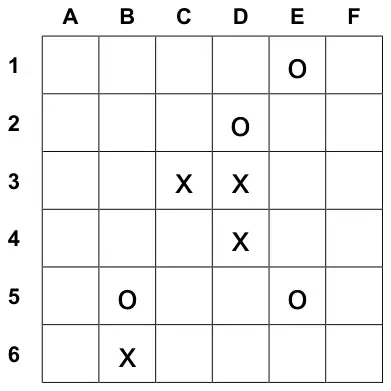
(a) Here is the position in a game.
It is Amy’s turn to put a cross on the grid.
She wins if she puts a cross in B3
Write down all the other squares where she could put a cross to win the game. [2 marks]
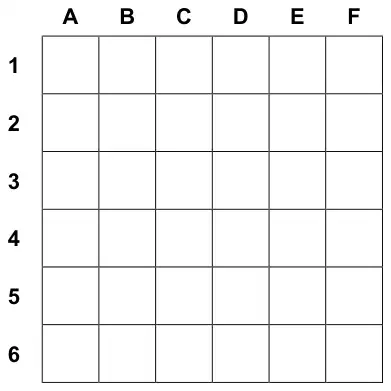
(b) Amy goes first in the next game.
Assume that she will choose a square at random.
Write down the probability that she will put her first cross in square F6 [1 mark]
(c) In fact, Amy decides to put her first cross into a corner square.
What does this mean about the probability that she will put her first cross in square F6?
Tick a box.
It is smaller than the answer to part (b)
It is greater than the answer to part (b)
It is the same as the answer to part (b)
Give a reason for your answer. [1 mark]
Mark scheme (a)
Answer
Mark
Comments
B2, C5, E3, D5
B2
B1 4 correct with at most 2 incorrect or any 2 or 3 correct with at most 1 incorrect or any 1 correct with none incorrect or no written answer, but all 4 correct marked on diagram with none incorrect
Additional guidance
Only mark the diagram with no written answer or 4 on answer line
4 on answer line with all 4 correct marked on diagram
B2
Ignore B3 repeated
Ignore repetition of correct answers
Condone eg 5C, 5,C, C,5, (5,C), (C,5) for B2 and B1
B2, 5C, (E,3), 5,D, B3
B2
Mark scheme (b)
Answer
Mark
Comments
\(\dfrac{1}{36}\) or 0.027(…) or 0.028 or 2.7(…)% or 2.8%
B1
oe
Additional guidance
Ignore attempts to convert a correct fraction
Ignore probability words
1 out of 36 or 1 in 36 together with a correct answer
B1
1 out of 36 or 1 in 36 alone
B0
1 : 36 with a correct answer
B0
Mark scheme (c)
Answer
Mark
Comments
It is greater than the answer to part (b) with valid reason
B1
eg now there are 4 squares to choose from (it is) \(\dfrac{1}{4}\) or (it is) \(\dfrac{9}{36}\)