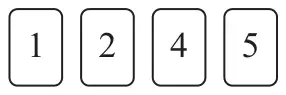
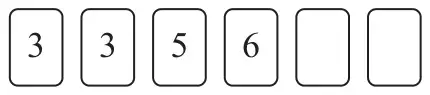
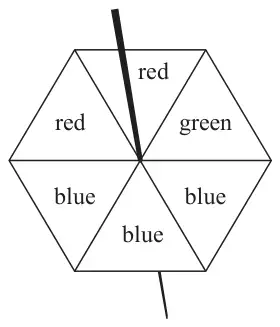
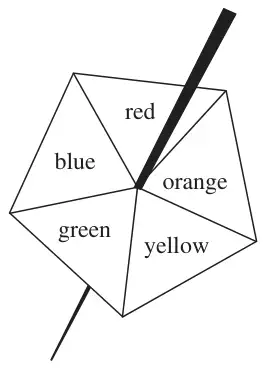
17 of the counters are red 28 of the counters are blue the rest of the counters are orange
Khalid is going to take at random a counter from the box.
The probability that Khalid will take an orange counter is \(\dfrac{4}{9}\)
Work out the number of orange counters that are in the box.
(3)
Mark scheme
Scheme
Marks
(17 + 28) ÷ (9 – 4) or 45 ÷ 5 or
\(1 - \dfrac{4}{9}\left(= \dfrac{5}{9}\right)\) or
\((17 + 28 =)\dfrac{5}{9}\) oe or
\(\dfrac{p}{p + 28 + 17} = \dfrac{4}{9}\) oe or \(\dfrac{p}{p + 45} = \dfrac{4}{9}\) or
\(\dfrac{m - 45}{m} = \dfrac{4}{9}\)
M1
(17 + 28) ÷ 5 × 4 or 45 ÷ 5 × 4 or
\((17 + 28) \div \text{``}{\dfrac{5}{9}}\text{''}\) (= 81) or \(45 \div \text{``}{\dfrac{5}{9}}\text{''}\) (= 81) or
\((17 + 28) \times \text{``}{\dfrac{9}{5}}\text{''}\) (= 81) or \(45 \times \text{``}{\dfrac{9}{5}}\text{''}\) (= 81) or
(17 + 28) ÷ 5 × 4 or 45 ÷ 5 × 4 or
\(\text{``}{\dfrac{5}{9}}\text{''} = \dfrac{17 + 28}{n}\) oe or \(n = 81\) or
\(9p = 4(p + 28 + 17)\) or \(9p - 4p = 180\) oe or \(5p = 180\) oe or
\(9(m - 45) = 4m\) or \(9m - 4m = 405\) oe or \(5m = 405\) oe or \(m = 81\)
M1
Working not required, so correct answer scores full marks (unless from obvious incorrect working) Answer: 36
A1
(3)
(3 marks)
Notes
M1: Allow 0.55(555…) or 55(.555…)% truncated or rounded
M1: for the correct calculation for the total number of counters or for the correct calculation for the number of orange counters or for the correct equation for the total number of counters (removing the denominators) or for the correct equation for the number of orange counters (removing the denominators)
Correct answer scores full marks (unless from obvious incorrect working) Answer: 8
A1
(3)
(3 marks)
Notes
M1: for finding the proportion of counters that are not green (may be a percentage or decimal) or for a correct ratio (allow ratio in any order) Values in ratio do not need labels, but if labels are used, they must be correct This is implied by eg 12 (counters) = 3 (parts)
OR for forming a correct equation in terms of the number of green counters or the total number of counters in the bag (allow use of any letter)
M1: for a method to find the value one-fifth of the counters or for a method to find the total number of counters in the bag OR for a correct method to solve a correct equation
11 The children at a holiday club play sport either on Monday or on Tuesday. They each choose one sport from tennis or athletics or cricket. The two‑way table shows some information about their choices.
tennis
athletics
cricket
Total
Monday
29
58
110
Tuesday
Total
62
105
240
(a) Complete the two‑way table. (3)
One of the children who plays cricket is chosen at random.
(b) Write down the probability that this child plays cricket on Monday. (1)
Mark scheme (a)
Scheme
Marks
tennis
athletics
cricket
Total
Monday
29
23
58
110
Tuesday
33
50
47
130
Total
62
73
105
240
Answer: A correctly completed table
B3
(3)
Notes
B3: (B2 for 4 or 5 correct entries B1 for 2 or 3 correct entries)
Mark scheme (b)
Scheme
Marks
\(\dfrac{58}{105}\)
B1
(1)
(4 marks)
Notes
B1: oe 0.55(238…) or 55(.238…)% truncated or rounded
17 of the counters are red 28 of the counters are blue the rest of the counters are orange
Khalid is going to take at random a counter from the box.
The probability that Khalid will take an orange counter is \(\dfrac{4}{9}\)
Work out the number of orange counters that are in the box.
(3)
Mark scheme
Scheme
Marks
(17 + 28) ÷ (9 – 4) or 45 ÷ 5 or
\(1 - \dfrac{4}{9}\left(= \dfrac{5}{9}\right)\) or
\((17 + 28 =)\dfrac{5}{9}\) oe or
\(\dfrac{p}{p + 28 + 17} = \dfrac{4}{9}\) oe or \(\dfrac{p}{p + 45} = \dfrac{4}{9}\) or
\(\dfrac{m - 45}{m} = \dfrac{4}{9}\)
M1
(17 + 28) ÷ 5 × 4 or 45 ÷ 5 × 4 or
\((17 + 28) \div \text{``}{\dfrac{5}{9}}\text{''}\) (= 81) or \(45 \div \text{``}{\dfrac{5}{9}}\text{''}\) (= 81) or
\((17 + 28) \times \text{``}{\dfrac{9}{5}}\text{''}\) (= 81) or \(45 \times \text{``}{\dfrac{9}{5}}\text{''}\) (= 81) or
(17 + 28) ÷ 5 × 4 or 45 ÷ 5 × 4 or
\(\text{``}{\dfrac{5}{9}}\text{''} = \dfrac{17 + 28}{n}\) oe or \(n = 81\) or
\(9p = 4(p + 28 + 17)\) or \(9p - 4p = 180\) oe or \(5p = 180\) oe or
\(9(m - 45) = 4m\) or \(9m - 4m = 405\) oe or \(5m = 405\) oe or \(m = 81\)
M1
Working not required, so correct answer scores full marks (unless from obvious incorrect working) Answer: 36
A1
(3)
(3 marks)
Notes
M1: Allow 0.55(555…) or 55(.555…)% truncated or rounded
M1: for the correct calculation for the total number of counters or for the correct calculation for the number of orange counters or for the correct equation for the total number of counters (removing the denominators) or for the correct equation for the number of orange counters (removing the denominators)
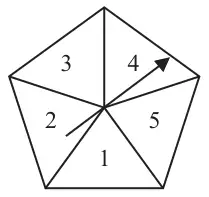
“0.48” ÷ 2 (= 0.24) [could be seen in table] or 400 – 56 – 68 – 84 (= 192) oe eg 400 – 208 (= 192) or 0.48 × 400 (= 192)
M1
“0.24” × 400 oe or
192 ÷ 2
M1
Correct answer scores full marks (unless from obvious incorrect working) Answer: 96
A1
(4)
(4 marks)
Notes
M1: Correct use of probabilities total 1 or correct calculation for an estimate for number of times the spinner will land on 2 or on 3 or on 5
M1: A completely correct method to find the probability that the spinner will land on 4 or a completely correct method to find the number of times the spinner will land on 1 or on 4
M1: a correct calculation to find the estimate required
or
an answer leading from 96 seen
eg \(\dfrac{96}{400}\)
A1: cao SCB1 for 104 if no other marks have been awarded
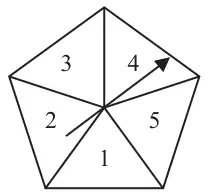
“0.48” ÷ 2 (= 0.24) [could be in table] or 400 – 56 – 68 – 84 (= 192) oe eg 400 – 208 (= 192) or 0.48 × 400 (= 192)
M1
“0.24” × 400 oe or
“192” ÷ 2
M1
Correct answer scores full marks (unless from obvious incorrect working) Answer: 96
A1
(4)
(4 marks)
Notes
M1: Correct use of probabilities total 1 or correct calculation for an estimate for number of times the spinner will land on 2 or on 3 or on 5
M1: A completely correct method to find the probability that the spinner will land on 4 or a completely correct method to find the number of times the spinner will land on 1 or on 4
M1: a correct calculation to find the estimate required
or
an answer leading from 96 seen
eg \(\dfrac{96}{400}\)
A1: cao SCB1 for 104 if no other marks have been awarded
17 450 students were asked how they travelled to school on Monday. Each student walked or travelled by bus or travelled by car or travelled by bicycle. Each student used just one method of travel.
One of these students is chosen at random. The table shows information about the probability of each method of travel.
Method of travel
walk
bus
car
bicycle
Probability
0.20
\(x\)
\(2x\)
0.26
Work out how many of the 450 students travelled by car.
(4)
Mark scheme
Scheme
Marks
1 – (0.20 + 0.26) (= 0.54) oe or \(x + 2x + 0.26 + 0.20 = 1\) oe or \(x + 2x = 0.54\) oe or
Correct answer scores full marks (unless from obvious incorrect working) Answer: 216
A1
(4)
(4 marks)
Notes
M1: for showing a clear understanding that the total of probabilities is 1 or for finding estimates for the number of times the spinner will land on 2 and 3 and 5
M1: for a method to find the value of \(x\) or \(2x\) or an estimate for the number of times the spinner will land on 4 or 1
5 balls are black 3 balls are green 2 balls are red
Rema is going to take at random a ball from the box.
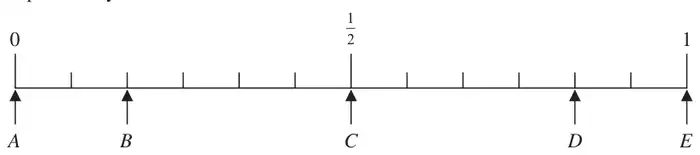
(a) On the probability scale, mark with a cross (\(\times\)) the probability that the ball is black. (1)
(b) On the probability scale, mark with a cross (\(\times\)) the probability that the ball is orange. (1)
Johan has three bags of counters, A, B and C He tries to find the probability of taking at random a white counter from each bag. He writes his probabilities in a table.
Bag
A
B
C
Probability
0.7
0.45
1.2
The probability that Johan writes for bag C is incorrect.
(c) Explain how you know that it is incorrect. (1)
Mark scheme (a)
Scheme
Marks
Cross at \(\dfrac{1}{2}\)
B1
(1)
Notes
B1: cao
Mark scheme (b)
Scheme
Marks
Cross at 0
B1
(1)
Notes
B1: cao
Mark scheme (c)
Scheme
Marks
Acceptable answers eg 1. It is over 1/more than 1 oe 2. It is over 100%/more than 100% oe 3. Probability of 1/100% is the highest oe 4. Probability ranges from 0 – 1 or 0 – 100% oe 5. 1.2/120% is impossible oe 6. It has to be 1 or less oe 7. It has to be below 1 oe
Do not accept eg 1. It is (too) high oe 2. Sum has to be 1 oe This is not an exhaustive list Answer: Correct reason
Correct answer scores full marks (unless from obvious incorrect working) Answer: 216
A1
(4)
(4 marks)
Notes
M1: for showing a clear understanding that the total of probabilities is 1 or for finding estimates for the number of times the spinner will land on 2 and 3 and 5
M1: for a method to find the value of \(x\) or \(2x\) or an estimate for the number of times the spinner will land on 4 or 1
2 450 students were asked how they travelled to school on Monday. Each student walked or travelled by bus or travelled by car or travelled by bicycle. Each student used just one method of travel.
One of these students is chosen at random. The table shows information about the probability of each method of travel.
Method of travel
walk
bus
car
bicycle
Probability
0.20
\(x\)
\(2x\)
0.26
Work out how many of the 450 students travelled by car.
(4)
Mark scheme
Scheme
Marks
1 – (0.20 + 0.26) oe or 0.54 oe or \(x + 2x + 0.26 + 0.20 = 1\) oe or \(x + 2x = 0.54\) oe
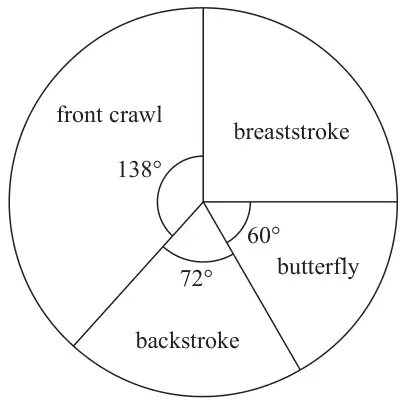
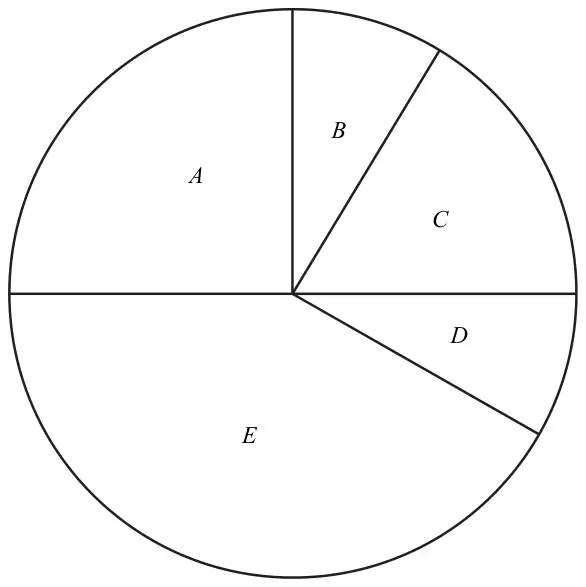
15 Sayeeda asked the members of a swimming club which one of front crawl, breaststroke, backstroke or butterfly is their favourite stroke.
The pie chart shows some information about their answers.
12 members said backstroke.
(a) Work out the number of members who said front crawl. (2)
There are 90 members in a diving club. The diving club has a beginners group, an intermediate group and an advanced group. Every member of the diving club is only in one of these groups.
The table shows information about the number of members in each group.
Group
beginners
intermediate
advanced
Frequency
18
\(x\)
\(2x\)
Kasim chooses at random one of the members of the diving club.
(b) Find the probability that this member is in the intermediate group. (3)
Mark scheme (a)
Scheme
Marks
\(138 \div \dfrac{72}{12}\) oe or 138 ÷ “6”
M1
Correct answer scores full marks (unless from obvious incorrect working) Answer: 23
“0.45” ÷ 3 (= 0.15) oe or “0.45” × “80” (= 36) or “80” – “44” (= 36)
M1
“80” × “0.15” or “80” × “0.3” (= 24)
or “36” ÷ 3 or “36” ÷ \(\dfrac{3}{2}\) (= 24)
M1
12
A1
(5)
(5 marks)
Notes
M1: indep for calculating total number of sweets
M1: or for a correct equation for missing values eg \(x + 2x + 0.2 + 0.35 = 1\) oe (can be implied by 2 probabilities that total 0.45 in table if not contradicted in working space)
M1: (or 0.15 or 0.3 seen in table – either order)
M1: A correct calculation for the number of white sweets or the number of pink sweets
\(\dfrac{n}{28} = \dfrac{0.15}{0.35}\) or \(\dfrac{n}{0.15} = \dfrac{28}{0.35}\) oe or \(\dfrac{n}{28} = \dfrac{0.3}{0.35}\) or \(\dfrac{n}{0.3} = \dfrac{28}{0.35}\) or 35% = 28 so 5% = 4
M1
(\(n =\)) \(28 \times \dfrac{0.15}{0.35}\) or (\(n =\)) \(0.15 \times \dfrac{28}{0.35}\) or 15% = 3 × 4 or \(28 \times \dfrac{0.3}{0.35}\) or \(0.3 \times \dfrac{28}{0.35}\) or 30% = 6 × 4 (= 24)
M1
12
A1
M1: or for a correct equation for missing values eg \(x + 2x + 0.2 + 0.35 = 1\) oe
M1: (or 0.15 or 0.3 seen in table – either order)
M1: for using proportion with an expression for \(n\) white sweets or finding 5% oe to enable calculation to 15%
M1: a calculation using proportion that would lead to finding their \(n\) or \(2n\)
“0.45” ÷ 3 (= 0.15) oe or “0.45” × “80” (= 36) or “80” – “44” (= 36)
M1
“80” × “0.15” or “80” × “0.3” (= 24)
or “36” ÷ 3 or “36” ÷ \(\dfrac{3}{2}\) (= 24)
M1
12
A1
(5)
(5 marks)
Notes
M1: indep for calculating total number of sweets
M1: or for a correct equation for missing values eg \(x + 2x + 0.2 + 0.35 = 1\) oe (can be implied by 2 probabilities that total 0.45 in table if not contradicted in working space)
M1: (or 0.15 or 0.3 seen in table – either order)
M1: A correct calculation for the number of white sweets or the number of pink sweets
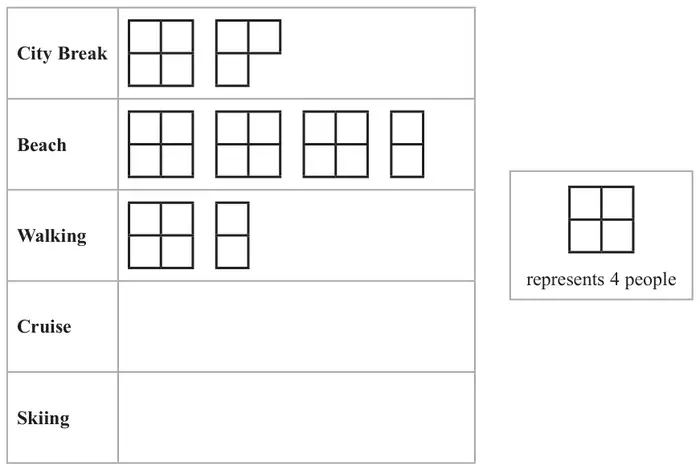
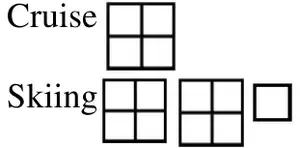
4 40 people were asked to name their favourite type of holiday. The pictogram gives information about the number of these people who said each of City Break or Beach or Walking.
(a) How many of these people said Beach? (1)
4 people said Cruise. 9 people said Skiing.
(b) Show this information on the pictogram. (2)
One person from the 40 people asked is selected at random.
(c) Find the probability that this person said City Break. (2)
Mark scheme (a)
Scheme
Marks
14
B1
(1)
Mark scheme (b)
Scheme
Marks
B1 B1
(2)
Notes
B1: correct symbol for Cruise
B1: correct symbols for Skiing
Mark scheme (c)
Scheme
Marks
M1
\(\dfrac{7}{40}\)
A1
(2)
(5 marks)
Notes
M1: \(\dfrac{7}{a}\) where \(a \geqslant 7\) or \(\dfrac{b}{40}\) where \(b \leqslant 40\)
Correct answer scores full marks (unless from obvious incorrect working) Answer: 21.26
A1
(4)
(5 marks)
Notes
M2: for at least 4 correct products added (need not be evaluated) If not M2 then award: M1 for consistent use of value within interval (including end points) for at least 4 products which must be added or correct midpoints used for at least 4 products and not added
M1: dep on at least M1 Allow division by their \(\Sigma f\) provided addition or total under column seen
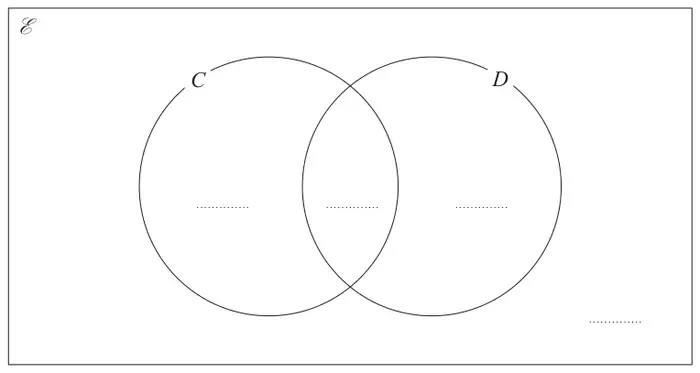
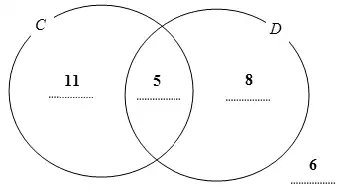
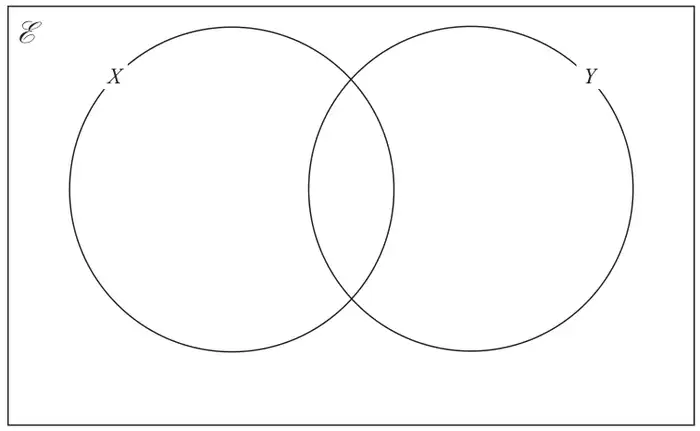
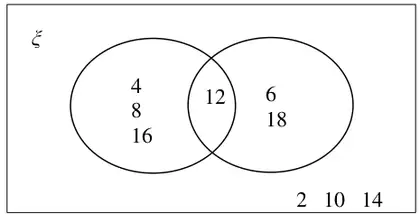
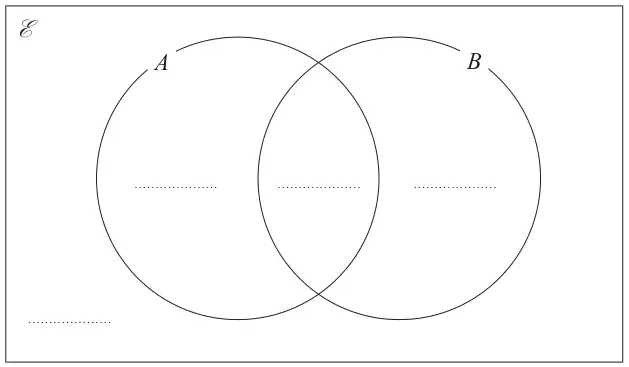
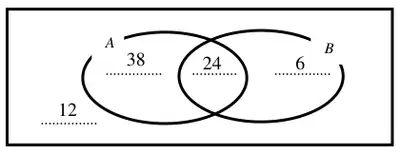
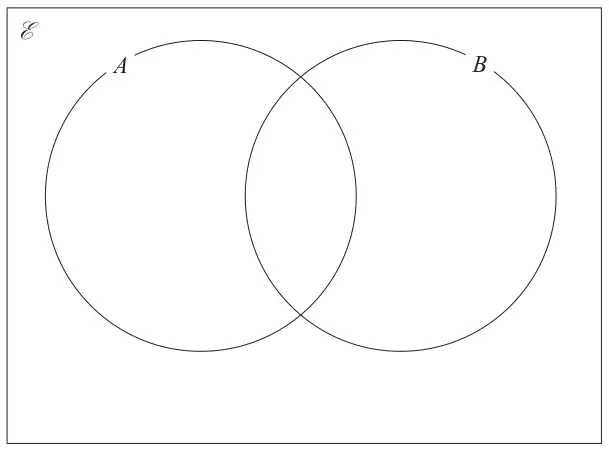
(a) Complete the Venn diagram for this information.(3)
A number is chosen at random from \(\mathscr{E}\)
(b) Find the probability that the number is in the set \(X \cup Y\) (2)
Mark scheme (a)
Scheme
Marks
B3
(3)
Notes
B3: fully correct (B2 for three correct regions) (B1 for one or two correct regions) [a repeat in a region is an error]
Mark scheme (b)
Scheme
Marks
\(\dfrac{\text{‘}6\text{’}}{9}\)
M1
\(\dfrac{6}{9}\)
A1
(2)
(5 marks)
Notes
M1: Numerator correct (or value intended as numerator) or correct for their Venn diagram (so long as fraction not improper) or 6 out of 9 or 6 : 9 oe (ie correct values in incorrect form)
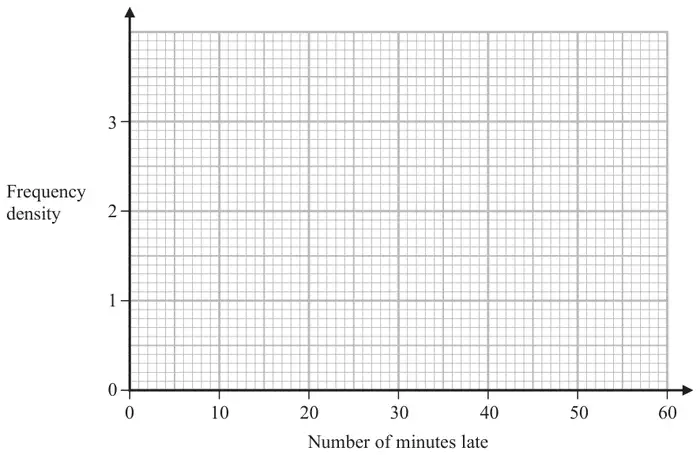
14 Manuel collected information about the flights that arrived late at an airport last month.
The table gives information about the number of minutes that these flights were late.
Minutes late (L minutes)
Frequency
\(0 \lt L \leqslant 10\)
8
\(10 \lt L \leqslant 15\)
13
\(15 \lt L \leqslant 25\)
19
\(25 \lt L \leqslant 40\)
24
\(40 \lt L \leqslant 60\)
6
(a) On the grid, draw a histogram for this information.(3)
Manuel selected at random a flight that was late by 25 minutes or less from his results.
(b) Work out an estimate for the probability that this flight was late by 5 minutes or less. (2)
Mark scheme (a)
Scheme
Marks
0.8, 2.6, 1.9, 1.6, 0.3 Answer: Correct histogram
B3
(3)
Notes
B3: fully correct histogram (B2 for at least 3 correct frequency densities or at least 3 correct bars or all five bars of correct width with heights in the correct ratio B1 for 2 correct frequency densities or 2 correct bars – but these bars must be of different widths, ie not 1st and 3rd) or three bars of correct width with heights in the correct ratio)
Mark scheme (b)
Scheme
Marks
M1
Correct answer scores full marks (unless from obvious incorrect working)
Answer: \(\dfrac{4}{40}\)
A1
(2)
(5 marks)
Notes
M1: for \(\dfrac{n}{40}\) where \(n \lt 40\) or for \(\dfrac{4}{m}\) where \(m \gt 4\)
Correct answer scores full marks (unless from obvious incorrect working) Answer: 21.26
A1
(4)
(5 marks)
Notes
M2: for at least 4 correct products added (need not be evaluated) If not M2 then award: (M1 for consistent use of value within interval (including end points) for at least 4 products which must be added or correct midpoints used for at least 4 products and not added)
M1: dep on at least M1 Allow division by their \(\Sigma f\) provided addition or total under column seen
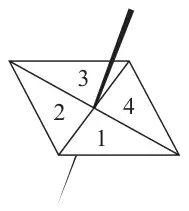
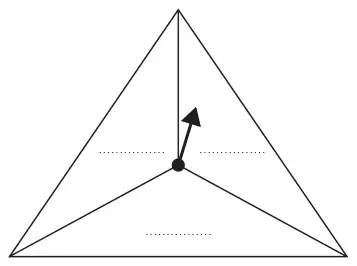
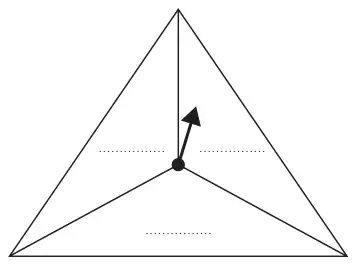
(i) Write a different number on each dotted line so that when the spinner is spun it is impossible that the spinner will land on a number greater than 9(1)
(ii) Write a different number on each dotted line so that when the spinner is spun it is certain that the spinner will land on a multiple of 10(1)
The likelihood of an outcome is evens.
(b) On the probability scale, mark with a cross (\(\times\)) the probability of this outcome.(1)
Mark scheme (a)
Scheme
Marks
(i) Answer: Three different numbers less than or equal to 9
‘0.45’ ÷ 3 (= 0.15) or ‘0.45’ × 180 (= 81) or 180 − 99 (= 81)
M1
‘0.15’ × 180 or ‘81’ ÷ 3
M1
27
A1
(4)
(4 marks)
Notes
M1: or for a correct equation for missing values eg \(x + 0.24 + 2x + 0.31 = 1\) oe (can be implied by 2 probabilities that total 0.45 in table if not contradicted in working space)
M1: (or 0.15 correctly placed in table if not contradicted)
M2: for at least 4 correct products added (need not be evaluated) If not M2 then award M1 for consistent use of value within interval (including end points) for at least 4 products which must be added or correct midpoints used for at least 4 products and not added
M1: dep on at least M1 Allow division by their \(\Sigma f\) provided addition or total under column seen
A1: oe
Mark scheme (c)
Scheme
Marks
\(\dfrac{2}{40} + \dfrac{1}{40}\)
M1
\(\dfrac{3}{40}\)
A1
(2)
(7 marks)
Notes
M1: for \(\dfrac{a}{40}\) where \(0 \lt a \lt 40\) or \(\dfrac{3}{b}\) where \(b \gt 3\) where \(a\) and \(b\) are integers
‘0.45’ ÷ 3 (= 0.15) Or ‘0.45’ × 180 (= 81) Or 180 − 99 (= 81)
M1
‘0.15’ × 180 Or ‘81’ ÷ 3
M1
27
A1
(4)
(4 marks)
Notes
M1: or for a correct equation for missing values eg \(x + 0.24 + 2x + 0.31 = 1\) oe (can be implied by 2 probabilities that total 0.45 in table if not contradicted in working space)
M1: (or 0.15 correctly placed in table as long as not contradicted)
M2: for at least 4 correct products added (need not be evaluated) or If not M2 then award M1 for consistent use of value within interval (including end points) for at least 4 products which must be added or correct midpoints used for at least 4 products and not added
M1: (dep on at least M1) Allow division by their Σf provided addition or total under column seen
A1: oe
Mark scheme (c)
Scheme
Marks
\(\dfrac{2}{40} + \dfrac{1}{40}\)
M1
\(\dfrac{3}{40}\)
A1
(2)
(7 marks)
Notes
M1: for \(\dfrac{a}{40}\) where \(0 \lt a \lt 40\) or \(\dfrac{3}{b}\) where \(b \gt 3\) where \(a\) and \(b\) are integers
2 Egor rolled a dice 24 times. Here are his results.
2
3
5
4
6
2
1
3
3
5
1
3
3
5
5
6
2
5
4
3
4
3
3
4
(a) Complete the frequency table for Egor’s results.
Number on dice
Tally
Frequency
1
2
3
4
5
6
(2)
(b) Write down the mode of the numbers that Egor rolled. (1)
Egor thinks the dice he rolled is biased.
(c) Give a reason why the results could show that the dice is biased. (1)
Mark scheme (a)
Scheme
Marks
Frequencies and tallies of 2, 3, 8, 4, 5, 2
B2
(2)
Notes
B2: All frequencies and tallies correct B1 for 3, 4 or 5 frequencies or tallies correct NB. Frequencies and tallies must be in the correct column. Accept 2/24 etc. in frequency column
Mark scheme (b)
Scheme
Marks
3
B1ft
(1)
Notes
B1ft: Follow through from table
Mark scheme (c)
Scheme
Marks
Sensible statement
B1
(1)
(4 marks)
Notes
B1: Not enough 1’s or 6’s Too many 3’s Rolled a 3 a third of the times Should expect to get 4 of each number
6 There are some ice lollies in a freezer. The flavour of each ice lolly is banana or strawberry or mint or chocolate. Julius takes at random an ice lolly from the freezer. The table shows the probabilities that the flavour of the ice lolly that Julius takes is banana or strawberry or chocolate.
Flavour
banana
strawberry
mint
chocolate
Probability
0.35
0.32
0.12
Work out the probability that the flavour of the ice lolly that Julius takes is either strawberry or mint.
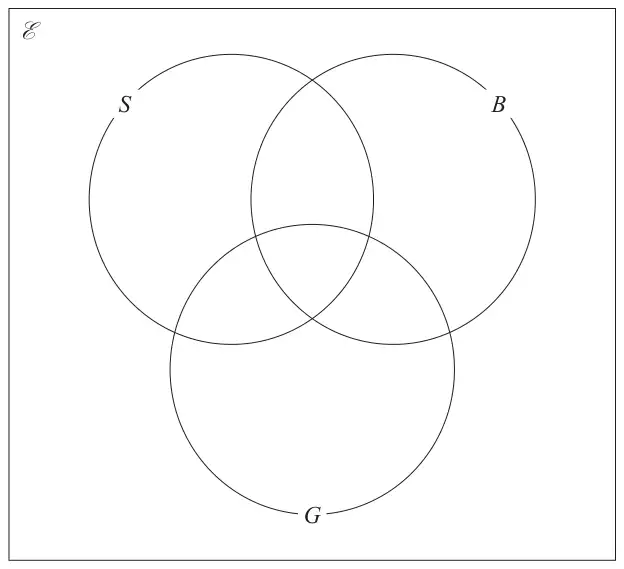
16 120 people who visited a sports centre were asked if they went swimming (\(S\)), played basketball (\(B\)) or used the gym (\(G\)).
Their answers showed that
28 people went swimming 16 people played basketball 27 people used the gym 3 people went swimming and played basketball 5 people played basketball and used the gym 7 people went swimming and used the gym 2 people went swimming, played basketball and used the gym
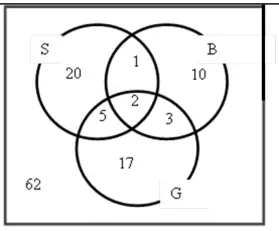
(a) Using this information, complete the Venn diagram to show the number of people in each region of the Venn diagram.(3)
One of the people who went swimming is chosen at random.
(b) Find the probability that this person also played basketball. (1)
Mark scheme (a)
Scheme
Marks
M1
M1
A1
(3)
Notes
M1: for 2 in the middle and one from 1 or 3 or 5 in the correct place in the Venn diagram
M1: for any 4 correct entries
A1: for a fully correct answer including 62 outside the circles inside the rectangle
7 of the beads are red. 11 of the beads are green. The rest of the beads are yellow.
Jan takes at random a bead from the box.
(a) Write down the probability that she takes a red bead. (1)
(b) Find the probability that she takes a red bead or a yellow bead. (2)
There are 26 counters in a bag.
5 of the counters are pink. 10 of the counters are blue. The rest of the counters are white.
Jan puts some more pink counters into the bag. She then takes some blue counters out of the bag. After she has done this there are still 26 counters in the bag.
Jan then takes at random a counter from the bag.
The probability that she takes a pink counter is \(\dfrac{1}{2}\)
(c) What is the probability that she takes a blue counter? (3)
Mark scheme (a)
Scheme
Marks
\(\dfrac{7}{20}\)
B1
(1)
Notes
B1: oe
Mark scheme (b)
Scheme
Marks
20 − 7 − 11 (= 2) and “2” + 7 (= 9) OR 20 – 11 (= 9)
M1
\(\dfrac{9}{20}\)
A1
(2)
Notes
M1: for a complete method to find the number of beads that are either red or yellow- may be seen in probabilities
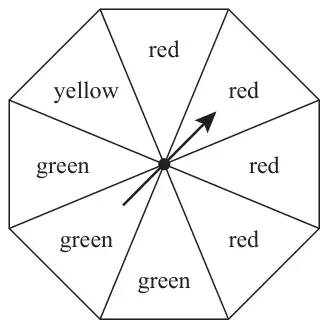
When the spinner is spun, it can land on red, blue, green, brown or yellow. The table gives the probabilities that the spinner lands on red or on blue or on green.
Colour
red
blue
green
brown
yellow
Probability
0.15
0.26
0.33
When the spinner is spun once, the probability that the spinner lands on brown is 0.06 more than the probability that the spinner lands on yellow. Jenine spins the spinner 150 times. Work out an estimate for the number of times the spinner lands on yellow.
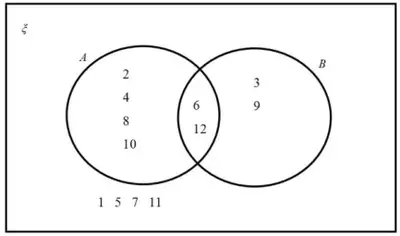
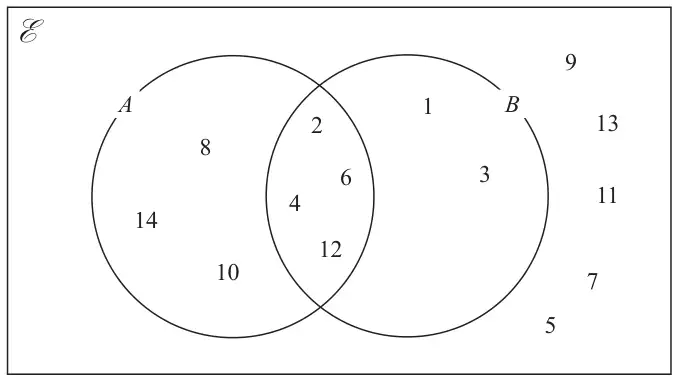
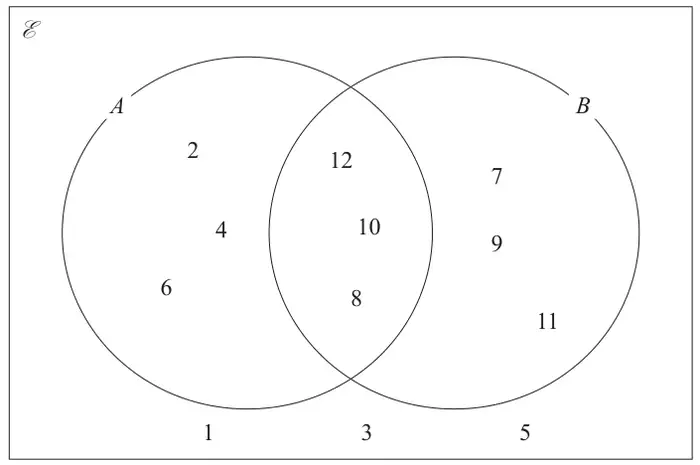
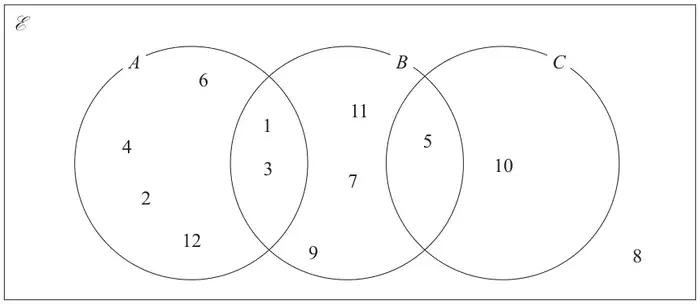
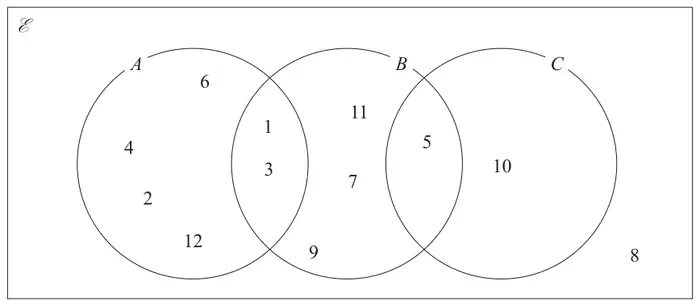
Brian writes down the statement \(A \cap C = \varnothing\)
(b) Is Brian’s statement correct? You must give a reason for your answer. (1)
One of the numbers in the Venn diagram is picked at random.
(c) Find the probability that this number is in set \(C'\) (2)
Mark scheme (a)
Scheme
Marks
(i) 1, 2, 3, 4, 6, 12
B1
(ii) 1, 3, 5, 7, 9, 10, 11
B1
(2)
Notes
B1: cao
B1: cao
Mark scheme (b)
Scheme
Marks
Yes with reason
B1
(1)
Notes
B1: e.g. no numbers in both \(A\) and \(C\) or \(A\) and \(C\) do not intersect or \(A\) and \(C\) do not overlap or \(A\) and \(C\) are mutually exclusive
Mark scheme (c)
Scheme
Marks
M1
\(\dfrac{10}{12}\) oe
A1
(2)
(5 marks)
Notes
M1: for 12 – 2 (=10) or \(\dfrac{a}{12}\) with \(a \lt 12\) or
10 and 12 used with incorrect notation E.g. 10 : 12
A1: for \(\dfrac{10}{12}\) oe or 0.83(3…) or 83(.3..)%
14 Javier has two sets of cards. Each set contains 4 cards, one marked A, one marked B, one marked C and one marked D.
Javier is going to take at random one card from each set. The table shows all possible pairs of cards that Javier could take.
Set 2
A
B
C
D
Set 1
A
AA
AB
AC
AD
B
BA
BB
BC
BD
C
CA
CB
CC
CD
D
DA
DB
DC
DD
(a) Find the probability that Javier will take at least one card marked C. (2)
Javier is going to take at random one card from each set, note the letter on each card and replace the cards. He is going to do this a total of 80 times.
(b) Work out an estimate for the number of times that Javier will take at least one card marked C. (2)
Mark scheme (a)
Scheme
Marks
7 outcomes with at least one C
M1
\(\dfrac{7}{16}\)
A1
(2)
Notes
M1: Identify at least 6 (with no more than 2 incorrectly identified) outcomes with at least one C or an answer of \(\dfrac{6}{16}\) or \(\dfrac{8}{16}\) or \(\dfrac{7}{n}\) where \(n \gt 7\)
A1: Or 0.4375 or 43.75% (allow 2dp rounded or truncated)
Mark scheme (b)
Scheme
Marks
\(\dfrac{7}{16} \times 80\)
M1
35
A1
(2)
(4 marks)
Notes
M1: ft from (a) for value between 0 and 1 or for an answer of \(\dfrac{35}{80}\)
Brian writes down the statement \(A \cap C = \varnothing\)
(b) Is Brian’s statement correct? You must give a reason for your answer. (1)
One of the numbers in the Venn diagram is picked at random.
(c) Find the probability that this number is in set \(C'\) (2)
Mark scheme (a)
Scheme
Marks
(i) 1, 2, 3, 4, 6, 12
B1
(ii) 1, 3, 5, 7, 9, 10, 11
B1
(2)
Notes
B1: cao
B1: cao
Mark scheme (b)
Scheme
Marks
Yes with reason
B1
(1)
Notes
B1: e.g. no numbers in both \(A\) and \(C\) or \(A\) and \(C\) do not intersect or \(A\) and \(C\) do not overlap or \(A\) and \(C\) are mutually exclusive
Mark scheme (c)
Scheme
Marks
M1
\(\dfrac{10}{12}\) oe
A1
(2)
(5 marks)
Notes
M1: for 12 – 2 (=10) or \(\dfrac{a}{12}\) with \(a \lt 12\) or
10 and 12 used with incorrect notation E.g. 10 : 12
A1: for \(\dfrac{10}{12}\) oe or 0.83(3…) or 83(.3..)%
2 Daniel has five bags of coloured sweets. He picks at random a sweet from each bag. The table shows the probability that the sweet he picks from each bag is red.
Bag
A
B
C
D
E
Probability of red
0.7
0.9
0.5
1
0.2
(a) From which bag is Daniel least likely to pick a red sweet? (1)
(b) Which bag contains only red sweets? (1)
(c) From which bag is Daniel equally likely to pick a red sweet as a sweet of another colour? (1)
11 Duncan has a fair 4-sided spinner. The spinner can land on 2, 3, 5 or 7
Duncan spins the spinner once.
(a)
(i) On the probability scale, mark with a cross (×) the probability that the spinner lands on 4
(ii) On the probability scale, mark with a cross (×) the probability that the spinner lands on an odd number.
(2)
Duncan spins the spinner again.
(b) Complete the table to show all the possible outcomes for the two spins of the spinner. Six outcomes have been done for you. (3, 2) means 3 on the first spin and 2 on the second spin.
Number on the second spin
2
3
5
7
Number on the first spin
2
(2, 2)
(2, 5)
3
(3, 2)
(3, 7)
5
7
(7, 3)
(7, 7)
(2)
(c) Find the probability that the number on the first spin is greater than the number on the second spin. (2)
Mark scheme (a)
Scheme
Marks
(i) × at 0
B1
(ii) × at \(\dfrac{3}{4}\)
B1
(2)
Mark scheme (b)
Scheme
Marks
M1
Correct table
A1
(2)
Notes
M1: For 3 correct entries
Mark scheme (c)
Scheme
Marks
M1ft
\(\dfrac{6}{16}\) oe
A1ft
(2)
Notes
M1ft: For \(\dfrac{6}{a}\) where \(6 \leqslant a \leqslant 16\) or
For \(\dfrac{b}{16}\) where \(1 \leqslant b \leqslant 16\) where \(a\) and \(b\) are integers
10 Jim puts 4 white tiles and 3 grey tiles into a bag. Each tile has a letter on it.
Jim takes at random a tile from the bag.
(a) Write down the letter that Jim is most likely to take. (1)
(b) Write down the probability that the tile is grey with the letter C on it. (1)
(c) Write down the probability that the tile does not have the letter A on it. (1)
Jim puts the tile back into the bag. He then puts more grey tiles into the bag. Each of these tiles has the letter C on it. Alice takes at random a tile from the bag.
The probability that this tile has the letter C on it is \(\dfrac{1}{2}\)
(d) Work out the probability that the tile Alice takes is grey with the letter C on it. (2)
M1: For at least 4 products (may not be evaluated.
M1: (dep) for division by 40 NB. If division is by something other than 40 this must clearly come from adding the frequencies.
A1: Accept 2.33 or 2 if 2.325 or \(\dfrac{93}{40}\) seen
Accept \(2\dfrac{13}{40}\)
SCB2 for 2.35
Mark scheme (b)
Scheme
Marks
M1
1
A1
(2)
Notes
M1: For Lower Quartile (Q1) = 2 AND Upper Quartile (Q3) = 3 Accept a correct ordered list of the 40 numbers with both quartiles clearly identified in the correct position.
M1: (ft from sensible table i.e. clear attempt at addition)
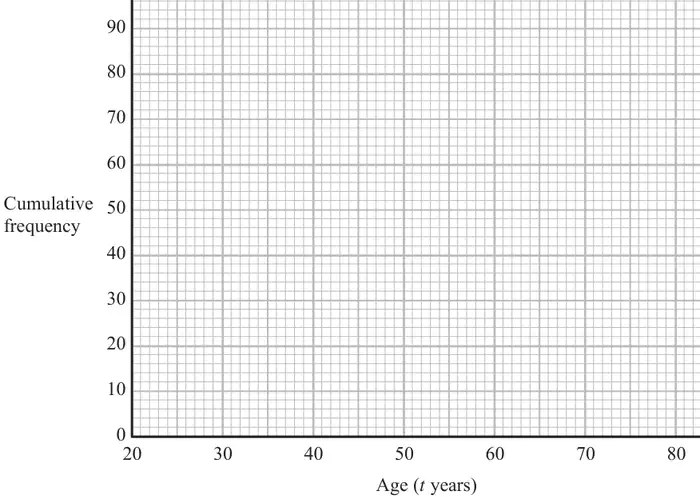
for at least 4 points plotted correctly at end of interval or for all 6 points plotted consistently within each interval in the freq table at the correct height (e.g. used values of 25, 35, 45 etc on age axis)
A1: accept curve or line segments accept curve that is not joined to (20,0)
Mark scheme (d)
Scheme
Marks
E.g. reading from graph at \(t = 65\) or reading of 82 – 84 or mark on cf axis from using \(t = 65\)
M1
6 – 8
A1
(2)
(7 marks)
Notes
M1: for evidence of using graph at \(t = 65\)
ft from a cumulative frequency graph provided method is shown
A1: dep on a cf graph in part (c) ft from a cumulative frequency graph provided method is shown
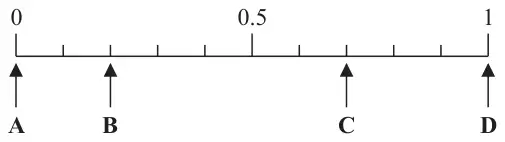
(i) On the probability scale, mark with a cross (×) the probability that the dice will land on a number less than 7 Label this cross A.
(ii) On the probability scale, mark with a cross (×) the probability that the dice will land on an odd number. Label this cross B.
(2)
Here is a biased 3-sided spinner.
When the spinner is spun, it can land on red or on blue or on green. The table shows the probability that the spinner lands on red and the probability that the spinner lands on blue.
Colour
red
blue
green
Probability
0.3
0.25
Ruochen spins the spinner once.
(b) Work out the probability that the spinner lands on green. (2)
Mark scheme (a)
Scheme
Marks
(i) Cross marked and labelled at 1
B1
(ii) Cross marked and labelled at \(\dfrac{1}{2}\)
When the spinner is spun, it can land on red, orange, yellow, green or blue. The probabilities that it lands on red, orange and yellow are given in the table.
Colour
red
orange
yellow
green
blue
Probability
0.4
0.2
0.1
The probability that the spinner lands on green is the same as the probability that the spinner lands on blue.
Michael spins the spinner once.
(a) Work out the probability that the spinner lands on green. (3)
Jenny spins the spinner 200 times.
(b) Work out an estimate for the number of times the spinner lands on red. (2)
Mark scheme (a)
Scheme
Marks
1 − 0.4 − 0.2 − 0.1 or 0.3
M1
\(\dfrac{1 - 0.4 - 0.2 - 0.1}{2}\) or \(\dfrac{\text{"}0.3\text{"}}{2}\)
M1
0.15
A1
(3)
Notes
M1: dep
Mark scheme (b)
Scheme
Marks
200×0.4
M1
80
A1
(2)
(5 marks)
Notes
A1: Note: Award M1A1 for 80 out of 200 Award M1A0 for 80/200
When the spinner is spun, it can land on red, orange, yellow, green or blue. The probabilities that it lands on red, orange and yellow are given in the table.
Colour
red
orange
yellow
green
blue
Probability
0.4
0.2
0.1
The probability that the spinner lands on green is the same as the probability that the spinner lands on blue.
Michael spins the spinner once.
(a) Work out the probability that the spinner lands on green. (3)
Jenny spins the spinner 200 times.
(b) Work out an estimate for the number of times the spinner lands on red. (2)
Mark scheme (a)
Scheme
Marks
1 − 0.4 − 0.2 − 0.1 or 0.3
M1
\(\dfrac{1 - 0.4 - 0.2 - 0.1}{2}\) or \(\dfrac{\text{“}0.3\text{”}}{2}\)
M1
0.15
A1
(3)
Notes
M1: dep
Mark scheme (b)
Scheme
Marks
200 × 0.4
M1
80
A1
(2)
(5 marks)
Notes
A1: Note: Award M1A1 for 80 out of 200 Award M1A0 for 80/200
16 There are 50 marbles in a bag. 35 of the marbles are brown. 5 of the marbles are green. The rest of the marbles are purple.
Seppi takes at random a marble from the bag.
(a)
(i) What is the probability that the marble is green?
(ii) What is the probability that the marble is purple?
(3)
Seppi replaces her marble. Otti takes at random a marble from the bag. He records the colour of the marble and puts the marble back in the bag. He does this 300 times.
(b) Work out an estimate for the number of brown marbles he takes. (2)
Mark scheme (a)
Scheme
Marks
(i) 5/50
B1oe
(ii) \(1 - \dfrac{35 + 5}{50}\)
M1ft
10/50
A1ft
(3)
Notes
M1ft: \(1 - \dfrac{35 + 5}{50}\) or 50 – 35 – 5 or 10
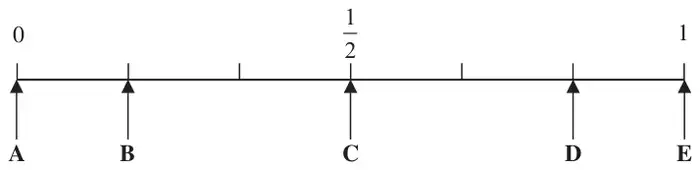
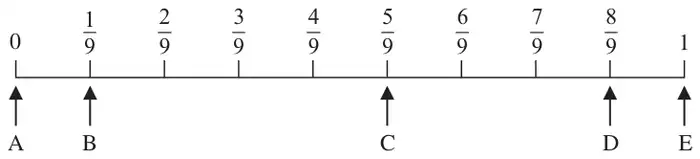
A fair 6-sided dice is thrown. Write down the letter of the arrow that points to the probability that the dice lands on
(i) the number 5
(ii) a number greater than 10
(iii) an even number.
(3)
Alice says that the probability it will rain tomorrow is 1.2 She cannot be right.
(b) Explain why. (1)
Brett has a bag of counters and a box of counters. 1 red counter, 1 white counter, 1 blue counter and 1 yellow counter are in the bag. 1 green counter and 1 purple counter are in the box. Brett takes at random a counter from the bag. He then takes at random a counter from the box.
(c)
(i) List all the possible combinations of coloured counters he could get.
(ii) Write down the probability that Brett takes a red counter and a green counter.
(3)
Mark scheme (a)
Scheme
Marks
(i) B
B1
(ii) A
B1
(iii) C
B1
(3)
Mark scheme (b)
Scheme
Marks
eg. cannot have a probability greater than 1
B1
(1)
Mark scheme (c)
Scheme
Marks
(i) rg, rp, wg, wp, bg, bp, yg, yp
B2
(ii) \(\dfrac{1}{8}\) oe
B1
(3)
Notes
B2: for all 8 with no repeats If not B2 then award B1 for at least 4 correct combinations (ignore incorrect and repeats)
21 A box contains toy cars. Each car is red or blue or black or silver. Emily takes at random a car from the box. The table shows the probabilities that Emily takes a red car or a blue car or a black car.
Colour of car
Probability
red
0.20
blue
0.05
black
0.15
silver
(a) Work out the probability that Emily takes a silver car. (2)
Emily puts the car back into the box. There are 6 blue cars in the box.
(b) Work out the total number of cars in the box. (2)
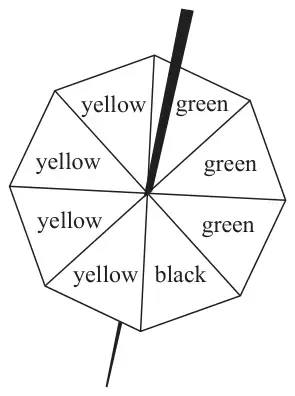
(a) Write down the probability that the spinner lands on green. (1)
(b) Find the probability that the spinner lands on red. (1)
Karen has a different spinner. When the spinner is spun once, the probability that it will land on yellow is \(\dfrac{2}{5}\) Karen spins the spinner 30 times.
(c) Work out an estimate for the number of times the spinner lands on yellow. (2)
Mark scheme (a)
Scheme
Marks
0
B1
(1)
Notes
B1: accept 0.0, 0% 0/6 but not words
Mark scheme (b)
Scheme
Marks
\(\dfrac{4}{6}\)
B1
(1)
Notes
B1: Accept \(\dfrac{2}{3}\) oe
Or 0.66, 0.67, 66%, 67% or better
Mark scheme (c)
Scheme
Marks
\(\dfrac{2}{5} \times 30\) or 0.4 × 30
M1
12
A1
(2)
Notes
A1: (an answer of \(\dfrac{12}{30}\) gains M1 only)
4 Maisie plays a game. Each time she plays, she can win a prize of $1 or $5 or $10 When she does not win one of these prizes, she loses. The table gives the probability of winning each of the prizes.
Prize
Probability
$1
0.50
$5
0.15
$10
0.05
Maisie plays the game once.
(a) Work out the probability that Maisie loses. (2)
(b) Maisie plays the game 40 times.
(i) Work out an estimate for the number of $5 prizes she wins. (2)
(ii) Work out an estimate for the total value of the prizes she wins. (3)
Mark scheme (a)
Scheme
Marks
\(1 - 0.5 - 0.15 - 0.05\)
M1
0.3
A1
(2)
Mark scheme (b)
(i)
Scheme
Marks
\(40 \times 0.15\)
M1
6
A1
(2)
Notes
M1: Accept 40 × 0.15 × 5 or 6 × 5 or 30
(ii)
Scheme
Marks
\(40 \times 0.5\) or 20 and \(40 \times 0.05\) or 2
15 Becky has a biased 6-sided spinner. She spins the spinner 25 times. She records the score for each spin. The table shows information about her scores.
Score
Frequency
1
9
2
6
3
3
4
2
5
1
6
4
(a) Which score is the mode? (1)
(b) Work out the range of her scores. (2)
(c) Find her median score. (2)
(d) Work out her mean score. (3)
Becky spins the spinner one more time.
(e) Find an estimate for the probability that the spinner will land on the number 4 (2)
Mark scheme (a)
Scheme
Marks
1
B1
(1)
Mark scheme (b)
Scheme
Marks
6 − 1
M1
5
A1
(2)
Notes
M1: For 6 and 1 identified
Mark scheme (c)
Scheme
Marks
(25 + 1) ÷ 2 or 13 or 12.5
M1
2
A1
(2)
Notes
M1: or listing scores and clear attempt to find middle value
Mark scheme (d)
Scheme
Marks
1×9 + 2×6 + 3×3 + 4×2 + 5×1 + 6×4 oe (= 67)
M1
“67” ÷ 25 or \(\dfrac{9 + 12 + 9 + 8 + 5 + 24}{25}\) oe (allow one error in a product)
M1
2.68 or \(2\dfrac{17}{25}\)
A1
(3)
Notes
M1: sight of at least 4 products and intention to add (can be their 25 if evidence of adding frequencies)
M1: dep for division of sum of products by 25 (can be their 25 if evidence of adding frequencies)
A1: accept 2.7 or 3 if preceded by \(\dfrac{67}{25}\)
(corrected from the printed mark scheme: the first line is printed as 1×9 + 2×6 + 3×3 + 5×1 + 4×6, which leaves out 4×2; the total 67 needs all six products)
Mark scheme (e)
Scheme
Marks
M1
\(\dfrac{2}{25}\) oe
A1
(2)
Total 10 marks
Notes
M1: \(\dfrac{x}{25}\); \(x \lt 25\) or \(\dfrac{2}{y}\); \(y \gt 2\)
1 A bag contains only red bricks and blue bricks. There is a total of 20 bricks in the bag. The probability that a brick taken at random from the bag will be red is \(\dfrac{2}{5}\) How many blue bricks are there in the bag?
(3)
Mark scheme
Scheme
Marks
\(1 - \dfrac{2}{5}\) or \(\dfrac{3}{5}\) oe
M1
\(\dfrac{3}{5} \times 20\) oe
M1
12
A1
(3)
Notes
M1: or for \(\dfrac{2}{5} \times 20\) oe or 8 or \(\dfrac{8}{20}\)
18 A jar contains 72 coloured beads. There are 24 red beads, 28 blue beads and 20 green beads.
Ajit takes at random a bead from the jar.
(a) Find the probability that the bead Ajit takes is
(i) red,
(ii) blue or green.
(3)
A second jar contains coloured beads. Ajit takes at random a bead from the jar. The probability that the bead is yellow is 0.08 The probability that the bead is pink is 0.1
(b) Find the probability that the bead is neither yellow nor pink. (2)
A third jar contains 100 coloured beads. 20 of these beads are brown. Ajit takes at random a bead from the jar. He records the colour of the bead and then returns the bead to the jar. He does this 60 times.
(c) Work out an estimate for the number of times Ajit records a brown bead. (2)
Mark scheme (a)
Scheme
Marks
(i) \(\dfrac{24}{72}\)
B1
(ii) 28 + 20 or 72 − 24 or 48 or \(1 - \text{“}\dfrac{24}{72}\text{”}\)
M1ft
\(\dfrac{48}{72}\)
A1ft
(3)
Notes
B1: oe eg \(\dfrac{1}{3}\)
Accept 0.33(3333…) correct to at least 2dp
M1ft: ft from their (a)(i) if 0 < (a)(i) < 1
A1ft: oe eg \(\dfrac{2}{3}\)
Accept 0.66(66…..) rounded or truncated to at least 2 dp
14 A bag contains only red counters, blue counters and yellow counters. The number of red counters in the bag is the same as the number of blue counters.
Mikhail takes at random a counter from the bag. The probability that the counter is yellow is 0.3
Work out the probability that the counter Mikhail takes is red.
5 A jar contains coloured beads. Ajit takes at random a bead from the jar. The probability that the bead is yellow is 0.08 The probability that the bead is pink is 0.1 The probability that the bead is blue is 0.25
(a)
(i) Find the probability that the bead is yellow or blue.
(ii) Find the probability that the bead is neither yellow nor pink.
(4)
Ajit replaces the first bead in the jar. He then takes at random a second bead from the jar.
(b) Find the probability that the first bead is yellow and the second bead is blue. (2)
A second jar contains 100 coloured beads. 20 of these beads are brown. Ajit takes at random a bead from the jar. He records the colour of the bead and then returns the bead to the jar. He does this 60 times.
(c) Work out an estimate for the number of times Ajit records a brown bead. (2)
Mark scheme (a)
Scheme
Marks
(i) 0.08 + 0.25
M1
0.33
A1
(ii) 1 – 0.08 – 0.1 or 1 – (0.25 + 0.1 + 0.08) + 0.25 or 0.57 + 0.25 or (1 – (“0.33” + 0.1)) + 0.25
M1
0.82
A1
(4)
Notes
A1: oe e.g. accept 33/100 0.33/1
M1: ft if their answer to (a)(i) is 0 < (a)(i) < 1
3 A bag contains only red counters, blue counters and yellow counters. The number of red counters in the bag is the same as the number of blue counters.
Mikhail takes at random a counter from the bag. The probability that the counter is yellow is 0.3
Work out the probability that the counter Mikhail takes is red.
18 Sarah has a biased 4-sided spinner. The spinner can land on 1, 2, 3 or 4 The probability that the spinner will land on 1, 2 or 4 is given in the table.
Number
1
2
3
4
Probability
0.4
0.35
0.1
Work out the probability that the spinner will land on 3
M2: Freq × all correct midpoint values stated or evaluated with intention to add (condone any one error). If not M2 then award M1 for all products \(t \times f\) (and \(t\) is consistently within the interval, including end values) and intention to add (condone any one error)
M1: (dep on at least M1) for division by 52. Accept their 52 if addition shown.
A1: for answer rounding to 14.7 Accept 15 with working (15 without working gains NO marks).
Mark scheme (c)
Scheme
Marks
\(\dfrac{13 + 8 + 3}{52}\)
M1
\(\dfrac{24}{52}\) \(\dfrac{6}{13}\) oe
A1
(2)
(Total 7 marks)
Notes
M1: for 13 + 8 + 3 or 24 or \(\dfrac{a}{52}\) where \(a < 52\)
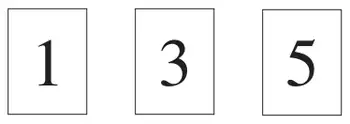
(a) Find the probability that the number on the card he takes is
(i) 5
(ii) an even number.
(2)
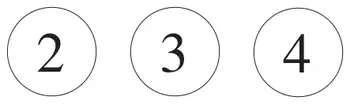
Three circular cards are numbered 2, 3 and 4
Shondra takes at random one of these circular cards.
(b) Find the probability that the number on the card she takes is an even number. (1)
Amrit has all six cards. She takes at random one rectangular card and one circular card. She adds together the numbers on the two cards to find the total for these two cards.
(c) Complete the table to show all possible totals. Three totals have been done for you.
Number on rectangular card
1
3
5
Number on circular card
2
3
3
8
4
5
(2)
(d) Work out the probability that the total is
(i) 8
(ii) 5 or 7
(2)
Mark scheme (a)
Scheme
Marks
(i)
Answer: \(\dfrac{1}{3}\)
B1
(ii) Answer: 0
B1
(2)
Notes
B1: Allow 0.33 (at least 2DP)
B1: Allow \(\dfrac{0}{3}\) but no other fractions
Accept probabilities as fractions, percentages or decimals. If any other form is seen, penalise ONCE only in this question, the first time it occurs.
Mark scheme (b)
Scheme
Marks
\(\dfrac{2}{3}\)
B1
(1)
Notes
B1: Allow 0.66… or 0.67
Accept probabilities as fractions, percentages or decimals. If any other form is seen, penalise ONCE only in this question, the first time it occurs.
Mark scheme (c)
Scheme
Marks
5, 7 4, 6 7, 9
B2
(2)
Notes
B2: Award B1 for any three correct.
Accept probabilities as fractions, percentages or decimals. If any other form is seen, penalise ONCE only in this question, the first time it occurs.
Mark scheme (d)
Scheme
Marks
(i)
Answer: \(\dfrac{1}{9}\)
B1
(ii)
Answer: \(\dfrac{4}{9}\)
B1
(2)
(Total 7 marks)
Notes
B1: Allow 0.11 (at least 2DP) ft from their complete table. Isw if correct answer seen, unless contradicted.
B1: Allow 0.44 (at least 2DP) ft from their complete table dependent on at least one more 5 or 7 present in table.
Accept probabilities as fractions, percentages or decimals. If any other form is seen, penalise ONCE only in this question, the first time it occurs.
M2: Freq x all correct midpoint values stated or evaluated with intention to add (condone any one error). If not M2 then award M1 for all products \(t \times f\) (and \(t\) is consistently within the interval, including end values) and intention to add (condone any one error)
M1: (dep on at least M1) for division by 52. Accept their 52 if addition shown.
A1: for answer rounding to 14.7 Accept 15 with working (15 without working gains M0A0)
Mark scheme (c)
Scheme
Marks
\(\dfrac{13 + 8 + 3}{52}\)
M1
\(\dfrac{24}{52}\)
Answer: \(\dfrac{6}{13}\) oe
A1
(2)
(7 marks)
Notes
M1: for 13 + 8 + 3 or 24 or \(\dfrac{a}{52}\) where \(a < 52\)
A1: Accept a decimal/percentage answer 0.461538…(46.15…%) truncated or rounded to 3 or more sig figs. Only accept 0.46 (46%) if preceded by a more accurate answer or M1 (above) awarded.
13 A box contains 20 nails. The table shows information about the length of each nail.
Length of nail (mm)
25
30
40
50
60
Number of nails
1
8
4
5
2
(a) Viraj takes at random one nail from the box. Find the probability that the length of the nail he takes is
(i) 50 mm or 60 mm,
(ii) less than 35 mm.
(4)
(b) Jamila puts all 20 nails into a bag. She takes at random one of the nails and records its length. She replaces the nail in the bag. She then takes at random a second nail from the bag and records its length. Calculate the probability that the two nails she takes
(i) each have a length of 60 mm,
(ii) have a total length of 80 mm.
(5)
Mark scheme (a)
Scheme
Marks
(i) 5 + 2 or 7 or \(\frac{5}{20} + \frac{2}{20}\)
M1
\(\frac{7}{20}\) oe
A1
(ii)
M1
\(\frac{9}{20}\) oe
A1
(4)
Notes
A1: accept answer written as an equivalent fraction or 0.35 or 35%
M1: for \(\dfrac{9}{a}\) with \(a \gt 9\) or \(\dfrac{b}{20}\) with \(b \lt 20\)
or 9 and 20 used with incorrect notation (eg. 9 : 20)
A1: accept answer written as an equivalent fraction or 0.45 or 45%
Mark scheme (b)
Scheme
Marks
(i) \(\frac{2}{20} \times \frac{2}{20}\) oe and no other terms
M1
\(\frac{4}{400}\) oe
A1
(ii) \(\frac{5}{20} \times \frac{8}{20}\) or \(\frac{8}{20} \times \frac{5}{20}\) or \(\frac{4}{20} \times \frac{4}{20}\)
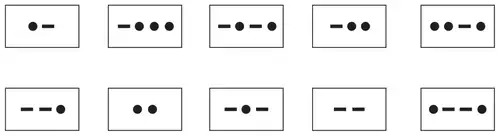
13 Morse Code uses dots (●) and dashes (▬) to represent each letter of the alphabet. Here are 10 cards. Each card has the Morse Code for a letter on it.
(a) Kelly has the 10 cards. She takes at random one of the cards. Find the probability that she takes a card with
(i) 4 dots,
(ii) exactly 1 dot,
(iii) 2 dots or 3 dots.
(5)
(b) Hashim has the 10 cards. He takes at random a card 200 times. He replaces the card each time. Work out an estimate for the number of times he will take a card with exactly 2 dots. (2)
Mark scheme (a)
Scheme
Marks
(i) Answer: 0
B1
(ii)
Answer: \(\dfrac{3}{10}\)
M1 A1
(iii) \(\dfrac{4}{10} + \dfrac{2}{10}\) or 4 + 2 or 6
M1
\(\dfrac{6}{10}\) or \(\dfrac{3}{5}\)
A1
(5)
Notes
B1: Also accept \(\dfrac{0}{1}\), \(\dfrac{0}{10}\)
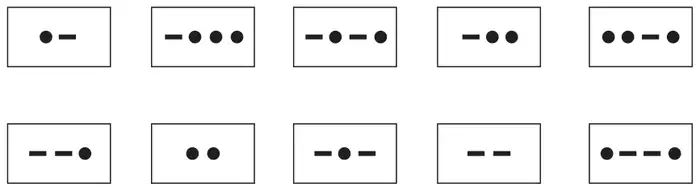
8 Morse Code uses dots (●) and dashes (▬) to represent each letter of the alphabet. Here are 10 cards. Each card has the Morse Code for a letter on it.
(a) Kelly takes at random one of the cards. Find the probability that she takes a card with 2 dots or a card with 3 dots. (2)
(b) Hashim has the 10 cards. He takes at random a card 200 times. He replaces the card each time. Work out an estimate for the number of times he will take a card with exactly 2 dots. (2)
(c) Shani takes at random two of the 10 cards without replacement. Calculate the probability that
(i) there is exactly 1 dot on each card she takes,
(ii) there is a total of 4 dots on the two cards she takes.
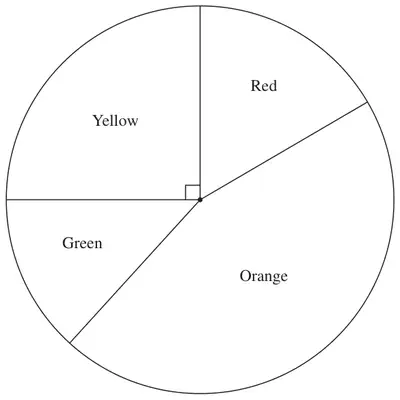
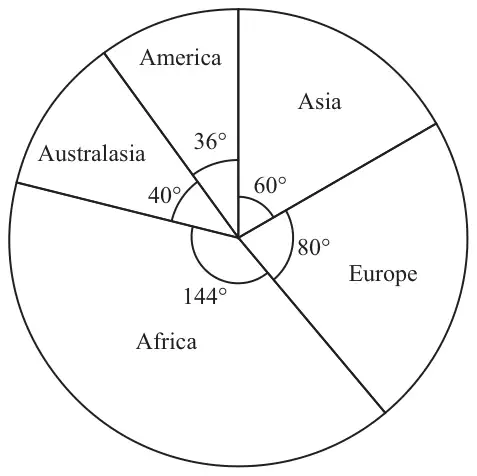
A jar contains 60 sweets. The sweets are red or orange or green or yellow. The number of sweets of each colour in the jar was used to draw the pie chart. The pie chart is accurately drawn.
(a) Which colour sweet is there most of in the jar? (1)
(b) Measure the size of the angle on the pie chart for green sweets. (1)
The angle on the pie chart for yellow sweets is \(90^\circ\)
(c) How many of the 60 sweets in the jar are yellow? (2)
10 of the 60 sweets in the jar are red. Billy takes at random a sweet from the jar.
(d) What is the probability that he takes a red sweet? (1)
Mark scheme (a)
Scheme
Marks
Orange
B1
(1)
Mark scheme (b)
Scheme
Marks
47
B1
(1)
Notes
B1: Allow 45 to 49 inclusive.
Mark scheme (c)
Scheme
Marks
\(\dfrac{90}{360} \times 60\) or \(\dfrac{1}{4} \times 60\) or \(60 \div 4\) or \(90 \div 6\)
M1
15
A1
(2)
Notes
M1: for \(\dfrac{90}{360}\) or \(\dfrac{1}{4}\)
Mark scheme (d)
Scheme
Marks
\(\dfrac{10}{60}\) oe \(\dfrac{1}{6}\)
B1
(1)
(Total 5 marks)
Notes
B1: Allow decimal values which round or truncate to 0.16 or 0.17
20 The number of runners in the London Marathon on 25th April, 2010 was 37 527.
Work out an estimate for the number of these runners whose birthday was on that day.
(4)
Mark scheme
Scheme
Marks
No approximation
\(\dfrac{37527}{365}\) or \(\dfrac{37527}{366}\) or \(\dfrac{37527}{365.25}\) or \(\dfrac{37527}{364}\)
M2
103
A2
(4)
Notes
M2: M1 for \(\dfrac{37527}{x}\) where \(356 \leqslant x \leqslant 370\)
A2: Accept 102 if M2 awarded A1 for \(102.5 \leqslant \text{answer} \leqslant 103.1\)
Alternative - with approximation
Scheme
Marks
\(\dfrac{x}{y}\) or \(x \times \dfrac{1}{y}\)
where \(x\) is \(35\,000 \leqslant x \leqslant 40\,000\)
AND
\(336 \leqslant y \leqslant 400\)
M2
integer in the range 93 − 111 inclusive
A2
Notes
M2: M1 for \(\dfrac{x}{y}\) or \(x \times \dfrac{1}{y}\) where either the value of \(x\) or the value of \(y\) is acceptable or \(\dfrac{y}{x}\) where the values of \(x\) and \(y\) are acceptable
A2:The award of any accuracy marks is dependent on the award of M2 A1 for non-integer in the range 93 − 111
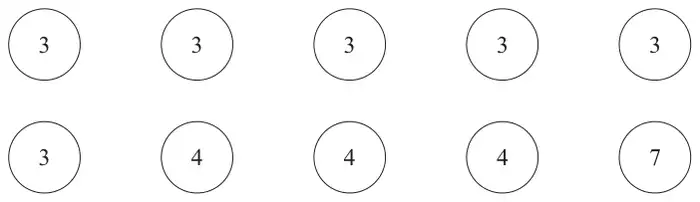
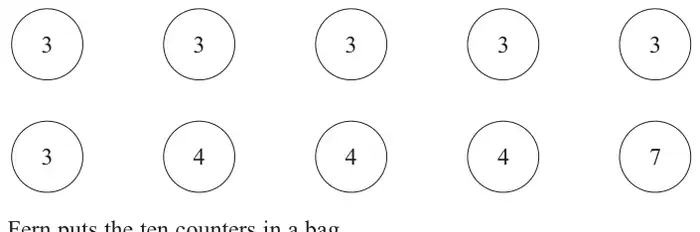
18 Here are ten counters. Each counter has a number on it.
Fern puts the ten counters in a bag. She takes at random a counter from the bag.
(a) Find the probability that the number on the counter is 3 or 4 (2)
Fern puts the counter back into the bag. Then Rajan takes at random one of the ten counters from the bag. He does not put the counter back into the bag. He then takes at random a second counter from the bag.
(b) Calculate the probability that 3 is the number on each of the two counters he takes. (2)
(c) Calculate the probability that the sum of the numbers on the two counters he takes is an odd number. (3)
Mark scheme (a)
Scheme
Marks
\(\dfrac{6}{10} + \dfrac{3}{10}\)
M1
\(\dfrac{9}{10}\) oe
A1
(2)
Mark scheme (b)
Scheme
Marks
\(\dfrac{6}{10} \times \dfrac{5}{9}\) oe and no other terms
M1
\(\dfrac{30}{90}\) oe inc \(\dfrac{1}{3}\)
A1
(2)
Notes
A1: Sample space method – award 2 marks for a correct answer; otherwise no marks
Mark scheme (c)
Scheme
Marks
\(\dfrac{6}{10} \times \dfrac{3}{9}\) oe or for \(\dfrac{3}{10} \times \dfrac{1}{9}\) oe or for \(\dfrac{7}{10} \times \dfrac{3}{9}\)
16 A box contains four different kinds of chocolates. Debbie takes at random a chocolate from the box. The table shows the probability of Debbie taking an Orange or a Coffee or a Caramel chocolate.
Chocolate
Probability
Orange
0.15
Coffee
0.40
Caramel
0.35
Strawberry
(a) Work out the probability that Debbie takes a Strawberry chocolate. (2)
(b) Work out the probability that Debbie takes an Orange chocolate or a Coffee chocolate. (2)
16 A box contains some coloured cards. Each card is red or blue or yellow or green. The table shows the probability of taking a red card or a blue card or a yellow card.
Card
Probability
Red
0.3
Blue
0.35
Yellow
0.15
Green
George takes at random a card from the box.
(a) Work out the probability that George takes a green card. (2)
George replaces his card in the box. Anish takes a card from the box and then replaces the card. Anish does this 40 times.
(b) Work out an estimate for the number of times Anish takes a yellow card. (2)
Mark scheme (a)
Scheme
Marks
\(1 - (0.3 + 0.35 + 0.15)\)
M1
0.2 oe
A1
(2)
Notes
M1: for a complete method
A1: for 0.2 oe as a fraction or percentage eg. 20%, \(\dfrac{1}{5}\) etc.
9 The number of runners in the London Marathon on 25th April, 2010 was 37 527. Work out an estimate for the number of these runners whose birthday was on that day.
(4)
Mark scheme
Scheme
Marks
No approximation
\(\dfrac{37527}{365}\) or \(\dfrac{37527}{366}\) or \(\dfrac{37527}{365.25}\) or \(\dfrac{37527}{364}\)
M2
103
A2
(4)
Notes
M2: M1 for \(\dfrac{37527}{x}\) where \(356 \leqslant x \leqslant 370\)
A2: Accept 102 if M2 awarded A1 for \(102.5 \leqslant \text{answer} \leqslant 103.1\)
Alternative – with approximation
Scheme
Marks
\(\dfrac{x}{y}\) or \(x \times \dfrac{1}{y}\) where \(x\) is \(35\,000 \leqslant x \leqslant 40\,000\) AND \(336 \leqslant y \leqslant 400\)
M2
integer in the range 93 − 111 inclusive
A2
Notes
M2: M1 for \(\dfrac{x}{y}\) or \(x \times \dfrac{1}{y}\) where either the value of \(x\) or the value of \(y\) is acceptable
The award of any accuracy marks is dependent on the award of M2
1 A box contains four different kinds of chocolates. Debbie takes at random a chocolate from the box. The table shows the probability of Debbie taking an Orange or a Coffee or a Caramel chocolate.
Chocolate
Probability
Orange
0.15
Coffee
0.40
Caramel
0.35
Strawberry
(a) Work out the probability that Debbie takes a Strawberry chocolate. (2)
(b) Work out the probability that Debbie takes an Orange chocolate or a Coffee chocolate. (2)
1 A box contains some coloured cards. Each card is red or blue or yellow or green. The table shows the probability of taking a red card or a blue card or a yellow card.
Card
Probability
Red
0.3
Blue
0.35
Yellow
0.15
Green
George takes at random a card from the box.
(a) Work out the probability that George takes a green card. (2)
George replaces his card in the box. Anish takes a card from the box and then replaces the card. Anish does this 40 times.
(b) Work out an estimate for the number of times Anish takes a yellow card. (2)
Mark scheme (a)
Scheme
Marks
1 − (0.3 + 0.35 + 0.15)
M1
0.2 oe
A1
(2)
Notes
M1: for a complete method
A1: for 0.2 oe as a fraction or percentage eg.20%, \(\dfrac{1}{5}\) etc.
When the spinner is spun, it can land on red, blue, black, white or green. The probability that it lands on red, blue, black or white is given in the table.
Colour
red
blue
black
white
green
Probability
0.18
0.20
0.23
0.22
George spins the spinner once.
(a) Work out the probability that the spinner lands on green. (2)
Heena spins the spinner 40 times.
(b) Work out an estimate for the number of times the spinner lands on blue. (2)
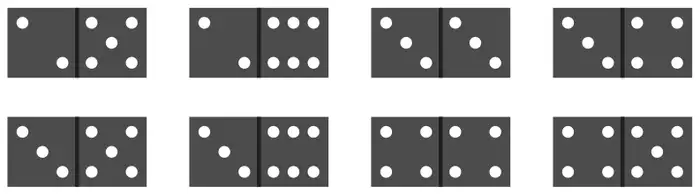
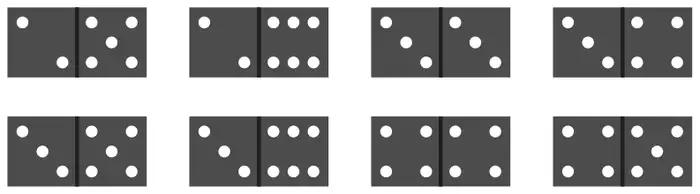
The 8 dominoes are put in a bag. Riaz takes at random a domino from the bag.
(a) Find the probability that he takes a domino with a total of 8 spots or a domino with a total of 9 spots. (2)
Helima takes at random 2 dominoes from the bag of 8 dominoes without replacement.
(b) Work out the probability that
(i) the total number of spots on the two dominoes is 18
(ii) the total number of spots on the two dominoes is 17
(5)
Mark scheme (a)
Scheme
Marks
\(\frac{3}{8} + \frac{2}{8}\) oe
M1
\(\frac{5}{8}\)
A1
(2)
Notes
Apart from Questions 3, 13(b) and 17(f) (where the mark scheme states otherwise), the correct answer, unless clearly obtained by an incorrect method, should be taken to imply a correct method.
Mark scheme (b)
Scheme
Marks
(i) \(\frac{2}{8} \times \frac{1}{7}\) appearing once only
M1
\(\frac{2}{56}\) or \(\frac{1}{28}\)
A1
(ii) \(\frac{2}{8} \times \frac{3}{7} + \frac{3}{8} \times \frac{2}{7}\) or \(2 \times \frac{2}{8} \times \frac{3}{7}\) oe
M1
M1
\(\frac{12}{56}\)
A1
(5)
(Total 7 marks)
Notes
A1: for \(\frac{2}{56}\) or \(\frac{1}{28}\) or for 0.036 or for answer rounding to 0.036
M1: for one correct product
M1: for completely correct expression
A1: for \(\frac{12}{56}\) oe inc \(\frac{3}{14}\) or for 0.21 or for answer rounding to 0.21
(b)(i): Sample space method – award 2 marks for correct answer; otherwise no marks
Note for (b)(ii): sample space method – award 3 marks for correct answer; otherwise no marks
SC M1 for \(\frac{2}{8} \times \frac{3}{8}\) or \(\frac{3}{8} \times \frac{2}{8}\) M1 (dep) for \(\frac{2}{8} \times \frac{3}{8} + \frac{3}{8} \times \frac{2}{8}\) oe
SC Sample space method – award 2 marks for \(\frac{12}{64}\) oe; otherwise no marks
4 Every morning, Samath has one glass of fruit juice with his breakfast. He chooses at random orange juice or pineapple juice or mango juice. The probability that he chooses orange juice is 0.6 The probability that he chooses pineapple juice is 0.3
(a) Work out the probability that he chooses mango juice. (2)
(b) There are 30 days in April. Work out an estimate for the number of days in April on which Samath chooses orange juice. (2)
2 John throws a biased coin 120 times. It shows heads 90 times.
(a) John throws the coin once more. Work out an estimate for the probability that the coin shows tails. (2)
Carly throws the same coin 200 times.
(b) Work out an estimate for the number of times the coin shows tails. (2)
Mark scheme (a)
Scheme
Marks
120 − 90 (=30)
M1
30/120 oe
A1
(2)
Notes
M1: or 1 − 90/120
Apart from questions 5b, 8, 15d, 20b, 21b, 23, 24b (where the mark scheme states otherwise) the correct answer, unless clearly obtained by an incorrect method, should be taken to imply correct working.
4 A bag contains some shapes. Each shape is a circle or a triangle or a square. Lewis takes at random a shape from the bag. The probability that he will take a circle is 0.3 The probability that he will take a triangle is 0.1
(a) Work out the probability that he will take a square. (2)
(b) Work out the probability that he will take a shape with straight sides. (2)
Grace takes at random one of the shapes from the bag and then replaces the shape. She does this 160 times.
(c) Work out an estimate for the number of times she will take a circle. (2)
Mark scheme (a)
Scheme
Marks
1 − (0.3 + 0.1)
M1
0.6
A1
(2)
Notes
A1: cao
Mark scheme (b)
Scheme
Marks
0.1 + “0.6” or 1 − 0.3
M1
0.7
A1
(2)
Notes
M1: do not award if ans to (a) > 1
A1: ft from (a) if ans to (b) < 1
Mark scheme (c)
Scheme
Marks
0.3 × 160
M1
48
A1
(2)
(6 marks)
Notes
M1: for 0.3 × 160 or 0.3 × 200 or \(\frac{48}{60}\)
3 A spinner can land on red or blue or yellow. The spinner is biased. The probability that it will land on red is 0.5 The probability that it will land on blue is 0.2
(a) Imad spins the spinner once. Work out the probability that it will land on yellow. (2)
(b) Janet spins the spinner 30 times. Work out an estimate for the number of times the spinner will land on blue. (2)
16 A bag contains some beads. The colour of each bead is red or green or blue. Binita is going to take a bead at random from the bag. The probability that she will take a red bead is 0.4 The probability that she will take a green bead is 0.5
(a) Work out the probability that she will take a blue bead. (2)
(b) There are 80 beads in the bag. Work out the number of red beads in the bag. (2)
4 A bag contains some beads. The colour of each bead is red or green or blue. Binita is going to take a bead at random from the bag. The probability that she will take a red bead is 0.4 The probability that she will take a green bead is 0.5
(a) Work out the probability that she will take a blue bead. (2)
(b) There are 80 beads in the bag. Work out the number of red beads in the bag. (2)
17 A bag contains 10 coloured beads. Ella is going to take at random a bead from the bag. She says, “The probability that I will take a red bead is 0.35”
Explain why Ella is wrong. You must show working to justify your answer.
(2)
Mark scheme
Scheme
Marks
Examples of complete, correct explanations
(i) 10 × 0.35 or 3.5 seen (may be in \(\dfrac{3.5}{10}\)) AND can’t have half beads or there must be a whole number of (red) beads
(ii) \(3\tfrac{1}{2}\) red beads is impossible
(iii) \(\dfrac{7}{20}\) AND there are (only) 10 beads or you need 20 beads
(iv) The probability of any bead/a red bead must be tenths or must have 1 decimal place or must have 1 significant figure
(v) Gives at least two examples that the probability of taking a red bead is \(\dfrac{n}{10}\) where \(2 \leqslant n \leqslant 9\) e.g. states 0.3 and 0.4
B2
(2)
(Total 2 marks)
Notes
B2: for a complete, correct explanation
B1 for a partially correct explanation
Examples of partially correct explanations
(i) \(\dfrac{1}{10}\) or 0.1 seen
(ii) Gives one example that the probability of taking a red bead is \(\dfrac{n}{10}\) where \(2 \leqslant n \leqslant 9\)
(iii) There would be 3.5 red beads.
(iv) 10 × 0.35 = 3.5
(v) \(0.35 = \dfrac{7}{20}\)
Treat statements like ‘Don’t know the number of red beads’ as irrelevant.
4 A bag contains 10 coloured beads. Ella is going to take at random a bead from the bag. She says, “The probability that I will take a red bead is 0.35”
Explain why Ella is wrong. You must show working to justify your answer.
(2)
Mark scheme
Scheme
Marks
Examples of complete, correct explanations (i) \(10 \times 0.35\) or 3.5 seen (may be in \(\frac{3.5}{10}\)) AND can’t have half beads or there must be a whole number of (red) beads (ii) \(3\frac{1}{2}\) red beads is impossible (iii) \(\frac{7}{20}\) AND there are (only) 10 beads or you need 20 beads (iv) The probability of any bead/a red bead must be tenths or must have 1 decimal place (v) Gives at least two examples that the probability of taking a red bead is \(\frac{n}{10}\) where \(2 \leqslant n \leqslant 9\) e.g. states 0.3 and 0.4
B2
(2)
(2 marks)
Notes
B2: for a complete, correct explanation B1 for a partially correct explanation Examples of partially correct explanations (i) \(\frac{1}{10}\) or 0.1 seen (ii) Gives one example that the probability of taking a red bead is \(\frac{n}{10}\) where \(2 \leqslant n \leqslant 9\) (iii) There would be 3.5 red beads. (iv) You can’t have half beads (v) \(10 \times 0.35 = 3.5\) (vi) \(0.35 = \frac{7}{20}\) Treat statements like ‘Don’t know the number of red beads’ as irrelevant.
18 When Peter goes to work, he can be early or on time or late. The probability that he will be early is 0.2 The probability that he will be late is 0.1
(a) Work out the probability that he will be on time. (2)
(b) Peter will go to work 20 times next month. Work out an estimate for the number of times he will be early next month. (2)
9 There are 10 counters in a bag. 1 of the counters is red. The rest of the counters are either white or blue. Ajit takes at random a counter from the bag.
(a) Write down the probability that he will take
(i) a red counter,
(ii) a black counter.
(2)
When Ajit takes one of the 10 counters, the probability that he will take a white counter is \(\dfrac{2}{5}\)
(b) Find the probability that he will not take a white counter. (1)
(c) Work out the number of white counters in the bag. (2)
Mark scheme (a)
Scheme
Marks
(i) \(\dfrac{1}{10}\)
B1
(ii) 0
B1
(2)
Notes
B1: Accept 0.1 or 10%
B1: Accept \(\dfrac{0}{10}\)
Mark scheme (b)
Scheme
Marks
\(\dfrac{3}{5}\) or \(\dfrac{6}{10}\)
B1
(1)
Notes
B1: Accept 0.6 or 60%
Mark scheme (c)
Scheme
Marks
eg \(\dfrac{2}{5}\times 10\), \(\dfrac{4}{10}\) seen
5 When Peter goes to work, he can be early or on time or late. The probability that he will be early is 0.2 The probability that he will be late is 0.1
(a) Work out the probability that he will be on time. (2)
(b) Peter will go to work 20 times next month. Work out an estimate for the number of times he will be early next month. (2)
14 A bag contains red discs, black discs and white discs. The number of black discs is equal to the number of white discs. Selina is going to take a disc at random from the bag. The probability that she will take a red disc is 0.6
Work out the probability that she will take a black disc.
6 A dice has six faces. Each face has a different number printed on it. The numbers on the faces are 1, 2, 3, 4, 5 and 6 When the dice is thrown, the number facing upwards is the score. All scores are equally likely.
Sushilla throws the dice once.
On the probability scale, mark with a cross (X) the probability that
(i) the score is even. Label this cross A.
(ii) the score is less than 7 Label this cross B.
(iii) the score is 5 Label this cross C.
Mark scheme
Scheme
Marks
(i) A mkd at 0.5 (± 2mm)
B1
(ii) B mkd at 1 (± 2mm)
B1
(iii) C mkd, 0.1 to 0.4
B1
(Total 3 marks)
Notes
If no cross, mark the point on the line level with the centre of the letter. If no letters shown, no marks.
3 The table shows information about the shoe sizes of 20 people.
Shoe size
Number of people
5
3
6
8
7
5
8
2
9
2
(a) Find the median shoe size. (2)
(b) Exactly 1 of these 20 people has a collar size of 15. Jean says “If you choose one of these 20 people at random, the probability that this person will have either a shoe size of 8 or a collar size of 15 is\[\frac{2}{20} + \frac{1}{20} = \frac{3}{20}\]Is Jean correct? Explain your answer. (2)
2 A bag contains red discs, black discs and white discs. The number of black discs is equal to the number of white discs. Selina is going to take a disc at random from the bag. The probability that she will take a red disc is 0.6
Work out the probability that she will take a black disc.
(2)
Mark scheme
Scheme
Marks
\(\dfrac{1 - 0.6}{2}\)
M1
0.2 oe
A1
(2)
(2 marks)
Notes
M1: for 1 − 0.6 or 0.4 seen or \(\frac{x}{2}\) where \(0 \lt x \lt 1\)
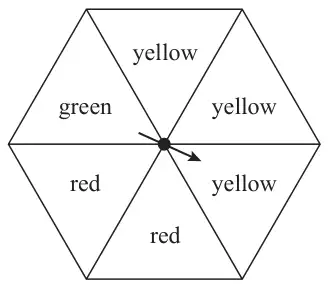
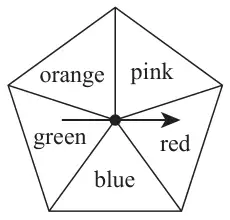
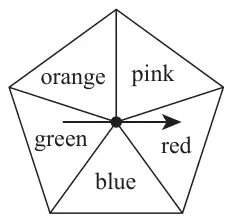
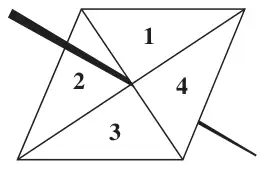
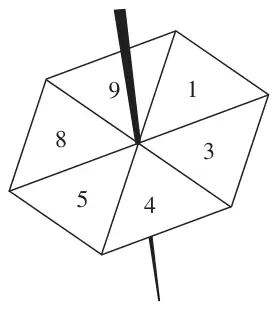
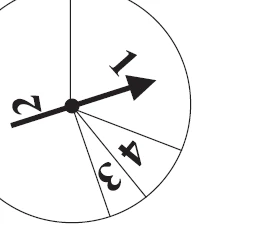
(a) Nathan spins the spinner once. Write down the probability that the spinner will land on a 4 (1)
(b) Daisy spins the spinner twice. One possible outcome is (1, 2). This means that the spinner lands on a 1 on the first spin and a 2 on the second spin. List all the possible outcomes. (2)
(c) The spinner is fair. Daisy spins the spinner twice. What is the probability that the two numbers it lands on are both odd? (2)
7 There are four grades of egg. The table shows how many eggs of each grade were laid by a hen last year.
Grade
Number of eggs
Extra large
55
Large
48
Medium
35
Small
12
(a) In the first four months of this year, the hen laid 60 eggs. Work out an estimate for the number of Extra large eggs the hen laid in these four months. (3)
(b) The table below shows how the grade of an egg is related to its weight.
Grade
Weight (\(w\) grams)
Extra large
\(w \geqslant 73\)
Large
\(63 \leqslant w \lt 73\)
Medium
\(53 \leqslant w \lt 63\)
Small
\(w \lt 53\)
Work out an estimate for the total weight of 48 Large eggs and 35 Medium eggs. (3)
(c) Jody wants to use the information in the table to work out an estimate for the total weight of all the eggs laid by the hen last year. Explain why it is difficult to do this. (1)
Mark scheme (a)
Scheme
Marks
\(\dfrac{55}{150} \times 60\)
B1
M1
22
A1
(3)
Notes
B1: for \(\frac{55}{150}\) oe or \(\frac{60}{150}\) oe seen
M1: for \(\frac{55}{150} \times 60\)
A1: cao
Mark scheme (b)
Scheme
Marks
68 × 48 + 58 × 35 = 3264 + 2030
M1
M1
5294
A1
(3)
Notes
M1: 2 products m × f where m is within each interval and consistent (inc end points)
M1: (dep) for use of halfway values
A1: Accept 5300 or 5290 if M1 + M1 scored
Mark scheme (c)
Scheme
Marks
eg no upper limit for extra large, no lower limit for small, don’t know midpoints for XL, S
Four of the shapes are squares and one of the shapes is a circle. One square is black. Three squares are white. The circle is black. The five shapes are put in a bag.
(a) Jasmine takes a shape at random from the bag 150 times. She replaces the shape each time. Work out an estimate for the number of times she will take a white square. (3)
(b) Alec takes a shape at random from the bag and does not replace it. Bashir then takes a shape at random from the bag. Work out the probability that
(i) they both take a square,
(ii) they take shapes of the same colour. (5)
Mark scheme (a)
Scheme
Marks
\(150 \times \frac{3}{5}\)
B1
M1
90
A1
(3)
Notes
B1: for \(\frac{3}{5}\) seen
M1: for \(150 \times \frac{3}{5}\)
A1: cao Do not accept \(\dfrac{90}{150}\)
Accept decimals in parts (a) and (b)
Mark scheme (b)
Scheme
Marks
(i) \(\frac{4}{5} \times \frac{3}{4}\)
M1
\(\frac{12}{20}\) or \(\frac{3}{5}\) oe
A1
(ii) \(\frac{2}{5} \times \frac{1}{4} + \frac{3}{5} \times \frac{2}{4}\)
M1
M1
\(\frac{8}{20}\) or \(\frac{2}{5}\) oe
A1
(5)
(8 marks)
Notes
M1: for \(\frac{4}{5} \times \frac{3}{4}\) seen
M1: for \(\frac{2}{5} \times \frac{1}{4}\) or \(\frac{3}{5} \times \frac{2}{4}\) SC M1 for \(\frac{2}{5} \times \frac{2}{5}\) or \(\frac{3}{5} \times \frac{3}{5}\)
M1: (dep) for adding both above products SC M1 (dep) for adding both above products
20 There are 48 beads in a bag. Some of the beads are red and the rest of the beads are blue. Shan is going to take a bead at random from the bag. The probability that she will take a red bead is \(\dfrac{3}{8}\)
(a) Work out the number of red beads in the bag. (2)
Shan adds some red beads to the 48 beads in the bag. The probability that she will take a red bead is now \(\dfrac{1}{2}\)
(b) Work out the number of red beads she adds. (2)
Mark scheme (a)
Scheme
Marks
\(48 \times \frac{3}{8}\)
M1
18
A1
(2)
Notes
A1: cao ans \(\frac{18}{48}\): M1A0
Mark scheme taken from the matching question on the Higher paper.
Mark scheme (b)
Scheme
Marks
eg 48 − 18 − 18, \(x + 48 = 2(x + 18)\)
M1
12
A1ft
(2)
(Total 4 marks)
Notes
A1ft: ft from “18”
Mark scheme taken from the matching question on the Higher paper.
9 There are 48 beads in a bag. Some of the beads are red and the rest of the beads are blue. Shan is going to take a bead at random from the bag. The probability that she will take a red bead is \(\dfrac{3}{8}\)
(a) Work out the number of red beads in the bag. (2)
Shan adds some red beads to the 48 beads in the bag. The probability that she will take a red bead is now \(\dfrac{1}{2}\)
(b) Work out the number of red beads she adds. (2)
2 A dice has six faces. Each face has a different number printed on it. The numbers on the faces are 1, 2, 3, 4, 5 and 6 When the dice is thrown, the number facing upwards is the score. All scores are equally likely.
Jim has two of these dice.
He throws each dice once. He finds the total of the scores on the two dice.
Certain Likely Unlikely Impossible
Write down the word from the box that best describes the probability that this total is
(i) 2
(ii) less than 13
(2)
Mark scheme
Scheme
Marks
(i) Unlikely
B1
(ii) Certain
B1
(2)
(Total 2 marks)
No official mark scheme was available for this paper; this one was written by Westie's Workshop.
2 A dice has six faces. Each face has a different number printed on it. The numbers on the faces are 1, 2, 3, 4, 5 and 6 When the dice is thrown, the number facing upwards is the score. All scores are equally likely.
Mohindar throws the dice once.
Write down the word from the box that best describes each outcome.
Certain Likely Unlikely Impossible
(i) The score is more than 1 (1)
(ii) The score is 6 (1)
(iii) The score is 7 (1)
Mark scheme
Scheme
Marks
(i) Likely
B1
(ii) Unlikely
B1
(iii) Impossible
B1
(3)
(Total 3 marks)
No official mark scheme was available for this paper; this one was written by Westie's Workshop.
6 A bag contains blue beads, red beads and green beads. Mel is going to take a bead at random from the bag. The probability that she will take a blue bead is shown on the probability scale.
The number of red beads is double the number of blue beads.
(a) On the probability scale, mark with a cross (×) the probability that Mel will take a red bead. Label it R. (1)
(b) On the probability scale, mark with a cross (×) the probability that Mel will take a green bead. Label it G. (1)
(c) On the probability scale, mark with a cross (×) the probability that Mel will take a yellow bead. Label it Y. (1)
(d) Explain why the total number of beads in the bag cannot be 15 (2)
Mark scheme (a)
Scheme
Marks
R at 0.6
B1
(1)
Notes
B1: cao
No official mark scheme was available for this paper; this one was written by Westie's Workshop.
Mark scheme (b)
Scheme
Marks
G at 0.1
B1
(1)
Notes
B1: ft 1 − 0.3 − their R
No official mark scheme was available for this paper; this one was written by Westie's Workshop.
Mark scheme (c)
Scheme
Marks
Y at 0
B1
(1)
Notes
B1: cao
No official mark scheme was available for this paper; this one was written by Westie's Workshop.
Mark scheme (d)
Scheme
Marks
\(0.3 \times 15\) or 4.5 (blue beads) or \(0.6 \times 15 = 9\) and \(0.1 \times 15 = 1.5\)
M1
The number of blue beads (or green beads) would not be a whole number
A1
(2)
(5 marks)
Notes
A1: oe eg “you can’t have 4.5 beads”
No official mark scheme was available for this paper; this one was written by Westie's Workshop.
The sides of the spinner are labelled 1, 2, 3 and 4. The spinner is biased. The probability that the spinner will land on each of the numbers 1, 2 and 3 is given in the table.
Number
1
2
3
4
Probability
0.2
0.1
0.4
(a) Work out the probability that the spinner will land on 4 (2)
Tom spun the spinner a number of times. The number of times it landed on 1 was 85
(b) Work out an estimate for the number of times the spinner landed on 3 (1)
19 The diagram shows a pointer which spins about the centre of a fixed disc.
When the pointer is spun, it stops on one of the numbers 1, 2, 3 or 4. The probability that it will stop on one of the numbers 1 to 3 is given in the table.
Number
1
2
3
4
Probability
0.35
0.16
0.27
Magda is going to spin the pointer once.
(a) Work out the probability that the pointer will stop on 4. (2)
(b) Work out the probability that the pointer will stop on 1 or 3. (2)
Omar is going to spin the pointer 75 times.
(c) Work out an estimate for the number of times the pointer will stop on 2. (2)
Mark scheme (a)
Scheme
Marks
1 − (0.35 + 0.16 + 0.27)
M1
0.22
A1
(2)
Notes
A1: oe
Mark scheme taken from the matching question on the Higher paper.
Mark scheme (b)
Scheme
Marks
0.35 + 0.27
M1
0.62
A1
(2)
Notes
A1: oe
Mark scheme taken from the matching question on the Higher paper.
Mark scheme (c)
Scheme
Marks
\(0.16 \times 75\)
M1
12
A1
(2)
(6 marks)
Notes
A1: cao
Mark scheme taken from the matching question on the Higher paper.
11 There are 15 counters in a bag. 8 of the counters are red. 4 of the counters are blue. The rest of the counters are green. Lee chooses a counter at random from the bag.
(a) Write down the probability that he will choose a red counter. (2)
Lee removes a blue counter from the bag of 15 counters and does not replace it. He then chooses a counter at random from the bag.
(b) Work out the probability that he will choose a blue counter. (2)
Mark scheme (a)
Scheme
Marks
\(\frac{8}{15}\)
B2
(2)
Notes
B2: oe B1 for \(\frac{8}{k}\) where \(k \gt 8\) or \(\frac{k}{15}\) where \(k \lt 15\) SC B1 for 8 out of 15 or 8 : 15
No official mark scheme was available for this paper; this one was written by Westie's Workshop.
Mark scheme (b)
Scheme
Marks
14 (counters left) or 3 (blue counters left) seen
M1
\(\frac{3}{14}\)
A1
(2)
(4 marks)
Notes
A1: oe
No official mark scheme was available for this paper; this one was written by Westie's Workshop.
4 The diagram shows a pointer which spins about the centre of a fixed disc.
When the pointer is spun, it stops on one of the numbers 1, 2, 3 or 4. The probability that it will stop on one of the numbers 1 to 3 is given in the table.
Number
1
2
3
4
Probability
0.35
0.16
0.27
Magda is going to spin the pointer once.
(a) Work out the probability that the pointer will stop on 4. (2)
(b) Work out the probability that the pointer will stop on 1 or 3. (2)
Omar is going to spin the pointer 75 times.
(c) Work out an estimate for the number of times the pointer will stop on 2. (2)
We'd like to use Google Analytics cookies to count visits and see which pages help most. They're optional, and the site works exactly the same either way. Privacy policy