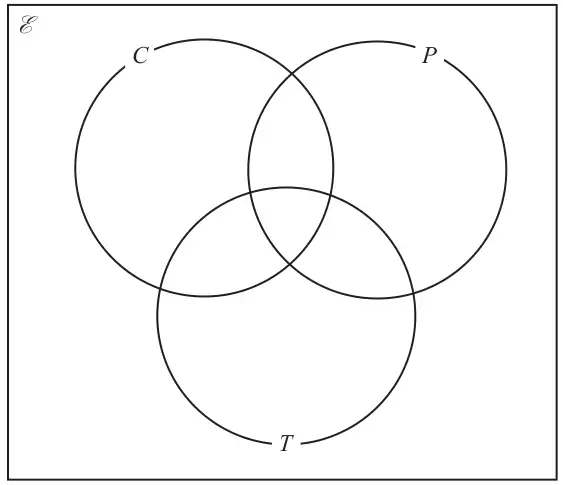
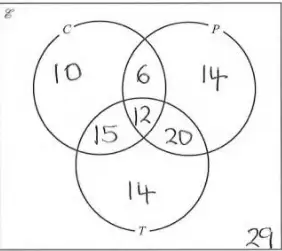
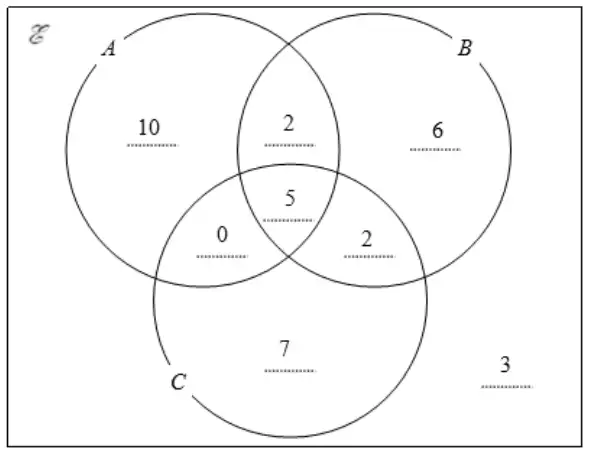
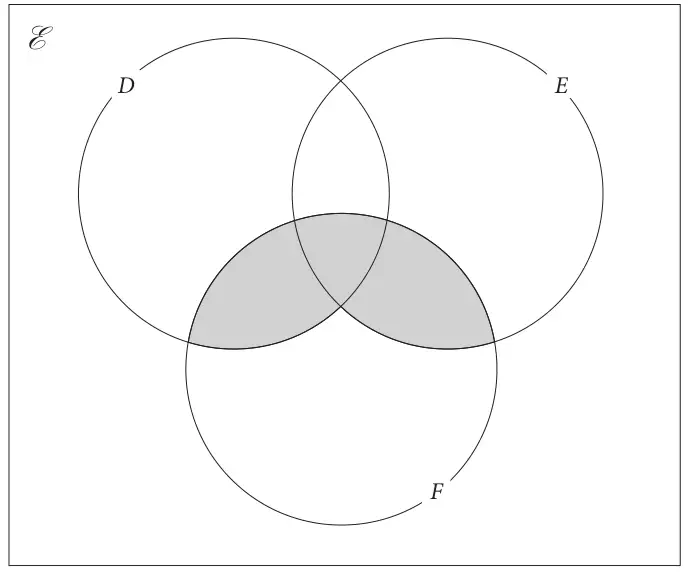
20 120 gardeners were asked if they grow carrots (\(C\)) or potatoes (\(P\)) or tomatoes (\(T\))
Of these gardeners
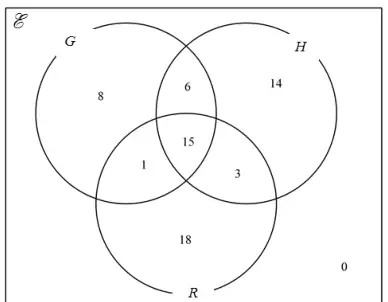
43 grow carrots 12 grow carrots and potatoes and tomatoes 18 grow carrots and potatoes 27 grow carrots and tomatoes 32 grow potatoes and tomatoes 29 do not grow carrots or potatoes or tomatoes
The number of these gardeners who grow only potatoes is equal to the number of these gardeners who grow only tomatoes.
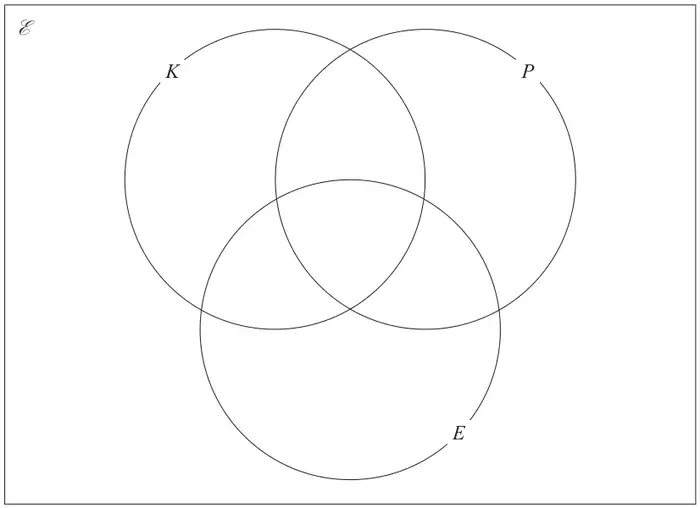
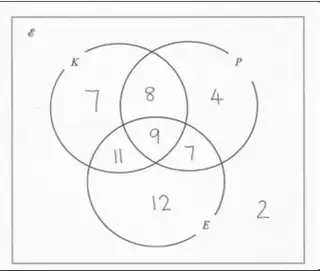
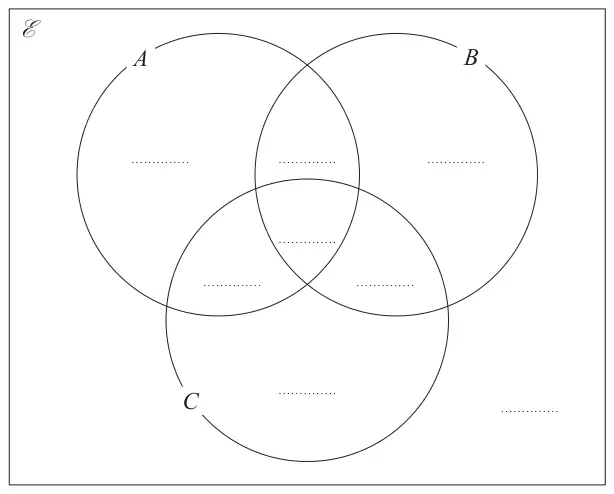
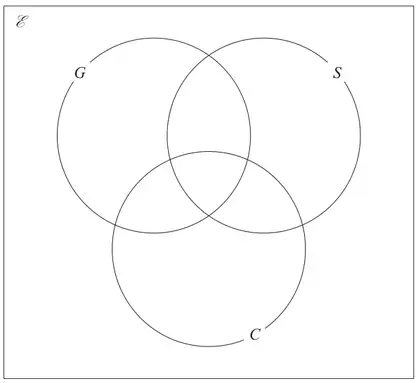
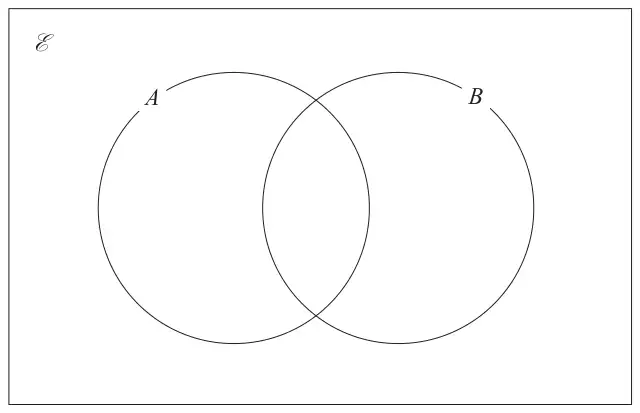
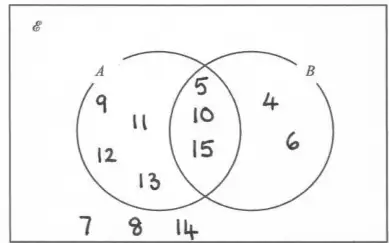
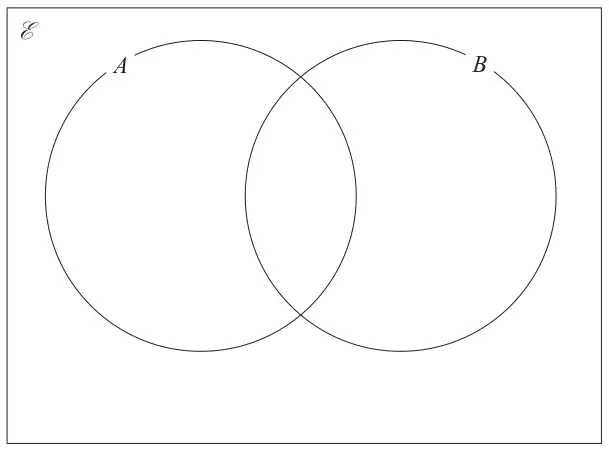
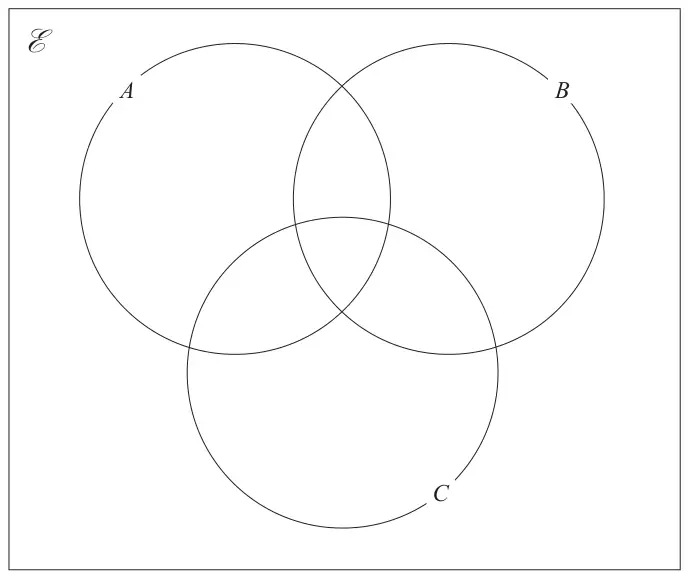
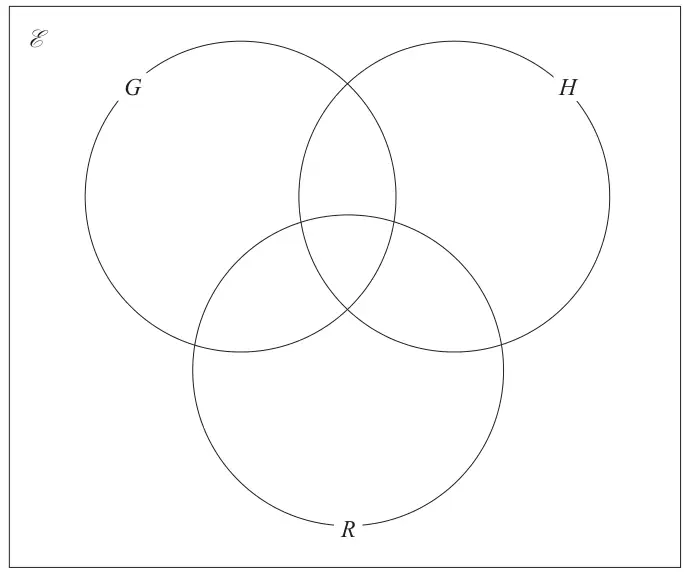
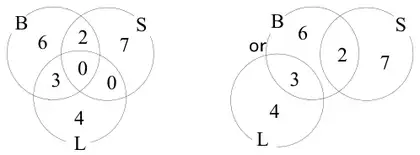
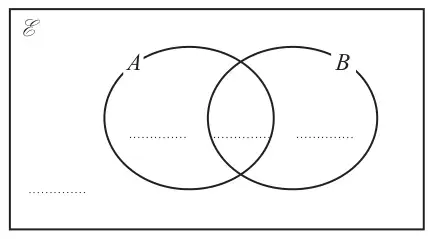
(a) Complete the Venn diagram to show this information. (3)
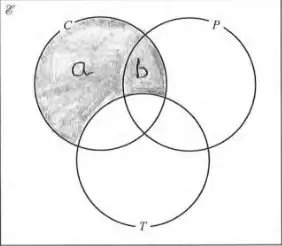
(b) Find \(\mathrm{n}(T' \cap C)\) (1)
One of the gardeners who grows carrots is chosen at random.
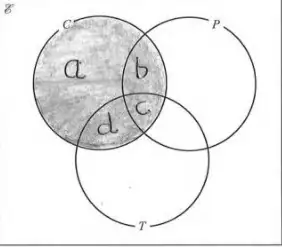
(c) Calculate the probability that this gardener also grows potatoes. (2)
Mark scheme (a)
Scheme
Marks
B3
(3)
Notes
B3: for all numbers in correct regions (B2 for 5, 6 or 7 correct numbers B1 for 3 or 4 correct numbers)
Mark scheme (b)
Scheme
Marks
Answer: 16
B1
(1)
Notes
B1: ft for their \(a\) + their \(b\)
Do not ft if there are no values for \(a\) and \(b\)
Mark scheme (c)
Scheme
Marks
M1
\(\dfrac{18}{43}\)
A1
(2)
(6 marks)
Notes
M1: for \(\dfrac{n}{43}\) where \(n \lt 43\) or \(\dfrac{18}{m}\) where \(m \gt 18\) or
ft their \(\dfrac{b + c}{p}\) where \(p \gt b + c\) or
ft their \(\dfrac{q}{a + b + c + d}\) where \(q \lt a + b + c + d\)
Do not ft if there are no values for \(a\), \(b\), \(c\) and \(d\)
A1: oe eg 0.41(860…) or 41(.860…)% truncated or rounded or ft their \(\dfrac{b + c}{a + b + c + d}\) as a fraction or a decimal or a percentage
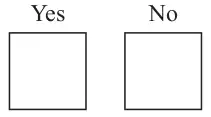
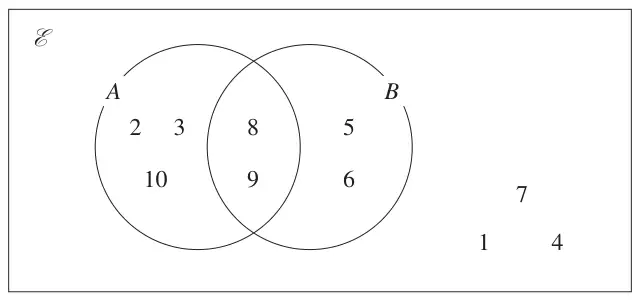
(b) Is it true that \(\;B \cap C = \varnothing\;\)?
Tick (✓) one of the boxes below.Give a reason for your answer. (1)
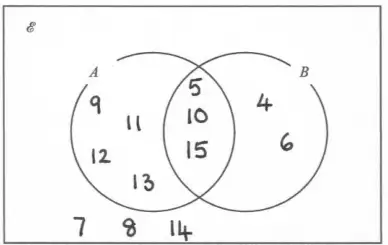
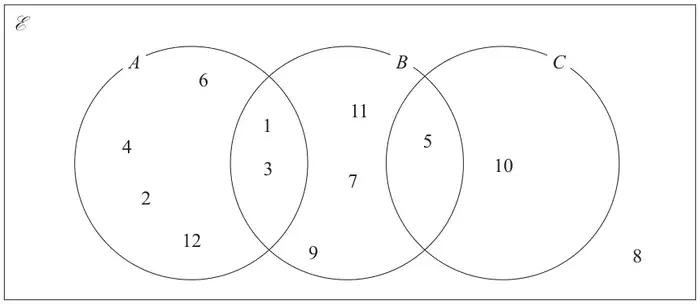
The set \(D\) has 4 members and is such that \(\;D \cap (A \cup C) = \varnothing\)
(c) List the members of set \(D\) (2)
Mark scheme (a)
Scheme
Marks
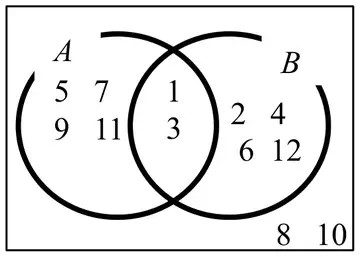
(i) Answer: 23, 24, 27, 29, 30, 31, 33
B1
(ii) Answer: 27, 33
B1
(2)
Notes
B1: in any order with no repeats
B1: in any order with no repeats
Mark scheme (b)
Scheme
Marks
eg 1. Yes, no members/numbers/values in common 2. Yes, nothing in common 3. Yes, no common members/numbers/values 4. Yes, they share no common members/numbers/values 5. Yes, there is not the same members/numbers/values in both sets 6. Yes, there is no intersection or there is nothing in B and C 7. Yes, as there are no members/numbers/values the same (in B and C) 8. Yes, no members/numbers/values in B are in C or vice versa 9. Yes, there are no members/numbers in B that are multiples of 3 10. Yes, there are no members/numbers/values in that empty set 11. Yes, 23, 29, 31 not in C 12. Yes, 24, 27, 30, 33 are not in B Allow sector for set This is not an exhaustive list Allow element(s) for members/numbers/values Answer: Yes, there are no multiples of 3 in set \(B\)
B1
(1)
Notes
B1: for Yes and a statement which indicates correct meanings of intersection and empty set.
If no box is ticked, then the ‘Yes’ must be stated in the answer
Mark scheme (c)
Scheme
Marks
23, 25, 29, 31
B2
(2)
(5 marks)
Notes
B2: for the four correct numbers and no additions (B1 for three correct values with no more than one incorrect or for four correct values with no more than one incorrect)
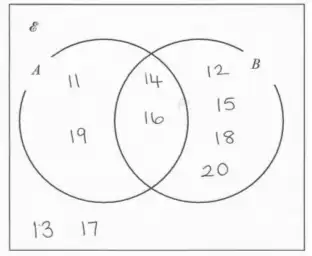
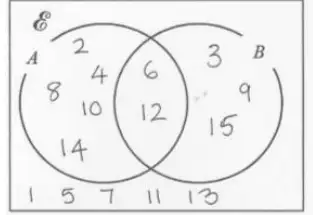
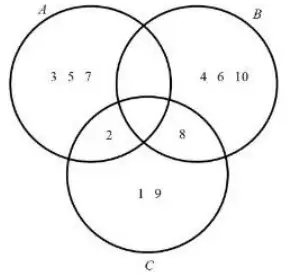
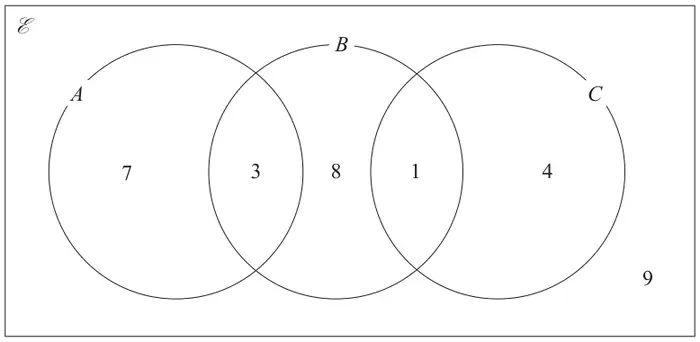
the set \(A \cap C\) has 2 members the set \(B \cap C\) has 2 members
Set \(A \cap C\) and set \(B \cap C\) have no members in common.
(c) List the 4 members of set \(C\) (2)
Mark scheme (a)
Scheme
Marks
(i) Answer: 1, 2, 3, 5, 6, 7
B1
(ii) Answer: 4, 5, 7, 8, 9, 10
B1
(2)
Notes
B1: in any order with no repeats
B1: in any order with no repeats
Mark scheme (b)
Scheme
Marks
eg 1. 2 (or 3 or 2 and 3) is in both sets oe 2. A and B have 2 (or 3 or 2 and 3) oe 3. … is common oe 4. … is in the intersection oe 5. \(A\cap B = \{2,3\}\) oe or \(A\cap B = \{2\}\) oe or \(A\cap B = \{3\}\) oe 6. They share 2 (or 3 or 2 and 3)oe 7. As 2 and/or 3 are factors of 6 and also prime numbers oe
Allow sector for set This is not an exhaustive list Answer: 2 (or 3 or 2 and 3) is a member of A and B
B1
(1)
Notes
B1: for identifying the element 2 or 3 or 2 and 3 with a correct explanation to show they know the meaning of intersection and empty set If students mention a number that is common, it must be correct
Mark scheme (c)
Scheme
Marks
1, 5, 6, 7
B2
(2)
(5 marks)
Notes
B2: for 1, 5, 6, 7 (B1 for three correct values with no more than one incorrect or for four correct values with no more than one incorrect)
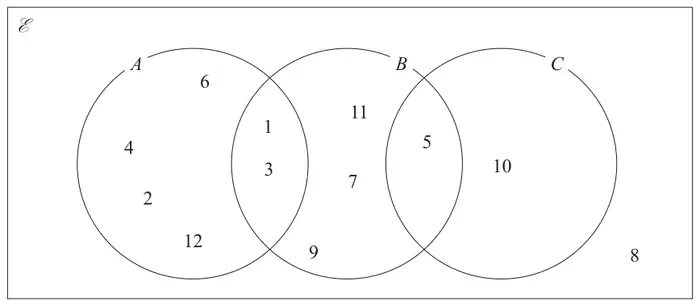
(b) Is it true that \(\;B \cap C = \varnothing\;\)?
Tick (✓) one of the boxes below.Give a reason for your answer. (1)
The set \(D\) has 4 members and is such that \(\;D \cap (A \cup C) = \varnothing\)
(c) List the members of set \(D\) (2)
Mark scheme (a)
Scheme
Marks
(a)(i) Answer: 23, 24, 27, 29, 30, 31, 33
B1
(a)(ii) Answer: 27, 33
B1
(2)
Notes
B1: in any order with no repeats
B1: in any order with no repeats
Mark scheme (b)
Scheme
Marks
eg 1. Yes, no members/numbers/values in common 2. Yes, nothing in common 3. Yes, no common members/numbers/values 4. Yes, they share no common members/numbers/values 5. Yes, there is not the same members/numbers/values in both sets 6. Yes, there is no intersection or there is nothing in B and C 7. Yes, as there are no members/numbers/values the same (in B and C) 8. Yes, no members/numbers/values in B are in C or vice versa 9. Yes, there are no members/numbers in B that are multiples of 3 10. Yes, there are no members/numbers/values in that empty set 11. Yes, 23, 29, 31 not in C 12. Yes, 24, 27, 30, 33 are not in B Allow sector for set This is not an exhaustive list Allow element(s) for members/numbers/values Answer: Yes, there are no multiples of 3 in set \(B\)
B1
(1)
Notes
B1: for Yes and a statement which indicates correct meanings of intersection and empty set.
If no box is ticked, then the ‘Yes’ must be stated in the answer
Mark scheme (c)
Scheme
Marks
23, 25, 29, 31
B2
(2)
(5 marks)
Notes
B2: for the four correct numbers and no additions (B1 for three correct values with no more than one incorrect or for four correct values with no more than one incorrect)
the set \(A \cap C\) has 2 members the set \(B \cap C\) has 2 members
Set \(A \cap C\) and set \(B \cap C\) have no members in common.
(c) List the 4 members of set \(C\) (2)
Mark scheme (a)
Scheme
Marks
(i) Answer: 1, 2, 3, 5, 6, 7
B1
(ii) Answer: 4, 5, 7, 8, 9, 10
B1
(2)
Notes
B1: in any order with no repeats
B1: in any order with no repeats
Mark scheme (b)
Scheme
Marks
eg 1. 2 (or 3 or 2 and 3) is in both sets oe 2. \(A\) and \(B\) have 2 (or 3 or 2 and 3) oe 3. 2 (or 3 or 2 and 3) is common oe 4. 2 (or 3 or 2 and 3) is in the intersection oe 5. \(A \cap B = \{2, 3\}\) oe or \(A \cap B = \{2\}\) oe or \(A \cap B = \{3\}\) oe 6. They share 2 (or 3 or 2 and 3) oe 7. As 2 and/or 3 are factors of 6 and also prime numbers oe
Allow sector for set This is not an exhaustive list Answer: 2 (or 3 or 2 and 3) is a member of \(A\) and \(B\)
B1
(1)
Notes
B1: for identifying the element 2 or 3 or 2 and 3 with a correct explanation to show they know the meaning of intersection and empty set
If students mention a number that is common, it must be correct
Mark scheme (c)
Scheme
Marks
1, 5, 6, 7
B2
(2)
(5 marks)
Notes
B2: for 1, 5, 6, 7
(B1 for three correct values with no more than one incorrect or for four correct values with no more than one incorrect)
B1: eg 9 is not a member of \(C\) or 9 is not in \(C\) or \(C\) only contains 6, 8, 10, 12, 14 or 9 is outside of \(C\) there must be no contradictory or incorrect statements
B1: eg 9 is not a member of \(C\) or 9 is not in \(C\) or \(C\) only contains 6, 8, 10, 12, 14 or 9 is outside of \(C\) there must be no contradictory or incorrect statements
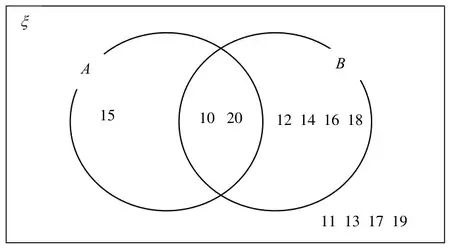
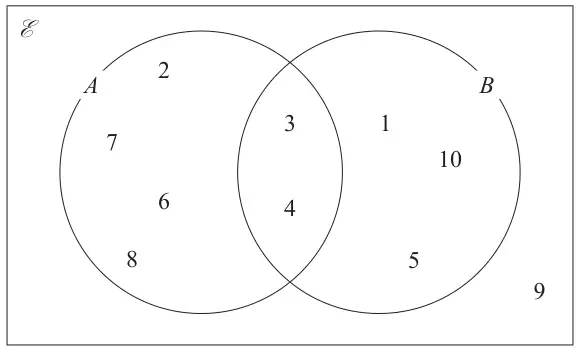
(b) Is it true that \(24 \in A\)? Tick one of the boxes below.
☐ Yes ☐ No
Give a reason for your answer. (1)
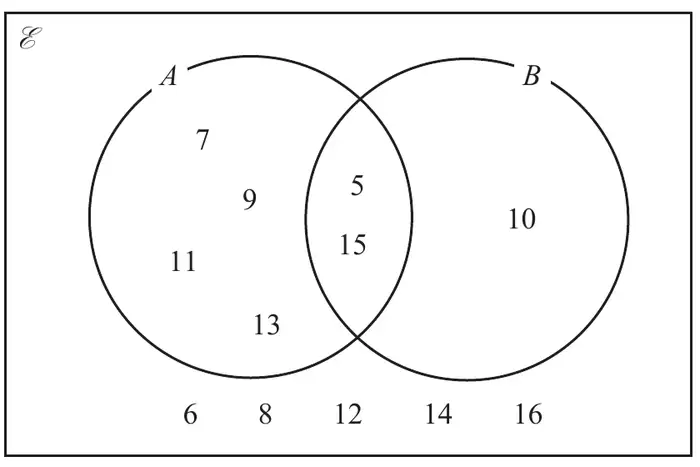
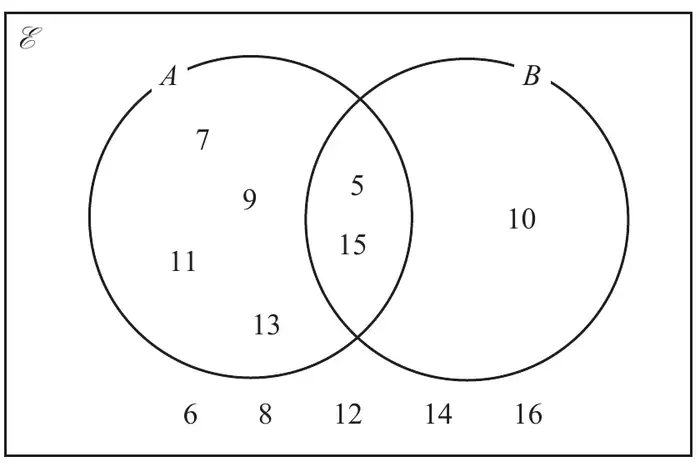
Set \(C\) has 4 members such that \(C \cap B' = \{10, 18\}\)
(c) List the members of one possible set \(C\) (2)
Mark scheme (a)
Scheme
Marks
(i) Answer: 9, 15
B1
(ii) Answer: 9, 11, 12, 13, 15, 17, 18, 19
B1
(2)
Notes
B1: no repeats
B1: no repeats or omissions
Mark scheme (b)
Scheme
Marks
No must be ticked along with a reason for the award of this mark Answer: No with a correct reason
B1
(1)
Notes
B1: No with eg 24/it is not in the universal set, 24/it is not between 9 and 20 (need some sort of reference that the numbers in the sets do not go beyond 20)
Mark scheme (c)
Scheme
Marks
10, 18 and two from 9, 11, 13, 15, 17, 19
B2
(2)
(5 marks)
Notes
B2: for 10, 18 and two from 9, 11, 13, 15, 17, 19 (B1 a set of 4 numbers of which 3 are correct or a set of 5 numbers including 10, 18, and no more than one incorrect number or a set of 3 or more numbers from {10, 18, 9, 11, 13, 15, 17, 19})
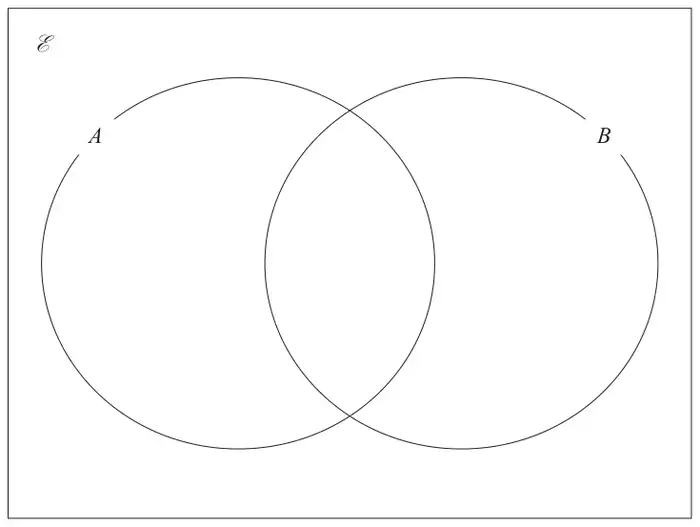
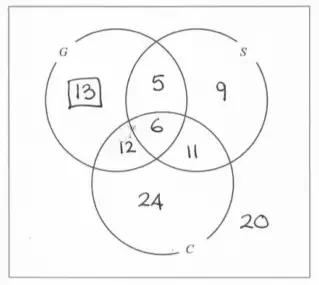
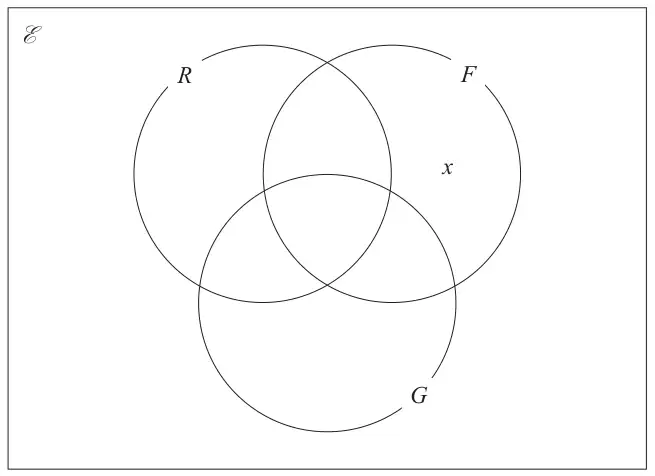
16 100 farmers are asked if they have goats (\(G\)), sheep (\(S\)) or chickens (\(C\)) on their farms.
Of these farmers
31 have sheep 53 have chickens 6 have goats, sheep and chickens 11 have sheep and goats 17 have sheep and chickens 18 have goats and chickens 20 do not have any goats, sheep or chickens
(a) Using this information, complete the Venn diagram to show the number of farmers in each appropriate subset. (3)
(b) Find
(i) \(\mathrm{n}(G)\) (1)
(ii) \(\mathrm{n}([G \cup S]')\) (1)
(iii) \(\mathrm{n}(G' \cap C)\) (1)
One of the farmers who has chickens is chosen at random.
(c) Find the probability that this farmer also has goats. (2)
Mark scheme (a)
Scheme
Marks
Answer: Fully correct Venn diagram
B1
B2
(3)
Notes
B1: For 13 correct in \(G\) only
B2: For all 7 others correct (B1 for 4, 5 or 6 others correct (does not need to be complete for this))
Mark scheme (b)
Scheme
Marks
(i) 36
B1ft
(ii) 44
B1ft
(iii) 35
B1ft
(3)
Notes
ft from a diagram where values are present in the required regions
If these 3 parts are given as probabilities, please mark incorrect the first time but award marks from there on if numerator is correct
Mark scheme (c)
Scheme
Marks
\(\dfrac{18}{53}\)
B2ft
(2)
(8 marks)
Notes
B2ft: oe 0.33(96…) or 33(.96…)% ft their Venn diagram
or
(B1 for \(\dfrac{18}{m}\) where \(m \gt 18\) or \(\dfrac{n}{53}\) where \(n \lt 53\) or
for 18 : 53 or other incorrect notation
or B1ft their Venn diagram for
\(\dfrac{\text{``}{18}\text{''}}{m}\) where \(m \gt \text{``}{18}\text{''}\) or \(\dfrac{n}{\text{``}{53}\text{''}}\) where \(n \lt \text{``}{53}\text{''}\))
(b) Is it true that \(24 \in A\)? Tick one of the boxes below.
Yes
No
Give a reason for your answer. (1)
Set \(C\) has 4 members such that \(C \cap B^{\prime} = \{10, 18\}\)
(c) List the members of one possible set \(C\) (2)
Mark scheme (a)
Scheme
Marks
(i) 9, 15
B1
(ii) 9, 11, 12, 13, 15, 17, 18, 19
B1
(2)
Notes
B1: no repeats
B1: no repeats or omissions
Mark scheme (b)
Scheme
Marks
No must be ticked along with a reason for the award of this mark Answer: No with a correct reason
B1
(1)
Notes
B1: No with eg 24/it is not in the universal set, 24/it is not between 9 and 20 (need some sort of reference that the numbers in the sets do not go beyond 20)
Mark scheme (c)
Scheme
Marks
10, 18 and two from 9, 11, 13, 15, 17, 19
B2
(2)
(5 marks)
Notes
B2: for 10, 18 and two from 9, 11, 13, 15, 17, 19 (B1 a set of 4 numbers of which 3 are correct or a set of 5 numbers including 10, 18, and no more than one incorrect number or a set of 3 or more numbers from \(\{10, 18, 9, 11, 13, 15, 17, 19\}\))
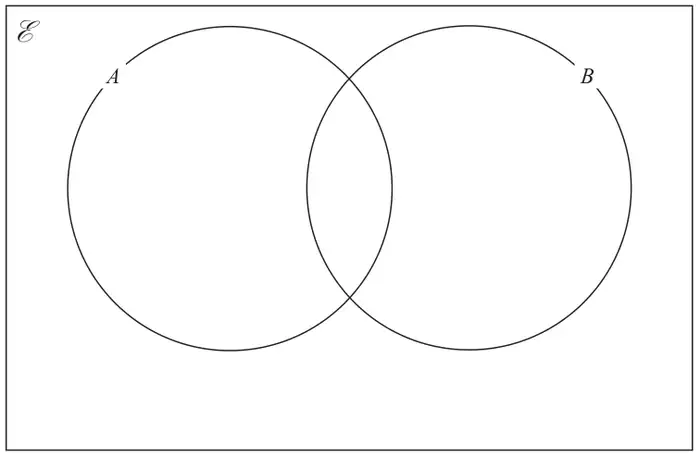
B3: all 4 parts of diagram correct (B2 for 2 or 3 parts correct) (B1 for 1 part correct) SCB1 if no marks scored, award B1 if 4,6 in the section \(A \cap B^{\prime}\) and 9, 11, 12, 13 in the section \(A^{\prime} \cap B\)
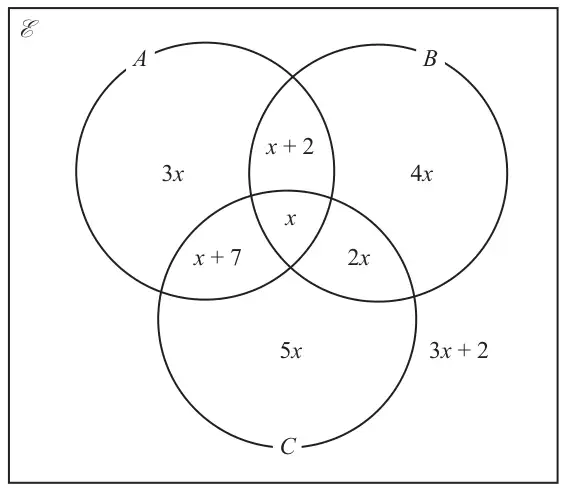
16 There are 32 students in a class. In one term these 32 students each took a test in Maths (\(M\)), in English (\(E\)) and in French (\(F\)).
25 students passed the test in Maths. 20 students passed the test in English. 14 students passed the test in French. 18 students passed the tests in Maths and English. 11 students passed the tests in Maths and French. 4 students failed all three tests. \(x\) students passed all three tests.
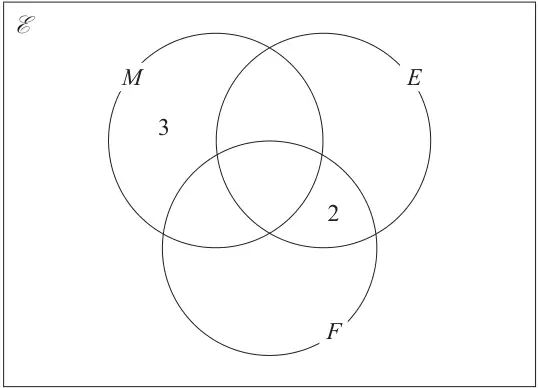
The incomplete Venn diagram gives some more information about the results of the 32 students.
(a) Use all the given information about the results of students who passed the test in Maths to find the value of \(x\). (2)
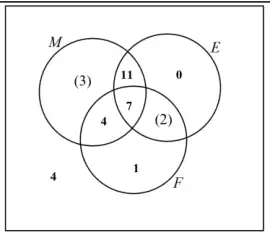
(b) Use your value of \(x\) to complete the Venn diagram to show the number of students in each subset. (2)
A student who passed the test in Maths is chosen at random.
(c) Find the probability that this student failed the test in French. (1)
Mark scheme (a)
Scheme
Marks
\((11 - x) + (x) + (18 - x) + 3 = 25\) oe or \((11 - x) + (x) + (18 - x) + 3 + 7 = 25 + 7\) oe or \(x + y + z = 25 - 3\) and \(x + z = 11\) and \(x + y = 18\) oe where \(y = M \cap E \cap F'\) and \(z = M \cap F \cap E'\)
M1
Correct answer scores full marks (unless from obvious incorrect working) Answer: 7
A1
(2)
Notes
M1: for setting up a correct equation
A1: (allow 7 in the Venn diagram if no answer is given in (a))
Mark scheme (b)
Scheme
Marks
M only (3), \(M \cap E\) only 11, \(E\) only 0, all three 7, \(M \cap F\) only 4, \(E \cap F\) only (2), \(F\) only 1, outside 4
B2
(2)
Notes
B2: ft for \(18 - x\), \(x\) and \(11 - x\) dep on M1 in part (a) and (\(x \lt 12\)) (NB 0, 1 and 4 are fixed) for 6 correct remaining values (B1 ft for 4 or 5 correct remaining values) Allow just \(E\) to be blank if other sections are populated with a number
Mark scheme (c)
Scheme
Marks
\(\dfrac{3 + \text{``}{11}\text{''}}{25}\) or \(\dfrac{3 + (18 - \text{``}{7}\text{''})}{25}\) or 0.56 oe
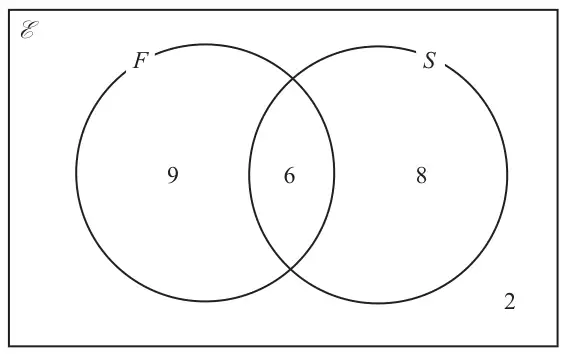
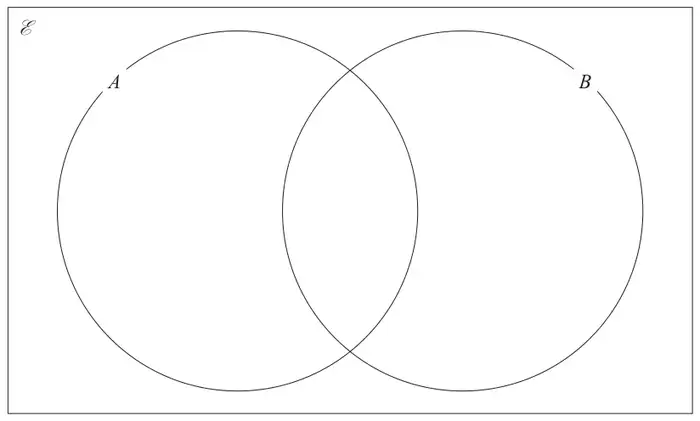
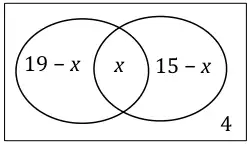
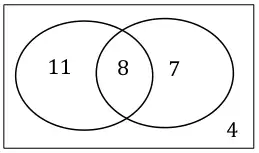
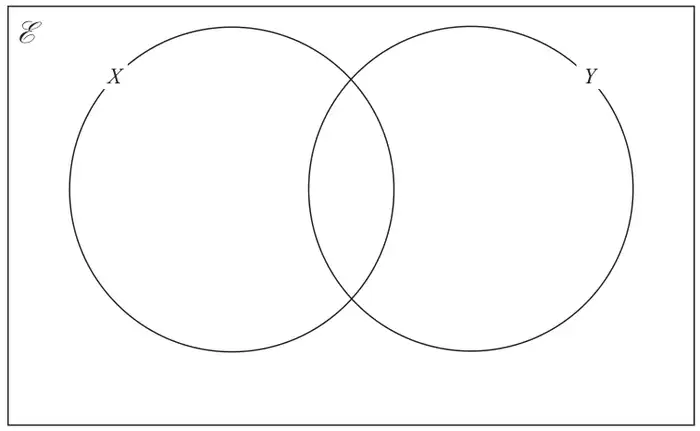
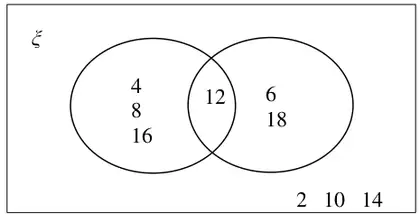
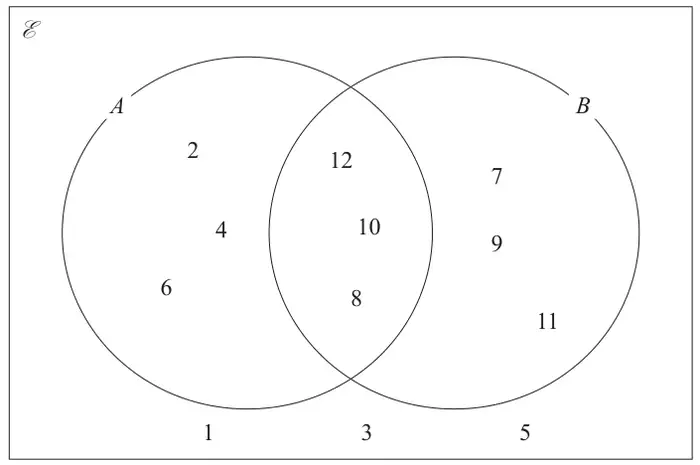
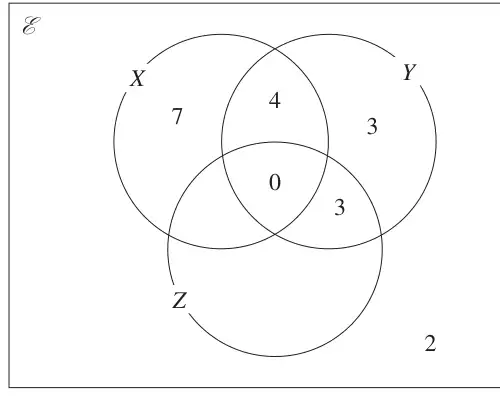
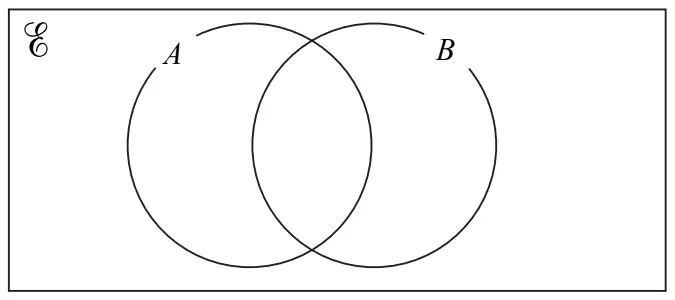
(a) Complete the Venn diagram for this information.(3)
A number is chosen at random from \(\mathscr{E}\)
(b) Find the probability that the number is in the set \(X \cup Y\) (2)
Mark scheme (a)
Scheme
Marks
B3
(3)
Notes
B3: fully correct (B2 for three correct regions) (B1 for one or two correct regions) [a repeat in a region is an error]
Mark scheme (b)
Scheme
Marks
\(\dfrac{\text{‘}6\text{’}}{9}\)
M1
\(\dfrac{6}{9}\)
A1
(2)
(5 marks)
Notes
M1: Numerator correct (or value intended as numerator) or correct for their Venn diagram (so long as fraction not improper) or 6 out of 9 or 6 : 9 oe (ie correct values in incorrect form)
Cody writes down the statement \(B \cap K = \varnothing\)
Cody’s statement is wrong.
(b) Explain why. (1)
Mark scheme (a)
Scheme
Marks
(i) other seen orders of letters: a, b, d, e, i, l, n, r, z b, r, I, a, e, z, l, n, d Answer: b, r, a, z, i, l, e, n, d
B1
(ii) Answer: b, z
B1
(2)
Notes
B1: no repeats, letters can be in any order. Condone capital letters rather than lower case letters. (no need for commas)
B1: No repeats, letters can be in any order. Condone capital letters. (no need for commas)
Mark scheme (b)
Scheme
Marks
correct explanation that shows they know the meaning of intersection and empty set
B1
(1)
(3 marks)
Notes
B1: eg letter ‘a’ is in both sets \(B \cap K = \{a\}\) Set \(B\) and set \(K\) have an element (or letter) in common. There is a letter that is in set \(B\) and in set \(K\) There is an intersection so it isn’t the null set There is a letter in common (do not allow ‘letters’ or ‘elements’ (plural) in common) (If students mention the letter that is in common, it must be the correct one (ie a))
4 \(\mathscr{E} = \{\)letters of the alphabet\(\}\) \(B = \{\mathrm{b, r, a, z, i, l}\}\) \(I = \{\mathrm{i, r, e, l, a, n, d}\}\)
(a) List the members of the set
(i) \(B \cup I\)
(ii) \(B \cap I'\)
(2)
\(K = \{\mathrm{k, e, n, y, a}\}\)
Cody writes down the statement \(B \cap K = \varnothing\)
Cody’s statement is wrong.
(b) Explain why. (1)
Mark scheme (a)(i)
Scheme
Marks
other seen orders of letters: a, b, d, e, i, l, n, r, z b, r, I, a, e, z, l, n, d Answer: b, r, a, z, i, l, e, n, d
B1
(1)
Notes
B1: no repeats, letters can be in any order. Condone capital letters rather than lower case letters. (no need for commas)
Mark scheme (a)(ii)
Scheme
Marks
b, z
B1
(1)
Notes
B1: No repeats, letters can be in any order. Condone capital letters. (no need for a comma)
Mark scheme (b)
Scheme
Marks
correct explanation that shows they know the meaning of intersection and empty set
B1
(1)
(3 marks)
Notes
B1: eg letter ‘a’ is in both sets \(B \cap K = \{\mathrm{a}\}\) Set \(B\) and set \(K\) have an element (or letter) in common. There is a letter that is in set \(B\) and in set \(K\) There is an intersection so it isn’t the null set There is a letter in common (do not allow ‘letters’ or ‘elements’ (plural) in common) (If students mention the letter that is in common, it must be the correct one (ie a))
16 Some students were asked the following question.
“Which of the subjects Russian (\(R\)), French (\(F\)) and German (\(G\)) do you study?”
Of these students
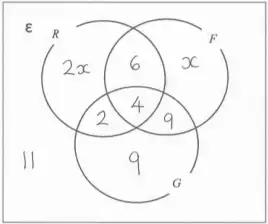
4 study all three of Russian, French and German 10 study Russian and French 13 study French and German 6 study Russian and German 24 study German 11 study none of the three subjects the number who study Russian only is twice the number who study French only.
Let \(x\) be the number of students who study French only.
(a) Show all this information on the Venn diagram, giving the number of students in each appropriate subset, in terms of \(x\) where necessary.(3)
Given that the number of students who were asked the question was 80
(b) work out the number of these students that study Russian. (3)
Mark scheme (a)
Scheme
Marks
B3
(3)
Notes
B3: For all sections completed correctly (B2 for 5 or 6 sections correct (excl \(x\)), B1 for 3 or 4 sections correct (excl \(x\)) )
Mark scheme (b)
Scheme
Marks
\(2x + 6 + x + 2 + 4 + 9 + 9 + 11 = 80\)
(80 – 6 – 2 – 4 – 9 – 9 – 11 ) ÷ 3
M1ft
\(x = 13\)
A1
Correct answer scores full marks (unless from obvious incorrect working) Answer: 38
B1
(3)
(6 marks)
Notes
M1ft: ft their Venn diagram A correct equation to find \(x\) or subtracting all numerical values from 80 and dividing by 3 or other fully correct method to find \(x\) with all sections completed
Correct answer scores full marks (unless from obvious incorrect working) Answer: 22, 23, 24, 25
A1
(2)
Notes
M1: may be seen in a Venn diagram (allow for example 10 – 17 for \(A\) and 13 – 21 for \(B\) or 10 – 21 for \(A \cup B\)) or for an answer with one missing element or one extra element
17 Some students in a school were asked the following question.
“Do you have a dog (\(D\)), a cat (\(C\)) or a rabbit (\(R\))?”
Of these students
28 have a dog 18 have a cat 20 have a rabbit 8 have both a cat and a rabbit 9 have both a dog and a rabbit \(x\) have both a dog and a cat 6 have a dog, a cat and a rabbit 5 have not got a dog or a cat or a rabbit
(a) Using this information, complete the Venn diagram to show the number of students in each appropriate subset. Give the numbers in terms of \(x\) where necessary. (3)
Given that a total of 50 students answered the question,
Venn diagram with: \(D\) only: \(25 - x\) \(D\) and \(C\) only: \(x - 6\) \(C\) only: \(16 - x\) \(D\) and \(R\) only: 3 \(D\), \(C\) and \(R\): 6 \(C\) and \(R\) only: 2 \(R\) only: 9 outside the circles: 5
B3
(3)
Notes
B3: All 8 values inserted correctly B2 for 4 to 7 correct values B1 for 2 or 3 correct values NB: Expressions involving \(x\) do not have to be simplified.
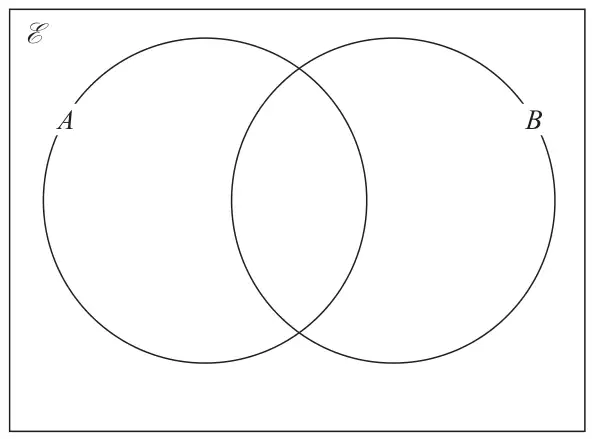
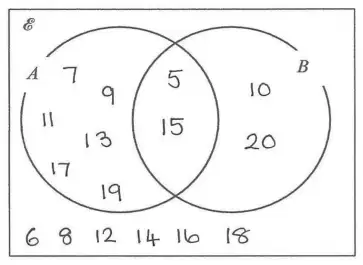
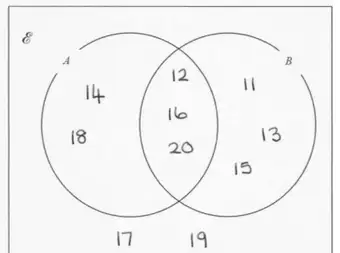
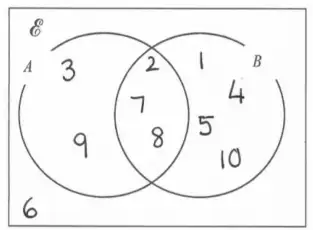
14 \(\mathscr{E} = \{\)positive integers less than 20\(\}\) \(A = \{x : x \lt 12\}\) \(B = \{x : 7 \leqslant x \lt 16\}\)
(a) List the members of \(A \cap B\) (2)
\(C\) is a set such that \(C \subset A\) and \(\text{n}(C) = 3\)
Given that all members of \(C\) are even numbers,
(b) list the members of one possible set \(C\). (1)
Mark scheme (a)
Scheme
Marks
7, 8, 9, 10, 11
B2
(2)
Notes
B2: completely correct. (B1 for 4 or 5 correct and no more than 1 incorrect or for all terms seen correctly placed in a Venn diagram or for a correct description of the numbers in the set but not listed, eg \(7 \leqslant x \lt 12\))
(b) Write down the two possible values of \(x\). (1)
Set \(C\) is such that
\(A \cup B \cup C = \mathscr{E}\) \(A \cap C = \{2\}\) \(B \cap C^{\prime} = \{4, 6, 10\}\)
(c) List all the members of set \(C\). (2)
Mark scheme (a)
Scheme
Marks
Examples There are no members that are in both \(A\) and \(B\) No members in common (in \(A\) and \(B\)) No numbers the same (in \(A\) and \(B\)) \(B\) has even numbers. \(A\) has odd numbers except 2 which is not in \(B\) Nothing in \(A\) is in \(B\) oe No overlap A and B don’t share any numbers Nothing in the intersection of \(A\) and \(B\) Answer: Correct statement
B1
(1)
Notes
B1: for a statement which indicates correct meanings for intersection and empty set
Mark scheme (b)
Scheme
Marks
1 and 9
B1
(1)
Mark scheme (c)
Scheme
Marks
e.g. Answer: 1, 2, 8, 9
B2
(2)
(4 marks)
Notes
B2: for fully correct (B1 for 3 or 4 correct with no more than one addition or a fully correct Venn diagram)
(b) Write down the two possible values of \(x\). (1)
Set \(C\) is such that
\(A \cup B \cup C = \mathscr{E}\) \(A \cap C = \{2\}\) \(B \cap C' = \{4, 6, 10\}\)
(c) List all the members of set \(C\). (2)
Mark scheme (a)
Scheme
Marks
Examples There are no members that are in both \(A\) and \(B\) No members in common (in \(A\) and \(B\)) No numbers the same (in \(A\) and \(B\)) \(B\) has even numbers. \(A\) has odd numbers except 2 which is not in \(B\) Nothing in \(A\) is in \(B\) oe No overlap A and B don’t share any numbers Answer: Correct statement
B1
(1)
Notes
B1: for a statement which indicates correct meanings for intersection and empty set
Mark scheme (b)
Scheme
Marks
1 and 9
B1
(1)
Mark scheme (c)
Scheme
Marks
e.g. Answer: 1, 2, 8, 9
B2
(2)
(4 marks)
Notes
B2: for fully correct (B1 for 3 or 4 correct with no more than one addition or a fully correct Venn diagram)
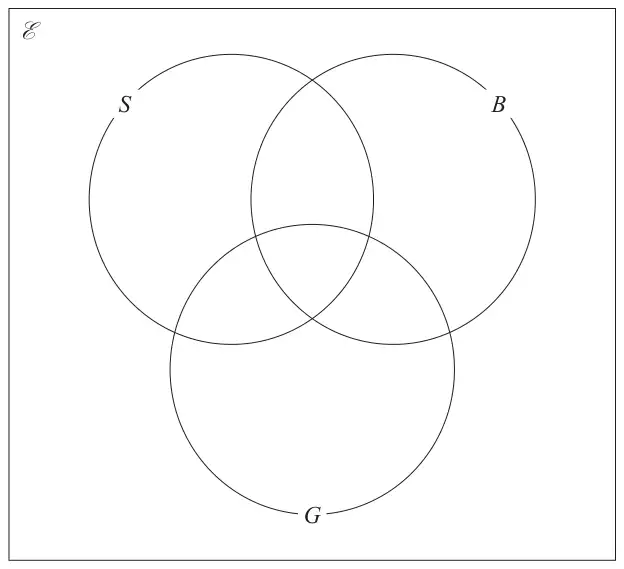
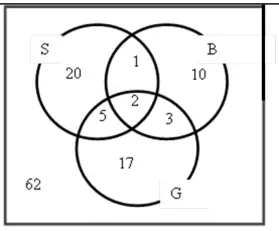
16 120 people who visited a sports centre were asked if they went swimming (\(S\)), played basketball (\(B\)) or used the gym (\(G\)).
Their answers showed that
28 people went swimming 16 people played basketball 27 people used the gym 3 people went swimming and played basketball 5 people played basketball and used the gym 7 people went swimming and used the gym 2 people went swimming, played basketball and used the gym
(a) Using this information, complete the Venn diagram to show the number of people in each region of the Venn diagram.(3)
One of the people who went swimming is chosen at random.
(b) Find the probability that this person also played basketball. (1)
Mark scheme (a)
Scheme
Marks
M1
M1
A1
(3)
Notes
M1: for 2 in the middle and one from 1 or 3 or 5 in the correct place in the Venn diagram
M1: for any 4 correct entries
A1: for a fully correct answer including 62 outside the circles inside the rectangle
13 All the students in Year 11 at a school must study at least one of Geography (\(G\)), History (\(H\)) and Religious Studies (\(R\)). In Year 11 there are 65 students. Of these students
15 study Geography, History and Religious Studies 21 study Geography and History 16 study Geography and Religious Studies 30 study Geography 18 study only Religious Studies 37 study Religious Studies
(a) Using this information, complete the Venn diagram to show the number of students in each region of the Venn diagram. (3)
A student in Year 11 who studies both History and Religious Studies is chosen at random.
(b) Work out the probability that this student does not study Geography. (2)
Mark scheme (a)
Scheme
Marks
M2
Correct Venn diagram
A1
(3)
Notes
M2: for at least 4 correct entries If not M2 then M1 for 2 or 3 correct entries NB: For the award of the method marks do not accept a blank outside the circles as 0
A1: Accept omission of 0 for the award of full marks
Mark scheme (b)
Scheme
Marks
M1
\(\dfrac{3}{18}\) oe
A1
(2)
(5 marks)
Notes
M1: ft from Venn diagram for \(\dfrac{a}{\text{``}{18}\text{''}}\) where \(a\) is an integer and \(1 \leqslant a \lt \text{``}{18}\text{''}\) or for \(\dfrac{\text{``}{3}\text{''}}{b}\) where \(b\) is an integer and \(b \gt \text{``}{3}\text{''}\)
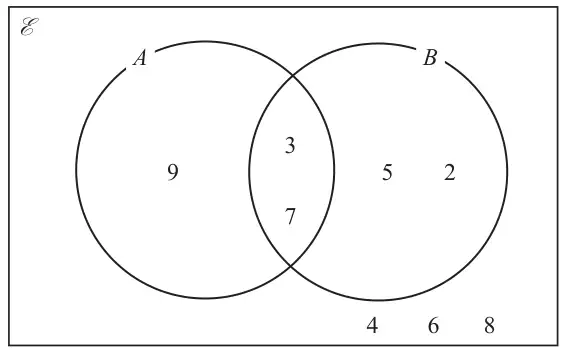
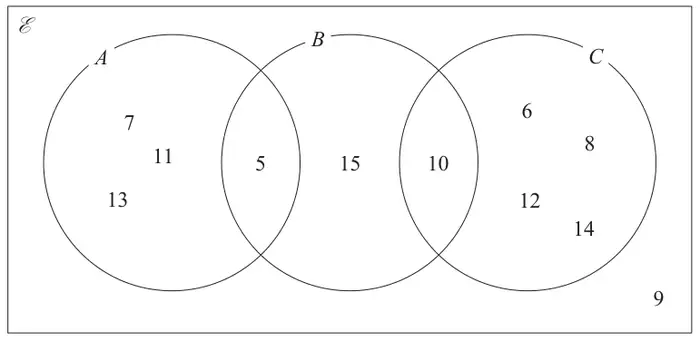
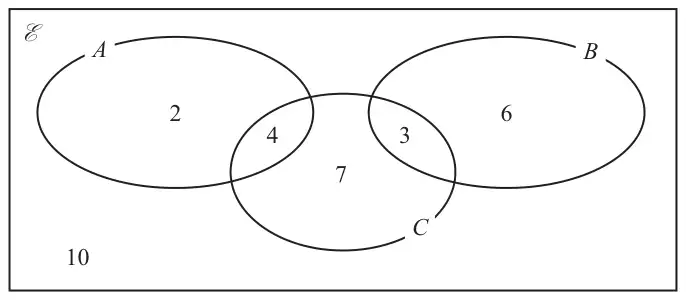
Brian writes down the statement \(A \cap C = \varnothing\)
(b) Is Brian’s statement correct? You must give a reason for your answer. (1)
One of the numbers in the Venn diagram is picked at random.
(c) Find the probability that this number is in set \(C'\) (2)
Mark scheme (a)
Scheme
Marks
(i) 1, 2, 3, 4, 6, 12
B1
(ii) 1, 3, 5, 7, 9, 10, 11
B1
(2)
Notes
B1: cao
B1: cao
Mark scheme (b)
Scheme
Marks
Yes with reason
B1
(1)
Notes
B1: e.g. no numbers in both \(A\) and \(C\) or \(A\) and \(C\) do not intersect or \(A\) and \(C\) do not overlap or \(A\) and \(C\) are mutually exclusive
Mark scheme (c)
Scheme
Marks
M1
\(\dfrac{10}{12}\) oe
A1
(2)
(5 marks)
Notes
M1: for 12 – 2 (=10) or \(\dfrac{a}{12}\) with \(a \lt 12\) or
10 and 12 used with incorrect notation E.g. 10 : 12
A1: for \(\dfrac{10}{12}\) oe or 0.83(3…) or 83(.3..)%
\(C\) is a set with 4 members. \(A \cap C = \varnothing\) and \(B \cap C = \varnothing\)
(b) List the members of set \(C\) (2)
Mark scheme (a)
Scheme
Marks
2, 3, 4, 6, 8, 9, 10, 12
B1
(1)
Mark scheme (b)
Scheme
Marks
5, 7, 11, 13
B2
(2)
Notes
B2: (B1 any set of 4 elements which satisfies exactly one of \(A \cap C = \varnothing\), \(B \cap C = \varnothing\) or just 2 or 3 of 5, 7, 11, 13 or all four correct values and one incorrect value eg 1, 5, 7, 11, 13)
(b) Is it true that \(20 \in A\)? Give a reason for your answer. (1)
\(C\) is a set such that \(A \cap C = \varnothing\) and \(B \cap C = \{7\}\) The set \(C\) has 3 members.
(c) List the members of one possible set \(C\). (2)
Mark scheme (a)
Scheme
Marks
2, 4, 6, 7, 8, 10, 11, 12
B1
(1)
Mark scheme (b)
Scheme
Marks
No with reason
B1
(1)
Notes
B1: e.g. 20 is not in the universal set set \(A\) only goes up to 12 etc
Mark scheme (c)
Scheme
Marks
e.g. 1, 3, 7
B2
(2)
Notes
B2: For 7 and any two of 1, 3, 5, 9 if not B2 then award B1 for three values of which two are correct or for 7 and three or four correct values, none incorrect
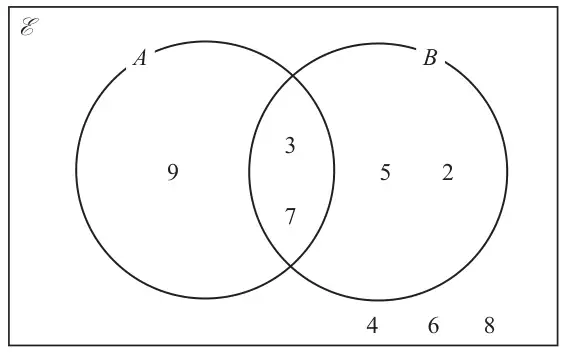
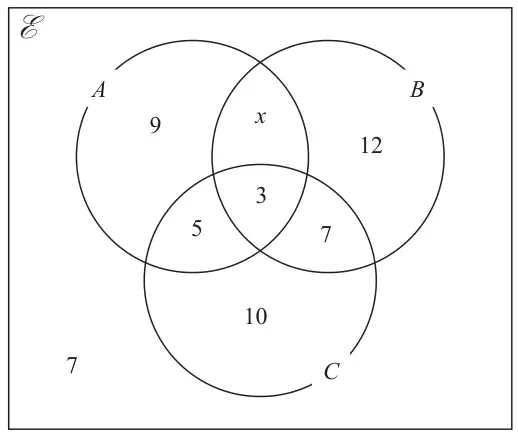
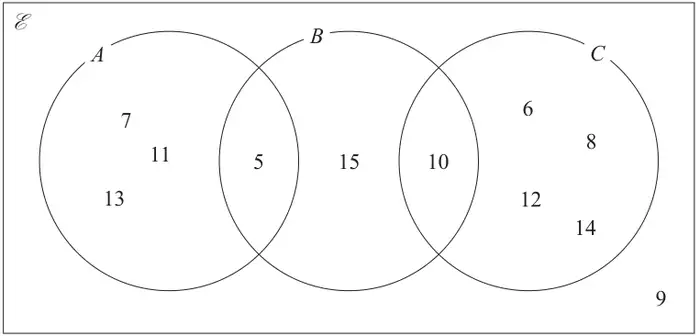
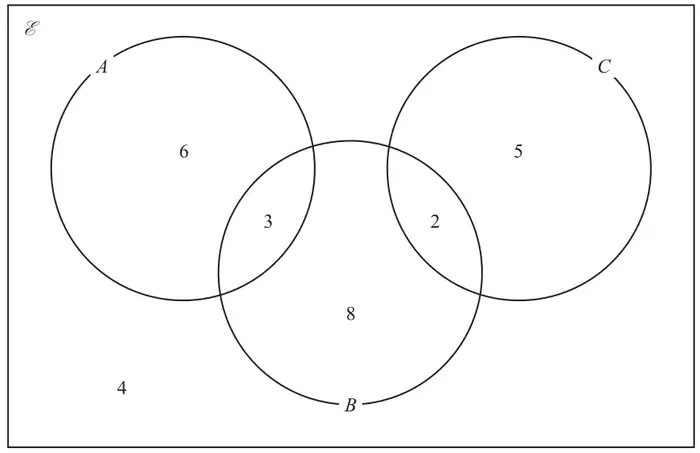
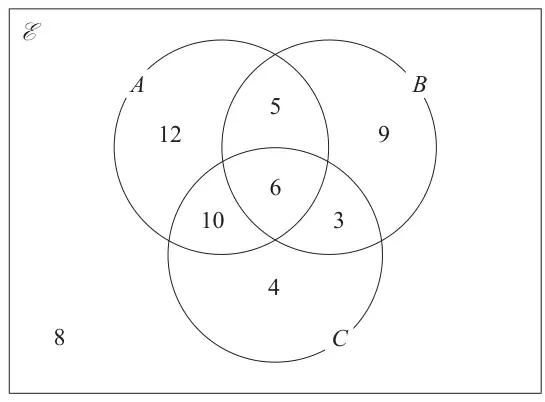
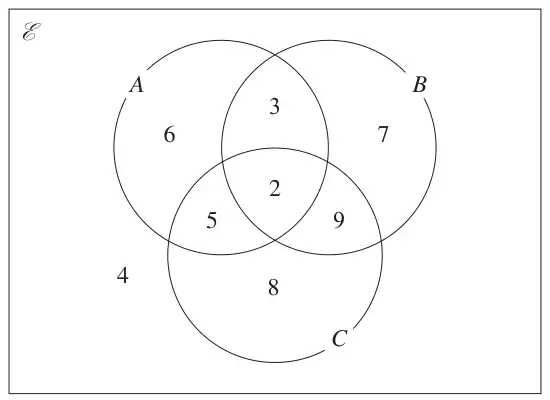
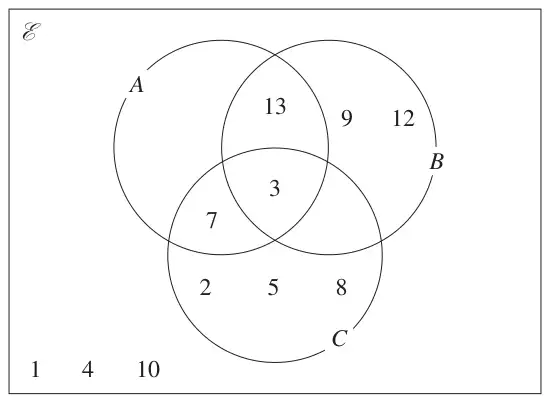
21 The Venn diagram shows a universal set \(\mathscr{E}\) and sets \(A\), \(B\) and \(C\), where 6, 3, 7, 5, 2, 9, 4 and 8 represent numbers of elements.
(a) Find \(\;\mathrm{n}(A \cup B)'\) (1)
(b) Find \(\;\mathrm{n}((A \cup C)' \cap B)\) (1)
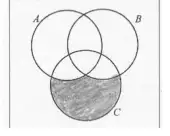
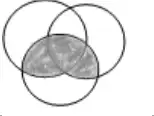
(c) On the Venn diagram, shade the region that represents the set \(\;(A \cup B) \cap C\) (1)
21 Each student in a group of 32 students was asked the following question.
“Do you have a desktop computer (\(D\)), a laptop (\(L\)) or a tablet (\(T\))?”
Their answers showed that
19 students have a desktop computer 17 students have a laptop 16 students have a tablet 9 students have both a desktop computer and a laptop 11 students have both a desktop computer and a tablet 7 students have both a laptop and a tablet 5 students have all three.
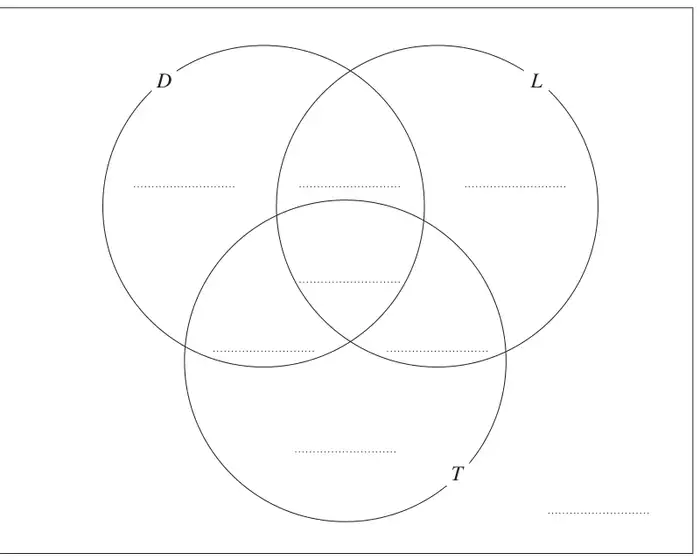
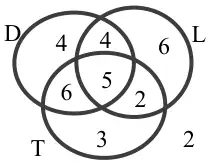
(a) Using this information, complete the Venn diagram to show the number of students in each appropriate subset.(3)
One of the students with both a desktop computer and a laptop is chosen at random.
(b) Find the probability that this student also has a tablet. (1)
Mark scheme (a)
Scheme
Marks
M1
M1
A1
(3)
Notes
M1: For 5 in the middle and 1 from 4(\(D \cap L \cap T'\)) or 2(\(L \cap T \cap D'\)) or 6(\(D \cap T \cap L'\))
M1: For any 4 correct entries
A1: For all correct including 2 outside the circles inside the rectangle
\(C\) is a set such that \(A \cap C = \{4, 5\}\) The set \(C\) has 4 members.
(b) List the members of one possible set \(C\) (2)
Mark scheme (a)
Scheme
Marks
1, 2, 3, 4, 5, 6, 7, 9
B1
(1)
Notes
B1: no repeats
Mark scheme (b)
Scheme
Marks
eg. 4, 5, 7, 8
B2
(2)
Notes
B2: for 4, 5, and any two of 7, 8, 9, 10 If not B2 then B1 for 4, 5 or 4, 5 and any one or two other numbers from the universal set or 4, 5, 7, 8, 9, 10 or 7, 8, 9, 10 or Venn diagram with 4, 5 in intersection and any two correct numbers (eg. 8, 10) in C
\(C\) is a set such that \(A \cap C = \{4, 5\}\) The set \(C\) has 4 members.
(b) List the members of one possible set \(C\) (2)
Mark scheme (a)
Scheme
Marks
1,2,3,4,5,6,7,9
B1
(1)
Notes
B1: no repeats
Mark scheme (b)
Scheme
Marks
eg. 4, 5, 7, 8
B2
(2)
Notes
B2: for 4, 5, and any two of 7, 8, 9, 10 If not B2 then B1 for 4,5 or 4,5 and any one or two other numbers from the universal set or 4, 5, 7, 8, 9, 10 or 7, 8, 9, 10 or Venn diagram with 4,5 in intersection and any two correct numbers (eg. 8,10) in \(C\)
(a) \(A = \{p, r, a, g, u, e\}\) \(B = \{p, a, r, i, s\}\) \(C = \{b, u, d, a, p, e, s, t\}\) List the members of the set
(i) \(A \cap B\)
(ii) \(B \cup C\)
(2)
(b) \(D = \{r, o, m, e\}\) \(E = \{l, i, s, b, o, n\}\) \(F = \{b, e, r, l, i, n\}\) Put one of the letters \(D\), \(E\) or \(F\) in the box below to make the statement correct.
\(A \cap\) \(= \varnothing\)
Explain your answer. (1)
Mark scheme (a)
Scheme
Marks
(i) {p, r, a}
B1
(ii) {p, a, r, i, s, b, u, d, e, t}
B1
(2)
Notes
B1: Withhold marks for repeats
B1: Withhold marks for repeats
Mark scheme (b)
Scheme
Marks
E no letters common to Prague and Lisbon
B1
(1)
(3 marks)
Notes
B1: dep on E in box Accept general reasons e.g. “no letters common to sets A and E” or “they share no common letters” or “no intersection (between A and E)” or “no letters the same” or “no letters in A are in E”.
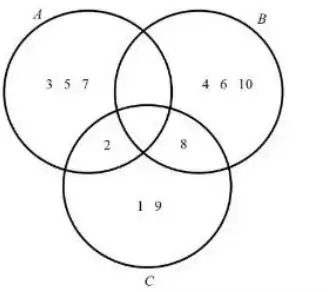
\(A \cap C = \{3, 7\}\), \(B \cap C = \{8\}\) and \(A \cup B \cup C = \mathscr{E}\)
(c) List all the members of \(C\). (2)
Mark scheme (a)
Scheme
Marks
e.g. There are no numbers which are in both A and B. e.g. A is odd, B is even.
B1
(1)
Notes
B1: for a statement which indicates correct meanings of intersection and empty set.
Mark scheme (b)
Scheme
Marks
9
B1
(1)
Mark scheme (c)
Scheme
Marks
3, 7, 8, 9
B2
(2)
(Total 4 marks)
Notes
B2: Award B1 for any three correct with no extras or all four correct with only one extra. Allow in any order, with or without brackets, ignore repeats.
(a) \(A = \{\text{p, r, a, g, u, e}\}\) \(B = \{\text{p, a, r, i, s}\}\) \(C = \{\text{b, u, d, a, p, e, s, t}\}\) List the members of the set
(i) \(A \cap B\)
(ii) \(B \cup C\)
(2)
(b) \(D = \{\text{r, o, m, e}\}\) \(E = \{\text{l, i, s, b, o, n}\}\) \(F = \{\text{b, e, r, l, i, n}\}\) Put one of the letters \(D\), \(E\) or \(F\) in the box below to make the statement correct. \[A \cap \boxed{\phantom{E}} = \varnothing\] Explain your answer. (1)
Mark scheme (a)
Scheme
Marks
(i) Answer: {p, r, a}
B1
(ii) Answer: {p, a, r, i, s, b, u, d, e, t}
B1
(2)
Notes
B1: Withhold marks for repeats
B1: Withhold marks for repeats
Mark scheme (b)
Scheme
Marks
E no letters common to Prague and Lisbon
B1
(1)
(3 marks)
Notes
B1: dep on E in box Accept general reasons. e.g. “no letters common to sets A and E” or “they share no common letters” or “no intersection (between A and E)” or “no letters the same” or “no letter in A are in E”.
\(A \cap C = \{3, 7\}\), \(B \cap C = \{8\}\) and \(A \cup B \cup C = \mathscr{E}\)
(c) List all the members of \(C\). (2)
Mark scheme (a)
Scheme
Marks
e.g. “There are no numbers which are in both A and B”. e.g. “A is odd, B is even”.
B1
(1)
Notes
B1: For a statement which indicates correct meanings of intersection and empty set.
Mark scheme (b)
Scheme
Marks
9
B1
(1)
Mark scheme (c)
Scheme
Marks
3, 7, 8, 9
B2
(2)
(4 marks)
Notes
B2: Award B1 for any three correct with no extras or all four correct with only one extra. Allow in any order, with or without brackets, ignore repeats.
21 A garage tests cars for faults. There are three types of fault – braking, steering and lighting. A car fails the test if it has one or more of these three types of fault.
Last week, 11 cars had braking faults 9 cars had steering faults 7 cars had lighting faults no car had both steering faults and lighting faults 2 cars had both braking faults and steering faults 3 cars had both braking faults and lighting faults.
By drawing a Venn Diagram, or otherwise, find the number of cars which failed the test last week.
(3)
Mark scheme
Scheme
Marks
M2
22
A1
(3)
Notes
M2: for complete, correct Venn Diagram (outline, labels and numbers) (accept blank instead of 0) M1 for correct outline and labels and at least 3 non-zero numbers correct excluding 11, 9, 7(in L)
(a) \(A = \{\text{s, u, p, e, r}\}\) \(B = \{\text{c, o, m, p, u, t, e, r}\}\) List the members of the set
(i) \(A \cap B\)
(ii) \(A \cup B\)
(2)
(b) \(X = \{\text{prime numbers}\}\) \(Y = \{\text{factors of } 12\}\) Is it true that \(X \cap Y = \varnothing\)? Tick (✓) the appropriate box. ☐ Yes ☐ No Explain your answer. (1)
Mark scheme (a)
Scheme
Marks
(i) u, p, e, r
B1
(ii) s, c, o, m, p, u, t, e, r
B1
(2)
Notes
B1: Any order. Brackets and commas not necessary
B1: B0 if ‘p’ or ‘u’ or ‘e’ or ‘r’ repeated
Mark scheme (b)
Scheme
Marks
“no” 2 (or 3) are prime, 2 (or 3) belongs to \(X\) & \(Y\) etc
B1
(1)
Notes
B1: identifies the element 2 or 3 or 2 and 3 eg \(X \cap Y = \{2, 3\}\) dependent on “No” box ticked or "No" stated in answer with neither box ticked
(a) \(A = \{\text{s, u, p, e, r}\}\) \(B = \{\text{c, o, m, p, u, t, e, r}\}\) List the members of the set
(i) \(A \cap B\)
(ii) \(A \cup B\)
(2)
(b) \(X = \{\text{prime numbers}\}\) \(Y = \{\text{factors of 12}\}\) Is it true that \(X \cap Y = \varnothing\)? Tick (✓) the appropriate box. ☐ Yes ☐ No Explain your answer. (1)
Mark scheme (a)
Scheme
Marks
(i) u, p, e, r
B1
(ii) s, c, o, m, p, u, t, e, r
B1
(2)
Notes
B1: B0 if ‘p’ or ‘u’ or ‘e’ or ‘r’ are repeated
Allow in any order Brackets and commas not necessary
Mark scheme (b)
Scheme
Marks
no 2 (or 3) are prime 2 (or 3) belongs to X & Y etc
B1
(1)
Notes
B1: - identifies the element 2 or 3 or 2 and 3 - dependent on “No” box ticked or “No” stated in answer with neither box ticked allow eg \(X \cap Y = \{2, 3\}\)
(a) \(B\) is a set such that \(A \cap B = \{4, 8\}\) The set \(B\) has 3 members. List the members of one possible set \(B\). (2)
(b) \(C\) is a set such that \(A \cap C = \varnothing\) The set \(C\) has 3 members. List the members of one possible set \(C\). (1)
Mark scheme (a)
Scheme
Marks
4, 8 & one even number other than 2, 6 or 10
B2
(2)
Notes
B2: B1 for 4, 8 or for 4, 8 and one odd number or for 4, 8 and more than one other even number (any extra even numbers must not be 2 or 6 or 10) Accept 0 as an even number
Mark scheme (b)
Scheme
Marks
3 even numbers other than 2, 4, 6, 8 or 10 eg 12, 14, 16
(a) \(B\) is a set such that \(A \cap B\) = {4, 8} The set \(B\) has 3 members. List the members of one possible set \(B\). (2)
(b) \(C\) is a set such that \(A \cap C = \varnothing\) The set \(C\) has 3 members. List the members of one possible set \(C\). (1)
Mark scheme (a)
Scheme
Marks
4, 8 & one even number other than 2, 6 or 10
B2
(2)
Notes
B2: B1 for 4, 8 alone or for 4, 8 and one odd number or for 4, 8 and more than one other even number (any extra even numbers must not be 2 or 6 or 10) Accept 0 as an even number
Mark scheme (b)
Scheme
Marks
3 even numbers other than 2, 4, 6, 8 or 10 eg 12, 14, 16
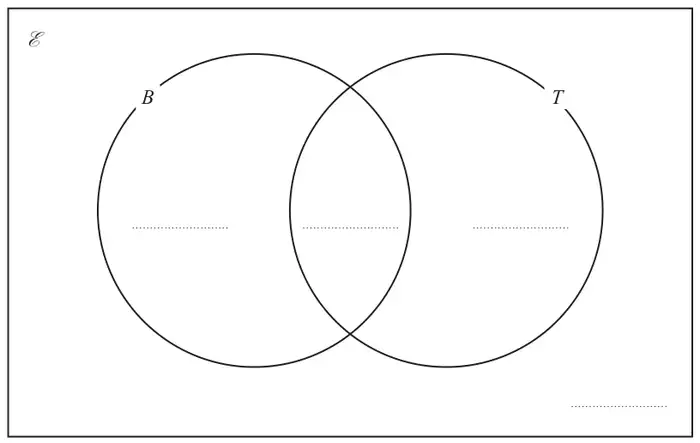
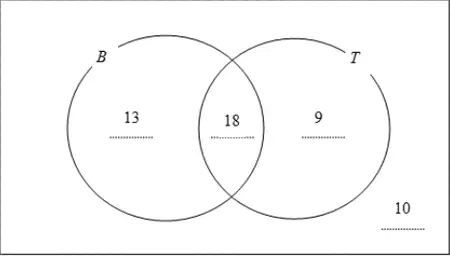
14 There are 31 students in a class. The only languages available for the class to study are French and Spanish. 17 students study French. 15 students study Spanish. 6 students study neither French nor Spanish. Using a Venn diagram, or otherwise, work out how many students study only one language.
(4)
Mark scheme
Scheme
Marks
(2) overlapping circles, 6 outside circles
M1
10 in F only, 8 in S only, 7 in overlap
M2
18
A1
(Total 4 marks)
Notes
M2: Venn diagram sets have to labelled if not M2 then M1 for any two values in correct place in union or 7 in overlap
Alt Method
Scheme
Marks
31 − 6 (=25) or (17+15+6) − 31 (=7) oe
M1
“25”−17 (=8) {Sp} and “25”− 15 (=10) {Fr} or 17 − “7” (=10) {Fr} and 15 − “7” (=8) {Sp}
M1 dep
“10” + “8”
M1 dep
18
A1
Notes
M1: Identifies union or intersection
M1 dep: Identifies components to add or M2 for “25” − “7”
M1 dep: Adds components
A1: (Ans only = M3A1)
Apart from questions 5, 7, 13c, 16b, 20, 21 and 22 (where the mark scheme states otherwise) the correct answer, unless clearly obtained by an incorrect method, should be taken to imply a correct method.
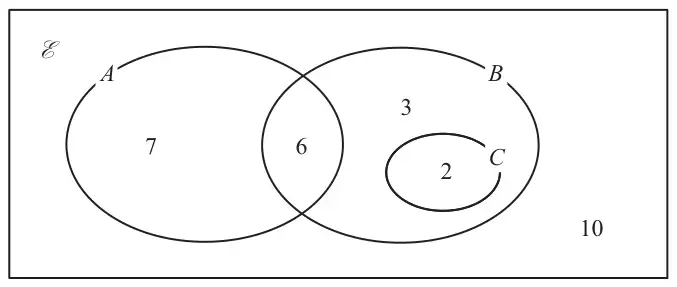
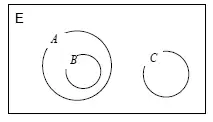
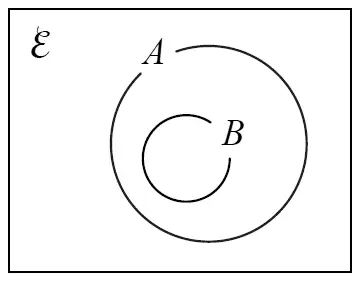
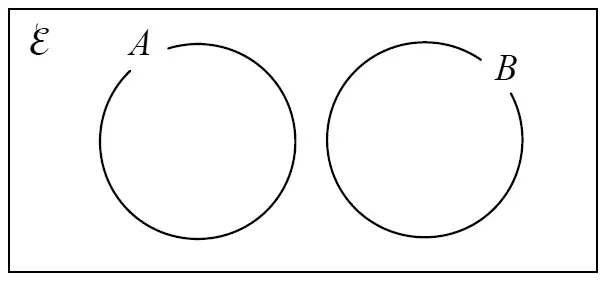
12 \(A\), \(B\) and \(C\) are three sets. \(A \cap B = \varnothing\) and \(C \subset A\)
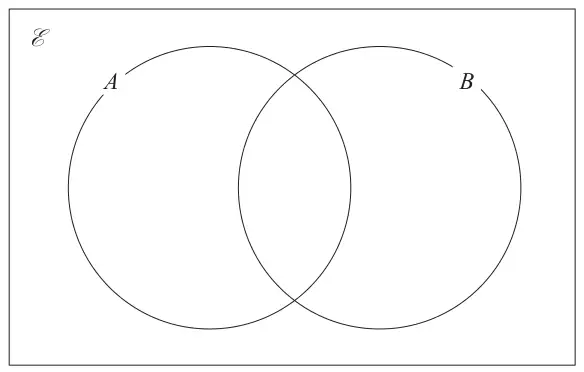
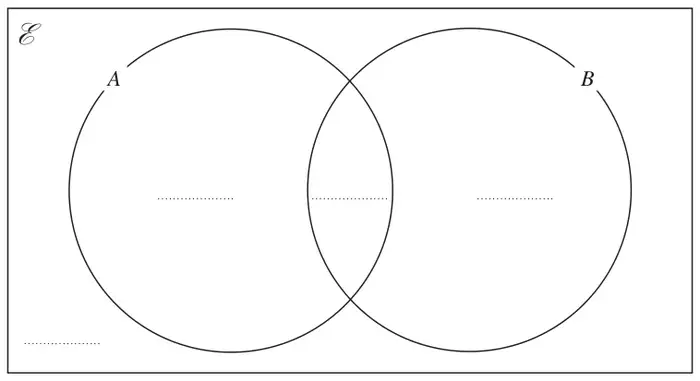
(a) Complete the Venn diagram to show the sets \(B\) and \(C\) (2)
(b) On the Venn diagram, shade the region that represents \(A \cap C\,\prime\) (1)
Mark scheme (a)
Scheme
Marks
set B separate to A, set C within A
B1 B1
(2)
Notes
B1 B1: Set C has to be a unique set
Apart from questions 5, 7, 13c, 16b, 20, 21 and 22 (where the mark scheme states otherwise) the correct answer, unless clearly obtained by an incorrect method, should be taken to imply a correct method.
Mark scheme (b)
Scheme
Marks
outer ring between A and C shaded
B1ft
(1)
(Total 3 marks)
Notes
B1ft: Completely outside of C and within all of A. Set C has to be a unique set
19 \(A\) and \(B\) are two sets. \(\mathrm{n}(\mathscr{E}) = 37\) \(\mathrm{n}(A) = 22\) \(\mathrm{n}(A \cap B) = 12\) \(\mathrm{n}(A \cup B) = 30\)
(a) Complete the Venn Diagram to show the numbers of elements.(2)
(b) Find
(i) \(\mathrm{n}(A \cap B\prime)\)
(ii) \(\mathrm{n}(A\prime \cup B\prime)\)
(2)
Mark scheme (a)
Scheme
Marks
B2
(2)
Notes
B2: for all correct B1 for 2 or 3 correct
Apart from Questions 3, 13(b) and 17(f) (where the mark scheme states otherwise), the correct answer, unless clearly obtained by an incorrect method, should be taken to imply a correct method.
(a) \(\mathscr{E} = \{\text{Students in Year 12}\}\) \(G = \{\text{Students who study German}\}\) \(F = \{\text{Students who study French}\}\) \(M = \{\text{Students who study Maths}\}\)
(i) \(G \cap M = \varnothing\) Use this information to write a statement about the students who study German in Year 12
(ii) Preety is a student in Year 12 Preety \(\notin F\). Use this information to write a statement about Preety.
(2)
(b) \(A = \{2, 4, 6, 8, 10\}\) \(A \cap B = \{2, 4\}\) \(A \cup B = \{1, 2, 3, 4, 6, 8, 10\}\) List all the members of set \(B\). (2)
Mark scheme (a)
Scheme
Marks
(i) Answer: Does not study Maths No student studies (both) German and Maths Students who study German do not study Maths etc
B1
(ii) Answer: (Preety) does not study French (Preety) is not a member of (set) F
B1
(2)
Notes
B1: Accept general answers (e.g. no student belongs in both sets).
B1: Accept she /he in place of Preety or omission of name. Penalise extra incorrect statements (e.g. Preety studies Maths and German but not French)
Mark scheme (b)
Scheme
Marks
1, 2, 3, 4
B2
(2)
(Total 4 marks)
Notes
B2: (B1 for any 3 correct with no repetitions or additions)
(i) Is it true that \(8 \notin A\)? Tick (✓) the appropriate box. Yes ☐ No ☐
(ii) Explain your answer.
(1)
Mark scheme (a)
Scheme
Marks
(i) Answer: 3, 5, 7, 11
B1
(ii) Answer: 2, 3, 5, 7, 9, 11
B1
(2)
Notes
B1: cao Brackets not necessary
B1: cao (B0 if 3 or 5 or 7 or 11 repeated)
Mark scheme (b)
Scheme
Marks
Yes and gives either a specific explanation eg 8 is not an odd number, 8 is an even number or a general explanation which shows understanding of the symbol \(\notin\) eg 8 is not a member of \(A\), 8 does not belong to the set of odd numbers.
(b) \(\mathscr{E} = \{3, 4, 5, 6, 7\}\) \(P = \{3, 4, 5\}\) Two other sets, \(Q\) and \(R\), each contain exactly three members. \(P \cap Q = \{3, 4\}\) \(P \cap R = \{3, 4\}\) Set \(Q\) is not the same as set \(R\).
(i) Write down the members of a possible set \(Q\).
(ii) Write down the members of a possible set \(R\).
(2)
Mark scheme (a)
Scheme
Marks
(i) Answer: 4, 5
B1
(ii) Answer: 6
B1
(2)
Mark scheme (b)
Scheme
Marks
(i) sc B1 B0 for \(Q\) = 3, 4, 6 or 7 then \(R\) = 3, 4, 6 or 7 Answer: \(Q\) = 3, 4, 6 or 3, 4, 7
(b) \(\mathscr{E} = \{3, 4, 5, 6, 7\}\) \(P = \{3, 4, 5\}\) Two other sets, \(Q\) and \(R\), each contain exactly three members. \(P \cap Q = \{3, 4\}\) \(P \cap R = \{3, 4\}\) Set \(Q\) is not the same as set \(R\).
(i) Write down the members of a possible set \(Q\).
(ii) Write down the members of a possible set \(R\). (2)
Mark scheme (a)
Scheme
Marks
(i) Answer: 4, 5
B1
(ii) Answer: 6
B1
(2)
Notes
B1: any order
B1: cao do not accept n(6)
Mark scheme (b)
Scheme
Marks
(i) Answer: (\(Q\) =) 3, 4, 6 or 3, 4, 7
B1
(ii) sc B1 B0 for Q = 3, 4, 6 or 7 then R = 3, 4, 6 or 7 Answer: (\(R\) =) 3, 4, 7 or 3, 4, 6
B1ft
(2)
(4 marks)
Notes
B1ft: R = 3, 4, 7 if Q = 3, 4, 6 // R = 3, 4, 6, if Q = 3, 4, 7
21 \(\mathscr{E}\) = {positive whole numbers} \(A\) = {factors of 27} \(B\) = {factors of 9} \(C\) = {first four even numbers}
(a) List the members of \(A \cup B\). (2)
(b)
(i) Is it true that \(A \cap C = \varnothing\)? Tick (✓) the appropriate box.
Yes ☐ No ☐
(ii) Explain your answer.
(1)
Mark scheme (a)
Scheme
Marks
1 3 9 27
B2
(2)
Notes
B2: −B1 for eeoo or any repetition
Mark scheme (b)
Scheme
Marks
Yes and gives an explanation which either refers specifically to the members of \(A\) and their properties eg All the factors of 27 are odd. None of the factors of 27 are even. 2, 4, 6, 8 aren’t factors of 27. or gives a general explanation which shows understanding of the statement eg \(A\) and \(C\) have no members in common. The intersection of \(A\) and \(C\) is empty.
B1
(1)
(Total 3 marks)
Notes
B1: for ‘Yes’ and an acceptable explanation Do not accept an explanation which merely lists, without comment, the members of both sets. Do not accept an explanation which includes the symbol \(\cap\) with no indication of its meaning.
8 \(\mathscr{E} =\) {positive whole numbers} \(A =\) {factors of 27} \(B =\) {factors of 9} \(C =\) {first four even numbers}
(a) List the members of \(A \cup B\). (2)
(b)
(i) Is it true that \(A \cap C = \varnothing\) ? Tick (✓) the appropriate box. Yes ☐ No ☐
(ii) Explain your answer.
(1)
(c) Complete the Venn Diagram to show the relationship between the sets \(A\), \(B\) and \(C\).(2)
Mark scheme (a)
Scheme
Marks
1 3 9 27
B2
(2)
Notes
B2: −B1 for eeoo or any repetition
Mark scheme (b)
Scheme
Marks
Yes and gives an explanation which either refers specifically to the members of \(A\) and their properties eg All the factors of 27 are odd. None of the factors of 27 are even. 2, 4, 6, 8 aren’t factors of 27. or gives a general explanation which shows understanding of the statement eg \(A\) and \(C\) have no members in common. The intersection of \(A\) and \(C\) is empty.
B1
(1)
Notes
B1: for ‘Yes’ and an acceptable explanation Do not accept an explanation which merely lists, without comment, the members of both sets. Do not accept an explanation which includes the symbol \(\cap\) with no indication of its meaning.
Mark scheme (c)
Scheme
Marks
B2
(2)
(5 marks)
Notes
B2: B1 for \(B \subset A\) B1 for \(A \cap C = \varnothing\) and \(B \cap C = \varnothing\) Ignore any individual members shown on the diagram. Mark the layout which must be labelled
22 \(\mathscr{E}\) = {Positive integers less than 11} \(A\) = {Multiples of 3} \(B\) = {Multiples of 2}
(a) List the members of
(i) \(A\),
(ii) \(A \cup B\).
(3)
(b) \(\mathscr{E}\) = {Students in class 12Y} \(P\) = {Students who study Mathematics} \(Q\) = {Students who study History}
(i) Describe the members of \(P \cap Q\).
(ii) \(R\) is also a set of students in class 12Y. \(P \cap R = \varnothing\) Use this information to write a statement about the students in set \(R\).
(3)
Mark scheme (a)
Scheme
Marks
(i) 3, 6, 9
B1
(ii) 2, 3, 4, 6, 8, 9, 10
B2
(3)
Notes
B2: Any order One omission or extra: B1
Mark scheme (b)
Scheme
Marks
(i) (Students who study) maths and history
B1
in 12Y
B1
(ii) They don’t study maths
B1
(3)
(Total 6 marks)
Notes
B1: or “study both” allow maths + history
B1: indep
B1: or No students in R study maths No students who study maths are in R Not: They don’t study maths or history
In (b)(i) & (ii), answers must refer to context, not just sets
9 \(\mathscr{E} =\) {Positive integers less than 11} \(A =\) {Multiples of 3} \(B =\) {Multiples of 2}
(a) List the members of
(i) \(A\),
(ii) \(A \cup B\).
(3)
(b) \(\mathscr{E} =\) {Students in class 12Y} \(P =\) {Students who study Mathematics} \(Q =\) {Students who study History}
(i) Describe the members of \(P \cap Q\).
(ii) \(R\) is also a set of students in class 12Y. \(P \cap R = \varnothing\) Use this information to write a statement about the students in set \(R\).
(3)
Mark scheme (a)
Scheme
Marks
(i) Answer: 3, 6, 9
B1
(ii) Answer: 2, 3, 4, 6, 8, 9, 10
B2
(3)
Notes
B2: Any order One omission or extra: B1
Mark scheme (b)
Scheme
Marks
(i) Answer: (Students who study) maths and history in 12Y
B1 B1
(ii) Answer: (They) don’t study maths
B1
(3)
(6 marks)
Notes
B1 B1: or “study both” allow maths + history indep
B1: or No students in \(R\) study maths No students who study maths are in R Not: They don’t study maths or history
In (b)(i) & (ii), answers must refer to context, not just sets
eg No members in common. The intersection is empty. None of the members of \(A\) & \(C\) are the same. They don’t have the same numbers. No numbers are in both \(A\) and \(C\).
(a) \(A = \{1, 2, 3, 4\}\) \(B = \{2, 4, 6, 8\}\) Write down the members of \(A \cup B\). (2)
(b) \(\mathscr{E} = \{\text{Positive integers less than }10\}\) \(P = \{3, 4, 5, 6, 7, 8\}\) \(P \cap Q = \varnothing\) Write down all the possible members of \(Q\). (2)
Mark scheme (a)
Scheme
Marks
1, 2, 3, 4, 6, 8
B2
(2)
Notes
B2: no repetitions B1 with repeats or one digit omitted
(a) \(A = \{1, 2, 3, 4\}\) \(B = \{2, 4, 6, 8\}\) Write down the members of \(A \cup B\). (2)
(b) \(\mathscr{E} = \{\text{Positive integers less than } 10\}\) \(P = \{3, 4, 5, 6, 7, 8\}\) \(P \cap Q = \varnothing\) Write down all the possible members of \(Q\). (2)
Mark scheme (a)
Scheme
Marks
1, 2, 3, 4, 6, 8
B2
(2)
Notes
B2: no repetitions B1 with repeats or one digit omitted
15 There are 35 students in a group. 18 students play hockey. 12 students play both hockey and tennis. 15 students play neither hockey nor tennis. Find the number of students who play tennis.
(4)
Mark scheme
Scheme
Marks
2 overlapping circles, 12 in overlap
M1
6 in H only
M1
2 in T only
M1
14
A1
(4)
(4 marks)
Notes
M1: or 6 play H only M2
M1: or 20−6, \(6 + 12 + x = 20\), 20−18, 35−33: M3
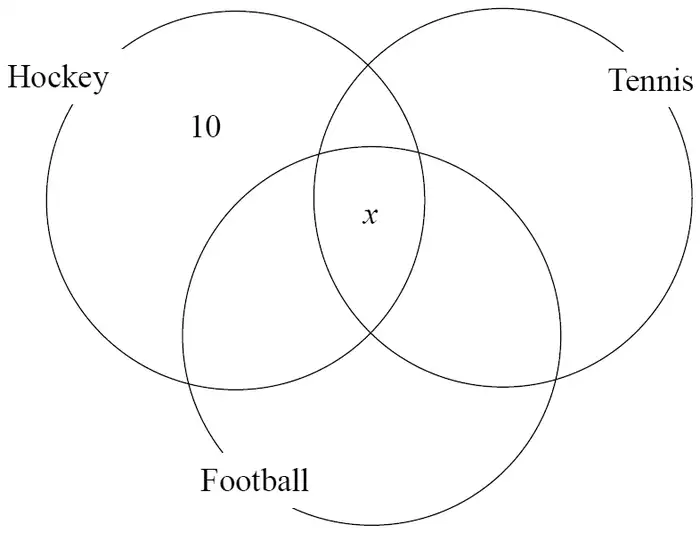
19 Each student in a group plays at least one of hockey, tennis and football. 10 students play hockey only 9 play football only. 13 play tennis only. 6 play hockey and football but not tennis. 7 play hockey and tennis. 8 play football and tennis. \(x\) play all three sports.
(a) Write down an expression, in terms of \(x\), for the number of students who play hockey and tennis, but not football. (1)
There are 50 students in the group.
(b) Find the value of \(x\). (3)
Mark scheme (a)
Scheme
Marks
\(7 - x\)
B1
(1)
Mark scheme (b)
Scheme
Marks
\(8 - x\) seen or 9, 13, 6 marked correctly on diagram or 50 − (10 + 9 + 13 + 6) = 50 − 38 = 12 and 8 + 7 = 15
M1
\(10 + 13 + 9 + 6 + (7 - x) + (8 - x) + x = 50\) oe inc \(7 - x + 8 - x + x = 12\) or 15 − 12
(a) \(A = \{\text{Quadrilaterals with two pairs of parallel sides}\}\) \(B = \{\text{Quadrilaterals with at least one right angle}\}\)
Write down the mathematical name for the quadrilaterals in
(i) \(A\),
(ii) \(A \cap B\). (2)
(b) The universal set \(\mathscr{E} = \{\text{Positive whole numbers}\}\) \(P = \{\text{Multiples of 3 less than 11}\}\) \(Q = \{\text{Multiples of 5 less than 11}\}\)
(i) What is \(P \cap Q\)?
(ii) Is it true that \(10 \in P \cup Q\)? Explain your answer. (2)
Mark scheme (a)
Scheme
Marks
(i) Parallelograms
B1
(ii) Rectangles
B1
(2)
Notes
B1: Allow “Squares & rectangles”
Mark scheme taken from the matching question on the Higher paper.
Mark scheme (b)
Scheme
Marks
(i) Ø or { } or empty oe
B1
(ii) Yes. \(10 \in Q\) or 10 is mult of 5 or 3, 5, 6, 9, 10 listed
B1
(2)
(Total 4 marks)
Notes
B1: Allow “Intersection of \(P\) & \(Q\)” oe
Mark scheme taken from the matching question on the Higher paper.
(a) \(A = \{\text{Quadrilaterals with two pairs of parallel sides}\}\) \(B = \{\text{Quadrilaterals with at least one right angle}\}\)
Write down the mathematical name for the quadrilaterals in
(i) \(A\),
(ii) \(A \cap B\). (2)
(b) The universal set \(\mathscr{E} = \{\text{Positive whole numbers}\}\) \(P = \{\text{Multiples of 3 less than 11}\}\) \(Q = \{\text{Multiples of 5 less than 11}\}\)
(i) What is \(P \cap Q\)?
(ii) Is it true that \(10 \in P \cup Q\)? Explain your answer. (2)
Mark scheme (a)
Scheme
Marks
(i) Parallelograms
B1
(ii) Rectangles
B1
(2)
Notes
B1: Allow “Squares & rectangles”
Mark scheme (b)
Scheme
Marks
(i) Ø or { } or empty oe
B1
(ii) Yes. \(10 \in Q\) or 10 is mult of 5 or 3, 5, 6, 9, 10 listed
(b) \(P = \{2, 4, 6, 8\}\). \(Q = \{\text{Odd numbers less than } 10\}\)
(i) List the members of the set \(P \cup Q\).
(ii) Is it true that \(P \cap Q = \varnothing\)? Explain your answer. (3)
Mark scheme (a)
Scheme
Marks
Kitchen chairs
B1
belonging to Angela or “her”
B1
(2)
Notes
B1: Or equivalent. Must be clear that overlap is intended eg “chairs that are part of / common to kitchen furniture” “furniture that is both a chair and in the kitchen”
Mark scheme taken from the matching question on the Higher paper.
Mark scheme (b)
Scheme
Marks
(i) 1, 2, 3, 4, 5, 6, 7, 8, 9
B2
(ii) Yes – no common members
B1
(3)
(5 marks)
Notes
B2: −B1 each omission or extra Any order, in a single list Ignore negative odd numbers
B1: Or eg “No odd numbers in \(P\).” “\(P\) is even numbers, or \(Q\) is odd numbers.” Must refer to sets or odd or even
Mark scheme taken from the matching question on the Higher paper.
(b) \(P = \{2, 4, 6, 8\}\). \(Q = \{\text{Odd numbers less than } 10\}\)
(i) List the members of the set \(P \cup Q\).
(ii) Is it true that \(P \cap Q = \varnothing\)? Explain your answer. (3)
Mark scheme (a)
Scheme
Marks
Kitchen chairs
B1
belonging to Angela or “her”
B1
(2)
Notes
B1: Or equivalent. Must be clear that overlap is intended eg “chairs that are part of / common to kitchen furniture” “furniture that is both a chair and in the kitchen”
Mark scheme (b)
Scheme
Marks
(i) 1, 2, 3, 4, 5, 6, 7, 8, 9
B2
(ii) Yes – no common members
B1
(3)
(5 marks)
Notes
B2: −B1 each omission or extra Any order, in a single list Ignore negative odd numbers
B1: Or eg “No odd numbers in \(P\).” “\(P\) is even numbers, or \(Q\) is odd numbers.” Must refer to sets or odd or even
We'd like to use Google Analytics cookies to count visits and see which pages help most. They're optional, and the site works exactly the same either way. Privacy policy