
Higher June 2024 Paper 6 Q11
11 Jack travels to work each day by train.
He records whether
- the train is on time or late
- there are seats available or no seats available.
Jack’s results are shown on this partly completed frequency tree.
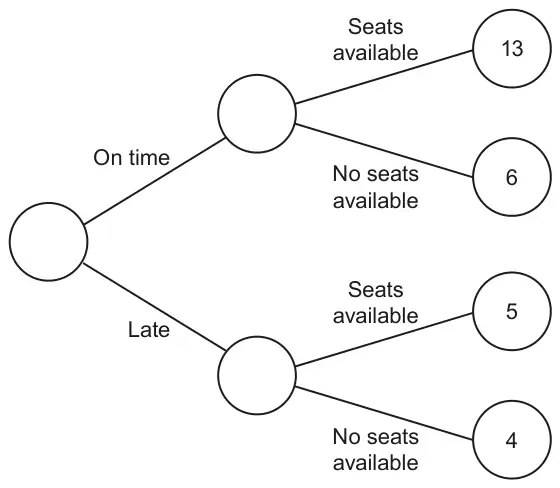
(a) Find the relative frequency of there being no seats available on Jack’s train journey. [2]
(b) Jack says
| If the train is late, travellers are less likely to find seats available than if the train was on time. |
Does Jack’s data suggest he is correct?
Show how you decide. [3]
| Answer | Marks | Part marks and guidance | |
|---|---|---|---|
| \(\frac{10}{28}\) oe | 2 | M1 for \(\frac{10}{k}\) with \(k \gt 10\) or \(\frac{m}{28}\) with \(0 \lt m \lt 28\) or for \(\frac{4 + 6}{13 + 6 + 5 + 4}\) If 0 scored, SC1 for answer 10 : 28 or 5 : 14 | Accept 0.357 to 0.36 |
| Answer | Marks | Part marks and guidance | |
|---|---|---|---|
| Eg. P(seats given late) = \(\frac{5}{9}\) P(seats given on time) = \(\frac{13}{19}\) 0.55[5…] to 0.56 and 0.68 to 0.68[4…] or 0.6 and 0.7 or \(\frac{95}{171}\) and \(\frac{117}{171}\) AND Yes/correct [because] oe | 3 | M1 for P(seats given late) = \(\frac{5}{9}\) oe M1 for P(seats given on time) = \(\frac{13}{19}\) oe | Condone lack of labelling; mark to candidate’s benefit. Condone wrong labelling for M marks only Include working on the diagram Allocate similar marks if working with probabilities for “no seats”: \(\frac{4}{9}\) \(\frac{6}{19}\) 0.4[4…] and 0.3[1] to 0.32 \(\frac{76}{171}\) and \(\frac{54}{171}\) For full marks must convert both to a comparable form and give a correct conclusion Comparable form may be decimal, percentage or fractions with common denominator or numerator |