Geometry & Angles

Your progress
0 of 152 done
Ticks are kept only in this browser: clearing your browsing data or changing device loses them. · ·

PK

IMC

PK

IMC

PK

GK

IMC

PK

IMC

GK

IMC

PK

IMC

PK

GK

IMC

PK

GK

PK

IMC

PK

GK

IMC

PK

IMC

GK

IMC

GK

PK

IMC

PK

IMC

PK

IMC

GK

IMC

PK

IMC

PK

IMC

GK

IMC

GK

PK

GK

IMC

GK

PK

IMC

PK

GK

IMC

PK

GK

IMC

PK 2020 Q25

PKCurrent spec6 marksGeometry & Angles

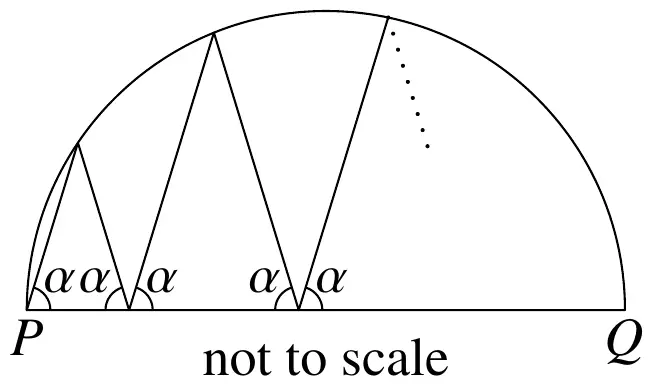
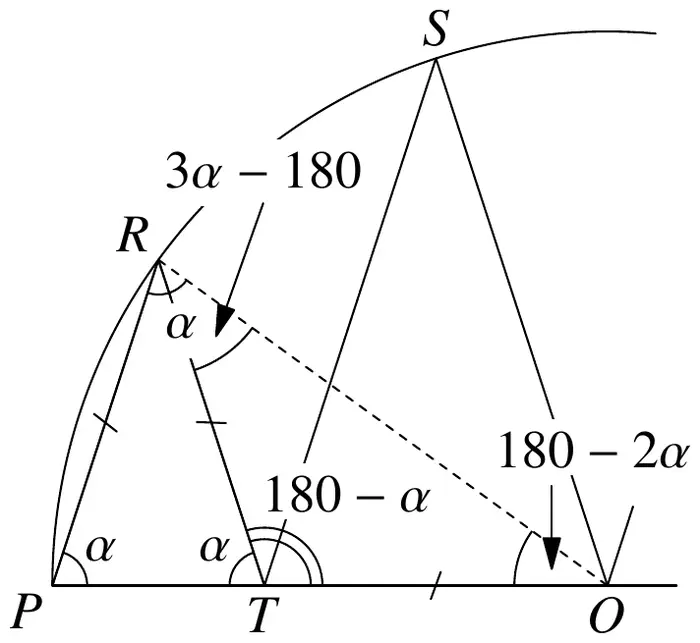
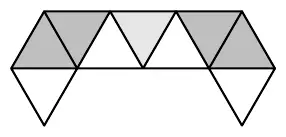
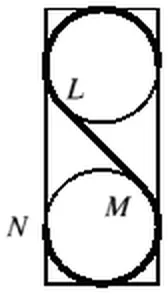
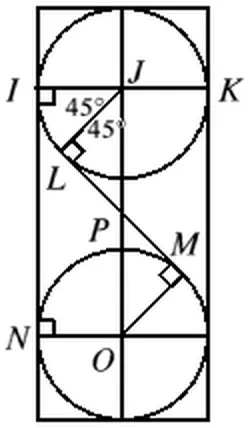
25. A zig-zag line starts at the point \(P\), at one end of the diameter \(PQ\) of a circle. Each of the angles between the zig-zag line and the diameter \(PQ\) is equal to \(\alpha\) as shown. After four peaks, the zig-zag line ends at the point \(Q\). What is the size of angle \(\alpha\)?

  1. A 60°
  2. B 72°
  3. C 75°
  4. D 80°
  5. E 86°
A semicircle on diameter PQ with a zig-zag line from P making equal angles alpha with PQ; not to scale

Pink Kangaroo 2020, Question 25. © UK Mathematics Trust. Original paper on ukmt.org.uk

IMC 2020 Q25

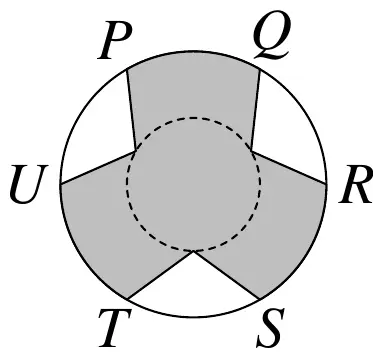
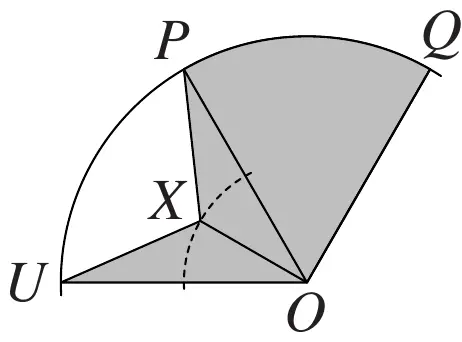
25. The diagram shows six points \(P\), \(Q\), \(R\), \(S\), \(T\) and \(U\) equally spaced around a circle of radius 2 cm. The inner circle has radius 1 cm. The shaded region has three lines of symmetry.
Which of the following gives the area, in cm2, of the shaded region?

  1. A \(2\pi + 3\)
  2. B \(3\pi + 2\)
  3. C \(\dfrac{4\pi + 3}{2}\)
  4. D \(3(\pi + 2)\)
  5. E \(4\pi + 3\)
Six points P, Q, R, S, T and U on a circle, with a dashed inner circle and a shaded region with three lines of symmetry

Intermediate Mathematical Challenge 2020, Question 25. © UK Mathematics Trust. Original paper on ukmt.org.uk

IMC 2020 Q23

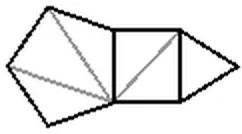
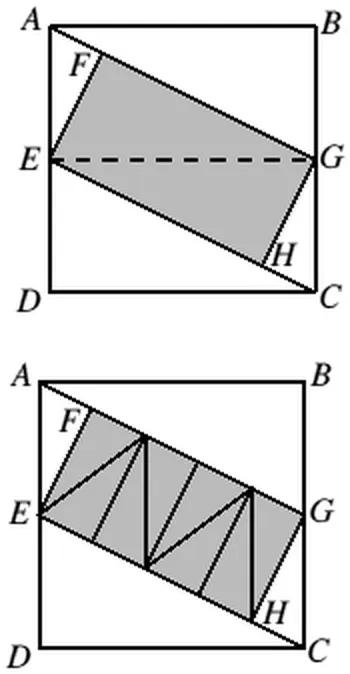
23. Five congruent triangles, each of which is half a square, are placed together edge to edge in three different ways as shown to form shapes P, Q and R.

Three shapes P, Q and R, each made of five half-square triangles

Which of the following lists gives the shapes in ascending order of the lengths of their perimeters?

  1. A P, Q, R
  2. B Q, P, R
  3. C R, Q, P
  4. D R, P, Q
  5. E P, R, Q

Intermediate Mathematical Challenge 2020, Question 23. © UK Mathematics Trust. Original paper on ukmt.org.uk

IMC 2020 Q22

IMCCurrent spec6 marksGeometry & Angles

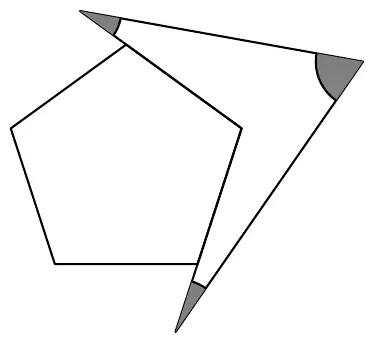
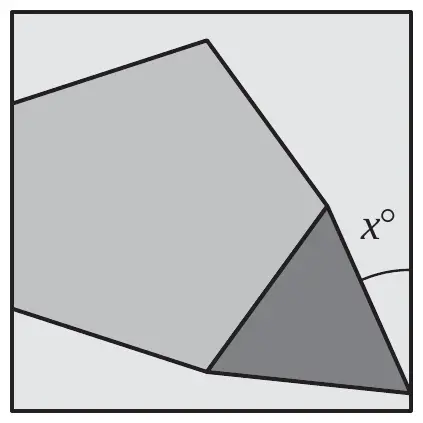
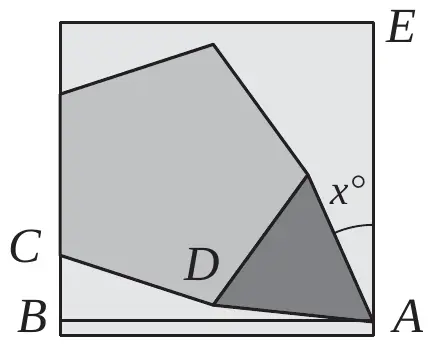
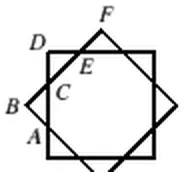
22. The diagram shows a regular pentagon and an irregular quadrilateral.

What is the sum of the three marked angles?

  1. A 72°
  2. B 90°
  3. C 108°
  4. D 126°
  5. E 144°
A regular pentagon and an irregular quadrilateral sharing a vertex, with three angles of the quadrilateral marked

Intermediate Mathematical Challenge 2020, Question 22. © UK Mathematics Trust. Original paper on ukmt.org.uk

PK 2020 Q21

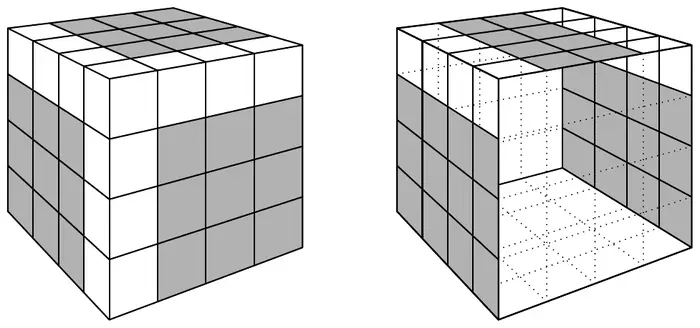
21. A large cube is built using 64 smaller identical cubes. Three of the faces of the large cube are painted. What is the maximum possible number of small cubes that can have exactly one face painted?

  1. A 27
  2. B 28
  3. C 32
  4. D 34
  5. E 40

Pink Kangaroo 2020, Question 21. © UK Mathematics Trust. Original paper on ukmt.org.uk

PK 2020 Q20

PKCurrent spec6 marksAlgebraGeometry & Angles

20. Kanga labelled the vertices of a square-based pyramid using 1, 2, 3, 4 and 5 once each. For each face Kanga calculated the sum of the numbers on its vertices. Four of these sums equalled 7, 8, 9 and 10. What is the sum for the fifth face?

  1. A 11
  2. B 12
  3. C 13
  4. D 14
  5. E 15

Pink Kangaroo 2020, Question 20. © UK Mathematics Trust. Original paper on ukmt.org.uk

PK 2020 Q19

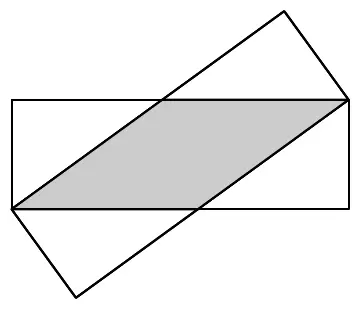
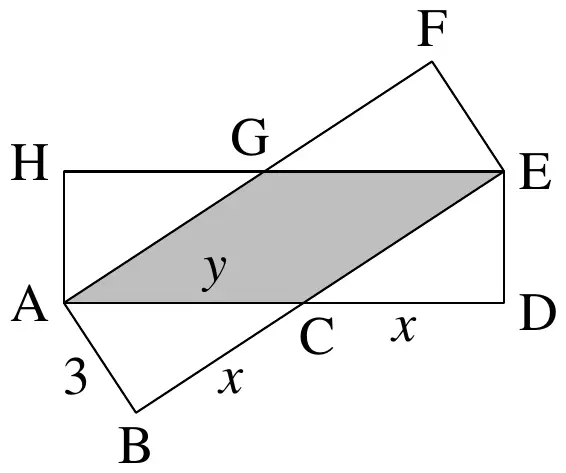
19. Two identical rectangles with sides of length 3 cm and 9 cm are overlapping as in the diagram. What is the area of the overlap of the two rectangles?

  1. A 12 cm2
  2. B 13.5 cm2
  3. C 14 cm2
  4. D 15 cm2
  5. E 16 cm2
Two 3 by 9 rectangles overlapping, one horizontal and one tilted, with the overlap shaded

Pink Kangaroo 2020, Question 19. © UK Mathematics Trust. Original paper on ukmt.org.uk

IMC 2020 Q19

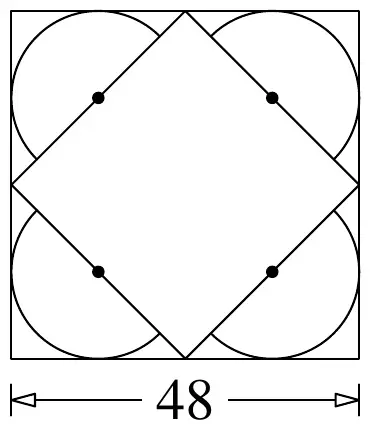
19. The diagram shows two squares and four equal semicircles. The edges of the outer square have length 48 and the inner square joins the midpoints of the edges of the outer square. Each semicircle touches two edges of the outer square, and the diameter of each semicircle lies along an edge of the inner square.

What is the radius of each semicircle?

  1. A 10
  2. B 12
  3. C 14
  4. D 16
  5. E 18
A square of side 48 with an inner square joining the midpoints of its edges and four semicircles on the edges of the inner square

Intermediate Mathematical Challenge 2020, Question 19. © UK Mathematics Trust. Original paper on ukmt.org.uk

PK 2020 Q17

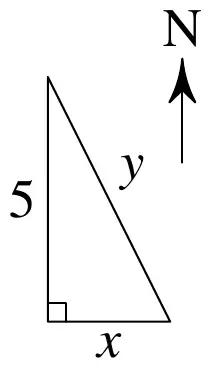
17. A hare and a tortoise competed in a 5 km race along a straight line, going due North. The hare is five times as fast as the tortoise. The hare mistakenly started running due East. After a while he realised his mistake, then turned and ran straight to the finish point. He arrived at the same time as the tortoise. What was the distance between the hare’s turning point and the finish point?

  1. A 11 km
  2. B 12 km
  3. C 13 km
  4. D 14 km
  5. E 15 km

Pink Kangaroo 2020, Question 17. © UK Mathematics Trust. Original paper on ukmt.org.uk

GK 2020 Q17

GKCurrent spec6 marksGeometry & Angles

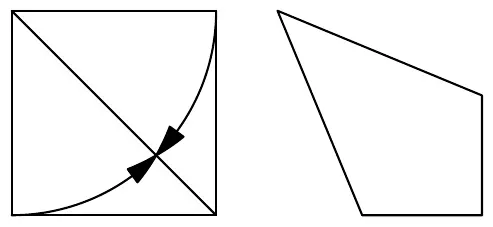
17. Bella took a square piece of paper and folded two of its sides to lie along the diagonal, as shown, to obtain a quadrilateral. What is the largest size of an angle in that quadrilateral?

  1. A 112.5°
  2. B 120°
  3. C 125°
  4. D 135°
  5. E 150°
A square with two sides folded onto the diagonal, and the resulting quadrilateral

Grey Kangaroo 2020, Question 17. © UK Mathematics Trust. Original paper on ukmt.org.uk

IMC 2020 Q15

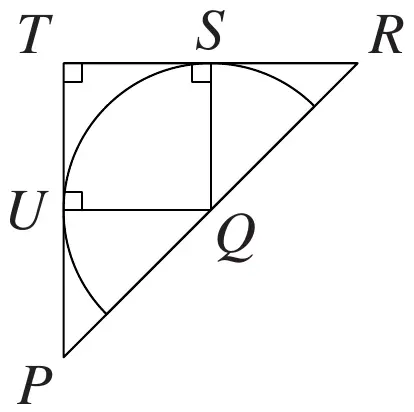
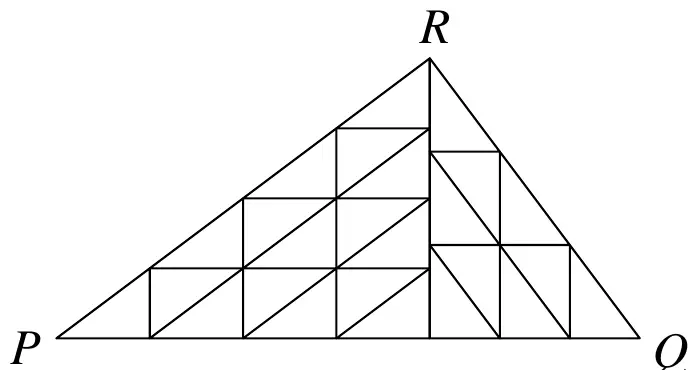
15. Triangle \(PQR\) has been divided into twenty-five congruent right-angled triangles, as shown. The length of \(RP\) is 2.4 cm.

What is the length of \(PQ\)?

  1. A 3 cm
  2. B 3.2 cm
  3. C 3.6 cm
  4. D 4 cm
  5. E 4.8 cm
Triangle PQR divided into twenty-five congruent right-angled triangles

Intermediate Mathematical Challenge 2020, Question 15. © UK Mathematics Trust. Original paper on ukmt.org.uk

PK 2020 Q12

PKCurrent spec5 marksGeometry & Angles

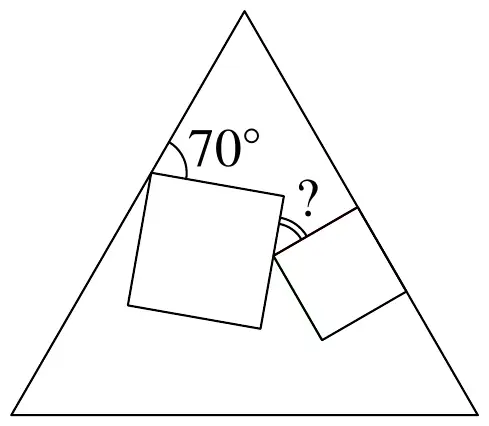
12. Two squares of different sizes are drawn inside an equilateral triangle. One side of one of these squares lies on one of the sides of the triangle as shown. What is the size of the angle marked by the question mark?

  1. A 25°
  2. B 30°
  3. C 35°
  4. D 45°
  5. E 50°
An equilateral triangle containing two squares of different sizes; an angle of 70 degrees and an angle marked with a question mark

Pink Kangaroo 2020, Question 12. © UK Mathematics Trust. Original paper on ukmt.org.uk

PK 2020 Q9

9. An isosceles triangle has a side of length 20 cm. Of the remaining two side-lengths, one is equal to two-fifths of the other. What is the length of the perimeter of this triangle?

  1. A 36 cm
  2. B 48 cm
  3. C 60 cm
  4. D 90 cm
  5. E 120 cm

Pink Kangaroo 2020, Question 9. © UK Mathematics Trust. Original paper on ukmt.org.uk

PK 2020 Q6

PKCurrent spec5 marksAlgebraGeometry & Angles

6. Mary had ten pieces of paper. Some of them were squares, and the rest were triangles. She cut three squares diagonally from corner to corner. She then found that the total number of vertices of the 13 pieces of paper was 42.

How many triangles did she have before making the cuts?

  1. A 8
  2. B 7
  3. C 6
  4. D 5
  5. E 4

Pink Kangaroo 2020, Question 6. © UK Mathematics Trust. Original paper on ukmt.org.uk

IMC 2020 Q5

IMCCurrent spec5 marksGeometry & Angles

5. Four of the following coordinate pairs are the corners of a square.
Which is the odd one out?

  1. A (4, 1)
  2. B (2, 4)
  3. C (5, 6)
  4. D (3, 5)
  5. E (7, 3)

Intermediate Mathematical Challenge 2020, Question 5. © UK Mathematics Trust. Original paper on ukmt.org.uk

GK 2020 Q4

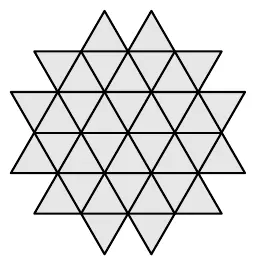
4. The diagram shows a shape made up of 36 identical small equilateral triangles. What is the smallest number of small triangles identical to these that could be added to the shape to turn it into a hexagon?

  1. A 10
  2. B 12
  3. C 15
  4. D 18
  5. E 24
A star-shaped figure made of 36 small equilateral triangles

Grey Kangaroo 2020, Question 4. © UK Mathematics Trust. Original paper on ukmt.org.uk

IMC 2019 Q25

IMCCurrent spec6 marksGeometry & Angles

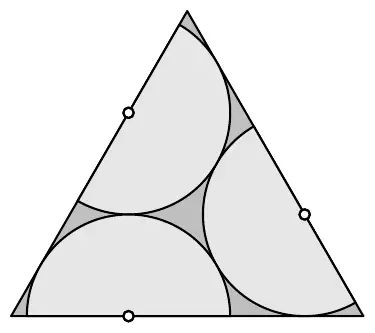
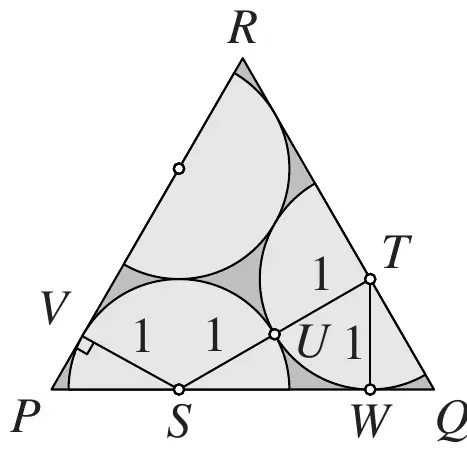
25. The diagram shows three touching semicircles with radius 1 inside an equilateral triangle, which each semicircle also touches. The diameter of each semicircle lies along a side of the triangle.

What is the length of each side of the equilateral triangle?

  1. A 3
  2. B \(\dfrac{13}{4}\)
  3. C \(\tfrac{3}{2}\sqrt{3}\)
  4. D \(2\sqrt{3}\)
  5. E 4
Three touching semicircles of radius 1 inside an equilateral triangle, each with its diameter along a side

Intermediate Mathematical Challenge 2019, Question 25. © UK Mathematics Trust. Original paper on ukmt.org.uk

IMC 2019 Q23

IMCCurrent spec6 marksAlgebraGeometry & Angles

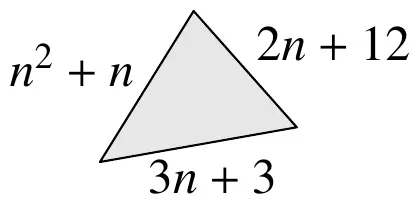
23. The diagram shows a triangle with sides \(n^2 + n\), \(2n + 12\) and \(3n + 3\).

What is the sum of all the values of \(n\) for which the triangle is isosceles?

  1. A 7
  2. B 9
  3. C 12
  4. D 13
  5. E 16
A triangle with sides labelled n squared plus n, 2n plus 12 and 3n plus 3

Intermediate Mathematical Challenge 2019, Question 23. © UK Mathematics Trust. Original paper on ukmt.org.uk

IMC 2019 Q21

IMCCurrent spec6 marksGeometry & Angles

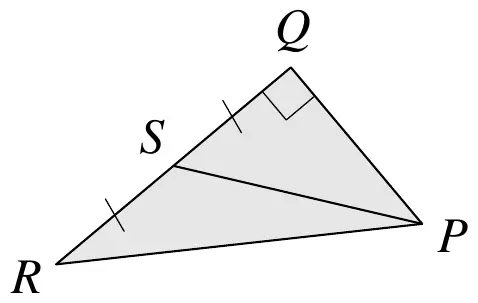
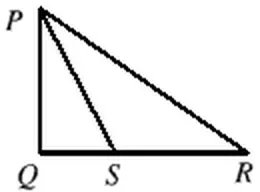
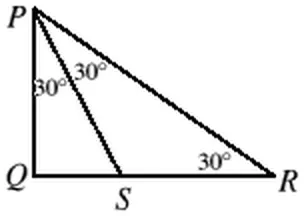
21. The diagram shows a right-angled triangle \(PQR\). The point \(S\) is the midpoint of the side \(QR\) and \(\tan \angle QPR = \tfrac{3}{2}\).

What is the value of \(\sin \angle QPS\)?

  1. A \(\dfrac{1}{\sqrt{3}}\)
  2. B \(\dfrac{1}{\sqrt{2}}\)
  3. C \(\dfrac{1}{2}\)
  4. D \(\dfrac{3}{5}\)
  5. E \(\dfrac{4}{5}\)
Right-angled triangle PQR with the right angle at Q and S the midpoint of QR joined to P

Intermediate Mathematical Challenge 2019, Question 21. © UK Mathematics Trust. Original paper on ukmt.org.uk

IMC 2019 Q20

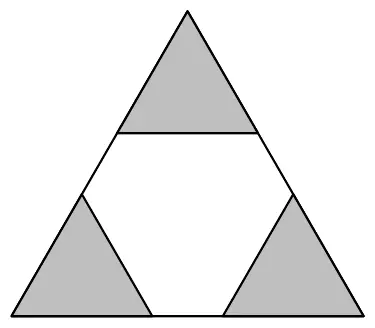
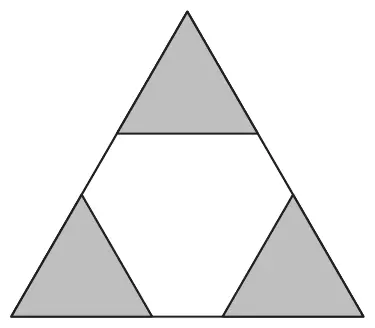
20. Three equilateral triangles with sides of length 1 are shown shaded in a larger equilateral triangle. The total shaded area is half the area of the larger triangle.

What is the side-length of the larger equilateral triangle?

  1. A \(\sqrt{5}\)
  2. B \(\sqrt{6}\)
  3. C \(\dfrac{5}{2}\)
  4. D \(\dfrac{3\sqrt{3}}{2}\)
  5. E \(1 + \sqrt{3}\)
A large equilateral triangle with three small shaded equilateral triangles of side 1 at its corners

Intermediate Mathematical Challenge 2019, Question 20. © UK Mathematics Trust. Original paper on ukmt.org.uk

PK 2019 Q18

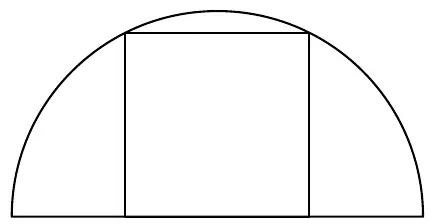
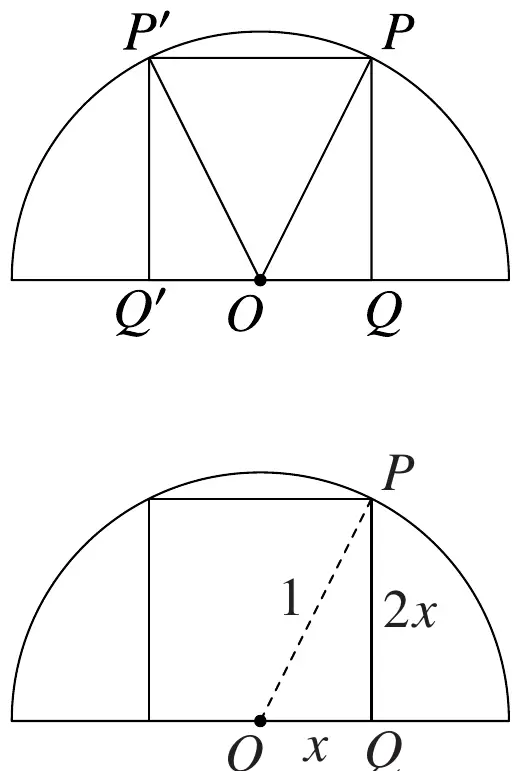
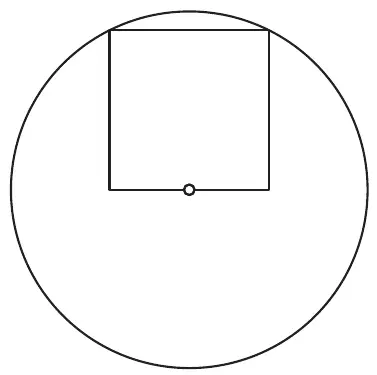
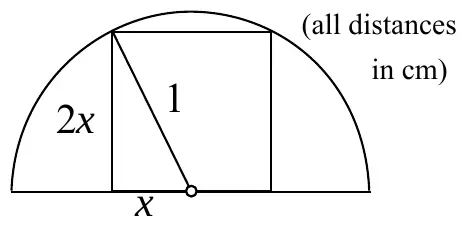
18. A square has two of its vertices on a semicircle and the other two on the diameter of the semicircle as shown. The radius of the circle is 1. What is the area of the square?

  1. A \(\dfrac{4}{5}\)
  2. B \(\dfrac{\pi}{4}\)
  3. C 1
  4. D \(\dfrac{4}{3}\)
  5. E \(\dfrac{2}{\sqrt{3}}\)
A square with two vertices on a semicircle and two on its diameter

Pink Kangaroo 2019, Question 18. © UK Mathematics Trust. Original paper on ukmt.org.uk

PK 2019 Q17

PKCurrent spec6 marksGeometry & Angles

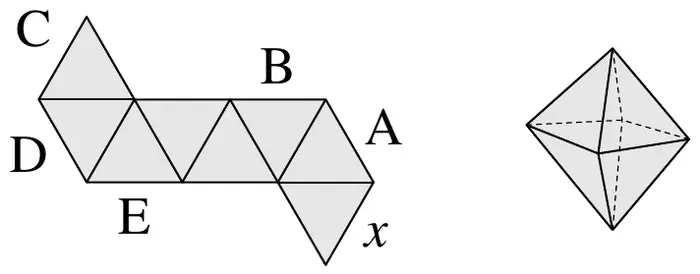
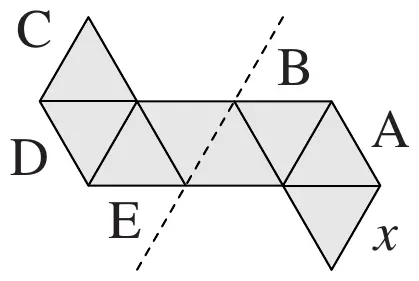
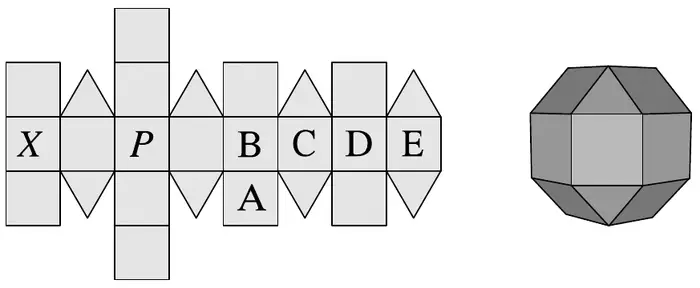
17. The diagram shows a net of an octahedron. When this is folded to form the octahedron, which of the labelled line segments will coincide with the line segment labelled \(x\)?

  1. A  
  2. B  
  3. C  
  4. D  
  5. E  
A net of eight equilateral triangles with edges labelled A, B, C, D, E and x, and a picture of an octahedron

Pink Kangaroo 2019, Question 17. © UK Mathematics Trust. Original paper on ukmt.org.uk

IMC 2019 Q15

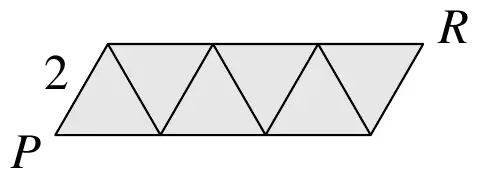
15. The diagram shows six congruent equilateral triangles, of side-length 2, placed together to form a parallelogram.

What is the length of \(PR\)?

  1. A \(2\sqrt{13}\)
  2. B 7
  3. C \(6\sqrt{3}\)
  4. D 9
  5. E \(7\sqrt{3}\)
A parallelogram made of six equilateral triangles of side 2, with P at the bottom left and R at the top right

Intermediate Mathematical Challenge 2019, Question 15. © UK Mathematics Trust. Original paper on ukmt.org.uk

PK 2019 Q14

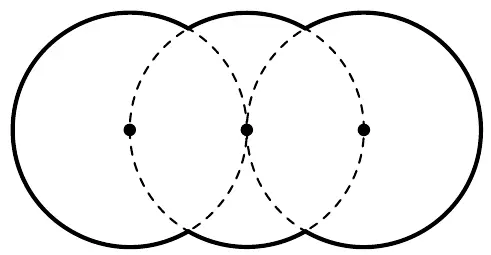
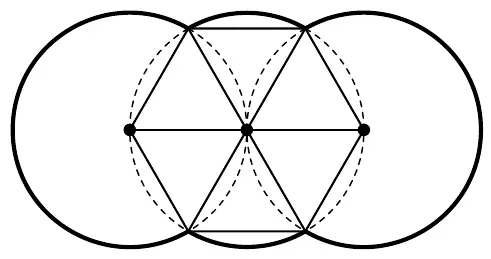
14. The diagram shows a shape made of arcs of three circles, each with radius \(R\). The centres of the circles lie on the same straight line, and the middle circle passes through the centres of the other two circles. What is the perimeter of the shape?

  1. A \(\dfrac{2\pi R\sqrt{3}}{3}\)
  2. B \(\dfrac{5\pi R}{3}\)
  3. C \(\dfrac{10\pi R}{3}\)
  4. D \(2\pi R\sqrt{3}\)
  5. E \(4\pi R\)
Three circles of equal radius with centres on a line; the outline of the shape is drawn solid and the inner arcs dashed

Pink Kangaroo 2019, Question 14. © UK Mathematics Trust. Original paper on ukmt.org.uk

GK 2019 Q13

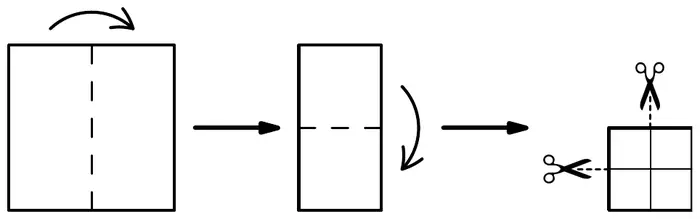
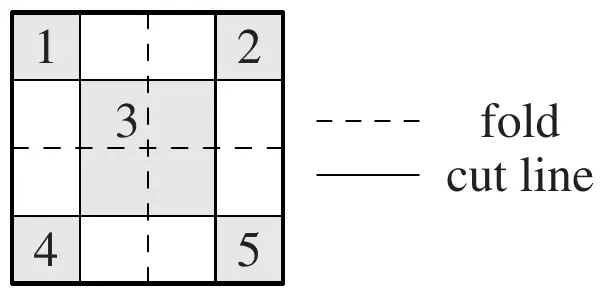
13. Cathie folded a square sheet of paper in half twice and then cut it through the middle twice, as shown in the diagram, before unfolding it all. How many of the pieces that she obtained were squares?

  1. A 3
  2. B 4
  3. C 5
  4. D 6
  5. E 8
A square folded in half twice, then cut twice through the middle as shown by scissors

Grey Kangaroo 2019, Question 13. © UK Mathematics Trust. Original paper on ukmt.org.uk

IMC 2019 Q12

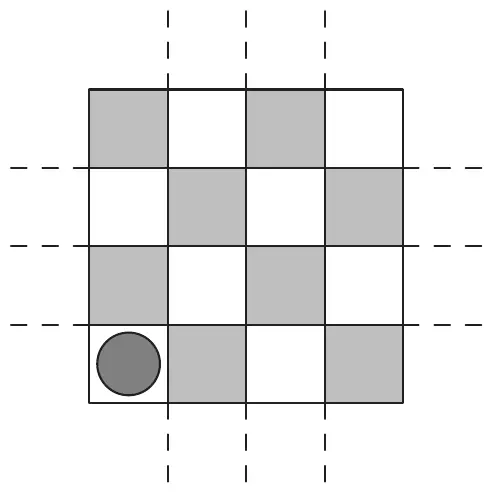
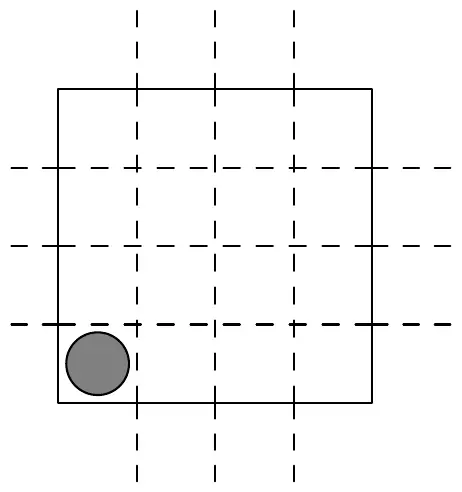
12. The game of Rorrim2 is played on a 4 × 4 board, starting with a counter in one corner, as shown.

At each turn, the player moves the counter to a cell that is the reflection of its current cell in one of the six dashed lines.

How many cells could the counter occupy after precisely three turns?

  1. A 4
  2. B 6
  3. C 8
  4. D 12
  5. E 16
A 4 by 4 board with a counter in the bottom left corner and six dashed lines through it, three vertical and three horizontal

Intermediate Mathematical Challenge 2019, Question 12. © UK Mathematics Trust. Original paper on ukmt.org.uk

PK 2019 Q10

PKCurrent spec5 marksGeometry & Angles

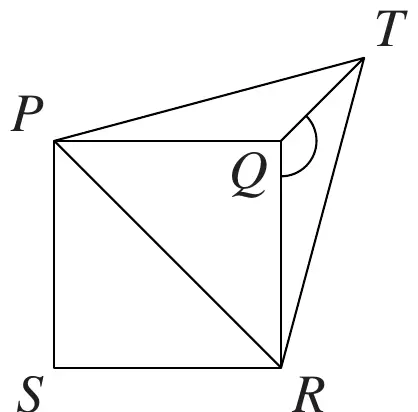
10. A square has vertices \(P\), \(Q\), \(R\), \(S\) labelled clockwise. An equilateral triangle is constructed with vertices \(P\), \(T\), \(R\) labelled clockwise. What is the size of angle \(RQT\) in degrees?

  1. A 30
  2. B 45
  3. C 135
  4. D 145
  5. E 150

Pink Kangaroo 2019, Question 10. © UK Mathematics Trust. Original paper on ukmt.org.uk

GK 2019 Q10

GKCurrent spec5 marksGeometry & Angles

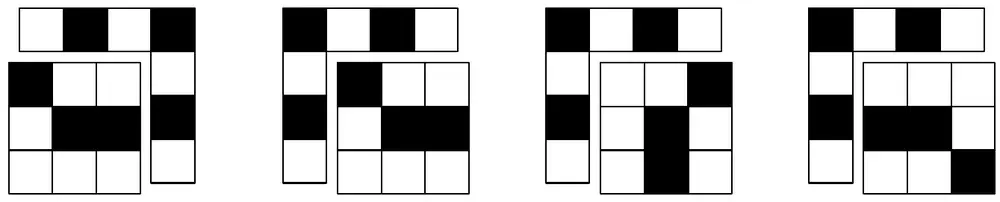
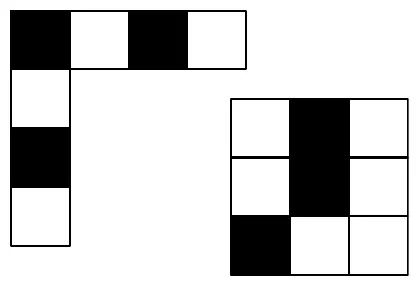
10. Which of the following 4 × 4 tiles cannot be formed by combining the two given pieces?

Two pieces: an L-shaped piece of seven squares and a 3 by 3 piece, with some squares black
Five 4 by 4 tiles labelled A to E with different patterns of black and white squares

Grey Kangaroo 2019, Question 10. © UK Mathematics Trust. Original paper on ukmt.org.uk

GK 2019 Q9

GKCurrent spec5 marksGeometry & Angles

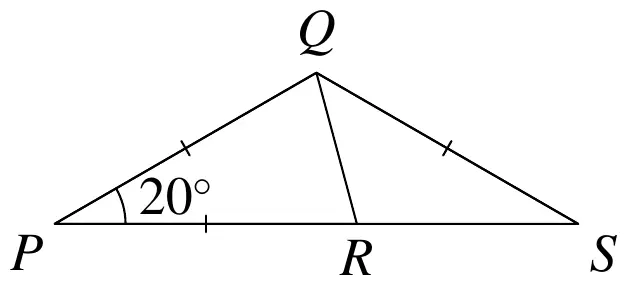
9. In the diagram, \(PQ = PR = QS\) and \(\angle QPR = 20°\). What is \(\angle RQS\)?

  1. A 50°
  2. B 60°
  3. C 65°
  4. D 70°
  5. E 75°
Triangle PQS with R on PS; PQ, PR and QS are marked equal and angle QPR is 20 degrees

Grey Kangaroo 2019, Question 9. © UK Mathematics Trust. Original paper on ukmt.org.uk

PK 2019 Q7

PKCurrent spec5 marksGeometry & Angles

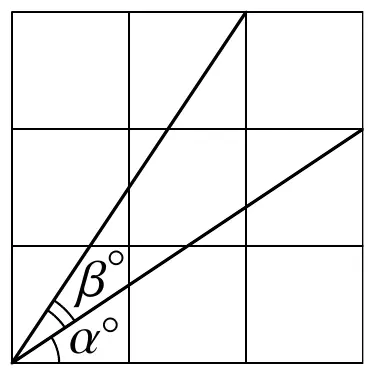
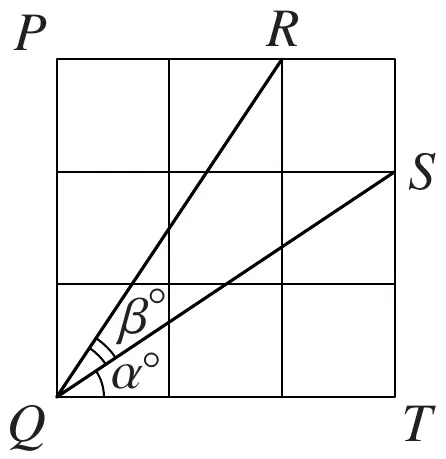
7. Two angles are marked on the 3 × 3 grid of squares.
Which of the following statements about the angles is correct?

  1. A \(\alpha = \beta\)
  2. B \(2\alpha + \beta = 90\)
  3. C \(\alpha + \beta = 60\)
  4. D \(2\beta + \alpha = 90\)
  5. E \(\alpha + \beta = 45\)
A 3 by 3 grid of squares with two lines from the bottom-left corner, making angles alpha and beta

Pink Kangaroo 2019, Question 7. © UK Mathematics Trust. Original paper on ukmt.org.uk

IMC 2019 Q6

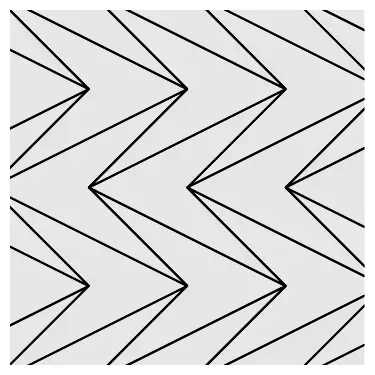
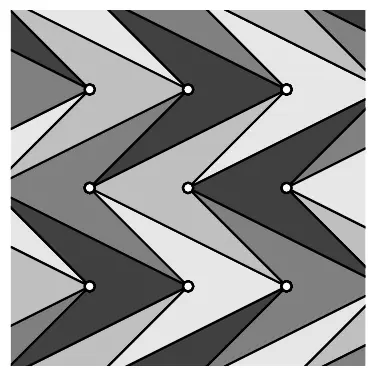
6. The diagram shows part of a tessellation of the plane by a quadrilateral.

Khelen wants to colour each quadrilateral in the pattern so that no two quadrilaterals that meet (even at a point) have the same colour.

What is the smallest number of colours he needs?

  1. A 3
  2. B 4
  3. C 5
  4. D 6
  5. E 7
Part of a tessellation of the plane by a quadrilateral, forming zigzag rows

Intermediate Mathematical Challenge 2019, Question 6. © UK Mathematics Trust. Original paper on ukmt.org.uk

PK 2019 Q3

PKCurrent spec5 marksGeometry & Angles

3. A barber wants to write the word SHAVE on a board behind the client’s seat in such a way that a client looking in the mirror reads the word correctly. Which of the following should the barber write on the board?

Five versions of the word labelled A to E: A SHAVE; B SHAVE with the E reversed; C EVAHS with the E reversed; D EVAHS with the S reversed; E EVAHS with the E and S reversed

Pink Kangaroo 2019, Question 3. © UK Mathematics Trust. Original paper on ukmt.org.uk

PK 2018 Q25

PKCurrent spec6 marksGeometry & Angles

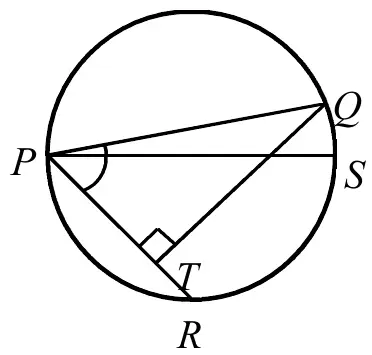
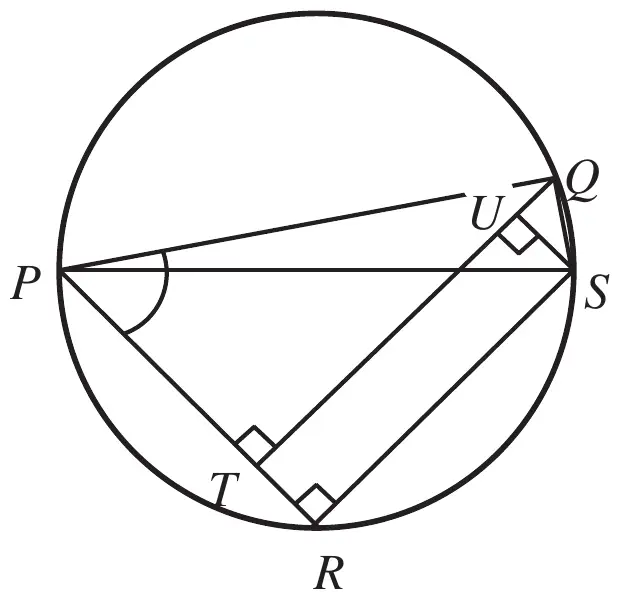
25. Two chords \(PQ\) and \(PR\) are drawn in a circle with diameter \(PS\).
The point \(T\) lies on \(PR\) and \(QT\) is perpendicular to \(PR\). The angle \(QPR = 60°\), \(PQ = 24\) cm, \(RT = 3\) cm. What is the length of the chord \(QS\) in cm?

  1. A \(\sqrt{3}\)
  2. B 2
  3. C 3
  4. D \(2\sqrt{3}\)
  5. E \(3\sqrt{2}\)
A circle with diameter PS, chords PQ and PR, and T on PR with QT perpendicular to PR

Pink Kangaroo 2018, Question 25. © UK Mathematics Trust. Original paper on ukmt.org.uk

GK 2018 Q25

GKCurrent spec6 marksGeometry & Angles

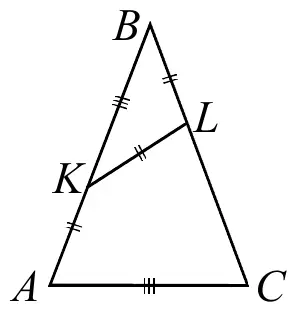
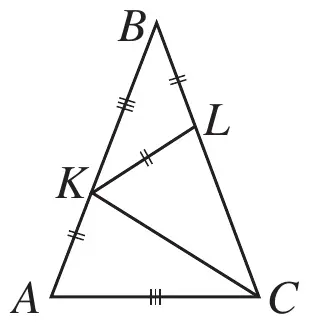
25. In the isosceles triangle \(ABC\), points \(K\) and \(L\) are marked on the equal sides \(AB\) and \(BC\) respectively so that \(AK = KL = LB\) and \(KB = AC\).
What is the size of angle \(ABC\)?

  1. A 36°
  2. B 38°
  3. C 40°
  4. D 42°
  5. E 44°
Isosceles triangle ABC with K on AB and L on BC; AK, KL and LB are marked equal, and KB and AC are marked equal

Grey Kangaroo 2018, Question 25. © UK Mathematics Trust. Original paper on ukmt.org.uk

IMC 2018 Q25

IMCCurrent spec6 marksGeometry & Angles

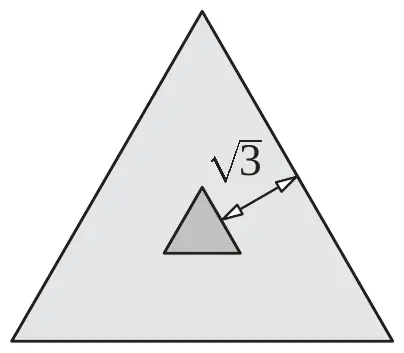
25. The diagram shows two equilateral triangles. The distance from each point of the smaller triangle to the nearest point of the larger triangle is \(\sqrt{3}\), as shown.
What is the difference between the lengths of the edges of the two triangles?

  1. A \(2\sqrt{3}\)
  2. B \(4\tfrac{1}{2}\)
  3. C \(3\sqrt{3}\)
  4. D 6
  5. E \(4\sqrt{3}\)
A small equilateral triangle inside a larger one, with the distance root 3 marked between them

Intermediate Mathematical Challenge 2018, Question 25. © UK Mathematics Trust. Original paper on ukmt.org.uk

IMC 2018 Q23

23. The diagram shows a hexagon. All the interior angles of the hexagon are 120°. The lengths of some of the sides are indicated.
What is the area of the hexagon?

  1. A \(20\sqrt{3}\)
  2. B \(21\sqrt{3}\)
  3. C \(22\sqrt{3}\)
  4. D \(23\sqrt{3}\)
  5. E \(24\sqrt{3}\)
A hexagon with all angles 120 degrees and sides of length 4, 3, 2, 8 and 1 marked

Intermediate Mathematical Challenge 2018, Question 23. © UK Mathematics Trust. Original paper on ukmt.org.uk

PK 2018 Q21

PKCurrent spec6 marksGeometry & Angles

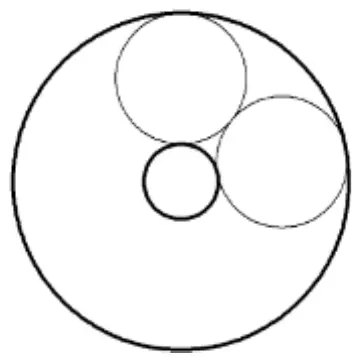
21. An annulus is a shape made from two concentric circles. The diagram shows an annulus consisting of two concentric circles of radii 2 and 9. Inside this annulus two circles are drawn without overlapping, each being tangent to both of the concentric circles that make the annulus. In a different annulus made by concentric circles of radii 1 and 9, what would be the largest possible number of non-overlapping circles that could be drawn in this way?

  1. A 2
  2. B 3
  3. C 4
  4. D 5
  5. E 6
A large circle with a small concentric circle, and two circles between them, each touching both

Pink Kangaroo 2018, Question 21. © UK Mathematics Trust. Original paper on ukmt.org.uk

PK 2018 Q18

18. Lonneke drew a regular polygon with 2018 vertices, which she labelled from 1 to 2018, in a clockwise direction. She then drew a diagonal from the vertex labelled 18 to the vertex labelled 1018. She also drew the diagonal from the vertex labelled 1018 to the vertex labelled 2000. This divided the original polygon into three new polygons. How many vertices did each of the resulting three polygons have?

  1. A 38, 983, 1001
  2. B 37, 983, 1001
  3. C 38, 982, 1001
  4. D 37, 982, 1000
  5. E 37, 983, 1002

Pink Kangaroo 2018, Question 18. © UK Mathematics Trust. Original paper on ukmt.org.uk

IMC 2018 Q18

IMCCurrent spec6 marksGeometry & Angles

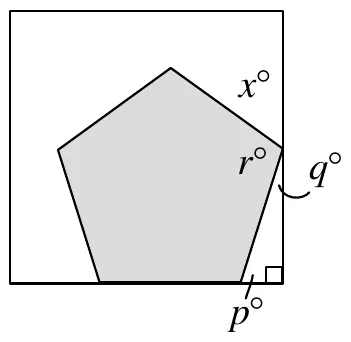
18. The diagram shows a regular pentagon and an equilateral triangle placed inside a square.
What is the value of \(x\)?

  1. A 24
  2. B 26
  3. C 28
  4. D 30
  5. E 32
A regular pentagon and an equilateral triangle inside a square, with an angle x degrees marked at the bottom right corner

Intermediate Mathematical Challenge 2018, Question 18. © UK Mathematics Trust. Original paper on ukmt.org.uk

IMC 2018 Q16

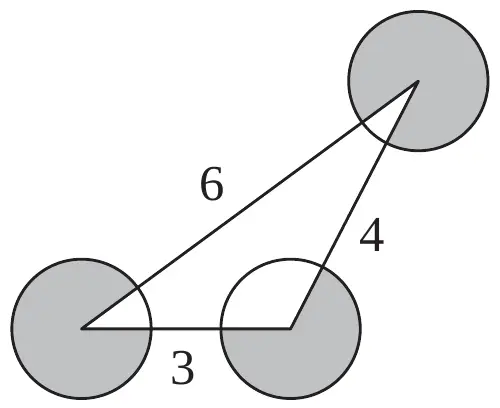
16. The diagram shows a triangle with edges of length 3, 4 and 6.
A circle of radius 1 is drawn at each vertex of the triangle.
What is the total shaded area?

  1. A \(2\pi\)
  2. B \(\dfrac{9\pi}{4}\)
  3. C \(\dfrac{5\pi}{2}\)
  4. D \(\dfrac{11\pi}{4}\)
  5. E \(3\pi\)
A triangle with sides 3, 4 and 6, with a circle of radius 1 centred at each vertex; the parts of the circles outside the triangle are shaded

Intermediate Mathematical Challenge 2018, Question 16. © UK Mathematics Trust. Original paper on ukmt.org.uk

IMC 2018 Q15

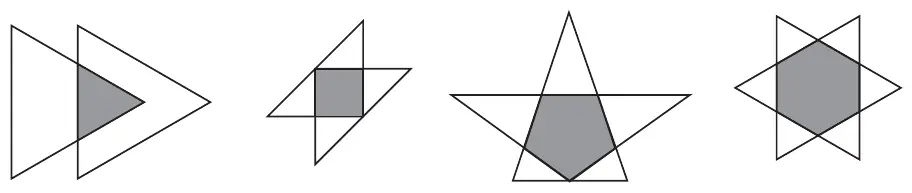
15. How many of these four shapes could be the shape of the region where two triangles overlap?

equilateral triangle   square   regular pentagon   regular hexagon
  1. A 0
  2. B 1
  3. C 2
  4. D 3
  5. E 4

Intermediate Mathematical Challenge 2018, Question 15. © UK Mathematics Trust. Original paper on ukmt.org.uk

GK 2018 Q12

GKCurrent spec5 marksGeometry & Angles

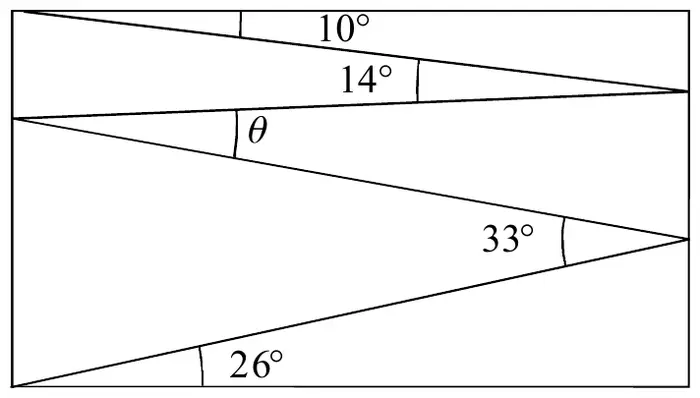
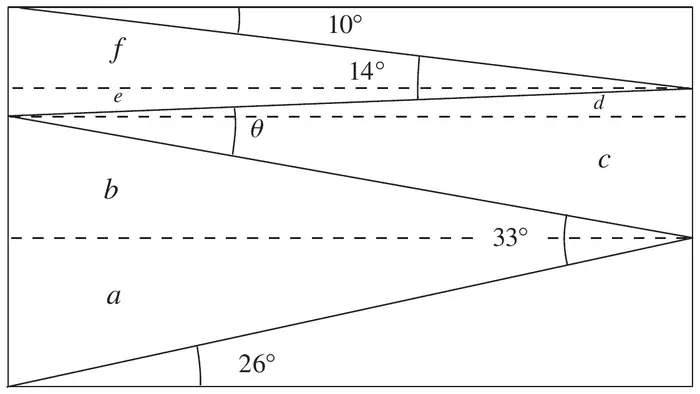
12. Valeriu draws a zig-zag line inside a rectangle, creating angles of 10°, 14°, 33° and 26° as shown.
What is the size of the angle marked \(\theta\)?

  1. A 11°
  2. B 12°
  3. C 16°
  4. D 17°
  5. E 33°
A zig-zag line inside a rectangle making angles of 10, 14, 33 and 26 degrees, with the angle theta marked

Grey Kangaroo 2018, Question 12. © UK Mathematics Trust. Original paper on ukmt.org.uk

GK 2018 Q7

GKCurrent spec5 marksGeometry & Angles

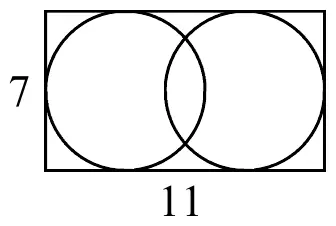
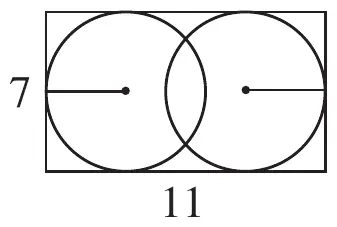
7. The diagram shows a rectangle of size 7 cm × 11 cm containing two circles that each touch three of the sides of the rectangle. What is the distance between the centres of the two circles?

  1. A 2 cm
  2. B 2.5 cm
  3. C 3 cm
  4. D 3.5 cm
  5. E 4 cm
A 7 by 11 rectangle containing two overlapping circles, each touching three sides

Grey Kangaroo 2018, Question 7. © UK Mathematics Trust. Original paper on ukmt.org.uk

IMC 2018 Q4

IMCCurrent spec5 marksGeometry & Angles

4. A kite is made by joining two congruent isosceles triangles, as shown.
What is the value of \(x\)?

  1. A 36
  2. B 54
  3. C 60
  4. D 72
  5. E 80
A kite made of two congruent isosceles triangles, with three angles each marked x degrees

Intermediate Mathematical Challenge 2018, Question 4. © UK Mathematics Trust. Original paper on ukmt.org.uk

GK 2018 Q3

GKCurrent spec5 marksGeometry & Angles

3. The faces of a cube are painted black, white or grey. Each face is only painted one colour and opposite faces are painted the same colour. Which of the following is a possible net for the cube?

Five cube nets labelled A to E, each with two black, two white and two grey faces in different positions

Grey Kangaroo 2018, Question 3. © UK Mathematics Trust. Original paper on ukmt.org.uk

GK 2018 Q2

GKCurrent spec5 marksGeometry & Angles

2. When the letters of the word MAMA are written vertically above one another the word has a vertical line of symmetry.
Which of these words also has a vertical line of symmetry when written in the same way?

  1. A ROOT
  2. B BOOM
  3. C BOOT
  4. D LOOT
  5. E TOOT
M
A
M
A

Grey Kangaroo 2018, Question 2. © UK Mathematics Trust. Original paper on ukmt.org.uk

PK 2018 Q1

PKCurrent spec5 marksGeometry & Angles

1. The lengths of two sides of a triangle are 5 cm and 2 cm. The length of the third side in cm is an odd integer. What is the length of the third side?

  1. A 1 cm
  2. B 3 cm
  3. C 5 cm
  4. D 7 cm
  5. E 9 cm

Pink Kangaroo 2018, Question 1. © UK Mathematics Trust. Original paper on ukmt.org.uk

PK 2017 Q25

PKCurrent spec6 marksGeometry & Angles

25. The diagram shows a triangle \(FHI\), and a point \(G\) on \(FH\) such that \(GH = FI\). The points \(M\) and \(N\) are the midpoints of \(FG\) and \(HI\) respectively. Angle \(NMH = \alpha°\). Which of the following gives an expression for \(\angle IFH\)?

Triangle FHI with G on FH, M the midpoint of FG, N the midpoint of HI, and the segment MN drawn
  1. A \(2\alpha°\)
  2. B \((90 - \alpha)°\)
  3. C \(45 + \alpha°\)
  4. D \(\left(90 - \tfrac{1}{2}\alpha\right)°\)
  5. E 60°

Pink Kangaroo 2017, Question 25. © UK Mathematics Trust. Original paper on ukmt.org.uk

IMC 2017 Q25

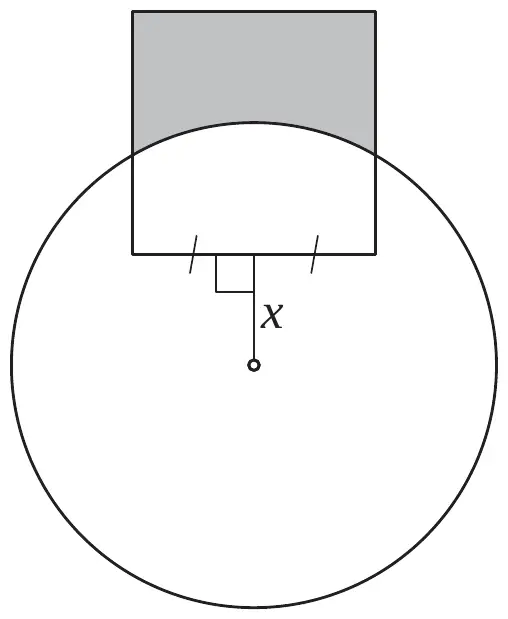
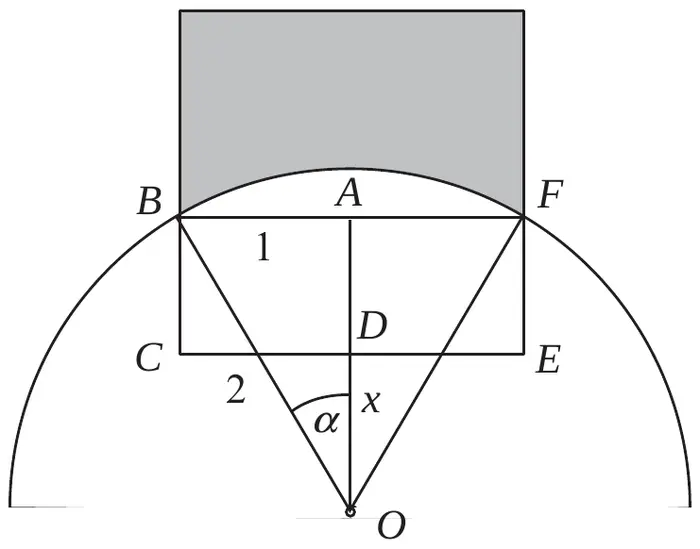
25. The diagram shows a circle with radius 2 and a square with sides of length 2. The centre of the circle lies on the perpendicular bisector of a side of the square, at a distance \(x\) from the side, as shown. The shaded region − inside the square but outside the circle − has area 2.
What is the value of \(x\)?

A square of side 2 above the centre of a circle of radius 2; the part of the square outside the circle is shaded; x is the distance from the centre to the bottom side of the square
  1. A \(\dfrac{\pi}{3} + \dfrac{\sqrt{3}}{2} - 1\)
  2. B \(\dfrac{\pi}{3} + \dfrac{\sqrt{3}}{4} - 1\)
  3. C \(\dfrac{\pi}{3} + \dfrac{1}{2}\)
  4. D \(\dfrac{\pi}{3} + 1\)
  5. E \(\dfrac{\pi}{3}\)

Intermediate Mathematical Challenge 2017, Question 25. © UK Mathematics Trust. Original paper on ukmt.org.uk

PK 2017 Q24

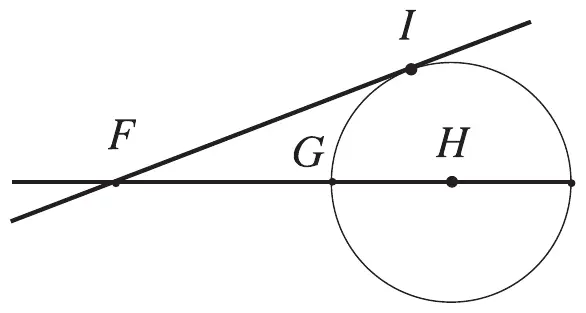
24. The points \(G\) and \(I\) are on the circle with centre \(H\), and \(FI\) is tangent to the circle at \(I\). The distances \(FG\) and \(HI\) are integers, and \(FI = FG + 6\). The point \(G\) lies on the straight line through \(F\) and \(H\). How many possible values are there for \(HI\)?

  1. A 0
  2. B 2
  3. C 4
  4. D 6
  5. E 8
A circle with centre H; a line through F, G and H, and a line from F touching the circle at I

Pink Kangaroo 2017, Question 24. © UK Mathematics Trust. Original paper on ukmt.org.uk

PK 2017 Q22

PKCurrent spec6 marksGeometry & Angles

22. Liza found the total of the interior angles of a convex polygon. She missed one of the angles and obtained the result 2017°. Which of the following was the angle she missed?

  1. A 37°
  2. B 53°
  3. C 97°
  4. D 127°
  5. E 143°

Pink Kangaroo 2017, Question 22. © UK Mathematics Trust. Original paper on ukmt.org.uk

IMC 2017 Q22

IMCCurrent spec6 marksGeometry & Angles

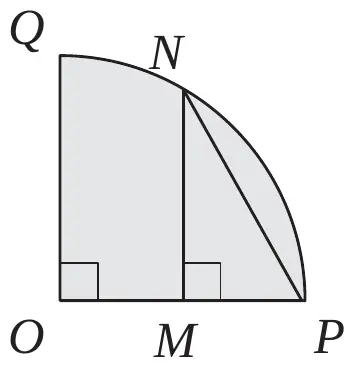
22. The diagram shows an arc \(PQ\) of a circle with centre \(O\) and radius 8. Angle \(QOP\) is a right angle, the point \(M\) is the midpoint of \(OP\) and \(N\) lies on the arc \(PQ\) so that \(MN\) is perpendicular to \(OP\).
Which of the following is closest to the length of the perimeter of triangle \(PNM\)?

  1. A 17
  2. B 18
  3. C 19
  4. D 20
  5. E 21
A quarter circle OPQ with M the midpoint of OP and N on the arc above M; triangle PNM is drawn

Intermediate Mathematical Challenge 2017, Question 22. © UK Mathematics Trust. Original paper on ukmt.org.uk

IMC 2017 Q20

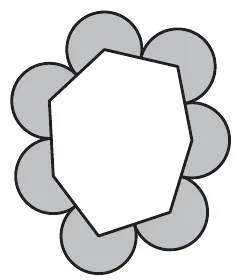
20. The diagram shows seven circular arcs and a heptagon with equal sides but unequal angles. The sides of the heptagon have length 4. The centre of each arc is a vertex of the heptagon, and the ends of the arc are the midpoints of the two adjacent sides.
What is the total shaded area?

  1. A \(12\pi\)
  2. B \(14\pi\)
  3. C \(16\pi\)
  4. D \(18\pi\)
  5. E \(20\pi\)
A heptagon with equal sides; seven shaded circular arcs centred at its vertices bulge outwards

Intermediate Mathematical Challenge 2017, Question 20. © UK Mathematics Trust. Original paper on ukmt.org.uk

IMC 2017 Q17

IMCCurrent spec6 marksGeometry & Angles

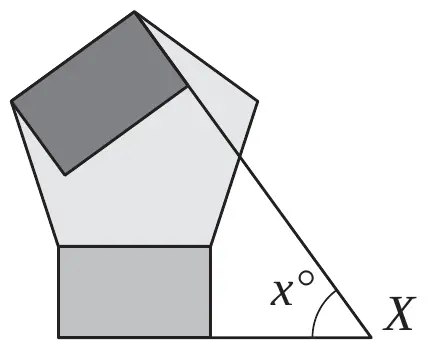
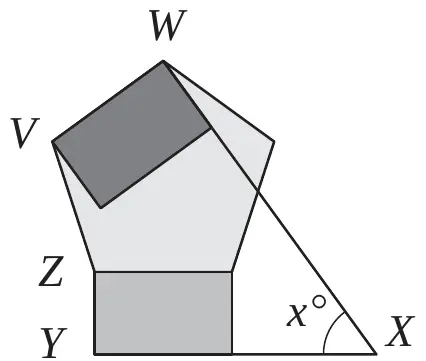
17. The diagram shows two rectangles and a regular pentagon. One side of each rectangle has been extended to meet at \(X\).
What is the value of \(x\)?

  1. A 52
  2. B 54
  3. C 56
  4. D 58
  5. E 60
A regular pentagon with a rectangle on its top-left side and one on its bottom side; a side of each rectangle is extended to meet at X, making angle x degrees

Intermediate Mathematical Challenge 2017, Question 17. © UK Mathematics Trust. Original paper on ukmt.org.uk

IMC 2017 Q15

IMCCurrent spec5 marksGeometry & Angles

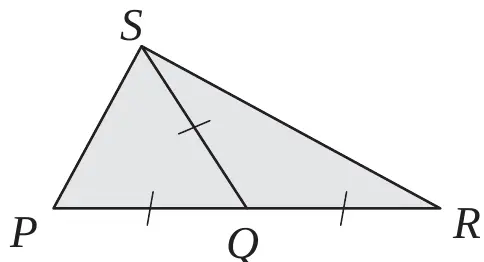
15. In the diagram shown, \(PQ = SQ = QR\) and \(\angle SPQ = 2 \times \angle RSQ\).
What is the size of angle \(QRS\)?

  1. A 20°
  2. B 25°
  3. C 30°
  4. D 35°
  5. E 40°
Triangle PSR with Q on PR such that PQ = SQ = QR

Intermediate Mathematical Challenge 2017, Question 15. © UK Mathematics Trust. Original paper on ukmt.org.uk

IMC 2017 Q13

13. The diagram shows a quadrilateral \(PQRS\) made from two similar right-angled triangles, \(PQR\) and \(PRS\). The length of \(PQ\) is 3, the length of \(QR\) is 4 and \(\angle PRQ = \angle PSR\).
What is the perimeter of \(PQRS\)?

  1. A 22
  2. B \(22\frac{5}{6}\)
  3. C 27
  4. D 32
  5. E \(45\frac{1}{3}\)
Quadrilateral PQRS made of right-angled triangles PQR and PRS, with PQ = 3 and QR = 4

Intermediate Mathematical Challenge 2017, Question 13. © UK Mathematics Trust. Original paper on ukmt.org.uk

IMC 2017 Q10

IMCCurrent spec5 marksGeometry & Angles

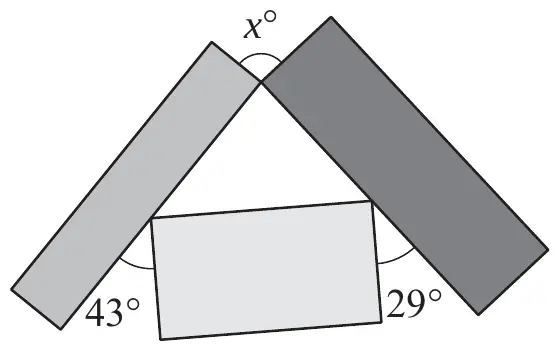
10. The diagram shows three rectangles.
What is the value of \(x\)?

  1. A 108
  2. B 104
  3. C 100
  4. D 96
  5. E 92
Three rectangles: two tilted ones meeting at the top with angle x degrees between them, resting on a lower rectangle, with angles 43 and 29 degrees marked

Intermediate Mathematical Challenge 2017, Question 10. © UK Mathematics Trust. Original paper on ukmt.org.uk

IMC 2017 Q6

6. The angles of a quadrilateral are in the ratio 3 : 4 : 5 : 6.

What is the difference between the largest angle and the smallest angle?

  1. A 30°
  2. B 40°
  3. C 50°
  4. D 60°
  5. E 70°

Intermediate Mathematical Challenge 2017, Question 6. © UK Mathematics Trust. Original paper on ukmt.org.uk

PK 2017 Q4

PKCurrent spec5 marksGeometry & Angles

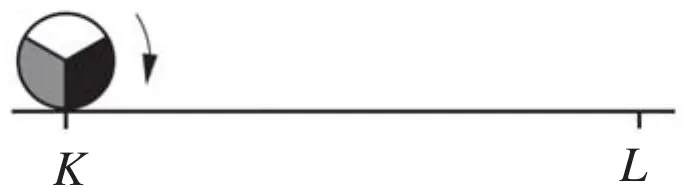
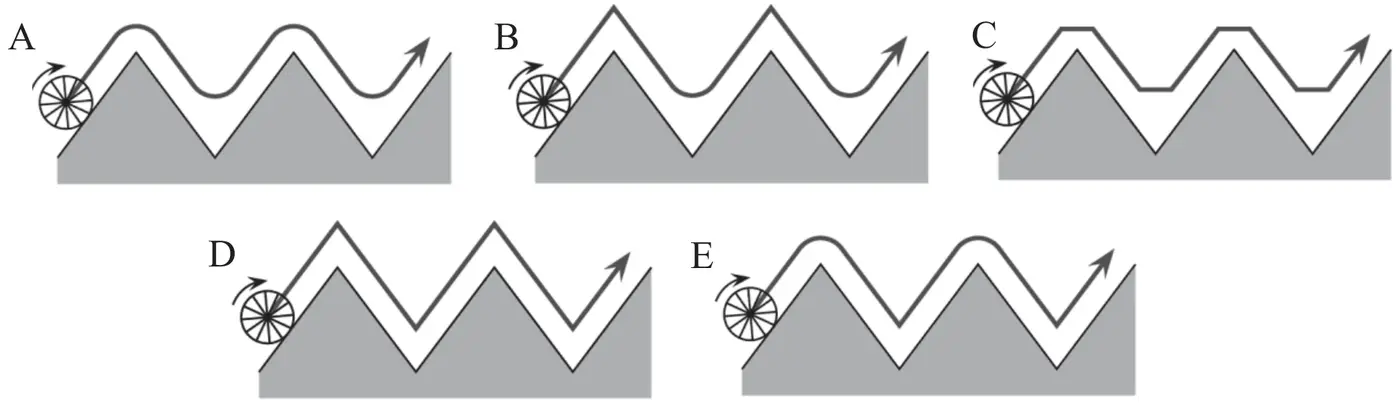
4. A circle of radius 1 rolls along a straight line from the point \(K\) to the point \(L\), where \(KL = 11\pi\). Which of the following pictures shows the correct appearance of the circle when it reaches \(L\)?

A circle divided into a white, a grey and a black sector, resting on a line at K, with L further along the line
Five circles labelled A to E, each divided into white, grey and black sectors in different orientations

Pink Kangaroo 2017, Question 4. © UK Mathematics Trust. Original paper on ukmt.org.uk

IMC 2017 Q2

2. Each of the diagrams below shows a circle and four small squares. In each case, the centre of the circle is the point where all four squares meet.
In one of the diagrams, exactly one third of the circle is shaded. Which one?

Five circles labelled A to E, each with four small squares meeting at its centre and a different sector shaded

Intermediate Mathematical Challenge 2017, Question 2. © UK Mathematics Trust. Original paper on ukmt.org.uk

IMC 2016 Q23

IMCCurrent spec6 marksGeometry & Angles

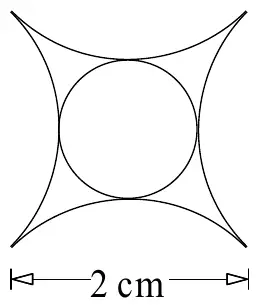
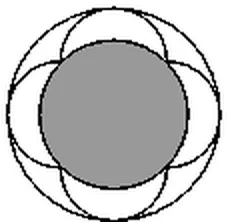
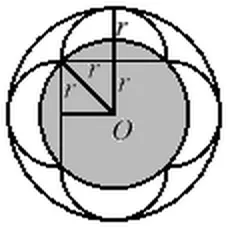
23. A Saxon silver penny, from the reign of Ethelbert II in the eighth century, was sold in 2014 for £78 000. A design on the coin depicts a circle surrounded by four equal arcs, each a quarter of a circle, as shown. The width of the design is 2 cm.
What is the radius of the small circle, in centimetres?

  1. A \(\frac{1}{2}\)
  2. B \(2 - \sqrt{2}\)
  3. C \(\frac{1}{2}\sqrt{2}\)
  4. D \(5 - 3\sqrt{2}\)
  5. E \(2\sqrt{2} - 2\)
A small circle surrounded by four quarter-circle arcs; the width of the design is 2 cm

Intermediate Mathematical Challenge 2016, Question 23. © UK Mathematics Trust. Original paper on ukmt.org.uk

GK 2016 Q22

GKCurrent spec6 marksAlgebraGeometry & Angles

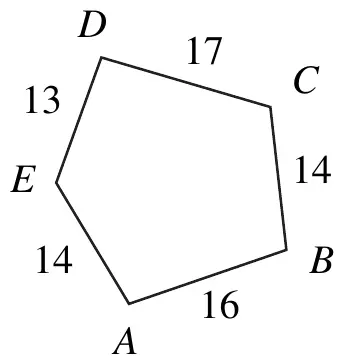
22. The diagram shows a pentagon. The lengths of the sides of the pentagon are given in the diagram.
Sepideh draws five circles with centres \(A\), \(B\), \(C\), \(D\) and \(E\) such that the two circles with centres at the ends of a side of the pentagon touch on that side. Which point is the centre of the largest circle that she draws?

  1. A \(A\)
  2. B \(B\)
  3. C \(C\)
  4. D \(D\)
  5. E \(E\)
Pentagon ABCDE with sides AB 16, BC 14, CD 17, DE 13 and EA 14

Grey Kangaroo 2016, Question 22. © UK Mathematics Trust. Original paper on ukmt.org.uk

IMC 2016 Q20

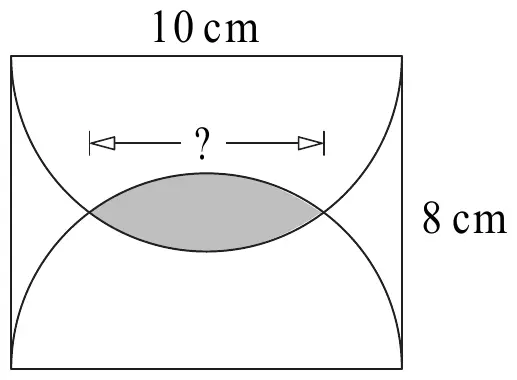
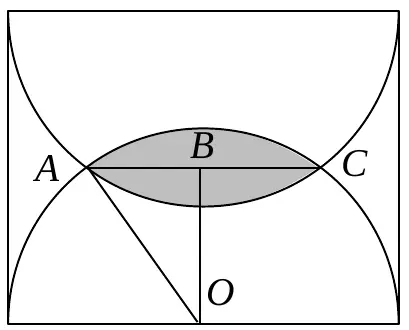
20. Two semicircles are drawn in a rectangle as shown.
What is the width of the overlap of the two semicircles?

  1. A 3 cm
  2. B 4 cm
  3. C 5 cm
  4. D 6 cm
  5. E 7 cm
A 10 cm by 8 cm rectangle with a semicircle on its top edge and one on its bottom edge; their overlap is shaded and its width is marked with a question mark

Intermediate Mathematical Challenge 2016, Question 20. © UK Mathematics Trust. Original paper on ukmt.org.uk

IMC 2016 Q18

18. The sum of the areas of the squares on the sides of a right-angled isosceles triangle is 72 cm2.
What is the area of the triangle?

  1. A 6 cm2
  2. B 8 cm2
  3. C 9 cm2
  4. D 12 cm2
  5. E 18 cm2

Intermediate Mathematical Challenge 2016, Question 18. © UK Mathematics Trust. Original paper on ukmt.org.uk

PK 2016 Q16

PKCurrent spec6 marksGeometry & Angles

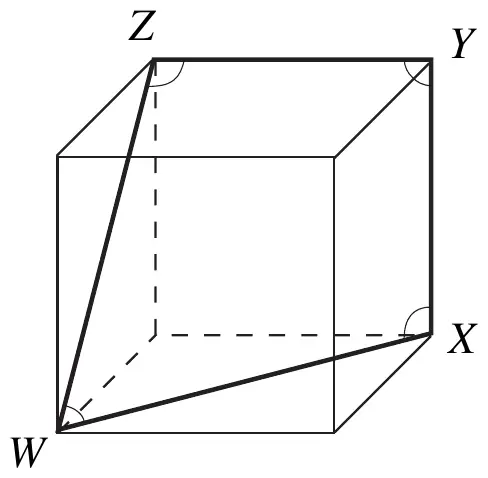
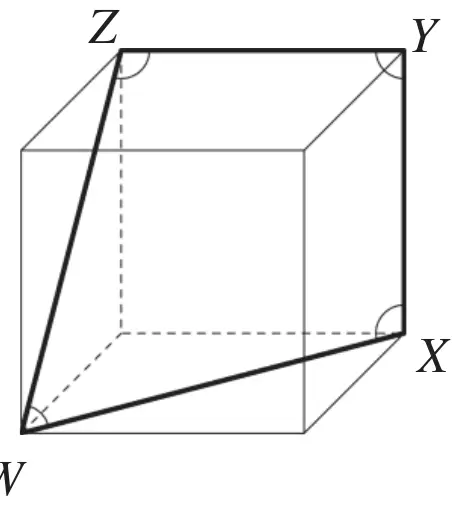
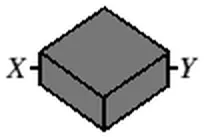
16. The picture shows a cube with four marked angles, \(\angle WXY\), \(\angle XYZ\), \(\angle YZW\) and \(\angle ZWX\). What is the sum of these angles?

  1. A 315°
  2. B 330°
  3. C 345°
  4. D 360°
  5. E 375°
A cube with vertices W, X, Y and Z joined to show the angles WXY, XYZ, YZW and ZWX

Pink Kangaroo 2016, Question 16. © UK Mathematics Trust. Original paper on ukmt.org.uk

IMC 2016 Q15

15. The circle has radius 1 cm. Two vertices of the square lie on the circle. One edge of the square goes through the centre of the circle, as shown.

What is the area of the square?

  1. A \(\dfrac{4}{5}\) cm2
  2. B \(\dfrac{\pi}{5}\) cm2
  3. C 1 cm2
  4. D \(\dfrac{\pi}{4}\) cm2
  5. E \(\dfrac{5}{4}\) cm2
A circle with a square whose bottom edge passes through the centre and whose top two vertices lie on the circle

Intermediate Mathematical Challenge 2016, Question 15. © UK Mathematics Trust. Original paper on ukmt.org.uk

IMC 2016 Q11

IMCCurrent spec5 marksGeometry & Angles

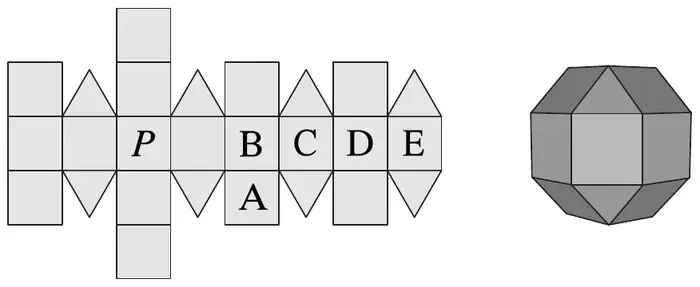
11. The net shown consists of squares and equilateral triangles. The net is folded to form a rhombicuboctahedron, as shown.

When the face marked \(P\) is placed face down on a table, which face will be facing up?

  1. A  
  2. B  
  3. C  
  4. D  
  5. E  
A net of squares and equilateral triangles with faces marked P, A, B, C, D and E, and the rhombicuboctahedron it folds into

Intermediate Mathematical Challenge 2016, Question 11. © UK Mathematics Trust. Original paper on ukmt.org.uk

PK 2016 Q10

PKCurrent spec5 marksGeometry & Angles

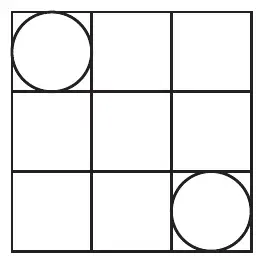
10. A square is split into nine identical squares, each with sides of length one unit. Circles are inscribed in two of these squares, as shown. What is the shortest distance between the two circles?

  1. A \(2\sqrt{2} - 1\)
  2. B \(\sqrt{2} + 1\)
  3. C \(2\sqrt{2}\)
  4. D 2
  5. E 3
A square split into a 3 by 3 grid of unit squares, with circles inscribed in the top-left and bottom-right squares

Pink Kangaroo 2016, Question 10. © UK Mathematics Trust. Original paper on ukmt.org.uk

IMC 2016 Q10

IMCCurrent spec5 marksAlgebraGeometry & Angles

10. The angles of a quadrilateral taken in order are \(x\)°, \(5x\)°, \(2x\)° and \(4x\)°. Which of the following is the quadrilateral?

  1. A kite
  2. B parallelogram
  3. C rhombus
  4. D arrowhead
  5. E trapezium

Intermediate Mathematical Challenge 2016, Question 10. © UK Mathematics Trust. Original paper on ukmt.org.uk

GK 2016 Q9

GKCurrent spec5 marksAlgebraGeometry & Angles

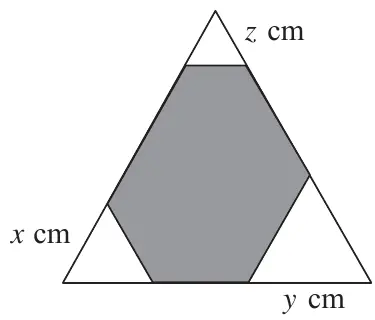
9. Three equilateral triangles are cut from the corners of a large equilateral triangle to form an irregular hexagon, as shown in the diagram.
The perimeter of the large equilateral triangle is 60 cm. The perimeter of the irregular hexagon is 40 cm. What is the sum of the perimeters of the triangles that were cut from the large triangle?

  1. A 60 cm
  2. B 66 cm
  3. C 72 cm
  4. D 75 cm
  5. E 81 cm
A large equilateral triangle with three smaller equilateral triangles cut from its corners, leaving a shaded irregular hexagon

Grey Kangaroo 2016, Question 9. © UK Mathematics Trust. Original paper on ukmt.org.uk

IMC 2016 Q7

IMCCurrent spec5 marksGeometry & Angles

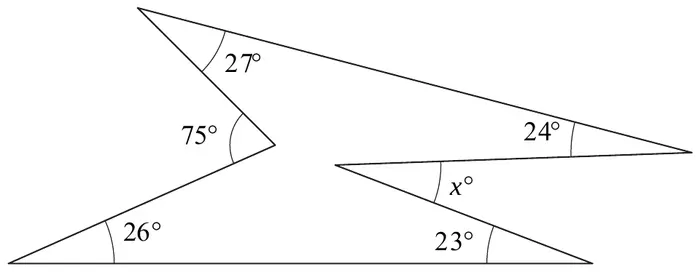
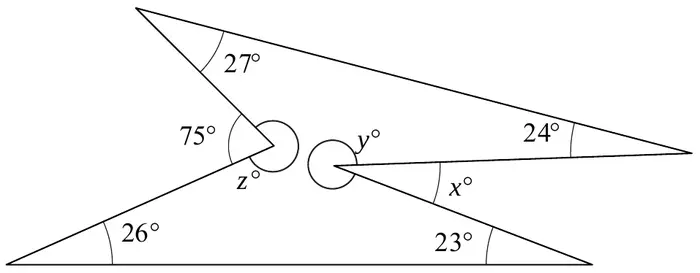
7. In the diagram, what is the value of \(x\)?

  1. A 23
  2. B 24
  3. C 25
  4. D 26
  5. E 27
Two zigzag shapes with angles of 27, 75, 26, 24, 23 and x degrees marked

Intermediate Mathematical Challenge 2016, Question 7. © UK Mathematics Trust. Original paper on ukmt.org.uk

GK 2016 Q3

GKCurrent spec5 marksGeometry & Angles

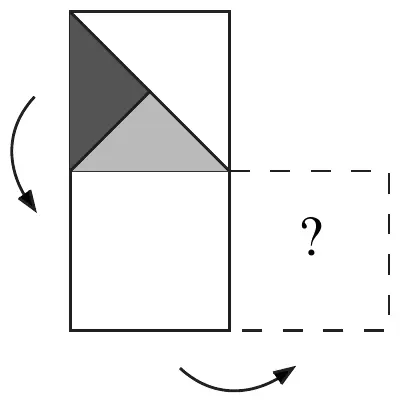
3. Joanna turns over the card shown about its lower edge and then about its right-hand edge, as indicated in the diagram.
What does she see?

Five cards labelled A to E, each with a dark grey and a light grey triangle in different positions
A square card with a dark grey and a light grey triangle, with arrows showing it turned over about its lower edge and then about its right-hand edge to a position marked ?

Grey Kangaroo 2016, Question 3. © UK Mathematics Trust. Original paper on ukmt.org.uk

PK 2016 Q2

PKCurrent spec5 marksGeometry & Angles

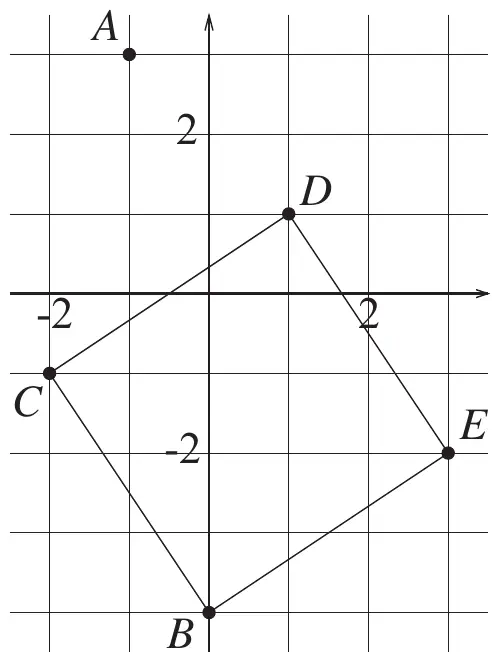
2. Four of the following points are vertices of the same square. Which point is not a vertex of this square?

  1. A (−1, 3)
  2. B (0, −4)
  3. C (−2, −1)
  4. D (1, 1)
  5. E (3, −2)

Pink Kangaroo 2016, Question 2. © UK Mathematics Trust. Original paper on ukmt.org.uk

GK 2016 Q1

GKCurrent spec5 marksGeometry & Angles

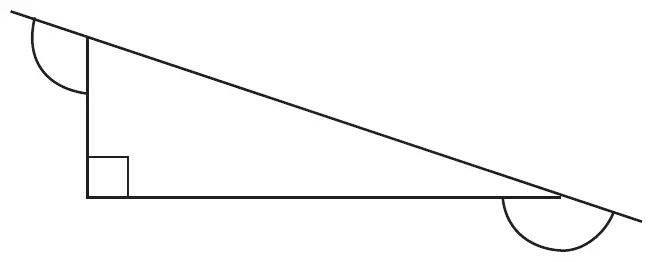
1. The triangle in the diagram contains a right angle.
What is the sum of the other two marked angles on the diagram?

  1. A 150°
  2. B 180°
  3. C 270°
  4. D 320°
  5. E 360°
A right-angled triangle with its hypotenuse and one leg extended; the two exterior angles are marked

Grey Kangaroo 2016, Question 1. © UK Mathematics Trust. Original paper on ukmt.org.uk

IMC 2015 Q24

IMCCurrent spec6 marksAlgebraGeometry & Angles

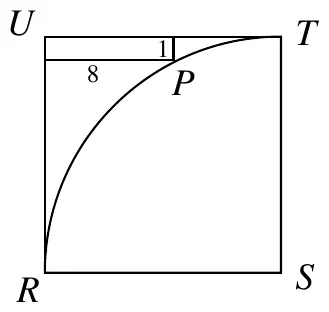
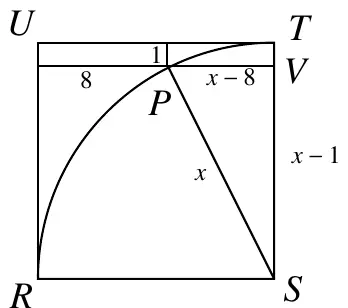
24. In square \(RSTU\) a quarter-circle arc with centre \(S\) is drawn from \(T\) to \(R\). A point \(P\) on this arc is 1 unit from \(TU\) and 8 units from \(RU\).
What is the length of the side of square \(RSTU\)?

  1. A 9
  2. B 10
  3. C 11
  4. D 12
  5. E 13
Square RSTU with a quarter-circle arc centred at S from T to R; point P on the arc is 1 unit from TU and 8 units from RU

Intermediate Mathematical Challenge 2015, Question 24. © UK Mathematics Trust. Original paper on ukmt.org.uk

GK 2015 Q22

GKCurrent spec6 marksGeometry & Angles

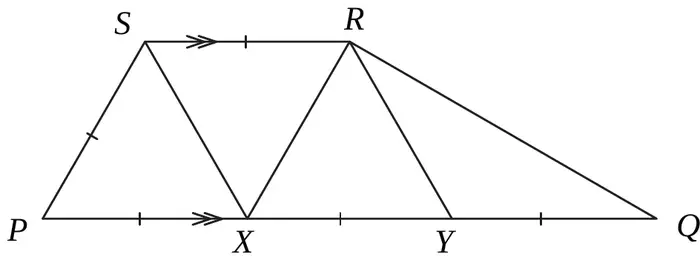
22. In trapezium \(PQRS\), the sides \(PQ\) and \(SR\) are parallel. Angle \(RSP\) is 120° and \(PS = SR = \tfrac{1}{3}PQ\). What is the size of angle \(PQR\)?

  1. A 15°
  2. B 22.5°
  3. C 25°
  4. D 30°
  5. E 45°

Grey Kangaroo 2015, Question 22. © UK Mathematics Trust. Original paper on ukmt.org.uk

PK 2015 Q21

PKCurrent spec6 marksGeometry & Angles

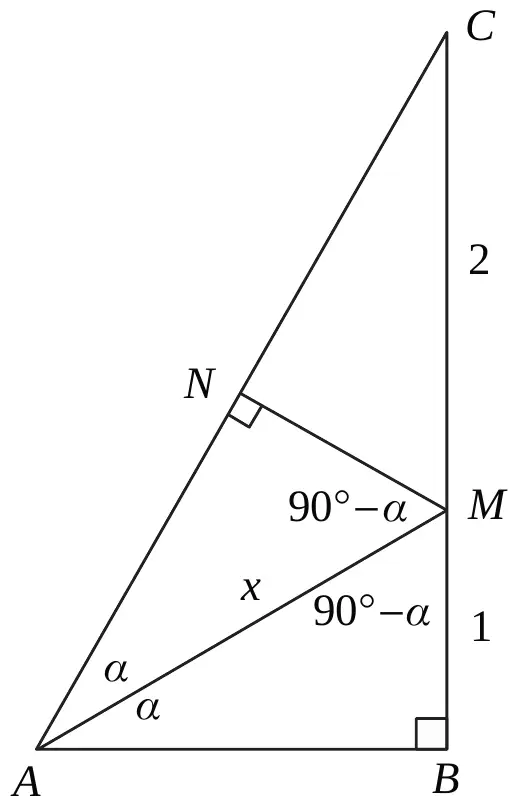
21. In a right-angled triangle, the angle bisector of an acute angle divides the opposite side into segments of length 1 and 2. What is the length of the bisector?

  1. A \(\sqrt{2}\)
  2. B \(\sqrt{3}\)
  3. C \(\sqrt{4}\)
  4. D \(\sqrt{5}\)
  5. E \(\sqrt{6}\)

Pink Kangaroo 2015, Question 21. © UK Mathematics Trust. Original paper on ukmt.org.uk

PK 2015 Q9

PKCurrent spec5 marksGeometry & Angles

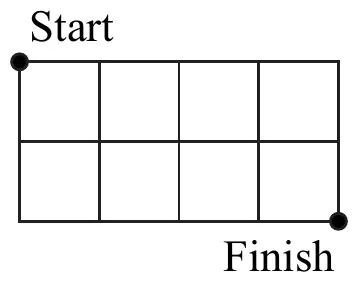
9. In the grid, each small square has side of length 1. What is the minimum distance from ‘Start’ to ‘Finish’ travelling only on edges or diagonals of the squares?

  1. A \(2\sqrt{2}\)
  2. B \(\sqrt{10} + \sqrt{2}\)
  3. C \(2 + 2\sqrt{2}\)
  4. D \(4\sqrt{2}\)
  5. E 6
A 4 by 2 grid of unit squares with Start at the top-left corner and Finish at the bottom-right corner

Pink Kangaroo 2015, Question 9. © UK Mathematics Trust. Original paper on ukmt.org.uk

IMC 2015 Q9

IMCCurrent spec5 marksGeometry & Angles

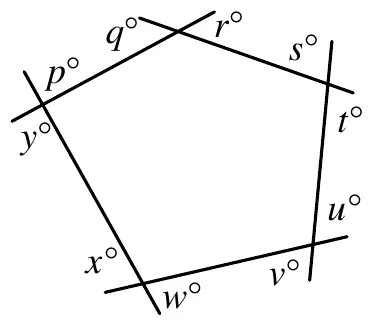
9. What is the value of \(p + q + r + s + t + u + v + w + x + y\) in the diagram?

  1. A 540
  2. B 720
  3. C 900
  4. D 1080
  5. E 1440
A pentagon with each side extended at both ends, making ten exterior angles p, q, r, s, t, u, v, w, x and y degrees

Intermediate Mathematical Challenge 2015, Question 9. © UK Mathematics Trust. Original paper on ukmt.org.uk

PK 2015 Q7

PKCurrent spec5 marksGeometry & Angles

7. Martha draws some pentagons, and counts the number of right-angles in each of her pentagons. No two of her pentagons have the same number of right-angles. Which of the following is the complete list of possible numbers of right-angles that could occur in Martha's pentagons?

  1. A 1, 2, 3
  2. B 0, 1, 2, 3, 4
  3. C 0, 1, 2, 3
  4. D 0, 1, 2
  5. E 1, 2

Pink Kangaroo 2015, Question 7. © UK Mathematics Trust. Original paper on ukmt.org.uk

GK 2015 Q5

5. A triangle has sides of lengths 6 cm, 10 cm and 11 cm. An equilateral triangle has the same perimeter. What is the length of the sides of the equilateral triangle?

  1. A 18 cm
  2. B 11 cm
  3. C 10 cm
  4. D 9 cm
  5. E 6 cm

Grey Kangaroo 2015, Question 5. © UK Mathematics Trust. Original paper on ukmt.org.uk

IMC 2015 Q4

IMCCurrent spec5 marksGeometry & Angles

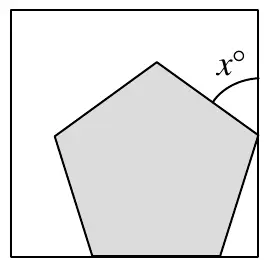
4. The diagram shows a regular pentagon inside a square.

What is the value of \(x\)?

  1. A 48
  2. B 51
  3. C 54
  4. D 60
  5. E 72
A regular pentagon inside a square, with one vertex touching the right side; the angle x degrees is marked between the pentagon and the side of the square

Intermediate Mathematical Challenge 2015, Question 4. © UK Mathematics Trust. Original paper on ukmt.org.uk

PK 2015 Q3

PKCurrent spec5 marksGeometry & Angles

3. Mr Hyde can't remember exactly where he has hidden his treasure. He knows it is at least 5 m from his hedge, and at most 5 m from his tree. Which of the following shaded areas could represent the largest region where his treasure could lie?

Five diagrams labelled A to E, each showing a hedge and a tree with a different shaded region: A a circle with a strip next to the hedge removed, B a semicircle, C a rectangle with a semicircle removed, D a rectangle, E a square with a circle removed

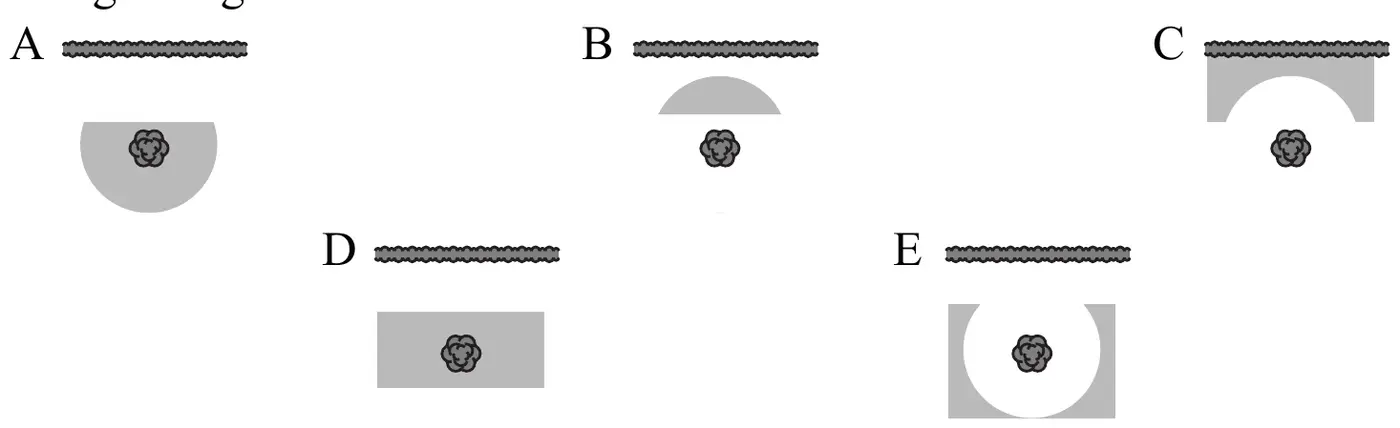
Pink Kangaroo 2015, Question 3. © UK Mathematics Trust. Original paper on ukmt.org.uk

GK 2015 Q1

GKCurrent spec5 marksGeometry & Angles

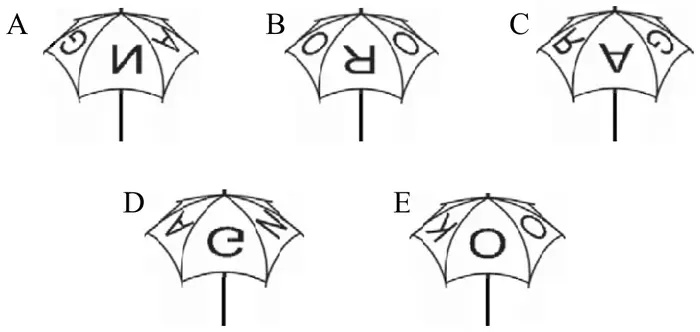
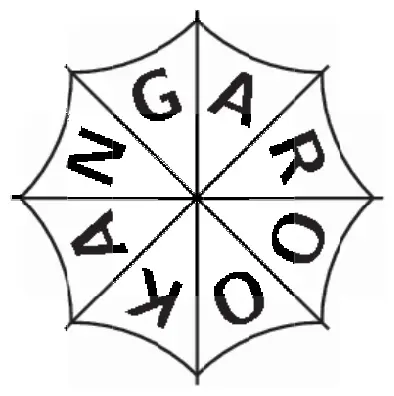
1. My umbrella has KANGAROO written on top as shown in the diagram. Which one of the following pictures also shows my umbrella?

Five side views of an umbrella, labelled A to E, each showing three letters
An octagonal umbrella seen from above, with the letters K, A, N, G, A, R, O, O written around it

Grey Kangaroo 2015, Question 1. © UK Mathematics Trust. Original paper on ukmt.org.uk

IMC 2014 Q25

25. The diagram shows two concentric circles with radii 1 and 2 units, together with a shaded octagon, all of whose sides are equal.
What is the length of the perimeter of the octagon?

  1. A \(8\sqrt{2}\)
  2. B \(8\sqrt{3}\)
  3. C \(8\sqrt{3}\pi\)
  4. D \(2\sqrt{5 + 2\sqrt{2}}\)
  5. E \(8\sqrt{5 - 2\sqrt{2}}\)
Two concentric circles with a blue-shaded octagon between them, its four outer vertices on the larger circle and four inner vertices on the smaller circle; the smaller circle is also shaded

Intermediate Mathematical Challenge 2014, Question 25. © UK Mathematics Trust. Original paper on ukmt.org.uk

IMC 2014 Q20

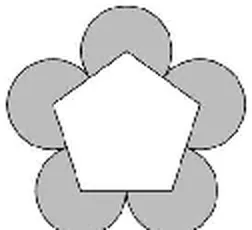
20. The diagram shows a regular pentagon and five circular arcs. The sides of the pentagon have length 4. The centre of each arc is a vertex of the pentagon, and the ends of the arc are the midpoints of the two adjacent edges.
What is the total shaded area?

  1. A \(8\pi\)
  2. B \(10\pi\)
  3. C \(12\pi\)
  4. D \(14\pi\)
  5. E \(16\pi\)
A regular pentagon with five grey circular arcs, one centred at each vertex, forming a flower shape around it

Intermediate Mathematical Challenge 2014, Question 20. © UK Mathematics Trust. Original paper on ukmt.org.uk

IMC 2014 Q18

18. Consider looking from the origin (0, 0) towards all the points (\(m\), \(n\)), where each of \(m\) and \(n\) is an integer. Some points are hidden, because they are directly in line with another nearer point. For example, (2, 2) is hidden by (1, 1).
How many of the points (6, 2), (6, 3), (6, 4), (6, 5) are not hidden points?

  1. A 0
  2. B 1
  3. C 2
  4. D 3
  5. E 4

Intermediate Mathematical Challenge 2014, Question 18. © UK Mathematics Trust. Original paper on ukmt.org.uk

IMC 2014 Q10

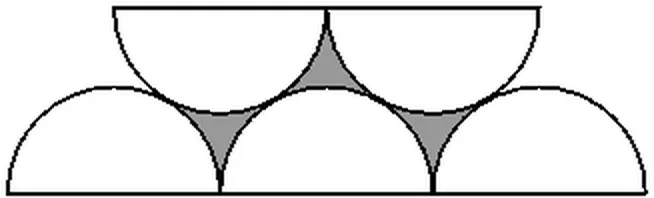
10. The diagram shows five touching semicircles, each with radius 2.

Two semicircles curving downwards from a top line, resting on three semicircles standing on a bottom line; the three curved gaps between them are shaded

What is the length of the perimeter of the shaded shape?

  1. A \(5\pi\)
  2. B \(6\pi\)
  3. C \(7\pi\)
  4. D \(8\pi\)
  5. E \(9\pi\)

Intermediate Mathematical Challenge 2014, Question 10. © UK Mathematics Trust. Original paper on ukmt.org.uk

IMC 2014 Q3

IMCCurrent spec5 marksGeometry & Angles

3. An equilateral triangle is placed inside a larger equilateral triangle so that the diagram has three lines of symmetry.
What is the value of \(x\)?

  1. A 100
  2. B 110
  3. C 120
  4. D 130
  5. E 150
An equilateral triangle inside a larger equilateral triangle, each vertex of the small triangle joined to a vertex of the large one; an angle x degrees is marked at the top vertex of the small triangle

Intermediate Mathematical Challenge 2014, Question 3. © UK Mathematics Trust. Original paper on ukmt.org.uk

IMC 2013 Q20

20. Jack's teacher asked him to draw a triangle of area 7cm2. Two sides are to be of length 6cm and 8cm. How many possibilities are there for the length of the third side of the triangle?

  1. A 1
  2. B 2
  3. C 3
  4. D 4
  5. E more than 4

Intermediate Mathematical Challenge 2013, Question 20. © UK Mathematics Trust. Original paper on ukmt.org.uk

IMC 2013 Q17

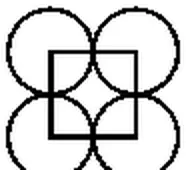
17. The diagram shows four equal discs and a square. Each disc touches its two neighbouring discs. Each corner of the square is positioned at the centre of a disc. The side length of the square is \(2/\pi\). What is the length of the perimeter of the figure?

  1. A 3
  2. B 4
  3. C \(\dfrac{3\pi}{2}\)
  4. D 6
  5. E \(2\pi\)
Four equal grey discs arranged in a square, each touching its two neighbours, with a square whose corners are at the centres of the discs

Intermediate Mathematical Challenge 2013, Question 17. © UK Mathematics Trust. Original paper on ukmt.org.uk

IMC 2013 Q16

IMCCurrent spec6 marksAlgebraGeometry & Angles

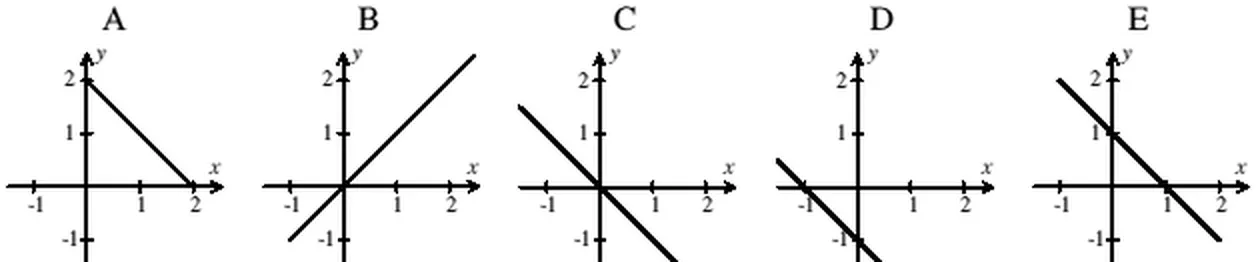
16. Which diagram shows the graph of \(y = x\) after it has been rotated 90° clockwise about the point (1, 1)?

Five graphs labelled A to E, each showing a straight line on axes marked from −1 to 2: A a line from (0, 2) to (2, 0); B the line y = x; C a line of slope −1 through the origin; D a line of slope −1 through (−1, 0); E a line of slope −1 through (1, 0)

Intermediate Mathematical Challenge 2013, Question 16. © UK Mathematics Trust. Original paper on ukmt.org.uk

IMC 2013 Q10

IMCCurrent spec5 marksGeometry & Angles

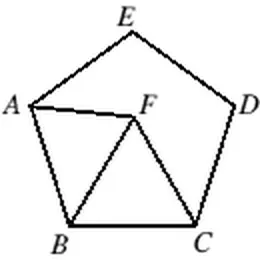
10. \(ABCDE\) is a regular pentagon and \(BCF\) is an equilateral triangle such that \(F\) is inside \(ABCDE\).
What is the size of \(\angle FAB\)?

  1. A 48°
  2. B 63°
  3. C 66°
  4. D 69°
  5. E 72°

Intermediate Mathematical Challenge 2013, Question 10. © UK Mathematics Trust. Original paper on ukmt.org.uk

IMC 2012 Q23

IMCCurrent spec6 marksGeometry & Angles

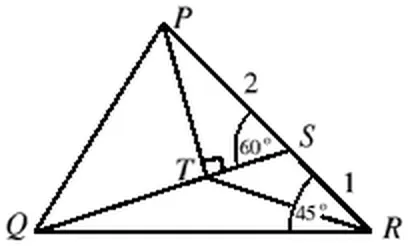
23. In triangle \(PQR\), \(PS = 2\); \(SR = 1\); \(\angle PRQ = 45^\circ\); \(T\) is the foot of the perpendicular from \(P\) to \(QS\) and \(\angle PST = 60^\circ\).
What is the size of \(\angle QPR\)?

  1. A 45°
  2. B 60°
  3. C 75°
  4. D 90°
  5. E 105°
Triangle PQR with S on PR, PS = 2 and SR = 1; T is the foot of the perpendicular from P to QS, the angle PST is 60 degrees and the angle PRQ is 45 degrees

Intermediate Mathematical Challenge 2012, Question 23. © UK Mathematics Trust. Original paper on ukmt.org.uk

IMC 2012 Q21

IMCCurrent spec6 marksGeometry & Angles

21. The parallelogram \(PQRS\) is formed by joining together four equilateral triangles of side 1 unit, as shown.
What is the length of the diagonal \(SQ\)?

  1. A \(\sqrt{7}\)
  2. B \(\sqrt{8}\)
  3. C 3
  4. D \(\sqrt{6}\)
  5. E \(\sqrt{5}\)
Parallelogram PQRS made of four equilateral triangles in a row, P and Q at the top, S and R at the bottom

Intermediate Mathematical Challenge 2012, Question 21. © UK Mathematics Trust. Original paper on ukmt.org.uk

IMC 2012 Q18

IMCCurrent spec6 marksGeometry & Angles

18. Peri the winkle starts at the origin and slithers anticlockwise around a semicircle with centre (4, 0). Peri then slides anticlockwise around a second semicircle with centre (6, 0), and finally clockwise around a third semicircle with centre (3, 0).
Where does Peri end this expedition?

  1. A (0, 0)
  2. B (1, 0)
  3. C (2, 0)
  4. D (4, 0)
  5. E (6, 0)

Intermediate Mathematical Challenge 2012, Question 18. © UK Mathematics Trust. Original paper on ukmt.org.uk

IMC 2012 Q16

IMCCurrent spec6 marksGeometry & Angles

16. The diagram shows a large equilateral triangle divided by three straight lines into seven regions. The three grey regions are equilateral triangles with sides of length 5 cm and the central black region is an equilateral triangle with sides of length 2 cm.
What is the side length of the original large triangle?

  1. A 18 cm
  2. B 19 cm
  3. C 20 cm
  4. D 21 cm
  5. E 22 cm
A large equilateral triangle divided by three straight lines into seven regions: three grey equilateral triangles, a small black central triangle and three white regions

Intermediate Mathematical Challenge 2012, Question 16. © UK Mathematics Trust. Original paper on ukmt.org.uk

IMC 2012 Q11

IMCCurrent spec5 marksGeometry & Angles

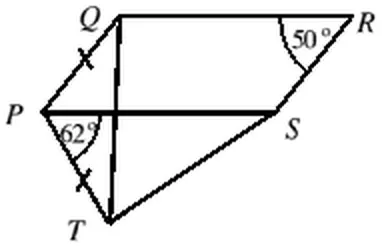
11. In the diagram, \(PQRS\) is a parallelogram; \(\angle QRS = 50^\circ\);
\(\angle SPT = 62^\circ\) and \(PQ = PT\).
What is the size of \(\angle TQR\)?

  1. A 84°
  2. B 90°
  3. C 96°
  4. D 112°
  5. E 124°
Parallelogram PQRS with the angle at R marked 50 degrees; T is below P, PQ and PT are marked equal, the angle SPT is marked 62 degrees, and T is joined to Q and to S

Intermediate Mathematical Challenge 2012, Question 11. © UK Mathematics Trust. Original paper on ukmt.org.uk

IMC 2012 Q6

IMCCurrent spec5 marksGeometry & Angles

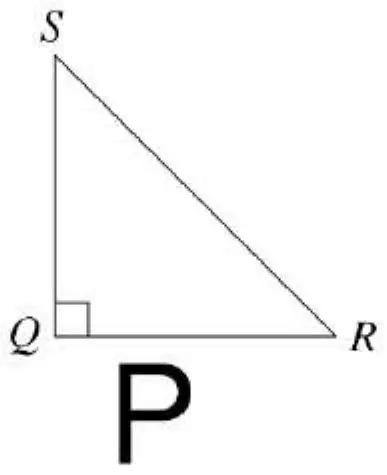
6. Triangle \(QRS\) is isosceles and right-angled.
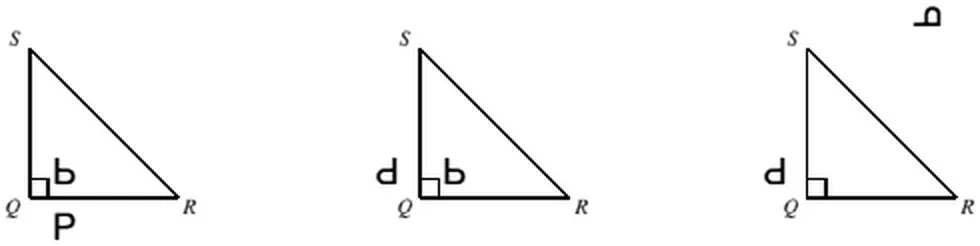
Beatrix reflects the P-shape in the side \(QR\) to get an image.
She reflects the first image in the side \(QS\) to get a second image.
Finally, she reflects the second image in the side \(RS\) to get a third image.
What does the third image look like?

Five images of the P-shape labelled A to E, each reflected or rotated differently
A right-angled isosceles triangle QRS with the right angle at Q, S above Q and R to the right; a letter P stands below the side QR

Intermediate Mathematical Challenge 2012, Question 6. © UK Mathematics Trust. Original paper on ukmt.org.uk

IMC 2012 Q3

IMCCurrent spec5 marksGeometry & Angles

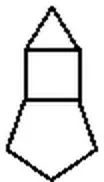
3. An equilateral triangle, a square and a pentagon all have the same side length. The triangle is drawn on and above the top edge of the square and the pentagon is drawn on and below the bottom edge of the square. What is the sum of the interior angles of the resulting polygon?

  1. A 10 × 180°
  2. B 9 × 180°
  3. C 8 × 180°
  4. D 7 × 180°
  5. E 6 × 180°
An equilateral triangle on top of a square, with a regular pentagon below the square

Intermediate Mathematical Challenge 2012, Question 3. © UK Mathematics Trust. Original paper on ukmt.org.uk

IMC 2011 Q23

IMCCurrent spec6 marksGeometry & Angles

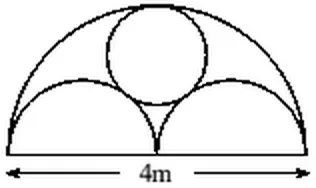
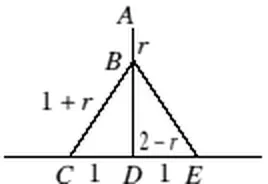
23. A window frame in Salt's Mill consists of two equal semicircles and a circle inside a large semicircle with each touching the other three as shown. The width of the frame is 4m.
What is the radius of the circle, in metres?

  1. A \(\dfrac{2}{3}\)
  2. B \(\dfrac{\sqrt{2}}{2}\)
  3. C \(\dfrac{3}{4}\)
  4. D \(2\sqrt{2} - 1\)
  5. E 1
A large semicircle of width 4 m containing two equal semicircles side by side on its diameter and a circle above them touching all three

Intermediate Mathematical Challenge 2011, Question 23. © UK Mathematics Trust. Original paper on ukmt.org.uk

IMC 2011 Q19

IMCCurrent spec6 marksGeometry & Angles

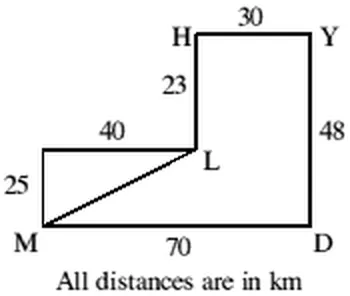
19. Harrogate is 23km due north of Leeds, York is 30km due east of Harrogate, Doncaster is 48km due south of York, and Manchester is 70km due west of Doncaster. To the nearest kilometre, how far is it from Leeds to Manchester, as the crow flies?

  1. A 38km
  2. B 47km
  3. C 56km
  4. D 65km
  5. E 74km

Intermediate Mathematical Challenge 2011, Question 19. © UK Mathematics Trust. Original paper on ukmt.org.uk

IMC 2011 Q15

IMCCurrent spec5 marksGeometry & Angles

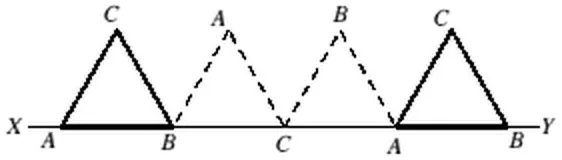
15. The equilateral triangle \(ABC\) has sides of length 1 and \(AB\) lies on the line \(XY\). The triangle is rotated clockwise around \(B\) until \(BC\) lies on the line \(XY\). It is then rotated similarly around \(C\) and then about \(A\) as shown in the diagram.

What is the length of the path traced out by point \(C\) during this sequence of rotations?

  1. A \(\dfrac{4\pi}{3}\)
  2. B \(2\sqrt{3}\)
  3. C \(\dfrac{8\pi}{3}\)
  4. D 3
  5. E \(\dfrac{2\pi}{3}\)
An equilateral triangle ABC on the line XY, shown again in dashed outline after each rotation about B, then C, then A, ending at the right with A and B on the line and C at the top

Intermediate Mathematical Challenge 2011, Question 15. © UK Mathematics Trust. Original paper on ukmt.org.uk

IMC 2011 Q9

IMCCurrent spec5 marksGeometry & Angles

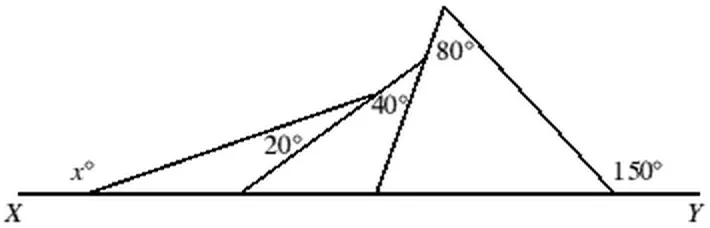
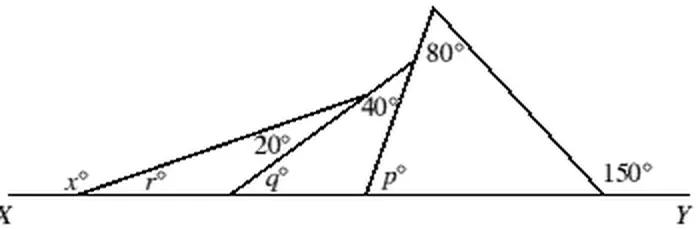
9. In the diagram, \(XY\) is a straight line.
What is the value of \(x\)?

  1. A 170
  2. B 160
  3. C 150
  4. D 140
  5. E 130
A straight line XY with a large triangle standing on it and two further lines from a point on XY to the triangle; marked angles are x degrees, 20 degrees, 40 degrees, 80 degrees at the apex, and an exterior angle of 150 degrees at the right

Intermediate Mathematical Challenge 2011, Question 9. © UK Mathematics Trust. Original paper on ukmt.org.uk

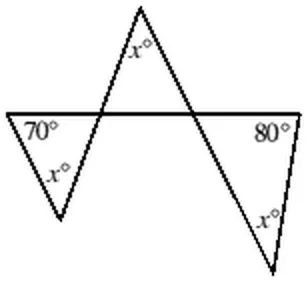
IMC 2011 Q7

IMCCurrent spec5 marksGeometry & Angles

7. What is the value of \(x\) in this diagram?

  1. A 30
  2. B 35
  3. C 40
  4. D 45
  5. E 50
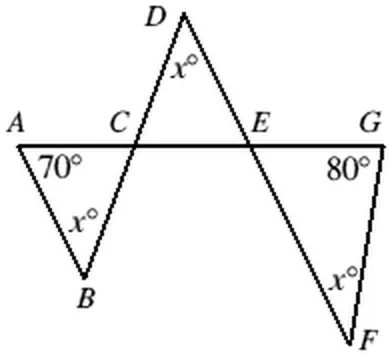
A horizontal line crossed by a zigzag of lines forming two triangles below it and one above it; angles of 70 degrees and 80 degrees are marked at the ends of the horizontal line, and three angles are marked x degrees

Intermediate Mathematical Challenge 2011, Question 7. © UK Mathematics Trust. Original paper on ukmt.org.uk

IMC 2011 Q4

4. The angles of a triangle are in the ratio 2:3:5. What is the difference between the largest angle and the smallest angle?

  1. A 9°
  2. B 18°
  3. C 36°
  4. D 45°
  5. E 54°

Intermediate Mathematical Challenge 2011, Question 4. © UK Mathematics Trust. Original paper on ukmt.org.uk

IMC 2010 Q25

25. Two squares, each of side length \(1 + \sqrt{2}\) units, overlap. The overlapping region is a regular octagon.
What is the area (in square units) of the octagon?

  1. A \(1 + \sqrt{2}\)
  2. B \(1 + 2\sqrt{2}\)
  3. C \(2 + \sqrt{2}\)
  4. D \(2 + 2\sqrt{2}\)
  5. E \(2 + 3\sqrt{2}\)

Intermediate Mathematical Challenge 2010, Question 25. © UK Mathematics Trust. Original paper on ukmt.org.uk

IMC 2010 Q6

IMCCurrent spec5 marksGeometry & Angles

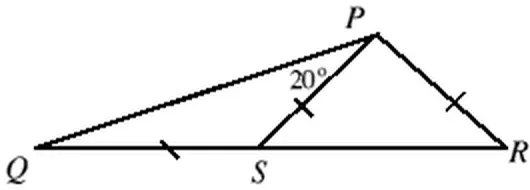
6. In triangle \(PQR\), \(S\) is a point on \(QR\) such that \(QS = SP = PR\) and \(\angle QPS = 20\)°. What is the size of \(\angle PRS\)?

  1. A 20°
  2. B 35°
  3. C 40°
  4. D 55°
  5. E 60°
Triangle PQR with S on QR; QS, SP and PR are marked equal, and the angle QPS is marked 20 degrees

Intermediate Mathematical Challenge 2010, Question 6. © UK Mathematics Trust. Original paper on ukmt.org.uk

IMC 2010 Q2

IMCCurrent spec5 marksGeometry & Angles

2. Three of the interior angles of a given quadrilateral are each 80°. What is the fourth angle of this quadrilateral?

  1. A 120°
  2. B 110°
  3. C 100°
  4. D 90°
  5. E 80°

Intermediate Mathematical Challenge 2010, Question 2. © UK Mathematics Trust. Original paper on ukmt.org.uk

IMC 2009 Q22

22. A square is divided into eight congruent triangles, as shown.
Two of these triangles are selected at random and shaded black.
What is the probability that the resulting figure has at least one axis of symmetry?

  1. A \(\dfrac{1}{4}\)
  2. B \(\dfrac{4}{7}\)
  3. C \(\dfrac{1}{2}\)
  4. D \(\dfrac{5}{7}\)
  5. E 1
A square divided into eight congruent right-angled triangles by its two midlines and the four lines joining the midpoints of adjacent sides

Intermediate Mathematical Challenge 2009, Question 22. © UK Mathematics Trust. Original paper on ukmt.org.uk

IMC 2009 Q20

20. A square, of side two units, is folded in half to form a triangle. A second fold is made, parallel to the first, so that the apex of this triangle folds onto a point on its base, thereby forming an isosceles trapezium. What is the perimeter of this trapezium?

  1. A \(4 + \sqrt{2}\)
  2. B \(4 + 2\sqrt{2}\)
  3. C \(3 + 2\sqrt{2}\)
  4. D \(2 + 3\sqrt{2}\)
  5. E 5

Intermediate Mathematical Challenge 2009, Question 20. © UK Mathematics Trust. Original paper on ukmt.org.uk

IMC 2009 Q17

IMCCurrent spec6 marksGeometry & Angles

17. \(PQR\) is a triangle and \(S\) is a point on \(QR\).
\(QP = QR = 9\) cm and \(PR = PS = 6\) cm.
What is the length of \(SR\)?

  1. A 1cm
  2. B 2cm
  3. C 3cm
  4. D 4cm
  5. E 5cm
Triangle PQR with P at the top, Q at the bottom left and R at the bottom right; S is a point on QR joined to P; not to scale

Intermediate Mathematical Challenge 2009, Question 17. © UK Mathematics Trust. Original paper on ukmt.org.uk

IMC 2009 Q12

IMCCurrent spec5 marksGeometry & Angles

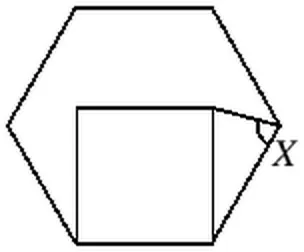
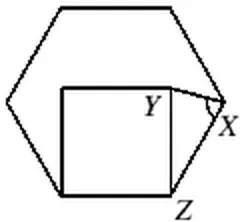
12. The diagram shows a square inside a regular hexagon. What is the size of the marked angle at \(X\)?

  1. A 45°
  2. B 50°
  3. C 60°
  4. D 75°
  5. E 80°
A regular hexagon with a square inside it sitting on the bottom edge; the top right corner of the square is joined to the right-hand vertex of the hexagon, and the angle there is marked X

Intermediate Mathematical Challenge 2009, Question 12. © UK Mathematics Trust. Original paper on ukmt.org.uk

IMC 2009 Q7

IMCCurrent spec5 marksGeometry & Angles

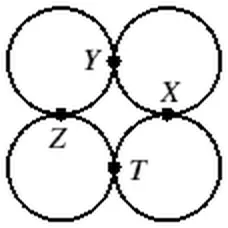
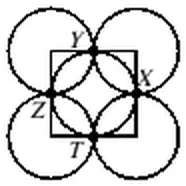
7. Four touching circles all have radius 1 and their centres are at the corners of a square.
What is the radius of the circle through the points of contact \(X\), \(Y\), \(Z\) and \(T\)?

  1. A \(\dfrac{1}{2}\)
  2. B \(\dfrac{1}{2}\sqrt{2}\)
  3. C 1
  4. D \(\sqrt{2}\)
  5. E 2
Four touching circles in a 2 by 2 arrangement; the points of contact between neighbouring circles are marked Y (top), X (right), T (bottom) and Z (left)

Intermediate Mathematical Challenge 2009, Question 7. © UK Mathematics Trust. Original paper on ukmt.org.uk

IMC 2009 Q4

IMCCurrent spec5 marksAlgebraGeometry & Angles

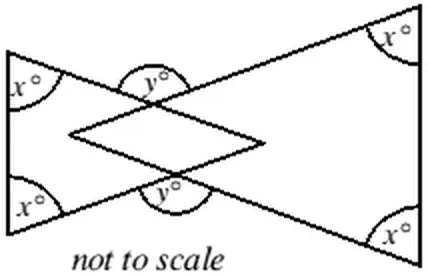
4. The diagram shows two isosceles triangles, in which the four angles marked \(x\)° are equal. The two angles marked \(y\)° are also equal. Which of the following is always true?

  1. A \(y = 2x\)
  2. B \(y = x + 30\)
  3. C \(y = x + 60\)
  4. D \(y = x + 90\)
  5. E \(y = 180 - x\)
Two overlapping isosceles triangles pointing towards each other, with four equal base angles marked x degrees and the two apex angles marked y degrees; a small quadrilateral is formed where they overlap; not to scale

Intermediate Mathematical Challenge 2009, Question 4. © UK Mathematics Trust. Original paper on ukmt.org.uk

IMC 2008 Q25

IMCCurrent spec6 marksGeometry & Angles

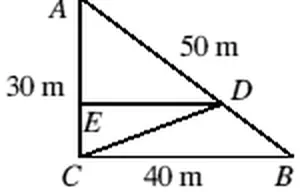
25. A garden has the shape of a right-angled triangle with sides of length 30, 40 and 50. A straight fence goes from the corner with the right-angle to a point on the opposite side, dividing the garden into two sections which have the same perimeter. How long is the fence?

  1. A 25
  2. B \(8\sqrt{3}\)
  3. C \(5\sqrt{11}\)
  4. D \(5\sqrt{39}\)
  5. E \(12\sqrt{5}\)

Intermediate Mathematical Challenge 2008, Question 25. © UK Mathematics Trust. Original paper on ukmt.org.uk

IMC 2008 Q24

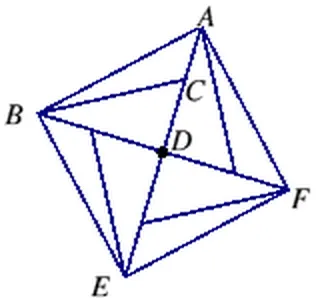
24. The diagram has order 4 rotational symmetry about \(D\). If angle \(ABC\) is 15° and the area of \(ABEF\) is 24 cm2, what, in cm, is the length of CD ?

  1. A 1
  2. B \(\sqrt{3}\)
  3. C 2
  4. D \(\sqrt{5}\)
  5. E \(2\sqrt{3} - 1\)
A square ABEF with centre D and point C on AD, with lines from B, E and F forming a figure with order 4 rotational symmetry about D

Intermediate Mathematical Challenge 2008, Question 24. © UK Mathematics Trust. Original paper on ukmt.org.uk

IMC 2008 Q21

IMCCurrent spec6 marksGeometry & Angles

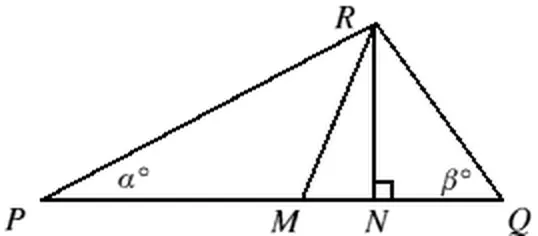
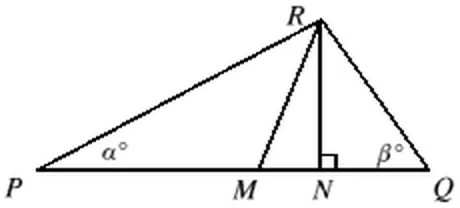
21. In triangle \(PQR\), \(\angle QPR = \alpha\)° and \(\angle PQR = \beta\)°, where \(\alpha < \beta\). The line \(RM\) bisects \(\angle PRQ\) and \(RN\) is the perpendicular from \(R\) to the line \(PQ\). What is the size, in degrees, of \(\angle MRN\) ?

Triangle PQR with angle alpha degrees at P and beta degrees at Q, M and N on PQ, RM bisecting angle PRQ and RN perpendicular to PQ
  1. A \(\dfrac{180 - (\alpha + \beta)}{2}\)
  2. B \(\dfrac{\beta - \alpha}{2}\)
  3. C \(\dfrac{\alpha + 2\beta}{2}\)
  4. D \(\dfrac{360 - \alpha - 2\beta}{2}\)
  5. E \(\dfrac{\alpha + \beta}{2}\)

Intermediate Mathematical Challenge 2008, Question 21. © UK Mathematics Trust. Original paper on ukmt.org.uk

IMC 2008 Q20

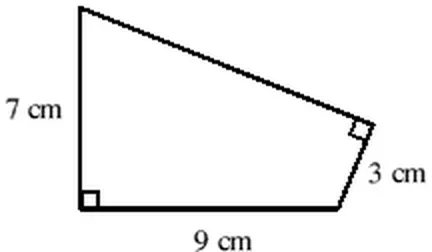
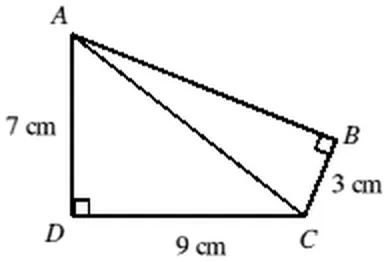
20. What, in cm2, is the area of this quadrilateral?

  1. A 48
  2. B 50
  3. C 52
  4. D 54
  5. E 56
A quadrilateral with a right angle at the bottom left between sides 7 cm and 9 cm, and a right angle at the top of the 3 cm side on the right

Intermediate Mathematical Challenge 2008, Question 20. © UK Mathematics Trust. Original paper on ukmt.org.uk

IMC 2008 Q17

17. The shaded region is bounded by eight equal circles with centres at the corners and midpoints of the sides of a square. The perimeter of the square has length 8. What is the length of the perimeter of the shaded region?

  1. A \(\pi\)
  2. B \(2\pi\)
  3. C 8
  4. D \(3\pi\)
  5. E \(4\pi\)
Eight equal circles centred at the corners and midpoints of the sides of a square, with the region enclosed between them shaded

Intermediate Mathematical Challenge 2008, Question 17. © UK Mathematics Trust. Original paper on ukmt.org.uk

IMC 2008 Q15

IMCCurrent spec5 marksGeometry & Angles

15. A designer wishes to use two copies of the logo shown on the right to create a pattern, without any of the dots overlapping. Which one of the following could be made?

Five patterns of twelve dots labelled A to E
The logo: four dots in a slanting straight line with two more dots, one on each side of the line

Intermediate Mathematical Challenge 2008, Question 15. © UK Mathematics Trust. Original paper on ukmt.org.uk

IMC 2008 Q10

IMCCurrent spec5 marksGeometry & Angles

10. Two sides of a triangle have lengths 6 cm and 5 cm. Perry suggests the following possible values for the perimeter of the triangle: (i) 11 cm (ii) 15 cm (iii) 24 cm.
Which of Perry's suggestions could be correct?

  1. A (i) only
  2. B (i) or (ii)
  3. C (ii) only
  4. D (ii) or (iii)
  5. E (iii) only

Intermediate Mathematical Challenge 2008, Question 10. © UK Mathematics Trust. Original paper on ukmt.org.uk

IMC 2008 Q6

6. Four of these shapes can be placed together to make a cube. Which is the odd one out?

Five solid shapes made of grey unit cubes and half-cubes, labelled A to E; C is a single small piece and E is the largest

Intermediate Mathematical Challenge 2008, Question 6. © UK Mathematics Trust. Original paper on ukmt.org.uk

IMC 2007 Q25

25. The diagram shows a semi-circle and an isosceles triangle which have equal areas. What is the value of \(\tan x\)° ?
  1. A 1

  2. B \(\dfrac{\sqrt{3}}{2}\)
  3. C \(\dfrac{\pi}{\sqrt{3}}\)
  4. D \(\dfrac{2}{\pi}\)
  5. E \(\dfrac{\pi}{2}\)
A semicircle sitting on the base of an isosceles triangle pointing downwards, with the angle x degrees marked between the base and one equal side

Intermediate Mathematical Challenge 2007, Question 25. © UK Mathematics Trust. Original paper on ukmt.org.uk

IMC 2007 Q21

21. The diagram shows two circles and four equal semi-circular arcs.
The area of the inner shaded circle is 1.
What is the area of the outer circle?

  1. A \(\sqrt{2}\)
  2. B 2
  3. C \(1 + \sqrt{2}\)
  4. D \(\dfrac{\pi}{2}\)
  5. E \(\dfrac{9}{4}\)
A shaded circle inside a larger circle, with four equal semicircular arcs around the shaded circle touching the outer circle

Intermediate Mathematical Challenge 2007, Question 21. © UK Mathematics Trust. Original paper on ukmt.org.uk

IMC 2007 Q20

IMCCurrent spec6 marksGeometry & Angles

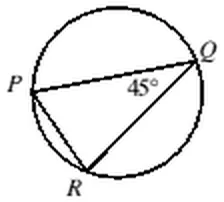
20. \(P\), \(Q\), \(R\) are points on the circumference of a circle of radius 4 cm. \(\angle PQR\) = 45°. What is the length of chord \(PR\)?

  1. A 4 cm
  2. B \(3\sqrt{3}\) cm
  3. C \(4\sqrt{2}\) cm
  4. D 5 cm
  5. E 6 cm
A circle with points P, Q and R on its circumference and angle PQR marked 45 degrees

Intermediate Mathematical Challenge 2007, Question 20. © UK Mathematics Trust. Original paper on ukmt.org.uk

IMC 2007 Q15

IMCCurrent spec5 marksGeometry & Angles

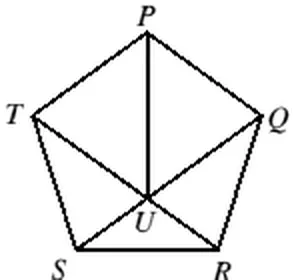
15. The diagram shows a regular pentagon \(PQRST\). The lines \(QS\) and \(RT\) meet at \(U\). What is the size of angle \(PUR\)?

  1. A 108°
  2. B 112°
  3. C 116°
  4. D 126°
  5. E 132°
A regular pentagon PQRST with the diagonals QS and RT meeting at U, and the line PU

Intermediate Mathematical Challenge 2007, Question 15. © UK Mathematics Trust. Original paper on ukmt.org.uk

IMC 2007 Q12

IMCCurrent spec5 marksAlgebraGeometry & Angles

12. Which of the following could be the graph showing the circumference \(C\) of a circle in terms of its diameter \(d\) ?

Five graphs of C against d labelled A to E: A a straight line through the origin; B a curve bending upwards; C a quarter circle falling to the d axis; D a steep straight line starting above the origin; E a curve rising and levelling off

Intermediate Mathematical Challenge 2007, Question 12. © UK Mathematics Trust. Original paper on ukmt.org.uk

IMC 2007 Q10

IMCCurrent spec5 marksGeometry & Angles

10. The diagram shows three squares drawn on the sides of a triangle.
What is the sum of the three marked angles?

  1. A 180°
  2. B 270°
  3. C 360°
  4. D 450°
  5. E It depends on the shape of the triangle
A triangle with a square drawn outwards on each side; at each vertex of the triangle the angle between two squares is marked with an arc

Intermediate Mathematical Challenge 2007, Question 10. © UK Mathematics Trust. Original paper on ukmt.org.uk

IMC 2007 Q3

IMCCurrent spec5 marksGeometry & Angles

3. In how many ways can a square be cut in half using a single straight line cut?

  1. A 1
  2. B 2
  3. C 4
  4. D 8
  5. E Infinitely many

Intermediate Mathematical Challenge 2007, Question 3. © UK Mathematics Trust. Original paper on ukmt.org.uk

IMC 2006 Q24

24. The diagram shows a square of area \(x\) square units inscribed inside a semicircle and a larger square of area \(y\) square units inscribed inside a circle.
What is the ratio \(x : y\)?

  1. A \(1 : \sqrt{2}\)
  2. B \(1 : 2\)
  3. C \(2 : 5\)
  4. D \(1 : 3\)
  5. E \(\sqrt{3} : 4\)
A circle containing a large inscribed square, and a smaller square inscribed in the semicircle above a horizontal diameter

Intermediate Mathematical Challenge 2006, Question 24. © UK Mathematics Trust. Original paper on ukmt.org.uk

IMC 2006 Q23

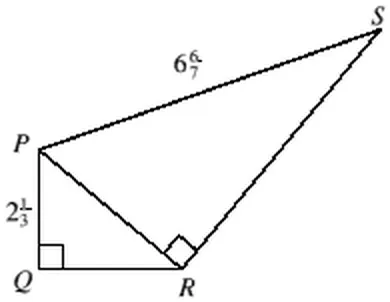
23. In the figure on the right, \(PQ = 2\frac{1}{3}\), \(PS = 6\frac{6}{7}\) and \(\angle QPR = \angle RPS\).
How long is \(PR\)?

  1. A \(3\frac{1}{2}\)
  2. B 4
  3. C \(4\frac{1}{4}\)
  4. D \(4\frac{25}{42}\)
  5. E 5
Triangle PQR with a right angle at Q and PQ = 2 and one third, and triangle PRS with a right angle at R and PS = 6 and six sevenths

Intermediate Mathematical Challenge 2006, Question 23. © UK Mathematics Trust. Original paper on ukmt.org.uk

IMC 2006 Q21

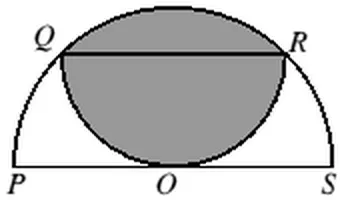
21. The diagram shows two semicircular arcs, \(PQRS\) and \(QOR\). The diameters, \(PS\) and \(QR\), of the two semicircles are parallel; \(PS\) is of length 4 and is a tangent to semicircular arc \(QOR\).
What is the area of the shaded region?

  1. A \(2\pi - 2\)
  2. B \(3\pi\)
  3. C \(\pi\)
  4. D 4
  5. E \(2\pi - 4\)
A large semicircle PQRS on diameter PS with centre O; a smaller semicircle QOR on chord QR touches PS at O, and the region inside it is shaded

Intermediate Mathematical Challenge 2006, Question 21. © UK Mathematics Trust. Original paper on ukmt.org.uk

IMC 2006 Q19

IMCCurrent spec6 marksGeometry & Angles

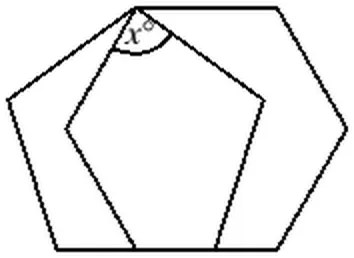
19. The diagram shows a regular pentagon and a regular hexagon which overlap. What is the value of \(x\) ?

  1. A 82
  2. B 84
  3. C 85
  4. D 87
  5. E 91
A regular hexagon and a regular pentagon overlapping, sharing part of the top edge, with an angle x degrees marked at the top

Intermediate Mathematical Challenge 2006, Question 19. © UK Mathematics Trust. Original paper on ukmt.org.uk

IMC 2006 Q14

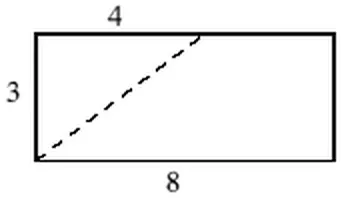
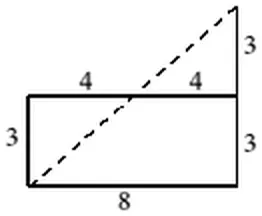
14. A 3 × 8 rectangle is cut into two pieces along the dotted line shown. The two pieces are then rearranged to form a right-angled triangle. What is the perimeter of the triangle formed?

  1. A 21
  2. B 22
  3. C 23
  4. D 24
  5. E 25
A 3 by 8 rectangle with a dotted line from the bottom left corner to a point 4 along the top edge

Intermediate Mathematical Challenge 2006, Question 14. © UK Mathematics Trust. Original paper on ukmt.org.uk

IMC 2006 Q12

IMCCurrent spec5 marksGeometry & Angles

12. When a solid cube is held up to the light, how many of the following shapes could its shadow have?

Four black shapes: a square standing on a corner, a non-regular hexagon, a regular hexagon and a rectangle
  1. A 0
  2. B 1
  3. C 2
  4. D 3
  5. E 4

Intermediate Mathematical Challenge 2006, Question 12. © UK Mathematics Trust. Original paper on ukmt.org.uk

IMC 2006 Q11

IMCCurrent spec5 marksGeometry & Angles

11. What is the obtuse angle between the hands of a clock at 6 minutes past 8 o'clock?

  1. A 123°
  2. B 126°
  3. C 153°
  4. D 156°
  5. E 159°

Intermediate Mathematical Challenge 2006, Question 11. © UK Mathematics Trust. Original paper on ukmt.org.uk

IMC 2006 Q5

5. A solid ‘star’ shape is created by gluing a square-based pyramid, in which each edge is of length 1 unit, precisely onto each face of a cube of edge 1 unit. How many faces does this ‘star’ have?

  1. A 18
  2. B 24
  3. C 30
  4. D 36
  5. E 48

Intermediate Mathematical Challenge 2006, Question 5. © UK Mathematics Trust. Original paper on ukmt.org.uk

IMC 2005 Q25

IMCCurrent spec6 marksAlgebraGeometry & Angles

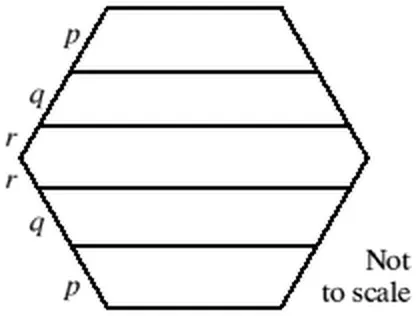
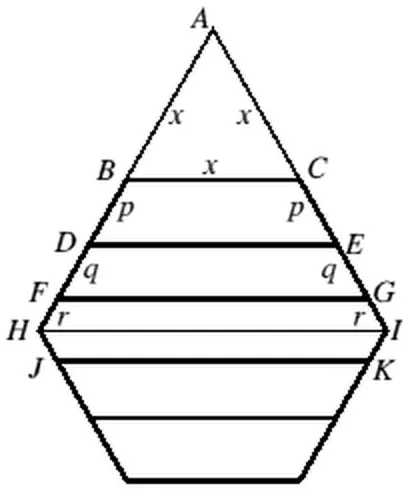
25. This regular hexagon has been divided into four trapezia and one hexagon. If each of the five sections has the same perimeter, what is the ratio of the lengths \(p\), \(q\) and \(r\) ?

  1. A 8 : 2 : 1
  2. B 12 : 4 : 1
  3. C 9 : 3 : 1
  4. D 6 : 3 : 1
  5. E 9 : 4 : 1
A regular hexagon divided by four horizontal lines into four trapezia and a central hexagon, with the sloping sides marked p, q, r, r, q, p from top to bottom; not to scale

Intermediate Mathematical Challenge 2005, Question 25. © UK Mathematics Trust. Original paper on ukmt.org.uk

IMC 2005 Q24

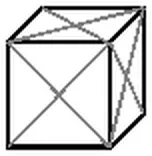
24. The figure shows a cube of side 1 on which all twelve face diagonals have been drawn – creating a network with 14 vertices (the original eight corners, plus the six face centres) and 36 edges (the original twelve edges of the cube plus four extra edges on each face). What is the length of the shortest path along the edges of the network which passes through all 14 vertices?

  1. A \(1 + 6\sqrt{2}\)
  2. B \(4 + 2\sqrt{2}\)
  3. C 6
  4. D \(8 + 6\sqrt{2}\)
  5. E \(12 + 12\sqrt{2}\)
A cube with all twelve face diagonals drawn

Intermediate Mathematical Challenge 2005, Question 24. © UK Mathematics Trust. Original paper on ukmt.org.uk

IMC 2005 Q21

IMCCurrent spec6 marksGeometry & Angles

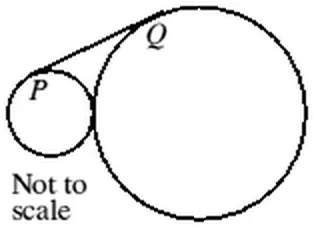
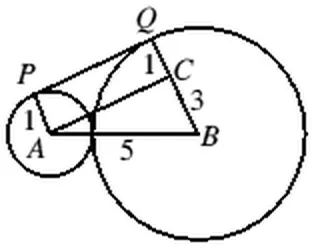
21. Two circles with radii 1 cm and 4 cm touch. The point \(P\) is on the smaller circle, \(Q\) is on the larger circle and \(PQ\) is a tangent to both circles. What is the length of \(PQ\)?

  1. A \(\sqrt{17}\) cm
  2. B 3 cm
  3. C \(2\sqrt{3}\) cm
  4. D \(3\sqrt{2}\) cm
  5. E 4 cm
A small circle with point P and a larger circle with point Q touching it, with the common tangent PQ; not to scale

Intermediate Mathematical Challenge 2005, Question 21. © UK Mathematics Trust. Original paper on ukmt.org.uk

IMC 2005 Q14

IMCCurrent spec5 marksGeometry & Angles

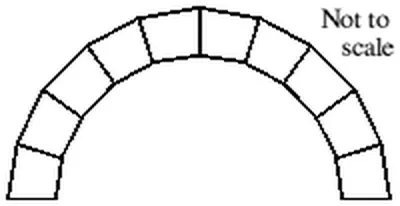
14. Ten stones, of identical shape and size, are used to make an arch, as shown in the diagram. Each stone has a cross-section in the shape of a trapezium with three equal sides. What is the size of the smallest angles of the trapezium?

  1. A 72°
  2. B 75°
  3. C 81°
  4. D 83°
  5. E 85°
A semicircular arch made of ten identical stones, each a trapezium; not to scale

Intermediate Mathematical Challenge 2005, Question 14. © UK Mathematics Trust. Original paper on ukmt.org.uk

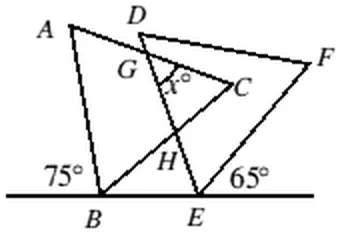
IMC 2005 Q13

IMCCurrent spec5 marksGeometry & Angles

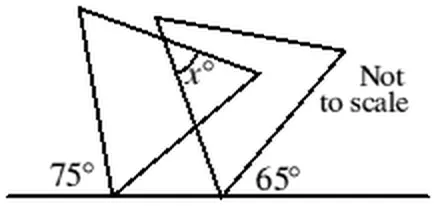
13. The diagram shows two equilateral triangles.
What is the value of \(x\)?

  1. A 70
  2. B 60
  3. C 50
  4. D 40
  5. E 30
Two overlapping equilateral triangles standing on a horizontal line, making angles of 75 degrees and 65 degrees with it, with an angle x degrees marked where they cross; not to scale

Intermediate Mathematical Challenge 2005, Question 13. © UK Mathematics Trust. Original paper on ukmt.org.uk

IMC 2005 Q11

IMCCurrent spec5 marksGeometry & Angles

11. If two of the sides of a right-angled triangle are 5 cm and 6 cm long, how many possibilities are there for the length of the third side?

  1. A 0
  2. B 1
  3. C 2
  4. D 3
  5. E 4

Intermediate Mathematical Challenge 2005, Question 11. © UK Mathematics Trust. Original paper on ukmt.org.uk

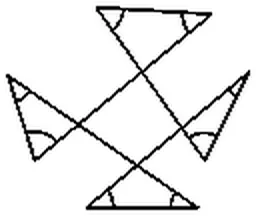
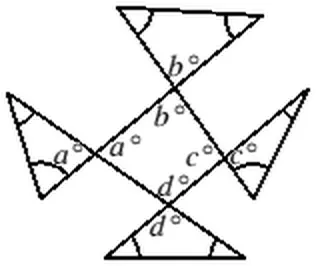
IMC 2005 Q7

IMCCurrent spec5 marksGeometry & Angles

7. In the diagram, what is the sum of the marked angles?

  1. A 180°
  2. B 360°
  3. C 450°
  4. D 540°
  5. E 720°
Four triangles arranged around a central quadrilateral, with two angles marked in each triangle

Intermediate Mathematical Challenge 2005, Question 7. © UK Mathematics Trust. Original paper on ukmt.org.uk

IMC 2005 Q3

IMCCurrent spec5 marksGeometry & Angles

3. Professor Rosseforp has an unusual clock. The clock shows the correct time at noon, but the hands move anti-clockwise rather than clockwise. The clock is very accurate, however, so the hands move at the correct speeds. If you looked in a mirror at the Professor's clock at 1:30 pm, which of the following would you see?

Five clock faces labelled A to E, each with the 12 printed in mirror image at the top and two hands pointing in different directions

Intermediate Mathematical Challenge 2005, Question 3. © UK Mathematics Trust. Original paper on ukmt.org.uk

IMC 2004 Q25

25. The diagram shows a square with two lines from a corner to the middle of an opposite side. The rectangle fits exactly inside these two lines and the square itself. What fraction of the square is occupied by the shaded rectangle?

  1. A \(\dfrac{1}{3}\)
  2. B \(\dfrac{2}{5}\)
  3. C \(\dfrac{3}{10}\)
  4. D \(\dfrac{1}{2}\)
  5. E \(\dfrac{3}{8}\)
A square with two lines from a corner to the midpoints of the opposite sides, and a shaded rectangle fitting exactly between these lines and the square

Intermediate Mathematical Challenge 2004, Question 25. © UK Mathematics Trust. Original paper on ukmt.org.uk

IMC 2004 Q23

IMCCurrent spec6 marksGeometry & Angles

23. In the diagram, the letter \(S\) is made from two arcs, \(KL\) and \(MN\), which are each five-eighths of the circumference of a circle of radius 1, and the line segment \(LM\), which is tangent to both circles. At points \(K\) and \(N\), common tangents to the two circles touch one of the circles. What is the length \(LM\)?

  1. A \(\dfrac{3}{2}\)
  2. B \(3 - \sqrt{2}\)
  3. C 2
  4. D \(\dfrac{3\sqrt{2}}{2}\)
  5. E \(1 + \sqrt{2}\)
A letter S inside a rectangle, made from arc KL of the top circle, arc MN of the bottom circle and the line segment LM

Intermediate Mathematical Challenge 2004, Question 23. © UK Mathematics Trust. Original paper on ukmt.org.uk

IMC 2004 Q18

18. In the triangle \(PQR\), there is a right angle at \(Q\) and angle \(QPR\) is 60°. The bisector of the angle \(QPR\) meets \(QR\) at \(S\), as shown.
What is the ratio \(QS : SR\)?

  1. A 1:1
  2. B 1:\(\sqrt{2}\)
  3. C 1:(3 − \(\sqrt{3}\))
  4. D 1 : \(\sqrt{3}\)
  5. E 1:2
Right-angled triangle PQR with the right angle at Q and a line from P to a point S on QR

Intermediate Mathematical Challenge 2004, Question 18. © UK Mathematics Trust. Original paper on ukmt.org.uk

IMC 2004 Q15

IMCCurrent spec5 marksGeometry & Angles

15. Only one of these triangles can actually be made. Which is it?

Five triangles labelled A to E: A has angles 25 and 110 degrees and two sides of 3 cm; B has sides 4 cm and 5 cm with angles 20 and 130 degrees; C is right-angled with sides 4 cm, 7 cm and 8 cm; D has sides 3 cm and 6 cm with angles 60 and 30 degrees; E has sides 2 cm, 6 cm and 3 cm

Intermediate Mathematical Challenge 2004, Question 15. © UK Mathematics Trust. Original paper on ukmt.org.uk

IMC 2004 Q4

IMCCurrent spec5 marksGeometry & Angles

4. What is the value of \(a + b + c + d + e + f\)?

  1. A 360
  2. B 540
  3. C 720
  4. D 900
  5. E it depends on the triangle
A triangle with its three sides extended; at the three vertices the angles a, b, c, d, e and f degrees are marked

Intermediate Mathematical Challenge 2004, Question 4. © UK Mathematics Trust. Original paper on ukmt.org.uk