24. Anne, Bronwyn and Carl ran a race. They started at the same time, and their speeds were constant. When Anne finished, Bronwyn had 15 m to run and Carl had 35 m to run. When Bronwyn finished, Carl had 22 m to run. What was the length of the race?
First note that Carl ran (35 − 22) m = 13 m while Bronwen ran 15 m. Let the length of the race be \(x\) m. Since their speeds were constant, the ratio of the distances they ran in any time is also constant. Therefore, since Carl ran \((x - 35)\) m while Bronwen ran \((x - 15)\) m, we have \(\dfrac{x - 35}{x - 15} = \dfrac{13}{15}\). Therefore \(15x - 15 \times 35 = 13x - 13 \times 15\) and hence \(2x = 15 \times 35 - 13 \times 15\). Therefore \(2x = 22 \times 15\) and hence \(x = 11 \times 15\). Therefore the distance they ran is 165 m.
We are given that \(10 \times 2^m = 2^n + 2^{n+2}\). Therefore \(5 \times 2 \times 2^m = 2^n(1 + 2^2)\). Hence \(5 \times 2^{m+1} = 2^n \times 5\). So \(m + 1 = n\). Therefore the difference between \(m\) and \(n\) is 1.
Let \(x\) be the number in the bottom right cell. Then the column total is \(x + 15\). Since each row and column has the same total, we can now find the other missing values. The third column requires \(x\) in its missing cell to make the total up to \(x + 15\). The top row requires \(x + 5\). The second column requires 1. The bottom row is now missing 7, hence this goes in the shaded square. [The other cells in the left column are \(x + 3\) and 4.]
20. Kanga labelled the vertices of a square-based pyramid using 1, 2, 3, 4 and 5 once each. For each face Kanga calculated the sum of the numbers on its vertices. Four of these sums equalled 7, 8, 9 and 10. What is the sum for the fifth face?
One face has total 7 which can only be obtained from the given numbers by adding 1, 2 and 4. Therefore it is a triangular face, and so the label of the top vertex, \(x\) say, is one of these three values. Hence the square face has 5 at one vertex. So the smallest possible face total for the square is 5 + 1 + 2 + 3 = 11. Therefore the four face totals given, 7, 8, 9 and 10, must be the face totals of the triangular faces and their sum is 34. Note that each vertex except the top belongs to two triangles; and the top belongs to all four. So the sum 34 is twice the sum of all the labels plus an extra \(2x\); that is \(34 = 2(1 + 2 + 3 + 4 + 5) + 2x = 30 + 2x\). Hence \(x = 2\) and the face total for the square face is 1 + 3 + 4 + 5 = 13.
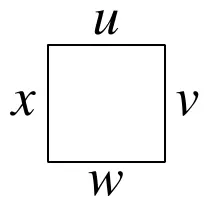
20. Harriet writes a positive integer on each edge of a square. She also writes at each vertex the product of the integers on the two edges that meet at that vertex. The sum of the integers at the vertices is 15. What is the sum of the integers on the edges of the square?
Let the integers written on the edges of the square be \(u\),\(v\), \(w\) and \(x\) as shown in the diagram. Therefore, since the integer written at each vertex is the product of the integers written on the edges that meet at that vertex, the integers at the vertices are \(ux, uv, vw\) and \(wx\). Therefore \(ux + uv + vw + wx = 15\) and hence \((u + w)(v + x) = 15\). Since \(u, v, w\) and \(x\) are positive integers, the smallest either of \(u + w\) or \(v + x\) can be is \(1 + 1 = 2\). Therefore the only possible multiplications which give an answer of 15 are 3 × 5 = 15 and 5 × 3 = 15. In each case, the sum of the integers on the edges of the square is 3 + 5 = 8.
Answer: D \((x + \tfrac{1}{4})(x - \tfrac{1}{4})\)
Solution (UKMT)
The first four expressions expand to \(x^2 - 1\);\(x^2 - \tfrac{1}{4}\);\(x^2 - \tfrac{1}{9}\); \(x^2 - \tfrac{1}{16}\) respectively. Note that \(\tfrac{1}{16} < \tfrac{1}{9} < \tfrac{1}{4} < 1\). Therefore the least value is \(x^2 - \tfrac{1}{16}\), that is \((x + \tfrac{1}{4})(x - \tfrac{1}{4})\). This result is irrespective of the value of \(x\).
17. The Knave of Hearts stole some tarts. He ate half of them, and half a tart more. The Knave of Diamonds ate half of what was left, and half a tart more. Then the Knave of Clubs ate half of what remained, and half a tart more. This left just one tart for the Knave of Spades. How many tarts did the Knave of Hearts steal?
Suppose that at a particular stage there are \(m\) tarts available for a Knave to eat and that there are \(n\) left after he has finished eating. Then \(n = m - (\tfrac{1}{2}m + \tfrac{1}{2}) = \tfrac{1}{2}m - \tfrac{1}{2}\). Therefore, \(m = 2n + 1\). As the Knave of Spades received one tart, then the number of tarts which the Knave of Clubs was given was 2 × 1 + 1 = 3. Similarly, the number of tarts which the Knave of Diamonds was given was 2 × 3 + 1 = 7. Finally, the number of tarts which the Knave of Hearts stole was 2 × 7 + 1 = 15.
12. Farmer Fatima rears chickens and goats. Today she returned from market and said, “I sold 80 animals, and now there are 200 fewer legs on my farm than before!” How many goats did she sell?
Let the number of chickens and goats sold be \(c\) and \(g\) respectively. Then, since 80 animals are sold, we have \(c + g = 80\). Also, \(2c + 4g = 200\), since the chickens have two legs and the goats have four legs. Dividing the second equation by 2, we obtain \(c + 2g = 100\). Then, subtracting the first equation gives \(g = 100 - 80 = 20\). So 20 goats were sold.
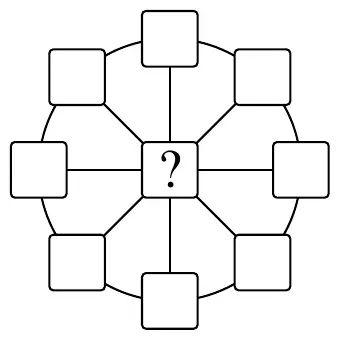
10. Freda wants to write a number in each of the nine cells of this figure so that the sum of the three numbers on each diameter is 13 and the sum of the eight numbers on the circumference is 40.
Each diameter has the same sum and contains the central cell, so the pair at the end of each diameter must have the same sum. These four pairs have sum 40, so each pair must have sum 10. Since each diameter has sum 13, the central number must be 3.
Since \(ab = 2cd\), the product \(abcd = 2cd \times cd = 2(cd)^2\), hence it must be twice a perfect square. This is true for all the options, except 100 since \(100 = 2 \times 50\) but 50 is not a perfect square. [\(50 = 2 \times 5^2\);\(200 = 2 \times 10^2\);\(450 = 2 \times 15^2\); and \(800 = 2 \times 20^2\).]
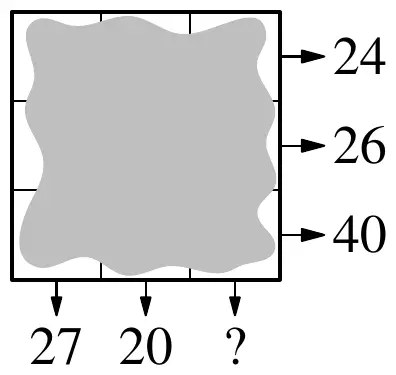
7. Each cell of a 3 × 3 square has a number written in it. Unfortunately the numbers are not visible because they are covered in ink. However, the sum of the numbers in each row and the sum of the numbers in two of the columns are all known, as shown by the arrows on the diagram. What is the sum of the numbers in the third column?
The sum of the row totals is the sum of all the nine numbers in the 3 × 3 square. Likewise, the sum of the column totals is the sum of these nine numbers. Therefore \(24 + 26 + 40 = 27 + 20 + x\), where \(x\) is the sum of the numbers in the third column. Therefore \(90 = 47 + x\) and hence \(x = 43\). Therefore the sum of the numbers in the third column is 43.
6. Mary had ten pieces of paper. Some of them were squares, and the rest were triangles. She cut three squares diagonally from corner to corner. She then found that the total number of vertices of the 13 pieces of paper was 42.
How many triangles did she have before making the cuts?
Let \(s\) be the number of squares, and \(t\) the number of triangles that Mary started with. The number of vertices was \(4s + 3t\). Also, there were 10 pieces of paper, so \[s + t = 10. \quad [1]\] When she cuts a square diagonally to create two triangles, she increases the number of vertices by 2 (from 4 to 6). Hence before she cut the three squares, she had \(42 - 3 \times 2 = 36\) vertices. Therefore \[4s + 3t = 36. \quad [2]\] Subtracting three times equation [1] from equation [2] gives \(s = 6\). Hence \(t = 4\).
The four integers cannot all be non-positive since the total is positive. Also, they cannot all be non-negative since the smallest possible total would then be 0 + 1 + 2 + 3 = 6. So, they must have at least one negative integer, and at least one positive integer, and hence will include -1, 0 and 1. Since these have a total of 0, the fourth number must be 2. Thus the least integer is -1.
3. In the calculations shown, each letter stands for a digit. They are used to make some two-digit numbers. The two numbers on the left have a total of 79.
What is the total of the four numbers on the right?
The numbers on the left use the digits M and K in the Units column, and the digits J and L in the Tens column. The numbers on the right use the digits M and K twice in the Units columns, and the digits J and L twice in the Tens column, so the total is exactly twice that of the numbers on the left. Twice 79 is 158, answer B.
25. A train is made up of 18 carriages. There are 700 passengers travelling on the train. In any block of five adjacent carriages, there are 199 passengers in total. How many passengers in total are in the middle two carriages of the train?
Let \(n\) be the total number of passengers in the middle two carriages. These are the ninth and tenth carriages and so, since there are 199 passengers in any block of five adjacent carriages, the total number of passengers in the sixth, seventh and eighth carriages is \(199 - n\). There are 199 passengers in total in carriages 1 to 5 inclusive, in carriages 9 to 13 inclusive and in carriages 14 to 18 inclusive. Since there are 700 passengers in total on the train, we have \(199 + 199 - n + 199 + 199 = 700\). Therefore \(796 - n = 700\) and hence \(n = 96\). Therefore there are 96 passengers in total in the middle two carriages of the train.
23. A chess tournament is planned for teams, each of which has exactly three players. Each player in a team will play exactly once against each player from all the other teams. For organisational reasons, no more than 250 games can be played in total. At most, how many teams can enter the tournament?
Let the largest number of teams that can enter the tournament be \(n\). Hence there would be \(3n\) players in total. Each player in a team will play a game against every player from all other teams and hence the total number of games played is \(\tfrac{3n \times (3n - 3)}{2} = \tfrac{9n(n - 1)}{2}\). Since no more than 250 games can be played, we have \(\tfrac{9n(n - 1)}{2} \leqslant 250\). Therefore \(n(n - 1) \leqslant \tfrac{500}{9} = 55\tfrac{5}{9}\). Since \(8 \times 7 = 56 > 55\tfrac{5}{9}\), we have \(n < 8\). Also, since \(7 \times 6 = 42 < 55\tfrac{5}{9}\), \(n = 7\) is a possible solution. Therefore the largest number of teams that can enter the tournament is 7.
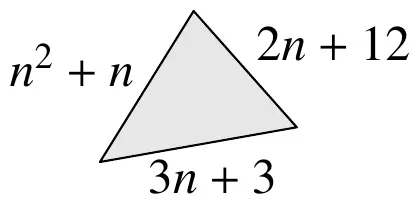
When equation (1) is true, we have \(n^2 - n - 12 = 0\), so that \((n - 4)(n + 3) = 0\). Hence either \(n = 4\) or \(n = -3\). However, when \(n = -3\) then \(3n + 3 < 0\), so that no triangle can be formed. There is, though, an isosceles triangle when \(n = 4\), as the sides of the triangle are then 20, 20 and 15. When equation (2) is true,we have \(n^2 - 2n - 3 = 0\), so that \((n - 3)(n + 1) = 0\). Hence either \(n = 3\) or \(n = -1\). However, when \(n = -1\) then \(3n + 3 = 0\), so that no triangle can be formed. There is, though, an isosceles triangle when \(n = 3\), as the sides of the triangle are then 12, 18 and 12. When equation (3) is true, we have \(n = 9\). But then \(n^2 + n = 90\) and \(3n + 3 = 30 = 2n + 12\), so that no triangle can be formed at all in this case, because 90 > 30 + 30. Hence the required sum is 3 + 4 = 7.
21. Each of the positive integers \(a\),\(b\), and \(c\) has three digits, and for each of these integers the first digit is the same as its last digit. Also \(b = 2a + 1\) and \(c = 2b + 1\). How many possibilities are there for the integer \(a\)?
Let the digits of \(a\) be ‘\(pqp\)’, so \(a = 101p + 10q\).Also \(c = 2b + 1 = 2(2a + 1) + 1 = 4a + 3\) which is \(404p + 40q + 3\). This is less than 1000, so \(p = 1\) or 2.
If \(p = 2\), then \(c = 808 + 40q + 3\). This ends with digit 1 (8 + 3 = 11) but \(c\) is a 3-digit number greater than 808 so can’t begin with 1.
If \(p = 1\), then \(c = 404 + 40q + 3\). This ends with digit 4 + 3 = 7, so must also begin with 7, hence \(700 \leq 404 + 40q + 3 < 800\) and thus \(293 \leq 40q < 393\). Therefore \(q = 8\) or 9.
When \(q = 8\), this gives \(a = 181\),\(b = 363\),\(c = 727\). When \(q = 9\), this gives \(a = 191\),\(b = 383\),\(c = 767\).
Hence there are two possibilities for \(a\), 181 and 191.
The value of ‘\(ab\)’ is \(10a + b\) so \(3a + 4b = 10a + b\) which gives \(3b = 7a\). Hence \(a\) is a multiple of 3 and \(b\) is a multiple of 7. Also \(a\) is non-zero (as it is the leading digit), and hence \(b\) also cannot be zero. The only single-digit solution of \(3b = 7a\) is \(a = 3\) and \(b = 7\), so \(a + b = 10\).
8. Andrew divided some apples into six equal piles. Boris divided the same number of apples into five equal piles. Boris noticed that each of his piles contained two more apples than each of Andrew’s piles. How many apples did Andrew have?
Let the number of apples Andrew had be \(6n\). When Boris divided the same number of apples into five piles, each pile contained two more apples than each of Andrew’s piles. Therefore \(6n = 5(n + 2)\) and hence \(6n = 5n + 10\). This has solution \(n = 10\). Therefore the number of apples Andrew had was 6 × 10 = 60.
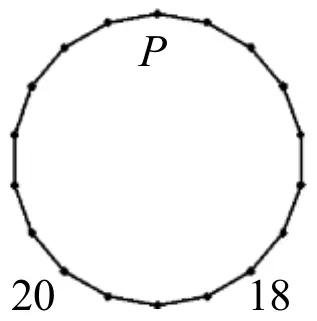
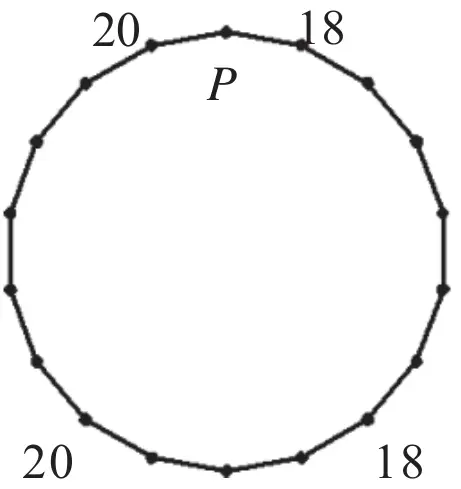
23. At each vertex of the 18-gon in the picture a number should be written which is equal to the sum of the numbers at the two adjacent vertices. Two of the numbers are given. What number should be written at the vertex \(P\)?
Let \(a\) and \(b\) be two adjacent numbers on the vertices. Then the next vertex after \(b\) will have the number \(b - a\); and that will be followed, in turn, by \(-a\),\(-b\),\(a - b\), then \(a\), \(b\) again. This shows that each number reappears every sixth vertex. Therefore the number at the vertex to the left of \(P\) is 20 and that to its right is 18. Thus the number at \(P\) is \(20 + 18 = 38\).
23. Wendy wants to write a number in every cell on the border of a table. In each cell, the number she writes is equal to the sum of the two numbers in the cells with which this cell shares an edge. Two of the numbers are given in the diagram. What number should she write in the cell marked \(x\)?
Let the values she writes in some of the cells be as shown in the diagram. Since the number in any cell is equal to the sum of the numbers in the two cells that border it, we have \(a = 10 + b\) and hence \(b = a - 10\). Also we have \(b = c + a\) giving \(c = -10\), \(c = b + d\) giving \(d = -a\) and \(d = c + 3\) giving \(d = -7\). Therefore \(a = 7\) and \(b = -3\) and it is now possible to work out the remaining unknown values. Since \(10 = 7 + e\), we obtain \(e = 3\). Similarly, \(e = 10 + f\) giving \(f = -7\) and then \(f = e + g\) giving \(g = -10\). Also \(g = f + h\) giving \(h = -3\) and \(h = g + x\) giving \(x = 7\).
Clearly, there are no values of \(x\) for which \(x = x + 6\). So the possible values of \(x\) will be solutions of the equation \(x = x^2\) or the equation \(x + 6 = x^2\). Consider the first equation: \(x = x^2\). This simplifies to \(x(1 - x) = 0\). So \(x = 0\) or \(x = 1\). The equation \(x + 6 = x^2\) simplifies to \(x^2 - x - 6 = 0\). So \((x - 3)(x + 2) = 0\). Therefore \(x = 3\) or \(x = -2\). So there are four different values of \(x\).
20. Omar marks a sequence of 12 points on a straight line beginning with a point \(O\), followed by a point \(P\) with \(OP = 1\). He chooses the points so that each point is the midpoint of the two immediately following points. For example \(O\) is the midpoint of \(PQ\), where \(Q\) is the third point he marks. What is the distance between the first point \(O\) and the 12th point \(Z\)?
Let the points \(O\), \(P\) etc, be labelled as \(A_1\),\(A_2\), etc, in the order in which they are drawn. Without loss of generality, we can draw the line horizontally with \(A_2\) on the right of \(A_1\). Since \(A_1\) is the midpoint of \(A_2\) and \(A_3\), we then put \(A_3\) to the left of \(A_1\) at a distance of 1 from \(A_1\). Since \(A_2\) is the midpoint of \(A_3\) and \(A_4\), we put \(A_4\) on the right of \(A_2\) at a distance of 2 from \(A_2\). Proceeding in this fashion, the odd points end up further to the left of \(A_1\), and the even points further to the right, with the distances doubling at each stage. The diagram shows the points and the distances between neighbouring points, though not to scale! The distance \(A_1A_{12}\) is \(1 + 2 + 8 + 32 + 128 + 512 = 683\).
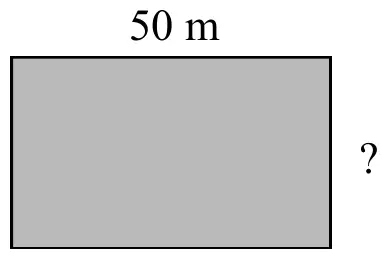
20. Ruth and Sarah decide to have a race. Ruth runs around the perimeter of the pool shown in the diagram while Sarah swims lengths of the pool. Ruth runs three times as fast as Sarah swims. Sarah swims six lengths of the pool in the same time Ruth runs around the pool five times. How wide is the pool?
Let the width of the pool be \(x\) m. Therefore the total distance Ruth runs is \(5(2 \times 50 + 2x)\) m = \((500 + 10x)\) m. The total distance Sarah swims is 6 × 50 m = 300 m. Since Ruth runs three times as fast as Sarah swims, \(500 + 10x = 3 \times 300\). Therefore \(10x = 400\) and hence \(x = 40\).
19. Abdul wrote down four positive numbers. He chose one of them and added it to the mean of the other three. He repeated this for each of the four numbers in turn. The results were 17, 21, 23 and 29. What was the largest of Abdul's numbers?
Let the four numbers be \(a\),\(b\),\(c\), \(d\) with \(a \leqslant b \leqslant c \leqslant d\). Abdul chooses the numbers in turn, giving \[\begin{array}{lll} a + \tfrac{1}{3}(b + c + d) = 17 \quad (1) & \qquad & b + \tfrac{1}{3}(a + c + d) = 21 \quad (2) \\ c + \tfrac{1}{3}(a + b + d) = 23 \quad (3) & \qquad & d + \tfrac{1}{3}(a + b + c) = 29 \quad (4) \end{array}\] Adding these equations gives: \[\begin{array}{lr} & a + b + c + d + \tfrac{1}{3}(3a + 3b + 3c + 3d) = 90 \\ \text{that is} & 2a + 2b + 2c + 2d = 90. \end{array}\] Hence \(a + b + c + d = 45\). Subtracting a third of this from equation (4), we get \[d + \tfrac{1}{3}(a + b + c) - \tfrac{1}{3}(a + b + c + d) = 29 - 15.\] Which gives \(\tfrac{2}{3}d = 14\), so \(d = 21\). We can continue in a similar way to find \(a = 3\), \(b = 9\) and \(c = 12\).
19. Amy, Becky and Chloe went shopping. Becky spent only 15 % of what Chloe spent. However, Amy spent 60 % more than Chloe. Together they spent £55. How much did Amy spend?
Let the amount Chloe spent be £\(x\). Therefore Amy spent £\(1.6x\) and Becky spent £\(0.15x\). The total amount spent is £55 and hence \(x + 1.6x + 0.15x = 55\). Therefore \(2.75x = 55\), which has solution \(x = 20\). Hence Amy spent £(1.6 × 20) = £32.
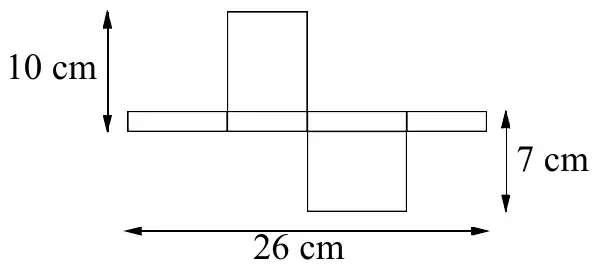
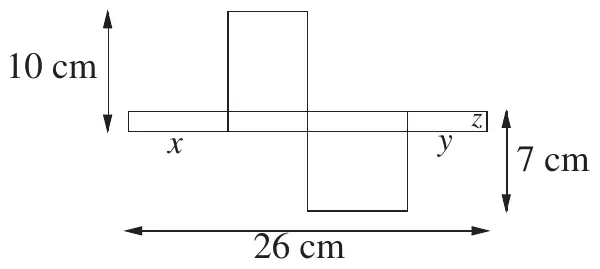
Let the dimensions of the box be \(x\) cm by \(y\) cm by \(z\) cm as indicated. From the diagram, we have \(2x + 2y = 26\), \(x + z = 10\) and \(y + z = 7\). When we add the last two of these, we obtain \(x + y + 2z = 17\) and, when we then double this, we obtain \(2x + 2y + 4z = 34\). Therefore \(4z = 34 - 26 = 8\) and hence \(z = 2\). Therefore \(x = 8\) and \(y = 5\) and hence the volume of the box in cm3 is 8 × 5 × 2 = 80.
17. There are three candidates standing for one position as student president and 130 students are voting. Sally has 24 votes so far, while Katie has 29 and Alan has 37. How many more votes does Alan need to be certain he will finish with the most votes?
The number of votes left to be cast is 130 – (24 + 29 + 37) = 40. Let the number of these votes Alan receives be \(x\). Since Katie is the closest challenger to Alan, for Alan to be certain of having the most votes, \(37 + x > 29 + 40 - x\). Therefore \(2x > 32\) and hence \(x > 16\). Therefore Alan needs at least 17 more votes to be certain to finish with the most votes.
The value of ‘abc’ equals \(100a + 10b + c\). We need to find integers of the form ‘abc’ such that ‘cba’ = ‘abc’ + 99. So \(100c + 10b + a = 100a + 10b + c + 99\), that is \(99c = 99a + 99\). This condition simplifies to \(c = a + 1\). So there are 10 such integers of the form ‘1b2’, 10 of the form ‘2b3’, 10 of the form ‘3b4’, …, and 10 of the form ‘8b9’. Therefore the required number is 8 × 10 = 80.
16. Eleven points are marked from left to right on a straight line. The sum of all the distances between the first point and the other points is 2018 cm. The sum of all the distances between the second point and the other points, including the first one, is 2000 cm. What is the distance between the first and second points?
Let the distance between the first two points be \(x\) cm. Consider the other nine points. The sum of their distances from the first point is \((2018 - x)\) cm and the sum of their distances from the second point is \((2000 - x)\) cm. Also, for each of these nine points, its distance from the second point is \(x\) cm less than its distance from the first point. Therefore, when we total the distances over the nine points, we obtain \(9x = (2018 - x) - (2000 - x)\) and hence \(9x = 18\). Therefore \(x = 2\) and so the distance between the first and second points is 2 cm.
15. How many 3-digit numbers are there with the property that the 2-digit number obtained by deleting the middle digit is equal to one ninth of the original 3-digit number?
Let the three digits be \(a\),\(b\),\(c\). Then the value of the 3-digit number is \(100a + 10b + c\) and the 2-digit number (made by deleting the middle digit) is \(10a + c\). Hence \(100a + 10b + c = 9(10a + c)\), which gives \(10(a + b) = 8c\), or \(5(a + b) = 4c\). Hence \(c\) is divisible by 5. But \(c\) cannot be zero (because this would mean \(a + b = 0\), and the digits cannot all be zero). So \(c = 5\). Then \(a + b = 4\), giving four possibilities: \(a = 1\), \(b = 3\) or \(a = 2\), \(b = 2\) or \(a = 3\), \(b = 1\) or \(a = 4\),\(b = 0\). These all give valid solutions (135 = 9 × 15, 225 = 9 × 25, 315 = 9 × 35, 405 = 9 × 45).
14. Peter wanted to buy a book, but he didn't have any money. He bought it with the help of his father and his two brothers. His father gave him half of the amount given by his brothers. His elder brother gave him one third of what the others gave. The younger brother gave him 10 euros. What was the price of the book?
Let \(D\) be the amount that Peter's dad gave, and \(B\) the amount his elder brother gave. Then \(D = \tfrac{1}{2}(B + 10) \ldots\) (1) and \(B = \tfrac{1}{3}(D + 10) \ldots\) (2). Substitute (1) into (2) to get \(B = \tfrac{1}{3}\left(\tfrac{1}{2}(B + 10) + 10\right) = \tfrac{1}{6}B + 5\). Hence \(\tfrac{5}{6}B = 5\), so \(B = 6\) and \(D = \tfrac{1}{2}(6 + 10) = 8\). This gives a total of 6 + 8 + 10 = 24. So the book cost 24 euros.
The difference of two squares \(a^2 - b^2\) factorises to \((a + b)(a - b)\). Therefore for it to be possible to express an integer as the difference of two squares, it must be possible to factorise the integer in the form \((a + b)(a - b)\), where \(a\) and \(b\) are both integers. Note that \(5 = (3 + 2)(3 - 2)\);\(7 = (4 + 3)(4 - 3)\);\(8 = (3 + 1)(3 - 1)\);\(9 = (5 + 4)(5 - 4)\). So 5, 7, 8, 9 can all be written as the difference of two squares. (It is left to the reader to show that 10 cannot be the difference of two squares as it cannot be written in the form \((a + b)(a - b)\) where a and b are both integers.)
8. Two buildings are located on one street at a distance of 250 metres from each other. There are 100 students living in the first building. There are 150 students living in the second building. Where should a bus stop be built so that the total distance that all residents of both buildings have to walk from their buildings to this bus stop would be the least possible?
All distances in this solution are in metres. Let \(x\) be the distance of the bus stop from the second building. Then the total distance walked by the 150 students in this building is \(150x\). The distance travelled by each of the students in the first building is \(250 - x\), so the total of their distances is \(100(250 - x)\). Adding these to get the total distance of all students gives \(150x + 100(250 - x) = 50x + 25000\). This is minimised by setting \(x = 0\), so the bus stop should be in front of the second building!
The largest possible value of \(a - b\) comes from subtracting the smallest possible value of \(b\) from the largest possible value of \(a\). Hence the largest possible value is 10 − (−5) = 10 + 5 = 15.
Let \(n\) be the middle number. Then the five numbers are \(n - 2\),\(n - 1\),\(n\),\(n + 1\), \(n + 2\) and have sum \(5n = 10^{2018}\). Therefore \(n = \dfrac{10^{2018}}{5} = \dfrac{10 \times 10^{2017}}{5} = 2 \times 10^{2017}\).
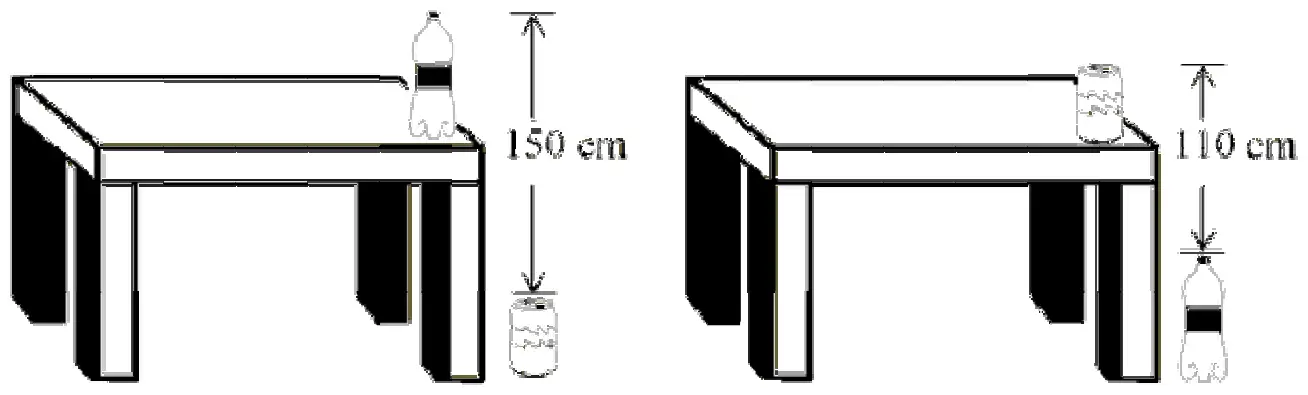
2. The distance from the top of the can on the floor to the top of the bottle on the table is 150 cm. The distance from the top of the bottle on the floor to the top of the can on the table is 110 cm. What is the height of the table?
Let \(t\) be the height of the table, \(b\) the height of the bottle and \(c\) the height of the can (all measured in cm). The first diagram shows \(t + b = c + 150\); the second diagram shows \(t + c = b + 110\). Adding these equations gives \(2t + b + c = 260 + b + c\) so \(2t = 260\). So the table has height 130 cm.
24. The \(n\)th term in a certain sequence is calculated by multiplying together all the numbers \(\sqrt{1 + \dfrac{1}{k}}\), where \(k\) takes all the integer values from 2 to \(n + 1\) inclusive. For example, the third term in the sequence is \(\sqrt{1 + \dfrac{1}{2}} \times \sqrt{1 + \dfrac{1}{3}} \times \sqrt{1 + \dfrac{1}{4}}\). Which is the smallest value of \(n\) for which the \(n\)th term of the sequence is an integer?
The product may be written \(\sqrt{\frac{3}{2}} \times \sqrt{\frac{4}{3}} \times \sqrt{\frac{5}{4}} \times \sqrt{\frac{6}{5}} \times \ldots = \frac{\sqrt{3}}{\sqrt{2}} \times \frac{\sqrt{4}}{\sqrt{3}} \times \frac{\sqrt{5}}{\sqrt{4}} \times \frac{\sqrt{6}}{\sqrt{5}} \times \ldots\). Notice that the numerator of each fraction is cancelled out by the denominator of the following fraction and the only terms which are not cancelled are the denominator of the first fraction and the numerator of the last fraction. So the \(n\)th term of the sequence is \(\frac{\sqrt{n + 2}}{\sqrt{2}} = \sqrt{\frac{n + 2}{2}}\). As \(n \geqslant 1\) the product is not equal to 1. The product increases with \(n\). So the next possible integer value to consider is 2 and this does occur when \(n = 6\) as \(\sqrt{\frac{6 + 2}{2}} = \sqrt{4} = 2\). So the smallest number of terms required for the product to be an integer is 6.
21.Brachycephalus frogs are tiny − less than 1 cm long − and have three toes on each foot and two fingers on each ‘hand’, whereas the common frog has five toes on each foot and four fingers on each ‘hand’. Some Brachycephalus and common frogs are in a bucket. Each frog has all its fingers and toes. Between them they have 122 toes and 92 fingers. How many frogs are in the bucket?
Let the number of Brachycephalus frogs and common frogs in the bucket be \(b\) and \(c\) respectively. Note that each Brachycephalus frog has 6 toes and 4 fingers, while a common frog has 10 toes and 8 fingers. Therefore, \(6b + 10c = 122\) (1); \(4b + 8c = 92\) (2). Subtracting (2) from (1) gives \(2b + 2c = 30\), so \(b + c = 15\).
18. A water tank is \(\dfrac{5}{6}\) full. When 30 litres of water are removed from the tank, the tank is \(\dfrac{4}{5}\) full. How much water does the tank hold when full?
Let the capacity of the tank be \(x\) litres. Then \(30 = \frac{5x}{6} - \frac{4x}{5} = \frac{25x - 24x}{30} = \frac{x}{30}\). So \(x = 30 \times 30 = 900\).
16. Seven positive integers \(a\),\(b\),\(c\),\(d\),\(e\),\(f\), \(g\) are written in a row. Every number differs by one from its neighbours. The total of the seven numbers is 2017. Which of the numbers can be equal to 286?
Each number \(a\),\(b\),\(c\),\(d\),\(e\),\(f\), \(g\) differs from its neighbour by one, so they alternate odd and even. To obtain an odd total, we must have an odd number of odd numbers in the list. Hence \(b\),\(d\), \(f\) are odd and cannot be equal to 286. If \(c = 286\), then the biggest total possible is 288 + 287 + 286 + 287 + 288 + 289 + 290 = 2015 which is too small. By reversing this list, we can also rule out \(e = 286\). We can obtain the total 2017 if we start with \(a = 286\) since 286 + 287 + 288 + 289 + 290 + 289 + 288 = 2017. By reversing this, we could also end with \(g = 286\).
16. Ella wants to write a number into each cell of a 3 × 3 grid so that the sum of the numbers in any two cells that share an edge is the same. She has already written two numbers, as shown in the diagram. When Ella has completed the grid, what will be the sum of all the numbers in the grid?
Label the numbers Ella writes down as shown in the diagram.
2
\(a\)
\(b\)
\(c\)
\(d\)
3
\(e\)
\(f\)
\(g\)
Since the sum of the numbers in any two adjacent cells is the same, \(2 + a = a + b\) and hence \(b = 2\). Therefore \(b + 3 = 2 + 3 = 5\). Hence the sum of the numbers in any two adjacent cells is 5. It is now straightforward to see that \(a = c = f = 3\) and that \(b = d = e = g = 2\). Therefore the sum of all the numbers in the grid is 5 × 2 + 4 × 3 = 22.
16. The product of two positive integers is equal to twice their sum. This product is also equal to six times the difference between the two integers. What is the sum of these two integers?
Let the two positive integers be \(m\) and \(n\). Then \(mn = 2(m + n) = 6(m - n)\). So \(2m + 2n = 6m - 6n\), that is \(8n = 4m\). Therefore \(m = 2n\). Substituting for \(m\) gives: \((2n)n = 2(2n + n)\). So \(2n^2 = 6n\), that is \(2n(n - 3) = 0\). Therefore \(n = 0\) or 3. However, \(n\) is positive so the only solution is \(n = 3\). Therefore \(m = 2 \times 3 = 6\) and \(m + n = 6 + 3 = 9\).
15. Maja decided to enter numbers into the cells of a 3 × 3 grid. She wanted to do this in such a way that the numbers in each of the four 2 × 2 grids that form part of the 3 × 3 grid have the same totals. She has already written numbers in three of the corner cells, as shown in the diagram. Which number does she need to write in the bottom right corner?
Let the numbers around the top left cell be \(a\), \(b\) and \(c\) as shown. Then the sum of the top left 2 × 2 square (and hence all the 2 × 2 squares) is \(a + b + c + 3\). The top right 2 × 2 square already contains \(a\) and \(b\) and 1, so the middle right cell must contain \(c + 2\). The bottom left 2 × 2 square contains \(b + c + 2\) so the bottom middle cell is \(a + 1\). The bottom right 2 × 2 square already contains \(a + b + c + 3\) so the missing value is zero. There are many ways to complete the grid; one way is shown here.
13. Four brothers have different heights. Tobias is shorter than Victor by the same amount by which he is taller than Peter. Oscar is shorter than Peter by the same amount as well. Tobias is 184 cm tall and the average height of all the four brothers is 178 cm. How tall is Oscar?
Let \(k\) cm be the difference between the heights. Then the heights in cm are: Tobias 184, Victor \(184 + k\), Peter \(184 - k\), and Oscar \(184 - 2k\). The mean is 178 so \(\tfrac{1}{4}\left(184 + 184 + k + 184 - k + 184 - 2k\right) = 178\). Hence \(4 \times 184 - 2k = 4 \times 178\), giving \(2k = 4 \times 184 - 4 \times 178 = 4 \times 6 = 24\). Hence \(k = 12\). Therefore Oscar's height in cm is \(184 - 2 \times 12 = 160\) cm.
12. Ellie wants to write a number in each box of the diagram shown. She has already written in two of the numbers. She wants the sum of all the numbers to be 35, the sum of the numbers in the first three boxes to be 22, and the sum of the numbers in the last three boxes to be 25.
3
4
What is the product of the numbers she writes in the shaded boxes?
Since the sum of the numbers in the first three boxes is to be 22, the sum of the numbers in the last three boxes is to be 25 and the sum of the numbers in all five boxes is to be 35, Ellie will write (22 + 25 − 35) = 12 in the middle box. Therefore she will write (22 − 3 − 12) = 7 in the second box and (25 − 12 − 4) = 9 in the fourth box. Hence the product of the numbers in the shaded boxes is 7 × 9 = 63.
12. The combined age of Alice and Bob is 39. The combined age of Bob and Clare is 40. The combined age of Clare and Dan is 38. The combined age of Dan and Eve is 44. The total of all five ages is 105. Which of the five is the youngest?
Let the ages of Alice, Bob, Clare, Dan and Eve be \(a\),\(b\),\(c\),\(d\), \(e\) respectively. So, for example, \(b + c = 40\) and \(d + e = 44\). Adding these gives \(b + c + d + e = 84\). We are also told that \(a + b + c + d + e = 105\). The difference between these equations shows that \(a = 105 - 84 = 21\). Hence \(b = 39 - 21 = 18\) and, similarly, \(c = 40 - 18 = 22\), \(d = 38 - 22 = 16\) and \(e = 44 - 16 = 28\). So Dan is the youngest.
The three squares will be approximately a third of 770, so roughly 250. Adding up \(15^2 = 225\), \(16^2 = 256\) and \(17^2 = 289\) gives the total 770. Alternatively, using algebra we could let \(n\) be the middle integer and then add the squares \((n - 1)^2 + n^2 + (n + 1)^2 = n^2 - 2n + 1 + n^2 + n^2 + 2n + 1 = 3n^2 + 2 = 770\). This gives \(n^2 = 256\) and hence \(n = 16\), so the largest integer is 17.
9. The number ‘tu’ is the two-digit number with units digit \(u\) and tens digit \(t\). The digits \(a\) and \(b\) are distinct, and non-zero. What is the largest possible value of ‘ab’ − ‘ba’?
First note that as ‘ab’ and ‘ba’ are two digit numbers, neither \(a\) nor \(b\) is equal to zero. Now ‘ab’ − ‘ba’ = \((10a + b) - (10b + a) = 9a - 9b = 9(a - b)\). So for the difference to be as large as possible, \(a\) must be as large as possible, that is 9, and \(b\) must be as small as possible, that is 1. So the required difference is 91 − 19 = 72.
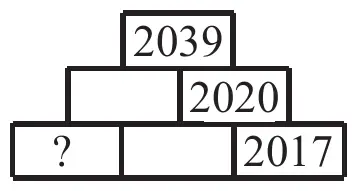
1. In the number pyramid shown each number is the sum of the two numbers immediately below. What number should appear in the left-hand cell of the bottom row?
24. A train has five carriages, each containing at least one passenger. Two passengers are said to be ‘neighbours’ if either they are in the same carriage or they are in adjacent carriages. Each passenger has exactly five or exactly ten neighbours. How many passengers are there on the train?
Let the numbers of passengers in the five carriages be \(p\),\(q\),\(r\), \(s\) and \(t\) respectively with \(p\),\(q\),\(r\), \(s\) and \(t\) all at least 1. Consider the neighbours of the passengers in the first and second carriages. Since each passenger has 5 or 10 neighbours, we have \(p - 1 + q = 5\) or 10 and \(p + q - 1 + r = 5\) or 10. Therefore \(p + q = 6\) or 11 and \(p + q + r = 6\) or 11. However, we know that \(r \geqslant 1\) and hence \(p + q \leqslant 10\) and therefore \(p + q = 6\) and \(r = 5\). Similarly, considering the neighbours of the passengers in the fourth and fifth carriages, we obtain \(s + t = 6\) and (again) \(r = 5\). Therefore, the total number of passengers in the train is 6 + 5 + 6 = 17. (Note that while the total number of passengers in the train is uniquely determined, the arrangement of these passengers in all but the centre carriage is not unique.)
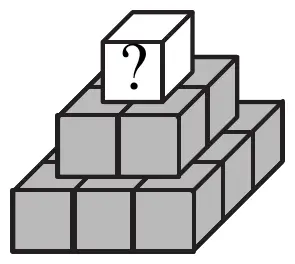
23. Katie writes a different positive integer on the top face of each of the fourteen cubes in the pyramid shown. The sum of the nine integers written on the cubes in the bottom layer is 50. The integer written on each of the cubes in the middle and top layers of the pyramid is equal to the sum of the integers on the four cubes underneath it. What is the greatest possible integer that she can write on the top cube?
Let the integers written on the small cubes in the bottom layer be arranged as shown.
\(a\)
\(b\)
\(c\)
\(d\)
\(e\)
\(f\)
\(g\)
\(h\)
\(i\)
Hence, since the integers written on the cubes in the second and third layers are the sum of the integers on the four cubes underneath, the following is written on the cubes in the second layer.
\(a + b + d + e\)
\(b + c + e + f\)
\(d + e + g + h\)
\(e + f + h + i\)
Therefore the integer written on the top cube is \[\begin{aligned}&(a + b + d + e) + (b + c + e + f) + (d + e + g + h) + (e + f + h + i)\\ &\quad = (a + b + c + d + e + f + g + h + i) + (b + d + f + h) + 3e.\end{aligned}\] Since the sum of the integers on the bottom layer is 50, the integer written on the top cube is equal to \(50 + (b + d + f + h) + 3e\). To maximise this, we first require \(e\) to be as large as possible which will be obtained when the other eight integers are as small as possible. Therefore \(e = 50 - (1 + 2 + 3 + 4 + 5 + 6 + 7 + 8) = 14\). Secondly, \((b + d + f + h)\) should now be made as large as possible and hence \(b\),\(d\), \(f\) and \(h\) are 5, 6, 7 and 8 in any order. Therefore \((b + d + f + h) = 5 + 6 + 7 + 8 = 26\). Hence the greatest possible integer she can write on the top cube is 50 + 26 + 3 × 14 = 118.
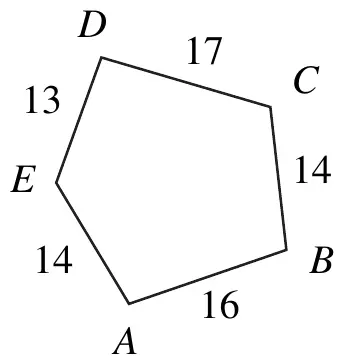
22. The diagram shows a pentagon. The lengths of the sides of the pentagon are given in the diagram. Sepideh draws five circles with centres \(A\),\(B\),\(C\), \(D\) and \(E\) such that the two circles with centres at the ends of a side of the pentagon touch on that side. Which point is the centre of the largest circle that she draws?
Let the radius of the circle with centre \(A\) be \(x\) cm. Therefore, since the circles drawn on each side of the pentagon touch, the radius of the circle with centre \(B\) is \((16 - x)\) cm. Similarly, the radius of the circle with centre \(C\) is \((14 - (16 - x))\) cm = \((x - 2)\) cm, the radius of the circle with centre \(D\) is \((17 - (x - 2))\) cm = \((19 - x)\) cm and the radius of the circle with centre \(E\) is \((13 - (19 - x))\) cm = \((x - 6)\) cm. However, the radius of the circle with centre \(E\) is also equal to \((14 - x)\) cm since the circle with centre \(A\) has radius \(x\) cm. Therefore \(14 - x = x - 6\), which has solution \(x = 10\). Hence the radii of the circles centres \(A\),\(B\),\(C\), \(D\) and \(E\) are 10 cm, 6 cm, 8 cm, 9 cm and 4 cm respectively. Therefore point \(A\) is the centre of the largest circle Sephideh draws.
20. It takes 4 hours for a motorboat to travel downstream from X to Y. To return upstream from Y to X it takes the motorboat 6 hours. How many hours would it take a wooden log to be carried from X to Y by the current, assuming it is unhindered by any obstacles? [Assume that the current flows at a constant rate, and that the motorboat moves at a constant speed relative to the water.]
Let \(D\) be the distance from \(X\) to \(Y\), and let \(u\) be the speed of the boat and \(v\) be the speed of the current. When travelling downstream the overall speed of the boat in the current is \(u + v\), and travelling upstream against the current it is \(u - v\). Then using time \(= \dfrac{\text{distance}}{\text{speed}}\), we get \(\dfrac{D}{u + v} = 4\) for the journey downstream and \(\dfrac{D}{u - v} = 6\) for the journey upstream. Inverting the equations gives \(\dfrac{u + v}{D} = \dfrac{1}{4}\) or \(4u + 4v = D \ldots\) (1) and \(\dfrac{u - v}{D} = \dfrac{1}{6}\) or \(6u - 6v = D \ldots\) (2). Multiplying (1) by 3 and (2) by 2, we get \(12u + 12v = 3D \ldots\) (3) and \(12u - 12v = 2D \ldots\) (4). Subtracting, (3) − (4) gives \(24v = D\) which rearranges to \(\dfrac{D}{v} = 24\) (hours), which is the time taken for the log to float downstream at the speed of the current alone.
19. Little Red Riding Hood is delivering waffles to three grannies. She starts with a basket full of waffles. Just before she enters the house of each granny, the Big Bad Wolf eats half of the waffles in her basket. She delivers the same number of waffles to each granny. When she leaves the third granny's house, she has no waffles left. Which of the following numbers definitely divides the number of waffles she started with?
Let \(x\) be the number of waffles Little Red Riding Hood delivered to each of the grannies. She delivered \(x\) waffles to the third granny and so, since the Big Bad Wolf eats half of the waffles in her basket just before she enters each granny's house, she must have arrived with \(2x\) waffles. Therefore she had \(3x\) waffles before giving the second granny her waffles and hence had \(2 \times 3x = 6x\) waffles when she arrived. Therefore she had \(6x + x = 7x\) waffles before giving the first granny her waffles and hence had \(2 \times 7x = 14x\) waffles in her basket when she arrived. Hence, since we do not know the value of \(x\), the only numbers that definitely divide the number of waffles she started with are the numbers that divide 14, namely 1, 2, 7 and 14. Therefore, of the options given, only 7 definitely divides the number of waffles she started with.
17. There are 2016 kangaroos in a zoo. Each of them is either grey or pink, and at least one of them is grey and at least one is pink. For every kangaroo, we calculate this fraction: the number of kangaroos of the other colour divided by the number of kangaroos of the same colour as this kangaroo (including himself). Find the sum of all the 2016 fractions calculated.
Let \(G\) be the number of grey kangaroos, and \(P\) the number of pink kangaroos, so \(G + P = 2016\). For each grey kangaroo we calculate the fraction as \(\dfrac{P}{G}\); and there are \(G\) of these, so the total of the fractions for grey kangaroos is \(G \times \dfrac{P}{G} = P\). Similarly the total of the fractions calculated for the pink kangaroos is \(G\). Thus the total of all the fractions is \(P + G = 2016\).
15. There are twenty students in a class. Some of them sit in pairs so that exactly one third of the boys sit with a girl, and exactly one half of the girls sit with a boy. How many boys are there in the class?
Let the number of boys in the class be \(x\) and let the number of girls be \(y\). Since one third of the boys sit with a girl and one half of the girls sit with a boy, we have \(\tfrac{1}{3}x = \tfrac{1}{2}y\) and hence \(\tfrac{2}{3}x = y\). The total number of students in the class is 20. Therefore \(x + \tfrac{2}{3}x = 20\). Hence \(\tfrac{5}{3}x = 20\), which has solution \(x = 12\). Therefore there are 12 boys in the class.
14. Tegwen has the same number of brothers as she has sisters. Each one of her brothers has 50% more sisters than brothers. How many children are in Tegwen's family?
Let there be \(g\) girls and \(b\) boys in Tegwen's family. Then, as she has the same number of brothers as she does sisters, \(b = g - 1\). Also, each of her brothers has 50% more sisters than brothers. Therefore \(g = \frac{3}{2}(b - 1)\). So \(b + 1 = \frac{3}{2}(b - 1)\) and hence \(2b + 2 = 3b - 3\). Rearranging this equation gives \(b = 5\). So \(g = 5 + 1 = 6\). Therefore there are 5 + 6 = 11 children in Tegwen's family.
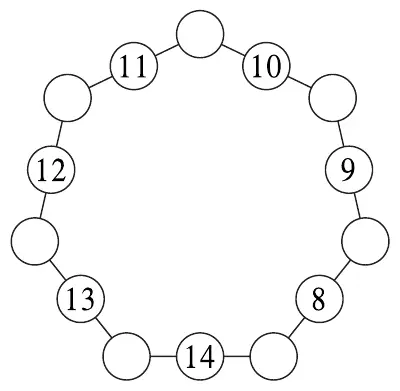
13. The diagram shows a heptagon with a line of three circles on each side. Each circle is to contain exactly one number. The numbers 8 to 14 are distributed as shown and the numbers 1 to 7 are to be distributed to the remaining circles. The total of the numbers in each of the lines of three circles is to be the same.
In the seven lines each of the integers from 1 to 7 is used twice and each of the integers from 8 to 14 is used once. So the sum of the numbers in the seven lines is (1 + 2 + … + 14) + (1 + 2 + … + 7) = 105 + 28 = 133. Therefore the total of the numbers in each line is 133 ÷ 7 = 19.
It is left as an exercise for the reader to show that it is possible to complete the diagram so that the total of the three numbers in each line is indeed 19.
12. Two kangaroos Bo and Ing start to jump at the same time, from the same point, in the same direction. After that, they each make one jump per second. Each of Bo's jumps is 6 m in length. Ing's first jump is 1 m in length, his second is 2 m, his third is 3 m, and so on. After how many jumps does Ing catch Bo?
Since the two kangaroos jump at the same time and in the same direction, Ing will catch Bo when they have jumped the same distance. After \(n\) jumps, Bo has jumped \(6n\) metres whereas Ing has jumped \((1 + 2 + 3 + \ldots + n)\) metres. The sum of the whole numbers from 1 to \(n\) is given by the formula \(\tfrac{1}{2}n(n + 1)\) (it is left as an exercise for the reader to prove this) and hence \(\tfrac{1}{2}n(n + 1) = 6n\). Hence \(n + 1 = 12\), which has solution \(n = 11\). Therefore Ing will catch Bo after 11 jumps.
Assume that \(a > b\). Then \(a + b = 7\) and \(a - b = 2\). Adding these two equations together gives \(2a = 9\). So \(a = \frac{9}{2}\) and hence \(b = 7 - \frac{9}{2} = \frac{14 - 9}{2} = \frac{5}{2}\). Therefore \(a \times b = \frac{9}{2} \times \frac{5}{2} = \frac{45}{4} = 11\frac{1}{4}\).
10. Tim, Tom and Tam are triplets (three brothers born on the same day). Their twin brothers Jon and Jim are exactly three years younger. Which of the following numbers could be the sum of the ages of the five brothers?
Let \(x\) be the age of each of Tim, Tom and Tam. Therefore the age of both Jon and Jim is \(x - 3\). Therefore the sum of all their ages is \(3x + 2(x - 3) = 5x - 6\) and \(5x - 6\) can also be written as \(5(x - 1) - 1\). Hence the sum of their ages is always one less than a multiple of 5. Of the options given, the only number for which this is true is 89 (when Tim, Tom and Tam are 19 and Jon and Jim are 16).
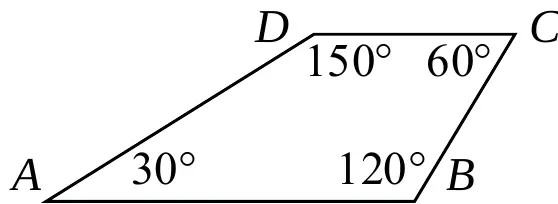
The sum of the interior angles of a quadrilateral is 360°, so \(x + 5x + 2x + 4x = 360\), that is \(12x = 360\). Therefore \(x = 30\) and the angles of the quadrilateral, taken in order, are 30°, 150°, 60° and 120°. The diagram shows the shape of the quadrilateral. Since 30 + 150 = 180, we see that \(AB\) and \(DC\) are parallel. Since it has no equal angles, it is not a rhombus or a parallelogram so it is a trapezium.
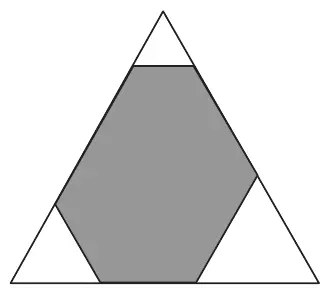
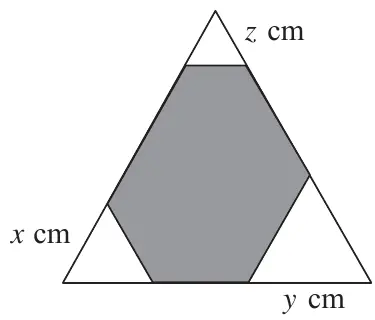
9. Three equilateral triangles are cut from the corners of a large equilateral triangle to form an irregular hexagon, as shown in the diagram. The perimeter of the large equilateral triangle is 60 cm. The perimeter of the irregular hexagon is 40 cm. What is the sum of the perimeters of the triangles that were cut from the large triangle?
Let the lengths of the sides of the equilateral triangles that are cut off be \(x\) cm, \(y\) cm and \(z\) cm, as shown in the diagram. The length of a side of the large equilateral triangle is \(\tfrac{1}{3} \times 60\) cm = 20 cm. The perimeter of the irregular hexagon is 40 cm. Therefore we have
\(40 = x + (20 - x - y) + y + (20 - y - z) + z + (20 - z - x)\). Hence \(40 = 60 - (x + y + z)\) and therefore \(x + y + z = 20\). Therefore the sum of the perimeters of the triangles cut off is \((3x + 3y + 3z)\) cm = 60 cm.
6. One third of the animals in Jacob's flock are goats, the rest are sheep. There are twelve more sheep than goats. How many animals are there altogether in Jacob's flock?
Let \(g\) and \(s\) be the number of goats and sheep respectively. Then \(s = 2g\) and \(12 = s - g = 2g - g = g\). Hence the number of animals is \(s + g = 3g = 36\).
5. When travelling from London to Edinburgh by train, you pass a sign saying ‘Edinburgh 200 miles’. Then, \(3\frac{1}{2}\) miles later, you pass another sign saying ‘Half way between London and Edinburgh’. How many miles is it by train from London to Edinburgh?
By train, the distance in miles of the second sign from Edinburgh is \(200 - 3\frac{1}{2}\). This sign is halfway between London and Edinburgh, so the distance in miles between the two cities is \(2(200 - 3\frac{1}{2}) = 400 - 7 = 393\).
24. Ten different numbers (not necessarily integers) are written down. Any number that is equal to the product of the other nine numbers is then underlined. At most, how many numbers can be underlined?
It is certainly possible to underline two numbers. In the list below both 1 and −1 are equal to the product of the other nine numbers \(1, -1, -2, \tfrac{1}{2}, 3, \tfrac{1}{3}, 4, \tfrac{1}{4}, 5, \tfrac{1}{5}\). However, it is not possible to underline three numbers. For supposing it was possible to underline the numbers \(a\),\(b\),\(c\). Let \(N\) be the product of the other seven numbers. Then we have \[a = b \times c \times N \ldots (1) \qquad b = a \times c \times N \ldots (2) \qquad c = a \times b \times N \ldots (3)\] Substituting (1) into (2) gives \(b = (b \times c \times N) \times c \times N = b \times c^2 \times N^2\) so \(c^2 \times N^2 = 1\). Thus \(c \times N = 1\) or \(c \times N = -1\). But if \(c \times N = 1\), then (1) becomes \(a = b\), contradicting that \(a\), \(b\) are distinct. Hence \(c \times N = -1\), and (1) becomes \(a = -b\). Substituting this into (3) gives \(c = (-b) \times b \times N\). Multiplying both sides by \(c\) gives \(c^2 = -b^2 \times c \times N = -b^2 \times (-1) = b^2\). Hence either \(c = b\) (contradicting that they are distinct) or \(c = -b = a\) (contradicting that \(a\), \(c\) are distinct). Hence there is no way that \(a\),\(b\), \(c\) can be distinct numbers and also underlined. (If the numbers are allowed to be the same, it is possible to underline them all by choosing the numbers to be all equal to one).
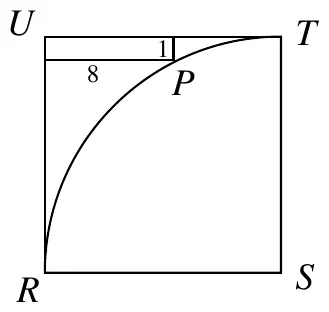
24. In square \(RSTU\) a quarter-circle arc with centre \(S\) is drawn from \(T\) to \(R\). A point \(P\) on this arc is 1 unit from \(TU\) and 8 units from \(RU\). What is the length of the side of square \(RSTU\)?
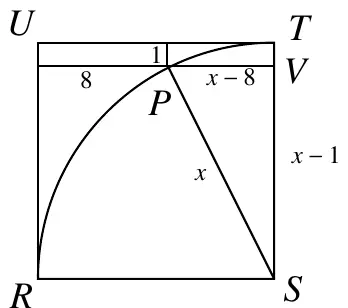
In the diagram \(V\) is the point where the perpendicular from \(P\) meets \(TS\). Let the side of the square \(RSTU\) be \(x\). So the radius of the arc from \(R\) to \(T\) is \(x\). Therefore \(SP\) has length \(x\), \(PV\) has length \(x - 8\) and \(VS\) has length \(x - 1\). Applying Pythagoras' Theorem to triangle \(PVS\): \((x - 8)^2 + (x - 1)^2 = x^2\). So \(x^2 - 16x + 64 + x^2 - 2x + 1 = x^2\). Therefore \(x^2 - 18x + 65 = 0\), so \((x - 5)(x - 13) = 0\). Hence \(x = 5\) or \(x = 13\), but \(x > 8\) so the length of the side of the square \(RSTU\) is 13.
23. When one number was removed from the set of positive integers from 1 to \(n\), inclusive, the mean of the remaining numbers was 4.75. What number was eliminated?
The sum of 1, 2, … \(n\) is \(\tfrac{1}{2}n(n + 1)\). So the smallest the sum could be if one number were deleted would be \(\tfrac{1}{2}n(n + 1) - n = \tfrac{1}{2}(n^2 + n - 2n) = \tfrac{1}{2}n(n - 1)\). Thus the mean of any \(n - 1\) of these numbers is at least \(\tfrac{1}{2}n\). So for the mean to be 4.75, we must have \(n \leqslant 9\). Similarly, the largest the sum could be with one number deleted would be \(\tfrac{1}{2}n(n + 1) - 1 = \tfrac{1}{2}(n^2 + n - 2) = \tfrac{1}{2}(n - 1)(n + 2)\). Thus the mean of any \(n - 1\) of the numbers is at most \(\tfrac{1}{2}(n + 2)\). So we must have \(\tfrac{1}{2}(n + 2) \geqslant 4.75\) and so \(n \geqslant 8\). Since \(4.75 = 19/4\) and the mean is obtained by dividing by \(n - 1\), we require \(n - 1\) to be a multiple of 4. So \(n = 9\). The sum of 1, … , 9 is 45 and we need the 8 numbers used to have a mean of 4.75. So their total is 38 and hence 7 is the number to be eliminated.
23. Five points lie on a straight line. Alex finds the distances between every pair of points. He obtains, in increasing order, 2, 5, 6, 8, 9, \(k\), 15, 17, 20 and 22. What is the value of \(k\)?
Let the five points be \(P\),\(Q\),\(R\), \(S\) and \(T\) with individual distances between them of \(w\),\(x\), \(y\) and \(z\) as shown.
The maximum distance between any two points is 22 so \(PT = 22\). The next largest distance is 20 and, since no distance is 1, this is either \(PS\) or \(QT\). Assume \(QT = 20\) so that \(PQ = w = 2\). The next largest distance is 17 and, since no distance is 3 this cannot be \(QS\) or \(RT\) and so is \(PS\). Hence \(ST = z = 5\) and \(QS = 15\). The remaining distances are 6, 8, 9 and \(k\) which represent the lengths of \(PR\),\(QR\), \(RS\) and \(RT\) in some order with \(QR + RS = 15\). Since \(k > 9\), the only possible pair of distances adding to 15 is 6 and 9 and so \(QR = x = 6\) and \(RS = y = 9\) (since \(QR = 9\) and \(RS = 6\) would mean two distances are 11) leaving \(PR = 8\) and \(RT = k = 14\). Hence the value of \(k\) is 14 with the distances between the points taking the values shown below.
(Note: The same distances would result but in the reverse order if we assumed \(PS = 20\).)
18. Five positive integers (not necessarily all different) are written on five cards. Boris calculates the sum of the numbers on every pair of cards. He obtains only three different totals: 57, 70 and 83. What is the largest integer on any card?
Let the five integers be \(a\),\(b\),\(c\), \(d\) and \(e\) with \(a \leqslant b \leqslant c \leqslant d \leqslant e\). The smallest total is 57, which is an odd number so \(b \neq a\). Similarly, the largest total is 83, which is also an odd number so \(d \neq e\). Hence we now have \(a < b \leqslant c \leqslant d < e\) and \(a + b = 57\) and \(d + e = 83\). Only one possible total remains and so \(b = c = d\) with \(c + d = 70\). This gives \(c = d\ (= b) = 35\) and therefore \(e\), the largest integer, is 83 − 35 = 48 (whilst \(a = 22\)).
18. The total weight of a box, 20 plates and 30 cups is 4.8 kg. The total weight of the box, 40 plates and 50 cups is 8.4 kg. What is the total weight of the box, 10 plates and 20 cups?
Let the weights in kg of the box, 1 plate and 1 cup be \(b\), \(p\) and \(c\) respectively. Then: \(b + 20p + 30c = 4.8\) (i); \(b + 40p + 50c = 8.4\) (ii). Subtracting (i) from (ii): \(20p + 20c = 3.6\) (iii). So \(10p + 10c = 1.8\) (iv). Subtracting (iv) from (i): \(b + 10p + 20c = 3\). So the required weight is 3 kg.
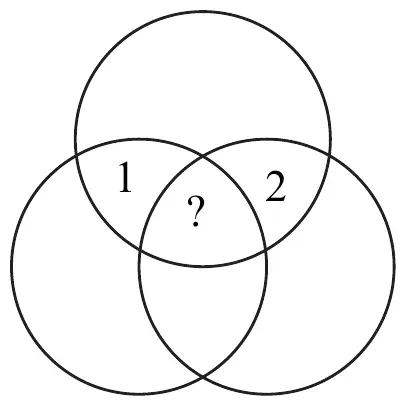
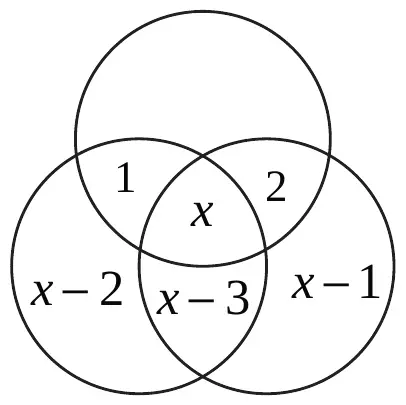
17. The figure shows seven regions enclosed by three circles. We call two regions neighbouring if their boundaries have more than one common point. In each region a number is written. The number in any region is equal to the sum of the numbers of its neighbouring regions. Two of the numbers are shown. What number is written in the central region?
Let \(x\) be the number in the central region. Since this is the sum of its three neighbouring regions which include 1 and 2, the region below it must contain \(x - 3\). The bottom right region then contains \((x - 3) + 2 = x - 1\). The bottom left region then contains \((x - 3) + 1 = x - 2\). But the number in the bottom central region can now be evaluated in two ways, firstly as \(x - 3\), but also as the sum of its neighbours, \(x\),\(x - 1\),\(x - 2\). Hence \(x - 3 = x + (x - 1) + (x - 2)\), giving \(x - 3 = 3x - 3\). So \(x = 3x\), giving \(2x = 0\) and so \(x = 0\).
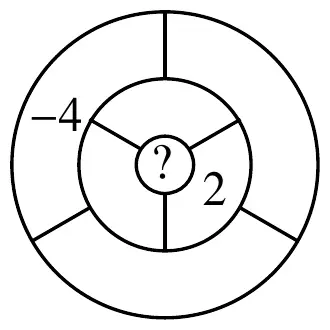
17. Ria wants to write a number in each of the seven bounded regions in the diagram. Two regions are neighbours if they share part of their boundary. The number in each region is to be the sum of the numbers in all of its neighbours. Ria has already written in two of the numbers, as shown. What number must she write in the central region?
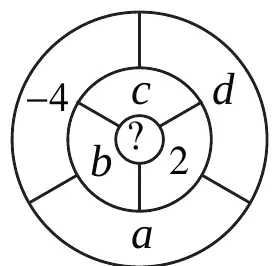
Let the numbers in the four regions that are neighbours to −4 be \(a\),\(b\), \(c\) and \(d\) as shown in the diagram. The question tells us that \(a + b + c + d = -4\). However, we also know that \(a + b + c + d + ? = 2\) and hence \(? = 6\). (Note: The values \(a = d = -4\) and \(b = c = 2\) give a complete solution to the problem).
Suppose the quadratic has roots \(p\) and \(q\). So it factorises as \((x - p)(x - q)\). This expands to give \(x^2 - (p + q)x + pq\). Comparing this with \(x^2 - 85x + c\) shows that \(p + q = 85\) and \(pq = c\). It follows that one of \(p\), \(q\) is even and one is odd. The only even prime is 2 so the primes \(p\), \(q\) are 2 and 83. Therefore \(c = 2 \times 83 = 166\), and therefore has digit sum 13.
14. Rachel added the lengths of three sides of a rectangle and got 44 cm. Heather added the lengths of three sides of the same rectangle and got 40 cm. What is the perimeter of the rectangle?
Let the length of the rectangle be \(x\) cm and let the width be \(y\) cm. The information in the question tells us that \(2x + y = 44\) and \(x + 2y = 40\). Add these two equations to obtain \(3x + 3y = 84\). Hence \(x + y = 28\) and so the perimeter, which is equal to \(2(x + y)\) cm, is 56 cm.
14. In a sequence, each term after the first two terms is the mean of all the terms which come before that term. The first term is 8 and the tenth term is 26. What is the second term?
Suppose the first three terms of the sequence are \(a\),\(b\),\(c\). Then \(c = \tfrac{1}{2}(a + b)\) and so \(a + b = 2c\). The mean of the first three terms is then \(\tfrac{1}{3}(a + b + c) = \tfrac{1}{3}(2c + c) = c\), so the fourth term is \(c\). Similarly, the following terms are all equal to \(c\). Since one of these terms is 26 and \(a = 8\) then \(b = 2c - a = 52 - 8 = 44\).
13. A large set of weighing scales has two identical sets of scales placed on it, one on each pan. Four weights \(W\),\(X\),\(Y\), \(Z\) are placed on the weighing scales as shown in the left diagram.
Then two of these weights are swapped, and the pans now appear as shown in the diagram on the right. Which two weights were swapped?
From the first picture, we can see: \[\begin{array}{lrcll} \text{From the right scale:} & Z & > & Y & \quad (1) \\ \text{From the left scale:} & X & > & W & \quad (2) \\ \text{From the large scale:} & Y + Z & > & W + X & \quad (3) \end{array}\] It follows from (1), (2) and (3) that \(Z + Z > Y + Z > W + X > W + W\), so \(2Z > 2W\), and hence \(Z > W\) … (4). We can show that most swaps give a contradiction of these inequalities: Firstly, suppose that weight \(Z\) doesn’t move. Then there are three possible swaps: \(X\) and \(Y\) swap: then in the second picture we must have \(Z < X\) and \(Y < W\), which add to give \(Y + Z < W + X\), contradicting (3). \(Y\) and \(W\) swap: then we would have \(Z < W\), contradicting (4). \(X\) and \(W\) swap: then we would have \(X < W\), contradicting (2). Hence \(Z\) must swap, which can happen in three ways: \(Z\) and \(Y\) swap: then we would have \(Z < Y\), contradicting (1). \(Z\) and \(X\) swap: then we would have \(Z < W\), contradicting (4). \(Z\) and \(W\) swap: This is the only possibility left, and it can work when the weights \(W\),\(X\),\(Y\), \(Z\) are 1, 2, 3, 4. The swap would give 4, 2, 3, 1 which matches the picture on the right. However, this does depend on the values of \(W\),\(X\),\(Y\),\(Z\); it would not work for 1, 5, 3, 4.
11. A bush has 10 branches. Each branch has either 5 leaves only or 2 leaves and 1 flower. Which of the following could be the total number of leaves the bush has?
The maximum number of leaves the bush could have is 10 × 5 = 50. Each branch that has two leaves and a flower instead of five leaves reduces the number of leaves the bush has by three. Therefore the total number of leaves the bush has is of the form \(50 - 3n\) where \(n\) is the number of branches with two leaves and a flower. It is straightforward to check that none of options A to D has that form and so the answer is E.
21. In King Arthur's jousting tournament, each of the several competing knights receives 17 points for every bout he enters. The winner of each bout receives an extra 3 points. At the end of the tournament, the Black Knight has exactly one more point than the Red Knight. What is the smallest number of bouts that the Black Knight could have entered?
Firstly suppose that any two knights X and Y win \(x\) and \(y\) bouts respectively and that \(x\) is at least as large as \(y\). The difference between their total scores would be the same as if X had won \(x - y\) bouts and Y had won none, since each of the separate totals would have been reduced by the same amount, namely 20\(y\). A similar procedure applies to losses. For example, if X won 3 and lost 6, while Y won 8 and lost 2, the difference between their total scores is the same as if X won 0 and lost 4, while Y won 5 and lost 0. In each case the difference is 32. This argument shows that, in the case of the Black Knight, B, and the Red Knight, R, the smallest number of bouts will be achieved when one of B, R wins all his bouts and the other loses all his bouts. Also B has to score one more point than R. The possible scores for the knight who wins all his bouts are 20, 40, 60, 80, 100, 120, … . while the possible scores for the knight who loses all his bouts are 17, 34, 51, 68, 85, 102, 119, 136, … . The first two numbers to differ by 1 are 119 and 120. Thus the Black Knight has a total of 120 corresponding to winning all of his 6 bouts and the Red Knight has a total of 119 corresponding to losing all of his 7 bouts.
15. Zac halves a certain number and then adds 8 to the result. He finds that he obtains the same answer if he doubles his original number and then subtracts 8 from the result. What is Zac's original number?
9. At the age of twenty-six, Gill has passed her driving test and bought a car. Her car uses \(p\) litres of petrol per 100 km travelled. How many litres of petrol would be required for a journey of \(d\) km?
Gill's car uses \(p/100\) litres of petrol for every one kilometre travelled. So for a journey of length \(d\) km, \(pd/100\) litres of petrol are required.
Since \(m\) is even, \(m = 2k\) for some integer \(k\). So \(3m + 4n = 2(3k + 2n)\);\(5mn = 2(5kn)\); \(m^3n^3 = 8k^3n^3\) and \(5m + 6n = 2(5k + 3n)\), which are all even. As \(n\) is odd, \(3n\) is also odd. So \(m + 3n\) is an even integer plus an odd integer and is therefore odd. The square of an odd integer is odd so \((m + 3n)^2\) is odd.
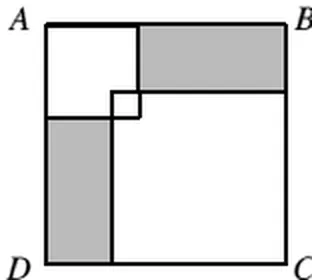
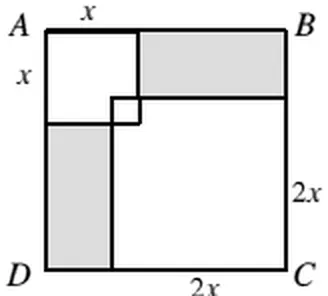
21. The square \(ABCD\) has an area of 196. It contains two overlapping squares; the larger of these squares has an area 4 times that of the smaller and the area of their overlap is 1. What is the total area of the shaded regions?
The large square has area 196 = 142. So it has side-length 14. The ratio of the areas of the inner squares is 4 : 1, so the ratio of their side-lengths is 2 : 1. Let the side-length of the larger inner square be 2\(x\), so that of the smaller is \(x\). The figure is symmetric about the diagonal \(AC\) and so the overlap of the two inner squares is also a square which therefore has side-length 1. Thus the vertical height can be written as \(x + 2x - 1\). Hence \(3x - 1 = 14\) and so \(x = 5\). Also, the two shaded rectangles both have side-lengths \(2x - 1\) and \(x - 1\); that is 9 and 4. So the total shaded area is 72.
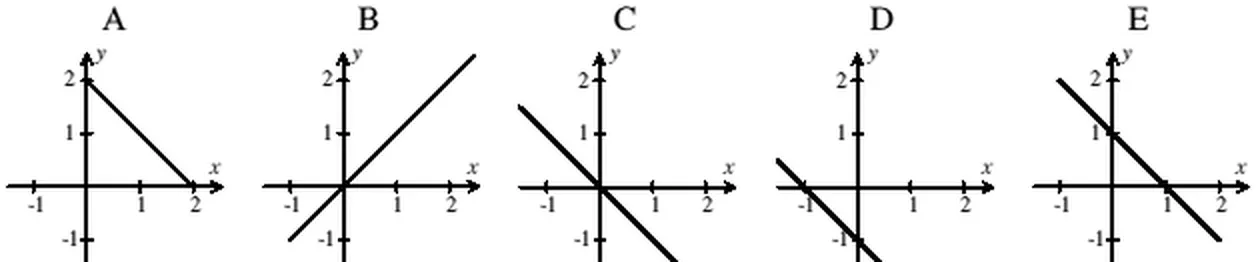
The image of a straight line under a rotation is also a straight line. The centre of rotation, the point (1, 1), lies on the given line and so also lies on the image. The given line has slope 1 and so its image will have slope −1. Hence graph A shows the image.
8. Jim rolled some dice and was surprised that the sum of the scores on the dice was equal to the product of the scores on the dice. One of the dice showed a score of 2, one showed 3 and one showed 5. The rest showed a score of 1. How many dice did Jim roll?
Let the number of scores of 1 be \(n\). Then the product of the scores is 1\(n\) × 2 × 3 × 5 = 30. Therefore 1 × \(n\) + 2 + 3 + 5 = 30, i.e. \(n\) = 20. So Jim threw 23 dice.
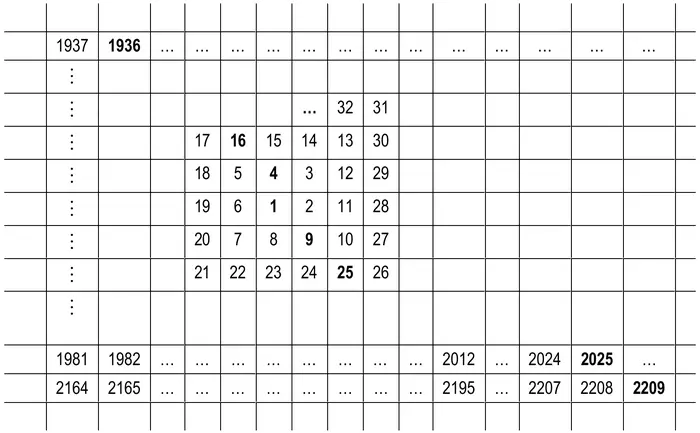
24. All the positive integers are written in the cells of a square grid. Starting from 1, the numbers spiral anticlockwise. The first part of the spiral is shown in the diagram.
The key to the solution is to note that the squares of the odd numbers occur on the diagonal leading downwards and to the right from the cell which contains the number 1, and the squares of the even numbers occur on the diagonal which leads upwards and to the left of the cell which contains the number 4. The squares of the even numbers have the form \((2n)^2\), that is, \(4n^2\).We see that the number \(4n^2 + 1\) occurs to the left of the cell containing \(4n^2\). Below \(4n^2 + 1\) there occur the numbers \(4n^2 + 2, 4n^2 + 3, \ldots, 4n^2 + 2n + 1\), and then in the cells to the right of the cell containing \(4n^2 + 2n + 1\), there occur the numbers \(4n^2 + 2n + 2, 4n^2 + 2n + 3, \ldots, 4n^2 + 4n + 1 = (2n + 1)^2\). Now \(44^2 = 1936\) and \(45^2 = 2025\). Thus 2011 is in the same row as 2025 and to the left of it, in the sequence 1981,….,2012,…,2025, and below these occur the numbers 2163,…., \(2209 = 47^2\), with 2208 below 2025 as shown below. It follows that 2195 is the number below 2012. In the diagram below the square numbers are shown in bold.
17. The first term of a sequence of positive integers is 6. The other terms in the sequence follow these rules: if a term is even then divide it by 2 to obtain the next term; if a term is odd then multiply it by 5 and subtract 1 to obtain the next term. For which values of \(n\) is the \(n\)th term equal to \(n\)?
The terms of the sequence are 6, 3, 14, 7, 34, 17, 84, 42, 21, 104, 52, 26, 13, 64, 32, 16, 8, 4, 2, 1, 4, 2, 1, … . As can be seen, there will now be no other terms in the sequence other than 4, 2 and 1. It can also be seen that the only values of \(n\) for which the \(n\) th term = \(n\) are 13 and 16.
The mean of the first three numbers is \(\tfrac{1}{3}(20 + x)\); the mean of the last four numbers is \(\tfrac{1}{4}(33 + x)\). Therefore \(4(20 + x) = 3(33 + x)\), that is \(80 + 4x = 99 + 3x\), so \(x = 99 - 80 = 19\).
20. Max and his dog Molly set out for a walk. Max walked up the road and then back down again, completing a six mile round trip. Molly, being an old dog, walked at half Max's speed. When Max reached the end of the road, he turned around and walked back to the starting point, at his original speed. Part way back he met Molly, who then turned around and followed Max home, still maintaining her original speed. How far did Molly walk?
Let Max and Molly meet after the latter has travelled \(x\) miles. Then Max has travelled \((6 - x)\) miles. So \(6 - x = 2x\), thus \(x = 2\). Therefore Molly walks a total of 4 miles.
\(3 = \dfrac{2 + 2^2}{2}\);\(10 = \dfrac{4 + 4^2}{2}\);\(15 = \dfrac{5 + 5^2}{2}\);\(21 = \dfrac{6 + 6^2}{2}\). However \(\dfrac{7 + 7^2}{2} = 28\) and \(\dfrac{8 + 8^2}{2} = 36\), so 30 is not exactly halfway between a positive integer and its square. (Note that every number which is exactly halfway between a positive integer and its square is a triangle number. Can you explain why this is so?)
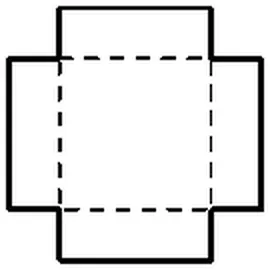
8. A square piece of card has a square of side 2 cm cut out from each of its corners. The remaining card is then folded along the dotted lines shown to form an open box whose total internal surface area is 180 cm2.
The base of the open box is a square. Let its side be of length \(x\) cm. Then the total surface area of the box in cm2 is \(x^2 + 4 \times 2x = x^2 + 8x\). Hence \(x^2 + 8x = 180\), that is \(x^2 + 8x - 180 = 0\). Therefore \((x + 18)(x - 10) = 0\), which gives \(x = -18\) or \(x = 10\). As \(x\) is positive, it may be deduced that the open box has dimensions 10 cm × 10 cm × 2 cm. So its volume is 200 cm3.
2. To find the diameter in mm of a Japanese knitting needle, you multiply the size by 0.3 and add 2.1. What is the diameter in mm of a size 5 Japanese knitting needle?
18. Supergran walks from her chalet to the top of the mountain. She knows that if she walks at a speed of 6 mph she will arrive at 1 pm, whereas if she leaves at the same time and walks at 10 mph, she will arrive at 11 am. At what speed should she walk if she wants to arrive at 12 noon?
Let the distance from the chalet to the top of the mountain be \(x\) miles. Then, at 6 mph Supergran would take \(\dfrac{x}{6}\) hours, whereas at 10 mph she would take \(\dfrac{x}{10}\) hours. So \(\dfrac{x}{6} - \dfrac{x}{10} = 2\), that is \(5x - 3x = 60\), so \(x = 30\). Hence Supergran's departure time is 8 am and to arrive at 12 noon she should walk at \(\dfrac{30}{4}\) mph, that is \(7\tfrac{1}{2}\) mph.
16. Albert Einstein is experimenting with two unusual clocks which both have 24-hour displays. One clock goes at twice the normal speed. The other clock goes backwards, but at the normal speed. Both clocks show the correct time at 13:00. What is the correct time when the displays on the clocks next agree?
After \(x\) hours, the first clock will have gone forward \(2x\) hours and the second clock will have gone back \(x\) hours. So the next time they agree is when \(2x + x = 24\), that is when \(x = 8\). The correct time then is 21:00.
15. Bill is trying to sketch the graph of \(y = 2x + 6\) but in drawing the axes he has placed the \(x\)-axis up the page and the \(y\)-axis across the page. Which of these five graphs is a correct sketch of \(y = 2x + 6\) when the axes are placed in this way?
The line \(y = 2x + 6\) intersects the \(y\)-axis when \(x = 0\) and \(y = 6\). It intersects the \(x\)-axis when \(x = -3\) and \(y = 0\). So E is the correct line. (Alternatively: \(y = 2x + 6\) may be rearranged to give \(x = \tfrac{1}{2}y - 3\). So the required line looks the same as the line \(y = \tfrac{1}{2}x - 3\) when the axes are drawn in the traditional way.)
Adding the three equations gives \(3x + 3y + 3z = 30\), so \(x + y + z = 10\). (The equations may be solved to obtain\(x = 2\),\(y = 3\),\(z = 5\).However, as the above method shows, this is not necessary in order to find the value of\(x + y + z\).)
13. At Corbett's Ironmongery a fork handle and a candle cost a total of £6.10. The fork handle costs £4.60 more than the candle. What is the cost of two fork handles and four candles?
Let the prices of a fork handle and a candle be £\(x\) and £\(y\) respectively. Then \(x + y = 6.1\) and \(x - y = 4.6\). Adding these two equations gives \(2x = 10.7\). So a fork handle costs £5.35 and a candle costs £0.75. Therefore the required total is £10.70 + £3.00 = £13.70.
Reading from the left, we number the statements I, II, III, IV and V. Statement I is true if and only if \(-1 < x < 1\); statement II is true if \(x > 1\) or if \(x < -1\). By considering the graph of \(y = x - x^2\), which intersects the \(x\)-axis at (0, 0) and (1, 0) and has a maximum at \((\tfrac{1}{2}, \tfrac{1}{4})\), it may be seen that statement V is true if and only if \(0 < x < 1\). We see from the table below that a maximum of three statements may be true at any one time.
\(\begin{array}{lccccccc} & x < -1 & x = -1 & -1 < x < 0 & x = 0 & 0 < x < 1 & x = 1 & x > 1 \\ \text{True statement(s)} & \text{II} & \text{none} & \text{I, III} & \text{none} & \text{I, IV, V} & \text{none} & \text{II} \end{array}\)
19. Driving to Birmingham airport, Mary cruised at 55 miles per hour for the first two hours and then flew along at 70 miles per hour for the remainder of the journey. Her average speed for the entire journey was 60 miles per hour. How long did Mary's journey to Birmingham Airport take?
Let the time for which Mary drove at 70 mph be \(t\) hours. Then the total distance covered was (55 × 2 + 70 × \(t\)) miles. Also, as her average speed over (2 + \(t\)) hours was 60 mph, the total distance travelled was 60(2 + \(t\)) miles.
Therefore 110 + 70\(t\) = 120 + 60\(t\), that is 10\(t\) = 10, that is \(t\) = 1.
Note that 2004 is a multiple of 3 (since its digit sum is a multiple of 3) and also a multiple of 4 (since its last two digits form a multiple of 4). So 2004 is a multiple of 12 and hence the part of the pattern between 2007 and 2011 is the same as the part of the pattern between 3 and 7.
Let the number be \(x\). Then \(x^2 = 2x^3\), that is \(x^2(1 - 2x) = 0\). So \(x = 0\) or \(x = \tfrac{1}{2}\). However, \(x\) is positive, so the only solution is \(x = \tfrac{1}{2}\).
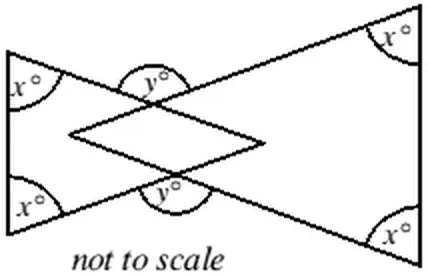
4. The diagram shows two isosceles triangles, in which the four angles marked \(x\)° are equal. The two angles marked \(y\)° are also equal. Which of the following is always true?
The two acute angles in the quadrilateral in the centre of the diagram are both \((180 - 2x)\)° and the two obtuse angles are both \(y\)°, so \(360 - 4x + 2y = 360\). So \(y = 2x\).
16. The first two terms of a sequence are \(\dfrac{2}{3}\) and \(\dfrac{4}{5}\). Each term after the second term is the average (mean) of the two previous terms. What is the fifth term in the sequence?
The problem may be solved by firstly calculating the third and fourth terms of the sequence, but an algebraic method does reduce the amount of calculation involved. Let the first two terms be \(x\) and \(y\) respectively. Then the third term is \(\tfrac{1}{2}(x + y)\), whilst the fourth term is \(\tfrac{1}{4}(x + 3y)\). So the fifth term is \(\tfrac{1}{8}(3x + 5y)\). Putting \(x = \dfrac{2}{3}\) and \(y = \dfrac{4}{5}\), we obtain \(\dfrac{2 + 4}{8} = \dfrac{3}{4}\).
Let the original number be \(x\). Then \(x^2 = 0{\cdot}7x\), that is \(x(x - 0{\cdot}7) = 0\). So \(x = 0\) or \(x = 0{\cdot}7\), but as \(x\) is non-zero it is 0·7.
23. As \(n\) takes each positive integer value in turn (that is, \(n = 1\),\(n = 2\),\(n = 3\), and so on) how many different values are obtained for the remainder when \(n^2\) is divided by \(n + 4\)?
So when \(n > 12\), the remainder when \(n^2\) is divided by \(n + 4\) is always 16. For \(1 \leqslant n \leqslant 12\), the remainder when \(n^2\) is divided by \(n + 4\) is shown in the table below.
\(n\)
1
2
3
4
5
6
7
8
9
10
11
12
\(n + 4\)
5
6
7
8
9
10
11
12
13
14
15
16
remainder
1
4
2
0
7
6
5
4
3
2
1
0
So there are 9 different remainders, namely 0, 1, 2, 3, 4, 5, 6, 7, 16.
The formula which gives \(C\) in terms of \(d\) is \(C = \pi d\), so the graph of \(C\) versus \(d\) is a straight line which passes through the origin.
9. A male punky fish has 9 stripes and a female punky fish has 8 stripes. I count 86 stripes on the fish in my tank. What is the ratio of male fish to female fish?
If there are \(f\) females and \(m\) males then \(86 = 8f + 9m = 8(f + m) + m\). Now 86 = 8 × 10 + 6 = 8 × 9 + 14 = 8 × 8 + 22…. Only the first of these is feasible (because \(f + m \geqslant m\)). So \(m = 6\) and \(f = 4\).
16. Al, Bertie, Chris and Di have sums of money totalling £150. Al and Bertie have £55 between them and Al and Chris have £65 between them. What is the difference between the amounts that Al and Di have?
Al and Bertie have £55 between them, so Chris and Di have £150 − £55, that is £95, between them. As Al and Chris have £65 between them, the difference between the amounts Al and Di have is £95 − £65.
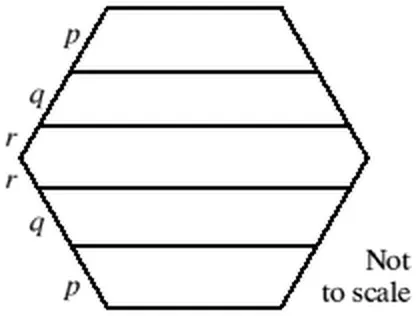
25. This regular hexagon has been divided into four trapezia and one hexagon. If each of the five sections has the same perimeter, what is the ratio of the lengths \(p\), \(q\) and \(r\) ?
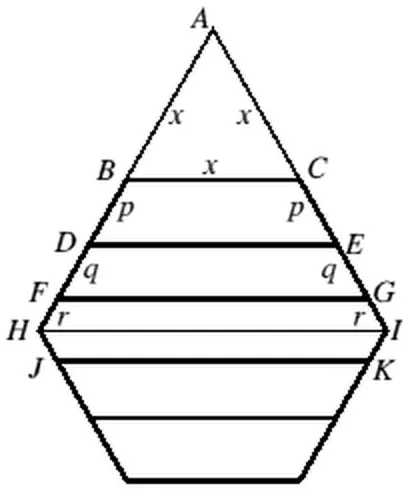
Each exterior angle of a regular hexagon = 360° ÷ 6 = 60°, so when sides \(HB\) and \(IC\) are produced to meet at \(A\), an equilateral triangle, \(ABC\), is created. Let the sides of this triangle be of length \(x\). As \(BC\), \(DE\) and \(FG\) are all parallel, triangles \(ABC\), \(ADE\) and \(AFG\) are all equilateral. So \(DE = DA = p + x\);\(FG = FA = q + p + x\).
The perimeter of trapezium \(BCED = x + p + x + 2p\) \(= 2x + 3p\); the perimeter of trapezium \(DEGF =\) \((p + x) + (q + p + x) + 2q\) \(= 2x + 2p + 3q\); the perimeter of hexagon \(FGIKJH = 2((q + p + x) + 2r)\) \(= 2x + 2p + 2q + 4r\).
The equations of the three lines must be considered in pairs to find the coordinates of their points of intersection, i.e. the coordinates of the vertices of the triangle. It is left to the reader to show that these are (−15, −9), (0, 6) and (5, 1). The area of the triangle may now be found by enclosing it in a rectangle measuring 20 × 15 and subtracting the areas of the three surrounding triangles from that of the rectangle. This gives 300 − (112\(\tfrac{1}{2}\) + 12\(\tfrac{1}{2}\) + 100) = 75.
The mean of the nine consecutive positive integers is the fifth of the numbers, so their sum is nine times the fifth number. As nine is itself a perfect square, the sum will be a perfect square if and only if the fifth number is a perfect square. For the options given, the fifth numbers are 114, 124, 134, 144 and 154 respectively.
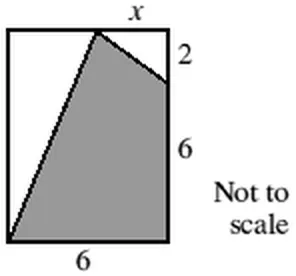
The area of the rectangle is 48 cm2, so the unshaded area is 12 cm2. Therefore \(\tfrac{1}{2} \times x \times 2 + \tfrac{1}{2} \times (6 - x) \times 8 = 12\), that is \(x + 24 - 4x = 12\), so \(x = 4\).
10. Granny has taken up deep-sea fishing! Last week, she caught a fish so big that she had to cut it into three pieces (head, body and tail) in order to weigh it. The tail weighed 9 kg and the head weighed the same as the tail plus one third of the body. The body weighed as much as the head and tail together. How much did the whole fish weigh?
Let the weights in kg of the head and body of the fish be \(h\) and \(b\) respectively. Then \(h = 9 + \tfrac{1}{3}b\) and \(b = h + 9\). So \(b = 9 + \tfrac{1}{3}b + 9\), that is \(\tfrac{2}{3}b = 18\), which gives \(b = 27\). Hence \(h = 18\), so the whole fish weighed 54 kg.
We may deduce that \(p > q\), so, as \(p\) and \(q\) are both positive, \(\dfrac{p^2}{q^2} > \dfrac{\sqrt{p}}{\sqrt{q}} > 1\). We may also deduce that \(0 < \dfrac{q^2}{p^2} < \dfrac{q}{p} < \dfrac{\sqrt{q}}{\sqrt{p}} < 1\) and hence \(\dfrac{q^2}{p^2}\) is the least of the five numbers.
22. In a maths exam with \(N\) questions, you score \(m\) marks for a correct answer to each of the first \(q\) questions and \(m + 2\) marks for a correct answer to each of the remaining questions. What is the maximum possible score?
If you answer all questions correctly, you receive \(m\) marks for each of the \(N\) questions plus an extra 2 marks for the last \((N - q)\) questions. So the maximum possible score \(= m \times N + 2 \times (N - q) = mN + 2N - 2q = (m + 2)N - 2q\).
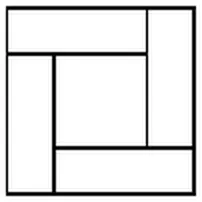
21. A square is divided into four congruent rectangles and a smaller square, as shown. (The diagram is not to scale.) The area of the small square is \(\tfrac{1}{4}\) of the area of the whole square. What is the ratio of the length of a short side of one of the rectangles to the length of a long side?
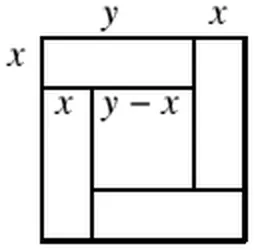
Let the length of a short side of a rectangle be \(x\) and the length of a long side be \(y\). Then the whole square has side of length \((y + x)\), whilst the small square has side of length \((y - x)\). As the area of the whole square is four times the area of the small square, the length of the side of the whole square is twice the length of the side of the small square. Therefore \(y + x = 2(y - x)\) i.e. \(y = 3x\) so \(x : y = 1 : 3\).
Note that the number at the end of the \(n\) th row is \(n^2\), so 400 will lie at the end of the 20 th row. The row below will end in 212, i.e. 441, so the number directly below 400 will be 440.
We note first that \(y = 5\) since that is the only non-zero digit which, when it is multiplied by 3, has itself as the units digit. So there is a carry of 1 into the tens column. We note also that \(a = 1\) or \(a = 2\) as “\(fly\)” < 1000 and therefore 3 × “\(fly\)” < 3000. We now need 3 × \(l\) + 1 to end in either 1 or 2 and the only possibility is \(l = 7\), giving \(a = 2\) with a carry of 2 into the hundreds column. As \(a = 2\), \(f\) must be at least 6. However, if \(f = 6\) then \(w = 0\) which is not allowed. Also the letters represent different digits, so \(f \neq 7\) and we can also deduce that \(f \neq 9\) since \(f = 9\) would make \(w = 9\). Hence \(f = 8\), making \(w = 6\) and the letters represent 875 × 3 = 2625.
11. The diagram shows a square board in which strips of white squares alternate with strips of black and white squares. A larger board, constructed in the same way, has 49 black squares. How many white squares are there on the larger board?
Let the numbers be \(x\) and \(y\). Then \(x + y = 2\);\(x - y = 4\). Adding these equations gives \(2x = 6\), so \(x = 3\). Hence \(y = 2 - 3 = -1\) so the numbers are 3 and −1.
We'd like to use Google Analytics cookies to count visits and see which pages help most. They're optional, and the site works exactly the same either way. Privacy policy