
GK 2016 Q22
22. The diagram shows a pentagon. The lengths of the sides of the pentagon are given in the diagram.
Sepideh draws five circles with centres \(A\), \(B\), \(C\), \(D\) and \(E\) such that the two circles with centres at the ends of a side of the pentagon touch on that side. Which point is the centre of the largest circle that she draws?
- A \(A\)
- B \(B\)
- C \(C\)
- D \(D\)
- E \(E\)
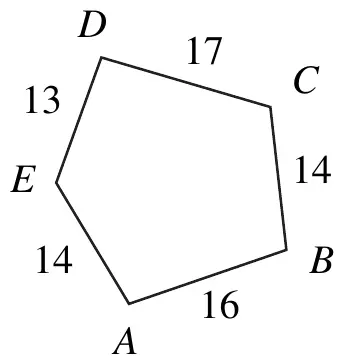
Grey Kangaroo 2016, Question 22. © UK Mathematics Trust. Original paper on ukmt.org.uk
Answer: A \(A\)
Let the radius of the circle with centre \(A\) be \(x\) cm. Therefore, since the circles drawn on each side of the pentagon touch, the radius of the circle with centre \(B\) is \((16 - x)\) cm. Similarly, the radius of the circle with centre \(C\) is \((14 - (16 - x))\) cm = \((x - 2)\) cm, the radius of the circle with centre \(D\) is \((17 - (x - 2))\) cm = \((19 - x)\) cm and the radius of the circle with centre \(E\) is \((13 - (19 - x))\) cm = \((x - 6)\) cm. However, the radius of the circle with centre \(E\) is also equal to \((14 - x)\) cm since the circle with centre \(A\) has radius \(x\) cm. Therefore \(14 - x = x - 6\), which has solution \(x = 10\). Hence the radii of the circles centres \(A\), \(B\), \(C\), \(D\) and \(E\) are 10 cm, 6 cm, 8 cm, 9 cm and 4 cm respectively. Therefore point \(A\) is the centre of the largest circle Sephideh draws.
Solution © UK Mathematics Trust, from the GK 2016 solutions.