24. Eight consecutive three-digit positive integers have the following property: each of them is divisible by its last digit. What is the sum of the digits of the smallest of these eight integers?
Since we cannot divide by zero, the eight numbers must have the form \(ABn\) where \(n\) runs from 1 to 8 or from 2 to 9. However if \(ABn\) is divisible by \(n\) for each \(n\) from 2 to 9, it is also divisible by \(n\) for each \(n\) from 1 to 8 and \(AB1\) is smaller than \(AB2\). Hence our solution will use the digits 1 to 8. Note that \(ABn\) is divisible by \(n\) if and only if \(AB0\) is divisible by \(n\). So we require the smallest number \(AB0\) which is divisible by 1, 2, 3, 4, 5, 6, 7, 8. The LCM of these 8 numbers is 8 × 7 × 5 × 3 = 840. The eight numbers are then 841, 842, 843, 844, 845, 846, 847, 848. The digit sum of 841 is 13.
We are given that \(10 \times 2^m = 2^n + 2^{n+2}\). Therefore \(5 \times 2 \times 2^m = 2^n(1 + 2^2)\). Hence \(5 \times 2^{m+1} = 2^n \times 5\). So \(m + 1 = n\). Therefore the difference between \(m\) and \(n\) is 1.
18. How many four-digit numbers \(N\) are there, such that half of the number \(N\) is divisible by 2, a third of \(N\) is divisible by 3 and a fifth of \(N\) is divisible by 5?
The information in the question tells us that \(N\) is divisible by 2 × 2 = 4, 3 × 3 = 9 and 5 × 5 = 25. Since these three values have no factors in common, \(N\) is divisible by 4 × 9 × 25 = 900. Therefore \(N\) is a four-digit multiple of 900. The smallest such multiple is 2 × 900 = 1800 and the largest is 11 × 900 = 9900. Therefore there are 10 such four-digit numbers.
To be divisible by 18, the number must be divisible by 2 and by 9. The digit sum for any number formed is 1 + 2 + 3 + 4 + 5 + 6 + 7 + 8 + 9 = 45, and hence every number is a multiple of 9. Therefore any even number formed will be divisible by 18. Of the 9 possible last digits, there are four even digits (2, 4, 6, 8), so the probability of the number being even is \(\tfrac{4}{9}\).
Note that 9 × 11 × 13 × 15 × 17 is a multiple of 9. Therefore the sum of its digits is also a multiple of 9. The sum of the digits of ‘3n8185’ equals \(25 + n\). So \(n = 2\), since 27 is a multiple of 9.
11. Masha put a multiplication sign between the second and third digits of the number 2020 and noted that the resulting product 20 × 20 was a square number.
How many integers between 2010 and 2099 (including 2020) have the same property?
Each number begins with 20, and \(20 = 5 \times 2^2\). Hence, to make a square product, the last two digits must make a number which is a product of 5 and a square number. The possibilities between 10 and 99 are \(5 \times 2^2 = 20\), \(5 \times 3^2 = 45\) and \(5 \times 4^2 = 80\). Therefore there are three possible numbers: 2020, 2045, 2080.
Since the units digits of all the options are different, it is sufficient to add the units digits of the four squares in the sum. As \(7^2 = 49\), \(17^2\) has a units digit of 9. In a similar way, we calculate that \(19^2\) has a units digit of 1, \(23^2\) has a units digit of 9 and \(29^2\) has a units digit of 1. Therefore the units digit of the given sum is the units digit of 9 + 1 + 9 + 1, that is 0. As we are told that the correct answer is one of the options, we may deduc that it is 2020.
Since \(ab = 2cd\), the product \(abcd = 2cd \times cd = 2(cd)^2\), hence it must be twice a perfect square. This is true for all the options, except 100 since \(100 = 2 \times 50\) but 50 is not a perfect square. [\(50 = 2 \times 5^2\);\(200 = 2 \times 10^2\);\(450 = 2 \times 15^2\); and \(800 = 2 \times 20^2\).]
The correct answer is a multiple of both 3 and 8, as 24 = 3 × 8. Although 100 is a multiple of 4, it is not a multiple of 8. Therefore even multiples of 100 are multiples of 8, but odd multiples are not. This leaves 200, 400 and 600, but of these only 600 is also a multiple of 3. Hence the only option which is a multiple of 24 is 600.
25. How many four-digit numbers have the following property? “For each of its digits, when this digit is deleted the resulting three-digit number is a factor of the original number.”
Let the 4-digit integer be ‘\(abcd\)’. When it is divided by ‘\(abc\)’, we get ‘\(abcd\)’ = 10 × ‘\(abc\)’ + \(d\). Since ‘\(abc\)’ is a factor of ‘\(abcd\)’, we must have \(d = 0\), and the integer is ‘\(abc\)0’. Similarly, when ‘\(abc\)0’ is divided by ‘\(ab\)0’, we get ‘\(abc\)0’ = 10 × ‘\(ab\)0’ + ‘\(c\)0’. But ‘\(c\)0’ can only be divisible by ‘\(ab\)0’ if \(c = 0\). Thus the integer is ‘\(ab\)00’. This is divisible by ‘\(b\)00’, so we can’t have \(b = 0\). When we divide ‘\(ab\)00’ by ‘\(a\)00’, we get ‘\(ab\)00’ = 10 × ‘\(a\)00’ + ‘\(b\)00’, hence ‘\(b\)00’ must be a multiple of ‘\(a\)00’, and therefore \(b\) is a multiple of \(a\).
Since ‘\(b\)00’ is a factor of ‘\(ab\)00’ and ‘\(ab\)00’ = ‘\(a\)000’ + ‘\(b\)00’, it must be that ‘\(b\)00’ divides ‘\(a\)000’, hence ‘\(a\)0’ is a multiple of \(b\). For \(b\) to be a multiple of \(a\) and a factor of \(10 \times a\), \(b\) must be \(a\),\(2a\), \(5a\) or \(10a\). But \(10a\) is more than one digit long. When \(b = a\) we get ‘\(ab\)00’ is 1100, 2200, 3300, 4400, 5500, 6600, 7700, 8800, 9900. When \(b = 2a\), we get 1200, 2400, 3600, 4800. When \(b = 5a\), we get 1500. This is 9 + 5 = 14 possibilities.
24. When 5655 is divided by a two-digit positive integer \(N\), the remainder is 11. When 5879 is divided by the same positive integer \(N\), the remainder is 14.
We are given that \(5655 = N \times j + 11\) and \(5879 = N \times k + 14\). Subtracting the first equation from the second, we obtain, \(224 = N \times (k - j) + 3\). Therefore \(221 {=} N \times (k - j)\).
It follows that \(N\) is a positive factor of 221, so that \(N\) is equal to 1, 13, 17 or 221. But one of the remainders is 14, so \(N\) is equal to 17 or 221. However, 221 does not have two digits. Therefore \(N = 17\) and the sum of its digits is 1 + 7 = 8.
23. Rhona wrote down a list of nine multiples of ten: 10, 20, 30, 40, 50, 60, 70, 80, 90. She then deleted some of the nine multiples so that the product of the remaining multiples was a square number. What is the least number of multiples that she could have deleted?
To end up with a square product, any prime factor must occur an even number of times. Rhona cannot use 70 since the factor 7 only appears once in 70, and never in any of the other numbers.
If she uses all the other numbers she gets \[\begin{aligned} &10 \times 20 \times 30 \times 40 \times 50 \times 60 \times 80 \times 90 \\ &= (2 \times 5) \times (2 \times 2 \times 5) \times (2 \times 3 \times 5) \times (2 \times 2 \times 2 \times 5) \times (2 \times 5 \times 5) \\ &\quad \times (2 \times 2 \times 3 \times 5) \times (2 \times 2 \times 2 \times 2 \times 5) \times (2 \times 3 \times 3 \times 5) \\ &= 2^{15} \times 3^4 \times 5^9. \end{aligned}\] To get a square, she needs to make the powers of 2 and 5 even, say by removing 10 from the list (although removing 40 or 90 works too). Hence she needs to remove only two numbers from her list.
22. A positive integer is to be placed on each vertex of a square. For each pair of these integers joined by an edge, one should be a multiple of the other. However, for each pair of diagonally opposite integers, neither should be a multiple of the other. What is the smallest possible sum of the four integers?
It is clear that none of the integers can be 1, since then the diagonally opposite integer will certainly be a multiple of it.
Let the smallest integer be \(a\), and the diagonally opposite integer be \(b\). Since \(a\) is the smallest integer, the other two numbers must both be multiples of \(a\), say \(ma\) and \(na\), for some integers \(m\),\(n\). Now \(b\) cannot be a multiple of \(a\) since \(a\) and \(b\) are diagonally opposite, so \(b\) cannot be a multiple of its neighbours \(ma\) and \(na\); hence both \(ma\) and \(na\) are multiples of \(b\).
Suppose \(a\) and \(b\) have a factor \(k\) in common (with \(k > 1\)). Then the other two integers also have this factor since they are multiples of \(a\) and of \(b\). But then each of the four integers could be divided by this factor to produce four smaller integers with the desired properties. But we are looking for the smallest possible sum, hence \(a\) and \(b\) must not have any factors in common. The smallest pair of integers with no common factors to consider would be \(a = 2\) and \(b = 3\).
The other two integers must be multiples of both 2 and 3, but not of each other. We cannot use 6 because this would be a factor of any other multiple of both 2 and 3. The smallest possible pair is 12 and 18.
This gives a total of 2 + 3 + 12 + 18 which is 35.
Note that 1001 = 7 × 143, so that any six-digit number of the form ‘XYZ XYZ’ = 1001 × ‘XYZ’ is necessarily a multiple of 7. So options A and D are both multiples of 7. Also, 10 101 = 7 × 1443, so that any six-digit number of the form ‘XYX YXY’ = 10101 × ‘XY’ is necessarily a multiple of 7. So options B and C are both multiples of 7. However, ‘PPP QQQ’ = \(111 \times (1000P + Q) = 3 \times 37 \times (1000P + Q)\) is not necessarily a multiple of 7. For example, when \(P = 1\) and \(Q = 2\),\(1000P + Q = 1002 = 143 \times 7 + 1\).
21. Each of the positive integers \(a\),\(b\), and \(c\) has three digits, and for each of these integers the first digit is the same as its last digit. Also \(b = 2a + 1\) and \(c = 2b + 1\). How many possibilities are there for the integer \(a\)?
Let the digits of \(a\) be ‘\(pqp\)’, so \(a = 101p + 10q\).Also \(c = 2b + 1 = 2(2a + 1) + 1 = 4a + 3\) which is \(404p + 40q + 3\). This is less than 1000, so \(p = 1\) or 2.
If \(p = 2\), then \(c = 808 + 40q + 3\). This ends with digit 1 (8 + 3 = 11) but \(c\) is a 3-digit number greater than 808 so can’t begin with 1.
If \(p = 1\), then \(c = 404 + 40q + 3\). This ends with digit 4 + 3 = 7, so must also begin with 7, hence \(700 \leq 404 + 40q + 3 < 800\) and thus \(293 \leq 40q < 393\). Therefore \(q = 8\) or 9.
When \(q = 8\), this gives \(a = 181\),\(b = 363\),\(c = 727\). When \(q = 9\), this gives \(a = 191\),\(b = 383\),\(c = 767\).
Hence there are two possibilities for \(a\), 181 and 191.
16. Sixty apples and sixty pears are to be packed into boxes so that each box contains the same number of apples, and no two boxes contain the same number of pears. What is the largest possible number of boxes that can be packed in this way?
Since each box has a different number of pears, and we want as many boxes as possible, we could start by putting no pears in box 1, 1 pear in box 2, 2 pears in box 3, and so on. By the 11th box we have 0 + 1 + 2 + 3 + 4 + 5 + 6 + 7 + 8 + 9 + 10 = 55 pears, and there are not enough pears for another box. However, we can’t use 11 boxes because we need to share the 60 apples evenly and 60 is not a multiple of 11. So, the maximum possible is 10 boxes with 6 apples in each box, and the pears distributed as stated but with 24 in the 10th box.
16. Chloe chose a three-digit integer with all its digits different and wrote it on lots of pieces of paper. Peter picked some of the pieces of paper and added the three-digit integers on them. His answer was 2331. How many pieces of paper did Peter pick?
First note that the factorisation of 2331 into prime numbers is 2331 = 3 × 3 × 7 × 37. Note also that 3 × 37 = 111. Since Claire’s three-digit integer has all its digits different, and both 3 × 111 = 333 and 7 × 111 = 777 have repeated digits, the factors of Claire’s integer do not include both 3 and 37. However, since 3 × 3 × 7 = 63, which is not a three-digit integer, the factors of Claire’s integer must include 37. Therefore Claire’s integer is 37 × 7 = 259 and hence the number of pieces of paper Peter picked is 2331 ÷ 259 = 9.
The value of ‘\(ab\)’ is \(10a + b\) so \(3a + 4b = 10a + b\) which gives \(3b = 7a\). Hence \(a\) is a multiple of 3 and \(b\) is a multiple of 7. Also \(a\) is non-zero (as it is the leading digit), and hence \(b\) also cannot be zero. The only single-digit solution of \(3b = 7a\) is \(a = 3\) and \(b = 7\), so \(a + b = 10\).
First note that the triangular numbers less than 20 are 1, 3, 6, 10, 15. As we are looking for a sequence of consecutive integers which are respectively prime, even, and triangular, the required triangular number is odd. So it is 3 or 15. It is not 3 as 1 is not prime, but it is 15 as 13 is prime. So the required product = 13 × 14 × 15 = 2730.
For the cube of a positive integer to end in a 5, the integer itself must end in a 5. We note that \(5^3 = 125\) and that \(15^3 = 3375\). However \(25^3 > 20^3 = 8000\) and so \(25^3 > 5000\). Therefore there are only two positive cubes less than 5000 which end in the digit 5, namely 125 and 3375.
3. Kerry writes a list of all the integers from 1 to \(n\) on a whiteboard. She uses the digit 0 five times and the digit 9 six times. What is the value of \(n\)?
Kerry uses the digit 0 five times and hence the value of \(n\) is smaller than 60. She uses the digit 9 six times and hence the value of \(n\) is at least 59. Therefore the value of \(n\) is 59.
First note that 72 = 8 × 9. So all multiples of 72 are multiples of 8 and of 9. As the only digits available are 0 and 1, the required integer is a multiple of the smallest power of 10 which is a multiple of 8, namely 1000. So the last three digits of the required integer are 000. Note also that this integer must be a multiple of 9, so the sum of its digits is a multiple of 9. Therefore, the smallest multiple of 9 whose digits are 1 and 0, and which is also a multiple of 8, is 111 111 111 000. This integer has 12 digits.
17. A list of integers has a sum of 2018, a product of 2018, and includes the number 2018 in the list. Which of the following could be the number of integers in the list?
Let the integers be \(\{2018, a_1, a_2, \ldots, a_n\}\). Their product is \(2018 \times a_1 \times a_2 \times \ldots \times a_n = 2018\) so we get \(a_1 \times a_2 \times \ldots \times a_n = 1\), meaning each \(a_i\) is either 1 or −1 (with an even number of occurrences of −1). Their sum is \(2018 + a_1 + a_2 + \ldots + a_n = 2018\) so \(a_1 + a_2 + \ldots + a_n = 0\), meaning an equal number of occurrences of 1 and −1. Hence the list includes 2018 once, an even number of 1s and the same even number of −1s. Therefore the number of integers must be one more than a multiple of 4, so from the list of options only 2017 is possible.
The value of ‘abc’ equals \(100a + 10b + c\). We need to find integers of the form ‘abc’ such that ‘cba’ = ‘abc’ + 99. So \(100c + 10b + a = 100a + 10b + c + 99\), that is \(99c = 99a + 99\). This condition simplifies to \(c = a + 1\). So there are 10 such integers of the form ‘1b2’, 10 of the form ‘2b3’, 10 of the form ‘3b4’, …, and 10 of the form ‘8b9’. Therefore the required number is 8 × 10 = 80.
15. How many 3-digit numbers are there with the property that the 2-digit number obtained by deleting the middle digit is equal to one ninth of the original 3-digit number?
Let the three digits be \(a\),\(b\),\(c\). Then the value of the 3-digit number is \(100a + 10b + c\) and the 2-digit number (made by deleting the middle digit) is \(10a + c\). Hence \(100a + 10b + c = 9(10a + c)\), which gives \(10(a + b) = 8c\), or \(5(a + b) = 4c\). Hence \(c\) is divisible by 5. But \(c\) cannot be zero (because this would mean \(a + b = 0\), and the digits cannot all be zero). So \(c = 5\). Then \(a + b = 4\), giving four possibilities: \(a = 1\), \(b = 3\) or \(a = 2\), \(b = 2\) or \(a = 3\), \(b = 1\) or \(a = 4\),\(b = 0\). These all give valid solutions (135 = 9 × 15, 225 = 9 × 25, 315 = 9 × 35, 405 = 9 × 45).
13. Alice wants to write down a list of prime numbers less than 100, using each of the digits 1, 2, 3, 4 and 5 once and no other digits. Which prime number must be in her list?
First note that none of 2, 4 or 5 can occur as the final digit of a two-digit prime. Also 21 and 51 are not prime since they are divisible by 3. Therefore the primes which might occur in Alice's list are 2, 3, 5, 13, 23, 31, 41, 43 and 53. Since 1 and 4 are not prime, they must occur in Alice's list as digits in some two-digit prime. If 41 is not used, the only two-digit primes which could use the 4 and the 1 are 43 and one of 31 or 13. However, this would repeat the digit 3. Hence 41 must be in Alice's list together with one of the groups 2, 3, 5 or 2, 53 or 5, 23.
10. A sequence of positive integers starts with one 1, followed by two 2s, three 3s, and so on. (Each positive integer \(n\) occurs \(n\) times.) How many of the first 105 numbers in this sequence are divisible by 3?
The number of terms in the sequence up to and including the \(n\) occurrences of \(n\) is \(1 + 2 + 3 + \ldots + n = \tfrac{1}{2}n(n + 1)\), which equals 105 when \(n = 14\). Hence the numbers divisible by 3 are 3 (three times), 6 (six times), 9 (nine times) and 12 (twelve times), giving a total of \(3 + 6 + 9 + 12 = 30\) numbers.
10. A rectangle is divided into 40 identical squares. The rectangle contains more than one row of squares. Andrew coloured all the squares in the middle row. How many squares did he not colour?
The possible rectangles containing 40 equal squares have dimensions (length × height) 1 × 40, 2 × 20, 4 × 10, 5 × 8, 8 × 5, 10 × 4, 20 × 2 and 40 × 1. The question tells us that when it is divided into squares, the rectangle contains more than one row and also that it has a middle row and hence has an odd number of rows. The number of rows of squares the rectangle contains is related to its height which must be an odd value. Therefore the rectangle has dimensions 8 × 5. Hence, when Andrew coloured the middle row, he coloured eight squares. Therefore the number of squares he did not colour is 40 – 8 = 32.
The difference of two squares \(a^2 - b^2\) factorises to \((a + b)(a - b)\). Therefore for it to be possible to express an integer as the difference of two squares, it must be possible to factorise the integer in the form \((a + b)(a - b)\), where \(a\) and \(b\) are both integers. Note that \(5 = (3 + 2)(3 - 2)\);\(7 = (4 + 3)(4 - 3)\);\(8 = (3 + 1)(3 - 1)\);\(9 = (5 + 4)(5 - 4)\). So 5, 7, 8, 9 can all be written as the difference of two squares. (It is left to the reader to show that 10 cannot be the difference of two squares as it cannot be written in the form \((a + b)(a - b)\) where a and b are both integers.)
9. Martha multiplied two 2-digit numbers correctly on a piece of paper. Then she scribbled out three digits as shown. What is the sum of the three digits she scribbled out?
Let the three missing digits from left to right be \(a\), \(b\) and \(c\). Consider the final digit ‘2’ of the answer. This is the last digit of \(3 \times b\) and hence \(b = 4\). Also, note that if \(a\) were 2 or more, then the answer would be more than 400. Therefore \(a = 1\). Hence the multiplication is 13 × 24 = 312, giving \(c = 1\). Therefore the sum of the digits scribbled out is \(a + b + c = 1 + 4 + 1 = 6\).
The two-digit squares are 16, 25, 36, 49, 64, 81. The products of their digits are 6, 10, 18, 36, 24, 8, respectively. So exactly one two-digit square has the required property, namely 49.
5. Marta has collected 42 apples, 60 apricots and 90 cherries. She wants to divide them into identical piles using all of the fruit and then give a pile to some of her friends. What is the largest number of piles she can make?
If the fruit in each pile is to be identical, then the number of piles must be a factor of 42, 60 and 90. The highest common factor of these numbers is 6, so this is the largest number of piles possible.
Write each number in the expression as a product of prime factors to obtain 2 × 2 × 3 × 3 × 2 × 7 = 2 × 3 × * × 7. It can then be seen that 2 × 2 × 3 = * and hence the value of * is 12.
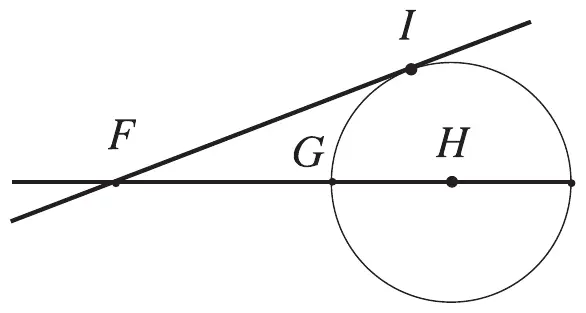
24. The points \(G\) and \(I\) are on the circle with centre \(H\), and \(FI\) is tangent to the circle at \(I\). The distances \(FG\) and \(HI\) are integers, and \(FI = FG + 6\). The point \(G\) lies on the straight line through \(F\) and \(H\). How many possible values are there for \(HI\)?
Let \(x\) be the length \(FG\) and let \(r\) be the radius. Then \(FI = x + 6\) and \(GH = HI = r\). Angle \(FIH\) is a right angle (the tangent and radius are perpendicular) so \(FI^2 + HI^2 + FH^2\), which gives \((x + 6)^2 + r^2 = (x + r)^2\). Expanding this gives \(x^2 + 12x + 36 + r^2 = x^2 + 2rx + r^2\), which simplifies to \(12x + 36 = 2rx\). Halving this gives \(6x + 18 = rx\), which rearranges to \(r = 6 + \tfrac{18}{x}\). Since \(r\) is an integer, \(x\) must be a (positive) factor of 18, namely 1, 2, 3, 6, 9, 18; each of these six factors give a different value of \(r\) (or \(HI\)) as required.
21. Each number in the sequence starting 2, 3, 6, 8, 8, 4, ... is obtained in the following way. The first two numbers are 2 and 3 and afterwards each number is the last digit of the product of the two preceding numbers in the sequence. What is the 2017th number in the sequence?
Continue the sequence as described to obtain 2, 3, 6, 8, 8, 4, 2, 8, 6, 8, 8, 4, 2, 8, 6, 8 and so on. Since the value of each term depends only on the preceding two terms, it can be seen that, after the first two terms, the sequence 6, 8, 8, 4, 2, 8 repeats for ever. Now 2017 − 2 = 335 × 6 + 5. Therefore the 2017th number in the sequence is the fifth number of the repeating sequence 6, 8, 8, 4, 2, 8. Hence the required number is 2.
19. Maria chooses two digits \(a\) and \(b\) and uses them to make a six-digit number \(ababab\). Which of the following is always a factor of numbers formed in this way?
Let ‘\(ab\)’ be the 2-digit number with digits \(a\) and \(b\), then the 6-digit number ‘\(ababab\)’ = ‘\(ab\)’ × 10101 = ‘\(ab\)’ × 3 × 7 × 13 × 37 so is always divisible by 3, 7, 13 and 37. But it is only divisible by 2, 5, 9 or 11 if ‘\(ab\)’ is.
The prime factor decomposition of 882 is \(2 \times 3^2 \times 7^2\). The ages must be under 18, so cannot be \(3 \times 7 = 21\) or \(7 \times 7 = 49\). Hence, the only way to create two different numbers using 7 are: 7 and \(2 \times 7 = 14\). This leaves only \(3^2\) which can create the two ages 1 and 9. The sum of the ages is then 1 + 9 + 7 + 14 = 31.
16. Seven positive integers \(a\),\(b\),\(c\),\(d\),\(e\),\(f\), \(g\) are written in a row. Every number differs by one from its neighbours. The total of the seven numbers is 2017. Which of the numbers can be equal to 286?
Each number \(a\),\(b\),\(c\),\(d\),\(e\),\(f\), \(g\) differs from its neighbour by one, so they alternate odd and even. To obtain an odd total, we must have an odd number of odd numbers in the list. Hence \(b\),\(d\), \(f\) are odd and cannot be equal to 286. If \(c = 286\), then the biggest total possible is 288 + 287 + 286 + 287 + 288 + 289 + 290 = 2015 which is too small. By reversing this list, we can also rule out \(e = 286\). We can obtain the total 2017 if we start with \(a = 286\) since 286 + 287 + 288 + 289 + 290 + 289 + 288 = 2017. By reversing this, we could also end with \(g = 286\).
13. Rohan wants to cut a piece of string into nine pieces of equal length. He marks his cutting points on the string. Jai wants to cut the same piece of string into only eight pieces of equal length. He marks his cutting points on the string. Yuvraj then cuts the string at all the cutting points that are marked. How many pieces of string does Yuvraj obtain?
Rohan wants to obtain 9 equal pieces and so makes eight marks. Jai wants to obtain 8 equal pieces and so makes seven marks. Since 9 and 8 have no common factors (9 and 8 are co-prime), none of the marks made by either boy coincide. Therefore Yuvraj will cut at 15 marked points and hence will obtain 16 pieces of string.
9. Four cousins Alan, Bob, Carl and Dan are 3, 8, 12 and 14 years old, although not necessarily in that order. Alan is younger than Carl. The sum of the ages of Alan and Dan is divisible by 5. The sum of the ages of Carl and Dan is divisible by 5. What is the sum of the ages of Alan and Bob?
The ages of the four cousins are 3, 8, 12 and 14. When these are added in pairs, we obtain 3 + 8 = 11, 3 + 12 = 15, 3 + 14 = 17, 8 + 12 = 20, 8 + 14 = 22 and 12 + 14 = 26. Only two of these, 15 and 20, are divisible by 5. However, we are told that the sum of the ages of Alan and Dan and the sum of the ages of Carl and Dan are both divisible by 5. Hence, since Dan's age appears in both sums that are divisible by 5, his age is 12. Since Alan is younger than Carl, Alan's age is 3 and Carl's age is 8. Hence Bob's age is 14. Therefore the sum of the ages of Alan and Bob is 3 + 14 = 17.
9. The number ‘tu’ is the two-digit number with units digit \(u\) and tens digit \(t\). The digits \(a\) and \(b\) are distinct, and non-zero. What is the largest possible value of ‘ab’ − ‘ba’?
First note that as ‘ab’ and ‘ba’ are two digit numbers, neither \(a\) nor \(b\) is equal to zero. Now ‘ab’ − ‘ba’ = \((10a + b) - (10b + a) = 9a - 9b = 9(a - b)\). So for the difference to be as large as possible, \(a\) must be as large as possible, that is 9, and \(b\) must be as small as possible, that is 1. So the required difference is 91 − 19 = 72.
All primes except 2 are odd. So the sum of a pair of primes cannot be odd, and so cannot be prime, unless one of the pair is 2. We note that 5 = 2 + 3; 7 = 2 + 5; 9 = 2 +7; 13 = 2 + 11. However, 11 = 2 + 9 and so it is not the sum of two primes, as 9 is not prime.
Consider the units digits of the squares of the integers 0, 1, 2, 3, ..., 9. These are 0, 1, 4, 9, 6, 5, 6, 9, 4, 1. Note that none of these is 7, so no square ends in a 7.
22. Jakob wrote down four consecutive positive integers. He then calculated the four possible totals made by taking three of the integers at a time. None of these totals was a prime. What is the smallest integer Jakob could have written?
Let \(n\) be the smallest of the integers. The four consecutive integers have sum \(n + n + 1 + n + 2 + n + 3 = 4n + 6\). Then the four possible sums formed by taking three of these at a time are \(4n + 6 - n = 3n + 6\) (divisible by 3 so not prime) \(4n + 6 - (n + 1) = 3n + 5\) (if \(n\) is odd then this is even, so is not prime) \(4n + 6 - (n + 2) = 3n + 4\) \(4n + 6 - (n + 3) = 3n + 3\) (divisible by 3 so not prime) Hence we are looking for the smallest \(n\) for which neither \(3n + 4\) nor \(3n + 5\) is prime.
21. In the Kangaroo republic each month consists of 40 days, numbered 1 to 40. Any day whose number is divisible by 6 is a holiday, and any day whose number is a prime is a holiday. How many times in a month does a single working day occur between two holidays?
Every multiple of 6 is a holiday. For \(n > 0\), the days in between \(6n\) and \(6n + 6\) will contain three consecutive non-primes \(6n + 2\) (divisible by 2), \(6n + 3\) (divisible by 3) and \(6n + 4\) (divisible by 2). Using H to represent a holiday, W a working day and ? for an unknown day, we see the numbers \(6n\) to \(6n + 6\) form the pattern H?WWW?H. We are searching for the pattern HWH but this will not fit into the pattern shown above. Hence, the only days that can possibly give HWH must occur in the first week of the month. The days 1, 2, 3, 4, 5, 6 have the pattern WHHWHH so contain one occurrence of HWH. The first day of the month could possibly be a working day between two holidays, but a quick check shows that of course day 40 is also a working day.
21. Several different positive integers are written on a blackboard. The product of the smallest two of them is 16. The product of the largest two of them is 225. What is the sum of all the integers written on the blackboard?
The only ways to express 16 as the product of two different positive integers are 1 × 16 and 2 × 8. The only ways to express 225 as the product of two different positive integers are 1 × 225, 3 × 75, 5 × 45 and 9 × 25. Therefore, since both integers in the first pair must be smaller than both integers in the second pair, the only possible combination is for the two smallest integers to be 2 and 8 and for the two largest integers to be 9 and 25. There are no other integers written on the blackboard since they would need to be different from these four, be less than 9 and greater than 8. Hence the sum of the integers written on the blackboard is 2 + 8 + 9 + 25 = 44.
19. Little Red Riding Hood is delivering waffles to three grannies. She starts with a basket full of waffles. Just before she enters the house of each granny, the Big Bad Wolf eats half of the waffles in her basket. She delivers the same number of waffles to each granny. When she leaves the third granny's house, she has no waffles left. Which of the following numbers definitely divides the number of waffles she started with?
Let \(x\) be the number of waffles Little Red Riding Hood delivered to each of the grannies. She delivered \(x\) waffles to the third granny and so, since the Big Bad Wolf eats half of the waffles in her basket just before she enters each granny's house, she must have arrived with \(2x\) waffles. Therefore she had \(3x\) waffles before giving the second granny her waffles and hence had \(2 \times 3x = 6x\) waffles when she arrived. Therefore she had \(6x + x = 7x\) waffles before giving the first granny her waffles and hence had \(2 \times 7x = 14x\) waffles in her basket when she arrived. Hence, since we do not know the value of \(x\), the only numbers that definitely divide the number of waffles she started with are the numbers that divide 14, namely 1, 2, 7 and 14. Therefore, of the options given, only 7 definitely divides the number of waffles she started with.
Since the remainder of a division is always less than the divisor used, we can begin our search for the largest possible remainder by looking at the largest possible divisor, that is the largest possible sum of the digits of a 2-digit number. The largest possible sum of digits is \(9 + 9 = 18\). And \(99 \div 18\) has remainder 9. The next largest is 17, which could come from 89 or 98. Doing the division, we see \(89 \div 17\) has remainder 4 and \(98 \div 17\) has remainder 13. The next largest sum of digits is 16, which could come from 88, 97, 79. And division shows that \(88 \div 16\) has remainder 8; \(97 \div 16\) has remainder 1, and \(79 \div 16\) has remainder 15 (the largest remainder so far). Any sum of digits below 16 will have remainder below 15, so the remainder of 15 that we have achieved must be the largest possible.
The prime factorisation of \(24 = 2^3 \times 3\). Therefore all multiples of 24 must include both \(2^3\) and 3 in their prime factorisation. Of the options given, only the last includes \(2^3\). As it is also a multiple of 3, it is a multiple of 24.
13. Sepideh is making a magic multiplication square using the numbers 1, 2, 4, 5, 10, 20, 25, 50 and 100. The products of the numbers in each row, in each column and in the two diagonals should all be the same. In the figure you can see how she has started. Which number should Sepideh place in the cell with the question mark?
Since each of the nine numbers appears exactly once in the three rows, the product of each of the three rows is equal to the product of all nine numbers, that is 1 × 2 × 4 × 5 × 10 × 20 × 25 × 50 × 100. This equals \(1 \times 2 \times 2^2 \times 5 \times 2 \times 5 \times 2^2 \times 5 \times 5^2 \times 2 \times 5^2 \times 2^2 \times 5^2 = 2^9 \times 5^9\). Since the products of each of the three rows are equal, these products are equal to \(\sqrt[3]{2^9 \times 5^9} = 2^3 \times 5^3\). So the ‘magic product’ is 1000. By considering the top row, we can see that the top right cell must contain \(1000 \div (20 \times 1) = 50\). The only other way to get 1000 as the product of 1 and two of the remaining numbers is 1 × 10 × 100. So 10 and 100 must fill the two spaces below 1. We cannot put the 100 in the centre since the products of the numbers on each diagonal would then be too large. So 10 goes in the centre and 100 below it. From the diagonal we see that the bottom right entry is 5 and so the middle number on the right is 4. Note: It may interest readers to know that in a 3 × 3 multiplicative magic square the centre number is always the cube root of the magic total.
10. Tim, Tom and Tam are triplets (three brothers born on the same day). Their twin brothers Jon and Jim are exactly three years younger. Which of the following numbers could be the sum of the ages of the five brothers?
Let \(x\) be the age of each of Tim, Tom and Tam. Therefore the age of both Jon and Jim is \(x - 3\). Therefore the sum of all their ages is \(3x + 2(x - 3) = 5x - 6\) and \(5x - 6\) can also be written as \(5(x - 1) - 1\). Hence the sum of their ages is always one less than a multiple of 5. Of the options given, the only number for which this is true is 89 (when Tim, Tom and Tam are 19 and Jon and Jim are 16).
6. Two pieces of rope have lengths 1 m and 2 m. Alex cuts the pieces into several parts. All the parts have the same length. Which of the following could not be the total number of parts he obtains?
Since all the parts cut are of the same length, Alex will obtain twice as many parts from his 2 metre piece of rope as he does from his 1 metre piece of rope. Hence, the total number of parts he obtains will always be a multiple of 3, and he can make it any multiple of 3. Of the options given, only 8 is not a multiple of 3 and so could not be obtained.
Amrita bakes every 5 days and Thursdays come every 7 days. So the next time Amrita bakes on a Thursday will be in 35 days time since 35 is the lowest common multiple of 5 and 7.
The number \(x\) is 3 more than a multiple of 6, so \(x = 6k + 3\) for some non-negative integer value of \(k\). And then \(3x = 3(6k + 3) = 18k + 9 = 6(3k + 1) + 3\). Hence \(3x\) is 3 more than a multiple of 6, so leaves remainder 3 when divided by 6.
25. Several different points are marked on a line, and all possible line segments are constructed between pairs of these points. One of these points lies on exactly 80 of these segments (not including any segments of which this point is an endpoint). Another one of these points lies on exactly 90 segments (not including any segments of which it is an endpoint). How many points are marked on the line?
Suppose the first of the two special points mentioned has \(a\) points to its left, and \(b\) points to its right. Then the number of line segments it lies on is \(a \times b\) (\(a\) choices for the left end, \(b\) choices for the right end). Also the number of points will be \(a + b + 1\). Similarly if the second point has \(c\) points to its left, and \(d\) to the right, then the number of line segments it lies on is \(c \times d\), and the number of points is \(c + d + 1\). Hence we need to find integers \(a\),\(b\),\(c\), \(d\) such that \(ab = 80\),\(cd = 90\), \(a + b + 1 = c + d + 1\) (or more simply \(a + b = c + d\)). The factor pairs of 80 (and hence the possible values of \(a\), \(b\)) are \(1 \times 80\),\(2 \times 40\),\(4 \times 20\),\(5 \times 16\),\(8 \times 10\). The factor pairs of 90 (and hence possible values of \(c\), \(d\)) are \(1 \times 90\),\(2 \times 45\),\(3 \times 30\),\(5 \times 18\),\(6 \times 15\),\(9 \times 10\). The only pairs for which we have \(a + b = c + d\) are 5, 16 and 6, 15. Since both of these add to 21, the number of points must be \(a + b + 1 = 21 + 1 = 22\).
24. Gregor divides 2015 successively by 1, 2, 3, and so on up to and including 1000. He writes down the remainder for each division. What is the largest remainder he writes down?
Suppose we obtain the remainder \(r\) when we divide 2015 by the positive integer \(d\). Then \(r \leqslant d - 1\). Also, with \(d \leqslant 1000\) the quotient must be at least 2. This suggests that to get the largest possible remainder we should aim to write 2015 in the form \(2d + (d - 1)\). The equation \(2015 = 2d + (d - 1)\) has the solution \(d = 672\). So we obtain the remainder 671 when we divide 2015 by 672. If we divide 2015 by an integer \(d_1 < 672\), the remainder will be at most \(d_1 - 1\) and so will be less than 671. If we divide 2015 by an integer \(d_2\), where \(672 < d_2 \leqslant 1000\) and obtain remainder \(r_2\), we would have \(r_2 = 2015 - 2d_2 < 2015 - 2 \times 672 = 671\). Hence 671 is the largest remainder we can obtain.
22. We use the notation \(\overline{ab}\) for the two-digit number with digits \(a\) and \(b\). Let \(a\),\(b\), \(c\) be different digits. How many ways can you choose the digits \(a\),\(b\), \(c\) such that \(\overline{ab} < \overline{bc} < \overline{ca}\) ?
Since the three digits \(a\),\(b\), \(c\) are different and \(\overline{ab} < \overline{bc} < \overline{ca}\), it is necessary that \(a < b < c\). But this condition is also sufficient. Also note that none of \(a\),\(b\), \(c\) are zero because they each represent the tens digit of a two-digit number. There are 9 ways to pick a non-zero digit, 8 ways to pick a second (different) digit, and 7 ways to pick a third digit. These digits can be arranged in \(3 \times 2 \times 1 = 6\) ways, but only one of these will be in ascending order (we need \(a < b < c\)). Hence there are \((9 \times 8 \times 7) \div 6 = 84\) ways to choose the digits \(a\),\(b\),\(c\).
Since \(2^7 = 128\) is larger than 100, the only powers we can choose from are the first seven powers: \(2^0\) to \(2^6\), i.e. 1, 2, 4, 8, 16, 32, 64. The sum of all seven is 127. We need to eliminate one of these, and be left with a total under 100, so the only possibilities to remove would be 32 or 64. Hence there are two options: 1 + 2 + 4 + 8 + 16 + 32 = 63, and 1 + 2 + 4 + 8 + 16 + 64 = 95.
16. Which of the following values of \(n\) is a counterexample to the statement, ‘If \(n\) is a prime number, then exactly one of \(n - 2\) and \(n + 2\) is prime’ ?
Since 21 is not prime, it cannot give a contradiction to the statement because \(n\) must be prime. The primes 11, 19, 29 don’t give a contradiction because exactly one of \(n - 2\), \(n + 2\) is a prime for each of them: 11 (9 is not prime, 13 is prime), 19 (17 is prime, 21 is not prime), 29 (27 is not prime, 31 is prime). However for 37, which is prime, this does give a contradiction.
16. You are asked to choose two positive integers, \(m\) and \(n\) with \(m > n\), so that as many as possible of the expressions \(m + n\),\(m - n\), \(m \times n\) and \(m \div n\) have values that are prime. When you do this correctly, how many of these four expressions have values that are prime?
All four values cannot be prime. If this were so, both \(m \times n\) and \(m \div n\) would be prime which can happen only if \(m\) is prime and \(n = 1\). If \(m\) is an odd prime then \(m + 1\) is even and at least 4, hence not prime, while if \(m = 2\) then \(m - 1\) is not prime but \(m + 1 = 3\) is. Thus three prime values are the most we can have.
The first digit can be anything from 1 to 9. Where possible, we can reduce this by three or increase it by three to get the next digit, giving the following possibilities for the first two digits: 14, 25, 30, 36, 41, 47, 52, 58, 63, 69, 74, 85, 96. Repeating for the third digit, we obtain the possibilities in numerical order: 141, 147, 252, 258, 303, 363, 369, 414, 474, 525, 585, 630, 636, 696, 741, 747, 852, 858, 963, 969, which is 20 options.
Suppose the quadratic has roots \(p\) and \(q\). So it factorises as \((x - p)(x - q)\). This expands to give \(x^2 - (p + q)x + pq\). Comparing this with \(x^2 - 85x + c\) shows that \(p + q = 85\) and \(pq = c\). It follows that one of \(p\), \(q\) is even and one is odd. The only even prime is 2 so the primes \(p\), \(q\) are 2 and 83. Therefore \(c = 2 \times 83 = 166\), and therefore has digit sum 13.
The prime factor decomposition of 2015 is \(5 \times 13 \times 31\), so the only possible pairs of ages are \(1 \times 2015\),\(5 \times 403\),\(13 \times 155\),\(31 \times 65\). The only realistic pair of ages is 65 and 31, with a difference of 34.
\(2^2 \times 3^3 \times 5^5 \times 7^7\) is of the form \(2^2 \times\) an odd number. It therefore has the form \(4(2n + 1) = 8n + 4\) where \(n\) is a positive integer and so leaves a remainder of 4 when divided by 8.
Using the index law \(a^{mn} = (a^m)^n\), we see \(2^9 = (2^3)^3\), a cube; \(3^{10} = (3^5)^2\), a square; \(4^{11} = (2^2)^{11} = (2^{11})^2\), a square; and \(5^{12} = (5^4)^3\), a cube. This leaves \(6^{13}\) which is neither a square nor a cube since 6 is neither a square nor a cube, and 13 is not divisible by 2 nor by 3.
The numbers in options A, B and E are clearly integers. In option C, 2 + 0 + 1 + 3 = 6 so, using the divisibility rule for divisibility by 3, \(\dfrac{2013}{3}\) is also an integer. However, while 2000 is divisible by 4, 14 is not so only \(\dfrac{2014}{4}\) is not an integer.
22. The positive integers \(a\), \(b\) and \(c\) are all different. None of them is a square but all the products \(ab\), \(ac\) and \(bc\) are squares. What is the least value that \(a + b + c\) can take?
Let \(a = a_1a_2\) where \(a_2\) is the largest square dividing \(a\). Note that \(a_1\) is then a product of distinct primes. Similarly write \(b = b_1b_2\) and \(c = c_1c_2\). Since \(ab\) is a square, \(a_1b_1\) must be a square; so \(a_1 = b_1 = k\) say. Similarly \(c_1 = k\). The smallest possible value of \(k\) is 2 (since \(a\) is not a square); and the smallest possible values for \(a_2\),\(b_2\), \(c_2\) are 1, 4 and 9 in some order. This makes \(a + b + c = 2 + 8 + 18 = 28\).
18. Consider looking from the origin (0, 0) towards all the points (\(m\), \(n\)), where each of \(m\) and \(n\) is an integer. Some points are hidden, because they are directly in line with another nearer point. For example, (2, 2) is hidden by (1, 1). How many of the points (6, 2), (6, 3), (6, 4), (6, 5) are not hidden points?
The point (\(m\), \(n\)) is hidden if and only if \(m\) and \(n\) share a common factor greater than 1. So (6, 2) is hidden by (3, 1) since 6 and 2 have common factor 2. Also (6, 3) is hidden by (2, 1) whilst (6, 4) is hidden by (3,2). However, 6 and 5 have no common factor other than 1 and therefore (6, 5) is not a hidden point.
Since 6 and 15 are factors of the integer, its prime factors will include 2, 3 and 5. So 10 and 30 will also be factors of the required integer. Seven of its factors are now known and as 1 must also be a factor, the required integer is 30, the factors of which are 1, 2, 3, 5, 6, 10, 15, 30. (Positive integers with exactly 8 factors are of the form \(pqr\) or \(pq^3\) or \(p^7\) where\(p\),\(q\), \(r\) are distinct primes.)
2. Which is the smallest positive integer for which all these are true? (i) It is odd. (ii) It is not prime. (iii) The next largest odd integer is not prime.
The first four options are the smallest positive integers which are both odd and not prime. However, the next largest odd numbers after 9, 15, 21 are 11, 17, 23 respectively and these are all prime. The next largest odd number after 25 is 27, which is not prime. So 25 is the smallest positive integer which satisfies all three conditions.
25. In 1984 the engineer and prolific prime-finder Harvey Dubner found the biggest known prime each of whose digits is either a one or a zero. The prime can be expressed as \(\dfrac{10^{641} \times (10^{640} - 1)}{9} + 1\). How many digits does this prime have?
\((10^{640} - 1)\) is a 640-digit number consisting entirely of nines. So \(\dfrac{(10^{640} - 1)}{9}\) is a 640-digit number consisting entirely of ones. Therefore \(\dfrac{10^{641} \times (10^{640} - 1)}{9}\) consists of 640 ones followed by 641 zeros. So \(\dfrac{10^{641} \times (10^{640} - 1)}{9} + 1\) consists of 640 ones followed by 640 zeros followed by a single one. Therefore it has 1281 digits.
15. I have a bag of coins. In it, one third of the coins are gold, one fifth of them are silver, two sevenths are bronze and the rest are copper. My bag can hold a maximum of 200 coins. How many coins are in my bag?
From the information given, we may deduce that the number of coins is a multiple of each of 3, 5, 7. Since these are distinct primes, their lowest common multiple is 3 × 5 × 7 = 105. So the number of coins in the bag is a multiple of 105. So there are 105 coins in the bag since 105 is the only positive multiple of 105 less than or equal to 200.
We first look at 66 = 2 × 3 × 11. Its factors involve none, one, two or all three of these primes. So the factors are 1, 2, 3, 11, 6, 22, 33, 66; and their sum is 144 = 122. Similarly, we can check that the sum of the factors of 3, 22, 40 and 70 is, respectively, 4 = 22, 36 = 62, 90 and 144 = 122. So 40 is the only alternative for which the sum of the factors is not a square number.
In order to be a multiple of 6, a number must be both even and a multiple of 3. Of the numbers given, only B 999 998 and D 999 996 are even. Using the rule for division by 3, we see that, of these two, only 999 996 is a multiple of 3.
10. An ‘abundant’ number is a positive integer \(N\), such that the sum of the factors of \(N\) (excluding \(N\) itself) is greater than \(N\). What is the smallest abundant number?
The table shows the first 12 positive integers, \(N\), and the sum, \(S\), of the factors of \(N\) excluding \(N\) itself. As can be seen, 12 is the first value of \(N\) for which this sum exceeds \(N\), so 12 is the smallest abundant number.
(Note that for \(N = 6\) the sum,\(S\),also equals 6. For this reason, 6 is known as a ‘perfect number’. After 6, the next two perfect numbers are 28 and 496.)
The primes in question are 5 and 11. The only primes smaller than 5 are 2 and 3. However \(p\) and \(q\) cannot be 2 and 8 nor 3 and 9 since neither 8 nor 9 is prime.
24. Given any positive integer \(n\), Paul adds together the distinct factors of \(n\), other than \(n\) itself. Which of these numbers can never be Paul's answer?
Firstly we give examples to show that Paul's answer could have been any of A, B, D or E. A: If \(n\) is prime then the only factor of \(n\) other than itself is 1. B: Take \(n = 4\). Its factors are 1, 2 and 4, and 1 + 2 = 3. D: Take \(n = 8\). Its factors are 1, 2, 4 and 8, and 1 + 2 + 4 = 7. E: Take \(n = 15\). Its factors are 1, 3, 5 and 15, and 1 + 3 + 5 = 9. We now show that Paul's answer cannot be C. If the sum were 5, then the factors of \(n\) other than itself would have to be 1 and 4, as we are not allowed to repeat any number in the sum. However, if 4 is a factor of \(n\), then 2 is also a factor, which produces a contradiction.
20 ÷ 11 = \(1\tfrac{9}{11}\) = 1.818181… . So the first 2011 digits are 1006 ‘1’s and 1005 ‘8’s. Therefore the required total is 1006 × 1 + 1005 × 8 = 1006 + 8040 = 9046.
7. The Three Choirs Festival is held annually. Its venue rotates in a three-year cycle among Hereford, Gloucester and Worcester. In 2009, it was held in Hereford, in 2010 it will be held in Gloucester, next year it will be held in Worcester. Assuming that this three-year cycle continues, in which one of the following years will the Festival not be held in Worcester?
The Festival will next be held in Worcester in 2011. As it follows a three-year cycle, the Festival is held in Worcester when the number of the year leaves a remainder of 1 when divided by 3. So it will be held in Worcester in 2020, 2032, 2047 and 2077, but not in 2054.
2345 has units digit 5 and so is a multiple of 5; 23 456 is even; the digit sum of 234 567 is 27 so it is a multiple of 9; 2 345 678 is even. So if exactly one of the numbers is prime then it must be 23 456 789.
For all positive integer values of \(p\) and \(q\), \(2p^2q\) and \(3pq^2\) have a common factor of \(pq\). They will also have an additional common factor of 2 if \(q = 2\) and an additional common factor of 3 if \(p = 3\). As the values of \(p\) and \(q\) are to be chosen from 2, 3 and 5, the largest possible value of the highest common factor will occur when \(p = 3\) and \(q = 5\). For these values of \(p\) and \(q\), \(2p^2q\) and \(3pq^2\) have values 90 and 225 respectively, giving a highest common factor of 45.
If \(n\) is an odd prime, then \(n^3 + 3\) is an even number greater than 3 and therefore not prime. The only even prime is 2 (which some would say makes it very odd!) and when \(n = 2\), \(n^3 + 3 = 11\) which is also prime. So there is exactly one value of \(n\) for which \(n\) and \(n^3 + 3\) are both prime.
If \(n\) is a positive integer then the units digit of 66\(n\) is 6. So when a power of 66 is divided by 2, the units digit of the quotient is either 3 or 8. Now 6666 is clearly a multiple of 4, so \(\tfrac{1}{2}\)(6666) is even and therefore has units digit 8 rather than 3.
Note that 2004 is a multiple of 3 (since its digit sum is a multiple of 3) and also a multiple of 4 (since its last two digits form a multiple of 4). So 2004 is a multiple of 12 and hence the part of the pattern between 2007 and 2011 is the same as the part of the pattern between 3 and 7.
10. Fussy Fiona wants to buy a new house but she doesn't like house numbers that are divisible by 3 or by 5. If all the houses numbered between 100 and 150 inclusive are for sale, how many houses can she choose from?
There are 51 houses numbered from 100 to 150 inclusive. Of these, 17 are multiples of 3, 11 are multiples of 5 and 4 are multiples of both 3 and 5. So the number of houses Fiona can choose from is 51 − (17 + 11 − 4) = 27.
In each of the fractions, the denominator is 18 and the sum of the digits of the numerator is also 18. So every numerator is a multiple of 9 and the even numerators are also multiples of 18. However, 873 is not a multiple of 18, so \(\dfrac{873}{8 + 7 + 3}\) is the only expression not equal to a whole number.
23. As \(n\) takes each positive integer value in turn (that is, \(n = 1\),\(n = 2\),\(n = 3\), and so on) how many different values are obtained for the remainder when \(n^2\) is divided by \(n + 4\)?
So when \(n > 12\), the remainder when \(n^2\) is divided by \(n + 4\) is always 16. For \(1 \leqslant n \leqslant 12\), the remainder when \(n^2\) is divided by \(n + 4\) is shown in the table below.
\(n\)
1
2
3
4
5
6
7
8
9
10
11
12
\(n + 4\)
5
6
7
8
9
10
11
12
13
14
15
16
remainder
1
4
2
0
7
6
5
4
3
2
1
0
So there are 9 different remainders, namely 0, 1, 2, 3, 4, 5, 6, 7, 16.
As each of the five given options is a member of the sequence, each is a multiple of 9. So we require the third factor of the number, that is the factor consisting of several 2s followed by a single 3, to be a multiple of 9 also. This is true if and only if the sum of its digits is a multiple of 9. For each number in the sequence, the number of 2s in its third factor equals the number of 0s in that number. The options given have 4, 6, 8, 10, 12 zeros, corresponding to their third factors having digital sums of 11, 15, 19, 23, 27 respectively. Of these, only 27 is a multiple of 9 so the correct answer is 20 000 000 000 007.
As the product of each pair has the same value, this value must be product of the smallest and largest numbers, that is 5 × 72. So the number which is paired with 10 is (5 × 72) ÷ 10, that is 36.
The product = 1 × 3 × 4 × 6 × 7 × 8 × 9 × (2 × 5) × 10. The product of the first seven of these numbers is not a multiple of 10, so the original product is a multiple of 100, but not a multiple of 1000.
25. Given that \(5^j + 6^k + 7^l + 11^m = 2006\) where \(j\),\(k\), \(l\) and \(m\) are different non-negative integers, what is the value of \(j + k + l + m\) ?
First note that as \(j\), \(l\) and \(m\) are all non-negative, the values of \(5^j\), \(7^l\) and \(11^m\) are all odd. However, the sum \(5^j + 6^k + 7^l + 11^m\) is even, so we deduce that \(6^k\) cannot be even and hence \(k = 0\), that is \(6^k = 1\). Now, for all positive integer values of \(j\) and \(m\), the units digit of \(5^j + 6^0 + 11^m\) is 5 + 1 + 1, that is 7. So the units digit of \(7^l\) is 9 and we deduce that \(l = 2\) since 7, 49 and 343 are the only positive integer powers of 7 less than 2006. We now have \(5^j + 6^0 + 7^2 + 11^m = 2006\), that is \(5^j + 11^m = 1956\). The only positive integer powers of 11 less than 2006 are 11, 121 and 1331. These would require the value of \(5^j\) to be 1945, 1835 and 625 respectively, and of these only 625 is a positive integer power of 5. So \(5^4 + 6^0 + 7^2 + 11^3 = 2006\).
The values of the given options are 3, 7, 31, 63 and 127 respectively. All are prime, except 63. (Note that \(2^c - 1\) is never prime if \(c\) is composite. However, if \(p\) is prime, \(2^p - 1\) is not necessarily prime. The smallest example of this occurs for\(p = 11\):\(2^{11} - 1 = 23 \times 89\).)
The mean of the nine consecutive positive integers is the fifth of the numbers, so their sum is nine times the fifth number. As nine is itself a perfect square, the sum will be a perfect square if and only if the fifth number is a perfect square. For the options given, the fifth numbers are 114, 124, 134, 144 and 154 respectively.
If a number is divisible by 6 then it must also be divisible by 2, so is even. ‘The sum of any two odd numbers is even’ is also true. However, not all multiples of 9 are odd (e.g. 18) and the sum of any two even numbers is even rather than odd, so two of the four statements are true.
We'd like to use Google Analytics cookies to count visits and see which pages help most. They're optional, and the site works exactly the same either way. Privacy policy