Number & Arithmetic

Your progress
0 of 86 done
Ticks are kept only in this browser: clearing your browsing data or changing device loses them. · ·

IMC

GK

IMC

PK

GK

PK

IMC

GK

PK

IMC

GK

PK

GK

PK

GK

IMC

GK

PK

GK

PK

IMC

PK

GK

PK

GK

PK

GK

PK

GK

IMC

PK

GK

PK

IMC

PK

GK

PK

IMC

IMC 2020 Q13

IMCCurrent spec5 marksNumber & Arithmetic

13. What is half of \(1.6 \times 10^6\)?

  1. A \(8 \times 5^6\)
  2. B \(4 \times 10^6\)
  3. C \(8 \times 10^5\)
  4. D \(8 \times 10^2\)
  5. E \(1.6 \times 10^3\)

Intermediate Mathematical Challenge 2020, Question 13. © UK Mathematics Trust. Original paper on ukmt.org.uk

IMC 2020 Q10

10. What is the value of \(\dfrac{2468 \times 2468}{2468 + 2468}\)?

  1. A 2
  2. B 1234
  3. C 2468
  4. D 4936
  5. E 6 091 024

Intermediate Mathematical Challenge 2020, Question 10. © UK Mathematics Trust. Original paper on ukmt.org.uk

GK 2020 Q8

GKCurrent spec5 marksNumber & Arithmetic

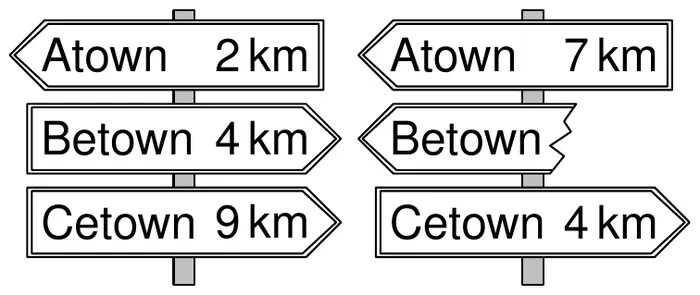
8. The shortest path from Atown to Cetown runs through Betown.
The two signposts shown are set up at different places along this path. What distance is written on the broken sign?

  1. A 1 km
  2. B 3 km
  3. C 4 km
  4. D 5 km
  5. E 9 km
Two signposts: one reads Atown 2 km, Betown 4 km, Cetown 9 km; the other reads Atown 7 km, Betown (broken), Cetown 4 km

Grey Kangaroo 2020, Question 8. © UK Mathematics Trust. Original paper on ukmt.org.uk

GK 2020 Q7

GKCurrent spec5 marksAlgebraNumber & Arithmetic

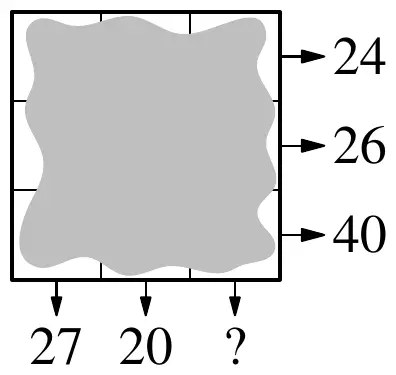
7. Each cell of a 3 × 3 square has a number written in it. Unfortunately the numbers are not visible because they are covered in ink. However, the sum of the numbers in each row and the sum of the numbers in two of the columns are all known, as shown by the arrows on the diagram. What is the sum of the numbers in the third column?

  1. A 41
  2. B 43
  3. C 44
  4. D 45
  5. E 47
A 3 by 3 square covered in ink, with row sums 24, 26 and 40 and column sums 27, 20 and ?

Grey Kangaroo 2020, Question 7. © UK Mathematics Trust. Original paper on ukmt.org.uk

IMC 2020 Q6

IMCCurrent spec5 marksNumber & Arithmetic

6. Which of the following has the largest value?

  1. A \(2^6\)
  2. B \(3^5\)
  3. C \(4^4\)
  4. D \(5^3\)
  5. E \(6^2\)

Intermediate Mathematical Challenge 2020, Question 6. © UK Mathematics Trust. Original paper on ukmt.org.uk

PK 2020 Q5

PKCurrent spec5 marksNumber & Arithmetic

5. The years 2020 and 1717 both consist of a repeated two-digit number.

How many years after 2020 will it be until the next year which has this property?

  1. A 20
  2. B 101
  3. C 120
  4. D 121
  5. E 202

Pink Kangaroo 2020, Question 5. © UK Mathematics Trust. Original paper on ukmt.org.uk

GK 2020 Q5

GKCurrent spec5 marksNumber & Arithmetic

5. Kanga wants to multiply three different numbers from the following list: −5, −3, −1, 2, 4, 6. What is the smallest result she could obtain?

  1. A −200
  2. B −120
  3. C −90
  4. D −48
  5. E −15

Grey Kangaroo 2020, Question 5. © UK Mathematics Trust. Original paper on ukmt.org.uk

PK 2020 Q4

PKCurrent spec5 marksAlgebraNumber & Arithmetic

4. The sum of four consecutive integers is 2. What is the least of these integers?

  1. A −3
  2. B −2
  3. C −1
  4. D 0
  5. E 1

Pink Kangaroo 2020, Question 4. © UK Mathematics Trust. Original paper on ukmt.org.uk

PK 2020 Q3

PKCurrent spec5 marksAlgebraNumber & Arithmetic

3. In the calculations shown, each letter stands for a digit. They are used to make some two-digit numbers. The two numbers on the left have a total of 79.

What is the total of the four numbers on the right?

  1. A 79
  2. B 158
  3. C 869
  4. D 1418
  5. E 7979
JK
+LM
79
JM
+LM
+JK
+LK
?

Pink Kangaroo 2020, Question 3. © UK Mathematics Trust. Original paper on ukmt.org.uk

PK 2020 Q2

PKCurrent spec5 marksNumber & Arithmetic

2. When the answers to the following calculations are put in order from smallest to largest, which will be in the middle?

  1. A 1 + 23456
  2. B 12 + 3456
  3. C 123 + 456
  4. D 1234 + 56
  5. E 12345 + 6

Pink Kangaroo 2020, Question 2. © UK Mathematics Trust. Original paper on ukmt.org.uk

IMC 2020 Q1

IMCCurrent spec5 marksNumber & Arithmetic

1. What is the value of \(2 - (3 - 4) - (5 - 6 - 7)\)?

  1. A 11
  2. B 9
  3. C 5
  4. D −5
  5. E −7

Intermediate Mathematical Challenge 2020, Question 1. © UK Mathematics Trust. Original paper on ukmt.org.uk

GK 2019 Q20

GKCurrent spec6 marksNumber & Arithmetic

20. Liam spent all his money buying 50 soda bottles at the corner shop for £1 each. He sold each bottle at the same higher price. After selling 40 bottles, he had £10 more than he started with. He then sold all the remaining bottles. How much money did Liam have once all the bottles were sold?

  1. A £70
  2. B £75
  3. C £80
  4. D £90
  5. E £100

Grey Kangaroo 2019, Question 20. © UK Mathematics Trust. Original paper on ukmt.org.uk

PK 2019 Q19

PKCurrent spec6 marksNumber & Arithmetic

19. The integers from 1 to 99 are written in ascending order without spaces. The sequence of digits is then grouped into triples of digits:

123456789101112 . . . 979899 → (123)(456)(789)(101)(112) . . . (979)(899).

Which of the following is not one of the triples?

  1. A (222)
  2. B (434)
  3. C (464)
  4. D (777)
  5. E (888)

Pink Kangaroo 2019, Question 19. © UK Mathematics Trust. Original paper on ukmt.org.uk

PK 2019 Q9

PKCurrent spec5 marksNumber & Arithmetic

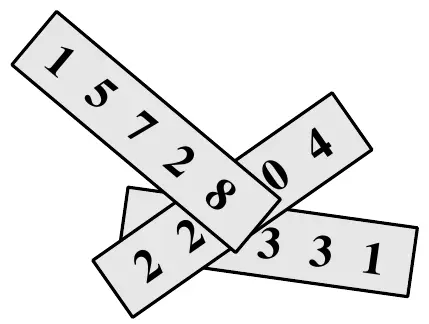
9. On each of three pieces of paper a five-digit number is written as shown.
Three of the digits are covered. The sum of the three numbers is 57263.
What are the covered digits?

  1. A 0, 2 and 2
  2. B 1, 2 and 9
  3. C 2, 4 and 9
  4. D 2, 7 and 8
  5. E 5, 7 and 8
Three overlapping strips of paper showing the numbers 15728, 22?04 and ??331, with three digits covered

Pink Kangaroo 2019, Question 9. © UK Mathematics Trust. Original paper on ukmt.org.uk

IMC 2019 Q9

IMCCurrent spec5 marksNumber & Arithmetic

9. What is the value of \(\big(7 - 6 \times (-5)\big) - 4 \times (-3) \div (-2)\)?

  1. A −17
  2. B −11
  3. C 31
  4. D 37
  5. E 43

Intermediate Mathematical Challenge 2019, Question 9. © UK Mathematics Trust. Original paper on ukmt.org.uk

GK 2019 Q7

GKCurrent spec5 marksNumber & Arithmetic

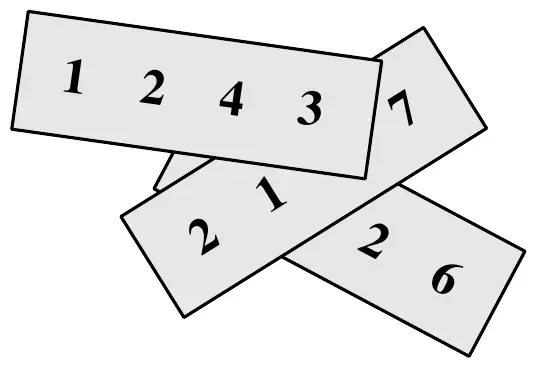
7. A four-digit integer is written on each of three pieces of paper and the pieces of paper are arranged so that three of the digits are covered, as shown. The sum of the three four-digit integers is 10 126. What are the covered digits?

  1. A 5, 6 and 7
  2. B 4, 5 and 7
  3. C 4, 6 and 7
  4. D 4, 5 and 6
  5. E 3, 5 and 6
Three overlapping pieces of paper showing the visible digits 1 2 4 3, 2 1 _ 7 and _ _ 2 6

Grey Kangaroo 2019, Question 7. © UK Mathematics Trust. Original paper on ukmt.org.uk

PK 2019 Q6

PKCurrent spec5 marksNumber & Arithmetic

6. Pedro is asked to find three kangaroos whose weights are all whole numbers of kilograms and whose total weight is 97 kg. What is the largest possible weight of the lightest of the kangaroos Pedro could find?

  1. A 1 kg
  2. B 30 kg
  3. C 31 kg
  4. D 32 kg
  5. E 33 kg

Pink Kangaroo 2019, Question 6. © UK Mathematics Trust. Original paper on ukmt.org.uk

GK 2019 Q6

GKCurrent spec5 marksNumber & Arithmetic

6. Five friends all brought some cakes with them when they met. Each of them gave a cake to each of the others. They then ate all the cakes they had just been given. As a result, the total number of cakes they had between them decreased by half. How many cakes did the five friends have at the start?

  1. A 20
  2. B 24
  3. C 30
  4. D 40
  5. E 60

Grey Kangaroo 2019, Question 6. © UK Mathematics Trust. Original paper on ukmt.org.uk

GK 2019 Q2

GKCurrent spec5 marksNumber & Arithmetic

2. The expression 2 − 0 − 1 − 9 contains four digits and three minus signs. What is the largest value that can be obtained by inserting exactly one pair of brackets into the expression?

  1. A 13
  2. B 12
  3. C 10
  4. D 9
  5. E 8

Grey Kangaroo 2019, Question 2. © UK Mathematics Trust. Original paper on ukmt.org.uk

PK 2018 Q20

PKCurrent spec6 marksAlgebraNumber & Arithmetic

20. Omar marks a sequence of 12 points on a straight line beginning with a point \(O\), followed by a point \(P\) with \(OP = 1\). He chooses the points so that each point is the midpoint of the two immediately following points. For example \(O\) is the midpoint of \(PQ\), where \(Q\) is the third point he marks. What is the distance between the first point \(O\) and the 12th point \(Z\)?

  1. A 171
  2. B 341
  3. C 512
  4. D 587
  5. E 683

Pink Kangaroo 2018, Question 20. © UK Mathematics Trust. Original paper on ukmt.org.uk

PK 2018 Q17

17. A list of integers has a sum of 2018, a product of 2018, and includes the number 2018 in the list. Which of the following could be the number of integers in the list?

  1. A 2016
  2. B 2017
  3. C 2018
  4. D 2019
  5. E 2020

Pink Kangaroo 2018, Question 17. © UK Mathematics Trust. Original paper on ukmt.org.uk

PK 2018 Q16

PKCurrent spec6 marksNumber & Arithmetic

16. In the calculation shown, how many times does the term \(2018^2\) appear inside the square root to make the calculation correct?

\(\sqrt{2018^2 + 2018^2 + \ldots + 2018^2} = 2018^{10}\)
  1. A 5
  2. B 8
  3. C 18
  4. D \(2018^8\)
  5. E \(2018^{18}\)

Pink Kangaroo 2018, Question 16. © UK Mathematics Trust. Original paper on ukmt.org.uk

GK 2018 Q15

GKCurrent spec5 marksNumber & Arithmetic

15. James wrote a different integer from 1 to 9 in each cell of a table. He then calculated the sum of the integers in each of the rows and in each of the columns of the table. Five of his answers were 12, 13, 15, 16 and 17, in some order. What was his sixth answer?

  1. A 17
  2. B 16
  3. C 15
  4. D 14
  5. E 13

Grey Kangaroo 2018, Question 15. © UK Mathematics Trust. Original paper on ukmt.org.uk

IMC 2018 Q12

IMCCurrent spec5 marksNumber & Arithmetic

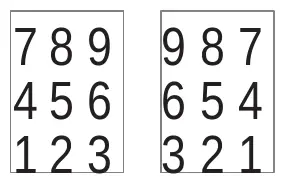
12. Someone has switched the numbers around on Harry’s calculator!
The numbers should be in the positions shown in the left-hand diagram, but have been switched to the positions in the right-hand diagram.
Which of the following calculations will not give the correct answer when Harry uses his calculator?

  1. A 79 × 97
  2. B 78 × 98
  3. C 147 × 369
  4. D 123 × 321
  5. E 159 × 951
Two calculator keypads: the left one with rows 789, 456, 123 and the right one with rows 987, 654, 321

Intermediate Mathematical Challenge 2018, Question 12. © UK Mathematics Trust. Original paper on ukmt.org.uk

GK 2018 Q9

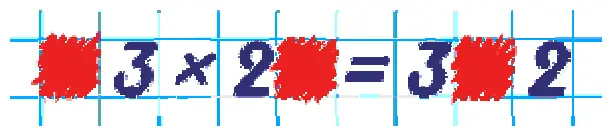
9. Martha multiplied two 2-digit numbers correctly on a piece of paper. Then she scribbled out three digits as shown.
What is the sum of the three digits she scribbled out?

  1. A 5
  2. B 6
  3. C 9
  4. D 12
  5. E 14
The multiplication ?3 × 2? = 3?2 with three digits scribbled out

Grey Kangaroo 2018, Question 9. © UK Mathematics Trust. Original paper on ukmt.org.uk

PK 2018 Q6

PKCurrent spec5 marksNumber & Arithmetic

6. Some of the digits in the following correct addition have been replaced by the letters \(P\), \(Q\), \(R\) and \(S\), as shown.
What is the value of \(P + Q + R + S\)?

  1. A 14
  2. B 15
  3. C 16
  4. D 17
  5. E 24
P45
+QRS
654

Pink Kangaroo 2018, Question 6. © UK Mathematics Trust. Original paper on ukmt.org.uk

GK 2018 Q5

GKCurrent spec5 marksAlgebraNumber & Arithmetic

5. The two numbers \(a\) and \(b\) both lie between −5 and 10 inclusive. What is the largest possible value of \(a - b\)?

  1. A −5
  2. B 0
  3. C 10
  4. D 15
  5. E 20

Grey Kangaroo 2018, Question 5. © UK Mathematics Trust. Original paper on ukmt.org.uk

PK 2018 Q3

PKCurrent spec5 marksAlgebraNumber & Arithmetic

3. The sum of five consecutive integers is \(10^{2018}\). What is the middle number?

  1. A \(10^{2013}\)
  2. B \(5^{2017}\)
  3. C \(10^{2017}\)
  4. D \(2^{2018}\)
  5. E \(2 \times 10^{2017}\)

Pink Kangaroo 2018, Question 3. © UK Mathematics Trust. Original paper on ukmt.org.uk

IMC 2018 Q3

IMCCurrent spec5 marksNumber & Arithmetic

3. In September 2016 a polymer £5 note was introduced. The Bank of England issued 440 million of them.
What is the total face value of all these notes?

  1. A £220 000 000
  2. B £440 000 000
  3. C £2 200 000 000
  4. D £4 400 000 000
  5. E £22 000 000 000

Intermediate Mathematical Challenge 2018, Question 3. © UK Mathematics Trust. Original paper on ukmt.org.uk

IMC 2018 Q1

IMCCurrent spec5 marksNumber & Arithmetic

1. Which of these is the sum of the cubes of two consecutive integers?

  1. A 4
  2. B 9
  3. C 16
  4. D 25
  5. E 36

Intermediate Mathematical Challenge 2018, Question 1. © UK Mathematics Trust. Original paper on ukmt.org.uk

PK 2017 Q21

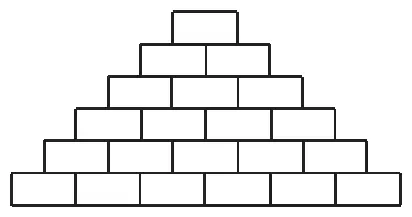
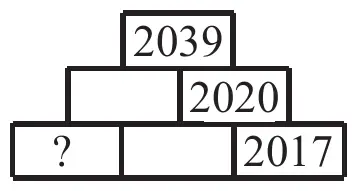
21. Carlos wants to put numbers in the number pyramid shown in such a way that each number above the bottom row is the sum of the two numbers immediately below it. What is the largest number of odd numbers that Carlos could put in the pyramid?

  1. A 13
  2. B 14
  3. C 15
  4. D 16
  5. E 17
A number pyramid of 21 empty cells in six rows, with six cells in the bottom row and one at the top

Pink Kangaroo 2017, Question 21. © UK Mathematics Trust. Original paper on ukmt.org.uk

GK 2017 Q17

17. Tom has a list of nine integers: 1, 2, 3, 4, 5, 6, 7, 8 and 9. He creates a second list by adding 2 to some of the integers in the first list and by adding 5 to all of the other integers in the first list. What is the smallest number of different integers he can obtain in the second list?

  1. A 5
  2. B 6
  3. C 7
  4. D 8
  5. E 9

Grey Kangaroo 2017, Question 17. © UK Mathematics Trust. Original paper on ukmt.org.uk

PK 2017 Q10

PKCurrent spec5 marksAlgebraNumber & Arithmetic

10. The sum of the squares of three consecutive positive integers is 770. What is the largest of these integers?

  1. A 15
  2. B 16
  3. C 17
  4. D 18
  5. E 19

Pink Kangaroo 2017, Question 10. © UK Mathematics Trust. Original paper on ukmt.org.uk

PK 2017 Q9

9. How many positive integers \(N\) possess the property that exactly one of the numbers \(N\) and \((N + 20)\) is a 4-digit number?

  1. A 19
  2. B 20
  3. C 38
  4. D 39
  5. E 40

Pink Kangaroo 2017, Question 9. © UK Mathematics Trust. Original paper on ukmt.org.uk

GK 2017 Q7

7. Olivia has 20 euros. Each of her four sisters has 10 euros. How many euros does Olivia need to give to each of her sisters so that each of the five girls has the same amount of money?

  1. A 2
  2. B 4
  3. C 5
  4. D 8
  5. E 10

Grey Kangaroo 2017, Question 7. © UK Mathematics Trust. Original paper on ukmt.org.uk

GK 2017 Q4

GKCurrent spec5 marksNumber & Arithmetic

4. The sum of three different positive integers is 7. What is the product of these three integers?

  1. A 12
  2. B 10
  3. C 9
  4. D 8
  5. E 5

Grey Kangaroo 2017, Question 4. © UK Mathematics Trust. Original paper on ukmt.org.uk

GK 2016 Q17

GKCurrent spec6 marksNumber & Arithmetic

17. Theo's watch is 10 minutes slow, but he believes it is 5 minutes fast. Leo's watch is 5 minutes fast, but he believes it is 10 minutes slow. At the same moment, each of them looks at his own watch. Theo thinks it is 12:00. What time does Leo think it is?

  1. A 11:30
  2. B 11:45
  3. C 12:00
  4. D 12:30
  5. E 12:45

Grey Kangaroo 2016, Question 17. © UK Mathematics Trust. Original paper on ukmt.org.uk

PK 2016 Q14

PKCurrent spec5 marksNumber & Arithmetic

14. Eight unmarked envelopes contain the numbers: 1, 2, 4, 8, 16, 32, 64, 128. Eve chooses a few envelopes randomly. Alie takes the rest. Both sum up their numbers. Eve's sum is 31 more than Alie's. How many envelopes did Eve take?

  1. A 2
  2. B 3
  3. C 4
  4. D 5
  5. E 6

Pink Kangaroo 2016, Question 14. © UK Mathematics Trust. Original paper on ukmt.org.uk

GK 2016 Q14

GKCurrent spec5 marksNumber & Arithmetic

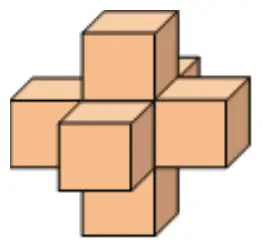
14. Seven standard dice are glued together to make the solid shown.
The pairs of faces of the dice that are glued together have the same number of dots on them. How many dots are on the surface of the solid?

  1. A 24
  2. B 90
  3. C 95
  4. D 105
  5. E 126
Seven dice glued together in a three-dimensional cross shape

Grey Kangaroo 2016, Question 14. © UK Mathematics Trust. Original paper on ukmt.org.uk

IMC 2016 Q13

IMCCurrent spec5 marksAlgebraNumber & Arithmetic

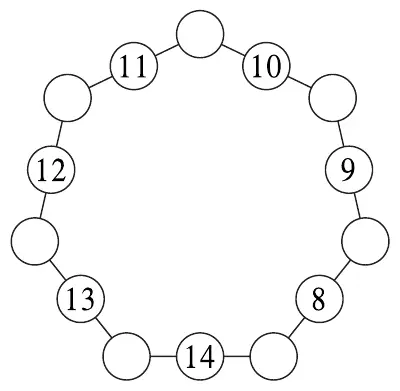
13. The diagram shows a heptagon with a line of three circles on each side. Each circle is to contain exactly one number. The numbers 8 to 14 are distributed as shown and the numbers 1 to 7 are to be distributed to the remaining circles. The total of the numbers in each of the lines of three circles is to be the same.

What is this total?

  1. A 18
  2. B 19
  3. C 20
  4. D 21
  5. E 22
A heptagon with three circles on each side; the circles at the middles of the sides contain 8 to 14 and the corner circles are empty

Intermediate Mathematical Challenge 2016, Question 13. © UK Mathematics Trust. Original paper on ukmt.org.uk

IMC 2016 Q8

8. What is the value of 2.017 × 2016 − 10.16 × 201.7?

  1. A 2.016
  2. B 2.017
  3. C 20.16
  4. D 2016
  5. E 2017

Intermediate Mathematical Challenge 2016, Question 8. © UK Mathematics Trust. Original paper on ukmt.org.uk

PK 2016 Q6

PKCurrent spec5 marksNumber & Arithmetic

6. Marie changed her dice by replacing 1, 3, and 5 with −1, −3 and −5 respectively. She left the even numbers unchanged. If she throws two such dice, which of the following totals cannot be achieved?

  1. A 3
  2. B 4
  3. C 5
  4. D 7
  5. E 8

Pink Kangaroo 2016, Question 6. © UK Mathematics Trust. Original paper on ukmt.org.uk

PK 2016 Q5

PKCurrent spec5 marksNumber & Arithmetic

5. Little Lucas invented his own way to write down negative numbers before he learned the usual way with the minus sign in front. Counting backwards, he would write: 3, 2, 1, 0, 00, 000, 0000, …. What is the result of 000 + 0000 in his notation?

  1. A 1
  2. B 00000
  3. C 000000
  4. D 0000000
  5. E 00000000

Pink Kangaroo 2016, Question 5. © UK Mathematics Trust. Original paper on ukmt.org.uk

GK 2016 Q2

GKCurrent spec5 marksNumber & Arithmetic

2. Jenny had to add 26 to a certain number. Instead she subtracted 26 and obtained −14. What number should she have obtained?

  1. A 28
  2. B 32
  3. C 36
  4. D 38
  5. E 42

Grey Kangaroo 2016, Question 2. © UK Mathematics Trust. Original paper on ukmt.org.uk

PK 2016 Q1

PKCurrent spec5 marksNumber & Arithmetic

1. Which of the following numbers is the closest to the value of \(\dfrac{17 \times 0.3 \times 20.16}{999}\)?

  1. A 0.01
  2. B 0.1
  3. C 1
  4. D 10
  5. E 100

Pink Kangaroo 2016, Question 1. © UK Mathematics Trust. Original paper on ukmt.org.uk

IMC 2016 Q1

IMCCurrent spec5 marksNumber & Arithmetic

1. What is the value of 6102 − 2016?

  1. A 3994
  2. B 4086
  3. C 4096
  4. D 4114
  5. E 4994

Intermediate Mathematical Challenge 2016, Question 1. © UK Mathematics Trust. Original paper on ukmt.org.uk

PK 2015 Q19

19. How many 2-digit numbers can be written as the sum of exactly six different powers of 2, including \(2^0\) ?

  1. A 0
  2. B 1
  3. C 2
  4. D 3
  5. E 4

Pink Kangaroo 2015, Question 19. © UK Mathematics Trust. Original paper on ukmt.org.uk

GK 2015 Q11

GKCurrent spec5 marksAlgebraNumber & Arithmetic

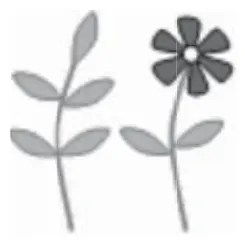
11. A bush has 10 branches. Each branch has either 5 leaves only or 2 leaves and 1 flower. Which of the following could be the total number of leaves the bush has?

  1. A 45
  2. B 39
  3. C 37
  4. D 31
  5. E None of A to D
A branch with five leaves and a branch with two leaves and a flower

Grey Kangaroo 2015, Question 11. © UK Mathematics Trust. Original paper on ukmt.org.uk

GK 2015 Q9

9. Every asterisk in the equation 2 * 0 * 1 * 5 * 2 * 0 * 1 * 5 * 2 * 0 * 1 * 5 = 0 is to be replaced with either + or − so that the equation is correct. What is the smallest number of asterisks that can be replaced with +?

  1. A 1
  2. B 2
  3. C 3
  4. D 4
  5. E 5

Grey Kangaroo 2015, Question 9. © UK Mathematics Trust. Original paper on ukmt.org.uk

GK 2015 Q5

5. A triangle has sides of lengths 6 cm, 10 cm and 11 cm. An equilateral triangle has the same perimeter. What is the length of the sides of the equilateral triangle?

  1. A 18 cm
  2. B 11 cm
  3. C 10 cm
  4. D 9 cm
  5. E 6 cm

Grey Kangaroo 2015, Question 5. © UK Mathematics Trust. Original paper on ukmt.org.uk

GK 2015 Q2

GKCurrent spec5 marksNumber & Arithmetic

2. Which of the following numbers is closest to 2.015 × 510.2?

  1. A 0.1
  2. B 1
  3. C 10
  4. D 100
  5. E 1000

Grey Kangaroo 2015, Question 2. © UK Mathematics Trust. Original paper on ukmt.org.uk

PK 2015 Q1

PKCurrent spec5 marksNumber & Arithmetic

1. What is the units digit of the number \(2015^2 + 2015^0 + 2015^1 + 2015^5\)?

  1. A 1
  2. B 5
  3. C 6
  4. D 7
  5. E 9

Pink Kangaroo 2015, Question 1. © UK Mathematics Trust. Original paper on ukmt.org.uk

IMC 2014 Q17

17. How many weeks are there in 8 × 7 × 6 × 5 × 4 × 3 × 2 × 1 minutes?

  1. A 1
  2. B 2
  3. C 3
  4. D 4
  5. E 5

Intermediate Mathematical Challenge 2014, Question 17. © UK Mathematics Trust. Original paper on ukmt.org.uk

IMC 2014 Q5

5. A ship's bell is struck every half hour, starting with one bell at 0030, two bells (meaning the bell is struck twice) at 0100, three bells at 0130 until the cycle is complete with eight bells at 0400. The cycle then starts again with one bell at 0430, two bells at 0500 and so on. What is the total number of times the bell is struck between 0015 on one day and 0015 on the following day?

  1. A 24
  2. B 48
  3. C 108
  4. D 144
  5. E 216

Intermediate Mathematical Challenge 2014, Question 5. © UK Mathematics Trust. Original paper on ukmt.org.uk

IMC 2013 Q25

25. In 1984 the engineer and prolific prime-finder Harvey Dubner found the biggest known prime each of whose digits is either a one or a zero. The prime can be expressed as
\(\dfrac{10^{641} \times (10^{640} - 1)}{9} + 1\). How many digits does this prime have?

  1. A 640
  2. B 641
  3. C 1280
  4. D 1281
  5. E 640 × 641

Intermediate Mathematical Challenge 2013, Question 25. © UK Mathematics Trust. Original paper on ukmt.org.uk

IMC 2013 Q6

IMCCurrent spec5 marksNumber & Arithmetic

6. Which of the following has the least value?

  1. A 10 − 01
  2. B 21 − 12
  3. C 32 − 23
  4. D 43 − 34
  5. E 54 − 45

Intermediate Mathematical Challenge 2013, Question 6. © UK Mathematics Trust. Original paper on ukmt.org.uk

IMC 2012 Q13

13. Alex Erlich and Paneth Farcas shared an opening rally of 2 hours and 12 minutes during their table tennis match at the 1936 World Games. Each player hit around 45 shots per minute.
Which of the following is closest to the total number of shots played in the rally?

  1. A 200
  2. B 2000
  3. C 8000
  4. D 12 000
  5. E 20 000

Intermediate Mathematical Challenge 2012, Question 13. © UK Mathematics Trust. Original paper on ukmt.org.uk

IMC 2012 Q8

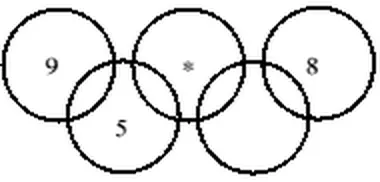
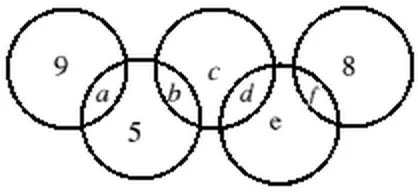
8. Seb has been challenged to place the numbers 1 to 9 inclusive in the nine regions formed by the Olympic rings so that there is exactly one number in each region and the sum of the numbers in each ring is 11. The diagram shows part of his solution.
What number goes in the region marked * ?

  1. A 6
  2. B 4
  3. C 3
  4. D 2
  5. E 1
The five Olympic rings, with 9 in the left ring, 5 in the lower left ring, 8 in the right ring and a star in the region where the middle top ring overlaps nothing

Intermediate Mathematical Challenge 2012, Question 8. © UK Mathematics Trust. Original paper on ukmt.org.uk

IMC 2012 Q4

IMCCurrent spec5 marksNumber & Arithmetic

4. All four digits of two 2-digit numbers are different. What is the largest possible sum of two such numbers?

  1. A 169
  2. B 174
  3. C 183
  4. D 190
  5. E 197

Intermediate Mathematical Challenge 2012, Question 4. © UK Mathematics Trust. Original paper on ukmt.org.uk

IMC 2012 Q2

IMCCurrent spec5 marksNumber & Arithmetic

2. Three positive integers are all different. Their sum is 7. What is their product?

  1. A 12
  2. B 10
  3. C 9
  4. D 8
  5. E 5

Intermediate Mathematical Challenge 2012, Question 2. © UK Mathematics Trust. Original paper on ukmt.org.uk

IMC 2011 Q14

IMCCurrent spec5 marksAlgebraNumber & Arithmetic

14. The number 6 lies exactly halfway between 3 and 32. Which of the following is not halfway between a positive integer and its square?

  1. A 3
  2. B 10
  3. C 15
  4. D 21
  5. E 30

Intermediate Mathematical Challenge 2011, Question 14. © UK Mathematics Trust. Original paper on ukmt.org.uk

IMC 2011 Q6

IMCCurrent spec5 marksNumber & Arithmetic

6. When I glanced at my car milometer it showed 24942, a palindromic number. Two days later, I noticed that it showed the next palindromic number. How many miles did my car travel in those two days?

  1. A 100
  2. B 110
  3. C 200
  4. D 220
  5. E 1010

Intermediate Mathematical Challenge 2011, Question 6. © UK Mathematics Trust. Original paper on ukmt.org.uk

IMC 2011 Q3

IMCCurrent spec5 marksNumber & Arithmetic

3. The consecutive digits 1, 2, 3, 4 in that order can be arranged to make the correct division, 12 ÷ 3 = 4. One other sequence of four consecutive digits \(p\), \(q\), \(r\), \(s\) makes a correct division, ‘\(pq\)’ ÷ \(r\) = \(s\). What is the value of \(s\) in this case?

  1. A 4
  2. B 5
  3. C 6
  4. D 7
  5. E 8

Intermediate Mathematical Challenge 2011, Question 3. © UK Mathematics Trust. Original paper on ukmt.org.uk

IMC 2011 Q2

IMCCurrent spec5 marksAlgebraNumber & Arithmetic

2. To find the diameter in mm of a Japanese knitting needle, you multiply the size by 0.3 and add 2.1. What is the diameter in mm of a size 5 Japanese knitting needle?

  1. A 3.6
  2. B 7.4
  3. C 10.8
  4. D 12
  5. E 17.1

Intermediate Mathematical Challenge 2011, Question 2. © UK Mathematics Trust. Original paper on ukmt.org.uk

IMC 2011 Q1

IMCCurrent spec5 marksNumber & Arithmetic

1. What is the value of 4.5 × 5.5 + 4.5 × 4.5?

  1. A 36.5
  2. B 45
  3. C 50
  4. D 90
  5. E 100

Intermediate Mathematical Challenge 2011, Question 1. © UK Mathematics Trust. Original paper on ukmt.org.uk

IMC 2010 Q20

20. Shahbaz thinks of an integer, \(n\), such that the difference between \(\sqrt{n}\) and 7 is less than 1.
How many different possibilities are there for \(n\)?

  1. A 13
  2. B 14
  3. C 26
  4. D 27
  5. E 28

Intermediate Mathematical Challenge 2010, Question 20. © UK Mathematics Trust. Original paper on ukmt.org.uk

IMC 2010 Q4

4. A radio advertisement claimed that using a particular brand of artificial sweetener every day would ‘save 7 000 calories in a year’. Approximately how many calories is this per day?

  1. A 20
  2. B 40
  3. C 70
  4. D 100
  5. E 140

Intermediate Mathematical Challenge 2010, Question 4. © UK Mathematics Trust. Original paper on ukmt.org.uk

IMC 2010 Q1

IMCCurrent spec5 marksNumber & Arithmetic

1. What is the value of 10 + 10 × 10 × (10 + 10) ?

  1. A 21 000
  2. B 20 100
  3. C 2100
  4. D 2010
  5. E 210

Intermediate Mathematical Challenge 2010, Question 1. © UK Mathematics Trust. Original paper on ukmt.org.uk

IMC 2008 Q22

IMCCurrent spec6 marksNumber & Arithmetic

22. At a cinema, a child's ticket costs £4.20 and an adult's ticket costs £7.70. When a group of adults and children went to see a film, the total cost was £\(C\). Which of the following is a possible value of \(C\)?

  1. A 91
  2. B 92
  3. C 93
  4. D 94
  5. E 95

Intermediate Mathematical Challenge 2008, Question 22. © UK Mathematics Trust. Original paper on ukmt.org.uk

IMC 2008 Q18

18. In the calculation 1003 ÷ 4995 = \(0.2\dot{0}0\dot{8}\), the number \(0.2\dot{0}0\dot{8}\) represents the recurring decimal fraction 0.2008008008008… . When the answers to the following calculations are arranged in numerical order, which one is in the middle?

  1. A 226 ÷ 1125 = \(0.200\dot{8}\)
  2. B 251 ÷ 1250 = 0.2008
  3. C 497 ÷ 2475 = \(0.20\dot{0}\dot{8}\)
  4. D 1003 ÷ 4995 = \(0.2\dot{0}0\dot{8}\)
  5. E 2008 ÷ 9999 = \(0.\dot{2}00\dot{8}\)

Intermediate Mathematical Challenge 2008, Question 18. © UK Mathematics Trust. Original paper on ukmt.org.uk

IMC 2007 Q18

18. One of the digits 1 to 9 is put in each unshaded square so that no digit is repeated and the totals of the entries in the rows and columns are as shown.
What number goes in the starred square?

  1. A 1
  2. B 3
  3. C 5
  4. D 7
  5. E 9
Total
12
7
*13
Total41612

Intermediate Mathematical Challenge 2007, Question 18. © UK Mathematics Trust. Original paper on ukmt.org.uk

IMC 2007 Q6

6. The sum of 9 consecutive positive whole numbers is 2007. What is the difference between the largest and smallest of these numbers?

  1. A 8
  2. B 9
  3. C 10
  4. D 18
  5. E 223

Intermediate Mathematical Challenge 2007, Question 6. © UK Mathematics Trust. Original paper on ukmt.org.uk

IMC 2007 Q5

IMCCurrent spec5 marksNumber & Arithmetic

5. What is the value of (12340 + 12·34) ÷ 1234 ?

  1. A 100.01
  2. B 100.1
  3. C 10.001
  4. D 10.01
  5. E 10.1

Intermediate Mathematical Challenge 2007, Question 5. © UK Mathematics Trust. Original paper on ukmt.org.uk

IMC 2007 Q1

IMCCurrent spec5 marksNumber & Arithmetic

1. At midnight on 15 December 2005, the moon reached its highest point in the sky, an event which occurs every 18.6 years. In which year will it next occur?

  1. A 2007
  2. B 2008
  3. C 2023
  4. D 2024
  5. E 2191

Intermediate Mathematical Challenge 2007, Question 1. © UK Mathematics Trust. Original paper on ukmt.org.uk

IMC 2006 Q10

IMCCurrent spec5 marksNumber & Arithmetic

10. Gill is 18 this year. She and I went to a restaurant for lunch to celebrate her birthday. The bill for lunch for the two of us came to £25.50. Gill paid the bill by credit card and I left a £2.50 tip in cash. We agreed to split the total cost equally. How much did I owe Gill?

  1. A £11
  2. B £11.50
  3. C £12
  4. D £12.50
  5. E £13

Intermediate Mathematical Challenge 2006, Question 10. © UK Mathematics Trust. Original paper on ukmt.org.uk

IMC 2005 Q19

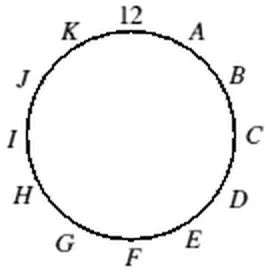
19. Trinni is fascinated by triangle numbers (1, 3, 6, 10, 15, 21, etc.) and recently, coming across a clock, she found that she could rearrange the twelve numbers 1, 2, 3, … 12 around the face so that each adjacent pair added up to a triangle number. She left the 12 in its usual place; what number did she put where the 6 would usually be?

  1. A 1
  2. B 4
  3. C 5
  4. D 10
  5. E 11

Intermediate Mathematical Challenge 2005, Question 19. © UK Mathematics Trust. Original paper on ukmt.org.uk

IMC 2005 Q4

IMCCurrent spec5 marksNumber & Arithmetic

4. Which of the following expressions is equal to 2005?

  1. A \((1^2 + 1)(10^2 + 1)\)
  2. B \((2^2 + 1)(20^2 + 1)\)
  3. C \((3^2 + 1)(30^2 + 1)\)
  4. D \((4^2 + 1)(40^2 + 1)\)
  5. E \((5^2 + 1)(50^2 + 1)\)

Intermediate Mathematical Challenge 2005, Question 4. © UK Mathematics Trust. Original paper on ukmt.org.uk

IMC 2005 Q1

1. If the following numbers are arranged in increasing order of size, which one is in the middle?

  1. A 4.04
  2. B 4.004
  3. C 4.4
  4. D 4.44
  5. E 4.044

Intermediate Mathematical Challenge 2005, Question 1. © UK Mathematics Trust. Original paper on ukmt.org.uk

IMC 2004 Q17

A number line marked 0, 1 and 2, with point A below 0, points B, P, C, Q, D between 0 and 1, and point E between 1 and 2

17. \(A\), \(B\), \(C\), \(D\), \(E\), \(P\) and \(Q\) are points on the number line as shown. One of the points represents the product of the numbers represented by \(P\) and \(Q\). Which is it?

  1. A  
  2. B  
  3. C  
  4. D  
  5. E  

Intermediate Mathematical Challenge 2004, Question 17. © UK Mathematics Trust. Original paper on ukmt.org.uk

IMC 2004 Q14

IMCCurrent spec5 marksAlgebraNumber & Arithmetic

14. In this addition sum, each letter represents a different non-zero digit.
What is the value of \(a + w + a + y\)?

  1. A 13
  2. B 15
  3. C 16
  4. D 17
  5. E 18
\(\begin{array}{rccc} & f & l & y\\ + & f & l & y\\ + & f & l & y\\ \hline a & w & a & y\end{array}\)

Intermediate Mathematical Challenge 2004, Question 14. © UK Mathematics Trust. Original paper on ukmt.org.uk

IMC 2004 Q6

IMCCurrent spec5 marksNumber & Arithmetic

6. In Niatirb they use Cibara numerals. These are the same shape as normal Arabic numerals, but with the meanings in the opposite order. So “0” means “nine”, “1” means “eight” and so on. But they write their numbers from left to right and use arithmetic symbols just as we do. So, for example, they use 62 for the number we write as 37.
How do the inhabitants of Niatirb write the answer to the sum which they write as 837 + 742?

  1. A 419
  2. B 580
  3. C 1579
  4. D 5317
  5. E 8420

Intermediate Mathematical Challenge 2004, Question 6. © UK Mathematics Trust. Original paper on ukmt.org.uk

IMC 2004 Q3

IMCCurrent spec5 marksNumber & Arithmetic

3. Four of these numbers can make two pairs so that each pair adds up to 98 765. Which number is the odd one out?

  1. A 37 373
  2. B 45 678
  3. C 53 087
  4. D 61 392
  5. E 70 082

Intermediate Mathematical Challenge 2004, Question 3. © UK Mathematics Trust. Original paper on ukmt.org.uk