24. Anne, Bronwyn and Carl ran a race. They started at the same time, and their speeds were constant. When Anne finished, Bronwyn had 15 m to run and Carl had 35 m to run. When Bronwyn finished, Carl had 22 m to run. What was the length of the race?
First note that Carl ran (35 − 22) m = 13 m while Bronwen ran 15 m. Let the length of the race be \(x\) m. Since their speeds were constant, the ratio of the distances they ran in any time is also constant. Therefore, since Carl ran \((x - 35)\) m while Bronwen ran \((x - 15)\) m, we have \(\dfrac{x - 35}{x - 15} = \dfrac{13}{15}\). Therefore \(15x - 15 \times 35 = 13x - 13 \times 15\) and hence \(2x = 15 \times 35 - 13 \times 15\). Therefore \(2x = 22 \times 15\) and hence \(x = 11 \times 15\). Therefore the distance they ran is 165 m.
23. Four children are in the four corners of a 10 m × 25 m pool. Their coach is standing somewhere on one side of the pool. When he calls them, three children get out and walk as short a distance as possible round the pool to meet him. They walk 50 m in total. What is the shortest distance the coach needs to walk to get to the fourth child’s corner?
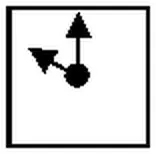
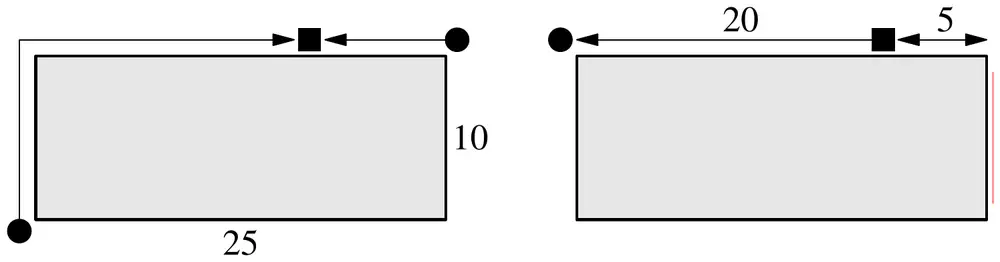
Consider two children in opposite corners of the pool. Wherever their trainer stands, the total distance these two pupils would need to walk to meet him is half the perimeter of the pool, as illustrated in the first diagram. Therefore, if all four children walked to meet their trainer, the total distance they would walk is (2 × 10 + 2 × 25) m = 70 m. Since we are given that three of the children walked 50 m in total, the distance the trainer would have to walk to get to the fourth child is (70 − 50) m = 20 m. The second diagram shows one possible position of the trainer and child which satisfies this situation although there are others.
17. A hare and a tortoise competed in a 5 km race along a straight line, going due North. The hare is five times as fast as the tortoise. The hare mistakenly started running due East. After a while he realised his mistake, then turned and ran straight to the finish point. He arrived at the same time as the tortoise. What was the distance between the hare’s turning point and the finish point?
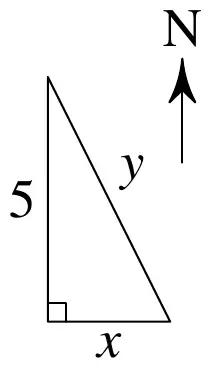
The routes of the hare and the tortoise form a right-angled triangle as shown on the diagram. The hare travels 5 times as fast, but arrives at the same time as the tortoise, so has travelled five times further, giving \[x + y = 25. \ [1]\] Pythagoras’ Theorem gives \(x^2 + 5^2 = y^2\), so \(y^2 - x^2 = 25\), and this factorises to give \((y + x)(y - x) = 25\). However, \(x + y = 25\) by equation [1]. So \(25(y - x) = 25\) and then \(y - x = 1\), and \(y = x + 1\). Substituting this into equation [1] gives \(x + x + 1 = 25\), and hence \(x = 12\) and \(y = 13\).
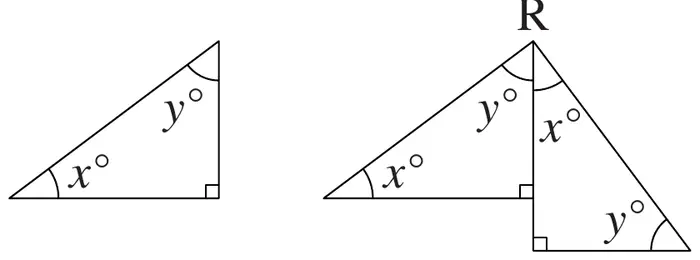
The diagrams show one of the twenty-five congruent right-angled triangles and the two such triangles at vertex R. Let the two acute angles in each of the triangles be \(x°\) and \(y°\).
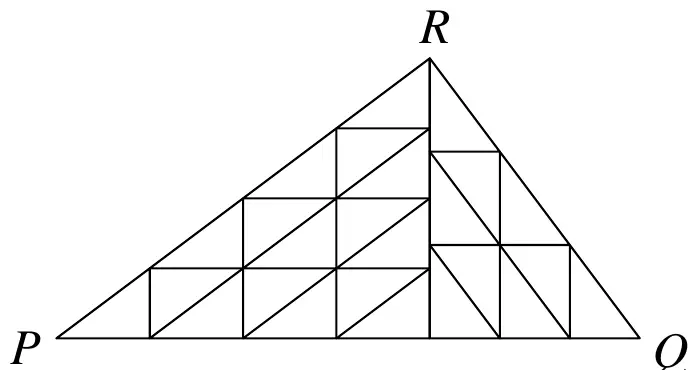
Note that \(x + y + 90 = 180\), as the interior angles of a triangle sum to 180°. So \(x + y = 90\). In the second diagram, the two angles which meet at R are \(x°\) and \(y°\), so we can deduce that angle \(QRP\) is a right angle. Let the length of the hypotenuse of each small triangle be \(a\) cm. Note that angle \(QRP\) is a right angle, \(PR\) has length \(4a\) cm and \(RQ\) has length \(3a\) cm. So the lengths of the sides in triangle \(PQR\) are in the ratio 3 : 4 : 5. Therefore the length of \(PQ\), in cm, is \(5 \times \tfrac{2.4}{4} = 3\).
13. Luca began a 520 km trip by car with 14 litres of fuel in the car tank. His car consumes 1 litre of fuel per 10 km. After driving 55 km, he saw a road sign showing the distances from that point to five petrol stations ahead on the road. These distances are 35 km, 45 km, 55 km, 75 km and 95 km. The capacity of the car’s fuel tank is 40 litres and Luca wants to stop just once to fill the tank.
How far is the petrol station that he should stop at?
Luca starts with 14 litres of fuel, which is enough for 140 km. After travelling 55 km, Luca can go a further 85 km. Hence, he cannot reach the 95 km petrol station, but can reach the others. If he stops at the 55 km petrol station (or any nearer one), then he will have at least 410 km left to travel of his 520 km journey, but his tank only holds enough for 400 km. Hence, he should stop at the 75 km petrol station, with 390 km left to travel.
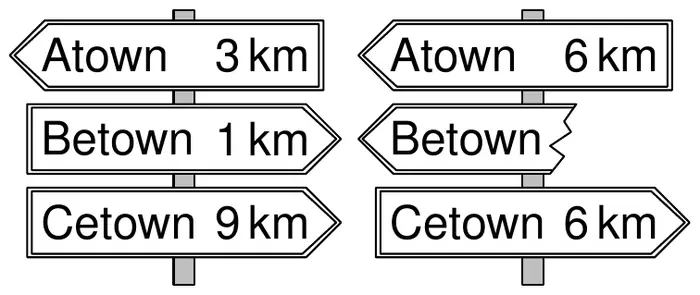
8. The shortest path from Atown to Cetown runs through Betown. Two of the signposts that can be seen on this path are shown, but one of them is broken and a number missing.
6. John always walks to and from school at the same speed. When he walks to school along the road and walks back using a short cut across the fields, he walks for 50 minutes. When he uses the short cut both ways, he walks for 30 minutes. How long does it take him when he walks along the road both ways?
Since using the short cut both ways takes 30 minutes, using the short cut one way takes 15 minutes. Hence, since walking to school by road and walking back using the short cut takes 50 minutes, walking by road takes (50 − 15) minutes = 35 minutes. Therefore walking by road both ways takes 2 × 35 minutes = 70 minutes.
22. When Ria and Flora compared the amounts of money in their savings accounts, they found that their savings were in the ratio 5 : 3. Then Ria took 160 euros from her savings to buy a tablet. The ratio of their savings then changed to 3 : 5. How many euros did Ria have before buying the tablet?
The original ratio of the amounts of money in Ria’s and Flora’s savings accounts was 5 : 3 = 25 : 15. After Ria withdrew 160 euros, the ratio changed to 3 : 5 = 9 : 15. Since Flora’s savings have not changed, the 160 euros Ria withdrew represented \(\tfrac{(25 - 9)}{25} = \tfrac{16}{25}\) of her original savings. Therefore 10 euros represented \(\tfrac{1}{25}\) of her original savings and hence she originally had 250 euros.
17. Julio has two cylindrical candles with different heights and diameters. The two candles burn wax at the same uniform rate. The first candle lasts 6 hours, while the second candle lasts 8 hours. He lights both candles at the same time and three hours later both candles are the same height. What is the ratio of their original heights?
Let the original heights of the first and second candles be \(x\) and \(y\) respectively. Since the first candle lasts six hours, after three hours its height is \(\tfrac{1}{2}x\). Similarly, since the second candle lasts eight hours, after three hours its height is \(\tfrac{5}{8}y\). After three hours the two candles have the same height and hence \(\tfrac{1}{2}x = \tfrac{5}{8}y\). Therefore \(\tfrac{x}{y} = \tfrac{5}{4}\) and hence the ratio of their original heights is 5 : 4.
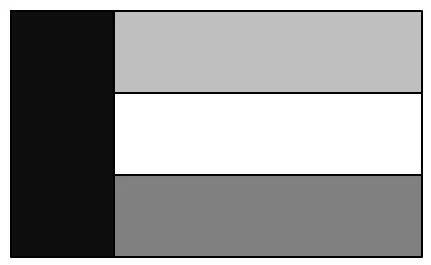
12. The flag of Kangaria is a rectangle with side-lengths in the ratio 3 : 5. The flag is divided into four rectangles of equal area as shown. What is the ratio of the length of the shorter sides of the white rectangle to the length of its longer sides?
Let the length of the white rectangle be \(x\) and its height \(y\). Then the height of the flag is \(3y\) and hence its width is \(5y\). The four rectangles which make up the flag are equal in area, so we have \(3y \times 5y = 4xy\). This simplifies to \(15y = 4x\) (since \(y\) is non-zero) and hence \(y : x = 4 : 15\).
10. A recent report about the amount of plastic created in the last 65 years stated that the 8.3 billion tonnes produced is as heavy as 25 000 Empire State Buildings in New York or a billion elephants.
On that basis, how many elephants have the same total weight as the Empire State Building?
We are told that the weight of 25 000 Empire State Buildings is equal to the weight of one billion elephants. So the Empire State Building weighs the same as \(\dfrac{1\,000\,000\,000}{25\,000}\) elephants = \(\dfrac{1\,000\,000}{25}\) elephants = 40 000 elephants.
Six circuits of 1 minute and 11 seconds take 6 minutes and 66 seconds. However, 66 seconds is 1 minute and 6 seconds, so the time taken is 7 minutes and 6 seconds.
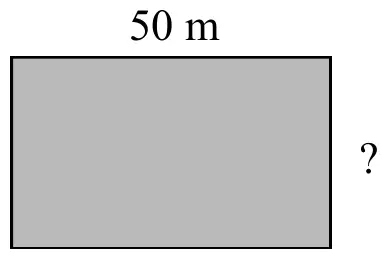
20. Ruth and Sarah decide to have a race. Ruth runs around the perimeter of the pool shown in the diagram while Sarah swims lengths of the pool. Ruth runs three times as fast as Sarah swims. Sarah swims six lengths of the pool in the same time Ruth runs around the pool five times. How wide is the pool?
Let the width of the pool be \(x\) m. Therefore the total distance Ruth runs is \(5(2 \times 50 + 2x)\) m = \((500 + 10x)\) m. The total distance Sarah swims is 6 × 50 m = 300 m. Since Ruth runs three times as fast as Sarah swims, \(500 + 10x = 3 \times 300\). Therefore \(10x = 400\) and hence \(x = 40\).
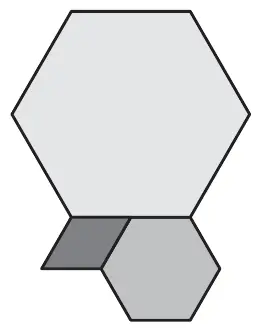
13. The diagram shows a rhombus and two sizes of regular hexagon. What is the ratio of the area of the smaller hexagon to the area of the larger hexagon?
Let the length of each edge of the rhombus be \(x\). Then, as the rhombus and the smaller regular hexagon have an edge in common, the length of each edge of this hexagon is also \(x\). So the length of each edge of the larger regular hexagon is \(2x\). The two regular hexagons are similar. Therefore the ratio of their areas is the square of the ratio of their edge-lengths, that is \(1^2 : 2^2 = 1 : 4\).
8. Two buildings are located on one street at a distance of 250 metres from each other. There are 100 students living in the first building. There are 150 students living in the second building. Where should a bus stop be built so that the total distance that all residents of both buildings have to walk from their buildings to this bus stop would be the least possible?
All distances in this solution are in metres. Let \(x\) be the distance of the bus stop from the second building. Then the total distance walked by the 150 students in this building is \(150x\). The distance travelled by each of the students in the first building is \(250 - x\), so the total of their distances is \(100(250 - x)\). Adding these to get the total distance of all students gives \(150x + 100(250 - x) = 50x + 25000\). This is minimised by setting \(x = 0\), so the bus stop should be in front of the second building!
6. In 2014, in Boston, Massachusetts, Eli Bishop set a world record for the greatest number of claps per minute. He achieved 1020 claps in one minute. How many claps is that per second?
23. Eric and Eleanor are training on a 720 metre circular track. They run in opposite directions, each at a constant speed. Eric takes four minutes to complete the full circuit and Eleanor takes five minutes. How far does Eleanor run between consecutive meetings of the two runners?
The ratio of the times taken to complete a circuit by Eric and Eleanor is 4:5. Therefore, since distance = speed × time and they both complete the same circuit, the ratio of their speeds is 5:4. Hence, since the total distance Eric and Eleanor cover between consecutive meetings is a complete circuit, Eleanor will run \(\tfrac{4}{4 + 5}\) of a circuit between each meeting. Therefore Eleanor will run \(\tfrac{4}{9}\) of 720 m which is 320 m between each meeting.
19. Buses leave the airport every 3 minutes to travel to the city centre. A car leaves the airport at the same time as one bus and travels to the city centre by the same route. It takes each bus 60 minutes and the car 35 minutes to travel from the airport to the city centre. How many of these airport buses does the car overtake on its way to the city centre, excluding the bus it left with?
Since the car takes 35 minutes to travel from the airport to the city centre and the buses all take 60 minutes, the car will arrive 25 minutes before the bus it left with. Since buses leave the airport every 3 minutes, they will also arrive at the city centre every 3 minutes. Since 25 = 8 × 3 + 1, in the 25 minute spell between the car arriving and the bus it left with arriving eight other buses will arrive. Therefore the car overtook eight airport buses on its way to the city centre.
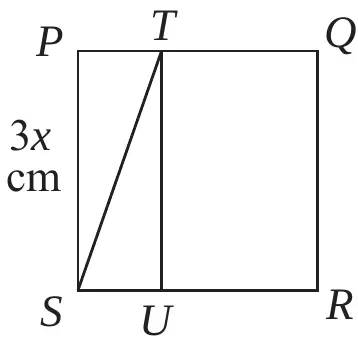
19. \(PQRS\) is a square. Point \(T\) lies on \(PQ\) so that \(PT : TQ = 1{:}2\). Point \(U\) lies on \(SR\) so that \(SU : UR = 1 : 2\). The perimeter of \(PTUS\) is 40 cm. What is the area of \(PTUS\)?
Let square \(PQRS\) have side \(3x\) cm. Then, as \(PT : TQ = 1 : 2\), \(PT = x\) cm. Similarly, \(US = x\) cm. In triangles \(PTS\) and \(UST\),\(PT = US\), \(\angle PTS = \angle UST\) (alternate angles) and \(TS\) is common to both. So the triangles are congruent (SAS). Therefore \(UT = PS = 3x\) cm and \(\angle TUS = \angle SPT = 90\)°. Hence \(PTUS\) is a rectangle, which has perimeter 40 cm. So \(40 = 2(3x + x) = 8x\). Therefore \(x = 5\) and the area of \(PTUS\), in cm2, is 15 × 5 = 75.
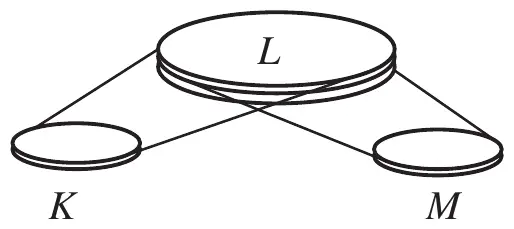
11. A belt drive system consists of the wheels \(K\), \(L\) and \(M\), which rotate without any slippage. The wheel \(L\) makes 4 full turns when \(K\) makes 5 full turns; also \(L\) makes 6 full turns when \(M\) makes 7 full turns. The perimeter of wheel \(M\) is 30 cm. What is the perimeter of wheel \(K\)?
To compare wheels \(K\) and \(M\), we need to find the lowest common multiple of 4 and 6, which is 12. When wheel \(L\) makes 12 turns, wheel \(K\) makes 15 turns and wheel \(M\) makes 14 turns. When wheel \(L\) makes 24 turns, wheel \(K\) makes 30 turns and wheel \(M\) makes 28 turns, so the ratio of the circumferences of wheel \(K\) to wheel \(M\) is 28:30.
Since 2017 = 33 × 60 + 37, a period of 2017 minutes is equivalent to 33 hours and 37 minutes or 1 day, 9 hours and 37 minutes. Hence the time 2017 minutes after 20:17 will be the time 9 hours and 37 minutes after 20:17, which is 05:54.
The sum of the interior angles of a quadrilateral is 360°. So the smallest angle in the quadrilateral is \(3 \times \frac{360°}{3 + 4 + 5 + 6} = 60\)° and the largest angle is \(6 \times \frac{360°}{3 + 4 + 5 + 6} = 120\)°. Hence the required difference is 60°.
24. Every day, Aimee goes up an escalator on her journey to work. If she stands still, it takes her 60 seconds to travel from the bottom to the top. One day the escalator was broken so she had to walk up it. This took her 90 seconds. How many seconds would it take her to travel up the escalator if she walked up at the same speed as before while it was working?
Let the distance from the bottom of the escalator to the top be \(d\). Then, when she stands still, Aimee travels \(d / 60\) every second. When she is walking, Aimee travels \(d / 90\) every second. So when Aimee walks up the working escalator, the distance which she travels every second is \(\dfrac{d}{60} + \dfrac{d}{90} = \dfrac{3d + 2d}{180} = \dfrac{5d}{180} = \dfrac{d}{36}\). So the required number of seconds is 36.
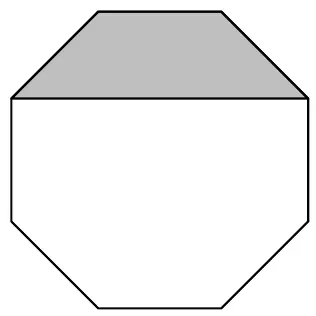
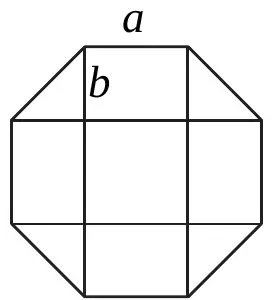
Let \(a\) be the side length of the octagon and \(b\) be as shown on the diagram. The square in the centre is \(a\) by \(a\), each rectangle is \(a\) by \(b\) and the triangles are each half of a \(b\) by \(b\) square. Applying Pythagoras' Theorem to a triangle shows that \(a^2 = 2b^2\). So the shaded area is \(b^2 + ab = b^2 + \sqrt{2}b^2 = b^2(1 + \sqrt{2})\). Similarly the total area of the figure is \(a^2 + 4ab + 2b^2 = 4b^2 + 4\sqrt{2}b^2\) \(= b^2(4 + 4\sqrt{2})\). Therefore the ratio required is \((1 + \sqrt{2}) : (4 + 4\sqrt{2}) = 1 : 4\).
20. It takes 4 hours for a motorboat to travel downstream from X to Y. To return upstream from Y to X it takes the motorboat 6 hours. How many hours would it take a wooden log to be carried from X to Y by the current, assuming it is unhindered by any obstacles? [Assume that the current flows at a constant rate, and that the motorboat moves at a constant speed relative to the water.]
Let \(D\) be the distance from \(X\) to \(Y\), and let \(u\) be the speed of the boat and \(v\) be the speed of the current. When travelling downstream the overall speed of the boat in the current is \(u + v\), and travelling upstream against the current it is \(u - v\). Then using time \(= \dfrac{\text{distance}}{\text{speed}}\), we get \(\dfrac{D}{u + v} = 4\) for the journey downstream and \(\dfrac{D}{u - v} = 6\) for the journey upstream. Inverting the equations gives \(\dfrac{u + v}{D} = \dfrac{1}{4}\) or \(4u + 4v = D \ldots\) (1) and \(\dfrac{u - v}{D} = \dfrac{1}{6}\) or \(6u - 6v = D \ldots\) (2). Multiplying (1) by 3 and (2) by 2, we get \(12u + 12v = 3D \ldots\) (3) and \(12u - 12v = 2D \ldots\) (4). Subtracting, (3) − (4) gives \(24v = D\) which rearranges to \(\dfrac{D}{v} = 24\) (hours), which is the time taken for the log to float downstream at the speed of the current alone.
9. The world's fastest tortoise is acknowledged to be a leopard tortoise from County Durham called Bertie. In July 2014, Bertie sprinted along a 5.5 m long track in an astonishing 19.6 seconds. What was Bertie's approximate average speed in km per hour?
Bertie travelled 5.5 m in 19.6 s, which is just less than one-third of a minute. So his average speed was approximately 16.5 m per minute, which is equal to 990 m in one hour, as 16.5 × 60 = 990. Now 990 m = 0.99 km, so Bertie's approximate average speed was 1 km per hour.
By dividing by 4 and then by 6, we see that 2016 = 4 × 504 = 4 × 6 × 84 = 24 × 84. So 2016 hours is 84 days and \(84 = 7 \times 12\) so 2016 hours is 12 weeks.
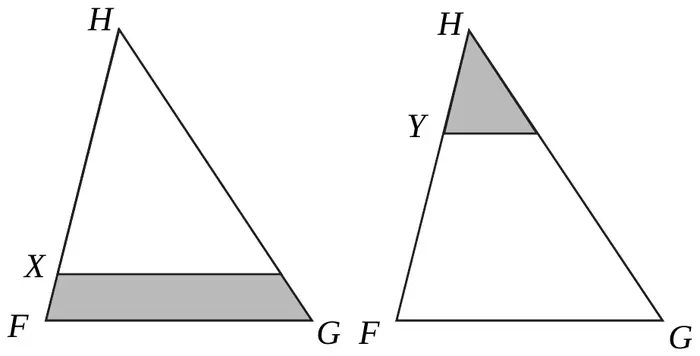
20. In the triangle \(FGH\), we can draw a line parallel to its base \(FG\), through point \(X\) or \(Y\). The areas of the shaded regions are the same. The ratio \(HX : XF = 4 : 1\). What is the ratio \(HY : YF\) ?
In the triangle on the left, the unshaded triangle is similar to triangle \(FGH\), and is obtained from it by a scale factor of \(\tfrac{4}{5}\). Hence its area is \(\left(\tfrac{4}{5}\right)^2 = \tfrac{16}{25}\) of the area of \(FGH\). The shaded area is therefore \(\tfrac{9}{25}\) of the area of \(FGH\). Hence \(HY : HF = 3 : 5\) and so \(HY : YF = 3 : 2\).
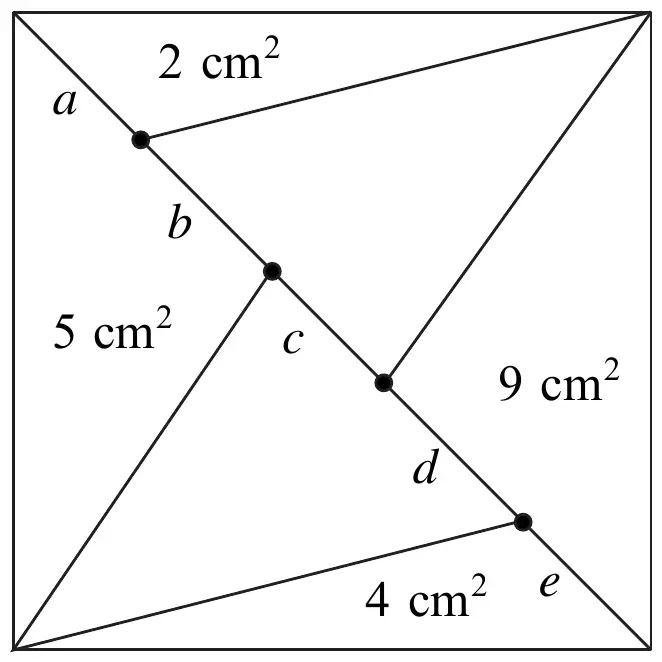
19. A square with area 30 cm2 is divided in two by a diagonal and then into triangles as shown. The areas of some of these triangles are given in the diagram (which is not drawn to scale). Which part of the diagonal is the longest?
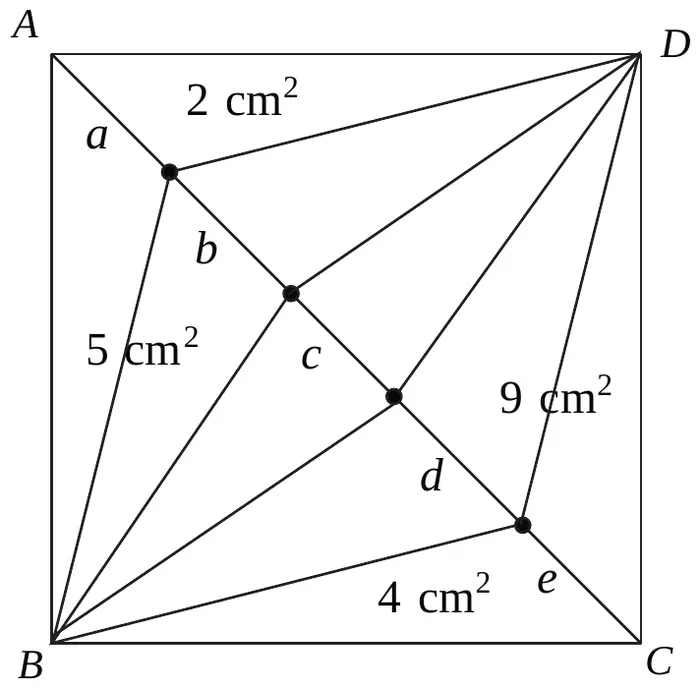
Label the corners of the square \(A\),\(B\), \(C\) and \(D\) going anticlockwise from the top left corner. Draw in the lines from each marked point on the diagonal to \(B\) and to \(D\). All the triangles with a base on the diagonal and a vertex at \(B\) or \(D\) have the same perpendicular height. Hence their areas are directly proportional to the length of their bases. The two triangles with \(e\) as their base both have area 4 cm2. Hence the two triangles with base \(d\) both have area 5 cm2. Similarly the two triangles with base \(a\) have area 2 cm2, and so the two triangles with base \(b\) have area 3 cm2. Finally, since the area of the square is 30 cm2, the two triangles with base \(c\) have area 1 cm2. Since the triangles with largest area are those of area 5 cm2, the longest base is that part labelled \(d\).
One litre is equivalent to 1000 cm3. Hence 15 litres falling over an area of one square metre is equivalent to 15 000 cm3 falling over an area of 10 000 cm2. Therefore the amount the water in Michael's pool would rise by, in cm, is 15 000 ÷ 10 000 = 1.5.
6. A cyclist rides at 5 metres per second. The wheels of his bicycle have a circumference of 125 cm. How many complete turns does each wheel make in 5 seconds?
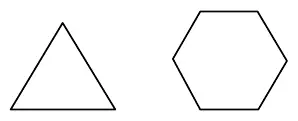
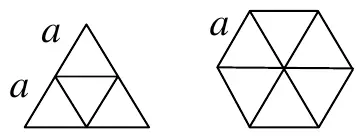
6. The equilateral triangle and regular hexagon shown have perimeters of the same length. What is the ratio of the area of the triangle to the area of the hexagon?
Let the length of the side of the regular hexagon be \(a\). Then its perimeter is \(6a\). Therefore the perimeter of the equilateral triangle is also \(6a\), so the length of each of its sides is \(2a\). The diagrams show that the equilateral triangle may be divided up into 4 equilateral triangles of side \(a\), whereas the regular hexagon may be divided into 6 such triangles. So the required ratio is 4 : 6 = 2 : 3.
4. Three sisters bought a packet of biscuits for £1.50 and divided them equally among them, each receiving 10 biscuits. However, Anya paid 80 pence, Berini paid 50 pence and Carla paid 20 pence. If the biscuits had been divided in the same ratios as the amounts each sister had paid, how many more biscuits would Anya have received than she did originally?
Anya pays 80p out of a total of 80p + 50p + 20p = 150p. So if the biscuits had been divided in the same ratio as the payments, she would have received \(\dfrac{80}{150} \times 30 = 16\) biscuits. So she would have received \(16 - 10 = 6\) more biscuits.
2. Last year, Australian Suzy Walsham won the annual women's race up the 1576 steps of the Empire State Building in New York for a record fifth time. Her winning time was 11 minutes 57 seconds. Approximately how many steps did she climb per minute?
The number of minutes in one week is 7 × 24 × 60, which may be written as 7 × (6 × 4) × (5 × 3 × 2 × 2) = (7 × 6 × 5 × 4 × 3 × 2) × 2. So the number of weeks in 8 × 7 × 6 × 5 × 4 × 3 × 2 × 1 minutes is 8 ÷ 2 = 4.
14. This year the Tour de France starts in Leeds on 5 July. Last year, the total length of the Tour was 3404 km and the winner, Chris Froome, took a total time of 83 hours 56 minutes 40 seconds to cover this distance. Which of these is closest to his average speed over the whole event?
9. At the age of twenty-six, Gill has passed her driving test and bought a car. Her car uses \(p\) litres of petrol per 100 km travelled. How many litres of petrol would be required for a journey of \(d\) km?
Gill's car uses \(p/100\) litres of petrol for every one kilometre travelled. So for a journey of length \(d\) km, \(pd/100\) litres of petrol are required.
5. A ship's bell is struck every half hour, starting with one bell at 0030, two bells (meaning the bell is struck twice) at 0100, three bells at 0130 until the cycle is complete with eight bells at 0400. The cycle then starts again with one bell at 0430, two bells at 0500 and so on. What is the total number of times the bell is struck between 0015 on one day and 0015 on the following day?
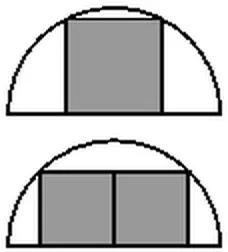
22. The diagrams show squares placed inside two identical semicircles. In the lower diagram the two squares are identical. What is the ratio of the areas of the two shaded regions?
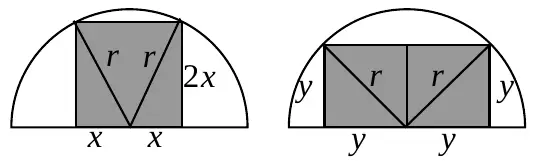
Let the radius of each semicircle be \(r\). In the left-hand diagram, let the side-length of the square be 2\(x\). By Pythagoras' Theorem, \(x^2 + (2x)^2 = r^2\) and so \(5x^2 = r^2\). So this shaded area is \(4x^2 = \tfrac{4r^2}{5}\). In the right-hand diagram, let the side-length of each square be \(y\). Then by Pythagoras' Theorem, \(y^2 + y^2 = r^2\) and so this shaded area is \(r^2\). Therefore the ratio of the two shaded areas is \(\tfrac{4}{5}\) : 1 = 4 : 5.
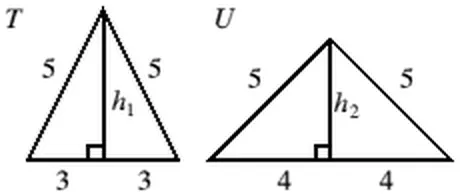
The diagrams show isosceles triangles \(T\) and \(U\). The perpendicular from the top vertex to the base divides an isosceles triangle into two congruent right-angled triangles as shown in both \(T\) and \(U\). Evidently, by Pythagoras' Theorem, \(h_1 = 4\) and \(h_2 = 3\). So both triangles \(T\) and \(U\) consist of two ‘3, 4, 5’ triangles and therefore have equal areas.
5. The northern wheatear is a small bird weighing less than an ounce. Some northern wheatears migrate from sub-Saharan Africa to their Arctic breeding grounds, travelling almost 15 000 km. The journey takes just over 7 weeks. Roughly how far do they travel each day, on average?
Let the sides of the rectangle, in cm, be \(4x\) and \(5x\). Then the area of the square is \(4x \times 5x\) cm2 = \(20x^2\) cm2. So \(20x^2 = 125\), that is \(x^2 = \tfrac{25}{4}\). Therefore \(x = \pm\tfrac{5}{2}\), but \(x\) cannot be negative so \(x = \tfrac{5}{2}\) and so the sides of the rectangle are 10 cm and 12.5 cm. Hence the rectangle has perimeter 45 cm.
13. Alex Erlich and Paneth Farcas shared an opening rally of 2 hours and 12 minutes during their table tennis match at the 1936 World Games. Each player hit around 45 shots per minute. Which of the following is closest to the total number of shots played in the rally?
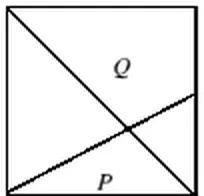
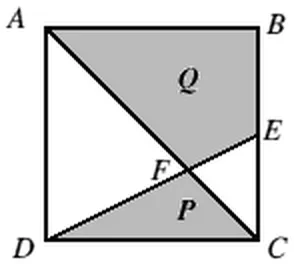
Let triangle \(CEF\) have area \(a\). Note that \(\angle AFD = \angle CFE\) (vertically opposite angles) and \(\angle DAF = \angle ECF\) (alternate angles), so triangles \(ADF\) and \(CEF\) are similar. Note also that the side \(AD\) is twice the length of the corresponding side \(CE\). Hence: (i) triangle \(ADF\) has area 4\(a\) and; (ii) \(AF\) has twice the length of the corresponding side \(CF\). View \(AF\) and \(CF\) as bases of the triangles \(ADF\) and \(CDF\) (which then share the same height). Therefore, by (ii), triangle \(ADF\) has twice the area of triangle \(CDF\) (area P), which thus is 2\(a\). The area of triangle \(ACD\) is 6\(a\); so that of triangle \(ABC\) is also 6\(a\) and that of area Q is 5\(a\). So the required ratio is 2 : 5.
20. Max and his dog Molly set out for a walk. Max walked up the road and then back down again, completing a six mile round trip. Molly, being an old dog, walked at half Max's speed. When Max reached the end of the road, he turned around and walked back to the starting point, at his original speed. Part way back he met Molly, who then turned around and followed Max home, still maintaining her original speed. How far did Molly walk?
Let Max and Molly meet after the latter has travelled \(x\) miles. Then Max has travelled \((6 - x)\) miles. So \(6 - x = 2x\), thus \(x = 2\). Therefore Molly walks a total of 4 miles.
22. Curly and Larry like to have their orange squash made to the same strength. Unfortunately, Moe has put 25 ml of squash with 175 ml of water in Curly's glass and 15 ml of squash with 185 ml of water in Larry's glass. How many millilitres of the mixture in Curly's glass must be put into Larry's glass so that they end up with drinks of the same strength?
Curly's drink has squash and water in the ratio 1: 7, whilst the corresponding ratio for Larry's drink is 3 : 37. This ratio is less than 1 : 7. When some of Curly's mixture is poured into Larry's, the strength will be between 1 : 7 and 3 : 37, but not equal to either.
18. Supergran walks from her chalet to the top of the mountain. She knows that if she walks at a speed of 6 mph she will arrive at 1 pm, whereas if she leaves at the same time and walks at 10 mph, she will arrive at 11 am. At what speed should she walk if she wants to arrive at 12 noon?
Let the distance from the chalet to the top of the mountain be \(x\) miles. Then, at 6 mph Supergran would take \(\dfrac{x}{6}\) hours, whereas at 10 mph she would take \(\dfrac{x}{10}\) hours. So \(\dfrac{x}{6} - \dfrac{x}{10} = 2\), that is \(5x - 3x = 60\), so \(x = 30\). Hence Supergran's departure time is 8 am and to arrive at 12 noon she should walk at \(\dfrac{30}{4}\) mph, that is \(7\tfrac{1}{2}\) mph.
17. Last year Gill's cylindrical 21st birthday cake wasn't big enough to feed all her friends. This year she will double the radius and triple the height. What will be the ratio of the volume of this year's birthday cake to the volume of last year's cake?
The volume of a cylinder of radius \(r\) and height \(h\) is \(\pi r^2 h\). Replacing \(r\) by \(2r\) and \(h\) by \(3h\) multiplies this volume by 12.
16. Albert Einstein is experimenting with two unusual clocks which both have 24-hour displays. One clock goes at twice the normal speed. The other clock goes backwards, but at the normal speed. Both clocks show the correct time at 13:00. What is the correct time when the displays on the clocks next agree?
After \(x\) hours, the first clock will have gone forward \(2x\) hours and the second clock will have gone back \(x\) hours. So the next time they agree is when \(2x + x = 24\), that is when \(x = 8\). The correct time then is 21:00.
4. A radio advertisement claimed that using a particular brand of artificial sweetener every day would ‘save 7 000 calories in a year’. Approximately how many calories is this per day?
19. Driving to Birmingham airport, Mary cruised at 55 miles per hour for the first two hours and then flew along at 70 miles per hour for the remainder of the journey. Her average speed for the entire journey was 60 miles per hour. How long did Mary's journey to Birmingham Airport take?
Let the time for which Mary drove at 70 mph be \(t\) hours. Then the total distance covered was (55 × 2 + 70 × \(t\)) miles. Also, as her average speed over (2 + \(t\)) hours was 60 mph, the total distance travelled was 60(2 + \(t\)) miles.
Therefore 110 + 70\(t\) = 120 + 60\(t\), that is 10\(t\) = 10, that is \(t\) = 1.
17. Grannie's watch gains 30 minutes every hour, whilst Grandpa's watch loses 30 minutes every hour. At midnight, they both set their watches to the correct time of 12 o'clock. What is the correct time when their two watches next agree?
The two watches will next agree when Grannie's watch has gained twelve hours relative to Grandpa's watch. Each hour, Grannie's watch gains one hour relative to Grandpa's watch, so it will take 12 hours for this to happen. At this time, both watches will show a time of 6 o'clock.
16. A wooden cube with edge length 12 cm is cut into cubes with edge length 1 cm. What is the total length of all the edges of all these centimetre cubes?
In total, there are 123 cubes with edge length 1 cm. Each of these centimetre cubes has 12 edges, so the sum of the lengths of these edges is 12 cm. Therefore the total length of the edges of all the centimetre cubes is 123 × 12 cm, that is 124 cm.
9. A male punky fish has 9 stripes and a female punky fish has 8 stripes. I count 86 stripes on the fish in my tank. What is the ratio of male fish to female fish?
If there are \(f\) females and \(m\) males then \(86 = 8f + 9m = 8(f + m) + m\). Now 86 = 8 × 10 + 6 = 8 × 9 + 14 = 8 × 8 + 22…. Only the first of these is feasible (because \(f + m \geqslant m\)). So \(m = 6\) and \(f = 4\).
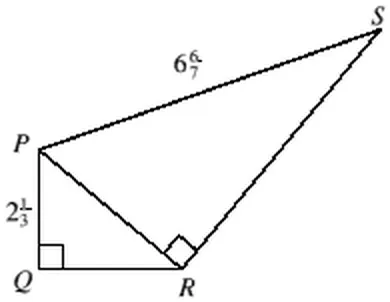
Triangles \(QPR\) and \(RPS\) are similar since \(\angle QPR = \angle RPS\) and \(\angle RQP = \angle SRP\). So \(\tfrac{PR}{PS} = \tfrac{PQ}{PR}\). Hence \(PR^2 = PQ \times PS = \tfrac{7}{3} \times \tfrac{48}{7} = 16\). So \(PR\) is 4 units long. (The geometric mean of \(x\) and \(y\) is defined to be\(\sqrt{xy}\),so in this problem \(PR\) is the geometric mean of \(PQ\) and\(PS\).)
8. Sydney flew to Melbourne, Australia. The flying time to Melbourne, which is 11 hours ahead of Britain, was 21 hours. Sydney's flight left London at 11.30am on Tuesday. What time was it in Melbourne when Sydney's flight arrived?
The clock time in Melbourne when Sydney arrived was 32 hours (one complete day and 8 hours) ahead of the clock time in London when he left. So he arrived at 7:30 pm on Wednesday.
6. Harriet Hare and Turbo Tortoise want to cross the finish line together on their 12 mile woodland race. Turbo sets off at 8:15 am and trots at a constant speed of 4 mph. Given that Harriet runs at a constant speed of 8 mph, at what time should she set off?
Turbo will take 3 hours to complete the 12 miles, whilst Harriet will take 1 hour 30 minutes. So Harriet should set off 1 hour 30 minutes after Turbo, that is at 9:45 am.
17. Platinum is a very rare metal, even rarer than gold. Its density is 21.45 g/cm3. Assuming that the world production has been about 110 tonnes for each of the past 50 years, and negligible before that, which of the following has a comparable volume to that of the total amount of platinum ever produced?
The volume of 1 kg of platinum is (1000/21.45) cm3, that is approximately 50 cm3. So 1 tonne of platinum has a volume of approximately 50 000 cm3, which is 1/20 m3. The volume of platinum produced per year is therefore about 5 m3 and the total volume of platinum ever produced is approximately 250 m3. This is the volume of a cuboid measuring 10 m × 5 m × 5 m, which is comparable to a house.
12. One gallon of honey provides enough fuel for a bee to fly about seven million miles. Roughly how many bees could fly one thousand miles if they had ten gallons of honey to share between them?
Ten gallons of honey would provide enough fuel for one bee to fly about 70 000 000 miles. So the number of bees which could fly 1000 miles is approximately 70 000 000 ÷ 1000, that is 70 000.
The offer gives the purchaser two items for the price of one and a half items. So the average cost per item is the same as four items for the price of three.
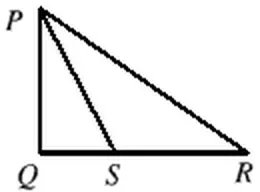
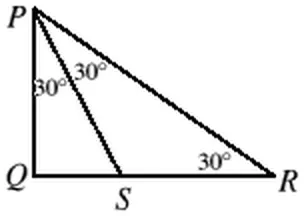
18. In the triangle \(PQR\), there is a right angle at \(Q\) and angle \(QPR\) is 60°. The bisector of the angle \(QPR\) meets \(QR\) at \(S\), as shown. What is the ratio \(QS : SR\)?
Angle \(PRS\) = 30°, so triangle \(PRS\) is isosceles with \(SP = SR\). Hence \(\dfrac{QS}{SR} = \dfrac{QS}{SP} = \dfrac{1}{2}\) as \(PQS\) is half of an equilateral triangle. [Alternatively, we can use the angle bisector theorem: \(\dfrac{QS}{SR} = \dfrac{PQ}{PR} = \dfrac{1}{2}\) as \(PQR\) is also half of an equilateral triangle.]
8. In March 2003 Welshman Tony Evans dropped a ball from an aircraft a mile above the Mojave desert to see if it would bounce. The ball was made from 6 million rubber bands, had a circumference of 14 ft 8 in, weighed 2600 pounds and took Mr Evans five years to build. On average, roughly how many rubber bands did he add each day whilst building the ball?
The average number of rubber bands added each day was approximately \(\dfrac{6\,000\,000}{5 \times 365} \approx \dfrac{6\,000\,000}{1800} \approx 3300\).
We'd like to use Google Analytics cookies to count visits and see which pages help most. They're optional, and the site works exactly the same either way. Privacy policy

 Grandpa's watch: