
IMC 2006 Q23
23. In the figure on the right, \(PQ = 2\frac{1}{3}\), \(PS = 6\frac{6}{7}\) and \(\angle QPR = \angle RPS\).
How long is \(PR\)?
- A \(3\frac{1}{2}\)
- B 4
- C \(4\frac{1}{4}\)
- D \(4\frac{25}{42}\)
- E 5
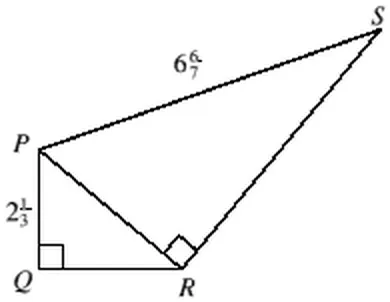
Intermediate Mathematical Challenge 2006, Question 23. © UK Mathematics Trust. Original paper on ukmt.org.uk
Answer: B 4
Triangles \(QPR\) and \(RPS\) are similar since \(\angle QPR = \angle RPS\) and \(\angle RQP = \angle SRP\). So \(\tfrac{PR}{PS} = \tfrac{PQ}{PR}\). Hence \(PR^2 = PQ \times PS = \tfrac{7}{3} \times \tfrac{48}{7} = 16\). So \(PR\) is 4 units long.
(The geometric mean of \(x\) and \(y\) is defined to be \(\sqrt{xy}\), so in this problem \(PR\) is the geometric mean of \(PQ\) and \(PS\).)
Solution © UK Mathematics Trust, from the IMC 2006 solutions.