The sum of \(\dfrac{1}{9} + \dfrac{1}{11}\) is \(\dfrac{11}{99} + \dfrac{9}{99}\), that is \(\dfrac{20}{99}\).
Now 20 and 99 do not have any factors in common except 1. So the fraction cannot be simplified. In option A, we may write 0.10 as the fraction \(\tfrac{10}{100}\), whose denominator is a power of 10. The same is true of options B, C and D. Therefore, when simplified, none of these fractions can have 99 as a denominator. It is left to the reader to confirm, by division, that \(\dfrac{20}{99} = 0.\dot{2}\dot{0}\). An alternative argument follows. Let \(x = 0.\dot{2}\dot{0} = 0.202020....\) Then \(100x = 20.202020...\) . Subtracting the first equation from the second gives \(99x = 20\). So \(0.\dot{2}\dot{0} = \dfrac{20}{99}\).
Werner’s salary is 20% of his boss’s salary. Therefore his boss’s salary is \(\tfrac{100}{20} = 5\) times Werner’s salary. Hence his boss’s salary is 500% of Werner’s salary and so is 400% larger.
10. Every pupil in a class either swims or dances. Three fifths of the class swim and three fifths dance. Five pupils both swim and dance. How many pupils are in the class?
Since three fifths of the class swim, three fifths of the class dance and no-one does neither, the fraction of the class who do both is \(\tfrac{3}{5} + \tfrac{3}{5} - 1 = \tfrac{1}{5}\). Hence, since 5 pupils do both, the number of pupils in the class is 5 × 5 = 25.
9. An isosceles triangle has a side of length 20 cm. Of the remaining two side-lengths, one is equal to two-fifths of the other. What is the length of the perimeter of this triangle?
The triangle is isosceles so has a pair of equal sides. Since the two unknown sides are not equal, they cannot be the pair of equal sides, and hence the 20 cm side must be one of the pair of equal sides. The base is then two-fifths of 20 cm, namely 8 cm. The perimeter is 20 + 20 + 8 = 48 cm.
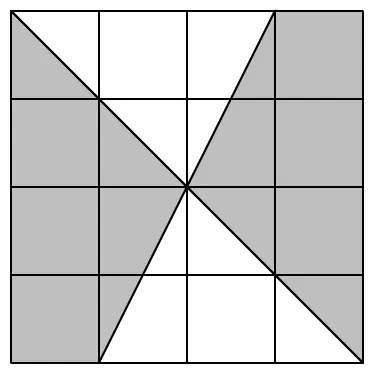
We choose units so the outer square has side-length 4, and hence area 16. The unshaded area of the square consists of two congruent triangles of base 3 and height 2. So the area of each unshaded triangle is \(\tfrac{1}{2} \times 3 \times 2 = 3\). Hence the area of the shaded part of the square is \(16 - 2 \times 3 = 10\). Therefore the fraction of the square which is shaded is \(\tfrac{10}{16} = \tfrac{5}{8}\).
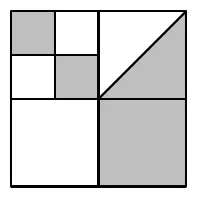
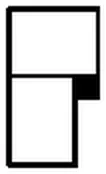
2. A large square is divided into smaller squares. In one of the smaller squares a diagonal is also drawn, as shown. What fraction of the large square is shaded?
The shaded square in the lower right corner of the large square is \(\tfrac{1}{4}\) of the large square. The shaded triangle is half of \(\tfrac{1}{4}\) of the large square. Hence it is \(\tfrac{1}{8}\) of the large square. The two small shaded squares in the upper left corner together are half of \(\tfrac{1}{4}\), or \(\tfrac{1}{8}\), of the large square. Therefore the fraction of the large square that is shaded is \(\tfrac{1}{4} + \tfrac{1}{8} + \tfrac{1}{8} = \tfrac{1}{2}\).
The values of the fractions shown are \(\tfrac{13}{3} = 4\tfrac{1}{3}\),\(\tfrac{8}{8} = 1\),\(\tfrac{8}{8} = 1\), \(\tfrac{11}{5} = 2\tfrac{1}{5}\) and \(\tfrac{3}{13}\). Hence the fraction which has the largest value is \(\tfrac{8+5}{3}\).
Finally, \(\dfrac{1}{3} + \dfrac{1}{4} > \dfrac{1}{4} + \dfrac{1}{4} = \dfrac{1}{2}\). Therefore the expression with the largest value is that in option E.
17. Julio has two cylindrical candles with different heights and diameters. The two candles burn wax at the same uniform rate. The first candle lasts 6 hours, while the second candle lasts 8 hours. He lights both candles at the same time and three hours later both candles are the same height. What is the ratio of their original heights?
Let the original heights of the first and second candles be \(x\) and \(y\) respectively. Since the first candle lasts six hours, after three hours its height is \(\tfrac{1}{2}x\). Similarly, since the second candle lasts eight hours, after three hours its height is \(\tfrac{5}{8}y\). After three hours the two candles have the same height and hence \(\tfrac{1}{2}x = \tfrac{5}{8}y\). Therefore \(\tfrac{x}{y} = \tfrac{5}{4}\) and hence the ratio of their original heights is 5 : 4.
14. Michael keeps dogs, cows, cats and kangaroos as pets. He has 24 pets in total and \(\tfrac{1}{8}\) of them are dogs, \(\tfrac{3}{4}\) are not cows and \(\tfrac{2}{3}\) are not cats. How many kangaroos does Michael keep?
Michael has 24 pets. Since \(\tfrac{1}{8}\) of them are dogs, he has 3 dogs. Since \(\tfrac{3}{4}\) are not cows, \(\tfrac{1}{4}\) of them are cows and hence he has 6 cows. Similarly, since \(\tfrac{2}{3}\) are not cats, \(\tfrac{1}{3}\) of them are cats and hence he has 8 cats. Therefore, the number of kangaroos he has is 24 − 3 − 6 − 8 = 7.
13. The triathlon consists of swimming, cycling and running. The cycling accounts for three-quarters of the total distance, the running for one-fifth and the swimming for 2 km. What is the total distance of this triathlon?
The cycling and running account for \(\tfrac{3}{4} + \tfrac{1}{5} = \tfrac{15}{20} + \tfrac{4}{20} = \tfrac{19}{20}\) of the distance. So the swimming, which is 2 km, is the remaining \(\tfrac{1}{20}\) of the distance. Hence the distance is 20 × 2 = 40km.
12. Jane was playing basketball. After a series of 20 shots, Jane had a success rate of 55%. Five shots later, her success rate had increased to 56%. On how many of the last five shots did Jane score?
Since Jane had a success rate of 55% after her first 20 shots, the number of times she had scored out of 20 was 0.55 × 20 = 11. Similarly, since her success rate had increased to 56% after 5 more shots, the number of times she had scored out of 25 was 0.56 × 25 = 14. Hence the number of shots she scored out of the last five was 14 − 11 = 3.
11. The numbers \(a\),\(b\), \(c\) and \(d\) are distinct positive integers chosen from 1 to 10 inclusive. What is the least possible value \(\dfrac{a}{b} + \dfrac{c}{d}\) could have?
To obtain the smallest value, the numerators should be as small as possible, so 1 or 2, and the denominators should be as large as possible, so 9 or 10. The two possible candidates are \(\tfrac{1}{10} + \tfrac{2}{9}\) and \(\tfrac{1}{9} + \tfrac{2}{10}\). The first gives \(\tfrac{9}{90} + \tfrac{20}{90} = \tfrac{29}{90}\), and the second gives \(\tfrac{10}{90} + \tfrac{18}{90} = \tfrac{28}{90} = \tfrac{14}{45}\), which is smaller.
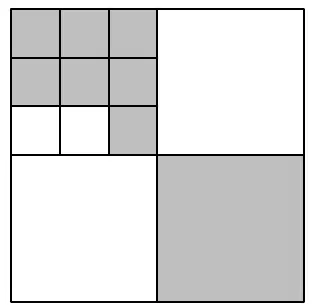
The largest grey square is a quarter of the large square. The smaller grey squares are each one ninth of the size of the largest grey square. Hence the fraction of the large square which is shaded is \(\tfrac{1}{4} + \tfrac{7}{9} \times \tfrac{1}{4} = \tfrac{1}{4} \times \left(1 + \tfrac{7}{9}\right) = \tfrac{1}{4} \times \tfrac{16}{9} = \tfrac{4}{9}\)
First note that three quarters of the UK red squirrels live in Scotland. So one quarter of the UK red squirrels live in the remainder of the UK and the number of such squirrels is therefore one third of the number of red squirrels living in Scotland, which is \(\dfrac{1}{3} \times 120\,000 = 40\,000\).
So the required difference equals 120 000 − 40 000 = 80 000.
19. Amy, Becky and Chloe went shopping. Becky spent only 15 % of what Chloe spent. However, Amy spent 60 % more than Chloe. Together they spent £55. How much did Amy spend?
Let the amount Chloe spent be £\(x\). Therefore Amy spent £\(1.6x\) and Becky spent £\(0.15x\). The total amount spent is £55 and hence \(x + 1.6x + 0.15x = 55\). Therefore \(2.75x = 55\), which has solution \(x = 20\). Hence Amy spent £(1.6 × 20) = £32.
14. Peter wanted to buy a book, but he didn't have any money. He bought it with the help of his father and his two brothers. His father gave him half of the amount given by his brothers. His elder brother gave him one third of what the others gave. The younger brother gave him 10 euros. What was the price of the book?
Let \(D\) be the amount that Peter's dad gave, and \(B\) the amount his elder brother gave. Then \(D = \tfrac{1}{2}(B + 10) \ldots\) (1) and \(B = \tfrac{1}{3}(D + 10) \ldots\) (2). Substitute (1) into (2) to get \(B = \tfrac{1}{3}\left(\tfrac{1}{2}(B + 10) + 10\right) = \tfrac{1}{6}B + 5\). Hence \(\tfrac{5}{6}B = 5\), so \(B = 6\) and \(D = \tfrac{1}{2}(6 + 10) = 8\). This gives a total of 6 + 8 + 10 = 24. So the book cost 24 euros.
13. At the University of Bugelstein you can study Languages, History and Philosophy. 35% of students that study a language study English. 13% of all the university students study a language other than English. No student studies more than one language. What percentage of the university students study Languages?
English is taken by 35% of language students, so 65% of language students don’t take English. These are stated as 13% of the overall university population. So 1% of the overall university population is the same as 5% of the language students. Hence 20% of the university population is 100% of the language students.
We are given that \(\dfrac{3}{10} < \dfrac{n}{20} < \dfrac{2}{5}\). Therefore \(\dfrac{6}{20} < \dfrac{n}{20} < \dfrac{8}{20}\). So, as \(n\) is an integer, \(n = 7\).
2018% of 25 is the same as 25% of 2018 (because they are both equal to \(\dfrac{25}{100} \times 2018\)), so their sum is equal to 50% of 2018, which is 1009.
5. The adult human body has 206 bones. Each foot has 26 bones. Approximately what fraction of the number of bones in the human body is found in one foot?
24. The \(n\)th term in a certain sequence is calculated by multiplying together all the numbers \(\sqrt{1 + \dfrac{1}{k}}\), where \(k\) takes all the integer values from 2 to \(n + 1\) inclusive. For example, the third term in the sequence is \(\sqrt{1 + \dfrac{1}{2}} \times \sqrt{1 + \dfrac{1}{3}} \times \sqrt{1 + \dfrac{1}{4}}\). Which is the smallest value of \(n\) for which the \(n\)th term of the sequence is an integer?
The product may be written \(\sqrt{\frac{3}{2}} \times \sqrt{\frac{4}{3}} \times \sqrt{\frac{5}{4}} \times \sqrt{\frac{6}{5}} \times \ldots = \frac{\sqrt{3}}{\sqrt{2}} \times \frac{\sqrt{4}}{\sqrt{3}} \times \frac{\sqrt{5}}{\sqrt{4}} \times \frac{\sqrt{6}}{\sqrt{5}} \times \ldots\). Notice that the numerator of each fraction is cancelled out by the denominator of the following fraction and the only terms which are not cancelled are the denominator of the first fraction and the numerator of the last fraction. So the \(n\)th term of the sequence is \(\frac{\sqrt{n + 2}}{\sqrt{2}} = \sqrt{\frac{n + 2}{2}}\). As \(n \geqslant 1\) the product is not equal to 1. The product increases with \(n\). So the next possible integer value to consider is 2 and this does occur when \(n = 6\) as \(\sqrt{\frac{6 + 2}{2}} = \sqrt{4} = 2\). So the smallest number of terms required for the product to be an integer is 6.
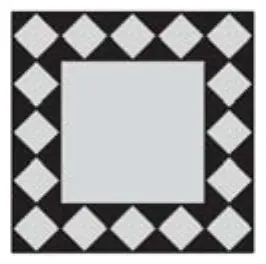
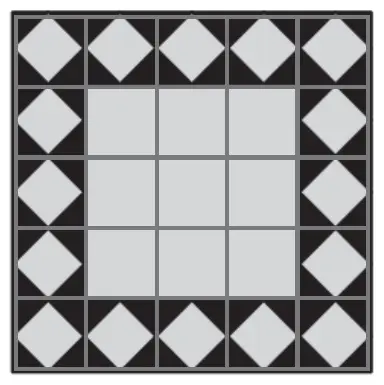
Divide the tablecloth into 25 equal squares as shown. Half of each of the 16 outer squares is coloured black which is equivalent to 8 complete squares. Therefore the percentage of the tablecloth that is coloured black is \(\dfrac{8}{25} \times 100 = 32\).
18. A water tank is \(\dfrac{5}{6}\) full. When 30 litres of water are removed from the tank, the tank is \(\dfrac{4}{5}\) full. How much water does the tank hold when full?
Let the capacity of the tank be \(x\) litres. Then \(30 = \frac{5x}{6} - \frac{4x}{5} = \frac{25x - 24x}{30} = \frac{x}{30}\). So \(x = 30 \times 30 = 900\).
11. This year there were more than 800 entrants in the Kangaroo Hop race. Exactly 35% of the entrants were female and there were 252 more males than females. How many entrants were there in total?
Since 35% of the entrants were female, 65% of the entrants were male. Hence, since there were 252 more males than females, 252 people represent (65 − 35)% = 30% of the total number of entrants. Therefore the total number of entrants was (252 ÷ 30) × 100 = 840.
One sixth of the audience are adults. Therefore five sixths of the audience are children. Two fifths of the children are boys and hence three fifths of the children are girls. Therefore three fifths of five sixths of the audience are girls. Now \(\tfrac{3}{5} \times \tfrac{5}{6} = \tfrac{1}{2}\). Hence the fraction of the audience who are girls is \(\tfrac{1}{2}\).
8. Adam the Ant started at the left-hand end of a pole and crawled \(\tfrac{2}{3}\) of its length. Benny the Beetle started at the right-hand end of the same pole and crawled \(\tfrac{3}{4}\) of its length. What fraction of the length of the pole are Adam and Benny now apart?
Adam the Ant has crawled \(\tfrac{2}{3}\) of the length of the pole and so is \(\tfrac{1}{3}\) of the length of the pole from the right-hand end. Benny the Beetle has crawled \(\tfrac{3}{4}\) of the length of the pole and so is \(\tfrac{1}{4}\) of the length of the pole from the left-hand end. Hence the fraction of the length of the pole that Adam and Benny are apart is \(\left(1 - \tfrac{1}{3} - \tfrac{1}{4}\right) = \tfrac{5}{12}\).
Consider options B to E: \(1.354\dot{2} = 1.354222 \ldots\) ; \(1.35\dot{4}\dot{2} = 1.35424242 \ldots\) ; \(1.3\dot{5}4\dot{2} = 1.3542542 \ldots\) ; \(1.\dot{3}54\dot{2} = 1.35423542 \ldots\) . These are all greater than 1.3542, so option A is not correct. The other four options have the same units digit and the first four digits after the decimal point are the same in all. So the largest option is that which has the largest digit five places after the decimal point and this is \(1.3\dot{5}4\dot{2}\).
6. One-eighth of the guests at a wedding were children. Three-sevenths of the adult guests were men. What fraction of the wedding guests were adult women?
Seven-eighths of all the guests were adults, of which three-sevenths were men, so the fraction of guests who were adult women equals \(\tfrac{7}{8} \times \tfrac{4}{7} = \tfrac{1}{2}\).
5. Martina plays chess. She has played 15 games this season, out of which she has won nine. She has five more games to play. What will her success rate be in this season if she wins all five remaining games?
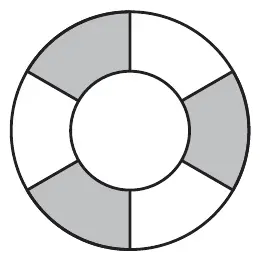
5. The diagram shows two circles with the same centre. The radius of the outer circle is twice the radius of the inner circle. The region between the inner circle and the outer circle is divided into six equal segments as shown. What fraction of the area of the outer circle is shaded?
Let the area of the inner circle be \(A\). The radius of the outer circle is twice that of the inner circle, so its area is four times that of the inner circle , that is \(4A\). Therefore the region between the two circles has area \(3A\). As three of the six equal segments are shaded, the total shaded area is \(3A \div 2\). So the required fraction is \(\frac{3}{2}A \div 4A = \frac{3}{8}\).
When you evaluate correctly the left-hand side of each proposed equality in turn, you obtain 4, 2.5, 2, 1.75 and 1.6. Hence the only true equality is \(\tfrac{5}{2} = 2.5\).
2. Each of the diagrams below shows a circle and four small squares. In each case, the centre of the circle is the point where all four squares meet. In one of the diagrams, exactly one third of the circle is shaded. Which one?
When one third of the circle is shaded, the angle at the centre of the shaded sector is 360° ÷ 3 = 120°. In diagram A, the sector angle is 90°. In diagram C, the sector angle is 90° + 90° ÷ 2 = 135°. So the correct diagram has a sector angle greater than that shown in A, but smaller than that shown in C. The only such sector angle is that in B.
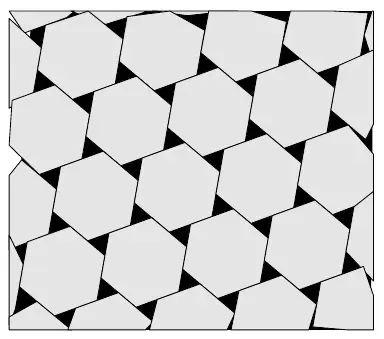
25. The tiling pattern shown uses two types of tile, regular hexagons and equilateral triangles, with the length of each side of the equilateral triangles equal to half the length of each side of the hexagons. A large number of tiles is used to cover a floor. Which of the following is closest to the fraction of the floor that is shaded black?
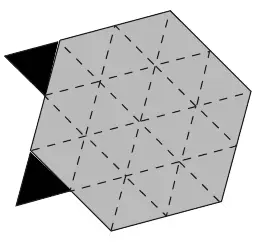
The tiled area may be considered to be a tessellation of the figure shown, except for the dotted lines. For every hexagonal tile, there are two triangular tiles. The diagram shows that the area of each hexagonal tile is 24 times the area of each triangular tile. As there are two triangular tiles to each hexagonal tile, the ratio of the fraction of the floor shaded black to that which is shaded grey is 2 : 24 = 1: 12. Therefore, in the repeating pattern of tiles, the fraction which is shaded black is 1/13. The exact ratios given are for the infinite plane. Since we are dealing with a finite floor, this is approximate since the edges are unpredictable, but close to correct since the numbers involved are large.
17. There are 2016 kangaroos in a zoo. Each of them is either grey or pink, and at least one of them is grey and at least one is pink. For every kangaroo, we calculate this fraction: the number of kangaroos of the other colour divided by the number of kangaroos of the same colour as this kangaroo (including himself). Find the sum of all the 2016 fractions calculated.
Let \(G\) be the number of grey kangaroos, and \(P\) the number of pink kangaroos, so \(G + P = 2016\). For each grey kangaroo we calculate the fraction as \(\dfrac{P}{G}\); and there are \(G\) of these, so the total of the fractions for grey kangaroos is \(G \times \dfrac{P}{G} = P\). Similarly the total of the fractions calculated for the pink kangaroos is \(G\). Thus the total of all the fractions is \(P + G = 2016\).
15. There are twenty students in a class. Some of them sit in pairs so that exactly one third of the boys sit with a girl, and exactly one half of the girls sit with a boy. How many boys are there in the class?
Let the number of boys in the class be \(x\) and let the number of girls be \(y\). Since one third of the boys sit with a girl and one half of the girls sit with a boy, we have \(\tfrac{1}{3}x = \tfrac{1}{2}y\) and hence \(\tfrac{2}{3}x = y\). The total number of students in the class is 20. Therefore \(x + \tfrac{2}{3}x = 20\). Hence \(\tfrac{5}{3}x = 20\), which has solution \(x = 12\). Therefore there are 12 boys in the class.
14. Tegwen has the same number of brothers as she has sisters. Each one of her brothers has 50% more sisters than brothers. How many children are in Tegwen's family?
Let there be \(g\) girls and \(b\) boys in Tegwen's family. Then, as she has the same number of brothers as she does sisters, \(b = g - 1\). Also, each of her brothers has 50% more sisters than brothers. Therefore \(g = \frac{3}{2}(b - 1)\). So \(b + 1 = \frac{3}{2}(b - 1)\) and hence \(2b + 2 = 3b - 3\). Rearranging this equation gives \(b = 5\). So \(g = 5 + 1 = 6\). Therefore there are 5 + 6 = 11 children in Tegwen's family.
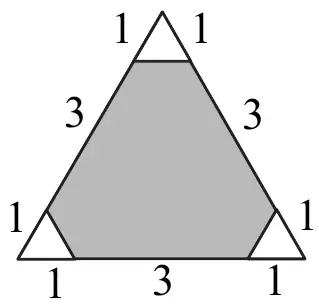
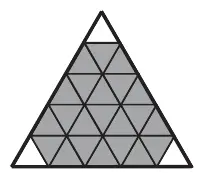
By dissecting the triangle into smaller, identical triangles, we see that the shaded area is 22/25 of the larger triangle, which corresponds to 88/100 = 88%.
For the one red bead to be 10% of the final number of beads, there must be nine blue beads representing 90% of the final number of beads. Therefore the number of beads Petra must remove is 49 − 9 = 40.
6. One third of the animals in Jacob's flock are goats, the rest are sheep. There are twelve more sheep than goats. How many animals are there altogether in Jacob's flock?
Let \(g\) and \(s\) be the number of goats and sheep respectively. Then \(s = 2g\) and \(12 = s - g = 2g - g = g\). Hence the number of animals is \(s + g = 3g = 36\).
5. When travelling from London to Edinburgh by train, you pass a sign saying ‘Edinburgh 200 miles’. Then, \(3\frac{1}{2}\) miles later, you pass another sign saying ‘Half way between London and Edinburgh’. How many miles is it by train from London to Edinburgh?
By train, the distance in miles of the second sign from Edinburgh is \(200 - 3\frac{1}{2}\). This sign is halfway between London and Edinburgh, so the distance in miles between the two cities is \(2(200 - 3\frac{1}{2}) = 400 - 7 = 393\).
4. In my school, 60% of the teachers come to school by bicycle. There are 45 teachers who come to school by bicycle. Only 12% come to school by car. How many teachers come to school by car?
The percentage of teachers coming to school by car is one fifth of the percentage of teachers coming to school by bicycle. Therefore, the number of teachers coming to school by car is \(\tfrac{1}{5} \times 45 = 9\).
The difference between the given options and 1 is \(\dfrac{1}{8}\),\(\dfrac{1}{7}\),\(\dfrac{1}{10}\), \(\dfrac{1}{11}\) and \(\dfrac{1}{10}\) respectively. As \(\dfrac{1}{11}\) is the smallest of these fractions, \(\dfrac{10}{11}\) is closest to 1.
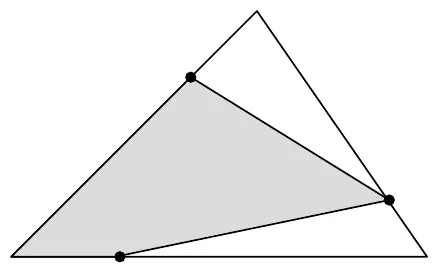
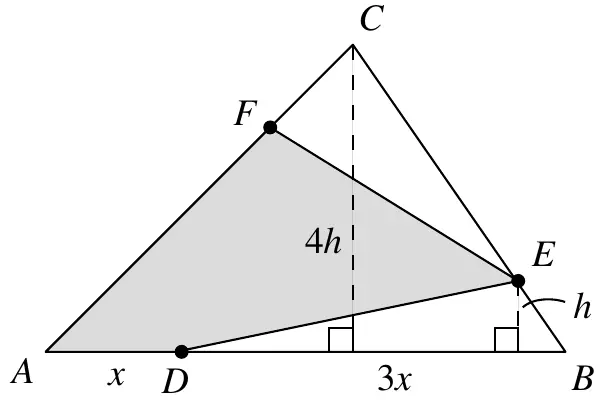
Points \(A\),\(B\),\(C\),\(D\),\(E\), \(F\) on the perimeter of the triangle are as shown. Let \(AD\) have length \(x\) so that \(DB\) has length \(3x\). Let the perpendicular from \(C\) to \(AB\) have length \(4h\). So, by similar triangles, the perpendicular from \(E\) to \(DB\) has length \(h\). The area of triangle \(ABC\) is \(\tfrac{1}{2} \times 4x \times 4h = 8xh\). The area of triangle \(DBE\) is \(\tfrac{1}{2} \times 3x \times h = \tfrac{3}{2}xh\). So the area of triangle \(DBE\) is \(\tfrac{3}{16}\) of the area of triangle \(ABC\). Similarly, by drawing perpendiculars to \(CB\) from \(A\) and from \(F\), it may be shown that the area of triangle \(FEC\) is \(\tfrac{3}{16}\) of the area of triangle \(ABC\). So the fraction of the area of the triangle that is shaded is \(1 - \tfrac{3}{16} - \tfrac{3}{16} = \tfrac{5}{8}\).
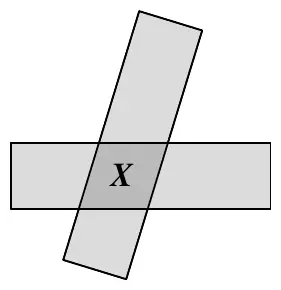
21. A rectangle is placed obliquely on top of an identical rectangle, as shown. The area \(X\) of the overlapping region (shaded more darkly) is one eighth of the total shaded area. What fraction of the area of one rectangle is \(X\)?
Let the area of each rectangle be \(Y\). Then the total shaded area is \(2(Y - X) + X = 2Y - X\). Therefore \(X = \tfrac{1}{8}(2Y - X)\). So \(8X = 2Y - X\), that is \(9X = 2Y\). Therefore \(\tfrac{X}{Y} = \tfrac{2}{9}\).
20. In a mob of kangaroos, the two lightest kangaroos together weigh 25% of the total weight of the mob. The three heaviest kangaroos together weigh 60% of the total weight. How many kangaroos are in the mob?
The remaining kangaroos weigh (100 − 25 − 60)% = 15% of the total weight. However, this cannot be made up of the weights of more than one kangaroo since the information in the question tells us that the lightest two weigh 25% of the total. Hence there are 2 + 1 + 3 = 6 kangaroos in the mob.
Half of a third, plus a third of a quarter, plus a quarter of a fifth equals \(\dfrac{1}{6} + \dfrac{1}{12} + \dfrac{1}{20} = \dfrac{10 + 5 + 3}{60} = \dfrac{18}{60} = \dfrac{3}{10}\).
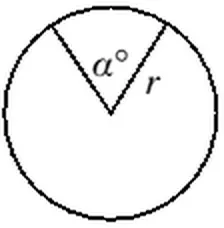
23. A sector of a disc is removed by making two straight cuts from the circumference to the centre. The perimeter of the sector has the same length as the circumference of the original disc. What fraction of the area of the disc is removed?
Let the radius of the circle be \(r\) and let the angle of the sector be \(a\)°. Then the perimeter of the sector is \(2r + \tfrac{a}{360} \times 2\pi r\). This equals \(2\pi r\), the circumference of the original circle. So \(2r + \tfrac{a}{360} \times 2\pi r = 2\pi r\). Therefore the fraction of the area of the disc removed is \(\tfrac{a}{360} = \tfrac{2\pi r - 2r}{2\pi r} = \tfrac{\pi - 1}{\pi}\).
16. The base of a triangle is increased by 25% but the area of the triangle is unchanged. By what percentage is the corresponding perpendicular height decreased?
If the areas of the original and new triangles are the same then the product of the base and the perpendicular height must be the same for the two triangles. When the base of the original triangle is increased by 25%, its value is multiplied by \(\tfrac{5}{4}\). So if the area is to remain unchanged then the perpendicular height must be multiplied by \(\tfrac{4}{5}\), which means that its new value is 80% of its previous value. So it is decreased by 20%.
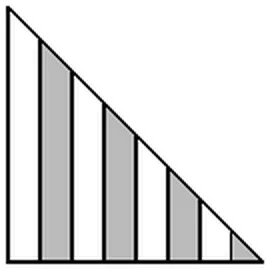
12. The diagram shows an isosceles right-angled triangle divided into strips of equal width. Four of the strips are shaded. What fraction of the area of the triangle is shaded?
Let the width of each strip be 1 unit. Then the triangle has base 8 and perpendicular height 8. So its area is equal to \(\tfrac{1}{2} \times 8 \times 8 = 32\). Looking from the right, the area of the first shaded strip is 1 unit of area less than the first unshaded strip. This difference of 1 unit also applies to the other three pairs of strips in the triangle, which means that the shaded area is 4 less than the unshaded area. So the total shaded area is \(\tfrac{1}{2}(32 - 4) = 14\). Therefore the required fraction is \(\tfrac{14}{32} = \tfrac{7}{16}\).
15. I have a bag of coins. In it, one third of the coins are gold, one fifth of them are silver, two sevenths are bronze and the rest are copper. My bag can hold a maximum of 200 coins. How many coins are in my bag?
From the information given, we may deduce that the number of coins is a multiple of each of 3, 5, 7. Since these are distinct primes, their lowest common multiple is 3 × 5 × 7 = 105. So the number of coins in the bag is a multiple of 105. So there are 105 coins in the bag since 105 is the only positive multiple of 105 less than or equal to 200.
As all the fractions are raised to the power 3, the expression which has the largest value is that with the largest fraction in the brackets. Each of these fractions is a little larger than \(1\tfrac{1}{2}\). Subtracting \(1\tfrac{1}{2}\) from each in turn, we get the fractions \(\tfrac{1}{14}\),\(\tfrac{1}{6}\),\(\tfrac{1}{4}\),\(\tfrac{3}{10}\), 0, the largest of which is \(\tfrac{3}{10}\) (because \(0 < \tfrac{1}{14} < \tfrac{1}{6} < \tfrac{1}{4} = \tfrac{2\frac{1}{2}}{10} < \tfrac{3}{10}\)). Hence \(\left(\tfrac{9}{5}\right)^3\) is the largest.
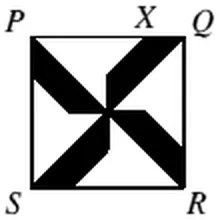
13. Four congruent isosceles trapeziums are placed so that their longer parallel sides form the diagonals of a square \(PQRS\), as shown. The point \(X\) divides \(PQ\) in the ratio 3:1. What fraction of the square is shaded?
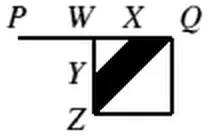
The diagram shows the top-right-hand portion of the square. The shaded trapezium is labelled \(QXYZ\) and \(W\) is the point at which \(ZY\) produced meets \(PQ\). As \(QXYZ\) is an isosceles trapezium, \(\angle QZY = \angle ZQX = 45^\circ\). Also, as \(YX\) is parallel to \(ZQ\),\(\angle XYW = \angle WXY = 45^\circ\). So \(WYX\) and \(WZQ\) are both isosceles right-angled triangles. As \(\angle ZWQ = 90^\circ\) and \(Z\) is at the centre of square \(PQRS\), we deduce that \(W\) is the midpoint of \(PQ\). Hence \(WX = XQ = \tfrac{1}{4}PQ\). So the ratio of the side-lengths of similar triangles \(WYX\) and \(WZQ\) is 1 : 2 and hence the ratio of their areas is 1 : 4. Therefore the area of trapezium \(QXYZ\) = \(\tfrac{3}{4}\) × area of triangle \(ZWQ\) = \(\tfrac{3}{32}\) × area \(PQRS\) since triangle \(ZWQ\) is one-eighth of \(PQRS\). So the fraction of the square which is shaded is 4 × \(\tfrac{3}{32}\) = \(\tfrac{3}{8}\).
4. A standard pack of pumpkin seeds contains 40 seeds. A special pack contains 25% more seeds. Rachel bought a special pack and 70% of the seeds germinated. How many pumpkin plants did Rachel have?
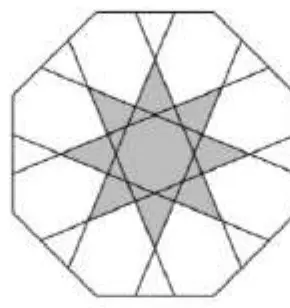
25. The diagram shows a ceramic design by the Catalan architect Antoni Gaudi. It is formed by drawing eight lines connecting points which divide the edges of the outer regular octagon into three equal parts, as shown. What fraction of the octagon is shaded?
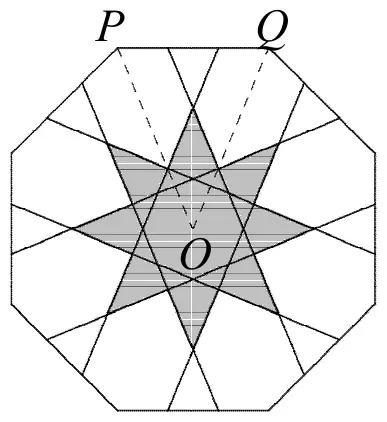
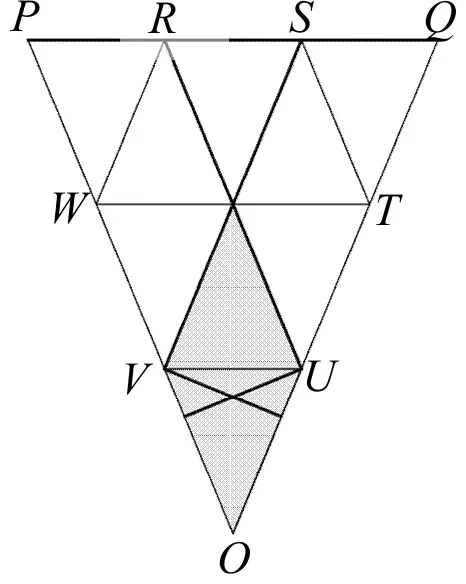
We consider the triangular segment of the octagon formed by joining two adjacent vertices, \(P\) and \(Q\) to the centre, \(O\). For convenience, we show this segment, drawn on a larger scale, on the left, where we have added the lines \(RW\),\(ST\), \(TW\) and \(UV\). These lines are parallel to the edges of the triangle \(POQ\), as shown and together with the lines \(RU\) and \(SV\) they divide the triangle \(OPQ\) into 9 congruent triangles, of which 2 are shaded. Thus \(\dfrac{2}{9}\) of the segment is shaded. The same holds for all the other congruent segments of the octagon. So \(\dfrac{2}{9}\) of the whole octagon is shaded.
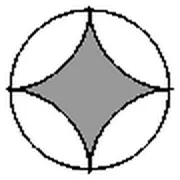
19. The shaded region shown in the diagram is bounded by four arcs, each of the same radius as that of the surrounding circle. What fraction of the surrounding circle is shaded?
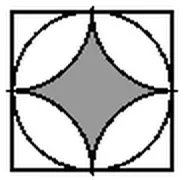
The diagram shows the original diagram enclosed within a square of side 2\(r\), where \(r\) is the radius of the original circle. The unshaded area of the square consists of four quadrants (quarter circles) of radius \(r\). So the shaded area is \(4r^2 - \pi r^2\) \(= r^2(4 - \pi)\). Therefore the required fraction is
9. Auntie Fi's dog Itchy has a million fleas. His anti-flea shampoo claims to leave no more than 1% of the original number of fleas after use. What is the least number of fleas that will be eradicated by the treatment?
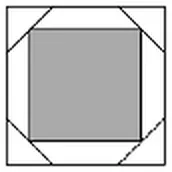
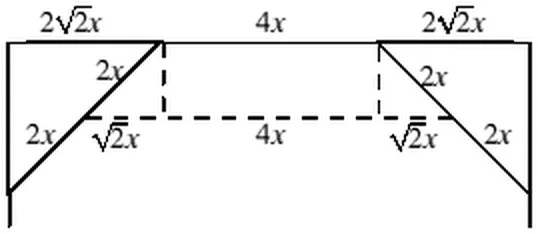
Let 4\(x\) be the length of each side of the regular octagon. The diagram shows part of the figure. The four triangles shown in the diagram are all isosceles right-angled triangles. In such triangles the ratio of the length of the hypotenuse to the length of the shorter sides is \(\sqrt{2} : 1\). So in the larger triangles which have hypotenuse of length 4\(x\), the length of the shorter sides is \(2\sqrt{2}x\), whilst the smaller triangles with hypotenuse 2\(x\) have shorter sides of length \(\sqrt{2}x\). Therefore the shaded square in the question has side of length \((4 + 2\sqrt{2})x\). The length of the side of the outer square is \((4\sqrt{2} + 4)x = \sqrt{2}(4 + 2\sqrt{2})x\). Therefore the two squares have sides in the ratio \(1 : \sqrt{2}\), which means that their areas have ratio 1 : 2.
As the diagram shows, each equilateral triangle may be divided into four equilateral triangles of side 1, whilst the hexagon may be divided into six equilateral triangles of side 1. Therefore the fraction of the whole shape which is shaded is \(\dfrac{6}{6 \times 4 + 6} = \dfrac{6}{30} = \dfrac{1}{5}\).
17. A shop advertised “Everything half price in our sale”, but also now advertises that there is “An additional 15% off sale prices”. Overall, this is equivalent to what reduction on the original prices?
The reduction of 15% off sale prices is equal to a reduction of 7.5% off the original prices. Therefore the total reduction on the original prices is (50 + 7.5)% = 57.5%.
13. The three blind mice stole a piece of cheese. In the night, the first mouse ate \(\tfrac{1}{3}\) of the cheese. Later, the second mouse ate \(\tfrac{1}{3}\) of the remaining cheese. Finally, the third mouse ate \(\tfrac{1}{3}\) of what was then left of the cheese. Between them, what fraction of the cheese did they eat?
After the first mouse has eaten, \(\tfrac{2}{3}\) of the cheese remains. After the second mouse has eaten, \(\tfrac{2}{3}\) of \(\tfrac{2}{3}\), that is \(\tfrac{4}{9}\), of the cheese remains. Finally, after the third mouse has eaten, \(\tfrac{2}{3}\) of \(\tfrac{4}{9}\), that is \(\tfrac{8}{27}\), of the cheese remains. So the mice ate \(\tfrac{19}{27}\) of the cheese.
20 ÷ 11 = \(1\tfrac{9}{11}\) = 1.818181… . So the first 2011 digits are 1006 ‘1’s and 1005 ‘8’s. Therefore the required total is 1006 × 1 + 1005 × 8 = 1006 + 8040 = 9046.
19. A snail is at one corner of the top face of a cube with side length 1 m. The snail can crawl at a speed of 1 m per hour. What proportion of the cube's surface is made up of points which the snail could reach within one hour?
In one hour, the snail can reach points within 1 m of the corner at which it starts. So it can reach some of the points on the three faces which meet at that corner, but none of the points on the other three faces. On each of the three reachable faces, the points which the snail can reach form a quarter of a circle of radius 1 m. So the required fraction is \(\dfrac{3 \times \frac{1}{4}\pi \times 1 \times 1}{6 \times 1 \times 1} = \dfrac{\pi}{8}\).
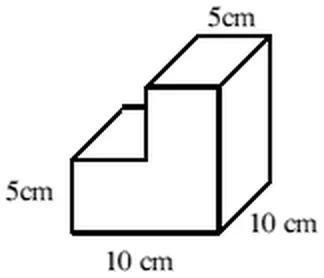
When the cuboid is cut away, the surface area of the solid ‘loses’ two rectangles measuring 10 cm × 5 cm and two squares of side 5 cm. However, it also ‘gains’ two rectangles measuring 10 cm × 5 cm. So the surface area decreases by an area equal to one half of the area of one of the faces of the original cube, that is one twelfth of its original surface area.
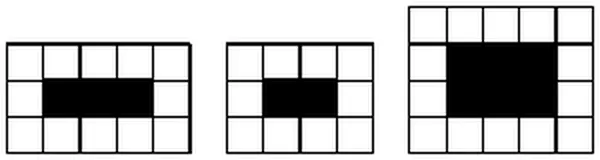
23. The diagram shows part of a tiling pattern which is made from two types of individual tiles: 8 by 6 rectangular white tiles and square black tiles. If the pattern is extended to cover an infinite plane, what fraction is coloured black?
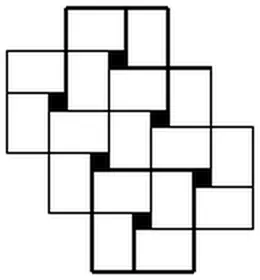
Firstly, note that the black squares have side 2 units. The pattern may be considered to be a tessellation of the shape shown on the right. So the ratio of squares to rectangles is 1:2 and hence the fraction coloured black is \(\dfrac{4}{4 + 2 \times 48} = \dfrac{4}{100} = \dfrac{1}{25}\).
\(\dfrac{4}{5} = \dfrac{12}{15}\) and \(-\dfrac{2}{3} = -\dfrac{10}{15}\), so the number half way between these is \(\dfrac{1}{2}\left(\dfrac{-10}{15} + \dfrac{12}{15}\right)\), that is \(\dfrac{1}{15}\).
18. In the calculation 1003 ÷ 4995 = \(0.2\dot{0}0\dot{8}\), the number \(0.2\dot{0}0\dot{8}\) represents the recurring decimal fraction 0.2008008008008… . When the answers to the following calculations are arranged in numerical order, which one is in the middle?
16. The first two terms of a sequence are \(\dfrac{2}{3}\) and \(\dfrac{4}{5}\). Each term after the second term is the average (mean) of the two previous terms. What is the fifth term in the sequence?
The problem may be solved by firstly calculating the third and fourth terms of the sequence, but an algebraic method does reduce the amount of calculation involved. Let the first two terms be \(x\) and \(y\) respectively. Then the third term is \(\tfrac{1}{2}(x + y)\), whilst the fourth term is \(\tfrac{1}{4}(x + 3y)\). So the fifth term is \(\tfrac{1}{8}(3x + 5y)\). Putting \(x = \dfrac{2}{3}\) and \(y = \dfrac{4}{5}\), we obtain \(\dfrac{2 + 4}{8} = \dfrac{3}{4}\).
9. A solid wooden cube is painted blue on the outside. The cube is then cut into 27 smaller cubes of equal size. What fraction of the total surface area of these new cubes is blue?
Let the smaller cubes have side of length 1 unit. So the original cube had side of length 3 units and hence a surface area of 54 units2, all of which was painted blue. The total surface area of the 27 small cubes is 27 × 6 units2, that is 162 units2. So the required fraction is \(\dfrac{54}{162} = \dfrac{1}{3}\).
Let the original number be \(x\). Then \(x^2 = 0{\cdot}7x\), that is \(x(x - 0{\cdot}7) = 0\). So \(x = 0\) or \(x = 0{\cdot}7\), but as \(x\) is non-zero it is 0·7.
The large square is made up of 25 small squares, 15 of which are shaded. So \(\dfrac{15}{25}\) of the large square is shaded, corresponding to \(\tfrac{15}{25}\) × 100% = 60%.
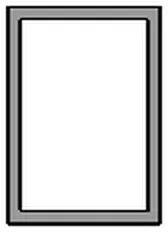
The area of the page inside the margins is 26 cm × 36 cm, that is 936 cm2. So the percentage of the page occupied by the margins is \(\dfrac{264}{1200}\) × 100%, that is 22%.
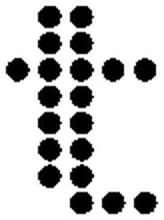
2. The information display on a train shows letters by illuminating dots in a rectangular 5 × 8 array. In the letter ‘t’ shown, what fraction of the dots in the array is illuminated?
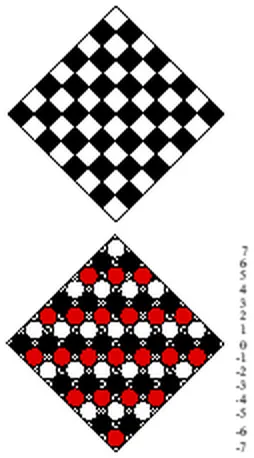
22. An 8 by 8 chessboard is placed so that a black square is in the top left-hand corner. Starting in the top left square and working along each row in turn, coloured counters are placed, one on each square, following the sequence black, white, red, black, white, red and so on. When the right-hand end of each row is reached, the pattern continues, starting at the left-hand end of the row beneath, until there is one counter on every square. In the final arrangement, what fraction of the counters are on squares of the same colour as themselves?
First note that counters of the same colour form diagonal lines across the board. The diagrams show the board before and after the counters are added. In both cases, the board has been rotated 45° anticlockwise. Note that the red counters are shown as grey. Now consider the board to consist of 15 horizontal rows of squares, numbered from 7 to −7 as shown. The only rows in which the colour of the squares on the board matches the colour of the counters are rows 7, 6, 1, 0, −5 and −6. These contain 1, 2, 7, 8, 3 and 2 squares respectively, so the required fraction is 23/64.
17. Last year, on the television programme Antiques Roadshow, a painting was said to be worth £15 000 although the painting had originally cost only 50p. As a percentage of the original price, what would be the approximate profit if the painting were to be sold for £15 000?
22. Inspector Remorse had a difficult year in 2004. A crime wave in Camford meant that he had 20% more cases to solve than in 2003, but his success rate dropped. In 2003, he solved 80% of his cases, but in 2004 he solved only 60% of them. What was the percentage change in the number of cases he solved in 2004 compared with 2003?
Let the number of cases solved in 2003 be \(x\). Then, as this was 80% of the number of cases, there were \(5x/4\) cases to solve in 2003. So the number of cases to solve in 2004 was \(5x/4 \times 6/5\), which is \(3x/2\). Inspector Remorse solved 60% of these cases, that is \(3x/2 \times 3/5\), which is \(9x/10\). So the change in the number of cases solved was a 10% decrease.
15. To make porridge, Goldilocks mixes together 3 bags of oats with 1 bag containing 20% wheat bran and 80% oats. All the bags have the same volume. What percentage of the volume of Goldilocks' porridge mixture is wheat bran?
The offer gives the purchaser two items for the price of one and a half items. So the average cost per item is the same as four items for the price of three.
19. Three rectangular-shaped holes have been drilled passing all the way through a solid 3 × 4 × 5 cuboid. The diagrams show the front, side and top views of the resulting block. What fraction of the original cuboid remains?
Consider the cuboid to be made up of 60 unit cubes. The front and side views show that top and bottom layers consist of the same number of cubes and from the top view we see that this number is 14. The front and side views indicate that only the 4 corner cubes remain in the middle layer, so the total number of cubes remaining is 2 × 14 + 4 = 32. The required fraction, therefore, is \(\dfrac{32}{60} = \dfrac{8}{15}\).
17.\(A\),\(B\),\(C\),\(D\),\(E\), \(P\) and \(Q\) are points on the number line as shown. One of the points represents the product of the numbers represented by \(P\) and \(Q\). Which is it?
As \(P\) and \(Q\) both lie between 0 and 1, their product will be greater than 0 but smaller than \(P\) and smaller than \(Q\). Of the options available, only \(B\) satisfies these conditions. (Furthermore, its position is correct since \(P\) is approximately equal to \(\tfrac{1}{2}\), which means that the product of \(P\) and \(Q\) lies approximately half way between 0 and \(Q\).)
We'd like to use Google Analytics cookies to count visits and see which pages help most. They're optional, and the site works exactly the same either way. Privacy policy