
IMC 2013 Q13
13. Four congruent isosceles trapeziums are placed so that their longer parallel sides form the diagonals of a square \(PQRS\), as shown. The point \(X\) divides \(PQ\) in the ratio 3:1. What fraction of the square is shaded?
- A \(\dfrac{5}{16}\)
- B \(\dfrac{3}{8}\)
- C \(\dfrac{7}{16}\)
- D \(\dfrac{5}{12}\)
- E \(\dfrac{1}{2}\)
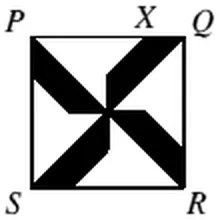
Intermediate Mathematical Challenge 2013, Question 13. © UK Mathematics Trust. Original paper on ukmt.org.uk
Answer: B \(\dfrac{3}{8}\)
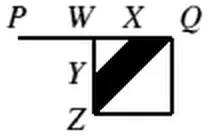
The diagram shows the top-right-hand portion of the square. The shaded trapezium is labelled \(QXYZ\) and \(W\) is the point at which \(ZY\) produced meets \(PQ\).
As \(QXYZ\) is an isosceles trapezium, \(\angle QZY = \angle ZQX = 45^\circ\).
Also, as \(YX\) is parallel to \(ZQ\), \(\angle XYW = \angle WXY = 45^\circ\). So \(WYX\) and \(WZQ\) are both isosceles right-angled triangles. As \(\angle ZWQ = 90^\circ\) and \(Z\) is at the centre of square \(PQRS\), we deduce that \(W\) is the midpoint of \(PQ\). Hence \(WX = XQ = \tfrac{1}{4}PQ\). So the ratio of the side-lengths of similar triangles \(WYX\) and \(WZQ\) is 1 : 2 and hence the ratio of their areas is 1 : 4.
Therefore the area of trapezium \(QXYZ\) = \(\tfrac{3}{4}\) × area of triangle \(ZWQ\) = \(\tfrac{3}{32}\) × area \(PQRS\) since triangle \(ZWQ\) is one-eighth of \(PQRS\). So the fraction of the square which is shaded is 4 × \(\tfrac{3}{32}\) = \(\tfrac{3}{8}\).
Solution © UK Mathematics Trust, from the IMC 2013 solutions. Longer versions with investigations: Solutions and investigations (PDF).