
IMC 2013 Q9
9. Jane has 20 identical cards in the shape of an isosceles right-angled triangle. She uses the cards to make the five shapes below. Which of the shapes has the shortest perimeter?

Intermediate Mathematical Challenge 2013, Question 9. © UK Mathematics Trust. Original paper on ukmt.org.uk
Answer: A
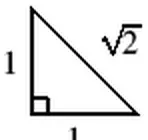
Let the length of the shorter sides of the cards be 1 unit. Then, by Pythagoras' Theorem, the length of the hypotenuse of each card is \(\sqrt{1^2 + 1^2} = \sqrt{2}\).
So the lengths of the perimeters of the five figures in order are: \(4\sqrt{2}\); \(4 + 2\sqrt{2}\); \(4 + 2\sqrt{2}\); 6; \(4 + 2\sqrt{2}\). Also, as \(\left(\tfrac{3}{2}\right)^2 = \tfrac{9}{4} = 2\tfrac{1}{4} > 2\) we see that \(\tfrac{3}{2} > \sqrt{2}\). Therefore, \(4\sqrt{2} < 6 < 4 + 2\sqrt{2}\). So figure A has the shortest perimeter.
Solution © UK Mathematics Trust, from the IMC 2013 solutions. Longer versions with investigations: Solutions and investigations (PDF).