
IMC 2011 Q21
21. A regular octagon is placed inside a square, as shown. The shaded square connects the midpoints of four sides of the octagon.
What fraction of the outer square is shaded?
- A \(\sqrt{2} - 1\)
- B \(\dfrac{1}{2}\)
- C \(\dfrac{\sqrt{2} + 1}{4}\)
- D \(\dfrac{\sqrt{2} + 2}{5}\)
- E \(\dfrac{3}{4}\)
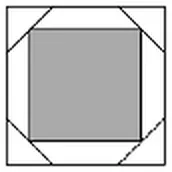
Intermediate Mathematical Challenge 2011, Question 21. © UK Mathematics Trust. Original paper on ukmt.org.uk
Answer: B \(\dfrac{1}{2}\)
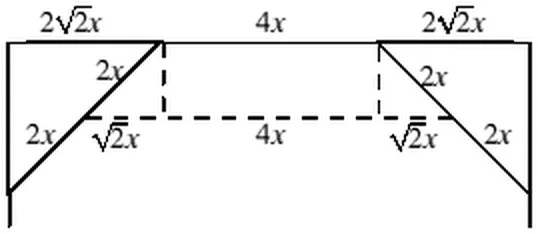
Let 4\(x\) be the length of each side of the regular octagon. The diagram shows part of the figure. The four triangles shown in the diagram are all isosceles right-angled triangles. In such triangles the ratio of the length of the hypotenuse to the length of the shorter sides is \(\sqrt{2} : 1\).
So in the larger triangles which have hypotenuse of length 4\(x\), the length of the shorter sides is \(2\sqrt{2}x\), whilst the smaller triangles with hypotenuse 2\(x\) have shorter sides of length \(\sqrt{2}x\).
Therefore the shaded square in the question has side of length \((4 + 2\sqrt{2})x\).
The length of the side of the outer square is \((4\sqrt{2} + 4)x = \sqrt{2}(4 + 2\sqrt{2})x\).
Therefore the two squares have sides in the ratio \(1 : \sqrt{2}\), which means that their areas have ratio 1 : 2.
Solution © UK Mathematics Trust, from the IMC 2011 solutions. Longer versions with investigations: Solutions and investigations (PDF).