
PK 2015 Q17
17. The figure shows seven regions enclosed by three circles. We call two regions neighbouring if their boundaries have more than one common point. In each region a number is written. The number in any region is equal to the sum of the numbers of its neighbouring regions. Two of the numbers are shown. What number is written in the central region?
- A −6
- B 6
- C −3
- D 3
- E 0
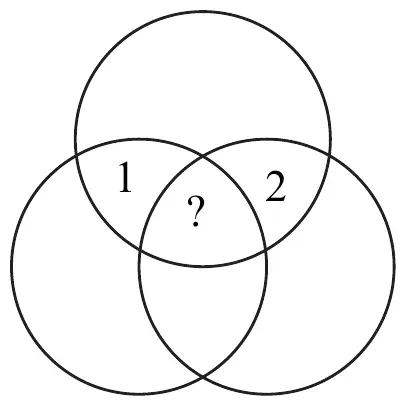
Pink Kangaroo 2015, Question 17. © UK Mathematics Trust. Original paper on ukmt.org.uk
Answer: E 0
Let \(x\) be the number in the central region. Since this is the sum of its three neighbouring regions which include 1 and 2, the region below it must contain \(x - 3\). The bottom right region then contains \((x - 3) + 2 = x - 1\). The bottom left region then contains \((x - 3) + 1 = x - 2\). But the number in the bottom central region can now be evaluated in two ways, firstly as \(x - 3\), but also as the sum of its neighbours, \(x\), \(x - 1\), \(x - 2\). Hence \(x - 3 = x + (x - 1) + (x - 2)\), giving \(x - 3 = 3x - 3\). So \(x = 3x\), giving \(2x = 0\) and so \(x = 0\).
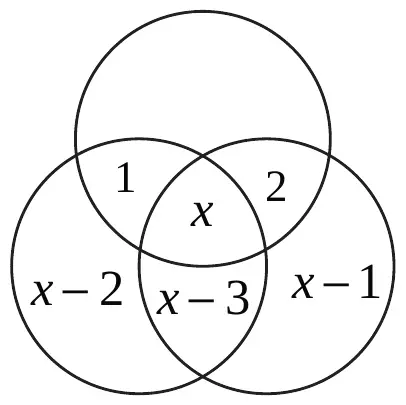
Solution © UK Mathematics Trust, from the PK 2015 solutions.