
IMC 2016 Q11
11. The net shown consists of squares and equilateral triangles. The net is folded to form a rhombicuboctahedron, as shown.
When the face marked \(P\) is placed face down on a table, which face will be facing up?
- A
- B
- C
- D
- E
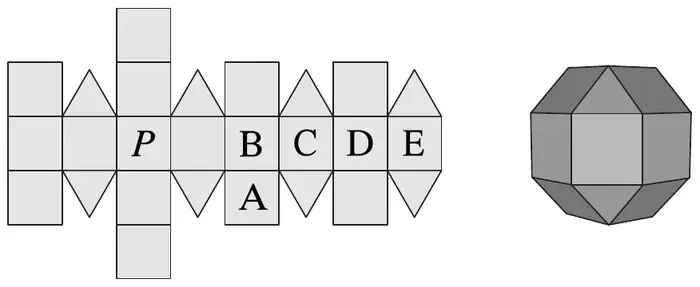
Intermediate Mathematical Challenge 2016, Question 11. © UK Mathematics Trust. Original paper on ukmt.org.uk
Answer: D
When the net is folded up to form the rhombicuboctahedron, the left-hand edge of the square marked \(X\) is joined to the right-hand edge of the square marked \(E\) so that the eight squares at the centre of the net form a band around the solid. In this band, the square opposite square \(P\) is the square which is four squares away from \(P\), that is square \(D\). So if the square marked \(P\) is placed face down on a table, then the square marked \(D\) will be facing up.
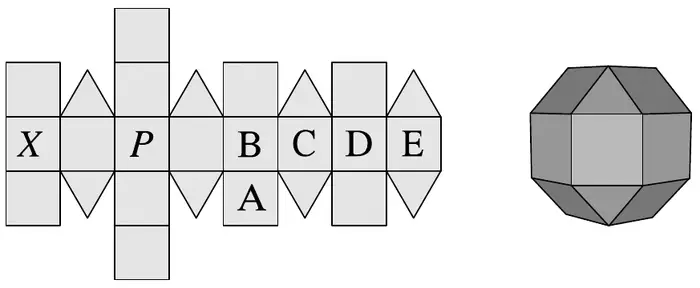
Solution © UK Mathematics Trust, from the IMC 2016 solutions. Longer versions with investigations: Solutions and investigations (PDF).