
IMC 2008 Q21
21. In triangle \(PQR\), \(\angle QPR = \alpha\)° and \(\angle PQR = \beta\)°, where \(\alpha < \beta\). The line \(RM\) bisects \(\angle PRQ\) and \(RN\) is the perpendicular from \(R\) to the line \(PQ\). What is the size, in degrees, of \(\angle MRN\) ?
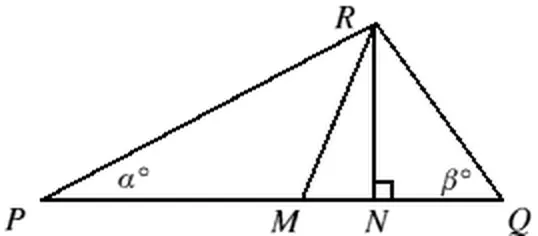
- A \(\dfrac{180 - (\alpha + \beta)}{2}\)
- B \(\dfrac{\beta - \alpha}{2}\)
- C \(\dfrac{\alpha + 2\beta}{2}\)
- D \(\dfrac{360 - \alpha - 2\beta}{2}\)
- E \(\dfrac{\alpha + \beta}{2}\)
Intermediate Mathematical Challenge 2008, Question 21. © UK Mathematics Trust. Original paper on ukmt.org.uk
Answer: B \(\dfrac{\beta - \alpha}{2}\)
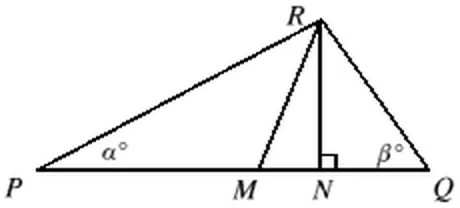
The sum of the interior angles of a triangle is 180°, so \(\angle PRQ\) = (180 − \(\alpha\) − \(\beta\))°; hence \(\angle QRM\) = \(\left(90 - \tfrac{\alpha}{2} - \tfrac{\beta}{2}\right)\)°. As \(RN\) is perpendicular to \(PQ\), \(\angle NRQ\) = (90 − \(\beta\))°. So \(\angle MRN\) = \(\left(90 - \tfrac{\alpha}{2} - \tfrac{\beta}{2}\right)\)° − (90 − \(\beta\))° = \(\left(\tfrac{\beta}{2} - \tfrac{\alpha}{2}\right)\)°.
Solution © UK Mathematics Trust, from the IMC 2008 solutions.