
IMC 2004 Q25
25. The diagram shows a square with two lines from a corner to the middle of an opposite side. The rectangle fits exactly inside these two lines and the square itself. What fraction of the square is occupied by the shaded rectangle?
- A \(\dfrac{1}{3}\)
- B \(\dfrac{2}{5}\)
- C \(\dfrac{3}{10}\)
- D \(\dfrac{1}{2}\)
- E \(\dfrac{3}{8}\)
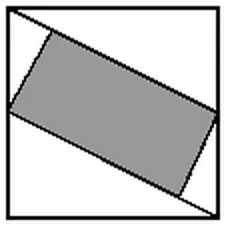
Intermediate Mathematical Challenge 2004, Question 25. © UK Mathematics Trust. Original paper on ukmt.org.uk
Answer: B \(\dfrac{2}{5}\)
Triangles \(ABG\), \(GFE\) and \(EFA\) are similar, so \(AF : FE = EF : FG = GB : BA = 1 : 2\). Thus if \(AF = a\), then \(FE = 2a\), \(FG = 4a\), and the shaded area is \(8a^2\). By Pythagoras' Theorem, \(AE = \sqrt{5}a\), so \(AD = 2\sqrt{5}a\) and the area of the square is \(20a^2\). Thus the required fraction is 8/20, which is 2/5.
[Alternatively, as we have shown that \(FG = 4AF\), we can divide parallelogram \(AGCE\) into 10 congruent triangles, 8 of which make up rectangle \(EFGH\). So the area of the rectangle is 4/5 of the area of the parallelogram, which in turn is half the area of square \(ABCD\).]
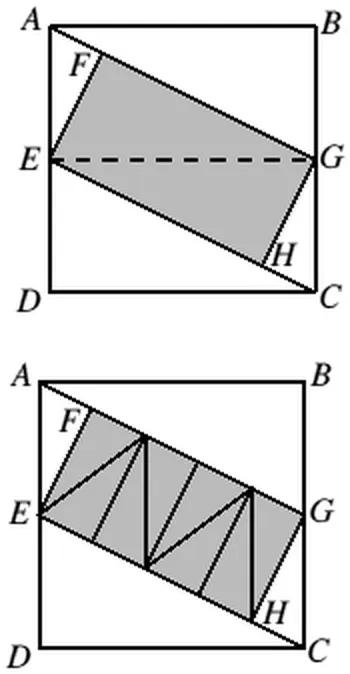
Solution © UK Mathematics Trust, from the IMC 2004 solutions.