
IMC 2012 Q11
11. In the diagram, \(PQRS\) is a parallelogram; \(\angle QRS = 50^\circ\);
\(\angle SPT = 62^\circ\) and \(PQ = PT\).
What is the size of \(\angle TQR\)?
- A 84°
- B 90°
- C 96°
- D 112°
- E 124°
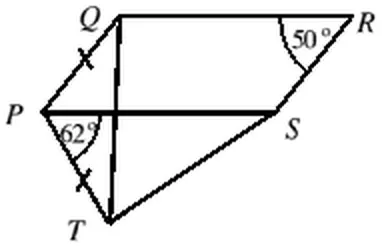
Intermediate Mathematical Challenge 2012, Question 11. © UK Mathematics Trust. Original paper on ukmt.org.uk
Answer: C 96°
Opposite angles of a parallelogram are equal, so \(\angle QPS = 50^\circ\). Therefore \(\angle QPT = 112^\circ\) and, as triangle \(QPT\) is isosceles, \(\angle PQT = (180^\circ - 112^\circ) \div 2 = 34^\circ\).
As \(PQRS\) is a parallelogram, \(\angle PQR = 180^\circ - 50^\circ\)
\(= 130^\circ\).
So \(\angle TQR = 130^\circ - 34^\circ = 96^\circ\).
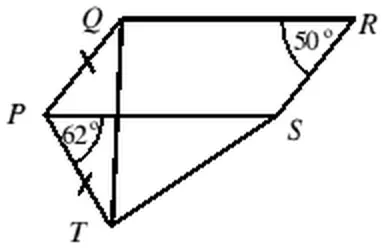
Solution © UK Mathematics Trust, from the IMC 2012 solutions. Longer versions with investigations: Solutions and investigations (PDF).