
PK 2020 Q19
19. Two identical rectangles with sides of length 3 cm and 9 cm are overlapping as in the diagram. What is the area of the overlap of the two rectangles?
- A 12 cm2
- B 13.5 cm2
- C 14 cm2
- D 15 cm2
- E 16 cm2
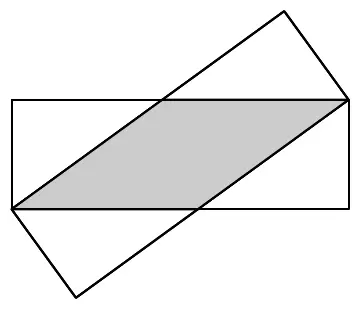
Pink Kangaroo 2020, Question 19. © UK Mathematics Trust. Original paper on ukmt.org.uk
Answer: D 15 cm2
First we prove that the four white triangles are congruent. Note that they each have a right angle. Also angles \(HGA\) and \(FGE\) are equal (vertically opposite). The quadrilateral \(ACEG\) is a parallelogram since each of its sides come from the rectangles. Hence angles \(FGE\) and \(GAC\) are equal (corresponding), and angles \(GAC\) and \(ECD\) are equal (corresponding). Therefore each triangle has a right-angle, and an angle equal to \(HGA\), and therefore they each have the same angles. Moreover, they each have a corresponding side of length 3 cm. By labelling triangle \(ABC\) with lengths 3, \(x\) and \(y\), Pythagoras’ Theorem gives \(x^2 + 3^2 = y^2\) [1]. The triangles \(ABC\) and \(CDE\) are congruent, so \(CD = CB = x\). Since \(AD = 9\), we can see \(x + y = 9\) [2].
Equation [2] rearranges to \(x = 9 - y\), so \(x^2 = (9 - y)^2 = 81 - 18y + y^2\). Substituting this into [1] gives \(81 - 18y + y^2 + 3^2 = y^2\), so \(18y = 90\) and \(y = 5\). Thus \(x = 9 - 5 = 4\). The area of each white triangle is \(\tfrac{1}{2} \times 3x = \tfrac{1}{2} \times 3 \times 4 = 6\) cm2. Thus the overlap is \(3 \times 9 - 2 \times 6 = 15\) cm2.
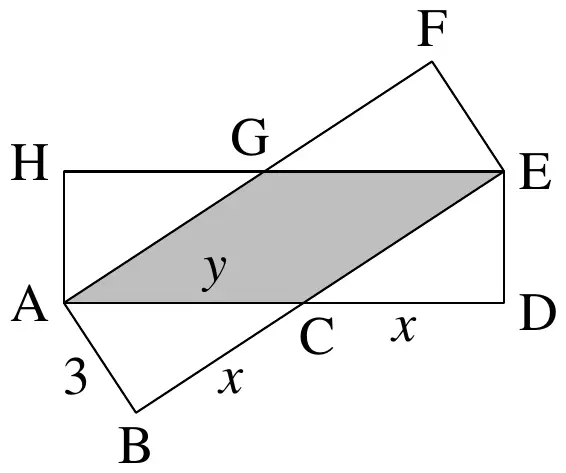
Solution © UK Mathematics Trust, from the PK 2020 solutions.