
IMC 2005 Q21
21. Two circles with radii 1 cm and 4 cm touch. The point \(P\) is on the smaller circle, \(Q\) is on the larger circle and \(PQ\) is a tangent to both circles. What is the length of \(PQ\)?
- A \(\sqrt{17}\) cm
- B 3 cm
- C \(2\sqrt{3}\) cm
- D \(3\sqrt{2}\) cm
- E 4 cm
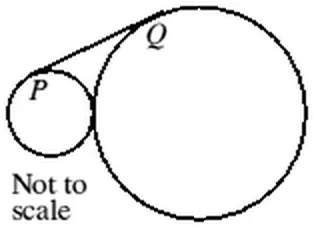
Intermediate Mathematical Challenge 2005, Question 21. © UK Mathematics Trust. Original paper on ukmt.org.uk
Answer: E 4 cm
The diagram shows points \(A\) and \(B\), which are the centres of the two circles, and \(C\), the point on \(BQ\) such that \(AC\) is parallel to \(PQ\). As radii \(PA\) and \(QB\) are both perpendicular to tangent \(PQ\), \(APQC\) is a rectangle. So \(\angle ACB\) is a right angle. The length of \(AB = 1 + 4 = 5\); the length of \(BC = 4 - 1 = 3\). So, by Pythagoras' Theorem, \(AC = \sqrt{5^2 - 3^2} = 4\), which, therefore, is also the length of \(PQ\).
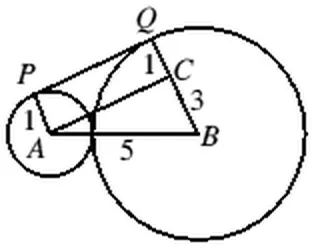
Solution © UK Mathematics Trust, from the IMC 2005 solutions.